Alfa Romeo Spare Parts in UAE: Buyer’s Guide for Giulia, Stelvio, Giulietta and 4C
September 25, 2026
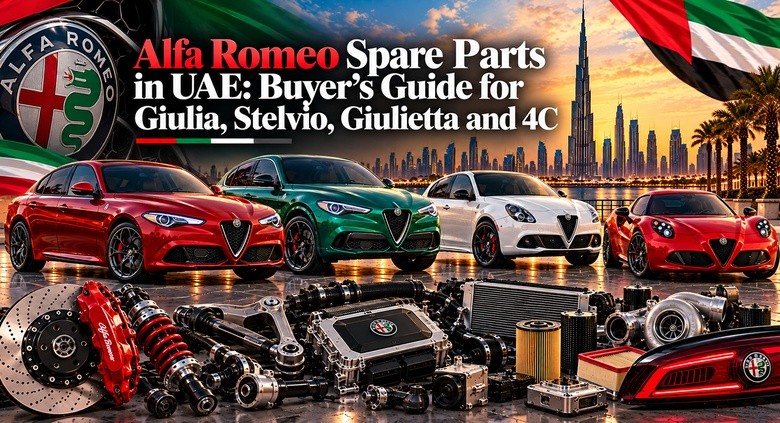
Alfa Romeo parts buying in the UAE gets complicated when the model name is treated as the whole identification. It isn't. A Giulia Quadrifoglio, a regular Giulia and an older Giulietta can sit under the same brand umbrella while requiring very different components, catalogues and diagnostic approaches. The 4C takes that problem further because Alfa Romeo now lists it among its end-of-series models, meaning sourcing for an older 4C is increasingly a matter of precise identification rather than simply asking for “a 4C part”.
Alfa Romeo Middle East currently presents the Giulia and Stelvio in its regional range, including Quadrifoglio and Veloce variants, while Giulietta and 4C are no longer current-production models.
Updated: September 2026. Availability, model support, prices and supplier stock can change, so UAE pricing should always be treated as a dated market reference rather than a permanent figure.
Alfa Romeo parts are a fitment problem before they are a price problem
The cheapest component is not necessarily the cheapest repair.
If the wrong sensor, suspension component, brake assembly or electronic module is ordered, the owner can end up paying twice: once for the part and again for diagnosis, return freight, labour or another replacement.
The sensible starting point is the exact car.
VIN should be part of the first enquiry
The vehicle identification number gives a parts supplier or workshop a much stronger basis for identifying the correct application.
Stellantis' technical-information system provides spare parts identification through its technical-information platform, while Alfa Romeo's own Middle East service enquiry process asks for the vehicle chassis number as an optional vehicle identifier.
For an expensive Alfa Romeo component, that is worth using.
Model name alone is too broad
“Giulia brake pads or Alfa Romeo spare parts in UAE” is not a sufficiently precise request.
The supplier needs to know the year, engine, trim, braking system and ideally the VIN or exact original part number.
Quadrifoglio components can be particularly sensitive to specification.
Giulia and Giulia Quadrifoglio are not the same parts shopping exercise
The Middle East range distinguishes Giulia, Giulia Veloce and Giulia Quadrifoglio.
That matters when buying brakes, suspension, bodywork, cooling components, engine parts and electronics.
A supplier who asks for the exact variant is doing the right thing.
Stelvio needs the same discipline
Stelvio shares Alfa Romeo's platform and some component families with Giulia, but that does not make the two cars interchangeable.
SUV-specific bodywork, suspension loads, brakes, cooling requirements and equipment can change the correct application.
“Same Alfa Romeo” is not a fitment specification.
Stelvio Quadrifoglio deserves particular attention
The Middle East site separately identifies Stelvio Quadrifoglio.
Performance variants should therefore be identified by their exact configuration rather than treated as ordinary Stelvio models.
This becomes important when sourcing brakes, engine components, cooling hardware and suspension parts.
Giulietta is now an end-of-series model
Alfa Romeo lists Giulietta among its end-of-series vehicles.
That changes the buying strategy.
You are not necessarily looking for the latest replacement part sitting on a current-model shelf. You may be dealing with older catalogue references, superseded numbers, remaining stock or specialist sourcing.
4C sourcing is a different game again
The 4C and 4C Spider are also listed by Alfa Romeo as end-of-series models.
For owners, that does not mean parts have suddenly become unavailable.
It does mean that exact identification becomes increasingly valuable, particularly for bodywork, specialist trim, suspension and model-specific components.
Alfa Romeo's technical records confirm distinct VIN formats
Alfa Romeo's technical-information database identifies different VIN formats for models including the 4C, Giulia and Giulietta.
That is useful evidence of something buyers often overlook: the VIN is not merely paperwork for registration.
It is part of the vehicle's technical identity.
Part numbers are your second checkpoint
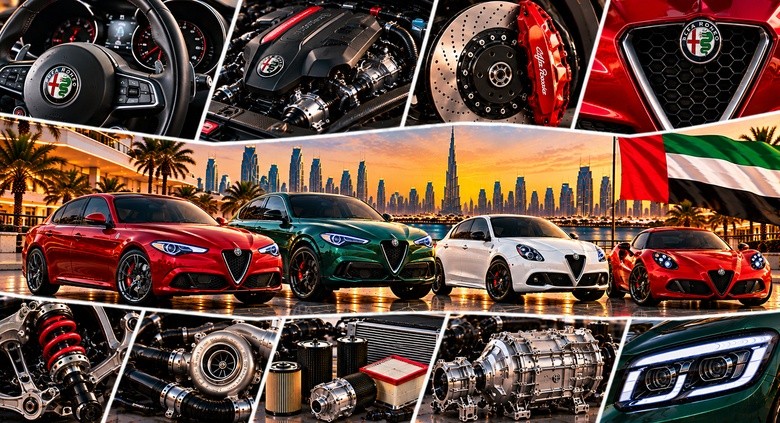
Once the vehicle is identified, obtain the exact part number wherever possible.
A quotation saying “Alfa Romeo thermostat” gives you almost nothing to verify.
A quotation containing the component description and catalogue reference gives you something concrete.
Don't assume an older part number is automatically wrong
Parts can be superseded.
A manufacturer may replace one reference with another while maintaining the correct application.
That is why a supplier should explain whether the quoted number is the original reference or a current superseding number.
Genuine Alfa Romeo parts are supplied through the Mopar parts structure
Alfa Romeo Middle East describes its Genuine Parts as Genuine Alfa Romeo Original Parts from Mopar and says they are developed around the vehicle's specifications and tested against strict standards.
That gives buyers a useful distinction when comparing quotations.
“Original”, “OEM”, “aftermarket” and “used genuine” should not be treated as interchangeable labels.
Genuine parts and approved alternatives are separate categories
Alfa Romeo Middle East also describes approved Eurorepar parts as a lower-cost alternative for multi-brand servicing, stating that these can be 25% less expensive than original parts and carry a two-year guarantee under the stated programme.
That is useful when calculating ownership costs on an older Alfa Romeo.
The important point is to know which category you are actually buying.
SUSTAINera adds another category
The same Alfa Romeo parts information also describes SUSTAINera recycled/remanufactured solutions intended to reduce raw-material waste.
Again, this should be shown separately on the quotation.
A recycled or remanufactured component is not the same product description as a new GenuinePart.
Used parts can make sense for older Alfa Romeos
A used genuine component may be financially sensible for an older Giulietta or 4C, particularly when the new component is expensive or difficult to source.
But condition matters.
A used engine mount, lamp, electronic module or suspension component should never be treated as automatically sound simply because it carries an Alfa Romeo part number.
Giulietta buyers should pay attention to production year
“Giulietta” covers a long production period.
Changes in engines, trim, electronics, lighting and equipment can affect fitment.
The registration year alone may not be enough; use the VIN and original part number where possible.
4C body parts require unusually careful identification
The 4C's construction and low-volume nature make casual body-part matching a poor idea.
A bumper, panel, lamp or trim piece should be checked against the exact model and specification before purchase.
For an older sports car, availability can be as important as price.
Carbon-fibre components should not be bought on appearance alone
The 4C is particularly associated with lightweight construction.
If sourcing a structural or body component, establish exactly what the part is, its material, condition and intended application.
A visually similar replacement is not necessarily equivalent.
Giulia suspension deserves diagnosis before ordering
If the car develops knocking, uneven ride height or unusual tyre wear, the workshop should establish whether the problem originates from a damper, spring, arm, bush, link, mount or another component.
Ordering the most obvious-looking suspension part without diagnosis is an expensive shortcut.
Stelvio suspension has another consideration
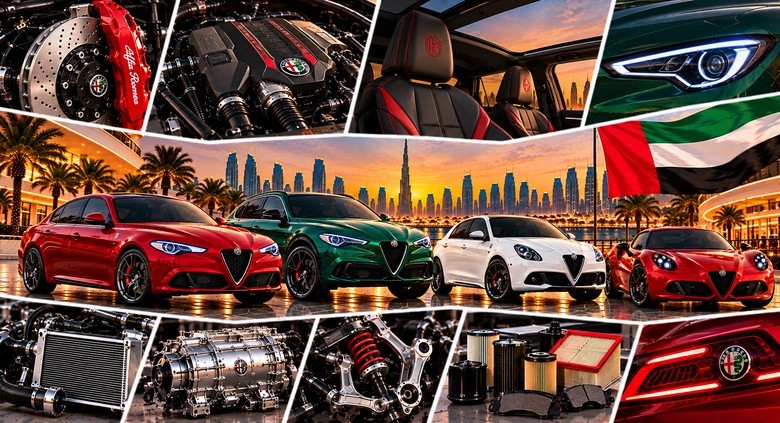
SUV ride height and loading can change the way suspension symptoms present.
A noise over Dubai speed humps does not automatically identify a failed damper.
A proper inspection should isolate the component before the parts order is placed.
Brake specifications should be confirmed by axle and variant
Brake components should be identified by the exact vehicle application.
For performance variants, the differences can be significant.
The correct question is not simply “Will this fit a Giulia?”
It is “Which braking specification belongs to this VIN?”
Don't buy brake discs from a photograph
A photograph can show shape and condition.
It cannot reliably establish the complete technical specification.
For a safety-critical component, obtain the exact application and part reference before payment.
Electronic modules can be physically compatible but electronically unsuitable
This is one of the easiest mistakes to make with modern Alfa Romeos.
A module may have the correct housing and connector while still requiring the correct software configuration, coding or calibration.
The workshop should establish those requirements before the part is ordered.
Diagnostic faults do not automatically identify a failed part
A dashboard warning is a symptom.
A diagnostic code is evidence.
Neither should automatically become a shopping list.
The workshop should test the relevant circuit, sensor, wiring, actuator or mechanical system before recommending replacement.
Air-conditioning parts need proper fault isolation
In UAE conditions, air conditioning receives heavy use.
But weak cooling does not automatically mean the compressor has failed.
Refrigerant charge, pressure, condenser airflow, electrical control, compressor operation and cabin-side components all need to be considered.
Cooling-system parts deserve the same discipline
Radiators, thermostats, water pumps, hoses and cooling fans can all produce overlapping symptoms.
If the engine is running hot, replacing one component without identifying the actual cause can turn a manageable repair into a sequence of unnecessary replacements.
UAE heat matters, but it is not an explanation for everything
High ambient temperatures can increase thermal load and expose weaknesses in cooling and air-conditioning systems.
They can also accelerate deterioration of some rubber, plastic and electrical components.
But “UAE heat” should never replace diagnosis.
Dust can affect cooling performance
Condenser and radiator airflow should be inspected where overheating or weak air conditioning is reported.
A restricted heat exchanger can reduce thermal efficiency.
The workshop should inspect the actual condition rather than assume that dust is responsible.
Battery problems can trigger confusing electrical symptoms
Modern Alfa Romeos contain numerous electronically controlled systems.
Low voltage can create warning messages or strange behaviour that looks like a failed module.
Battery condition and charging performance should therefore be checked before expensive electronics are replaced.
Start-stop and charging systems need their own diagnosis
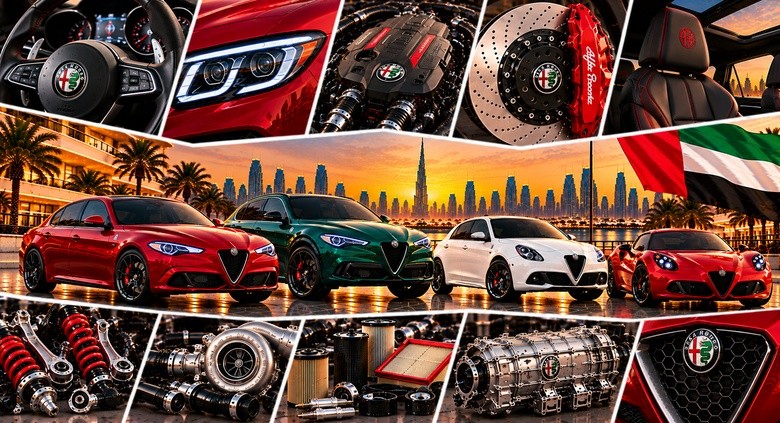
If a vehicle has repeated low-voltage warnings or charging problems, establish the battery condition, alternator output and relevant electrical connections before ordering replacement electronics.
This is basic diagnostic discipline, but it can save a surprisingly large parts bill.
Genuine does not automatically mean “buy it immediately”
A genuine part can be correctly specified and still be the wrong repair decision.
If the fault has not been confirmed, even the correct component may not solve the problem.
The first question is always: what has actually failed?
Repair versus replacement matters on expensive components
An Alfa Romeo owner may face a choice between a new component, approved alternative, remanufactured part, used original or repair of the existing component.
The correct option depends on the part.
A brake component is a very different proposition from a trim panel or an electronic module.
Used electronic modules need extra caution
Ask whether the module is tested, whether its donor vehicle is known, whether the exact part number matches and whether coding is required.
Without that information, “tested used module” is too vague.
Used engines require evidence, not optimism
For a used engine, obtain donor mileage if available, compression or leak-down information where appropriate, oil-pressure evidence where relevant, visible condition and a clear warranty.
A photograph of an engine sitting on a pallet is not an inspection report.
Gearbox sourcing should start with identification
If an Alfa Romeo transmission needs replacement, establish the exact transmission family, application and part/reference number.
Then investigate whether repair, a tested used unit, a remanufactured assembly or a new replacement makes sense.
Do not start with whichever gearbox happens to be available first.
A gearbox quotation should separate the assembly from installation
The total repair can include:
- gearbox assembly
- fluids
- seals
- ancillary components
- labour
- diagnostics
- programming or adaptation where required
- road testing
A low gearbox price can therefore be misleading if it excludes half the job.
Body parts can hide sensor compatibility problems
Modern bumpers and exterior assemblies can carry parking sensors, cameras, radar-related equipment or other fittings.
A visually identical bumper may not have the correct openings or mounts.
Check the equipment specification before ordering.
Headlamps deserve exact left/right identification
For Alfa Romeo lamps, verify:
model → generation → left/right → lamp specification → part number → condition.
If the unit is used, inspect mounting points, lens condition, moisture damage and connector condition.
Interior trim is not merely cosmetic
A replacement seat module, switch pack, steering-wheel component or trim panel may vary with equipment.
Colour and shape are only part of the identification.
The underlying specification matters too.
Wheels and tyres should be checked as a system
Do not identify an Alfa Romeo wheel only by diameter.
Confirm width, offset, bolt pattern, brake clearance and the exact vehicle application.
On performance models, wheel and brake clearance become particularly important.
Before You Click Buy
Stop if the seller cannot identify the exact Alfa Romeo application.
Stop if a supplier says “fits Giulia” without asking which Giulia.
Stop if a used electronic component has no donor information.
Stop if a supposedly genuine part has no identifiable part number.
And stop if the price is dramatically below comparable quotations until you establish whether the item is new, approved, aftermarket, remanufactured or used.
What a proper Alfa Romeo parts quotation should show
A useful quotation should identify:
Vehicle: exact model and variant
VIN: where available
Component: precise description
Part number: current or superseded reference
Condition: new / genuine / approved / remanufactured / used
Warranty: stated terms
Availability: confirmed date
Parts price: AED
Labour: separate AED
Programming or calibration: separate where applicable
That is a quotation an owner can actually compare.
UAE buyers have an official Alfa Romeo route
Alfa Romeo Middle East lists Gargash Motors & General Trading LLC as its UAE dealer, with its listed Dubai location at City Walk, Al Wasl.
The regional Alfa Romeo service system also allows owners to select models including Giulia and Stelvio and provide vehicle details, including chassis information.
For difficult or expensive parts, that official identification route is worth knowing.
The official parts network is not the only sourcing route
Older Giulietta and 4C owners may encounter used, specialist or independent sourcing options.
That can be useful when a component is discontinued, back-ordered or expensive.
But the burden of verification becomes more important as the sourcing route becomes less direct.
Keep the original part number
If a component is removed from the vehicle, photograph its label and retain the number where practical.
That little record can save substantial time later.
It also gives another supplier a precise reference rather than forcing them to guess from a model name.
The Alfa Romeo technical-information system supports parts identification
Alfa Romeo's technical-information platform explicitly includes a spare-parts identification section and explains that independent operators can access the spare-parts catalogue through its technical-information system.
That reinforces the broader principle: proper parts sourcing starts with catalogue identification, not visual guessing.
When sourcing Alfa Romeo parts through PartFinder UAE, the useful starting point is still the vehicle itself: provide the exact model, variant, VIN where available and the original part number rather than relying on a broad “Giulia” or “Stelvio” search.
That gives the parts enquiry a proper technical reference point. It also makes it easier to distinguish a genuine replacement from an approved alternative, remanufactured component or used original part.
Don't confuse parts availability with parts compatibility
A supplier can have a component physically sitting in Dubai and still not have the right component for your Alfa Romeo.
Availability answers:
Can I get it?
Fitment answers:
Is it actually mine?
You need both answers.
Older Alfa Romeos reward good record-keeping
For a Giulietta or 4C, keep invoices, part numbers, donor information, warranty documents and workshop notes.
As these vehicles age, a detailed repair history becomes increasingly useful when the next component needs to be sourced.
Buyer decision matrix
| Situation | First thing to verify | Suitable sourcing direction |
| Current Giulia | VIN + variant + part number | Genuine or approved replacement |
| Giulia Quadrifoglio | VIN + performance specification | Exact genuine/approved application |
| Current Stelvio | VIN + engine + equipment | Genuine or approved replacement |
| Stelvio Quadrifoglio | VIN + variant + braking/suspension specification | Exact performance application |
| Older Giulietta | VIN + production year + part number | Genuine, approved or tested used |
| 4C | VIN + exact model + component reference | Genuine, specialist or carefully inspected used |
| Electronic module | Part number + coding requirements | New, remanufactured or tested used |
| Engine | Donor history + mileage + testing | New, remanufactured or tested used |
| Gearbox | Transmission identification + diagnosis | Repair, remanufactured or verified replacement |
The rule that saves the most money
Don't begin an Alfa Romeo parts search with:
“How cheap can I get this?”
Begin with:
“Exactly which component does this vehicle require?”
Once that is established, genuine parts, approved alternatives, remanufactured components and used options can be compared properly.
That is the difference between bargain hunting and sensible parts buying.
FAQs
Categories
- Audi
- BMW
- Car Accessories
- Car Tips
- Ford
- Land Rover
- Mazda
- Range Rover
- Top 10
- UAE Car Parts
- Used Car Parts
- Toyota
- Replacement Engines
- Nissan
- Hyundai
- Mitsubishi
- Volkswagen
- Honda
- Kia
- Chevrolet
- Dodge
- Jeep
- Subaru
- Renault
- Lexus
- Mercedes
- Suzuki
- Hummer
- Porsche
- Infiniti
- Peugeot
- GMC
- Mini
- Volvo
- Replacement Gearboxes
- MG
- Jaguar
- Skoda
- Cadillac
- Daihatsu
- Fiat
- German Car Parts
- Japanese Car Parts
- Aftermarket Car Parts
- Genuine Car Parts
- New Car Parts
- Reconditioned Car Parts
- European Car Parts
- American Car Parts
- Korean Car Parts
- British Car Parts
- Chinese Car Parts
- Sports/Exotic Car Parts
- Luxury Car Parts
- Performance Car Parts
- SUV/4x4 Spare Parts
- Truck Spare Parts
- EV Car Parts
- Hybrid Car Parts
- Auto Spare Parts in UAE
- Tesla
- Isuzu
- Ram
- Ferrari
- Bentley
- Lamborghini
- Genesis
- Maserati
- Lincoln
- Chrysler
- Opel
- Citroen
- SsangYong
- Seat
- McLaren
- Aston Martin
- Rolls Royce
- Maybach
- Alfa Romeo