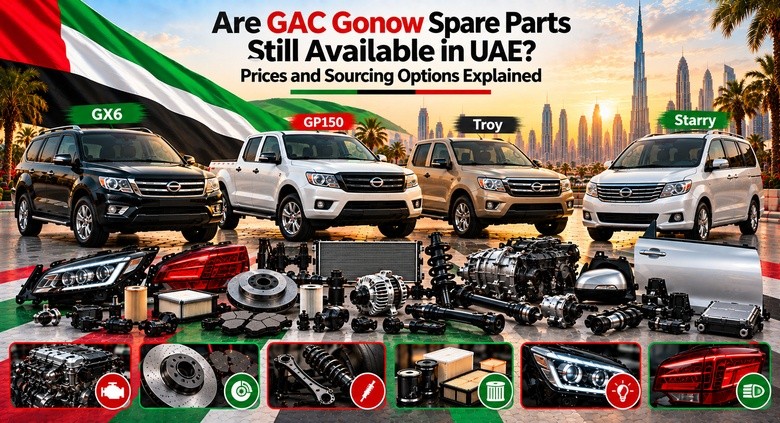
Are GAC Gonow Spare Parts Still Available in UAE? Prices and Sourcing Options Explained
October 5, 2026
UAE Update Reference: September 2026
The awkward truth about GAC Gonow spare parts in UAE is that availability has not disappeared completely, but the easy, catalogue-driven supply chain has.
That distinction matters.
A modern GAC owner can usually identify a model, enter a registration or VIN, select a component and start comparing options. A Gonow owner dealing with a GX6, GP150, Troy or Starry may instead find an old model name, three different descriptions for the same-looking component, a supplier asking for photographs, and a workshop saying, “We can probably find it.”
“Probably” is not a parts specification.
GAC acquired the remaining 49% of GAC Gonow in 2016, making the company wholly owned, while contemporary reporting also documented serious dealership and after-sales problems around the brand during that period. That history helps explain why sourcing a ten-year-old Gonow component today is a very different exercise from ordering a current GAC Motor part.
For UAE owners, the sensible approach is therefore identification first, sourcing second, price third.
Are GAC Gonow spare parts still available in the UAE?
Yes, but availability depends heavily on the model, part type and how accurately the vehicle is identified.
There are still UAE-facing parts platforms that list GAC Gonow among supported makes, while local supplier directories retain references to GAC Gonow and Belhasa Motors. A current UAE parts marketplace, for example, still includes GAC Gonow in its searchable make database.
That does not mean every GX6, GP150, Troy or Starry part is sitting in a Dubai warehouse.
It means the sourcing network has not vanished.
The difference is crucial.
Fast-moving consumables may have an aftermarket route. Mechanical components may sometimes be cross-referenced. Body panels and model-specific lighting can be considerably harder. Electronic modules may become a completely different problem because the part must not only physically fit but also communicate correctly with the vehicle.
Why Gonow parts are harder to find than current GAC parts
The brand's history is the first clue.
GAC Gonow was a joint venture between GAC and Gonow. In March 2016, GAC acquired the remaining 49% stake and became the wholly owned owner.
By May that year, China Daily reported dealers complaining about vehicle supply and after-sales issues, including demands concerning unsold vehicles and spare parts.
This matters today because aftermarket ecosystems need continuity.
A current model generates regular demand for filters, brake components, suspension parts, sensors, lamps and body panels. A discontinued model with a small surviving fleet creates sporadic demand. Suppliers therefore have less reason to hold expensive, model-specific inventory.
That is why a Gonow part can be technically obtainable while still being difficult to source quickly.
The Gonow name covers several very different vehicles
Do not search simply for “GAC Gonow parts”.
That is too broad.
The former Gonow range included the GX6 SUV, GP150 pickup, Troy pickup family, Starry MPV and other vehicles. Historical model listings place the GX6 in 2014–2016 production, GP150 around 2014–2016, Troy through the same broad period and Starry around 2013–2016.
Those vehicles do not share one universal parts catalogue.
A GX6 suspension component cannot be assumed to fit a GP150 simply because both carry the Gonow badge. A Troy 100 component cannot automatically be substituted for a Troy 500 component. A Starry electrical component may vary with engine, production period or equipment.
The first question should always be:
Which Gonow?
GX6 parts: the SUV with the identification problem
The Gonow GX6 was produced from 2014 to 2016 and was also known as the Aoosed GX6 in some markets. Published specifications identify a 2.4-litre petrol engine and five-speed manual transmission, with rear-wheel-drive and four-wheel-drive configurations appearing in model references.
That already tells you why “GX6 part” is not enough information.
Before ordering a mechanical component, confirm:
- model year;
- engine;
- transmission;
- drivetrain;
- VIN or chassis number;
- left/right position where applicable;
- original part reference if available.
The GX6 also has international naming variations, which can make overseas catalogue searches more confusing. One parts catalogue specifically identifies the GX6 as an Aoosed GX6 name used in Saudi Arabia and the UAE.
So searching both names can sometimes uncover information that a simple UAE search misses.
GP150 parts: do not assume the engine from the badge
The GP150 creates another identification trap.
A 2015 GP150 specification listing identifies a 2.5-litre turbocharged diesel with manual transmission and engine reference GA4D25TCI, while other documented GP150 configurations include a 2.7-litre petrol engine.
That is exactly why “GP150 oil filter” or “GP150 fuel pump” is incomplete.
One UAE parts listing for a MANN oil filter currently shows GONOW GP150 applications, but the catalogue associates the item with specific GP150 2.7 applications rather than treating every GP150 as identical. The same product is listed at AED 33.75 at the time of the September 2026 check.
That is useful evidence, but it is not permission to order the filter for every GP150.
It demonstrates something more valuable: cross-referencing works, but only when the application is specific.
Troy parts are especially dangerous to search by name alone
“Troy” is not a sufficiently precise parts description.
Historical Gonow listings include Troy variants such as Troy 100 and Troy 500, and UAE supplier directories still show GAC Gonow products including Troy 100 and Troy 500.
That means a request to a supplier for a “Troy brake part” leaves too much room for error.
Give the supplier the exact model designation, year, engine, drivetrain and chassis/VIN wherever possible.
For body parts, add photographs.
For electrical parts, add the connector and label photograph.
For suspension components, photograph both the old component and mounting points if there is any uncertainty.
A ten-minute identification exercise can save several days of returning the wrong component.
Starry parts are a different sourcing problem
The Starry, also known as Xinglang, was a compact MPV sold during the Gonow period. Historical listings place production around 2013–2016, with different engine specifications appearing across markets.
That matters because MPV parts often split into two categories.
The first category is generic mechanical maintenance: filters, belts, bearings, brake components and certain suspension items may have cross-reference possibilities.
The second is body and electrical equipment: lamps, door components, trim, switches, modules and model-specific interior parts.
The second group is where an old vehicle becomes difficult.
A filter may have a cross-reference number. A tail lamp usually needs the correct housing, mounting pattern and connector arrangement.
What parts are easiest to source?
For older Gonow vehicles in the UAE, the most realistic starting point is usually the parts that have broader aftermarket or cross-reference coverage.
Think:
- oil filters;
- air filters;
- fuel filters;
- brake pads;
- brake discs;
- wheel bearings;
- belts;
- hoses;
- common bearings;
- bulbs;
- certain sensors;
- selected suspension components.
That does not mean every item is available.
It means these categories are more likely to have an alternative sourcing route than a unique body panel or electronic control module.
The UAE market also has multi-brand parts networks rather than a single Gonow-only channel. Current UAE parts platforms advertise new, used, genuine and aftermarket inventory across large numbers of vehicle makes, including GAC Gonow.
Which Gonow parts are hardest to source?
Usually the parts with one or more of these characteristics:
- model-specific body shape;
- unique lighting;
- unusual interior trim;
- dedicated electronic module;
- vehicle-specific wiring;
- discontinued transmission component;
- four-wheel-drive-specific drivetrain component;
- complete engine assembly;
- unusual suspension geometry;
- glass or trim with limited regional demand.
The difficulty is not necessarily that the component was badly designed.
It is simply that the potential buyer pool is small.
A supplier can economically stock 100 filters that fit multiple vehicles. Stocking one expensive, model-specific Gonow control module for years is another proposition entirely.
Is genuine Gonow stock still sitting in UAE warehouses?
Sometimes it may be, but public evidence does not justify claiming that large quantities of genuine Gonow stock remain readily available.
That distinction is important.
Belhasa Motors has historically been associated with GAC Gonow in UAE supplier directories, while its current service operation states that its central spare-parts facility carries required parts for the vehicles it supports and that its parts department handles genuine parts and re-export.
However, that current service information does not establish a publicly listed inventory of GX6, GP150, Troy or Starry parts in September 2026.
So an owner should ask, not assume.
Warehouse stock is evidence only when the supplier confirms the actual part.
The old dealer route is still worth checking
For a rare Gonow component, the dealer or historical distributor trail should not be ignored simply because the vehicle is old.
A current UAE directory still identifies Belhasa Motors with GAC Gonow terrain vehicles and displays historical Gonow products including Troy 100, Troy 500 and Starry.
That does not guarantee stock.
It gives you a potentially useful sourcing lead.
Ask a very specific question:
“Can you check this exact VIN/chassis and part reference for remaining stock or an old catalogue reference?”
That is much more productive than asking, “Do you have Gonow parts?”
UAE independent suppliers may be more useful for discontinued vehicles
Independent parts networks can sometimes be better suited to old vehicles because they search across multiple suppliers rather than relying on one brand warehouse.
Current UAE sourcing services advertise access to new and used stock across multiple supplier networks and specifically ask for the vehicle chassis number to identify the correct component.
This model makes particular sense for Gonow.
A supplier may not advertise “GX6 control arm in stock” on a public catalogue, but it may locate one through another UAE warehouse, dismantler or specialist supplier.
The important phrase is locate, not “guaranteed stock”.
Used Gonow parts may be more realistic than new genuine parts
For rare body and mechanical components, used original parts can make economic sense.
A used genuine headlight, door, grille, differential or interior component may be easier to locate than a newly manufactured original replacement.
But “used” describes history, not condition.
Ask:
- Which vehicle supplied the part?
- What year was the donor?
- Which engine and drivetrain?
- Was the donor accident damaged?
- Was it flood damaged?
- Was the component tested?
- Is the connector intact?
- Are mounting tabs broken?
- Is there corrosion?
- Is there a return period?
- Is any warranty offered?
For electronics, ask even more.
A used module that physically plugs in may still require programming or may not be compatible with your vehicle configuration.
Aftermarket Gonow parts need a different kind of verification
Aftermarket does not automatically mean poor quality.
It means the part was produced outside the original vehicle manufacturer's parts channel.
The real question is whether the aftermarket component is actually specified for your vehicle.
Check dimensions, mounting, connector configuration, operating specification and application data.
For a filter, physical dimensions and filtration specification matter.
For a brake component, dimensions, friction material and application matter.
For a suspension arm, geometry and mounting points matter.
For a sensor, electrical characteristics and calibration can matter.
A cheap component that does not match the vehicle is not cheap.
It is simply an expensive mistake with better marketing.
One UAE filter listing shows why cross-reference research matters
The UAE market already provides a useful example.
A MANN-FILTER W 712/95 oil filter is listed at AED 33.75 by a UAE parts retailer and is catalogued for GONOW (GAC), including GP150 2.7 applications for 2014–2016.
Notice what the listing does not say:
It does not say “all Gonow vehicles”.
It provides an application.
That is the distinction buyers should copy.
A cross-reference is useful because it expands sourcing options. It becomes dangerous when the cross-reference is treated as proof of universal compatibility.
Price reference: AED 33.75, public UAE listing checked September 2026; listed as a part price, not an installed repair cost.
Why a cheap filter can be easier than a cheap headlight
This sounds obvious until you are actually waiting for the part.
Filters are manufactured across large vehicle populations. Their dimensions and specifications can sometimes overlap with other applications.
A headlight is different.
Its housing, lens, mounting tabs, wiring connector, bulb or LED configuration and body geometry may all be model-specific.
That is why the market can have a UAE listing for a compatible GP150 filter while simultaneously having no publicly advertised GX6 headlight price.
The absence of a public price does not prove the part cannot be sourced.
It means there is insufficient public price evidence to publish a responsible number.
What should a UAE buyer expect to pay?
There is no defensible single “GAC Gonow spare parts price” for the UAE.
That would be misleading.
A common filter and a complete gearbox are not remotely comparable sourcing problems. Neither are a used door mirror and a discontinued electronic module.
For September 2026, the publicly visible UAE evidence I found is strong enough to document some individual components, such as the AED 33.75 MANN filter listing, but not strong enough to produce a reliable UAE average for GX6, GP150, Troy and Starry parts as a whole.
That is a useful finding in itself.
When public price evidence is thin, an honest article should say so.
A practical Gonow price structure
Instead of chasing one imaginary average, divide the repair into four price layers.
Layer one: common consumables.
Filters, belts and similar items may have aftermarket or cross-reference options.
Layer two: common mechanical parts.
Brakes, bearings, selected suspension parts and some sensors may have broader sourcing.
Layer three: model-specific components.
Lights, body panels, trim and unusual mechanical parts may require a supplier search.
Layer four: rare electronic or drivetrain components.
These can become enquiry-only items, used-part searches or overseas sourcing jobs.
The price should rise with sourcing difficulty, but not always in a neat line.
A rare part may actually be inexpensive once found. A common-looking component can become expensive if it is supplied with a complete assembly or requires programming.
Why online prices can mislead Gonow owners
An online price is not necessarily the final repair price.
A listing may exclude:
- VAT;
- delivery;
- fitting;
- diagnostic time;
- fluids;
- seals;
- programming;
- calibration;
- additional installation hardware.
The AED 33.75 filter example is a part price. It is not an oil-service invoice.
The same distinction becomes much more important when buying an engine, gearbox, ECU or body assembly.
Always ask:
“Is this the price of the component, or the price of getting my car repaired?”
Those are different numbers.
VIN matching is not optional for expensive Gonow parts
For a rare vehicle, the VIN or chassis number is often the most useful piece of information you can give a supplier.
Send:
- VIN/chassis number;
- model;
- model year;
- engine type;
- transmission;
- drivetrain;
- part name;
- old part number if visible;
- photographs.
This gives the supplier several independent ways to identify the component.
It also reduces the temptation to match the part solely by appearance.
That matters because older vehicles can have regional specifications and production changes that are invisible from the badge.
What if the part number is missing?
Then the search becomes harder, but not impossible.
Photograph the original component from several angles.
Include:
- manufacturer markings;
- labels;
- connector plugs;
- casting numbers;
- barcode stickers;
- mounting points;
- dimensions where useful.
Do not clean away markings before photographing them.
On electronic components, photograph every label.
On body parts, photograph the mounting tabs.
On suspension components, photograph both sides and the attachment points.
A supplier can sometimes identify a component from these details even when the owner has no catalogue number.
Can a Toyota, Mitsubishi or Volkswagen part be used on a Gonow?
Sometimes a Gonow component may share an engineering lineage, supplier reference or cross-reference with another vehicle.
But the badge on the other vehicle is not proof.
The GP150 example illustrates the point. A UAE MANN-FILTER listing identifies a specific GP150 2.7 application and provides a cross-reference trail.
That is evidence.
“Someone on a forum said this filter fits” is not equivalent evidence.
For mechanical parts, verify dimensions and specification.
For electrical parts, verify electrical characteristics and connector configuration.
For safety-critical components, use the manufacturer's or supplier's application data wherever possible.
Engine parts require more care than filters
A filter can sometimes be cross-referenced using dimensions and application data.
Engine components are less forgiving.
A GP150 may exist with different documented engine configurations, including 2.5-litre diesel and 2.7-litre petrol variants.
That means an engine mount, injector, sensor, timing component or gasket cannot safely be ordered from “GP150” alone.
Confirm the engine.
Then confirm the production period.
Then confirm the part reference.
Then compare the physical component before installation.
For a complete engine, the supplier should provide the donor vehicle information and engine identification wherever available.
Gearbox and drivetrain parts are a different category again
A gearbox component can look right and still be wrong.
For Gonow vehicles with different drivetrain configurations, this is particularly important.
Confirm:
- transmission type;
- number of speeds;
- two-wheel-drive or four-wheel-drive;
- transfer-case arrangement where applicable;
- differential application;
- final-drive ratio where relevant;
- mounting arrangement;
- shaft dimensions;
- electrical connectors or sensors.
Do not buy a complete used gearbox merely because the casing resembles yours.
Ask for the transmission identification marking and donor vehicle details.
Body parts can be sourced, but photographs matter
For a discontinued vehicle, a body part search is often closer to a dismantler exercise than a conventional parts-catalogue exercise.
For a GX6 front bumper, for example, give the supplier photographs showing the existing bumper, fog-light openings, parking-sensor provisions, grille interface and mounting areas.
For a Starry door, photograph the mirror aperture, handle arrangement, trim, wiring and hinge area.
For a Troy pickup body panel, specify cab configuration.
This is where used original parts can become attractive because a supplier can compare the actual panel rather than relying on an old catalogue description.
Lighting parts need connector and specification checks
Headlights and tail lamps are particularly easy to misidentify from photographs.
Check:
- left-hand or right-hand unit;
- housing shape;
- mounting tabs;
- connector;
- bulb type;
- LED configuration;
- indicator arrangement;
- fog-light provision;
- market specification.
If the supplier sends a photograph, compare the rear of the lamp, not just the front lens.
Two headlights can look almost identical from the road-facing side and have completely different connectors behind them.
That is not a cosmetic difference.
It is a fitment problem.
Electronic Gonow parts can become the expensive part of the search
ECUs, body-control modules, ABS units, instrument clusters and other electronic assemblies deserve caution.
A used module may require:
- coding;
- programming;
- immobiliser matching;
- configuration;
- calibration;
- vehicle-specific software.
A seller saying “same plug” is not enough.
Ask for the exact module number and software information where available.
Then ask the workshop whether it can program the replacement before purchasing it.
Otherwise you can end up with a technically correct-looking component that cannot be commissioned.
UAE workshops should diagnose before ordering
This is where old-car ownership can go wrong.
A workshop sees an overheating vehicle and orders a radiator.
But overheating can also involve the thermostat, cooling fan, coolant circulation, pressure loss, water pump, sensor, trapped air or other faults.
The same principle applies to electrical problems.
A failed charging warning does not automatically prove the alternator is dead.
A starting problem does not automatically mean the starter motor needs replacement.
A rough-running engine does not automatically justify buying injectors.
The diagnostic result should lead the parts search.
Not the other way around.
What should the workshop check before you buy?
For mechanical faults, ask for evidence appropriate to the symptom.
That can include:
- scan-tool fault codes;
- live-data readings;
- charging voltage;
- current draw;
- cooling-system pressure testing;
- coolant temperature behaviour;
- fuel pressure;
- boost pressure;
- compression testing;
- leak-down testing;
- oil pressure;
- gearbox adaptation or fault data;
- road-test findings;
- physical connector inspection.
The exact test depends on the system.
The important point is simple: a symptom is not a parts order.
If the workshop cannot explain what failed and why the proposed component should correct it, pause before buying an expensive Gonow part.
The safest sourcing strategy for a Gonow in the UAE
Think of the process as a sourcing ladder.
First: identify the vehicle precisely.
Second: identify the failed component precisely.
Third: obtain the original part reference if possible.
Fourth: check UAE genuine or remaining stock.
Fifth: search UAE independent suppliers.
Sixth: check aftermarket cross-references.
Seventh: investigate a tested used genuine component.
Eighth: consider overseas sourcing only after local options have been exhausted.
This order matters because overseas sourcing adds freight, customs handling, delivery time and return complications.
For a cheap consumable, international shipping can make no economic sense.
For a discontinued ECU or body component, it may be entirely reasonable.
Why dismantlers can matter more than catalogues
For a ten-year-old or older vehicle, the dismantler can become an informal parts archive.
A damaged vehicle may still have perfectly usable:
- mirrors;
- lamps;
- doors;
- seats;
- dashboards;
- suspension arms;
- differentials;
- engines;
- gearboxes;
- electronic modules;
- trim.
The challenge is condition.
A used component should be inspected for accident damage, corrosion, water exposure, missing hardware and previous repairs.
For structural or safety-related components, condition matters as much as fitment.
What should you ask a used-parts seller?
Do not send one sentence saying “Gonow GX6 headlight needed”.
Send a proper request.
For example:
Vehicle: Gonow GX6
Year: [actual year]
Engine: [actual engine]
Transmission: [actual transmission]
VIN/chassis: [actual number]
Part: Front-left headlight
Condition wanted: Used original
Required: Photograph of front and rear, connector, mounting tabs and label
Questions: Donor year, donor mileage if known, accident history, testing, return policy and warranty
That format changes the quality of the conversation.
The supplier now has something they can investigate.
Is importing a Gonow part from China worth it?
Sometimes.
But the calculation should include the full landed cost.
Add:
- component price;
- international freight;
- customs or import charges where applicable;
- intermediary fees;
- local delivery;
- possible currency conversion cost;
- return cost;
- workshop fitting;
- diagnostic or programming cost.
A part advertised at a low overseas price can become expensive by the time it reaches a UAE workshop.
The reverse can also happen.
A rare, lightweight component may be economical to import if the UAE search has failed.
The decision should be made from the landed cost, not the headline price.
What does the UAE market tell us about Gonow availability in September 2026?
The evidence points to a fragmented market rather than a completely closed one.
Current UAE parts platforms still recognise GAC Gonow as a supported make.
UAE supplier directories retain GAC Gonow references, including historical Belhasa listings for Troy and Starry.
A UAE retailer currently lists a MANN oil filter with specific GONOW GP150 applications at AED 33.75.
Used-parts networks in the UAE also advertise VIN-based sourcing across broad categories including engines, transmissions, body parts, suspension, brakes and electronics.
What the evidence does not support is a claim that all Gonow parts are readily stocked or that a reliable UAE-wide average price exists for GX6, GP150, Troy and Starry.
That would be pretending the market is more transparent than it is.
Where PartFinder UAE fits into the search
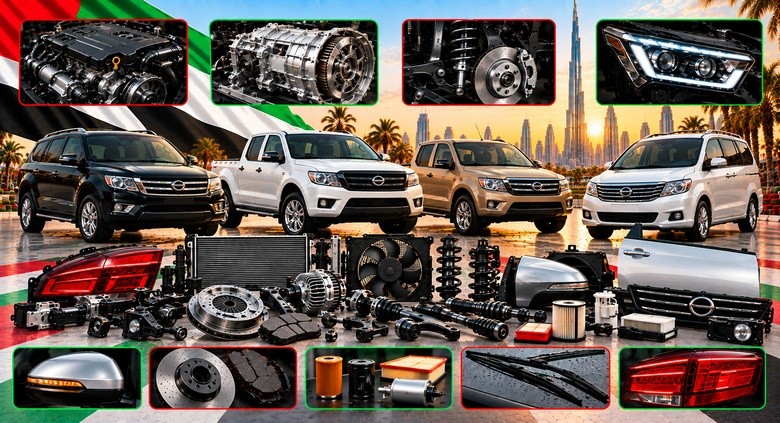
For a rare Gonow component, the useful role of PartFinder UAE is not simply finding a cheap listing.
The better use is to approach the search as a matching problem.
Give the vehicle identity.
Give the exact part.
Give the VIN where appropriate.
Compare new, aftermarket and used options where genuinely available.
Then verify the supplier's application before paying.
For a discontinued vehicle, the quality of the identification process can matter more than the number of suppliers you contact.
A simple buyer decision matrix
| Situation | Sensible first option | What to verify |
| Oil/filter service | Cross-referenced aftermarket or genuine | Exact engine/application |
| Brake pads | Established aftermarket or genuine | Axle, dimensions, application |
| Suspension arm | New or verified used | Geometry, side, mounting |
| Headlight | Used genuine or exact new replacement | Connector, tabs, market specification |
| Door/body panel | Used original | Shape, mounting, trim |
| ECU/module | Tested used or verified replacement | Module number, programming |
| Gearbox | Tested used/rebuilt/new where available | Transmission code, drivetrain |
| Complete engine | Verified donor/replacement | Engine identity, condition, warranty |
| Rare trim | Used original | Physical comparison |
| Uncertain component | Diagnose and identify first | VIN + part reference |
The cost of getting the part identification wrong
This is where cheap sourcing can become expensive.
Suppose a supplier sends a component that looks correct.
You pay for delivery.
The workshop removes the old component.
The new one does not fit.
Now you have:
- delivery cost;
- workshop labour;
- vehicle downtime;
- return handling;
- possible restocking cost;
- another sourcing delay.
If the component is electronic, the problem can become worse because the workshop may spend diagnostic time trying to configure a part that was never correct for the vehicle.
With a discontinued Gonow, the second mistake is often more expensive than the first.
What should a workshop do when no exact part is listed?
Do not immediately improvise.
First establish whether the original component has:
- a manufacturer number;
- casting number;
- supplier reference;
- dimensional specification;
- cross-reference;
- superseded number.
Then determine whether the proposed substitute meets the same application requirements.
For a simple mechanical component, engineering equivalence may be possible.
For a safety-critical or electronic component, the burden of proof should be much higher.
“Can be made to fit” is not the same as “is suitable”.
Why the UAE climate matters — but only after diagnosis
Heat, dust, traffic congestion and air-conditioning demand can increase operating stress on vehicles.
That context is useful.
It is not a diagnosis.
A Gonow radiator does not need replacement merely because the vehicle is used in Dubai.
A compressor does not automatically fail because the temperature is high.
A battery does not become faulty simply because the climate is hot.
The workshop still needs to test the system.
Climate should explain why certain systems deserve attention, not replace the diagnostic process.
The best sourcing evidence is the part in front of you
For a rare Gonow component, photographs can be surprisingly valuable.
Ask the supplier to photograph:
- the complete part;
- identification label;
- casting marks;
- connectors;
- mounting points;
- damaged areas;
- donor vehicle where possible.
Then compare those images with the removed component.
This is particularly useful for used headlights, body panels, suspension pieces and electronic modules.
If the seller refuses to show the identification label on an expensive used component, treat that as a reason to slow down rather than speed up the purchase.
What “available” should actually mean
There are several levels of availability.
Listed: a website recognises the part or vehicle.
Enquiry available: the supplier says it may be sourced.
Supplier confirmed: a supplier has located the actual component.
Physically verified: the supplier has photographed the component and confirmed identification.
Ready for dispatch: the exact component is available for delivery.
For a rare Gonow part, these are not interchangeable statements.
A search result is not stock.
A catalogue entry is not stock.
An old listing is definitely not proof of current stock.
Why an old online listing can waste your time
Legacy vehicles generate stale catalogue data.
A page may remain indexed years after the part has disappeared.
The vehicle remains searchable.
The price remains visible.
The stock does not.
This is why current-date verification matters for this particular subject.
For a normal fast-moving filter, an old page is merely inconvenient.
For a discontinued Gonow bumper or ECU, it can send you down an entirely false sourcing path.
Genuine, OEM, aftermarket and used are not interchangeable labels
Ask exactly what the supplier means.
Genuine: supplied through the vehicle manufacturer's authorised parts chain.
OEM: a term that can be used differently by sellers; ask who manufactured the part and under what reference.
Aftermarket: produced by a third-party manufacturer.
Used genuine: original vehicle component removed from another vehicle.
Reconditioned: previously used component that has undergone some form of repair or refurbishment.
A seller calling a used Gonow component “OEM” does not automatically tell you its condition.
Ask for the actual provenance.
A sensible budget for a discontinued Gonow repair
Do not budget from the component alone.
Use:
Part + delivery + VAT where applicable + diagnosis + labour + supporting parts + programming/calibration + return risk
Then compare that with the vehicle's age, condition and remaining useful life.
For an old GX6 with a healthy engine, transmission and body, spending more on a hard-to-find suspension or cooling component may be perfectly rational.
For a heavily deteriorated vehicle needing multiple rare electronic and body components, the calculation changes.
The part does not exist in isolation.
It exists inside a car.
The final answer: are Gonow parts still available in UAE?
Yes — but not in the effortless, predictable way associated with current GAC models.
The UAE still has searchable GAC Gonow coverage, independent supplier networks, used-parts sourcing, historical distributor connections and at least some current cross-referenced listings.
What has changed is the structure of the market.
The older the vehicle and the more model-specific the component, the more important identification becomes.
GX6, GP150, Troy and Starry should be treated as separate sourcing exercises.
For common service parts, cross-reference research can open the door to affordable aftermarket alternatives. For body panels, lighting and rare mechanical components, used genuine parts may become more realistic. For ECUs, ABS modules and other electronics, VIN, module identification and programming capability need to be established before payment.
And when a supplier says, “Yes, we have it,” ask one more question:
“Can you confirm this exact part against my VIN or original part reference?”
That question is worth more than a dozen vague price quotes.
FAQs
Categories
- Audi
- BMW
- Car Accessories
- Car Tips
- Ford
- Land Rover
- Mazda
- Range Rover
- Top 10
- UAE Car Parts
- Used Car Parts
- Toyota
- Replacement Engines
- Nissan
- Hyundai
- Mitsubishi
- Volkswagen
- Honda
- Kia
- Chevrolet
- Dodge
- Jeep
- Subaru
- Renault
- Lexus
- Mercedes
- Suzuki
- Hummer
- Porsche
- Infiniti
- Peugeot
- GMC
- Mini
- Volvo
- Replacement Gearboxes
- MG
- Jaguar
- Skoda
- Cadillac
- Daihatsu
- Fiat
- German Car Parts
- Japanese Car Parts
- Aftermarket Car Parts
- Genuine Car Parts
- New Car Parts
- Reconditioned Car Parts
- European Car Parts
- American Car Parts
- Korean Car Parts
- British Car Parts
- Chinese Car Parts
- Sports/Exotic Car Parts
- Luxury Car Parts
- Performance Car Parts
- SUV/4x4 Spare Parts
- Truck Spare Parts
- EV Car Parts
- Hybrid Car Parts
- Auto Spare Parts in UAE
- Tesla
- Isuzu
- Ram
- Ferrari
- Bentley
- Lamborghini
- Genesis
- Maserati
- Lincoln
- Chrysler
- Opel
- Citroen
- SsangYong
- Seat
- McLaren
- Aston Martin
- Rolls Royce
- Maybach
- Alfa Romeo
- Bugatti
- Scion
- Abu Dhabi Car Parts
- Ajman Car Parts
- Al Khan Car Parts
- Al Sajaa Car Parts
- Deira Car Parts
- Dubai Car Parts
- Fujairah Car Parts
- Industrial Area 6 Car Parts
- Mussafah Car Parts
- Ras Al Khaimah Car Parts
- Sharjah Car Parts
- Umm Al Quwain Car Parts
- Acura
- BYD
- Chery
- Dacia
- DS
- Geely Emgrand
- EXEED
- GAC
- GAC Gonow
- Geely