Are Renault Samsung Parts Available in UAE? Prices and Replacement Options for Older Models
October 13, 2026
Yes — Renault Samsung parts in UAE are still available. But that answer is less useful than it sounds.
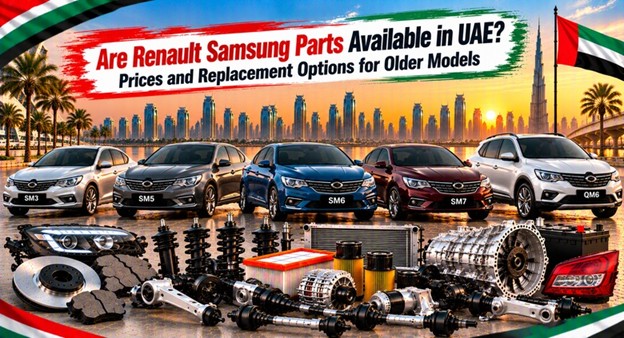
The real difficulty starts when an older SM3, SM5, SM6, SM7 or QM6 needs something specific: a headlamp from the correct facelift, an engine component from the correct specification, a control module that has to communicate with the car, or a body panel that nobody in the workshop wants to order twice. The parts supply has not simply vanished; it has become more fragmented, with genuine Renault Samsung/Renault components, aftermarket equivalents, imported Korean used parts and Renault cross-references sitting alongside one another.
That can work in the owner's favour.
It can also make the market rather treacherous.
Renault's own production records make the reason clear. At the Busan plant, Renault Samsung produced Talisman/SM6, Fluence/SM3, Latitude/SM5 and Koleos/QM6, alongside SM7. So, there are genuine engineering and parts relationships behind some of the model names, rather than merely superficial badge similarities.
But a relationship is not the same thing as universal compatibility.
That distinction should sit at the centre of every older Renault Samsung parts search in the UAE.
The short answer: yes, but don't search by badge alone
There is still a functioning parts trail for these cars.
Current Korean genuine-parts inventories separately identify SM6/New SM6, QM6/New QM6, New SM5 L43, New SM3 L38, New SM7 L47 and earlier SM5, SM7 and QM5 generations. They also maintain categories for brake pads, spark plugs, filters, suspension and shock absorbers, electrical components and engine/transmission parts.
That is reassuring if you own an older Renault Samsung.
Yet it also exposes the first problem. “SM5” is not a sufficient parts description. “SM7” isn't either. A supplier needs to know which generation and, for many components, the engine, transmission and equipment specification.
The badge gets the search started.
The VIN finishes it.
Why older Renault Samsung cars are still supportable
There is a difference between old and unsupported.
A vehicle can be fifteen years old and still have an active aftermarket, used-parts network and surviving genuine stock. Conversely, a relatively young imported car can become difficult to repair if its specification is unusual and very few local suppliers recognise it.
Renault Samsung has one advantage here: the Korean market was large enough to sustain a substantial domestic parts ecosystem. Current genuine-parts retail infrastructure still separates older Renault Samsung generations rather than quietly deleting them from the catalogue.
That doesn't guarantee UAE shelf stock.
It does mean the sourcing trail still exists.
And that is a very different proposition from hunting for a part that has disappeared everywhere.
SM3: plenty of history, plenty of chances to get the generation wrong
The SM3 is perhaps the clearest example of why age and generation matter.
Renault's production record identifies SM3 with the Fluence family, while current parts inventories separately identify the New SM3 L38 alongside older SM3 applications.
That means an owner searching simply for “Renault Samsung SM3 suspension parts” can encounter several different application families.
A filter may cross over.
A body panel may not.
An engine mount certainly deserves checking.
A headlamp needs even closer attention.
For an older SM3, provide the year, chassis/VIN, engine and original part number wherever possible. If the component is still fitted, photograph the label before removing it.
Small habit. Large saving.
SM5 is a deeper parts market than many UAE owners realise
SM5 has a long production history, and the current genuine-parts ecosystem still separates New SM5 L43 from earlier SM5/Impression generations.
That gives owners several sourcing routes.
New genuine.
Aftermarket.
Used genuine.
Reconditioned.
Imported Korean stock.
The sensible route depends on the component. A used bonnet is easy enough to inspect. A used engine-control module is not. A gearbox needs an entirely different level of evidence.
And because SM5 was produced in several generations, the temptation to search by the broad model name should be resisted.
If the supplier asks for the chassis code, give it.
SM6 has one particularly useful advantage in the UAE
The SM6's relationship with the Renault Talisman can make certain parts easier to identify and source.
A current UAE listing, for example, identifies coolant expansion tank reference 217108136R for both Renault Talisman and Samsung SM6 applications, with an advertised price of AED 221 when checked. That is a real UAE listing for a specified component, not a generic estimate.
This is exactly the kind of cross-reference that helps.
Notice what makes it credible: the vehicle application and part reference are explicit.
That is very different from somebody saying, “Talisman and SM6 are basically the same car, so this should fit.”
Parts sourcing needs evidence, not family resemblance.
QM6 can benefit from the same Renault connection
The QM6 is closely associated with the Renault Koleos II, and that relationship is useful when searching for replacement components.
Again, the important word is some.
The connection can open another catalogue or supplier route. It does not turn every Koleos component into a QM6 component.
A current UAE parts listing, for example, identifies coolant expansion tank reference 217105HA0A against a Koleos II/QM6 application, with an advertised price of AED 159 when checked.
That is the right way to use cross-brand information: find the reference, verify the application, then compare the UAE price.
Not the other way round.
SM7 is where used parts become increasingly interesting
SM7 is an older proposition, so the economics can change considerably.
A new genuine component may still be obtainable through the Korean parts ecosystem, but paying full new-part pricing for an ageing vehicle does not always make sense. Current genuine inventories still identify SM7/L47 and earlier SM7/New Art generations, while used-parts inventories continue to carry bodywork, electronics and other components.
For a body panel, a good used original can be perfectly sensible.
For an airbag module, the conversation is entirely different.
For an engine, it becomes a question of remaining life.
The older the car, the more carefully the part's economics need to be considered alongside the car's value.
“Available in Korea” does not mean “available in Dubai”
This is one of the easiest mistakes to make.
A Korean catalogue can show a part as active, perhaps even display a price, while the UAE buyer still faces international shipping, handling, import costs where applicable, payment charges and potentially difficult returns.
The component might still be a bargain.
But the headline price is no longer the complete price.
Imagine a used SM6 lamp listed at the equivalent of AED 600. If delivery and handling add AED 250, the landed part is already AED 850. Add fitting, and perhaps calibration or an electrical fault discovered after installation, and the saving against a local replacement becomes much less dramatic.
Sometimes importing wins.
Sometimes the local part wins.
You have to price the repair, not the webpage.
Current UAE price evidence is strongest for selected components
The UAE market does have actual Renault/Renault Samsung-compatible listings.
The SM6/Talisman coolant tank at AED 221 and QM6/Koleos II tank at AED 159 are two examples. Those prices are useful because they are tied to identifiable applications rather than invented “average prices”.
There is also a broader genuine-accessory ecosystem in Korea. Current official retail listings still show SM3, SM5, SM6, SM7 and QM6-specific items, including body accessories and model-specific exterior pieces. For example, listed prices include an SM3 wide spoiler at KRW 221,000, an SM6 rear spoiler at KRW 132,000, an SM5 spoiler assembly at KRW 53,000 and a QM6 boot liner at KRW 47,000.
Those Korean prices are not UAE spare-part prices.
They simply demonstrate that model-specific supply has not disappeared.
Why a neat “Renault Samsung parts price list” would be misleading
There is no sensible single number for an SM5 bumper, an SM6 headlamp or a QM6 gearbox.
Price changes with:
- generation;
- engine;
- trim;
- side/location;
- genuine or aftermarket status;
- new or used condition;
- donor history;
- availability;
- shipping;
- VAT;
- labour;
- programming or calibration;
- warranty;
- return terms.
This is why a serious UAE parts article should give observed prices where evidence exists, rather than filling every gap with an invented estimate.
A coolant tank at AED 159 tells us something.
It does not tell us what an SM6 transmission should cost.
Genuine parts are still a viable route
Renault Korea's current parts infrastructure continues to separate older models and categories, including exterior, electrical, engine/transmission and suspension/wheel components.
There is also still an official model-specific accessory catalogue carrying SM3, SM5, SM6, SM7 and QM6 items.
That gives owners confidence that genuine supply has not simply been switched off.
But UAE availability is another question.
A genuine part may need to be ordered from outside the UAE. The correct question is therefore not merely “Is it genuine?”
It is:
Can I get the correct genuine part, at what landed cost, and how long will the car be off the road?
Aftermarket parts can make much more sense for routine maintenance
There is no prize for paying genuine-part money for every filter, brake component or suspension bush on an older vehicle.
A reputable aftermarket manufacturer can offer a perfectly reasonable alternative, provided the application is correct and the component meets the required specification.
The problem comes when “aftermarket” becomes a synonym for “whatever is cheapest”.
It isn't.
A cheap filter from an unknown source and a well-established aftermarket equivalent are not the same purchase. Neither are two brake-pad sets simply because both fit the caliper.
For an older Renault Samsung, the supplier's ability to prove application matters almost as much as the manufacturer's name.
Used parts are often where the biggest savings appear
This is particularly true for bodywork and expensive assemblies.
A used SM7 bonnet can be inspected.
A used SM5 mirror can be photographed.
A used SM6 bumper can be checked for broken brackets.
A used QM6 electronic module is harder.
A used gearbox is harder still.
The uncertainty rises as the remaining life of the component becomes invisible.
That is why “used” should never be treated as a quality grade. It is a history.
You need to know what happened before the part reached your car.
A donor car tells you more than a photograph
For an expensive used component, ask where it came from.
Model.
Year.
Engine.
Transmission.
Mileage, if known.
Accident history.
Flood exposure.
Reason for dismantling.
Testing procedure.
Storage condition.
Warranty.
Return terms.
A supplier who can provide that information has reduced your uncertainty.
A supplier who says “tested, good condition” without explaining what was tested has reduced very little.
Especially with engines and transmissions.
Body panels are usually the safer used purchase
There is a reason dismantlers can be useful for older Renault Samsung cars.
You can inspect a panel.
A used door skin can be checked for previous repairs and corrosion. A bonnet can be examined for distortion. A bumper can be inspected for broken mounting points.
The risks are visible.
The panel still needs to match the correct generation and facelift, but at least the buyer has something physical to assess.
That makes used bodywork considerably easier to justify than a mystery ECU.
Headlamps sit somewhere in the middle
A headlamp looks like a body component.
Modern versions can be an electronic component wearing a plastic shell.
SM6 and QM6 lighting can differ by specification, technology and trim. A used lamp should therefore be checked for its exact reference, connector, mounting tabs, lens condition, control electronics and whether the complete assembly is included.
A very cheap lamp can be missing the expensive bit.
That's the sort of detail that only becomes obvious after the bumper is off.
Electrical modules demand a different buying standard
ECUs, body-control modules, ABS modules, airbag modules, parking systems and other electronic components should never be bought on visual similarity.
Two units can have identical housings and connectors while carrying different software, calibration or vehicle configuration.
Before buying a used module, establish:
exact part number → vehicle application → coding requirement → donor information → testing → return policy.
If programming is required, include that in the repair budget before comparing prices.
A module that costs AED 500 but needs a specialist coding operation is not really an AED 500 repair.
Engines should not be replaced because the engine light came on
This sounds absurd.
It happens anyway.
A check-engine light can originate from sensors, ignition, fuel delivery, air intake, emissions systems, wiring or control issues. Even serious symptoms such as poor running or loss of power do not automatically condemn the entire engine.
Before an expensive replacement, the workshop should choose diagnostic tests according to the complaint — scan and live data, compression, leak-down, oil pressure, fuel pressure, cooling-system checks or other relevant measurements.
The replacement engine should be the conclusion.
Not the first theory.
Gearboxes need even more caution
A transmission that shifts badly may have an internal mechanical fault.
It may also have a control issue, fluid problem, mount problem, sensor fault or another driveline problem.
Before ordering a used gearbox, identify the exact transmission and establish why the existing unit has been condemned.
Then investigate the donor unit.
If the supplier cannot tell you whether the gearbox was tested, what vehicle it came from or what warranty covers it, the low price should make you more cautious, not more enthusiastic.
Heavy parts are expensive to return.
Cooling components can be a sensible place to save
The current UAE expansion-tank examples show why Renault Samsung owners should search by part reference and related Renault application, rather than by badge alone.
An SM6/Talisman tank at AED 221 and a QM6/Koleos II tank at AED 159 are both fairly ordinary repair purchases.
But don't let the cheap component distract from the diagnosis.
An overheating car does not necessarily need a new expansion tank.
Check the actual leak.
Check the cooling system.
Check the radiator.
Check fan operation.
Check thermostat behaviour.
Check coolant circulation.
The UAE heat makes cooling faults more consequential, but it does not identify the failed component.
Filters and service items are the least dramatic — and usually the easiest
This is where older Renault Samsung ownership can remain pleasantly ordinary.
Current genuine-parts and accessory inventories still show model-specific filters and service categories for SM3, SM5, SM6, SM7 and QM6.
For these parts, a reputable aftermarket alternative may make more financial sense than importing a genuine Korean component.
Just verify the application.
An air filter that is two centimetres narrower is not an “almost right” air filter.
It is the wrong air filter.
Brake parts should be treated as safety components, not bargain-bin components
Brake pads and discs are among the easier categories to source because aftermarket support tends to survive long after a model leaves the new-car market.
But the buyer should still establish the exact brake configuration.
Front versus rear.
Disc versus drum where applicable.
Engine and trim.
Correct dimensions.
Correct friction specification.
And then inspect the existing hardware.
If the pads are worn but the discs are within specification, replacing everything because a supplier has a “complete brake kit” is not necessarily economical.
Conversely, fitting the cheapest unknown pad simply to save AED 50 is rarely clever.
Suspension parts can be economical to source used or aftermarket
Older Renault Samsung cars can accumulate suspension wear simply through age and mileage.
Bushes.
Links.
Ball joints.
Control arms.
Shock absorbers.
Top mounts.
The UAE market can support aftermarket solutions for these categories, but fitment remains model-specific.
A knocking SM5 does not automatically need four shock absorbers. A steering pull does not automatically mean a control arm. Diagnose the movement first.
Then order.
The parts bill should follow the inspection.
The real repair price is not the price of the part
This is where owners often get caught.
Imagine an imported used SM6 headlamp costs AED 700.
The local replacement is AED 1,100.
The used unit appears to save AED 400.
Then add AED 250 shipping.
Add fitting.
Add possible coding or calibration.
Add the risk of return shipping if the lamp arrives damaged.
The saving has disappeared.
Or perhaps it hasn't. If the imported unit is complete, tested, locally supported by a supplier and arrives quickly, it may still be the better choice.
The point is not that used is bad.
The point is that purchase price is only one line on the repair bill.
UAE availability and UAE stock are different things
Ask the supplier:
“Is this physically in UAE stock?”
Then ask:
“If not, where is it?”
Those two questions are surprisingly powerful.
A part may be available to order from Korea but take several days or weeks to arrive. If your SM7 is already dismantled, downtime has a cost. If the car is still driveable, the same delay may be irrelevant.
Availability therefore has three layers:
catalogue availability;
supplier availability;
physical UAE stock.
Only the third means you can usually have the part quickly.
Grey-import Renault Samsung cars need extra identification
This is especially relevant in the UAE.
A Korean-market Renault Samsung car may have equipment, software, trim or engine specifications that differ from a Renault-branded vehicle sold elsewhere. Even where the mechanical relationship is genuine, the exact component still needs confirmation.
The VIN becomes particularly valuable.
Give it to the parts supplier.
Give it to the workshop.
Use the original part reference.
Then compare the physical component.
It is tedious.
It is also cheaper than guessing.
The Renault cross-reference is a tool, not a shortcut
The documented model relationships are genuinely useful: Talisman/SM6, Fluence/SM3, Latitude/SM5 and Koleos/QM6 were produced within the same broader Renault Samsung manufacturing system.
That means a Renault reference can sometimes unlock a part that is difficult to find under the Samsung name.
But it should trigger another check, not end the search.
Does the reference match?
Does the application match?
Does the connector match?
Does the production period match?
Does the supplier explicitly list the vehicle?
Only then should the order go through.
Genuine versus aftermarket versus used: which route makes sense?
| Part type | Preferred starting point | Why |
|---|---|---|
| Oil/air/cabin filters | Genuine or reputable aftermarket | Easy to verify, frequent replacement |
| Brake pads | Reputable new part | Safety-critical and readily available |
| Suspension bush/control arm | Reputable aftermarket or new genuine | Wear item; condition matters |
| Body panel | Good used genuine can make sense | Easy to inspect |
| Headlamp | New or tested used | Specification and electronics matter |
| ECU/BCM | New or verified used | Coding and compatibility risks |
| Engine | Repair or tested used/new | High cost and hidden condition |
| Gearbox | Diagnosed repair or tested replacement | Major financial risk |
| Cooling component | New | Failure can have wider consequences |
| Trim/accessory | Used or old genuine stock | Condition is usually visible |
There is no prize for choosing one category for every component.
The sensible buyer matches the sourcing strategy to the risk of failure.
What should a UAE workshop check before an expensive Renault Samsung replacement?
The workshop should be able to show its reasoning.
For an engine complaint, that could involve DTCs, live data, compression, leak-down, oil pressure, fuel pressure or cooling-system tests.
For a gearbox complaint, transmission identification, fault scanning, fluid inspection, road testing and mechanical checks may be appropriate.
For an electrical fault, power, ground, connector, wiring and communication checks should come before condemning a module.
For accident damage, inspect the wiring, brackets, cooling components, sensors and mounting points behind the visible bodywork.
The exact test depends on the fault.
But “we changed the part and it still does it” is not a diagnostic strategy.
How to compare three replacement options without fooling yourself
For an expensive part, obtain three routes if possible:
new genuine;
new reputable aftermarket;
tested used genuine or reconditioned.
Then record:
- part price;
- delivery;
- VAT;
- labour;
- diagnostics;
- programming;
- calibration;
- warranty;
- return policy;
- expected downtime.
Now you have a real comparison.
Otherwise you are simply comparing three numbers that describe three different repairs.
When an older Renault Samsung is still worth repairing
The age of the car should not automatically decide the matter.
An older SM5 with a healthy engine, solid body, good gearbox and tidy interior may justify spending money on suspension, brakes, A/C or cooling.
An SM7 that needs an expensive electronic module but is otherwise excellent may still be worth saving.
A tired SM3 that simultaneously needs an engine, transmission, tyres, cooling system and major electrical work is another proposition.
Look at the next year of ownership.
One repair rarely tells the whole story.
When a cheap replacement becomes a bad investment
A cheap part becomes expensive when it creates another repair.
Wrong fitment.
Poor quality.
No warranty.
Incorrect coding.
Repeat labour.
Long delivery.
Return shipping.
Workshop storage.
Downtime.
These are the costs nobody puts in the search-result price.
For an older Renault Samsung, they matter because the financial margin between “sensible repair” and “why did I bother?” can be surprisingly narrow.
The most useful questions to ask a parts supplier
Before paying for a major component, ask:
What exact model and production range does this part fit?
What is the part number?
Is it genuine, aftermarket, used or reconditioned?
Is it physically in UAE stock?
If used, what donor vehicle supplied it?
Has it been tested?
What does the warranty cover?
Can I return it if the application is wrong?
Does it require coding or calibration?
A good supplier should not find these questions irritating.
They should already be asking most of them.
How PartFinder UAE fits into the process
When comparing Renault Samsung replacement routes through PartFinder UAE, the useful comparison is not simply the cheapest component on the screen. The real comparison is between a correctly identified part, its condition, supply route, warranty, delivery time and complete installed cost.
That matters especially for older SM3, SM5, SM6, SM7 and QM6 models, where an imported used component can look dramatically cheaper before delivery and fitting are added.
Find the part.
Prove the fitment.
Then compare the price.
The old Renault Samsung parts market is not disappearing in the way owners sometimes assume
The evidence points to something more nuanced.
Current genuine-parts infrastructure still separates older Renault Samsung generations. Model-specific accessories remain listed for SM3, SM5, SM6, SM7 and QM6. Korean used-parts inventories continue to carry large numbers of components for those cars.
That does not mean every part is cheap.
It does mean the supply chain still has several layers.
For an older UAE-owned Renault Samsung, that is good news.
You have options.
The real question is not whether a part exists
It is whether the correct part can be sourced at a sensible total cost.
That is a harder question, but it is the one that matters.
If a genuine component is available locally at a reasonable price, take the simple route.
If a reputable aftermarket equivalent is available, compare it properly.
If a discontinued body component costs a fortune new, investigate used stock.
If a gearbox is available cheaply from a dismantler, demand evidence of its condition.
If an electronic module is suspiciously cheap, find out what programming it needs before buying it.
And if nobody can prove the part fits, don't let a good price talk you into a bad purchase.
The older the Renault Samsung, the more valuable that discipline becomes.
UAE Update Reference: October 2026
UAE and Korean-market parts information was checked in October 2026. Current evidence shows continued model-specific genuine-parts infrastructure for SM3, SM5, SM6, SM7 and QM6, while UAE listings provide identifiable prices for selected Renault/Renault Samsung-compatible components. Public pricing for complete engines, transmissions and many electronic assemblies remains much less transparent, so those items should be quoted against the exact VIN and part reference rather than assigned generic UAE prices.
Frequently Asked Questions
Categories
- Audi
- BMW
- Car Accessories
- Car Tips
- Ford
- Land Rover
- Mazda
- Range Rover
- Top 10
- UAE Car Parts
- Used Car Parts
- Toyota
- Replacement Engines
- Nissan
- Hyundai
- Mitsubishi
- Volkswagen
- Honda
- Kia
- Chevrolet
- Dodge
- Jeep
- Subaru
- Renault
- Lexus
- Mercedes
- Suzuki
- Hummer
- Porsche
- Infiniti
- Peugeot
- GMC
- Mini
- Volvo
- Replacement Gearboxes
- MG
- Jaguar
- Skoda
- Cadillac
- Daihatsu
- Fiat
- German Car Parts
- Japanese Car Parts
- Aftermarket Car Parts
- Genuine Car Parts
- New Car Parts
- Reconditioned Car Parts
- European Car Parts
- American Car Parts
- Korean Car Parts
- British Car Parts
- Chinese Car Parts
- Sports/Exotic Car Parts
- Luxury Car Parts
- Performance Car Parts
- SUV/4x4 Spare Parts
- Truck Spare Parts
- EV Car Parts
- Hybrid Car Parts
- Auto Spare Parts in UAE
- Tesla
- Isuzu
- Ram
- Ferrari
- Bentley
- Lamborghini
- Genesis
- Maserati
- Lincoln
- Chrysler
- Opel
- Citroen
- SsangYong
- Seat
- McLaren
- Aston Martin
- Rolls Royce
- Maybach
- Alfa Romeo
- Bugatti
- Scion
- Abu Dhabi Car Parts
- Ajman Car Parts
- Al Khan Car Parts
- Al Sajaa Car Parts
- Deira Car Parts
- Dubai Car Parts
- Fujairah Car Parts
- Industrial Area 6 Car Parts
- Mussafah Car Parts
- Ras Al Khaimah Car Parts
- Sharjah Car Parts
- Umm Al Quwain Car Parts
- Acura
- BYD
- Chery
- Dacia
- DS
- Geely Emgrand
- EXEED
- GAC
- GAC Gonow
- Geely
- Gonow
- Great Wall
- Haima
- Haval
- Holden
- Iveco
- JAC
- Jaecoo
- Jetour
- Lotus
- Omoda
- Proton
- Renault Samsung
- Roewe