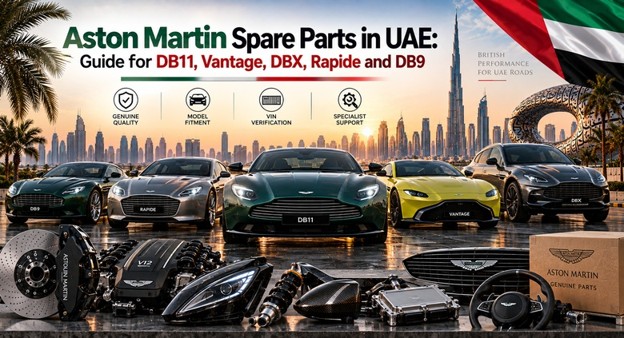
Aston Martin Spare Parts in UAE: Guide for DB11, Vantage, DBX, Rapide and DB9
September 25, 2026
Aston Martin spare parts in UAE are not the sort of thing you buy by typing a model name into a search box and hoping the photograph looks close enough. That works until it doesn't — and on a DB11, Vantage, DBX, Rapide or DB9, “close enough” can become a rather expensive phrase.
The important distinction is between finding an Aston Martin part and finding the correct part for a particular Aston Martin. VIN, model year, body style, engine, transmission, option specification and sometimes the exact component revision all belong in that conversation.
As of September 2026, Aston Martin's official model range includes newer cars such as Vantage and DBX, while DB11, DB9 and Rapide sit within the marque's previous-model and pre-owned ecosystem. Aston Martin's own pre-owned search still separately lists DB11, DB9 and Rapide, which matters for owners keeping these older cars on the road.
The real problem is not finding the part
It is identifying the part correctly.
A listing saying “Aston Martin DB11 front suspension” tells you remarkably little. V8 or V12? Coupe or Volante? Which production specification? Which side? Which revision? New, used or reconditioned?
That is why a proper parts enquiry starts with the vehicle rather than the shelf.
VIN first, catalogue second
Send the VIN before asking for a final fitment confirmation.
For expensive components, the VIN gives the supplier or specialist a much stronger basis for checking the vehicle against the intended part. It also reduces the risk of buying something that belongs to a visually similar specification.
This is particularly useful with electronics, body panels, lighting, suspension, interior trim and assemblies containing multiple sub-components.
Model name alone is too broad
“DB11” is not a complete parts specification.
A DB11 Coupe and DB11 Volante are different body configurations, while Aston Martin's own archived specification data also distinguishes DB11 Coupe, Volante and V12 versions.
The same logic applies to Vantage generations, DBX variants and the later Rapide S.
Genuine does not automatically mean compatible
A genuine Aston Martin component can still be wrong for a particular vehicle.
That distinction is easy to miss because genuine packaging creates a comforting sense that the hard part is over.
It isn't.
Authenticity tells you what the component is. Fitment tells you whether it belongs on your car.
Aston Martin Dubai provides an official UAE route
Aston Martin Dubai is an authorised and official Aston Martin dealership. Its Al Quoz service operation currently lists servicing, parts, tyres, collision repair and related aftersales support.
For difficult parts identification, complicated electronic faults or cars with uncertain service history, that official route provides a useful reference point.
It is not the only possible sourcing route. It is, however, a documented manufacturer-backed route in Dubai.
Abu Dhabi owners have an official option too
Aston Martin Abu Dhabi is also listed by Aston Martin as an authorised and official dealership, with sales and service operations at Etihad Towers, West Corniche.
That matters for owners who would rather have vehicle inspection and parts identification handled locally instead of moving a non-running or partially dismantled car between emirates.
Aston Martin itself emphasises Genuine Parts
Aston Martin's official servicing information states that approved service technicians use parts specifically designed for the vehicle and that its official service centres use Genuine Parts, with a 12-month warranty under the manufacturer's stated service programme.
For buyers, the useful takeaway is not simply “always buy genuine”.
It is to understand exactly what category of component you are being offered.
DB11 parts need generation and engine discipline
The DB11 arrived with substantially different powertrain configurations during its production life. Aston Martin's archived data identifies both V8 and V12 versions, alongside Coupe and Volante body styles.
So an enquiry such as “DB11 engine part” needs considerably more detail.
Engine-related parts should be matched against the actual engine and vehicle specification, not simply the badge on the boot.
DB11 V12 components can be a different proposition
The DB11 V12 used a 5.2-litre twin-turbo V12, with Aston Martin's published DB11 AMR specification showing 630 bhp and 700 Nm for that later performance variant.
Cooling, charge-air systems, engine sensors, ignition components and related hardware therefore deserve exact application checks.
A V12 component should never be assumed to be interchangeable with a V8 equivalent merely because both belong to the DB11 family.
DB11 Volante changes the body-parts equation
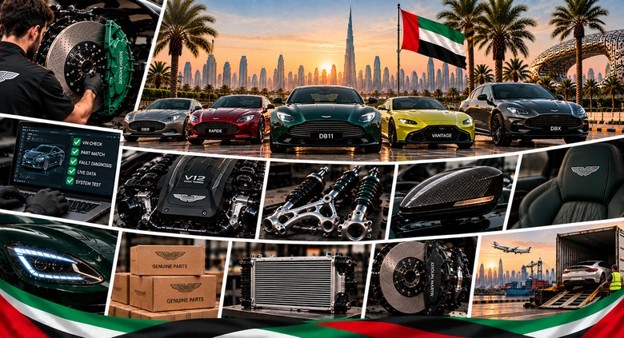
The Volante's folding roof introduces another collection of components that do not exist on the Coupe in the same form.
Roof mechanisms, seals, trim, hydraulic or electrical components and associated bodywork therefore require body-style-specific identification.
If ordering a used roof or trim component, photographs of the mounting points are worth far more than a generic statement saying “DB11 part”.
Vantage needs generation awareness
“Vantage” covers more than one generation.
The current Vantage is a 4.0-litre twin-turbo sports car, with Aston Martin's current specification showing 680 PS, 800 Nm and a rear-mounted ZF eight-speed automatic transmission.
Older Vantage cars are different propositions entirely.
For a used Vantage part, the production generation should therefore sit near the top of the enquiry.
Current Vantage cooling deserves particular attention
Aston Martin says the latest Vantage's increased power and torque required a substantially revised cooling system, including more radiators, auxiliary coolers and a larger thermal aperture area.
That is exactly the sort of model-specific detail that matters when sourcing cooling components.
A “Vantage radiator” is not a sufficiently precise request.
Ask which radiator, which cooling circuit and which Vantage.
Vantage suspension is not generic sports-car hardware
The current Vantage uses front double wishbones and rear multi-link suspension with adaptive damping.
So if a buyer is sourcing dampers, suspension arms, bushes or related components, the exact application matters.
And if the replacement affects ride height or geometry, the installation process becomes part of the parts decision.
Vantage braking components need specification checks
Brake discs, calipers and related hardware should be matched to the vehicle's exact specification.
Do not buy simply because the component carries an Aston Martin marking or because the seller says it came from a Vantage.
Check the application.
Then check condition.
For used braking components, physical inspection matters more than a flattering photograph.
DBX is not simply a larger Aston Martin
The DBX introduces a very different ownership environment because it is an SUV with all-wheel drive, substantial suspension travel and a much larger collection of chassis and driveline components.
The current DBX range includes DBX707 and DBX S, according to Aston Martin's current model information.
That makes model variant identification especially important.
DBX707 has serious cooling and brake hardware
DBX707 uses a 4.0-litre twin-turbo V8 and a 9-speed wet-clutch automatic transmission. Aston Martin lists 420 mm front and 390 mm rear carbon-ceramic brake discs on the model.
Those specifications matter when sourcing replacement components.
A DBX707 brake part should not be casually matched against a standard DBX component simply because the vehicles share the same badge family.
DBX air suspension deserves its own check
DBX707 uses triple-chamber air suspension with electronic variable damping and active anti-roll control.
That means an air-suspension problem should be diagnosed before a replacement air spring, damper or related component is ordered.
A vehicle sitting low on one corner does not, by itself, prove that a particular component is the culprit.
Leak testing, ride-height data, system diagnosis and physical inspection may all matter.
DBX electronic parts can become expensive mistakes
The DBX carries more electronic equipment than an older Aston Martin such as a DB9.
Control modules, sensors, cameras, driver-assistance equipment and infotainment components can have vehicle-specific requirements.
Before buying a used module, ask whether it can be installed directly or whether configuration, programming or calibration is required.
DBX body parts need exact trim specification
A DBX bumper, grille, mirror or trim piece can vary with model and option package.
Carbon-fibre exterior pieces deserve additional scrutiny because mounting points and surface damage may not be obvious in marketplace photographs.
Ask for the back of the panel, not just the pretty front.
DBX tyres and wheels are not just cosmetic
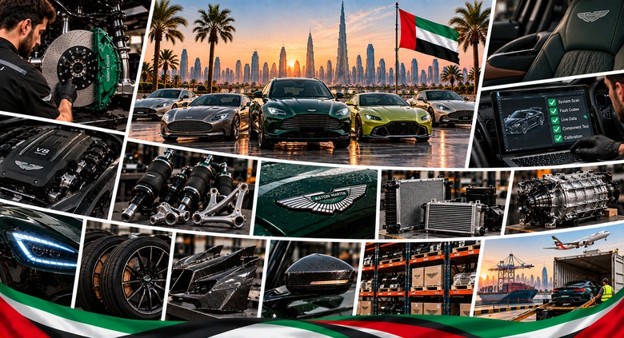
The current DBX707 specification includes different front and rear tyre sizes and 22-inch wheel equipment, with larger 23-inch options also available.
So when sourcing a wheel, tyre, TPMS component or brake assembly, the exact wheel and tyre package should be established first.
A wheel that bolts on is not necessarily the correct wheel specification.
Rapide is an older-car sourcing exercise
Aston Martin lists Rapide as a previous model, with production beginning in 2010. The original Rapide used a 5.9-litre V12 and six-speed Touchtronic 2 transmission.
That age changes the parts conversation.
Availability, donor vehicles, discontinued numbers, superseded components and refurbishment become more important than simply asking for a new part.
Rapide S needs to be separated from the original Rapide
Rapide S moved to an eight-speed Touchtronic III transmission, with different braking and suspension specifications from the earlier Rapide.
So “Rapide gearbox” is nowhere near enough information.
State Rapide or Rapide S.
Then provide the VIN.
Rapide's four-door architecture creates unusual bodywork demand
Doors, interior trim, rear-seat components and the distinctive rear cabin are specific to the Rapide's four-door design.
A used interior part may look almost perfect in photographs but still be wrong in leather colour, stitching, trim finish or seat configuration.
For interior components, trim codes and photographs should be treated as seriously as mechanical part numbers.
DB9 belongs in a different parts strategy
Aston Martin identifies the DB9 as a 2003–2012 historic model and describes it as the first Aston Martin built at the Gaydon factory, using the company's VH platform.
This is an important distinction.
A DB9 owner is not simply maintaining an old DB11.
The car has its own architecture, component history and supply challenges.
DB9 parts can benefit from donor-vehicle sourcing
For older cars, a good used genuine component can sometimes be more realistic than waiting indefinitely for a new replacement.
But donor provenance matters.
Ask where the part came from, what happened to the donor, its mileage if known, whether it was removed from a running car and whether the component was inspected before removal.
DB9 Volante adds another layer
The DB9 Volante introduced its own roof and body mechanisms, with Aston Martin describing its folding hood as a significant part of the car's engineering package.
Roof seals, hydraulic components, trim, motors and associated hardware therefore need Volante-specific identification.
Don't let a seller collapse Coupe and Volante into one generic DB9 category.
Older Aston Martins make part-number supersession especially important
A part that was originally supplied under one number may later be replaced by a superseding component.
This is one reason a specialist or official parts route can be useful when dealing with older cars.
The correct modern replacement may not carry exactly the same number as the component removed from the vehicle.
A used part should come with evidence
For an expensive Aston Martin component, request photographs showing:
- identification labels
- casting or stamped numbers
- connectors
- mounting points
- seals
- damage
- corrosion
- wear areas
- donor information where available
A single photograph taken from the front is rarely enough.
UAE heat changes what deserves inspection
Dubai, Abu Dhabi and the wider UAE place serious thermal demands on vehicles, particularly cars that spend long periods parked outdoors or in hot environments.
That does not mean every Aston Martin in the UAE has heat damage.
It does mean that batteries, rubber components, cooling systems, seals, electronics, air-conditioning components and interior materials deserve sensible inspection when age or storage history is uncertain.
Cooling-system diagnosis matters more in a UAE workshop
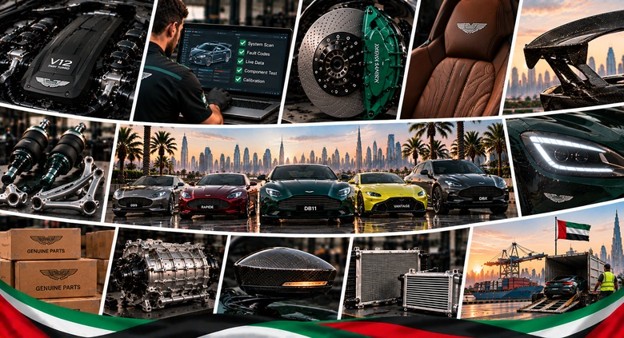
If an Aston Martin is overheating, do not jump straight to the radiator.
A workshop should establish coolant level and condition, pressure integrity, thermostat operation, fan operation, pump performance, temperature readings and evidence of restricted airflow or leakage as appropriate to the engine.
Replacing a radiator without identifying the reason for the overheating can leave the original problem sitting underneath the new part.
AC parts need the same diagnostic discipline
An Aston Martin with weak air conditioning in UAE summer traffic is not automatically suffering from a failed compressor.
The system may have refrigerant loss, condenser problems, airflow restrictions, electrical faults, pressure-control issues or other causes.
Diagnosis first.
Parts order second.
That sequence saves money.
Electronics should not be diagnosed from fault codes alone
A fault code identifies a detected condition.
It does not always identify the failed component.
A good workshop should consider wiring, connectors, power supply, grounds, communication networks, sensors and the wider system before condemning an expensive control module.
This becomes particularly important on newer Vantage and DBX models.
Ask what the workshop actually tested
For a major Aston Martin repair, “we scanned the car” is not a complete diagnostic explanation.
Ask what was tested.
Was the fault reproduced?
Was the wiring checked?
Were live values examined?
Was power and ground verified?
Was the mechanical system inspected?
Was the suspected component tested against the manufacturer's expected behaviour?
The exact procedure depends on the fault, but the reasoning should be traceable.
Genuine, OEM and aftermarket are different categories
Do not let a quotation blur these terms.
Genuine Aston Martin means the component is supplied as a genuine manufacturer part.
OEM can refer to a component produced by an original-equipment supplier, but it should not automatically be presented as Aston Martin Genuine.
Aftermarket is a broader category again.
For a routine non-critical component, alternatives may deserve consideration. For safety-critical, highly integrated or difficult-to-source parts, specification and proven compatibility become more important.
Used genuine parts can be perfectly sensible in the right place
A used DB9 interior trim panel with clear provenance is one thing.
A used DBX control module with unknown history is another.
A used carbon body panel with photographs of the mounting points may be perfectly serviceable; a damaged brake component with an uncertain history is a much different proposition.
The part determines the risk.
Imported parts need a landed-cost calculation
An overseas quotation is not the final UAE price.
Consider the component price, freight, insurance, customs treatment where applicable, VAT where applicable, handling and final delivery.
For a small sensor, shipping may be relatively insignificant.
For a large bumper, engine assembly, gearbox or body panel, logistics can materially alter the economics.
Dubai is useful, but the UAE market is wider
Dubai has an official Aston Martin service and parts operation in Al Quoz, while Abu Dhabi has an authorised dealership and service operation.
For owners elsewhere in the UAE, the decision should not be reduced to “Dubai or nowhere”.
Transport distance, collection services, workshop capability, diagnosis and part availability all belong in the calculation.
Specialist knowledge matters more as the car gets older
A newer DBX may have a relatively straightforward manufacturer-backed parts route.
A DB9 or early Rapide can be a different exercise.
The older the vehicle, the more useful it becomes to understand superseded numbers, donor cars, refurbishment, discontinued trim and component interchangeability.
That is where a specialist who understands the model history earns their keep.
The cheapest part can create the most expensive repair
Suppose one supplier offers a cheaper component but cannot confirm fitment.
Another costs more but provides the exact part number, donor information, condition photographs and a written warranty.
The cheaper quotation is not necessarily the cheaper repair.
Diagnosis, return shipping, labour and installation time all have a price.
Ask whether the quoted part includes the complete assembly
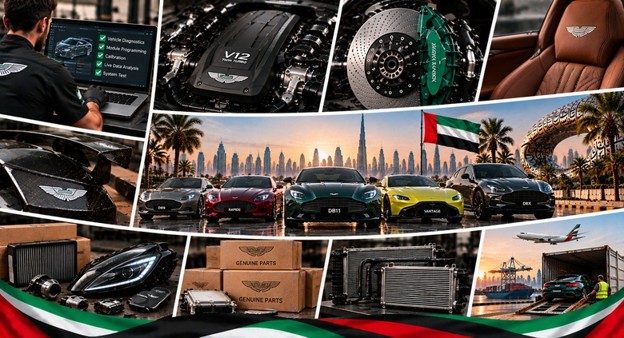
This catches people out.
A “headlight” may mean the complete lamp or only a housing.
A “mirror” may mean the shell, or the complete electrically equipped assembly.
A “suspension unit” may not include every associated component.
A “gearbox” may be a bare transmission or a more complete assembly.
Ask what is physically inside the box.
Ask what happens after installation
Some components are mechanically straightforward.
Others may require:
- programming
- calibration
- coding
- adaptation
- alignment
- system bleeding
- software updates
- diagnostic resets
The requirement depends on the component and model.
But it should be established before purchase, not discovered after the vehicle is already occupying a workshop bay.
VIN, part number and photograph should agree
For a serious parts enquiry, three pieces of evidence should point in the same direction:
VIN → part identification → physical component.
If one conflicts with the others, stop and investigate.
That simple habit is especially useful when buying used parts online or sourcing components from outside the UAE.
Before You Click Buy
For an Aston Martin DB11, Vantage, DBX, Rapide or DB9, check the following before paying:
- Exact model and generation
- Model year
- VIN
- Coupe, Volante, Roadster or SUV body style
- Engine specification
- Transmission
- Left/right side where relevant
- Exact part number
- Superseded number if applicable
- New, used or reconditioned status
- Donor vehicle information
- Mileage where known
- Accident or flood history
- Condition photographs
- What is included in the assembly
- Programming or calibration requirements
- Warranty
- Delivery cost
- Installation labour
- Return conditions
If several of those answers are missing, the sensible move is to pause rather than gamble.
A useful buyer decision matrix
| Part type | What matters most before purchase |
| Engine component | Engine variant, VIN, exact part number, diagnosis |
| Gearbox | Transmission specification, donor history, condition, installation requirements |
| Brake component | Exact specification, condition and safety inspection |
| Suspension | Model/generation, axle position, calibration or geometry requirements |
| DBX air-suspension part | Exact variant, fault diagnosis and system testing |
| Electronic module | VIN/application, software or coding requirements |
| Headlamp | Complete assembly status, specification and electronics |
| Carbon body panel | Exact body style, mounting points and damage inspection |
| DB9 trim | Colour, trim specification, donor condition |
| Rapide rear interior | Exact model, trim code and physical configuration |
| Volante roof component | Body style, mechanism identification and condition |
| Imported component | Fitment plus complete landed cost |
Why DB11, Vantage, DBX, Rapide and DB9 should not share one generic parts catalogue
They belong to the same marque.
That does not make them one mechanical family.
The DB11 brings V8/V12 and Coupe/Volante distinctions. The current Vantage has its own 4.0-litre twin-turbo platform and adaptive chassis. DBX introduces SUV-specific driveline, air suspension and electronic systems. Rapide and Rapide S belong to an older four-door V12 lineage with different transmission generations. DB9 sits further back in the VH-era history.
That is why model-specific parts pages are more useful than one enormous “Aston Martin parts” bucket.
A proper UAE parts enquiry is surprisingly simple
Give the supplier the VIN.
Name the exact model.
State the year.
Describe the failed or damaged component.
Attach photographs.
Show the old part number if available.
Then ask for the exact replacement number, condition, warranty and complete installed-cost implications.
That gives the other side something concrete to work with.
PartFinder UAE can be useful when the job is sourcing rather than guessing
For an Aston Martin owner trying to source a DB11, Vantage, DBX, Rapide or DB9 through PartFinder UAE, the useful enquiry is not simply “find this part cheaply”.
It is to establish which part actually belongs to the vehicle, what condition it is in, where it is coming from and what the complete repair will involve.
That approach cuts through a surprising amount of noise.
Official service history has value beyond the stamp
Aston Martin states that official servicing includes digital updating of the service record, helping preserve service-history provenance.
For an older DB9 or Rapide, documented history can become particularly useful when assessing a major used component or deciding whether an expensive repair is justified.
A folder full of vague invoices is not the same thing as a traceable maintenance history.
For older Aston Martins, preservation matters
A DB9 or Rapide is not simply an old car that happens to wear a premium badge.
Parts availability can become part of ownership strategy.
If a good genuine component is available today and a failure is already known, waiting until the part becomes difficult to source may not always be wise. Equally, buying piles of speculative parts makes little sense.
The sensible middle ground is evidence-led maintenance: identify known weak points, inspect the actual vehicle and source the right component when the need is real.
The best parts decision starts before the parts search
By the time a browser search begins, the important questions should already be clear.
Which Aston Martin?
Which generation?
Which engine?
Which body style?
What actually failed?
What part number is currently applicable?
Is the component new, used or reconditioned?
What has been tested?
What happens after installation?
Once those answers are established, sourcing becomes much less mysterious. The UAE market then becomes a question of availability, logistics, warranty and total repair cost rather than a frantic hunt for something that merely looks right.
FAQs
Categories
- Audi
- BMW
- Car Accessories
- Car Tips
- Ford
- Land Rover
- Mazda
- Range Rover
- Top 10
- UAE Car Parts
- Used Car Parts
- Toyota
- Replacement Engines
- Nissan
- Hyundai
- Mitsubishi
- Volkswagen
- Honda
- Kia
- Chevrolet
- Dodge
- Jeep
- Subaru
- Renault
- Lexus
- Mercedes
- Suzuki
- Hummer
- Porsche
- Infiniti
- Peugeot
- GMC
- Mini
- Volvo
- Replacement Gearboxes
- MG
- Jaguar
- Skoda
- Cadillac
- Daihatsu
- Fiat
- German Car Parts
- Japanese Car Parts
- Aftermarket Car Parts
- Genuine Car Parts
- New Car Parts
- Reconditioned Car Parts
- European Car Parts
- American Car Parts
- Korean Car Parts
- British Car Parts
- Chinese Car Parts
- Sports/Exotic Car Parts
- Luxury Car Parts
- Performance Car Parts
- SUV/4x4 Spare Parts
- Truck Spare Parts
- EV Car Parts
- Hybrid Car Parts
- Auto Spare Parts in UAE
- Tesla
- Isuzu
- Ram
- Ferrari
- Bentley
- Lamborghini
- Genesis
- Maserati
- Lincoln
- Chrysler
- Opel
- Citroen
- SsangYong
- Seat
- McLaren
- Aston Martin
- Rolls Royce