Audi Genuine vs Aftermarket Parts in UAE: What Buyers Should Know
August 19, 2026
Understanding Genuine and Aftermarket Audi Parts
Audi Genuine vs Aftermarket Parts in UAE: What Is the Difference?
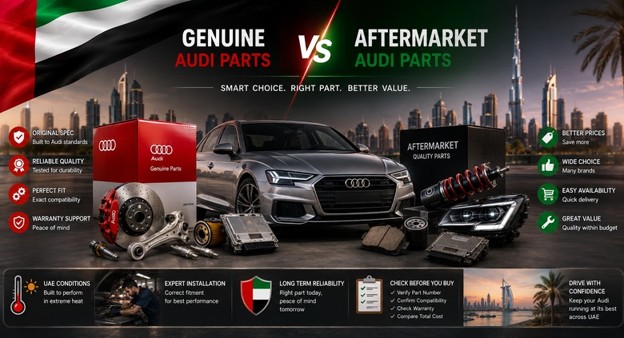
The easiest way to explain the difference is this: a genuine Audi part is supplied as an original Audi part, while an aftermarket part is made by an independent manufacturer for use as a replacement.
That sounds straightforward until you actually start shopping, because the aftermarket world is enormous. Some manufacturers produce excellent parts that meet demanding specifications, while others compete almost entirely on price.
A genuine part is therefore not automatically the only sensible choice.
Nor is an aftermarket part automatically a compromise.
The useful comparison starts with who made the part, what specification it meets, whether it fits your exact Audi and what protection you get after installation.
What does “genuine Audi” actually mean?
The genuine Audi spare parts in UAE is associated with Audi's original parts supply chain and is intended for the relevant vehicle application.
For an owner of an A4, A6, Q5 or Q7, that can provide a straightforward route when exact fitment and original specification are priorities.
You are generally paying more, though, and that premium needs a reason.
If the genuine part costs AED 700 and a reputable alternative costs AED 520, the AED 180 difference may be perfectly reasonable.
If the same genuine part costs AED 2,000 while a proven alternative costs AED 800, the decision deserves much more scrutiny.
What is an aftermarket Audi part?
An aftermarket part is produced by an independent manufacturer rather than being sold as an Audi-branded genuine replacement.
There are thousands of these products across the automotive market, from simple filters and wiper-related parts to suspension, braking, electrical and engine-related applications.
The important thing is that aftermarket is a category, not a quality rating.
One aftermarket brake part can be excellent.
Another can be poorly finished, badly matched or simply unsuitable for the way your Audi is being used.
Why UAE owners need to look beyond the label
An Audi used every day for long motorway commutes in Dubai is not necessarily facing the same ownership pattern as an older weekend-driven A4 in Abu Dhabi.
A Q7 used for family trips, heavy air-conditioning use and frequent inter-Emirate travel may justify a different approach to durability and warranty than a lightly used A3.
So ask a better question:
What level of quality does this particular repair actually require?
That is where the genuine-versus-aftermarket argument becomes useful rather than ideological.
Genuine and aftermarket comparison
| Factor | Genuine Audi | Aftermarket |
| Audi branding | Yes | No |
| Manufacturer | Audi supply chain | Independent manufacturer |
| Price | Usually higher | Wide range |
| Availability | Depends on model/part | Often broad |
| Specification | Original application | Depends on manufacturer |
| Quality consistency | Generally predictable | Varies by brand |
| Warranty | Supplier/manufacturer dependent | Manufacturer/supplier dependent |
| Best advantage | Original-spec confidence | Choice and potential savings |
The smart buyer does not stop at the first column.
Look at the actual manufacturer, exact part number, warranty and complete repair cost.
A genuine part can still be the wrong purchase
This catches people out.
A genuine Audi part can be completely original and still be unsuitable for a particular vehicle specification.
An A6 may have several engine or drivetrain configurations, and the correct part for one application may not suit another.
So “genuine” does not remove the need for VIN and part-number verification.
The part still has to fit.
What Makes Genuine Audi Parts Different from Aftermarket Parts?
The biggest difference is not simply the badge on the packaging.
It is the combination of source, specification, manufacturing responsibility, application and warranty.
When those things line up, genuine parts can offer a reassuringly predictable purchase.
Original application matters
A genuine Audi part is designed around an identified Audi application.
That can be particularly valuable when the part interacts with several other vehicle systems.
Think about an electronic module.
It may physically fit, but the vehicle could still require the correct software, coding or configuration before everything works properly.
With a complex Audi, physical fit is only the first hurdle.
Aftermarket manufacturers have different priorities
A good aftermarket manufacturer may concentrate on producing a replacement part for a broad range of vehicles.
That can bring economies of scale.
Instead of making a part only for one Audi application, the manufacturer may produce related versions for several brands or platforms.
That can help keep prices down.
But the buyer needs to know what they are getting.
Materials and manufacturing quality matter
Two visually similar parts can behave very differently after thousands of kilometres.
This is particularly relevant to parts exposed to heat, vibration, pressure or repeated movement.
For a UAE owner, that means you should pay attention to the part's intended specification rather than simply grabbing the lowest-priced listing.
High temperatures, long drives and heavy air-conditioning use are normal parts of life here.
The warranty changes the calculation
A reputable aftermarket part with a clear warranty can be a stronger purchase than an anonymous product with no meaningful support.
Likewise, a used genuine part with a defined warranty can sometimes make more financial sense than a new aftermarket item of uncertain provenance.
Warranty is therefore not decoration.
It is part of the value.
Genuine is about confidence; aftermarket is about choice
That is a useful way to think about it.
Genuine Audi gives you a more controlled route to original specification.
Aftermarket opens up a much wider field of manufacturers, price points and product types.
Neither approach should be applied blindly.
Where genuine usually has an advantage
Genuine can be particularly attractive when:
- The part is technically complex
- The vehicle is relatively new
- Installation involves substantial labour
- Coding or calibration is involved
- Failure could create secondary damage
- The price difference is manageable
- You intend to keep the Audi for several years
Where aftermarket can make sense
A reputable aftermarket part can be attractive when:
- The application is well established
- The manufacturer has a strong reputation
- The part is a common maintenance item
- The price difference is substantial
- The warranty is clear
- The workshop is comfortable installing that brand
That last point matters.
A technician who regularly sees a particular aftermarket manufacturer may have useful experience with its fitment and durability.
Are Genuine Audi Parts Worth the Higher Price in the UAE?
Sometimes.
And sometimes, frankly, no.
The answer depends on what you are buying and what it takes to replace it.
A genuine cabin filter and a genuine gearbox are two completely different financial decisions.
Start with the price difference
Suppose a genuine part costs AED 900 and a reputable aftermarket alternative costs AED 700.
You are considering an AED 200 difference.
Now imagine a difficult-to-access part where installation costs AED 1,500.
In that situation, spending the additional AED 200 for the genuine part may be quite reasonable because most of your financial exposure sits in the labour, not the part.
Now change the numbers.
If the genuine part costs AED 2,500 and the reputable alternative costs AED 900, you have a much bigger decision to make.
The Audi logo alone does not explain an AED 1,600 difference.
Installation risk should influence the decision
The more difficult the part is to replace, the more carefully you should consider quality and expected service life.
A cheap part that fails quickly can trigger another round of labour.
That is painful on a simple repair.
On a gearbox or engine-related job, it can become a serious financial headache.
When genuine is easier to justify
For a newer Audi, paying more for a genuine part may fit the ownership strategy.
You may want to preserve original specification, maintain predictable quality and avoid experimenting with alternatives while the vehicle still has substantial years ahead of it.
The same logic can apply to expensive electronic systems where compatibility and programming are particularly important.
When aftermarket can be the smarter financial move
Older Audi owners often have a different calculation.
If the vehicle is already several years old, has significant mileage and is being maintained carefully rather than restored to showroom condition, a reputable aftermarket alternative can reduce running costs without necessarily sacrificing sensible quality.
That can free up money for the repairs that actually matter.
The UAE ownership factor
The climate does not automatically make genuine parts mandatory.
That would be far too simplistic.
What UAE conditions do mean is that durability, correct specification and heat exposure deserve proper attention where relevant.
For example, if two alternatives are available for a heat-sensitive part, compare their material specification and warranty rather than assuming the cheaper one will perform identically.
Genuine versus aftermarket: a practical decision
| Situation | Usually worth considering |
| Newer Audi | Genuine or high-quality OEM |
| Older Audi | Genuine, OEM or reputable aftermarket |
| Difficult installation | Higher-confidence part |
| Simple maintenance part | Reputable aftermarket may be sensible |
| Complex electronic part | Genuine/OEM with verified compatibility |
| Large price difference | Compare manufacturer and warranty carefully |
| Safety-critical repair | Prioritise proven quality over lowest price |
The key is not to ask, “Which category is best?”
Ask:
“Which option gives this Audi the lowest sensible ownership risk for the money?”
That question gets you much closer to the right answer.
How to Identify a Genuine Audi Part Before Buying
A box that looks convincing is not proof.
Neither is a seller saying, “It is original.”
If authenticity and specification matter, verify the part using information that can actually be checked.
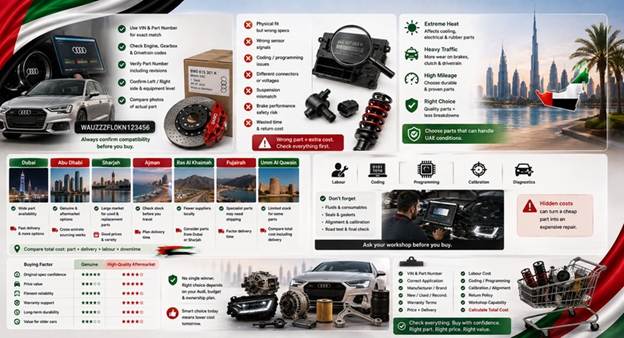
Start with the part number
The part number is one of your strongest clues.
Look for the identification printed, stamped or labelled on the part and compare it with the information supplied for the replacement.
Do not ignore suffixes or revision details.
A small difference in the number can indicate a different version, updated revision or completely different application.
Use the VIN
The VIN identifies the vehicle rather than the part itself, but it gives the supplier a much stronger starting point for compatibility.
Give the complete VIN when requesting a quotation for an expensive or technically complex Audi part.
Then ask the supplier to confirm that the proposed part is suitable for that specific vehicle.
Ask for the actual part
If you are buying a used genuine part, ask for photographs of the actual item.
For a new part, ask for packaging and identification information where appropriate.
A generic photograph from an online catalogue tells you what the part looks like.
It does not prove that the supplier has that exact specification sitting on the shelf.
Check manufacturer information
If a seller describes an item as genuine, ask what makes it genuine.
If the claim is actually “OEM”, ask who manufactured it.
If it is aftermarket, ask for the brand and part number.
Those questions strip away the vague terminology and leave you with something concrete.
Warning signs when buying
Be cautious if the seller:
- Refuses to provide a part number
- Cannot confirm VIN compatibility
- Uses only generic photographs for an expensive used part
- Makes broad “fits all Audi models” claims
- Cannot explain the warranty
- Cannot identify the manufacturer
- Pushes you to pay before compatibility is checked
None of these automatically proves fraud or poor quality.
They do tell you that the purchase deserves another look.
Packaging is not enough
A genuine-looking box can create confidence very quickly.
But packaging should support verification, not replace it.
Check the part number, application, manufacturer information and supplier documentation together.
Genuine versus genuine-used
There is another distinction worth keeping straight.
A new genuine Audi part is not the same purchase as a used genuine Audi part.
The latter may be original and perfectly usable, but it has already lived part of its service life.
For a used genuine gearbox, for example, donor mileage, testing and warranty can matter more to your financial decision than the fact that the casing carries an Audi identification mark.
OEM vs Genuine vs Aftermarket Audi Parts: What Buyers Often Get Wrong
This is where terminology starts to muddy the water.
“Genuine”, “OEM”, “original”, “replacement” and “OEM quality” are sometimes used interchangeably in listings, even though they do not necessarily describe the same thing.
Do not buy the wording.
Buy the identifiable part.
Genuine
A genuine Audi part is associated with Audi's original parts supply chain and vehicle application.
It is generally the easiest category to understand, although you should still verify the exact part number and compatibility.
OEM
OEM means Original Equipment Manufacturer.
But when a seller says “OEM”, ask which manufacturer.
That question matters.
A known OEM manufacturer with a traceable part number is one thing.
A generic part described as “OEM quality” is another.
Aftermarket
Aftermarket simply means an independent replacement manufacturer.
It tells you very little about quality on its own.
A respected aftermarket brand can produce an excellent part.
An unknown manufacturer can produce something very different.
Replacement
“Replacement” is even broader.
A replacement part may be genuine, OEM, aftermarket, used or reconditioned.
The word itself does not tell you enough to make a buying decision.
A useful terminology table
| Term | What it tells you | What it does not tell you |
| Genuine Audi | Original Audi parts supply/application | Remaining life if used |
| OEM | Independent equipment manufacturer category | Actual manufacturer unless identified |
| Aftermarket | Independent replacement part | Quality level |
| Replacement | Intended as a substitute | Who made it |
| Used genuine | Original Audi part previously used | Remaining service life |
| Reconditioned | Previously used/rebuilt | Quality of rebuild unless explained |
This distinction becomes particularly important when comparing online Audi spare parts prices.
A supplier offering an “OEM Audi gearbox” should be able to explain precisely what that means.
Likewise, a seller offering a “genuine used Q5 headlight” should be able to provide the exact identification and condition.
Which category should you choose?
Think in terms of risk, not labels.
For a simple maintenance part, a reputable aftermarket option can be entirely sensible.
For a complex electronic module, you may prefer genuine or a well-established OEM alternative where compatibility and programming are clear.
For an older Audi with an expensive failed gearbox, a tested used genuine or properly reconditioned unit may make far more financial sense than a new genuine replacement.
And for a high-value R8 repair, specification, provenance and specialist installation can outweigh a headline price saving very quickly.
The buyer's five-question test
Before choosing between genuine and aftermarket, ask:
Does it fit my exact Audi?
Who actually made it?
What is the difference in price?
What warranty protects me?
What happens if it fails after installation?
If you can answer all five, the decision becomes much less murky.
That is the real point of comparing genuine and aftermarket Audi parts in the UAE: not to crown one category as universally superior, but to work out which part gives your particular car the right combination of compatibility, quality, price and long-term value.
Audi Parts by Model and Application
Genuine vs Aftermarket Audi A3 Parts: Which Should You Choose?
The Audi A3 is one of the easier models for owners to find replacement parts for, but that does not mean every A3 part is interchangeable.
Generation, engine, gearbox, drivetrain and equipment level can all change the correct application, so start with the VIN and original part number before comparing genuine and aftermarket prices.
Where aftermarket can make sense on an A3
For routine maintenance items, reputable aftermarket brands can offer a useful price advantage without turning the repair into a gamble.
Filters, brake-related wear parts, suspension items and other commonly replaced parts can have several credible alternatives, although the manufacturer's reputation still matters.
When genuine A3 parts deserve closer attention
Be more cautious with electronic modules, transmission-related parts and other applications where compatibility is more than simply matching a mounting point.
A genuine part can make sense when the price difference is manageable and the cost of getting the repair wrong is high.
A3 price decision
| A3 situation | Sensible approach |
| Routine maintenance | Compare reputable aftermarket and genuine |
| Older A3 | Look closely at price-to-value |
| Electronic module | Verify exact part number and coding |
| Gearbox-related part | Prioritise specification |
| Difficult installation | Consider higher-confidence parts |
| Safety-critical part | Prioritise proven quality |
An A3 owner should therefore resist the temptation to buy the cheapest listing simply because several sellers show the same photograph.
The exact engine and generation can matter more than the model badge itself.
Genuine vs Aftermarket Audi A4 Parts: Price, Quality and Fitment
The A4 has been sold across multiple generations and with a wide range of engines and transmissions, so “Audi A4 part” is not precise enough for many serious purchases.
A supplier should know which generation and powertrain you have before quoting a major part.
A4 engine-related parts
Engine-specific sensors, cooling parts, intake-related parts and other mechanical items can differ between engine codes.
An aftermarket part that fits one A4 application may not be suitable for another.
Check first.
Buy second.
A4 suspension and brake parts
These are areas where owners can often compare genuine and aftermarket options more comfortably, particularly when reputable manufacturers produce the relevant replacement.
But specification still matters.
Different suspension setups can change the correct part, while brake systems can vary according to engine, trim and equipment.
A4 electronic parts
This is where the price-saving argument becomes less straightforward.
A used or aftermarket electronic part may cost much less than a new genuine unit, but coding, programming or compatibility can become part of the repair.
If your workshop cannot configure the replacement, the cheap part has not solved anything.
A4 buying example
Suppose a genuine A4 part costs AED 1,200.
A reputable aftermarket equivalent is AED 750, while a used genuine unit is AED 450.
Do not immediately choose AED 450.
Ask how old the used part is, whether it has been tested, what warranty comes with it and whether all three options require the same installation work.
That is a proper comparison.
What A4 owners should prioritise
For an older A4, the financial argument for aftermarket or used genuine parts can be strong.
For a newer A4, particularly one you intend to keep for several years, paying more for a new genuine or proven OEM part may be easier to justify.
The vehicle's remaining ownership period matters just as much as today's price.
Genuine vs Aftermarket Audi A6 Parts: Where the Difference Matters
The A6 can involve more sophisticated electronic and mechanical systems depending on its generation and specification.
That makes diagnosis and compatibility particularly important when choosing between genuine and aftermarket parts.
Do not replace an A6 part simply because a fault code mentions it
A diagnostic code can point towards a system, circuit or sensor.
It does not always prove that the physical part itself has failed.
Check wiring, connectors, voltage supply and related systems before ordering an expensive replacement.
This one step can save a lot of money.
A6 electronic parts
For control modules and other electronically integrated parts, exact identification becomes critical.
A used genuine module may be cheaper than a new Audi unit, but it may require programming or adaptation.
An aftermarket alternative may be cheaper again, but compatibility and software support need to be established before purchase.
A6 suspension and chassis parts
For conventional wear parts, reputable aftermarket manufacturers can provide useful alternatives.
But if the A6 has a more complex suspension specification, confirm the exact application before ordering.
The cheapest suspension part is not useful if it changes the vehicle's intended specification or needs to be removed again.
A6 gearbox-related parts
Transmission repairs deserve a different level of caution.
The gearbox code, engine pairing and drivetrain configuration should be confirmed.
For an expensive transmission repair, the extra cost of a higher-confidence part may be justified because repeat labour can quickly erase an initial saving.
Where the price difference matters most
If a genuine A6 part costs only slightly more than a reputable aftermarket alternative, genuine may be the easier decision.
If the difference is several thousand dirhams, stop and examine what you are actually receiving.
That means comparing:
manufacturer + specification + condition + warranty + installation risk.
For owners comparing Audi part availability and prices, PartFinder UAE can be useful as part of the supplier-comparison process, but the exact part number and vehicle compatibility should still be verified before purchase.
Genuine vs Aftermarket Audi Q5 and Q7 Parts: What SUV Owners Should Check
The Q5 and Q7 deserve extra attention because their larger size does not automatically mean every part is more expensive, but certain mechanical and electronic repairs can become significantly more involved.
The drivetrain specification is especially important.
Q5 parts: check the drivetrain
Quattro-related applications can require precise matching.
A Q5 with one powertrain specification should not be assumed to accept a drivetrain part from another simply because the body and model name look identical.
Check the original number and vehicle specification.
Q5 suspension choices
Q5 suspension can vary according to equipment and configuration.
Before buying springs, dampers, arms or related parts, establish exactly what is fitted to the vehicle.
A generic “Q5 suspension part” description is too vague for a serious purchase.
Q7 parts: larger repair consequences
The Q7 can involve substantial repair costs when major mechanical assemblies or sophisticated electronic systems are involved.
That makes the genuine-versus-aftermarket decision more sensitive to installation time and repeat-failure risk.
If replacing a part requires extensive dismantling, a slightly cheaper part may not be the smartest saving.
Q7 air suspension
Where fitted, air suspension introduces additional possibilities when a vehicle develops a low ride height or suspension warning.
Do not immediately assume the air spring is the failed part.
The compressor, valve system, air lines, sensors and other related areas may need checking.
Diagnosis comes before the parts order.
Used genuine Q5/Q7 parts
Used genuine parts can be particularly attractive for expensive body, lighting and mechanical assemblies.
A Q7 headlight, for example, may be worth sourcing used if the unit is genuine, undamaged, correctly identified and significantly cheaper than new.
But inspect the actual part.
Check mounting points, lenses, connectors, moisture and electronic functions where relevant.
Q5 versus Q7 decision
| Area | Q5 | Q7 |
| Drivetrain | Exact specification important | Exact specification very important |
| Suspension | Configuration matters | Air suspension may add complexity |
| Electronics | Verify part number/coding | Verify part number/coding |
| Used parts | Can offer strong savings | Can offer strong savings on expensive parts |
| Major repair risk | Moderate to high | Potentially high |
| Price priority | Important | Important, but repeat labour matters more |
For both SUVs, the right aftermarket part can save money.
The wrong one can cost much more than the original price difference.
Genuine vs Aftermarket Audi Q8 and R8 Parts: Why Specification Matters More
The Q8 and R8 sit at very different points in Audi's range, but they share one important buying lesson:
Do not let price outrun specification.
Q8 parts
The Q8 uses newer technology and can have sophisticated electronic integration depending on its equipment.
That makes exact part identification increasingly important.
A replacement electronic part may need coding, programming or calibration after installation, so the purchase price should never be treated as the entire repair cost.
Q8 lighting
Advanced lighting systems can make a seemingly simple headlight replacement more complicated.
Check the exact part number, hardware, electronic specification and any configuration requirements before buying a used or aftermarket unit.
A cheaper headlight that cannot be correctly configured is not a successful saving.
Q8 suspension and chassis parts
Specification should be checked carefully where the vehicle has electronically controlled or specialised suspension.
Do not assume that a physically compatible part will reproduce the original vehicle behaviour.
Ask the workshop to confirm the correct application before ordering.
R8 parts are a different proposition
The R8 is a performance-focused vehicle, so certain parts deserve a much more conservative approach to specification and provenance.
For performance-critical mechanical parts, braking systems, suspension and drivetrain-related applications, saving money should not come before confirming that the replacement is genuinely appropriate for the vehicle.
Why used R8 parts need extra scrutiny
A used genuine R8 part may be expensive even when it is considerably cheaper than a new replacement.
That does not make it a poor purchase.
But donor history, condition, part number and specialist inspection become more important because the cost of getting the decision wrong can be substantial.
Q8 versus R8
| Factor | Q8 | R8 |
| Main concern | Electronic integration and specification | Performance specification and provenance |
| Used parts | Verify condition and coding | Verify condition and specialist suitability |
| Aftermarket | Manufacturer quality matters | Greater caution for critical parts |
| Genuine | Useful for complex applications | Often easier to justify for critical parts |
| Coding/calibration | May be required | Depends on system |
| Price comparison | Include programming/installation | Include specialist labour and risk |
Should you always choose genuine on a Q8 or R8?
No.
But the threshold for accepting an unknown aftermarket product should be much higher when the part is technically complex, performance-critical or difficult to replace.
For a straightforward trim piece, the calculation is different.
For a critical drivetrain or braking part, it is not.
Model generation still comes first
An Audi badge does not identify the part.
A3, A4, A6, Q5, Q7, Q8 and R8 are families, not individual specifications.
Generation, engine, gearbox, drivetrain, equipment and part number narrow the search down to the actual application.
That is why a proper genuine-versus-aftermarket comparison should always begin with fitment, then move through quality, warranty, price and installation risk.
The cheapest part only wins when it is also the right part.
Price, Quality and Reliability
Genuine Audi Parts Prices in UAE: What Are You Actually Paying For?
The higher price of a genuine Audi part is not simply the cost of putting four rings on a box.
You are also paying for the original parts supply chain, specification confidence, availability, warranty arrangements and, depending on the part, a lower level of uncertainty about fitment.
But how much of that premium is actually useful to you?
That depends on the repair.
Genuine does not have one fixed price premium
There is no sensible rule saying genuine Audi parts are always 20%, 30% or 50% more expensive than aftermarket.
The difference changes dramatically between parts.
A simple maintenance part may have a modest gap.
A sophisticated electronic module, headlight, gearbox or engine-related part can have a much wider spread.
What affects the genuine Audi price?
| Factor | Effect on price |
| Exact part number | Determines the specific application |
| Audi model/generation | Changes availability and specification |
| Part complexity | More complex parts generally cost more |
| Electronic integration | Can increase replacement complexity |
| Availability | Scarce parts may cost more |
| New condition | Higher than used alternatives |
| Warranty | Adds value to the purchase |
| Installation difficulty | Can make the total repair much higher |
That last point is easy to miss.
A genuine part costing AED 1,000 may be excellent value if fitting it costs AED 2,000 and the alternative has a higher failure risk.
Genuine price versus complete repair
Imagine three quotations for an Audi A6 electronic module:
| Option | Part price | Other repair costs | Illustrative total |
| Genuine | AED 2,000 | AED 600 | AED 2,600 |
| Reputable aftermarket | AED 1,200 | AED 700 | AED 1,900 |
| Used genuine | AED 700 | AED 800 | AED 1,500 |
These figures are illustrative only, not fixed UAE prices.
The used option appears to win.
But what happens if it requires additional programming, has a weak warranty or fails shortly afterwards?
The cheapest purchase may not remain the cheapest repair.
What are you really buying?
With genuine, you are primarily buying confidence in original application and new-part condition.
That can be valuable.
But if a reputable aftermarket manufacturer offers the same required function, correct specification and strong warranty for considerably less, the genuine premium deserves to be questioned rather than accepted automatically.
When the premium is easier to justify
Genuine is easier to justify when:
- The Audi is relatively new
- You plan long-term ownership
- The part is difficult to replace
- Coding or calibration is involved
- Failure would create substantial repeat labour
- The price difference is relatively small
- The part is safety-critical
The older the Audi and the wider the price gap, the more carefully you should compare alternatives.
Aftermarket Audi Parts Prices in UAE: How Much Can You Save?
Aftermarket pricing is much harder to summarise because there is no single aftermarket price level.
You can find inexpensive products, mid-range alternatives and premium independent brands serving essentially the same vehicle application.
That variety is both the attraction and the problem.
Price ranges are manufacturer-driven
Two aftermarket parts may fit the same Audi yet come from completely different manufacturers.
One may use better materials, tighter manufacturing tolerances or stronger quality control.
The other may simply be cheaper.
So if one seller quotes AED 300 and another AED 550, do not ask only why the second seller is expensive.
Ask what exactly is different.
Where the saving can be substantial
The largest savings often appear when the genuine Audi replacement carries a significant premium over an established aftermarket alternative.
This can be attractive for older A3, A4 and A6 vehicles where owners want to control annual running costs.
But saving 40% does not mean getting 40% less quality
Percentage comparisons can be misleading.
If a genuine part costs AED 1,000 and a reputable aftermarket part costs AED 600, the saving is AED 400.
That is meaningful.
But if the aftermarket part has a shorter warranty, poor availability or requires extra fitting work, the effective saving becomes smaller.
A better aftermarket price test
Ask:
Who made it?
What is the exact part number?
What specification does it meet?
What warranty is offered?
Does my workshop trust the brand?
Will it require coding or calibration?
Those questions tell you far more than the percentage discount.
Aftermarket price by part type
| Part type | Aftermarket saving potential | Main consideration |
| Filters | Often useful | Manufacturer quality |
| Brake parts | Can be useful | Safety and specification |
| Suspension parts | Potentially significant | Fitment and durability |
| Sensors | Variable | Correct electrical specification |
| Electronic modules | Potentially large | Coding/compatibility |
| Body parts | Often useful | Fit, finish and paint |
| Gearbox | Potentially substantial | Provenance and reliability |
| Engine | Potentially substantial | Testing and warranty |
Cheap aftermarket does not always mean poor
A reputable manufacturer may price aggressively because it produces high volumes or supplies several markets.
Likewise, a high-priced aftermarket product is not automatically excellent.
Price is evidence.
It is not proof.
The UAE cost equation
For UAE owners, compare the total installed cost, particularly if the part is difficult to replace.
A saving of AED 700 on the part can disappear quickly if the alternative requires additional labour or fails early.
That is why the strongest aftermarket purchase is not necessarily the one with the largest discount.
It is the one with the largest sensible saving after risk is accounted for.
Genuine vs Aftermarket Audi Parts: Complete Repair Cost Comparison
This is where the genuine-versus-aftermarket debate becomes much more practical.
Forget the sticker for a moment.
Put both options into the same repair calculation.
Example: Audi suspension repair
Imagine a genuine suspension part at AED 1,400 and a reputable aftermarket alternative at AED 850.
At first glance, the aftermarket option saves AED 550.
Now add the rest of the job.
| Cost | Genuine | Aftermarket |
| Part | AED 1,400 | AED 850 |
| Delivery | AED 100 | AED 100 |
| Labour | AED 700 | AED 700 |
| Alignment | AED 250 | AED 250 |
| Illustrative total | AED 2,450 | AED 1,900 |
The aftermarket option still saves AED 550.
That may be worthwhile if the manufacturer is reputable and the warranty is comparable.
Now consider a difficult repair
Suppose a genuine gearbox-related part costs AED 6,000 and an aftermarket alternative costs AED 4,200.
The difference is AED 1,800.
But if the aftermarket unit fails and the workshop charges AED 2,500 to remove and refit it, your apparent saving disappears.
This is why installation difficulty changes the value equation.
Compare four things, not two
For every important repair, compare:
Purchase price
Installation cost
Warranty
Failure/replacement risk
Then consider expected service life.
That produces a much more realistic comparison.
Genuine versus aftermarket project comparison
| Question | Genuine | Aftermarket |
| Initial price | Usually higher | Usually lower |
| Specification confidence | High | Depends on manufacturer |
| Installation | Usually same basic requirement | Usually same, but may vary |
| Coding/calibration | May apply | May apply |
| Warranty | Supplier/manufacturer terms | Manufacturer/supplier terms |
| Failure risk | Not zero | Varies by brand |
| Potential saving | Lower | Higher |
| Long-term value | Depends on vehicle | Depends on quality and price |
There is no automatic winner.
A premium aftermarket part can be excellent value.
A bargain aftermarket part can be false economy.
A genuine part can be worth every dirham.
Or it can be an unnecessary expense.
Consider the Audi's current value
This matters particularly with older vehicles.
If your 12-year-old A4 is worth AED 25,000 and a new genuine part costs AED 4,000 while a proven alternative costs AED 1,800, the wider ownership calculation deserves attention.
That does not mean “buy cheap”.
It means match the repair spend to the vehicle's condition and expected future use.
Warranty changes the comparison
Two parts priced AED 500 apart are not necessarily AED 500 apart in value.
If one comes with stronger warranty protection and a clearer replacement process, part of the price difference may be buying reduced financial exposure.
That matters even more when labour is expensive.
Are Expensive Genuine Audi Parts Always Better?
No.
And this is probably the most important point in the whole genuine-versus-aftermarket discussion.
A higher price can indicate a different supply route, new-part status, brand positioning or specification.
It does not automatically prove that the part will deliver proportionally better real-world value.
Price and quality are not identical
Consider two brake parts.
One costs AED 700 and carries a recognised manufacturer warranty.
Another costs AED 350 from an unknown source with little information about materials or testing.
The AED 700 part may be the better purchase.
Now compare the AED 700 part with a reputable aftermarket alternative costing AED 480.
That is a much more interesting decision.
Where genuine can be genuinely better
There are applications where original parts can provide advantages through precise integration with the vehicle.
Complex electronic systems are a good example.
If a part communicates with several vehicle systems and requires specific coding or calibration, compatibility becomes a major consideration.
Where the genuine premium may not buy much
For certain straightforward maintenance or wear parts, a reputable aftermarket manufacturer may provide an excellent alternative.
If the part meets the required specification and has a strong track record, paying substantially more for the Audi-branded version may not produce a proportionate benefit.
Do not confuse brand with durability
A part can carry an Audi label and still eventually wear out.
Likewise, a high-quality aftermarket part can deliver years of reliable service.
Durability depends on design, materials, manufacturing quality, installation and operating conditions.
UAE operating conditions
Audi owners in the UAE deal with high ambient temperatures, heavy air-conditioning use, long commutes and, for some vehicles, substantial annual mileage.
Those conditions make correct specification and durability important.
They do not create a blanket rule that genuine parts must always be used.
Instead, consider how exposed the specific part is to heat, vibration, pressure or continuous operation.
Expensive genuine parts can still be the right choice
There is no contradiction here.
A genuine part can be the better option even when it is considerably more expensive.
That is particularly true when:
- The alternative's quality is uncertain
- Installation is very expensive
- The part is safety-critical
- Coding compatibility is difficult
- The vehicle is relatively new
- Warranty protection is stronger
The point is not to avoid genuine parts.
It is to understand why you are paying more.
Can High-Quality Aftermarket Audi Parts Match Genuine Parts?
Sometimes they can come remarkably close.
But “aftermarket” covers too many manufacturers to make a blanket claim.
The real comparison should be between specific manufacturers and specific parts, not between two labels.
Manufacturer reputation matters
A recognised aftermarket manufacturer with a long history in a particular part category deserves a different level of consideration from an anonymous seller.
If a manufacturer specialises in braking, suspension, filtration or electrical parts, its engineering capability in that category can be highly relevant.
Check the specification
Before choosing an aftermarket replacement, verify:
- Exact Audi application
- Part number
- Engine compatibility
- Gearbox/drivetrain where relevant
- Dimensions
- Electrical specification
- Manufacturer
- Warranty
A good brand cannot rescue the wrong part.
Fitment comes before quality
This is worth repeating because it causes so many avoidable purchases.
A superb aftermarket part that does not match your Audi is still useless.
An average-looking genuine part with the correct application may be the safer choice.
Correct fitment comes first.
What about service life?
You cannot assume that every aftermarket part will last exactly as long as a genuine Audi part.
Likewise, you cannot assume the genuine part will always last longer.
Look for manufacturer evidence, warranty terms and credible workshop experience where available.
Aftermarket parts that deserve more careful comparison
Pay particular attention to:
- Braking systems
- Suspension
- Sensors
- Engine-management parts
- Cooling-system parts
- Transmission-related parts
- Electronic modules
- Driver-assistance-related parts
These are not all equally risky, but errors can become expensive quickly.
Where aftermarket can be excellent value
A common maintenance part from a reputable manufacturer can make little financial sense to buy at a huge genuine premium if the alternative provides the required specification and appropriate warranty.
That is where aftermarket can genuinely improve ownership economics.
A practical quality test
Before buying, ask:
Is the manufacturer known?
Is the exact part number traceable?
Is the specification confirmed?
Is the warranty meaningful?
Can my workshop install and configure it correctly?
If the answer to all five is yes, the aftermarket option deserves serious consideration.
Genuine versus aftermarket: the real conclusion
The best Audi part is not necessarily the one that costs the most.
It is the one that fits correctly, performs the required job, comes from a credible source, carries sensible warranty protection and leaves you with a repair bill that makes sense for the vehicle.
That is a much more useful standard for UAE owners than simply asking whether genuine is better than aftermarket.
Compatibility, UAE Conditions and Workshop Decisions
Audi VIN and Part Number Checks: How to Avoid Buying the Wrong Part
Before comparing genuine and aftermarket prices, confirm that you are comparing the same Audi application.
It sounds obvious, yet this is where plenty of parts searches go sideways: an A6 part looks identical in a photograph, the price looks attractive, and only after delivery does someone discover that the connector, revision or specification is different.
Start with the VIN
Give the supplier the complete VIN whenever possible.
The VIN helps narrow down the exact vehicle specification, while the original part number identifies the part already fitted to the car.
Using both gives you a much stronger compatibility check than searching for “Audi A4 brake part” or “Audi Q5 sensor” on its own.
Check the complete part number
Do not overlook suffixes, revisions or other identification marks.
Two Audi parts can look almost identical while carrying different applications.
If the replacement has a different number, ask whether it is a confirmed supersession rather than assuming it is interchangeable.
Genuine does not eliminate compatibility problems
This catches buyers out.
A genuine Audi part can still be wrong for your particular engine, gearbox, generation or equipment specification.
“Genuine” describes the source or branding.
It does not mean every Audi can use it.
Aftermarket requires even more checking
With aftermarket parts, verify the manufacturer's application list and exact reference number.
A reputable manufacturer should provide vehicle applications rather than simply claiming that a product “fits Audi”.
If the listing is vague, slow down.
Important compatibility information
| Check | Why it matters |
| VIN | Identifies the vehicle specification |
| Model generation | Prevents cross-generation mistakes |
| Engine code | Important for engine-specific parts |
| Gearbox code | Critical for transmission applications |
| Drivetrain | Can change the correct part |
| Original part number | Strong fitment reference |
| Revision/suffix | May indicate a different application |
| Equipment level | Can affect electronic and chassis parts |
| Left/right position | Essential for many body and suspension parts |
Photograph the old part
If the existing part has a readable label, photograph it before removal.
Keep the image.
It gives you a reference when comparing supplier quotations and can help prevent a surprisingly simple identification mistake.
What if the supplier says the part number is different?
Do not reject it immediately.
Manufacturers sometimes supersede older numbers with updated versions.
Ask the supplier to explain the change and confirm compatibility with your VIN.
If they cannot do that, keep looking.
Compatibility should come before price
Suppose one supplier offers an aftermarket Audi sensor for AED 280 and another offers one for AED 420.
The AED 280 option looks better.
But if its electrical specification does not match your vehicle, the AED 140 saving is meaningless.
Verify first. Compare second. Buy third.
Audi Aftermarket Parts and Compatibility: What Can Go Wrong?
A good aftermarket part can work extremely well.
The problem begins when buyers treat “aftermarket” as though every manufacturer follows the same design, materials and application standards.
They do not.
The part may physically fit but still be wrong
This is particularly relevant to electronic parts.
A module can have the correct mounting points and connectors yet still require software, coding or configuration that is not compatible with the vehicle.
Physical fitment is only one layer of compatibility.
Sensors can create false confidence
A replacement sensor may look identical to the original.
But differences in electrical characteristics, calibration or communication can affect how the Audi's systems interpret its signal.
That is why exact manufacturer references matter.
Braking parts need proper specification
A brake part that is close in dimensions may still be unsuitable for the specific Audi.
Check the correct application, dimensions and manufacturer specification rather than choosing based on visual similarity.
For safety-related parts, price should never be the first filter.
Suspension can be specification-sensitive
Audi models can have different suspension configurations.
The correct part may depend on the vehicle's equipment and chassis specification.
An aftermarket supplier should therefore be able to identify the correct application rather than simply saying, “It fits Q5.”
Electronic parts may need programming
Some aftermarket or replacement electronic parts can require coding, programming or adaptation after installation.
Ask the workshop before buying.
Otherwise, you may save AED 500 on the part and then discover an unexpected programming bill — or, worse, that the workshop cannot configure it.
Common compatibility mistakes
| Mistake | Possible result |
| Matching only the Audi model | Wrong specification |
| Ignoring engine code | Incorrect engine-related part |
| Ignoring gearbox code | Transmission mismatch |
| Comparing photographs | Hidden specification differences |
| Ignoring part suffix | Wrong revision |
| Buying without VIN confirmation | Expensive return |
| Forgetting coding | Part may not operate correctly |
| Choosing by lowest price | Higher repeat-repair risk |
What happens when the wrong part arrives?
You may face return shipping, workshop delays and another wait for the correct part.
If the vehicle has already been dismantled, the cost can become even more frustrating because the workshop may be unable to finish the job.
That is why compatibility checks should happen before payment, not after the parcel reaches the garage.
UAE Heat, Traffic and Mileage: How Should You Choose Audi Parts?
UAE conditions do not mean you must buy genuine Audi parts for everything.
They do mean you should think carefully about where the part operates, how hard the vehicle is used and how expensive failure would be.
Heat is part of normal ownership
High ambient temperatures, heavy air-conditioning use and extended periods of driving can place additional demands on cooling, electrical and other heat-sensitive systems.
That does not prove that an aftermarket part will fail.
It means the manufacturer, specification and warranty deserve proper attention.
Mileage changes the calculation
An Audi used every day for long commutes can accumulate substantial mileage.
For an older, high-mileage vehicle, spending heavily on every genuine replacement may not be financially sensible.
At the same time, fitting the cheapest possible part to a heavily used vehicle can be false economy.
The answer sits somewhere in between.
Consider the job the part performs
Ask how exposed the part is to:
- Heat
- Vibration
- Pressure
- Continuous operation
- Moisture
- Mechanical wear
- Electrical load
A trim part and a cooling-system part should not be judged by the same standard.
UAE driving patterns matter
A Dubai owner travelling daily between home and work may put far more kilometres on an Audi than someone who uses the car only occasionally.
Likewise, an Audi used regularly between Dubai and Abu Dhabi will accumulate motorway mileage quickly.
For these owners, durability and warranty can become more valuable than a small upfront saving.
Older Audi versus newer Audi
For a newer Audi, the premium for genuine or high-quality OEM parts may be easier to justify.
For an older A4 or A6, a proven aftermarket alternative can help control running costs while keeping the vehicle economically viable.
The decision should follow the vehicle's age, condition and expected future ownership, not the odometer alone.
UAE condition decision matrix
| Ownership situation | Priority |
| Newer Audi | Specification and long-term reliability |
| High-mileage commuter | Durability and warranty |
| Older Audi | Value and complete repair cost |
| Heavy daily use | Proven manufacturer |
| Light occasional use | Price can carry more weight |
| Heat-exposed part | Materials, specification and warranty |
| Difficult-to-replace part | Higher confidence and lower repeat-failure risk |
Do not use climate as a sales shortcut
If someone tells you, “Because it is UAE weather, you must use genuine,” ask why.
Which part?
What specification?
What evidence?
The climate matters, but it should be part of a broader engineering and ownership decision rather than a blanket reason to spend more.
Audi Genuine vs Aftermarket Parts in Dubai, Abu Dhabi and Sharjah
The basic rules do not change between Emirates.
The practical buying conditions can.
Supplier stock, workshop labour, delivery time, specialist capability and vehicle downtime all influence the final value of a genuine or aftermarket part.
Dubai
Dubai gives owners access to a large automotive market, which can make supplier comparison easier.
That is useful when you want to compare genuine, OEM and aftermarket options for the same Audi.
But more listings also mean more opportunities to compare parts that are not actually identical.
Check the part number before comparing the prices.
Abu Dhabi
Abu Dhabi owners may find that a specialist part is available from another Emirate.
That is not necessarily a disadvantage.
If the supplier can confirm the exact application, provide appropriate warranty protection and deliver quickly, cross-Emirate sourcing can make financial sense.
Sharjah
Sharjah can offer a broad selection of replacement and used automotive parts.
For Audi owners, that variety can be helpful when searching for alternatives to expensive genuine parts.
Still, inspect the manufacturer's identity, exact part number and warranty before deciding.
Ajman, Ras Al Khaimah, Fujairah and Umm Al Quwain
Owners outside the largest automotive markets may sometimes need to source specialist parts from elsewhere in the UAE.
The calculation is straightforward:
Part price + delivery + workshop cost + downtime.
A part that costs AED 300 less is not necessarily cheaper if it arrives several days later and keeps the Audi off the road.
Workshop capability can matter more than location
Suppose a genuine Audi module is available immediately at a nearby supplier.
An aftermarket alternative costs less but needs coding that the local workshop cannot perform.
The cheaper part may now require additional transport to a specialist.
The original saving can disappear.
Emirate-level comparison
| Location | What buyers should consider |
| Dubai | Wide supplier choice and workshop availability |
| Abu Dhabi | Local versus cross-Emirate sourcing |
| Sharjah | Broad replacement-part market |
| Ajman | Delivery and workshop access |
| Ras Al Khaimah | Availability versus transport |
| Fujairah | Cross-Emirate sourcing may help |
| Umm Al Quwain | Delivery and specialist capability |
There is no single “cheapest Emirate” for Audi parts.
The best option is the supplier offering the right part, sensible price, credible warranty and practical delivery.
Audi Workshop Labour, Coding and Calibration: Hidden Costs Buyers Miss
This is where an apparently excellent parts deal can unravel.
You find an aftermarket Audi module for AED 900 instead of a genuine unit at AED 1,600.
Great.
Then the workshop tells you it needs additional programming, adaptation and diagnostics.
Suddenly, the price gap is much smaller.
Labour is part of the parts decision
Before buying, ask the workshop:
How much will you charge to install this exact part?
Do not assume genuine and aftermarket options will always have identical installation requirements.
The physical fitting may be the same, but configuration or additional troubleshooting can differ.
Coding
Some electronic Audi parts require coding after installation.
This can include certain control modules and other electronically integrated systems.
Confirm whether coding is required before ordering the replacement.
Programming and adaptation
Programming can involve configuring the replacement part for the vehicle.
Adaptation can be necessary for certain systems to operate correctly after installation.
The exact requirement depends on the Audi and the part.
Do not let a supplier promise “plug and play” unless the workshop confirms it.
Calibration
Certain Audi systems can require calibration after a replacement or repair.
Depending on the vehicle and system, this can affect driver-assistance, steering, suspension, lighting or other electronically managed functions.
Ask the workshop to identify any calibration requirement in advance.
Diagnostics
Diagnostics belong at both ends of the repair.
Before purchasing, diagnosis can help establish whether the part has actually failed.
After installation, diagnostics can confirm whether the original problem has disappeared and whether any new faults remain.
Replacing an expensive part without confirming the underlying fault is a costly way to guess.
Illustrative repair comparison
Suppose:
| Cost | Genuine | Aftermarket |
| Part | AED 1,600 | AED 900 |
| Installation | AED 500 | AED 500 |
| Coding | AED 250 | AED 450 |
| Diagnostics | AED 150 | AED 200 |
| Illustrative total | AED 2,500 | AED 2,050 |
The aftermarket option still saves AED 450.
But notice what happened.
The original AED 700 parts-price difference became a AED 450 complete-repair saving.
That is why comparing only the part price can give you the wrong impression.
Workshop checklist
Before buying, ask whether the quotation includes:
- Part installation
- Diagnostics
- Coding
- Programming
- Adaptation
- Calibration
- Fluids
- Seals
- Supporting parts
- Road testing
Not every job needs all of these.
The point is to identify which ones your Audi actually needs.
What if the aftermarket part fails?
This is the question buyers often forget.
Ask who pays for removal and refitting if the replacement fails.
If the part costs AED 1,000 but another AED 1,500 is required to remove and reinstall it, the warranty becomes much more important.
A supplier offering a slightly more expensive part with clearer warranty protection may therefore deliver better overall value.
The final workshop decision
Do not choose a genuine or aftermarket Audi part in isolation.
Bring the supplier, part, workshop and warranty into the same conversation.
Once you know the exact fitment, installation requirements, coding or calibration needs and failure protection, the price comparison becomes much cleaner.
And that is the real UAE buying decision: not “genuine or aftermarket?” in the abstract, but “which exact part gives this Audi the right result without creating a bigger bill later?”
Making the Right Buying Decision
Genuine vs Aftermarket Audi Parts for Older and High-Mileage Cars
An older Audi changes the maths.
The question is no longer simply whether genuine is technically preferable; you also have to ask whether paying the genuine premium makes sense for a vehicle that has already covered substantial mileage and may have other ageing parts waiting in the wings.
Look at the whole Audi first
Before approving an expensive genuine replacement, assess the vehicle's broader condition.
Check the engine, gearbox, cooling system, suspension, brakes, tyres, electrical systems, air conditioning and service history.
If the Audi is otherwise healthy, spending more on one important part can be perfectly rational.
If three or four major repairs are already approaching, the same purchase needs much more scrutiny.
High mileage does not automatically favour aftermarket
A 180,000-km A4 with excellent maintenance history may be a better candidate for a quality genuine replacement than a neglected 100,000-km car.
Mileage gives you useful context.
It does not tell the whole story.
When aftermarket becomes attractive
For older Audis, a reputable aftermarket part can make particular sense when the genuine price is high but the part itself is relatively straightforward and the independent manufacturer's reputation is strong.
That can keep annual ownership costs under control without forcing you into questionable low-quality parts.
Major parts require a different calculation
Be more careful with engines, gearboxes and difficult-to-access parts.
If installation costs AED 2,000–3,000 or more, the cost of getting the decision wrong can quickly exceed the difference between genuine and aftermarket.
In those situations, warranty and expected service life deserve almost as much attention as the purchase price.
Older-Audi decision guide
| Vehicle situation | More sensible approach |
| Older Audi, excellent condition | Compare all credible options |
| Older Audi, one major fault | Genuine vs aftermarket based on risk |
| High mileage, strong history | Quality and warranty |
| High mileage, several faults | Calculate future ownership cost |
| Low-value Audi | Avoid disproportionate genuine premiums |
| Difficult installation | Prioritise proven reliability |
| Business/fleet use | Include downtime |
UAE mileage matters too
Long commutes, motorway journeys between Emirates and heavy daily use can push mileage up quickly.
For an Audi that spends much of its life on the road, a small saving on a part may not be worthwhile if the replacement has uncertain durability.
Think beyond the invoice.
What will this part cost you over the next several years?
That is the more useful question.
Which Audi Parts Should You Buy Genuine Rather Than Aftermarket?
Not every Audi part deserves the same buying strategy.
For some parts, genuine is easier to justify.
For others, a high-quality aftermarket alternative can deliver almost everything you actually need at a lower price.
Complex electronic parts
Control modules and other electronically integrated parts deserve careful attention.
A genuine unit can reduce uncertainty around compatibility, while an aftermarket alternative may require more extensive verification.
The important point is not that aftermarket electronics are always bad.
It is that software, communication and coding can matter just as much as physical fitment.
Safety-critical parts
Braking and other safety-related systems deserve a higher quality threshold.
If you choose aftermarket, use a recognised manufacturer and verify the exact specification.
This is not the place to gamble for the sake of saving AED 200.
Difficult-to-install parts
A part that takes five minutes to replace can tolerate a different risk calculation from one that requires half a day in the workshop.
If failure means paying another large labour bill, a higher-confidence part may be cheaper in the long run.
Performance-critical R8 parts
For an R8, certain drivetrain, braking and suspension applications deserve particularly careful specification and provenance checks.
A large discount is irrelevant if the replacement does not meet the vehicle's intended performance requirements.
Genuine is often worth considering for
- Complex control modules
- Certain sensors with strict application requirements
- Safety-critical systems
- Difficult-to-access parts
- Performance-critical parts
- Parts where coding compatibility is uncertain
- Newer vehicles where long-term ownership matters
But even here, a proven OEM alternative may sometimes be the better value.
Do not confuse “consider genuine” with “buy genuine without checking”.
Which Audi Parts Are Safer to Buy Aftermarket?
Aftermarket can be a very sensible choice when the part is well understood, the manufacturer is reputable and the price difference is meaningful.
The key is to choose the right aftermarket part, not merely an inexpensive one.
Common maintenance parts
Filters and other routine maintenance items are obvious areas where reputable aftermarket manufacturers can compete strongly.
You still need the correct application.
But the buyer has more opportunity to compare brands and prices.
Certain brake parts
Quality aftermarket brake products can be perfectly reasonable when supplied by an established manufacturer and matched to the exact Audi specification.
Do not judge brake parts by price alone.
Check manufacturer reputation, specification and warranty.
Suspension parts
Some suspension parts can also be sourced successfully from reputable aftermarket manufacturers.
Again, vehicle configuration matters.
An A6 with one suspension specification may require a different part from another A6.
Body and trim parts
Used or aftermarket body and interior parts can provide particularly strong savings.
A door trim, mirror housing or certain interior piece does not necessarily need to carry an Audi badge if the replacement fits properly and provides the required finish.
Consumable and wear-related parts
For regularly replaced parts, aftermarket can help reduce the running cost of an older Audi.
The saving becomes even more useful when the vehicle is driven heavily in the UAE and routine maintenance is a significant annual expense.
Aftermarket suitability guide
| Part type | Aftermarket potential | What to verify |
| Filters | High | Brand and exact application |
| Wipers | High | Correct fitment |
| Brake parts | Medium/high | Manufacturer and specification |
| Suspension | Medium/high | Chassis specification |
| Body trim | High | Fit and finish |
| Interior trim | High | Colour and equipment |
| Sensors | Medium | Electrical specification |
| Control modules | Lower | Compatibility and coding |
| Gearbox | Requires caution | Exact code and testing |
| Engine | Requires caution | Testing and warranty |
The more technically integrated the part becomes, the more carefully you should evaluate the aftermarket option.
Genuine vs Aftermarket Audi Parts: Decision Matrix for UAE Owners
If you are still unsure, stop looking at labels for a moment and score the actual purchase.
A simple decision matrix can make the choice much clearer.
Genuine may score higher when
- The Audi is newer
- The part is difficult to replace
- The repair is expensive
- Coding or calibration is involved
- The vehicle is being kept long-term
- The alternative manufacturer is unknown
- Warranty protection is significantly stronger
Aftermarket may score higher when
- The manufacturer is well established
- The part is relatively straightforward
- The price difference is substantial
- Fitment is confirmed
- Warranty is credible
- The Audi is older
- The part is commonly replaced
- Installation risk is low
Practical scoring matrix
| Buying factor | Genuine | High-quality aftermarket |
| Original-spec confidence | 5/5 | 4/5* |
| Price value | 3/5 | 5/5 |
| Manufacturer certainty | 5/5 | 4–5/5 |
| Fitment confidence | 5/5 | 4–5/5 |
| Warranty value | 4–5/5 | 3–5/5 |
| Long-term ownership | 5/5 | 4–5/5 |
| Older-car economics | 2–4/5 | 4–5/5 |
| Difficult installation | 5/5 | 3–5/5 |
*Depends heavily on the aftermarket manufacturer.
These scores are a decision framework, not universal product ratings.
A premium aftermarket manufacturer can score just as strongly as genuine on several criteria.
A real-world example
Imagine an older Audi Q5 needs a suspension part.
The genuine replacement costs AED 1,200.
A recognised aftermarket alternative costs AED 750.
Installation is AED 600 either way, and both options have clear warranty terms.
The aftermarket option saves AED 450 without changing the labour calculation.
That is a strong case for considering aftermarket.
Now change the repair to a difficult electronic module.
The genuine unit costs AED 2,000.
The aftermarket version costs AED 1,000 but needs uncertain programming and has a weaker warranty.
The AED 1,000 saving is suddenly much less convincing.
Use the matrix before paying
Ask yourself:
Is the price difference large?
Is the aftermarket manufacturer proven?
Is compatibility confirmed by VIN and part number?
What happens if it fails?
How expensive is repeat labour?
How long will I keep this Audi?
If the answers point towards aftermarket, buy a good aftermarket part.
If they point towards genuine, pay the premium knowingly.
That is much better than choosing by habit.
Audi Parts Buying Checklist: What to Confirm Before Paying
Before handing over the money, run through the basics.
It takes a few minutes, and it can save you from paying twice.
Confirm the vehicle
Have the following ready:
- Audi model
- Generation
- Model year
- VIN
- Engine code
- Gearbox code where relevant
- Drivetrain
- Equipment specification
Do not rely on “Audi A6 2019” when the VIN and original part number are available.
Confirm the replacement part
Check:
- Exact part number
- Manufacturer
- Revision or suffix
- New/used/reconditioned status
- Included parts
- Left/right position where relevant
- Vehicle application
If the part number differs, ask whether it is a confirmed supersession.
Check the aftermarket manufacturer
If you are choosing aftermarket, find out who made it.
Do not accept “OEM quality” as the complete answer.
Ask for the manufacturer's name and exact reference.
Then check whether the product is actually intended for your Audi application.
Check the actual condition
For used genuine parts, ask about:
- Donor vehicle
- Donor mileage
- Removal reason
- Testing
- Previous repairs
- Storage
- Warranty
A clean photograph is useful.
It is not a mechanical inspection.
Calculate the complete cost
Write down:
Part price + delivery + labour + fluids + seals + supporting parts + diagnostics + coding/programming + calibration/alignment where required
Now compare genuine and aftermarket on the same basis.
That is when the real price difference appears.
Confirm the warranty
Ask:
- How long does it last?
- What exactly does it cover?
- Does it cover labour?
- Who pays return transport?
- What happens if the part arrives damaged?
- What happens if it does not fit?
- What happens if it fails after installation?
Get important answers in writing.
Confirm workshop capability
Before purchasing a complex electronic or mechanical part, ask the workshop whether it can complete the required work.
Confirm:
- Installation
- Diagnostics
- Coding
- Programming
- Adaptation
- Calibration
- Alignment where applicable
- Final testing
Do not discover a coding requirement after the part has already been fitted.
Final buyer checklist
| Before payment | Confirmed |
| VIN checked | ☐ |
| Original part number checked | ☐ |
| Replacement part number confirmed | ☐ |
| Manufacturer identified | ☐ |
| Exact application verified | ☐ |
| Used-part condition checked | ☐ |
| Warranty understood | ☐ |
| Return procedure understood | ☐ |
| Delivery time confirmed | ☐ |
| Labour quotation received | ☐ |
| Coding/programming checked | ☐ |
| Calibration checked | ☐ |
| Complete repair cost calculated | ☐ |
The smartest genuine-versus-aftermarket decision
There is no prize for buying the most expensive Audi part.
There is also no prize for finding the cheapest one.
The better purchase is the one that fits correctly, comes from a credible manufacturer or supplier, performs the required job, carries sensible warranty protection and leaves the Audi owner with a repair cost that makes financial sense.
For a newer Q8, that may mean choosing genuine.
For an older A4, a reputable aftermarket alternative may be the better call.
For a difficult Q7 gearbox repair, the strongest warranty and lowest repeat-labour risk may matter more than the initial parts discount.
And for a high-mileage Audi used every day across the UAE, the best choice is the one that balances price, durability, compatibility, downtime and expected remaining ownership.
FAQs About Genuine and Aftermarket Audi Parts in UAE
Categories
- Audi
- BMW
- Car Accessories
- Car Tips
- Ford
- Land Rover
- Mazda
- Range Rover
- Top 10
- UAE Car Parts
- Used Car Parts
- Toyota
- Replacement Engines
- Nissan
- Hyundai
- Mitsubishi
- Volkswagen
- Honda
- Kia
- Chevrolet
- Dodge
- Jeep
- Subaru
- Renault
- Lexus
- Mercedes
- Suzuki
- Hummer
- Porsche
- Infiniti
- Peugeot
- GMC
- Mini
- Volvo
- Replacement Gearboxes
- MG
- Jaguar
- Skoda
- Cadillac
- Daihatsu
- Fiat
- German Car Parts
- Japanese Car Parts
- Aftermarket Car Parts
- Genuine Car Parts
- New Car Parts
- Reconditioned Car Parts
- European Car Parts
- American Car Parts
- Korean Car Parts
- British Car Parts
- Chinese Car Parts
- Sports/Exotic Car Parts
- Luxury Car Parts
- Performance Car Parts
- SUV/4x4 Spare Parts
- Truck Spare Parts
- EV Car Parts
- Hybrid Car Parts
- Auto Spare Parts in UAE
- Tesla
- Isuzu
- Ram
- Ferrari
- Bentley
- Lamborghini
- Genesis
- Maserati
- Lincoln
- Chrysler
- Opel
- Citroen
- SsangYong
- Seat
- McLaren
- Aston Martin
- Rolls Royce
- Maybach
- Alfa Romeo
- Bugatti
- Scion
- Abu Dhabi Car Parts
- Ajman Car Parts
- Al Khan Car Parts
- Al Sajaa Car Parts
- Deira Car Parts
- Dubai Car Parts
- Fujairah Car Parts
- Industrial Area 6 Car Parts
- Mussafah Car Parts
- Ras Al Khaimah Car Parts
- Sharjah Car Parts
- Umm Al Quwain Car Parts
- Acura
- BYD
- Chery
- Dacia
- DS
- Geely Emgrand
- EXEED
- GAC
- GAC Gonow
- Geely
- Gonow
- Great Wall
- Haima
- Haval
- Holden
- Iveco
- JAC
- Jaecoo
- Jetour
- Lotus
- Omoda
- Proton
- Renault Samsung
- Roewe
- Lucid
- Replacement Headlight
- Replacement Bumper