Audi Spare Parts in UAE: Complete Guide for A3, A4, A6, Q5, Q7, Q8 and R8
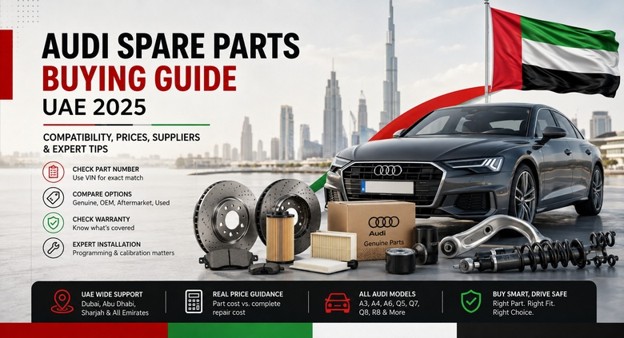
August 19, 2026
Find and Identify the Right Audi Spare Parts in the UAE
1. Audi Spare Parts in UAE: What to Check Before You Buy
Finding Audi spare parts in UAE is easy. Finding the correct part is where the real work begins.
An Audi A4, Q7 or A6 badge does not identify a replacement component precisely enough because the same model can have different generations, engines, gearboxes and equipment specifications.
Before asking for a price, have the VIN, model year, engine specification and original part number ready if possible.
For expensive components such as engines, gearboxes, ECUs, suspension assemblies and electronic modules, this information can prevent a costly compatibility mistake.
The VIN identifies the vehicle, while the part number identifies the component, so checking both gives a much stronger match than relying on the model name alone.
What information does an Audi parts supplier need?
| Information | Why it matters |
| VIN/chassis number | Vehicle-specific identification |
| Model and year | Narrows generation and specification |
| Engine code | Confirms engine application |
| Gearbox | Important for transmission components |
| Part number | Identifies the exact component |
| Drivetrain | Relevant to quattro and drivetrain parts |
| Left/right side | Essential for applicable body and suspension parts |
| Fault information | Helps avoid replacing the wrong component |
If the original part is still available, photograph its label, part number and connectors before removing it.
Do not buy an expensive Audi component because a seller says it “should fit”.
Ask the supplier to confirm compatibility against the VIN or exact part number.
Component price is not the complete repair price
A quoted Audi parts price may exclude delivery, labour, fluids, seals, supporting parts, diagnostics, programming or calibration.
For example, a used gearbox may look affordable until removal, installation, transmission fluid and diagnostic adaptation are added to the final bill.
Ask for the complete installed cost before comparing two offers.
That gives you a much more realistic basis for deciding whether a repair makes financial sense.
Genuine, OEM, aftermarket and used Audi parts
Genuine Audi parts are manufacturer-branded replacement components.
OEM parts require more scrutiny because the label itself does not prove that the component is identical to a genuine manufacturer-supplied part.
Aftermarket parts come from independent manufacturers, and quality can vary considerably between brands.
Used genuine parts can offer substantial savings, particularly for expensive components, but donor history, mileage, testing, condition and warranty need to be checked.
Reconditioned parts should also be investigated carefully; ask what was actually rebuilt, which components were replaced and how the finished unit was tested.
The cheapest option is not automatically the best value.
For a major Audi repair, the sensible choice depends on component risk, vehicle condition, ownership period, budget and warranty protection.
Audi A3, A4, A6, Q5, Q7, Q8 and R8 Parts: What Is Different?
The seven Audi models in this guide cover very different vehicles, so their replacement-part requirements should not be treated as one catalogue.
The A3, A4 and A6 have different generations and powertrain combinations, while the Q5, Q7 and Q8 introduce SUV-specific suspension, braking and drivetrain considerations.
The R8 is a performance car and requires particularly careful specification matching for engine, drivetrain, braking and other performance-related components.
Audi A3 parts
A3 parts can vary according to generation, engine and transmission.
Routine service and wear components are generally easier to identify, but sensors, electronic modules, engine components and transmission parts require more detailed checking.
Do not rely on “Audi A3” alone when ordering an expensive component.
Audi A4 parts
The A4 has been offered with different engines, transmissions and equipment across its generations.
Cooling components, engine parts, suspension, gearbox components and electronic modules may therefore have different applications.
For an A4, check the VIN and part number before committing to a major replacement.
Audi A6 parts
The A6 can involve more complex drivetrain, suspension, comfort and electronic systems, depending on specification.
That makes diagnosis particularly important.
A gearbox warning does not automatically mean the entire gearbox needs replacing, just as an engine warning does not automatically prove that the engine itself has failed.
Audi Q5 parts
The Q5 brings SUV-specific requirements, including suspension, braking and drivetrain components.
Usage also matters.
A Q5 used mainly for urban commuting has a different operating pattern from one covering high annual mileage on motorways.
Audi Q7 parts
The larger Q7 can make certain replacement jobs more expensive because of component size, access and system complexity.
When comparing Q7 parts, look beyond the advertised component price and calculate the complete installation cost.
Audi Q8 parts
The Q8 combines SUV packaging with sophisticated mechanical and electronic systems.
Some replacement components may require programming, coding or calibration after installation, so confirm the workshop requirements before buying.
Audi R8 parts
The R8 requires a more cautious approach because performance-critical components need to match the exact vehicle specification.
A component should not be selected simply because a supplier describes it as “R8 compatible”.
For expensive R8 parts, verify generation, specification, part number and application before payment.
Why the model name is not enough
Two Audi A4 vehicles can share the same badge while having different engines or transmissions.
The same issue can occur with Q7, A6, A3 and other Audi models.
A useful identification sequence is:
Model → generation → year → engine → gearbox → drivetrain → part number → VIN
You may not need every check for a simple filter or trim component, but major mechanical and electronic parts deserve the full process.
How to Find the Correct Audi Part Number Using Your VIN
The VIN is one of the most useful starting points when identifying Audi spare parts because it links the search to a specific vehicle.
It becomes particularly valuable when several versions of a component exist.
However, VIN checking works best alongside the original part number rather than replacing it.
Why the Audi part number matters
Compare these two requests:
“I need a Q7 suspension part.”
and:
“I need this specific suspension component; here is the VIN and the number printed on the original part.”
The second gives the supplier far more information to work with.
Part numbers can also be superseded.
If the number on your original component differs from the supplier's replacement number, do not immediately assume the supplier has supplied the wrong part.
Ask whether the newer number supersedes the original application.
Use photographs as supporting evidence
Clear photographs can help confirm:
- Part number
- Manufacturer markings
- Connectors
- Mounting points
- Physical condition
- Visible damage
But photographs cannot always establish technical compatibility.
Two sensors or electronic modules can look almost identical while having different specifications.
That is why VIN + part number remains the safer combination for expensive or technically complex Audi parts.
When should you insist on VIN verification?
VIN checking is especially useful when:
- The Audi has multiple engine options
- Several gearbox versions exist
- The model has changed generation
- The component is electronic
- The part has revised versions
- You are buying a used engine or gearbox
- The component is expensive
- Several visually similar parts are available
If a supplier cannot explain why a high-value component matches your vehicle, pause the purchase.
Get the compatibility question settled first.
Audi Parts Compatibility: Why the Same Part May Not Fit Every A3, A4 or Q7
Physical fit does not always mean correct compatibility.
A component can bolt into place and still be unsuitable because the engine application, electrical connector, software, calibration or drivetrain specification is different.
That is why “it should fit” is not a satisfactory answer for an expensive Audi part.
Generation and model year
Audi models change throughout their production life.
A part from an earlier generation should not automatically be fitted to a newer vehicle simply because both carry the same model badge.
Facelift changes can also affect individual components.
Check the generation and production year before ordering.
Engine specification
Engine variants can alter components used for:
- Cooling
- Fuel delivery
- Ignition
- Intake
- Exhaust
- Sensors
- Engine management
- Ancillary systems
This is why an engine code can be more useful than simply saying “Audi A4 2.0”.
Gearbox specification
Transmission parts require particularly careful matching.
A component from one gearbox should not automatically be assumed to work with another transmission from the same Audi model.
For gearboxes, mechatronics and related components, confirm the exact transmission identification before purchase.
quattro and drivetrain differences
Drivetrain configuration can affect compatibility for differentials, driveshaft-related components and other transmission parts.
If the vehicle has quattro, make that clear to the supplier.
Do not leave an important drivetrain detail out of the enquiry.
Electronic components
Electronic Audi parts can introduce another layer of complexity.
Some modules and components may require coding, programming, adaptation or calibration after installation.
So before buying a replacement module, ask the workshop:
“Will this part work immediately after installation, or does it need coding or calibration?”
If additional work is required, include it in the repair budget.
Left-hand and right-hand parts
Some components are side-specific.
This is particularly relevant to lighting, suspension and body parts.
A photograph showing the correct shape does not prove that the component is for the correct side of the vehicle.
Check the application before ordering.
Most Common Audi Spare Parts Needed in the UAE
Audi parts requirements range from routine wear items to major engine and transmission assemblies.
For buyers, the important distinction is between normal maintenance, diagnosed component failure and major repair.
Engine components
Engine-related parts can include cooling-system components, sensors, ignition parts, intake components, fuel-system components, seals and engine-management components.
Do not jump from an engine symptom to an engine replacement.
An overheating Audi, for example, needs proper cooling-system diagnosis before anyone concludes that the engine itself requires replacement.
Brake parts
Brake pads and discs are common wear items, but they still need to match the exact Audi specification.
Depending on the vehicle, the job may also involve sensors, calipers or associated hardware.
If other brake components are already near the end of their service life, factor them into the repair rather than treating every replacement as a completely separate job.
Suspension parts
Common suspension-related complaints include:
- Knocking noises
- Uneven tyre wear
- Poor ride quality
- Changes in handling
- Pulling
- Ride-height problems on applicable vehicles
Do not replace the entire suspension system because one component has failed.
Ask the workshop to identify the defective part and explain which supporting components genuinely require replacement.
Cooling-system parts
UAE vehicles operate in high ambient temperatures and rely heavily on their cooling and air-conditioning systems.
Potential cooling-system replacement can involve hoses, fans, thermostatic components, pumps, radiators or sensors, depending on the diagnosis.
Heat is an operating condition, not a diagnosis.
Find the failed component before buying it.
Electrical and electronic parts
Audi's electronic systems include sensors, control modules, actuators, switches and other components that can be expensive to replace incorrectly.
A diagnostic fault code should therefore be investigated rather than treated as automatic proof that the named component has failed.
This is particularly important when the replacement requires coding or programming.
Air-conditioning parts
Air conditioning is essential for everyday UAE driving, particularly through the hottest months.
Weak cooling does not automatically mean the compressor has failed.
Leaks, refrigerant issues, sensors and electrical controls should be ruled out before approving an expensive compressor replacement.
Body and lighting parts
Body panels, mirrors, lamps and trim are often easier to inspect visually, but compatibility still matters.
Check the generation, body style, side, lighting specification and sensor provisions before buying.
A seemingly cheap body or lighting component can also require fitting, painting or calibration, which changes the final repair cost.
The UAE factor
Audi owners in Dubai, Abu Dhabi, Sharjah and other Emirates can face heavy traffic, long commutes, motorway driving, high ambient temperatures and substantial air-conditioning use.
Dust and sand can also form part of the operating environment, while high-mileage business vehicles may accumulate considerably more kilometres than privately used cars.
These conditions do not mean every Audi develops the same faults.
They do mean that maintenance history, diagnosis and component condition should be considered when deciding what to replace.
The first rule when buying Audi spare parts
Do not start with “Which part is cheapest?”
Start with “Which exact part does my Audi need?”
Then verify the part number and VIN, check compatibility, compare genuine, OEM, aftermarket, used and reconditioned options where appropriate, and calculate the complete installed cost.
That approach may take a little longer.
It is also far more likely to leave you with the right component and a repair bill you can actually understand.
Comparing Genuine, OEM, Aftermarket and Used Audi Parts
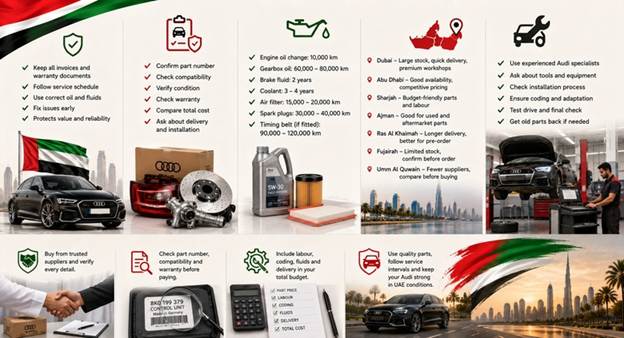
Genuine vs OEM vs Aftermarket Audi Parts: Which Should You Buy?
The cheapest Audi spare part is not always the cheapest repair.
A better comparison looks at fitment, manufacturer, condition, warranty, installation risk and expected service life before looking at the final price.
Genuine Audi parts
Genuine Audi parts are manufacturer-branded replacement components intended for the vehicle's specified application.
They are often the straightforward choice for owners who want to keep a car for several years, particularly when the component is safety-critical, electronically integrated or difficult to replace.
For example, spending more on the correct genuine component can make sense for a complex electronic module if a cheaper alternative has uncertain compatibility and could require another diagnostic session.
But genuine does not automatically mean that it is the right financial choice for every repair.
For an older A4 used as a daily commuter, paying a substantial premium for a simple, non-critical component may not provide enough additional value to justify the difference.
OEM Audi parts
OEM stands for Original Equipment Manufacturer, but the label deserves scrutiny.
Do not assume that anything advertised as “OEM” is automatically identical to a genuine Audi dealer-supplied part.
Check the actual manufacturer, specification, part number and warranty.
A reputable OEM component from a known manufacturer can be a sensible middle ground when the application is confirmed and the saving is meaningful.
Aftermarket Audi parts
Aftermarket parts are produced by independent manufacturers.
Quality varies, sometimes quite a lot.
For straightforward service or wear items, a reputable aftermarket manufacturer may offer good value, while a poorly specified component can create premature wear, poor fitment or another repair.
Do not judge an aftermarket component solely by its price.
Ask who manufactured it, what warranty comes with it and whether the manufacturer is known for that particular component.
Used genuine Audi parts
Used genuine parts can be particularly attractive for expensive Audi components.
An original component removed from a donor vehicle may cost substantially less than a new replacement, but the saving comes with another question: what condition is it actually in?
Check the donor vehicle, mileage where known, testing procedure, physical condition and warranty.
A used body component can often be inspected more easily than a used electronic module, so the acceptable level of risk differs from one part to another.
Reconditioned Audi parts
Reconditioned sits somewhere between used and rebuilt, but the terminology can be loose.
Ask exactly what was done.
Was the unit dismantled?
Which internal components were replaced?
Was it tested under load?
Were seals, bearings or wear components renewed?
What happens if it fails after installation?
A reconditioned gearbox with documented rebuilding and testing is a very different proposition from a used gearbox that has merely been cleaned and described as “reconditioned”.
Which option is right for you?
| Option | Cost level | Main advantage | Main concern | Suitable for |
| Genuine | Higher | Strong specification confidence | Higher upfront cost | Critical or long-term repairs |
| OEM | Medium–high | Potential value with reputable manufacturer | “OEM” claims need verification | Many mechanical components |
| Aftermarket | Low–medium | Choice and lower cost | Quality varies | Suitable service/wear parts |
| Used genuine | Lower | Original component at reduced cost | Unknown remaining life | Expensive components where tested |
| Reconditioned | Medium | Rebuilt component at lower cost | Quality depends on rebuild | Components suitable for rebuilding |
The right answer is therefore not “always buy genuine” or “always buy used”.
Match the part to the risk.
Used Genuine Audi Parts in UAE: Are They Worth Buying?
Used genuine Audi parts can make sense in the UAE, particularly when a new component is expensive and a good donor part is available.
The key is to buy a tested component with traceable information, rather than simply buying the cheapest used listing.
When used genuine can be a smart choice
Used parts are often worth considering for components where the original Audi part is expensive but the component can be inspected or tested properly.
This can include certain:
- Body panels
- Mirrors
- Lighting assemblies
- Suspension components
- Mechanical assemblies
- Engines
- Gearboxes
- Interior components
The suitability depends on the specific part.
A used engine and a used mirror should not be evaluated in the same way.
Check the donor vehicle
Ask where the component came from.
A supplier should ideally be able to provide useful donor information, particularly for major mechanical parts.
For an engine or gearbox, ask about:
- Donor model
- Production year
- Engine or transmission specification
- Mileage where known
- Reason for dismantling
- Testing carried out
- Storage condition
- Warranty
A low-mileage donor component can be attractive, but mileage alone does not prove that the part is healthy.
Maintenance history and actual testing matter too.
Used Audi engines need deeper checks
A used engine should never be purchased simply because it came from the same Audi model.
Check the engine code, specification and compatibility first.
Where appropriate, ask whether compression testing, leak-down testing or other mechanical inspection has been carried out.
Compression results should be assessed against the relevant manufacturer's specification rather than a generic internet number.
Also check for visible oil or coolant contamination, damaged ancillaries, corrosion and evidence of poor storage.
Used Audi gearboxes need their own checks
A used gearbox requires confirmation of the exact transmission specification.
Ask about donor mileage, testing, fluid condition where relevant and any known fault history.
If the gearbox is electronically controlled, ask whether adaptation, coding or other diagnostic procedures will be required after installation.
A cheap gearbox becomes far less attractive if it fails after fitting and you have to pay removal and installation labour again.
Warranty matters more with used parts
Before paying, establish:
- Warranty duration
- Parts-only or parts-and-labour coverage
- Conditions of installation
- Required workshop procedures
- Reporting period for faults
- Return process
- Replacement process
- Delivery responsibility
This is particularly important for major components.
If a replacement engine fails, the part may be covered, but the labour required to remove and install another engine may not be.
That difference can be worth thousands of dirhams.
When should you avoid a used part?
Be cautious when:
- The supplier cannot provide a part number
- Donor information is unavailable
- Testing cannot be explained
- The warranty is vague
- The component has visible damage
- Compatibility is based only on appearance
- The seller pressures you to pay immediately
A low price should never compensate for missing information.
Reconditioned Audi Parts: When Are They a Better Choice?
A reconditioned Audi component can offer a useful middle ground between a used part and a new genuine replacement.
But the word reconditioned needs to mean something concrete.
Ask what happened inside the component.
Reconditioned versus used
A used component has generally been removed from another vehicle and sold in its existing condition, subject to whatever testing the supplier performs.
A genuinely reconditioned component should have undergone additional work to restore its condition or function.
The problem is that sellers do not always use these terms consistently.
So ask for the actual work carried out rather than relying on the label.
What should a reconditioning process include?
The answer depends entirely on the component.
For a mechanical assembly, it might involve dismantling, inspection, replacement of worn internal components, sealing and testing.
For an electronic component, the process may be completely different.
That is why a buyer should ask:
What was replaced?
What was tested?
What was not replaced?
Those three questions often reveal more than the word “reconditioned”.
Reconditioned gearboxes
Gearboxes are one area where proper reconditioning can potentially make financial sense.
A documented rebuild may include inspection and replacement of specified wear components, followed by testing.
But not every “reconditioned gearbox” has undergone the same process.
Ask whether the gearbox was fully dismantled, what internal work was completed and whether the unit was tested after rebuilding.
Also establish whether the warranty covers only the component or includes labour under the supplier's terms.
Reconditioned electronic components
Electronic parts need different scrutiny.
A supplier may have repaired a known fault, replaced a failed component or refurbished the casing, but that does not necessarily mean the unit has been comprehensively rebuilt.
Ask what testing was performed and whether programming or coding is required once the component is installed.
When reconditioning makes financial sense
Reconditioning can be attractive when:
- A new genuine component is very expensive
- The original component is technically rebuildable
- The rebuilder has a credible process
- Testing is documented
- Warranty protection is clear
- Installation costs remain reasonable
It becomes less attractive when the rebuild process is vague or when a failure would require expensive repeat labour.
Do not compare prices alone
Suppose you have three options:
- Used gearbox: lower purchase price
- Reconditioned gearbox: higher purchase price
- Genuine new gearbox: highest purchase price
The cheapest gearbox is not automatically the cheapest solution.
Calculate:
Part + delivery + labour + fluid + supporting work + diagnostics + programming/adaptation + repeat-labour risk.
That is the comparison that matters.
Audi Spare Parts Prices in UAE: What Determines the Real Cost?
There is no single Audi spare-parts price for an A3, A4, A6, Q5, Q7, Q8 or R8.
The component itself is only the starting point.
What changes Audi parts prices?
The final price can be affected by:
- Audi model
- Generation
- Engine
- Gearbox
- Component type
- Genuine/OEM/aftermarket/used status
- Availability
- Supplier
- Donor mileage
- Testing
- Warranty
- Delivery
- Installation requirements
A small electronic component can therefore cost more than a larger mechanical part if it is technically complex or difficult to source.
Why the same Audi part can have different prices
Two suppliers may offer apparently identical components at different prices.
Before assuming that one supplier is overcharging, compare the details.
Is the cheaper part genuinely new?
Is it used?
Has it been tested?
Does it carry a warranty?
Is delivery included?
Does the supplier provide the exact part number?
Will the workshop need additional programming?
A quotation without these details is difficult to compare properly.
Illustrative Audi repair-cost structure
The following is a cost structure example, not a universal UAE market price:
| Cost area | What to check |
| Part | Exact part number and condition |
| Delivery | Local or cross-Emirate transport |
| Labour | Removal and installation |
| Supporting parts | Seals, gaskets, mounts and hardware |
| Fluids | Engine oil, coolant, gearbox fluid where applicable |
| Diagnostics | Fault diagnosis and post-installation scan |
| Programming | Coding, software or module configuration |
| Calibration | Required electronic or mechanical calibration |
| Warranty risk | Who pays if the part fails? |
This is why a supplier quoting AED X for the component has not necessarily quoted AED X for the repair.
Those are two different numbers.
UAE labour can change the equation
Workshop labour varies between Dubai, Abu Dhabi, Sharjah and other Emirates.
There is no sensible universal hourly figure because access difficulty, vehicle generation, workshop equipment, technician experience and diagnostic requirements all affect the job.
Replacing an accessible sensor and replacing a buried gearbox component are not comparable labour operations.
A specialist workshop may also charge more than a general garage while providing equipment and diagnostic capability that the job actually requires.
The right comparison is therefore total job cost and expected repair quality, not labour rate alone.
Used vs Reconditioned vs OEM vs Genuine Audi Parts: Complete Buying Comparison
The decision becomes easier when each option is judged against the actual repair rather than treated as a universal category.
| Buying option | Upfront cost | Main benefit | Main risk | Check before buying |
| Genuine | Higher | Strong specification confidence | Higher purchase cost | Exact part number and warranty |
| OEM | Medium–high | Potential quality/value balance | OEM claim may be vague | Actual manufacturer and specification |
| Aftermarket | Low–medium | Lower cost and wider choice | Quality varies | Manufacturer, fitment and warranty |
| Used genuine | Lower | Original component for less | Remaining life uncertain | Donor, mileage, testing, warranty |
| Reconditioned | Medium | Rebuilt component at lower cost | Rebuild quality varies | Reconditioning work and testing |
When genuine is the better choice
Consider genuine when the component is safety-critical, electronically integrated, difficult to install or likely to remain with the vehicle for many years.
It can also make sense when the price difference is relatively small compared with the potential cost of a failed alternative.
When OEM can make sense
A reputable OEM component can be attractive when the manufacturer is known and the exact application is confirmed.
Do not pay an OEM premium simply because a seller has printed “OEM” on a listing.
Verify the manufacturer.
When aftermarket can make sense
Aftermarket can be sensible for suitable maintenance and wear components when the manufacturer has a strong reputation and the specification is correct.
The quality of the manufacturer matters more than the word “aftermarket”.
When used genuine can make sense
Used genuine is worth considering when the component is expensive, available from a credible donor and properly tested.
For older Audi vehicles, this can sometimes preserve the economics of keeping the car rather than replacing an otherwise sound vehicle.
When reconditioned can make sense
Reconditioned is attractive when the component is rebuildable and the rebuilder can explain exactly what was done.
A proper warranty strengthens the case.
A vague warranty weakens it.
A practical decision matrix
| Your situation | Option worth considering first |
| Newer Audi, long-term ownership | Genuine or reputable OEM |
| Older Audi with limited market value | Tested used or quality aftermarket where appropriate |
| Expensive mechanical assembly | Used tested or properly reconditioned |
| Safety-critical component | Genuine or proven high-quality alternative |
| Electronic module | Exact compatible genuine/OEM or professionally tested unit |
| Rebuildable gearbox | Properly reconditioned or tested replacement |
| Low-risk wear component | Reputable aftermarket may offer good value |
| Unknown supplier with vague warranty | Avoid, regardless of price |
The key is to match the part category to the risk level.
A bargain brake component, questionable electronic module and tested used gearbox should never be judged using the same criteria.
What should an Audi owner ask before paying?
Keep the questions simple.
What is the exact part number?
Does it match my VIN?
Is it new, used or reconditioned?
If used, what is the donor mileage?
Has it been tested?
What does the warranty cover?
Does the warranty include labour?
Does installation require programming or calibration?
What is the complete installed cost?
If the supplier can answer these clearly, you have something useful to compare.
If the answer keeps coming back to “don't worry, it will fit”, stop there.
The cheapest Audi part is only a bargain when it is the right part, in the right condition, with acceptable warranty protection and a sensible installation cost.
Audi A3, A4, A6, Q5, Q7, Q8 and R8 Parts: Model-Specific Buying Guide
Audi A3 Spare Parts in UAE: What Owners Should Check First
The Audi A3 is often cheaper to maintain than the larger models in this guide, but that does not mean its parts can be bought casually.
Generation, engine, gearbox and equipment still matter, particularly when you move beyond routine service items.
For brakes, filters, suspension components and other wear parts, a reputable aftermarket option can sometimes make financial sense if the manufacturer and specification are known.
For an engine-control module, transmission component or other electronically integrated part, be much stricter about compatibility.
A3 owners should also separate a genuine mechanical failure from a sensor or electrical fault before ordering an expensive component.
A warning light is a clue.
It is not a shopping list.
Which A3 parts are worth buying used?
Used genuine parts can work well for certain expensive components, particularly when the donor part is identifiable and properly tested.
Body parts, mirrors, some lighting assemblies and selected mechanical components can be easier to assess than hidden electronic units.
For a used A3 gearbox or engine, however, check the exact specification, donor mileage, testing and warranty before considering the saving.
The labour risk matters too.
A component that costs less but fails shortly after installation can erase the original saving surprisingly quickly.
A3 buying priorities
| Part type | Sensible first check |
| Brake components | Exact specification and manufacturer |
| Suspension | Diagnosis and complete axle condition |
| Engine parts | Engine code and part number |
| Gearbox parts | Transmission identification |
| Sensors | Fault diagnosis and exact part number |
| Electronic modules | VIN, part number and programming requirement |
| Body parts | Generation, body style and side |
| Used major components | Donor history, testing and warranty |
If the A3 is an older daily commuter, the economics can favour a quality used or aftermarket component for some applications.
That calculation changes completely for a safety-critical or electronically complex component.
Audi A4 Spare Parts in UAE: Common Replacement Areas and Compatibility
The Audi A4 is one of those cars where the badge tells you surprisingly little about the part you need.
Different generations and engine-transmission combinations mean that a component listed simply as an “A4 part” deserves another question: which A4?
For an A4, keep the VIN and original part number close at hand.
They become especially useful when comparing engine components, cooling parts, suspension assemblies, gearbox components and electronic modules.
Common A4 replacement categories
A4 owners commonly encounter replacement needs around:
- Braking
- Suspension
- Cooling
- Engine ancillaries
- Sensors
- Electrical components
- Air conditioning
- Transmission-related parts
The diagnosis should come before the purchase.
If the engine is running poorly, for instance, do not assume that the most expensive component associated with the symptom has failed.
A misfire, rough running or loss of power can have several possible causes, and replacing parts by guesswork is an expensive way to diagnose a car.
A4 engine and cooling parts
Cooling-system problems deserve prompt attention.
A vehicle operating in UAE summer temperatures has little room for complacency when coolant temperature begins rising, but an overheating complaint still needs proper diagnosis before an engine is condemned.
Check the cooling system, leaks, fans, thermostatic components and other relevant systems before moving towards major engine work.
If an engine replacement does become necessary, compare used, reconditioned and genuine replacement options using the complete installed cost rather than the engine price alone.
A4 gearbox parts
Transmission problems can be particularly costly when the wrong component is purchased.
Confirm the transmission identification before buying a gearbox, mechatronic unit or related component.
Then ask whether installation requires fluid replacement, adaptation, coding or diagnostic work.
A supplier who gives you only the gearbox price has not necessarily given you the final repair cost.
Audi A6 Spare Parts in UAE: Why Diagnosis Matters More on a Complex Audi
The A6 can become expensive very quickly when diagnosis is skipped.
Depending on generation and specification, the car can combine sophisticated drivetrain, suspension, comfort and electronic systems, and symptoms can sometimes overlap between them.
That makes the workshop's diagnostic process part of the parts-buying decision.
Do not replace the biggest component first
A gearbox warning is not proof that the entire gearbox has failed.
An electrical warning does not automatically mean the control module needs replacing.
An overheating engine does not automatically mean the engine itself is damaged.
This is where a proper diagnostic scan, physical inspection and component testing can save serious money.
A6 suspension and electronic parts
A6 suspension work can involve more than simply replacing a visibly worn component.
If the vehicle has a sophisticated suspension arrangement, ask what actually failed and whether calibration or adaptation is required after the repair.
Electronic components need similar caution.
A module may be physically correct yet still require coding or configuration before the vehicle will operate normally.
A6 used-part strategy
Used genuine parts can be attractive on an older A6 because some new components can represent a significant proportion of the vehicle's current market value.
But do not let that comparison push you towards an untested component.
For an expensive used A6 component, establish donor information, mileage where known, testing, compatibility and warranty before paying.
If the component is difficult to install, repeat labour should be part of the risk calculation.
When does an A6 repair stop making financial sense?
There is no single mileage figure or repair bill that answers this.
Look at the whole vehicle.
If the body is sound, the interior is well maintained, the drivetrain is healthy and the repair addresses one isolated problem, spending money on the correct part can be perfectly rational.
If several major systems are approaching the end of their useful life, the same repair may simply be the next bill in a long queue.
That is the point where repair cost, future repair exposure and vehicle replacement cost need to be considered together.
Audi Q5 and Q7 Spare Parts in UAE: SUV-Specific Buying Decisions
The Q5 and Q7 share Audi's SUV identity, but they should not be treated as scaled versions of the same vehicle.
Their dimensions, weight, drivetrain applications and component requirements differ.
For both, suspension, braking, cooling and drivetrain parts deserve careful specification matching.
Q5 parts
The Q5 is often used as a family vehicle and daily commuter, so practical wear items can account for a significant portion of its maintenance.
Brakes, suspension components, cooling parts, sensors and air-conditioning components should be assessed according to the actual fault and vehicle condition.
If the Q5 has a drivetrain or transmission problem, the exact specification becomes much more important.
A generic “Q5 gearbox” search is not enough.
Q7 parts
The Q7's larger size can change the economics of certain repairs.
Component prices may be higher, access can be more involved and labour can rise when additional parts have to be removed to reach the failed component.
That is why a Q7 quotation should show more than a parts figure.
Ask for:
Part + labour + supporting parts + fluids + diagnostics + programming/calibration where applicable.
Q5 and Q7 suspension
Suspension complaints can be particularly misleading.
A vehicle sitting low, riding poorly or making a knocking sound does not automatically identify one failed component.
The workshop should establish whether the problem comes from the relevant suspension assembly, associated hardware, sensors, mounts or another component.
On vehicles equipped with electronically controlled or air-suspension systems, ask whether calibration or system-level diagnostics are required after replacement.
Quattro and drivetrain parts
Where quattro is fitted, drivetrain compatibility needs to be checked carefully.
Differentials, driveshaft-related components and other transmission parts should be matched to the exact vehicle and transmission specification.
Do not buy a component because the donor vehicle has the same Q5 or Q7 badge.
The drivetrain details matter.
Buying used Q5 and Q7 parts
Used genuine components can make sense for expensive mechanical assemblies, especially on older vehicles.
For engines and gearboxes, however, ask for donor information and testing rather than accepting mileage alone as proof of condition.
A low-mileage component with poor storage or unknown history is not automatically a better purchase than a higher-mileage unit with credible testing and warranty protection.
Audi Q8 and R8 Spare Parts in UAE: High-Specification Components Need More Care
The Q8 and R8 sit at very different ends of Audi's performance and vehicle-use spectrum, yet they share one important buying principle:
Specification matters.
With expensive components, an incorrect purchase can turn into a costly return, additional delivery expense and another workshop appointment.
Audi Q8 parts
The Q8 combines SUV packaging with a high level of mechanical and electronic integration.
That means replacement decisions can involve:
- Suspension
- Brakes
- Drivetrain
- Cooling
- Sensors
- Lighting
- Electronic modules
- Driver-assistance components
Some components may require programming or calibration after installation.
Ask about that before buying, not after the vehicle is already sitting on the workshop lift.
Q8 body and lighting components
Body and lighting parts can look deceptively simple.
A replacement lamp, for example, may interact with sensors, control systems or vehicle electronics depending on specification.
Check the part number, vehicle generation and equipment level.
If the component requires calibration, include that cost in the quotation.
Audi R8 parts
The R8 requires a much narrower tolerance for guesswork.
Engine, transmission, braking and performance-related components should be matched to the exact vehicle specification rather than selected from a generic R8 listing.
A used component can still be considered, but its provenance and condition matter enormously.
For a performance-critical part, ask what testing was carried out and whether the supplier provides sufficient warranty protection for the value of the component.
R8 engine and drivetrain components
A replacement R8 engine should be assessed by engine specification, donor information, mileage where known, inspection, testing and compatibility.
Compression testing can provide useful information about cylinder condition where appropriate, but the results need to be interpreted against the manufacturer's specifications rather than an arbitrary figure found online.
The same principle applies to major drivetrain components.
A gearbox that appears compatible may still have a different specification or require additional electronic procedures after installation.
Why Q8 and R8 parts need a different budget mindset
With a routine service part, the difference between two suitable options might be relatively modest.
With a high-value Q8 or R8 component, the consequences of choosing incorrectly can be much larger because the part itself may be expensive and installation may require specialist equipment or programming.
So do not compare the sticker price alone.
Compare the risk-adjusted repair cost.
| Decision factor | Why it matters on Q8/R8 |
| Exact part number | Prevents specification mismatch |
| VIN | Confirms vehicle application |
| Donor history | Important for used components |
| Testing | Reduces uncertainty |
| Warranty | Protects against component failure |
| Programming/calibration | May add installation cost |
| Specialist labour | Complex systems may need suitable equipment |
| Repeat labour | A failed part can make a cheap purchase expensive |
Which Audi models are most sensitive to compatibility?
There is no useful rule saying one model is always difficult and another is always simple.
The component is often more important than the badge.
A brake pad is one type of buying decision.
A gearbox mechatronic unit is another.
An R8 engine is another again.
That is why the buying process should always start with the specific component and its application rather than assumptions about the model.
Model-specific buying checklist
Before buying a major Audi component, work through these checks:
| Check | A3/A4/A6 | Q5/Q7/Q8 | R8 |
| VIN | Essential for major parts | Essential for major parts | Essential |
| Part number | Strongly recommended | Strongly recommended | Critical |
| Engine specification | Important | Important | Critical |
| Gearbox identification | Essential for transmission parts | Essential | Essential |
| Drivetrain | Relevant | Particularly important | Critical |
| Donor history | Used major parts | Used major parts | Very important |
| Testing | Depends on component | Important | Essential for major components |
| Programming/calibration | Component-dependent | Common on some systems | Component-dependent |
| Warranty | Important | Important | Particularly important |
The model badge gets you into the catalogue. The specification gets you to the correct part.
That distinction is worth remembering when searching for Audi spare parts in the UAE.
An A3, A4, A6, Q5, Q7, Q8 or R8 gives you the starting point, but generation, engine, gearbox, drivetrain, VIN and part number narrow the search to something you can actually buy with confidence.
And once the correct component has been identified, the next question becomes much more interesting: what should you actually pay for it, and where do labour, diagnostics, delivery and hidden costs change the calculation?
Diagnose, Price and Buy the Right Audi Component
Audi Engine Problems: How to Know Whether You Need a Part or a Complete Engine
An Audi engine problem does not automatically mean you need another engine.
That distinction can save a serious amount of money, because overheating, rough running, misfires, oil consumption and loss of power can originate from individual components rather than the engine assembly itself.
Start with diagnosis.
A proper investigation may involve diagnostic fault codes, visual inspection, fluid checks, compression testing, leak-down testing where appropriate and examination of the cooling and lubrication systems.
Audi overheating: engine failure or cooling-system fault?
An overheating warning deserves immediate attention, particularly in UAE summer conditions.
But replacing the engine before checking the cooling system can be a costly mistake.
Depending on the Audi and the fault, the investigation may need to consider coolant leaks, cooling fans, thermostatic components, pumps, radiators, hoses and related sensors.
If coolant is disappearing, find out where it is going.
Repeatedly topping up coolant and continuing to drive is not a repair strategy.
Audi misfire and rough running
A misfire can come from several areas, including ignition, fuel delivery, air intake, sensors or engine-management systems.
That means buying a replacement engine because the car is misfiring is usually premature.
The workshop should establish whether the problem is isolated to one cylinder, follows a particular component or points towards an internal mechanical problem.
Where internal engine condition is suspected, compression testing can help assess cylinder sealing.
The results should be compared with the relevant manufacturer's specification and, importantly, with the consistency between cylinders rather than judged against a generic internet figure.
A leak-down test can provide additional information when compression results need deeper investigation.
When engine replacement starts making sense
Engine replacement becomes more reasonable when there is confirmed internal damage, severe wear, major overheating damage or a repair bill that no longer makes economic sense for the original engine.
Even then, do not jump straight to the cheapest used engine.
Check the replacement engine's engine code, donor vehicle, mileage where known, testing, condition, included ancillaries and warranty.
A replacement engine should also be priced as an installation project.
| Engine replacement cost area | What to check |
| Replacement engine | Exact specification and part number |
| Donor history | Vehicle, mileage and condition |
| Testing | Compression or other appropriate inspection |
| Delivery | UAE delivery and handling |
| Labour | Removal and installation |
| Fluids | Oil, coolant and other required fluids |
| Seals/gaskets | Supporting replacement items |
| Ancillaries | Whether existing components are transferred |
| Diagnostics | Pre- and post-installation checks |
| Warranty | Parts-only or parts plus labour |
A used engine can look inexpensive until all the supporting work is added.
That is why the meaningful figure is the complete installed engine-replacement cost, not the engine listing.
Audi Gearbox Problems: Repair, Recondition or Replace?
Audi gearbox faults can become expensive quickly, but a transmission warning does not automatically condemn the entire gearbox.
The first job is to establish what has actually failed.
Symptoms such as delayed engagement, harsh shifts, slipping, warning messages or loss of drive can have different causes depending on the transmission.
Diagnostics should therefore come before the purchase decision.
Common gearbox symptoms
Watch for:
- Delayed engagement
- Harsh or abnormal shifts
- Slipping
- Gear selection problems
- Transmission warning messages
- Loss of drive
- Unusual transmission noises
- Fluid leaks
A gearbox fault can sometimes involve fluid condition, electrical control, sensors, mechatronics or adaptation rather than catastrophic internal damage.
That is why replacing the complete gearbox without proper diagnosis can be unnecessarily expensive.
Repairing the original gearbox
Repairing the existing transmission can make sense when the underlying unit is fundamentally sound and the failed component can be identified and repaired properly.
The advantage is that you retain the original transmission, but the quality of the repair process matters enormously.
Ask what failed.
Ask what will be replaced.
Ask whether the transmission will be tested afterwards.
A vague answer is not enough for a major repair.
Reconditioned gearbox
A properly reconditioned gearbox can offer a middle ground between repairing the original unit and buying a new genuine replacement.
But “reconditioned” should describe actual work.
Find out whether the gearbox was dismantled, which internal components were replaced, what was inspected and how the finished unit was tested.
A cleaned used gearbox is not automatically a professionally reconditioned gearbox.
Used Audi gearbox
A used gearbox can be financially attractive, particularly for an older Audi where a new transmission would be disproportionate to the vehicle's value.
Check the donor vehicle, transmission specification, mileage where known, testing and warranty.
Do not accept “same model” as sufficient compatibility evidence.
The transmission code or exact part number should be checked against the recipient vehicle.
What about programming and adaptation?
Modern Audi transmissions can involve electronic control and adaptation procedures.
Ask the workshop whether the replacement gearbox or transmission component requires coding, programming, adaptation or diagnostic calibration after installation.
If it does, include that work in the quotation before approving the purchase.
Gearbox replacement cost structure
| Cost area | Why it matters |
| Gearbox | Used, reconditioned or genuine replacement |
| Delivery | Transport and handling |
| Removal | Existing transmission removal |
| Installation | Replacement transmission fitting |
| Fluid | Correct transmission fluid and quantity |
| Seals/hardware | Supporting installation components |
| Diagnostics | Fault scanning and verification |
| Adaptation/programming | Required where applicable |
| Warranty | Coverage and installation conditions |
A cheaper gearbox can therefore produce a more expensive repair if it requires additional work or fails after installation.
For a high-mileage Audi, compare the gearbox repair against the vehicle's overall condition and expected future repair exposure, not simply today's transmission bill.
When comparing Audi parts suppliers in the UAE, check the exact part number, VIN compatibility, condition, testing, warranty and delivery terms before paying. A platform such as PartFinder UAE can be referenced naturally when discussing the process of comparing available Audi parts and supplier options, rather than treating the keyword as an isolated SEO phrase.
Audi Suspension, Brakes and Steering Parts: What Should Be Replaced Together?
Suspension, braking and steering faults are often easier to feel than engine or electronic problems.
The steering wheel may pull, the brakes may vibrate, the suspension may knock or the vehicle may sit unevenly.
But the symptom still needs to be traced back to the failed component.
Audi suspension: replace one part or several?
A knocking noise does not automatically mean every suspension component needs replacing.
Depending on the vehicle, the workshop may need to inspect control arms, bushes, ball joints, dampers, mounts, wheel bearings and other related components.
If one bush is worn but the neighbouring components are healthy, replacing everything can add unnecessary cost.
On the other hand, if several components are already worn, replacing only one may leave you paying labour again soon afterwards.
That is where a proper inspection matters.
Audi air suspension
Where an Audi is equipped with air suspension, a vehicle sitting low can point towards several possible issues.
An air spring, compressor, valve system, leak, sensor or control issue can produce related symptoms.
Do not automatically buy a compressor because the vehicle has dropped.
The workshop should identify whether the system is losing air, failing to generate pressure or receiving incorrect information from a sensor or control system.
After replacement, check ride height, warning messages, compressor behaviour and possible leaks.
Calibration or system adaptation may also be relevant depending on the vehicle and component.
Audi brake parts
Brake pads and discs should be matched to the vehicle specification, but the replacement decision should also consider their condition as a system.
If pads are worn and discs are close to their service limit, fitting new pads alone may not be the sensible long-term option.
Inspect the braking system rather than replacing components based purely on mileage.
Brake vibration, pulling or abnormal noise can also point towards different issues, so the symptom needs to be investigated rather than translated directly into a shopping list.
Audi steering components
Steering complaints deserve particular care because they affect vehicle control.
Pulling, play, uneven steering response or abnormal noises can involve suspension geometry, steering components, tyres or wheel-related issues.
Do not assume that changing one visible component will solve the problem.
A proper inspection should establish the source before parts are ordered.
Supporting parts and repeat labour
One of the most overlooked costs in suspension work is repeat labour.
Suppose a workshop removes several components to reach a failed assembly.
If another closely related part is already badly worn and is ignored, the vehicle may return shortly afterwards for another repair requiring similar dismantling.
That does not mean every adjacent component should automatically be replaced.
It means the workshop should tell you what is worn, what is serviceable and what is worth replacing while access is already available.
Audi Electrical Parts and Sensors: Why Diagnosis Matters Before Ordering
Electrical faults create some of the worst parts-buying traps because the failed component is not always the component mentioned by the fault code.
A diagnostic code points towards a system, circuit or condition.
It does not always mean, “Buy this sensor.”
Audi sensors
Modern Audi vehicles use numerous sensors for engine management, braking, temperature monitoring, emissions, suspension and other systems.
If a sensor reports an abnormal value, the workshop should establish whether:
- The sensor itself has failed
- The wiring is damaged
- The connector is poor
- The power supply is incorrect
- Another component is causing the abnormal reading
- The fault is intermittent
Replacing the sensor without checking these possibilities can simply produce the same warning again.
Electronic control modules
Control modules are more expensive and more complicated than many ordinary replacement parts.
Before buying one, confirm the exact part number and vehicle application.
Then ask whether the replacement unit needs coding, programming or configuration.
A used module may also contain data or configuration associated with its donor vehicle, so installation requirements need to be understood before purchase.
Audi battery and voltage-related faults
Low system voltage can create a surprising number of electronic warnings.
That is why a vehicle displaying several unrelated warnings should not automatically be treated as having several failed modules.
Battery condition, charging voltage and the vehicle's electrical supply should be checked as part of the diagnostic process.
Otherwise, an owner can end up replacing an expensive electronic component when the underlying problem is elsewhere.
ABS and wheel-speed sensors
A warning involving the braking or stability-control system may involve a wheel-speed sensor, wiring, connector, tone-related components or another part of the system.
Check the actual fault rather than buying a sensor solely because it is the most visible possibility.
Safety-related electronics deserve particularly careful diagnosis.
MMI and electronic comfort systems
Audi's infotainment and comfort systems can involve multiple modules communicating with one another.
A screen problem, communication fault or intermittent function does not necessarily mean the visible component is defective.
The workshop may need to trace power, communication and module-level faults before recommending replacement.
Programming and coding
Some replacement electronic components may need software configuration after installation.
Ask the workshop:
Will the replacement work immediately, or does it need coding?
Then ask:
Is the coding included in the quotation?
This avoids the familiar situation where the part arrives, the mechanic installs it and another charge appears because the repair is not actually complete.
Complete Audi Repair Cost in UAE: Part + Labour + Diagnostics + Supporting Work
An Audi repair quotation should be judged as a project, not a single number.
The basic calculation is:
Part + delivery + labour + supporting parts + fluids + diagnostics + programming/calibration = estimated project cost
That formula works particularly well for engines, gearboxes, suspension assemblies and electronic modules because the component price alone can be misleading.
Why a cheap Audi part can become an expensive repair
Consider a used gearbox.
The component may be priced attractively, but the vehicle still needs the old gearbox removed, the replacement fitted, the appropriate fluid installed and the system checked afterwards.
If adaptation or programming is required, that adds another cost.
Now imagine the used gearbox develops a fault shortly after installation.
If the warranty covers only the component, you may still face another removal and installation bill.
The original saving can disappear very quickly.
Example: comparing two Audi repair options
The figures below are illustrative examples rather than universal UAE prices.
| Cost area | Option A: Used component | Option B: Reconditioned component |
| Component | AED 4,000 | AED 6,000 |
| Delivery | AED 300 | AED 300 |
| Labour | AED 2,000 | AED 2,000 |
| Fluids/seals | AED 700 | AED 700 |
| Diagnostics/adaptation | AED 500 | AED 500 |
| Warranty | Parts-only | Parts with defined coverage |
| Initial project cost | AED 7,500 | AED 9,500 |
At first glance, Option A saves AED 2,000.
But that comparison is incomplete if the used component has uncertain condition or weak warranty protection.
If it fails and another AED 2,000 of labour is required to remove and replace it, the apparent saving has largely disappeared.
That is why risk-adjusted cost is more useful than purchase price alone.
Audi labour costs across the UAE
Workshop labour can vary between Dubai, Abu Dhabi, Sharjah and other Emirates, but there is no reliable universal rate that applies to every Audi repair.
A simple service job and a gearbox replacement are worlds apart in terms of access, equipment, technician time and diagnostic requirements.
Specialist Audi work can also involve diagnostic equipment, coding or calibration that a basic mechanical workshop may not be equipped to perform.
When comparing quotations, look at what the labour figure actually includes.
A practical quotation comparison
| Ask the workshop | Why |
| What failed? | Confirms the diagnosis |
| Which exact part is needed? | Prevents vague purchasing |
| What is the part number? | Allows supplier comparison |
| Is it new, used or reconditioned? | Establishes condition |
| What supporting parts are required? | Reveals hidden costs |
| How much is labour? | Separates installation cost |
| Are fluids included? | Avoids surprise charges |
| Is diagnostics included? | Important for electronic repairs |
| Is programming/calibration included? | Prevents incomplete quotations |
| What does the warranty cover? | Establishes financial risk |
| Who pays repeat labour if the part fails? | Crucial for major components |
When a repair quotation keeps changing
A changing quotation is not automatically proof that a workshop is acting improperly.
Sometimes dismantling genuinely reveals another failed component.
The problem is poor communication.
If the workshop discovers additional work, ask for the reason, the component involved, the additional cost and whether the vehicle can safely be reassembled without doing that work immediately.
That gives you a choice rather than leaving the decision to the workshop.
Repair cost versus vehicle value
A major Audi repair should also be considered against the vehicle's wider condition.
If the A3, A4, A6, Q5 or Q7 is mechanically sound apart from one expensive component, repairing it may still be the sensible choice.
If the vehicle already needs suspension work, cooling-system repairs, transmission work and multiple electronic components, another major bill may change the calculation.
The question is not simply:
“Is this repair expensive?”
It is:
“After spending this money, what condition will the vehicle actually be in?”
That is the figure worth chasing before the parts order is placed.
UAE Audi Parts Buying, Supplier Checks and Real Buyer Questions
How to Check an Audi Spare Parts Supplier Before Paying
A good Audi parts supplier should be able to answer simple questions without dancing around them.
Start with the exact part number.
Then ask whether the component has been checked against your VIN, what condition it is in, whether it has been tested, what warranty applies and what happens if the part turns out to be incompatible.
If you are buying a used engine or gearbox, ask for the donor vehicle information and mileage where known.
A vague answer such as “same model, it will fit” is not enough for a high-value component.
What should appear on the quotation?
A useful quotation should separate the important costs rather than hiding everything under one figure.
| Quotation item | What you should confirm |
| Part | Exact component and part number |
| Condition | New, genuine, OEM, aftermarket, used or reconditioned |
| Compatibility | VIN or specification confirmation |
| Price | Component cost |
| Delivery | Included or charged separately |
| Warranty | Duration and coverage |
| Labour | If installation is included |
| Supporting parts | Seals, fluids, filters or hardware |
| Programming | Required or not |
| Calibration | Required or not |
| Return | Conditions and responsibility |
This matters because two suppliers can quote apparently similar prices while offering very different levels of protection.
A used gearbox with a clear warranty and tested donor history may be a better purchase than a slightly cheaper unit with no meaningful return protection.
Check the warranty before the part leaves the supplier
Do not wait until something goes wrong.
Ask whether the warranty covers the part only or the part plus labour, because these are very different forms of protection.
Also ask how quickly a fault must be reported, whether installation must be carried out by an approved workshop and who pays the transport cost if the component needs to be returned.
For major Audi parts, repeat labour can become the largest hidden risk.
What to Ask an Audi Workshop Before Installation
The workshop should be able to explain why the part is being replaced.
That sounds basic, but it separates diagnosis from guesswork.
Ask what tests were performed, what failed, whether supporting components need attention and what checks will be carried out after installation.
If the answer is simply, “The scanner says it needs replacing,” ask for a little more detail.
A diagnostic code is useful evidence, but it is not always the final diagnosis.
Questions worth asking
What exactly has failed?
How was it confirmed?
Does the replacement need programming or calibration?
What supporting parts should be replaced at the same time?
Are fluids included?
What happens if the replacement part does not solve the fault?
These questions are particularly valuable with electronic modules, gearboxes, engines and suspension systems.
Ask about the supporting work
A replacement component rarely exists in isolation.
An engine installation may involve oil, coolant, seals, filters and transferred ancillaries.
A gearbox may require fluid, seals, adaptation and diagnostic checks.
A suspension repair may reveal worn mounts, bushes or related hardware.
That does not mean a workshop should automatically add every nearby component to the bill.
Ask them to distinguish between necessary, recommended and optional work.
That gives you room to make an informed decision.
Audi Spare Parts Installation: Why Supporting Components Matter
The cheapest Audi component can become an expensive mistake if the installation is incomplete.
A replacement part works as part of a system, and the surrounding components sometimes need to be checked or renewed at the same time.
Engines
When fitting a replacement engine, check the condition of relevant seals, fluids, filters, hoses and transferred ancillary components.
The exact list depends on the vehicle and the replacement engine.
Do not assume that every component from the old engine should automatically be transferred.
Some parts may be worn already.
Gearboxes
A replacement gearbox may require the correct transmission fluid and new seals or related hardware.
Depending on the transmission, adaptation or diagnostic procedures may also be required after installation.
A gearbox that is mechanically fitted but electronically unconfigured is not necessarily a completed repair.
Suspension
Suspension work can involve mounts, bushes, fasteners and wheel alignment.
If a component has been replaced and the vehicle's geometry has changed, ask whether alignment is required.
Otherwise, a new suspension component may be fitted correctly while the vehicle still wears tyres unevenly or handles poorly.
Cooling systems
When replacing a cooling component, inspect the surrounding system rather than treating the new component as the end of the job.
Check for leaks, hose condition, coolant condition and related components where relevant.
A new radiator will not solve a separate leak somewhere else in the cooling system.
Body and lighting components
Bodywork can introduce another cost layer.
A replacement panel may require painting.
A lighting assembly may involve electrical configuration or calibration depending on the vehicle.
Ask before buying, because the visible part price rarely tells the complete story.
Audi Programming, Coding and Calibration After Parts Replacement
Some Audi replacement parts are not simply remove old part → fit new part → drive away.
Electronic integration can change the installation process.
Depending on the component and vehicle, a replacement module, sensor, lighting system, transmission component or other electronically controlled unit may require coding, programming, adaptation or calibration.
Why this matters when buying used parts
A used component can be mechanically sound and still require configuration before the vehicle accepts it correctly.
This is particularly relevant to electronic control modules and other vehicle-network components.
Ask the supplier whether the part is suitable for your vehicle and ask the workshop whether it can be configured after installation.
Do not assume the seller and workshop have automatically included those two checks.
Calibration is not the same as programming
These terms can overlap in everyday workshop conversation, but they describe different processes.
Programming or coding can involve configuring an electronic component so that it communicates or operates correctly with the vehicle.
Calibration generally involves setting or verifying a system against a defined reference or operating position.
The exact procedure depends on the component and Audi model.
The practical question for the owner is simpler:
What has to be done after fitting, and is it included in the quotation?
Components that may need additional procedures
Depending on the vehicle, the work can involve:
- Electronic control modules
- Transmission components
- Driver-assistance components
- Lighting systems
- Steering-related systems
- Suspension systems
- Sensors
Not every replacement requires these procedures.
That is why the workshop should confirm the requirement rather than adding programming or calibration automatically.
Audi Workshop Red Flags: When to Stop and Ask More Questions
A high Audi repair bill is not automatically a red flag.
A complicated Q7, Q8 or R8 repair can genuinely cost a lot, while a straightforward A3 repair can still become expensive if access is difficult or diagnosis takes time.
The warning signs are usually about poor explanation, unclear evidence or shifting requirements.
“It should fit”
For an expensive part, this phrase should make you pause.
Ask for the part number and VIN confirmation.
If the supplier cannot establish compatibility more precisely, do not make the purchase simply because the component looks identical.
No clear diagnosis
If the workshop cannot explain what failed, ask what tests were performed.
You do not need a ten-page engineering report.
You do need to understand why the proposed replacement is necessary.
No written quotation
A verbal price can become difficult to challenge when the vehicle is already dismantled.
Ask for the quotation in writing, including the component, condition, labour and known supporting costs.
If additional work becomes necessary after dismantling, ask for the reason and revised cost before authorising it where practical.
Pressure to buy immediately
A supplier may genuinely have a scarce component available.
That does not mean you should skip compatibility checks.
“Only one left” is not a technical specification.
Take the VIN and part number seriously, particularly when the component is expensive.
Unclear warranty
“Warranty available” tells you very little.
Ask:
How long?
What does it cover?
Does it include labour?
What voids it?
How quickly must a fault be reported?
Who pays for return delivery?
The answers are far more useful than the word “warranty” itself.
Generic photographs for a supposedly specific component
Generic photographs are not necessarily a problem for every new aftermarket part.
They become more concerning when a seller is offering a particular used engine, gearbox, module or body component but cannot show the actual item or its identifying markings.
For a used major component, ask for photographs of the actual part and its identification label.
Unnecessary supporting parts
A workshop may legitimately recommend replacing related components while access is available.
The problem comes when every additional item is described as mandatory without explanation.
Ask:
Is this required for the repair, recommended because it is worn, or simply advisable while the vehicle is apart?
That small distinction can make a substantial difference to the bill.
Constantly changing quotations
Sometimes a quotation changes because dismantling reveals a genuine additional fault.
That can happen.
The important part is whether the workshop explains what was discovered, why it matters and what happens if you choose not to repair it immediately.
A changing bill without an explanation is much harder to assess.
Where to Buy Audi Spare Parts in the UAE: Dubai, Abu Dhabi, Sharjah and Other Emirates
Local availability matters because a part that arrives tomorrow and a part that arrives after several days can have very different consequences when the Audi is already off the road.
Dubai has a large concentration of automotive businesses and parts activity, while Sharjah is also an important destination for vehicle parts and repair-related purchasing.
Abu Dhabi serves a substantial private, family and commercial vehicle market, and owners in Ajman, Ras Al Khaimah, Fujairah and Umm Al Quwain may sometimes compare local availability with suppliers delivering from another Emirate.
The right supplier is not necessarily the one closest to your home.
What matters is correct identification, credible condition, availability, warranty and delivery time.
Cross-Emirate buying
Cross-Emirate sourcing can make sense when a specialist supplier has the exact Audi component in stock.
But calculate delivery and vehicle downtime.
If the Audi is already at a workshop in Abu Dhabi and the correct used gearbox is available in Dubai, the delivery cost may be trivial compared with keeping the vehicle off the road for several additional days.
For fleet and business vehicles, downtime can be even more important.
A vehicle that earns money while operating has an opportunity cost when it is sitting on a workshop ramp.
Buying Audi parts for older vehicles
Older A3, A4, A6 and Q5 models can create a different buying equation.
New genuine parts may still be available, but the price can become disproportionate to the vehicle's current value.
That is where a properly tested used genuine or reconditioned component may become attractive.
However, the vehicle's overall condition should decide the investment.
If the engine, transmission, body and electrical systems are otherwise healthy, a major replacement can keep a good older Audi on the road.
If several major systems are failing at the same time, another large parts purchase deserves more scrutiny.
The Audi Parts Decision in the UAE
The best Audi spare-parts purchase is rarely the one with the lowest number beside it.
It is the one where the part is correct, the condition is understood, the compatibility is verified, the installation is properly costed and the warranty gives you reasonable protection.
For an A3 or A4, that may mean a reputable aftermarket or used component for a suitable application.
For an A6, Q7 or Q8, the higher complexity of some systems can make specification and installation capability more important.
For an R8, the tolerance for guesswork becomes even smaller.
And across Dubai, Abu Dhabi, Sharjah and the other Emirates, the same rule holds: identify first, compare second, buy third.
Real Buyer Questions About Audi Spare Parts in UAE
Categories
- Audi
- BMW
- Car Accessories
- Car Tips
- Ford
- Land Rover
- Mazda
- Range Rover
- Top 10
- UAE Car Parts
- Used Car Parts
- Toyota
- Replacement Engines
- Nissan
- Hyundai
- Mitsubishi
- Volkswagen
- Honda
- Kia
- Chevrolet
- Dodge
- Jeep
- Subaru
- Renault
- Lexus
- Mercedes
- Suzuki
- Hummer
- Porsche
- Infiniti
- Peugeot
- GMC
- Mini
- Volvo
- Replacement Gearboxes
- MG
- Jaguar
- Skoda
- Cadillac
- Daihatsu
- Fiat
- German Car Parts
- Japanese Car Parts
- Aftermarket Car Parts
- Genuine Car Parts
- New Car Parts
- Reconditioned Car Parts
- European Car Parts
- American Car Parts
- Korean Car Parts
- British Car Parts
- Chinese Car Parts
- Sports/Exotic Car Parts
- Luxury Car Parts
- Performance Car Parts
- SUV/4x4 Spare Parts
- Truck Spare Parts
- EV Car Parts
- Hybrid Car Parts
- Auto Spare Parts in UAE
- Tesla
- Isuzu
- Ram
- Ferrari
- Bentley
- Lamborghini
- Genesis
- Maserati
- Lincoln
- Chrysler
- Opel
- Citroen
- SsangYong
- Seat
- McLaren
- Aston Martin
- Rolls Royce
- Maybach
- Alfa Romeo
- Bugatti
- Scion
- Abu Dhabi Car Parts
- Ajman Car Parts
- Al Khan Car Parts
- Al Sajaa Car Parts
- Deira Car Parts
- Dubai Car Parts
- Fujairah Car Parts
- Industrial Area 6 Car Parts
- Mussafah Car Parts
- Ras Al Khaimah Car Parts
- Sharjah Car Parts
- Umm Al Quwain Car Parts
- Acura
- BYD
- Chery
- Dacia
- DS
- Geely Emgrand
- EXEED
- GAC
- GAC Gonow
- Geely
- Gonow
- Great Wall
- Haima
- Haval
- Holden
- Iveco
- JAC
- Jaecoo
- Jetour
- Lotus
- Omoda
- Proton
- Renault Samsung
- Roewe
- Lucid
- Replacement Headlight
- Replacement Bumper