Audi Spare Parts Prices in UAE: Genuine, Used and Aftermarket Options
August 19, 2026
Audi Spare Parts Prices and What Drives Them
Audi Spare Parts Prices in UAE: What Should Owners Expect?
There is no single price for Audi spare parts in the UAE. A brake pad, headlight, engine, gearbox or electronic module can sit in completely different price brackets, even when they belong to the same Audi model.
The first mistake is therefore comparing prices before confirming the exact part.
A proper price check starts with the Audi model, generation, year, VIN, engine code where relevant, gearbox specification and original part number.
Then comes the part's condition: genuine new, OEM, aftermarket, used or reconditioned.
Those labels can move the price considerably, but they also change the level of risk, expected service life and warranty protection.
What actually makes one Audi part more expensive than another?
| Price factor | Why it matters |
| Exact part number | Determines the correct application |
| Audi model and generation | Different versions can use different parts |
| Engine specification | Can change compatibility and availability |
| Gearbox/drivetrain | Particularly important for transmission and drivetrain parts |
| Part condition | New, used and reconditioned parts carry different values |
| Manufacturer | Genuine, OEM and aftermarket pricing can differ |
| Availability | Scarce parts can command higher prices |
| Warranty | Stronger protection can increase the purchase price |
| Installation difficulty | Labour can outweigh the part price |
| Coding/calibration | Some electronic parts need additional work |
So when someone asks, “How much is an Audi spare part?”, the useful answer starts with another question:
Which Audi, which part and which specification?
That is not being difficult.
It is the only way to produce a meaningful comparison.
Why the advertised price is not always the final price
Suppose an Audi gearbox is advertised at AED 5,000.
You have not necessarily found a AED 5,000 repair.
You may still need removal and installation, transmission fluid, seals, diagnostics, adaptation or other supporting work.
The same applies to engines.
A used engine may look inexpensive until you discover that the quotation excludes several supporting parts and installation items.
For this reason, always separate:
Part price
from
Complete repair cost.
That distinction should stay visible throughout your buying decision.
A simple Audi repair-price formula
For a significant repair, use:
Part price + delivery + labour + supporting parts + fluids + diagnostics + coding/calibration where required = estimated project cost
Not every repair needs every item.
The purpose is to stop an attractive parts price from hiding the expenses that come afterwards.
How Much Do Audi Spare Parts Cost in Dubai, Abu Dhabi and Sharjah?
Prices can vary across the UAE because availability, supplier stock, workshop labour and delivery requirements are not identical.
That does not mean one Emirate is always cheaper.
A part available immediately in Dubai may be more valuable to an owner whose Audi is already at a Dubai workshop than a slightly cheaper part that needs several days to arrive from elsewhere.
Dubai
Dubai offers a large automotive market, so owners can often compare multiple supplier options.
That makes comparison useful, but it can also create a problem: two listings may look similar while offering different part numbers, condition or warranty.
Compare like with like.
If one used Q7 gearbox has documented donor mileage and testing while another does not, their prices should not be treated as directly equivalent.
Abu Dhabi
For Abu Dhabi owners, the same principle applies.
A specialist supplier elsewhere in the UAE may still offer the better overall deal if the exact part is available quickly and delivery is straightforward.
Calculate the part price plus delivery and downtime, rather than rejecting an outside supplier simply because it is not nearby.
Sharjah
Sharjah can offer a broad range of automotive parts and supplier choices.
That can be useful when searching for used, replacement or aftermarket Audi parts.
But variety does not remove the need for verification.
Check the exact part number and vehicle application before comparing prices.
Ajman, Ras Al Khaimah, Fujairah and Umm Al Quwain
Owners in these Emirates may sometimes source an exact Audi part from another UAE market.
That can be sensible when local availability is limited.
The important calculation is:
Purchase price + delivery time + transport cost + workshop downtime.
A lower price is not necessarily a lower total cost.
Cross-Emirate price comparison
| Situation | What to compare |
| Part available locally | Price + condition + warranty |
| Part from another Emirate | Price + delivery + downtime |
| Urgent repair | Availability + delivery speed + warranty |
| Expensive engine/gearbox | Complete installed cost |
| Electronic part | Part price + coding/programming |
| Body or lighting part | Part price + paint/fitting where required |
This approach is particularly useful for older Audi models, where a small saving on the part can sometimes be outweighed by additional delivery or workshop costs.
What Factors Affect Audi Spare Parts Prices in the UAE?
The biggest difference of Audi spare parts prices in UAE usually come from specification and source, not simply the Audi badge.
A used genuine A4 part and a new genuine A4 part can be dramatically different in price.
That does not automatically make one the better purchase.
Genuine parts
A new genuine Audi part generally carries a higher price because you are paying for a new original-specification part and its associated supply chain and warranty arrangements.
For some applications, that premium can make sense.
For others, particularly older vehicles, it may be disproportionate to the car's current value.
OEM parts
OEM pricing can sit below genuine dealer-supplied parts in some applications.
But verify who actually manufactured the part.
The term OEM is sometimes used loosely in the automotive market, so the manufacturer's identity and exact part number are more useful than the label alone.
Used parts
Used genuine Audi parts can offer substantial savings.
The trade-off is remaining service life.
A low-mileage, tested used part with a credible warranty is a very different purchase from an untested part with unknown history.
Reconditioned parts
A reconditioned part should have undergone additional inspection and rebuilding work.
Ask what was actually done.
If the seller cannot explain which wear parts were replaced or how the unit was tested afterwards, the word “reconditioned” does not tell you enough.
Aftermarket parts
Aftermarket prices can be attractive, particularly for common maintenance and replacement parts.
Quality varies between manufacturers, so compare the actual brand, specification, warranty and application.
Do not reject an aftermarket part simply because it is not genuine.
Equally, do not buy one merely because it is cheaper.
Availability changes prices
A common Audi part with several suppliers may be easy to compare.
A rare R8 part or a specific Q8 electronic part can be much harder to source.
When supply becomes limited, price comparison becomes less about finding the absolute lowest number and more about finding the correct part at a defensible price with reasonable warranty protection.
Installation difficulty can dwarf the price difference
A part costing AED 2,000 may look expensive beside one costing AED 1,500.
But if the cheaper part fails and requires another six hours of workshop labour to remove and replace, the AED 500 saving disappears quickly.
This is why installation risk should be included in any serious price comparison.
Audi Part Number and VIN: Why Identification Changes the Price
The VIN helps identify the vehicle.
The part number helps identify what you are actually buying.
For expensive Audi repairs, use both wherever possible.
Why model name alone is weak
“2019 Audi A6” is useful information.
It is not necessarily enough information to identify the correct gearbox, ECU, sensor, engine-related part or suspension application.
Audi models can have multiple engines, transmissions and equipment specifications.
The correct part therefore depends on more than the badge on the boot.
Part-number matching
Check the number printed or stamped on the original part when possible.
Photograph the label before removing the old part.
Record the complete number, including suffixes and revision information.
If the replacement number is different, do not automatically assume it is wrong.
Ask whether the newer number supersedes the original and whether it is confirmed for your Audi.
VIN matching can prevent an expensive mistake
Give the supplier the complete VIN.
For a major part, ask them to confirm compatibility in writing before payment.
This is particularly useful for:
- Engines
- Gearboxes
- ECUs
- Control modules
- Sensors
- Lighting assemblies
- Suspension systems
- Drivetrain parts
VIN and price are connected
Correct identification can sometimes reveal that the part you first found is not actually the correct application.
That may change the price.
It can also reveal that two seemingly expensive listings are not comparable because one is for a different specification.
So VIN checking is not merely a technical step.
It is part of price checking.
Do not buy from the photograph
Two Audi parts can look nearly identical in an online photograph.
Their internal specification, connectors, software, mounting arrangement or vehicle application may still differ.
Use the photograph to inspect condition.
Use the VIN and part number to establish compatibility.
Audi A3, A4, A6, Q5, Q7, Q8 and R8 Parts: Why Prices Differ
The Audi model strongly influences parts pricing, but the model name alone does not determine it.
The generation, engine, gearbox, drivetrain, equipment level and specific part all contribute.
Audi A3
A3 parts can cover a wide price range because the model has been offered across multiple generations and powertrain specifications.
For common maintenance parts, aftermarket and OEM alternatives can provide useful price competition.
For electronic or transmission-related parts, exact identification becomes more important.
Audi A4
The A4 has a particularly broad range of engine and transmission applications.
That means a supplier should not quote a major part based solely on “A4”.
Give the VIN and original part number where available, particularly for engines, gearboxes, electronic parts and drivetrain-related parts.
Audi A6
A6 ownership can involve more sophisticated electronic and mechanical systems depending on generation and specification.
A high-priced electronic or transmission repair therefore deserves proper diagnosis before a replacement part is ordered.
A fault code should be treated as evidence, not automatically as proof that the named part has failed.
Audi Q5
Q5 pricing can be influenced by engine, gearbox and drivetrain specification.
For quattro-related parts, compatibility deserves particular attention.
Suspension specification can also affect the correct replacement part and final installation cost.
Audi Q7
Q7 parts can become expensive when the job involves large mechanical assemblies or sophisticated electronic systems.
That makes used and reconditioned options worth comparing in some cases, but donor history, testing and warranty become increasingly important.
A cheaper gearbox is not necessarily better value if its condition is uncertain.
Audi Q8
Q8 parts can involve newer technology and electronically integrated systems.
When buying used electronic parts, ask whether coding, programming or calibration will be required.
Those additional costs belong in the price comparison.
Audi R8
R8 parts sit in a different price and risk category from many mainstream Audi applications.
Performance-critical parts deserve particularly careful specification checks, and a lower purchase price should never be allowed to override provenance, condition or correct fitment.
Model comparison
| Audi model | Price considerations |
| A3 | Generation, engine and common aftermarket availability |
| A4 | Engine, transmission and part-number differences |
| A6 | Electronics, drivetrain and diagnostic requirements |
| Q5 | quattro, suspension and powertrain specification |
| Q7 | Major-part cost and installation complexity |
| Q8 | Newer electronic systems and calibration |
| R8 | Specialist parts, specification and higher risk |
The important point is simple:
Audi model = starting point. Exact part specification = real price comparison.
If two suppliers quote different prices, do not ask only, “Who is cheaper?”
Ask:
Are they actually selling me the same part, in the same condition, with the same warranty and the same installation requirements?
That is the comparison that can save money without turning the repair into a gamble.
Genuine, OEM, Used and Aftermarket Audi Parts
Genuine Audi Parts Prices in UAE: Are They Worth the Extra Cost?
A genuine Audi part is usually the easiest option to understand: it is supplied as an original Audi part for the vehicle application, but that does not automatically make it the best financial decision for every repair.
The real question is whether the additional cost buys something you genuinely need — new-part condition, specification confidence, warranty protection or lower long-term risk.
Why genuine Audi parts cost more
The price can reflect several things beyond the physical part itself.
You may be paying for original specification, manufacturer supply channels, availability, warranty arrangements and the confidence that the part is new rather than previously used.
For a newer Q8, A6 or R8, that extra confidence may be easier to justify.
For an older A3 or A4, however, the calculation can look very different if a good-quality used or OEM alternative costs substantially less.
When genuine makes more sense
A new genuine Audi part deserves closer consideration when:
- The part is safety-critical
- Failure would create substantial repeat labour
- The vehicle is relatively new
- The price difference from alternatives is modest
- Exact specification is difficult to source elsewhere
- A stronger warranty is important
- You plan to keep the Audi for several more years
A difficult-to-access part is a good example.
If fitting it requires several hours of labour, saving AED 400 on the part may not be worth increasing the risk of another replacement.
When genuine may be difficult to justify
For an older Audi with a lower market value, a high-priced genuine part can sometimes distort the repair economics.
Imagine a ten-year-old A4 that needs a relatively expensive electronic part.
If a tested used genuine part costs considerably less and carries a credible warranty, it may be the more rational choice.
That does not mean new genuine is poor quality.
It means the vehicle's age and expected ownership period matter.
Genuine does not mean “maintenance-free”
A new genuine part can still fail.
It can also be installed incorrectly, paired with a different fault or fitted without the coding or calibration required by the vehicle.
Part quality and repair quality are separate issues.
Genuine versus used genuine
| Factor | New genuine | Used genuine |
| Part condition | New | Previously used |
| Original specification | Yes | Yes, where verified |
| Remaining service life | New-part condition | Depends on history |
| Purchase price | Higher | Lower |
| Donor history | Not applicable | Important |
| Testing | Manufacturer supply process | Supplier testing matters |
| Warranty | Defined by seller/manufacturer | Supplier-dependent |
| Best fit | Long-term, lower-risk repairs | Value-focused repairs |
The strongest choice is the one that matches the risk and economics of the repair, rather than the one carrying the most prestigious label.
OEM Audi Parts vs Genuine Parts: What Is the Price Difference?
OEM and genuine are often discussed as if they mean exactly the same thing.
They do not necessarily mean the same thing in a buying conversation, and the terminology used by sellers can be inconsistent.
That is why you should identify the actual manufacturer and part number instead of relying on the word OEM.
What OEM means
OEM stands for Original Equipment Manufacturer.
In practical terms, an OEM supplier may manufacture parts for vehicle manufacturers or produce parts to relevant original-equipment specifications.
But a seller describing something as “OEM quality” does not prove that it is an OEM part.
Ask:
Who manufactured it?
What is the part number?
What warranty is offered?
Those questions are more useful than the label.
Why OEM can cost less
A reputable OEM alternative can sometimes cost less than a genuine Audi-branded part because you are not necessarily paying for the vehicle manufacturer's branded supply channel.
That can make OEM attractive for owners who want a balance between specification and price.
But compare the actual product, not simply the claimed category.
OEM versus genuine: practical comparison
| Factor | Genuine Audi | OEM |
| Audi branding | Yes | Usually no |
| Manufacturer | Audi supply chain | Independent equipment manufacturer |
| Price | Often higher | Can be lower |
| Specification | Original application | Depends on actual manufacturer |
| Warranty | Supplier/manufacturer terms | Manufacturer/supplier terms |
| Identification | Audi part number | Manufacturer part number |
| Main concern | Higher purchase cost | Verify manufacturer |
A reputable OEM part can be a very sensible choice.
An anonymous part sold as “OEM quality” is a completely different proposition.
How to verify an OEM claim
Ask the supplier for the manufacturer's name and part number.
Then check whether that manufacturer actually produces the relevant type of part.
For major mechanical parts, also compare the specification against the original Audi part.
Do not let the word OEM replace proper identification.
When genuine is worth paying more
The premium may make sense when the part is difficult to access, safety-critical, electronically integrated or particularly important to long-term reliability.
If the genuine part costs only slightly more than the OEM alternative, the additional confidence may justify the difference.
If the difference is substantial, however, a reputable OEM part deserves serious consideration.
Used Audi Spare Parts Prices in UAE: When Can You Save Money?
Used genuine Audi parts can be one of the most effective ways to reduce repair costs in the UAE.
But the saving needs to be measured against condition, remaining life, warranty and installation risk.
Why used parts can be dramatically cheaper
A used part has already been fitted to another vehicle, so you are not paying the same new-part premium.
This can make a significant difference with expensive assemblies such as:
- Engines
- Gearboxes
- Headlights
- Electronic modules
- Suspension assemblies
- Body panels
- Interior parts
The potential saving is particularly relevant for older Audi models.
Used genuine does not mean poor quality
A genuine Audi part removed from a healthy donor vehicle can be perfectly usable.
The important question is how much useful life remains.
A used genuine headlight with intact mounting points may be an excellent purchase.
A used gearbox with unknown mileage and no testing is a much riskier proposition.
The part category changes everything.
When used parts make financial sense
Used can be attractive when:
- The new genuine price is high
- The part can be inspected properly
- Donor information is available
- Testing has been completed where appropriate
- Warranty protection is clear
- The installation cost is reasonable
- The Audi itself is worth keeping
Where you should be more cautious
Be particularly careful with safety-critical and labour-intensive parts.
For example, saving AED 1,000 on a used gearbox does not necessarily mean saving AED 1,000 overall.
If the gearbox fails and you have to pay for another removal and installation, the apparent saving can vanish.
Used Audi part price is only the first number
A better comparison looks like this:
Used part price + delivery + installation + fluids + diagnostics + coding/calibration + potential repeat labour
That is the figure you should put beside the genuine or OEM alternative.
Used part buying example
Suppose a new genuine Audi gearbox costs AED 15,000 and a tested used unit costs AED 6,500.
The used option appears to save AED 8,500.
Now check:
- Donor mileage
- Transmission code
- Testing
- Warranty
- Delivery
- Fluid requirements
- Adaptation
- Installation
If all of those are satisfactory, the used gearbox may offer a substantial financial advantage.
If the warranty is weak and testing is unclear, the AED 8,500 saving may not be worth the risk.
Reconditioned Audi Parts vs Used Parts: Which Offers Better Value?
A reconditioned part sits between ordinary used and new in the buying conversation.
But do not assume every item labelled “reconditioned” has undergone the same level of work.
Ask what was actually rebuilt.
What should reconditioning involve?
The exact process depends on the part.
For a gearbox, it may involve dismantling, inspecting internal parts, replacing selected wear items and testing the unit after rebuilding.
For another part, the process may be much simpler.
That is why the supplier should explain what was replaced, what was inspected and how the finished part was tested.
Used versus reconditioned
| Factor | Used | Reconditioned |
| Previous use | Yes | Yes |
| Additional rebuilding | Not necessarily | Expected |
| Internal inspection | Varies | Should be more extensive |
| Wear parts replaced | Not necessarily | Depending on rebuild |
| Price | Usually lower | Usually higher |
| Remaining-life uncertainty | Higher | Potentially lower |
| Warranty | Supplier-dependent | Often more defined |
| Best use | Lower-cost repairs | Higher-risk rebuildable parts |
The word reconditioned should therefore lead to questions, not automatic trust.
When reconditioned makes more sense
A reconditioned gearbox can be attractive when a cheap used gearbox has too much uncertainty but a new genuine gearbox is financially excessive.
The same logic can apply to other major repairable assemblies.
You are effectively paying more than ordinary used for additional inspection and rebuilding, while still avoiding the cost of a completely new unit.
Compare the rebuild quality
Ask:
- What was replaced?
- What was reused?
- Were internal wear parts checked?
- Was the unit pressure-tested or function-tested where appropriate?
- Who carried out the rebuild?
- What warranty applies?
If the supplier cannot answer those questions, you have little evidence that the reconditioned premium is justified.
Reconditioned versus new genuine
A reconditioned part may cost considerably less than new genuine.
That can make it attractive for older Audi vehicles.
But for a newer vehicle or a repair where repeat labour would be extremely expensive, new genuine may still be the safer financial choice despite the higher initial price.
Aftermarket Audi Parts in UAE: Are Cheaper Parts Really Worth Buying?
Aftermarket does not automatically mean cheap and poor.
Some aftermarket manufacturers produce very good parts, while others offer products where the lower price reflects compromises in materials, durability, fit or quality control.
The manufacturer's identity matters.
Where aftermarket can make sense
Aftermarket parts can be attractive for common service and maintenance requirements where reputable manufacturers have established products.
They can also make financial sense on older Audi vehicles where genuine-part prices are difficult to justify.
For a routine wear item, paying a large premium purely for the Audi logo may not always be necessary.
Where caution is needed
Be more careful with:
- Safety-critical parts
- Engine-management parts
- Complex electronic modules
- Transmission-related parts
- Suspension systems
- Parts requiring precise calibration
- Difficult-to-access parts
The cheaper purchase price can become meaningless if the part fails early or does not integrate correctly.
Do not compare aftermarket by price alone
Suppose three brake-part options are available.
One is AED 350.
Another is AED 500.
A genuine Audi part is AED 750.
The AED 350 part is not automatically the bargain.
Ask who manufactured each part, what warranty applies, what specification it meets and whether the workshop trusts that particular product.
Aftermarket versus genuine versus used
| Option | Typical price position | Main advantage | Main concern |
| Genuine new | Highest | New original-specification part | Higher cost |
| OEM | Mid to high | Potential quality/value balance | Verify manufacturer |
| Reconditioned | Mid | Rebuilt major part | Rebuild quality |
| Used genuine | Lower | Original part at reduced cost | Remaining life |
| Aftermarket | Wide range | Choice and potentially lower price | Quality varies |
There is no universal ranking where genuine sits first and aftermarket sits last.
The better question is:
Which option gives this particular Audi the right balance of price, quality, compatibility, warranty and expected service life?
When a reputable aftermarket part can beat used
This is an important comparison.
A new aftermarket part from a proven manufacturer may sometimes be a better purchase than a heavily used genuine part with unknown history.
You are trading original branding for new-part condition and predictable supply.
For some wear and maintenance parts, that can be a very sensible trade.
When used genuine can beat aftermarket
The opposite can also be true.
A used genuine Audi part with low donor mileage, clear provenance and testing may be preferable to an inexpensive aftermarket part from an unknown manufacturer.
This can be particularly relevant for body, interior, lighting and certain complex assemblies.
The UAE climate and part choice
UAE heat, heavy air-conditioning use, long commutes and high annual mileage can influence how owners think about durability.
That does not mean every aftermarket part will perform poorly in the UAE.
It means owners should pay closer attention to material quality, correct specification, warranty and expected service life, especially when choosing parts exposed to heat or heavy daily use.
The decision should follow the part, not the label
For a low-risk trim part, used can be perfectly sensible.
For a difficult-to-access mechanical part, new OEM or genuine may justify its higher cost.
For a rebuildable gearbox, a properly reconditioned unit may provide a useful middle ground.
For a common maintenance part, a reputable aftermarket manufacturer may offer excellent value.
And when comparing suppliers, give them the exact Audi model, VIN and part number where possible; that makes it much easier to compare genuine, OEM, used, reconditioned and aftermarket options on an equal basis, rather than simply chasing the lowest advertised figure.
Audi Part Prices by Repair Type
Audi Engine Prices in UAE: Used, Reconditioned and Genuine Options
Audi engine prices can vary sharply because “engine” does not describe one standard product.
A bare engine, complete replacement engine, used donor engine and professionally reconditioned engine can all carry very different prices, even when they are intended for the same Audi model.
What determines an Audi engine price?
The first checks are engine code, model generation, mileage, condition, donor history and what is included with the engine.
A used A4 engine with a known donor vehicle and documented testing should not be compared directly with an unknown engine simply because both are advertised as 2.0-litre units.
Used Audi engine
A used engine can provide a substantial saving over new genuine supply.
The important questions are:
- What is the engine code?
- What was the donor mileage?
- Why was the donor vehicle dismantled?
- Has compression been checked where appropriate?
- Are there oil or coolant leaks?
- What parts are included?
- What warranty is offered?
A low price without these answers is not much of a bargain.
Reconditioned Audi engine
A reconditioned engine should involve more than cleaning and repainting.
Ask which internal parts were inspected or replaced, what machining was carried out where applicable, how the engine was tested and what warranty backs the rebuild.
The additional cost can be justified when it materially reduces uncertainty.
Genuine new Audi engine
A new genuine engine is normally the highest-cost route.
It can make sense for a newer Audi, a vehicle in exceptional condition or a repair where maximum confidence and long-term ownership matter more than minimising the initial bill.
For an older A3 or A4, however, the price difference may justify a careful comparison with used and reconditioned alternatives.
Do not forget the installation bill
An engine quotation should not stop at the engine itself.
Include:
Engine + delivery + labour + oil + coolant + filters + seals/gaskets + supporting parts + diagnostics/programming where required
Some replacement engines are supplied without ancillaries that the owner assumes are included.
Ask before comparing two prices.
Illustrative UAE engine comparison
| Option | Purchase price position | Main consideration |
| Used donor engine | Lower | Remaining life and history |
| Reconditioned engine | Mid | Quality of rebuild |
| New OEM engine | Mid/high | Manufacturer and warranty |
| New genuine Audi engine | Highest | New condition and specification |
These are price-position categories, not fixed UAE market prices.
Actual quotations depend on the exact Audi and engine application.
When does a used engine make sense?
A used engine can be financially sensible when the Audi itself is otherwise healthy and the replacement carries enough evidence of condition to justify the risk.
If the vehicle already has several major faults, calculate the next 12 months of ownership costs before approving another large repair.
One engine bill does not exist in isolation.
Audi Gearbox Prices in UAE: Repair, Used and Reconditioned Costs
Gearbox prices can be deceptive because the advertised transmission price is only one part of the repair.
Removal and installation can be substantial, while fluid, seals, diagnostics, adaptation and other supporting work can add further cost.
Why Audi gearbox prices vary
The exact transmission code matters.
So do engine pairing, drivetrain, model generation, condition and availability.
A gearbox for one A6 specification should not be treated as interchangeable with every other A6 gearbox.
The same applies to A4, Q5 and Q7 applications.
Repairing the original gearbox
Repairing the original unit can make sense when the fault is identifiable and the main transmission remains suitable for rebuilding.
One advantage is that you retain the gearbox already matched to your vehicle.
But ask for a proper diagnosis before approving a rebuild.
A transmission warning does not automatically mean the complete gearbox needs replacement.
Used gearbox
A used gearbox is usually attractive because of the lower initial purchase price.
Before buying, confirm:
- Transmission code
- Part number
- Donor vehicle
- Donor mileage where known
- Drivetrain
- Testing
- Fluid condition where available
- Warranty
- Adaptation requirements
A cheap transmission with unknown history can become expensive very quickly if it fails after installation.
Reconditioned gearbox
A properly reconditioned gearbox can sit between a basic used unit and a new genuine replacement.
Ask exactly what was rebuilt.
Were internal wear parts replaced?
Was the unit tested after rebuilding?
What warranty applies?
Those answers determine whether the reconditioned premium is actually worthwhile.
Illustrative gearbox project cost
| Cost item | Example |
| Used gearbox | AED 5,500 |
| Delivery | AED 300 |
| Removal and installation | AED 2,000 |
| Fluid/seals | AED 800 |
| Diagnostics/adaptation | AED 500 |
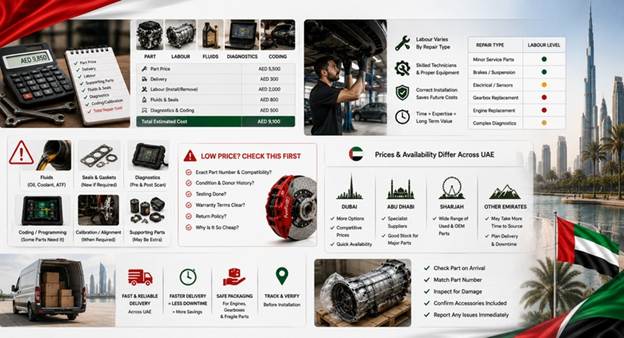
| Illustrative project total | AED 9,100 |
These figures are illustrative only, not a fixed UAE tariff.
The important lesson is that a gearbox advertised at AED 5,500 does not mean the repair costs AED 5,500.
When should you compare repair with replacement?
Compare the original gearbox repair against used and reconditioned replacement when the diagnosis is uncertain or the rebuild quotation becomes high.
Then compare the complete installed cost, warranty and expected service life rather than the gearbox purchase price alone.
Audi Brake and Suspension Parts Prices: What Should You Budget?
Brake and suspension pricing depends heavily on whether you are buying wear parts, assemblies or electronically controlled systems.
A brake pad and an air-suspension assembly should never be treated as comparable purchases simply because both sit under the “chassis” category.
Brake parts
For brakes, consider:
- Pads
- Discs
- Calipers
- Sensors
- Mounting hardware where applicable
Brake pads are wear items, so buying used pads simply to save money is generally difficult to justify.
For discs, inspect thickness, scoring, cracking, heat damage and remaining service life against the relevant specification.
Used brake calipers
A used caliper can be worth considering if it is properly inspected.
Check for corrosion, piston condition, seal condition and mounting damage.
A low purchase price does not compensate for a caliper that requires immediate rebuilding.
Suspension parts
Used suspension arms, hubs and other assemblies can offer useful savings when their condition is known.
Look for:
- Excessive play
- Bent arms
- Cracked parts
- Worn bushes
- Corrosion
- Damaged mounting points
A clean photograph is not enough.
Mechanical wear is often hidden.
Dampers and shock absorbers
A used damper should be checked for leakage and physical damage.
Donor mileage also matters.
If one damper is badly worn and the other side is still original, discuss whether replacing the pair is more appropriate for the particular Audi.
Air suspension
Q7 and other Audi models equipped with air suspension can have substantially different repair costs from vehicles with conventional suspension.
A low vehicle does not automatically mean the air spring itself has failed.
The fault could involve the compressor, valve system, air leak or sensor.
Diagnose first.
Then buy the part.
Wheel alignment
Suspension work can require wheel alignment afterwards.
Include that cost when comparing quotations.
A cheap suspension part followed by poor alignment is not a cheap repair.
Brake and suspension price decision
For safety-related parts, the priority should be:
Correct specification → condition/quality → installation → price
Not the other way around.
Audi Electrical Parts and Sensor Prices: Why Coding Can Add to the Bill
Audi electrical parts can have relatively modest purchase prices while creating surprisingly complicated repair bills.
The reason is simple: the physical part is only one part of the job.
Sensors
Sensor prices can vary according to model, engine, system and manufacturer.
Before replacing one, confirm that the sensor itself has actually failed.
A diagnostic code can point towards a circuit or system without proving that the sensor is defective.
Check wiring, connectors, power supply and related parts before buying.
Control modules
Used Audi control modules can be considerably cheaper than new genuine replacements.
But compatibility must be checked carefully.
The exact part number matters, and the replacement may require coding or programming.
Ask the workshop about this before buying.
Coding and programming
A used electronic part may arrive physically correct but still require configuration for the vehicle.
That can add diagnostic labour to the repair.
The total calculation becomes:
Part + delivery + installation + coding/programming + diagnostic testing
A supplier who gives you only the module price has not necessarily given you the repair price.
Calibration
Some Audi systems may require calibration after installation.
Depending on the vehicle and system, that can affect lighting, steering, suspension or driver-assistance functions.
Confirm the requirement with the workshop before purchasing the replacement.
Used versus new electronic parts
| Option | Price | Main risk |
| Used genuine | Lower | Compatibility and remaining life |
| Reconditioned | Mid | Rebuild/testing quality |
| New OEM | Mid/high | Manufacturer verification |
| New genuine | Highest | Higher initial cost |
A tested used module with a clear warranty can be an excellent value purchase.
An untested module with an uncertain part number can be a very expensive experiment.
Don't replace an electronic part blindly
This is particularly important with intermittent faults.
If the real problem is damaged wiring, poor voltage supply or a communication fault, replacing the module will not solve it.
Good diagnosis can therefore save money before the parts search even begins.
Audi Body, Lighting and Interior Parts: How Much Does Condition Affect Price?
Body and interior parts are often easier to inspect than engines or electronic modules, but their prices can still vary substantially.
The condition of the actual part matters enormously.
Audi body panels
Used doors, wings, bonnets and other body panels can offer major savings over new genuine parts.
But inspect:
- Dents
- Creases
- Rust or corrosion
- Previous repairs
- Broken mounting points
- Paint condition
- Correct side and body style
A cheap panel requiring extensive bodywork and repainting may no longer be cheap after installation.
Used Audi headlights
Headlights can be expensive, particularly on higher-spec Audi models.
Before buying, check:
- Exact part number
- Lens condition
- Housing
- Mounting brackets
- Connectors
- Moisture inside the unit
- Electronic functions
- Coding requirements where applicable
A headlight that looks perfect from the front may have a broken mounting point at the rear.
Taillights and lighting assemblies
The same principle applies to rear lighting.
Check for cracks, water ingress, damaged mounts and connector condition.
If the Audi uses electronically managed lighting, ask whether configuration is required.
Interior parts
Seats, trim, switches, screens and other interior parts can be particularly attractive as used purchases because cosmetic condition is easy to compare.
But check colour, trim code, specification and connector arrangement.
A seat from the same Audi model may still have different electrical functions or upholstery.
Why colour matters for body parts
A used panel in the correct shape is not necessarily a perfect replacement.
Paint colour, finish and previous repairs can affect the final cost.
A panel that needs repainting may still be worthwhile if it is structurally sound and substantially cheaper.
But include paint and fitting in the calculation.
Body and lighting price comparison
| Part | Main used-part check | Possible extra cost |
| Door | Damage, mounts, paint | Painting/fitting |
| Bonnet | Dents, alignment, corrosion | Paint/fitting |
| Headlight | Lens, mounts, electronics | Coding/calibration |
| Taillight | Cracks, moisture, connectors | Fitting |
| Seat | Trim, colour, electrical functions | Installation |
| Interior trim | Clips, finish, specification | Fitting |
When used body parts are especially attractive
Used genuine body and interior parts can make strong financial sense when the part is visually inspected and the replacement does not involve complicated mechanical or electronic work.
A clean door panel from the correct donor can save a substantial amount compared with buying new.
But again, compare the finished repair, not just the price of the part.
The final price question
For almost every Audi repair in this section, the same rule comes back:
What is the price of the part, and what will it cost to have the car properly repaired?
That second figure is the one that matters.
A cheaper engine with unknown condition, a low-priced gearbox without warranty or an inexpensive headlight requiring unexpected coding can all produce the same problem: the advertised saving looks impressive until the final invoice arrives.
Complete Repair Cost and UAE Buying Decisions
Audi Spare Part Price vs Complete Repair Cost: What Will You Actually Pay?
The price printed beside an Audi spare part is only the first number.
If a gearbox costs AED 5,500, for example, your repair bill can still include removal, installation, fluid, seals, diagnostics, adaptation and other supporting work.
That is why owners should compare complete repair costs, not isolated part prices.
Build the repair cost before approving the job
For a major Audi repair, calculate:
Part + delivery + labour + supporting parts + fluids + diagnostics + coding/calibration where required
Then ask whether anything else is likely to be discovered during installation.
This matters particularly with older Audi vehicles, where one failed part can sit alongside other worn parts.
Example: used Audi gearbox
An illustrative UAE calculation could look like this:
| Repair item | Example cost |
| Used gearbox | AED 5,500 |
| Delivery | AED 300 |
| Removal and installation | AED 2,000 |
| Transmission fluid/seals | AED 800 |
| Diagnostics/adaptation | AED 500 |
| Illustrative total | AED 9,100 |
These figures are examples, not fixed UAE market rates.
The important point is that the AED 5,500 gearbox is not the AED 5,500 repair.
Supporting parts can change the calculation
A replacement engine may require new oil, coolant, filters, seals or other supporting parts.
A suspension repair may require alignment.
An electronic module may need coding.
A headlight may require configuration or calibration depending on the vehicle.
Ask the workshop to identify these requirements before you commit.
Installation difficulty matters
A cheap part that takes several hours to install can become expensive.
This is particularly relevant to engines, gearboxes and parts buried behind other assemblies.
If the replacement fails, you may have to pay much of that labour again.
That is why warranty and installation difficulty belong in the price comparison.
The real question
Do not ask:
“How much is the Audi part?”
Ask:
“How much will it cost to complete the repair correctly?”
That shift alone can prevent a surprisingly large number of bad buying decisions.
Audi Labour Costs in UAE: How Much Does Installation Add?
Audi labour costs vary according to the job, workshop, equipment and technician expertise.
There is no useful single UAE labour figure that applies equally to replacing a mirror, gearbox, engine or electronic module.
Simple versus complex work
Replacing an accessible exterior part may require relatively little labour.
A gearbox or engine can involve extensive dismantling, fluid replacement, diagnostics and road testing.
The difference in labour can therefore be much larger than the difference between the parts themselves.
Illustrative UAE labour ranges
The following should be treated as planning examples rather than fixed market rates:
| Repair type | Typical labour intensity |
| Simple body/interior part | Low |
| Brake or suspension work | Low to medium |
| Electrical module | Medium, potentially higher with coding |
| Gearbox replacement | High |
| Engine replacement | Very high |
| Complex diagnostic/electronic repair | Variable |
A supplier quoting only the part price is not necessarily hiding anything.
They may simply be a parts supplier rather than the workshop carrying out the repair.
Get the installation quotation separately.
Specialist equipment can affect labour
Some Audi repairs require specialist diagnostic equipment or programming capability.
That can increase the workshop cost.
But paying for the correct equipment can be cheaper than fitting the wrong part and then transporting the Audi elsewhere for configuration.
Dubai, Abu Dhabi and Sharjah labour differences
Workshop pricing can vary between Emirates and even between workshops in the same city.
The useful comparison is therefore not simply:
Dubai versus Abu Dhabi versus Sharjah.
Instead, compare:
Technician expertise + equipment + labour scope + warranty + total repair cost.
A lower hourly rate does not automatically produce a lower final bill.
Ask what the labour quotation includes
Before approving work, confirm whether the labour price includes:
- Removal
- Installation
- Fluid replacement
- Diagnostics
- Coding
- Adaptation
- Calibration
- Road testing
- Final inspection
If these items are separate, ask for their individual prices.
That makes quotations much easier to compare.
Hidden Audi Repair Costs: Fluids, Seals, Diagnostics, Coding and Calibration
Hidden costs are rarely mysterious.
Most of them become “hidden” because nobody asks about them before the work starts.
Fluids
Engine replacement can require oil and coolant.
Gearbox work can require transmission fluid.
These are not optional extras if the repair procedure requires them.
Ask whether the quoted price includes the correct fluid.
Seals and gaskets
When a major assembly is removed, accessible seals and gaskets may be worth replacing rather than reusing old items.
The exact requirement depends on the repair.
The important point is to ask before the vehicle is dismantled.
Diagnostics
A diagnostic scan before purchasing the part can prevent an unnecessary replacement.
After installation, another scan may be needed to verify that the original fault has been resolved.
That means diagnostics can be part of both the decision-making process and the final repair.
Coding and programming
Electronic Audi parts may require configuration after installation.
Ask about this before buying a used or OEM electronic part.
A part that is mechanically correct but electronically incompatible is not a successful purchase.
Calibration
Some systems may require calibration after installation.
The requirement depends on the Audi model, system and exact repair.
Do not assume every replacement needs calibration, but do not assume none do either.
Wheel alignment
Suspension-related repairs can sometimes require alignment.
If the workshop does not include it in the quote, add it to your budget.
Otherwise, the “cheap” suspension repair may be followed by uneven tyre wear or handling problems.
Hidden-cost checklist
| Possible cost | Commonly relevant to |
| Engine oil | Engine work |
| Coolant | Cooling/engine work |
| Transmission fluid | Gearbox work |
| Seals/gaskets | Major mechanical repairs |
| Diagnostics | Electronic and major mechanical repairs |
| Coding | Certain electronic parts |
| Programming | Certain modules |
| Calibration | Selected electronic/driver-assistance systems |
| Wheel alignment | Some suspension repairs |
| Additional supporting parts | Complex repairs |
The safest quotation is not necessarily the shortest one.
It is the one that makes the final cost easier to understand.
Cheap Audi Spare Parts in UAE: When Is a Low Price a Warning Sign?
A cheap Audi part can be a smart purchase.
An unexplained cheap Audi part can be a trap.
The difference is whether the price has a sensible explanation.
Why might a part be cheaper?
It could be:
- From a high-mileage donor
- Excess stock
- An older-generation part
- Cosmetic stock
- A common used part
- Missing some accessories
- Sold without a strong warranty
- Available because the supplier needs to clear inventory
Not every reason is bad.
You need to find out which one applies.
Warning signs
Be cautious if the supplier:
- Cannot provide the exact part number
- Cannot confirm VIN compatibility
- Refuses to show the actual part
- Has no donor information
- Cannot explain testing
- Gives vague warranty terms
- Claims one part fits every specification
- Pressures you to pay immediately
These signs do not prove that the part is faulty.
They do increase uncertainty.
Cheap gearbox example
Suppose one used gearbox costs AED 4,000 and another costs AED 5,500.
The AED 4,000 option is not automatically better.
If the second gearbox has documented donor mileage, testing and a stronger warranty, the additional AED 1,500 may represent a reasonable reduction in risk.
Cheap electronic parts
With an ECU or control module, the risk can be even less visible.
The part may look perfect while being the wrong specification or requiring programming that the workshop cannot perform.
Confirm compatibility before price becomes the deciding factor.
The cheapest successful repair is the goal
There is a difference between:
cheapest part
and
cheapest reliable repair.
Always aim for the second.
Audi Parts in Dubai, Abu Dhabi, Sharjah and Other Emirates: What Changes?
The fundamental compatibility rules remain the same across the UAE.
What changes is often availability, delivery, workshop access and downtime.
Dubai
Dubai can provide a broad choice of Audi suppliers and workshops.
That makes price comparison easier, but it also means owners may encounter many apparently similar listings.
Check the exact part number and condition before treating two prices as comparable.
Abu Dhabi
Abu Dhabi owners can source parts locally or from other Emirates when availability is better elsewhere.
For major repairs, compare delivery time with workshop downtime.
A slightly higher part price can be justified if it gets the Audi repaired sooner and the supplier provides stronger warranty protection.
Sharjah
Sharjah's automotive market can provide a wide range of used and replacement Audi options.
The same warning applies: availability is useful only when the part actually matches the vehicle.
Ajman, Ras Al Khaimah, Fujairah and Umm Al Quwain
Owners in these Emirates may sometimes need to source specialist Audi parts from larger automotive markets.
That is not necessarily a disadvantage.
Cross-Emirate sourcing can work well when the supplier provides reliable delivery and clear return arrangements.
UAE-wide comparison
| Location factor | What to consider |
| Local stock | Faster collection or delivery |
| Cross-Emirate stock | Potentially better availability |
| Delivery | Cost and expected arrival time |
| Workshop location | Labour and installation convenience |
| Specialist capability | Diagnostics/coding/calibration |
| Vehicle downtime | Particularly important for business use |
The best supplier may therefore be outside your immediate area.
Distance is only one part of the calculation.
Audi Spare Parts Delivery in UAE: Does Faster Availability Save Money?
It can.
When an Audi is already sitting in a workshop, every additional day can have a cost.
For a private owner, that may mean alternative transport.
For a business or fleet vehicle, it can mean lost working time.
Compare price with availability
Imagine two compatible used Audi gearboxes:
Supplier A: AED 4,800, delivery in five days.
Supplier B: AED 5,300, available for immediate delivery.
The AED 500 difference may be worth paying if the vehicle is already dismantled and downtime is expensive.
But if the Audi is still driveable and the repair is not urgent, waiting may be perfectly sensible.
The owner's circumstances change the answer.
Delivery cost
Ask whether delivery is included.
For large parts such as engines and gearboxes, transport costs can be more significant than they are for sensors or trim.
A low parts price with unexpectedly high delivery can narrow the apparent saving.
Inspect the part when it arrives
For expensive used parts, check the packaging and physical condition before installation where practical.
Photograph any obvious transport damage.
Check the part number against the purchase details.
If something looks wrong, raise it before the workshop starts fitting the part.
Returns matter
Ask beforehand:
- How long is the return period?
- Who pays return delivery?
- What happens if the part arrives damaged?
- What happens if it is incompatible?
- Is replacement offered?
- Is a refund available?
- Does the warranty start on delivery or installation?
These details are particularly important for engines and gearboxes.
Delivery and workshop coordination
The ideal arrangement is straightforward.
The workshop confirms exactly what part is required.
The supplier confirms availability and compatibility.
The part arrives before or at the agreed installation time.
The workshop then completes installation, diagnostics and any required coding or calibration.
That sounds ordinary.
Yet when those three parties are not coordinated, a repair can lose days for no good reason.
Downtime should be part of the price
For a fleet Audi, calculate:
Parts cost + repair cost + expected downtime cost.
For a private Audi, calculate the practical cost of being without the vehicle.
A slightly more expensive part that arrives promptly can sometimes be the financially smarter choice.
The key is not to pay extra blindly.
Pay extra when faster availability actually saves you more elsewhere.
Choosing the Right Audi Part for Long-Term Value
Genuine vs OEM vs Used vs Reconditioned vs Aftermarket: Which Should You Buy?
There is no single Audi parts category that wins every time.
The right choice depends on the part itself, the Audi's age, installation difficulty, expected ownership period, warranty, remaining life and the difference between purchase prices.
A new genuine part may be the obvious choice for one repair, while a tested used genuine part makes far more financial sense for another.
Genuine Audi parts
New genuine parts generally offer the strongest confidence in new-part condition and original specification.
That does not mean they are automatically the best value.
If the genuine option costs several times more than a credible alternative on an older Audi, calculate whether the additional expenditure is justified by the expected benefit.
OEM parts
A reputable OEM manufacturer can offer a useful middle ground between genuine pricing and lower-cost alternatives.
But verify the manufacturer.
“OEM quality” is not the same thing as proving that a recognised OEM actually made the part.
Used genuine Audi parts
Used genuine parts can offer substantial savings, particularly for expensive assemblies and older Audi vehicles.
The important trade-off is remaining service life.
Check donor mileage, condition, testing, part number and warranty before deciding.
Reconditioned parts
A properly reconditioned part can make sense where internal wear is the main concern and the rebuilding process is credible.
Ask what was replaced and how the finished unit was tested.
If the supplier cannot explain the rebuild, do not pay a large premium simply because the listing says “reconditioned”.
Aftermarket parts
Aftermarket options can provide excellent value when supplied by a reputable manufacturer and matched correctly to the vehicle.
They can be particularly useful for routine maintenance and common wear parts.
Quality varies, though, so the manufacturer and specification matter.
A practical decision table
| Option | Price position | Best reason to choose it | Main risk |
| Genuine new | Highest | Maximum new-part confidence | Cost |
| OEM | Medium/high | Quality/value balance | Manufacturer must be verified |
| Reconditioned | Medium | Rebuilt major part | Rebuild quality |
| Used genuine | Lower | Original part at lower cost | Remaining life |
| Aftermarket | Wide range | Choice and potential savings | Quality variation |
Which option suits which situation?
For a newer Audi that you intend to keep for years, a new genuine or reputable OEM part can be easier to justify.
For an older A3 or A4 where the genuine price is disproportionately high, a tested used genuine part may provide much better value.
For a gearbox or another rebuildable assembly, compare a documented reconditioned unit against both used and new options.
For common maintenance parts, a reputable aftermarket alternative may be the most sensible route.
The answer should follow the risk of the repair, not the prestige of the label.
Repair or Replace: When Does an Audi Parts Bill Become Too High?
A large Audi repair bill does not automatically mean the car should be sold.
Nor does a cheap used part automatically make the repair sensible.
The decision depends on the vehicle's overall condition and what you are likely to spend after today's repair.
Start with the current repair
Calculate the complete cost.
Then list the repairs you already know are approaching.
For example, an older Q7 may need a gearbox while also showing worn suspension, ageing tyres and cooling-system issues.
The gearbox itself may be repairable.
The bigger question is whether the whole vehicle remains financially sensible.
The 12-month ownership test
Ask:
What is this Audi likely to cost me over the next year if I repair it today?
Include:
- Current major repair
- Known maintenance
- Tyres
- Brakes
- Suspension
- Cooling-system work
- Electrical repairs
- Scheduled servicing
- Other already-identified faults
You will not predict every failure.
You can still make a much better decision by recognising the problems already visible.
When repair often makes sense
Repair deserves serious consideration when:
- The Audi has a strong service history
- The body is in good condition
- The interior is well maintained
- The engine or gearbox is otherwise healthy
- Major recent work has already been completed
- The current fault is isolated
- You know the car's history well
Your existing car has one major advantage over an unknown replacement:
you know what you own.
When replacement deserves consideration
Start comparing replacement vehicles when the Audi has several major unresolved problems and the repair list keeps expanding.
A gearbox repair followed by another major engine-related problem, significant suspension work and multiple electronic faults can change the economics quickly.
At that point, compare the vehicle's next 12 months of costs against replacing it.
Repair versus replacement calculation
| Question | Repair Audi | Replace Audi |
| Immediate cost | Repair bill | Purchase cost |
| Known history | High | Depends on replacement |
| Upcoming repairs | Can be estimated | Often uncertain |
| Registration/insurance | Existing | New costs |
| Financing | Usually none for repair | May apply |
| Downtime | Repair period | Acquisition period |
| Familiarity | High | Low |
| Long-term value | Depends on condition | Depends on replacement |
Do not compare an AED 10,000 repair with the AED 10,000 purchase price of another used car and assume they are equivalent.
The replacement vehicle may immediately need tyres, servicing, brakes or other work.
Audi Parts for Older and High-Mileage Cars: How Much Should You Spend?
Mileage is useful evidence.
It should not be the only reason to stop repairing an Audi.
A high-mileage vehicle with consistent maintenance can be a better ownership proposition than a lower-mileage vehicle with an uncertain history.
Look at the whole car
Before approving a major repair, assess:
- Engine condition
- Gearbox condition
- Cooling system
- Suspension
- Brakes
- Tyres
- Electrical systems
- Air conditioning
- Body condition
- Service history
Then decide whether the major part you are about to buy is likely to restore a fundamentally healthy vehicle.
High mileage and UAE ownership
UAE driving can involve long daily commutes, extensive motorway use and regular journeys between Emirates.
That can push annual mileage up quickly.
High mileage therefore deserves attention when buying used engines, gearboxes, suspension parts and other wear-sensitive parts.
But mileage alone does not tell you how well a part has been maintained.
Heat and operating conditions
High ambient temperatures and extensive air-conditioning use form part of normal UAE ownership.
For an older Audi, cooling-system condition, fluid quality, seals, battery performance and other heat-sensitive areas deserve proper inspection.
This does not mean replacing parts simply because the vehicle operates in a hot climate.
It means considering operating conditions when assessing remaining life and repair risk.
When should you spend more on an older Audi?
Spend more when the additional money materially reduces risk.
For example, choosing a tested reconditioned gearbox with a stronger warranty over an unknown used gearbox may be sensible.
Paying a large premium for a cosmetic part that is already available in excellent used condition may not be.
High-mileage decision matrix
| Vehicle condition | Sensible approach |
| High mileage, strong history | Repair selectively |
| High mileage, good body, one major fault | Compare used/reconditioned/genuine |
| High mileage, several known faults | Calculate 12-month ownership cost |
| Poor history, multiple major faults | Consider replacement |
| High mileage but mechanically healthy | Do not replace unnecessarily |
| Business/fleet vehicle | Add downtime to repair calculation |
Do not let the odometer make the decision for you
A 200,000-km Audi is not automatically finished.
A 120,000-km Audi is not automatically healthy.
Condition, maintenance and the quality of the proposed repair matter more than a single number.
Audi Spare Parts Buying Checklist: What to Confirm Before Paying
Before paying for an Audi spare part, stop and verify the details.
It takes a few minutes.
A wrong gearbox, incompatible control module or damaged used engine can cost far more than the time spent checking it.
Confirm the Audi
Write down:
- Model
- Generation
- Model year
- VIN
- Engine code
- Gearbox code where relevant
- Drivetrain
- Exact specification
Do not send a supplier only “Audi Q5 2019” if you have the VIN and original part information available.
Confirm the part
Check:
- Exact part number
- Manufacturer
- Revision/suffix
- Left or right side where relevant
- New/used/reconditioned status
- What is included
- Whether ancillary parts are included
If the replacement number differs from the original, ask whether it is a confirmed supersession.
Check the condition
For used parts, ask:
- What was the donor vehicle?
- What was its mileage?
- Why was it dismantled?
- Has the part been tested?
- What defects were found?
- Has it been repaired?
- How was it stored?
For an engine or gearbox, ask more detailed questions.
“Good condition” is not a test result.
Calculate the complete price
Before approving the purchase, add:
Part + delivery + labour + fluids + seals/gaskets + supporting parts + diagnostics + coding/programming + calibration/alignment where required
That is the figure you should compare between suppliers.
Confirm warranty
Ask:
- How long is the warranty?
- What exactly does it cover?
- Is labour included?
- What installation conditions apply?
- Who pays return delivery?
- What happens if the part is incompatible?
- What happens if it fails after installation?
- Is replacement or refund offered?
Get the answer in writing.
Confirm workshop capability
For complex Audi repairs, ask whether the workshop can perform any required:
- Diagnostics
- Coding
- Programming
- Adaptation
- Calibration
- Wheel alignment
- Post-installation testing
There is little value in buying a compatible electronic part if nobody at the workshop can configure it.
Final buying checklist
| Before payment | Check |
| VIN verified | ☐ |
| Exact part number confirmed | ☐ |
| Engine/gearbox specification checked | ☐ |
| Donor history available | ☐ |
| Mileage known where relevant | ☐ |
| Condition inspected | ☐ |
| Testing explained | ☐ |
| Actual part photographs seen | ☐ |
| Warranty understood | ☐ |
| Return terms understood | ☐ |
| Delivery time confirmed | ☐ |
| Complete repair cost calculated | ☐ |
| Coding/calibration checked | ☐ |
| Workshop capability confirmed | ☐ |
The final price is not the advertised price
An Audi part advertised for AED 2,000 can become an AED 4,000 repair.
Another part priced at AED 2,500 may become an AED 3,200 repair because installation is easier, the supplier provides better warranty protection and no expensive programming is required.
That is why the smartest comparison is always based on the complete repair outcome.
For owners comparing Audi parts and supplier availability in the UAE, PartFinder UAE can be mentioned naturally as part of the sourcing process, but the decision should still come down to exact fitment, condition, warranty, delivery and total repair cost rather than a platform or supplier name alone.
FAQs
Categories
- Audi
- BMW
- Car Accessories
- Car Tips
- Ford
- Land Rover
- Mazda
- Range Rover
- Top 10
- UAE Car Parts
- Used Car Parts
- Toyota
- Replacement Engines
- Nissan
- Hyundai
- Mitsubishi
- Volkswagen
- Honda
- Kia
- Chevrolet
- Dodge
- Jeep
- Subaru
- Renault
- Lexus
- Mercedes
- Suzuki
- Hummer
- Porsche
- Infiniti
- Peugeot
- GMC
- Mini
- Volvo
- Replacement Gearboxes
- MG
- Jaguar
- Skoda
- Cadillac
- Daihatsu
- Fiat
- German Car Parts
- Japanese Car Parts
- Aftermarket Car Parts
- Genuine Car Parts
- New Car Parts
- Reconditioned Car Parts
- European Car Parts
- American Car Parts
- Korean Car Parts
- British Car Parts
- Chinese Car Parts
- Sports/Exotic Car Parts
- Luxury Car Parts
- Performance Car Parts
- SUV/4x4 Spare Parts
- Truck Spare Parts
- EV Car Parts
- Hybrid Car Parts
- Auto Spare Parts in UAE
- Tesla
- Isuzu
- Ram
- Ferrari
- Bentley
- Lamborghini
- Genesis
- Maserati
- Lincoln
- Chrysler
- Opel
- Citroen
- SsangYong
- Seat
- McLaren
- Aston Martin
- Rolls Royce
- Maybach
- Alfa Romeo
- Bugatti
- Scion
- Abu Dhabi Car Parts
- Ajman Car Parts
- Al Khan Car Parts
- Al Sajaa Car Parts
- Deira Car Parts
- Dubai Car Parts
- Fujairah Car Parts
- Industrial Area 6 Car Parts
- Mussafah Car Parts
- Ras Al Khaimah Car Parts
- Sharjah Car Parts
- Umm Al Quwain Car Parts
- Acura
- BYD
- Chery
- Dacia
- DS
- Geely Emgrand
- EXEED
- GAC
- GAC Gonow
- Geely
- Gonow
- Great Wall
- Haima
- Haval
- Holden
- Iveco
- JAC
- Jaecoo
- Jetour
- Lotus
- Omoda
- Proton
- Renault Samsung
- Roewe
- Lucid
- Replacement Headlight
- Replacement Bumper