Before You Replace Your Volkswagen Amarok, See How a Replacement Engine Could Save You Thousands in UAE
June 6, 2026
A surprising number of Volkswagen Amarok owners arrive at exactly the same crossroads.
The pickup is parked outside a workshop.
The engine has failed. Or perhaps it hasn't failed completely yet, but it's heading in that direction with enough determination to make the outcome fairly obvious.
The quotation arrives.
The first reaction isn't usually to look for a replacement engine.
It's to look for another vehicle.
Open a few classified websites. Check pickup prices. Browse dealer inventory. Run some numbers. Wonder whether this is finally the point where the Amarok leaves the driveway for good.
Perfectly understandable.
Also, in many cases, completely unnecessary.
Because here's the uncomfortable reality that workshops see every week across Dubai, Abu Dhabi, Sharjah and beyond: plenty of Amaroks get replaced when the only thing truly worn out is the engine.
The pickup itself may still be perfectly capable of delivering years of service.
The chassis may be healthy.
The transmission may still have life left.
The suspension may have been maintained properly.
The body may be in excellent condition.
Yet one major engine failure sends owners into vehicle-replacement mode before they've properly examined the alternatives.
And that's where thousands of dirhams can quietly disappear.
Before You Give Up on Your Volkswagen Amarok, Ask This One Question First
Not:
"Can I afford a replacement engine?"
Ask something more useful.
"Is the rest of the vehicle worth saving?"
The distinction matters.
A lot.
Because many Amarok owners accidentally frame the problem incorrectly. They focus entirely on the failed engine and ignore everything surrounding it.
Imagine two scenarios.
Owner number one has an Amarok with a strong service history, healthy transmission, relatively recent suspension work and no significant structural issues.
Owner number two has a vehicle suffering from multiple major mechanical problems, corrosion issues and years of neglected maintenance.
Both experience engine failure.
The correct decision may be completely different for each owner.
Yet both receive exactly the same diagnosis.
"Engine replacement required."
That's why smart buyers step back before they rush forward.
The engine is only one chapter of the story.
Not the entire book.
What Usually Causes Volkswagen Amarok Engine Failure in UAE Conditions?
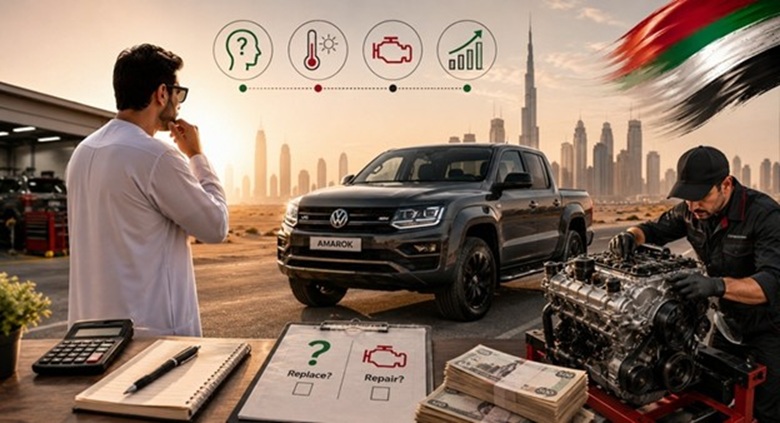
People often blame the climate.
The climate gets blamed for everything.
To be fair, UAE temperatures are demanding. Summer traffic alone can test cooling systems in ways many vehicles never experience elsewhere.
But the weather rarely destroys an engine on its own.
Neglect usually helps.
Sometimes a lot.
A cooling problem gets ignored.
An oil leak gets postponed until next month.
A warning light appears and then somehow becomes part of the dashboard scenery.
Weeks pass.
Months pass.
The vehicle keeps running.
So the owner keeps driving.
Then one day it doesn't.
Most Common Causes of Amarok Engine Failure
| Cause | Severity |
| Chronic Overheating | Critical |
| Low Oil Levels | Critical |
| Turbocharger Problems | High |
| Cooling System Failure | High |
| Poor Maintenance History | High |
| Internal Component Wear | Moderate to High |
| Injector Problems | Moderate to High |
| Ignored Warning Signs | Critical |
What's remarkable is how often the final failure isn't the real problem.
It's merely the result of dozens of smaller problems that were allowed to build up quietly over time.
The Expensive Mistake Many Amarok Owners Make Immediately After Engine Failure
Panic shopping.
That's what it is.
The workshop delivers bad news and suddenly the owner starts comparing replacement vehicles before comparing replacement engines.
Now, sometimes replacing the vehicle is absolutely the right move.
But often?
Not even close.
Let's say an owner jumps straight into the used-pickup market.
They're not just replacing an engine anymore.
They're paying:
- Vehicle purchase costs
- Registration costs
- Insurance adjustments
- Unknown maintenance history
- Possible financing costs
- Potential future repairs
Suddenly the replacement vehicle isn't replacing an engine.
It's replacing certainty.
And certainty has value.
Particularly when the current Amarok's history is already known.
A vehicle you understand often represents less risk than one you don't.
Can a Replacement Engine Really Save You Thousands Compared to Replacing the Vehicle?
Short answer?
Frequently, yes.
Long answer?
It depends on the condition of the vehicle.
Yet many UAE owners are surprised when they compare the numbers properly.
Let's look at the broader financial picture.
Typical Cost Comparison
| Option | Estimated UAE Cost (AED) |
| Major Engine Repair | 8,000–20,000 |
| Used Engine Project | 12,000–25,000 |
| Reconditioned Engine Project | 18,000–35,000 |
| OEM Engine Project | 25,000–50,000 |
| Replacement Pickup Purchase | 70,000–180,000+ |
The gap can be substantial.
Even after accounting for installation, labour, supporting parts and contingencies.
And this is where many owners pause.
Because suddenly the replacement-engine route starts looking less like a repair and more like a financial strategy.
Volkswagen Amarok Engine Options Available in UAE
This is usually where confusion begins.
Every workshop has an opinion.
Every supplier has a recommendation.
Every friend has a story.
The challenge isn't finding advice.
The challenge is sorting through it.
Common Engine Options
| Engine Type | Initial Cost | Reliability Potential |
| Used Engine | Lower | Variable |
| Reconditioned Engine | Moderate | Strong |
| OEM Engine | Higher | Very Strong |
| Genuine Engine | Highest | Excellent |
Notice what's missing?
There isn't a universally correct answer.
The best engine depends entirely on ownership goals.
Someone planning to sell the Amarok within a year may reach a very different conclusion from a contractor planning another five years of service.
Context changes everything.
Volkswagen Amarok Replacement Engine Costs in UAE: What Owners Actually Pay
This is the section readers usually jump to first.
Fair enough.
The numbers matter.
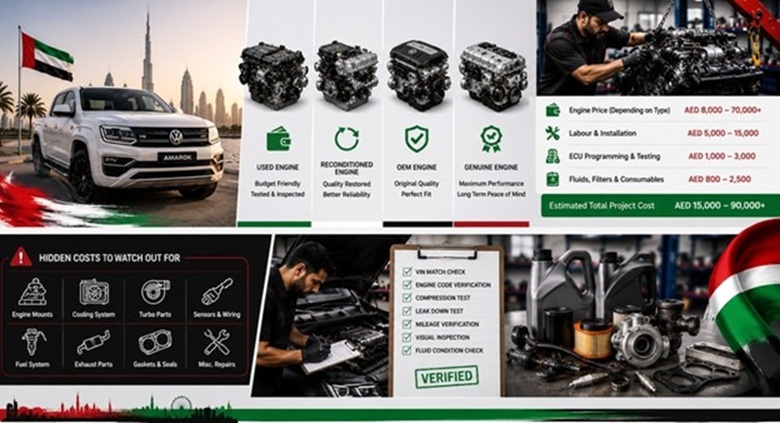
Typical Engine Prices
| Engine Type | Estimated Cost (AED) |
| Used Engine | 8,000–18,000 |
| Reconditioned Engine | 12,000–28,000 |
| OEM Engine | 20,000–45,000 |
| Genuine Engine | 35,000–70,000+ |
But here's where owners regularly get caught out.
Those aren't project costs.
They're engine costs.
The difference can be dramatic.
An engine sitting on a pallet doesn't solve anything.
The project includes everything required to get the vehicle back on the road reliably.
And that's where the real conversation begins.
Labour Costs, Installation Charges and Total Project Costs Explained
Nobody enjoys paying labour.
Yet nobody enjoys paying twice either.
A poor installation can turn a promising replacement-engine project into an ongoing source of frustration.
Which is why labour quality matters almost as much as engine quality.
Labour Cost Breakdown
| Service | Typical UAE Cost (AED) |
| Diagnostics | 500–2,000 |
| Engine Removal | 2,000–5,000 |
| Installation | 3,000–8,000 |
| ECU Programming | 1,000–3,000 |
| Testing & Calibration | 500–2,500 |
Estimated Complete Project Costs
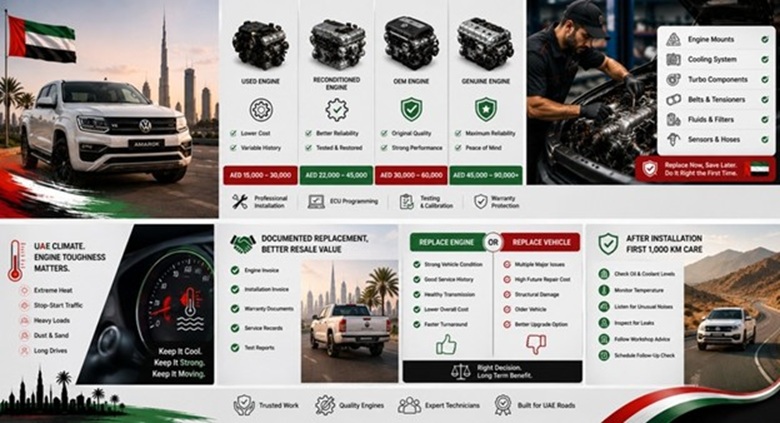
| Engine Type | Total Project Cost (AED) |
| Used Engine | 15,000–30,000 |
| Reconditioned Engine | 22,000–45,000 |
| OEM Engine | 30,000–60,000 |
| Genuine Engine | 45,000–90,000+ |
And here's the irony.
The cheapest quotation often receives the most attention.
Yet experienced Amarok owners frequently focus on a different question:
"What will this cost me two years from now?"
That's usually where the smartest decisions get made.
Hidden Expenses That Can Turn a Cheap Engine Into an Expensive Decision
This is where reality starts pushing back.
A workshop removes the old engine.
Then additional issues begin showing themselves.
Not because anyone is being dishonest.
Because certain problems simply can't be seen properly until disassembly begins.
And that's when the original budget starts feeling optimistic.
Common Hidden Costs
| Item | Typical Cost (AED) |
| Engine Mounts | 800–3,000 |
| Radiator Replacement | 1,000–5,000 |
| Cooling Hoses | 300–2,000 |
| Turbo-Related Components | 1,000–8,000 |
| Sensors & Electronics | 500–4,000 |
| Fuel System Repairs | 1,000–6,000 |
| Wiring Repairs | 500–5,000 |
Some owners see these expenses as bad news.
Others see them as opportunities to prevent future failures while access is already available.
The second group usually sleeps better afterwards.
The Compatibility Check That Can Save You From an Extremely Expensive Mistake
This isn't the glamorous part of engine shopping.
Nobody sits around discussing VIN numbers over coffee.
Yet compatibility mistakes have a nasty habit of turning straightforward engine projects into long, frustrating and expensive projects.
Here's the problem.
Many Amarok owners become obsessed with finding the cheapest engine. They scroll through listings. They call suppliers. They compare prices. Eventually, somebody offers a unit that appears significantly cheaper than everything else on the market.
A bargain.
Or at least it appears to be.
Then installation begins.
The engine physically fits.
The electronics disagree.
The ECU throws faults.
Sensors refuse to communicate properly.
The transmission starts behaving strangely.
Suddenly, the bargain is no longer a bargain. It's a troubleshooting exercise.
And troubleshooting exercises tend to charge by the hour.
Essential Compatibility Checks
| Verification Item | Importance |
| VIN Match | Critical |
| Engine Code Verification | Critical |
| ECU Compatibility | Critical |
| Transmission Compatibility | Critical |
| Wiring Harness Matching | High |
| Turbo Configuration | High |
| Emissions System Matching | High |
The cheapest engine in the UAE becomes surprisingly expensive when it needs weeks of additional work just to function correctly.
Mileage Verification and Compression Testing: Trust, But Verify
People trust paperwork.
Sometimes they should.
Sometimes they really shouldn't.
A used Amarok engine advertised as "excellent condition" sounds wonderful. So does "low mileage." Unfortunately, neither phrase turns a crankshaft nor confirms internal health.
That's why experienced buyers look beyond marketing language.
They want evidence.
Compression readings.
Leak-down test results.
Service records.
Inspection reports.
Actual data.
A contractor in Abu Dhabi once told a workshop manager something interesting:
"I don't buy engines. I buy proof."
Hard to argue with that.
Recommended Pre-Purchase Checks
| Inspection | Why It Matters |
| Compression Test | Internal Engine Health |
| Leak-Down Test | Cylinder Integrity |
| Oil Inspection | Wear Detection |
| Cooling System Assessment | Overheating History |
| Turbo Inspection | Performance & Reliability |
| Service Documentation | Ownership Confidence |
| Mileage Verification | Value Assessment |
The goal isn't finding a perfect engine.
The goal is ruling out expensive surprises.
There's a difference.
Warranty Protection: What Looks Good on Paper Isn't Always Good in Reality
A warranty can be reassuring.
It can also be misleading.
The phrase "warranty included" sounds fantastic until somebody actually reads the document.
Then reality enters the conversation.
Some warranties cover parts but not labour.
Others exclude commercial vehicles.
Some become invalid if certain servicing conditions aren't followed.
And a few seem almost designed to avoid paying out under real-world circumstances.
That doesn't mean warranties aren't valuable.
They are.
Exceptionally valuable.
Just not automatically.
Warranty Comparison
| Engine Type | Typical Coverage |
| Used Engine | 7–90 Days |
| Reconditioned Engine | 3–12 Months |
| OEM Engine | 6–24 Months |
| Genuine Engine | Manufacturer Support Where Applicable |
A useful warranty isn't measured by length alone.
It's measured by what actually happens when something goes wrong.
That's the part that matters.
How Long Will Your Amarok Be Off the Road?
Now we're entering territory that many Amarok owners understand immediately.
Downtime.
For a family vehicle, downtime is inconvenient.
For a business vehicle, downtime can become expensive very quickly.
A contractor loses site visits.
A maintenance company loses operational flexibility.
A delivery operator loses productivity.
The pickup may be parked.
The costs rarely are.
Typical Installation Timeline
| Stage | Estimated Duration |
| Engine Sourcing | 2–14 Days |
| Compatibility Verification | 1–3 Days |
| Installation | 3–7 Days |
| Programming & Calibration | 1–2 Days |
| Final Testing | 1–3 Days |
Overall Project Timeline
| Engine Type | Estimated Completion Time |
| Used Engine | 5–14 Days |
| Reconditioned Engine | 7–21 Days |
| OEM Engine | 10–30 Days |
| Genuine Engine | 14–45+ Days |
This is why availability matters.
A slightly more expensive engine that arrives next week may ultimately cost less than a cheaper engine that leaves the Amarok parked for six weeks.
Funny how that works.
Contractors and Fleet Owners: The Cost Nobody Calculates Properly
Here's where things get interesting.
Private owners usually focus on repair costs.
Business owners focus on operational costs.
And sometimes the second number becomes much larger than the first.
Imagine an Amarok earning revenue.
Not directly, perhaps. But indirectly.
Site inspections.
Maintenance visits.
Transport work.
Equipment movement.
Now remove that vehicle from service for a month.
The repair invoice remains unchanged.
The business impact doesn't.
Business Downtime Impact
| Vehicle Use | Potential Cost of Downtime |
| Site Inspections | Lost Productivity |
| Contracting Work | Delayed Projects |
| Service Calls | Reduced Revenue |
| Equipment Transport | Operational Delays |
| Fleet Operations | Resource Pressure |
The smartest fleet managers don't simply compare engine prices.
They compare business continuity.
That's a much bigger conversation.
Why Delaying the Decision Usually Makes the Final Bill Worse
A surprising number of owners know an engine replacement is coming.
They just don't want to hear it.
Which is understandable.
Nobody wakes up hoping to spend thousands of dirhams on an engine.
So they wait.
And wait.
And wait a little longer.
Maybe the problem won't get worse.
Maybe the noise isn't serious.
Maybe the overheating isn't as bad as it seems.
Maybe.
Engines don't generally respond well to "maybe."
What Delay Often Leads To
| Existing Issue | Potential Escalation |
| Minor Overheating | Head Gasket Failure |
| Oil Consumption | Internal Wear |
| Turbo Issues | Engine Damage |
| Cooling Problems | Multiple System Failures |
| Bearing Wear | Complete Engine Failure |
| Low Compression | Major Performance Loss |
The cheapest replacement project often happens before the damage spreads.
Not afterwards.
That's the part many owners discover too late.
Supporting Parts That Deserve Attention While the Engine Is Already Out
This section rarely gets the attention it deserves.
Perhaps because nobody gets excited about hoses.
Or thermostats.
Or engine mounts.
Yet these are often the parts that determine whether a replacement-engine project feels complete.
Think about it.
The engine is already out.
Access is already available.
Labour overlap already exists.
Returning later to replace ageing supporting parts often costs considerably more.
Recommended Supporting Parts
| Component | Why Replace It |
| Water Pump | Cooling Reliability |
| Thermostat | Temperature Stability |
| Engine Mounts | Vibration Control |
| Radiator Hoses | Leak Prevention |
| Belts & Tensioners | Reliability |
| Filters | Engine Protection |
| Fluids | System Health |
| Sensors | Performance Consistency |
This isn't about spending money unnecessarily.
It's about avoiding the frustration of paying for overlapping labour twice.
And nobody enjoys that conversation.
The Ownership Decision Starts Here, Not at the End
Something changes once buyers move beyond engine prices.
The discussion becomes less emotional.
More strategic.
The question is no longer:
"How cheap can I do this?"
It's:
"How do I get the Amarok back on the road without creating another major problem six months from now?"
That's a much better question.
And, interestingly enough, it's usually the question that leads to the best long-term outcome.
Five Years From Now, Which Engine Choice Will You Actually Be Happy With?
This is where the conversation starts getting uncomfortable.
Not because the numbers are shocking.
Because they force buyers to think beyond next week.
Most Amarok owners don't plan to keep their pickup for seven days.
They're thinking in years.
Work years.
Family years.
Business years.
And that changes everything.
A used engine can look like a financial victory on day one.
A reconditioned engine can feel expensive.
An OEM engine may even look excessive.
Then time enters the conversation.
And time is ruthless.
It exposes shortcuts.
It highlights weak decisions.
It rewards quality.
A contractor in Dubai once summed it up perfectly after replacing two engines in different Amaroks over several years.
"The cheaper one saved me money for about four months."
That sentence tells an entire story.
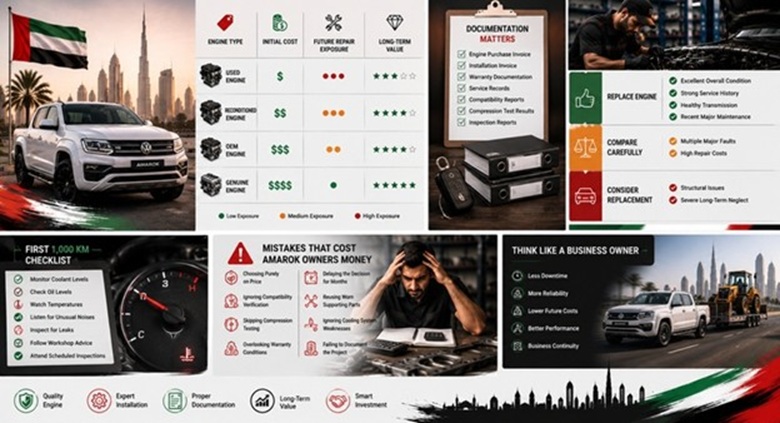
If you're comparing replacement options through platforms like PartFinder UAE, it's worth looking beyond the purchase price and considering the total ownership experience.
Five-Year Ownership Cost Comparison
| Engine Type | Initial Cost | Future Repair Exposure | Long-Term Value |
| Used Engine | Lower | Higher | Moderate |
| Reconditioned Engine | Moderate | Moderate | Strong |
| OEM Engine | Higher | Lower | Excellent |
| Genuine Engine | Highest | Lowest | Excellent |
Notice something.
The table doesn't tell you what to buy.
It tells you what tends to happen afterwards.
That's often more useful.
The UAE Climate Doesn't Care About Your Budget
A replacement engine doesn't get installed into ideal laboratory conditions.
It gets installed into reality.
And reality in the UAE can be brutal.
Forty-plus degree temperatures.
Stop-start traffic.
Construction sites.
Desert access roads.
Heavy towing.
Long-distance highway journeys.
The Amarok was designed to work.
Which is exactly why engine quality matters.
A weak cooling system that survives comfortably elsewhere may struggle badly here.
A neglected radiator that limps along in cooler climates can become a genuine liability during UAE summer traffic.
And that's why experienced workshops obsess over cooling systems during engine replacement projects.
They're not being cautious.
They're being realistic.
The climate isn't interested in second chances.
What Happens to Resale Value After an Engine Replacement?
This question turns up more often than people expect.
Especially among business owners.
And expats.
And people who already know they won't keep the vehicle forever.
There is a common misconception that an engine replacement automatically damages resale value.
Not necessarily.
In some situations, the opposite happens.
Imagine two Amaroks.
One has a tired original engine with uncertain future reliability.
The other has a properly documented replacement engine, supporting paperwork, service records and evidence of professional installation.
Which one inspires more confidence?
Exactly.
Documentation changes everything.
Paperwork matters.
Service history matters.
Invoices matter.
A replacement engine without documentation creates questions.
A replacement engine with documentation answers them.
Documents Worth Keeping
| Document | Future Value |
| Engine Purchase Invoice | High |
| Installation Invoice | High |
| Warranty Documentation | High |
| Service Records | High |
| Compatibility Reports | Moderate |
| Compression Test Results | Moderate |
| Inspection Reports | High |
The resale conversation often starts years after the engine replacement.
Prepare for it now.
Replace the Engine or Replace the Amarok?
This is the question sitting quietly underneath the entire article.
And sometimes it's the correct question.
Because occasionally the engine isn't the only issue.
Sometimes the vehicle has reached a point where multiple major systems need attention.
Transmission concerns.
Suspension concerns.
Electrical problems.
Body issues.
Structural damage.
At that stage, replacing the vehicle deserves serious consideration.
But here's what surprises many owners.
A healthy Amarok with a failed engine often remains a far stronger financial proposition than replacing the entire pickup.
Especially when replacement-vehicle prices enter the discussion.
Decision Matrix
| Vehicle Condition | Recommended Path |
| Excellent Overall Condition | Replace Engine |
| Strong Service History | Replace Engine |
| Healthy Transmission | Replace Engine |
| Recent Major Maintenance | Replace Engine |
| Multiple Major Faults | Compare Options Carefully |
| Structural Issues | Consider Replacement |
| Severe Long-Term Neglect | Evaluate Replacement |
The engine may have failed.
That doesn't automatically mean the vehicle has.
Those are two different conclusions.
Many owners accidentally treat them as the same thing.
The First 1,000 Kilometres: The Part Nobody Talks About
Strange, isn't it?
People spend weeks researching replacement engines.
Then spend almost no time thinking about what happens after installation.
Yet the first thousand kilometres can tell you a lot.
Not because the new engine is likely to fail.
Because this is the period where small issues reveal themselves.
A minor coolant leak.
A loose connection.
A sensor issue.
A calibration adjustment.
The smart owners don't simply drive away and forget about the project.
They stay engaged.
For a little while.
First 1,000 km Checklist
- Monitor coolant levels.
- Check oil levels regularly.
- Watch operating temperatures.
- Listen for unusual noises.
- Inspect underneath the vehicle.
- Follow workshop recommendations.
- Attend scheduled inspections.
Simple habits.
Small effort.
Large payoff.
That's usually a worthwhile trade.
The Mistakes That Cost Amarok Owners the Most Money
You'd think the biggest mistake would be buying the wrong engine.
Often it isn't.
The biggest mistake is usually making decisions based on incomplete information.
Or rushing.
Or trying to save money in the wrong place.
The patterns repeat themselves.
Different owners.
Same outcomes.
Common Buyer Mistakes
- Choosing purely on price.
- Ignoring compatibility verification.
- Skipping compression testing.
- Overlooking warranty conditions.
- Delaying the decision for months.
- Reusing worn supporting parts.
- Ignoring cooling-system weaknesses.
- Failing to document the project.
None of these mistakes seem catastrophic individually.
Combined?
They can become very expensive.
Very quickly.
The Business Owner's Perspective Is Often the Most Practical One
Fleet managers approach this differently.
Contractors do too.
They ask fewer emotional questions.
More operational questions.
They don't usually ask:
"What's the cheapest engine?"
They ask:
"Which option gets my vehicle back to work with the least future disruption?"
That's a very different mindset.
And honestly, it's often the most useful one.
Because the goal isn't simply repairing an Amarok.
The goal is restoring capability.
Revenue generation.
Operational reliability.
Business continuity.
The pickup earns its place by working.
The replacement-engine strategy should support that.
Before You Spend a Dirham, Think About the Entire Ownership Journey
This may be the most important section in the entire article.
Not because it contains a dramatic revelation.
Because it changes the question.
Many buyers ask:
"What will this engine cost?"
A better question might be:
"What will this ownership decision cost over the next five years?"
Suddenly everything changes.
The warranty matters more.
Compatibility matters more.
Documentation matters more.
Installation quality matters more.
Supporting parts matter more.
Long-term reliability matters more.
And that's usually where the strongest decisions emerge.
Final Thoughts: The Smartest Amarok Owners Don't Rush This Decision
The irony of major engine failure is that it often feels like an emergency.
And emotionally, it is.
The pickup is off the road.
The workshop is waiting.
The quotations are arriving.
The pressure builds quickly.
Yet the owners who achieve the best outcomes usually do one thing exceptionally well.
They slow down.
Not indefinitely.
Just long enough.
Long enough to evaluate the vehicle properly.
Long enough to compare engine options properly.
Long enough to understand the complete project cost rather than focusing on one attractive headline number.
Because once you step back and examine the entire picture, something interesting often happens.
The replacement-engine route stops looking like a repair.
It starts looking like an opportunity.
An opportunity to extend the life of a vehicle you already know.
An opportunity to avoid the much larger cost of replacing an otherwise capable pickup.
And, quite often, an opportunity to save thousands of dirhams without sacrificing reliability, performance or long-term confidence.
That's why so many Amarok owners across the UAE eventually arrive at the same conclusion.
The engine failed.
The pickup didn't.
Categories
- Audi
- BMW
- Car Accessories
- Car Tips
- Ford
- Land Rover
- Mazda
- Range Rover
- Top 10
- UAE Car Parts
- Used Car Parts
- Toyota
- Replacement Engines
- Nissan
- Hyundai
- Mitsubishi
- Volkswagen
- Honda
- Kia
- Chevrolet
- Dodge
- Jeep
- Subaru
- Renault
- Lexus
- Mercedes
- Suzuki
- Hummer
- Porsche
- Infiniti
- Peugeot
- GMC
- Mini
- Volvo
- Replacement Gearboxes
- MG
- Jaguar
- Skoda
- Cadillac
- Daihatsu
- Fiat
- German Car Parts
- Japanese Car Parts
- Aftermarket Car Parts
- Genuine Car Parts
- New Car Parts
- Reconditioned Car Parts
- European Car Parts
- American Car Parts
- Korean Car Parts
- British Car Parts
- Chinese Car Parts
- Sports/Exotic Car Parts
- Luxury Car Parts
- Performance Car Parts
- SUV/4x4 Spare Parts
- Truck Spare Parts
- EV Car Parts
- Hybrid Car Parts
- Auto Spare Parts in UAE
- Tesla
- Isuzu
- Ram
- Ferrari
- Bentley
- Lamborghini
- Genesis
- Maserati
- Lincoln
- Chrysler
- Opel
- Citroen
- SsangYong
- Seat
- McLaren
- Aston Martin
- Rolls Royce
- Maybach
- Alfa Romeo
- Bugatti
- Scion
- Abu Dhabi Car Parts
- Ajman Car Parts
- Al Khan Car Parts
- Al Sajaa Car Parts
- Deira Car Parts
- Dubai Car Parts
- Fujairah Car Parts
- Industrial Area 6 Car Parts
- Mussafah Car Parts
- Ras Al Khaimah Car Parts
- Sharjah Car Parts
- Umm Al Quwain Car Parts
- Acura
- BYD
- Chery
- Dacia
- DS
- Geely Emgrand
- EXEED
- GAC
- GAC Gonow
- Geely
- Gonow
- Great Wall
- Haima
- Haval
- Holden
- Iveco
- JAC
- Jaecoo
- Jetour
- Lotus
- Omoda
- Proton
- Renault Samsung
- Roewe
- Lucid