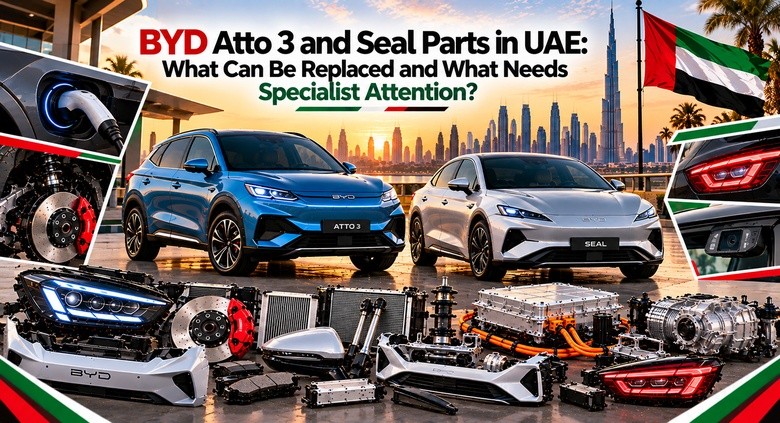
BYD Atto 3 and Seal Parts in UAE: What Can Be Replaced and What Needs Specialist Attention?
September 30, 2026
The tricky thing about buying BYD spare parts in UAE is not finding a replacement. It is knowing where ordinary replacement work ends and where an EV-specific diagnosis, programming procedure or high-voltage repair begins.
A bumper bracket is one thing. A headlight with integrated electronics is another. A 12V battery is familiar territory. A high-voltage battery fault is not something to approach like a conventional engine-bay repair.
That distinction matters particularly with the BYD Atto 3 and BYD Seal because their electrical architecture, battery systems and integrated electronics make some seemingly simple faults much more complicated than the part itself suggests. BYD's UAE aftersales information currently states that the high-voltage battery and drive unit are covered for 8 years or 200,000 km, with battery capacity covered at ≥70%, while the basic vehicle warranty is 6 years or 150,000 km.
The useful question, then, is not simply “How much is the part?” It is: Can this part be replaced independently, or does the car need specialist diagnosis, calibration, coding or high-voltage procedures before anyone orders it?
The replacement rule for BYD Atto 3 and Seal
Think of the two cars in three broad groups:
Ordinary replacement parts: filters, wiper blades, some brackets, trim, certain body panels, conventional wear items and selected suspension components.
Technically sensitive parts: headlights, charging components, cameras, sensors, control modules, electric steering components and electronically controlled systems.
Specialist/high-voltage parts: battery assemblies, battery-management components, drive units, high-voltage cabling, onboard chargers and faults involving HV isolation or battery safety.
The boundary is not always obvious from the outside.
Why the Atto 3 and Seal need different buying logic
The Atto 3 is built around BYD's e-Platform 3.0 and Blade Battery architecture, while the Seal adds Cell-to-Body construction and, depending on variant, a dual-motor drivetrain. BYD's UAE Seal information specifies 150 kW DC charging capability and up to 390 kW total output for the four-wheel-drive version.
That means a Seal component should never be ordered simply because the seller says “BYD Seal”.
Variant matters.
So does model year, drivetrain, market specification and the exact part application.
Atto 3 body parts are generally straightforward
A damaged Atto 3 bumper cover, fender lining, bumper bracket or certain exterior trims is usually much closer to conventional body repair.
The real buying question is fitment.
A current UAE public listing, for example, shows an Atto 3 right headlight at AED 1,680, a left front bumper bracket at AED 85, a left front fender lining at AED 255 and a left rear bumper bracket at AED 90. These are dated public seller listings rather than universal UAE installed prices.
The difference is enormous, and it tells you something useful: do not judge the economics of a repair by the price of the largest-looking component.
Atto 3 bumpers can be replaced, but inspect behind them
A cracked bumper does not automatically mean an expensive electronic repair.
After an accident, however, the workshop should inspect what sits behind it.
That can include parking sensors, wiring, mounting brackets, impact absorbers and other components hidden by the plastic skin.
Replacing the bumper without checking those items can leave you with a perfectly painted car and an unresolved electrical fault.
Fender liners and brackets are lower-risk purchases
Small plastic and mounting components are usually among the easier BYD parts to source.
The UAE public Atto 3 listing above illustrates this neatly: individual brackets and liners can sit far below the cost of lighting assemblies.
For these parts, the important checks are:
- exact side
- model
- model year
- mounting points
- seller photos
- return conditions
- whether fasteners are included
It is rarely sensible to overcomplicate a simple bracket purchase.
Headlights are where the story changes
A BYD LED headlight is not merely a piece of glass, plastic and LEDs.
It is an electronic assembly.
That changes the buying decision.
The Atto 3 public UAE listing at AED 1,680 is useful as a market reference, but the price does not tell you whether the component is the correct specification, whether programming is required, or whether installation and calibration are included.
Before buying a headlight, verify the exact application and ask what happens after installation.
Seal headlights deserve the same caution
A current UAE-facing Seal parts catalogue lists an original headlamp from AED 708, alongside smaller components such as a front bumper emblem LED module from AED 188.
Those figures are useful public listing observations as of September 2026, not official BYD UAE installed prices.
The important point is not that one headlamp costs AED 708 or AED 1,680.
It is that electronic lighting assemblies can have very different specifications, suppliers and post-installation requirements.
Do not compare a complete headlight with a lamp module
This sounds obvious. It gets missed surprisingly often.
A headlight assembly, an LED module, a DRL component, a lens and a control unit are not interchangeable price categories.
If a seller quotes AED 700 and another quotes AED 1,700, ask what exactly is included.
Otherwise, you are comparing two different parts and calling it a price difference.
Wiper blades are ordinary replacement territory
Wipers are among the least complicated BYD Seal parts.
One current UAE-facing listing shows a two-piece Seal wiper set at AED 100.
There is no reason to treat a normal wiper replacement like a battery repair.
But fitment still matters. Blade length, connector type and correct mounting should be confirmed before ordering.
Cabin filters are another routine item
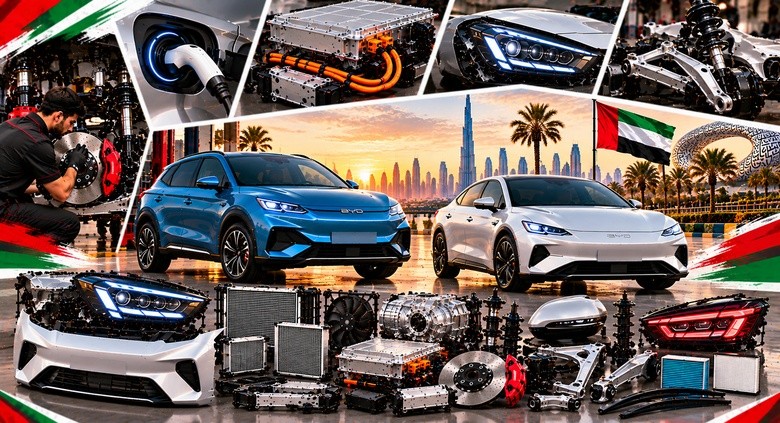
Cabin filters belong firmly in the ordinary-maintenance category.
They can usually be replaced without specialist EV equipment.
The mistake here is different: paying an unnecessarily high price because the component is being marketed as a “BYD electronic vehicle part”.
A filter is still a filter.
Check the correct application and specification.
Brake pads can be replaced normally
The Atto 3 and Seal still use conventional braking hardware alongside regenerative braking.
BYD's published Atto 3 specification identifies ventilated front discs and rear disc brakes, while Seal specifications likewise show conventional disc-brake hardware.
Brake-pad replacement therefore remains familiar workshop work.
What changes is the diagnosis around it: a workshop should understand how regenerative braking interacts with friction braking rather than assuming every braking complaint is caused by the pads.
Brake discs need physical inspection, not guesswork
A brake disc should be assessed for condition, thickness, corrosion, surface damage and runout where appropriate.
EV ownership can change brake usage because regenerative braking can reduce reliance on friction brakes.
That does not mean discs should automatically be replaced because a vehicle has been driven relatively little.
Measure first.
Suspension parts are generally replaceable
Bushes, links, ball joints and shock absorbers can be replaced as mechanical components.
BYD UAE's current warranty information separately identifies suspension and ball joints within its limited parts coverage, subject to the stated time and mileage conditions.
For an out-of-warranty repair, the buying decision should still distinguish between:
part condition → correct fitment → labour → alignment → post-repair road test.
Alignment is part of the repair
This becomes particularly important after replacing suspension or steering components.
A new component cannot compensate for incorrect wheel geometry.
After suitable suspension or steering work, ask whether the workshop will perform an alignment and provide the measured results where appropriate.
The cheapest component can become an expensive repair if the underlying geometry is ignored.
The 12V battery is not the high-voltage battery
This distinction deserves its own section because it causes unnecessary panic.
The 12V battery supports the vehicle's low-voltage electrical systems. The high-voltage traction battery is a fundamentally different system.
BYD UAE currently states that the 12V battery has a 6-year/150,000 km warranty, except for Atto 3, where the listed 12V battery warranty is 1 year/20,000 km.
So a flat 12V battery does not automatically mean there is a problem with the traction battery.
A dead 12V battery can create misleading symptoms
An EV with low-voltage problems can produce warnings, failed starts, communication faults or apparently unrelated electrical behaviour.
That is why a technician should establish the low-voltage condition before condemning expensive electronic modules.
Replacing a control unit because the 12V supply was unstable is the sort of mistake that turns a manageable repair into a costly one.
High-voltage battery work is specialist territory
This is the major dividing line.
BYD's UAE aftersales information gives the high-voltage battery and drive unit specific warranty coverage, including 8 years or 200,000 km and battery capacity coverage of at least 70% under the stated terms.
A suspected HV battery fault therefore deserves diagnosis before anyone starts discussing replacement.
A workshop should establish whether the problem is actually:
- battery capacity
- cell/module behaviour
- battery-management electronics
- cooling
- wiring or connectors
- charging system
- isolation fault
- accident damage
- software or communication issue
Those are very different repairs.
Never order a complete battery because of one warning light
This is probably the most expensive mistake in this entire subject.
An EV warning does not automatically mean “replace battery”.
A competent diagnosis should identify the relevant diagnostic trouble codes, battery-management data, charging behaviour and electrical condition before a replacement quotation is accepted.
The battery is a system, not merely a large box.
The Seal has an additional structural consideration
The Seal uses Cell-to-Body technology, with the Blade Battery integrated into the vehicle structure. BYD describes the battery as forming part of the vehicle's structural arrangement.
That makes accident assessment especially important.
After substantial underbody or side-impact damage, the question may not simply be “Can we replace the battery?”
It may be “Has the battery enclosure, mounting structure, wiring or vehicle body suffered damage that changes the repair method?”
That is specialist territory.
The Atto 3 battery should also be treated as an HV system
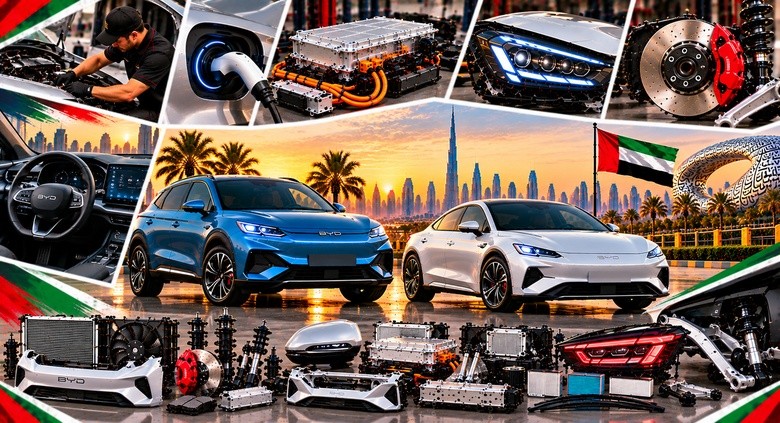
The Atto 3 uses BYD's Blade Battery and e-Platform 3.0 architecture. BYD's published material identifies a 60.5 kWh Blade Battery configuration in a current Atto 3 specification sheet.
The exact battery specification can vary by market and model year, so VIN/application confirmation remains important.
Do not order a battery-related component from a generic “Atto 3 battery” description alone.
Drive-unit replacement is not a normal gearbox job
An electric drive unit combines electrical and mechanical functions.
BYD describes the Seal's integrated 8-in-1 electric powertrain as incorporating the VCU, BMS, MCU, PDU, DC-DC controller, onboard charger, drive motor and transmission.
That is why a drive-unit fault should not be diagnosed solely from noise or reduced power.
The technician needs to establish which portion of the system has actually failed.
Motor noise does not automatically mean motor replacement
A humming, whine, vibration or reduced-power complaint can have several possible causes.
The workshop should consider diagnostic codes, electrical measurements, cooling, connectors, drive-unit behaviour and mechanical symptoms before recommending a complete unit.
This is where EV-specific diagnostic equipment earns its keep.
Onboard charger faults need specialist diagnosis
If an Atto 3 or Seal charges slowly or refuses AC charging, replacing the charging port immediately may be premature.
The fault could involve:
- charging cable
- connector
- charging port
- onboard charger
- high-voltage system
- battery-management system
- communication
- software
- external charging equipment
The first question should therefore be “Where does the charging process fail?”
Not “How much is a charging port?”
DC fast-charging faults are even more diagnostic-sensitive
The Seal's UAE specification advertises DC charging capability up to 150 kW.
If DC charging fails, the technician needs to determine whether the vehicle, charger, cable, communication sequence or high-voltage system is responsible.
A replacement part ordered before that distinction is established can easily become a wasted purchase.
Cooling components can be replaced, but the system matters
Radiators, pumps, fans, hoses and related thermal components are replaceable components.
The difficult part is knowing which thermal circuit is actually affected.
EVs can have different thermal-management requirements for the battery, power electronics, motor and passenger compartment.
A cooling warning should therefore lead to system diagnosis rather than a random parts order.
Air-conditioning parts are not automatically specialist
A compressor, condenser, blower or cabin component may be replaceable in a conventional workshop environment.
But modern EV climate-control systems interact with vehicle electronics and thermal management.
The workshop should understand the particular BYD system rather than treating the vehicle exactly like an older petrol car.
ADAS components need calibration thinking
Cameras, radar-related components, parking sensors and other driver-assistance hardware can be damaged during accidents.
Replacing the physical sensor is only part of the job.
Depending on the system and repair, calibration or system checks may be required.
A quote that says “sensor AED X + fitting AED Y” may therefore be incomplete.
A replacement windscreen can affect electronic systems
This is an easily missed issue.
If cameras or sensors are mounted around the windscreen area, glass replacement can have consequences beyond fitting the new pane.
Before approving the job, ask whether the vehicle's relevant driver-assistance systems require inspection or calibration afterwards.
Body panels are usually easier than electronic body components
A fender, bracket, trim piece or bumper cover can often be treated as a conventional replacement.
An LED lamp, powered mirror, camera, radar component or electronically controlled module cannot be judged in the same way.
This is the basic hierarchy buyers should remember:
metal/plastic part → mechanical part → electronic assembly → calibrated electronic system → high-voltage system.
The further down the list you go, the more important diagnosis and specialist capability become.
Genuine, OEM and aftermarket are not interchangeable labels
A seller describing a part as “OEM” does not automatically make it equivalent to an officially supplied genuine BYD part.
Ask what the term actually means.
BYD itself recommends genuine spare parts and states that damage and performance issues caused by non-genuine parts are not covered under its stated warranty policy.
That does not mean every alternative component is automatically unsuitable. It means the buyer needs to understand exactly what is being purchased and what warranty implications apply.
Some alternative parts are easier to consider than others
For simple wear or non-critical components, buyers may have more practical choice.
For example:
- wipers
- selected filters
- certain trim pieces
- some brackets
- some conventional suspension components
The risk calculation changes sharply for:
- HV components
- battery-management electronics
- charging electronics
- safety systems
- cameras and sensors
- integrated LED assemblies
- control modules
The more the component interacts with the vehicle's software or safety systems, the more verification matters.
Used genuine parts can be useful — with conditions
A used component is not automatically good or bad.
Its history matters.
For an Atto 3 or Seal, ask:
- donor model and year
- exact variant
- donor mileage
- reason for dismantling
- accident or flood history
- part number
- test evidence
- physical condition
- warranty
- return period
- whether programming is required
“Used” describes history, not quality.
Used electronic parts deserve extra caution
A used bumper bracket is one thing.
A used control module is another.
For electronic components, establish whether the unit can be installed directly, whether it requires coding or configuration, whether the donor vehicle's specification matches and whether the seller accepts returns if the module cannot be commissioned.
That final point matters.
VIN verification should happen before expensive orders
For high-value or generation-sensitive parts, give the supplier the VIN before payment.
The VIN can help establish the vehicle's exact application rather than relying on a broad model name.
For a Seal, for example, “Seal” alone may not identify every drivetrain and equipment variation.
The same principle applies to Atto 3 model-year differences and regional specifications.
Part numbers are useful, but they are not magic
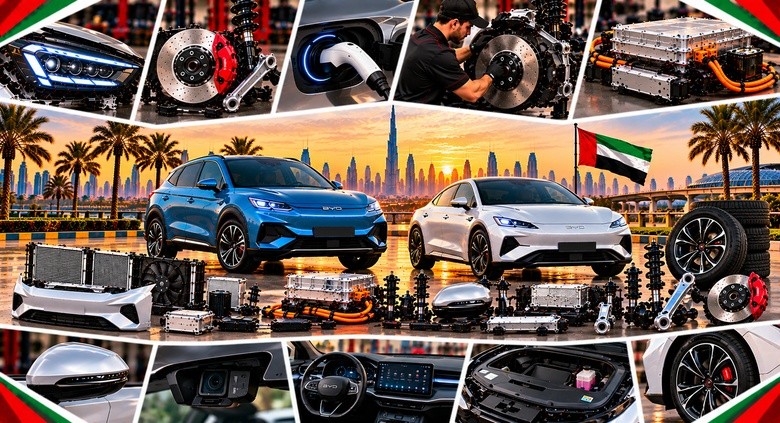
A matching part number is powerful evidence.
It is not a substitute for checking the application.
Ideally, the supplier should confirm:
VIN → part number → physical/component description → model/variant → compatibility.
If those five pieces agree, the chance of an expensive ordering mistake falls considerably.
UAE heat changes the context, not the basic diagnosis
BYD says its vehicles have undergone GCC hot-weather testing, including more than one million kilometres driven in the UAE as part of its hot-summer testing claim.
That is useful context, but it does not mean individual components are immune to UAE operating conditions.
High ambient temperatures, heavy air-conditioning use, traffic, charging patterns and prolonged exposure to heat can all make thermal management an important part of diagnosis.
The right response is testing, not assumptions.
What can usually be replaced without specialist HV work?
A useful practical split looks like this:
| Component | Typical replacement approach | Specialist attention? |
| Wiper blades | Routine replacement | Usually no |
| Cabin filter | Routine service | Usually no |
| Bumper bracket | Body-part replacement | Usually no |
| Fender lining | Body-part replacement | Usually no |
| Exterior trim | Body repair | Usually no |
| Brake pads | Mechanical service | Usually no |
| Brake discs | Mechanical inspection/replacement | Usually no |
| Suspension links | Mechanical repair | Usually no |
| 12V battery | Electrical replacement | Sometimes diagnostic check |
| Headlight | Electronic assembly | Often worth specialist verification |
| Camera/sensor | Electronic system | Yes, depending on system |
| Charging port | EV electrical system | Yes |
| Onboard charger | High-voltage/electronic | Yes |
| Drive unit | EV powertrain | Yes |
| HV battery | High-voltage system | Yes |
| Battery-management electronics | HV/electronic | Yes |
| HV cabling | High-voltage system | Yes |
The table is a buying framework, not a substitute for the manufacturer's repair procedure for a particular vehicle.
What the workshop should check before ordering an expensive part
For an expensive Atto 3 or Seal component, ask for the diagnostic chain.
At minimum, depending on the complaint, that can include:
scan → fault codes → live data → electrical supply → wiring/connectors → component test → system operation → road/charging test → repair recommendation.
For HV faults, the workshop should use appropriate high-voltage safety procedures and equipment.
A quotation without a diagnosis is not necessarily wrong. It is simply less informative.
Part price is not installed repair cost
This distinction should appear on every serious BYD quotation.
Suppose a headlight is listed at AED 1,680. That does not mean the repair costs AED 1,680.
The final figure may include:
- part
- delivery
- VAT
- labour
- diagnosis
- programming
- calibration
- clips or mounting hardware
- paint/bodywork
- alignment
- warranty implications
The current Atto 3 headlight listing is therefore a part-price observation, not a complete UAE repair quotation.
A simple buyer decision matrix
| Option | Best suited to | Main advantage | Main risk | Verify first |
| Genuine new | Sensitive or warranty-related parts | Clear manufacturer route | Higher purchase price | VIN, warranty, availability |
| Quality alternative | Suitable non-critical components | Potentially lower cost | Specification/fitment variation | Brand, specification, returns |
| Used genuine | Older/out-of-warranty repairs | Can reduce part cost | Unknown history | Donor, mileage, test, warranty |
| Reconditioned | Repairable specialist components | Can sit between new and used | Quality depends on rebuilder | What was replaced, test evidence |
| Repair existing unit | Certain electronic/mechanical faults | Avoids unnecessary replacement | Not every unit is repairable | Confirm failed component |
Before You Click Buy
For an Atto 3 or Seal part, stop for thirty seconds and check:
VIN: Does the seller have it?
Part number: Has it been matched?
Variant: RWD, AWD or other specification where applicable?
Model year: Is the component actually for this production/application?
Condition: New, used, repaired or reconditioned?
Testing: Has the part been tested where testing matters?
Programming: Will coding or configuration be needed?
Calibration: Does the system require calibration after installation?
Warranty: How long?
Returns: What happens if it does not fit or cannot be commissioned?
Total installed cost: What is the final figure, not merely the advertised part price?
That checklist will save more money than chasing the lowest headline price.
The UAE market already shows why comparison matters
Current public UAE listings demonstrate a wide spread between small body components and sophisticated assemblies.
For the Atto 3, the publicly listed examples include an AED 85 bumper bracket, AED 255 fender lining and AED 1,680 right headlight.
For the Seal, current UAE-facing listings include a two-piece wiper set at AED 100, front bumper LED emblem module from AED 188, wing fender at AED 225 and original headlamps from AED 708.
These are September 2026 public listing observations, not fixed UAE market prices and not necessarily installed repair costs.
Availability is improving, but “available” needs definition
BYD UAE states that genuine spare parts are available through its service network, while its UAE benefits information also promotes parts availability through service centres.
A seller saying a component is “available”, however, could mean:
- physically in stock
- available from another UAE warehouse
- available after transfer
- special order
- international order
- available from a dismantler
- available but not immediately tested
Ask which one.
What happens after an accident matters more than the bumper price
For an accident-damaged Atto 3 or Seal, the correct sequence is closer to:
structural inspection → body damage assessment → wiring/sensor inspection → HV safety assessment where relevant → parts identification → repair → calibration/testing → final scan.
Ordering body parts before the vehicle is properly assessed can create duplicate work.
The same principle applies to headlights, charging components and underbody damage.
The cost of getting the wrong part is not just the part price
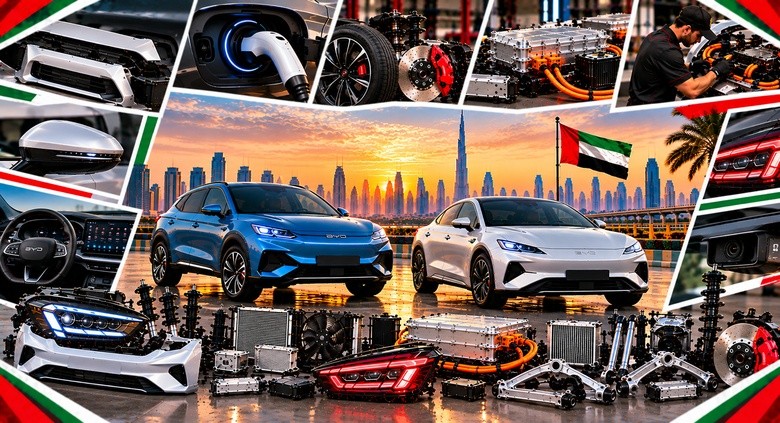
A wrong bracket is annoying.
A wrong electronic module can mean delivery delays, return disputes, additional labour and another diagnostic visit.
A wrong HV component can create a much more serious and technically complicated situation.
That is why the sensible buying hierarchy is:
correct diagnosis first, exact fitment second, price comparison third.
Not the other way around.
Atto 3 buyers should pay particular attention to the vehicle's exact specification
The Atto 3 is not simply a generic EV with a BYD badge.
Its e-Platform 3.0 architecture, Blade Battery, electric motor and electronic systems all mean that component compatibility matters. BYD's published Atto 3 material identifies the platform, Blade Battery and permanent-magnet motor architecture.
When ordering expensive components, provide the VIN and, where possible, the old component's identification.
Seal buyers should pay even more attention to drivetrain configuration
The Seal can be offered in different drivetrain configurations, and BYD's UAE page identifies a four-wheel-drive version using two electric motors with total output up to 390 kW.
A component described simply as “Seal motor part” is therefore not enough information.
Confirm the exact drivetrain and application before buying.
Warranty can change the repair decision completely
Before paying for a high-voltage component, check whether the vehicle is still within the applicable warranty.
BYD UAE currently publishes 8 years/200,000 km for the high-voltage battery and drive unit, with battery capacity coverage of ≥70%, while the basic vehicle warranty is 6 years/150,000 km.
The precise warranty terms, exclusions and vehicle eligibility should be checked against the vehicle's documentation and applicable UAE policy.
When an independent workshop makes sense
An independent workshop can be perfectly suitable for ordinary mechanical or body work when the technicians have the appropriate BYD/EV knowledge and equipment.
The question should not be “dealer or independent?”
It should be:
Does this workshop have the equipment, technical information, safety procedures and diagnostic capability required for this particular repair?
That is a much better test.
When specialist BYD attention becomes the sensible route
Specialist attention becomes particularly important where the repair involves:
- high-voltage battery systems
- battery-management systems
- drive units
- HV isolation faults
- charging electronics
- onboard chargers
- HV wiring
- accident-damaged battery areas
- electronic control modules
- ADAS calibration
- complex communication faults
These are not areas where guessing saves money.
The cheapest quote can be the most expensive route
Imagine two quotes.
Quote A: cheaper part, unclear origin, no confirmed fitment, no calibration included.
Quote B: more expensive part, VIN verified, correct specification, defined warranty, installation and required calibration included.
The second quotation may have the higher part price while producing the lower repair risk.
That is why buyers should compare the repair package, not merely the component number.
What PartFinder UAE adds to the buying process
For buyers comparing new, used and alternative BYD components, the useful objective is not simply to find a cheaper listing. The better approach is to establish the exact application first at PartFinder UAE, then compare condition, provenance, warranty, availability and the likely installed cost before committing.
That is particularly important for Atto 3 and Seal components that sit close to the vehicle's electronic or high-voltage systems.
What current UAE evidence can and cannot tell us
The current evidence gives us useful public reference points for selected components.
It supports the existence of UAE-facing listings for Atto 3 and Seal parts and gives dated examples such as the Atto 3 right headlight at AED 1,680 and selected smaller body components, alongside current Seal listings for lighting, trim and other components.
It does not establish a universal UAE price for every BYD component.
Nor does a public listing prove that the item is officially supplied through BYD UAE.
Those distinctions should remain visible in any serious price comparison.
A better way to read a BYD parts quotation
When a supplier sends a quotation, separate it into five lines:
1. Part identity — exactly what component?
2. Part status — genuine, alternative, used or reconditioned?
3. Fitment evidence — VIN/part-number confirmation?
4. Installation requirements — labour, programming, calibration, fluids or additional hardware?
5. Warranty and returns — what happens if the repair does not solve the fault?
Now the quotation becomes useful.
Without those details, a low number can be surprisingly meaningless.
The practical rule for Atto 3 and Seal owners
If the part is plastic, trim, a straightforward filter, wiper or conventional mechanical wear component, ordinary replacement is usually the sensible starting point.
If it is a headlight, sensor, camera, electronic module or charging component, verify compatibility and post-installation requirements before buying.
If it is a high-voltage battery, drive unit, onboard charger, HV cable or battery-management component, diagnosis and specialist EV procedures should come before replacement.
That is the dividing line worth remembering.
UAE update reference: September 2026
This article uses UAE-facing public listings and current BYD UAE/Middle East aftersales information available in September 2026. Prices and stock can change quickly, while model-year, variant and regional-specification differences can affect fitment.
BYD's UAE warranty and aftersales pages should be checked again before making a warranty-sensitive purchase, particularly for high-voltage battery, drive-unit, charging and electronic-system repairs.
Frequently Asked Questions
Categories
- Audi
- BMW
- Car Accessories
- Car Tips
- Ford
- Land Rover
- Mazda
- Range Rover
- Top 10
- UAE Car Parts
- Used Car Parts
- Toyota
- Replacement Engines
- Nissan
- Hyundai
- Mitsubishi
- Volkswagen
- Honda
- Kia
- Chevrolet
- Dodge
- Jeep
- Subaru
- Renault
- Lexus
- Mercedes
- Suzuki
- Hummer
- Porsche
- Infiniti
- Peugeot
- GMC
- Mini
- Volvo
- Replacement Gearboxes
- MG
- Jaguar
- Skoda
- Cadillac
- Daihatsu
- Fiat
- German Car Parts
- Japanese Car Parts
- Aftermarket Car Parts
- Genuine Car Parts
- New Car Parts
- Reconditioned Car Parts
- European Car Parts
- American Car Parts
- Korean Car Parts
- British Car Parts
- Chinese Car Parts
- Sports/Exotic Car Parts
- Luxury Car Parts
- Performance Car Parts
- SUV/4x4 Spare Parts
- Truck Spare Parts
- EV Car Parts
- Hybrid Car Parts
- Auto Spare Parts in UAE
- Tesla
- Isuzu
- Ram
- Ferrari
- Bentley
- Lamborghini
- Genesis
- Maserati
- Lincoln
- Chrysler
- Opel
- Citroen
- SsangYong
- Seat
- McLaren
- Aston Martin
- Rolls Royce
- Maybach
- Alfa Romeo
- Bugatti
- Scion
- Abu Dhabi Car Parts
- Ajman Car Parts
- Al Khan Car Parts
- Al Sajaa Car Parts
- Deira Car Parts
- Dubai Car Parts
- Fujairah Car Parts
- Industrial Area 6 Car Parts
- Mussafah Car Parts
- Ras Al Khaimah Car Parts
- Sharjah Car Parts
- Umm Al Quwain Car Parts
- Acura
- BYD
- Chery