Chevrolet Captiva Engine Replacement Cost UAE: A Strategic Buyer's Guide to Long-Term Reliability and Ownership Value
June 11, 2026
Most Chevrolet Captiva owners do not wake up one morning and decide to replace an engine.
The decision usually develops slowly.
A warning light appears.
Fuel consumption increases.
The vehicle begins losing performance.
A repair bill arrives.
Then another.
And another.
Eventually the owner reaches a crossroads.
Continue repairing.
Replace the engine.
Or replace the vehicle altogether.
Many people approach this decision emotionally.
Strategic buyers approach it differently.
They evaluate costs.
Risks.
Future value.
Reliability.
Resale potential.
Long-term ownership outcomes.
That distinction often determines whether a major engine investment becomes a smart financial decision or an expensive mistake.
In the UAE, where extreme temperatures, heavy traffic and demanding driving conditions place additional stress on vehicles, these decisions become even more important.
A Chevrolet Captiva engine replacement should never be viewed purely as a repair.
It should be viewed as an investment decision.
The objective is not simply restoring mobility.
The objective is creating the strongest possible balance between:
- Cost control
- Reliability
- Risk reduction
- Long-term ownership value
This guide is designed to help buyers make that decision strategically rather than reactively.
The Strategic Buyer's Starting Point: Is a Chevrolet Captiva Engine Replacement the Right Financial Decision?
Every major automotive investment begins with one question:
Does this expenditure create value?
Many owners immediately focus on engine prices.
Strategic buyers focus first on the overall condition of the vehicle.
An engine replacement may be financially sensible if:
✓ The vehicle remains structurally sound
✓ The transmission is performing properly
✓ Maintenance history is strong
✓ Future ownership is expected to continue
✓ Replacement vehicle costs are significantly higher
However, engine replacement becomes harder to justify when multiple expensive systems are approaching failure simultaneously.
Strategic Evaluation Framework
| Vehicle Condition | Strategic Outlook |
| Excellent Overall Condition | Strong Candidate |
| Good Condition | Positive Candidate |
| Average Condition | Requires Cost Analysis |
| Poor Condition | Requires Further Evaluation |
| Multiple Major Failures | Compare Replacement Vehicle |
The smartest buyers evaluate the entire ownership picture before committing funds.
Evaluating the True Cost of Ownership: Looking Beyond the Engine Price
One of the most common ownership mistakes is focusing exclusively on engine cost.
The engine itself often represents only part of the financial commitment.
Additional Cost Categories
- Labour
- Diagnostics
- Supporting components
- Fluids and filters
- Warranty protection
- Documentation
- Downtime
Typical Chevrolet Captiva Engine Project Breakdown
| Cost Category | Typical Cost (AED) |
| Replacement Engine | 8,000 – 35,000 |
| Labour | 4,000 – 16,000 |
| Diagnostics | 500 – 3,000 |
| Supporting Components | 2,000 – 15,000 |
| Fluids & Consumables | 500 – 3,000 |
| Additional Repairs | Variable |
Total Project Cost Comparison
| Project Type | Estimated Cost (AED) |
| Budget Project | 15,000 – 25,000 |
| Mid-Range Project | 25,000 – 45,000 |
| Premium Project | 45,000 – 75,000+ |
Strategic buyers calculate total ownership investment rather than focusing on a single figure.
Mileage Assessment Strategy: How Engine History Influences Future Reliability
Mileage alone does not determine value.
The story behind the mileage often matters more.
A well-maintained Captiva with higher mileage may present less risk than a poorly maintained vehicle with significantly lower mileage.
Strategic Mileage Evaluation Checklist
✓ Full service history available
✓ Cooling-system maintenance documented
✓ Regular oil changes recorded
✓ Diagnostic reports available
✓ Major repairs documented
Mileage Risk Matrix
| Mileage Range | Strategic Risk |
| Under 100,000 km | Lower |
| 100,000 – 180,000 km | Moderate |
| 180,000 – 250,000 km | Elevated |
| Above 250,000 km | High |
Mileage should influence the decision.
It should never make the decision on its own.
The UAE Climate Risk Factor: How Heat Exposure Shapes Engine Investment Decisions
The UAE climate creates ownership challenges that many overseas markets simply do not experience.
Heat accelerates wear.
Cooling systems work harder.
Lubricants experience greater stress.
Components age more rapidly.
Systems Most Affected by UAE Temperatures
- Radiators
- Water pumps
- Cooling fans
- Thermostats
- Engine seals
- Sensors
Climate Stress Comparison
| Operating Environment | Mechanical Stress |
| Mild Climate | Moderate |
| UAE Winter Operation | Moderate |
| UAE Summer Highway Use | High |
| UAE Urban Traffic | Very High |
| Heavy Summer Daily Use | Critical |
UAE Summer Failure Pattern Analysis
Common workshop observations include:
- Overheating complaints
- Cooling-system failures
- Increased oil consumption
- Sensor failures
- Seal deterioration
Strategic buyers account for climate risk before selecting an engine replacement strategy.
Recognising Cost Escalation Signals Before They Become Major Financial Problems
Most expensive engine projects begin with small warnings that were ignored.
Strategic buyers monitor trends rather than waiting for catastrophic failure.
Common Cost Escalation Indicators
- Increasing repair frequency
- Rising oil consumption
- Persistent warning lights
- Cooling-system problems
- Declining fuel economy
- Loss of performance
Cost Escalation Timeline
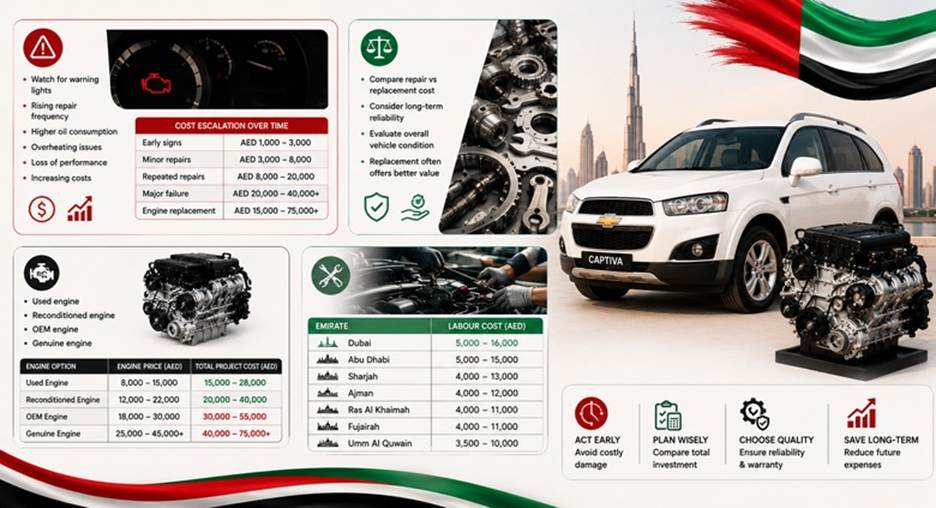
| Ownership Stage | Typical Cost Exposure (AED) |
| Preventive Maintenance | 500 – 3,000 |
| Early Repairs | 2,000 – 8,000 |
| Repeated Repairs | 8,000 – 20,000 |
| Major Failure | 20,000 – 40,000+ |
| Engine Replacement Project | 15,000 – 75,000+ |
Ignoring warning signs rarely reduces costs.
It usually postpones them.
The Engine Replacement Threshold: Determining When Investment Creates Better Value Than Continued Repairs
Eventually every owner reaches a point where continued repairs stop making strategic sense.
This is the replacement threshold.
Indicators Supporting Engine Replacement
✓ Escalating repair costs
✓ Strong remaining vehicle condition
✓ High replacement-vehicle costs
✓ Long-term ownership plans
✓ Positive reliability outlook after replacement
Indicators Supporting Further Evaluation
- Significant transmission concerns
- Electrical-system instability
- Structural deterioration
- Multiple major mechanical failures
Strategic Decision Matrix
| Situation | Strategic Recommendation |
| Strong Vehicle + Engine Issues | Consider Replacement Engine |
| Multiple Major Failures | Compare Vehicle Replacement |
| Moderate Condition | Detailed Cost Analysis |
| Severe Overall Deterioration | Evaluate Vehicle Replacement |
The replacement threshold is rarely defined by one repair bill.
It is usually defined by ownership economics.
Chevrolet Captiva Engine Replacement Cost UAE: Comparing Strategic Investment Options
Engine choice directly influences future ownership outcomes.
Strategic buyers compare value rather than simply comparing price.
Used Engine Option
Advantages:
- Lower upfront cost
- Faster availability
Risks:
- Unknown history
- Variable reliability
Reconditioned Engine Option
Advantages:
- Balanced cost structure
- Refreshed internal components
Risks:
- Quality varies by rebuild standards
OEM Engine Option
Advantages:
- Strong compatibility
- Predictable reliability
Risks:
- Higher investment
Genuine Chevrolet Engine Option
Advantages:
- Maximum confidence
- Strongest long-term outlook
Risks:
- Highest purchase cost
Engine Cost Comparison
| Engine Type | Estimated Cost (AED) |
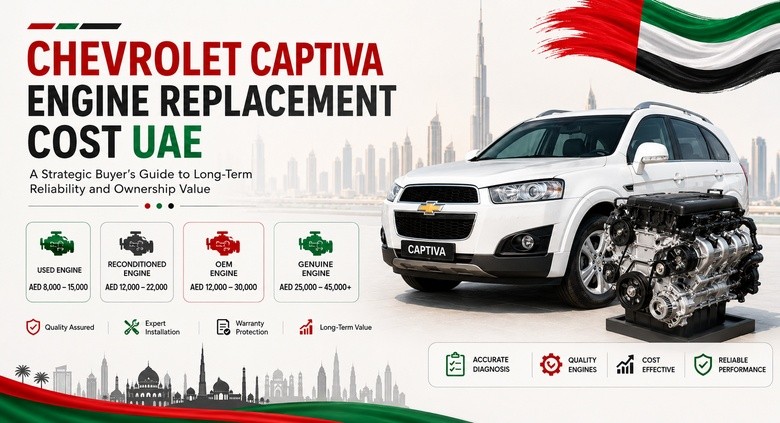
| Used Engine | 8,000 – 15,000 |
| Reconditioned Engine | 12,000 – 22,000 |
| OEM Engine | 18,000 – 30,000 |
| Genuine Engine | 25,000 – 45,000+ |
Total Project Cost Comparison
| Engine Type | Estimated Project Cost (AED) |
| Used Engine Project | 15,000 – 28,000 |
| Reconditioned Project | 20,000 – 40,000 |
| OEM Project | 30,000 – 55,000 |
| Genuine Project | 40,000 – 75,000+ |
The cheapest engine often delivers the lowest entry cost.
It does not always deliver the strongest ownership value.
UAE Labour Cost Analysis by Emirate
Labour costs vary across the Emirates.
These differences often reflect:
- Facility standards
- Technician expertise
- Equipment investment
- Warranty support
- Workshop overheads
Labour Cost Comparison by Emirate
| Emirate | Typical Labour Cost (AED) |
| Dubai | 5,000 – 16,000 |
| Abu Dhabi | 5,000 – 15,000 |
| Sharjah | 4,000 – 13,000 |
| Ajman | 4,000 – 12,000 |
| Ras Al Khaimah | 4,000 – 11,000 |
| Fujairah | 4,000 – 11,000 |
| Umm Al Quwain | 3,500 – 10,000 |
Strategic buyers evaluate labour quality alongside labour cost.
Cost-of-Delay Analysis: Why Waiting Can Become Expensive
Many owners postpone decisions hoping costs will stabilise.
Unfortunately, major engine problems often become more expensive over time.
Potential Consequences of Delay
- Additional engine damage
- Cooling-system failures
- Supporting component deterioration
- Increased downtime
- Reduced resale value
Delay Cost Comparison
| Decision Timing | Strategic Outcome |
| Early Action | Lower Risk |
| Moderate Delay | Moderate Cost Increase |
| Extended Delay | Significant Financial Exposure |
| Failure Event | Maximum Cost Exposure |
The strongest strategic decisions are often made before complete failure occurs.
The First Strategic Buyer Conclusion
At this stage, a clear pattern emerges.
The smartest Chevrolet Captiva owners do not focus solely on replacing an engine.
They focus on maximising ownership value.
They evaluate:
- Total project costs
- Mileage history
- Climate risk
- Labour quality
- Future reliability
- Cost escalation patterns
- Long-term ownership plans
Supporting Components and Hidden Costs: Expenses Strategic Buyers Must Anticipate
One of the biggest differences between reactive owners and strategic buyers is preparation.
Reactive owners budget for the engine.
Strategic buyers budget for the entire project.
This distinction matters because replacement engines rarely operate independently.
They rely on supporting systems that may already be experiencing wear.
Ignoring those systems can reduce today's invoice while increasing tomorrow's expenses.
Supporting Components Commonly Replaced During Installation
✓ Radiator
✓ Water pump
✓ Thermostat
✓ Engine mounts
✓ Cooling hoses
✓ Sensors
✓ Belts
✓ Tensioners
✓ Filters
✓ Fluids
Supporting Component Cost Comparison
| Component | Typical Cost (AED) |
| Radiator | 1,500 – 5,500 |
| Water Pump | 800 – 4,000 |
| Thermostat | 400 – 2,000 |
| Engine Mounts | 1,000 – 5,000 |
| Sensors | 500 – 4,500 |
| Belts & Tensioners | 500 – 3,000 |
| Fluids & Filters | 500 – 2,500 |
Strategic Buyer Perspective
Many supporting components are easier and cheaper to replace while the engine is already removed.
A lower initial invoice does not always represent the lowest ownership cost.
Hidden Cost Analysis: The Expenses That Often Surprise Chevrolet Captiva Owners
Engine replacement projects occasionally exceed original estimates.
Not because workshops intentionally increase costs.
Because additional issues are often discovered during disassembly.
Common Hidden Costs
- Wiring repairs
- Cooling-system faults
- Oil leaks
- Sensor failures
- Mount deterioration
- Ancillary component wear
Example Hidden Cost Scenario
Initial Quotation:
AED 22,000
Additional Cooling-System Repairs:
AED 2,500
Sensor Replacement:
AED 1,500
Engine Mount Replacement:
AED 2,000
Additional Labour:
AED 2,000
Final Cost:
AED 30,000
Hidden Cost Risk Matrix
| Vehicle Condition | Hidden Cost Risk |
| Excellent | Low |
| Good | Moderate |
| Average | Elevated |
| Unknown History | High |
| Neglected Maintenance | Very High |
Strategic buyers create contingency budgets before beginning major projects.
Warranty Evaluation Framework: How Smart Buyers Reduce Future Financial Risk
A warranty is more than a document.
It is a risk-management tool.
Strategic buyers evaluate warranty quality with the same attention they give engine quality.
Characteristics of Strong Warranty Protection
✓ Written coverage
✓ Clearly defined duration
✓ Transparent exclusions
✓ Workshop accountability
✓ Claims procedure documentation
Warranty Red Flags
✗ Verbal promises
✗ Undefined coverage periods
✗ Missing paperwork
✗ Unclear exclusions
✗ No installation records
Warranty Comparison
| Warranty Type | Strategic Value |
| Comprehensive Written Warranty | Excellent |
| Standard Written Warranty | Good |
| Limited Warranty | Moderate |
| Verbal Warranty | Poor |
A stronger warranty often reflects greater workshop confidence in the work performed.
Documentation and Verification Strategy: Protecting Future Ownership Value
Documentation is often overlooked during repairs.
Strategic buyers treat it as an asset.
Years later, documentation frequently influences resale negotiations, warranty claims and buyer confidence.
Documentation Verification Checklist
✓ Engine purchase invoice
✓ Installation invoice
✓ Warranty certificate
✓ Diagnostic reports
✓ Compression-test results
✓ Service records
✓ Engine identification details
Documentation Quality Matrix
| Documentation Status | Ownership Value |
| Complete Documentation | Highest |
| Strong Documentation | High |
| Partial Records | Moderate |
| Missing Records | Reduced |
A replacement engine without documentation creates uncertainty.
Strategic buyers aim to eliminate uncertainty wherever possible.
Insurance and Registration Considerations
Administrative preparation often receives less attention than mechanical work.
Yet proper records can become valuable later.
Important Documents to Retain
- Purchase invoices
- Installation records
- Warranty documents
- Diagnostic reports
- Maintenance history
These records support:
- Ownership verification
- Warranty claims
- Future resale
- Vehicle-history transparency
Administrative organisation contributes directly to ownership value.
Downtime Economics: Measuring the Real Cost of Vehicle Unavailability
Many owners calculate repair costs.
Fewer calculate downtime costs.
For strategic buyers, both matter.
A vehicle unavailable for days or weeks creates consequences that extend beyond workshop invoices.
Family Ownership Impact
Downtime may affect:
- School transport
- Family schedules
- Daily commuting
- Travel plans
Business Ownership Impact
Downtime may affect:
- Customer commitments
- Revenue generation
- Staff mobility
- Operational efficiency
Downtime Cost Assessment
| Downtime Duration | Strategic Impact |
| 1–3 Days | Low |
| 4–7 Days | Moderate |
| 1–2 Weeks | High |
| More Than 2 Weeks | Significant |
Reliable planning reduces downtime exposure.
Family Ownership Perspective: Balancing Reliability and Cost Control
Many Chevrolet Captiva owners operate within family budgets.
Strategic decisions therefore extend beyond vehicle ownership.
They affect household finances.
Family Ownership Priorities
✓ Reliability
✓ Safety
✓ Predictable costs
✓ Long-term value
✓ Reduced financial surprises
Family Buyer Decision Factors
| Priority | Importance |
| Reliability | Critical |
| Safety | Critical |
| Cost Predictability | High |
| Resale Value | Moderate |
| Performance | Lower |
For families, stability often matters more than maximum performance.
Business Continuity Perspective: Protecting Operational Stability
Some Chevrolet Captiva vehicles support business operations, field work and client-facing activities.
For these owners, reliability becomes an operational requirement.
Business Priorities
✓ Reduced downtime
✓ Predictable maintenance
✓ Operational continuity
✓ Cost control
✓ Vehicle availability
Business Continuity Comparison
| Ownership Strategy | Business Stability |
| Reactive Repairs | Lower |
| Preventive Maintenance | Higher |
| Planned Engine Replacement | Strong |
| Delayed Major Repairs | Weak |
Strategic buyers often evaluate operational impact alongside repair costs.
Poor Installation Warning Signs Strategic Buyers Should Monitor
The installation process influences future ownership outcomes.
Even a quality engine can create problems if installation standards are poor.
Warning Signs
- Fluid leaks
- Warning lights
- Rough idle
- Excessive vibration
- Cooling issues
- Abnormal fuel consumption
Risk Assessment Matrix
| Observation | Risk Level |
| Stable Operation | Low |
| Minor Irregularity | Moderate |
| Repeated Warning Lights | High |
| Persistent Leaks | High |
| Overheating | Critical |
Early detection reduces future repair exposure.
The Second Strategic Buyer Conclusion
At this point, the decision-making framework becomes clearer.
Successful Chevrolet Captiva ownership is rarely determined by engine price alone.
It is shaped by:
- Supporting-part decisions
- Hidden-cost planning
- Warranty quality
- Documentation standards
- Downtime management
- Installation quality
- Long-term risk control
For buyers researching Chevrolet Captiva replacement engine for sale, the strongest outcomes usually come from evaluating the complete ownership equation rather than focusing solely on the cheapest available option.
The First 1,000 Kilometres After Installation: Protecting the Investment
A strategic buyer understands that engine replacement is not the finish line.
It is the beginning of a new ownership phase.
The first 1,000 kilometres provide an opportunity to identify installation issues, verify performance and protect the investment before minor concerns become expensive repairs.
First 1,000 km Strategic Monitoring Checklist
✓ Check oil levels regularly
✓ Monitor coolant levels
✓ Observe operating temperatures
✓ Watch dashboard warning lights
✓ Listen for unusual noises
✓ Monitor fuel consumption
✓ Check for fluid leaks
Early Detection Benefit Analysis
| Issue Identified Early | Potential Future Cost Avoided |
| Minor Coolant Leak | High |
| Oil Leak | High |
| Sensor Issue | Moderate |
| Calibration Error | Moderate |
| Cooling-System Failure | Very High |
Strategic buyers actively monitor the vehicle during this period rather than assuming the project is complete.
Resale Value Protection Strategy: Preserving Future Market Appeal
One of the most overlooked aspects of engine replacement is future resale value.
Many buyers fear that replacing the engine automatically reduces vehicle appeal.
The reality is more nuanced.
A professionally documented engine replacement often creates greater buyer confidence than an ageing vehicle with unresolved mechanical concerns.
Factors Influencing Resale Value
- Engine quality
- Installation quality
- Documentation quality
- Warranty records
- Service history
Resale Confidence Comparison
| Ownership Scenario | Buyer Confidence |
| Genuine Engine + Full Documentation | Excellent |
| OEM Engine + Strong Records | Very Good |
| Reconditioned Engine + Documentation | Good |
| Used Engine + Partial Records | Moderate |
| Unknown Engine History | Weak |
Strategic buyers think about resale value before the replacement project begins.
Three-Year Ownership Forecast: Evaluating Medium-Term Financial Outcomes
A replacement engine should not be evaluated solely on installation cost.
The stronger approach is evaluating future ownership economics.
Estimated Three-Year Ownership Costs
| Category | Estimated Cost (AED) |
| Scheduled Maintenance | 3,000 – 9,000 |
| Fluids & Filters | 1,500 – 4,500 |
| Diagnostics | 1,000 – 4,000 |
| Preventive Repairs | 2,000 – 10,000 |
| Contingency Repairs | 2,000 – 12,000 |
Three-Year Risk Comparison
| Engine Type | Ownership Risk |
| Used Engine | Highest |
| Reconditioned Engine | Moderate |
| OEM Engine | Lower |
| Genuine Engine | Lowest |
The most expensive engine does not always produce the highest return.
The best value comes from balancing investment and reliability.
Five-Year Ownership Forecast: Understanding Long-Term Value
Strategic buyers often look beyond immediate ownership costs.
A five-year outlook provides a clearer understanding of long-term value.
Five-Year Ownership Considerations
- Annual mileage
- Climate exposure
- Maintenance discipline
- Usage patterns
- Workshop quality
Long-Term Reliability Outlook
| Engine Type | Five-Year Outlook |
| Used Engine | Variable |
| Reconditioned Engine | Balanced |
| OEM Engine | Strong |
| Genuine Engine | Strongest |
The true success of an engine replacement often becomes visible over several years.
Engine Replacement vs Vehicle Replacement: Which Strategic Option Creates Better Value?
This is the question most Chevrolet Captiva owners eventually ask.
Should the engine be replaced?
Or should the entire vehicle be replaced?
Strategic buyers compare both options objectively.
Factors Supporting Engine Replacement
✓ Strong vehicle condition
✓ Good service history
✓ Lower overall investment
✓ Continued ownership plans
✓ Acceptable future operating costs
Factors Supporting Vehicle Replacement
✓ Multiple major system failures
✓ Severe structural deterioration
✓ Significant future repair exposure
✓ Changing ownership requirements
Cost Comparison
| Option | Typical Cost (AED) |
| Used Engine Project | 15,000 – 28,000 |
| Reconditioned Project | 20,000 – 40,000 |
| OEM Project | 30,000 – 55,000 |
| Genuine Project | 40,000 – 75,000+ |
| Replacement Vehicle | 60,000 – 220,000+ |
Strategic buyers compare total ownership economics rather than emotional attachment.
Real UAE Ownership Scenarios
Dubai Family Owner
Vehicle:
Chevrolet Captiva
Situation:
Increasing repair frequency and concern about long-term reliability.
Decision:
OEM replacement engine with supporting component upgrades.
Outcome:
Improved reliability and stronger long-term ownership confidence.
Abu Dhabi Professional Owner
Vehicle:
Chevrolet Captiva
Situation:
Escalating maintenance expenses but otherwise strong vehicle condition.
Decision:
Reconditioned engine with comprehensive warranty.
Outcome:
Balanced investment and predictable ownership costs.
Sharjah Budget-Conscious Owner
Vehicle:
Chevrolet Captiva
Situation:
Limited budget but desire to extend vehicle life.
Decision:
Documented used engine with thorough diagnostics.
Outcome:
Lower upfront investment while maintaining acceptable reliability.
These examples demonstrate that the best decision varies according to ownership goals.
Competitor Ownership Comparison
Strategic buyers often compare the Chevrolet Captiva with competing SUVs before making major investments.
Ownership Comparison
| Vehicle | Engine Replacement Exposure | Ownership Complexity |
| Chevrolet Captiva | Moderate | Moderate |
| Hyundai Santa Fe | Moderate | Moderate |
| Kia Sorento | Moderate | Moderate |
| Nissan X-Trail | Lower | Lower |
| Ford Escape | Higher | Higher |
Long-term ownership value depends on more than engine cost alone.
Common Strategic Buyer Mistakes That Increase Ownership Costs
Most expensive ownership outcomes begin with avoidable mistakes.
Common Mistakes
- Choosing solely on price
- Ignoring diagnostics
- Delaying major decisions
- Overlooking supporting components
- Accepting weak warranty protection
- Failing to document repairs
Cost Impact Assessment
| Mistake | Long-Term Impact |
| Delayed Repairs | High |
| Weak Warranty | High |
| Poor Documentation | Moderate |
| Cheapest Engine Selection | Elevated |
| Ignoring Supporting Parts | Very High |
Strategic buyers focus on reducing risk rather than chasing the lowest quotation.
Buyer Decision Matrix
Priority: Lowest Upfront Cost
Recommended Option:
Documented Used Engine
Priority: Balanced Value
Recommended Option:
Reconditioned Engine
Priority: Long-Term Reliability
Recommended Option:
OEM Engine
Priority: Maximum Confidence
Recommended Option:
Genuine Chevrolet Engine
Strategic Decision Matrix
| Ownership Goal | Recommended Strategy |
| Budget Focus | Used Engine |
| Value Focus | Reconditioned Engine |
| Reliability Focus | OEM Engine |
| Maximum Confidence | Genuine Engine |
The correct decision depends on ownership objectives rather than a universal rule.
Insurance, Registration and Documentation Considerations
Administrative preparation is an important part of ownership protection.
Essential Documents
✓ Engine invoice
✓ Installation invoice
✓ Warranty paperwork
✓ Service records
✓ Diagnostic reports
These documents assist with:
- Future resale
- Warranty claims
- Ownership transparency
- Vehicle-history verification
Good documentation strengthens both value and confidence.
Final Strategic Buyer Framework: Making the Smartest Long-Term Decision
A Chevrolet Captiva engine replacement should never be viewed as a simple repair transaction.
Strategic buyers evaluate the complete ownership picture.
They consider:
- Cost
- Reliability
- Risk
- Resale value
- Warranty quality
- Future ownership plans
For buyers researching solutions through PartFinder UAE, the strongest outcomes usually come from comparing long-term ownership value rather than focusing solely on the cheapest available option.
Strategic Buyer Framework
| Decision Area | Primary Objective |
| Diagnostics | Accurate Decision-Making |
| Engine Selection | Reliability Balance |
| Labour Quality | Installation Confidence |
| Supporting Parts | Future Stability |
| Warranty Protection | Risk Reduction |
| Documentation | Value Preservation |
| Ownership Forecasting | Financial Clarity |
| Resale Planning | Future Flexibility |
The most successful Chevrolet Captiva owners rarely ask:
"Which replacement engine is cheapest?"
Instead, they ask:
"Which decision delivers the strongest combination of reliability, risk control and ownership value over the years ahead?"
In the UAE's demanding automotive environment, that question often determines whether an engine replacement becomes a smart investment or an expensive lesson.
Frequently Asked Questions
Categories
- Audi
- BMW
- Car Accessories
- Car Tips
- Ford
- Land Rover
- Mazda
- Range Rover
- Top 10
- UAE Car Parts
- Used Car Parts
- Toyota
- Replacement Engines
- Nissan
- Hyundai
- Mitsubishi
- Volkswagen
- Honda
- Kia
- Chevrolet
- Dodge
- Jeep
- Subaru
- Renault
- Lexus
- Mercedes
- Suzuki
- Hummer
- Porsche
- Infiniti
- Peugeot
- GMC
- Mini
- Volvo
- Replacement Gearboxes
- MG
- Jaguar
- Skoda
- Cadillac
- Daihatsu
- Fiat
- German Car Parts
- Japanese Car Parts
- Aftermarket Car Parts
- Genuine Car Parts
- New Car Parts
- Reconditioned Car Parts
- European Car Parts
- American Car Parts
- Korean Car Parts
- British Car Parts
- Chinese Car Parts
- Sports/Exotic Car Parts
- Luxury Car Parts
- Performance Car Parts
- SUV/4x4 Spare Parts
- Truck Spare Parts
- EV Car Parts
- Hybrid Car Parts
- Auto Spare Parts in UAE
- Tesla
- Isuzu
- Ram
- Ferrari
- Bentley
- Lamborghini
- Genesis
- Maserati
- Lincoln
- Chrysler
- Opel
- Citroen
- SsangYong
- Seat
- McLaren
- Aston Martin
- Rolls Royce
- Maybach
- Alfa Romeo
- Bugatti
- Scion
- Abu Dhabi Car Parts
- Ajman Car Parts
- Al Khan Car Parts
- Al Sajaa Car Parts
- Deira Car Parts
- Dubai Car Parts
- Fujairah Car Parts
- Industrial Area 6 Car Parts
- Mussafah Car Parts
- Ras Al Khaimah Car Parts
- Sharjah Car Parts
- Umm Al Quwain Car Parts
- Acura
- BYD
- Chery
- Dacia
- DS
- Geely Emgrand
- EXEED
- GAC
- GAC Gonow
- Geely
- Gonow
- Great Wall
- Haima
- Haval
- Holden
- Iveco
- JAC
- Jaecoo
- Jetour
- Lotus
- Omoda
- Proton
- Renault Samsung
- Roewe
- Lucid