Chevrolet Trax Engine Replacement Cost UAE: How One Mechanical Issue Often Becomes Several
June 11, 2026
How One Mechanical Issue Often Becomes Several
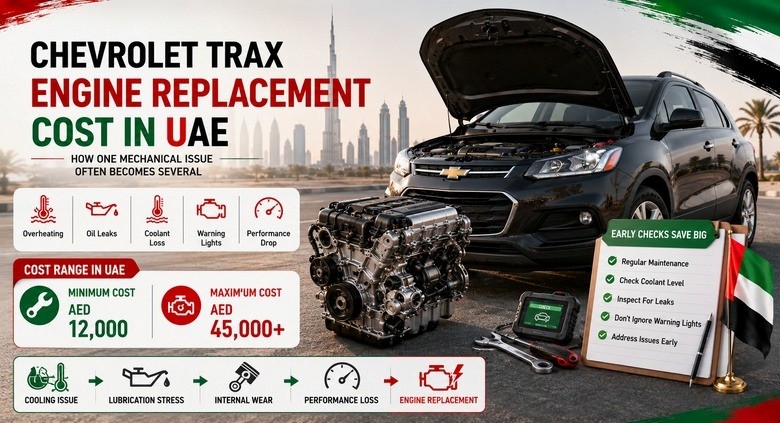
People rarely wake up one morning and discover that their Chevrolet Trax suddenly needs a replacement engine. The more interesting truth is that engine replacement usually begins months—or sometimes years—before anyone starts searching for prices.
A cooling fan works slightly less efficiently.
A coolant level drops a little faster than expected.
A warning light appears and disappears.
Nothing dramatic happens.
The vehicle continues driving.
That is often the problem.
Mechanical deterioration is surprisingly polite in the beginning. It whispers long before it starts shouting.
Spend enough time around UAE workshops and a pattern emerges.
The final engine failure receives all the attention.
The sequence that created it receives very little.
Owners naturally focus on the expensive moment because that is when the invoice arrives. Technicians often focus on the earlier moments because that is where the story actually started.
The Chevrolet Trax is no exception.
In many cases, the replacement engine becomes the final consequence rather than the original problem.
A thermostat fault becomes an overheating issue.
The overheating issue becomes lubrication stress.
The lubrication stress becomes internal wear.
The internal wear becomes performance loss.
The performance loss becomes a replacement decision.
Each stage creates the next.
That chain reaction is the real subject of this article.
The First Missed Warning Sign: Looking Back at the Moment the Failure Began
Ask a technician when the engine failed and you will receive one answer.
Ask when the problem began and you often receive a completely different answer.
That distinction matters.
Many Chevrolet Trax owners can identify the day the vehicle stopped operating normally. Far fewer can identify the moment the mechanical decline actually started.
Sometimes it begins with a small coolant leak.
Sometimes it begins with delayed oil changes.
Occasionally it starts with a sensor that quietly reports inaccurate information.
The frustrating thing about early warning signs is that they rarely feel urgent.
A slight increase in engine temperature during a Dubai traffic jam feels temporary. A small oil leak on the garage floor feels manageable.
Life continues.
Work continues.
The vehicle continues.
The consequence chain continues as well.
Commonly Ignored Early Warnings
✓ Small coolant loss
✓ Occasional temperature fluctuations
✓ Delayed oil-service intervals
✓ Minor oil leaks
✓ Intermittent warning lights
✓ Slight reduction in fuel economy
✓ Rough cold starts
✓ Small performance changes
None of these symptoms automatically mean engine replacement is approaching.
What they do mean is that investigation becomes cheaper than delay.
Early Warning Risk Matrix
| Initial Symptom | Consequence Potential |
| Minor Coolant Leak | High |
| Small Oil Leak | High |
| Warning Light | Moderate to High |
| Rough Start-Up | Moderate |
| Temperature Fluctuation | Very High |
| Repeated Overheating | Critical |
The cost difference between an early repair and a late repair can be extraordinary.
That is not a marketing statement.
It is simply how mechanical systems behave.
Cooling-System Consequence Mapping: How a Minor Temperature Problem Becomes Major Engine Damage
Cooling systems rarely receive much attention when they are functioning properly.
That changes very quickly when they stop.
The Chevrolet Trax relies heavily on stable operating temperatures. Once that stability begins disappearing, several other systems become exposed to additional stress.
A radiator develops a restriction.
Coolant circulation becomes less efficient.
Engine temperatures begin rising.
Oil temperatures follow.
Internal clearances change.
Lubrication effectiveness declines.
The engine starts working harder under less favourable conditions.
The original problem may have cost a few hundred dirhams to address.
The final consequence can cost tens of thousands.
Cooling-System Escalation Pathway
Coolant Leak
↓
Reduced Cooling Efficiency
↓
Higher Engine Temperatures
↓
Oil Breakdown
↓
Internal Wear
↓
Performance Loss
↓
Engine Damage
↓
Replacement Engine Project
This progression does not always happen.
It happens often enough that experienced workshops treat cooling-system concerns seriously.
Chevrolet Trax Cooling-System Repair Costs UAE
| Repair Item | Estimated Cost (AED) |
| Coolant Service | 200 – 600 |
| Thermostat Replacement | 400 – 1,500 |
| Water Pump Replacement | 900 – 3,500 |
| Radiator Replacement | 1,200 – 5,000 |
| Cooling Fan Assembly | 800 – 4,000 |
| Head Gasket Repair | 4,000 – 12,000 |
| Replacement Engine Project | 12,000 – 45,000+ |
The table tells a story.
Each stage becomes progressively more expensive.
That is technical consequence mapping in its simplest form.
When UAE Heat Starts Amplifying the Problem
Vehicles operating in the UAE do not experience the same environment as vehicles operating in milder climates.
That sounds obvious.
Its consequences are less obvious.
A Chevrolet Trax sitting in Sharjah traffic during August experiences thermal stress levels that many global maintenance schedules barely acknowledge. Every component inside the engine bay works harder simply because the surrounding environment is already hot.
Heat changes everything.
Rubber ages faster.
Cooling systems work harder.
Engine oil faces greater stress.
Sensors operate under more demanding conditions.
The margin for error becomes smaller.
A vehicle that might tolerate minor neglect elsewhere can become far less forgiving in UAE conditions.
UAE Driving Environment Comparison
| Driving Environment | Engine Stress Level |
| Winter Highway Driving | Low |
| Normal Daily Driving | Moderate |
| Summer Highway Driving | High |
| Summer Urban Congestion | Very High |
| Repeated Summer Overheating | Critical |
One overheating event may not destroy an engine.
Repeated overheating events often create cumulative consequences that become increasingly difficult to reverse.
UAE Heat-Related Failure Contributors
✓ Cooling-system fatigue
✓ Accelerated oil degradation
✓ Sensor deterioration
✓ Hose ageing
✓ Increased fan-system workload
✓ Greater thermal cycling
The engine rarely notices one difficult day.
Years of difficult days create a different outcome.
Oil Starvation and Internal Wear: The Damage Owners Rarely See Developing
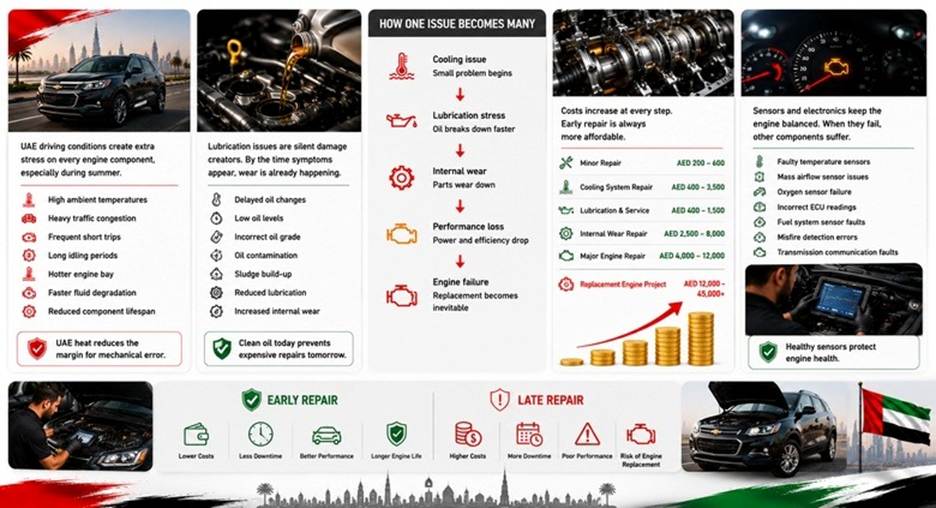
Cooling-system failures attract attention because temperatures are visible.
Lubrication failures are often more dangerous because they are not.
Oil works quietly.
It protects bearings.
It reduces friction.
It carries heat away from critical components.
Most owners never think about it.
Until something changes.
A small oil leak appears insignificant at first. Extended oil-change intervals seem harmless when the vehicle feels normal.
The mechanical consequences remain hidden.
For a while.
Inside the engine, however, conditions are changing.
Metal surfaces experience greater friction.
Bearing wear increases.
Heat accumulates.
Microscopic damage begins multiplying.
Nothing dramatic happens immediately.
That is what makes oil-related damage so deceptive.
Oil-Starvation Consequence Pathway
Oil Leak
↓
Reduced Lubrication
↓
Higher Friction
↓
Bearing Wear
↓
Metal Contamination
↓
Internal Engine Damage
↓
Power Loss
↓
Replacement Decision
By the time unusual noises appear, the damage often exists already.
The sound is not the beginning.
It is the announcement.
Typical UAE Repair Escalation Costs
| Issue | Estimated Cost (AED) |
| Oil Leak Repair | 300 – 2,000 |
| Oil System Repair | 800 – 4,000 |
| Bearing Repair | 4,000 – 10,000 |
| Internal Engine Repair | 6,000 – 18,000 |
| Replacement Engine | 12,000 – 45,000+ |
Again, the pattern is difficult to ignore.
Early intervention costs hundreds.
Delayed intervention often costs thousands.
The Cost-of-Delay Map: How a Small Repair Evolves Into a Large Invoice
Owners rarely delay repairs because they want larger repair bills.
They delay because the vehicle still functions.
That distinction explains many expensive automotive decisions.
The Chevrolet Trax starts.
Drives.
Stops.
Feels mostly normal.
The owner decides to monitor the issue.
Weeks become months.
Months become longer.
Meanwhile, the fault continues its own schedule.
One of the most common workshop observations in the UAE is that many replacement-engine discussions started as relatively affordable repairs.
Not all.
Many.
Cost-of-Delay Example
Stage One:
Coolant Leak Repair
AED 400 – 1,200
↓
Stage Two:
Water Pump and Cooling-System Repairs
AED 1,500 – 5,000
↓
Stage Three:
Head Gasket Damage
AED 4,000 – 12,000
↓
Stage Four:
Replacement Engine Project
AED 12,000 – 45,000+
The numbers change.
The pattern remains remarkably consistent.
Real UAE Ownership Consequences
For a family vehicle:
- Transportation disruption
- School-run complications
- Unexpected expenses
For an executive owner:
- Lost productivity
- Travel disruption
- Increased downtime exposure
For a business user:
- Operational interruption
- Revenue impact
- Customer-service delays
The repair invoice is only one consequence.
The ownership consequences often continue long after the repair itself is completed.
Where the Chain Reaction Begins
The most expensive Chevrolet Trax engine replacements often begin with surprisingly ordinary problems. A small leak, a delayed service, a cooling-system weakness or a warning sign that seemed too minor to justify immediate attention can eventually create a sequence of consequences far larger than the original fault.
The Secondary Damage Problem: Repairs Owners Never Planned to Pay For
There is a moment that catches many Chevrolet Trax owners off guard.
The workshop calls.
The original problem has been identified.
Then comes the second sentence.
"We found something else."
That "something else" is often where budgets begin changing.
The assumption that engine failure exists in isolation rarely survives contact with reality. Mechanical systems share workloads, temperatures, vibrations and operating conditions, which means one struggling component often places additional pressure on several others.
A cooling-system failure does not merely affect cooling.
It affects lubrication.
Combustion efficiency.
Sensors.
Electronic systems.
Even emissions components.
The original fault becomes a multiplier.
Not immediately.
Gradually.
Common Secondary Damage Following Engine Problems
✓ Damaged radiator
✓ Water-pump failure
✓ Cooling-fan deterioration
✓ Contaminated sensors
✓ Catalytic-converter damage
✓ Engine-mount wear
✓ Turbocharger stress (where applicable)
✓ Electrical-system complications
✓ Oxygen-sensor contamination
✓ Transmission stress caused by reduced engine performance
The frustrating thing is that many of these repairs were not part of the owner's original plan.
The vehicle had other ideas.
Secondary Damage Cost Comparison UAE
| Secondary Repair Item | Estimated Cost (AED) |
| Cooling Fan Assembly | 800 – 4,000 |
| Radiator Replacement | 1,200 – 5,000 |
| Engine Mounts | 1,000 – 4,500 |
| Sensor Replacement | 300 – 3,000 |
| Catalytic Converter | 2,000 – 10,000 |
| Turbocharger Repairs | 3,000 – 12,000 |
| Electrical Diagnostics | 500 – 4,000 |
This is why experienced technicians rarely discuss only the engine.
They discuss the surrounding ecosystem.
Because that ecosystem often determines the final invoice.
Used, Reconditioned, OEM and Genuine Engines: Comparing Future Consequences Rather Than Purchase Prices
Most engine comparisons begin with price.
Most ownership experiences end with reliability.
The gap between those two things deserves attention.
A used engine may appear attractive because the initial number looks manageable. Yet the real question is not what the engine costs today.
The real question is what uncertainty costs later.
That is a different calculation entirely.
Chevrolet Trax Engine Price Comparison UAE
| Engine Type | Estimated Cost (AED) |
| Used Engine | 5,000 – 12,000 |
| Rebuilt Engine | 8,000 – 16,000 |
| Reconditioned Engine | 10,000 – 20,000 |
| OEM Engine | 14,000 – 28,000 |
| Genuine Engine | 20,000 – 40,000+ |
The cheapest option frequently receives the most attention.
The least stressful option frequently receives the least.
That irony appears repeatedly in automotive ownership.
Consequence Comparison Matrix
| Engine Type | Upfront Cost | Future Risk | Long-Term Confidence |
| Used | Low | High | Moderate |
| Rebuilt | Moderate | Moderate | Moderate |
| Reconditioned | Moderate | Moderate-Low | Good |
| OEM | High | Low | Very Good |
| Genuine | Highest | Lowest | Excellent |
The numbers matter.
Confidence matters too.
Particularly when summer temperatures reach levels where mechanical weaknesses become much harder to hide.
Hidden Cost Comparison
Owners often compare:
- Engine purchase price
They should also compare:
- Future diagnostic costs
- Downtime risk
- Warranty coverage
- Resale implications
- Repeat repair probability
- Labour duplication costs
A cheaper engine can become an expensive ownership strategy.
Not always.
Often enough to deserve careful thought.
Labour Quality and Installation Consequences: Why the Same Engine Can Produce Different Ownership Results
Two Chevrolet Trax owners purchase identical replacement engines.
Six months later, one is happy.
The other is frustrated.
The engine was not necessarily the difference.
The installation may have been.
This is one of the least appreciated realities in the UAE used-engine market.
The workshop becomes part of the product.
An experienced technician notices details.
A rushed installation sometimes creates new problems that did not previously exist.
The replacement engine inherits those consequences.
Common Installation-Related Issues
✓ Fluid leaks
✓ Wiring mistakes
✓ Sensor calibration errors
✓ Cooling-system bleeding issues
✓ Poor mounting alignment
✓ Incorrect torque procedures
✓ ECU communication faults
The engine often receives blame.
Sometimes the installation deserves it.
UAE Labour Cost Analysis by Emirate
| Emirate | Labour Cost Range (AED) |
| Dubai | 3,500 – 12,000 |
| Abu Dhabi | 3,500 – 11,000 |
| Sharjah | 3,000 – 10,000 |
| Ajman | 2,500 – 8,500 |
| Ras Al Khaimah | 2,500 – 8,000 |
| Fujairah | 2,500 – 8,000 |
| Umm Al Quwain | 2,000 – 7,500 |
Choosing purely on labour cost can be tempting.
The consequences sometimes arrive later.
Workshop Evaluation Checklist
✓ Chevrolet experience
✓ Diagnostic capability
✓ Warranty support
✓ Transparent quotations
✓ Installation history
✓ Post-installation testing procedures
✓ Cooling-system expertise
✓ Electronic-system expertise
A workshop should be evaluated like a long-term partner.
Not simply a one-time expense.
For buyers researching Chevrolet Trax replacement engine for sale, mileage should never be evaluated in isolation. Service history, operating conditions and documentation often reveal more about future reliability than the odometer alone.
Supporting Components and Failure Cascades: The Parts That Decide Whether the New Engine Survives
There is a common misunderstanding in engine replacement projects.
Owners replace the engine.
Then assume the problem has disappeared.
Sometimes it has.
Sometimes it has merely moved.
A replacement engine entering an unhealthy cooling system inherits the same risks that damaged the previous engine. The component may be new, but the environment remains unchanged.
The consequence chain simply begins again.
Components Worth Replacing During Engine Installation
✓ Water pump
✓ Thermostat
✓ Radiator hoses
✓ Cooling fan assembly
✓ Engine mounts
✓ Drive belts
✓ Tensioners
✓ Sensors
✓ Spark plugs
✓ Ignition coils
✓ Fluids
✓ Filters
This list often generates resistance.
Then again, so do repeat repair bills.
Supporting-Part Cost Analysis
| Component | Estimated Cost (AED) |
| Water Pump | 800 – 3,500 |
| Thermostat | 400 – 1,500 |
| Radiator Hoses | 200 – 1,000 |
| Cooling Fan | 800 – 4,000 |
| Engine Mounts | 1,000 – 4,500 |
| Sensors | 300 – 3,000 |
| Ignition Components | 500 – 4,000 |
The cheapest time to replace many of these parts is when the engine is already out.
Labour overlap creates an opportunity.
Missing that opportunity can become expensive.
Mileage Versus Mechanical History: Why Numbers Alone Can Mislead Buyers
The used-engine market loves mileage.
Mileage is easy.
Mechanical history is difficult.
That is why mileage receives attention.
Two Chevrolet Trax engines may both show 100,000 kilometres.
One spent most of its life cruising comfortably between Abu Dhabi and Dubai.
The other spent years in stop-start traffic while coping with deferred maintenance.
Those engines are not equivalent.
The odometer suggests they are.
Reality suggests otherwise.
Mileage Evaluation Guide
| Mileage Range | General Risk Level |
| Under 50,000 km | Low |
| 50,000–100,000 km | Moderate |
| 100,000–150,000 km | Moderate to High |
| 150,000–200,000 km | High |
| Above 200,000 km | Very High |
Mileage tells you distance.
Mechanical history tells you consequences.
The second piece of information is usually more valuable.
Documentation Verification Checklist
✓ Service records
✓ Engine serial number verification
✓ Compression-test results
✓ Donor-vehicle history
✓ Warranty paperwork
✓ Import records where applicable
✓ Previous repair documentation
A documented 150,000-kilometre engine may represent less risk than an undocumented 80,000-kilometre engine.
That statement surprises some buyers.
It should not surprise experienced workshops.
UAE Traffic Exposure Mapping: Why Two Chevrolet Trax Vehicles Age Differently
Mileage measures movement.
It does not measure difficulty.
A Chevrolet Trax driven mostly on open highways experiences a very different life from one operating daily in heavy Sharjah congestion.
The odometer records distance.
It does not record suffering.
UAE Driving Environment Comparison
| Driving Pattern | Mechanical Stress |
| Highway Driving | Low |
| Mixed Driving | Moderate |
| Urban Congestion | High |
| Heavy Stop-Start Use | Very High |
| Repeated Summer Congestion | Critical |
This helps explain why seemingly identical vehicles often produce dramatically different ownership outcomes.
The conditions matter.
Sometimes more than the mileage itself.
Real UAE Ownership Scenarios
Dubai Executive Scenario
Long highway journeys create relatively stable operating temperatures. Engine wear often progresses more slowly when maintenance remains consistent.
Sharjah Commuter Scenario
Frequent congestion increases cooling-system workload, idle-time exposure and thermal cycling. Small weaknesses become noticeable faster.
Family Ownership Scenario
Short trips, school runs and irregular maintenance schedules can create a different set of mechanical consequences compared with highway-focused driving.
Small Business Scenario
Downtime often becomes more expensive than repairs themselves. Vehicle availability becomes part of the financial equation.
The lesson is straightforward.
Identical vehicles rarely experience identical lives.
And identical lives are what determine long-term reliability.
When the Original Problem Starts Recruiting Others
A cooling-system weakness becomes a lubrication issue. A lubrication issue becomes internal wear. Internal wear creates performance problems. Performance problems expose weaknesses in supporting components.
This is how consequence chains work.
The replacement engine eventually becomes the visible part of the story, but much of the real damage often occurs earlier and elsewhere. Understanding those secondary failures, installation risks and operating conditions gives owners a much better chance of avoiding the same sequence twice.
Warranty Coverage, Risk Transfer and Ownership Exposure
Most buyers feel reassured when they hear the word warranty.
Workshops know the conversation becomes more interesting once the warranty is actually needed.
A warranty is not merely protection.
It is a transfer of risk.
The important question is not whether a warranty exists. The important question is which risks remain with the owner after the paperwork is signed.
That distinction can change the entire ownership experience.
One warranty covers internal engine failure.
Another excludes overheating.
A third excludes labour.
A fourth requires maintenance documentation so specific that a missing invoice can create problems later.
Suddenly the word warranty means very different things.
Questions Every Chevrolet Trax Owner Should Ask
✓ Does the warranty include labour?
✓ Does it cover overheating damage?
✓ Is diagnostic work included?
✓ Are sensors covered?
✓ Are cooling-system failures excluded?
✓ Is nationwide support available?
✓ What maintenance records are required?
✓ Are consequential damages excluded?
The last question often matters most.
Because consequence mapping does not stop when the engine is installed.
Warranty Comparison Matrix
| Warranty Type | Owner Exposure |
| Verbal Promise | Very High |
| Limited Parts Warranty | High |
| Parts-Only Coverage | Moderate |
| Parts + Labour Coverage | Low |
| Comprehensive Warranty | Lowest |
A warranty should reduce uncertainty.
It should not create new forms of it.
The First 1,000 Kilometres: Where Small Installation Issues Become Larger Ownership Problems
The vehicle leaves the workshop.
The engine feels smooth.
Everything appears successful.
This is usually where owners relax.
Ironically, this is also where experienced technicians begin paying closer attention.
The first 1,000 kilometres often reveal details that workshop testing cannot. Real-world traffic, summer temperatures and daily operating conditions expose weaknesses much more effectively than a short test drive.
Minor fluid leaks appear.
Sensors begin reporting inconsistencies.
Cooling-system pressure changes become visible.
Small issues announce themselves.
The challenge is recognising them before they recruit larger problems.
First 1,000 km Monitoring Checklist
✓ Engine temperature stability
✓ Oil consumption
✓ Coolant level consistency
✓ Warning lights
✓ Unusual noises
✓ Fluid leaks
✓ Fuel-consumption changes
✓ Idle quality
✓ Throttle response
A small leak discovered after 300 kilometres feels inconvenient.
The same leak discovered after six months can become expensive.
Post-Installation Risk Matrix
| Observation | Risk Level |
| Stable Operation | Low |
| Minor Leak | Moderate |
| Warning Light | High |
| Temperature Variation | Very High |
| Overheating | Critical |
Many successful engine replacements are protected during this period.
Many unsuccessful ones are revealed by it.
The Downtime Consequence Map: When Vehicle Unavailability Costs More Than Repairs
Repair bills are easy to calculate.
Downtime is not.
That is why many owners underestimate it.
A Chevrolet Trax that cannot operate creates consequences that extend beyond workshop invoices. The financial impact often spreads into areas owners never expected to measure.
A family vehicle becomes unavailable.
School schedules change.
Transport costs increase.
Time disappears.
The same thing happens in business environments.
The difference is that businesses often attach numbers to it.
Executive Ownership Scenario
An executive travelling regularly between Dubai and Abu Dhabi loses mobility, scheduling flexibility and productivity.
The engine repair cost becomes only one part of the financial picture.
Small Business Scenario
A delivery vehicle misses commitments.
Customer relationships suffer.
Revenue opportunities disappear.
The workshop invoice remains fixed.
The operational consequences continue growing.
Downtime Cost Comparison
| Ownership Type | Potential Downtime Impact |
| Family Vehicle | Moderate |
| Executive Vehicle | High |
| Business Vehicle | Very High |
| Fleet Vehicle | Critical |
Owners often compare engine prices.
The more important comparison is sometimes vehicle availability.
Documentation Failure and Resale Consequences
Documentation feels boring until somebody needs it.
Then it becomes extremely valuable.
A replacement engine with excellent records tells a clear story. A replacement engine with missing paperwork forces future buyers to create their own explanations.
Most buyers choose caution when uncertainty appears.
The market behaves predictably.
Confidence increases value.
Uncertainty reduces it.
Documentation Verification Checklist
✓ Engine invoice
✓ Labour invoice
✓ Warranty records
✓ Service history
✓ Engine serial verification
✓ Mileage documentation
✓ Diagnostic reports
✓ Post-installation inspections
Each document removes a question.
Enough missing documents create new ones.
Resale Consequence Pathway
Poor Documentation
↓
Buyer Uncertainty
↓
Lower Confidence
↓
Reduced Offers
↓
Longer Selling Period
↓
Lower Resale Value
This chain reaction may seem unfair.
The market does not care.
The market rewards transparency.
Resale Value Comparison
| Documentation Quality | Resale Impact |
| Complete Records | Positive to Neutral |
| Partial Records | Moderate Reduction |
| Minimal Records | Significant Reduction |
| Unknown History | Severe Reduction |
Engine replacement itself is rarely the problem.
Poor documentation often is.
Replace the Engine or Replace the Problem? Understanding Root-Cause Failures
This may be the most important question in the entire article.
Many owners believe replacing the engine automatically solves the issue.
Sometimes it does.
Sometimes it merely replaces the victim.
Consider a cooling-system weakness.
The old engine suffered from it.
A new engine is installed.
The cooling-system weakness remains.
The original problem survives.
Only the engine changes.
The same principle applies to:
- Poor maintenance habits
- Cooling-system neglect
- Sensor failures
- Electrical faults
- Repeated overheating
- Lubrication issues
Root causes matter.
More than symptoms.
Engine Replacement vs Root-Cause Correction
| Scenario | Long-Term Outcome |
| Engine Replaced Only | Uncertain |
| Root Cause Corrected | Better |
| Engine + Supporting Components Replaced | Strong |
| Complete System Rehabilitation | Best |
Replacing parts without understanding causes often creates repeat failures.
The invoice changes.
The lesson remains the same.
The UAE Technical Consequence Blueprint: How Reliability Is Preserved or Lost Over Time
The Chevrolet Trax ownership journey is rarely defined by one catastrophic event.
It is usually shaped by hundreds of small decisions.
Some decisions reduce risk.
Others quietly increase it.
The difference becomes visible only later.
Reliability Preservation Framework
✓ Cooling-system inspections
✓ Oil-service discipline
✓ Early diagnostic intervention
✓ Genuine-fluid usage
✓ Supporting-component maintenance
✓ Warranty verification
✓ Documentation management
✓ Post-installation monitoring
✓ Heat-management awareness
✓ Preventative maintenance scheduling
Each item appears ordinary.
Together they create reliability.
Three-Year Ownership Forecast
| Category | Estimated Cost (AED) |
| Scheduled Maintenance | 3,000 – 10,000 |
| Diagnostics | 1,000 – 4,000 |
| Preventative Repairs | 2,000 – 8,000 |
| Unexpected Repairs | 2,000 – 12,000 |
Five-Year Ownership Forecast
| Engine Type | Ownership Outlook |
| Used Engine | Variable |
| Rebuilt Engine | Moderate |
| Reconditioned Engine | Good |
| OEM Engine | Very Good |
| Genuine Engine | Excellent |
The pattern appears repeatedly throughout UAE ownership stories.
The owners who experience the fewest major surprises are rarely the luckiest.
They are usually the most proactive.
Buyer Decision Matrix
Not every owner wants the same outcome.
That is why the same recommendation rarely suits everyone.
Lowest Initial Cost
Recommended Direction:
Used Engine
Balanced Cost and Reliability
Recommended Direction:
Reconditioned Engine
Long-Term Ownership Strategy
Recommended Direction:
OEM Engine
Maximum Confidence and Value Retention
Recommended Direction:
Genuine Engine
Decision Matrix
| Priority | Recommended Option |
| Lowest Purchase Cost | Used |
| Best Value | Reconditioned |
| Long-Term Reliability | OEM |
| Maximum Confidence | Genuine |
The correct decision depends less on the engine.
It depends more on the ownership plan.
For readers exploring PartFinder UAE, the most successful outcomes tend to share several characteristics.
Final Consequence Map: The Lesson Hidden Behind Every Replacement Engine
A coolant leak becomes an overheating issue.
The overheating issue becomes lubrication stress.
The lubrication stress becomes internal wear.
The internal wear becomes performance loss.
The performance loss becomes an engine replacement.
The replacement creates decisions about labour quality, supporting components, documentation, warranty protection and long-term maintenance.
That is the real story.
The Chevrolet Trax engine is rarely the beginning of the chain reaction.
It is usually where the chain reaction finally becomes impossible to ignore.
The owners who achieve the strongest outcomes are not necessarily the ones who spend the least. More often, they are the ones who recognise consequences early, understand how mechanical systems influence one another and make decisions before small problems have time to become several.
Frequently Asked Questions
Categories
- Audi
- BMW
- Car Accessories
- Car Tips
- Ford
- Land Rover
- Mazda
- Range Rover
- Top 10
- UAE Car Parts
- Used Car Parts
- Toyota
- Replacement Engines
- Nissan
- Hyundai
- Mitsubishi
- Volkswagen
- Honda
- Kia
- Chevrolet
- Dodge
- Jeep
- Subaru
- Renault
- Lexus
- Mercedes
- Suzuki
- Hummer
- Porsche
- Infiniti
- Peugeot
- GMC
- Mini
- Volvo
- Replacement Gearboxes
- MG
- Jaguar
- Skoda
- Cadillac
- Daihatsu
- Fiat
- German Car Parts
- Japanese Car Parts
- Aftermarket Car Parts
- Genuine Car Parts
- New Car Parts
- Reconditioned Car Parts
- European Car Parts
- American Car Parts
- Korean Car Parts
- British Car Parts
- Chinese Car Parts
- Sports/Exotic Car Parts
- Luxury Car Parts
- Performance Car Parts
- SUV/4x4 Spare Parts
- Truck Spare Parts
- EV Car Parts
- Hybrid Car Parts
- Auto Spare Parts in UAE
- Tesla
- Isuzu
- Ram
- Ferrari
- Bentley
- Lamborghini
- Genesis
- Maserati
- Lincoln
- Chrysler
- Opel
- Citroen
- SsangYong
- Seat
- McLaren
- Aston Martin
- Rolls Royce
- Maybach
- Alfa Romeo
- Bugatti
- Scion
- Abu Dhabi Car Parts
- Ajman Car Parts
- Al Khan Car Parts
- Al Sajaa Car Parts
- Deira Car Parts
- Dubai Car Parts
- Fujairah Car Parts
- Industrial Area 6 Car Parts
- Mussafah Car Parts
- Ras Al Khaimah Car Parts
- Sharjah Car Parts
- Umm Al Quwain Car Parts
- Acura
- BYD
- Chery
- Dacia
- DS
- Geely Emgrand
- EXEED
- GAC
- GAC Gonow
- Geely
- Gonow
- Great Wall
- Haima
- Haval
- Holden
- Iveco
- JAC
- Jaecoo
- Jetour
- Lotus
- Omoda
- Proton
- Renault Samsung
- Roewe
- Lucid