Chinese Car Parts in UAE: Everything Buyers Need to Know Before Purchasing
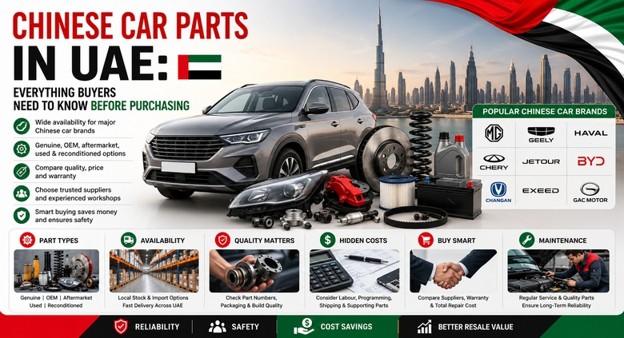
July 30, 2026
Understanding Chinese Car Parts Availability in the UAE
Key Takeaways
| Quick Insight | Why It Matters |
| Chinese car ownership is rising rapidly across the UAE. | Higher vehicle numbers encourage suppliers to stock more replacement parts. |
| Parts availability depends on the brand, model and production year. | Popular models usually have stronger supplier support. |
| Genuine, OEM and aftermarket options are now easier to source. | Buyers have more flexibility than ever before. |
| Correct fitment is more important than simply finding a part. | VIN verification prevents expensive mistakes. |
Why Chinese Cars Are Suddenly Everywhere in the UAE
Five years ago, plenty of motorists hesitated.
"Should I really buy a Chinese car?"
Today, that conversation sounds very different.
Walk through a supermarket car park in Dubai. Spend ten minutes outside an office in Abu Dhabi. Drive across Sharjah during the morning rush hour. You'll notice something almost immediately.
MGs.
Geelys.
Jetours.
Havals.
BYDs.
Cherys.
They're everywhere.
That isn't happening by accident.
Chinese manufacturers have worked incredibly hard to change perceptions. Better designs have arrived. Cabin quality has improved. Safety ratings have become stronger. Technology that once belonged only in premium European cars now appears in family SUVs costing considerably less.
Naturally, buyers started paying attention.
Then came another question.
"What happens when something breaks?"
That's the question this guide answers.
Are Chinese Car Parts Really Easy to Find?
The short answer?
Yes... for most popular models.
The longer answer is a little more interesting.
Availability depends on several moving pieces working together.
How many vehicles are already on UAE roads?
Does the supplier regularly stock those parts?
Has the manufacturer established a strong distribution network?
Is the component a routine service item or a specialist electronic module?
Those questions matter far more than simply asking whether a vehicle is Chinese.
Take brake pads for an MG HS.
Many workshops can obtain them quickly because thousands of similar vehicles already operate across the Emirates.
Now compare that with a newly introduced hybrid model that requires a specialised control module.
Finding that component may take longer—not because it's a Chinese vehicle, but because demand hasn't yet reached the same level.
That's exactly how every developing automotive market works.
The UAE Spare Parts Market Has Changed Faster Than Most People Realise
The UAE automotive industry never stands still.
Neither do spare parts suppliers.
Ten years ago, suppliers mainly focused on Japanese, German, Korean and American vehicles.
Today?
Warehouse shelves look very different.
More Chinese brands have entered the market.
Vehicle registrations have increased.
Independent workshops have invested in training.
Importers have expanded supplier relationships.
Distributors have improved logistics.
As demand has grown, businesses have responded.
That's good news for owners because competition usually improves both availability and customer choice.
What Actually Determines Parts Availability?
Many buyers imagine that spare parts simply arrive in a warehouse and wait for someone to purchase them.
Reality is far more complicated.
Several factors influence whether a replacement part is available today, next week or next month.
These include:
- Vehicle popularity in the UAE.
- Sales volume of the specific model.
- Supplier inventory levels.
- Manufacturer production schedules.
- Shipping and logistics.
- Genuine or aftermarket demand.
- Model-year revisions.
- Electronic compatibility.
- Seasonal repair demand.
Notice what's missing.
The country's name.
Being manufactured in China doesn't automatically make a component difficult to source.
Market demand usually decides that.
The Biggest Myths About Chinese Vehicle Parts
Let's clear up a few misconceptions.
"Chinese parts are impossible to find."
Not anymore.
For many mainstream models, routine maintenance parts are now widely available.
"Every Chinese vehicle uses the same components."
Definitely not.
Manufacturers use different platforms, engines, transmissions and electronics.
Compatibility still matters.
"Only dealerships can supply Chinese parts."
Independent suppliers now play an increasingly important role across the UAE, particularly for routine servicing and mechanical repairs.
"The cheapest part is the smartest purchase."
That's probably the most expensive mistake a buyer can make.
Saving money feels good.
Buying the wrong component doesn't.
Workshop Story
A Geely Coolray owner walked into an independent workshop in Dubai convinced that replacing a damaged headlamp would involve weeks of waiting.
He'd read countless comments online claiming Chinese parts were impossible to source.
The workshop manager didn't argue.
Instead, he picked up the phone.
Within an hour, three suppliers had confirmed availability.
Two offered genuine replacements.
One supplied an OEM alternative.
The owner looked surprised.
"I expected a month-long delay."
The technician laughed.
"The internet sometimes takes longer to update than the spare parts market."
That small conversation reflects what many UAE workshops now experience every week.
Chinese Car Parts Availability Comparison
| Category | Typical Availability |
| Brake Components | Excellent |
| Filters | Excellent |
| Suspension Parts | Very Good |
| Cooling Components | Very Good |
| Body Panels | Good (model dependent) |
| Electrical Modules | Moderate to Very Good (depends on model) |
| Engines & Gearboxes | Good, but may require specialist sourcing |
Decision Matrix – Should You Be Concerned About Parts Availability?
| Situation | Recommendation |
| Buying a popular MG, Geely or Chery model | Low concern |
| Buying a newly launched Chinese model | Check supplier support before purchasing |
| Looking for routine service parts | Usually straightforward |
| Searching for specialist electronic modules | Confirm availability using the VIN |
| Buying a used Chinese vehicle | Review previous maintenance history first |
Suggested Visual Callout
Infographic Idea:
A UAE map highlighting Dubai, Abu Dhabi, Sharjah, Ajman, Ras Al Khaimah, Fujairah and Umm Al Quwain with icons representing supplier networks, warehouses, workshops, genuine parts, OEM parts and delivery routes.
Quick Buyer Checklist
Before searching for any replacement part, always have:
- Vehicle VIN.
- Exact model.
- Production year.
- Engine specification.
- Gearbox type.
- GCC or imported specification.
- OEM part number if available.
Five minutes spent gathering this information can save days of frustration later.
Key Takeaways
Chinese vehicles are no longer newcomers in the UAE.
They're becoming part of everyday traffic, and the spare parts industry has evolved alongside them. That's the real story.
Most popular Chinese models now benefit from far stronger supplier networks than many buyers expect. Routine service parts are generally straightforward to source, while specialist components depend more on demand, production year and compatibility than the vehicle's country of manufacture.
Most importantly, don't ask only whether a part is available.
Ask whether it's the right part.
That single question can save you money, reduce downtime and prevent unnecessary workshop visits.
Which Chinese Car Brands Have the Best Parts Availability in the UAE?
Quick Summary
| Brand Group | Overall Parts Availability | Typical Waiting Time for Common Parts |
| MG | Excellent | Usually very short |
| Geely | Very Good | Usually short |
| Chery | Very Good | Short to moderate |
| Haval | Good to Very Good | Moderate |
| Jetour | Good | Moderate |
| BYD | Improving Rapidly | Depends on component |
One thing becomes obvious after speaking with workshops across the UAE.
Not all Chinese brands enjoy the same level of parts support.
Some have built mature supply chains.
Others are still catching up.
That isn't criticism. It's simply how automotive markets develop.
The earlier a manufacturer enters the market and the more vehicles it sells, the stronger its spare parts network usually becomes.
Simple.
MG Spare Parts Availability in the UAE
Ask almost any independent workshop which Chinese brand they see most often.
MG usually enters the conversation within seconds.
That popularity has created something extremely valuable.
Demand.
And demand changes everything.
Suppliers are far more willing to keep fast-moving components sitting on warehouse shelves when they know those parts will sell regularly.
Owners can generally find routine replacement items such as:
- Brake pads
- Brake discs
- Air filters
- Oil filters
- Suspension bushes
- Shock absorbers
- Radiators
- Water pumps
- Headlamps
- Exterior mirrors
Major repairs naturally take longer.
Finding an engine, automatic gearbox or advanced electronic control module may require additional sourcing, but the overall supply chain for MG is now one of the strongest among Chinese manufacturers operating in the UAE.
Geely Has Quietly Built a Strong Parts Network
Geely didn't become popular overnight.
Its growth has been steady.
Consistent.
And that consistency has helped suppliers build confidence.
Independent garages now repair Geely vehicles every single day.
That means replacement parts are no longer considered unusual stock.
Many suppliers regularly carry:
- Suspension arms
- Steering racks
- Brake components
- Cooling system parts
- Wheel bearings
- Engine sensors
- Ignition coils
- Service kits
Interestingly, workshops often mention that availability has improved dramatically over the last few years.
A repair that once involved international ordering may now be completed with locally available stock.
That's a huge improvement for owners.
Chery Continues to Strengthen Its Position
Chery has developed a loyal customer base.
Families appreciate the equipment levels.
Businesses often value the affordability.
As vehicle numbers continue growing, suppliers have expanded their inventories accordingly.
Routine maintenance parts are becoming easier to source, particularly for high-volume models.
These commonly include:
- Brake systems
- Filters
- Suspension components
- Cooling hoses
- Wheel hubs
- Lighting assemblies
Body panels and specialist electronic modules may still require additional ordering time depending on production year and specification.
That's perfectly normal.
Even well-established European manufacturers occasionally experience similar delays.
Haval Has Benefited from the SUV Boom
SUV demand has exploded across the UAE.
Haval has certainly benefited.
Family buyers appreciate the comfort.
Long-distance drivers enjoy the practicality.
Fleet operators increasingly consider them as well.
That popularity creates healthy demand for replacement parts.
Frequently requested items include:
- Control arms
- Shock absorbers
- Brake discs
- Air-conditioning compressors
- Radiators
- Turbo hoses
- Parking sensors
- Exterior trim
The more Haval vehicles workshops repair, the more confident suppliers become about holding inventory.
It becomes a positive cycle.
Jetour Is Growing Faster Than Many Expected
A few years ago, some buyers had never even heard of Jetour.
Now?
Things have changed.
Sales have increased.
Visibility has improved.
Supplier confidence is following.
Routine servicing rarely causes concern.
Major accident repairs or specialised electronic systems may involve slightly longer lead times simply because the vehicle population is still growing.
That situation is already improving.
And it will probably continue improving as more Jetour models enter the UAE market.
BYD Is Creating a Different Type of Demand
BYD deserves its own discussion.
Why?
Because electric vehicles change the conversation completely.
Traditional maintenance items such as engine oil and spark plugs disappear from many servicing schedules.
Instead, buyers begin thinking about different systems altogether.
Examples include:
- High-voltage electrical components
- Battery cooling systems
- Charging hardware
- Electric drive units
- Power electronics
- Regenerative braking components
Fortunately, supplier knowledge is improving alongside vehicle sales.
Specialist training has become increasingly important, and workshops familiar with hybrid and electric vehicles continue expanding across the Emirates.
Smaller Chinese Brands Are Also Finding Their Place
The UAE market doesn't stop with six manufacturers.
Several others continue building their presence.
These include:
- GAC
- JAC
- BAIC
- Bestune
- Dongfeng
Naturally, lower vehicle numbers often mean fewer replacement parts sitting in local warehouses.
That doesn't mean parts are unavailable.
It simply means sourcing may take a little longer.
Experienced suppliers usually explain realistic lead times before confirming an order.
That's exactly what buyers should expect.
Why Popularity Matters More Than Country of Origin
Here's something many first-time buyers don't realise.
The country where a vehicle is built isn't usually what determines parts availability.
Sales volume does.
Think about it.
If thousands of identical vehicles operate across Dubai, Abu Dhabi and Sharjah, suppliers know replacement parts will move quickly.
Holding inventory becomes a sensible business decision.
If only a handful of vehicles exist, suppliers naturally become more cautious.
That's basic inventory management.
Nothing more.
Nothing less.
Workshop Story
A workshop in Al Quoz received two enquiries on the same morning.
The first customer owned an MG RX5 and needed front brake discs.
The second drove a recently introduced Chinese SUV that had sold in much smaller numbers.
The MG parts were collected from a nearby supplier before lunchtime.
The second vehicle required a factory order because the component wasn't yet stocked locally.
Both customers received honest updates.
Neither repair involved poor service.
The difference simply reflected market demand.
The workshop manager summed it up perfectly.
"The more cars we see, the faster the shelves fill up."
Sometimes automotive economics really is that straightforward.
Chinese Brand Comparison
| Brand | Routine Service Parts | Major Mechanical Parts | Electronic Components | Overall Support |
| MG | Excellent | Very Good | Very Good | Excellent |
| Geely | Very Good | Very Good | Good | Very Good |
| Chery | Very Good | Good | Good | Very Good |
| Haval | Good | Good | Good | Good |
| Jetour | Good | Moderate to Good | Moderate | Good |
| BYD | Good | Good | Improving Rapidly | Good to Very Good |
Buyer Decision Matrix
| If You Want... | Consider |
| Strongest current parts network | MG |
| Mature independent workshop support | MG or Geely |
| Growing availability with competitive ownership costs | Chery |
| Popular family SUV support | Haval |
| Newer, expanding supplier network | Jetour |
| Long-term EV ownership | BYD with an experienced EV workshop |
Suggested Visual Callout
Workshop Comparison Graphic
Display six popular Chinese brands parked against a Dubai skyline, with warehouse shelves behind them. Use simple icons for brake parts, engine components, suspension, electrical systems and delivery trucks to illustrate different levels of parts availability without relying on heavy text.
Buyer Checklist
Before choosing a Chinese vehicle, ask:
- How many of this model are already driving in the UAE?
- Can independent workshops source routine parts?
- Are genuine and OEM options available?
- How quickly can major components be supplied?
- Does the supplier verify parts using the VIN?
- Is warranty support clearly explained?
A few questions today can save plenty of frustration later.
Key Takeaways
No Chinese manufacturer should be judged by outdated assumptions.
The market has evolved quickly, and several brands now benefit from strong supplier networks across the UAE.
MG currently leads in overall parts availability thanks to its popularity and well-developed supply chain. Geely and Chery have made significant progress, while Haval, Jetour and BYD continue strengthening their support as more vehicles reach UAE roads.
One final thought.
Don't choose a vehicle based only on today's purchase price.
Think about tomorrow's maintenance as well. That's often where smart ownership really begins.
Genuine vs OEM vs Aftermarket vs Used Chinese Car Parts – Which One Should You Buy?
Quick Summary
| Part Type | Quality | Price | Warranty | Best For |
| Genuine | ★★★★★ | Highest | Usually Excellent | Long-term ownership |
| OEM | ★★★★★ | Lower than Genuine | Very Good | Best value overall |
| Aftermarket | ★★★☆☆ to ★★★★☆ | Moderate | Varies | Budget-conscious buyers |
| Used | Depends on condition | Low | Limited | Rare or expensive components |
| Reconditioned | Good when professionally rebuilt | Moderate | Usually Available | Major mechanical repairs |
Walk into five workshops across Dubai and ask the same question.
"Which type of replacement part should I buy?"
Don't be surprised if you hear five different answers.
Why?
Because there isn't a single answer that suits every repair.
Replacing a cabin air filter isn't the same as replacing an automatic gearbox. Buying a bumper after a minor accident isn't remotely comparable to fitting a new steering rack.
The smartest buyers don't chase the cheapest option.
They buy the right option.
What Exactly Are Genuine Chinese Car Parts?
Let's begin with the easiest category.
A genuine part is manufactured for the vehicle brand and supplied through its authorised distribution network.
It's the component your vehicle was originally designed to use.
Everything—from dimensions and materials to electronic communication—is intended to match factory specifications.
That doesn't automatically mean it's the only good option.
It does, however, offer the highest level of confidence.
Genuine parts are particularly recommended for:
- Safety systems
- Airbags
- ABS components
- Electronic control modules
- Sensors
- Steering components
- Hybrid and EV electrical systems
Could you fit an alternative?
Sometimes.
Should you?
That depends on the component.
When safety is involved, it's rarely worth taking unnecessary risks.
Understanding OEM Parts
Here's where many buyers become confused.
OEM stands for Original Equipment Manufacturer.
In simple terms, the company producing the part may be the same manufacturer that supplied the original factory component.
The difference?
The packaging.
Instead of carrying the vehicle manufacturer's branding, the part may be sold under the component manufacturer's own name.
Imagine buying the same product without paying for premium retail packaging.
That's why OEM parts have become incredibly popular among experienced workshops.
They often provide:
- Factory-level quality
- Excellent fitment
- Reliable durability
- Better pricing than genuine alternatives
Many technicians quietly admit something interesting.
If an OEM part is available from a trusted manufacturer, they'll often recommend it before automatically suggesting the genuine version.
That says quite a lot.
Are Aftermarket Chinese Car Parts Worth Buying?
Now things become more complicated.
The word aftermarket covers an enormous range of products.
Some manufacturers build replacement components that perform impressively.
Others focus almost entirely on keeping prices low.
Guess which category causes most workshop headaches?
Quality varies enormously.
One aftermarket brake pad may last for years.
Another may create excessive dust, increased noise or premature wear after only a few thousand kilometres.
That doesn't mean aftermarket parts should be avoided altogether.
It means buyers need to be selective.
They're often a sensible choice for:
- Exterior trim
- Mirrors
- Lighting assemblies
- Window regulators
- Interior plastics
- Routine service items from reputable manufacturers
Always ask who made the part.
If the supplier can't answer that simple question, it's probably worth asking another supplier instead.
When Used Chinese Car Parts Make Financial Sense
Not every repair requires a brand-new component.
In fact, many experienced workshops regularly recommend quality used parts under the right circumstances.
Consider a damaged door.
Replacing it with a colour-matched used panel in excellent condition may reduce costs significantly while delivering almost identical results.
Other commonly sourced used parts include:
- Doors
- Tailgates
- Bonnets
- Headlamps
- Alloy wheels
- Seats
- Interior trim
- Infotainment units
Mechanical parts require more caution.
Buying a used turbocharger, gearbox or engine without understanding its history can become an expensive gamble.
Documentation matters.
Mileage matters.
Inspection matters even more.
Reconditioned Parts Explained
Reconditioned parts occupy the middle ground.
They're neither brand-new nor simply removed from another vehicle.
Instead, worn components are dismantled, inspected and rebuilt using new internal parts where necessary.
This approach is particularly common for:
- Automatic gearboxes
- Steering racks
- Alternators
- Starter motors
- Turbochargers
- Power steering pumps
When carried out by experienced specialists, reconditioning can deliver excellent results.
When done poorly?
The savings disappear remarkably quickly.
Always ask:
Who rebuilt it?
What was replaced?
Is there a written warranty?
Those three questions reveal a lot.
Which Option Offers the Best Value?
This is where buyers often expect a simple answer.
Unfortunately...
Automotive repairs don't work like that.
Let's look at a few examples.
Replacing brake pads?
OEM may offer outstanding value.
Repairing collision damage?
A quality used door could make perfect financial sense.
Replacing an airbag sensor?
Choose genuine.
Rebuilding an automatic gearbox?
A professionally reconditioned unit may provide the best balance between reliability and cost.
Different repair.
Different answer.
That's exactly why experienced workshops assess every situation individually instead of following the same recommendation every time.
Why Correct Fitment Matters More Than Price
Imagine buying the cheapest suspension arm online.
It arrives two days later.
Everything looks identical.
Installation begins.
Then the technician notices something.
One mounting point is slightly different.
The bush diameter doesn't match.
The wheel alignment can't be completed properly.
Suddenly, the cheapest part becomes the most expensive purchase of the week.
Incorrect fitment creates:
- Installation delays
- Additional labour
- Vehicle downtime
- Return shipping costs
- Repeat workshop visits
- Customer frustration
Saving money feels satisfying.
Doing the same repair twice rarely does.
Workshop Story
An owner of a Chery Tiggo arrived at a Sharjah workshop after purchasing an inexpensive aftermarket wheel bearing online.
The listing claimed it fitted several models.
On paper, everything looked perfect.
Reality told a different story.
The bearing dimensions differed by only a few millimetres.
Enough to stop the repair.
The technician compared the part number against the vehicle's VIN.
Wrong specification.
A trusted OEM replacement arrived the following morning, fitted perfectly and completed the repair without further issues.
The customer admitted something before leaving.
"I thought I was saving money."
Instead, he paid for two deliveries and extra labour.
Sometimes the part with the lowest price carries the highest overall cost.
Comparison Table – Which Type of Part Should You Choose?
| Factor | Genuine | OEM | Aftermarket | Used | Reconditioned |
| Factory Fit | Excellent | Excellent | Varies | Original | Excellent if rebuilt correctly |
| Quality Consistency | Excellent | Excellent | Varies | Depends on condition | Depends on rebuilder |
| Purchase Cost | Highest | Lower | Moderate | Lowest | Moderate |
| Warranty | Usually Best | Usually Strong | Varies | Limited | Usually Available |
| Availability | Excellent | Excellent | Excellent | Model dependent | Mechanical components only |
| Best Application | Safety & electronics | Most repairs | Budget servicing | Body parts | Major mechanical repairs |
Buyer Decision Matrix
| Situation | Recommended Choice |
| Daily family vehicle | Genuine or OEM |
| Older high-mileage vehicle | OEM or selected aftermarket |
| Accident repairs | Quality used panels where appropriate |
| Major gearbox or steering repair | Professionally reconditioned |
| Safety-related systems | Genuine components |
| Routine servicing | OEM or premium aftermarket |
Suggested Visual Callout
Comparison Infographic
Display five identical replacement boxes labelled Genuine, OEM, Aftermarket, Used and Reconditioned. Add simple icons for quality, price, warranty, durability and fitment so readers can compare each option at a glance without relying on heavy text.
Smart Buyer's Checklist
Before purchasing any Chinese replacement part, confirm:
- VIN has been checked.
- OEM part number matches.
- Vehicle model year is correct.
- Engine specification is verified.
- GCC or imported specification is confirmed.
- Warranty is provided in writing.
- Supplier reputation has been reviewed.
- Installation workshop approves the selected part.
Those checks take only a few minutes, yet they can prevent days of inconvenience and unnecessary expense.
Key Takeaways
There's no universal winner when it comes to replacement parts.
Genuine parts offer maximum confidence, OEM components often provide the best balance between quality and cost, premium aftermarket products can be excellent when chosen carefully, used parts make sense for selected repairs, and professionally reconditioned units remain a practical solution for major mechanical components.
The real goal isn't finding the cheapest part.
It's finding the part that fits properly, performs reliably and keeps your vehicle on the road without creating another repair a few weeks later.
The Chinese Car Parts Buyers Search for Most
Quick Summary
| Component | Typical Lifespan in UAE | Why It Commonly Needs Replacing |
| Brake Components | 30,000–70,000 km | Heat, traffic and driving habits |
| Suspension Components | 50,000–100,000 km | Speed humps, rough roads and heavy loads |
| Engine Parts | Varies greatly | Poor maintenance, overheating and wear |
| Gearbox Components | 120,000 km+ with proper servicing | Neglected fluid changes and harsh driving |
| Electrical Modules | No fixed lifespan | Moisture, heat and electronic failure |
| Cooling System Parts | 60,000–120,000 km | High temperatures and ageing materials |
One question keeps coming up.
"Which Chinese car parts fail most often?"
The answer isn't as dramatic as many people expect.
Chinese cars don't have one mysterious weak point that affects every model. Like any modern vehicle, the parts that wear out first are usually the ones working hardest every single day.
Brakes stop tonnes of moving metal.
Suspension absorbs thousands of road impacts.
Cooling systems battle relentless UAE heat.
Eventually, wear catches up.
That's completely normal.
Brake Components
Brakes rarely receive compliments.
Until they stop working properly.
Then they become everyone's top priority.
Across Dubai, Abu Dhabi and Sharjah, brake components remain among the most frequently replaced parts on Chinese vehicles.
Typical replacements include:
- Brake pads
- Brake discs
- Brake calipers
- Brake sensors
- Brake hoses
- Brake fluid
City driving accelerates wear.
Think about daily traffic.
Accelerate.
Brake.
Move forward.
Brake again.
Repeat that hundreds of times every week, and it's hardly surprising that brake components eventually need attention.
Warning Signs
Watch for:
- Squealing noises
- Grinding sounds
- Longer stopping distances
- Steering vibration while braking
- Brake warning lights
- Soft brake pedal feel
Ignore those symptoms and repair costs often climb much faster than expected.
Suspension Components
The UAE has excellent roads.
That doesn't mean suspension enjoys an easy life.
Speed humps.
Kerbs.
Construction zones.
Unexpected potholes.
Daily commuting.
Weekend desert trips.
Everything adds up.
Common suspension replacements include:
- Shock absorbers
- Struts
- Control arms
- Suspension bushes
- Ball joints
- Stabiliser links
- Wheel bearings
Drivers often mistake worn suspension for tyre problems.
In reality, the suspension may have been gradually deteriorating for months.
Common Symptoms
Notice any of these?
- Knocking noises
- Uneven tyre wear
- Vehicle pulling sideways
- Poor ride comfort
- Excessive bouncing
- Loose steering feel
Don't simply turn the radio up.
Have it inspected.
Engine Parts
Modern Chinese engines parts have improved enormously.
Many now deliver impressive reliability when maintained correctly.
Yet engines remain mechanical systems packed with moving parts.
Eventually, something will wear.
Frequently replaced engine components include:
- Water pumps
- Timing components
- Ignition coils
- Spark plugs
- Engine mounts
- Turbochargers
- Fuel injectors
- Sensors
- Belts
- Gaskets
Interestingly, many engine failures don't begin inside the engine.
They start with neglected maintenance.
Skipping oil changes.
Ignoring coolant leaks.
Delaying small repairs.
That's where expensive problems often begin.
Early Warning Signs
Keep an eye out for:
- Rough idling
- Reduced fuel economy
- Poor acceleration
- Smoke from the exhaust
- Unusual engine noises
- Engine warning light
Catch these issues early and repairs are usually much simpler.
Gearbox Components
Automatic transmissions have become incredibly sophisticated.
Unfortunately, sophistication doesn't make them indestructible.
Many gearbox problems develop quietly.
Drivers often adapt without even noticing.
Shifts become slightly slower.
Acceleration feels different.
A small hesitation appears.
Months later...
A major repair arrives.
Frequently replaced gearbox-related parts include:
- Transmission filters
- Solenoids
- Valve bodies
- Clutch packs
- Torque converters
- Seals
- Sensors
- Transmission mounts
Regular transmission servicing makes a remarkable difference.
Fresh fluid costs far less than a gearbox rebuild.
Every time.
Signs Your Gearbox Needs Attention
Never ignore:
- Delayed gear changes
- Gear slipping
- Transmission warning lights
- Burning smell
- Jerking during acceleration
- Fluid leaks
The sooner these symptoms are investigated, the better the outcome usually is.
Electrical and Electronic Modules
Today's Chinese vehicles are packed with technology.
Large touchscreens.
Advanced driver assistance systems.
Parking cameras.
Radar sensors.
Electronic steering.
Digital dashboards.
Convenient?
Absolutely.
Complex?
Without question.
The most commonly replaced electrical components include:
- Parking sensors
- Cameras
- Window switches
- Door lock actuators
- Infotainment screens
- Battery management modules
- Engine sensors
- Lighting control units
- Alternators
- Starter motors
Heat remains one of electronics' biggest enemies.
During peak UAE summers, under-bonnet temperatures become incredibly demanding.
Quality components cope well.
Ageing electronics sometimes struggle.
Common Symptoms
Electrical faults often announce themselves through:
- Flickering lights
- Warning messages
- Random system resets
- Battery drain
- Non-responsive touchscreens
- Intermittent faults
Those "sometimes it works" complaints deserve attention.
Intermittent faults rarely disappear on their own.
Cooling System Components
Few systems work harder in the UAE.
Imagine sitting in slow-moving Dubai traffic in August.
Outside temperatures climb well above 40°C.
The air conditioning runs continuously.
The engine produces enormous heat.
Now ask yourself.
Which system keeps everything under control?
The cooling system.
Frequently replaced components include:
- Radiators
- Cooling fans
- Water pumps
- Thermostats
- Expansion tanks
- Radiator hoses
- Coolant pipes
- Temperature sensors
Cooling system maintenance isn't optional in this climate.
It's essential.
Signs of Cooling Problems
Watch carefully for:
- Rising temperature gauge
- Coolant leaks
- Sweet smell around the engine
- Steam from the bonnet
- Poor heater performance
- Engine overheating
Ignore overheating once...
You may end up replacing far more than a radiator.
Why These Parts Wear Out
Many buyers assume frequent replacement means poor manufacturing.
Not necessarily.
Every vehicle contains wear-and-tear components.
Several factors influence how quickly they deteriorate:
- Driving style
- Annual mileage
- Road conditions
- Vehicle loading
- Regular servicing
- UAE temperatures
- Traffic congestion
- Genuine versus low-quality replacement parts
Two identical cars can experience completely different repair histories simply because one owner follows the service schedule while the other postpones maintenance.
Workshop Story
A Haval H6 arrived at a workshop in Abu Dhabi with a complaint of "strange noises."
The owner expected a costly engine repair.
The technician lifted the vehicle and quickly spotted worn stabiliser links and tired suspension bushes.
Nothing serious.
The repair took only a few hours.
The customer smiled.
"I thought the engine was failing."
The technician replied,
"Cars often sound much more expensive than they actually are."
That simple inspection prevented unnecessary worry—and a lot of guesswork.
Most Frequently Replaced Chinese Car Parts
| Category | Common Components | Replacement Priority |
| Braking | Pads, discs, calipers | Very High |
| Suspension | Bushes, shocks, control arms | High |
| Engine | Water pumps, coils, sensors | High |
| Gearbox | Solenoids, filters, seals | Moderate to High |
| Electrical | Sensors, cameras, modules | Moderate |
| Cooling | Radiators, fans, thermostats | High |
Buyer Decision Matrix
| If You Notice... | Likely Area to Inspect First |
| Grinding while braking | Brake system |
| Knocking over bumps | Suspension |
| Engine overheating | Cooling system |
| Rough acceleration | Engine or gearbox |
| Delayed gear shifts | Transmission |
| Dashboard warning lights | Electronic diagnostics |
Remember, these are starting points—not definitive diagnoses. A professional inspection is always the safest approach.
Suggested Visual Callout
Infographic Idea
Show a modern Chinese SUV with callout icons highlighting the six major replacement areas:
- Brake System
- Suspension
- Engine
- Gearbox
- Electrical System
- Cooling System
Beside each icon, include a small symbol representing wear, inspection and replacement to help readers identify the vehicle's most commonly serviced components.
Smart Buyer's Checklist
Before approving any repair, ask your workshop:
- Which component has actually failed?
- Has the fault been confirmed through inspection or diagnostics?
- Is a genuine, OEM or quality aftermarket replacement recommended?
- Are any related components worn as well?
- Will replacing one part solve the problem permanently?
- Is there a warranty on both the part and the labour?
Good workshops welcome informed questions.
Excellent workshops answer them clearly.
Key Takeaways
The parts most frequently replaced on Chinese vehicles are largely the same components that wear out on cars from any major manufacturer—brakes, suspension, engine ancillaries, gearbox components, electronics and cooling systems.
The difference between an inexpensive repair and a major bill often comes down to timing. Small warning signs ignored today can become significant mechanical failures tomorrow.
Why Chinese Car Parts Prices Differ Between Suppliers
Quick Summary
| Factor | Effect on Price | Should Buyers Be Concerned? |
| Genuine vs OEM | High | No, if you understand the difference |
| Country of Import | Moderate | Compare supplier sourcing |
| Shipping Costs | Moderate | Depends on urgency |
| Stock Availability | High | Rare parts usually cost more |
| Warranty | Moderate | Longer warranties often justify higher prices |
| Supplier Reputation | Moderate | Reliable support is worth paying for |
One buyer receives a quote for a brake disc.
AED 220.
Another supplier asks for AED 380.
A third offers what appears to be the same part for AED 145.
Naturally, confusion sets in.
"Why is there such a huge difference?"
It's a fair question.
And the answer isn't simply about profit margins.
Several factors influence the final price of a replacement part, and understanding them can save buyers from making expensive mistakes.
Import Sources and Distribution Networks
Not every replacement part follows the same journey before reaching a workshop.
Some arrive directly from the manufacturer.
Others pass through regional distributors.
Some are imported in large quantities, reducing costs through bulk purchasing.
Others are ordered individually for a specific customer.
That difference alone can affect pricing.
Imagine two suppliers.
One imports hundreds of brake pads every month.
The other orders only a handful.
Who is likely to secure better shipping rates and wholesale pricing?
Exactly.
Scale matters.
Established distributors often negotiate better deals because they move larger volumes.
That saving can eventually reach the customer.
Genuine vs OEM Price Differences
Many buyers assume genuine and OEM parts should cost exactly the same.
In reality, they rarely do.
A genuine component includes:
- Manufacturer branding
- Official distribution
- Dealer support
- Standardised warranty coverage
OEM parts, on the other hand, often come from the very company that produced the original component but without the vehicle manufacturer's branding.
You're still paying for quality.
You're simply not paying for the badge on the box.
That's why OEM components frequently offer one of the best value propositions in the market.
Lower price.
Comparable quality.
Reliable fitment.
Not a bad combination.
Stock Availability and Market Demand
Economics has a habit of influencing almost everything.
Spare parts are no exception.
When thousands of identical vehicles are driving across Dubai, Abu Dhabi and Sharjah, suppliers know demand will remain strong.
Popular items move quickly.
Warehouses restock regularly.
Prices stay relatively competitive.
Now think about a newly launched Chinese SUV with only a small number of vehicles on UAE roads.
Demand is limited.
Stock moves more slowly.
Import quantities remain smaller.
Naturally, prices may increase.
Not because the part is better.
Simply because fewer units are available.
Supply and demand still rule the market.
Shipping and Import Costs
Some buyers only look at the price printed on the quotation.
Experienced buyers look a little deeper.
Shipping costs can significantly affect the final bill.
Several factors come into play:
- Air freight versus sea freight
- Import duties
- Customs clearance
- International logistics
- Warehouse handling
- Local transportation
Need a part urgently?
Air freight may solve the problem.
It will almost certainly increase the cost as well.
If time isn't critical, waiting for a scheduled shipment can often reduce expenses considerably.
Patience occasionally pays.
Warranty and Supplier Support
Here's something many people overlook.
A higher price sometimes buys far more than the part itself.
Consider two suppliers.
Supplier A sells a steering rack for less.
No installation guidance.
No warranty beyond basic return terms.
Minimal after-sales support.
Supplier B charges slightly more.
The package includes:
- Written warranty
- Technical assistance
- Fitment verification
- Easier exchange process if required
Which option represents better value?
That depends on your priorities.
The cheapest invoice isn't always the lowest overall cost.
Why the Cheapest Quote Isn't Always the Best
Everyone enjoys saving money.
That's perfectly understandable.
But chasing the lowest figure without asking questions can become surprisingly expensive.
Imagine buying a suspension arm because it's AED 80 cheaper than every other quotation.
The part arrives.
Installation begins.
Then the technician discovers the mounting geometry doesn't match your vehicle's specification.
Now what?
You pay for:
- Additional labour
- Return shipping
- Replacement ordering
- Vehicle downtime
Suddenly, the "cheap" part has become the most expensive purchase of the week.
Price should never be the only deciding factor.
Hidden Factors That Influence Pricing
Some costs remain invisible until the repair begins.
Examples include:
- VIN verification services
- Packaging quality
- Storage conditions
- Exchange rates
- Manufacturer updates
- Limited production runs
- Component redesigns
- Electronic programming requirements
These factors rarely appear on the quotation.
Yet they still influence the final cost.
Understanding them helps buyers make more informed decisions.
Workshop Story
A customer brought a BYD sedan to a workshop in Dubai after purchasing an inexpensive replacement cooling fan from an unfamiliar online seller.
Everything looked correct.
At least, initially.
Once installed, the fan operated at the wrong speed because the control module wasn't fully compatible with the vehicle's software.
The workshop removed the part, ordered a verified OEM replacement and completed the repair the following day.
The customer sighed.
"I thought I'd found a bargain."
The technician smiled politely.
"Sometimes the cheapest price comes with the most expensive lesson."
That extra labour could have been avoided with proper compatibility checks.
Why Supplier Reputation Matters
A reputable supplier offers more than inventory.
They provide confidence.
Good suppliers usually:
- Verify the VIN before confirming compatibility.
- Explain the difference between genuine, OEM and aftermarket options.
- Offer realistic delivery estimates.
- Honour warranty commitments.
- Recommend suitable alternatives when stock is unavailable.
- Communicate openly if delays occur.
Those services don't always appear on the invoice.
But they add real value.
Price Comparison Example
| Option | Initial Cost | Warranty | Compatibility Support | Overall Value |
| Genuine Part | Highest | Excellent | Excellent | Excellent |
| OEM Part | Moderate | Very Good | Very Good | Outstanding |
| Premium Aftermarket | Moderate | Good | Good | Good |
| Unknown Low-Cost Part | Lowest | Limited | Poor | High Risk |
Buyer Decision Matrix
| Your Priority | Recommended Option |
| Maximum reliability | Genuine |
| Best balance between quality and price | OEM |
| Older vehicle with limited budget | Premium aftermarket |
| Rare body panel | Quality used part after inspection |
| Major mechanical repair | Professionally reconditioned component where appropriate |
Suggested Visual Callout
Price Breakdown Infographic
Create a layered illustration showing how the final cost of a replacement part is built up:
- Manufacturing
- International Shipping
- Import & Customs
- Warehousing
- Supplier Margin
- Warranty Support
- Installation
The visual helps readers understand that the quoted price reflects much more than the physical component.
Smart Buyer's Checklist
Before accepting any quotation, ask:
- Is this a genuine, OEM or aftermarket part?
- Has compatibility been checked using the VIN?
- Does the quoted price include VAT?
- What warranty is included?
- How long will delivery take?
- Are there additional programming or installation costs?
- Is this the final price or could extra charges arise during fitting?
Clear answers today prevent unpleasant surprises tomorrow.
Key Takeaways
Chinese car parts don't vary in price by chance. Differences usually reflect the source of the component, the strength of the supplier's distribution network, stock availability, shipping costs, warranty coverage and the level of support provided before and after the sale.
The smartest buyers don't automatically choose the lowest quotation—or the highest one. They compare quality, compatibility, warranty and long-term value before making a decision.
A well-priced part is one that fits correctly, performs reliably and avoids repeat repairs. That's where real savings are found.
In the next section, we'll explore how to buy the correct Chinese car part, explain why VIN verification is so important and show the simple checks that prevent costly ordering mistakes.
How to Buy the Correct Chinese Car Part
Quick Summary
| Verification Step | Why It Matters | Risk if Ignored |
| VIN Verification | Confirms exact vehicle specification | Wrong part supplied |
| OEM Part Number | Identifies the precise component | Compatibility issues |
| Model Year Check | Manufacturers update parts frequently | Installation failure |
| Engine & Gearbox Matching | Many models use multiple powertrains | Incorrect fitment |
| GCC vs Imported Specification | Different regional specifications | Electrical and mechanical mismatches |
| Supplier Confirmation | Reduces ordering mistakes | Delays and additional costs |
Buying the right replacement part sounds easy.
Until you discover that two identical-looking vehicles don't actually use the same component.
That's when confusion begins.
One customer orders a headlamp.
It doesn't fit.
Another buys brake pads online.
They're slightly too small.
Someone else purchases a cooling fan that plugs in perfectly—but refuses to communicate with the vehicle's electronics.
Frustrating?
Absolutely.
Preventable?
Almost always.
The difference between a smooth repair and an expensive headache usually comes down to one thing.
Verification.
Why Appearance Can Be Misleading
Here's a common mistake.
A buyer searches online, spots a photograph that looks identical to the broken component and places an order.
Simple.
Except it isn't.
Manufacturers regularly update vehicles throughout their production life.
A model introduced in 2022 may receive revised suspension components in 2023.
The dashboard electronics could change.
The cooling system might be upgraded.
Even the shape of a mounting bracket can be altered.
Visually, the parts appear almost identical.
Mechanically?
They're completely different.
Never rely on photographs alone.
VIN Verification
If there's one piece of advice worth remembering, it's this.
Always verify the Vehicle Identification Number (VIN).
Think of the VIN as your car's fingerprint.
No two vehicles share the same one.
A proper VIN check allows suppliers to confirm:
- Exact production date
- Factory specification
- Engine type
- Transmission type
- Trim level
- Regional market
- Original equipment details
That tiny sequence of characters prevents an astonishing number of ordering mistakes every day.
Professional workshops rarely place an order without checking it first.
Neither should buyers.
OEM Part Numbers
The VIN tells the supplier which vehicle you own.
The OEM part number identifies the exact component required.
Those two pieces of information work together.
Imagine visiting a library.
The VIN tells you which section to visit.
The OEM number tells you exactly which book belongs on the shelf.
Without it, you're guessing.
OEM numbers become particularly important when replacing:
- Electronic modules
- Sensors
- Cooling components
- Steering parts
- Gearbox components
- Suspension assemblies
Even a single digit can make the difference between a perfect fit and a wasted purchase.
Model-Year Compatibility
Many buyers assume a vehicle model remains unchanged until a completely new generation arrives.
In reality, manufacturers make continuous improvements.
Sometimes they're obvious.
Sometimes they're almost invisible.
For example, a 2023 MG HS and a 2024 MG HS may appear identical from the outside.
Yet internally, the manufacturer may have revised:
- Wiring connectors
- Brake assemblies
- Engine sensors
- Infotainment hardware
- Cooling fans
- Suspension geometry
These mid-cycle revisions explain why workshops always ask for the production year.
They're not being difficult.
They're avoiding unnecessary problems.
Engine and Gearbox Matching
Here's another area where buyers occasionally come unstuck.
Many Chinese models are offered with more than one engine or transmission.
Take a family SUV.
It might be available with:
- A naturally aspirated petrol engine.
- A turbocharged petrol engine.
- A hybrid powertrain.
- Different automatic gearbox configurations.
Now imagine ordering a water pump based solely on the vehicle's model name.
The chances of receiving the wrong part increase dramatically.
That's why experienced suppliers always ask about:
- Engine capacity
- Engine code
- Fuel type
- Gearbox type
- Drivetrain configuration
A few extra questions at the start can save several days later.
GCC vs Imported Vehicle Differences
This catches many buyers by surprise.
Not every vehicle on UAE roads was originally built for the Gulf region.
Some arrive as parallel imports from other markets.
They may look identical.
But underneath?
There can be significant differences.
Examples include:
- Cooling system capacity
- Air-conditioning specifications
- Lighting configurations
- Emissions equipment
- Electronic control modules
- Dashboard software
A part that fits a European specification vehicle may not suit its GCC equivalent.
Or vice versa.
Always mention whether your vehicle is a GCC specification model if you know its history.
Common Ordering Mistakes Buyers Make
Workshops see the same errors again and again.
Some are harmless.
Others become expensive.
The most frequent mistakes include:
- Ordering by appearance alone.
- Ignoring the VIN.
- Guessing the production year.
- Assuming every trim level shares identical parts.
- Choosing the cheapest option without checking compatibility.
- Forgetting to compare OEM numbers.
- Mixing genuine and incompatible aftermarket components.
- Ordering before consulting the installation workshop.
Every one of those mistakes can delay a repair.
Some can even create additional damage.
Why Good Suppliers Ask So Many Questions
Ever wondered why a supplier keeps requesting photographs, registration details and VIN information?
They're not trying to complicate the sale.
They're trying to get it right.
A responsible supplier may ask for:
- Vehicle registration
- VIN
- Dashboard warning lights
- Photographs of the damaged part
- Existing part number
- Engine code
- Production year
That information dramatically improves ordering accuracy.
It protects both the supplier and the customer.
Workshop Story
A customer arrived at a workshop in Ras Al Khaimah carrying a brand-new alternator purchased online.
Everything seemed fine.
Until installation began.
The mounting points matched.
The electrical connector fitted.
Yet the charging output wasn't compatible with the vehicle's electrical system.
The technician checked the VIN.
It turned out the vehicle had a later production update that required a revised alternator.
The replacement unit looked almost identical.
Almost.
That tiny difference meant the original online purchase could never have worked.
The customer wasn't upset.
Just surprised.
"I didn't realise one production year could make such a difference."
It can.
And it often does.
Comparison Table – Information Every Supplier Should Request
| Information | Why It's Needed | Importance |
| VIN | Confirms factory specification | Essential |
| OEM Part Number | Identifies exact replacement | Essential |
| Model Year | Accounts for production updates | Very High |
| Engine Type | Prevents mechanical mismatch | Very High |
| Gearbox Type | Ensures transmission compatibility | High |
| GCC or Imported | Confirms regional specification | High |
| Photos of Existing Part | Helps verify connectors and mounting points | Useful |
Buyer Decision Matrix
| Situation | Best Course of Action |
| Unsure which part you need | Provide the VIN before requesting a quotation |
| Multiple part numbers appear online | Ask the supplier to verify the OEM reference |
| Buying an electrical component | Confirm software and connector compatibility |
| Vehicle has been imported | Check regional specification before ordering |
| Installing at an independent workshop | Let the technician verify the part before purchase |
| Replacing expensive components | Never order based solely on photographs |
Suggested Visual Callout
VIN Verification Workflow
Create a simple flow diagram showing:
Vehicle → VIN Check → OEM Part Number → Supplier Verification → Correct Replacement Part → Professional Installation
Add small icons for a magnifying glass, barcode, gearbox, engine, cooling fan and checkmark to reinforce the process visually.
Smart Buyer's Checklist
Before clicking "Buy Now", make sure you have:
- Vehicle VIN.
- OEM part number, if available.
- Exact production year.
- Engine specification.
- Gearbox type.
- GCC or imported confirmation.
- Photographs of the existing component.
- Installation workshop approval.
- Written warranty details.
Tick every box.
Then place the order.
That simple routine dramatically reduces the likelihood of receiving the wrong part.
Key Takeaways
Finding a replacement part is only half the job. Choosing the correct one is what really matters.
Successful repairs depend on accurate identification, not guesswork. VIN verification, OEM part numbers, model-year checks and engine or gearbox confirmation all work together to ensure the component you buy is the one your vehicle actually needs.
Spend a few extra minutes verifying the details before ordering. Those minutes can save days of delays, unnecessary labour charges and the frustration of returning incompatible parts.
Online vs Local UAE Spare Parts Suppliers – Which Option Is Better?
Quick Summary
| Buying Method | Advantages | Potential Drawbacks | Best For |
| Online Suppliers | Larger selection, easy price comparison, doorstep delivery | Delivery time, compatibility mistakes if details aren't verified | Planned repairs and routine maintenance |
| Local UAE Suppliers | Immediate availability, physical inspection, expert advice | Limited stock for uncommon models | Urgent repairs and same-day replacements |
| Authorised Dealerships | Genuine parts, official warranty | Higher prices | Warranty repairs and critical components |
| Independent Spare Parts Specialists | Genuine, OEM and aftermarket choices with competitive pricing | Quality depends on supplier reputation | Most day-to-day repairs |
Imagine this situation.
Your vehicle needs a new radiator.
One supplier says they can deliver tomorrow.
Another asks you to visit their warehouse.
A third offers a lower price online but estimates delivery in five days.
So...
Which one should you choose?
There isn't a universal answer.
The right buying method depends on your priorities.
Is time more important than money?
Is warranty more valuable than convenience?
Or are you simply trying to find the correct part without wasting hours calling different suppliers?
Let's break it down.
Buying Chinese Car Parts Online
Online spare parts shopping has transformed the UAE automotive market.
Ten years ago, many owners relied almost entirely on local workshops.
Today?
A smartphone is often enough to compare dozens of suppliers before lunch.
That convenience has changed buying habits dramatically.
Advantages of Buying Online
Online platforms usually offer:
- Easy price comparisons.
- Access to multiple suppliers.
- Wider product selection.
- Home or workshop delivery.
- Genuine, OEM and aftermarket options.
- Customer reviews.
- Faster quotation requests.
- Convenient ordering at any time.
Perhaps the biggest advantage is transparency.
Instead of accepting the first quotation, buyers can compare availability, delivery estimates and warranty terms before making a decision.
That encourages healthier competition.
Everyone benefits.
Things to Watch Out For
Convenience shouldn't replace common sense.
Some online listings use generic photographs.
Others cover several model years without explaining important compatibility differences.
Before completing an order, always confirm:
- VIN compatibility.
- OEM part number.
- Production year.
- Engine specification.
- Gearbox type.
- GCC or imported vehicle status.
A few extra messages to the supplier can prevent an expensive mistake.
Buying from Local UAE Spare Parts Suppliers
Sometimes you simply can't wait.
Your car has broken down.
The workshop has already removed the damaged component.
You need a replacement today.
That's where local suppliers shine.
Walking into a warehouse allows you to:
- Speak directly with experienced staff.
- Compare different brands.
- Inspect the component before purchase.
- Verify packaging.
- Discuss warranty conditions.
- Collect the part immediately if available.
For urgent repairs, that speed can make all the difference.
When Local Suppliers Have the Advantage
Not every repair allows time for shipping.
Imagine a delivery van sitting idle.
Or a family SUV needed for the school run tomorrow morning.
Waiting several days may not be practical.
Local suppliers often become the quickest solution for:
- Brake components.
- Filters.
- Suspension parts.
- Cooling system components.
- Batteries.
- Belts.
- Spark plugs.
- Service kits.
Fast-moving items are usually well stocked because demand remains consistently high.
Delivery Times Across the Emirates
One question appears on almost every enquiry.
"How long will delivery take?"
The honest answer?
It depends.
Several factors influence delivery speed:
- Stock availability.
- Supplier location.
- Courier schedules.
- Public holidays.
- Import status.
- Special-order requirements.
Routine service items are often delivered quickly across:
- Dubai
- Abu Dhabi
- Sharjah
- Ajman
- Ras Al Khaimah
- Fujairah
- Umm Al Quwain
Rare body panels, specialist electronic modules or newly released model components may naturally require more time.
That's true for almost every vehicle manufacturer.
Warranty and Return Policies
A warranty isn't just a marketing feature.
It's reassurance.
Good suppliers explain exactly:
- What the warranty covers.
- How long it lasts.
- Whether labour is included.
- How returns are handled.
- Which conditions may void coverage.
Unfortunately, not every buyer asks those questions.
They should.
A written warranty speaks volumes about a supplier's confidence in the product.
Which Buying Method Offers Better Value?
Let's compare two buyers.
The first driver needs routine brake pads during a scheduled service.
Delivery tomorrow is perfectly acceptable.
Buying online may save both time and money.
The second driver has a leaking radiator and needs the vehicle back on the road today.
Visiting a local supplier makes far more sense.
Same repair category?
No.
Different circumstances require different decisions.
That's why experienced workshops rarely recommend the same buying method for every customer.
Comparing Multiple Suppliers
Here's one habit that separates experienced buyers from first-time owners.
They compare more than price.
They ask:
- Is the part genuinely in stock?
- Has compatibility been confirmed?
- What warranty is included?
- When can delivery realistically happen?
- Who manufactured the component?
- Is technical support available after purchase?
Those questions reveal far more than a simple quotation ever could.
Workshop Story
A customer in Sharjah needed a replacement air-conditioning compressor for a Geely SUV.
He found an attractive online price and was ready to place the order immediately.
The workshop suggested waiting a few minutes.
The technician contacted two trusted local suppliers.
One had the same OEM compressor available for collection that afternoon, complete with a written warranty.
The online option was slightly cheaper.
But delivery would have taken almost a week.
The customer chose the local supplier.
His vehicle was repaired before the evening commute.
Sometimes the fastest solution also turns out to be the smartest.
Online vs Local Supplier Comparison
| Factor | Online Suppliers | Local UAE Suppliers |
| Price Comparison | Excellent | Moderate |
| Immediate Collection | No | Excellent |
| Product Selection | Excellent | Good to Excellent |
| Expert Face-to-Face Advice | Limited | Excellent |
| Delivery Convenience | Excellent | Good |
| Urgent Repairs | Moderate | Excellent |
| Warranty Support | Varies | Usually easier to discuss in person |
| Physical Inspection Before Purchase | No | Yes |
Buyer Decision Matrix
| Situation | Recommended Buying Option |
| Routine servicing planned in advance | Online supplier |
| Vehicle off the road today | Local supplier |
| Safety-critical replacement | Trusted supplier with warranty |
| Expensive electronic component | Supplier offering VIN verification |
| Rare body panel | Compare several suppliers before ordering |
| Fleet vehicle requiring minimal downtime | Local supplier with confirmed stock |
Suggested Visual Callout
Buying Journey Illustration
Create a split infographic.
On the left, show an online customer comparing prices, checking reviews and arranging delivery.
On the right, show a buyer visiting a UAE spare parts warehouse, inspecting the component and collecting it immediately.
Add icons representing delivery speed, warranty, stock availability, price comparison and technical advice.
Smart Buyer's Checklist
Before choosing where to buy, ask yourself:
- Do I need the part today?
- Has the supplier confirmed compatibility using the VIN?
- Am I comparing like-for-like components?
- Does the quotation include warranty details?
- Is delivery time realistic?
- Can the supplier provide technical support if something doesn't fit?
- Have I compared at least two or three quotations?
Those questions often make the difference between a smooth repair and a frustrating experience.
Key Takeaways
Both online suppliers and local UAE spare parts specialists have clear advantages.
Online platforms excel when you want to compare prices, explore a wider range of products and organise repairs in advance. Local suppliers, meanwhile, are often the better choice for urgent repairs, immediate collection and face-to-face technical support.
The smartest buyers don't choose one method exclusively. They use both, depending on the repair, the urgency and the type of component required.
In the next section, we'll uncover the hidden costs of buying Chinese car parts—expenses that many owners don't notice until the repair is already underway, from additional labour and programming charges to supporting components that are often overlooked.
Hidden Costs Buyers Often Overlook When Purchasing Chinese Car Parts
Quick Summary
| Hidden Cost | Why It Happens | Can It Be Avoided? |
| Labour Charges | Complex installation | Usually, with accurate quotations |
| Programming & Coding | Electronic components require configuration | Yes, if discussed beforehand |
| Supporting Parts | Worn neighbouring components | Often |
| Shipping & Delivery | Urgent or special-order imports | Sometimes |
| Vehicle Downtime | Waiting for parts or repairs | Reduced with good planning |
| Repeat Repairs | Wrong or low-quality parts | Yes, through proper verification |
Buying a replacement part feels like the biggest expense.
Most of the time...
It isn't.
The invoice sitting on the workshop counter usually tells only half the story.
What about the extra labour?
The software programming?
The seals nobody mentioned?
The coolant that has to be replaced?
The delivery charge?
Or the extra three days your vehicle spends sitting in the workshop because one tiny connector was missing?
Those are the costs that catch buyers off guard.
And they appear far more often than people realise.
Labour Costs
Let's start with the obvious one.
Installing a replacement part isn't always straightforward.
Some jobs take twenty minutes.
Others consume an entire working day.
Consider replacing a headlamp.
Simple enough?
Not always.
On many modern Chinese SUVs, the front bumper may need to be removed first.
Now compare that with replacing an automatic gearbox.
Suddenly you're looking at:
- Transmission removal
- Fluid replacement
- New seals
- Adaptation procedures
- Road testing
- Diagnostic checks
The labour bill reflects the complexity of the repair—not just the size of the component.
Always ask for an estimated labour cost before approving any work.
Programming and Coding Charges
Modern vehicles are computers on wheels.
That's not an exaggeration.
Many replacement components don't simply plug in and start working.
They must communicate with dozens of other control units.
Examples include:
- Electronic steering modules
- Parking sensors
- Radar systems
- Cameras
- Body control modules
- Instrument clusters
- Infotainment systems
- Hybrid control units
After installation, technicians may need specialised diagnostic equipment to:
- Register the component.
- Update software.
- Reset fault codes.
- Perform calibration.
- Configure vehicle settings.
Those procedures require expertise.
Naturally, they also carry a cost.
Skipping them can leave warning lights glowing across the dashboard.
Supporting Components That Need Replacing
Here's a situation workshops encounter almost daily.
A customer requests a new water pump.
During removal, the technician discovers:
- A cracked hose.
- A worn drive belt.
- Ageing coolant.
- Corroded clamps.
Can the original parts be reused?
Technically...
Sometimes.
Should they?
Probably not.
Replacing only the obvious failed component while ignoring surrounding wear often creates another repair only weeks later.
Experienced technicians think beyond today's fault.
They look at the entire system.
Shipping and Delivery Costs
Many buyers focus exclusively on the quoted part price.
Then comes the shipping charge.
Suddenly the bargain isn't quite so attractive.
Delivery costs vary depending on:
- Supplier location.
- Air freight.
- Sea freight.
- Urgency.
- Customs processing.
- Local courier services.
If your vehicle is already off the road, paying for express delivery may make perfect sense.
If the repair isn't urgent, waiting for the next shipment could reduce the overall cost.
Patience occasionally saves more than bargaining.
Installation Delays and Vehicle Downtime
A repair doesn't finish when the part arrives.
Sometimes that's when the waiting actually begins.
Imagine this.
The workshop receives the replacement radiator.
Excellent.
Unfortunately, the correct coolant hasn't arrived yet.
Or perhaps the diagnostic technician is fully booked.
Maybe another damaged component is discovered during installation.
Each delay extends vehicle downtime.
For private owners, that's inconvenient.
For businesses?
It can become expensive remarkably quickly.
Delivery vehicles.
Ride-sharing cars.
Company fleets.
Every day off the road affects productivity.
Total Cost of Ownership Beyond the Part Price
Smart buyers think differently.
Instead of asking:
"How much does the part cost?"
They ask:
"How much will this repair cost from beginning to end?"
That calculation includes:
- Purchase price.
- Labour.
- Consumables.
- Programming.
- Delivery.
- VAT.
- Wheel alignment, where applicable.
- Diagnostic testing.
- Warranty protection.
Only then does the true cost become clear.
That's a far more useful figure.
Hidden Costs of Choosing the Wrong Part
Perhaps the most expensive hidden cost isn't listed on any invoice.
It's choosing the wrong replacement component.
A poorly matched part may result in:
- Removal and reinstallation.
- Additional labour.
- Return shipping.
- Delayed repairs.
- Repeat diagnostics.
- Lost confidence in the repair.
All because compatibility wasn't verified properly at the start.
Saving a little on the purchase price can sometimes double the final repair bill.
Workshop Story
A Jetour owner visited a workshop in Dubai after buying an inexpensive replacement radiator online.
Everything appeared correct.
The dimensions matched.
The mounting points lined up.
Then the technician noticed the hose connections differed slightly from the original specification.
Installation stopped immediately.
A correctly matched radiator was ordered.
Unfortunately, the cooling system had already been drained.
Fresh coolant was required.
Extra labour became unavoidable.
The customer wasn't paying for another radiator.
He was paying for time.
"I didn't think one small difference could matter so much," he admitted.
It often does.
Cost Breakdown Example
| Expense | Visible Before Purchase | Often Overlooked |
| Replacement Part | ✔ | |
| Labour | ✔ | |
| Diagnostic Testing | Sometimes | ✔ |
| Software Programming | Sometimes | ✔ |
| New Fluids | Sometimes | ✔ |
| Seals & Gaskets | Rarely | ✔ |
| Supporting Components | Rarely | ✔ |
| Delivery Charges | Sometimes | ✔ |
| Additional Labour from Incorrect Parts | No | ✔ |
Buyer Decision Matrix
| Situation | Recommended Approach |
| Electronic module replacement | Ask whether programming is included |
| Cooling system repair | Budget for coolant and hoses if required |
| Gearbox repair | Confirm fluid, seals and adaptation costs |
| Suspension replacement | Ask if wheel alignment is necessary afterwards |
| Online purchase | Verify total delivered cost before ordering |
| Older vehicle | Expect nearby worn components to require inspection |
Suggested Visual Callout
"The Real Cost of a Repair" Infographic
Illustrate a replacement part at the centre with arrows pointing to every associated cost:
- Labour
- Programming
- Shipping
- Fluids
- Seals
- Diagnostics
- Vehicle Downtime
- Warranty
This visual helps readers understand that the component itself is often only one part of the overall repair budget.
Smart Buyer's Checklist
Before approving any quotation, ask your supplier or workshop:
- Does this price include labour?
- Will the part require software programming?
- Are new fluids included?
- Will any seals, clips or gaskets need replacing?
- Are there supporting components that should be changed at the same time?
- How long will the vehicle be off the road?
- Is there any possibility of additional charges after inspection?
- Is the final quotation fixed or only an estimate?
A transparent workshop won't hesitate to answer those questions.
In fact, they'll probably appreciate you asking them.
Key Takeaways
The price of a Chinese car part is rarely the full cost of the repair. Labour, programming, replacement fluids, supporting components, shipping, diagnostics and vehicle downtime can all add to the final invoice.
That's why experienced vehicle owners look beyond the initial quotation. They consider the complete repair, not just the component sitting in the box.
Ask detailed questions before authorising any work. A clear understanding of the total cost today can prevent unwelcome surprises when it's time to collect your vehicle.
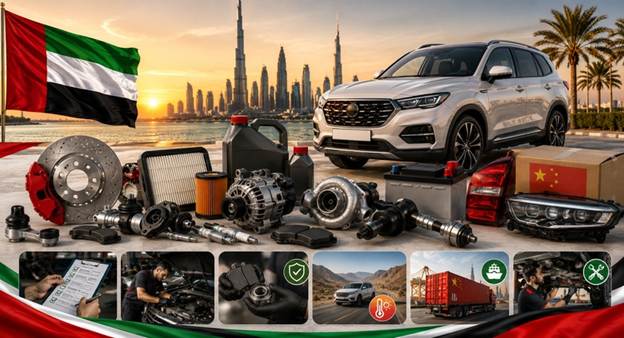
How to Avoid Fake and Low-Quality Chinese Car Parts
Quick Summary
| Risk | Why It Happens | How to Protect Yourself |
| Counterfeit Parts | High demand and low prices attract counterfeiters | Buy from trusted suppliers |
| Poor-Quality Aftermarket Parts | Unknown manufacturers | Choose recognised brands |
| Incorrect Fitment | Compatibility not verified | Always check the VIN and OEM number |
| No Warranty | Unreliable sellers | Ask for written warranty terms |
| Hidden Defects | Poor inspection before sale | Examine the part carefully before installation |
| Financial Loss | Repeat repairs and additional labour | Focus on long-term value, not the lowest price |
Everyone loves a bargain.
That's perfectly normal.
But when it comes to vehicle safety, chasing the cheapest deal can become surprisingly expensive.
Counterfeit automotive parts don't always look counterfeit.
In fact, that's the problem.
Some arrive in convincing packaging.
Others carry copied labels.
A few even display fake serial numbers.
At first glance, everything appears genuine.
Only later do the problems begin.
The brake pad wears out far too quickly.
The water pump starts leaking.
The suspension bush cracks after only a few thousand kilometres.
The buyer saves money once...
Then pays twice.
How Counterfeit Parts Enter the Market
Many people imagine fake parts are easy to identify.
Unfortunately, they aren't.
Counterfeit products enter supply chains in several ways.
Some imitate well-known manufacturers.
Others copy packaging so accurately that only experienced technicians notice the difference.
Occasionally, poor-quality components are simply described using vague terms such as:
- OEM style
- Factory quality
- Premium replacement
- Direct equivalent
Those descriptions sound reassuring.
They don't actually confirm who manufactured the component.
Always ask one simple question.
"Who made this part?"
If nobody can answer confidently, that's already telling you something.
Why Counterfeit Parts Are So Dangerous
A faulty mobile phone charger is annoying.
A faulty steering component is something else entirely.
Certain vehicle parts directly affect safety.
These include:
- Brake systems
- Steering components
- Suspension arms
- Wheel bearings
- Airbags
- Seat belt assemblies
- ABS sensors
- Tyres
Using poor-quality replacements in these areas increases unnecessary risk.
A component doesn't have to fail completely to become dangerous.
Even slightly inferior materials can affect braking distance, steering precision or suspension stability.
That's not a gamble worth taking.
Identifying Genuine Quality Components
You don't need to be a master mechanic to spot warning signs.
Good replacement parts usually demonstrate attention to detail.
Look for:
- Clear manufacturer branding.
- Professional packaging.
- Accurate part numbers.
- Quality casting or machining.
- Proper labelling.
- Written warranty information.
- Installation instructions where appropriate.
Poor-quality products often reveal themselves through:
- Misspelled labels.
- Thin packaging.
- Rough finishes.
- Missing serial numbers.
- Poor-quality printing.
- Damaged seals.
- Missing documentation.
Small details often reveal the biggest problems.
Choosing Trusted UAE Suppliers
Not every supplier is the same.
Some focus purely on volume.
Others build their reputation on long-term customer relationships.
Experienced suppliers usually:
- Verify compatibility using the VIN.
- Explain available options honestly.
- Offer genuine, OEM and premium aftermarket choices.
- Provide written invoices.
- Honour warranty claims.
- Answer technical questions confidently.
Notice something important.
Good suppliers rarely pressure buyers into making immediate decisions.
They're happy to explain the differences.
That's usually a positive sign.
Warranty Red Flags Buyers Should Notice
Ask about the warranty before reaching for your wallet.
Not afterwards.
Be cautious if you hear statements like:
"Don't worry, it'll be fine."
Or...
"We've never had any problems."
Those aren't warranties.
They're opinions.
A reliable supplier should explain:
- Warranty duration.
- What is covered.
- What is excluded.
- Return procedures.
- Installation requirements.
- Conditions that may void the warranty.
If the answers sound vague, keep looking.
Questions Every Buyer Should Ask
Never feel awkward asking questions.
Informed customers make better decisions.
Before buying any replacement part, ask:
- Is this genuine, OEM or aftermarket?
- Who manufactured it?
- Has compatibility been checked using the VIN?
- What warranty is included?
- Is this suitable for my production year?
- Has the part been inspected before dispatch?
- Are there better alternatives available?
A trustworthy supplier welcomes those questions.
An unreliable one may try to avoid them.
That difference speaks volumes.
Warning Signs of Poor-Quality Replacement Parts
Sometimes the warning signs appear before installation.
Sometimes afterwards.
Stay alert if you notice:
- Unusually low prices compared with other quotations.
- Packaging that looks poorly printed.
- Missing labels.
- No manufacturer information.
- Poor welding or casting.
- Uneven paint finishes.
- Loose connectors.
- Missing fixing hardware.
- Incorrect dimensions.
- Unclear warranty conditions.
One warning sign might not prove anything.
Several together should raise concern.
Why Cheap Parts Can Become Expensive
Let's imagine two suspension arms.
One costs significantly less.
The other comes from a recognised manufacturer.
The cheaper option initially looks attractive.
Six months later...
The bush begins cracking.
Tyre wear increases.
Wheel alignment drifts.
Another workshop visit becomes necessary.
More labour.
Another alignment.
Another replacement.
The original saving disappears completely.
Quality isn't always about lasting forever.
It's about avoiding unnecessary repeat repairs.
Workshop Story
A customer brought an MG SUV into a workshop in Abu Dhabi after purchasing brake pads from an unfamiliar online seller.
The packaging looked impressive.
Installation went smoothly.
Within weeks, the owner complained of excessive brake noise and vibration.
The technician removed the pads and immediately noticed inconsistent friction material across the surface.
A premium OEM replacement solved the problem straight away.
The customer asked quietly,
"How could two brake pads look so similar but behave so differently?"
The technician smiled.
"Appearance is easy to copy. Engineering isn't."
That sentence stayed with the customer long after the repair.
Genuine vs Poor-Quality Parts Comparison
| Feature | Genuine or Premium OEM | Poor-Quality Replacement |
| Manufacturing Standards | High | Uncertain |
| Material Quality | Consistent | Varies |
| Fitment Accuracy | Excellent | May differ |
| Durability | Predictable | Often inconsistent |
| Warranty | Usually Available | Limited or none |
| Long-Term Value | Excellent | High risk of repeat repairs |
Buyer Decision Matrix
| Situation | Recommended Choice |
| Brake or steering repair | Genuine or OEM only |
| Electronic control module | Genuine or verified OEM |
| Routine service items | Genuine, OEM or trusted premium aftermarket |
| Body panel replacement | Genuine or quality used part after inspection |
| Unknown online seller with unusually low prices | Avoid until fully verified |
| Supplier unwilling to provide warranty | Choose another supplier |
Suggested Visual Callout
Counterfeit vs Genuine Comparison
Create a split illustration.
On one side, display a professionally packaged genuine replacement part with clear branding, serial numbers and warranty documentation.
On the other, show a suspicious-looking package with faded printing, missing labels and visible quality defects.
Use simple checkmark and warning icons to highlight the differences without overcrowding the graphic.
Smart Buyer's Checklist
Before purchasing any Chinese car part:
- Confirm the manufacturer's name.
- Verify the VIN.
- Check the OEM part number.
- Compare more than one quotation.
- Read the warranty carefully.
- Inspect the packaging.
- Examine the build quality.
- Buy only from suppliers with a strong reputation.
- Keep your invoice for future warranty claims.
Those small steps take only a few minutes.
They could save you hundreds—or even thousands—in avoidable repair costs.
Key Takeaways
Counterfeit and low-quality replacement parts remain a genuine concern in every automotive market, not just for Chinese vehicles. The good news is that most problems can be avoided by choosing reputable suppliers, verifying compatibility and refusing to base your decision on price alone.
The best replacement part isn't always the most expensive, nor is it the cheapest. It's the one that fits correctly, performs reliably and comes with the confidence of proper quality control and warranty support.
In the final part of this guide, we'll explore long-term ownership costs, practical maintenance strategies, expert buying advice, real buyer questions, frequently asked questions and a complete checklist to help you own a Chinese vehicle in the UAE with confidence.
Long-Term Ownership and Maintenance Costs of Chinese Cars in the UAE
Quick Summary
| Ownership Factor | Long-Term Impact | Smart Strategy |
| Routine Servicing | Extends component lifespan | Never skip scheduled maintenance |
| Genuine or Quality Parts | Reduces repeat repairs | Focus on long-term value |
| Preventative Maintenance | Prevents expensive breakdowns | Fix small problems early |
| Workshop Selection | Improves repair quality | Choose experienced technicians |
| Service Records | Protect resale value | Keep every invoice |
| Planned Repairs | Lower overall ownership costs | Budget ahead instead of reacting |
Buying a vehicle is only the beginning.
Owning it?
That's where the real financial story begins.
Some owners drive for years with remarkably few surprises.
Others seem to visit workshops every few months.
What's the difference?
In many cases, it isn't luck.
It's maintenance.
And good maintenance is rarely about spending more money.
It's about spending it at the right time.
Preventative Maintenance Is Always Cheaper Than Emergency Repairs
Let's picture two drivers.
The first notices a slight coolant leak.
He books the car into a workshop the following week.
The hose is replaced.
The repair is straightforward.
The second driver ignores the same leak.
"It'll probably be fine."
Three weeks later, the engine overheats on Sheikh Zayed Road during afternoon traffic.
The recovery truck arrives.
The repair bill grows.
The inconvenience multiplies.
The original hose wasn't expensive.
Ignoring it was.
That's the real purpose of preventative maintenance.
Stop small problems before they become major failures.
How Regular Servicing Reduces Repair Costs
Every manufacturer provides a maintenance schedule for a reason.
Engine oil isn't changed simply because the calendar says so.
Transmission fluid doesn't last forever.
Brake fluid absorbs moisture.
Coolant gradually loses its protective properties.
Skipping those services may not cause immediate damage.
But wear quietly accelerates.
Routine servicing normally includes:
- Engine oil and filter changes.
- Air filter replacement.
- Cabin filter replacement.
- Brake inspections.
- Suspension checks.
- Coolant inspection.
- Battery testing.
- Tyre rotation.
- Fluid level checks.
- Diagnostic scanning.
None of these tasks feels dramatic.
Together, however, they can prevent some remarkably expensive repairs.
Protecting Your Vehicle's Resale Value
Many buyers think only about today's repair costs.
Future buyers think differently.
When someone inspects a used vehicle, they usually ask:
"Has it been looked after?"
A complete service history answers that question before the conversation even begins.
Well-maintained Chinese vehicles are becoming increasingly attractive in the UAE because confidence in these brands continues to grow.
Keep records of:
- Scheduled services.
- Replacement parts.
- Diagnostic reports.
- Warranty work.
- Major repairs.
- Accident repairs.
- Routine inspections.
Those documents tell the next owner a reassuring story.
A vehicle with a documented history often sells more easily than one with missing records—even if both appear identical.
Planning Future Parts Replacements
Vehicles don't suddenly decide to need repairs.
Most components wear gradually.
That gives owners an advantage.
Planning ahead allows you to:
- Compare suppliers.
- Schedule workshop visits.
- Avoid emergency purchases.
- Budget more effectively.
- Reduce vehicle downtime.
Suppose your brake pads are approaching the end of their service life.
Ordering replacements before they're completely worn gives you time to compare quality, warranty and price rather than accepting the first available option.
Planning almost always leads to better decisions.
If you're comparing replacement parts across the UAE, platforms such as PartFinder UAE make that process considerably easier by allowing buyers to compare multiple supplier quotations, evaluate stock availability and review different replacement options before making a final purchasing decision.
Choosing the Right Workshop
Not every workshop specialises in the same vehicles.
Chinese manufacturers continue introducing new technologies, hybrid systems and advanced electronics.
Experience matters.
Look for workshops that:
- Understand Chinese vehicle platforms.
- Use professional diagnostic equipment.
- Verify parts using the VIN.
- Explain repairs clearly.
- Offer written quotations.
- Provide warranty support.
- Recommend appropriate genuine or OEM alternatives where suitable.
A good technician repairs the fault.
An excellent technician explains why it happened in the first place.
That's a valuable difference.
Driving Habits Influence Ownership Costs
Here's something often overlooked.
Drivers have a surprisingly large influence on future repair bills.
Aggressive acceleration.
Harsh braking.
Ignoring warning lights.
Driving with low tyre pressures.
Overloading the vehicle.
Each habit increases mechanical stress.
On the other hand:
Smooth acceleration.
Regular servicing.
Gentle braking.
Routine inspections.
Timely repairs.
These simple habits help many components last significantly longer.
Sometimes the cheapest maintenance strategy sits behind the steering wheel.
Climate Matters More Than Many Buyers Realise
The UAE presents unique challenges for every vehicle.
Long summers.
High ambient temperatures.
Heavy traffic.
Occasional sand and dust.
Frequent air-conditioning use.
Those conditions place additional pressure on:
- Cooling systems.
- Batteries.
- Tyres.
- Air-conditioning components.
- Rubber hoses.
- Suspension bushes.
Routine inspections become even more important because the environment itself accelerates wear.
Ignoring seasonal maintenance is rarely a wise decision.
Workshop Story
A fleet manager in Abu Dhabi operated several Chinese SUVs for daily business travel.
One year, he introduced a simple policy.
Every vehicle received inspections slightly earlier than the manufacturer's maximum service interval.
Nothing else changed.
Within twelve months, unexpected breakdowns reduced noticeably.
Emergency recovery costs dropped.
Vehicle downtime became far less common.
The maintenance budget actually became more predictable.
The manager laughed when someone asked whether he'd discovered a secret.
"No secret," he replied.
"We simply stopped waiting for things to fail."
Sometimes the simplest ideas produce the biggest results.
Long-Term Ownership Comparison
| Ownership Approach | Likely Outcome |
| Regular servicing with quality parts | Lower repair costs and stronger reliability |
| Delaying maintenance | Higher long-term expenses |
| Ignoring warning lights | Increased risk of major failures |
| Keeping detailed service records | Better resale value |
| Using experienced workshops | More accurate repairs |
| Buying parts purely on price | Greater chance of repeat repairs |
Buyer Decision Matrix
| Your Situation | Recommended Strategy |
| New Chinese vehicle | Follow the manufacturer's service schedule from day one |
| High-mileage vehicle | Increase inspection frequency |
| Family vehicle | Prioritise safety-related maintenance |
| Business or fleet vehicle | Schedule preventative servicing to minimise downtime |
| Preparing to sell | Complete overdue maintenance and organise service records |
| Planning long-term ownership | Invest in quality parts instead of repeated low-cost replacements |
Suggested Visual Callout
The Cost of Ownership Timeline
Create a horizontal timeline covering five years of ownership.
Mark key maintenance milestones with icons for:
- Oil service
- Brake inspection
- Cooling system check
- Suspension inspection
- Battery replacement
- Transmission service
- Tyre replacement
At the end of the timeline, illustrate the benefits of consistent maintenance with icons representing reliability, resale value and lower repair costs.
Smart Owner's Checklist
To keep long-term ownership costs under control:
- Follow the recommended service schedule.
- Don't ignore unusual noises or warning lights.
- Replace worn parts before they fail completely.
- Keep every maintenance invoice.
- Use quality replacement components.
- Have repairs carried out by experienced workshops.
- Check fluid levels regularly.
- Inspect tyres and brakes routinely.
- Plan future maintenance instead of reacting to breakdowns.
Those habits aren't complicated.
They simply require consistency.
Consistency is often the difference between enjoyable ownership and costly frustration.
Key Takeaways
Owning a Chinese vehicle in the UAE doesn't have to involve unpredictable repair bills. Like any modern car, long-term reliability depends far more on maintenance habits than on the badge fitted to the bonnet.
Regular servicing, quality replacement parts, early diagnosis of small faults and experienced workshop support all contribute to lower ownership costs, improved reliability and stronger resale value.
The owners who enjoy the lowest overall running costs usually aren't the ones who spend the least. They're the ones who make informed decisions, plan ahead and treat maintenance as an investment rather than an inconvenience.
In the final part of this guide, we'll bring everything together with a complete buying checklist, real workshop case study, frequently asked questions, real buyer questions, key takeaways and expert advice to help you buy Chinese car parts in UAE with complete confidence.
Complete Buying Guide, Real Buyer Questions, FAQs and Expert Advice
Quick Summary
| Final Buying Principle | Why It Matters |
| Verify the VIN before ordering | Prevents compatibility mistakes |
| Compare more than one supplier | Improves value and availability |
| Understand the difference between Genuine, OEM and Aftermarket | Helps you buy confidently |
| Don't focus only on price | Long-term value is far more important |
| Choose experienced workshops | Better diagnosis and installation |
| Keep maintenance records | Protects reliability and resale value |
If you've reached this point, you've probably realised something.
Finding Chinese car parts in the UAE isn't the challenge many people think it is.
Finding the right part...
Now that's the real challenge.
Over the past few years, Chinese manufacturers have transformed the UAE automotive market. As more vehicles have reached the roads, suppliers, workshops and distributors have expanded alongside them.
Today, buyers enjoy more choice than ever before.
But more choice also means more decisions.
Let's bring everything together.
Chinese Car Parts Buying Checklist
Before buying any replacement part, work through this checklist.
✔ Confirm your VIN.
✔ Verify the OEM part number.
✔ Check the production year.
✔ Confirm engine and gearbox specifications.
✔ Identify whether the vehicle is GCC or imported.
✔ Compare at least two or three quotations.
✔ Understand whether you're buying Genuine, OEM, Aftermarket, Used or Reconditioned.
✔ Ask about warranty coverage.
✔ Confirm realistic delivery times.
✔ Make sure your workshop agrees with the selected replacement.
Skipping even one of these steps can create unnecessary delays.
Spending five extra minutes checking the details often saves several days later.
Real Workshop Case Study
A family from Abu Dhabi owned a three-year-old Geely SUV.
Following a minor collision, they needed:
- Front bumper
- Headlamp
- Parking sensor
- Radiator support
Their first quotation was considerably higher than expected.
Instead of approving it immediately, they decided to compare suppliers.
The workshop verified every component using the VIN.
Several suppliers confirmed availability.
The family selected a combination of genuine and OEM components where appropriate.
The repair finished sooner than expected.
The final invoice remained well below their original estimate.
More importantly...
Everything fitted perfectly.
The workshop manager smiled before handing back the keys.
"The cheapest quote rarely wins. The most accurate one usually does."
That single sentence summarises years of workshop experience.
The Biggest Mistakes Buyers Continue to Make
Despite improved availability, several mistakes still appear again and again.
They include:
- Buying based only on photographs.
- Ignoring VIN verification.
- Choosing the cheapest quotation immediately.
- Assuming every model year uses identical parts.
- Forgetting about labour and programming costs.
- Ignoring warranty conditions.
- Buying from unknown sellers without checking reputation.
- Delaying repairs after warning signs appear.
Notice something?
Most of these mistakes happen before the repair even begins.
That's encouraging.
It means they're largely preventable.
Expert Tips for Buying Chinese Car Parts
Experienced technicians tend to follow a very similar routine.
You should too.
Always:
- Verify compatibility first.
- Compare suppliers carefully.
- Keep every invoice.
- Ask questions if something seems unclear.
- Replace supporting components when recommended.
- Budget for the complete repair rather than only the replacement part.
- Follow scheduled servicing after the repair.
Simple habits.
Big difference.
Real Buyer Questions
"Are Chinese car parts difficult to find in the UAE?"
Not for most popular brands.
Models from manufacturers such as MG, Geely, Chery, Haval, Jetour and BYD now benefit from much stronger supplier networks than they did a few years ago. Routine maintenance parts are generally easy to source, while specialist electronic or newly introduced components may require additional lead time.
"Should I always buy genuine parts?"
Not necessarily.
Genuine parts offer excellent reliability, but high-quality OEM components often provide virtually identical fitment and performance at a lower cost. The right choice depends on the repair, the vehicle and your long-term ownership plans.
"Are aftermarket parts safe?"
They can be.
Quality varies significantly, so it's important to choose recognised manufacturers and reputable suppliers. Safety-critical systems such as braking and steering deserve particular care.
"Can I buy Chinese car parts online?"
Absolutely.
Online suppliers offer convenience and wider product choice, but compatibility should always be confirmed using the VIN before placing an order.
"How can I avoid buying the wrong part?"
Never rely solely on photographs or model names.
Always verify:
- VIN
- OEM part number
- Engine specification
- Gearbox type
- Production year
Those checks dramatically reduce the likelihood of ordering errors.
Final Decision Matrix
| If Your Priority Is... | Best Approach |
| Maximum reliability | Genuine parts from trusted suppliers |
| Best overall value | Quality OEM components |
| Lower repair costs | Compare multiple quotations and plan repairs early |
| Fastest repair | Choose suppliers with confirmed local stock |
| Long-term ownership | Preventative maintenance and scheduled servicing |
| Protecting resale value | Maintain complete service records and use quality parts |
Suggested Visual Callout
"The Smart Buyer's Journey"
Design a simple roadmap beginning with:
Vehicle Inspection → VIN Verification → Compare Suppliers → Select the Correct Part → Professional Installation → Warranty Protection → Regular Maintenance → Reliable Long-Term Ownership
Each stage should include a clean icon and minimal text, making the buying process easy to understand at a glance.
Final Buyer's Checklist
Before completing any purchase, ask yourself:
- Have I confirmed the exact part?
- Have I compared multiple suppliers?
- Do I understand the difference between Genuine, OEM and Aftermarket?
- Has my workshop approved the replacement?
- Is the warranty clear?
- Do I know the total repair cost, including labour?
- Am I solving the root cause of the problem rather than only the symptom?
- Have I planned future maintenance?
If every answer is yes, you're already making smarter decisions than many vehicle owners.
Final Key Takeaways
Chinese cars have become an established part of the UAE automotive landscape, and the spare parts market has matured alongside them. Genuine, OEM, aftermarket, used and reconditioned options are now widely available for many popular models, giving buyers far greater flexibility than ever before.
The most successful vehicle owners aren't those who simply spend the least. They're the ones who verify compatibility, compare suppliers, understand the differences between replacement options and choose experienced workshops that prioritise quality over shortcuts.
Buying the right part isn't just about repairing today's problem. It's about reducing future costs, protecting reliability and keeping your vehicle safe and dependable for years to come.
Approach every purchase with a little research, ask the right questions and never rush the decision. Do that consistently, and you'll discover that owning and maintaining a Chinese vehicle in the UAE can be both practical and cost-effective.
Frequently Asked Questions
Categories
- Audi
- BMW
- Car Accessories
- Car Tips
- Ford
- Land Rover
- Mazda
- Range Rover
- Top 10
- UAE Car Parts
- Used Car Parts
- Toyota
- Replacement Engines
- Nissan
- Hyundai
- Mitsubishi
- Volkswagen
- Honda
- Kia
- Chevrolet
- Dodge
- Jeep
- Subaru
- Renault
- Lexus
- Mercedes
- Suzuki
- Hummer
- Porsche
- Infiniti
- Peugeot
- GMC
- Mini
- Volvo
- Replacement Gearboxes
- MG
- Jaguar
- Skoda
- Cadillac
- Daihatsu
- Fiat
- German Car Parts
- Japanese Car Parts
- Aftermarket Car Parts
- Genuine Car Parts
- New Car Parts
- Reconditioned Car Parts
- European Car Parts
- American Car Parts
- Korean Car Parts
- British Car Parts
- Chinese Car Parts
- Sports/Exotic Car Parts
- Luxury Car Parts
- Performance Car Parts
- SUV/4x4 Spare Parts
- Truck Spare Parts
- EV Car Parts
- Hybrid Car Parts
- Auto Spare Parts in UAE
- Tesla
- Isuzu
- Ram
- Ferrari
- Bentley
- Lamborghini
- Genesis
- Maserati
- Lincoln
- Chrysler
- Opel
- Citroen
- SsangYong
- Seat
- McLaren
- Aston Martin
- Rolls Royce
- Maybach
- Alfa Romeo
- Bugatti
- Scion
- Abu Dhabi Car Parts
- Ajman Car Parts
- Al Khan Car Parts
- Al Sajaa Car Parts
- Deira Car Parts
- Dubai Car Parts
- Fujairah Car Parts
- Industrial Area 6 Car Parts
- Mussafah Car Parts
- Ras Al Khaimah Car Parts
- Sharjah Car Parts
- Umm Al Quwain Car Parts
- Acura
- BYD
- Chery
- Dacia
- DS
- Geely Emgrand
- EXEED
- GAC
- GAC Gonow
- Geely
- Gonow
- Great Wall
- Haima
- Haval
- Holden
- Iveco
- JAC
- Jaecoo
- Jetour
- Lotus
- Omoda
- Proton
- Renault Samsung
- Roewe
- Lucid