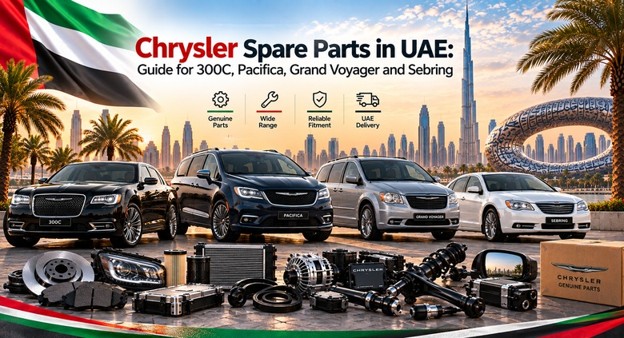
Chrysler Spare Parts in UAE: Guide for 300C, Pacifica, Grand Voyager and Sebring
September 18, 2026
A Chrysler spare parts in UAE search can go wrong surprisingly quickly. “Chrysler 300C brake pad” sounds precise until the seller asks for the year, engine, brake package, drivetrain and, eventually, the VIN. That is not bureaucracy for its own sake. The 300C changed engines, platforms and brake specifications across its life, while the Pacifica is a much newer vehicle with its own generation-specific electronics, sliding-door hardware and family-focused systems.
The same problem becomes even sharper with the Grand Voyager and Sebring. Both are older models, so age, donor history and discontinued-part availability now matter almost as much as the original specification.
For UAE owners, the sensible approach is therefore not simply finding the cheapest Chrysler spare part. It is finding the correct part for the exact vehicle, in a condition that makes financial sense once fitting, programming, fluids, delivery and workshop labour are included.
Understanding the Chrysler Range
Chrysler models do not share one parts catalogue
The four models in this guide occupy very different mechanical territory.
The 300C is a large rear-wheel-drive-based sedan, with later versions using the 3.6-litre Pentastar V6 or HEMI V8 engines and an eight-speed automatic. The final 2023 300C used a 6.4-litre HEMI V8 producing an estimated 485 hp, but that should not be used as the specification for every 300C found in the UAE.
The Pacifica is a modern minivan, launched for the 2017 model year after entering production in 2016. The current 2026 version uses a 3.6-litre Pentastar V6, with available AWD and seating for up to eight depending on configuration.
The Grand Voyager belongs to an older minivan family. A European-market specification, for example, offered a 2.8 CRD diesel producing 163 PS and 360 Nm alongside petrol versions, illustrating why simply searching “Grand Voyager engine parts” is not enough.
Sebring is older again. The model ran through three generations from 1995 to 2010 before being replaced by the Chrysler 200 for the 2011 model year.
The four cars have very different ownership patterns
The 300C tends to attract buyers who care about drivetrain, suspension, brakes, cooling and electrical equipment.
The Pacifica is more complicated in a different way. Sliding doors, family-use interiors, rear climate systems, infotainment, cameras, sensors and Stow 'n Go seating add plenty of parts that a conventional sedan simply does not have.
Grand Voyager buyers are usually dealing with an ageing vehicle. Here, rubber components, cooling parts, suspension, electrical connectors and previous repair quality can become more important than the original factory specification.
Sebring brings another issue: age. A replacement part may technically exist in a catalogue but still be awkward to source locally, making used and aftermarket options more relevant.
Current and discontinued models need different buying strategies
The Pacifica remains an active Chrysler model in 2026, and official parts catalogues continue to list model years through 2027.
The 300 has been discontinued, while the final production run ended with the 2023 model year.
That difference matters.
For a newer Pacifica, the buyer can often justify genuine or OEM replacement parts for safety-critical or electronically integrated systems.
For an older Sebring or Grand Voyager, a good used original part can sometimes make more financial sense, particularly for body panels, trim or hard-to-find interior pieces.
The word “old” does not automatically mean “buy used”. Nor does “new” automatically mean “better”.
Chrysler 300C fitment changes with engine and generation
The 300C is one of the easiest Chrysler models to buy incorrectly.
Earlier LX-platform cars and later LD-platform cars should not be treated as one interchangeable catalogue. Current UAE parts-market information specifically distinguishes first-generation LX and second-generation LD applications, with different part requirements across engines and brake configurations.
Even within a later 300, the 3.6-litre V6 and 5.7-litre HEMI do not share every engine-related part.
Brakes can diverge too, particularly where performance packages are involved. A part that visually resembles the old one may have the wrong dimensions, mounting arrangement or friction specification.
Pacifica fitment is more than the engine
The Pacifica's 3.6-litre Pentastar is only one part of the fitment equation.
The 2026 model is offered in FWD and AWD configurations, and equipment varies by trim. The official specification also shows different wheel and equipment combinations across Select, Limited and Pinnacle versions.
That means a buyer should not assume that a suspension, wheel, electronic or body-related part fits every Pacifica simply because the engine is identical.
Trim, model year and option package can matter.
Grand Voyager and Sebring require historical fitment checks
This is where the VIN earns its keep.
A Grand Voyager from the later fifth-generation era may have a different engine, transmission or equipment package from another vehicle wearing the same badge. The documented 2.8 CRD version, for instance, used a 2,768 cc turbo-diesel and six-speed automatic.
Sebring is even more fragmented. Parts catalogues continue to separate the FJ, JR and JS generations, with different body styles and engine combinations across the years.
So when an older Chrysler owner says, “I need a Sebring radiator”, the useful response is not a price.
It is: Which year, which engine and which body style?
VIN and Fitment Before Buying
Start with the 17-digit VIN
The VIN is the quickest way to stop a parts search drifting into guesswork.
Give the seller the full 17-digit VIN, not just “2014 Chrysler 300C”. Where possible, also provide the old part number and a photograph of the installed part.
That combination is particularly useful when the vehicle has been imported into the UAE and its specification differs from the common local configuration.
Model year is not registration year
A car registered in Dubai in 2019 is not necessarily a 2019 model.
It could have been manufactured earlier and registered later. This matters with discontinued Chrysler models because a one-year difference can correspond with an engine, transmission, electrical or body revision.
Use the manufacturing/model-year information associated with the VIN rather than relying only on the registration card's first-registration date.
Engine code can save an expensive mistake
A 300C equipped with a HEMI is not a 3.6 Pentastar car simply because both are called 300C.
Likewise, Grand Voyager petrol and diesel applications require different engine-related parts, fluids and diagnostic approaches.
For Sebring, the catalogue evidence itself shows combinations including 2.4L four-cylinder, 2.7L V6 and 3.5L V6 applications across different years.
Engine identification should therefore happen before ordering filters, cooling parts, ignition parts, sensors or engine assemblies.
Check the old part number
The number printed, stamped or moulded onto the old part can be extremely useful.
But it should not automatically be treated as the final ordering number.
Manufacturers supersede numbers. Suppliers revise packaging. A replacement number can legitimately replace the number on the original part.
The correct process is to have the old number cross-checked against the VIN and the current catalogue number.
Superseded numbers need documentation
Suppose the number on your old Pacifica module no longer appears in the catalogue.
That does not necessarily mean the part is unavailable.
It may have been superseded by a newer number. Ask for confirmation that the new number is an official replacement rather than accepting a seller's statement that the two parts “look the same”.
This becomes particularly important with electronics, where physical similarity tells you very little about software compatibility.
Imported Chrysler vehicles need extra scrutiny
The UAE has a substantial grey-import and used-import market.
A US-specification Pacifica, for example, may differ in equipment from another market's vehicle. The same applies to 300C cars brought in from North America.
Check:
- VIN
- production year
- engine
- drivetrain
- body style
- trim
- brake package
- electrical specification
- existing part number
- software/module compatibility
That list looks tedious until the wrong electronic module has already been fitted.
Common Chrysler Parts in the UAE
Brakes are a specification issue
Brake pads and discs are not generic Chrysler parts.
The 300's factory documentation shows multiple brake configurations, while performance packages can introduce different hardware.
For a 300C, confirm rotor diameter, caliper type and pad shape before ordering.
For Pacifica, confirm the model year and axle application.
For Grand Voyager and Sebring, age and previous repairs make physical inspection particularly useful.
Suspension parts deserve a proper inspection
Control arms, bushes, ball joints, stabiliser links, shocks and struts live a hard life on UAE roads.
Heat does not magically destroy every suspension part, but high temperatures, dust, heavy kerb strikes, speed humps and long motorway mileage all contribute to wear.
A workshop should inspect the complete suspension rather than replacing whichever bush happens to look cracked.
Cooling parts are particularly relevant in UAE traffic
Radiators, thermostats, water pumps, hoses, cooling fans and expansion tanks deserve attention on older Chrysler vehicles.
The reason is obvious enough. A cooling system that works adequately on an open motorway can behave very differently during a long Dubai traffic queue in August.
The diagnosis still matters, though.
Replacing a radiator will not fix a failed cooling fan, restricted airflow, faulty thermostat or electrical control problem.
Air-conditioning parts carry their own cost
The AC system is not simply “gas”.
A Chrysler may need diagnosis of the compressor, condenser, evaporator, expansion device, pressure sensors, blower system or electrical controls.
For older cars, replacing a compressor without checking contamination in the system can turn one repair into several.
Electrical parts need compatibility checks
Starters and alternators are relatively straightforward compared with modules.
Body control modules, engine control units, transmission modules, instrument clusters, cameras and advanced sensors may require programming or configuration after installation.
A used module can therefore be cheap at the counter and expensive on the invoice.
Lighting has become more complicated
Headlights, LED assemblies, ballasts, control units and adaptive-lighting equipment can vary by year and trim.
A complete headlamp that fits physically may still require the correct control electronics.
Before buying a used light assembly, check mounting points, lens condition, internal moisture, connectors and module inclusion.
Body parts are where used can make sense
Bonnet, doors, fenders, bumpers, mirrors and some interior trim can be sensible used purchases when the donor is known and the part is structurally sound.
Colour matching remains a separate problem.
A silver bonnet from another Chrysler may fit perfectly and still require repainting because of paint-code variation, fading or previous refinishing.
Interior parts are often harder than mechanical parts
Older Chrysler owners sometimes discover that a mechanical part is easier to source than a clean dashboard trim panel.
Sebring and Grand Voyager interiors have been out of production for years. A good used original trim piece may therefore be preferable to a badly fitting reproduction.
That is one of the situations where originality has practical value rather than merely sentimental value.
Genuine, OEM, Aftermarket and Used
Genuine and OEM are not always being used correctly
“Genuine” normally refers to a part supplied through the vehicle manufacturer's genuine-parts channel.
OEM is often used more loosely in the independent market.
For Chrysler, Mopar is the relevant factory parts brand, and official parts catalogues continue to list genuine applications for models including Pacifica and Sebring.
Do not accept “OEM” as proof of authenticity without checking the actual manufacturer, part number and packaging.
Aftermarket can be perfectly reasonable
There is nothing inherently wrong with aftermarket parts.
For filters, brake pads, belts, bearings and some service items, a reputable aftermarket manufacturer can provide a sensible alternative.
The problem begins when “aftermarket” becomes shorthand for “whatever is cheapest”.
For a critical suspension, cooling or electronic part, brand quality and documented fitment matter.
Used original parts have a different advantage
A used original part has something an unknown new aftermarket part may not: it was already engineered for the vehicle.
That does not make every used part good.
A 150,000-km suspension arm from a crashed vehicle is not automatically a bargain. A clean low-use body module from a verified donor can be much more interesting.
Condition and history determine the value.
Reconditioned parts need a defined process
“Reconditioned” should mean something.
Ask what was actually rebuilt.
A reconditioned gearbox should have a documented scope of work. A rebuilt alternator should have information about bearings, brushes, regulator and testing. A reconditioned steering rack should not merely have been cleaned and painted.
If nobody can explain what was replaced, “reconditioned” is only a label.
Which Chrysler parts are safer to buy used
Used body panels, mirrors, seats, trim pieces, some suspension housings and certain mechanical assemblies can be reasonable candidates after inspection.
But airbags, severely heat-exposed electronics, worn braking surfaces and unknown safety-system components deserve much greater caution.
The cheapest price is irrelevant if the part has to be removed again.
Donor history matters more than donor mileage alone
A donor vehicle that has been sitting outside in extreme heat is not equivalent to one dismantled shortly after a low-speed collision.
Ask:
- What was the donor vehicle?
- What year was it?
- What engine did it have?
- How many kilometres?
- Why was it dismantled?
- Where was it stored?
- Was the part tested?
- Does the seller provide a start-up or diagnostic report where appropriate?
That information turns a used part from a gamble into an informed purchase.
Model-Specific Buying Problems
Chrysler 300C engine parts
The 300C can be found with several engine families depending on generation and market.
The later 300 range included the 3.6L Pentastar V6 and 5.7L HEMI V8, while the final 2023 300C used the 6.4L HEMI V8.
That means even a basic item such as a filter, ignition component, belt, thermostat or engine sensor should be checked against the exact engine.
Do not buy from the badge.
Buy from the specification.
Chrysler 300C transmission parts
The later 300 used an eight-speed automatic, while older generations used different transmission applications.
If a transmission replacement is being considered, the workshop should record the transmission identification, software requirements, fluid specification and donor history.
A gearbox that physically bolts into place is not necessarily the end of the job.
Pacifica engine and drivetrain parts
The current Pacifica uses a 3.6L Pentastar V6 with available AWD.
For a replacement drivetrain part, confirm FWD/AWD before ordering.
Differentials, driveshaft-related parts, hubs and certain suspension components should never be ordered solely from the engine size.
Pacifica sliding-door parts
This is one area where the minivan's design changes the buying equation.
Power sliding-door rollers, motors, cables, latches, sensors and control systems can all produce symptoms that look similar to the owner.
A door that refuses to close is not automatically a failed motor.
The workshop should inspect the mechanical track, rollers, wiring, latch and control system before replacing the expensive part.
Grand Voyager cooling and engine parts
Older Grand Voyager vehicles can present a completely different ownership problem.
The documented 2.8 CRD, for example, uses a turbo-diesel engine with 360 Nm of torque and a six-speed automatic in the referenced specification.
A petrol Grand Voyager and a diesel Grand Voyager should therefore never be treated as interchangeable simply because both carry the same model badge.
Grand Voyager sliding-door and interior parts
Older minivan doors, seats, switches and trim can be surprisingly difficult to replace cheaply with new original parts.
This is where dismantler stock can become useful.
But the buyer should match the door mechanism, wiring connector, trim colour and production revision rather than buying the first visually similar piece.
Sebring engine parts
The Sebring's long production history makes engine identification essential.
The 2006 catalogue alone lists 2.4L four-cylinder and several 2.7L V6 configurations, while later 2008 applications also included a 3.5L V6.
That is an enormous spread for a model that is often treated casually by parts sellers.
Sebring body and interior parts
For an older Sebring, the body and interior can become the harder sourcing problem.
The current genuine-parts catalogue still breaks Sebring down by year, but availability is not the same thing as local UAE stock.
A used original mirror, grille, dashboard trim or switch may therefore be worth sourcing before considering an expensive custom replacement.
UAE Workshop Diagnosis
Do not replace the part that merely shows the symptom
This is one of the most expensive habits in parts buying.
A Pacifica with a cooling warning may need a thermostat, but it may also have a fan, wiring or coolant-flow problem.
A 300C with steering noise may need a control arm, but the workshop should first identify whether the noise is coming from a ball joint, bush, wheel bearing, steering component or another source.
Diagnosis comes before the invoice.
Scan the vehicle before buying electronic parts
A diagnostic code is evidence, not always a shopping list.
A sensor-related code can be caused by wiring, voltage, connector corrosion, a failed control module or an actual sensor.
The workshop should record the code, freeze-frame data where available, live data and relevant electrical tests before ordering an expensive electronic part.
Test charging voltage before replacing modules
Low system voltage can create strange electrical behaviour.
On an older Chrysler, a weak battery, poor ground or failing alternator can create multiple warning lights that send an owner chasing unrelated modules.
Check the battery and charging system first.
It is a boring test.
That is precisely why it saves money.
Cooling-system diagnosis should include pressure and fan operation
A proper cooling investigation should examine coolant level and condition, leaks, pressure retention, thermostat operation, fan activation, radiator airflow and temperature behaviour.
Replacing three cooling parts without identifying the original fault is not a repair strategy.
It is parts roulette.
Suspension diagnosis should identify the source of movement
The workshop should inspect bushes under load, check ball joints, look for play in links and bearings, inspect shock absorbers and consider alignment data.
On a UAE-used vehicle with a history of kerb impacts, visual inspection alone may miss a bent or displaced suspension part.
AC diagnosis should distinguish refrigerant loss from component failure
If refrigerant is low, find the leak.
Do not simply recharge it repeatedly.
Check compressor engagement, pressure readings, condenser condition, evaporator behaviour, electrical controls and blower operation.
For older Chrysler vehicles, a proper leak diagnosis can prevent the familiar cycle of “gas recharge today, no cooling again next month”.
Engine replacement needs compression and leak-down thinking
If a Chrysler engine is being replaced because of poor running, oil consumption or low compression, the replacement engine should not be judged solely by mileage.
Where practical, compression testing can identify major cylinder variation.
Leak-down testing can go further by indicating whether pressure is escaping through valves, rings or the head-gasket area.
For a used engine, these tests are far more useful than a clean exterior.
Gearbox replacement needs more than a fluid check
For an automatic transmission, the workshop should examine diagnostic data, fluid condition, adaptation values where available, fault codes and evidence of mechanical debris.
A used gearbox should have its donor information recorded.
If the replacement requires programming or adaptation, that should be included in the job plan before installation.
UAE Costs and the Real Repair Bill
Part price is not repair price
Imagine a used radiator costs AED 600.
That is not an AED 600 repair.
The final invoice may include coolant, labour, pressure testing, additional hoses, clips, fan diagnosis, disposal and possibly an unrelated fault discovered during the work.
This distinction should be made before authorising the repair.
Current UAE market evidence needs context
A Dubai workshop pricing guide published in late 2025 gives thermostat-housing replacement ranges of AED 1,200–1,800 for Chrysler 200/Sebring, AED 1,500–2,200 for Pacifica/Voyager, and AED 1,800–2,600 for 300C V8 applications. These are workshop-specific replacement ranges rather than universal UAE prices, so they should be treated as a dated reference rather than a quotation.
That distinction matters.
A part can cost AED 300 and still produce a four-figure repair bill once access, labour and supporting work are included.
Labour varies by job complexity
A straightforward brake-pad replacement is one thing.
A Pacifica sliding-door mechanism, 300C electronic module or buried cooling-system part can be another matter entirely.
For a quote, ask the workshop to separate:
| Cost area | What to ask |
| Part | Exact part number and condition |
| Delivery | UAE stock or special order |
| Labour | Fixed job price or hourly |
| Fluids | Included or extra |
| Programming | Required or not |
| Calibration | Included or separate |
| Supporting parts | Seals, clips, hoses, bolts |
| Warranty | Part only or part plus labour |
Hidden costs appear after installation
Common examples include:
- coolant and transmission fluid
- refrigerant
- seals and O-rings
- one-time-use fasteners
- programming
- wheel alignment
- diagnostic time
- cleaning contaminated systems
- additional damaged parts
- return delivery
- repeat labour after an incorrect part
A cheap part with expensive installation can be the wrong bargain.
Repair versus replacement needs a vehicle-level view
For a 2010 Sebring, spending a large amount on a major drivetrain repair deserves a different calculation from repairing a newer Pacifica.
Consider:
Vehicle value + existing condition + expected repair life + upcoming maintenance + availability of parts.
Do not compare the repair bill with the car's purchase price alone.
A low purchase price does not make a structurally sound older Chrysler worthless.
Cost of delay depends on the part
Delaying a worn cabin filter is usually inconvenient.
Delaying a cooling-system problem can be much more serious.
Ignoring a noisy wheel bearing, deteriorating brake part or overheating issue can allow a relatively contained repair to become a larger one.
The sensible question is not “Can I drive another month?”
It is “What happens if the underlying fault gets worse?”
UAE Heat, Driving and Ownership
Air-conditioning gets worked hard
A Chrysler used for daily family transport in Dubai or Abu Dhabi can spend hours in traffic with the AC operating continuously.
That puts practical importance on compressor health, condenser airflow, cabin filtration, blower performance and correct refrigerant charge.
The climate does not change the factory specification.
It changes how hard the system is expected to work.
Highway use changes mileage interpretation
A 160,000-km Pacifica used mostly for long highway journeys may have a different wear pattern from a 100,000-km family van that spent years crawling through urban traffic.
Mileage is evidence.
It is not a verdict.
Look at service records, fluid condition, tyre wear, interior wear, diagnostic history and previous repair documentation alongside the odometer.
Family use can reveal different wear patterns
Pacifica and Grand Voyager owners often use the vehicle as a genuine family workhorse.
That means repeated door cycles, full passenger loads, child-seat use, luggage, folded seating and heavy AC demand.
When inspecting a used minivan, check the parts that are actually being used every day rather than focusing exclusively on the engine.
Desert and rough-road use affects suspension
The UAE's smoother major roads do not eliminate suspension abuse.
Kerbs, rough access roads, construction zones, speed humps and occasional desert driving can produce impact damage.
If a used Chrysler has uneven tyre wear or persistent steering pull, alignment and suspension geometry should be checked before buying expensive replacement parts.
Storage history matters in older cars
An older Sebring or Grand Voyager that spent years parked outside can have brittle plastics, aged seals, oxidised connectors and deteriorated rubber.
A low-mileage car is not automatically the healthier car.
This is especially important when comparing two old vehicles with very different storage histories.
Abu Dhabi and Dubai ownership can still look very different
A vehicle covering long motorway distances may accumulate kilometres quickly but experience fewer brake applications and less stop-start heat.
A car used mainly for dense urban commuting may have lower mileage while accumulating considerable idle time, braking cycles and AC usage.
That is why a mileage-only parts strategy is weak.
Buying and Installation
What to send when requesting a Chrysler part
The most useful request contains:
- VIN
- model
- model year
- engine
- drivetrain where relevant
- exact part required
- old part number
- photograph
- left/right/front/rear position
- GCC or imported status
- whether the car is modified
This dramatically reduces back-and-forth.
Check the part before installation
For a physical part, compare:
- mounting holes
- connector shape
- pipe diameter
- casting or moulding number
- sensor position
- dimensions
- left/right orientation
- included brackets
- seals and fittings
Do this before the old part is discarded.
Electrical parts need special handling
For a module or sensor, record the old part number and connector arrangement.
Ask whether programming is required.
Ask whether the part has been tested.
Ask whether a used module is locked to the donor vehicle.
Do not discover those questions after the dashboard has been dismantled.
Installation quality can decide part life
A new control arm installed with incorrect bushing preload can have a very different service life from one installed correctly.
A cooling system can still overheat if air is trapped after installation.
A transmission can behave badly if the fluid level or adaptation procedure is wrong.
The part and the installation are one repair.
Treating them as separate purchases is how repeat labour begins.
The first 1,000 km matters
After a major Chrysler repair, monitor:
- warning lights
- fluid levels
- coolant temperature
- unusual vibration
- steering pull
- braking behaviour
- transmission shifts
- AC performance
- leaks
- new electrical faults
Return to the workshop early if something changes.
Do not wait until the warranty period is nearly finished.
Keep the paperwork
Keep the invoice, part number, donor details if used, warranty terms, workshop report and diagnostic results.
For a newer Pacifica, this helps establish maintenance history.
For an older 300C, Grand Voyager or Sebring, documentation can become surprisingly valuable when the car is sold.
A future buyer is more likely to trust “gearbox replaced” when there is an invoice showing exactly what gearbox was fitted and when.
Buyer Decisions and Practical Checklist
61. The sensible part depends on the job
| Part type | Genuine/OE | Aftermarket | Used | Reconditioned |
| Brake hardware | Strong option | Good from reputable maker | Usually limited value | Sometimes |
| Body panel | Useful | Often acceptable | Often sensible | Rarely relevant |
| Engine | Strong option | Varies | Can make sense with testing | Useful with documentation |
| Gearbox | Strong option | Limited | Possible with donor history | Good if rebuild is documented |
| Electronic module | Often safest | Compatibility varies | Possible but needs testing | Only with clear rebuild/testing |
| Interior trim | Expensive/limited | Variable | Often practical | Rare |
| Radiator | Strong | Good reputable option | Possible | Rare |
| Suspension arm | Strong | Good reputable option | Possible | Depends on part |
There is no universal winner. The correct choice changes with the part, vehicle age, risk and budget.
The 300C buyer should prioritise specification
Before buying anything, establish:
generation → year → engine → drivetrain → brake package → VIN → part number.
That sequence is particularly important because 300C parts vary substantially across the model's life.
The Pacifica buyer should prioritise electronics and trim
For newer Pacifica models, do not concentrate only on mechanical parts.
Check cameras, sensors, infotainment, power doors, climate controls, seating systems and other trim-dependent equipment.
The current Pacifica's Stow 'n Go seating and available AWD are examples of why configuration matters when identifying parts.
The Grand Voyager buyer should prioritise age and donor condition
With an older Grand Voyager, condition can outweigh catalogue availability.
A clean used original part from a properly documented donor may be more useful than an obscure new replacement with uncertain quality.
But safety-critical parts still deserve greater scrutiny.
The Sebring buyer should prioritise generation
Never order a Sebring part without identifying whether the car belongs to the FJ, JR or JS generation.
The model existed from 1995 through 2010, with significant mechanical and body changes during that period.
That one check prevents a remarkable amount of wasted searching.
The cheapest quote is not necessarily the cheapest repair
Compare the complete job.
If one seller offers a used component at AED 450 and another offers a tested unit at AED 600 with a documented warranty, the difference is AED 150.
One failed installation can consume more than that difference immediately.
Look at risk, not just the first number.
Where UAE owners should look for Chrysler parts
Dubai remains an important hub for American-car parts, with areas such as Ras Al Khor and other industrial districts serving the wider UAE market. Current UAE parts-market listings cover Chrysler 300, 300C, Pacifica, Grand Voyager and Sebring applications and allow buyers to request parts by model, year and condition.
Owners in Abu Dhabi, Sharjah, Ajman, Ras Al Khaimah, Fujairah and Umm Al Quwain should confirm delivery time before authorising a repair, particularly where the part is not local stock.
For a buyer comparing genuine, OEM, used and aftermarket options, PartFinder UAE can be part of that wider UAE sourcing process, but the same VIN-first rule still applies.
Chrysler spare-parts buyer checklist
Before paying, confirm:
- VIN checked
- model year verified
- engine verified
- drivetrain verified
- exact part number checked
- superseded number confirmed
- GCC/imported status considered
- left/right position confirmed
- new/used/reconditioned condition stated
- donor mileage recorded for used parts
- donor history requested
- electrical programming confirmed
- labour included or excluded
- fluids and consumables included or excluded
- warranty written down
- return conditions understood
- installation requirements understood
It is a tedious little checklist.
It is also cheaper than buying the wrong part twice.
Questions worth asking the seller
A useful Chrysler parts seller should be able to answer straightforward questions.
Is this the exact part number for my VIN?
Is the number superseded?
Is this genuine, OEM, aftermarket, used or reconditioned?
If used, what was the donor vehicle and mileage?
Has the part been tested?
Does it require programming?
What does the warranty actually cover?
Does the price include delivery?
If the answer to all of these is vague, keep looking.
Final decision matrix
| Situation | More sensible starting point |
| Newer Pacifica safety part | Genuine/OE or reputable aftermarket |
| Pacifica electronic module | Verified exact-fit genuine/OE or tested used |
| 300C engine-specific part | VIN-confirmed genuine/OE or reputable aftermarket |
| 300C body panel | Good used original or quality replacement |
| Grand Voyager trim | Tested used original |
| Grand Voyager major drivetrain part | Tested used or documented reconditioned |
| Sebring rare interior part | Good used original |
| Sebring routine service part | Reputable aftermarket or genuine |
| Unknown donor gearbox | Avoid until history/testing is established |
| Unknown electronic module | Avoid until compatibility is confirmed |
The old Chrysler buying rule still holds, even if nobody writes it down: the part that looks right is not necessarily the part that fits, and the part that fits is not necessarily the part that makes financial sense.
Key Takeaways
Chrysler spare-parts buying in the UAE becomes much easier once the vehicle is treated as a specific configuration rather than a badge.
The 300C needs particular attention to generation, engine, drivetrain and brake specification. The Pacifica requires more attention to model year, trim, AWD/FWD configuration and electronic equipment. Grand Voyager buyers are dealing with ageing vehicles where donor condition and parts availability can dominate the decision. Sebring buyers need generation and engine identification before almost anything else.
The practical sequence is simple:
VIN first. Part number second. Condition third. Total installed cost fourth.
That order is far more useful than starting with the cheapest listing.
Frequently Asked Questions
Categories
- Audi
- BMW
- Car Accessories
- Car Tips
- Ford
- Land Rover
- Mazda
- Range Rover
- Top 10
- UAE Car Parts
- Used Car Parts
- Toyota
- Replacement Engines
- Nissan
- Hyundai
- Mitsubishi
- Volkswagen
- Honda
- Kia
- Chevrolet
- Dodge
- Jeep
- Subaru
- Renault
- Lexus
- Mercedes
- Suzuki
- Hummer
- Porsche
- Infiniti
- Peugeot
- GMC
- Mini
- Volvo
- Replacement Gearboxes
- MG
- Jaguar
- Skoda
- Cadillac
- Daihatsu
- Fiat
- German Car Parts
- Japanese Car Parts
- Aftermarket Car Parts
- Genuine Car Parts
- New Car Parts
- Reconditioned Car Parts
- European Car Parts
- American Car Parts
- Korean Car Parts
- British Car Parts
- Chinese Car Parts
- Sports/Exotic Car Parts
- Luxury Car Parts
- Performance Car Parts
- SUV/4x4 Spare Parts
- Truck Spare Parts
- EV Car Parts
- Hybrid Car Parts
- Auto Spare Parts in UAE
- Tesla
- Isuzu
- Ram
- Ferrari
- Bentley
- Lamborghini
- Genesis
- Maserati
- Lincoln
- Chrysler