Citroen Spare Parts Prices in UAE: Genuine, Used and Aftermarket Options
September 23, 2026
Citroen spare parts prices in UAE can swing wildly for what appears to be the same component. A radiator might be a few hundred dirhams; a complete engine can run into five figures; a headlamp that looks like a simple plastic-and-glass assembly may contain enough electronics to make the price jump again.
And that is before labour, programming, fluids, seals, delivery or the wrong part entering the equation.
Citroën UAE itself presents several routes for keeping older vehicles running: genuine parts, authorised multi-brand parts, second-hand parts, repairs and refurbished/circular-economy solutions. Its official parts information also states that multi-brand parts are checked by its experts and carry a two-year warranty under the stated programme for cars over three years old.
So the useful question is not “What is the cheapest Citroën part in UAE?”
It is “Which part should I buy, at what quality level, and what will the complete repair actually cost?”
What Citroën spare parts cost in the UAE
Published UAE market references for 2025–2026 show substantial differences between used, aftermarket and new original-equipment options.
| Part | Used reference | Aftermarket new | New original-equipment reference |
| EB2 1.2L engine | AED 2,500–6,000 | — | AED 8,000–14,000 |
| EP6 1.6L engine | AED 3,000–7,500 | — | AED 9,000–16,000 |
| DV6 1.6L HDi | AED 3,500–8,000 | — | AED 9,000–17,000 |
| DW10 2.0L diesel | AED 4,000–9,500 | — | AED 10,000–18,000 |
| Gearbox | AED 2,000–7,000 | AED 3,000–8,500 | AED 8,000–16,000 |
| Cylinder head | AED 700–3,200 | AED 1,200–4,500 | AED 3,000–7,000 |
| Radiator | AED 200–800 | AED 300–1,400 | AED 600–2,500 |
| Turbocharger | AED 900–3,500 | AED 1,200–4,500 | AED 3,000–7,500 |
| EGR valve | AED 350–1,200 | AED 500–1,800 | AED 1,000–3,000 |
These are indicative UAE market references for 2025–2026, not fixed September 2026 retail quotations. Actual pricing depends on model, generation, engine code, transmission, part number, condition, availability and warranty.
Why two Citroën parts can have completely different prices
The badge on the bonnet tells you surprisingly little about the price.
A C3 can have different engines and generations. A C4 can have different powertrains and transmissions. A Berlingo used for commercial work can need a very different drivetrain component from a passenger version.
Then there are electronics, left-hand-drive/right-hand-drive differences, facelift changes and equipment levels.
The part number usually tells the more useful story.
Genuine Citroën parts
Genuine parts are developed for the vehicle and supplied through the manufacturer's parts ecosystem.
Citroën UAE states that its original parts are tested for characteristics including reliability, resistance and endurance, with specific testing depending on the component.
That additional assurance can matter for engine, braking, electronic and safety-related components.
But genuine does not automatically mean economically sensible for every repair.
What genuine parts usually cost more for
The price premium becomes easier to understand with complex components.
A genuine electronic module, headlamp, turbocharger or complete transmission carries more engineering, testing, distribution and specification considerations than a simple rubber hose or filter.
For older Citroëns, the calculation changes again. Paying full new-part pricing for a ten-year-old vehicle may not make financial sense when a properly verified used or approved alternative exists.
Aftermarket parts can be a sensible middle ground
Aftermarket does not mean one quality level.
There are reputable manufacturers producing replacement components to established specifications, and there are also very cheap parts where the main selling point is simply the price.
That distinction matters.
Citroën UAE's Advantage plans explicitly use authorised parts from different brands that have been validated by Citroën engineers for vehicles over three years old.
Do not treat every aftermarket part as equivalent
Two brake discs can look identical in a photograph and still differ in metallurgy, machining, coating, dimensions or quality control.
The same applies to radiators, sensors, suspension arms, ignition components and electrical parts.
Ask who manufactured the component, what specification it meets and whether there is a warranty.
Used Citroën parts can reduce the bill dramatically
Used parts are particularly relevant for older Citroëns.
A used engine or gearbox can cost several thousand dirhams rather than the much higher amount associated with a new original component. Published UAE references place used Citroën engines from around AED 2,500 for some EB2 applications, with larger diesel and petrol engines reaching considerably higher figures.
But the saving only works if the component is actually suitable.
Citroën itself recognises used parts
This is worth noting because “used part” is sometimes treated as automatically inferior.
Citroën's UAE information says its workshops may offer estimates based on used parts selected from Citroën partners and describes those components as being certified in excellent condition for reuse.
That is very different from buying an unidentified component with no testing or history.
Reconditioned parts sit between used and new
A reconditioned component should have undergone some defined restoration process.
That might involve replacing worn internal parts, cleaning, inspection and testing.
The important word is defined.
If a seller says “reconditioned” but cannot explain what was replaced or tested, ask more questions before paying.
Remanufactured is not simply another word for used
A properly remanufactured component is rebuilt to a specified process rather than simply removed from another vehicle and resold.
For major mechanical parts, that distinction can be significant.
Ask for the work scope, test procedure and warranty rather than relying on the label.
C3 spare-parts prices depend heavily on generation
The Citroën C3 has existed across multiple generations, so “C3 parts” is too broad for a reliable quotation.
Published UAE references list used EB2 1.2-litre engines around AED 2,500–6,000, while older C3 applications can involve different engine families altogether.
Give the year, engine code and VIN when requesting a price.
C4 prices can vary even more
The C4 has moved through several generations and powertrain combinations.
Published UAE references put used EP6 1.6-litre engines around AED 3,000–7,500 and used DV6 diesel engines around AED 3,500–8,000, with used automatic gearboxes around AED 2,200–6,500 for listed applications.
Those figures are references, not universal prices for every C4.
C5 and C5 Aircross parts
The C5 family covers very different vehicles and generations.
A used DW10 2.0-litre diesel engine can sit in a substantially different price bracket from an EP6 petrol unit, while a modern C5 Aircross electronic component can carry a very different replacement cost again.
Never buy by the “C5” name alone.
Berlingo parts need commercial-use thinking
Berlingo is often used for work, which changes the condition question.
A gearbox, clutch, suspension component or cooling system part from a heavily loaded commercial vehicle may have experienced a harder life than the same-looking component from a lightly used passenger vehicle.
Donor mileage matters.
So does how the vehicle was used.
DS parts require separate fitment attention
DS became a distinct current marque, and its parts catalogues and technical documentation use VIN and vehicle-specific information for identifying the correct technical material.
That matters when a seller says a Citroën-family component “should fit” a DS model.
Verify the exact application rather than relying on shared platform assumptions.
VIN is the first price-checking tool
Before comparing prices, confirm the vehicle.
A VIN can help establish the precise vehicle configuration, while the part number identifies the component itself.
Without those two pieces of information, you may be comparing prices for different parts without realising it.
Part number is more important than the photograph
A photograph can show shape.
It cannot reliably show software compatibility, internal specification or supersession history.
Ask for the manufacturer's part number and check whether it has been superseded by another number.
This is especially important for ECUs, body modules, headlights, sensors and transmission components.
Engine code changes the price
An EB2, EP6, DV6 and DW10 are not interchangeable simply because they belong to the same manufacturer family.
Engine code affects the component specification, availability and price.
If you are asking for an engine, turbocharger, injector, cylinder head or engine-control component, include the engine code in the enquiry.
Gearbox prices need transmission identification
“Automatic gearbox for Citroën C4” is not enough.
The transmission type, engine combination, generation and sometimes software/calibration information can all matter.
A cheaper gearbox with the wrong specification is not a bargain.
It is a very heavy box taking up workshop space while you try to work out what went wrong.
Genuine versus used: where the price gap gets serious
For major components, the gap can be substantial.
A published UAE reference places used EB2 engines at AED 2,500–6,000 against a new original-equipment reference of AED 8,000–14,000. For DW10 engines, the published used range is AED 4,000–9,500 against AED 10,000–18,000 for the new original-equipment reference.
That is where used sourcing becomes commercially interesting.
But inspection becomes equally important.
Aftermarket versus genuine radiator pricing
A published UAE reference puts radiators at approximately AED 200–800 used, AED 300–1,400 aftermarket new and AED 600–2,500 for the new original-equipment reference.
For a radiator, physical condition and construction quality matter.
Check the core, tanks, mounting points and leakage risk rather than selecting purely by price.
Turbocharger pricing is another three-way comparison
Turbochargers are more complicated.
Published UAE references place used turbochargers around AED 900–3,500, aftermarket new around AED 1,200–4,500 and new original-equipment examples around AED 3,000–7,500.
The cheapest turbo can become the most expensive option if the original failure cause remains unresolved.
EGR valve prices
EGR valves appear relatively inexpensive compared with engines and gearboxes.
Published UAE references put used EGR valves around AED 350–1,200, aftermarket new around AED 500–1,800 and new original-equipment examples around AED 1,000–3,000.
But carbon contamination, wiring faults and vacuum/control problems can sometimes imitate an EGR failure.
Diagnose before replacing.
Cylinder heads need condition evidence
A cylinder head is not simply a lump of aluminium that either fits or does not.
Ask about pressure testing, warpage, cracks, valve condition and machining history where relevant.
A cheap used cylinder head that needs extensive machine work may quickly lose its price advantage.
Sensors can be deceptively expensive
A small sensor can create a surprisingly large diagnostic bill because the labour is often disproportionate to the component itself.
Before buying a replacement, verify the fault code, live data and wiring.
A sensor code does not automatically prove that the sensor itself has failed.
Electronic modules can require programming
A used module may physically connect to the car but still require configuration, coding or pairing.
Ask the workshop before buying:
Will this module need programming?
Can it be configured to my VIN?
Is the programming included in the repair quote?
That conversation can save a second workshop visit.
Headlamp prices vary with technology
A basic lamp and a sophisticated LED assembly are very different products.
Current UAE listings show examples of Citroën C3 and C5 Aircross headlamp assemblies around AED 1,550–1,650, illustrating how even a single component category can carry four-figure pricing. These are specific listings rather than universal Citroën price ranges.
Check the exact side, LHD specification, part number and lighting technology.
Body parts are usually easier to compare
Doors, bonnets, wings and some bumper covers are comparatively straightforward to inspect.
Still, check:
- mounting points;
- cracks;
- previous repairs;
- paint condition;
- clips;
- sensor brackets;
- alignment.
A used panel requiring extensive preparation may not remain cheaper after labour and paint.
Brake parts should not be selected on price alone
Brake pads are consumables.
Used brake pads are generally a poor buying proposition because much of their useful life may already be gone.
For discs, inspect thickness, corrosion, scoring and run-out where appropriate.
Safety-critical components deserve a higher purchasing threshold.
Suspension parts need wear assessment
A used suspension arm can look fine while its bushes are already tired.
Check ball joints, bushes, boots and impact damage.
If the component is cheap but the workshop has to remove it again after a short period, the original saving disappears.
UAE heat changes the repair equation
The UAE's combination of high ambient temperatures, air-conditioning demand, traffic and long periods of idling can place considerable stress on cooling and electrical systems.
That does not mean every failure is caused by heat.
It means cooling-system condition, battery health, alternator performance and air-conditioning operation deserve proper attention when evaluating parts for UAE use.
Cooling-system parts deserve particular attention
For radiators, fans, thermostats, hoses and related components, ask whether the part has been pressure-tested where appropriate.
A cooling component that leaks after installation can create a much larger repair bill than the original part price suggests.
Air-conditioning parts are not all equal
A used compressor may be much cheaper than a new one.
But ask why the original compressor failed.
If the old compressor contaminated the system with debris, replacing only the compressor may not solve the problem.
The system may also require flushing, filtration or other associated work depending on the failure.
Battery and alternator faults can look like parts problems
A warning light does not automatically mean the alternator is defective.
The workshop should check battery condition, charging voltage, cables, grounds, belt drive and the vehicle's charging control strategy before replacing an expensive component.
This is one of those occasions where five minutes of proper diagnosis can save hundreds of dirhams.
Engine replacement pricing is not the installed price
Suppose a used EB2 engine is quoted at AED 4,000.
That is not a AED 4,000 engine replacement.
You may still need labour, fluids, filters, seals, ancillary transfers, mounts, coding or adaptation and potentially timing-related work depending on the engine and repair strategy.
Ask for the complete installed quotation.
Gearbox pricing has the same trap
A used gearbox quoted at AED 3,000 may sound excellent.
Then come transmission fluid, seals, labour, diagnostic work, adaptation and potentially a torque converter or related component.
The cheapest part can become the most expensive repair.
Ask what comes with the engine
A “complete engine” can mean different things to different sellers.
Ask whether it includes:
- turbocharger;
- injectors;
- alternator;
- starter;
- intake manifold;
- exhaust components;
- wiring;
- ECU;
- compressor;
- flywheel.
Get the exact contents in writing.
Ask what comes with the gearbox
The same principle applies.
Does the quotation include the torque converter? Bellhousing? Transfer components where applicable? Sensors? Valve-body components?
If the answer is unclear, the quotation is incomplete.
Warranty changes the real price
Two engines priced at AED 5,000 are not necessarily equivalent.
One might come with a written three-month warranty and documented testing.
The other might be sold “as is”.
The warranty is part of the value proposition and should be considered when comparing quotations.
Return policies matter for electronic parts
A module or sensor may be difficult to return after installation.
Ask whether the seller accepts returns for incorrect fitment, whether installation must be carried out by an approved workshop and what evidence is required if the part is faulty.
Do this before payment.
What should you ask for in a UAE parts quotation?
A useful quotation should state:
Vehicle: model and year
Engine: code
Transmission: type/code
Part: exact description
Part number: confirmed
Condition: genuine/aftermarket/used/reconditioned
Donor mileage: where applicable
Warranty: duration and conditions
Price: part-only or installed
Availability: current stock status
Programming: included or excluded
Delivery: included or excluded
That turns a vague WhatsApp price into something you can actually compare.
Dubai prices are not necessarily UAE-wide prices
Parts availability varies by location and supplier.
Dubai's established automotive trading areas can have different stock from Sharjah or Ajman, while Abu Dhabi buyers may face different delivery and sourcing considerations.
A current quotation is therefore more useful than an old statement that a particular component “always costs” a certain amount.
Compare at least three categories before buying
For an expensive component, ask for three prices where practical:
Genuine/new
Reliable aftermarket/new
Used or reconditioned
Then compare warranty, expected service life, installation cost and availability.
That is a much more useful comparison than simply asking for the cheapest part.
Do not compare part-only against installed pricing
This mistake is surprisingly common.
Supplier A may quote AED 2,500 for the component only.
Supplier B may quote AED 3,400 including installation, fluids and diagnostics.
On paper, B looks expensive.
In reality, it may be cheaper.
Always normalise the quotations before choosing.
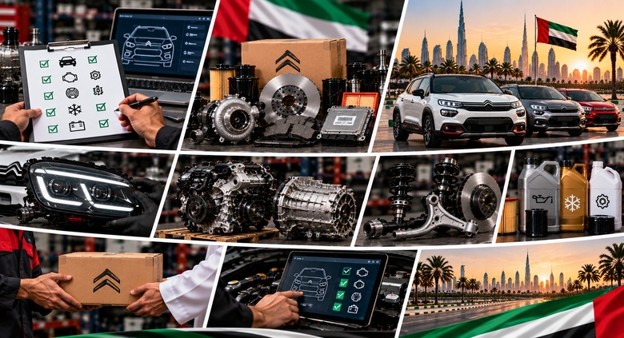
Before You Click Buy: verify these details
Check the VIN.
Check the part number.
Check the engine code.
Check the transmission.
Ask whether it is genuine, aftermarket, used or reconditioned.
Ask about warranty.
Ask about return conditions.
Ask whether coding or calibration is required.
Ask for the complete installed cost.
And if it is used, ask about donor mileage and history.
That little checklist can prevent a surprisingly expensive mistake.
Where PartFinder UAE fits into the buying process
PartFinder UAE can be useful when the buyer wants to compare the available part route rather than automatically defaulting to one quality category.
For an older Citroën, the sensible comparison may be genuine versus authorised multi-brand versus tested used versus reconditioned, depending on the component and vehicle age.
The important thing is still the same: verify fitment before comparing the numbers.
Citroën's UAE network offers more than one repair route
Citroën UAE currently describes both Origine plans using original parts and Advantage plans using authorised parts from different brands validated by Citroën engineers for cars over three years old.
That is useful context for owners of older C3, C4, C5 and Berlingo models.
You do not necessarily have to choose between “brand new genuine” and “unknown used”.
There is a middle ground.
When genuine makes the most sense
Genuine parts deserve particular consideration when:
- the component is safety-critical;
- electronic compatibility is complicated;
- the vehicle is relatively new;
- failure could cause extensive secondary damage;
- warranty or documented provenance matters more than the initial saving.
It is not about buying the most expensive part.
It is about buying the level of certainty the repair requires.
When used makes more sense
A properly checked used part can be attractive when:
- the vehicle is older;
- the genuine new component is expensive;
- the part is not a wear item;
- the donor vehicle is known;
- mileage is available;
- the part number is confirmed;
- testing has been performed;
- warranty is provided.
This is particularly relevant to body panels, certain mechanical assemblies and some high-value components.
Citroën spare-parts price decision matrix
| Situation | Suitable route to investigate | Main reason |
| Newer vehicle, complex electronics | Genuine | Fitment and software certainty |
| Older vehicle, expensive module | Used/reconditioned + testing | Lower replacement cost |
| Cooling-system repair | New aftermarket/genuine | New component reduces uncertainty |
| Major engine failure | Used/reconditioned/genuine comparison | Large price difference |
| Gearbox replacement | Used vs rebuilt vs genuine | Condition and warranty matter |
| Body panel | Used genuine | Often economical |
| Brake pads | New | Wear item |
| Filters | New | Consumable |
| Turbo failure | Reconditioned/used/new comparison | Root-cause diagnosis essential |
| EGR replacement | New aftermarket/genuine/used comparison | Price and condition vary |
| Headlamp | Used genuine/new comparison | Electronics and condition matter |
FAQs
Categories
- Audi
- BMW
- Car Accessories
- Car Tips
- Ford
- Land Rover
- Mazda
- Range Rover
- Top 10
- UAE Car Parts
- Used Car Parts
- Toyota
- Replacement Engines
- Nissan
- Hyundai
- Mitsubishi
- Volkswagen
- Honda
- Kia
- Chevrolet
- Dodge
- Jeep
- Subaru
- Renault
- Lexus
- Mercedes
- Suzuki
- Hummer
- Porsche
- Infiniti
- Peugeot
- GMC
- Mini
- Volvo
- Replacement Gearboxes
- MG
- Jaguar
- Skoda
- Cadillac
- Daihatsu
- Fiat
- German Car Parts
- Japanese Car Parts
- Aftermarket Car Parts
- Genuine Car Parts
- New Car Parts
- Reconditioned Car Parts
- European Car Parts
- American Car Parts
- Korean Car Parts
- British Car Parts
- Chinese Car Parts
- Sports/Exotic Car Parts
- Luxury Car Parts
- Performance Car Parts
- SUV/4x4 Spare Parts
- Truck Spare Parts
- EV Car Parts
- Hybrid Car Parts
- Auto Spare Parts in UAE
- Tesla
- Isuzu
- Ram
- Ferrari
- Bentley
- Lamborghini
- Genesis
- Maserati
- Lincoln
- Chrysler
- Opel
- Citroen