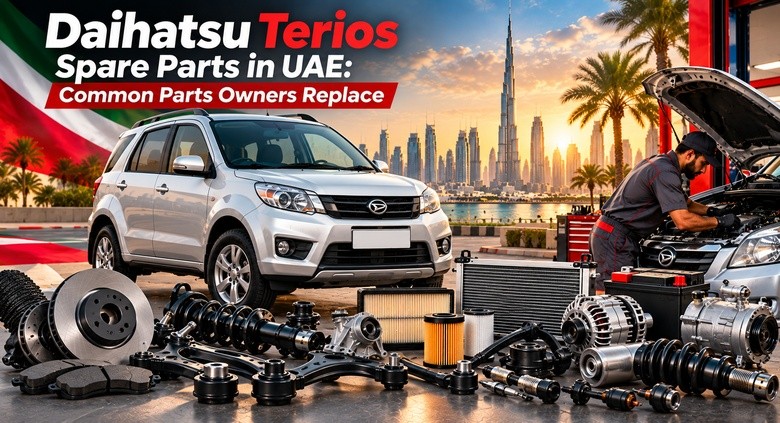
Daihatsu Terios Spare Parts in UAE: Common Parts Owners Replace
September 26, 2026
A Daihatsu Terios does not usually become expensive because one spectacular component suddenly fails. The more familiar problem with an older Terios is accumulation: a tired suspension bush here, a noisy bearing there, ageing brake hardware, a cooling-system component that has started leaking, perhaps a driveshaft or steering component showing play. Leave several of them together and a relatively simple 4x4 can turn into a surprisingly expensive repair order.
That makes “common replacement parts” a more useful question than a generic list of Daihatsu Terios spare parts in UAE. The real issue for a UAE owner is knowing which components deserve inspection first, which symptoms actually point towards them, and when replacing the obvious-looking part would simply waste money.
The evidence available publicly is not UAE-specific enough to claim a definitive UAE failure ranking. UK DVSA-derived Terios data, for example, shows suspension, structural areas, brakes and driveshaft-related faults appearing repeatedly, while other datasets identify front suspension joints, track-rod ends and suspension mounting areas as recurring patterns. These are useful supporting signals, not proof that every UAE Terios experiences the same failures.
Which Daihatsu Terios parts are most commonly replaced?
For an older Terios in the UAE, the parts worth putting on the inspection radar are:
- suspension bushes, arms, ball joints and stabiliser links
- shock absorbers and associated mounting hardware
- brake pads, discs, calliper components and brake hoses
- wheel bearings
- driveshaft/CV-joint components and boots
- steering and track-rod components
- engine mounts
- cooling-system components such as thermostats, hoses, radiators and water pumps where inspection confirms deterioration
- ignition and engine-management components where diagnostics identify a fault
- batteries, alternators, starter motors and ageing electrical components
- air-conditioning components where cooling performance or refrigerant loss points to a fault
- exhaust and emissions-related components
- 4WD driveline components on applicable versions
That is deliberately broader than saying “these parts fail”. Replacement frequency depends heavily on generation, mileage, drivetrain, maintenance history, imported specification and the condition of the individual vehicle.
Public Terios inspection data supports particular attention to suspension and steering: one large MOT-derived dataset lists suspension bushes/joints, track-rod ends, shock absorbers and suspension mounting areas among recorded faults.
The first distinction: symptoms are not diagnoses
This is where Terios owners can save themselves a fair bit of money.
A clunk does not automatically mean a shock absorber. A wheel bearing noise is not automatically a differential. An overheating complaint does not automatically mean the radiator. And a battery that repeatedly goes flat does not prove the battery itself is defective.
The symptom tells the workshop where to start looking. It does not tell them what to replace.
A useful Terios parts decision should therefore move through three stages:
Symptom → diagnostic evidence → confirmed component
That sounds obvious. In practice, skipping the middle step is one of the easiest ways to buy the wrong part.
Suspension bushes and control-arm components
Suspension is one of the clearest areas where Terios owners should expect age-related replacement work.
Public Terios datasets repeatedly flag worn suspension bushes, joints, ball joints and suspension mounting areas. A Terios-specific maintenance manual also instructs inspection of shock absorbers, suspension arms, dust covers, attachment tightness and abnormal movement.
Typical symptoms can include:
- knocking over speed bumps
- vague steering
- wandering under braking
- uneven tyre wear
- a feeling that the front end moves before the vehicle responds
- visible cracking in rubber bushes
- excessive play when the suspension is loaded and unloaded
But there is an important distinction.
A cracked bush is not automatically a failed arm. A noisy suspension corner is not automatically a complete suspension replacement.
A competent inspection should identify which joint or bush actually has excessive movement, whether the arm itself is damaged, whether the mounting hardware is secure, and whether the geometry has been affected.
Shock absorbers: don't judge them only by visible leakage
A leaking damper is an obvious reason for replacement. A worn damper can also lose effective damping without presenting itself as a dramatic oil leak.
The Terios J100 maintenance documentation describes visual inspection for damage and oil leakage and also a functional check for abnormal movement and continued oscillation.
For a UAE Terios, the workshop should check:
- damper body condition
- leakage
- rebound/control behaviour
- upper and lower mounting condition
- associated bushes
- spring condition
- uneven tyre wear
- whether another suspension component is creating the noise blamed on the damper
Replacing two shock absorbers when the actual problem is a loose suspension joint is money spent twice.
Ball joints and steering linkage
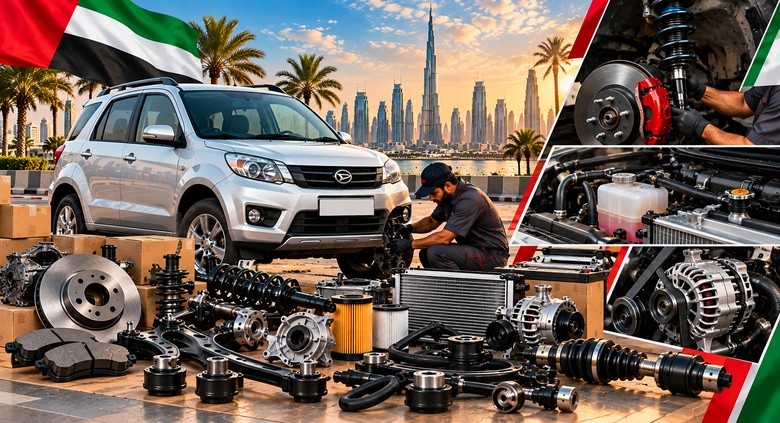
Ball joints and track-rod ends matter because they sit between suspension movement and steering control. Wear can produce vague steering, knocking or irregular tyre wear, but the same symptoms can also come from bushes, wheel bearings, alignment or other steering components.
Terios MOT-derived data provides useful external evidence here: front ball-joint and track-rod-end faults appear among statistically elevated patterns in certain model-year datasets.
The workshop should physically inspect for play rather than replacing steering parts because a customer reports “loose steering”.
That distinction matters even more on older vehicles, where several small amounts of wear can exist simultaneously.
Wheel bearings
A wheel-bearing problem usually announces itself through a speed-related hum, growl or rumble. The sound can change when the vehicle loads one side during a gentle turn.
But diagnosis needs care because tyres, driveshafts, differentials and other rotating components can also produce noises that travel surprisingly well through the body.
A workshop should check:
- wheel play
- bearing roughness
- noise while rotating the wheel
- noise under road load
- ABS sensor condition where applicable
- tyre condition and tread pattern
- driveshaft/CV components
- other drivetrain bearings if the sound remains after wheel-bearing inspection
Do not buy a bearing simply because the noise “sounds like one”.
CV joints and driveshaft boots
This is particularly relevant to Terios versions using four-wheel drive.
A split CV boot can allow dirt and moisture into the joint while allowing grease to escape. The visible rubber boot may therefore be the inexpensive warning sign for a more expensive joint problem.
Public Terios MOT data also records CV-joint boot defects among notable failures.
The buying decision changes depending on what the inspection finds:
| Condition found | Likely decision to investigate |
| Boot damaged, joint still sound | Boot repair/replacement may be appropriate |
| Grease loss but no confirmed joint damage | Inspect joint before buying complete driveshaft |
| Clicking under steering/load | Joint condition needs proper assessment |
| Excessive shaft play or damaged joint | Replacement may become more economical |
| 4WD vibration/noise | Inspect the wider driveline, not just the CV joint |
The mistake is assuming every driveshaft complaint requires a complete assembly.
Brake pads and discs
Brake components are consumables, but that does not make diagnosis irrelevant.
Pads can wear unevenly. Discs can develop corrosion or scoring. Callipers can stick. Brake hoses can deteriorate. A vehicle that has spent long periods parked may show different brake problems from one used daily in Dubai traffic.
Public Terios failure data records brake pads/linings, brake discs, hydraulic components, hoses and brake-performance issues among the observed defects.
The workshop should check pad thickness, disc condition, calliper movement, hose condition, brake-fluid condition and braking performance rather than simply fitting pads because the vehicle has reached a certain mileage.
Battery, alternator and starter components
Electrical complaints become particularly annoying when several ageing components overlap.
A Terios that struggles to start might have:
- a weak battery
- charging-system problems
- excessive parasitic drain
- starter-motor issues
- poor electrical connections
- an ignition-switch problem
- another intermittent electrical fault
So the useful test is not “battery or alternator?” as a guess.
It is battery condition + charging voltage/current behaviour + starting-system performance + parasitic draw where appropriate.
The battery is often the part that gets blamed because it is easy to replace. That does not mean it caused the problem.
Cooling-system parts deserve more attention in UAE conditions
Cooling-system components should be treated seriously on an older Terios, particularly in a climate where ambient temperatures are high and air-conditioning loads can be substantial.
Potential replacement items include:
- radiator
- radiator hoses
- thermostat
- water pump
- coolant reservoir components
- radiator fan components
- temperature sensors where diagnosis supports replacement
The important point is that overheating is a symptom, not a parts list.
The workshop should establish coolant level and condition, pressure integrity, thermostat operation, fan operation, temperature behaviour, radiator condition and evidence of coolant loss before deciding what to replace.
If the vehicle has actually overheated, the investigation should go further. Continuing to replace cooling components without establishing why the temperature rose can turn a manageable repair into an engine problem.
Water pump replacement needs evidence, not guesswork
A water pump can develop leakage or bearing problems, but an overheating Terios does not automatically need a water pump.
One technical Terios inspection source specifically describes checking the water pump for leakage and bearing-related signs on certain Terios configurations, while other Terios maintenance material emphasises broader cooling-system inspection.
For parts buying, this means the workshop should identify:
- exact engine/application
- pump design
- evidence of leakage
- bearing noise or abnormal movement
- coolant circulation
- thermostat behaviour
- belt/drive arrangement where applicable
The engine code and VIN can matter here.
Thermostats and temperature-related faults
A thermostat is relatively simple compared with an engine repair, but replacing it without confirming the temperature problem is still poor diagnosis.
An engine that runs too hot, takes too long to warm up or behaves inconsistently may have different causes.
The workshop should compare actual coolant temperature behaviour with expected operation and check related components before fitting a thermostat simply because it is inexpensive.
This is one of those repairs where cheap part ≠ automatically cheap mistake.
Engine mounts
Engine mounts are easy to overlook because the engine can still run perfectly while the mount is deteriorating.
Possible clues include:
- excessive vibration at idle
- a noticeable thump during Drive/Reverse engagement
- movement when the engine is loaded
- vibration transmitted into the cabin
- visible rubber deterioration
The correct diagnosis needs to separate mount movement from engine misfire, transmission issues and exhaust contact.
If the engine itself is running unevenly, changing mounts first may only mask part of the problem.
Ignition coils, spark plugs and engine-management components
On petrol Terios models, ignition components can become replacement items as mileage and age increase.
But a misfire should not automatically result in replacing every ignition coil.
A workshop can use fault codes, live data and cylinder-specific testing to narrow the problem down. Spark plugs, ignition coils, wiring, injectors, air/fuel issues and mechanical engine faults can create overlapping symptoms.
That is the difference between diagnosis-led parts sourcing and simply ordering a handful of components because they are commonly associated with misfires.
Sensors: the expensive temptation to guess
Oxygen sensors, ABS sensors, temperature sensors and other electrical components can generate warning lights and drivability complaints.
The dangerous assumption is:
warning light → sensor → replacement
A diagnostic trouble code identifies a circuit, system or monitored condition. It does not always prove that the named sensor itself has failed.
A workshop should inspect wiring, connectors, reference signals, live data and the conditions under which the fault occurs before ordering the component.
That approach is especially useful when sourcing older Terios electronics, because buying the wrong specification can leave you with a part that physically looks correct but does not match the vehicle.
Air-conditioning parts: check the leak before buying the compressor
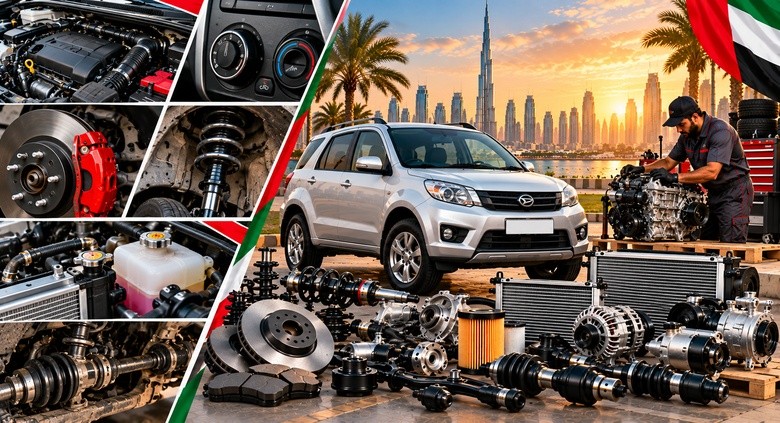
In the UAE, A/C performance is hardly a luxury issue. It is daily-use equipment.
A Terios with weak cooling may need something as simple as diagnosis of refrigerant loss, or it may have a more substantial fault involving the condenser, compressor, evaporator, expansion device, electrical controls or associated components.
A weak A/C complaint should therefore trigger checks for:
- refrigerant charge
- system pressure
- leakage
- compressor engagement and operation
- condenser condition
- cooling-fan operation
- evaporator performance
- electrical control faults
Replacing a compressor without establishing why the system stopped cooling is an expensive way to discover that the original problem is still there.
Exhaust and emissions components
Exhaust faults appear prominently in some Terios datasets, while emissions-related defects also show up in model-year records.
Possible replacement areas include exhaust sections, mounts, catalytic components and sensors, but the right repair depends on the actual fault.
A warning light or emissions problem should lead to diagnostic testing rather than an automatic catalytic-converter purchase.
The catalytic converter is often the cost-of-getting-it-wrong part of the equation: replacing it when the underlying engine or mixture problem remains can simply damage the replacement again.
Four-wheel-drive components need generation and drivetrain identification
Not every Terios has identical drivetrain hardware.
This is precisely why “Daihatsu Terios 4x4 parts” is not enough information for an expensive order.
The buyer should establish:
- model generation
- model year
- engine
- transmission
- 2WD or 4WD configuration
- chassis/model code where available
- VIN
- exact component or existing part number where available
For driveline components, these details can matter far more than the model name printed in an online listing.
Generation matters more than many buyers expect
The Terios name covers substantially different generations.
The first-generation J100-era vehicle and later J200-era Terios are not interchangeable simply because both badges say Terios. Parts catalogues, suspension architecture, engines, drivetrain components and electrical equipment can differ.
This is one of the strongest reasons to avoid ordering purely by model name.
The public maintenance material available for the J100, for example, contains generation-specific suspension inspection procedures, while later Terios sources describe different mechanical and electrical issues.
For a high-value component, the hierarchy should be:
VIN/application → generation → engine/drivetrain → part number → visual confirmation
Not:
“It looks the same online.”
J100 Terios: what deserves particular attention?
For early Terios vehicles, age is now a major variable.
A J100-era vehicle can have accumulated years of wear across suspension, steering, rubber components, cooling parts, electrical connectors and drivetrain hardware. Public J100 maintenance documentation specifically calls for inspection of shocks, suspension arms, dust covers, mounting tightness and abnormal suspension movement.
That means an owner looking for one replacement part should also consider the condition of the surrounding system.
If the lower suspension arm is worn, for example, replacing a tyre because it has developed uneven wear does not solve the cause.
J200 Terios: don't assume every later car uses the same parts
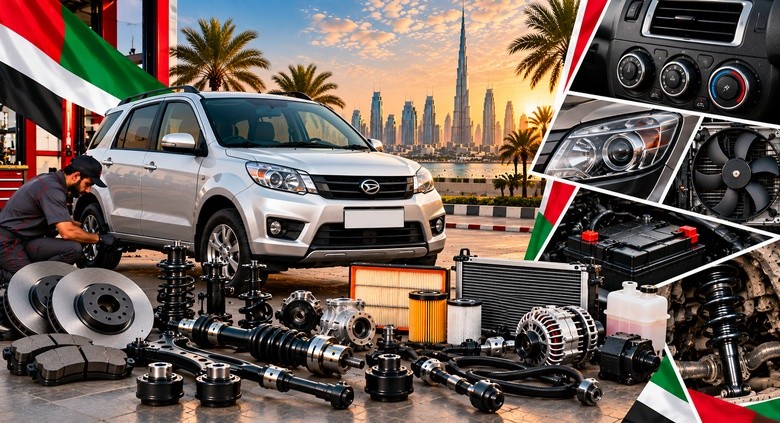
Later Terios vehicles have their own fitment differences, including engine, transmission and drivetrain variations.
Some public sources covering J2/J200 vehicles identify suspension wear, drivetrain concerns, electrical faults and cooling-system components among areas requiring attention, but these are not UAE failure statistics and should be treated as supporting evidence rather than a universal fault ranking.
For a J200, confirm the exact application before ordering:
- suspension components
- drivetrain parts
- sensors
- transmission components
- cooling-system components
- electrical assemblies
The generation is the starting point, not the final fitment check.
What the workshop should check before you buy a Terios part
A good inspection should answer a specific question: what has actually failed?
For suspension and steering:
- physical play
- bush condition
- ball-joint condition
- damper performance
- mounting condition
- tyre wear
- alignment symptoms
For brakes:
- pad thickness
- disc condition
- calliper operation
- hoses
- fluid
- braking performance
For cooling:
- pressure integrity
- coolant condition
- thermostat operation
- fan operation
- radiator condition
- pump leakage
- actual temperature behaviour
For electrical components:
- fault codes
- live data
- wiring
- connectors
- voltage/current behaviour
- battery/charging condition
For drivetrain:
- fluid condition
- leaks
- shaft/CV condition
- bearing noise
- vibration
- engagement behaviour
- road-test findings
That is the permanent evidence layer behind a sensible parts purchase.
Common part does not mean common failure
This distinction deserves its own section because parts websites can blur it.
Brake pads are common because they are consumables.
A control-arm bush may be common because suspension components age.
An ABS sensor may be commonly listed because it is available for the vehicle.
None of those facts proves that the particular Terios in front of you needs that component.
The article should therefore never become a shopping list masquerading as a diagnosis guide.
Genuine, OEM, aftermarket, used or reconditioned?
For an older Terios, the choice can be more nuanced than simply buying the cheapest available part.
Genuine/new original-specification: useful when exact fitment, durability or electronic compatibility matters.
Quality aftermarket: can make sense for established wear items when specifications and manufacturer quality are clear.
Used genuine: potentially useful for discontinued, expensive or difficult-to-source components, especially body and certain electronic parts, but donor history and testing matter.
Reconditioned/remanufactured: potentially attractive for selected components, provided the rebuilder, process, warranty and returned-core conditions are clear.
The right choice depends on the component.
A used suspension bush makes little sense when a new replacement is readily available. A tested used body-control or trim component may make much more sense when a new original component is difficult to source.
The cost of getting the wrong part
This is where online buying becomes less attractive than it first appears.
The wrong Terios part can create:
Part cost + delivery + return cost + workshop labour + lost time + second installation + possible damage from incorrect fitment
That is why a slightly cheaper component is not necessarily the cheaper purchase.
For a £/AED-equivalent low-cost filter, the risk may be trivial. For a driveshaft, transmission component, cooling component, electronic module or major suspension assembly, it is a different calculation entirely.
Repair versus replacement: the Terios calculation
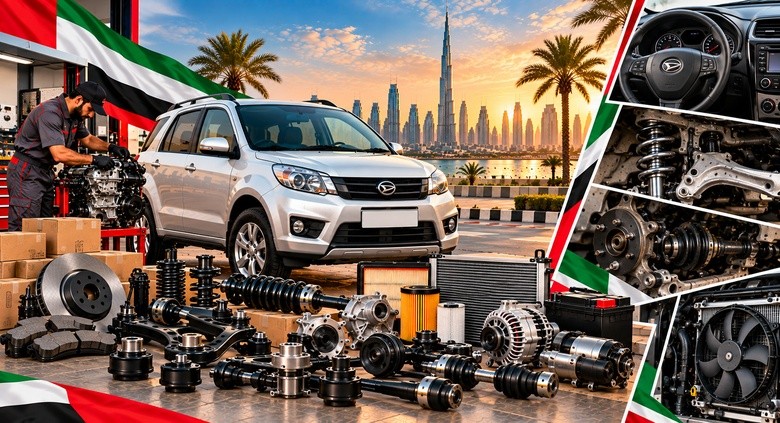
Before ordering a component, ask four questions:
| Question | Why it matters |
| Is the component definitely failed? | Prevents replacing a symptom |
| Can the original component be repaired? | May reduce cost where repair is technically sound |
| Is a tested used part available? | Relevant for older/discontinued components |
| What is the total installed cost? | Part price alone can be misleading |
A used component may be cheaper to purchase but require more inspection and carry a shorter warranty.
A new aftermarket part may cost less than genuine but vary significantly by manufacturer.
A reconditioned component may offer a useful middle ground, but only if the rebuilding process and warranty are credible.
Buying used Terios parts in the UAE
For used parts, ask about the donor, not just the part.
Useful evidence includes:
- donor vehicle model year
- engine and transmission specification
- 2WD/4WD configuration
- donor mileage where known
- accident or flood history
- reason for dismantling
- component testing
- visible damage
- warranty period
- return conditions
- compatibility confirmation
“Used” describes history. It does not describe quality.
For electronics and drivetrain components, that distinction becomes especially important.
Where UAE conditions change the buying decision
Dubai traffic, high ambient temperatures, frequent A/C operation, dusty conditions and long periods of stop-start driving can change how certain components are used.
But localisation needs to remain technically honest.
It would be wrong to claim that every Terios suspension bush fails because of UAE heat, or that every battery has a predictable lifespan simply because the vehicle operates in the Emirates.
The useful UAE question is instead:
Which components should receive extra inspection because the vehicle's operating environment can place additional demands on them?
Cooling, A/C, battery/charging, rubber components, suspension and general underbody condition are sensible areas to inspect closely, while the actual replacement decision still comes from the individual vehicle.
A practical Terios parts decision matrix
| Part situation | Sensible starting point | Main risk | What to verify |
| Routine brake wear | New replacement | Wrong specification | Model/year, axle, dimensions |
| Worn suspension bush | New bush/arm as appropriate | Replacing the wrong component | Physical play and arm condition |
| Noisy wheel area | Diagnosis first | Mistaking tyre/driveline noise for bearing | Bearing play and road-test evidence |
| Damaged CV boot | Inspect joint | Buying complete shaft unnecessarily | Joint condition and grease loss |
| Electronic module | Exact-fit used/new option | Compatibility failure | VIN, module number, coding requirements |
| Cooling fault | Diagnose system | Replacing radiator/pump without finding cause | Pressure, temperature, fan and circulation checks |
| Discontinued body component | Tested used genuine | Unknown donor condition | Donor, condition, return policy |
| Major drivetrain component | VIN/part-number-led sourcing | Very expensive mismatch | Transmission/drivetrain specification |
Before You Click Buy: the Terios checklist
For anything more complicated than a routine service consumable, have these details ready:
VIN
Model year
Generation/chassis code
Engine
Transmission
2WD or 4WD
Existing part number, if visible
Photo of the old component
Exact symptom
Workshop diagnosis
Whether the part is new, used or reconditioned
Warranty and return terms
That information turns a vague “Daihatsu Terios spare parts” search into a proper fitment request.
Build your Terios parts search around the vehicle, not the keyword
This is also where PartFinder UAE becomes useful as part of a broader sourcing journey: start with the exact Terios specification, identify the component, confirm compatibility, then compare the available sourcing route rather than treating every listing carrying the word “Terios” as equivalent.
The strongest internal-link structure for a Terios content cluster would naturally connect this article with pages covering Daihatsu spare parts in UAE, used Daihatsu parts, Terios engine parts, Terios gearbox components, Terios suspension parts and Terios parts pricing where those pages genuinely exist.
The point is not to scatter links everywhere. Each link should answer the next question the buyer is likely to have.
Evidence layer: what we can actually say about Terios replacement patterns
There is useful external evidence, but it needs to be labelled honestly.
Public test evidence: Terios MOT datasets repeatedly show suspension, steering, brake, structural and driveshaft-related defects.
Manufacturer/technical maintenance evidence: available J100 maintenance documentation specifies inspection of shocks, suspension arms, dust covers, mounting fasteners and abnormal suspension movement.
Model-specific secondary evidence: later Terios/J200 sources identify suspension, drivetrain, electrical and cooling-system areas as potential maintenance concerns, although these sources are not UAE fleet studies.
UAE-specific evidence: a reliable UAE-wide failure-frequency ranking for Terios replacement parts was not established from the public evidence reviewed for this article. That limitation matters. It is better to say “we have not verified this” than turn overseas inspection data into fake UAE statistics.
What this means for a Terios owner in the UAE
The most useful Terios spare-parts strategy is not to keep a giant list of parts in anticipation of failure.
It is to watch the systems that generate the most consequential wear, identify symptoms early, diagnose before ordering, and verify fitment against the exact vehicle.
Suspension and steering deserve particular attention on older examples. Brakes and tyres are routine inspection items. Driveshaft and CV components matter on applicable 4WD versions. Cooling and A/C systems deserve sensible scrutiny in UAE operating conditions. Electronics require much more care with compatibility. And once the vehicle gets old enough, the donor history of a used component can matter almost as much as the component itself.
The big money-saving rule is simple: don't buy the part that sounds right; buy the part that the evidence says the vehicle actually needs.
UAE Update Reference: September 2026
Part availability, supplier stock, used-part availability and pricing can change quickly in the UAE, particularly for older Daihatsu models. This article should therefore be updated when new UAE market evidence, verified part-number information, supplier availability or model-specific technical documentation becomes available.
FAQs
Categories
- Audi
- BMW
- Car Accessories
- Car Tips
- Ford
- Land Rover
- Mazda
- Range Rover
- Top 10
- UAE Car Parts
- Used Car Parts
- Toyota
- Replacement Engines
- Nissan
- Hyundai
- Mitsubishi
- Volkswagen
- Honda
- Kia
- Chevrolet
- Dodge
- Jeep
- Subaru
- Renault
- Lexus
- Mercedes
- Suzuki
- Hummer
- Porsche
- Infiniti
- Peugeot
- GMC
- Mini
- Volvo
- Replacement Gearboxes
- MG
- Jaguar
- Skoda
- Cadillac
- Daihatsu
- Fiat
- German Car Parts
- Japanese Car Parts
- Aftermarket Car Parts
- Genuine Car Parts
- New Car Parts
- Reconditioned Car Parts
- European Car Parts
- American Car Parts
- Korean Car Parts
- British Car Parts
- Chinese Car Parts
- Sports/Exotic Car Parts
- Luxury Car Parts
- Performance Car Parts
- SUV/4x4 Spare Parts
- Truck Spare Parts
- EV Car Parts
- Hybrid Car Parts
- Auto Spare Parts in UAE
- Tesla
- Isuzu
- Ram
- Ferrari
- Bentley
- Lamborghini
- Genesis
- Maserati
- Lincoln
- Chrysler
- Opel
- Citroen
- SsangYong
- Seat
- McLaren
- Aston Martin
- Rolls Royce
- Maybach
- Alfa Romeo
- Bugatti