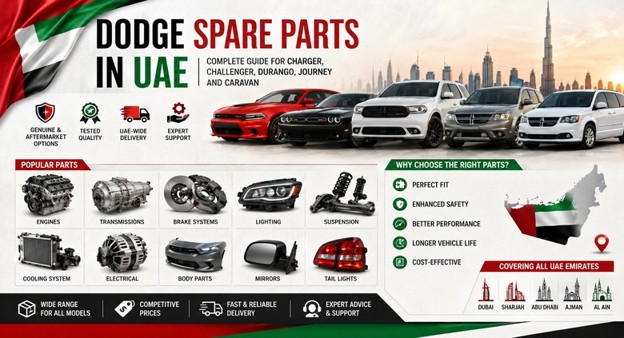
Dodge Spare Parts in UAE: Complete Guide for Charger, Challenger, Durango, Journey and Caravan
August 28, 2026
Dodge Spare Parts in UAE: Models, Common Replacements and Compatibility
Dodge Spare Parts in UAE: What Owners Commonly Replace
A Dodge in the UAE tends to reveal its weak spots differently from a small commuter car.
The weather matters. So does the way the vehicle is driven.
A Charger that spends its life crossing Dubai in stop-start traffic sees plenty of brake and cooling-system work. A Challenger driven enthusiastically puts another kind of demand on brakes, tyres, suspension and drivetrain parts. A Durango carrying a family through Abu Dhabi traffic, then heading out on a long highway trip, has its own wear pattern. Older Journey and Caravan models bring another issue altogether: age.
So the phrase “Dodge spare parts in UAE” is far too broad for a serious quotation.
The useful question is:
Which Dodge, which year, which engine, and which part?
The replacement parts owners usually encounter
| Part category | Common reason for replacement | Buying approach |
| Brake pads | Friction wear | Usually new |
| Brake discs | Wear, scoring or runout | New or inspected |
| Control arms | Bush/ball-joint wear | New or tested genuine used |
| Wheel hubs | Bearing noise/play | New or quality replacement |
| Shocks | Loss of damping | New |
| Radiator | Leakage/restriction | New or tested used |
| Water pump | Leakage/circulation fault | New preferred |
| AC compressor | Mechanical/system failure | Diagnose first |
| Alternator | Charging fault | Tested used or new |
| Starter | Starting fault | Tested used or new |
| Headlight | Damage/electrical failure | Genuine used or new |
| Engine | Major mechanical failure | Test before buying |
| Gearbox | Internal/shift failure | Exact specification essential |
| Body panels | Accident damage | Genuine used can be valuable |
The important bit is that not every failed-looking part actually needs replacing.
A noisy suspension system might need one control arm, not an entire front axle. A warm AC system might have a refrigerant leak rather than a dead compressor. A battery warning might point towards charging-system trouble rather than an alternator that should be ordered immediately.
That is where a workshop inspection earns its money.
Dodge model generations matter
The Charger is a particularly good example.
The modern four-door Charger ran through the 2006–2010 and 2011–2023 generations before the nameplate moved to a new generation beginning in 2024. The newer Charger uses a completely different platform and powertrain approach, so a buyer cannot treat “Charger” as one continuous parts catalogue.
That isn't a small technical detail.
It changes the parts search.
Genuine UAE price evidence: what it can and cannot tell you
Dodge's UAE parts-ordering system allows owners to select models such as Durango, Charger and Challenger when requesting a part, which reflects the importance of identifying the actual vehicle before obtaining a quotation.
For published UAE pricing, use dated dealer or workshop quotations as the primary evidence rather than inventing a universal “Dodge parts price”.
For example, a genuine UAE quotation for a Charger brake job might include parts, labour and consumables, while an independent seller may quote only the brake pads. Those two numbers should never be presented as direct competitors.
What changes the final price
Model year + engine + trim + drivetrain + part specification + genuine/used/aftermarket status + availability + labour.
And there is another one people forget:
Completeness.
A used bumper at AED 900 isn't necessarily cheaper than a complete bumper at AED 1,300 if the first one arrives without brackets, sensors and trim.
UAE workshop example
A Sharjah owner brings in a Charger with a front-end knocking noise.
The first online search points towards “Dodge suspension kit”.
The technician checks the car.
One control-arm bush is badly worn. The opposite side is still serviceable. The stabiliser links are fine.
So the owner doesn't buy the whole kit.
One properly matched part is ordered, followed by alignment.
That's a better repair than throwing five parts at a noise.
Dodge parts buying rule
Identify the exact vehicle first, diagnose the failed part second, and only then compare genuine, OEM, used, reconditioned and aftermarket options.
Dodge Charger Spare Parts in UAE: Common Wear and Replacement Parts
The Charger has an unusually wide parts-search problem because “Charger” covers several very different cars.
A 2008 Charger isn't a 2016 Charger.
A 2016 R/T isn't a 2016 V6.
And a late-model Hellcat isn't merely a normal Charger with a more powerful engine.
The parts catalogue follows those differences.
Charger generations worth remembering
For modern UAE parts research, the major split is:
2006–2010 + 2011–2014 + 2015–2023 + the new 2024-onwards generation.
The 2011–2023 generation alone covered V6 and several HEMI V8 applications, different drivetrains and multiple performance versions.
That means a search such as:
“Dodge Charger brake disc”
is incomplete.
Common Charger replacement parts
Brake pads
Brake discs
Control arms
Wheel hubs
Shocks
Engine mounts
Radiators
Cooling fans
AC compressors
Alternators
Starters
Headlights
Tail lights
Bumpers
Grilles
Sensors and electronic modules
V6 versus HEMI
This distinction becomes important for engine-related parts and several supporting systems.
A 3.6-litre V6 Charger and a 5.7-litre HEMI Charger should not be treated as interchangeable simply because the body looks similar.
Check:
Engine + transmission + drivetrain + VIN.
R/T, SRT and Hellcat
Performance variants can introduce different brake, suspension, cooling and drivetrain requirements.
A cheap standard Charger brake assembly is not automatically suitable for a performance version.
Brake example
Imagine a 2018 Charger R/T.
The owner needs front brake parts.
One seller offers a cheap set listed for “2015–2020 Charger”.
Another asks for the VIN and confirms the exact brake application.
The second seller may charge more.
That extra confirmation is useful.
Especially when the car has performance equipment.
Cooling matters in the UAE
A Charger that spends hours in summer traffic needs a healthy cooling system.
Inspect:
Radiator + cooling fans + hoses + thermostat + water pump + coolant condition.
If the car has overheated, find out why before installing another expensive part.
AC parts
A Charger with weak cooling doesn't automatically need a compressor.
Check:
Refrigerant pressure + leaks + compressor operation + condenser + electrical controls.
Otherwise, an expensive compressor can become an unnecessary purchase.
Body parts
Used genuine Charger body parts can be attractive for older cars.
Look at:
Bumper + grille + fender + door + mirror + headlight.
But ask whether the part is supplied complete.
Electrical parts
A Charger warning light can trigger an online parts hunt very quickly.
Don't rush.
A diagnostic code can identify a system or circuit problem without proving that the named module or sensor itself has failed.
Workshop case
A Dubai Charger develops intermittent starting problems.
The owner finds a used starter online.
The workshop checks the battery, terminals and charging system first.
The starter is actually weak.
Only then is the replacement ordered.
The part purchase is based on diagnosis, not guesswork.
Charger compatibility checklist
| Check | Why it matters |
| Model year | Generations changed |
| Engine | V6/V8 applications differ |
| Trim | Brake/body/equipment differences |
| Drivetrain | RWD/AWD applications |
| VIN | Vehicle-specific confirmation |
| Part number | Exact identification |
| Original equipment | Helps compare replacements |
The Charger rule
For Charger parts, never stop at the model name. Add the year, engine, trim and VIN before you pay.
Dodge Challenger Spare Parts in UAE: Engines, Brakes, Suspension and Body Parts
The Challenger creates a different parts-buying headache.
It is a performance-oriented car, and owners often care about more than whether a part physically fits. Brake performance, cooling capacity, suspension behaviour and drivetrain compatibility matter.
A bargain can become a false economy very quickly.
Challenger engine applications
The modern Challenger range included V6 and several HEMI V8 configurations, with high-performance variants requiring particularly careful parts matching.
So:
3.6 V6 ≠ 5.7 HEMI ≠ 6.4 HEMI ≠ supercharged 6.2.
That sounds obvious.
Yet generic online listings routinely blur these applications.
Engine replacement
If a Challenger needs an engine, check:
Engine code/specification + donor vehicle + mileage + compression + leak-down evidence where appropriate + completeness + warranty.
Ask whether the engine is supplied as:
Long block + complete engine + accessories.
That difference can completely change the installed price.
Compression testing
For a used petrol engine, ask for actual readings where compression testing is applicable.
Not:
“Engine tested, good condition.”
Actual numbers are more useful.
If readings are substantially uneven, ask the workshop to investigate before you buy.
Brakes
Performance-oriented Challenger versions can have substantially different braking requirements.
Check:
Caliper + disc diameter + pad shape + brake package + wheel clearance.
A photograph is not enough.
Suspension
Inspect:
Control arms + bushes + ball joints + shocks + wheel hubs + stabiliser links.
A Challenger that has spent years on UAE roads can develop suspension wear even when the engine remains healthy.
Cooling system
High-performance driving raises the importance of cooling.
Inspect:
Radiator + fans + thermostat + water pump + hoses + coolant.
A car that has experienced repeated overheating deserves a deeper diagnosis.
Body parts
Common accident-related searches include:
Front bumper + rear bumper + fenders + grille + bonnet + doors + mirrors + headlights + tail lights.
Used genuine body parts can save money, particularly on older examples.
But inspect mounting points and previous repairs.
Headlights
Check:
Part number + connector + mounting tabs + internal moisture + electronic equipment.
A lamp that looks correct from the front can still be the wrong application.
Workshop example
An Abu Dhabi Challenger owner finds a used front brake assembly.
The seller says it is “for Challenger”.
The workshop asks which brake package it came from.
The donor information reveals a different setup.
The part is rejected before payment.
That ten-minute conversation saves a much bigger headache.
Challenger parts decision
| Part | Used genuine | New aftermarket | Genuine new |
| Body panel | Often attractive | Useful | Expensive |
| Headlight | Good if tested | Depends on quality | Strongest fitment confidence |
| Brake assembly | Check carefully | Can be useful | Best specification confidence |
| Control arm | Inspect bushes/joints | Often practical | Higher cost |
| Engine | Major option | Application-specific | Highest cost |
| Gearbox | Major option | Less straightforward | Highest cost |
Challenger rule
Match performance parts to the exact brake, engine, suspension and drivetrain specification; don't buy from a generic “Challenger fits” description.
Dodge Durango Spare Parts in UAE: Common Mechanical and Electrical Replacements
The Durango is the family-heavy member of this group.
Three-row seating. Larger footprint. More weight. Often more equipment.
And because many examples are used as daily family vehicles, their replacement parts are less about weekend performance and more about keeping a large SUV dependable in heat, traffic and long-distance driving.
The current Durango generation dates back to 2011, with updates including a 2014 refresh and a more substantial 2021 update. UAE-market references also show V6 and V8 applications, along with rear- and all-wheel-drive configurations depending on version.
Common Durango replacement parts
Brake pads + discs
Control arms + bushes
Wheel hubs
Shocks
Radiators
Cooling fans
Water pumps
AC compressors
Alternators
Starters
Sensors
Headlights
Mirrors
Bumpers
Engine and transmission assemblies
V6 versus V8
The engine matters enormously.
A 3.6-litre V6 Durango and a 5.7-litre HEMI V8 require different engine-specific parts and supporting equipment.
Don't let a seller reduce both to:
“Durango engine.”
RWD versus AWD
Drivetrain also matters.
For major mechanical parts, check:
Transmission + transfer case where applicable + differential + axle specification.
A mismatch can be expensive after installation.
Cooling-system inspection
A large SUV running AC continuously in UAE summer traffic needs a properly functioning cooling system.
If the temperature rises, investigate:
Radiator + fan operation + thermostat + water pump + coolant + hoses.
Don't keep driving until the temperature drops.
AC
Durango owners also need to consider the rear-cabin cooling system.
If the front blows cold but the rear does not, don't immediately order a compressor.
The fault may sit elsewhere in the system.
Suspension
The Durango's weight means suspension wear can become noticeable through:
Knocking + body movement + steering looseness + uneven tyre wear.
Inspect the whole axle rather than replacing the first part that looks suspicious.
Electrical parts
Common searches include:
Alternator + starter + sensors + modules + lighting.
For electronic modules, part-number and VIN confirmation matter more than visual similarity.
UAE price evidence
Current UAE vehicle-market data shows how broad the Durango's model-year range remains: used 2017 examples, for instance, are listed in the UAE market alongside newer 2021–2024 vehicles, while the 2024 model has separate UAE pricing and specification information.
That matters for parts.
A 2017 Durango should not be budgeted or sourced in exactly the same way as a 2024 vehicle.
Workshop case
A family-owned Durango starts producing a front-end knock.
The owner assumes the shocks are finished.
The workshop checks the vehicle.
One control arm has excessive play; the shocks are still usable.
Only the failed assembly is replaced.
The owner avoids turning a targeted repair into a full suspension rebuild.
Durango rule
Confirm V6/V8, model year and drivetrain before ordering Durango mechanical parts, and inspect cooling and suspension systems as complete systems rather than isolated parts.
Dodge Journey Spare Parts in UAE: Affordable Replacement Options for Older Models
The Journey deserves a slightly different approach.
It is now an older vehicle in the UAE market, so the parts decision often comes down to a simple question:
How much longer is this particular Journey worth keeping?
That's not pessimism.
It's arithmetic.
A low-cost suspension repair on an otherwise healthy Journey can make perfect sense. A major engine or gearbox replacement on a high-mileage example with tired AC, worn suspension and ageing electrical equipment needs a harder look.
Common Journey replacement parts
Brake pads + discs
Control arms + bushes
Wheel hubs
Shocks
Radiators
Water pumps
AC compressors
Alternators
Starters
Sensors
Headlights
Mirrors
Bumpers
Door hardware
Engine and gearbox assemblies
Why used genuine parts can make sense
For an older Journey, a genuine used body or electrical part can sometimes be more sensible than paying a large premium for a new genuine item.
Examples:
Mirror + headlight + bumper + grille + door assembly.
But condition still matters.
A ten-year-old used part isn't automatically a bargain.
Aftermarket parts
Aftermarket can be especially useful for routine wear items when a reputable manufacturer offers the correct application.
Think:
Brake pads + filters + selected suspension parts + cooling components.
The key word is reputable.
Engine decision
If the Journey needs an engine, calculate:
Replacement engine + installation + fluids + supporting repairs + first-year maintenance.
Then look at the rest of the vehicle.
Does the gearbox shift properly?
Is the AC working?
Are the tyres healthy?
Is the suspension already due?
If the answer to several questions is “no”, the engine quotation isn't the whole story.
Gearbox decision
The same logic applies to a transmission.
A cheap used gearbox may look attractive until installation reveals a second fault.
Ask for:
Transmission identification + donor information + testing + warranty.
Body parts
Older Journey owners can often reduce accident-repair costs through tested genuine used body parts.
Check:
Bumper + grille + fender + door + mirror + tailgate.
Then calculate paintwork.
Workshop example
A Sharjah Journey needs a damaged side mirror.
A new genuine replacement is expensive.
A tested used genuine mirror is available at a fraction of the price and matches the vehicle's electrical specification.
That is a sensible used-parts decision.
Now change the scenario.
The Journey needs an engine, gearbox and AC compressor.
Suddenly, “used parts are cheaper” isn't enough.
The owner needs a vehicle-level cost calculation.
Repair-versus-replace thinking
| Journey condition | Sensible direction |
| Brake/suspension wear only | Repair |
| Single body-panel accident | Repair with suitable used parts |
| AC compressor failure, otherwise healthy | Repair |
| Engine failure, good overall condition | Compare engine options |
| Gearbox + AC + suspension failures | Calculate carefully |
| Multiple major failures + poor body | Replacement may be wiser |
First-year ownership
For an older Journey, include:
Current repair + tyres + brakes + suspension + AC + cooling + routine servicing.
A part that costs AED 700 today can be perfectly sensible.
A AED 15,000 repair can still be sensible.
Or it can be the point where the numbers stop making sense.
You need the whole picture.
The Journey rule
For older Dodge Journey models, chase value rather than simply the lowest part price—and always compare the next 12 months of ownership before approving a major repair.
A practical Dodge buying checkpoint
Before moving into engines, gearboxes, brakes and electrical parts, keep this short checklist beside the quotation:
VIN confirmed?
Exact model year confirmed?
Engine confirmed?
RWD/AWD confirmed where relevant?
Original part number checked?
Part condition documented?
Warranty written down?
Installation cost known?
Supporting parts included?
UAE workshop diagnosis completed?
If one of those is missing on an expensive part, slow down.
That's usually the moment when the cheapest-looking Dodge spare part becomes the least cheap option of all.
Dodge Engines, Gearboxes and Major Mechanical Replacement Parts
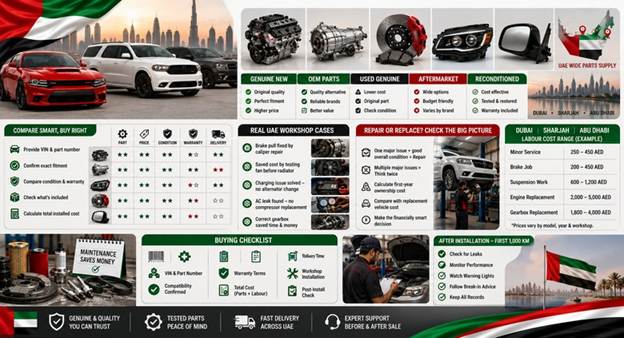
Dodge Charger Engines in UAE: Used, Genuine, OEM and Reconditioned Options
An engine failure changes the conversation immediately.
A Charger that was perfectly usable yesterday can suddenly become a several-thousand-dirham decision, and that is exactly when owners are most tempted by the first cheap engine listing they find.
Don't.
The engine needs to match the car, but it also needs to make financial sense for the car.
Start with the exact Charger specification
Before comparing engines, confirm:
Model year + engine + transmission + drivetrain + VIN + original engine identification.
The Charger range has covered substantially different powertrains over its generations. A V6 Charger and a HEMI V8 Charger aren't interchangeable simply because the engine bay carries the same Dodge badge.
Performance versions need even more care.
A Hellcat-related engine purchase, for example, is a completely different proposition from sourcing a conventional V6 replacement.
Used genuine Charger engine
A tested used genuine engine can be the sensible route when the rest of the vehicle is in good condition.
Ask the supplier for:
Donor vehicle + engine identification + mileage where available + reason for removal + testing evidence + warranty.
And ask what is actually included.
Is it a:
Long block?
Complete engine?
Engine with accessories?
That one distinction can move the installation budget considerably.
Genuine new engine
A new genuine assembly gives strong specification confidence, but the price can be difficult to justify on an older Charger.
It makes more sense when:
The vehicle is newer + body/interior condition is strong + gearbox is healthy + the owner plans to keep it.
OEM replacement
A reputable OEM replacement can sit between genuine and cheaper aftermarket options.
But don't accept “OEM quality” as a product description and leave it there.
Ask:
Who manufactured it?
Reconditioned Charger engine
A properly reconditioned engine can be worthwhile when the rebuild is documented.
Ask what was actually done:
Bearings + seals + gaskets + machining + cylinder work + timing-related parts where applicable.
“Reconditioned” should describe real work.
Compression testing
For a used petrol engine, compression testing can provide useful evidence of cylinder condition.
Ask for the actual readings.
Not just:
“Compression good.”
A workshop can then look for consistency between cylinders and decide whether further testing is warranted.
Leak-down testing
Where appropriate, leak-down testing can provide another layer of evidence when buying a high-value used engine.
It can help investigate whether compression is escaping through areas such as valves, rings or other sealing points.
Why UAE climate matters
The engine isn't working in a mild climate.
Long summer traffic queues, continuous AC use and high ambient temperatures put a premium on a healthy cooling system.
Before installing a replacement engine, inspect:
Radiator + fans + thermostat + water pump + hoses + coolant system.
If the original engine overheated, establish why.
Otherwise, the replacement may inherit the same problem.
Supporting parts
While the engine is out, inspect accessible items rather than replacing everything blindly.
Potential checks include:
Engine mounts + seals + belts + hoses + filters + fluids.
Replace what is actually worn or due.
Workshop case
A Dubai Charger develops severe internal engine damage.
The owner finds a cheaper used V8 online.
The workshop checks the identification.
The engine specification isn't the same as the vehicle's original application.
It is rejected.
Another unit costs more but matches the vehicle and comes with testing evidence.
The second engine is the real bargain because the first one was never a usable solution.
First-year ownership test
Suppose the engine costs AED 10,000.
That number alone tells you almost nothing.
Add:
Installation + fluids + cooling repairs + mounts where required + diagnostics + other known upcoming work.
Then inspect the rest of the Charger.
If the gearbox, suspension, AC and body are healthy, the repair can still make excellent sense.
If all four are already demanding money, pause.
The Charger engine rule
Buy the exact engine, not merely an engine advertised for the same Dodge model—and calculate the vehicle's next 12 months of ownership before approving a major replacement.
Dodge Challenger Engines in UAE: Engine Codes, Mileage and Compression Testing
The Challenger's engine search can go wrong very quickly because the model covers a wide spread of powertrains.
A 3.6-litre V6, 5.7-litre HEMI, 6.4-litre HEMI and supercharged 6.2-litre V8 should never be thrown into one generic “Challenger engine” category.
The badge isn't enough.
Engine identification comes first
Confirm:
VIN + model year + engine code/specification + transmission + drivetrain.
For a performance Challenger, also verify the exact performance package where relevant.
Mileage
Mileage is useful.
But it isn't a verdict.
A higher-mileage engine with credible maintenance and testing can be preferable to a lower-mileage engine with unknown history.
Ask:
Where did the engine come from?
Why was it removed?
Was the donor vehicle running?
Was the engine tested before removal?
Compression testing
For an applicable petrol engine, ask for cylinder-by-cylinder compression readings.
Look for consistency.
A single impressive number isn't enough.
If one cylinder is materially weaker, ask the workshop to investigate before buying.
Leak-down test
For an expensive performance engine, additional testing can be worth the money.
Leak-down testing can help distinguish different sealing problems that a basic compression test may not fully explain.
Oil condition
If the engine is available for inspection, ask about:
Oil contamination + sludge + metal particles + coolant contamination.
A photograph of the engine exterior doesn't tell you much about internal condition.
Cold-start evidence
Where possible, a cold-start video from the donor vehicle can provide useful information.
Listen for:
Knocking + excessive ticking + abnormal vibration + smoke.
It isn't a substitute for physical testing, but it is better evidence than a clean engine-bay photograph.
Engine completeness
Clarify whether the engine includes:
Alternator + starter + AC compressor + intake/exhaust accessories + sensors + wiring-related items.
Different suppliers package engines differently.
Cooling
A replacement Challenger engine should not simply be dropped into a system that may have caused the original overheating.
Inspect:
Radiator + fan operation + thermostat + water pump + hoses.
Performance variants
The more specialised the Challenger, the more dangerous generic parts listings become.
Performance braking, cooling and drivetrain equipment may differ.
Confirm the exact application.
Workshop case
An Abu Dhabi Challenger owner needs a replacement V8.
Two used engines are available.
One has lower mileage.
The second has slightly higher mileage but comes with compression readings, donor identification and a written warranty.
The second engine is selected.
Mileage lost the argument because evidence won it.
Installation
Engine installation may involve:
Removal + replacement + fluids + diagnostics + adaptation/programming where required + testing.
Don't accept a fixed installation timeline before the workshop sees the vehicle and replacement engine.
First 1,000 km
After installation, monitor:
Oil level + coolant level + temperature + warning lights + smoke + vibration + unusual noise.
A small change noticed early is far easier to deal with than a major failure after several weeks.
The Challenger engine rule
For a used Challenger engine, documented testing and exact specification are worth more than a low mileage figure printed on a listing.
Dodge Durango Engines in UAE: Replacement Compatibility and Cooling-System Checks
The Durango's engine decision is closely tied to how the SUV has been used.
Family transport. Long highway trips. Heavy passenger loads. Constant AC. Sometimes towing.
It all adds up.
And because Durango owners can keep their vehicles for many years, an engine replacement isn't necessarily the end of the road.
Durango engine applications
Common UAE-market configurations have included V6 and V8 engines, with different drivetrain applications.
So confirm:
3.6 V6 or V8 + model year + RWD/AWD + VIN.
Never order simply because the seller says:
“Durango engine, fits.”
Used engine
A used genuine engine can be attractive for an older Durango.
Ask for:
Donor + mileage + engine identification + testing + completeness + warranty.
Reconditioned
A properly rebuilt engine can make sense when the vehicle is otherwise worth keeping.
But ask what has been rebuilt.
If the answer is vague, the price doesn't tell you enough.
Cooling-system history
This deserves particular attention.
If the old engine overheated, inspect:
Radiator + thermostat + water pump + fans + hoses + coolant + cooling-system pressure.
Don't assume a replacement engine automatically fixes overheating.
AC load
A Durango's AC works hard in UAE summer, and the cooling system needs to cope with the resulting operating conditions.
If the vehicle has weak AC and overheating symptoms, diagnose both systems properly.
Engine mounts
Worn mounts can create:
Vibration + clunks + excessive engine movement.
If the engine is already being removed, inspect the mounts.
Oil leaks
Before accepting a used engine, inspect accessible areas for:
Fresh leaks + gasket seepage + damaged housings.
A clean engine can be cleaned.
That's why testing matters more than appearance.
Workshop example
A family-owned Durango needs an engine after repeated overheating.
The owner finds a cheap replacement.
The workshop checks the vehicle and discovers the radiator is heavily restricted and one cooling fan isn't operating correctly.
The replacement engine isn't installed until the cooling problem is addressed.
That's important.
Otherwise, the same failure could come back wearing a different engine.
Engine replacement economics
For an older Durango, calculate:
Engine + labour + fluids + cooling work + diagnostics + known suspension/AC/tyre requirements.
Then compare the total with the cost of changing vehicles.
First-year ownership
If the engine is healthy after replacement but the tyres are near replacement and suspension work is due, include those costs.
The first-year number is more honest than today's invoice.
The Durango engine rule
Match the engine to the exact Durango specification, investigate the reason for the original failure and repair the supporting system before putting the replacement engine into service.
Dodge Gearboxes in UAE: Charger, Challenger and Durango Transmission Options
Transmission shopping is where a cheap listing can become particularly dangerous.
The vehicle won't move without the correct gearbox.
And a gearbox that physically fits isn't necessarily a gearbox that works correctly with the vehicle's engine, drivetrain and electronics.
Diagnose before replacing
Possible transmission symptoms include:
Slipping + harsh shifts + delayed engagement + loss of drive + abnormal noise + warning lights.
Those symptoms need diagnosis.
A sensor, wiring fault, fluid problem or control issue can sometimes imitate internal transmission failure.
Used gearbox
A tested used genuine transmission can reduce the repair cost considerably.
Ask for:
Exact transmission identification + donor vehicle + mileage where available + testing + warranty.
Reconditioned gearbox
A properly reconditioned unit can provide more confidence when internal wear is suspected.
Ask what was rebuilt.
Clutches? + seals? + valve-body work? + bearings?
Don't accept a vague “fully rebuilt” description without supporting detail.
Genuine new gearbox
This is the expensive route.
It can make sense for a newer Charger, Challenger or Durango where the owner wants long-term retention.
For an older vehicle, calculate carefully.
Fluid
Use the correct transmission fluid and procedure for the exact transmission.
Don't improvise.
A replacement gearbox is too expensive to gamble with.
Cooling
Transmission cooling matters, especially where the vehicle operates in high temperatures or under heavy loads.
Inspect:
Cooler + lines + heat exchanger/cooling paths where applicable.
Electronic controls
Some modern Dodge transmissions involve electronic controls and adaptation procedures.
Ask whether:
Programming + relearning + diagnostic scanning
are included in the installation quotation.
Charger versus Challenger
Even where engines overlap, transmission applications can differ according to:
Engine + year + drivetrain + performance specification.
So don't use the engine alone to identify a gearbox.
Durango AWD
For an AWD Durango, drivetrain identification becomes especially important.
The transmission and associated drivetrain parts must match the vehicle's specification.
Workshop case
A Dubai owner finds a transmission advertised for a Challenger with the same engine.
The workshop checks the transmission identification.
Different application.
The owner doesn't order it.
The engine match looked convincing.
The transmission match wasn't.
Installation cost
A transmission quotation can include:
Removal + installation + fluid + filter where applicable + diagnostics + adaptation + road testing.
Confirm every item.
Warranty
Ask whether the warranty covers:
Internal transmission failure + parts + labour.
A warranty that covers only the replacement unit can still leave a substantial labour bill if the gearbox fails again.
First 1,000 km
Watch:
Engagement + shift quality + leaks + warning lights + vibration + unusual noises.
Don't ignore a new symptom because the gearbox has “just been replaced”.
The gearbox rule
Identify the transmission independently of the engine, verify the exact application and compare the complete installed-and-warranted cost.
10. Dodge Journey and Caravan Gearboxes: Used vs Reconditioned vs Genuine
Older Journey and Caravan vehicles create a slightly different economic problem.
The vehicle itself may no longer justify an enormous replacement bill.
That doesn't mean every gearbox should be bought as cheaply as possible.
It means the gearbox needs to be matched to the vehicle's remaining value and expected service life.
Used genuine gearbox
A tested used transmission can make sense when:
The vehicle is otherwise healthy + the donor unit is identified + testing is credible + warranty is meaningful.
Reconditioned gearbox
A properly rebuilt transmission can be attractive when the owner intends to keep the vehicle.
Ask exactly what work was carried out.
Genuine new
New genuine can provide excellent specification confidence.
But for an older Journey or Caravan, the price premium can be difficult to justify.
Run the numbers.
Transmission identification
Confirm:
Model year + engine + transmission specification + drivetrain + VIN.
Don't rely on:
“Same Journey.”
Why donor history matters
A used gearbox from a vehicle that suffered an accident may be attractive because the transmission itself could have remained healthy.
A gearbox from a poorly maintained, heavily abused vehicle is a different proposition.
Ask.
Mileage
Again, mileage is only one clue.
A documented 150,000-km transmission may be easier to assess than an unexplained low-mileage unit.
Testing
Ask what testing was performed.
Depending on the situation, this can include:
Operational testing + leak inspection + diagnostic checks.
Supporting parts
Inspect:
Transmission mounts + cooler lines + fluid + seals + related cooling components.
If the original gearbox failed because of overheating, fix the cause.
Journey example
A 2015 Journey needs a gearbox.
The owner finds a used unit at a low price.
The rest of the vehicle is in good condition, including the AC, suspension and body.
The workshop verifies the transmission and warranty.
The replacement makes economic sense.
Now change the picture.
The same Journey also needs major AC work, suspension, tyres and body repairs.
The gearbox decision changes.
That's why the vehicle—not just the gearbox—must be evaluated.
Caravan example
An older Caravan used for family transport needs a transmission.
The owner compares a cheap unknown used unit against a tested reconditioned unit.
The reconditioned gearbox costs more but includes stronger documentation and warranty.
Because installation labour is substantial, the owner chooses the better-documented unit.
Hidden installation costs
Don't forget:
Fluid + filter + seals + mounts + diagnostics + adaptation/programming where applicable + labour.
Repair versus vehicle replacement
For older Journey and Caravan vehicles, calculate:
Gearbox replacement + first-year maintenance + likely upcoming repairs.
Then compare with replacing the vehicle.
Warranty red flags
Be cautious when a seller:
Refuses to identify the transmission + gives no testing evidence + offers only verbal warranty + excludes all installation-related claims.
A low price doesn't repair those weaknesses.
First 1,000 km
After installation, monitor:
Shift quality + engagement + fluid leaks + warning lights + vibration.
Keep the invoice and warranty.
The Journey/Caravan gearbox rule
For an older Dodge, choose the transmission that gives the best balance of specification, tested condition, warranty and total ownership cost—not simply the gearbox with the smallest price tag.
The mechanical-parts checkpoint
Before moving into brakes, suspension, cooling, AC and electrical parts, the same five checks should remain in place:
Exact VIN.
Exact model year.
Exact engine/drivetrain.
Exact part or transmission identification.
Complete installed cost.
Miss one on a major Dodge engine or gearbox and the risk climbs sharply. Get all five right, and the buying decision becomes much less mysterious.
Dodge Brakes, Suspension, Cooling, AC and Electrical Parts
Dodge Charger Brake Parts: Pads, Discs, Calipers and Common UAE Faults
A Charger can hide brake wear rather well. The car still stops, the pedal still feels reasonably normal, and then one morning the workshop shows you a pad worn almost to the backing plate.
That is why waiting for grinding noise is a bad maintenance strategy.
UAE driving gives the brakes a mixed workload. Stop-start Dubai traffic means repeated heat cycles. Long motorway runs are easier on the pads, until a heavy braking event arrives. Then there are R/T, SRT and other performance-oriented Charger variants, where assuming that every Charger uses the same brake hardware can turn an ordinary parts order into a mess.
What commonly needs attention
Expect inspection around:
Front brake pads + rear brake pads + discs/rotors + calipers + brake hardware + brake fluid.
Don't replace all of them automatically.
Inspect first.
Brake pads
Pads should normally be bought new. They're consumable friction parts, and buying used pads to save a small amount makes little sense.
But specification matters.
A seller advertising:
“Dodge Charger pads 2015–2023”
hasn't necessarily told you enough.
Confirm:
Model year + engine + trim/performance package + VIN + brake specification.
Brake discs
Replace a rotor because its condition requires replacement, not because somebody says pads and rotors must always be changed together.
Check for:
Minimum thickness + scoring + cracking + heat damage + excessive runout.
Sometimes the rotors remain usable.
Sometimes they absolutely don't.
Calipers
A sticking caliper can quietly ruin a new set of pads.
Signs can include:
Uneven pad wear + pulling under braking + excessive wheel heat + burning smell + reduced free movement.
If one wheel is dramatically hotter than the other after normal driving, investigate.
Performance Chargers need more care
This is where generic parts searching gets risky.
Brake hardware can vary according to specification, particularly on performance versions. Don't assume an R/T, SRT or another performance package uses the same parts as an ordinary V6 Charger.
Use the VIN.
Then verify the original part number where possible.
Real UAE price evidence should stay real
For current Charger brake pricing, the strongest evidence is a dated UAE supplier or workshop quotation for the exact VIN/application.
Don't publish a made-up range such as “AED 300–700” merely because it sounds believable.
A useful evidence record should show:
| Evidence field | What to record |
| Date | When price was obtained |
| Emirate | Dubai, Sharjah or Abu Dhabi |
| Charger | Year/variant |
| Part | Pads, discs, caliper, etc. |
| Brand/category | Genuine, OEM, aftermarket |
| Price basis | Part only or installed |
| VAT | Included/excluded |
| Labour | Included/excluded |
That table can be refreshed later without rewriting the entire article.
Workshop case: Charger pulling under braking
A Dubai Charger comes in because the owner thinks the front pads are finished.
They are worn.
But one side is much worse.
The technician doesn't just throw new pads in. He checks the caliper movement and finds the underlying problem.
Now the repair addresses the reason for the uneven wear rather than resetting the clock until another set of pads gets chewed up.
That's the difference between parts changing and fault diagnosis.
After brake work
Test for:
Pedal feel + pulling + noise + vibration + warning lights.
And follow the correct bedding-in procedure for the fitted friction parts.
The Charger brake rule
Buy pads and discs for the exact brake package, and investigate uneven wear before fitting fresh friction parts.
12. Dodge Challenger Suspension Parts: Shocks, Control Arms, Bushes and Hubs
A Challenger can look magnificent while the suspension underneath has started getting scruffy.
You hear a knock over a ramp.
Then another.
Maybe the steering feels slightly loose at motorway speed. Perhaps the front tyres are wearing strangely on the inner shoulders.
Don't immediately order a “complete suspension kit”.
Find the play.
Control arms
Control-arm problems often involve:
Bush wear + ball-joint wear + physical damage.
Sometimes the complete arm is the sensible replacement.
Sometimes a serviceable bush or related part is the actual issue.
Bushes
Rubber doesn't live forever, particularly after years of heat exposure.
Worn bushes can contribute to:
Knocking + wandering + vibration + alignment changes + irregular tyre wear.
The tyre can sometimes expose a suspension problem before the driver clearly feels it.
Shocks
A tired shock isn't merely a comfort problem.
Damping affects:
Body control + tyre contact + braking stability + steering behaviour.
Performance-oriented cars deserve proper dampers, not simply the cheapest item that bolts into place.
Wheel hubs and bearings
Listen for:
Humming + droning + vibration + wheel play.
A bearing noise can change as the vehicle loads and unloads through bends.
Get it diagnosed rather than guessing which corner needs a hub.
Stabiliser links
Small part. Annoying noise.
A worn stabiliser link can produce knocking over broken surfaces or speed humps and sometimes gets mistaken for a larger suspension failure.
Standard Challenger vs performance specification
Suspension specification can vary by model and package.
Confirm:
Year + trim + suspension package + VIN + original part number.
A part physically fitting the car doesn't automatically mean it delivers the correct suspension behaviour.
Used suspension parts
This needs judgement.
A clean used metal arm with healthy joints may have value.
A ten-year-old arm carrying ten-year-old rubber bushes? Less convincing.
For wear-heavy suspension parts, a reputable new replacement can often make more sense.
Aftermarket doesn't automatically mean poor
There are good aftermarket suspension manufacturers and weak ones.
Compare:
Manufacturer + construction + warranty + exact application.
Avoid anonymous “premium quality” language with no identifiable maker behind it.
Alignment is part of the bill
A suspension quotation may look cheap because alignment isn't included.
So calculate:
Part + removal/fitting + alignment where required + any supporting hardware.
That's the repair cost.
Workshop case: Challenger front-end knock
A Challenger in Sharjah develops a knock.
The owner has already priced:
Shocks + control arms + stabiliser links.
The workshop checks the front end before ordering.
Only one joint has meaningful play.
One targeted repair follows, then alignment.
The owner doesn't rebuild half the front suspension to eliminate one noise.
Good.
The Challenger suspension rule
Find the actual play, match the suspension specification and include alignment before deciding whether a quotation is genuinely cheap.
Dodge Durango Cooling System Parts: Radiators, Fans, Water Pumps and Hoses
This is one area where waiting can get very expensive.
A Durango's cooling system works hard in the UAE. Large vehicle, hot ambient temperature, AC running hard, family on board, sometimes crawling through traffic.
A marginal cooling system doesn't get much sympathy from August.
Radiator
Watch for:
Coolant leakage + damaged tanks + restricted flow + deteriorated connections + damaged fins.
A used radiator can be considered, but ask yourself whether the saving justifies installing another ageing cooling part.
Often, a reputable new radiator is easier to defend.
Cooling fans
A Durango can behave normally at motorway speed and then start getting hot in traffic.
Why?
Natural airflow falls as road speed drops.
That's when fan operation becomes particularly important.
Check:
Fan motor + control system + relay/fuse arrangement where applicable + wiring + temperature inputs.
Don't buy a fan assembly until the control side has been checked.
Water pump
Possible warning signs include:
Coolant leakage + bearing noise + overheating + circulation problems.
Diagnosis matters because an overheating Durango can have more than one cooling fault.
Thermostat
A thermostat that doesn't operate correctly can disturb temperature control.
But again, don't treat a thermostat as the automatic answer to every temperature complaint.
Hoses and plastic fittings
Look closely.
Years of heat cycles can leave hoses and plastic cooling-system parts:
Brittle + swollen + cracked + softened + leaking around joints.
A hose that looks acceptable while cold can behave differently when the system is hot and pressurised.
Coolant specification
Use the correct coolant specification.
Mixing random coolant types because both bottles happen to be brightly coloured isn't maintenance.
Overheating investigation
If the Durango has already overheated, inspect the whole chain:
Coolant level → leaks → pressure → radiator → fans → thermostat → water pump → engine condition where necessary.
Don't jump directly to the most convenient part.
Used vs new cooling parts
| Part | Used? | Better buying logic |
| Radiator | Possible | New often preferable if price gap is modest |
| Fan assembly | Yes, if tested | Verify controls first |
| Water pump | Poor place to gamble | New usually makes more sense |
| Thermostat | No strong reason for used | New |
| Hose | Avoid used | New |
| Expansion tank | Possible | Inspect ageing/cracks carefully |
Workshop case: Durango overheats only in traffic
An Abu Dhabi Durango runs at normal temperature on faster roads but starts heating up in slow traffic.
The owner suspects the radiator.
The workshop tests the cooling system and discovers the fan isn't consistently doing its job.
A radiator purchase would have missed the fault.
That's a very ordinary example of why symptom-based online shopping can waste money.
After cooling-system work
Monitor:
Temperature + coolant level + leaks + fan operation + warning messages.
And check again after several heat cycles.
The Durango cooling rule
An overheating Durango needs a system diagnosis, not a shopping list built around whichever cooling part appears first in search results.
Dodge Journey and Caravan AC Parts: Compressors, Condensers and Common Problems
A weak AC system in the UAE isn't something an owner ignores for long.
You know immediately.
The vents are blowing, the fan sounds enthusiastic, but the cabin isn't getting properly cold. The natural reaction is:
Compressor.
Maybe.
Maybe not.
AC compressor
A compressor can fail mechanically or develop control-related problems, but poor cooling alone doesn't prove compressor failure.
Test:
System pressures + refrigerant charge + compressor operation + electrical control + temperature performance.
Condenser
The condenser sits in a vulnerable area.
Damage or leakage can result in refrigerant loss.
Inspect for:
Physical damage + oily leakage evidence + contamination + airflow restriction.
Evaporator-related faults
These can be more labour-intensive because access may be difficult.
A relatively inexpensive part can therefore produce a sizeable labour bill.
This is why part price alone is such a lousy repair-cost indicator.
Expansion/control parts
Depending on the exact AC system, metering and pressure-control parts can affect performance.
Diagnosis should establish what isn't functioning correctly before parts are ordered.
AC hoses and seals
Small leak. Big irritation.
A deteriorated seal or hose can slowly lose refrigerant, and repeated recharging without leak repair simply delays the same complaint.
Journey economics
An older Journey may not justify the most expensive possible AC repair route.
Compare:
New genuine + reputable aftermarket + tested used where appropriate.
But don't cheap out on labour-intensive parts if failure would mean repeating hours of dismantling.
Caravan rear AC
For a Caravan equipped with rear climate functions, diagnose the whole system.
If the front is cold and the rear isn't, a compressor may be doing its job perfectly well.
Don't replace it because “AC weak” was written on a job card.
Used AC compressor
A used compressor is possible, but the questions need to be uncomfortable:
Was it tested?
Why was the donor dismantled?
Was the system contaminated?
What warranty applies?
Are the ports properly sealed during storage?
New aftermarket compressor
This can be a sensible route when the manufacturer is reputable and the warranty is meaningful.
Anonymous packaging deserves more caution.
Compressor failure and contamination
If a compressor has broken up internally, the rest of the system may contain contamination.
Simply fitting another compressor can set up the next failure.
Ask the AC technician what cleaning, flushing or replacement work is required for that specific system and failure.
Dubai, Sharjah and Abu Dhabi labour comparison
For AC work, don't compare a bare hourly figure.
Ask each workshop for the same scope:
Diagnosis + refrigerant recovery/recharge + part replacement + oil/consumables + leak test + final temperature/pressure test.
Only then does the comparison become useful.
Real price evidence format
For the published article, build the UAE evidence like this:
| Model | AC repair | Dubai | Sharjah | Abu Dhabi | Quote date |
| Journey | Compressor replacement | Actual quote | Actual quote | Actual quote | Record |
| Caravan | Condenser replacement | Actual quote | Actual quote | Actual quote | Record |
Populate it with real dated quotations when available.
Don't fill empty cells with invented “market averages”.
The AC rule
Find the leak or failed AC function first; don't turn “not cold enough” into an automatic compressor order.
Dodge Electrical Parts in UAE: Alternators, Starters, Sensors and Control Modules
Electrical faults have a nasty habit of making perfectly good parts look guilty.
The car struggles to start.
Starter?
Battery light appears.
Alternator?
Check-engine light names a sensor circuit.
Sensor?
Not so fast.
Alternators
Possible charging-system symptoms include:
Battery warning + low voltage + repeated battery discharge + dimming/flickering electrical equipment.
Before replacing the alternator, test:
Battery condition + charging output + terminals + cables + grounds.
A poor connection can make the diagnosis look much bigger than it is.
Starters
A failing starter can produce:
Clicking + slow cranking + intermittent no-crank + complete no-crank.
But so can weak battery voltage or poor connections.
Test first.
Sensors
A diagnostic trouble code isn't always a shopping instruction.
A code relating to a sensor circuit can result from:
Sensor failure + wiring + connector damage + voltage problem + another system fault.
Read the code.
Then diagnose the circuit.
Electronic modules
Here, compatibility becomes unforgiving.
Confirm:
Exact part number + hardware/version information + VIN compatibility + programming/coding requirement.
Two modules can look identical on a workbench and behave very differently once installed.
Used modules
A used genuine module can be worthwhile when properly matched.
Ask:
Donor model + donor year + part number + water exposure + programming requirements + return policy.
Alternator: used or new?
A tested used genuine alternator can work for an older Journey or Caravan where the budget matters.
For a Charger or Challenger the owner intends to keep, a reputable new replacement may offer better long-term value.
It depends on:
Price difference + testing + warranty + installation difficulty.
Starter: same calculation
If starter replacement requires significant labour, paying slightly more for a stronger warranty can be sensible.
Cheap parts become expensive when the same labour has to be paid twice.
Heat exposure
UAE heat can be hard on:
Batteries + wiring insulation + connectors + electronic parts.
That doesn't mean every electrical fault should be blamed on temperature.
It means ageing wiring deserves inspection.
Workshop case: Charger battery warning
A Charger arrives at a Dubai workshop with a battery warning and intermittent electrical behaviour.
The owner has already found an alternator online.
The technician tests the system.
The battery is weak, but there is also a poor connection affecting charging behaviour.
The alternator output itself remains acceptable.
No alternator is ordered.
One diagnosis just saved a perfectly good part from being thrown away.
Workshop case: Durango module fault
A Durango shows a module-related fault.
A used module appears online at an attractive price.
Before ordering, the workshop checks:
Power + ground + wiring + communication + connector condition.
The fault turns out to be outside the module.
Again, no module.
This isn't glamorous workshop work, but it is exactly the kind that saves money.
Electrical replacement matrix
| Part | Used option | Critical check |
| Alternator | Can make sense | Output test |
| Starter | Can make sense | Functional/bench test |
| Sensor | Sometimes | Confirm diagnosis |
| ECU/control module | Carefully | VIN, number, programming |
| Wiring harness | Sometimes | Corrosion/damage |
| Fuse/relay box | Carefully | Water/heat damage |
| Battery | New generally preferred | Correct specification |
US-spec vs GCC-spec Dodge electrical parts
This becomes important in the UAE because imported vehicles are common.
Don't assume a US-spec Charger, Challenger or Durango has every electrical or equipment-related part in common with a GCC-market vehicle of the same year.
For specification-sensitive parts, use:
VIN + original part number + connector + equipment configuration.
That applies especially to modules, lighting and equipment-dependent electrical assemblies.
Internal-link placement
This section creates natural internal-link opportunities to the relevant Dodge spare parts, Dodge Charger parts, Dodge Challenger parts, Dodge Durango parts, Dodge Journey parts, Dodge Caravan parts and electrical-parts pages.
The links should sit beside the reader's actual decision.
A person diagnosing a Charger alternator doesn't need ten random links. They need the Charger/electrical path that helps them move forward.
Where PartFinder UAE fits
For buyers trying to narrow down multiple replacement choices, PartFinder UAE can sit naturally in the sourcing stage after the workshop has identified the failed part and the owner has the VIN or part number ready.
That order matters:
Diagnose → identify → compare → verify → buy.
Not:
Guess → buy → install → discover the problem is still there.
The electrical rule
Treat diagnostic codes as evidence, not verdicts; test the circuit, confirm the exact part number and establish programming requirements before ordering Dodge electronics.
Dodge Body Parts, Lighting, Compatibility and UAE Workshop Costs
Dodge Body Parts in UAE: Bumpers, Grilles, Doors, Fenders and Mirrors
Body parts look simple until the workshop starts putting the car back together.
A bumper arrives. It looks right. Then the mounting brackets don't line up. Or the parking-sensor openings are different. Or the grille trim is missing. Suddenly the “cheap bumper” needs three extra parts.
This happens often enough that body-part buyers should stop comparing bare panel prices.
Compare the complete repair.
Dodge Charger body parts
Common Charger accident-replacement searches include:
Front bumper + rear bumper + grille + bonnet + fender + door + mirror + headlight + tail light.
Generation matters.
A 2008 Charger and a 2018 Charger don't share the same body design, and performance or trim equipment can further change the specification.
Dodge Challenger body parts
Challenger owners commonly look for:
Bumpers + grilles + fenders + bonnet + doors + mirrors + headlights + tail lights.
The shape may look familiar across model years, but the details can change.
Check the exact application.
Dodge Durango body parts
For a larger SUV, accident repairs can involve:
Bumper + grille + fender + bonnet + door + mirror + tailgate + lighting assemblies.
Sensors and camera equipment can make a supposedly straightforward bumper replacement much less straightforward.
Dodge Journey and Caravan
For older models, used genuine body parts can be particularly useful.
Why?
Because paying a large premium for a new genuine panel doesn't always make sense when the vehicle itself has already depreciated substantially.
Used genuine body panels
Inspect:
Mounting points + dents + previous repairs + cracks + corrosion + straightness.
Then ask whether the panel is supplied painted or unpainted.
A body panel isn't installed simply because it arrived at the workshop.
Bumper completeness
Ask:
Does it include brackets?
Grille sections?
Parking sensors?
Lower trim?
Fog-light surrounds?
Tow-related hardware where applicable?
If the answer is “no”, add those parts to the quotation.
Mirrors
A mirror can contain far more than reflective glass.
Depending on the Dodge specification, it may have:
Power adjustment + heating + folding + indicator + blind-spot-related equipment + other electrical functions.
A basic replacement isn't necessarily equivalent.
Doors
Clarify whether you're buying:
Bare shell + complete door + glass + regulator + lock + trim + wiring.
The price difference can be substantial.
Workshop case: Charger bumper
A Dubai Charger owner finds a used bumper for AED 900.
Another quotation is AED 1,300.
The cheaper bumper is only the outer cover.
The second includes mounting hardware and required trim.
Once the missing parts and fitting are added, the supposedly expensive bumper turns out to be the cheaper repair.
That is the kind of UAE workshop evidence worth including in a serious article.
Paint cost
Don't forget:
Preparation + colour matching + paint + fitting.
A perfect used panel in the wrong colour still needs paintwork.
US-spec versus GCC-spec body equipment
Imported Dodge vehicles can carry different equipment.
Where a bumper or mirror incorporates sensors or other equipment, verify the actual specification rather than assuming a same-year GCC vehicle is identical.
The body-part rule
For Dodge body parts, compare completeness, specification, mounting condition and paintwork—not the panel price alone.
Dodge Charger and Challenger Headlights: Genuine, Used and Aftermarket Options
Headlights are particularly dangerous territory for casual online buying.
The front photograph can look perfect.
The rear connector tells another story.
Then you discover a broken mounting tab.
Or internal condensation.
Or a different electronic specification.
The order goes back.
The workshop slot is wasted.
Genuine new
A genuine new headlight generally provides the strongest confidence in original specification and fitment.
The drawback is cost.
For an older Dodge, that premium can be difficult to justify.
Genuine used
A tested used genuine lamp can be a very good compromise.
Inspect:
Lens + housing + mounting tabs + connector + moisture + electronic equipment.
Ask for photographs of the actual unit.
Not a catalogue image.
Aftermarket
A reputable aftermarket headlight can reduce the bill.
But check:
Manufacturer + exact application + connector + equipment + warranty.
Don't let “OEM style” replace an actual manufacturer name.
Charger generation
The Charger has gone through major design changes, so year identification is essential.
A 2011 Charger headlight shouldn't be treated as a generic “Charger light”, and the newer generation introduced for 2024 is another major compatibility boundary.
Challenger
The Challenger retained its broad retro design for many years, but lighting specifications still need to be matched to the actual year and trim.
Don't assume visual similarity equals compatibility.
Lighting equipment
Depending on specification, check for:
LED/HID-type equipment where applicable + daytime running-light functions + indicators + electronic controls + adaptive/automatic functions where fitted.
The exact equipment needs to match.
Moisture
A small amount of temporary condensation can have a different meaning from persistent water accumulation.
If a used headlight repeatedly collects moisture, investigate the sealing condition.
Mounting tabs
Ask the seller to photograph:
Top tabs + lower tabs + side mounts + rear housing.
A broken tab can make an otherwise excellent lamp a poor purchase.
Workshop case: Challenger headlight
A Sharjah Challenger owner finds a used genuine headlight at a strong price.
The seller confirms it is “for Challenger”.
The workshop checks the part number.
Wrong application.
The owner doesn't order it.
That tiny verification prevents a much larger return-and-refit headache.
Headlight comparison
| Option | Main advantage | Main risk |
| Genuine new | Strongest specification confidence | High price |
| Genuine used | Lower cost, original equipment | Condition |
| Aftermarket | Wider pricing | Quality/fitment variation |
| Repaired used | Potentially very cheap | Repair/sealing quality |
The lighting rule
Match Dodge headlights by part number, vehicle specification and equipment—not by the shape visible in a photograph.
Dodge Spare Parts Compatibility: VIN, Part Numbers, Model Year and Engine
This is the section to bookmark before buying anything expensive.
Because a Dodge model name narrows the search.
It does not finish it.
VIN
The VIN should be the first serious identification tool for major parts.
Provide it to the supplier when requesting:
Engine + gearbox + electronic module + lighting + drivetrain + suspension parts where application varies.
Part number
The original part number gives you another useful reference.
If a seller supplies a different number, ask:
Is it a supersession?
Is it officially compatible?
Does the supplier guarantee fitment against my VIN?
Don't assume a similar-looking number is interchangeable.
Model year
Model-year boundaries matter because manufacturers change:
Engine + transmission + electronics + body + suspension + brakes + lighting.
Sometimes the change is obvious.
Sometimes it is hidden inside a connector or mounting arrangement.
Engine
For Dodge, engine identification is particularly important.
Examples:
3.6 V6 + 5.7 HEMI + 6.4 HEMI + supercharged 6.2 V8
can require different supporting parts even within the same model family.
Transmission
Don't identify a gearbox from engine size alone.
Confirm:
Transmission identification + engine + model year + drivetrain + VIN.
Drivetrain
For AWD vehicles, check the wider drivetrain.
A replacement differential or transfer-case-related part must match the actual application.
Trim
Trim can affect:
Brakes + bumpers + mirrors + headlights + interior electronics + suspension.
Performance versions deserve additional caution.
Compatibility matrix
| Part | Key identification |
| Engine | VIN + engine specification |
| Gearbox | Transmission ID + engine + drivetrain |
| Brake assembly | Year + trim + brake package |
| Suspension | Year + trim + axle/application |
| Headlight | Part number + connector + equipment |
| Mirror | Equipment + connector |
| Bumper | Generation + trim + sensors |
| ECU/module | Part number + VIN + programming |
| Differential | Axle + ratio + drivetrain |
US-spec and GCC-spec Dodge vehicles
This deserves its own check.
A Dodge imported into the UAE may not have exactly the same specification as a GCC-market vehicle carrying the same badge and model year.
For mechanical parts, the difference may sometimes be irrelevant.
For:
Lighting + electronics + sensors + cooling configurations + equipment-specific body parts
it can matter significantly.
Use the VIN.
VIN versus photograph
A photograph answers:
“Does this look similar?”
The VIN helps answer:
“Is this intended for my vehicle?”
Those are very different questions.
Workshop case: Durango suspension
An Abu Dhabi Durango owner finds a control arm listed for the correct year.
The workshop checks the VIN and original part number.
The listing turns out to be for a different suspension application.
The order is stopped before installation.
Again, the most useful parts check happens before the payment.
Supplier questions
Before paying for an expensive part, ask:
Can you confirm compatibility against my VIN?
What is the exact part number?
Is this new, used, OEM or reconditioned?
What does the quoted price include?
What warranty applies?
Get the answers in writing.
The compatibility rule
For Dodge parts, model name starts the search; VIN, part number, engine, drivetrain and equipment finish it.
Dodge US-Spec vs GCC-Spec Parts in UAE: What Buyers Need to Check
This is especially relevant in the UAE because the used-car market contains vehicles from different origins.
A Charger can arrive from the US.
Another can be GCC specification.
Both can be registered in the UAE.
They can still differ.
Don't assume the badge tells the whole story
Check the vehicle's:
VIN + factory specification + engine + equipment + original part number.
Where differences can matter
Pay particular attention to:
Lighting + electronics + sensors + body equipment + cooling-related parts + wiring.
Not every difference is dramatic.
Some are hidden.
Headlights
This is one of the easiest areas to get caught.
A visually similar headlight may use different:
Connector + control arrangement + lighting equipment.
Confirm before ordering.
Bumpers
If the bumper carries sensors or equipment, check the exact configuration.
A bare bumper can physically fit while leaving the vehicle's equipment unsupported.
Mirrors
Check whether the original mirror includes:
Heating + power folding + indicators + blind-spot equipment or other functions where fitted.
Electrical modules
This is even more sensitive.
Confirm:
Part number + VIN compatibility + programming requirements.
A used module from another market isn't automatically plug-and-play.
Cooling components
Don't automatically assume every radiator or cooling fan is identical across market specifications.
Confirm the actual vehicle application.
Genuine price evidence
For UAE buyers, record whether a quotation is for:
GCC-spec genuine + US-spec genuine + aftermarket + used genuine.
Then compare like with like.
A cheaper US-spec part isn't a bargain if it requires additional adaptation or doesn't support the vehicle's equipment.
Workshop case
A Dubai owner with an imported Challenger finds a GCC-market headlight at a lower price.
The physical shape is almost identical.
The workshop checks the connector and equipment specification.
Not suitable.
The owner buys the correctly matched unit instead.
The lesson is simple:
Same model doesn't mean same specification.
US-spec engine
For engines, the situation can be more nuanced.
Mechanical compatibility depends heavily on:
Engine code + model year + calibration/electronics + supporting equipment + transmission.
Don't assume market origin alone makes an engine incompatible—or compatible.
Verify.
GCC heat
The UAE's climate makes cooling and AC-related specification worth checking carefully, especially on imported vehicles.
But again, don't invent differences simply because the vehicle came from another market.
Confirm the actual parts catalogue/application.
The market-spec rule
When a Dodge is US-spec, GCC-spec or otherwise imported, verify the VIN and original part number before assuming a UAE-market replacement will work.
Dubai vs Sharjah vs Abu Dhabi Dodge Repair Labour: What Owners Should Compare
“Which emirate is cheapest for Dodge repair?”
It's a useful question.
It's also incomplete.
A workshop charging less per hour can still produce the more expensive repair if the diagnosis is weak, labour scope is unclear or the wrong part gets installed.
For Dodge vehicles, especially older V6/V8 models and major engine or gearbox jobs, technician familiarity matters.
Dubai
Dubai offers a large independent workshop market, which gives owners room to compare.
For a Charger, Challenger or Durango, ask whether the workshop regularly handles:
HEMI engines + Dodge transmissions + electrical diagnostics + performance brakes where relevant.
Sharjah
Sharjah can offer competitive independent repair options, particularly for older vehicles and body/mechanical work.
But compare the job scope, not just the quoted labour.
Abu Dhabi
Abu Dhabi owners should similarly compare:
Dodge experience + diagnostics + parts sourcing + labour warranty + turnaround time.
There is no honest universal labour rate
A brake-pad replacement isn't comparable with an engine replacement.
A headlight isn't comparable with a gearbox.
So the article should not publish invented figures such as:
Dubai = AED X/hour
Sharjah = AED Y/hour
Abu Dhabi = AED Z/hour
unless those figures come from dated, genuine workshop quotations.
What to collect
For each quotation, record:
| Field | Record |
| Emirate | Dubai/Sharjah/Abu Dhabi |
| Dodge model | Charger/Challenger/Durango/etc. |
| Model year | Exact year |
| Engine | V6/V8/application |
| Job | Exact repair |
| Labour | Actual quotation |
| Parts | Included/excluded |
| Diagnostics | Included/excluded |
| Fluids | Included/excluded |
| Programming | Included/excluded |
| VAT | Included/excluded |
| Warranty | Written terms |
| Quote date | Essential |
That becomes genuine UAE evidence.
Brake labour
Ask whether the quotation includes:
Pad fitting + hardware + inspection + cleaning + rotor measurement.
If rotors are additional, say so.
Suspension labour
Ask whether:
Wheel alignment
is included after relevant suspension work.
It can otherwise appear later as a surprise charge.
Engine replacement labour
Clarify:
Removal + installation + fluids + diagnostics + programming/adaptation where required + testing.
Also ask whether supporting repairs are excluded.
Gearbox labour
Check:
Removal + installation + fluid + filter where applicable + adaptation + road test.
Electrical diagnostics
Ask whether diagnostic charges are:
Flat fee + hourly + waived if repair proceeds.
That small detail can materially change the final bill.
Body repair
Separate:
Panel fitting + preparation + paint + trim transfer + sensor calibration where applicable.
Customer-supplied parts
Before buying online, ask the workshop:
Will you install customer-supplied parts?
Some workshops will.
Some won't.
Some will fit them but provide limited labour warranty.
Know before the part arrives.
Workshop case: three quotations
A Charger owner gets three Dubai, Sharjah and Abu Dhabi quotations.
The Sharjah labour figure is lowest.
But its quotation excludes diagnostics and alignment.
The Dubai quotation costs more but includes diagnosis, fitting and alignment.
The Abu Dhabi quotation includes a stronger labour warranty.
Once the scopes are normalised, the three prices are much closer.
That's the comparison worth publishing.
Genuine UAE labour evidence
For this article, the strongest E-E-A-T evidence would come from real anonymised quotations:
“2018 Charger 5.7 HEMI — Dubai — front control-arm replacement — quotation dated [month/year].”
Then repeat the same methodology for Sharjah and Abu Dhabi.
No invented workshop names.
No imaginary invoices.
No fake precision.
Repair timeline
Labour cost isn't the only issue.
Ask:
Is the part in UAE stock?
Can the workshop start immediately?
Does the part require programming?
Will alignment or calibration follow installation?
A cheaper repair that keeps a vehicle off the road for several extra days may not be cheaper for a business user.
Downtime calculation
For a work-use Durango or Caravan, consider:
Workshop delay + replacement transport + missed work/family use + additional delivery time.
For a weekend Challenger, the calculation may be completely different.
The labour rule
Compare Dubai, Sharjah and Abu Dhabi using identical repair scopes, then judge labour, diagnostics, technician experience, warranty and downtime together—not as isolated numbers.
Dodge Spare Parts Prices, Buying Decisions and Long-Term Ownership
Dodge Spare Parts Prices in UAE: Genuine, Used, OEM and Aftermarket
The price printed beside a Dodge part is only the beginning.
A Charger brake disc, a Challenger engine, a Durango radiator and a Journey mirror don't belong in the same pricing bucket, and even two apparently identical parts can carry different prices once specification, condition and warranty enter the picture.
That's why a serious UAE price comparison needs more than a list of attractive numbers.
What actually moves the price
Model year + engine + trim + drivetrain + part number + condition + brand + availability + warranty + labour.
Then there is completeness.
A used bumper priced at AED 800 isn't really an AED 800 repair if the brackets, sensors and trim cost another AED 600.
Genuine Dodge parts
Genuine parts generally make the most sense where:
Exact fitment matters + the vehicle is newer + the part is specification-sensitive + long-term ownership is planned.
Electronic modules and equipment-heavy lighting assemblies are good examples.
OEM parts
OEM can be a useful middle ground, but ask who manufactured the part.
“OEM quality” is not a manufacturer.
It is a claim.
For an expensive repair, ask for the actual brand and part number.
Used genuine Dodge parts
Used genuine parts can be particularly attractive for older vehicles.
Good candidates may include:
Bumpers + grilles + mirrors + doors + headlights + tail lights + selected mechanical assemblies.
But condition needs evidence.
Aftermarket parts
A good aftermarket part can be perfectly sensible for:
Brake pads + filters + selected suspension parts + cooling-system parts + routine service items.
The manufacturer matters enormously.
Reconditioned parts
For engines and gearboxes, properly reconditioned units can make sense when the rebuilding work is documented.
Ask:
What was replaced?
What was machined?
What was tested?
What warranty is provided?
Genuine UAE price evidence
For this article, genuine UAE price evidence should come from dated dealer, supplier or workshop quotations, not fabricated “average prices”.
For example, a published UAE dealer price for a genuine Dodge part may represent a different cost basis from an independent supplier's used-part quotation.
Record the basis clearly:
| Price evidence | Record |
| Date | Exact quotation date |
| Emirate | Dubai/Sharjah/Abu Dhabi |
| Dodge model | Exact model/year |
| Engine | Exact application |
| Part | Exact part number |
| Condition | Genuine/new/used/etc. |
| Price | AED |
| VAT | Included/excluded |
| Labour | Included/excluded |
| Warranty | Written terms |
That makes the information auditable and much more useful.
Don't invent a UAE price range
This is important for long-term search quality.
If you don't have genuine current evidence for a Dodge 5.7 HEMI engine, don't publish:
“A used Dodge engine costs AED 8,000–12,000.”
It sounds authoritative.
It isn't evidence.
Use a real quotation instead, identify its date and explain exactly what was included.
Price comparison
| Option | Typical strength | Main question |
| Genuine new | Highest specification confidence | Is the premium justified? |
| OEM | Strong alternative | Who made it? |
| Used genuine | Often excellent value | Has it been tested? |
| Aftermarket | Potentially economical | Who manufactured it? |
| Reconditioned | Useful for major assemblies | What was actually rebuilt? |
The hidden-cost problem
A part can arrive at the workshop and still require:
Delivery + fitting + fluids + seals + programming + calibration + alignment + paintwork.
That is why the installed cost matters.
The price rule
Compare identical specifications and identical cost scopes; otherwise you are comparing numbers, not prices.
How to Compare Dodge Spare Parts Prices Without Buying the Wrong Part
Here's the easiest way to avoid getting trapped by a cheap listing:
Don't start with price.
Start with identification.
Build one complete enquiry
Send the supplier:
VIN + model year + engine + transmission + drivetrain + original part number.
Then request:
Exact part number + condition + price + availability + warranty + delivery.
Send the same information to every supplier.
Now you have a genuine comparison.
Example: Charger headlight
Supplier A:
Used genuine — AED 1,000
Supplier B:
New aftermarket — AED 850
Supplier C:
New genuine — AED 2,400
At first glance, Supplier B wins.
But does it?
Ask:
Does it support the same equipment?
Is the used genuine unit moisture-free?
Are all mounting tabs intact?
Does the genuine unit include the required electronics?
Now the decision becomes more interesting.
Example: Challenger suspension
A used genuine control arm is AED 500.
A new aftermarket arm is AED 650.
The used unit has worn bushes.
The aftermarket unit carries a warranty.
The AED 150 saving suddenly looks rather thin.
Example: Durango engine
One used engine costs less.
Another costs more.
The expensive one comes with:
Donor identification + compression evidence + clearer mileage history + written warranty.
For a major engine installation, the additional evidence may justify the higher price.
Example: Journey gearbox
A cheap gearbox without testing evidence can become very expensive if it fails after installation.
You may then pay:
Removal + return logistics + another gearbox + installation again.
That's why gearbox price alone is a poor buying metric.
Use a side-by-side quotation
| Check | Seller A | Seller B | Seller C |
| VIN confirmed | Yes/No | Yes/No | Yes/No |
| Part number | — | — | — |
| Condition | — | — | — |
| Testing | — | — | — |
| Warranty | — | — | — |
| Delivery | — | — | — |
| Completeness | — | — | — |
| Installation | — | — | — |
| VAT | — | — | — |
This catches something surprisingly common:
three different products being compared as though they were one product.
Delivery location
Ask where the part actually sits.
Dubai stock + Sharjah stock + Abu Dhabi stock + overseas stock
can mean very different delivery times.
Downtime has a price
For a family Charger or Durango, an extra day or two may be irritating.
For a business-use Caravan, it can become an operating cost.
That should be part of the decision.
Customer-supplied parts
Before ordering, ask the workshop whether it will install the part you buy yourself.
Then ask:
What labour warranty applies?
That answer can materially change the value of a cheap online part.
The comparison rule
Match VIN, part number, condition, completeness, warranty and installation scope before allowing the price to decide.
Real UAE Workshop Cases: Choosing the Right Dodge Replacement Part
The most useful workshop stories aren't dramatic.
They're ordinary.
A mechanic checks something before the customer spends money.
That little pause often prevents the bigger mistake.
Case: Dubai Charger brakes
A Charger owner searches for the cheapest brake-pad set.
The workshop inspects the front axle.
The pads are worn unevenly and one caliper isn't operating correctly.
The owner could have spent money on new pads immediately.
Instead, the underlying issue is addressed first.
Otherwise, the new pads could have suffered the same uneven wear.
Case: Sharjah Challenger suspension
A Challenger develops a front-end knock.
The owner has already priced shocks, control arms and stabiliser links.
The technician checks the suspension.
Only one joint shows meaningful play.
The rest is serviceable.
One targeted replacement is carried out, followed by the necessary alignment.
No unnecessary suspension “package”.
Case: Abu Dhabi Durango cooling system
The Durango overheats in slow traffic.
The owner suspects the radiator.
The workshop tests the system.
The cooling fan isn't operating correctly.
The radiator isn't automatically replaced.
That diagnosis saves the owner from buying an expensive part that wouldn't have solved the problem.
Case: Charger electrical fault
A Charger shows charging problems.
The owner finds a used alternator online.
The workshop checks the battery, terminals, grounds and charging system.
The battery is weak and a connection is poor.
The alternator output is acceptable.
No alternator purchase.
Case: Journey AC
A Journey isn't cooling properly.
The owner wants a compressor.
The technician checks the AC system and finds a refrigerant leak elsewhere.
The compressor remains in the car.
Again, diagnosis beats guesswork.
Case: Dodge gearbox
A used gearbox looks inexpensive.
The supplier cannot provide the exact transmission identification or meaningful testing information.
Another unit costs more but has:
Correct transmission identification + donor information + testing + written warranty.
The second unit is chosen.
For a gearbox, that extra documentation isn't decoration.
It is risk reduction.
What these cases teach
The common pattern is not:
Buy genuine.
Nor:
Buy used.
Nor:
Buy aftermarket.
It is:
Diagnose the failure → identify the exact part → compare credible alternatives → calculate installation → assess warranty.
That's the repeatable process.
Evidence worth keeping
For major repairs, retain:
Diagnostic report + VIN confirmation + part number + quotation + invoice + warranty + installation record.
If the vehicle is sold later, this paperwork can help explain a major engine, gearbox or electrical repair.
First-hand evidence standard
For future updates to this article, anonymised workshop cases should ideally record:
Emirate + Dodge model + model year + engine + repair + quoted amount + date + what was included.
Don't attach a workshop's name unless permission exists.
Don't invent an invoice.
Don't round a fictional quotation until it looks “real”.
Actual evidence is more valuable than decorative precision.
The workshop rule
Use online listings to find replacement options, but let diagnosis determine which part deserves your money.
Repair or Replace a Dodge: When Does the Cost Stop Making Sense?
This is the uncomfortable question.
Sometimes repairing the Dodge is obviously sensible.
Sometimes it isn't.
The difficult cases sit in the middle.
A Charger needs an engine.
The gearbox is healthy.
The AC works.
The body is straight.
The interior is good.
Repairing it may be entirely reasonable.
Now add a failing gearbox, worn suspension, weak AC and four nearly finished tyres.
Different story.
Start with the whole vehicle
Assess:
Engine + gearbox + cooling + AC + suspension + brakes + tyres + electrical system + body + interior.
Then estimate what needs attention over the next 12 months.
Repair often makes sense when
One major part has failed + the rest of the vehicle is healthy + maintenance history is reasonable + body condition is good + replacement vehicle costs are significantly higher.
Be cautious when
Several major systems are deteriorating simultaneously.
For example:
Engine + gearbox + AC + suspension.
That isn't one repair.
It's a vehicle-level financial decision.
Charger example
A well-maintained 2017 Charger needs an engine.
The transmission shifts properly.
Suspension is sound.
AC is cold.
Bodywork is good.
A quality replacement engine may be the sensible route.
Challenger example
A Challenger needs a gearbox, but the rest of the vehicle is in excellent condition.
Again, repair may make sense.
The car's remaining service life matters.
Durango example
A high-mileage Durango needs an engine and major suspension work.
The AC is weak and the tyres are due.
Now calculate the first-year ownership cost.
Don't decide based on the engine quotation alone.
Journey example
An older Journey needs a gearbox.
At the same time, it needs major AC work, suspension work and tyres.
The combined cost may push the vehicle beyond the point where another major investment is comfortable.
Repair-vs-replace matrix
| Vehicle condition | Likely direction |
| One major failure, otherwise healthy | Repair often sensible |
| Engine failure, strong vehicle | Compare replacement engines |
| Gearbox failure, strong vehicle | Compare tested transmissions |
| Major repair plus routine wear | Calculate first-year cost |
| Several major failures | Consider replacement |
| Major mechanical + structural damage | Replacement deserves serious consideration |
| Strong documented maintenance history | Supports repair decision |
| Poor history + repeated failures | Higher repair risk |
Don't use resale value alone
A common mistake is:
“The repair costs more than the car is worth, so sell it.”
Not necessarily.
If replacing the Dodge requires a much larger cash outlay, insurance cost, registration and immediate maintenance, keeping the current vehicle can still be financially sensible.
But don't throw good money after bad
The opposite mistake exists too.
An owner keeps repairing an increasingly unreliable vehicle because every individual invoice looks manageable.
Look at the total.
First-year ownership formula
Use:
Major repair + known maintenance + tyres + brakes + suspension + AC/cooling + expected electrical work.
Then compare that number with the realistic cost of replacing the vehicle.
Resale documentation
Keep evidence of:
Engine replacement + gearbox replacement + major suspension repairs + cooling work.
A documented repair history is easier for a future buyer to understand than:
“Engine replaced, no papers.”
The repair rule
Don't ask whether the Dodge can be repaired; ask whether the entire vehicle is worth the next year of repairs.
Dodge Spare Parts Buying Checklist: VIN, Price, Condition, Warranty and Installation
Before buying that engine, gearbox, headlight, bumper or suspension assembly, stop.
Run the quotation through this final check.
Vehicle identification
Confirm:
VIN + model year + engine + transmission + drivetrain + trim where relevant.
Part identification
Confirm:
Original part number + replacement/superseded number.
If the supplier gives you a different number, ask why.
Condition
For used parts, establish:
Donor vehicle + mileage where available + testing + visible condition + completeness.
Engine
For a used engine, ask for:
Engine identification + donor + compression evidence where applicable + leak/condition information + warranty.
Gearbox
Ask for:
Transmission identification + donor + testing + fluid requirements + warranty.
Body parts
Check:
Mounting points + brackets + sensors + trim + previous repairs + paint requirements.
Electrical parts
Confirm:
Part number + VIN application + connector + programming/coding requirements.
Price
Calculate the whole job:
Part + delivery + labour + fluids + seals + diagnostics + programming + alignment + paintwork.
That is the number worth comparing.
Warranty
Ask:
How long?
What fails are covered?
Does labour count?
Who pays removal if the part fails?
What is the return period?
A “warranty available” statement is not enough.
Get the actual terms.
Installation
Before ordering, ask the workshop:
Will you fit this customer-supplied part?
Will you inspect it first?
What labour warranty applies?
What additional work might be required?
Delivery
Confirm:
In-stock UAE + location + dispatch time + expected arrival.
Don't let “available” quietly turn into “we can source it”.
After installation
For a major repair, keep:
Invoice + part number + warranty + mileage + installation date + diagnostic report.
Then pay attention during the first 1,000 km.
First 1,000 km after a major Dodge repair
Watch for:
Fluid leaks + overheating + warning lights + unusual vibration + new noises + poor shifting + steering changes + braking problems.
Don't wait until the warranty period is nearly over before reporting a problem.
UAE climate and maintenance
A Dodge living in the UAE deserves a maintenance plan that accounts for:
High ambient temperature + heavy AC use + stop-start traffic + long highway journeys + dust + ageing rubber and plastics.
That doesn't mean replacing parts early without evidence.
It means checking the systems that the climate and driving conditions put under greater stress.
Dubai, Sharjah and Abu Dhabi evidence
For future price updates, maintain separate records for:
| Emirate | Evidence to retain |
| Dubai | Dated Dodge workshop/supplier quotation |
| Sharjah | Dated Dodge workshop/supplier quotation |
| Abu Dhabi | Dated Dodge workshop/supplier quotation |
Use the same repair scope in all three.
Otherwise, the comparison is meaningless.
Internal-link structure for the finished article
The article should connect naturally to relevant internal pages such as:
Dodge spare parts + Dodge Charger parts + Dodge Challenger parts + Dodge Durango parts + Dodge Journey parts + Dodge Caravan parts + Dodge engines + Dodge gearboxes + Dodge suspension + Dodge brake parts.
Don't dump these links into a footer-like block.
Place them where the reader actually needs the next step.
Someone reading about a Charger engine should be able to move directly to the relevant engine category. A Journey owner comparing suspension should reach the Journey/suspension page without having to restart the search.
That's useful internal linking.
It also strengthens the site's topical structure.
For years to come: maintain the article properly
Long-term ranking isn't achieved by writing an article once and forgetting about it.
The UAE spare-parts market changes.
Prices move.
New model generations appear.
Stock changes.
Workshop labour changes.
Part numbers get superseded.
So this article should be maintained rather than endlessly padded.
A sensible editorial process is:
Review market-sensitive pricing every 3–6 months + refresh dated UAE quotations + update compatibility information when model/part changes occur + replace obsolete examples + add genuinely new workshop evidence + audit internal links.
And don't change the publication date merely to make the page appear fresh.
Update the substance.
Dodge spare-parts maintenance plan
For long-term usefulness, keep a simple evidence log:
| Review area | What to update |
| UAE prices | Fresh dated quotations |
| Labour | Dubai/Sharjah/Abu Dhabi evidence |
| Model coverage | New generations/applications |
| Part numbers | Supersessions |
| Workshop cases | New anonymised examples |
| Internal links | Newly published Dodge pages |
| FAQs | Emerging search intent |
| Compatibility | Confirmed application changes |
This makes the article more defensible over time.
The final buying decision
When a Dodge owner is standing in front of a workshop quotation, the best question isn't:
“Can I find this part cheaper?”
Ask:
“Is this the correct part, has the fault actually been diagnosed, is its condition credible, what will the complete repair cost, and what protection do I have if it fails?”
That changes everything.
A cheap Dodge spare part that doesn't fit is worthless.
A cheap engine with no testing evidence is a gamble.
A low labour quotation that excludes half the job isn't cheap.
And a slightly more expensive part with correct identification, credible testing, proper installation and a written warranty can sometimes be the option that costs the least over the next year.
FAQs
Categories
- Audi
- BMW
- Car Accessories
- Car Tips
- Ford
- Land Rover
- Mazda
- Range Rover
- Top 10
- UAE Car Parts
- Used Car Parts
- Toyota
- Replacement Engines
- Nissan
- Hyundai
- Mitsubishi
- Volkswagen
- Honda
- Kia
- Chevrolet
- Dodge
- Jeep
- Subaru
- Renault
- Lexus
- Mercedes
- Suzuki
- Hummer
- Porsche
- Infiniti
- Peugeot
- GMC
- Mini
- Volvo
- Replacement Gearboxes
- MG
- Jaguar
- Skoda
- Cadillac
- Daihatsu
- Fiat
- German Car Parts
- Japanese Car Parts
- Aftermarket Car Parts
- Genuine Car Parts
- New Car Parts
- Reconditioned Car Parts
- European Car Parts
- American Car Parts
- Korean Car Parts
- British Car Parts
- Chinese Car Parts
- Sports/Exotic Car Parts
- Luxury Car Parts
- Performance Car Parts
- SUV/4x4 Spare Parts
- Truck Spare Parts
- EV Car Parts
- Hybrid Car Parts
- Auto Spare Parts in UAE
- Tesla
- Isuzu
- Ram
- Ferrari
- Bentley
- Lamborghini
- Genesis
- Maserati
- Lincoln
- Chrysler
- Opel
- Citroen
- SsangYong
- Seat
- McLaren
- Aston Martin
- Rolls Royce
- Maybach
- Alfa Romeo
- Bugatti
- Scion
- Abu Dhabi Car Parts
- Ajman Car Parts
- Al Khan Car Parts
- Al Sajaa Car Parts
- Deira Car Parts
- Dubai Car Parts
- Fujairah Car Parts
- Industrial Area 6 Car Parts
- Mussafah Car Parts
- Ras Al Khaimah Car Parts
- Sharjah Car Parts
- Umm Al Quwain Car Parts
- Acura
- BYD
- Chery
- Dacia
- DS
- Geely Emgrand
- EXEED
- GAC
- GAC Gonow
- Geely
- Gonow
- Great Wall
- Haima
- Haval
- Holden
- Iveco
- JAC
- Jaecoo
- Jetour
- Lotus
- Omoda
- Proton
- Renault Samsung
- Roewe
- Lucid