EV Car Parts in UAE: Complete Guide for Electric Vehicle Owners
July 21, 2026
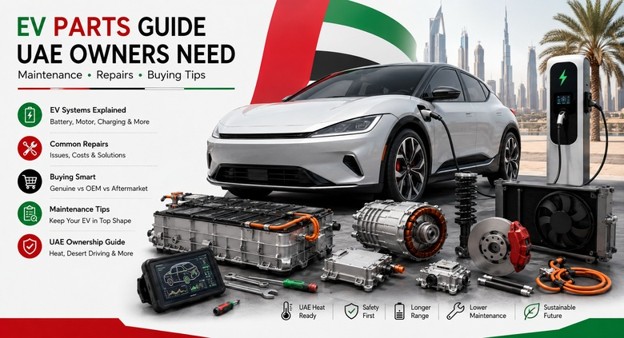
Understanding EV Car Parts in the UAE
Why EV Car Parts Matter More Than Ever in the UAE
Electric vehicles have moved well beyond novelty in the UAE, though you could argue that the pace of change has caught many owners slightly off guard because buying an EV is one thing, living with it every day is something else entirely, particularly once the conversation shifts away from glossy brochures and impressive driving ranges to the less glamorous subject of maintenance, replacement components and long-term reliability. That's where ownership really begins.
Take a drive through Dubai, Abu Dhabi or Sharjah and you'll notice it almost immediately. Teslas sit beside BYDs at charging stations, Hyundai Ioniq 5s weave quietly through commuter traffic, and the MG4, once considered an outsider, has become a familiar sight in residential communities. The roads have changed.
So has the aftermarket.
The demand for reliable EV car parts in UAE is growing, not because electric vehicles break down more often than conventional cars, but because more people now own them, keep them longer and inevitably face the same question sooner or later. What happens when a component needs replacing?
That question matters more than many first-time owners realise.
Electric vehicles remove plenty of familiar maintenance jobs. No engine oil. No spark plugs. No exhaust system. Wonderful. Yet they replace those mechanical routines with a network of sophisticated electrical systems which, while remarkably dependable, don't simply look after themselves forever.
Every journey relies on hundreds of decisions being made inside the vehicle long before the driver notices anything unusual. The battery continuously regulates temperature. The Battery Management System monitors thousands of individual cells. The inverter converts electrical current in milliseconds. Cooling circuits quietly work away beneath the surface, particularly during a UAE summer when outside temperatures push well beyond what most European manufacturers originally tested against. None of this attracts attention until something starts to drift outside its normal operating range.
Then reality catches up.
Many owners still assume an electric vehicle requires almost no maintenance because that's often how EV ownership is presented. It's an understandable misunderstanding. Electric cars certainly eliminate many wear items found in petrol and diesel vehicles, although replacing those systems with high-voltage electronics, thermal management hardware and sophisticated software hardly makes them maintenance-free. It simply changes the maintenance altogether.
The UAE adds another layer of complexity.
Extreme temperatures linger for months. Fine desert dust finds its way into cooling assemblies and filtration systems. Long motorway journeys between Dubai and Abu Dhabi generate sustained battery temperatures, while stop-start urban traffic asks cooling systems, braking components and power electronics to perform under entirely different conditions, all within the same day. The environment never really gives an EV a day off.
Which brings us to replacement parts.
Choosing an EV component isn't simply about finding the lowest price or clicking the first online listing that appears. Compatibility matters. Build quality matters. Thermal performance matters. Even software compatibility can influence whether a replacement component performs exactly as intended or quietly creates a chain of expensive faults somewhere else inside the vehicle.
Spend wisely now.
Or spend much more later.
Key Takeaways
| Topic | Why It Matters |
| EV ownership continues to grow across the UAE | Demand for specialist replacement parts and qualified servicing is increasing every year. |
| Electric vehicles use different technologies | High-voltage systems replace many traditional mechanical components. |
| UAE driving conditions accelerate wear on certain systems | Heat, dust, motorway driving and frequent charging all influence component longevity. |
| Quality replacement parts reduce long-term costs | Reliable components improve safety, efficiency and vehicle reliability. |
| Understanding EV systems helps owners make better decisions | Informed buyers avoid unnecessary repairs and costly compatibility mistakes. |
How Electric Cars Differ from Petrol and Diesel Vehicles
At first glance, an electric vehicle doesn't look especially revolutionary.
Four wheels. Steering wheel. Seats. Suspension. Brakes. Everything appears reassuringly familiar until you lift the bonnet, or rather, until you realise what isn't there.
A conventional petrol engine is a remarkably busy machine. Fuel burns thousands of times every minute, pistons race up and down inside cylinders, valves open and close continuously, lubricating oil circulates through intricate passages and the exhaust system spends its entire life dealing with combustion by-products. Hundreds of moving parts, all relying on one another, simply to keep the vehicle moving.
An electric vehicle approaches the same task from a completely different direction.
Instead of creating power through combustion, it stores electricity inside a high-voltage battery before sending that energy through sophisticated power electronics to one or more electric motors. Fewer moving parts? Certainly. Simpler overall? Not necessarily.
One layer disappears.
Another takes its place.
Gone are oil filters, timing belts, spark plugs and fuel pumps, yet in their place arrive battery cooling systems, inverters, DC-DC converters, onboard chargers, battery management software and high-voltage wiring, each performing highly specialised tasks while constantly communicating with every other system inside the vehicle.
It's easy to underestimate that complexity because most of it happens invisibly.
Until it doesn't.
Most Common EV Car Parts and Their Functions
Ask someone what powers an electric vehicle and they'll probably answer, "The battery."
They're right.
They're also only telling part of the story.
An EV depends on an entire ecosystem of interconnected components, each designed to support efficiency, performance, charging capability and long-term reliability. If one system begins to struggle, another often compensates for it, at least for a while, which explains why diagnosing electric vehicles requires considerably more than replacing whichever part appears faulty first.
The core components include:
| EV Component | Primary Function |
| High-voltage battery pack | Stores electrical energy used to power the vehicle. |
| Electric motor | Converts electrical energy into mechanical movement. |
| Battery Management System (BMS) | Monitors battery condition, temperature and charging behaviour. |
| Inverter | Converts DC battery power into AC power for the motor. |
| DC-DC converter | Supplies electricity to the 12-volt electrical system. |
| Onboard charger | Controls AC charging from domestic and public charging points. |
| Charging port | Connects the vehicle to external charging equipment. |
| Battery cooling system | Maintains safe battery operating temperatures. |
| Regenerative braking system | Recovers energy during deceleration. |
| High-voltage cables | Transfer electrical energy safely between major systems. |
| HVAC or heat pump system | Controls cabin temperature while improving efficiency. |
| 12-volt auxiliary battery | Powers vehicle electronics and control modules. |
Notice something?
Almost every component depends on another.
A battery cooling fault may reduce charging performance. A deteriorating auxiliary battery can trigger seemingly unrelated warning messages. Software might identify a fault long before the driver notices anything unusual. That's why replacing parts in isolation rarely solves the bigger picture.
Why Electric Vehicles Need a Different Maintenance Strategy
People often ask whether electric vehicles need servicing.
Yes.
Just not the servicing many drivers grew up expecting.
Brake pads may last considerably longer because regenerative braking reduces mechanical wear, although brake discs still deserve regular inspection because corrosion doesn't disappear simply because friction decreases.
Battery care becomes part of normal ownership too. Frequent rapid charging, repeated exposure to extreme temperatures, consistently charging to maximum capacity and ignoring software updates can all influence battery health over time, even though those effects usually appear gradually rather than overnight.
Tyres tell a similar story.
Electric vehicles are typically heavier than comparable petrol cars, largely because of their battery packs, while instant torque delivers tremendous acceleration the moment power reaches the wheels. Great fun to drive. Less enjoyable when tyres wear out sooner than expected because rotations and wheel alignments were neglected.
Maintenance hasn't disappeared.
It's evolved.
Owners who understand that difference usually spend less, experience fewer unexpected repairs and keep their vehicles performing exactly as the manufacturer intended, which, in the long run, is perhaps the smartest investment any EV owner can make.
Key Takeaways
- Electric vehicles rely on specialised electrical, electronic and thermal systems rather than conventional engine components.
- High-voltage batteries, power electronics and cooling systems sit at the centre of long-term EV reliability.
- The UAE's climate creates additional challenges that every electric vehicle owner should understand before buying replacement parts.
- Careful maintenance, correct charging habits and compatible replacement components help reduce ownership costs over time.
- Understanding how EV systems work today makes future repair decisions simpler, safer and considerably more cost-effective.
The Heart of an Electric Vehicle
High-Voltage Battery Pack: Components, Lifespan and Replacement Costs
Ask any technician what the single most valuable component inside an electric vehicle is and you'll almost always hear the same answer. The battery pack.
That isn't surprising because the high-voltage battery doesn't simply store electricity. It determines how far the vehicle travels, how quickly it accelerates, how efficiently it charges and, perhaps most importantly, how much the car will be worth several years from now. Everything seems to circle back to battery health.
Think of the battery pack as a carefully organised community rather than one giant battery.
Inside the aluminium housing sit hundreds, sometimes thousands, of individual lithium-ion cells, grouped into modules and monitored continuously by sensors, cooling channels and sophisticated electronics, all working together because a single weak cell can influence the performance of the entire pack. One tiny problem. Bigger consequences.
Several major components work together inside a modern EV battery system.
| Battery Component | Primary Purpose |
| Battery Cells | Store electrical energy |
| Battery Modules | Group multiple cells into manageable units |
| Battery Pack Housing | Protects internal components from damage |
| Battery Management System (BMS) | Monitors voltage, temperature and charging behaviour |
| Cooling System | Maintains safe operating temperatures |
| High-Voltage Connectors | Transfer electrical power safely |
| Safety Contactors | Disconnect power during faults or accidents |
| Temperature Sensors | Continuously monitor battery conditions |
Every component has a job.
Miss one, and the entire system feels the effect.
How long should an EV battery actually last?
It's one of the first questions buyers ask, and for good reason.
Under normal driving conditions, many modern battery packs are designed to remain effective for eight to fifteen years, although real-world lifespan depends on far more than age alone. Charging habits matter. Climate matters. Mileage matters. Even where the vehicle spends most of its life matters.
The UAE creates a particularly demanding environment.
Extreme heat doesn't automatically destroy a battery, despite what you might read online, yet prolonged exposure to high temperatures can accelerate chemical ageing if thermal management systems struggle to keep temperatures under control. Add frequent rapid charging, heavy motorway driving and repeated full-charge cycles into the equation, and the battery works considerably harder than many owners appreciate.
That doesn't mean every battery will fail early.
Far from it.
Most well-maintained EVs lose capacity gradually rather than suddenly, which explains why owners often notice reduced driving range long before any warning light appears.
Replacement costs naturally become the next concern.
Battery prices vary enormously because capacity, chemistry and manufacturer all influence the final figure, although replacing an entire battery pack remains one of the most expensive repairs an EV owner can face. Fortunately, complete battery replacement isn't always necessary. Individual modules, damaged connectors, cooling components or battery control systems can sometimes be repaired or replaced independently, reducing overall costs significantly after proper diagnosis.
Jumping straight to a full battery replacement?
Not always the smartest move.
Estimated Battery Replacement Costs in the UAE
| Vehicle Category | Estimated Replacement Cost (AED) |
| Small Electric Hatchback | 18,000 to 35,000 |
| Family Electric SUV | 30,000 to 60,000 |
| Premium Electric Vehicle | 45,000 to 90,000+ |
| Luxury Performance EV | 70,000 to 150,000+ |
Actual costs depend on battery size, manufacturer, labour requirements, warranty coverage and whether new, genuine, OEM or reconditioned components are used.
Battery Cooling Systems and Thermal Management
Heat is the quiet enemy of every lithium-ion battery.
Not dramatic.
Not immediate.
Just persistent.
A battery performs best within a relatively narrow temperature range, which means modern electric vehicles spend a surprising amount of time managing heat rather than simply delivering power. That's where thermal management steps in.
Battery cooling systems circulate coolant around the battery pack, transferring excess heat away from sensitive cells before temperatures climb high enough to affect performance or long-term durability. During rapid charging, this becomes even more important because charging generates additional heat throughout the battery.
Now imagine the same process taking place during a July afternoon in Dubai.
Outside temperatures approach 48°C.
The road surface feels even hotter.
The battery has already been working through heavy commuter traffic before arriving at a fast charger.
Everything inside the cooling system suddenly becomes critical.
If coolant circulation slows, sensors detect abnormal temperatures or cooling pumps begin wearing out, the Battery Management System often responds by limiting charging speed or reducing available power. Drivers sometimes assume the charger is faulty.
It isn't.
The vehicle is protecting itself.
Regular inspection of coolant levels, pumps, hoses and heat exchangers helps identify small issues before they develop into expensive battery-related repairs, particularly in regions where high ambient temperatures remain part of everyday driving.
Cooling isn't optional.
It's protection.
Battery Management System (BMS): The Hidden Brain Behind Every EV
Drivers rarely think about the Battery Management System.
That's understandable because you never actually see it working.
Yet every second your vehicle is switched on, the BMS quietly monitors voltage, temperature, charging rates, individual cell balance and dozens of additional operating parameters, making tiny adjustments that protect battery health while maximising efficiency.
Without it, modern electric vehicles simply wouldn't function safely.
Imagine filling a swimming pool using several hundred hoses, each delivering water at a slightly different rate.
Chaos.
The Battery Management System prevents that kind of imbalance by ensuring battery cells charge and discharge evenly, reducing stress throughout the entire pack and helping preserve long-term capacity.
It also provides an early warning.
If temperatures begin rising unexpectedly, if one module starts behaving differently from the others or if voltage falls outside safe operating limits, the system records the fault and alerts technicians before a relatively small issue grows into a major repair.
That's clever engineering.
And extremely expensive to ignore.
Charging Habits That Increase Battery Life
Most battery degradation happens gradually.
Often because of everyday habits.
Charging to 100% every single day sounds sensible, although many manufacturers actually recommend stopping around 80% for routine use unless maximum range is genuinely needed. Likewise, allowing the battery to remain almost empty for extended periods places unnecessary stress on lithium-ion cells.
Consistency usually beats extremes.
Rapid charging deserves attention too.
Fast chargers are incredibly convenient, particularly during long journeys between emirates, yet relying on them exclusively increases thermal stress inside the battery. Mixing slower AC charging with occasional DC fast charging generally creates a healthier long-term charging routine.
Simple habits make a difference.
Park in shaded areas whenever possible.
Pre-condition the battery before rapid charging if your vehicle supports it.
Keep software updated.
Avoid repeated full discharge cycles.
Little changes today often prevent bigger bills tomorrow.
Fast Charging vs Slow Charging: Long-Term Effects
Everyone loves convenience.
Nobody enjoys waiting.
That's exactly why DC fast charging has transformed EV ownership across the UAE, allowing drivers to recover hundreds of kilometres of range during relatively short stops. Brilliant for busy schedules.
Not quite so brilliant if used for absolutely everything.
Fast charging pushes large amounts of electrical energy into the battery within a short period, generating additional heat which, although carefully managed by cooling systems, still contributes to long-term battery ageing when repeated excessively.
Slow AC charging works differently.
Lower charging speeds generate less heat, place reduced stress on battery cells and generally support healthier long-term battery performance. It takes longer, of course, although overnight home charging often fits naturally into daily routines without creating unnecessary battery strain.
So which approach is best?
Neither on its own.
A balanced charging routine, combining regular AC charging with occasional DC fast charging when genuinely needed, usually offers the most practical compromise between convenience, efficiency and long-term battery health.
Key Takeaways
- The high-voltage battery pack is the most valuable and technically sophisticated component in any electric vehicle.
- Battery lifespan depends on charging habits, temperature, mileage, maintenance and overall vehicle use rather than age alone.
- Thermal management systems play a vital role in protecting battery performance, particularly under demanding UAE conditions.
- The Battery Management System continuously monitors battery health, balances individual cells and helps prevent serious faults before they escalate.
- Smart charging habits, routine inspections and early diagnosis help preserve battery capacity, reduce ownership costs and keep an electric vehicle performing reliably for many years.
Electric Drivetrain and Power Electronics
Electric Motor: Common Problems, Lifespan and Maintenance
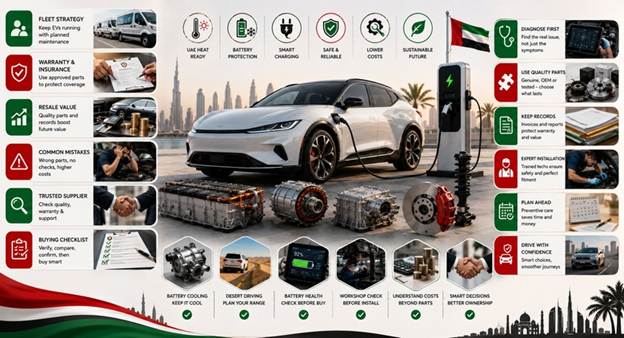
An electric motor looks deceptively simple. No roaring engine. No pistons. No timing chain. Yet press the accelerator and it delivers instant torque with barely a whisper.
That's the beauty of it.
Unlike an internal combustion engine, an electric motor contains far fewer moving parts, which naturally reduces routine maintenance. Fewer components rubbing together means fewer opportunities for wear. It sounds ideal because, in many ways, it is.
That doesn't mean failures never happen.
Electric motors can still develop bearing wear, insulation breakdown, overheating issues or contamination from moisture and debris, particularly if the vehicle has been involved in flooding or sustained impact damage. These faults don't always appear overnight.
They creep in.
Drivers often notice subtle changes first. A faint humming noise. Slight vibration under acceleration. Reduced power. Unexpected warning messages. Small clues, perhaps, although they rarely appear without a reason.
Heat plays its part too.
While EV motors are designed to operate efficiently in demanding environments, prolonged exposure to extreme temperatures, aggressive driving and repeated high-load acceleration can increase thermal stress over time, especially if the cooling system isn't performing as it should.
Routine inspections still matter.
Checking cooling systems, monitoring software updates and investigating unusual noises early can prevent relatively minor issues from becoming expensive repairs. Waiting rarely saves money.
Common Electric Motor Problems
| Problem | Likely Cause | Possible Effect |
| Bearing wear | High mileage or contamination | Noise and vibration |
| Overheating | Cooling system issues | Reduced performance |
| Moisture ingress | Flood or water exposure | Electrical faults |
| Insulation failure | Age or excessive heat | Power loss |
| Sensor faults | Electrical issues | Warning lights and reduced efficiency |
Inverter, Converter and Power Electronics Explained
Most drivers never think about the inverter.
They probably should.
Without it, the battery couldn't power the electric motor because the electricity stored inside the battery isn't delivered in the form the motor actually needs. The inverter quietly converts direct current into alternating current thousands of times every second.
It's constantly working.
Alongside it sits the DC-DC converter.
Its job seems less dramatic, although it's just as important because it supplies electricity to the vehicle's 12-volt systems, powering lighting, infotainment, safety equipment and dozens of electronic control modules. Lose the converter and many everyday vehicle functions begin to disappear surprisingly quickly.
Power electronics dislike one thing above all else.
Excessive heat.
That's worth remembering in the UAE, where summer temperatures push cooling systems harder than they would in many other parts of the world. If thermal management begins to struggle, sensitive electronic components may reduce performance to protect themselves.
The vehicle isn't malfunctioning.
It's looking after itself.
Charging Ports, Connectors and Onboard Chargers
Charging looks straightforward from the outside.
Plug in. Wait. Drive away.
Behind that simple routine sits a collection of hardware working together every time electricity flows into the vehicle. The charging port creates the physical connection. The onboard charger manages incoming AC power. Multiple sensors continuously monitor voltage, temperature and communication between the vehicle and the charging station.
Everything has to agree.
Dust, corrosion, damaged connector pins or worn charging cables can interrupt that process. Sometimes charging slows down. Sometimes it stops completely. Occasionally the issue isn't the vehicle at all.
It's the charger.
Frequent inspections help identify cracked seals, loose connectors or signs of overheating before they lead to more serious electrical faults. A few minutes spent checking charging equipment can prevent hours of frustration later.
Don't overlook the obvious.
High-Voltage Wiring and Electrical Safety
Electric vehicles carry far more electrical energy than conventional cars.
That alone changes the approach to repairs.
Bright orange high-voltage cables run throughout the vehicle, connecting the battery, inverter, electric motor and other major systems. Their colour isn't cosmetic.
It's a warning.
These cables are heavily insulated and engineered to withstand demanding conditions, although physical damage, poor repairs or accident-related impacts can compromise their integrity. Even if the outer covering appears intact, hidden damage may still exist beneath the surface.
That's why trained technicians always inspect high-voltage wiring carefully after significant collisions or major electrical faults. Guesswork has no place here.
Safety comes first.
Never attempt repairs on high-voltage systems without the correct training, equipment and isolation procedures. The risks are simply too great.
Key Takeaways
- Electric motors require less routine maintenance than petrol engines but still need regular inspections.
- Bearings, cooling systems and electrical insulation remain common areas for long-term wear.
- Inverters and DC-DC converters quietly manage power throughout the vehicle and are essential for normal operation.
- Charging ports, connectors and onboard chargers should be inspected regularly to maintain reliable charging performance.
- High-voltage wiring demands specialist handling because correct diagnosis, safe repairs and compatible replacement parts protect both the vehicle and everyone working on it.
Braking, Suspension and Daily Driving
Regenerative Braking System and Brake Component Wear
Braking in an electric vehicle feels different, even if you don't notice it straight away.
Lift your foot off the accelerator and the car often begins to slow down before you've even touched the brake pedal. That's regenerative braking at work.
Instead of wasting energy as heat, the electric motor reverses its role and sends electricity back into the battery. Clever engineering. Everyday benefit.
Brake pads usually last much longer because they're used less often.
That's the good news.
The catch is that brake discs can develop surface corrosion if the friction brakes aren't used regularly. It catches some owners by surprise because worn brake pads aren't always the first concern.
Rust can be.
Heavy stop-start traffic in Dubai or Sharjah encourages regenerative braking to do most of the work, while motorway driving between Abu Dhabi and Al Ain often means the conventional brakes remain idle for longer periods.
Different driving habits create different wear patterns.
The solution isn't complicated.
Use the mechanical brakes occasionally, particularly during safe driving conditions, and have the braking system inspected during routine servicing. Small checks keep bigger repairs at bay.
Signs Your EV Braking System Needs Attention
| Symptom | Possible Cause |
| Grinding noise | Corroded brake discs |
| Squeaking brakes | Worn pads or surface contamination |
| Reduced braking feel | Brake fluid or hydraulic issues |
| Warning light | ABS or braking system fault |
| Vibration while braking | Warped or uneven brake discs |
EV Suspension Components and Their Importance
Electric vehicles carry a hidden burden.
Weight.
Large battery packs add hundreds of kilograms compared with many petrol-powered equivalents, which means suspension components work harder every single day, whether you're driving through city traffic or cruising along open motorways.
That extra weight doesn't automatically create problems.
It simply increases the importance of keeping the suspension in good condition.
Shock absorbers, springs, control arms, bushes and anti-roll bars all absorb constant punishment from uneven roads, speed humps and potholes. Add fully loaded family journeys or weekend trips into the mountains, and those components rarely get much of a break.
Wear usually develops gradually.
The steering may feel less precise.
The ride becomes unsettled.
Tyres start wearing unevenly.
None of these symptoms should be ignored because suspension issues rarely improve by themselves.
Suspension Components That Commonly Wear
| Component | Why It Matters |
| Shock absorbers | Maintain ride comfort and stability |
| Suspension bushes | Reduce vibration and absorb movement |
| Ball joints | Support steering and suspension movement |
| Control arms | Keep wheel alignment stable |
| Anti-roll bar links | Improve cornering stability |
Steering Components in Electric Vehicles
Electric power steering has transformed modern driving.
Parking takes less effort.
Motorway cruising feels more relaxed.
The system quietly adjusts steering assistance depending on speed, giving drivers confidence without demanding constant correction.
Most electric steering systems are highly reliable.
Still, they aren't immune to wear.
Steering racks, tie rods, sensors and electronic control units can all develop faults over time, particularly after repeated impacts with kerbs or deep potholes. Sometimes the warning signs are subtle.
A slight knock.
Uneven steering weight.
A dashboard warning.
Pay attention.
Minor steering issues often cost far less to fix than major steering failures.
Tyres Designed for Electric Cars
Tyres deserve far more attention than they usually receive.
They're the only parts touching the road.
Electric vehicles produce maximum torque almost instantly, which feels fantastic from behind the wheel but places additional stress on tyre tread, especially during quick acceleration.
Weight plays another role.
Battery packs increase vehicle mass, meaning tyres support greater loads while maintaining grip, braking performance and efficiency. That's why many manufacturers fit EV-specific tyres with reinforced construction and lower rolling resistance.
Choosing cheaper alternatives isn't always the bargain it appears.
The wrong tyre can reduce driving range, increase road noise and compromise handling.
Regular tyre pressure checks, wheel balancing and rotations help maximise tyre life while keeping the vehicle efficient.
Simple habits.
Big savings.
Tyre Maintenance Checklist
| Maintenance Task | Recommended Frequency |
| Check tyre pressure | Every two weeks |
| Inspect tread depth | Monthly |
| Rotate tyres | Every 10,000 to 12,000 km |
| Wheel alignment | Annually or after heavy impacts |
| Wheel balancing | Whenever vibration develops |
HVAC Systems and Heat Pumps
Comfort matters.
Battery efficiency does too.
Modern electric vehicles use either conventional HVAC systems or advanced heat pumps to control cabin temperature while minimising energy consumption. Unlike petrol vehicles, they can't rely on waste engine heat during winter or cooler evenings.
Every degree matters.
Heat pumps are particularly efficient because they transfer existing heat instead of generating it from scratch, helping preserve battery range during climate control.
Like any mechanical system, though, they still require maintenance.
Refrigerant leaks, failing compressors, blocked condensers and faulty sensors can reduce cooling performance or increase battery consumption.
If the cabin struggles to cool down during a UAE summer, don't automatically assume the battery is responsible.
The climate control system may be the real culprit.
Cabin Filters and Air Quality Components
Dust is unavoidable in the UAE.
Your cabin filter knows that better than anyone.
Every journey pulls outside air into the vehicle, carrying fine dust, pollen and airborne particles that gradually clog the filter. Ignore it for long enough and airflow begins to suffer.
The cabin feels stuffy.
Air conditioning works harder.
Passengers notice unpleasant smells.
Replacing a cabin filter is one of the simplest maintenance jobs an EV owner can carry out, yet it's frequently overlooked because the vehicle continues driving normally.
Comfort slowly disappears.
Efficiency follows.
12-Volt Auxiliary Battery: Why It Still Matters
Here's a question many new EV owners ask.
"If my car has a huge battery pack, why does it still need a small 12-volt battery?"
Because almost every control system depends on it.
The auxiliary battery powers lights, locks, safety systems, infotainment, electronic modules and, crucially, helps activate the high-voltage system during start-up. If the 12-volt battery fails, the vehicle may refuse to drive despite the main battery being fully charged.
It's a surprisingly common workshop visit.
Fortunately, it's also one of the easiest problems to prevent.
Routine battery testing, clean terminals and timely replacement help avoid inconvenient breakdowns and unnecessary recovery costs.
Don't let the smallest battery become the biggest inconvenience.
Key Takeaways
- Regenerative braking reduces brake pad wear but increases the need to monitor brake disc condition.
- Suspension and steering components work harder because EVs are generally heavier than conventional vehicles.
- EV-specific tyres improve safety, efficiency and driving range when correctly maintained.
- HVAC systems, heat pumps and cabin filters contribute to both comfort and battery efficiency.
- The 12-volt auxiliary battery remains essential because it supports the electronic systems that allow the entire vehicle to operate safely and reliably.
Technology, Electronics and Everyday Reliability
Sensors, Cameras and Advanced Driver Assistance Components
Modern electric vehicles don't just drive.
They watch, measure, calculate and react.
Look around your EV and you'll find cameras tucked into mirrors, radar units hidden behind bumpers and ultrasonic sensors sitting quietly around the bodywork. Most owners barely notice them until a warning pops up on the dashboard.
Then everything changes.
These components support features such as adaptive cruise control, automatic emergency braking, lane-keeping assistance, blind-spot monitoring and parking assistance. They work together constantly, exchanging information in milliseconds.
One faulty sensor can confuse the whole system.
That's why replacing a damaged bumper after even a low-speed collision isn't always as simple as fitting new plastic. The radar behind it may also need recalibration, while cameras often require precise alignment before the safety systems operate correctly again.
Accuracy matters.
Guesswork doesn't.
Common ADAS Components
| Component | Primary Function |
| Front radar | Adaptive cruise control |
| Rear radar | Blind-spot monitoring |
| Front camera | Lane recognition and traffic signs |
| Parking sensors | Obstacle detection |
| Surround-view cameras | Parking assistance |
| Ultrasonic sensors | Low-speed manoeuvring |
Infotainment Systems and Software Hardware
People often think of the infotainment screen as little more than a large tablet.
It isn't.
That display controls navigation, climate settings, charging schedules, battery information and, in many vehicles, critical system functions. If the hardware or software begins playing up, daily ownership quickly becomes frustrating.
A frozen screen isn't always a screen problem.
It could stem from outdated software, a communication fault between control modules or even a weakening 12-volt battery affecting electronic stability. Modern vehicles depend on dozens of computers working together, so one fault sometimes appears somewhere completely different.
Technology can be clever.
It can also be confusing.
Keeping software updated is one of the simplest ways to improve reliability because manufacturers regularly release updates that fix bugs, improve charging performance and refine battery management.
Don't ignore update notifications.
They exist for a reason.
Common EV Warning Lights and What They Mean
Dashboard warning lights rarely appear without explanation.
They're the vehicle's way of asking for attention before a small issue grows into a larger one.
Some warnings demand immediate action.
Others simply suggest booking an inspection.
Knowing the difference can save both time and money.
Common EV Warning Lights
| Warning | What It Could Mean |
| Battery warning | High-voltage battery issue |
| Charging system warning | Charging fault or connector problem |
| Motor warning | Electric motor or inverter fault |
| ABS warning | Braking system issue |
| Steering warning | Electric power steering fault |
| High-voltage alert | Electrical system requires immediate inspection |
Don't panic if a warning appears.
Read the message.
Avoid guessing.
And if the warning persists, arrange a professional inspection before continuing long journeys.
Waiting rarely improves electrical faults.
Most Common EV Faults Seen in UAE Workshops
No vehicle is immune to wear.
Electric cars are no exception.
Interestingly, many workshop visits aren't caused by catastrophic battery failures. They're triggered by smaller issues that have gradually built up over months of everyday driving.
Charging faults are common.
Auxiliary batteries fail more often than many owners expect.
Cooling pumps wear.
Sensors lose calibration.
Charging connectors become damaged after repeated use.
Software occasionally develops communication errors following incomplete updates.
The UAE climate adds another challenge.
High temperatures place additional demand on cooling systems, while dust can gradually affect electrical connectors and cooling assemblies if routine inspections are overlooked.
Most faults start small.
Ignoring them allows them to grow.
Common Workshop Repairs
| Fault | Typical Cause |
| Charging problems | Damaged port or onboard charger |
| Cooling system issues | Pump, hose or coolant fault |
| Sensor malfunction | Impact damage or contamination |
| Auxiliary battery failure | Age or charging issues |
| Communication errors | Software or control module fault |
| Cooling fan problems | Heat-related wear |
Preventative Maintenance Checklist for EV Owners
The easiest repair is the one you never need.
That sounds obvious.
Yet preventative maintenance is still one of the most overlooked parts of EV ownership because many drivers assume electric vehicles require almost no attention.
Reality says otherwise.
You don't need monthly engine servicing, but you do need regular inspections that focus on the systems electric vehicles actually depend upon.
A few minutes today can prevent days of inconvenience later.
Preventative Maintenance Checklist
| Maintenance Item | Suggested Interval |
| Inspect charging port | Monthly |
| Check tyre pressures | Every two weeks |
| Test 12-volt battery | Every service |
| Inspect brake discs | Every service |
| Replace cabin filter | Every 15,000 to 20,000 km |
| Check battery cooling system | Annually |
| Install software updates | Whenever available |
| Inspect suspension and steering | Every service |
Don't wait for warning lights.
Listen for unusual noises.
Pay attention to changes in charging speed.
Notice how the vehicle feels.
Electric cars are remarkably good at telling you something isn't quite right, although they usually do it quietly.
Key Takeaways
- Cameras, radar units and sensors support many of the safety features modern EV owners rely on every day.
- Infotainment systems and software updates influence far more than entertainment because they also affect vehicle performance and reliability.
- Dashboard warning lights should never be dismissed without understanding their cause.
- Most EV workshop repairs involve charging systems, cooling components, sensors or auxiliary batteries rather than complete battery failure.
- Routine inspections, timely software updates and preventative maintenance remain the most effective ways to reduce repair costs, improve reliability and keep an electric vehicle performing at its best for years to come.
Buying Replacement EV Parts
Genuine vs OEM vs Aftermarket EV Parts
Buying an EV part sounds simple.
Until you actually start searching.
Within minutes you'll come across genuine parts, OEM components, aftermarket alternatives and prices that vary wildly for what appears to be the same item. It's confusing because, sometimes, the differences aren't immediately obvious.
Let's clear that up.
A genuine part is supplied through the vehicle manufacturer and usually carries the brand's logo. In many cases, it's produced by the same company that originally manufactured the component for the vehicle.
An OEM part comes from that original manufacturer but is sold without the vehicle brand's packaging.
Same factory.
Different box.
Aftermarket parts are produced by independent manufacturers.
Some are exceptionally good.
Others cut corners to reduce costs.
That's why choosing solely on price can become an expensive mistake, especially when dealing with battery cooling systems, charging components or high-voltage electronics where precision matters just as much as durability.
Saving a few hundred dirhams today could lead to thousands in repairs later.
Genuine vs OEM vs Aftermarket
| Option | Advantages | Considerations |
| Genuine | Exact fit, manufacturer-backed quality | Usually the highest price |
| OEM | Original quality with better value | Availability may vary |
| Aftermarket | Wide choice and lower cost | Quality depends on manufacturer |
There's no universal winner.
The right choice depends on the component, the vehicle and your long-term ownership plans.
New vs Used vs Reconditioned EV Components
Not every replacement part needs to be brand new.
Equally, not every used component is worth buying.
Understanding the difference matters because EV parts aren't all exposed to the same levels of wear. A used interior trim panel presents very little risk. A used high-voltage battery without documented health data is a completely different story.
Context changes everything.
Reconditioned components occupy the middle ground.
These parts are inspected, repaired where necessary and tested before being offered for sale again. When rebuilt by reputable specialists, they can provide an excellent balance between cost and reliability.
The key word?
Reputable.
Always ask how the component was tested, whether diagnostic reports are available and what warranty accompanies the purchase. If those questions can't be answered clearly, walk away.
Comparing Replacement Options
| Option | Best For | Risk Level |
| New | Long-term ownership | Low |
| Used | Cosmetic and non-critical parts | Medium |
| Reconditioned | Expensive mechanical or electrical components | Low to Medium |
A cheap part isn't always good value.
A well-tested part usually is.
Repair or Replace? Making the Right Decision
Every repair creates a decision.
Fix what's there or replace it completely?
The answer isn't always obvious because replacing an entire assembly often feels safer, although repairing a single faulty component can sometimes deliver exactly the same outcome at a fraction of the cost.
Take an onboard charger.
If one electronic module has failed, replacing the complete unit may be unnecessary after proper diagnosis. The same principle applies to battery packs, where a damaged module doesn't automatically mean the whole battery has reached the end of its life.
Diagnosis comes first.
Parts come second.
Age, mileage, repair history, warranty cover and future ownership plans should all influence the decision. A driver planning to keep the vehicle for another eight years may choose differently from someone preparing to sell within six months.
There isn't one correct answer.
There is only the answer that best fits your situation.
VIN and Compatibility Checks Before Purchasing EV Parts
Two electric vehicles may look identical.
They may even share the same model year.
That doesn't guarantee they'll use the same replacement parts.
Battery capacities differ.
Software versions change.
Manufacturers revise components throughout production without making obvious visual changes. Ordering based purely on appearance is one of the quickest ways to buy the wrong part.
The Vehicle Identification Number changes that.
A VIN check confirms exactly which components were fitted when the vehicle left the factory, reducing compatibility issues and helping suppliers identify the correct replacement the first time.
Five minutes spent checking compatibility can prevent weeks of unnecessary delays.
Don't skip it.
Compatibility Checklist
| Check | Why It's Important |
| VIN verification | Confirms correct component specification |
| Part number match | Avoids installation problems |
| Software compatibility | Prevents communication faults |
| Connector type | Ensures proper electrical connection |
| Battery specification | Confirms correct voltage and capacity |
Questions to Ask Before Ordering EV Components
Buying confidently starts with asking better questions.
Not awkward questions.
Useful ones.
Ask whether the component has been tested.
Ask if diagnostic reports are available.
Ask about warranty length, return policies and software compatibility.
Ask where the part came from.
A reputable supplier won't hesitate.
In fact, they'll usually welcome informed buyers because they know transparency builds trust.
Silence, vague answers or constant attempts to change the subject should immediately raise concerns.
That's your signal.
Keep looking.
Red Flags When Choosing an EV Parts Supplier
The supplier matters almost as much as the part itself.
A genuine-looking component supplied by an unreliable seller can quickly become a costly problem if there's no warranty, no technical support and no way of verifying where the part originated.
Watch for warning signs.
Prices that seem unbelievably low.
No documented testing.
Missing serial numbers.
Poor communication.
Pressure to buy immediately.
No physical business address.
No warranty.
Individually, these issues may not prove dishonesty.
Together?
They're difficult to ignore.
Trust your instincts.
If something feels wrong, it probably deserves a second look.
Key Takeaways
- Genuine, OEM and aftermarket EV parts each have advantages when chosen for the right application.
- Used and reconditioned components can offer excellent value, provided they've been properly inspected and tested.
- Accurate diagnosis should always come before replacing expensive electrical components.
- VIN verification and compatibility checks reduce costly purchasing mistakes.
- Choosing a knowledgeable, transparent supplier is one of the most effective ways to protect both your investment and your vehicle's long-term reliability.
UAE Ownership Challenges
How UAE Heat Affects EV Components
Owning an electric vehicle in the UAE isn't the same as owning one in Northern Europe or North America.
The climate changes the conversation.
Summer temperatures regularly climb above 45°C, while the road surface can become even hotter, meaning your EV isn't just dealing with warm air. It's surrounded by heat from every direction.
Can modern EVs cope?
Yes, they can.
They're engineered for demanding conditions, although that doesn't mean extreme heat has no effect. Batteries, cooling systems, tyres and power electronics all work harder to maintain safe operating temperatures, particularly during long journeys or repeated fast-charging sessions.
The battery feels it first.
Lithium-ion batteries perform best within a controlled temperature range, so when the surrounding environment becomes exceptionally hot, the cooling system has to work continuously to keep everything stable. If it struggles, the Battery Management System may reduce charging speeds or limit power output to protect the battery.
The car isn't failing.
It's protecting itself.
Parking habits matter too.
Leaving an EV in direct sunlight every day won't instantly damage the battery, yet repeated exposure to excessive heat can gradually increase thermal stress over the years. A shaded parking space, underground car park or covered charging area may seem like a small choice.
It isn't.
Those simple habits can help preserve battery health over the long term.
EV Components Most Affected by UAE Heat
| Component | Effect of Extreme Heat |
| High-voltage battery | Increased thermal stress |
| Battery cooling system | Works for longer periods |
| Inverter | Higher operating temperatures |
| Charging equipment | May reduce charging speed |
| Tyres | Faster pressure changes and wear |
| Air conditioning system | Increased workload |
Desert Driving and Battery Performance
Desert driving offers an experience few countries can match.
It also asks far more of your vehicle.
Soft sand increases rolling resistance dramatically, forcing the electric motor to deliver higher levels of torque for extended periods. More power means more energy consumption.
Range drops.
That's perfectly normal.
Battery temperatures can also rise more quickly during off-road driving because the vehicle spends longer working under sustained load while travelling at relatively low speeds. The cooling system has little opportunity to recover.
Planning becomes essential.
Heading into the desert with a partially charged battery is rarely a sensible idea, especially if charging infrastructure isn't available nearby. Recovery vehicles aren't always close either.
Preparation beats optimism.
Lower tyre pressures improve traction on sand, although they should always be restored before returning to normal roads. Driving on underinflated tyres at motorway speeds creates unnecessary heat and increases tyre wear.
One environment.
Two different setups.
EV Parts That Commonly Wear Out Together
Vehicle components rarely wear in isolation.
One worn part often places additional stress on another, gradually creating a chain reaction that many owners don't notice until several repairs become necessary at the same time.
Think about suspension.
A worn shock absorber allows more movement through the suspension system, placing extra strain on bushes, control arms and tyres. Replace only the obvious fault and the remaining worn components may soon demand attention anyway.
The same principle applies throughout an electric vehicle.
Cooling pumps and hoses.
Brake discs and brake pads.
Tyres and wheel alignment.
Charging connectors and charging cables.
Everything works together.
Replacing related components during the same repair often reduces future labour costs while improving long-term reliability.
Components Often Replaced Together
| Primary Component | Related Parts Worth Inspecting |
| Shock absorbers | Suspension bushes and mounts |
| Brake discs | Brake pads and brake fluid |
| Cooling pump | Hoses and coolant |
| Charging port | Charging cable and connectors |
| Tyres | Wheel alignment and balancing |
| Auxiliary battery | Charging system inspection |
Battery Health Inspection Before Buying a Used EV
Buying a used electric vehicle without checking battery health is a little like buying a house without inspecting the roof.
It might be fine.
It might not.
Battery condition influences driving range, charging performance and long-term ownership costs far more than the vehicle's age alone. Two identical cars can deliver completely different ownership experiences depending on how they've been driven and charged.
Mileage tells only part of the story.
A professional battery health report provides far more useful information because it measures remaining capacity, charging history, cell balance and any stored fault codes. That's information worth paying for.
Ask for documentation.
Don't rely on reassurance.
If detailed battery health records aren't available, arrange an independent inspection before committing to the purchase. The inspection fee could save thousands of dirhams later.
Knowledge is cheaper than regret.
Workshop Checklist Before Installing Replacement Components
A replacement part should never be fitted simply because it physically fits.
Compatibility runs much deeper than appearance.
Experienced workshops carry out several checks before installation begins, confirming software compatibility, inspecting surrounding components and ensuring no underlying faults remain unresolved. Skipping those steps often leads to repeat repairs.
Good technicians don't rush.
They verify.
They test.
They confirm.
Pre-Installation Workshop Checklist
| Inspection Item | Why It Matters |
| VIN verification | Confirms correct specification |
| Diagnostic scan | Identifies hidden faults |
| Software compatibility | Prevents communication issues |
| Wiring inspection | Detects damage or corrosion |
| Connector inspection | Ensures secure electrical connections |
| Cooling system check | Protects temperature-sensitive components |
Replacing a part without diagnosing the root cause is rarely good practice.
Fix the cause.
Not just the symptom.
Key Takeaways
- Extreme UAE temperatures increase the workload on batteries, cooling systems, tyres and power electronics.
- Desert driving reduces driving range and places additional demand on battery cooling and electric motors.
- Many EV components wear together, making comprehensive inspections more effective than replacing single parts in isolation.
- Battery health reports are essential when purchasing a used electric vehicle because they reveal far more than mileage alone.
- Thorough workshop inspections, compatibility checks and professional diagnosis help ensure replacement parts deliver reliable performance while avoiding unnecessary future repairs.
Costs, Repairs and Ownership
Hidden Costs of EV Repairs Many Owners Overlook
Most buyers compare the price of the replacement part.
Far fewer think about everything that comes afterwards.
That's where repair bills quietly grow because the component itself is often only one part of the total expense. Labour, software programming, diagnostics, calibration and specialist equipment all add to the final figure, even though they're rarely mentioned in the original quotation.
A battery cooling pump might appear reasonably priced until the workshop explains that the cooling system needs draining, refilling, pressure testing and recalibrating afterwards. Suddenly, the repair looks very different.
The same thing happens with sensors.
Replacing a radar unit after a minor accident isn't simply a case of bolting on a new component. The system often needs precise calibration before features such as adaptive cruise control or automatic emergency braking work correctly again.
It's the hidden work that catches people out.
Hidden Costs to Consider
| Hidden Cost | Why It Matters |
| Diagnostic testing | Identifies the actual fault before repairs begin |
| Software programming | Allows new components to communicate correctly |
| Calibration | Restores safety system accuracy |
| Labour | Specialist EV repairs require trained technicians |
| Coolant replacement | Often required after battery-related repairs |
| Vehicle recovery | Necessary if the EV cannot be driven safely |
EV Parts Most Frequently Replaced After Accidents
Electric vehicles are exceptionally safe.
Repairing them, however, often demands a different approach.
A seemingly minor collision can damage more than body panels because many electronic components sit behind bumpers, wings and windscreens. Cameras, radar sensors, charging ports and high-voltage wiring may all require careful inspection even when external damage appears limited.
Appearances can be misleading.
Battery packs are another example.
They're heavily protected, yet any significant impact underneath the vehicle deserves immediate attention because hidden structural damage isn't always visible during a quick inspection.
Safety comes before savings.
Common Accident-Related Replacement Parts
| Component | Why Replacement May Be Needed |
| Front radar | Impact damage |
| Parking sensors | Bumper collision |
| Charging port | Side impact damage |
| Cameras | Misalignment or physical damage |
| Suspension arms | Wheel impact |
| Underbody protection | Contact with road debris |
Labour Costs for EV Repairs Across the UAE
One workshop may quote significantly more than another.
That doesn't automatically make it expensive.
Electric vehicle repairs often require specialist training, insulated tools, diagnostic equipment and dedicated safety procedures. Those investments naturally influence labour rates, particularly when technicians are working around high-voltage systems.
Experience has value.
A technician who correctly diagnoses an electrical fault in one visit may ultimately save far more money than several unsuccessful repair attempts elsewhere.
Location also plays a role.
Labour rates vary across the UAE depending on workshop facilities, manufacturer expertise and regional operating costs.
Estimated Labour Costs Across the UAE
| Emirate | Typical Labour Rate (AED per Hour) |
| Dubai | 350 to 700 |
| Abu Dhabi | 350 to 650 |
| Sharjah | 250 to 500 |
| Ajman | 220 to 450 |
| Ras Al Khaimah | 220 to 420 |
| Fujairah | 220 to 420 |
| Umm Al Quwain | 200 to 400 |
These figures are estimates.
Premium brands and highly specialised repairs often exceed these ranges.
Repair vs Replacement Cost Comparison
Replacing a complete assembly isn't always necessary.
Sometimes it is.
The challenge lies in knowing which approach offers better long-term value because the cheapest repair today isn't always the most economical decision over the next five years.
Diagnosis changes everything.
If only a battery module has failed, replacing the entire battery pack may offer little additional benefit. Equally, repeatedly repairing an ageing component can eventually cost more than replacing it once.
Think beyond today's invoice.
Repair vs Replacement
| Situation | Repair | Replacement |
| Minor electrical fault | Usually worthwhile | Rarely required |
| Cooling hose leak | Repair recommended | Not normally necessary |
| Failed battery module | Case-by-case decision | Sometimes unnecessary |
| Severe battery damage | Limited repair options | Usually recommended |
| Major collision damage | Depends on inspection | Often required |
Genuine vs OEM vs Aftermarket Cost Comparison
Price matters.
Value matters more.
Choosing the least expensive component without considering reliability, warranty or compatibility can increase ownership costs later, particularly if the replacement part fails prematurely.
Quality often pays for itself.
Cost Comparison
| Part Type | Typical Cost | Long-Term Value |
| Genuine | Highest | Excellent |
| OEM | Medium to High | Very Good |
| Aftermarket | Low to Medium | Varies considerably |
There's no perfect answer.
Match the part to the repair.
New vs Used vs Reconditioned Cost Comparison
Not every repair justifies a brand-new component.
Equally, not every used part deserves a place in your vehicle.
The decision depends on the importance of the component, its condition and the level of confidence you have in its history.
Documentation matters.
Testing matters.
Warranty matters.
Comparison Table
| Option | Purchase Cost | Expected Reliability |
| New | Highest | Excellent |
| Reconditioned | Moderate | Good to Very Good |
| Used | Lowest | Depends on condition |
Buying wisely usually saves more than buying cheaply.
First-Year EV Ownership Cost Breakdown After Major Repairs
Replacing a major component rarely ends with the repair itself.
Owners should also budget for inspections, servicing and routine maintenance during the following year because these costs often arrive gradually rather than all at once.
Planning ahead removes surprises.
Estimated First-Year Costs After a Major Repair
| Expense | Estimated Cost (AED) |
| Replacement component | Varies by vehicle |
| Labour | 1,500 to 8,000 |
| Software programming | 500 to 2,500 |
| Diagnostic inspections | 300 to 1,000 |
| Coolant and consumables | 300 to 1,500 |
| Follow-up maintenance | 500 to 2,000 |
The exact figures vary according to vehicle model, repair complexity and workshop pricing.
What doesn't change is the importance of budgeting for the complete repair journey rather than focusing solely on the initial invoice.
Key Takeaways
- The cost of an EV repair extends well beyond the replacement component because labour, diagnostics, calibration and programming all contribute to the final bill.
- Accident repairs often involve hidden electronic systems that require careful inspection before the vehicle returns to the road.
- Labour rates vary across the UAE depending on location, workshop expertise and repair complexity.
- Comparing repair with replacement helps owners make more informed financial decisions instead of reacting to the first quotation.
- Considering quality, warranty, compatibility and long-term reliability alongside purchase price usually leads to lower ownership costs over time.
Making Smart Buying Decisions
Fleet EV Maintenance Strategies for UAE Businesses
Electric vehicles are no longer limited to private owners.
Courier companies, corporate fleets, government organisations and ride-hailing businesses are steadily adding EVs to their operations because lower running costs make financial sense over time. The challenge, though, isn't buying the vehicles.
It's keeping them on the road.
Downtime costs money.
One vehicle sitting in a workshop for several days might not seem like a major issue, yet multiply that across an entire fleet and the numbers begin to change very quickly. Missed deliveries, delayed appointments and reduced productivity all carry a price tag.
That's why successful fleet managers focus on prevention rather than reaction.
Routine inspections, scheduled software updates, battery health monitoring and planned replacement of high-wear components help reduce unexpected breakdowns. It isn't exciting work.
It is profitable.
Keeping a small inventory of commonly replaced parts also makes sense for larger fleets because waiting several weeks for overseas deliveries can disrupt operations far more than the cost of holding essential stock.
Planning always beats panic.
Insurance and Warranty Considerations for Replacement Parts
A replacement part doesn't just affect the repair.
It can influence your warranty too.
Many manufacturers specify that certain high-voltage repairs must follow approved procedures and use compatible components. Ignore those requirements and warranty claims may become more complicated than expected.
Read the small print.
Insurance policies deserve the same attention.
Some insurers insist on genuine or manufacturer-approved components after major accident repairs, while others may accept OEM alternatives if they meet the required specifications. Knowing your policy before repairs begin helps avoid unpleasant surprises later.
Ask questions early.
Not after the invoice arrives.
Warranty and Insurance Checklist
| Item | Why It Matters |
| Manufacturer warranty | Confirms approved repair requirements |
| Parts warranty | Protects against manufacturing defects |
| Labour warranty | Covers installation quality |
| Insurance policy | Clarifies approved replacement parts |
| Repair documentation | Supports future claims and resale |
Good paperwork often proves just as valuable as good parts.
Resale Value and How Replacement Parts Affect It
Resale value doesn't depend solely on mileage.
Repair history matters too.
Buyers want confidence because purchasing a used EV already involves questions about battery health, charging performance and long-term reliability. Detailed service records help answer many of those concerns before they're even asked.
Documentation builds trust.
Replacing important components with quality parts, supported by invoices and workshop records, generally strengthens buyer confidence. On the other hand, undocumented repairs or unknown replacement parts often raise more questions than answers.
Transparency wins.
Every time.
A well-maintained vehicle with clear maintenance records usually attracts stronger offers than one surrounded by uncertainty, even if both appear identical at first glance.
Mistakes EV Owners Commonly Make When Buying Parts
Most expensive mistakes begin with good intentions.
Owners want to save money.
Nothing wrong with that.
Problems arise when price becomes the only deciding factor because the cheapest listing online rarely tells the whole story. Compatibility, warranty, testing and supplier reputation all deserve equal attention.
Skipping the VIN check is another common error.
So is assuming that parts from one model automatically fit another because they look identical. Manufacturers revise components throughout production, often without changing the vehicle's appearance.
Looks can deceive.
Rushing into a purchase creates problems too.
Taking an extra day to compare suppliers, request documentation and verify specifications usually costs nothing. Correcting a wrong order often costs plenty.
Common Buying Mistakes
| Mistake | Possible Consequence |
| Buying on price alone | Lower quality and reduced reliability |
| Ignoring VIN verification | Incorrect component purchased |
| Choosing untested used parts | Increased failure risk |
| Skipping diagnostic checks | Wrong fault repaired |
| No warranty | Greater financial risk |
| Using inexperienced installers | Repeat repairs and compatibility issues |
Avoiding mistakes is often cheaper than fixing them.
How to Choose a Trusted EV Parts Supplier in the UAE
Finding the right supplier isn't just about availability.
It's about confidence.
A trustworthy supplier understands the product, explains compatibility clearly and willingly answers technical questions. They don't rush the conversation.
They earn it.
Look for suppliers who provide detailed product information, transparent warranty terms and evidence of proper testing where appropriate. If they can also help verify compatibility using your VIN, that's an encouraging sign.
Support matters.
Especially after the sale.
Reputation should influence your decision as well.
Established suppliers often invest in better quality control, stronger manufacturer relationships and experienced technical teams. Those advantages may not appear on the invoice.
You'll notice them when something goes wrong.
EV Parts Buying Checklist
Before placing an order, pause for a moment.
A few simple checks can prevent expensive mistakes.
Smart Buying Checklist
| Check | Completed? |
| Confirm VIN compatibility | ✓ |
| Verify part number | ✓ |
| Compare genuine, OEM and aftermarket options | ✓ |
| Check warranty coverage | ✓ |
| Ask about testing and certification | ✓ |
| Request written quotation | ✓ |
| Confirm return policy | ✓ |
| Choose an experienced installer | ✓ |
It takes only a few minutes.
Those minutes can save weeks of frustration.
Real Workshop Scenario: Battery Cooling Failure During a UAE Summer
A family SUV arrived at a workshop in Dubai during August.
The owner complained that charging had become unusually slow, although no major warning lights appeared and the vehicle still drove normally.
The obvious assumption was a battery fault.
It wasn't.
A diagnostic inspection revealed that the battery cooling pump had begun failing, preventing the thermal management system from keeping temperatures within the ideal range during rapid charging. To protect the battery, the Battery Management System automatically reduced charging speed.
Replacing the cooling pump solved the problem.
The battery itself remained perfectly healthy.
The lesson?
Symptoms don't always reveal the real fault.
Professional diagnosis almost always pays for itself.
When comparing suppliers, take time to review warranty terms, compatibility checks and customer support. Platforms such as PartFinder UAE can also help you compare offers from multiple suppliers, making it easier to evaluate availability, pricing and replacement options before making a final decision.
Real Buyer Questions
Should I always buy genuine EV parts?
Not necessarily. Genuine parts offer excellent quality, although many OEM components provide the same manufacturing standards at a lower cost.
Can I use used EV parts?
Yes, provided they're suitable for the application, properly tested and supplied by a reputable source. High-voltage components deserve particularly careful inspection.
How important is a battery health report?
Very important.
It provides objective information about battery condition instead of relying on assumptions or mileage alone.
Is software compatibility really that important?
Absolutely.
Modern EVs depend on multiple electronic control systems communicating correctly, so incompatible software can create unexpected faults even when the physical component fits perfectly.
Key Takeaways
- Fleet operators benefit from preventative maintenance because reducing downtime often saves more money than reacting to breakdowns.
- Insurance policies, warranties and repair documentation should always be reviewed before replacing major EV components.
- Clear service records and quality replacement parts help protect long-term resale value.
- Careful supplier selection, VIN verification and professional diagnosis reduce purchasing mistakes and improve repair outcomes.
- Smart buying decisions aren't driven by price alone because long-term reliability, compatibility and expert installation ultimately deliver the greatest value for EV owners across the UAE.
Final Guidance
EV Ownership Timeline: What to Expect
Understanding when different maintenance tasks usually appear helps owners budget more confidently and avoid unnecessary surprises.
Typical EV Maintenance Timeline
| Vehicle Age or Mileage | What to Focus On |
| First year | Software updates, tyre inspections, charging equipment checks |
| 20,000 to 40,000 km | Cabin filter replacement, brake inspection, suspension checks |
| 40,000 to 80,000 km | Cooling system inspection, wheel alignment, battery health assessment |
| 80,000 to 150,000 km | 12-volt battery replacement, suspension wear, charging system evaluation |
| 150,000 km and beyond | Comprehensive battery health reports, drivetrain inspection and major component assessment |
These aren't strict deadlines.
They're sensible checkpoints.
Every vehicle tells a slightly different story.
Future of EV Parts Availability in the UAE
The market isn't standing still.
It's expanding faster than many people expected.
More manufacturers are entering the UAE, charging infrastructure continues to grow and specialist workshops are investing heavily in EV training, diagnostic equipment and dedicated repair facilities. That shift should improve both parts availability and technical support over the coming years.
Competition will help too.
As more suppliers enter the market, owners are likely to benefit from wider product choice, better pricing and faster access to replacement components. That's good news for private drivers.
It's even better news for fleets.
Expert Recommendations for New EV Owners
Don't wait until something breaks.
Learn how your vehicle behaves while everything is working properly because small changes often provide the earliest warning that a component deserves attention.
Keep detailed service records.
Install software updates promptly.
Choose experienced workshops.
Verify compatibility before ordering parts.
Request battery health reports whenever buying a used EV.
Most importantly, don't assume every warning light signals a major battery failure.
Quite often, it doesn't.
Professional diagnosis nearly always costs less than replacing the wrong component.
Final Buying Advice
Buying replacement parts isn't simply about fixing today's problem.
It's about protecting tomorrow's ownership experience.
Choosing compatible components, asking sensible questions, comparing genuine, OEM and reconditioned options, understanding warranty cover and working with knowledgeable suppliers all contribute to lower running costs and greater confidence behind the wheel. None of those decisions happens by accident.
They happen through preparation.
Spend a little more time researching today and you'll probably spend a lot less money correcting mistakes later. That's a trade-off most experienced EV owners are happy to make.
Final Conclusion
Electric vehicles are transforming personal and commercial transport across the UAE, yet successful ownership depends on far more than charging a battery and enjoying quiet journeys. Every EV combines advanced electrical engineering, sophisticated software, thermal management and precision-built components, all of which deserve informed maintenance and careful replacement when the time eventually comes.
The encouraging part is that modern EVs are remarkably reliable when they're looked after properly.
Understand how the major systems work. Pay attention to early warning signs. Choose quality replacement parts instead of chasing the lowest price. Work with technicians who genuinely understand high-voltage vehicles. Keep accurate maintenance records and think long term rather than reacting to individual repair bills.
Do those things consistently and you'll give your electric vehicle the best possible chance of delivering years of dependable, efficient and enjoyable driving across Dubai, Abu Dhabi, Sharjah and every other emirate. In the end, smart ownership isn't about spending more.
It's about making better decisions.
Frequently Asked Questions
Categories
- Audi
- BMW
- Car Accessories
- Car Tips
- Ford
- Land Rover
- Mazda
- Range Rover
- Top 10
- UAE Car Parts
- Used Car Parts
- Toyota
- Replacement Engines
- Nissan
- Hyundai
- Mitsubishi
- Volkswagen
- Honda
- Kia
- Chevrolet
- Dodge
- Jeep
- Subaru
- Renault
- Lexus
- Mercedes
- Suzuki
- Hummer
- Porsche
- Infiniti
- Peugeot
- GMC
- Mini
- Volvo
- Replacement Gearboxes
- MG
- Jaguar
- Skoda
- Cadillac
- Daihatsu
- Fiat
- German Car Parts
- Japanese Car Parts
- Aftermarket Car Parts
- Genuine Car Parts
- New Car Parts
- Reconditioned Car Parts
- European Car Parts
- American Car Parts
- Korean Car Parts
- British Car Parts
- Chinese Car Parts
- Sports/Exotic Car Parts
- Luxury Car Parts
- Performance Car Parts
- SUV/4x4 Spare Parts
- Truck Spare Parts
- EV Car Parts
- Hybrid Car Parts
- Auto Spare Parts in UAE
- Tesla
- Isuzu
- Ram
- Ferrari
- Bentley
- Lamborghini
- Genesis
- Maserati
- Lincoln
- Chrysler
- Opel
- Citroen
- SsangYong
- Seat
- McLaren
- Aston Martin
- Rolls Royce
- Maybach
- Alfa Romeo
- Bugatti
- Scion
- Abu Dhabi Car Parts
- Ajman Car Parts
- Al Khan Car Parts
- Al Sajaa Car Parts
- Deira Car Parts
- Dubai Car Parts
- Fujairah Car Parts
- Industrial Area 6 Car Parts
- Mussafah Car Parts
- Ras Al Khaimah Car Parts
- Sharjah Car Parts
- Umm Al Quwain Car Parts
- Acura
- BYD
- Chery
- Dacia
- DS
- Geely Emgrand
- EXEED
- GAC
- GAC Gonow
- Geely
- Gonow
- Great Wall
- Haima
- Haval
- Holden
- Iveco
- JAC
- Jaecoo
- Jetour
- Lotus
- Omoda
- Proton
- Renault Samsung
- Roewe
- Lucid