EV Car Parts vs Petrol Car Parts in UAE: What Is Different?
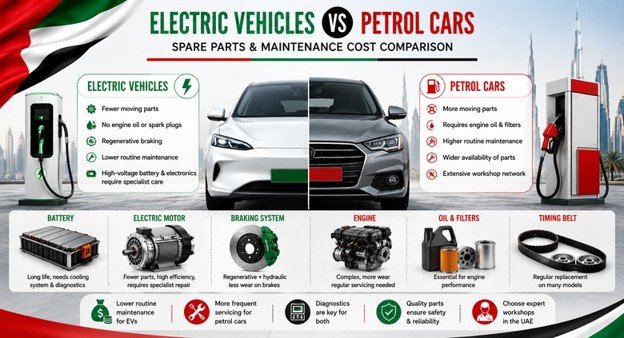
July 31, 2026
Understanding Why EV and Petrol Car Parts Are So Different
Quick Summary
| Topic | EV | Petrol Car |
| Power Source | High-voltage battery | Petrol engine |
| Main Drive Unit | Electric motor | Internal combustion engine |
| Moving Parts | Fewer | Hundreds more |
| Routine Servicing | Lower | Higher |
| Specialist Repairs | High-voltage expertise required | Conventional mechanical repairs |
| UAE Ownership Trend | Growing rapidly | Still dominates the market |
Walk through any car park in Dubai today and you'll notice something that was almost impossible to imagine a decade ago.
Electric vehicles are no longer unusual.
They're parked outside shopping centres.
Charging outside office buildings.
Travelling quietly through Abu Dhabi, Sharjah and the Northern Emirates alongside traditional petrol-powered cars.
The UAE is embracing electric mobility faster than ever before.
Government initiatives, expanding charging infrastructure and growing environmental awareness are encouraging more motorists to consider making the switch.
Yet many buyers still ask exactly the same question.
"If I buy an electric vehicle, what happens when it needs replacement parts?"
It's a sensible question.
Because while an EV may look remarkably similar to a petrol car from the outside, underneath the body panels they're fundamentally different machines.
That difference affects everything.
Maintenance.
Diagnostics.
Workshop procedures.
Repair costs.
And, perhaps most importantly, the type of spare parts each vehicle requires throughout its lifetime.
Understanding those differences helps owners make better decisions long before a warning light ever appears on the dashboard.
Why More UAE Drivers Are Comparing EVs and Petrol Cars
Choosing between an electric vehicle and a petrol car isn't simply about fuel anymore.
Ownership has become a much broader conversation.
Drivers now compare:
- Long-term maintenance costs.
- Reliability.
- Spare parts availability.
- Repair complexity.
- Workshop expertise.
- Vehicle lifespan.
For many families, the decision involves several years of ownership.
For business fleets, it affects operating costs across dozens or even hundreds of vehicles.
That's why understanding the differences between EV car parts in UAE and petrol car parts in UAE has become increasingly important.
Buying the vehicle is only the beginning.
Maintaining it properly is what determines whether ownership remains affordable.
How an Electric Vehicle Works Compared with a Petrol Car
A petrol car creates power through controlled combustion.
Petrol mixes with air.
The mixture ignites inside the engine.
That explosion pushes pistons.
The pistons rotate the crankshaft.
Eventually, power reaches the wheels through the transmission.
It's a complex process involving hundreds of moving mechanical components.
An electric vehicle takes a completely different approach.
Instead of burning fuel, electrical energy stored inside a high-voltage battery flows through sophisticated power electronics before reaching an electric motor.
That motor immediately converts electrical energy into motion.
No combustion.
No spark plugs.
No fuel injectors.
No exhaust gases.
Fewer moving parts.
A completely different engineering philosophy.
The result?
Many of the components that require regular replacement in petrol cars simply don't exist in an electric vehicle.
Why EV Spare Parts Are Completely Different
This is where many first-time EV owners become surprised.
An electric vehicle doesn't simply replace the engine with a battery.
Its entire engineering architecture changes.
Instead of servicing fuel-related systems, technicians may be working with:
- High-voltage battery packs.
- Electric drive motors.
- Inverters.
- DC-DC converters.
- Battery management systems.
- High-voltage wiring.
- Charging ports.
- Thermal management systems.
These components operate using electrical systems capable of carrying dangerous voltages.
They're designed differently.
Manufactured differently.
Diagnosed differently.
Installed differently.
That means the spare parts themselves also require a completely different approach.
Main Components Inside an Electric Vehicle
Although EV designs vary between manufacturers, most electric vehicles share several major components.
These include:
- High-voltage battery pack.
- Electric traction motor.
- Power inverter.
- DC-DC converter.
- On-board charger.
- Battery Management System (BMS).
- Charging socket.
- High-voltage cables.
- Thermal cooling system.
- Electronic control modules.
Every one of these systems communicates electronically.
Many require specialised software during diagnosis.
Some even require programming after replacement.
Replacing an EV component isn't always as straightforward as removing one part and fitting another.
Sometimes the vehicle itself must recognise and configure the new component before normal operation can resume.
Main Components Inside a Petrol Vehicle
Petrol-powered vehicles rely on a much larger collection of mechanical systems.
Typical major components include:
- Internal combustion engine.
- Fuel tank.
- Fuel pump.
- Fuel injectors.
- Spark plugs.
- Ignition coils.
- Air intake system.
- Exhaust system.
- Catalytic converter.
- Multi-speed gearbox.
Because these systems generate heat through combustion, they also depend heavily upon:
- Engine oil.
- Cooling systems.
- Belts.
- Timing components.
- Filters.
- Lubrication systems.
Many of these items naturally wear over time.
Consequently, petrol vehicles generally require more routine replacement parts throughout their lives.
Which Vehicle Has More Moving Parts?
This is perhaps the biggest engineering difference between both technologies.
A traditional petrol engine contains hundreds of moving components.
Pistons.
Connecting rods.
Camshafts.
Valves.
Timing chains or belts.
Fuel pumps.
Oil pumps.
Crankshafts.
Every moving part creates friction.
Every moving part eventually wears.
An electric motor, by comparison, contains remarkably few moving components.
Fewer moving parts usually mean fewer wear-related failures.
However...
That doesn't necessarily make EVs maintenance-free.
Instead of mechanical complexity, they rely far more heavily on sophisticated electronics, high-voltage systems and advanced software.
When problems do occur, specialist knowledge becomes essential.
Workshop Story
A customer recently brought an imported electric SUV into a specialist workshop in Dubai after another garage had recommended replacing the complete battery pack.
The quotation was substantial.
Naturally, the owner was concerned.
Before ordering any expensive components, the specialist workshop carried out a full high-voltage diagnostic procedure.
After carefully analysing the battery management system, technicians discovered the battery itself wasn't faulty at all.
The problem came from a malfunctioning battery coolant sensor.
Replacing that relatively small component restored normal operation.
The customer smiled with obvious relief.
"So I don't need a new battery?"
The senior technician shook his head.
"No."
"You needed the right diagnosis."
That's one of the biggest differences between EVs and traditional petrol vehicles.
Correct diagnostics often matter just as much as the replacement part itself.
EV vs Petrol Vehicle Overview
| Comparison | Electric Vehicle | Petrol Vehicle |
| Power Source | Battery electricity | Petrol combustion |
| Main Drive Unit | Electric motor | Internal combustion engine |
| Routine Service Parts | Fewer | More numerous |
| Mechanical Complexity | Lower | Higher |
| Electronic Complexity | Very High | Moderate |
| Specialist Workshop Required | Often | Sometimes |
Buyer Decision Matrix
| Your Situation | Recommended Choice |
| Mostly city driving with access to charging | EV may offer lower routine maintenance |
| Long-distance driving with limited charging access | Petrol may remain more practical |
| Looking for fewer routine service items | EV offers an advantage |
| Prefer widely available repair workshops | Petrol currently provides broader workshop availability |
| Interested in future vehicle technology | EV is a strong long-term consideration |
| Unsure about maintenance differences | Learn how each vehicle's components are designed before deciding |
Suggested Visual Callout
"Inside an EV vs Inside a Petrol Car"
Create a split-view infographic showing:
- Electric vehicle battery pack.
- Electric motor.
- Inverter.
- Charging port.
- Battery cooling system.
Alongside:
- Petrol engine.
- Fuel injectors.
- Spark plugs.
- Gearbox.
- Exhaust system.
Use realistic cutaway illustrations with subtle UAE-inspired red, green, white and black accents.
Keep text minimal and focus on visual comparison.
Smart Buyer's Checklist
Before choosing between an EV and a petrol vehicle:
- Understand how each vehicle generates power.
- Learn which parts require routine replacement.
- Consider workshop availability in your area.
- Think about long-term maintenance rather than only purchase price.
- Check whether specialist EV servicing is accessible.
- Compare expected ownership costs over several years.
- Don't assume fewer moving parts means zero maintenance.
- Always prioritise accurate diagnostics over replacing expensive components.
Choosing between an electric vehicle and a petrol car isn't simply about embracing new technology.
It's about understanding two completely different engineering philosophies.
The more you understand today, the more confident your ownership decisions will be tomorrow.
Key Takeaways
Electric vehicles and petrol cars may share similar body styles, but the engineering beneath the surface is fundamentally different. Petrol vehicles rely on complex mechanical systems with hundreds of moving components, while EVs depend on high-voltage batteries, electric motors, advanced electronics and sophisticated software. These differences directly influence maintenance schedules, repair procedures and the types of spare parts owners will need throughout the vehicle's life.
One of the most important lessons is that EV repairs require specialist diagnostics, high-voltage safety procedures and careful component fitment. Correct diagnosis can prevent unnecessary part replacement and significantly reduce repair costs. Understanding these differences is the first step towards making informed ownership decisions in the rapidly evolving UAE automotive market.
Comparing the Core Components of EVs and Petrol Cars
Quick Summary
| Component | Electric Vehicle | Petrol Vehicle |
| Main Power Unit | Battery Pack | Internal Combustion Engine |
| Drive System | Electric Motor | Petrol Engine |
| Energy Supply | High-voltage Battery | Fuel Tank & Fuel System |
| Transmission | Single-Speed Reduction Gear | Multi-Speed Gearbox |
| Braking | Regenerative + Hydraulic | Hydraulic Only |
| Cooling | Battery & Electronics Thermal Management | Engine Cooling System |
Open the bonnet of an electric vehicle.
Then open the bonnet of a petrol car.
At first glance, they couldn't look more different.
One is remarkably uncluttered.
The other is filled with hoses, belts, pulleys, pumps and mechanical components.
Neither design is better simply because it looks different.
They're engineered to solve the same problem in completely different ways.
That's why replacing parts in an EV isn't simply a case of swapping one engine for one battery.
Almost every major system has been redesigned.
The result?
Different components.
Different maintenance routines.
Different diagnostics.
Different repair procedures.
Let's explore the parts that make these two technologies so unique.
EV Battery Pack vs Petrol Engine: The Heart of the Vehicle
Every vehicle has one component that defines it.
For petrol cars, that's the engine.
For electric vehicles, it's the battery pack.
A petrol engine creates power through combustion.
Thousands of controlled explosions occur every minute.
Fuel mixes with air.
Spark plugs ignite the mixture.
Pistons move continuously.
Heat builds rapidly.
Lubrication becomes essential.
An EV battery works very differently.
Instead of generating power, it stores electrical energy.
That energy is supplied to the electric motor whenever the driver accelerates.
No combustion.
No pistons.
No engine oil.
No exhaust gases.
However...
Modern battery packs are incredibly sophisticated.
Inside them are hundreds—or even thousands—of individual battery cells working together under constant supervision from the Battery Management System (BMS).
These batteries require:
- Precise temperature control.
- Voltage balancing.
- Continuous monitoring.
- Specialist diagnostics.
- Careful handling.
Unlike a petrol engine, battery repairs should never involve guesswork.
Incorrect handling of high-voltage systems can damage expensive components and create significant safety risks.
Electric Motor vs Internal Combustion Engine
The electric motor quietly replaces one of the most complicated machines ever fitted to a road car.
The internal combustion engine.
A petrol engine relies on hundreds of moving parts working in perfect synchronisation.
Among them are:
- Pistons.
- Connecting rods.
- Camshafts.
- Crankshaft.
- Valves.
- Oil pump.
- Fuel injectors.
- Timing components.
Every moving component eventually wears.
Every moving component creates friction.
An electric motor is refreshingly simple by comparison.
Its primary moving part is the rotor.
That's one reason EVs generally require fewer routine mechanical repairs.
But simplicity doesn't eliminate complexity altogether.
Electric motors communicate constantly with:
- Power electronics.
- Battery management systems.
- Vehicle control modules.
- Cooling systems.
If one system develops a fault, accurate diagnostics become critical before replacing any expensive component.
Inverter, Converter and High-Voltage Electronics Explained
Here's where electric vehicles become truly different.
Petrol cars don't require inverters.
Electric vehicles can't operate without them.
The inverter performs one essential task.
It converts the battery's direct current (DC) into alternating current (AC) required by the electric motor.
Other high-voltage components include:
- DC-DC converter.
- On-board charger.
- Power distribution module.
- High-voltage junction box.
- Battery management electronics.
These aren't ordinary electrical components.
They're precision electronic systems that require specialist testing equipment.
Replacing them without proper diagnosis can quickly become an expensive mistake.
Sometimes the faulty component isn't faulty at all.
The fault may originate elsewhere within the vehicle's electrical network.
Fuel System Components Found Only in Petrol Cars
Petrol vehicles depend on a complete fuel delivery system.
Without it, the engine simply won't run.
Typical fuel-related components include:
- Fuel tank.
- Fuel pump.
- Fuel filter.
- Fuel injectors.
- Fuel pressure regulator.
- Throttle body.
- Intake manifold.
Over time, these components naturally experience wear.
Contaminated fuel.
Carbon deposits.
Heat.
Vibration.
Age.
Eventually, replacement becomes necessary.
Electric vehicles eliminate this entire system.
No fuel.
No injectors.
No fuel pumps.
No exhaust emissions.
That's one reason routine servicing often involves fewer replacement parts.
EV Single-Speed Transmission vs Petrol Gearbox
Many drivers are surprised to discover that most electric vehicles don't use traditional multi-speed gearboxes.
Instead, they employ a single-speed reduction gear.
Why?
Because electric motors produce maximum torque almost instantly.
They don't need multiple gear ratios to deliver smooth acceleration.
Petrol engines are different.
They build power gradually across a wide rev range.
That's why conventional vehicles rely upon:
- Manual gearboxes.
- Automatic transmissions.
- Dual-clutch systems.
- Torque converters.
- Clutch assemblies.
These systems contain numerous moving components requiring lubrication and, eventually, maintenance.
Although EV transmissions are mechanically simpler, they still require:
- Proper lubrication.
- Seal inspections.
- Periodic servicing.
- Specialist diagnosis if faults occur.
Simpler doesn't mean maintenance-free.
Cooling Systems: EV Thermal Management vs Engine Cooling
Heat is the enemy of every vehicle.
The difference lies in where that heat comes from.
Petrol engines generate enormous temperatures during combustion.
Consequently, they rely on:
- Radiator.
- Water pump.
- Thermostat.
- Cooling fan.
- Coolant hoses.
- Expansion tank.
Electric vehicles also require cooling.
Just not for combustion.
Instead, thermal management protects:
- Battery pack.
- Electric motor.
- Inverter.
- Charging electronics.
- High-voltage systems.
Battery temperature has a direct impact on:
- Driving range.
- Charging speed.
- Battery lifespan.
- Vehicle performance.
That's why EV cooling systems deserve just as much attention as traditional engine cooling systems.
Ignoring either can become very expensive.
Why Specialist Diagnostics Matter Before Replacing EV Components
Here's where many costly mistakes happen.
A warning message appears.
Someone immediately assumes the battery has failed.
A replacement battery is discussed.
The estimated cost looks alarming.
Then a specialist workshop performs a complete diagnostic scan.
The actual fault?
A cooling pump.
Or perhaps a temperature sensor.
Or even a software communication issue.
Without accurate diagnostics, expensive components may be replaced unnecessarily.
High-voltage vehicles demand a structured diagnostic process.
Technicians don't simply replace parts.
They investigate.
Test.
Confirm.
Only then do they repair.
That's exactly how modern EV servicing should work.
Workshop Story
A Tesla owner arrived at a specialist workshop in Abu Dhabi after being told elsewhere that the drive unit required complete replacement.
The quotation exceeded the owner's expectations by a considerable margin.
Rather than ordering new components immediately, the workshop connected manufacturer-approved diagnostic equipment and carried out a comprehensive inspection.
After several system tests, technicians discovered the drive unit itself was operating normally.
The fault originated from a defective inverter cooling pump.
Replacing that single component restored full vehicle performance.
As the owner collected the car, he smiled.
"I thought I needed a new motor."
The senior technician replied,
"You didn't need a new motor."
"You needed someone to diagnose it properly."
That's one of the biggest lessons every EV owner should remember.
Diagnosis comes before replacement.
Always.
EV vs Petrol Core Components Comparison
| Component | Electric Vehicle | Petrol Vehicle |
| Main Power Source | High-voltage Battery | Petrol Engine |
| Primary Drive Unit | Electric Motor | Internal Combustion Engine |
| Fuel System | Not Required | Essential |
| Inverter | Yes | No |
| Multi-Speed Gearbox | Usually No | Yes |
| Cooling Focus | Battery & Electronics | Engine Combustion |
Buyer Decision Matrix
| Your Priority | Recommended Focus |
| Lower routine servicing | Electric vehicle |
| Easier access to conventional repairs | Petrol vehicle |
| Fewer moving mechanical parts | Electric vehicle |
| Simpler nationwide workshop availability | Petrol vehicle |
| Interested in modern electrical technology | Electric vehicle |
| Unsure about expensive EV repairs | Choose workshops with certified high-voltage diagnostic capability |
Suggested Visual Callout
"Core Components: EV vs Petrol Car"
Create a split-view infographic showing:
Electric Vehicle Side
- Battery pack.
- Electric motor.
- Inverter.
- DC-DC converter.
- Charging port.
- Battery cooling system.
Petrol Vehicle Side
- Engine.
- Fuel injectors.
- Fuel tank.
- Gearbox.
- Radiator.
- Exhaust system.
Use realistic cutaway illustrations with subtle UAE-inspired red, green, white and black accents.
Keep wording minimal and allow the visuals to explain the engineering differences.
Smart Buyer's Checklist
Before purchasing replacement parts for any EV or petrol vehicle:
- Confirm the exact component causing the fault.
- Never assume a warning light identifies the failed part.
- Use workshops equipped with the correct diagnostic equipment.
- Verify VIN compatibility before ordering components.
- Ask whether software programming is required after installation.
- Compare repair costs before replacing major assemblies.
- Prioritise specialist expertise for high-voltage systems.
- Remember that careful diagnosis usually saves more money than hurried replacement.
Understanding the core components of each vehicle is the foundation of making better maintenance decisions.
The technology may differ.
But the principle remains the same.
Replace the right part.
At the right time.
For the right reason.
Key Takeaways
Although electric vehicles and petrol cars perform the same job, they rely on entirely different engineering systems. EVs replace the engine and fuel system with a high-voltage battery, electric motor, inverter and sophisticated electronic controls, while petrol vehicles continue to depend on combustion engines, fuel delivery systems, multi-speed gearboxes and numerous mechanical components. These differences explain why each vehicle requires a unique approach to servicing and spare parts.
Perhaps the most important lesson is that EV repairs depend heavily on specialist diagnostics, safety procedures and correct component fitment. Replacing expensive parts without confirming the root cause can lead to unnecessary costs, whereas a structured diagnostic process often identifies smaller faults that can be repaired efficiently. As EV ownership grows across the UAE, understanding these core differences will help owners make more informed maintenance decisions.
Braking, Steering and Suspension Systems – Where EVs and Petrol Cars Really Begin to Feel Different
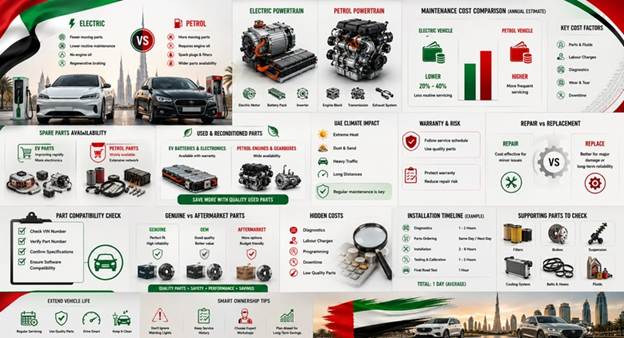
Quick Summary
| System | Electric Vehicle | Petrol Vehicle |
| Braking | Regenerative + Hydraulic | Hydraulic Only |
| Brake Pad Wear | Usually Lower | Usually Higher |
| Steering | Electric Power Steering | Hydraulic or Electric |
| Suspension | Designed for Higher Vehicle Weight | Designed Around Engine Weight |
| Tyre Wear | Often Faster | Generally More Even |
| Driveline Components | Simpler | More Mechanical Components |
Most drivers notice the silence of an electric vehicle first.
The second thing they notice?
How differently it slows down.
Lift your foot from the accelerator in many EVs and the car immediately begins to decelerate.
No brake pedal.
No dramatic movement.
Just smooth, controlled slowing.
It feels unusual at first.
Then it becomes completely natural.
That single difference changes far more than the driving experience.
It changes how brake components wear.
It changes servicing schedules.
It changes which spare parts require replacement.
And that's only the braking system.
Move underneath the vehicle and you'll find further differences in suspension design, steering technology and drivetrain components.
Some parts last longer.
Others work much harder.
Understanding why helps owners avoid expensive surprises later.
Regenerative Braking vs Traditional Brake Systems
One of the greatest engineering advantages of an electric vehicle lies in something many drivers barely notice.
Regenerative braking.
Instead of wasting energy as heat during deceleration, the electric motor reverses its role.
Rather than driving the wheels, it becomes a generator.
That recovered energy flows back into the battery.
It's remarkably efficient.
Petrol vehicles work differently.
When the brake pedal is pressed:
- Brake pads clamp the brake discs.
- Friction creates heat.
- Kinetic energy is lost.
- Brake components gradually wear away.
An EV still has conventional hydraulic brakes.
They're simply used less frequently during everyday driving.
That changes maintenance considerably.
Brake Wear Differences Between EVs and Petrol Cars
Here's a question workshop technicians hear regularly.
"Why do EV brake pads last so long?"
The answer is simple.
Because regenerative braking performs much of the slowing.
Less friction means:
- Lower brake pad wear.
- Reduced brake disc wear.
- Less brake dust.
- Longer replacement intervals.
Sounds perfect.
Well...
Not entirely.
Because conventional brakes are used less often, some EVs experience different issues.
Brake discs may develop:
- Surface corrosion.
- Light rust.
- Uneven contact areas.
Especially in coastal parts of the UAE where humidity is higher.
Routine inspections remain important even if replacement intervals become longer.
Petrol vehicles generally wear braking components more consistently because friction braking is used almost every time the vehicle slows down.
Suspension Components Compared
Regardless of how a vehicle is powered, suspension still performs the same essential job.
It supports weight.
Maintains stability.
Keeps tyres in contact with the road.
Absorbs bumps.
However...
Electric vehicles often weigh considerably more.
Why?
The battery pack.
High-voltage batteries are heavy.
Manufacturers compensate by designing suspension systems specifically for that additional weight.
Common suspension components include:
- Shock absorbers.
- Coil springs.
- Control arms.
- Bushings.
- Anti-roll bars.
- Ball joints.
Although the components look familiar, they're frequently engineered differently to manage the unique weight distribution of electric vehicles.
That matters when ordering replacement parts.
Steering Systems: Electric vs Hydraulic Assistance
Years ago, hydraulic power steering dominated the automotive industry.
Today?
Electric Power Steering (EPS) has become increasingly common.
Most EVs rely entirely upon electric steering assistance.
Many modern petrol cars do too.
Older petrol vehicles, however, may still use:
- Hydraulic pumps.
- Steering fluid.
- Pressure hoses.
- Drive belts.
Electric steering eliminates many of those maintenance items.
No hydraulic fluid.
No steering pump.
No leaking hoses.
Instead, steering assistance depends upon:
- Electric motors.
- Torque sensors.
- Steering control modules.
- Software calibration.
Diagnosis becomes more electronic than mechanical.
Once again, specialist equipment plays an increasingly important role.
Tyre Wear Differences in Electric Vehicles
Many first-time EV owners are surprised by tyre replacement intervals.
Not because tyres last longer.
Sometimes...
Quite the opposite.
Electric vehicles often produce maximum torque instantly.
Acceleration can be extremely smooth.
And extremely strong.
Combined with higher vehicle weight, this can increase tyre wear.
Factors influencing EV tyre life include:
- Instant torque delivery.
- Battery weight.
- Driving style.
- Tyre compound.
- Wheel alignment.
- Road conditions.
Petrol vehicles usually build power more progressively.
That often results in slightly different tyre wear characteristics.
Neither system is necessarily better.
They're simply different.
Wheel Bearings, Hubs and Driveline Components Compared
Look beneath most petrol cars and you'll find a complex driveline.
Typical components include:
- Clutch.
- Driveshaft.
- Differential.
- Gearbox.
- Universal joints.
- Flywheel.
Electric vehicles simplify much of this arrangement.
Many models combine the electric motor with a compact reduction gear assembly.
Fewer mechanical components often means:
- Fewer wear items.
- Simpler driveline layouts.
- Reduced routine servicing.
However...
Critical components like wheel bearings, hubs and suspension joints continue to experience normal wear regardless of the vehicle's power source.
Road conditions don't discriminate.
Why EV Parts Require Specialist Checks
Here's where ownership becomes particularly interesting.
A brake pad may still look like a brake pad.
A steering rack may still resemble a steering rack.
Yet the inspection process can be completely different.
Why?
Because many EV systems interact continuously.
Replacing a component sometimes requires:
- High-voltage isolation.
- Software verification.
- Electronic calibration.
- Diagnostic confirmation.
- System reset procedures.
Even apparently simple repairs should begin with careful inspection.
That's why workshops trained in electric vehicle servicing follow structured diagnostic routines before replacing components.
The goal isn't simply fitting new parts.
The goal is restoring the complete system safely and correctly.
Choosing the Correct Parts Matters More Than Ever
Whether the vehicle is electric or petrol-powered, compatibility remains critical.
Small specification differences can create significant problems.
Especially when advanced electronics are involved.
Many UAE motorists compare suppliers through PartFinder UAE before ordering replacement components, allowing them to verify compatibility, compare multiple options and reduce the risk of purchasing incorrect parts for either an EV or a conventional petrol vehicle.
Choosing the correct component the first time saves:
- Labour.
- Downtime.
- Repeat repairs.
- Unnecessary expense.
That's a winning combination for any vehicle owner.
Workshop Story
A customer brought an electric crossover into a specialist workshop in Sharjah after noticing an unusual scraping sound during low-speed braking.
Another garage had already recommended replacing the complete braking system.
Before ordering any parts, the technicians carried out a detailed inspection.
The brake pads still had plenty of material remaining.
The actual issue?
Light corrosion had developed on the brake discs because regenerative braking handled most of the vehicle's everyday stopping.
After cleaning the braking surfaces, carrying out a controlled bedding-in procedure and confirming system performance, the noise disappeared completely.
The owner looked surprised.
"So I didn't need new brakes?"
The technician smiled.
"You needed the brakes you already had to be inspected properly."
That's exactly why careful diagnostics remain just as important on an EV as they are on a petrol car.
EV vs Petrol Chassis Components Comparison
| Component | Electric Vehicle | Petrol Vehicle |
| Braking | Regenerative + Hydraulic | Hydraulic |
| Brake Pad Life | Usually Longer | Standard Wear |
| Steering | Electric Power Steering | Hydraulic or Electric |
| Suspension Setup | Designed for Higher Battery Weight | Designed Around Engine Weight |
| Tyre Wear | Often Higher Under Strong Acceleration | More Conventional |
| Driveline Complexity | Lower | Higher |
Buyer Decision Matrix
| Your Priority | Best Approach |
| Longer brake component life | EV offers an advantage through regenerative braking |
| Easier repairs almost anywhere | Petrol vehicles still have broader workshop coverage |
| Reduced routine mechanical servicing | EV is generally favourable |
| Lower tyre replacement costs | Driving style matters more than vehicle type |
| Maximum reliability | Prioritise correct diagnostics and genuine compatibility |
| Buying replacement parts | Always verify specifications before ordering |
Suggested Visual Callout
"How EV and Petrol Chassis Systems Differ"
Create a split-view infographic featuring:
Electric Vehicle
- Regenerative braking.
- Electric steering.
- Battery underfloor.
- Electric motor.
- Suspension supporting battery weight.
- Tyre contact patch.
Petrol Vehicle
- Brake discs.
- Hydraulic steering.
- Engine.
- Gearbox.
- Conventional suspension.
- Driveshaft.
Use realistic cutaway visuals with subtle UAE-inspired red, green, white and black accents.
Keep text minimal and let the illustrations highlight the engineering differences.
Smart Buyer's Checklist
Before replacing braking, steering or suspension components:
- Confirm the fault through professional diagnosis.
- Check whether software calibration is required.
- Verify VIN compatibility.
- Inspect related components before replacing individual parts.
- Don't assume longer-lasting components never require servicing.
- Choose workshops familiar with your vehicle's technology.
- Replace safety-critical components with high-quality parts.
- Prioritise careful fitment over the quickest repair.
Modern braking, steering and suspension systems have become more sophisticated than ever.
Whether you drive an EV or a petrol car, replacing the right component begins with understanding how the entire system works—not simply replacing the part that appears worn.
Key Takeaways
Electric vehicles and petrol cars may use similar braking, steering and suspension components, but the way those systems operate is fundamentally different. Regenerative braking reduces wear on traditional brake parts, EV suspension systems are engineered to support heavier battery packs, and electric steering relies more heavily on electronic controls than hydraulic assistance. These differences directly affect maintenance schedules, spare parts selection and repair procedures.
Perhaps the biggest lesson is that modern EV chassis components require specialist checks, accurate diagnostics and careful fitment before any replacement takes place. Correctly identifying the root cause of a fault prevents unnecessary repairs, improves safety and helps owners avoid replacing expensive components that are still functioning perfectly.
Routine Servicing and Maintenance – Why EVs and Petrol Cars Follow Completely Different Service Schedules
Quick Summary
| Maintenance Item | Electric Vehicle | Petrol Vehicle |
| Engine Oil | Not Required | Essential |
| Spark Plugs | Not Required | Regular Replacement |
| Timing Belt/Chain | Not Required | Inspection or Replacement Required |
| Fuel Filters | Not Required | Required |
| Battery Coolant | Yes (Model Dependent) | No |
| Routine Service Frequency | Generally Lower | Generally Higher |
Ask a mechanic what keeps most petrol cars returning to the workshop.
The answer is almost always the same.
Routine servicing.
Oil changes.
Filter replacements.
Spark plugs.
Belts.
Fluids.
Now ask that same question about an electric vehicle.
The list becomes much shorter.
But don't mistake shorter for simpler.
An EV may require fewer routine service items, yet the systems that do require attention often demand specialist knowledge, dedicated equipment and careful inspection.
That's why many first-time EV owners become confused.
"If there isn't any engine oil to change, what exactly gets serviced?"
It's an excellent question.
Let's answer it.
Engine Oil vs Battery Coolant Maintenance
For decades, engine oil has been one of the most important maintenance items in every petrol vehicle.
Its job is straightforward.
It lubricates moving components.
Reduces friction.
Removes heat.
Protects internal engine parts from premature wear.
Over time, however, engine oil deteriorates.
It collects contaminants.
Its protective properties gradually weaken.
Ignoring oil changes can eventually damage:
- Pistons.
- Bearings.
- Camshafts.
- Crankshaft.
- Turbochargers.
Electric vehicles eliminate this requirement completely.
There's no engine oil because there's no combustion engine.
Instead, many EVs rely on specialised thermal management systems using dedicated coolant to regulate:
- Battery temperature.
- Electric motor temperature.
- Power electronics.
- Charging systems.
Unlike engine oil, battery coolant usually requires less frequent attention.
Nevertheless, it remains essential for protecting expensive high-voltage components.
Air Filters, Cabin Filters and Cooling Filters Compared
Not every filter disappears in an electric vehicle.
Some remain just as important.
Cabin air filters, for example, are common to both vehicle types.
They improve interior air quality by filtering:
- Dust.
- Sand.
- Pollen.
- Airborne particles.
An important consideration in the UAE, where fine desert dust can quickly affect filter performance.
Petrol vehicles also require:
- Engine air filters.
- Fuel filters.
- Oil filters.
Electric vehicles remove several of these entirely.
However, certain models include cooling system filters that help protect battery thermal management systems.
Although fewer filters require replacement overall, regular inspection remains important.
Clean filters help every system operate more efficiently.
Spark Plugs, Timing Belts and Components EVs Don't Need
Here's where maintenance differences become obvious.
Petrol engines depend upon ignition.
No spark.
No combustion.
That's why routine servicing often includes:
- Spark plugs.
- Ignition coils.
- Timing belts.
- Timing chains.
- Fuel injectors.
- Engine belts.
Each component eventually reaches the end of its service life.
Electric vehicles simply don't have these systems.
No spark plugs.
No ignition coils.
No timing belt.
No fuel injectors.
No exhaust manifold.
No catalytic converter.
Fewer mechanical systems naturally mean fewer routine replacement parts.
But remember...
The components that remain are often more technologically advanced.
Fluids Required for EVs vs Petrol Cars
Many motorists believe electric vehicles contain no fluids whatsoever.
That's another common misconception.
Petrol cars regularly require:
- Engine oil.
- Transmission fluid.
- Brake fluid.
- Coolant.
- Power steering fluid (on some models).
- Windscreen washer fluid.
Electric vehicles generally eliminate engine oil and fuel-related fluids.
However, they still rely on:
- Battery coolant.
- Brake fluid.
- Transmission or reduction gear lubricant.
- Air-conditioning refrigerant.
- Windscreen washer fluid.
So yes...
EV servicing still includes fluid inspections.
Just not the same ones.
How Often Should EV Parts Be Replaced?
This is one of the biggest advantages of electric vehicle ownership.
Many routine wear items last longer.
Not because they're stronger.
Because they're used differently.
For example:
Regenerative braking reduces brake pad wear.
No combustion eliminates oil changes.
No spark plugs removes ignition servicing.
No fuel system removes injector maintenance.
However, EV owners should continue monitoring:
- Battery cooling systems.
- Suspension.
- Tyres.
- Steering.
- Brake fluid.
- Cabin filtration.
Maintenance becomes less frequent.
Not unnecessary.
Ignoring inspections simply because an EV has fewer moving parts is never a wise strategy.
Preventative Maintenance Schedules Compared
Let's compare two owners.
The first waits for something to break.
The second follows scheduled inspections every year.
Who spends less?
Almost always the second owner.
Preventative maintenance remains valuable regardless of how the vehicle is powered.
Typical petrol vehicle servicing includes:
- Oil changes.
- Filter replacement.
- Spark plug inspections.
- Belt checks.
- Cooling system servicing.
Typical EV servicing often focuses on:
- Battery health reports.
- High-voltage cable inspection.
- Cooling system performance.
- Charging system inspection.
- Software updates.
- Brake condition.
- Suspension wear.
Different procedures.
Same objective.
Prevent problems before they become expensive.
Why Specialist Checks Matter Even During Routine EV Servicing
Routine servicing isn't simply about replacing parts.
It's about confirming that every system continues operating safely.
High-voltage vehicles require technicians trained to inspect:
- Battery insulation.
- Electrical connectors.
- Cooling performance.
- Charging systems.
- Battery Management System data.
- Software fault codes.
Some faults develop quietly.
Drivers may notice no symptoms at all.
That's precisely why specialist inspections are so valuable.
The vehicle might appear perfectly healthy.
Diagnostic data sometimes tells a different story.
UAE Driving Conditions Change Maintenance Requirements
Climate influences maintenance more than many people realise.
In the UAE, vehicles routinely experience:
- Extreme summer temperatures.
- Heavy air-conditioning use.
- Fine airborne sand.
- Stop-start city traffic.
- Long motorway journeys.
These conditions affect both vehicle types.
Petrol cars often experience additional stress on:
- Cooling systems.
- Engine oil.
- Air filters.
Electric vehicles place greater emphasis on:
- Battery temperature management.
- Cooling efficiency.
- Charging performance.
Routine servicing tailored to local conditions helps maximise reliability.
Ignoring climate rarely saves money.
Workshop Story
A family from Dubai brought their electric SUV into a specialist workshop for its annual inspection.
The vehicle had travelled thousands of kilometres without any obvious problems.
Everything appeared normal.
The owner almost postponed the service.
Fortunately, the inspection went ahead.
Technicians reviewed the battery cooling system and discovered that coolant circulation had begun to deteriorate because of a partially restricted cooling valve.
The vehicle still drove perfectly.
But prolonged operation during the UAE summer could have placed unnecessary stress on the battery.
The small component was replaced during routine servicing.
As the customer collected the vehicle, he asked,
"Would I have noticed this?"
The technician smiled.
"Probably not."
"That's exactly why routine inspections matter."
Sometimes the most valuable repair is the one completed before the driver ever notices a problem.
Routine Maintenance Comparison Table
| Maintenance Item | Electric Vehicle | Petrol Vehicle |
| Engine Oil Changes | Not Required | Regular |
| Spark Plug Replacement | No | Yes |
| Timing Belt Inspection | No | Often Required |
| Fuel Filter Replacement | No | Yes |
| Battery Coolant Inspection | Yes | No |
| Software Updates | Common | Limited |
| Brake Fluid Checks | Yes | Yes |
| Cabin Filter Replacement | Yes | Yes |
Buyer Decision Matrix
| Your Priority | Recommended Approach |
| Lowest routine servicing requirements | Electric vehicle |
| Familiar maintenance procedures | Petrol vehicle |
| Long-term ownership planning | Follow manufacturer service schedules regardless of vehicle type |
| Maximum reliability | Never skip annual inspections |
| Hot UAE operating conditions | Prioritise cooling system maintenance |
| Purchasing replacement parts | Replace components according to condition, not assumptions |
Suggested Visual Callout
"Routine Servicing: EV vs Petrol"
Create a split-view infographic showing:
Electric Vehicle
- Battery coolant.
- Charging system.
- Battery health scan.
- High-voltage cables.
- Software update.
- Cabin air filter.
Petrol Vehicle
- Engine oil.
- Oil filter.
- Spark plugs.
- Timing belt.
- Fuel filter.
- Radiator.
Use realistic workshop illustrations with subtle UAE-inspired red, green, white and black accents.
Keep wording minimal and focus on visual comparison.
Smart Buyer's Checklist
Before booking your next vehicle service:
- Follow the manufacturer's maintenance schedule.
- Never skip annual inspections.
- Check cooling system performance regularly.
- Replace filters at recommended intervals.
- Don't ignore software updates on EVs.
- Inspect tyres and suspension regardless of vehicle type.
- Choose workshops experienced with your vehicle's technology.
- Remember that preventative maintenance always costs less than emergency repairs.
Routine servicing isn't about replacing as many parts as possible.
It's about replacing the right parts at the right time.
Whether you drive an EV or a petrol car, that principle never changes.
Key Takeaways
Although electric vehicles require fewer routine service items than petrol cars, they still depend on regular inspections to protect high-value components such as the battery pack, cooling system and power electronics. Petrol vehicles continue to require more traditional maintenance, including oil changes, spark plugs, fuel filters and timing components, while EV servicing focuses on battery health, thermal management, software and high-voltage safety.
The biggest lesson is that lower maintenance does not mean maintenance-free ownership. Preventative servicing, accurate inspections and specialist workshop expertise remain essential for both vehicle types. Following the correct maintenance schedule helps maximise reliability, extend component lifespan and reduce long-term ownership costs, particularly under the demanding driving conditions found across the UAE.
Why EV Parts Require Specialist Diagnostics, Safety Checks and Careful Fitment
Quick Summary
| Specialist Requirement | Why It Matters |
| High-Voltage Safety | Protects technicians and the vehicle. |
| Advanced Diagnostics | Identifies the actual fault before replacing parts. |
| Battery Isolation | Prevents electrical hazards during repairs. |
| Software Calibration | Ensures replacement components communicate correctly. |
| Careful Component Fitment | Prevents damage to expensive electrical systems. |
| Certified EV Technicians | Reduce repair risks and improve reliability. |
Here's a common misconception.
"An electric vehicle has fewer moving parts, so it must be easier to repair."
It sounds logical.
In reality...
The opposite is often true.
Mechanically?
Yes, many EVs are simpler.
Electronically?
They're significantly more sophisticated.
Replacing an engine mount on a petrol car might involve little more than mechanical tools and workshop experience.
Replacing a high-voltage battery component on an electric vehicle?
That's an entirely different process.
Safety procedures.
Battery isolation.
Electronic testing.
Software verification.
System calibration.
Every step matters.
Because in an EV, installing the correct part is only half the job.
The vehicle must also recognise, communicate with and safely operate that component afterwards.
That's exactly why specialist diagnostics and careful fitment have become essential.
Why EVs Require Specialist Diagnostic Equipment
Modern electric vehicles constantly monitor themselves.
Thousands of data points move between electronic control units every second.
The Battery Management System.
Motor controller.
Charging system.
Thermal management.
Power electronics.
Safety systems.
Everything communicates.
When something goes wrong, the dashboard warning light often reveals only one thing.
A fault exists.
It rarely identifies the exact cause.
Specialist diagnostic equipment allows technicians to examine:
- Live battery data.
- Cell voltage balance.
- Charging performance.
- Motor efficiency.
- Thermal system operation.
- Communication between electronic modules.
- High-voltage safety status.
Without these tools, replacing parts becomes educated guesswork.
And guesswork has no place around high-voltage systems.
High-Voltage Safety Procedures Every Workshop Must Follow
A conventional 12-volt vehicle system can still be dangerous if handled carelessly.
An electric vehicle operates on an entirely different level.
Many EV battery systems work with several hundred volts.
That changes everything.
Before any repair begins, trained technicians normally follow strict safety procedures, including:
- Vehicle identification.
- High-voltage shutdown.
- Battery isolation.
- Voltage confirmation.
- Protective equipment checks.
- Safe work area preparation.
Only after confirming that the system has been safely isolated should repairs begin.
Skipping these procedures isn't simply poor practice.
It can place both technicians and vehicles at serious risk.
That's why EV servicing requires specialised training.
Why Correct Diagnostics Matter Before Replacing EV Parts
Imagine visiting a doctor.
Would you expect surgery before receiving a diagnosis?
Probably not.
Vehicle repairs should follow exactly the same principle.
Many EV warning messages can originate from:
- Sensors.
- Cooling systems.
- Wiring.
- Software.
- Communication modules.
- Charging equipment.
The expensive component often isn't the faulty one.
Consider a battery temperature warning.
Some people immediately assume the battery has failed.
Yet the real problem may be:
- A faulty coolant pump.
- A damaged temperature sensor.
- Restricted coolant flow.
- Software calibration.
- Electrical connection issues.
Replacing the battery wouldn't solve any of those faults.
Correct diagnosis prevents unnecessary expense.
Every time.
Why EV Parts Require Specialist Installation and Careful Fitment
Installing a replacement component involves much more than tightening bolts.
Many EV components require:
- Correct torque specifications.
- Electrical insulation checks.
- High-voltage connector inspection.
- Moisture protection.
- Software pairing.
- System calibration.
Even slight installation errors can create problems later.
Loose electrical connections.
Cooling system leaks.
Communication faults.
Reduced charging performance.
Warning messages.
Careful fitment protects both the replacement component and every system connected to it.
That's why experienced EV technicians never rush installation.
Precision matters.
Can Every Garage Repair an Electric Vehicle?
This question is becoming increasingly common across the UAE.
The honest answer?
Not yet.
Many independent workshops continue investing in:
- High-voltage training.
- Diagnostic equipment.
- Safety certification.
- Specialist tooling.
- Manufacturer software access.
Others still focus primarily on conventional petrol and diesel vehicles.
Before booking an EV repair, owners should ask:
- Do your technicians have high-voltage training?
- Can you perform battery diagnostics?
- Do you use manufacturer-approved diagnostic equipment?
- Can replacement components be programmed if necessary?
- Have you repaired this model before?
Confident answers usually indicate genuine experience.
Choosing an EV-Certified Workshop in the UAE
Not every workshop offering EV servicing provides the same level of expertise.
When comparing repair centres, consider:
- Technician certification.
- Experience with your vehicle brand.
- High-voltage safety procedures.
- Diagnostic capabilities.
- Genuine and OEM parts availability.
- Warranty support.
Price should never be the only deciding factor.
A cheaper repair becomes very expensive if the wrong component is installed or diagnosed incorrectly.
Experience saves money.
Especially with electric vehicles.
Software Is Now a Spare Part Too
Here's something many drivers never consider.
Sometimes...
Nothing mechanical is actually broken.
Modern EVs rely heavily on software.
Replacement components often require:
- Firmware updates.
- Control module programming.
- Battery registration.
- Charging system configuration.
- Vehicle network synchronisation.
Without these procedures, a perfectly healthy replacement component may fail to operate correctly.
That's why software has become part of modern vehicle repair.
Not just hardware.
Why Careful Fitment Protects Expensive Components
Think about replacing a battery cooling hose.
Simple enough?
Not necessarily.
If air becomes trapped inside the thermal management system, battery temperatures may rise unexpectedly.
If a high-voltage connector isn't secured correctly, communication faults can appear.
If moisture reaches sensitive electronics, corrosion may develop over time.
One small installation mistake can affect several connected systems.
That's why professional workshops follow detailed manufacturer procedures rather than relying on shortcuts.
The repair doesn't finish when the component is fitted.
It finishes when every system has been tested and confirmed to operate correctly.
Workshop Story
A premium electric SUV arrived at a specialist workshop in Dubai after another repair centre had replaced its charging module.
The vehicle still refused to charge.
The owner feared another expensive replacement.
Instead of ordering new parts immediately, the workshop began with a complete diagnostic routine.
Battery isolation was confirmed.
Communication between the charging module and Battery Management System was analysed.
The replacement component itself worked perfectly.
The real issue?
The module had never been programmed to the vehicle after installation.
After completing the required software configuration and system calibration, charging resumed normally.
The customer looked relieved.
"So the new part wasn't faulty?"
The technician smiled.
"No."
"It simply hadn't been introduced to the vehicle properly."
That single conversation explains modern EV servicing perfectly.
Correct fitment includes software as well as hardware.
Specialist Repair Comparison Table
| Repair Stage | Electric Vehicle | Petrol Vehicle |
| Initial Diagnosis | Advanced electronic scanning | Mechanical and electronic diagnosis |
| Safety Procedures | High-voltage isolation required | Standard workshop safety |
| Component Installation | Mechanical + electronic + software | Primarily mechanical |
| Calibration | Frequently required | Occasionally required |
| Final Testing | High-voltage system verification | Mechanical performance testing |
| Technician Training | EV-certified recommended | Conventional automotive training |
Buyer Decision Matrix
| Situation | Best Decision |
| Dashboard warning appears | Diagnose before replacing parts |
| Battery-related warning | Visit an EV-qualified workshop |
| High-voltage component replacement | Choose certified technicians |
| Charging problems | Test the charging system before replacing major components |
| Considering a cheaper repair | Compare workshop expertise as well as price |
| Software-related faults | Ensure programming capability is available |
Suggested Visual Callout
"How an EV Repair Should Be Performed"
Create a realistic workflow infographic featuring:
- High-voltage battery isolation.
- Technician wearing insulated protective equipment.
- Diagnostic scanner connected to the vehicle.
- Battery Management System.
- Electric motor.
- Charging module.
- Software calibration.
- Final safety inspection.
Use minimal wording.
Focus on realistic workshop visuals with subtle UAE-inspired red, green, white and black accents.
Smart Buyer's Checklist
Before authorising any EV repair:
- Confirm the workshop has high-voltage experience.
- Ask whether a complete diagnostic scan has been performed.
- Never approve major component replacement without diagnosis.
- Verify whether software programming is required.
- Ensure replacement parts match the VIN specification.
- Ask about warranty coverage.
- Request confirmation that safety checks will be completed.
- Prioritise careful fitment over the lowest repair quotation.
The most successful EV repairs don't begin with replacing parts.
They begin with understanding the fault.
Everything else follows from there.
Key Takeaways
Electric vehicles require a fundamentally different repair process from petrol cars because they rely on high-voltage electrical systems, sophisticated electronics and integrated software. Specialist diagnostic equipment, strict safety procedures, battery isolation and careful component fitment are essential before replacing any major EV part. These steps protect both the technician and the vehicle while ensuring the correct fault is identified.
Perhaps the most valuable lesson for EV owners is that replacing expensive components should never be the first response to a warning light. Accurate diagnostics, certified technicians and manufacturer-approved repair procedures often reveal smaller underlying faults that can be resolved without unnecessary replacements. As EV ownership continues to grow across the UAE, choosing workshops with the right expertise will become just as important as choosing the right replacement parts.
EV Spare Parts Prices vs Petrol Car Parts Prices in the UAE – What Really Affects the Cost?
Quick Summary
| Cost Factor | Electric Vehicle | Petrol Vehicle |
| Average Routine Service Cost | Generally Lower | Generally Higher |
| Most Expensive Component | Battery Pack | Engine |
| Parts Availability | Improving | Excellent |
| Specialist Labour | Higher | Moderate |
| Diagnostic Costs | Higher | Lower |
| Long-Term Maintenance | Usually Lower | Usually Higher |
One of the first questions buyers ask after purchasing a vehicle is surprisingly simple.
"What will it cost if something goes wrong?"
It's a sensible question.
Whether you drive through Dubai every day, commute across Abu Dhabi, or regularly travel between Sharjah and the Northern Emirates, repair costs eventually become part of vehicle ownership.
The answer, however, isn't as straightforward as many people expect.
Some EV parts are considerably more expensive than equivalent petrol components.
Others cost less.
Some repairs are quick.
Others require specialist technicians, advanced diagnostics and software calibration.
Meanwhile, many routine servicing expenses that petrol owners expect simply disappear with an electric vehicle.
To understand the real cost of ownership, it's important to look beyond headlines and compare where the money is actually spent.
EV Spare Parts Prices in the UAE
Electric vehicles contain fewer routine service components, but several of their major systems represent significant investments.
Examples include:
- High-voltage battery packs.
- Electric drive motors.
- Inverters.
- DC-DC converters.
- On-board chargers.
- Battery cooling components.
- High-voltage wiring assemblies.
Fortunately, these components are designed for long service lives.
Many owners never replace the largest assemblies during normal ownership.
When replacement becomes necessary, however, specialist parts and labour contribute significantly to the final repair cost.
Pricing is influenced by:
- Vehicle manufacturer.
- Model year.
- Battery capacity.
- Parts availability.
- Import source.
- Software programming requirements.
As EV adoption increases across the UAE, replacement component availability continues to improve, helping stabilise prices.
Petrol Car Spare Parts Prices in the UAE
Petrol vehicles benefit from decades of established supply networks.
Most workshops can quickly source:
- Engine components.
- Fuel pumps.
- Alternators.
- Starters.
- Radiators.
- Suspension parts.
- Brake components.
- Filters.
- Ignition systems.
Competition among suppliers often keeps prices competitive.
However, petrol vehicles generally require more routine replacement parts throughout their lifespan.
Individual repairs may cost less than equivalent EV repairs.
Collectively, though, routine maintenance can become a significant long-term ownership expense.
That's an important distinction.
Small repairs repeated regularly eventually add up.
Which EV Parts Are Most Expensive to Replace?
Certain EV components naturally attract attention because of their value.
The most expensive repairs commonly involve:
- High-voltage battery packs.
- Electric drive units.
- Power inverters.
- Charging modules.
- Battery management electronics.
Thankfully, complete replacement is often less common than many buyers assume.
Modern diagnostic procedures frequently identify faults within supporting systems rather than the primary component itself.
Examples include:
- Cooling pumps.
- Temperature sensors.
- Electrical connectors.
- Communication modules.
Replacing a relatively inexpensive supporting component may restore normal operation without replacing the larger assembly.
That's exactly why accurate diagnostics save money.
Which Petrol Car Parts Commonly Need Replacement?
Petrol vehicles rarely require complete engine replacement during ordinary ownership.
Instead, maintenance usually involves numerous smaller repairs over time.
Frequently replaced components include:
- Spark plugs.
- Ignition coils.
- Fuel injectors.
- Water pumps.
- Timing belts.
- Alternators.
- Starter motors.
- Brake pads.
- Suspension bushings.
None may seem particularly expensive individually.
Combined across several years of ownership, however, routine servicing costs steadily accumulate.
This is one reason many EV owners experience lower maintenance expenditure despite higher prices for certain individual components.
Availability of EV Parts Across Dubai, Abu Dhabi and Sharjah
Only a few years ago, sourcing EV components sometimes required lengthy waiting periods.
That situation is changing rapidly.
Today, many UAE suppliers stock or source:
- Battery cooling components.
- Charging equipment.
- Suspension parts.
- Brake systems.
- Body panels.
- Electrical modules.
Availability continues improving as electric vehicle ownership expands.
Premium models may still require imported components for specialised repairs.
However, common service parts are becoming easier to obtain than ever before.
Reduced waiting times benefit both private owners and fleet operators.
Why Petrol Spare Parts Are Usually Easier to Source
Petrol vehicles still dominate the roads throughout much of the UAE.
Consequently, their supply chains remain exceptionally mature.
Independent workshops, dealers and parts distributors often maintain extensive inventories.
Benefits include:
- Faster availability.
- Wider supplier choice.
- Competitive pricing.
- Familiar repair procedures.
Electric vehicles are progressing rapidly in the same direction.
But the petrol market still enjoys decades of established infrastructure.
That advantage remains significant for certain makes and models.
Labour Costs: Why EV Repairs Can Cost More
Parts represent only one side of the invoice.
Labour matters too.
EV technicians require:
- High-voltage certification.
- Specialist diagnostic equipment.
- Ongoing technical training.
- Safety equipment.
- Software subscriptions.
These investments naturally influence workshop labour rates.
However, because electric vehicles generally require fewer routine mechanical repairs, overall maintenance costs may still remain competitive over long-term ownership.
The key is looking beyond individual repair invoices.
Ownership should always be measured across several years rather than a single workshop visit.
Hidden Costs That Many Buyers Forget
When comparing repair quotations, owners often focus only on the replacement part.
That's understandable.
Yet several additional factors influence the final bill.
Examples include:
- Diagnostic testing.
- Software programming.
- Battery isolation procedures.
- Cooling system bleeding.
- Electronic calibration.
- Labour time.
- Vehicle recovery if undrivable.
Petrol repairs may involve:
- Oil replacement.
- Coolant replacement.
- Belt adjustments.
- Fuel system cleaning.
Comparing complete repair costs—not just component prices—provides a far more accurate picture.
Workshop Story
A businessman from Abu Dhabi visited a specialist workshop after reading online that replacing an EV battery could cost a substantial amount.
His vehicle displayed a charging warning.
Naturally, he feared the worst.
Before discussing replacement parts, the technicians connected manufacturer-approved diagnostic equipment and carried out a complete inspection.
The battery pack itself remained in excellent condition.
The actual fault was traced to a failed charging communication module.
Replacing and programming that component restored normal charging performance.
The repair cost represented only a fraction of what the owner had expected.
As he collected the vehicle, he laughed.
"I spent days worrying about the battery."
The workshop manager replied,
"Most expensive repairs begin with assumptions."
"The best repairs begin with diagnosis."
EV vs Petrol Spare Parts Cost Comparison
| Category | Electric Vehicle | Petrol Vehicle |
| Routine Service Costs | Lower | Higher |
| Major Component Cost | Higher | Moderate to High |
| Diagnostic Complexity | Higher | Moderate |
| Labour Requirements | Specialist | Conventional |
| Parts Availability | Improving Rapidly | Well Established |
| Long-Term Maintenance | Generally Lower | Generally Higher |
Buyer Decision Matrix
| Your Priority | Best Choice |
| Lowest annual servicing costs | Electric vehicle |
| Widest parts availability | Petrol vehicle |
| Lower routine maintenance | Electric vehicle |
| Easier repairs in smaller workshops | Petrol vehicle |
| Lower long-term ownership costs | Compare total ownership rather than individual repairs |
| Buying replacement parts | Prioritise quality and compatibility over the cheapest option |
Suggested Visual Callout
"Where Does the Money Go?"
Create a comparison infographic showing:
Electric Vehicle
- Battery pack.
- Electric motor.
- Inverter.
- Diagnostic scanner.
- Software calibration.
- Specialist technician.
Petrol Vehicle
- Engine.
- Spark plugs.
- Fuel injectors.
- Timing belt.
- Engine oil.
- Routine servicing.
Include cost icons rather than exact prices to illustrate where ownership expenses typically occur.
Use realistic workshop imagery with subtle UAE-inspired red, green, white and black accents.
Smart Buyer's Checklist
Before approving any repair quotation:
- Request a complete diagnostic report.
- Confirm the exact component requiring replacement.
- Compare repair and replacement options.
- Ask whether software programming is included.
- Verify warranty coverage for replacement parts.
- Compare labour costs as well as component prices.
- Consider long-term ownership costs rather than one repair.
- Never assume the most expensive component is the faulty one.
A repair invoice tells only part of the ownership story.
The real value lies in understanding why the repair is needed, whether it has been diagnosed correctly, and whether the chosen solution provides the best long-term outcome.
Key Takeaways
Electric vehicle repairs often involve higher-priced specialist components and labour, but they are balanced by lower routine servicing requirements and fewer regularly replaced mechanical parts. Petrol vehicles benefit from widespread parts availability and established repair networks, yet they typically require more frequent maintenance over their lifetime. Looking at a single repair bill rarely provides an accurate picture of overall ownership costs.
The most important lesson is that correct diagnostics remain the greatest cost-saving tool for both vehicle types. Many expensive EV components are replaced unnecessarily when the real fault lies in a supporting sensor, cooling system or electronic module. Comparing complete repair costs, labour, software requirements and long-term maintenance provides a far more realistic understanding of vehicle ownership in the UAE.
Long-Term Reliability, Lifespan and Ownership Costs – Which Vehicle Is Better for UAE Drivers?
Quick Summary
| Comparison | Electric Vehicle | Petrol Vehicle |
| Routine Maintenance | Lower | Higher |
| Battery/Engine Lifespan | Long with Proper Care | Long with Regular Servicing |
| Common Wear Items | Tyres, Suspension, Cooling Components | Oil System, Belts, Fuel System, Ignition Components |
| Reliability | Excellent When Properly Maintained | Proven but More Mechanically Complex |
| UAE Heat Impact | Battery Thermal Management Is Critical | Cooling System Maintenance Is Critical |
| Long-Term Ownership Costs | Often Lower | Can Increase with Age |
Buying a vehicle isn't just about today's price.
It's about tomorrow's costs.
And next year's.
And the costs five or even ten years from now.
A vehicle that appears affordable today can become surprisingly expensive if repairs become frequent.
Likewise, a car with a higher purchase price may prove to be the better financial decision if it remains reliable for years.
That's why experienced buyers rarely ask only one question.
"How much does it cost?"
Instead, they ask,
"How much will it cost to own?"
For EVs and petrol cars, that's where the real comparison begins.
Which Vehicle Has Lower Long-Term Maintenance Costs?
Routine servicing forms a significant part of every ownership budget.
Petrol vehicles require scheduled maintenance throughout their lives.
Typical recurring expenses include:
- Engine oil changes.
- Oil filters.
- Air filters.
- Fuel filters.
- Spark plugs.
- Ignition components.
- Drive belts.
- Timing components.
These repairs are predictable.
They're also unavoidable.
Electric vehicles remove many of these routine maintenance requirements entirely.
Owners generally don't budget for:
- Engine oil.
- Spark plugs.
- Fuel injectors.
- Timing belts.
- Exhaust repairs.
Instead, servicing focuses on inspections, battery health, software, cooling systems and safety checks.
For many drivers, that results in lower annual maintenance expenditure.
Battery Life Compared with Petrol Engine Life
Few topics generate more discussion than battery lifespan.
Many buyers still wonder whether an EV battery will require frequent replacement.
Modern battery technology has advanced considerably.
Manufacturers design battery packs to deliver reliable performance over many years of normal driving.
Battery longevity depends upon factors including:
- Charging habits.
- Driving style.
- Thermal management.
- Climate.
- Regular maintenance.
Petrol engines also offer impressive durability.
Provided they receive:
- Regular oil changes.
- Proper cooling.
- Timely servicing.
- High-quality replacement parts.
Neglect either system and lifespan falls dramatically.
Maintain both properly and they can provide dependable service for many years.
Common EV Component Failures
Although electric vehicles contain fewer moving parts, they aren't immune to wear.
Some of the more commonly encountered issues include:
- Charging port faults.
- Cooling pump failures.
- Battery temperature sensors.
- High-voltage contactors.
- Electronic control modules.
- Suspension wear.
- Wheel bearings.
- Air-conditioning compressors.
Notice something interesting?
Many of these components support the battery rather than being the battery itself.
That's an important distinction.
The most expensive component often isn't the one that fails.
Common Petrol Car Component Failures
Petrol vehicles contain hundreds of mechanical components operating under high temperatures and constant movement.
As mileage increases, workshops frequently replace:
- Water pumps.
- Alternators.
- Starter motors.
- Ignition coils.
- Fuel pumps.
- Turbochargers.
- Engine mounts.
- Timing belts.
- Radiators.
These repairs are well understood across the automotive industry.
The challenge isn't diagnosing them.
It's managing the cumulative cost as the vehicle ages.
UAE Heat and Its Impact on EV Batteries and Petrol Engines
Climate plays a much greater role in vehicle reliability than many owners realise.
The UAE presents one of the world's most demanding operating environments.
Summer temperatures.
Heavy traffic.
Long motorway journeys.
Frequent air-conditioning use.
Fine desert dust.
Every vehicle experiences additional stress.
For petrol cars, attention should focus on:
- Engine cooling systems.
- Radiators.
- Coolant quality.
- Engine oil condition.
- Air filtration.
Electric vehicles require equally careful monitoring of:
- Battery cooling circuits.
- Thermal management systems.
- Charging efficiency.
- Battery operating temperatures.
Fortunately, modern EVs continuously monitor battery temperature and automatically adjust cooling performance when required.
Routine inspections ensure these protective systems continue working effectively.
Which Vehicle Offers Better Long-Term Reliability?
There isn't a universal answer.
Reliability depends upon several factors.
Vehicle quality.
Maintenance history.
Driving conditions.
Workshop expertise.
Parts quality.
A well-maintained petrol vehicle regularly exceeds expectations.
A neglected one becomes expensive surprisingly quickly.
Exactly the same applies to electric vehicles.
Owners who follow recommended service schedules, respond promptly to warning messages and use experienced workshops generally experience fewer major problems.
Technology doesn't replace maintenance.
It rewards it.
Ownership Costs Beyond Repairs
When calculating ownership costs, repairs represent only one part of the equation.
Drivers should also consider:
- Scheduled servicing.
- Tyre replacement.
- Brake maintenance.
- Insurance.
- Vehicle downtime.
- Parts availability.
- Labour charges.
- Resale value.
Electric vehicles often reduce routine servicing costs.
Petrol vehicles may benefit from wider repair networks.
Every ownership decision involves balancing these factors according to individual driving needs.
Preventative Maintenance Always Costs Less
Here's a lesson every experienced workshop has learned.
Small problems rarely remain small.
A cooling system warning ignored today can become a major repair tomorrow.
A worn suspension bush may eventually damage tyres.
A neglected charging fault may reduce charging performance over time.
Preventative maintenance remains the most affordable repair strategy regardless of how the vehicle is powered.
Regular inspections identify developing issues before they become expensive failures.
That's true for both technologies.
Workshop Story
A delivery company operating vehicles across Dubai and Abu Dhabi owned both electric vans and conventional petrol vans.
Initially, managers assumed the petrol fleet would always be cheaper to maintain because replacement parts were widely available.
After several years, their maintenance records revealed something interesting.
The petrol vehicles required regular oil services, ignition components, belts and cooling system repairs.
The electric vans visited the workshop less frequently.
Most appointments involved inspections, software updates and routine safety checks.
When an EV did require repair, diagnosis was completed before any component was replaced, preventing unnecessary costs.
Reviewing the records, the fleet manager summed it up perfectly.
"The petrol vans needed more visits."
"The electric vans needed more specialised visits."
That simple observation highlighted the difference between routine maintenance and specialist maintenance.
Long-Term Ownership Comparison Table
| Category | Electric Vehicle | Petrol Vehicle |
| Routine Servicing | Lower | Higher |
| Major Mechanical Wear | Lower | Higher |
| Electronic Complexity | Higher | Moderate |
| Cooling System Importance | Very High | Very High |
| Long-Term Reliability | Excellent with Correct Maintenance | Excellent with Correct Maintenance |
| Total Ownership Costs | Often Lower Over Time | Depends on Maintenance History |
Buyer Decision Matrix
| Your Situation | Recommended Focus |
| High annual mileage | Compare long-term servicing costs carefully |
| Mostly urban driving | EV may reduce routine maintenance expenses |
| Frequent long-distance travel | Consider charging access and service availability |
| Keeping the vehicle for many years | Prioritise reliability history over purchase price |
| Purchasing a used vehicle | Inspect maintenance records thoroughly |
| Reducing ownership costs | Invest in preventative maintenance rather than reactive repairs |
Suggested Visual Callout
"Five Years of Vehicle Ownership"
Create a timeline infographic comparing:
Electric Vehicle
- Annual inspections.
- Battery health checks.
- Cooling system inspections.
- Software updates.
- Tyre replacement.
- Brake fluid servicing.
Petrol Vehicle
- Oil changes.
- Filter replacements.
- Spark plugs.
- Timing system maintenance.
- Cooling system servicing.
- Brake maintenance.
Use realistic workshop imagery with subtle UAE-inspired red, green, white and black accents.
Keep wording minimal and focus on the ownership journey.
Smart Buyer's Checklist
When comparing long-term ownership:
- Look beyond the purchase price.
- Compare expected servicing schedules.
- Consider your annual mileage.
- Follow manufacturer maintenance recommendations.
- Don't delay minor repairs.
- Keep complete service records.
- Choose experienced workshops.
- Prioritise quality replacement parts over the cheapest alternatives.
Owning a vehicle is a long-term commitment.
The best ownership experience rarely belongs to the cheapest vehicle.
It belongs to the one that receives the right maintenance at the right time.
Key Takeaways
Electric vehicles and petrol cars both offer excellent long-term reliability when maintained correctly, but they achieve it in different ways. Petrol vehicles require more frequent routine servicing because of their complex mechanical systems, while EVs depend on battery health, thermal management, software and specialist inspections to maintain performance. Neither technology is maintenance-free, and both benefit significantly from preventative care.
The most important lesson is that total ownership cost should always be measured over several years rather than by a single repair invoice. Routine maintenance, climate, driving habits, workshop expertise and the quality of replacement parts all influence reliability. For UAE drivers, choosing the right maintenance strategy is often more important than choosing between an electric vehicle and a petrol car.
Buying EV and Petrol Car Spare Parts the Right Way – Avoid Costly Mistakes
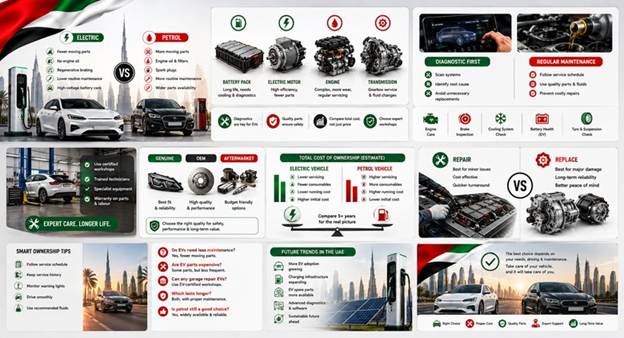
Quick Summary
| Buying Factor | Electric Vehicle | Petrol Vehicle |
| Genuine Parts | Recommended for high-voltage systems | Recommended for critical engine components |
| OEM Parts | Excellent alternative in many cases | Excellent alternative in many cases |
| Aftermarket Parts | Suitable for selected non-critical components | Widely available for many repairs |
| VIN Compatibility | Essential | Essential |
| Specialist Verification | Highly Recommended | Recommended |
| Incorrect Part Risk | High | Moderate |
Finding the right spare part has never been easier.
Or more confusing.
Today, thousands of components are available online and through independent suppliers.
Many appear identical.
Some even carry similar product descriptions.
Yet one small difference in specification can prevent a vehicle from operating correctly.
For electric vehicles, choosing the wrong part can affect software communication, charging performance or battery management.
For petrol cars, incorrect components may reduce engine efficiency, increase fuel consumption or shorten the lifespan of neighbouring parts.
Buying spare parts isn't simply about finding the lowest price.
It's about finding the correct component.
The first time.
Genuine vs OEM vs Aftermarket EV Parts
Electric vehicles contain some of the most advanced automotive technology currently available.
That is why component quality matters.
Understanding the different categories of replacement parts helps buyers make informed decisions.
Genuine Parts
Genuine parts are supplied through the vehicle manufacturer.
They are designed specifically for the exact vehicle specification.
These components are usually recommended for:
- High-voltage batteries.
- Charging systems.
- Power electronics.
- Battery management components.
- Safety systems.
They often provide the highest level of compatibility and manufacturer support.
OEM Parts
OEM stands for Original Equipment Manufacturer.
These parts are produced by the same companies that manufacture components for vehicle brands but may be sold without the manufacturer's packaging.
For many repairs, OEM parts offer:
- Excellent quality.
- Reliable compatibility.
- Competitive pricing.
- Proven durability.
Many experienced workshops confidently recommend OEM components where appropriate.
Aftermarket Parts
Aftermarket manufacturers produce compatible replacement components independently.
Quality varies considerably.
Some manufacturers produce outstanding products.
Others may not meet original specifications.
For electric vehicles, aftermarket parts are generally more suitable for:
- Suspension components.
- Brake components.
- Cabin filters.
- Exterior trim.
- Certain body panels.
High-voltage systems should always be approached with greater caution.
Genuine vs OEM vs Aftermarket Petrol Car Parts
Petrol vehicles offer buyers a wider range of replacement options because the technology has existed for much longer.
Owners often choose between:
- Genuine manufacturer parts.
- OEM components.
- High-quality aftermarket products.
For critical engine repairs, many workshops continue recommending genuine or OEM components.
Examples include:
- Timing components.
- Fuel system parts.
- Engine sensors.
- Cooling system components.
Aftermarket products may provide excellent value for routine maintenance items when purchased from reputable manufacturers.
The important word is quality.
Not simply price.
Why VIN Compatibility Is Essential
Two vehicles may look identical.
They may even share the same model name.
Yet underneath, important differences can exist.
Manufacturers regularly update:
- Engine specifications.
- Battery versions.
- Electronic modules.
- Suspension designs.
- Braking systems.
- Software calibrations.
That's why the Vehicle Identification Number (VIN) is so important.
Checking the VIN allows suppliers to confirm:
- Correct part numbers.
- Production variations.
- Regional specifications.
- Factory-installed equipment.
Skipping this step creates unnecessary risk.
Especially with modern vehicles.
How to Avoid Buying Incorrect EV Components
Electric vehicles depend on components communicating perfectly.
Installing an incompatible module can lead to:
- Charging faults.
- Warning lights.
- Reduced performance.
- Software errors.
- Communication failures.
Before ordering any EV component:
- Confirm the VIN.
- Verify software compatibility.
- Compare manufacturer part numbers.
- Confirm whether programming is required.
- Discuss compatibility with an experienced supplier.
These simple checks often prevent expensive mistakes.
Common Mistakes Buyers Make When Purchasing Spare Parts
Workshop technicians regularly encounter avoidable problems.
The most common include:
- Ordering parts using photographs instead of part numbers.
- Choosing the cheapest available option.
- Ignoring VIN verification.
- Assuming all model years use identical components.
- Replacing parts before confirming the diagnosis.
- Purchasing electronic components without checking programming requirements.
Each mistake increases repair costs.
Each can usually be avoided through careful planning.
Questions You Should Ask Before Buying Any Vehicle Part
Good buyers ask questions.
Excellent buyers ask the right questions.
Consider asking:
- Is this component compatible with my VIN?
- Is it genuine, OEM or aftermarket?
- Does it require programming?
- Is there a manufacturer's warranty?
- Has the part been tested?
- Does installation require specialist equipment?
- Will replacing this component solve the confirmed fault?
The answers often reveal far more than the product description.
Why Buying the Cheapest Part Can Cost More
Saving money is sensible.
Compromising on quality often isn't.
Inferior replacement parts may lead to:
- Premature failure.
- Poor fitment.
- Increased labour costs.
- Repeat repairs.
- Reduced vehicle reliability.
Imagine replacing the same component twice.
The second repair often costs far more than choosing the correct part initially.
Quality should always be viewed as an investment rather than an expense.
Why Professional Advice Still Matters
Online shopping has transformed the automotive industry.
Yet experienced advice remains invaluable.
A knowledgeable supplier or workshop can often identify compatibility issues before the order is placed.
That expertise helps owners avoid:
- Incorrect part numbers.
- Software incompatibility.
- Duplicate purchases.
- Unnecessary returns.
- Vehicle downtime.
Technology continues evolving.
Professional guidance remains just as valuable as ever.
Workshop Story
A customer in Dubai ordered an electric power steering module from an overseas supplier after finding a lower online price.
The component appeared identical to the original.
After installation, however, the steering warning light remained illuminated.
The workshop carried out a complete diagnostic inspection.
The replacement unit belonged to a similar model produced for another market.
Although physically identical, its software configuration differed.
The correct module was installed, programmed and calibrated.
The steering system immediately returned to normal operation.
As the owner looked at both components on the workbench, he asked,
"They look exactly the same. How could one be wrong?"
The technician smiled.
"Because modern vehicles don't recognise appearances."
"They recognise specifications."
That simple lesson explains why compatibility matters more than ever.
Spare Parts Buying Comparison Table
| Buying Factor | Electric Vehicle | Petrol Vehicle |
| VIN Verification | Essential | Essential |
| Software Compatibility | Frequently Required | Occasionally Required |
| Genuine Parts | Recommended for High-Voltage Systems | Recommended for Critical Engine Components |
| OEM Parts | Excellent Alternative | Excellent Alternative |
| Aftermarket Availability | Growing | Extensive |
| Incorrect Part Risk | Higher | Moderate |
Buyer Decision Matrix
| Your Situation | Recommended Choice |
| Replacing battery-related components | Genuine or approved OEM parts |
| Replacing engine components | Genuine or high-quality OEM parts |
| Routine maintenance items | Quality aftermarket parts may be appropriate |
| Unsure about compatibility | Verify the VIN before purchasing |
| Electronic component replacement | Confirm software programming requirements |
| Looking for the cheapest option | Compare quality, warranty and compatibility—not just price |
Suggested Visual Callout
"How to Buy the Correct Spare Part"
Create a step-by-step infographic showing:
- Vehicle VIN identification.
- Diagnostic confirmation.
- Genuine vs OEM vs Aftermarket comparison.
- Part number verification.
- Software compatibility check.
- Professional installation.
- Final system testing.
Use realistic workshop visuals with subtle UAE-inspired red, green, white and black accents.
Keep text minimal and make the buying journey easy to understand.
Smart Buyer's Checklist
Before ordering any replacement part:
- Confirm the exact fault through diagnostics.
- Verify the VIN and part number.
- Ask whether software programming is required.
- Compare genuine, OEM and aftermarket options.
- Check warranty coverage.
- Buy from reputable suppliers.
- Prioritise quality over the lowest price.
- Ensure the workshop is experienced with your vehicle.
Buying the right part is about much more than making a purchase.
It's about protecting your vehicle, your safety and your long-term ownership costs.
Key Takeaways
Choosing the correct spare part is just as important as diagnosing the correct fault. Whether you own an electric vehicle or a petrol car, verifying VIN compatibility, understanding the differences between genuine, OEM and aftermarket parts, and confirming software requirements can prevent unnecessary repairs, wasted money and vehicle downtime. Modern vehicles are increasingly sophisticated, making careful part selection more important than ever.
The biggest lesson is that the cheapest component is rarely the most economical choice if it compromises compatibility or quality. Working with experienced suppliers, confirming specifications before ordering and using professionally fitted replacement parts helps ensure reliable repairs and long-term vehicle performance.
Repair vs Replacement – When Should You Repair a Part and When Is Replacement the Better Option?
Quick Summary
| Component | Repair May Be Suitable | Replacement May Be Better |
| EV Battery Pack | Individual modules, cooling components or sensors | Severe battery degradation or major internal damage |
| Electric Motor | Bearings, seals or supporting components | Extensive internal failure |
| Petrol Engine | Gaskets, pumps, sensors or minor internal repairs | Severe mechanical damage or catastrophic engine failure |
| Gearbox | Solenoids, seals or valve body repairs | Major internal wear or repeated failures |
| Electronics | Software updates or module repairs | Irreparable electronic failure |
| Decision Factor | Condition, cost and diagnosis | Safety, reliability and long-term value |
Every vehicle owner eventually faces a difficult decision.
Repair it.
Or replace it.
At first glance, the answer often appears simple.
If repairing the component costs less, repair it.
If replacement costs less, replace it.
Reality is rarely that straightforward.
A repair that looks inexpensive today may become costly if the same component fails again a few months later.
Likewise, replacing an expensive assembly isn't always necessary when only one supporting component has failed.
Making the right decision requires more than comparing quotations.
It requires understanding the condition of the component, the accuracy of the diagnosis and the long-term value of the repair.
Repair vs Replace: EV Battery Packs
Battery packs receive more attention than any other EV component.
Many drivers assume that any battery-related warning automatically means complete battery replacement.
Fortunately, that assumption is often incorrect.
Modern battery systems consist of numerous interconnected components.
Depending on the fault, technicians may repair or replace:
- Cooling pumps.
- Temperature sensors.
- High-voltage contactors.
- Wiring.
- Battery control modules.
- Individual battery modules (where manufacturer procedures permit).
Complete battery replacement is generally considered only when there is:
- Significant internal damage.
- Severe degradation.
- Safety concerns.
- Manufacturer-recommended replacement.
This is why battery diagnosis should always come before discussing replacement costs.
Repair vs Replace: Petrol Engines
Petrol engines often develop faults gradually.
Not every problem requires a complete engine replacement.
Repairs commonly include:
- Head gasket replacement.
- Water pump replacement.
- Timing component replacement.
- Turbocharger repairs.
- Fuel injector replacement.
- Oil leak repairs.
- Sensor replacement.
Replacement usually becomes the preferred option when the engine suffers:
- Severe overheating damage.
- Cracked engine block.
- Major internal wear.
- Catastrophic mechanical failure.
The decision depends on repair cost compared with the engine's remaining service life.
Repair vs Replace: Electric Motors and Gearboxes
Electric motors are generally designed for long service lives.
When faults occur, technicians first inspect supporting systems rather than assuming the motor itself has failed.
Repairable issues may include:
- Bearings.
- Cooling components.
- Electrical connectors.
- Sensors.
- Mountings.
Replacement may be necessary if extensive internal electrical or mechanical damage has occurred.
Gearboxes follow a similar principle.
Many transmission faults originate from:
- Seals.
- Solenoids.
- Valve bodies.
- Electronic controllers.
These repairs often cost considerably less than replacing the complete gearbox assembly.
Accurate diagnosis once again determines the correct solution.
Hidden Costs of Incorrect Part Installation
Sometimes the repair itself isn't the problem.
The installation is.
Incorrectly fitted components may lead to:
- Fluid leaks.
- Electrical faults.
- Cooling system problems.
- Communication errors.
- Premature component failure.
- Repeat labour charges.
For EVs, improper installation may also require:
- Additional diagnostics.
- Software recalibration.
- High-voltage safety inspections.
The cheapest repair quickly becomes expensive if the component needs removing and reinstalling.
Careful fitment protects your investment.
Why Cheap Parts Can Become Expensive Repairs
Price attracts attention.
Quality determines value.
A lower-priced component may initially appear to save money.
However, inferior quality can result in:
- Reduced reliability.
- Poor fitment.
- Faster wear.
- Additional labour.
- Vehicle downtime.
Imagine replacing the same part twice within a year.
The total cost often exceeds purchasing a better-quality component from the beginning.
Experienced workshops usually evaluate:
- Component quality.
- Expected lifespan.
- Warranty support.
- Installation reliability.
Not simply the purchase price.
Total Cost of Ownership: EV vs Petrol
Ownership costs should never be measured by one repair alone.
Instead, consider:
- Routine servicing.
- Major repairs.
- Parts availability.
- Labour.
- Diagnostic costs.
- Vehicle downtime.
- Future resale value.
An EV owner may experience fewer workshop visits.
A petrol owner may benefit from lower costs for individual repairs.
Neither tells the whole story.
The real comparison is the total cost across several years of ownership.
That's the figure that truly matters.
When Repair Is the Better Financial Decision
Repairing a component often makes sense when:
- The fault is accurately identified.
- The remaining component is in good condition.
- Manufacturer-approved repair procedures exist.
- The repair restores long-term reliability.
- Replacement offers little additional benefit.
Many successful repairs involve replacing only the failed supporting component rather than the complete assembly.
That approach saves money without compromising reliability.
When Replacement Is the Smarter Choice
Replacement becomes more attractive when:
- Repairs approach the cost of replacement.
- Reliability cannot be guaranteed.
- Safety is compromised.
- Multiple components have already failed.
- Labour costs for repeated repairs become excessive.
Replacing the complete assembly may appear expensive initially.
However, it often restores confidence and reduces the likelihood of repeated workshop visits.
Long-term thinking usually produces the best financial outcome.
Workshop Story
A luxury electric saloon arrived at a specialist workshop in Dubai after another repair centre recommended replacing the complete drive unit.
The quotation was substantial.
Rather than ordering the assembly immediately, technicians performed a complete diagnostic assessment.
Testing revealed that the electric motor remained in excellent condition.
The fault originated from a damaged resolver sensor responsible for monitoring motor position.
The sensor was replaced.
The system was recalibrated.
Road testing confirmed perfect operation.
The customer looked genuinely surprised.
"I nearly authorised a complete motor replacement."
The workshop manager replied,
"Expensive components deserve accurate diagnosis before expensive decisions."
The same principle applies whether repairing an EV battery, a petrol engine or any other major vehicle system.
Repair vs Replacement Comparison Table
| Situation | Repair | Replacement |
| Minor Component Failure | ✔ Often Suitable | ✖ Usually Unnecessary |
| Supporting Sensor Failure | ✔ Recommended | ✖ Not Required |
| Severe Mechanical Damage | ✖ Limited Benefit | ✔ Preferred |
| Safety-Critical Damage | ✖ Not Advisable | ✔ Recommended |
| Repeated Major Failures | △ Depends on Cost | ✔ Often Better |
| Long-Term Reliability Required | △ Depends on Diagnosis | ✔ Frequently Preferred |
Buyer Decision Matrix
| Your Situation | Recommended Action |
| Warning light appears | Obtain a full diagnostic report first |
| Major repair quotation | Request confirmation of the root cause |
| Repair costs below replacement with reliable outcome | Consider repair |
| Multiple repeated failures | Evaluate replacement |
| High-value EV components | Use EV-certified workshops |
| Unsure which option offers better value | Compare long-term ownership costs, not just today's invoice |
Suggested Visual Callout
"Repair or Replace?"
Create a decision-tree infographic showing:
- Warning light appears.
- Professional diagnostic scan.
- Root cause identified.
- Minor fault → Repair.
- Major internal damage → Replacement.
- Software calibration.
- Final testing and road test.
Use realistic workshop illustrations with subtle UAE-inspired red, green, white and black accents.
Keep wording minimal and make the decision process easy to follow.
Smart Buyer's Checklist
Before approving a major repair:
- Request a detailed diagnostic report.
- Ask whether the component can be repaired safely.
- Compare repair and replacement costs.
- Consider future reliability.
- Check warranty coverage.
- Verify the quality of replacement parts.
- Confirm whether software calibration is included.
- Choose long-term value rather than the quickest solution.
A successful repair isn't measured by how little it costs today.
It's measured by how confidently the vehicle performs tomorrow.
Key Takeaways
Repairing and replacing vehicle components should always be guided by accurate diagnostics rather than assumptions. Many EV battery, electric motor and gearbox faults originate from supporting components such as sensors, cooling systems or electronic modules, while petrol engines often develop repairable issues long before complete replacement becomes necessary. Understanding the true cause of a fault helps owners avoid unnecessary expense and achieve more reliable repairs.
The most important lesson is that the lowest repair cost does not always represent the best value. Long-term reliability, component condition, installation quality, warranty support and future ownership costs should all influence the final decision. Whether you own an electric vehicle or a petrol car, informed decisions based on professional diagnosis almost always lead to better financial and mechanical outcomes.
Real-World Ownership Advice – Workshop Inspections, Warning Signs and Smart Buying Decisions
Quick Summary
| Topic | Why It Matters |
| Pre-Purchase Inspection | Identifies hidden problems before you spend money. |
| Early Warning Signs | Prevents small faults becoming major repairs. |
| Diagnostic Reports | Confirm the real fault before replacing parts. |
| Workshop Experience | Improves repair quality and reliability. |
| Service History | Reveals how well the vehicle has been maintained. |
| Smart Buying Checklist | Helps avoid expensive ownership mistakes. |
Whether you're buying your first electric vehicle or have owned petrol cars for decades, one truth never changes.
Good ownership begins with good decisions.
The majority of expensive repairs don't happen overnight.
They develop gradually.
A small warning light is ignored.
An unusual vibration becomes slightly worse.
A cooling issue is postponed until the hottest month of the year.
Eventually, what could have been a straightforward repair becomes a major workshop visit.
Experienced technicians see this pattern every week.
The encouraging news?
Most of these situations are preventable.
Knowing what to look for—and acting early—can significantly reduce repair costs while improving reliability and safety.
Workshop Inspection Checklist Before Buying Parts
Before purchasing any replacement component, the workshop should confirm exactly what has failed.
Replacing parts before completing an inspection often wastes both time and money.
A professional inspection normally includes:
- Full diagnostic scan.
- Visual inspection.
- Road test where appropriate.
- Mechanical assessment.
- Electrical system checks.
- Cooling system inspection.
- Battery or engine health assessment.
- Verification of fault codes.
For electric vehicles, additional checks may include:
- High-voltage safety verification.
- Battery Management System analysis.
- Charging system inspection.
- Battery temperature monitoring.
- Electrical insulation testing.
Inspection always comes before replacement.
Never the other way around.
Warning Signs Your EV Needs Immediate Attention
Electric vehicles are exceptionally good at monitoring their own systems.
Even so, drivers should never ignore warning signs such as:
- Reduced driving range.
- Charging taking noticeably longer.
- Battery temperature warnings.
- High-voltage system alerts.
- Sudden loss of performance.
- Unusual noises from the electric drive unit.
- Coolant warnings.
- Repeated software fault messages.
Some problems remain minor if addressed quickly.
Ignoring them may allow supporting components to deteriorate further.
Warning Signs Your Petrol Car Needs Immediate Repairs
Petrol vehicles communicate problems differently.
Drivers should pay attention to:
- Engine warning lights.
- Oil pressure warnings.
- Rising coolant temperature.
- White, blue or black exhaust smoke.
- Knocking noises.
- Poor acceleration.
- Difficult starting.
- Excessive fuel consumption.
- Fluid leaks beneath the vehicle.
Many of these symptoms develop gradually.
Early diagnosis usually reduces repair costs considerably.
Why Regular Inspections Save Thousands
One of the biggest misconceptions among motorists is that servicing is simply about replacing worn parts.
In reality, inspections are about preventing failures.
A trained technician often identifies:
- Early bearing wear.
- Small coolant leaks.
- Loose electrical connectors.
- Suspension deterioration.
- Brake corrosion.
- Battery cooling problems.
Correcting these issues early protects surrounding components.
One inexpensive repair today may prevent several expensive repairs tomorrow.
Preventative maintenance has always been the most economical maintenance.
The Value of a Complete Service History
Service history tells a story.
Not just about the vehicle.
About the owner.
A complete maintenance record demonstrates that the vehicle has received regular attention.
It allows workshops to identify:
- Previously replaced components.
- Outstanding maintenance items.
- Recurring faults.
- Software updates.
- Inspection intervals.
For used vehicles, documented servicing often increases buyer confidence and may support stronger resale values.
Missing service records create uncertainty.
Buying a Used EV or Petrol Vehicle
Buying a used vehicle requires careful evaluation regardless of its powertrain.
For an electric vehicle, buyers should assess:
- Battery health.
- Charging performance.
- Service records.
- Cooling system condition.
- Diagnostic history.
- Software updates.
For a petrol vehicle, attention should focus on:
- Engine condition.
- Cooling system.
- Oil leaks.
- Timing system.
- Gearbox operation.
- Suspension.
- Service documentation.
Never rely solely on appearance.
Modern vehicles can hide expensive faults beneath clean bodywork.
Choosing the Right Workshop
Not every workshop offers the same expertise.
The best repair experience usually comes from technicians who understand the technology they're working with.
Before booking repairs, ask:
- How much experience do you have with this model?
- Do you perform complete diagnostic inspections?
- Can you programme replacement components?
- Are your technicians EV-certified where applicable?
- Do you provide warranty support?
- Will I receive a written diagnostic report?
A professional workshop should welcome these questions.
Transparency builds trust.
The Cost of Ignoring Small Problems
Vehicle faults rarely disappear on their own.
Instead, they tend to spread.
For example:
A small coolant leak can reduce cooling efficiency.
Reduced cooling increases operating temperatures.
Higher temperatures place additional stress on major components.
Eventually, repair costs increase.
Exactly the same principle applies to:
- Suspension wear.
- Brake deterioration.
- Electrical faults.
- Steering problems.
- Charging issues.
Responding early almost always costs less.
Workshop Story
A family from Sharjah planned a weekend trip to Fujairah in their electric SUV.
A small battery cooling warning appeared several days earlier.
Because the vehicle still drove normally, they almost ignored it.
Fortunately, they booked a workshop inspection before travelling.
Technicians discovered that a cooling hose connection had begun to loosen.
The repair was completed within a short time.
Had the family continued driving during peak summer temperatures without addressing the issue, the battery management system could have reduced performance to protect the battery, disrupting their journey and increasing the risk of more extensive repairs.
As the owner thanked the technician, he said,
"I nearly cancelled the appointment because the warning disappeared."
The technician replied,
"Warning lights sometimes disappear."
"The underlying problem doesn't."
That simple advice applies to every modern vehicle.
Workshop Inspection Comparison Table
| Inspection Area | Electric Vehicle | Petrol Vehicle |
| Diagnostic Scan | Essential | Essential |
| Battery/Engine Assessment | Battery Health Analysis | Engine Performance Inspection |
| Cooling System | Battery Thermal Management | Engine Cooling System |
| Electrical Inspection | High-Voltage & Low-Voltage Systems | Conventional Electrical Systems |
| Software Verification | Frequently Required | Occasionally Required |
| Road Test | Recommended | Recommended |
Buyer Decision Matrix
| Your Situation | Best Decision |
| Buying a used EV | Request a battery health report before purchase |
| Buying a used petrol car | Inspect engine, gearbox and service history thoroughly |
| Dashboard warning appears | Arrange professional diagnostics immediately |
| Preparing for a long journey | Book a preventative inspection |
| Unsure about workshop quality | Ask about qualifications, equipment and warranty |
| Replacing expensive components | Confirm diagnosis before approving repairs |
Suggested Visual Callout
"The Professional Vehicle Inspection Process"
Create a step-by-step workshop infographic showing:
- Customer explains the fault.
- Technician performs a visual inspection.
- Diagnostic scanner connected.
- Battery or engine health assessment.
- Cooling system inspection.
- Suspension and brake inspection.
- Repair recommendation.
- Final road test and customer handover.
Use realistic workshop imagery with subtle UAE-inspired red, green, white and black accents.
Keep text minimal and let the illustrations explain the process.
Smart Buyer's Checklist
Before buying a vehicle or approving major repairs:
- Request a complete diagnostic inspection.
- Review the service history carefully.
- Check battery or engine condition.
- Inspect the cooling system.
- Verify that warning lights have been investigated.
- Confirm the compatibility of replacement parts.
- Choose experienced workshops with appropriate equipment.
- Focus on long-term reliability rather than short-term savings.
The best repairs begin long before the first component is replaced.
They begin with careful inspection, informed decisions and a willingness to investigate problems before they become expensive.
Key Takeaways
Successful vehicle ownership depends on identifying problems early, choosing experienced workshops and making informed maintenance decisions. Whether you drive an electric vehicle or a petrol car, routine inspections, professional diagnostics and complete service records significantly improve reliability while reducing the likelihood of major repair bills. Small faults are far easier—and far less expensive—to resolve before they affect larger systems.
The most valuable habit any vehicle owner can develop is responding promptly to warning signs rather than waiting for a breakdown. Preventative inspections, accurate diagnostics and quality repairs protect both the vehicle and your long-term ownership budget, making every journey safer and more dependable.
Final Comparison, Real Buyer Questions, FAQs and Expert Verdict
Quick Summary
| Final Comparison | Electric Vehicle | Petrol Vehicle |
| Routine Maintenance | Lower | Higher |
| Mechanical Complexity | Lower | Higher |
| Electronic Complexity | Higher | Moderate |
| Specialist Diagnostics | Essential | Recommended |
| Parts Availability | Improving Rapidly | Excellent |
| Best Choice | Depends on Driving Habits and Ownership Goals | Depends on Driving Habits and Ownership Goals |
After comparing every major system, one conclusion becomes clear.
Electric vehicles and petrol cars are not competing with identical technology.
They solve the same transportation problem using completely different engineering philosophies.
That difference affects:
- Maintenance.
- Repairs.
- Spare parts.
- Workshop procedures.
- Ownership costs.
- Long-term reliability.
Neither vehicle is universally better.
The better choice depends entirely on how you drive, where you drive and how you intend to maintain your vehicle throughout its life.
Understanding those differences is far more valuable than believing one technology is automatically superior to the other.
Side-by-Side Comparison: EV Parts vs Petrol Car Parts
Let's bring everything together.
| Category | Electric Vehicle | Petrol Vehicle |
| Power Source | High-Voltage Battery | Petrol Engine |
| Main Drive Unit | Electric Motor | Internal Combustion Engine |
| Fuel System | Not Required | Required |
| Engine Oil | Not Required | Essential |
| Spark Plugs | Not Required | Required |
| Timing Belt | Not Required | Required on Many Models |
| Cooling System | Battery & Electronics | Engine Cooling |
| Braking | Regenerative + Hydraulic | Hydraulic |
| Routine Service Parts | Fewer | More Numerous |
| Software Dependence | Very High | Moderate |
| Specialist Diagnostics | Essential | Important |
| Workshop Expertise | EV-Trained Technicians Preferred | Conventional Automotive Workshops |
This comparison explains why servicing schedules, repair methods and replacement parts differ so significantly between the two vehicle types.
Real Buyer Questions
These are some of the most common questions asked by UAE vehicle owners before choosing between an EV and a petrol car.
Do electric vehicles really require fewer spare parts?
Yes.
EVs eliminate many routine service items such as engine oil, spark plugs, fuel filters and timing components.
However, they introduce sophisticated electrical systems that require specialist inspection and diagnosis.
Are EV repairs always more expensive?
Not necessarily.
Routine maintenance is often less expensive because there are fewer wear-related mechanical components.
Some major EV components are costly, but accurate diagnostics frequently reveal smaller supporting faults instead of complete component failure.
Can any workshop repair an electric vehicle?
Not every workshop currently has the equipment or training required for high-voltage systems.
Owners should choose workshops with suitable diagnostic equipment and technicians trained to work safely on electric vehicles.
Which vehicle lasts longer?
Both technologies can provide excellent long-term reliability when maintained correctly.
Regular servicing, quality replacement parts and prompt repairs remain far more important than the type of powertrain alone.
Is buying an EV in the UAE becoming easier?
Yes.
Charging infrastructure continues to expand, while the availability of EV spare parts and specialist workshops is improving across Dubai, Abu Dhabi, Sharjah and the other emirates.
Which ownership costs should buyers compare?
Rather than focusing on one repair bill, compare:
- Routine servicing.
- Major repair costs.
- Parts availability.
- Labour charges.
- Vehicle downtime.
- Long-term reliability.
- Resale value.
This provides a much clearer picture of total ownership costs.
Future of EV Spare Parts in the UAE
The UAE automotive market is changing rapidly.
Electric vehicle adoption continues to increase.
Charging infrastructure continues to expand.
Specialist workshops are investing in:
- High-voltage technician training.
- Advanced diagnostic equipment.
- Battery repair capabilities.
- Software programming.
- Thermal management expertise.
At the same time, spare parts suppliers continue expanding their EV inventory.
Over the coming years, owners can expect:
- Improved component availability.
- Shorter repair times.
- Greater workshop expertise.
- More competitive pricing.
- Wider availability of OEM and genuine EV components.
Petrol vehicles will remain an important part of the UAE market for many years.
The future is unlikely to belong exclusively to one technology.
Instead, both technologies will continue evolving together.
Final Decision Guide
| If You... | Consider... |
| Mostly drive in cities with charging access | Electric Vehicle |
| Travel long distances regularly | Compare both options carefully based on charging availability |
| Want lower routine servicing requirements | Electric Vehicle |
| Prefer maximum workshop availability | Petrol Vehicle |
| Plan to keep the vehicle for many years | Prioritise maintenance history over powertrain type |
| Want predictable ownership costs | Follow preventative maintenance regardless of vehicle choice |
Workshop Story
A customer visited a specialist workshop in Dubai after owning both a petrol SUV and a new electric crossover for nearly three years.
Curious about which vehicle had proved more economical, he asked the workshop manager to compare their service records.
The petrol SUV had required several routine services, oil changes, ignition components and cooling system maintenance.
The electric crossover had visited less frequently, but each inspection involved comprehensive diagnostics, software checks and battery health assessments.
Neither vehicle had experienced a major failure.
The workshop manager handed back the service records and smiled.
"You've looked after both properly."
"That's why both have looked after you."
The owner laughed before replying,
"So the secret isn't whether it's electric or petrol."
"It's maintaining it correctly."
Exactly.
Technology changes.
Good maintenance never does.
Ultimate Vehicle Ownership Checklist
Before buying, servicing or repairing any vehicle:
- Understand how your vehicle's technology works.
- Never ignore dashboard warning lights.
- Request a professional diagnostic inspection before replacing expensive components.
- Verify VIN compatibility when ordering spare parts.
- Use genuine or high-quality OEM parts for critical systems.
- Follow manufacturer service schedules.
- Choose experienced workshops with the correct equipment.
- Keep detailed maintenance records.
- Invest in preventative maintenance.
- Focus on long-term reliability rather than short-term savings.
Suggested Visual Callout
"The Complete EV vs Petrol Ownership Journey"
Create a premium infographic showing two ownership timelines.
Electric Vehicle
- Purchase.
- Battery health inspections.
- Charging system maintenance.
- Software updates.
- Cooling system checks.
- Long-term ownership.
Petrol Vehicle
- Purchase.
- Oil services.
- Filter replacements.
- Ignition maintenance.
- Cooling system servicing.
- Long-term ownership.
Finish both timelines with the same destination:
Reliable Vehicle Ownership Through Proper Maintenance
Use realistic workshop illustrations with subtle UAE-inspired red, green, white and black accents.
Keep text minimal and focus on visual storytelling.
Final Verdict
After examining every major component, servicing requirement and ownership consideration, one conclusion stands above everything else.
Electric vehicles are not maintenance-free.
Petrol cars are not outdated.
They simply require different maintenance strategies.
Electric vehicles reward owners with fewer routine service items, quieter operation and reduced mechanical complexity. In return, they demand specialist diagnostics, high-voltage safety procedures and carefully fitted replacement components.
Petrol vehicles continue to offer familiar servicing, extensive workshop networks and readily available spare parts, but they require more routine mechanical maintenance throughout their lives.
For UAE drivers, the smartest decision is not choosing the technology with the fewest parts.
It is choosing the technology that best suits your driving habits, your budget and your access to qualified servicing.
Whichever vehicle you own, the same principles always apply:
Diagnose accurately.
Use quality replacement parts.
Follow scheduled maintenance.
Choose experienced workshops.
Those four decisions will influence reliability far more than whether your vehicle runs on electricity or petrol.
Key Takeaways
Electric vehicles and petrol cars represent two different engineering approaches, each with distinct maintenance requirements, repair procedures and spare parts. EVs reduce routine mechanical servicing but rely heavily on sophisticated electronics, battery management and specialist diagnostics. Petrol vehicles continue to require more regular maintenance, yet they benefit from extensive workshop networks and widely available replacement components.
The most important lesson throughout this guide is that successful vehicle ownership is driven by informed maintenance rather than the choice of powertrain alone. Accurate diagnostics, careful component selection, professional installation and preventative servicing remain the foundations of long-term reliability, safety and cost-effective ownership across the UAE. By understanding how each technology works and responding promptly to maintenance needs, owners can enjoy dependable performance for many years, regardless of whether they drive an electric vehicle or a petrol car.
Frequently Asked Questions
Categories
- Audi
- BMW
- Car Accessories
- Car Tips
- Ford
- Land Rover
- Mazda
- Range Rover
- Top 10
- UAE Car Parts
- Used Car Parts
- Toyota
- Replacement Engines
- Nissan
- Hyundai
- Mitsubishi
- Volkswagen
- Honda
- Kia
- Chevrolet
- Dodge
- Jeep
- Subaru
- Renault
- Lexus
- Mercedes
- Suzuki
- Hummer
- Porsche
- Infiniti
- Peugeot
- GMC
- Mini
- Volvo
- Replacement Gearboxes
- MG
- Jaguar
- Skoda
- Cadillac
- Daihatsu
- Fiat
- German Car Parts
- Japanese Car Parts
- Aftermarket Car Parts
- Genuine Car Parts
- New Car Parts
- Reconditioned Car Parts
- European Car Parts
- American Car Parts
- Korean Car Parts
- British Car Parts
- Chinese Car Parts
- Sports/Exotic Car Parts
- Luxury Car Parts
- Performance Car Parts
- SUV/4x4 Spare Parts
- Truck Spare Parts
- EV Car Parts
- Hybrid Car Parts
- Auto Spare Parts in UAE
- Tesla
- Isuzu
- Ram
- Ferrari
- Bentley
- Lamborghini
- Genesis
- Maserati
- Lincoln
- Chrysler
- Opel
- Citroen
- SsangYong
- Seat
- McLaren
- Aston Martin
- Rolls Royce
- Maybach
- Alfa Romeo
- Bugatti
- Scion
- Abu Dhabi Car Parts
- Ajman Car Parts
- Al Khan Car Parts
- Al Sajaa Car Parts
- Deira Car Parts
- Dubai Car Parts
- Fujairah Car Parts
- Industrial Area 6 Car Parts
- Mussafah Car Parts
- Ras Al Khaimah Car Parts
- Sharjah Car Parts
- Umm Al Quwain Car Parts
- Acura
- BYD
- Chery
- Dacia
- DS
- Geely Emgrand
- EXEED
- GAC
- GAC Gonow
- Geely
- Gonow
- Great Wall
- Haima
- Haval
- Holden
- Iveco
- JAC
- Jaecoo
- Jetour
- Lotus
- Omoda
- Proton
- Renault Samsung
- Roewe
- Lucid