EXEED Hybrid and EV Parts in UAE: Battery, Motor and Electronic Replacement Costs
October 2, 2026
The expensive EXEED hybrid parts in UAE or EV parts are not necessarily the battery.
That may sound odd when the battery is the component everyone talks about, but it matters when a warning light appears, charging becomes abnormal or the vehicle suddenly refuses to deliver its usual electric power. A high-voltage fault can originate in the battery pack, a battery-management component, charging hardware, an inverter, an electric motor, wiring, cooling equipment or software-controlled electronics. Replacing the entire battery because the dashboard says there is a battery fault can be an extraordinarily expensive way to skip diagnosis.
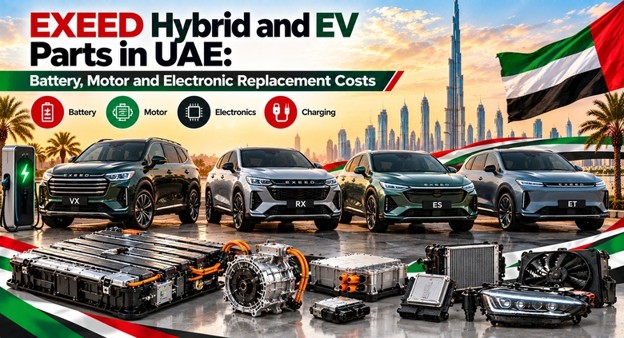
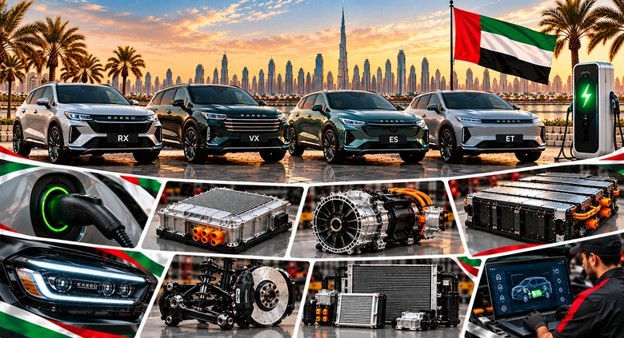
EXEED's UAE range now includes several electrified configurations: RX Super Hybrid, VX Super Hybrid, ES REEV, ES BEV, ET REEV and ET BEV. The official UAE model comparison currently lists the RX Super Hybrid from AED 129,999, VX Super Hybrid from AED 164,999, ES REEV from AED 149,999, ES BEV from AED 219,999, ET REEV from AED 149,999 and ET BEV from AED 214,999.
Those are vehicle prices, not replacement-part prices. That distinction becomes crucial once an owner is staring at a workshop quotation.
UAE Update Reference: September 2026
“Battery problem” is not a diagnosis
A hybrid or EV can report a high-voltage battery-related fault for several reasons.
The battery itself may have a genuine internal problem. But the fault could also involve the battery-management system, cell-voltage monitoring, temperature sensing, contactors, insulation monitoring, charging circuitry, wiring or communication between control modules.
That means the first useful question is not:
“How much is a new battery?”
It is:
“What component or condition has actually been diagnosed as faulty?”
For an expensive high-voltage repair, that distinction can be worth thousands of dirhams.
Which EXEED models are actually electrified in the UAE?
The current UAE range is more complicated than simply calling everything an “EXEED hybrid”.
The RX and VX have Super Hybrid versions. The ES is available as both REEV and BEV, while the ET is also offered in REEV and BEV forms. EXEED's current UAE comparison pages show these variants separately.
That means a supplier who receives the message “EXEED battery” still does not have enough information.
The model is needed.
So is the powertrain.
And for expensive electrical components, the VIN and exact vehicle configuration should be supplied before a part is ordered.
REEV and BEV are not the same repair proposition
A BEV, or battery-electric vehicle, relies on its high-voltage battery and electric drive system for propulsion.
A REEV, or range-extended electric vehicle, adds a petrol engine-generator system to an electrically driven powertrain.
The distinction is visible in EXEED's own specifications.
The ES brochure lists an 82 kWh battery for the BEV and 34 kWh and 40 kWh batteries for its REEV variants. It also identifies one or two electric motors depending on the version.
The ET brochure similarly lists a 77 kWh BEV battery and 40 kWh REEV batteries.
So there cannot sensibly be one “EXEED EV battery price”.
There are different systems.
The ES BEV has an 82 kWh battery — but that does not give us a replacement price
The current UAE ES BEV specification states an 82 kWh battery, 353 kW output and 800V fast-charging architecture. EXEED lists the model from AED 219,999 in the UAE.
It is tempting to take 82 kWh and multiply it by some generic battery cost per kWh found online.
Don't.
That would not produce a reliable UAE replacement quotation.
A replacement pack is not simply a pile of cells priced by energy capacity. The assembly can involve casing, thermal management, battery-management electronics, contactors, sensing, protection equipment, connectors and vehicle-specific integration. Labour, diagnostics, transport and safety procedures can also materially affect the repair.
No reliable current UAE public retail price for a complete ES BEV battery pack was identified in the sources reviewed.
That is an important result, not a missing paragraph.
The ET BEV uses a different battery again
The current UAE ET BEV specification lists a 77 kWh battery, 800V fast charging and 345 kW output, with the model shown from AED 214,999 on EXEED UAE.
The ET brochure also identifies the BEV battery as 77 kWh.
So an ET BEV battery should not be priced by copying an ES BEV quotation.
The capacity is different.
The vehicle architecture is different.
The component application is different.
And even if two batteries had similar nominal capacity, that would not establish interchangeability.
What does an EXEED REEV battery cost?
This is where published UAE information becomes even less straightforward.
The official ES brochure lists 34 kWh and 40 kWh REEV battery configurations, while the ET brochure lists a 40 kWh battery for its REEV versions.
But the public UAE parts listings reviewed do not provide a dependable transaction price for complete ES or ET high-voltage battery assemblies.
So an owner should be wary of any article claiming a neat universal figure such as “EXEED hybrid battery replacement costs AED X”.
Unless the figure comes from a dated UAE quotation for the exact vehicle and component, it is not a reliable market benchmark.
Battery capacity does not tell you battery health
An 82 kWh battery is not automatically an 82 kWh battery in usable condition.
But nor does reduced driving range automatically prove that the battery pack has failed.
Range can be influenced by temperature, driving speed, air-conditioning demand, tyre condition, terrain, vehicle load and the vehicle's energy-management strategy.
For diagnosis, the workshop should look at battery-management data and relevant fault information rather than treating range loss alone as proof of pack failure.
A useful battery-health assessment needs actual measurements and vehicle-specific diagnostic procedures.
UAE heat deserves attention — but not lazy conclusions
High ambient temperatures and heavy air-conditioning use make thermal management particularly relevant to electrified vehicles in the UAE.
That does not mean every battery problem is “because of the heat”.
The more useful question is whether the battery and associated high-voltage system are maintaining their required operating temperatures and whether cooling-system faults, temperature sensors or control issues are present.
The workshop may need to investigate coolant circuits, temperature readings, cooling components, pumps, fans and relevant fault codes, depending on the system.
Heat is a condition to consider.
It is not a diagnosis.
The battery-management system can be the expensive-looking problem that isn't a failed battery
The battery-management system monitors and controls critical information from the high-voltage pack.
Depending on vehicle architecture, that can include cell voltages, temperatures, state of charge, protection limits and communication with other vehicle controllers.
If a fault occurs in monitoring or control, the vehicle may enter a restricted operating mode or trigger warning messages.
That does not automatically mean the entire battery pack needs replacing.
Before approving a pack replacement, ask the workshop to identify the actual diagnostic evidence supporting the conclusion.
Cell imbalance is different from a completely failed battery
A battery pack contains multiple cells or cell groups.
If their measured voltages behave abnormally relative to one another, the system can detect an imbalance or another battery-related condition.
But “cell imbalance” is not a magic phrase that tells you the repair.
The workshop still needs to establish the extent of the issue, the manufacturer's permitted repair procedure, whether modules or other components are serviceable, and whether the complete pack is actually required.
Do not accept a battery quote that says only:
“Battery weak — replace.”
Ask what was measured.
11. An inverter is not the battery
The inverter is another major high-voltage component.
Its job in an electrified powertrain is broadly connected with converting and controlling electrical energy between the battery and electric motor system.
A fault in the inverter or associated power electronics can therefore produce symptoms that an owner may casually describe as a “motor” or “battery” problem.
That is precisely why electronic diagnosis matters.
A replacement inverter also needs application confirmation. Hardware compatibility alone may not be sufficient if the vehicle requires software configuration, coding, calibration or communication with other control systems.
Electric motors have different failure patterns from batteries
An electric motor does not fail in exactly the same way as an internal-combustion engine.
Possible concerns can include electrical faults, insulation problems, bearing or mechanical issues, temperature-related problems, position sensing and power-electronics interaction.
The correct diagnostic route depends heavily on the architecture.
For the ES BEV, EXEED's published specifications identify a dual-motor AWD arrangement with 353 kW output.
The REEV versions have different motor configurations.
Therefore an ES electric motor quotation needs the exact variant before a supplier can meaningfully identify the assembly.
The ET can have a 77 kWh battery and 345 kW electric power — still not enough information to order a motor
The ET BEV's official UAE specification gives 77 kWh battery capacity and 345 kW output, with AWD.
That tells us what vehicle configuration exists.
It does not give us a motor replacement price.
Nor does it establish that an ET motor can be sourced from another EXEED model merely because the power rating appears similar.
For a motor assembly, the supplier should be given the VIN, exact variant, model year and existing component identification where available.
Why there are so few public UAE prices for high-voltage EXEED parts
The UAE aftermarket is not yet publishing transparent retail prices for every high-voltage EXEED component.
Public UAE parts marketplaces do list EXEED electrical and electronic categories, including batteries, control modules and other electrical parts, but many high-value items remain enquiry-based rather than carrying a clear public retail price.
That creates an awkward SEO problem: readers want a number, but a made-up number would be worse than no number.
For high-voltage batteries, traction motors, inverters and specialised control units, the honest answer is often:
quotation required for the exact VIN and component.
The ordinary 12V battery is a completely different item
This deserves its own warning because “battery replacement” can mean two completely different things.
An electrified EXEED still has conventional low-voltage electrical equipment, while its propulsion system uses a high-voltage battery architecture.
A workshop saying “the battery is dead” should therefore identify which battery.
A weak 12V battery can cause starting, unlocking, communication or electronic-system symptoms without proving that the high-voltage propulsion battery has failed.
Do not approve a high-voltage battery replacement before the workshop has established which system is actually at fault.
Charging faults do not automatically mean battery faults
An EXEED owner may notice:
- charging stops unexpectedly
- charging is slower than expected
- the vehicle refuses to start charging
- a charging warning appears
- state-of-charge behaviour appears abnormal
The battery is only one possibility.
The charging equipment, charging connection, onboard charging system, communication, thermal management or software-controlled systems may also need investigation.
For the ES BEV and ET BEV, EXEED advertises 800V fast-charging capability.
A charging problem should therefore be diagnosed within the complete charging chain.
What does an onboard charger do?
The onboard charger is involved in converting incoming AC charging power into the form required by the vehicle's high-voltage battery system.
That makes it different from the traction battery itself and different again from the DC fast-charging equipment outside the vehicle.
If AC charging fails while another charging method works normally, the diagnostic direction can be different from a vehicle that refuses every form of charging.
The workshop needs to establish the exact failure pattern before quoting an expensive component.
DC fast charging creates another diagnostic branch
A vehicle capable of rapid DC charging has a different relationship with the charging infrastructure because the external charging equipment supplies DC power to the vehicle's high-voltage system.
EXEED advertises 800V fast charging on both the ES BEV and ET BEV.
If fast charging fails, the technician should not immediately assume battery failure.
The charging station, vehicle communication, charge inlet, high-voltage protection systems and battery conditions may all need consideration.
The exact diagnostic procedure should follow the manufacturer's system requirements.
High-voltage cables are parts too — and they are not ordinary wiring
A damaged high-voltage cable or connector is not equivalent to replacing a conventional lighting wire.
These systems carry potentially dangerous electrical energy and use specialised connectors, shielding and protection arrangements.
If an accident has damaged the underside or front/rear powertrain area, inspection of high-voltage wiring and connectors becomes particularly important.
Do not let an ordinary body-repair quotation quietly turn into “we'll reconnect the orange cable”.
High-voltage systems require appropriately trained personnel and the correct isolation and testing procedures.
Electronic modules can be cheaper than a battery — but still difficult to replace
Modern electrified EXEED vehicles depend on numerous electronic control systems.
A supplier operating in the UAE market lists EXEED engine-control modules among the available electronic categories and also advertises used, genuine and aftermarket EXEED electrical and electronic parts.
But buying a module is not necessarily the end of the repair.
Depending on the component, the replacement may require configuration, programming, coding, calibration, pairing or other vehicle-specific procedures.
A module that powers up is not necessarily a module that is correctly installed.
Used electronic parts require more investigation than used body panels
A used bumper is easy to inspect visually.
A used control module is not.
You need to know the donor vehicle, model year, variant, part reference, hardware revision and condition where available. There may also be software or vehicle-security relationships that prevent a used module from being a straightforward plug-and-play replacement.
This is where the apparently cheap used component can become expensive.
If the part arrives, gets fitted and then requires specialist programming before its compatibility can even be established, the original price was only the first line of the bill.
What can a UAE workshop actually check before quoting a battery?
The exact procedure should follow EXEED's technical information and the specific vehicle, but a sensible diagnostic investigation may involve:
- full vehicle fault-code scan
- high-voltage system fault history
- battery-management data
- cell-voltage information where available
- battery temperature data
- state-of-charge information
- insulation-related diagnostics
- charging-system behaviour
- contactor or high-voltage isolation information where applicable
- cooling-system checks
- 12V system condition
- software and communication faults
The objective is not to collect a giant list of tests.
It is to establish what has failed.
What should be checked before replacing an electric motor?
For a suspected motor fault, the workshop may need to establish whether the problem lies with the motor itself, its control electronics, position sensing, wiring, bearings, cooling or another part of the drive system.
A noise, loss of power or warning message is not sufficient on its own to condemn the motor.
The motor assembly should be identified by the correct application and part reference.
Where a complete drive unit is proposed, ask whether the quotation includes related power electronics and whether the replacement requires software configuration or calibration.
“Motor assembly” can mean different things from one supplier to another.
Battery replacement versus battery repair: ask what the manufacturer permits
The word “repair” needs caution here.
Not every high-voltage battery pack is designed to be repaired in the same way, and not every independent workshop should be opening a high-voltage pack.
If a workshop offers cell or module-level repair, ask what process is being used, what testing follows, what warranty is provided and whether the repair is compatible with the manufacturer's requirements.
A lower invoice is not enough.
For a high-voltage component, safety, traceability and post-repair validation matter.
A complete replacement quotation should look very different from a battery-only quotation
Suppose a workshop quotes for an EXEED high-voltage battery.
Ask whether the price includes:
| Cost item | Question |
| Battery assembly | Exact part/application? |
| Condition | New, reconditioned or used? |
| Labour | Removal and installation included? |
| High-voltage isolation | Included in labour? |
| Diagnostics | Before and after replacement? |
| Cooling system | Any coolant work required? |
| Seals/connectors | Included? |
| Programming | Required? |
| Calibration | Required? |
| Testing | Post-installation validation included? |
| Delivery | Included? |
| VAT | Included? |
| Warranty | Duration and conditions? |
| Return | What happens if the component is incompatible? |
A battery price without these details is not a complete repair price.
What do public UAE prices tell us right now?
For September 2026, the evidence is much stronger for vehicle prices and conventional EXEED parts than for complete high-voltage replacement assemblies.
The current official UAE vehicle prices include:
| Electrified EXEED | UAE starting price, September 2026 | Powertrain |
| RX Super Hybrid | AED 129,999 | Super Hybrid |
| VX Super Hybrid | AED 164,999 | Super Hybrid |
| ES REEV | AED 149,999 | REEV |
| ES BEV | AED 219,999 | BEV |
| ET REEV | AED 149,999 | REEV |
| ET BEV | AED 214,999 | BEV |
These are current EXEED UAE starting prices, not parts prices.
For high-voltage batteries, motors and inverters, the public UAE sources reviewed do not provide a sufficiently reliable current universal retail price to present as a market benchmark.
That limitation should remain visible.
Why “AED per kWh” is a dangerous shortcut
An 82 kWh ES battery and a 77 kWh ET battery have different capacities.
But even if someone supplied an apparently credible AED/kWh figure, it would not automatically tell you the installed replacement cost.
Consider what can sit around the battery:
battery housing, management electronics, cooling, protection hardware, connectors, isolation procedures, transport, labour, diagnostics and post-installation configuration.
A capacity-based estimate can therefore look impressively precise while being almost useless for a UAE repair decision.
Precision is not the same thing as accuracy.
Repair economics change sharply as the vehicle gets older
A relatively new EXEED under its published UAE warranty should be approached differently from an older imported vehicle outside warranty.
EXEED UAE currently states a 7-year / 200,000 km warranty, subject to its terms. The official UAE aftersales network is operated through Al Ghurair Motors.
For a covered vehicle, establish the warranty route before buying a third-party high-voltage component.
For an older vehicle, the calculation becomes more complicated:
vehicle value, remaining service life, battery condition, repair warranty, replacement availability, labour, downtime and the risk of another major component failing.
The question is no longer simply “Can the battery be replaced?”
It becomes “Does this repair make economic sense for this particular car?”
Used batteries and motors: the donor vehicle matters
A used high-voltage battery should never be bought simply because the casing looks clean.
Ask about:
donor model and variant, production year, mileage, reason for dismantling, accident history, flood exposure, storage conditions, battery test results, state of health if documented, part reference, warranty and return conditions.
The same applies to an electric motor.
A motor removed from a flood-damaged vehicle is a very different proposition from one removed from a mechanically damaged donor with a documented operating history.
“Used” describes history.
It does not describe quality.
Before You Click Buy: the EXEED electrified-parts checklist
Before paying for a battery, motor, inverter, charger or control module, have these details ready:
Vehicle: EXEED model
Variant: RX/VX Super Hybrid, ES REEV/BEV or ET REEV/BEV
Model year: exact year
VIN: full VIN
Powertrain: exact configuration
Fault codes: documented codes where available
Part required: exact component
Existing reference: part number or component label
Condition wanted: new, genuine, used or reconditioned
Supplier warranty: written terms
Return policy: especially for electronic parts
Programming: required or not?
Calibration: required or not?
Delivery: included or separate?
VAT: included or separate?
For a high-voltage component, add one more question:
“What diagnostic evidence confirms this is the component that needs replacing?”
That question can save more money than negotiating over the parts price.
EXEED electrified parts decision matrix
| Repair situation | Potential route | Main thing to verify |
| Weak 12V battery | New conventional battery | Correct specification |
| Charging fault | Diagnose charging system | AC/DC behaviour and fault codes |
| High-voltage battery fault | New, approved repair or tested replacement where applicable | Diagnostic evidence and battery data |
| Inverter fault | New or approved replacement | Hardware/software compatibility |
| Motor fault | New, reconditioned or tested used unit | Exact drive-unit application |
| Electronic module fault | New or compatible used module | Coding/programming requirements |
| Accident-damaged HV wiring | Repair/replace according to approved procedure | Insulation and safety testing |
| Older out-of-warranty vehicle | Compare repair routes | Vehicle value, warranty and remaining life |
The right route depends on the evidence. There is no sensible universal hierarchy for every EXEED.
Why official parts support matters more with electrified cars
EXEED UAE currently identifies Al Ghurair Motors as its exclusive distributor and provides service centres across the Emirates.
That matters particularly for complicated electronic and high-voltage repairs because diagnosis may depend on manufacturer-specific tools, technical information, software procedures and trained technicians.
The independent UAE parts market still has a role. Public marketplaces advertise genuine, used and aftermarket EXEED components, including electrical and electronic categories.
But for a high-voltage battery or sophisticated control system, the buyer should establish exactly what support exists after the component is sold.
The part is only one half of the repair.
What about aftermarket high-voltage EXEED components?
This is an area where the label “aftermarket” needs even more caution.
For a simple trim component, aftermarket alternatives may be straightforward to evaluate.
For a high-voltage battery, inverter, charger or traction motor, the relevant questions become much more technical:
Does the component match the vehicle architecture? Is its electrical rating correct? Is the software compatible? Are communication protocols supported? Is thermal management appropriate? Has the component been tested? What certification or safety documentation exists? Who is responsible if it fails?
A cheaper component with no credible technical support is not necessarily a cheaper repair.
The cost of getting an electronic part wrong is different from getting a bumper wrong
With a bumper, the usual problem is physical fitment.
With an electronic component, the problem may continue after installation.
The unit may not communicate.
It may require programming.
It may contain incompatible software.
It may trigger additional fault codes.
It may require pairing with another controller.
The workshop may need further diagnostics to determine whether the replacement itself is faulty or simply not configured correctly.
That means return terms should be agreed before installation, not after.
UAE workshop reality: the quote can change after diagnosis
A customer may arrive saying:
“The battery needs replacing.”
The technician scans the vehicle.
The fault points towards another part of the high-voltage system.
Further testing follows.
The battery itself may turn out to be healthy.
This is not necessarily a workshop changing its story. It can be what proper diagnosis looks like.
The opposite can happen too. A preliminary electronic fault may eventually lead to evidence of a genuine battery or motor problem.
The important thing is that the expensive component should be supported by evidence.
What should an owner do after a high-voltage component is replaced?
The job is not finished when the new part is physically installed.
Depending on the component, the workshop may need to perform diagnostic clearing, programming, calibration, insulation checks, charging tests, thermal checks, road testing or other manufacturer-specified procedures.
The exact requirements vary.
After collection, the owner should understand what was replaced, what diagnostic work was performed, what warranty applies and whether any follow-up inspection is required.
Keep the invoice and component identification.
That paperwork becomes useful if the vehicle is sold, repaired again or the same fault returns.
A UAE price table that is more honest than a fabricated battery estimate
For September 2026, the available evidence can be summarised like this:
| Component | Reliable public UAE price found? | What can be established |
| ES BEV 82 kWh battery | No reliable universal retail price found | Exact VIN/component quotation required |
| ET BEV 77 kWh battery | No reliable universal retail price found | Exact VIN/component quotation required |
| ES REEV battery | No reliable universal retail price found | Variant-specific quotation required |
| ET REEV battery | No reliable universal retail price found | Variant-specific quotation required |
| EXEED traction motor | No reliable universal public UAE price found | Variant and drive-unit identification required |
| Inverter/power electronics | No reliable universal public UAE price found | Exact component and software compatibility required |
| High-voltage control modules | Public UAE sourcing exists, but no dependable universal EXEED replacement price established | VIN and module reference required |
| 12V battery | Vehicle-specific | Do not confuse with propulsion battery |
This is the evidence level available from the UAE-facing sources reviewed.
A neat battery number would look better on a page.
It would not make the page more trustworthy.
The practical rule for buying EXEED hybrid and EV parts
Don't start with the battery price.
Start with the vehicle architecture.
RX Super Hybrid is not ES BEV. ES REEV is not ES BEV. ET REEV is not ET BEV. Even within one model, different variants can use different battery capacities, motor configurations and electrical systems. EXEED's own published specifications make those differences clear.
Then establish the fault.
Then identify the component.
Then obtain the exact part reference.
Then ask what programming, calibration, high-voltage safety work and post-installation testing are included.
Only after that does the price become meaningful.
For owners sourcing electrified components through the UAE market, PartFinder UAE can help with the wider parts-sourcing process, but the same rule should govern any supplier: a quoted price is useful only when you know exactly what component the price refers to and why that component has been diagnosed as necessary.
That is particularly important with high-voltage batteries, traction motors and electronic modules, where the cheapest-looking quotation can become the most expensive route if diagnosis, compatibility or programming was overlooked.
FAQs
Categories
- Audi
- BMW
- Car Accessories
- Car Tips
- Ford
- Land Rover
- Mazda
- Range Rover
- Top 10
- UAE Car Parts
- Used Car Parts
- Toyota
- Replacement Engines
- Nissan
- Hyundai
- Mitsubishi
- Volkswagen
- Honda
- Kia
- Chevrolet
- Dodge
- Jeep
- Subaru
- Renault
- Lexus
- Mercedes
- Suzuki
- Hummer
- Porsche
- Infiniti
- Peugeot
- GMC
- Mini
- Volvo
- Replacement Gearboxes
- MG
- Jaguar
- Skoda
- Cadillac
- Daihatsu
- Fiat
- German Car Parts
- Japanese Car Parts
- Aftermarket Car Parts
- Genuine Car Parts
- New Car Parts
- Reconditioned Car Parts
- European Car Parts
- American Car Parts
- Korean Car Parts
- British Car Parts
- Chinese Car Parts
- Sports/Exotic Car Parts
- Luxury Car Parts
- Performance Car Parts
- SUV/4x4 Spare Parts
- Truck Spare Parts
- EV Car Parts
- Hybrid Car Parts
- Auto Spare Parts in UAE
- Tesla
- Isuzu
- Ram
- Ferrari
- Bentley
- Lamborghini
- Genesis
- Maserati
- Lincoln
- Chrysler
- Opel
- Citroen
- SsangYong
- Seat
- McLaren
- Aston Martin
- Rolls Royce
- Maybach
- Alfa Romeo
- Bugatti
- Scion
- Abu Dhabi Car Parts
- Ajman Car Parts
- Al Khan Car Parts
- Al Sajaa Car Parts
- Deira Car Parts
- Dubai Car Parts
- Fujairah Car Parts
- Industrial Area 6 Car Parts
- Mussafah Car Parts
- Ras Al Khaimah Car Parts
- Sharjah Car Parts
- Umm Al Quwain Car Parts
- Acura
- BYD
- Chery
- Dacia
- DS
- Geely Emgrand
- EXEED