Ferrari Genuine Parts in UAE: Why VIN and Part Number Checks Matter
September 12, 2026
The Identification Problem
Ferrari Genuine Parts in UAE: The Part Number Is Only Half the Check
A Ferrari genuine part can still be the wrong part for your Ferrari.
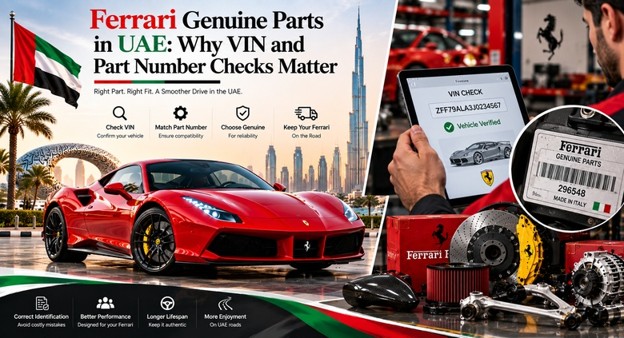
That sounds absurd until you look at how Ferrari's parts information is actually organised. Ferrari's technical information system supports vehicle identification through the VIN or vehicle specifications, and its spare-parts catalogue can then be searched by part number, description and catalogue structure. In other words, the vehicle itself is part of the parts-identification process.
This matters in the UAE because a seller may hear “Ferrari 488”, find a visually similar item and quote a genuine-looking replacement without establishing the exact production specification.
For a low-value trim clip, that can be irritating.
For a radiator, suspension assembly, electronic module, steering part, gearbox part or engine-related item, it can become an expensive mistake.
Before ordering, establish:
- VIN
- Model
- Model year
- Engine specification
- Gearbox
- Left- or right-hand drive
- Exact Ferrari part number
- Superseding number, if applicable
- Position or side
- Required quantity
- Whether programming or calibration is required
The Ferrari part number identifies the part.
The VIN helps identify the car that needs it.
You want both.
Why a Ferrari VIN Is More Useful Than Simply Giving the Model Name
“Ferrari 458” is not a sufficiently precise parts description.
Neither is “Ferrari F8”.
Neither is “2018 Ferrari 488”.
A VIN gives the parts-identification process a much stronger starting point because it identifies the specific vehicle rather than merely the model family. Ferrari's own technical information documentation explicitly supports VIN-based vehicle identification for accessing technical documentation and spare-parts information.
That distinction becomes valuable when:
- production specifications change;
- a part number is superseded;
- left- and right-hand versions differ;
- optional equipment changes the required part;
- an electronic module has different software requirements;
- a component is supplied as an assembly;
- a model has multiple technical configurations.
A parts seller should therefore be comfortable receiving the VIN.
If somebody says, “I don't need the VIN; all 488s use this,” ask for the exact part number and the evidence supporting that statement.
Sometimes the answer will be correct.
Sometimes it will reveal that the seller is searching by model name alone.
That is a very different level of confidence.
What the Ferrari Part Number Actually Tells You
A Ferrari part number is more than a catalogue reference.
It is the bridge between the vehicle identification process and the physical item being ordered.
Ferrari's technical information system includes spare-parts codes, descriptions, illustrations and catalogue information, with search functions that can be used by part number or description.
That gives the buyer a useful verification chain:
VIN → vehicle specification → catalogue → part number → physical part → installation.
Break that chain anywhere and uncertainty increases.
For example, a seller may provide a photograph of a Ferrari radiator and tell you it fits a 458.
You should still ask:
- What is the part number?
- Is it the original number or a superseding number?
- Is it for the correct side?
- Is it for the correct specification?
- Is the photograph of the actual part?
- Does the VIN confirm the application?
A photograph establishes appearance.
A part number establishes identity.
The VIN establishes vehicle application.
You need the three to agree.
Genuine Does Not Mean Automatically Compatible
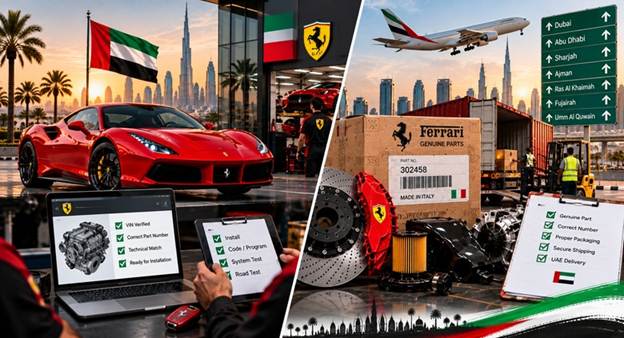
This is one of the most misunderstood points in Ferrari parts buying.
A part can be genuine Ferrari and still be unsuitable for a particular vehicle.
Genuine describes provenance/specification.
Compatibility describes whether that particular part belongs on that particular vehicle.
Imagine a genuine Ferrari electronic module sitting on a parts shelf. There is nothing fake about it. The Ferrari logo may be genuine, the casing may be genuine, and the part number may genuinely belong to a Ferrari.
But if it is for a different specification, production range or electronic configuration, it may still be the wrong purchase.
The same principle applies to body panels, suspension parts, cooling parts and assemblies.
This is why Ferrari's technical information environment allows identification by VIN as well as model and version.
A genuine wrong part is still a wrong part.
How VIN Verification Works in Practice
VIN Verification Before Ordering a Ferrari Genuine Part
A sensible UAE buying process begins before the quotation.
Give the seller or workshop:
- Full VIN
- Exact model
- Model year
- Engine
- Existing part number
- Photograph of the old part
- Location of the part on the vehicle
- Left/right position where applicable
Then ask for the proposed replacement number.
Do not merely ask:
“Do you have a Ferrari 488 radiator?”
Ask:
“Please confirm the correct genuine Ferrari radiator part number against this VIN.”
That wording changes the conversation.
Now the seller has to establish compatibility rather than simply find something that resembles the old part.
Ferrari's technical documentation describes VIN identification as particularly useful for consulting spare-parts catalogues effectively, while also allowing selection by model and version.
For expensive parts, keep the VIN confirmation in writing.
A WhatsApp message or email confirming the number can be useful later if the supplied part differs from the quotation.
Where to Find the VIN on a Ferrari
The VIN is not something that should be guessed from the registration plate or model name.
The owner should use the vehicle's actual identification information and provide the complete VIN to the parts specialist.
For ordering purposes, avoid sending a blurred photograph where one character is difficult to read.
One incorrect character can produce the wrong vehicle record.
Check:
- all letters;
- all numbers;
- sequence;
- whether the VIN is complete;
- whether the photographed identification information belongs to the vehicle being repaired.
Ferrari's technical documentation specifically includes vehicle identification information and describes identification plates within its spare-parts catalogue environment.
For a high-value Ferrari repair, VIN verification should happen before the purchase order, not after the parcel arrives.
VIN vs Registration Plate vs Chassis Information
These are not interchangeable in a parts-buying conversation.
A registration plate identifies the vehicle for road administration.
The VIN provides the detailed vehicle identity needed for technical and parts-related identification.
The chassis number may also appear in Ferrari documentation and conversations, but the buyer should provide whatever complete identification information the parts system requires rather than assuming a shortened reference is enough.
If a workshop asks for the VIN, send the VIN.
Do not substitute:
- number plate;
- model badge;
- engine size;
- registration year;
- colour;
- owner's description.
“Red Ferrari 458” is useful for finding the car in a parking area.
It is not a serious parts specification.
When the Part Number on the Old Ferrari Part Is Different
This is where buyers often panic unnecessarily.
You remove the old part and find one number.
The seller gives you another number.
That does not automatically mean the seller has supplied the wrong part.
Ferrari's parts information includes catalogue structures and identification information, and parts can be represented through assemblies and updated catalogue references.
A replacement number may be:
- a superseding number;
- a revised version;
- an updated assembly;
- a replacement for an obsolete reference;
- a different catalogue representation.
But do not assume that either.
Ask the seller to establish the relationship between the old and new numbers.
The useful question is:
“Is this the superseding replacement for the number currently fitted to my VIN?”
That is far stronger than:
“Does this look like the same part?”
Ferrari Part Number Checks for Left and Right Sides
Some Ferrari parts are side-specific.
That sounds obvious.
It becomes less obvious when a photograph shows two visually similar parts and the listing simply says “front suspension” or “radiator”.
Before ordering, establish:
- Front or rear
- Left or right
- Driver/passenger terminology if used
- Vehicle orientation
- Exact catalogue position
- Whether the part is sold individually or as a pair
Never assume that a part's orientation is obvious from a seller's photograph.
A box containing a genuine Ferrari part does not tell you whether it is the left-hand or right-hand application.
The label and catalogue identification do.
VIN Checks Become More Important With Electronic Ferrari Parts
Modern Ferrari systems contain far more electronics than the basic mechanical description of a part suggests.
That changes the buying process.
For an ECU, control module, actuator or electronically managed assembly, establish:
- Hardware number
- Software information where applicable
- VIN application
- Coding requirement
- Programming requirement
- Calibration requirement
- Immobiliser/security relationship where relevant
- Whether the supplied part is new, previously installed or refurbished
Ferrari's technical information platform includes vehicle diagnosis, diagnostic trouble-code information, software calibration identification and reprogramming-related technical information.
That is strong evidence that modern Ferrari parts identification cannot always stop at physical fitment.
A module can fit the connector and still need configuration work.
Ferrari Genuine Parts and UAE Supply
What Ferrari Genuine Means in the UAE
Ferrari's authorised UAE aftersales operation states that genuine Ferrari parts and accessories are designed and developed by Ferrari, with Ferrari-trained technicians supporting replacement-part fitting. Its current UAE parts network includes Dubai and Abu Dhabi facilities.
That makes genuine supply particularly relevant when:
- originality matters;
- the vehicle is under warranty;
- the part is safety-critical;
- electronic programming is involved;
- the repair needs factory-supported procedures;
- documentation is important;
- the Ferrari is being prepared for a future sale or certification.
But genuine does not mean the buyer can stop checking.
Even an authorised quotation should be reviewed for:
- exact part number;
- quantity;
- side;
- assembly contents;
- labour;
- programming;
- calibration;
- VAT;
- expected delivery;
- warranty coverage.
The VIN and part number remain useful because they protect against human ordering errors.
Dubai Ferrari Genuine Parts: Why the Parts Centre Still Needs Your VIN
Dubai's authorised Ferrari aftersales network includes parts and service facilities, while Abu Dhabi also has Ferrari service infrastructure.
An owner might assume that walking into a specialist centre eliminates the need for VIN verification.
It does not.
The VIN is still valuable because the objective is not simply to buy a Ferrari part.
It is to buy the correct Ferrari part for that Ferrari.
This is especially important when an owner is ordering over the phone.
The safest exchange is:
Owner supplies VIN → parts specialist identifies application → part number is confirmed → quotation is issued → owner checks number → order is placed.
That process is deliberately dull.
Dull is exactly what you want when the part costs thousands of dirhams.
Abu Dhabi and Musaffah: The Same Identification Rules Apply
Abu Dhabi owners sometimes assume that local sourcing changes the technical requirements.
It does not.
Whether the part comes from a Ferrari service centre, independent specialist, used-parts seller or an importer, the identification problem remains the same.
The authorised UAE Ferrari network currently lists a Musaffah service centre and bodyshop, alongside its other UAE locations.
For an independent purchase, the same VIN discipline should apply.
For example:
Ferrari F8 → VIN → exact module number → coding requirement → quotation → installation.
Not:
Ferrari F8 → “F8 ECU” → buy → discover programming issue later.
That second route is how an apparently simple parts purchase becomes a diagnostic problem.
Sharjah and Used Genuine Ferrari Parts: VIN Still Matters
The fact that a part is used does not reduce the importance of compatibility.
If anything, it increases it.
A used Ferrari part may come from:
- another model year;
- another market specification;
- another production range;
- an accident-damaged vehicle;
- a donor with different optional equipment.
The seller may honestly believe it fits.
The seller may also be wrong.
Ask for the donor part number and, where appropriate, donor VIN information.
Then compare it against the recipient Ferrari's VIN.
For body panels, the check may be relatively straightforward.
For an electronic module, the donor configuration can matter considerably more.
For an engine or gearbox, the compatibility check should extend beyond the basic model name.
Used does not mean “generic”.
Imported Ferrari Genuine Parts: Check the Number Before Shipping
Imported genuine Ferrari parts create another trap.
The overseas supplier may genuinely have an original Ferrari item.
That still does not prove it is the correct item for your UAE vehicle.
Before paying international shipping, obtain:
- Exact part number
- Photograph of label
- Description
- VIN/application confirmation
- Supersession information
- Condition
- Warranty
- Return conditions
- Expected delivery
For a high-value imported part, ask the seller to confirm the compatibility against the VIN, not just against “Ferrari 458” or “Ferrari 488”.
The more expensive the shipping and the harder the return, the more important this becomes.
A wrong AED 200 clip is irritating.
A wrong AED 8,000 electronic module shipped internationally is an entirely different problem.
Genuine Ferrari Parts by Model
Ferrari 458 Genuine Parts: Why Variant Identification Still Matters
The Ferrari 458 family is old enough that a healthy used-parts market exists, but modern enough that owners can still encounter specification differences and superseding numbers.
For a 458, verify:
- 458 Italia, Spider or relevant variant;
- model year;
- VIN;
- engine specification;
- transmission;
- left/right side;
- exact catalogue number;
- superseding number;
- whether the part is supplied individually or as an assembly.
This is especially important with:
- cooling parts;
- suspension;
- electronics;
- lighting;
- body panels;
- engine-related assemblies.
A 458 owner should be wary of listings using the phrase “fits 458” without a part number.
The model name is the beginning of the search.
It should not be the end.
Ferrari 488 Genuine Parts: Electronic Compatibility Deserves More Attention
The 488 brings another layer of complexity because owners may encounter parts that look straightforward but interact with electronically controlled systems.
For 488 parts, establish the exact number before purchase.
Then ask whether the replacement requires:
- coding;
- calibration;
- software configuration;
- system reset;
- adaptation;
- diagnostic confirmation after installation.
Ferrari's technical information system includes specific information for diagnosis, software calibration and vehicle identification, which reinforces the importance of treating electronic parts as vehicle-specific items rather than simple plug-and-play objects.
This is where a genuine new part can still produce a disappointing repair if the workshop has not planned the post-installation procedure.
The box being genuine is not the finish line.
Ferrari F8 Tributo Genuine Parts: Newer Cars Need More Precise Identification
With a newer Ferrari, buyers sometimes become less cautious because the vehicle is recent.
That is backwards.
Newer cars can contain more integrated electronic systems and more complex calibration requirements.
For an F8 Tributo, keep the parts order tied to the VIN from the beginning.
If a seller proposes an alternative number, ask:
Why has the number changed?
If it is a supersession, the explanation should be clear.
If it is “the same part”, ask for the technical basis.
If it is a used donor part, ask for the donor information.
A newer Ferrari is not a reason to skip identification.
It is a reason to tighten it.
Ferrari Roma and Portofino: Optional Equipment Can Change the Parts Question
Roma and Portofino owners can encounter another source of confusion: equipment specification.
A vehicle's optional equipment can affect what is fitted and therefore what replacement is required.
That makes VIN identification especially useful.
Do not assume:
“Same model + same year = same part.”
Instead:
“Same model + same year + VIN-confirmed specification = stronger identification.”
When ordering:
- electronic equipment;
- lighting;
- interior controls;
- body trim;
- steering assemblies;
- suspension-related parts;
ask the parts specialist to verify the vehicle configuration.
The extra minute spent checking is considerably cheaper than removing and returning the wrong assembly.
Part Number Inspection Before Payment
Photograph the Ferrari Part Number Before You Pay
For used, imported or independently sourced Ferrari genuine parts in UAE, ask for a clear photograph of the actual label.
The photograph should ideally show:
- Part number
- Barcode where present
- Manufacturer markings
- Revision information where present
- Connector or mounting details
- Physical condition
Do not accept a catalogue photograph when the purchase is for an expensive used part.
The seller may have multiple units.
The photograph may belong to a different item.
The actual number is what matters.
For a new genuine part, the box label can also be useful.
Keep a photograph of it with the invoice.
This creates a simple record:
Ordered number → supplied number → installed number.
That record can become extremely useful if a later fault appears.
What to Do When a Seller Says the Part Number Is “Close Enough”
“Close enough” is not a Ferrari parts specification.
If the proposed number differs from the number identified for your VIN, ask the seller to establish why.
Possible explanations include:
- supersession;
- updated assembly;
- revised production part;
- replacement catalogue number;
- different supplier packaging;
- incorrect quotation.
Only some of these are legitimate.
The correct response is not an argument.
It is documentation.
Ask for:
“Please confirm the replacement relationship between these two numbers and confirm compatibility with this VIN.”
If the seller can establish it, proceed with greater confidence.
If they cannot, pause the order.
Ferrari Part Number vs Description: Which One Should You Trust?
Use both, but give the part number greater weight.
Descriptions can be broad.
“Front suspension arm” does not establish:
- left/right;
- upper/lower;
- front/rear;
- exact model;
- production specification.
A number can be checked against catalogue information.
Ferrari's technical information system explicitly supports searches through spare-parts codes and descriptions, which illustrates why both forms of identification exist.
If a seller only provides a description, ask for the number.
If a seller provides a number but refuses to show the actual part on a used item, ask why.
For high-value parts, identity and condition should be visible.
UAE Climate and Genuine Part Storage
Does UAE Heat Affect Genuine Ferrari Parts?
A new genuine part is not automatically immune to storage conditions.
The UAE climate introduces high temperatures, strong sunlight and periods of intense heat, while some Ferrari owners keep cars stored for long periods.
The part's sensitivity depends on what it is.
Pay particular attention to storage history for:
- rubber seals;
- hoses;
- plastics;
- batteries;
- adhesives;
- exposed electronics;
- interior trim;
- certain lighting assemblies.
For a sealed mechanical part stored correctly, the concern may be limited.
For an electronic or rubber-heavy part that has spent years in poor storage, the inspection should be more careful.
This is particularly relevant to older genuine stock.
“New” describes installation history.
It does not automatically describe storage history.
New Old Stock Ferrari Parts: Why the Word “New” Needs Context
A genuine part that has never been installed can be highly desirable.
But ask:
How long has it been sitting?
Then ask:
How was it stored?
A 15-year-old genuine rubber seal that has never been installed is not necessarily equivalent to a recently manufactured seal.
The same principle can apply to:
- hoses;
- belts;
- certain plastics;
- batteries;
- adhesive-backed trim;
- electronic parts exposed to poor storage conditions.
For metallic mechanical parts, storage condition may present a different set of concerns such as corrosion or contamination.
The point is not to reject old stock.
It is to stop treating the word new as a complete condition report.
Genuine vs OEM vs Used Ferrari Parts
Genuine Ferrari vs OEM: Do Not Assume the Labels Mean the Same Thing
The terminology used in the independent market can become confusing.
“Genuine Ferrari” normally refers to a part supplied as Ferrari genuine equipment through the relevant supply chain.
“OEM” is often used to describe a manufacturer associated with original production or a part claimed to meet original-equipment specification.
Those terms should not be treated as interchangeable without evidence.
Ask:
- Who manufactured it?
- What is the exact part number?
- Is it supplied in Ferrari packaging?
- Is there a manufacturer number?
- Is it an official Ferrari part?
- What application is confirmed?
A buyer should not pay a genuine-part premium for an item merely because a seller calls it “OEM quality”.
Quality claims need evidence.
Genuine vs Reconditioned Ferrari Parts: The Risk Is Different
A genuine new part has a different risk profile from a reconditioned original.
A reconditioned part may be perfectly appropriate.
But the buyer needs to know what was actually reconditioned.
For a reconditioned mechanical assembly, ask:
- What failed?
- What was replaced?
- What was measured?
- What was tested?
- Who carried out the work?
- What warranty is provided?
“Refurbished” is too broad.
For an electronic module, a reconditioned unit may require additional coding.
For a gearbox, the rebuild specification matters.
For an engine, the evidence needs to be substantially stronger than a visual inspection.
Genuine vs Used Ferrari Parts: Where Used Can Make Sense
Used genuine Ferrari parts can make financial sense when:
- the part is not safety-critical;
- the donor is known;
- the mileage is documented;
- the part is physically inspected;
- compatibility is confirmed;
- the price saving is meaningful;
- return protection is reasonable.
Used is less attractive when:
- failure would require major reinstallation;
- the part is safety-critical;
- electronic coding is uncertain;
- donor history is unknown;
- the price difference from new is small.
The question is not whether used parts are “good” or “bad”.
It is whether the remaining uncertainty is worth the saving.
Workshop Installation and Post-Installation Verification
The Workshop Should Check the Part Number Before Installation
There should be a final identification check at the workshop.
The technician should compare:
Old part → ordered number → supplied number → replacement application.
This is especially useful when the part has arrived through an independent seller.
Do not assume that because the box has a Ferrari logo, the technician should install it immediately.
Check first.
Then install.
Then perform any required:
- programming;
- calibration;
- adaptation;
- diagnostic clearing;
- system test;
- road test.
Ferrari's technical information includes workshop procedures, wiring diagrams, fault diagnostics, software calibration information and spare-parts catalogues, showing that parts replacement and technical procedures are closely connected.
Supporting Parts Can Turn One Ferrari Part Into a Larger Repair
A parts quote may cover only the main item.
Installation can reveal that additional parts are required.
Examples include:
- seals;
- O-rings;
- clips;
- fasteners;
- hoses;
- fluids;
- filters;
- gaskets;
- mounting hardware;
- calibration;
- wheel alignment.
This is particularly relevant to cooling, suspension and engine work.
Ask the workshop before ordering:
“What else should be replaced while this part is being fitted?”
That question can prevent the car from returning to the workshop a week later because a disturbed seal or aged hose has failed.
Ferrari Diagnostic Checks After Electronic Part Replacement
An electronic replacement should not end when the warning light disappears.
The workshop should establish whether the replacement requires:
- fault-code clearing;
- coding;
- programming;
- calibration;
- adaptation;
- system communication checks;
- road testing.
The exact procedure depends on the part and vehicle.
Ferrari's technical platform explicitly includes diagnostic and reprogramming information, including software calibration identification and DTC resolution.
That is why electronic parts should be bought with the installation process already understood.
Otherwise, the owner may discover after delivery that the supposedly correct part requires additional technical work.
Ferrari Documentation and Resale
Keep the VIN and Part Number on the Repair Invoice
For a high-value Ferrari, the invoice should ideally identify what was installed.
A useful record includes:
- VIN;
- vehicle model;
- mileage;
- date;
- part description;
- exact part number;
- quantity;
- supplier;
- labour;
- programming/calibration where applicable.
This is better than an invoice that simply says:
“Ferrari repair — AED X.”
A future buyer can understand what was done.
A workshop can understand what was installed.
The owner can establish what part was previously fitted.
Documentation is not glamorous.
It becomes valuable when something goes wrong.
Genuine Ferrari Parts and Resale Value
Original specification can matter to Ferrari buyers, particularly when the vehicle has strong service documentation.
Ferrari itself places considerable emphasis on aftersales, technical standards, authenticity and the preservation of vehicle condition through its official network. Its published information also describes supply of parts for current and older Ferrari models through the authorised network.
That does not mean every used or aftermarket part automatically destroys resale value.
It means undocumented repairs create questions.
If a future buyer asks:
“Which steering module was installed?”
and the answer is:
“I don't know; the workshop sourced it.”
that is less reassuring than a documented genuine replacement with the exact part number recorded.
Ferrari Genuine Parts for Older Models: Availability Is Not the Same as Compatibility
Ferrari's published information states that genuine parts are supplied for current and older models, with historical stock covering models going back to earlier production periods; Ferrari has also described support for out-of-production vehicles.
That is useful for owners of older Ferraris.
But availability should never replace identification.
If a genuine part is still available for a 360, F430, California or 458, confirm that it is the correct catalogue reference for the vehicle.
Older cars can be particularly vulnerable to:
- superseded numbers;
- revised assemblies;
- discontinued variants;
- market differences;
- donor-part confusion.
The older the Ferrari, the more tempting it can be to say:
“It's all the same.”
That is precisely when the part number deserves closer attention.
The UAE Ferrari Buyer Decision Matrix
When a VIN Check Is Essential
Use VIN verification as a non-negotiable step for:
| Ferrari part type | VIN importance | Why |
| ECU/control module | Very high | Configuration and coding |
| Engine | Very high | Specification and compatibility |
| Gearbox | Very high | Transmission specification |
| Suspension assembly | High | Model and side/application |
| Radiator | High | Configuration and physical fit |
| Headlight | High | Specification and electronics |
| Steering assembly | Very high | Safety and electronics |
| Body panel | Medium–high | Variant and fitment |
| Brake assembly | Very high | Safety and specification |
| Simple trim clip | Lower | Usually straightforward, but still verify |
The higher the installation cost and failure consequence, the more valuable VIN verification becomes.
When the Part Number Is More Important Than the Seller's Description
If the seller says:
“Ferrari 488 front suspension.”
Ask for the number.
If the seller says:
“Genuine Ferrari 488 front suspension, part number XXXXX.”
Now you can verify.
If the seller says:
“This number is different but it fits.”
Ask why.
If the seller says:
“This is the superseding number for your VIN.”
Ask for confirmation.
That progression turns an informal parts conversation into an auditable buying process.
A Ferrari Genuine Parts Verification Checklist
Before paying for an expensive Ferrari part in the UAE, confirm:
- VIN recorded correctly
- Model confirmed
- Model year confirmed
- Engine specification confirmed
- Gearbox confirmed
- LHD/RHD confirmed
- Old part number photographed
- New part number confirmed
- Superseding number checked
- Actual part photographed where applicable
- Left/right position confirmed
- New/used/reconditioned status confirmed
- Coding requirement checked
- Calibration requirement checked
- Supporting parts identified
- Warranty confirmed
- Return conditions confirmed
- VAT status confirmed
- Delivery date confirmed
- Installation plan confirmed
For electronic parts, add:
- Hardware number
- Software/version information where applicable
- Programming procedure
- Diagnostic procedure
- Security/immobiliser implications where applicable
That checklist looks excessive until the wrong Ferrari part arrives on a Friday afternoon and the workshop is booked for Monday.
Then it looks rather sensible.
What to Do if the VIN and Part Number Do Not Match
Stop.
Do not install the part simply because it physically fits.
Do not allow the seller to resolve the issue with:
“It should work.”
Ask for the discrepancy to be explained.
Possible reasons include:
- superseded number;
- updated catalogue entry;
- replacement assembly;
- incorrect seller information;
- wrong vehicle application.
If the relationship cannot be established, return to the parts catalogue or authorised technical source.
Ferrari's own technical information system supports VIN-based identification and spare-parts catalogue searches, which is precisely the type of verification required when numbers appear inconsistent.
The Cost of Getting a Ferrari Part Number Wrong
The cost is not simply the price of the part.
A wrong part can create:
Wrong order → delivery delay → workshop downtime → return shipping → replacement order → additional labour → diagnostic time → delayed vehicle collection.
For a simple part, the inconvenience may be small.
For an engine, gearbox, suspension assembly or electronic module, the consequences can multiply.
That is why the cheapest prevention remains the same:
Check the VIN. Check the part number. Check the physical part.
Do it before payment.
UAE Ferrari Ownership and Practical Buying Scenarios
Dubai Daily-Driven Ferrari: Speed Matters, But Identification Comes First
A Ferrari used regularly in Dubai traffic creates a different urgency from a weekend-only car.
The owner may need the car for commuting, business travel or regular family use.
The temptation is to accept the first available part.
That is exactly when mistakes happen.
If a local genuine part is immediately available and correctly identified, the premium may be justified because downtime has a value.
If the part is unavailable locally, an imported genuine item may make sense.
If a verified used part is available immediately, that may also be reasonable for certain applications.
But urgency should change the speed of verification, not eliminate verification.
Abu Dhabi and Al Ain Owners: Delivery Time Belongs in the Comparison
For an owner outside Dubai's dense specialist network, the cost of sourcing can include:
- delivery;
- vehicle transport;
- workshop transfer;
- specialist inspection;
- additional waiting time.
That means two identical parts can have different practical costs depending on where the Ferrari is being repaired.
An Abu Dhabi owner may reasonably choose local supply when the price difference is modest.
An Al Ain owner may prefer a UAE-wide supplier who can deliver directly to the workshop.
A Fujairah owner may care more about reliable delivery than whether the seller's physical premises are in Dubai.
The part number remains the same.
The total ownership cost of sourcing it changes.
UAE Summer Repairs: Why Waiting Time Matters
Ferrari cooling and air-conditioning work deserves particular attention during UAE summer.
A vehicle that is perfectly tolerable in winter can become difficult to use when temperatures rise and traffic slows.
If a cooling-system part is needed, establish:
- exact number;
- local availability;
- delivery time;
- installation date;
- coolant requirements;
- bleeding procedure;
- leak test;
- post-repair temperature monitoring.
Do not leave the workshop with:
“Part ordered.”
Ask:
“When will the actual part arrive, and when will the vehicle be tested after installation?”
That is the useful question.
Final Buying Rules
The Three-Level Ferrari Parts Verification System
For ordinary purchases, think in three levels.
Level one — identity
- VIN
- model
- year
- specification
Level two — part
- exact number
- superseding number
- side/position
- actual physical part
Level three — installation
- coding
- calibration
- supporting parts
- diagnostics
- road test
A Ferrari parts purchase that passes all three levels is substantially safer than one based solely on a model name.
The Ferrari Genuine Parts Rule That Saves the Most Money
The cheapest time to discover that a Ferrari part is wrong is before you order it.
Not after delivery.
Not after the workshop removes the old part.
Not after the technician discovers a connector is different.
Not after international return shipping has been paid.
Before ordering.
Give the VIN.
Confirm the part number.
Ask whether the number is superseded.
Ask whether the supplied part is the actual item shown.
Ask whether programming or calibration is needed.
Then pay.
That sequence is simple enough to become a workshop habit.
Where PartFinder UAE Fits Into the Buying Process
For UAE owners comparing genuine, used, OEM and other replacement routes, PartFinder UAE can be used as an initial availability and sourcing reference.
But the sourcing search should never replace technical verification.
A search can help you find a part.
The VIN and part number establish whether you should actually buy it.
That distinction should remain clear.
Final Ferrari Genuine Parts Buyer Decision Matrix
| Buying situation | VIN check | Part-number check | Physical inspection | Main priority |
| Genuine new brake part | Essential | Essential | Packaging/part | Safety |
| Used suspension arm | Essential | Essential | Essential | Condition |
| New radiator | Essential | Essential | Useful | Correct specification |
| Used ECU | Essential | Essential | Essential | Compatibility/coding |
| Genuine steering assembly | Essential | Essential | Essential | Safety/electronics |
| Imported body panel | Essential | Essential | Essential | Fitment/condition |
| Used engine | Essential | Essential | Essential | Provenance/testing |
| Used gearbox | Essential | Essential | Essential | Specification/testing |
| Simple trim part | Recommended | Essential | Useful | Fitment |
| Reconditioned module | Essential | Essential | Essential | Repair quality/coding |
There is no prize for making the buying process complicated.
There is, however, a very real financial penalty for making it careless.
A Ferrari part should reach the workshop with its identity already established.
FAQs
Categories
- Audi
- BMW
- Car Accessories
- Car Tips
- Ford
- Land Rover
- Mazda
- Range Rover
- Top 10
- UAE Car Parts
- Used Car Parts
- Toyota
- Replacement Engines
- Nissan
- Hyundai
- Mitsubishi
- Volkswagen
- Honda
- Kia
- Chevrolet
- Dodge
- Jeep
- Subaru
- Renault
- Lexus
- Mercedes
- Suzuki
- Hummer
- Porsche
- Infiniti
- Peugeot
- GMC
- Mini
- Volvo
- Replacement Gearboxes
- MG
- Jaguar
- Skoda
- Cadillac
- Daihatsu
- Fiat
- German Car Parts
- Japanese Car Parts
- Aftermarket Car Parts
- Genuine Car Parts
- New Car Parts
- Reconditioned Car Parts
- European Car Parts
- American Car Parts
- Korean Car Parts
- British Car Parts
- Chinese Car Parts
- Sports/Exotic Car Parts
- Luxury Car Parts
- Performance Car Parts
- SUV/4x4 Spare Parts
- Truck Spare Parts
- EV Car Parts
- Hybrid Car Parts
- Auto Spare Parts in UAE
- Tesla
- Isuzu
- Ram
- Ferrari
- Bentley