Fiat Spare Parts in UAE: Complete Guide for 500, 500X, Punto, Tipo, Doblo and Panda
September 18, 2026
The Fiat parts question is usually more specific than it looks
Why a Fiat part number matters more than the badge
A Fiat 500 is not simply a Fiat 500 once you start ordering Fiat spare parts in UAE.
Engine, model year, transmission, market specification, trim and production revision can all change what sits behind the same familiar badge. Fiat's own technical documentation is built around vehicle-specific technical data, diagnostic procedures, wiring diagrams, service plans and parts information, while its eLUM system lets users select the exact model or enter a registration number/VIN.
That is why “I need a Fiat 500 alternator” is a weak parts enquiry.
“I need the alternator for this VIN, this engine and this model year” is a proper one.
The difference is small on the screen. It can be enormous at the workshop.
The six Fiat models that create very different buying problems
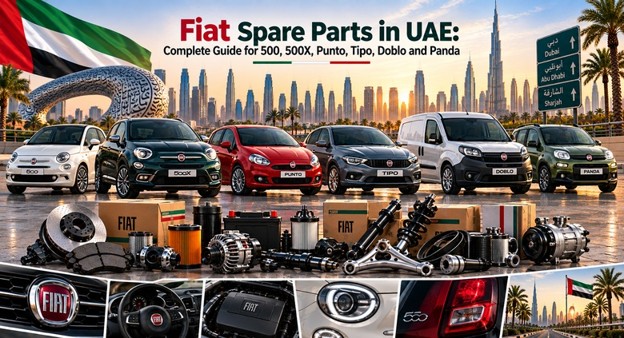
The 500, 500X, Punto, Tipo, Doblo and Panda sit in very different corners of the Fiat family.
The 500 is compact, style-led and heavily dependent on year and engine identification. The 500X brings crossover hardware, more body and suspension variation and, on some versions, four-wheel-drive-related differences. The Punto has a long production history and a huge spread of engines and revisions. Tipo parts can differ between body styles and engine generations. Doblo brings commercial-vehicle use into the equation, where mileage and load matter. Panda, meanwhile, looks simple until the 4x4, TwinAir, diesel and different-generation variations start turning up.
Fiat's technical documentation confirms the breadth of these model families, listing separate documentation for 500, 500X, Doblò, Panda, Punto and multiple Tipo versions.
So, no, there isn't one universal “Fiat spare parts” bucket.
Why UAE Fiat owners need a different parts strategy
A Fiat running around Dubai does not experience the same operating environment as one used gently in a cooler European city.
Summer heat, heavy A/C use, stop-start traffic, dusty roads, long highway journeys and cars sitting outside for hours all alter the way certain parts age. Rubber, plastics, cooling-system parts, batteries, belts, sensors and A/C hardware deserve more scrutiny on an older UAE car.
And there is another wrinkle.
Some Fiats in the UAE are GCC-market vehicles. Others arrive through private import, resale or used-car channels from Europe and elsewhere. Two cars carrying the same badge can therefore have different equipment, engines or part references.
Check first. Order second.
Know the Fiat model before you know the part
Fiat 500 parts in the UAE
The Fiat 500 is compact enough to fool buyers into thinking its parts are simple.
They are not always.
The 500 has been produced across several generations and powertrain configurations, including petrol and later electric versions in the wider Fiat range. Fiat's own technical documentation lists the 500 as a separate model family and provides VIN/model-based access to its documentation.
For a UAE 500, check the engine, transmission, model year and exact equipment before buying electrical, cooling or engine parts.
A headlamp can be especially deceptive. Same shape from a distance, different internal equipment. Same goes for switches, body modules, steering-wheel controls and infotainment parts.
Fiat 500X parts are not simply larger 500 parts
The 500X shares Fiat's visual family resemblance, but mechanically it is its own proposition.
Official Fiat technical documentation for the 500X identifies specific dimensions, drivetrain variations and technical specifications, including different 4x2 and 4x4 applications.
That matters when shopping for suspension, driveline, braking and underbody parts.
A 500X owner should therefore supply the VIN and drivetrain configuration rather than relying on “500X” alone. Fiat's handbook also explicitly warns that information can vary by trim level, engine and version, which is exactly why generic catalogue matching can go astray.
Fiat Punto parts are a generation game
Punto is one of those names that can make a parts counter go quiet for a second.
Which Punto?
Classic? Grande Punto? Punto Evo? Punto 2012?
Fiat's own technical documentation lists Punto Classic, Grande Punto, Punto Evo and Punto 2012 as separate documentation families.
That distinction is not cosmetic.
A buyer looking for a clutch, headlamp, ECU, suspension arm or dashboard module needs to identify the generation before searching. Otherwise an online catalogue can throw up several apparently compatible references and leave the owner trying to work out which one actually belongs on the car.
Fiat Tipo needs body-style and engine checks
Tipo is another model where “Tipo part” is too vague.
Fiat documentation identifies Tipo 4Doors and Tipo 5Doors/Station Wagon as separate versions, while technical records also show different engine applications, including 1.3 and 1.6 diesel versions in later technical data.
So if you need a rear lamp, bumper, tailgate trim, suspension part or engine-related item, give the body style and engine.
That sounds fussy.
It is actually quicker than returning the wrong part.
Fiat Doblo is a different sort of Fiat ownership
Doblo owners often use the vehicle harder.
Courier work. Small business deliveries. Hotel transport. Workshop duties. Family loads. Repeated short trips.
That changes parts wear.
A Doblò suspension arm from a lightly used private vehicle and one from a heavily loaded commercial vehicle may look identical in a photograph, yet their histories are completely different.
Fiat's technical documentation separates Doblò passenger and Fiat Professional applications, including Doblò Combi/Cargo configurations.
If you are buying used parts, ask what the donor vehicle actually did.
Fiat Panda parts require generation and drivetrain checks
Panda looks uncomplicated. It isn't.
Fiat's documentation lists Panda, Panda Classic and newer Panda variants separately, while technical records show petrol, diesel, Natural Power and 4x4 applications across different production periods.
For a Panda 4x4, drivetrain-specific parts obviously deserve extra attention.
For an older Panda, availability can be the bigger problem. A common filter or brake part may be easy. A trim-specific interior piece or electronic module can take more hunting.
That is where used genuine parts become useful.
What Fiat parts usually need replacing in UAE cars
Engine service parts
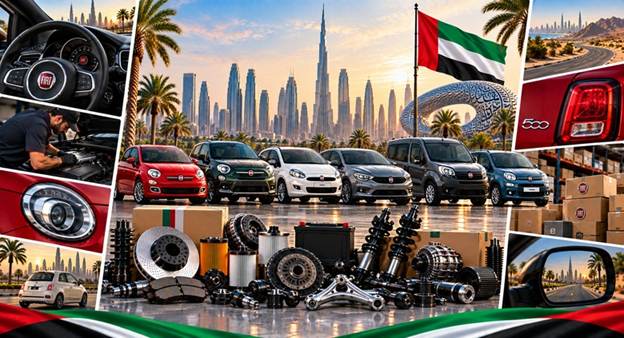
Filters, spark plugs, ignition coils, belts, tensioners, thermostats, hoses and sensors are among the parts owners regularly encounter.
But don't bundle them together as generic “engine parts”.
A TwinAir engine, a FIRE-family petrol engine and a Multijet diesel have very different service requirements. The exact oil specification matters too. Fiat's technical documentation warns that using products outside specified requirements can cause engine damage that may not be covered by warranty.
That is not the sort of sentence worth ignoring because an online seller has a cheaper bottle of oil.
Cooling-system parts
Dubai's summer exposes weak cooling systems quickly.
Radiators, thermostats, cooling fans, hoses, expansion tanks, water pumps and temperature sensors can all become suspects when a Fiat starts running hotter than expected.
But the workshop needs to identify the actual fault.
An overheated Panda does not automatically need a radiator. A 500X with temperature fluctuations does not automatically need a thermostat.
Check coolant loss, fan operation, pressure, thermostat behaviour and temperature readings first.
Otherwise the owner buys a perfectly healthy part.
It happens.
Fiat A/C parts
Air conditioning is not optional in the UAE.
A Fiat with weak A/C is going to get noticed within about ten minutes of a July afternoon.
Compressors, condensers, evaporators, pressure sensors, expansion devices, blower motors and climate-control electronics can all create similar complaints from the driver's seat.
Before buying a compressor, the workshop should establish whether the system has the correct refrigerant charge, whether there is a leak, whether the compressor is engaging and whether the electrical controls are working.
A cold A/C diagnosis begins with measurements, not a guess based on which part looks expensive.
Brake parts
Brake pads and discs are routine replacement items, but fitment still matters.
Check axle position, disc dimensions, caliper arrangement, pad shape and model year.
For a used Fiat, inspect the condition rather than buying the cheapest used assembly available. Brake friction surfaces are not the place to experiment with unknown history.
New reputable aftermarket parts can make sense here, particularly for common applications, but the brand and specification should be clear.
“European quality” is not a part number.
Suspension and steering
Control arms, bushes, stabiliser links, ball joints, shocks, strut mounts, tie rods and steering components take a beating on rougher roads.
UAE driving adds plenty of heat and road-surface variation to the equation, while kerbs and speed humps do the less glamorous damage.
For a Punto or Panda that has developed a front-end knock, inspect the whole corner.
Replacing one worn link while another bush is split can leave the owner thinking the new part is faulty when the actual problem is simply broader.
Clutch and transmission parts
Manual Fiat models can require clutch kits, slave cylinders, master cylinders, release bearings and flywheel-related work.
Automatic and automated-manual applications need more careful identification.
A gearbox problem is particularly dangerous territory for catalogue shopping because a complete transmission can look like a straightforward bolt-on purchase.
Transmission code first.
Then the part.
Electrical and electronic parts
Fiat uses a substantial amount of electronic control equipment across its model range.
ECUs, body modules, sensors, ABS units, instrument clusters, infotainment systems, window regulators and various control switches can all appear in the used-parts market.
Fiat technical documentation even records model-specific ECU part numbers for the 500, Panda, 500X and Tipo, with some applications dependent on the model version series.
That is a useful warning.
An ECU is not just an ECU.
Body and lighting parts
Headlamps, tail lamps, bumpers, mirrors, grilles, wings, bonnets and door assemblies are common used-part searches, especially for older Fiats.
For bodywork, colour matters.
So does equipment.
A mirror might include heating, electrical adjustment or other functions. A bumper can have different openings for parking sensors. A headlamp may have different lighting technology.
Send photographs.
It saves guessing.
Genuine, OEM, aftermarket, used and reconditioned Fiat parts
Genuine Fiat parts
Genuine parts are the straightforward factory-specification option.
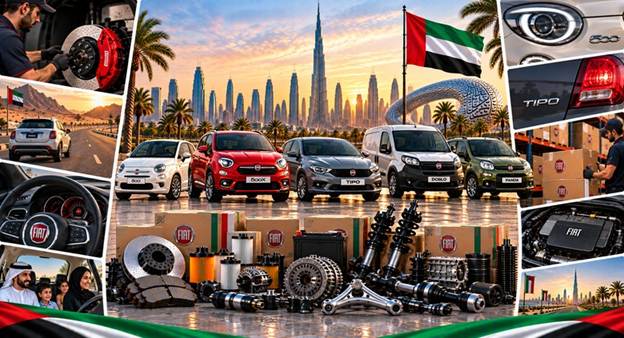
Fiat/Stellantis technical information describes genuine parts as parts developed for the relevant vehicles and includes genuine spare parts, reconditioned spare parts and Mopar accessories within its parts ecosystem.
For difficult electronic parts, safety-related systems, unusual trim and expensive-to-install parts, genuine can be particularly attractive because fitment uncertainty is lower.
That does not mean every routine part must be genuine.
It means the decision should reflect the consequence of getting it wrong.
OEM is not a magic word
OEM is one of the most overused terms in the spare-parts trade.
Ask who actually manufactured the part.
Ask for the brand.
Ask for the reference.
Ask whether it is genuinely original-equipment supply or simply an aftermarket product being described as “OEM quality”.
Those are not the same thing.
New aftermarket parts
A reputable aftermarket part can be entirely sensible for routine maintenance.
Filters, brake components, belts, bulbs, wiper equipment and selected suspension parts are examples where buyers often have several credible options.
The important bit is specification.
A known manufacturer with a clear application is one thing.
An anonymous box with “Premium Quality” printed across it is another.
Used genuine Fiat parts
Used parts become more attractive as Fiat models age.
A used genuine headlamp for a Punto can make sense if the original unit is discontinued or expensive. A used interior switch can be perfectly reasonable. A used body panel may be preferable if colour matching is close.
But used mechanical and electronic parts need history.
Ask where the donor came from.
Ask why the vehicle was dismantled.
Ask about mileage.
Ask whether the part was tested.
Reconditioned parts
Reconditioned is a useful middle ground when the work is properly documented.
An alternator may have had bearings and brushes renewed. A gearbox may have been dismantled, inspected and rebuilt. An electronic unit may have been repaired and tested.
But the word itself proves nothing.
Ask what was actually done.
A proper reconditioning record is much more valuable than a sticker saying “refurbished”.
How to identify the correct Fiat part
Start with the VIN
The VIN should be the first serious identification tool.
Fiat's eLUM system explicitly provides a VIN/registration-number route to vehicle documentation and model selection.
Send the VIN when asking for a complicated part.
For simple consumables, model and engine may sometimes be enough, but VIN confirmation remains useful where several variants exist.
Find the old part number
If the old part is still accessible, photograph the label.
Look for:
part number, revision number, manufacturer code, serial information and any superseded reference.
Do not wipe the label clean because the workshop technician wants a better photograph. Photograph it first.
The old number can be the quickest route to the replacement.
Superseded numbers are not necessarily bad news
Fiat parts can receive revised references.
A supplier might tell you that the original number has been superseded by another.
That can be legitimate.
Ask for the old number and the replacement number, then confirm that the new reference is officially applicable to the vehicle.
A newer number can simply mean the manufacturer has revised the part.
But “newer number” should never become an excuse for skipping verification.
Check the engine code
This becomes essential on Fiat.
The same model can have several engines, and engines that look similar on a catalogue page can require different sensors, filters, belts, ignition parts or mounting hardware.
Fiat's technical data for the Tipo, for example, identifies separate engine codes and specifications for different diesel applications.
Engine code beats guesswork.
Check whether the car is GCC-spec or imported
A Fiat imported from Europe can have equipment that differs from another vehicle wearing the same badge in the UAE.
Check the VIN and build specification.
This matters particularly for:
lighting, emissions equipment, engine management, infotainment, sensors, climate-control systems and body electronics.
The phrase “same model” does not necessarily mean “same part”.
Buying Fiat parts across Dubai and the UAE
Dubai
Dubai has the widest practical concentration of specialist automotive businesses and online parts sellers, but that abundance has a downside.
There are too many listings.
You can find the same-looking Fiat part under several descriptions, with several prices, and sometimes with very little technical information attached.
Do not shop by photograph alone.
Abu Dhabi
For Abu Dhabi owners, delivery timing can become part of the repair calculation.
If the car is already in a workshop, a part that arrives tomorrow may be more useful than one that is marginally cheaper but takes several additional days.
Ask about actual stock.
Not catalogue stock.
Sharjah
Sharjah is useful for comparison shopping because of its broad automotive parts and repair ecosystem.
For Fiat, though, the same rule applies: ask for the exact part number and condition.
A seller having a shelf full of European parts does not automatically mean the correct Fiat reference is there.
Ajman and the Northern Emirates
Ajman, Ras Al Khaimah, Fujairah and Umm Al Quwain buyers can benefit from online sourcing because specialist Fiat parts may not be sitting around the corner.
Delivery becomes important for bulky parts such as engines, gearboxes, doors and bumpers.
For smaller items, the seller's ability to verify fitment may matter more than physical distance.
Online Fiat parts buying
Online buying is particularly useful for older Fiats because it widens the search.
Current UAE online listings show Fiat coverage across models including 500, 500X, Doblo, Panda, Punto and Tipo, with genuine, used and aftermarket categories appearing in the market.
There are also UAE-facing online catalogues that list broad Fiat model coverage, including 500, 500X, Doblo, Panda, Punto and Tipo.
The trick is using those catalogues as a starting point, not as an excuse to stop checking.
A useful online parts enquiry
Instead of sending:
“Fiat Panda brake parts price?”
Send:
“2015 Fiat Panda, 1.2 petrol, VIN attached, front brake discs and pads required. Please confirm exact part numbers, brand, condition, availability, warranty and delivery to Dubai.”
Now there is something to work with.
A proper seller can answer it.
Fiat engines, gearboxes and expensive parts
Used Fiat engines
Buying a used engine requires more than checking displacement.
Ask for:
donor model, donor year, engine code, mileage, reason for removal, compression test where appropriate, oil condition, visible leaks, included ancillaries and warranty.
A bare engine and a complete engine assembly are very different purchases.
The photographs can look almost identical.
The invoice will not.
Compression and leak-down testing
For a used petrol engine, compression testing can reveal whether cylinders are broadly producing similar pressure, while a leak-down test can help identify where compression is escaping.
These tests are not magic.
They should be interpreted alongside oil consumption, smoke, cooling-system condition, fault codes and the engine's history.
For a used Fiat engine, a seller who can provide credible test evidence gives you more to work with than one who simply says “running condition”.
Used Fiat gearboxes
A used gearbox should be matched by transmission identification.
Ask:
What vehicle did it come from?
What was its mileage?
Why was the donor dismantled?
Was the transmission tested?
Was the fluid inspected?
What warranty applies?
Will adaptation or programming be required?
Do not buy a gearbox because the casing looks identical.
That is how workshop floors acquire very expensive paperweights.
Repair versus replacement
A failed alternator does not necessarily mean buying a complete replacement if a reputable rebuild is available.
A noisy wheel bearing may not justify replacing an entire hub assembly if the exact design allows separate replacement.
A gearbox fault may be repairable.
An engine with serious internal damage may not be.
The correct decision comes from diagnosis and total cost, not from the most dramatic quotation.
Hidden costs
The part price is only the first line.
Consider:
| Cost area | Why it can appear |
| Delivery | Especially for bulky parts |
| Labour | Complex installation |
| Fluids | Engine, gearbox, cooling or A/C work |
| Seals and gaskets | Often replaced during major jobs |
| Programming | Some electronic parts |
| Calibration | Sensors, steering or driver-assistance systems |
| Wheel alignment | Suspension or steering work |
| Diagnostic time | Fault confirmation |
| Return shipping | Wrong or incompatible parts |
| Supporting parts | Nearby worn items discovered during installation |
A AED 300 part can become a AED 1,000 job surprisingly quickly.
And sometimes that is still the correct repair.
Model-specific UAE buying problems
Fiat 500: small car, surprisingly broad parts list
The 500's compact dimensions can create a false sense of simplicity.
Electrical parts are particularly worth checking carefully because equipment varies by version and production period. The model's official documentation includes specific technical information and version-dependent equipment.
For used body parts, colour and trim matter.
For mechanical parts, engine identification matters.
For electronic parts, VIN and part number matter.
Different problems. Same car.
Fiat 500X: suspension, drivetrain and electronics
The 500X needs stronger model-specific identification because of its broader drivetrain and equipment range.
The official technical specification distinguishes 4x2 and 4x4 versions, with different dimensional and technical references.
For a 500X suspension or driveline purchase, therefore, ask whether the vehicle is front-wheel drive or four-wheel drive.
That single detail can stop an expensive mistake.
Fiat Punto: age changes the strategy
Punto ownership in the UAE is often about keeping an older car useful without throwing money at every repair.
That makes used genuine parts, reputable aftermarket parts and reconditioned units more relevant.
A simple interior switch might be worth buying used.
A belt kit should generally be approached differently.
A control module needs another level of caution.
Age changes the economics.
Fiat Tipo: body style and engine first
Tipo buyers should confirm whether the car is the four-door saloon, five-door hatchback or station wagon application before ordering body parts.
Engine identification becomes equally important for mechanical parts.
Official Fiat documentation distinguishes Tipo 4Doors and Tipo 5Doors/Station Wagon, while technical specifications show separate diesel engine applications.
Do not let the shared “Tipo” badge do all the thinking.
Fiat Doblo: mileage can hide the real story
A Doblo used for deliveries can rack up substantial mileage.
But mileage alone does not tell you whether a used engine, gearbox, suspension arm or alternator is worth buying.
Look at the work history.
A high-mileage donor with regular maintenance can sometimes be more useful than a lower-mileage part with unknown commercial use and poor storage.
For a fleet vehicle, downtime deserves a place in the calculation too.
Fiat Panda: simplicity is useful, but only when identified correctly
Panda parts can be inexpensive for common applications.
That does not mean every Panda part is interchangeable.
Panda Classic, later Panda, diesel, petrol, Natural Power and 4x4 applications have different technical histories in Fiat's documentation.
The smaller the car, the easier it is to assume everything is standard.
Don't.
UAE heat, workshops and ownership costs
Heat affects more than the engine
UAE summer heat attacks the whole car.
Battery capacity falls under extreme thermal stress. Rubber hardens and ages. Plastics become brittle. Cooling systems get worked hard. A/C compressors operate under heavy demand. Interior trim sees intense solar exposure.
That makes condition particularly important for used Fiat parts.
A used dashboard trim from a sun-baked vehicle can look fine online and feel tired when it arrives.
Dust matters too
Dust can work its way into filters, connectors, cooling surfaces and sensor areas.
That does not mean every Fiat sensor failure in Dubai is caused by dust.
It means the environment should be considered when diagnosing symptoms.
If an engine is running poorly, check air intake, filters, sensors, wiring and stored fault codes before ordering an expensive electronic part.
Short trips are not always kind to small Fiats
A Fiat used mainly for short urban trips can develop a different maintenance pattern from one doing long highway journeys.
The engine may spend more time cold, the A/C cycles constantly, the battery sees repeated starting demand and maintenance intervals can be neglected because annual mileage looks low.
Low mileage is not the same as low wear.
That distinction matters when buying used.
Labour costs by emirate
Workshop labour varies substantially by location, workshop type, diagnostic complexity and the job itself, so a universal “Fiat labour rate” would be misleading.
For budgeting, ask the workshop to separate:
| Job | Ask for separately |
| Diagnosis | Diagnostic labour |
| Part installation | Fitting labour |
| Programming | Coding/configuration |
| Alignment | Alignment charge |
| Fluids | Fluid and disposal cost |
| Additional repairs | Separate quotation |
A Fiat owner in Dubai may receive a very different quotation from a specialist workshop in Sharjah or Abu Dhabi.
Compare the scope of work, not just the hourly figure.
First-year ownership cost
For an older Fiat, the first year after purchase can be more expensive than expected because several deferred maintenance items arrive together.
Think belts, fluids, filters, brakes, tyres, battery, cooling-system checks and suspension.
A sensible buyer should keep a reserve for these rather than assuming the previous owner changed everything.
The service history decides how much uncertainty remains.
Cost of delay
Some Fiat repairs can wait.
Others should not.
A noisy wheel bearing, overheating issue, brake fault, serious oil leak or transmission problem deserves quicker attention than a scratched bumper.
Delay can turn a contained problem into a larger one.
A coolant leak is a good example. A small leak can become an overheating event, and then the repair conversation changes completely.
How to buy Fiat parts without wasting money
Ask these questions before paying
Is the part genuine, OEM, aftermarket, used or reconditioned?
What is the exact part number?
Has that number been superseded?
Does the seller have the actual item in stock?
Has the part been tested?
What is the warranty?
Can it be returned if the VIN check proves incompatibility?
Will programming or calibration be required?
Does the price include delivery?
The seller should not become irritated by sensible questions.
If anything, good sellers usually appreciate precise buyers because it reduces returns.
How to judge a used Fiat part
For mechanical parts, look for donor history.
For electronics, look for testing.
For body parts, look for actual photographs.
For engines, look for compression or other credible mechanical evidence where appropriate.
For gearboxes, look for transmission identification and testing.
For suspension, inspect rubber and corrosion.
For lights, check mounting tabs, lenses, connectors and internal moisture.
Different part, different inspection.
Warranty red flags
Be cautious when the warranty says:
“Warranty against manufacturing defects only.”
That phrase may exclude almost everything you are worried about.
Ask what happens if:
the part is incompatible, the part fails after installation, the part needs programming, the donor history was incomplete, or the workshop discovers a related fault.
For engines and gearboxes, read the exclusions carefully.
For electronics, ask whether installation by a non-authorised workshop affects coverage.
Poor installation can make a good part look bad
A new Fiat thermostat cannot correct a damaged wiring connector.
A new wheel bearing cannot fix a bent hub.
A new ECU cannot repair a bad power supply.
A replacement A/C compressor cannot compensate for a blocked condenser or incorrect refrigerant charge.
The part and the installation have to agree with the diagnosis.
Otherwise the owner blames the part for a workshop problem.
The first 1,000 km after major Fiat repairs
After a major engine, transmission, cooling, brake or suspension repair, pay attention during the first few drives.
Check for:
new warning lights, fluid loss, overheating, steering changes, brake vibration, unusual noises, harsh gear changes and changes in fuel consumption.
After cooling-system work, watch temperature behaviour.
After suspension work, check steering and tyre wear.
After transmission work, watch shifting quality.
After engine work, check fluids and listen for anything that was not there before.
Do not wait for a major symptom.
Fiat parts documentation is worth keeping
Keep the invoice.
Keep the part number.
Keep the warranty.
Keep the workshop report.
Keep photographs of major replaced parts.
This is especially useful with older Punto, Panda and 500 models, where owners may need the same reference years later.
It also helps with resale.
A buyer looking at an older Fiat is more likely to trust a folder of actual repair records than a vague promise that “all the parts were changed”.
A practical Fiat buying matrix
| Situation | Sensible starting point | Main concern |
| Routine filter | Genuine or reputable aftermarket | Exact engine |
| Brake pads/discs | New genuine or reputable aftermarket | Brake specification |
| Old body panel | Used genuine | Condition/colour |
| Headlamp | New genuine or tested used | Version/equipment |
| ECU/module | Genuine or tested compatible unit | VIN/programming |
| Engine | Genuine/reconditioned/tested used | Compression/history |
| Gearbox | Tested used/reconditioned | Transmission code |
| Suspension arm | New aftermarket or genuine | Exact application |
| Alternator | New/reconditioned/quality used | Output and engine |
| Interior trim | Used genuine | Trim/colour |
| Rare discontinued part | Used/reconditioned | Donor history |
There is no “best” column because the right answer depends on the part and the car.
That is the whole point.
The Fiat buyer's final checklist
Before the order goes through, check the VIN.
Then the model year.
Then the engine.
Then the transmission.
Then the body style or drivetrain where relevant.
Then the old part number.
Then the replacement or superseded number.
Then the brand and condition.
Then stock status.
Then warranty.
Then delivery.
Then installation requirements.
Only after that should the price become the deciding factor.
It feels slower.
It usually isn't.
Where PartFinder UAE fits into the search
For UAE owners comparing different Fiat options, PartFinder UAE can be useful when the aim is to compare availability across genuine, OEM, used, reconditioned and aftermarket categories rather than committing to the first listing that appears.
That comparison is particularly useful for older Punto and Panda models, unusual 500 trim parts, Doblo commercial parts and model-specific 500X items where the first quotation may not tell the whole story.
The useful question remains the same: does the seller have the correct part for this exact Fiat?
One Fiat, several possible parts markets
A 500 owner may need a small electrical switch.
A 500X owner may be chasing a drivetrain or suspension reference.
A Punto owner may be keeping a fifteen-year-old car alive with used genuine parts.
A Tipo owner may need a body-specific lamp.
A Doblo operator may need a hard-working suspension or commercial-use engine part.
A Panda owner may simply want a reliable cooling-system repair.
Those are six very different buying situations hiding behind one word: Fiat.
And that is why the sensible UAE approach is not to search harder for the cheapest part. It is to identify the car more precisely, work backwards from the fault, check the original reference, compare genuine, OEM, aftermarket, used and reconditioned options on equal terms, and then price the entire repair rather than the shiny little box sitting at the top of the search results.
Frequently Asked Questions
Categories
- Audi
- BMW
- Car Accessories
- Car Tips
- Ford
- Land Rover
- Mazda
- Range Rover
- Top 10
- UAE Car Parts
- Used Car Parts
- Toyota
- Replacement Engines
- Nissan
- Hyundai
- Mitsubishi
- Volkswagen
- Honda
- Kia
- Chevrolet
- Dodge
- Jeep
- Subaru
- Renault
- Lexus
- Mercedes
- Suzuki
- Hummer
- Porsche
- Infiniti
- Peugeot
- GMC
- Mini
- Volvo
- Replacement Gearboxes
- MG
- Jaguar
- Skoda
- Cadillac
- Daihatsu
- Fiat
- German Car Parts
- Japanese Car Parts
- Aftermarket Car Parts
- Genuine Car Parts
- New Car Parts
- Reconditioned Car Parts
- European Car Parts
- American Car Parts
- Korean Car Parts
- British Car Parts
- Chinese Car Parts
- Sports/Exotic Car Parts
- Luxury Car Parts
- Performance Car Parts
- SUV/4x4 Spare Parts
- Truck Spare Parts
- EV Car Parts
- Hybrid Car Parts
- Auto Spare Parts in UAE
- Tesla
- Isuzu
- Ram
- Ferrari
- Bentley
- Lamborghini
- Genesis
- Maserati
- Lincoln
- Chrysler