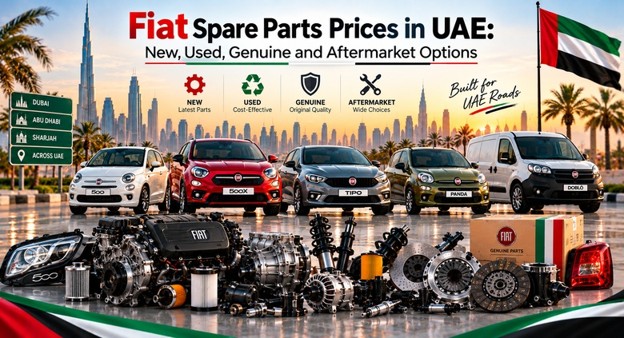
Fiat Spare Parts Prices in UAE: New, Used, Genuine and Aftermarket Options
September 21, 2026
What Fiat parts actually cost in the UAE
The price on the listing is rarely the final number
A Fiat spare part can look cheap until the workshop starts adding the things that make the car run properly again. A used engine listed at AED 2,500 is not a AED 2,500 repair once fluids, seals, filters, labour, diagnostics, installation and any worn supporting parts enter the calculation. The same problem appears with gearboxes, turbochargers and electrical parts.
Current UAE market listings give useful reference points, but they should be treated as market ranges, not fixed quotations. A recent UAE listing places used 1.4 Fire engines around AED 2,000–5,500, 1.3 Multijet engines around AED 2,500–6,500, 1.6 Multijet II engines around AED 3,500–8,000, and used gearboxes around AED 1,500–5,500.
Fiat spare parts prices in UAE at a glance
The table below gives a practical starting point based on a UAE market listing available in September 2026. The figures cover the part itself, not installation or the full repair bill.
| Fiat part | Used market reference | New/aftermarket reference | What changes the price |
| 1.2/1.4 Fire engine | AED 1,500–5,500 | Varies by supplier | Engine code, mileage, completeness |
| 1.3 Multijet engine | AED 2,500–6,500 | Varies | Donor, mileage, turbo/injectors |
| 1.6 Multijet II engine | AED 3,500–8,000 | Varies | Version, condition, accessories |
| Manual gearbox | AED 1,200–4,800 | AED 2,000–6,000 | Ratio, model, condition |
| Automatic/DCT gearbox | AED 2,000–5,500 | AED 3,500–7,500 | Transmission code and condition |
| Cylinder head | AED 600–2,800 | AED 1,000–4,000 | Complete or bare assembly |
| Radiator | AED 180–750 | AED 280–1,200 | Model and specification |
| Turbocharger | AED 800–3,200 | AED 1,100–4,500 | Engine, actuator and condition |
| Body panel | AED 350–2,500 | AED 500–3,500 | Panel type, finish and availability |
These are dated 2025–2026 UAE market references published on the current listing, rather than an official Fiat retail price list. Fiat's own technical-information system explains that genuine price lists are updated and supersede previous lists, so an exact genuine-part quotation should always be checked against the relevant current catalogue.
Why two identical-looking Fiat parts can have different prices
This is where Fiat ownership gets slightly awkward. A radiator, alternator, ECU or gearbox can look identical in a photograph while carrying a different reference number, connector arrangement, calibration, mounting arrangement or application.
The 500X handbook makes the point clearly: equipment and specifications can vary according to trim, engine and version. That is why “it is for a Fiat 500X” is not a sufficiently precise buying description.
The cheapest part is not automatically the cheapest repair
A used gearbox at AED 1,600 may appear attractive beside a new replacement at several thousand dirhams. But if the used unit has unknown mileage, requires another clutch, arrives without the correct selector mechanism, or has a warranty that only covers the casing, the arithmetic changes rather quickly.
Fiat spare parts prices in UAE should therefore be compared at repair level, not listing level. Part price, delivery, labour, consumables, programming and supporting parts belong in the same calculation.
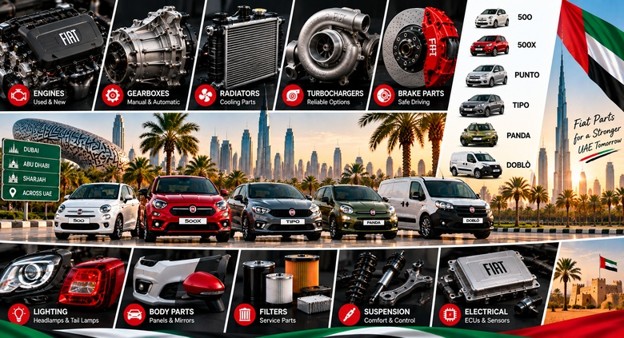
Fiat 500, 500X, Punto, Tipo, Panda and Doblò do not share one price structure
The Fiat badge tells you very little about the final cost. A small 500 body panel can be relatively straightforward to source, while an electronic module for a later 500X may involve compatibility and programming questions. A Doblò used in commercial work can also have a very different replacement history from a privately owned 500.
UAE listings currently cover the 500, 500X, Tipo, Panda, Punto, Doblò and a much wider Fiat range, with compatibility checking offered for individual applications.
A useful first buying rule
Before asking for a price, have the VIN, model year, engine size, engine code where available, gearbox type and old part number ready.
That five-minute bit of preparation can prevent a much more expensive mistake later. Fiat's official eLUM system itself allows vehicle documentation to be identified using the registration number or VIN, which shows how important vehicle-specific identification is in the Fiat ecosystem.
Understanding genuine, OEM, aftermarket and used Fiat parts
What “genuine” means in practical terms
Genuine Fiat/Stellantis parts are designed and supplied for the relevant vehicle applications. The official technical-information system describes genuine parts as being developed for Stellantis vehicles and states that genuine Mopar parts are intended to provide compatibility with the vehicles for which they were developed.
For an older Fiat whose market value has fallen substantially, however, fitting genuine parts everywhere can make little financial sense. The sensible question is not whether genuine is good. It is whether the extra cost makes sense for that particular part and that particular car.
OEM and genuine are not interchangeable words
This distinction gets blurred in online listings.
“Genuine” generally refers to a part supplied through the vehicle manufacturer's genuine-parts channel. “OEM” is commonly used for an original-equipment manufacturer or an equivalent part supplied outside the vehicle-maker's branded packaging. But sellers do not always use these labels consistently.
So do not pay a genuine-parts premium merely because a listing says “OEM”. Ask who manufactured the part, what reference it carries, and what documentation supports the claim.
Where aftermarket parts make financial sense
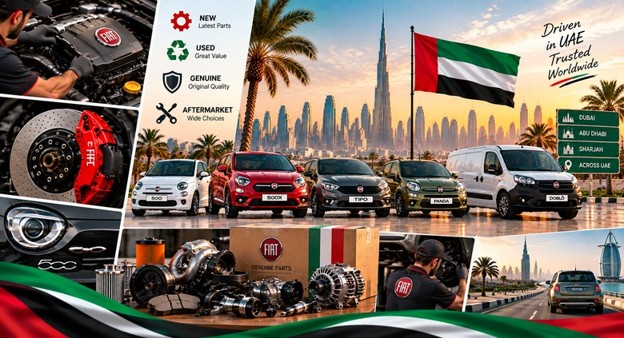
Aftermarket can be perfectly rational for service items and many conventional wear parts, particularly on an older Fiat used for ordinary commuting.
Filters, belts, brake parts, suspension bushes and some cooling-system parts can have a much wider supplier base than an ECU or transmission control unit. The important question is the quality of the actual manufacturer and whether the specification matches the vehicle.
Where cheap aftermarket becomes a false economy
Electronics deserve more caution. A poorly matched sensor may create a fault that looks like a larger engine problem. A questionable thermostat can turn into an overheating issue. A badly specified electrical module can leave the workshop chasing communication faults instead of fixing the original problem.
The lower purchase price is irrelevant if the part creates three hours of diagnostic labour.
Used parts are not simply “cheap genuine parts”
A used Fiat part is valuable because it can provide an original design at a fraction of the price of a new genuine replacement. But its history matters.
For an engine, gearbox, turbocharger, ECU or steering rack, ask where the donor vehicle came from, why it was dismantled, whether the mileage is documented, and what testing was performed. “Removed from running vehicle” is useful information, but it is not the same as a documented test report.
Reconditioned sits between two worlds
A reconditioned part can make sense when the underlying assembly is rebuildable and the reconditioning process is transparent. Fiat's official technical-information platform itself includes a Reconditioned Spare Parts Catalogue, so reconditioned parts are not inherently an inferior category.
The question is what has actually been reconditioned. A gearbox with new seals but worn internal components is not equivalent to a properly rebuilt gearbox with documented inspection and replacement of defective internals.
Model-by-model price differences
Fiat 500 parts prices
The 500 has a broad parts market because of its long production history and popularity. Current UAE listings identify 1.2/1.4 petrol and 1.3 Multijet applications and show used engine and manual gearbox ranges for the model.
For the 500, smaller mechanical and body parts can be easier to source than rare trim-specific items. That matters because a cheap mechanical repair may still be accompanied by a surprisingly expensive interior or exterior part.
Fiat 500X parts prices
The 500X requires more careful specification checking. Fiat's handbook explicitly warns that equipment can differ according to trim, engine and version, while official documentation covers multiple 500X configurations.
That becomes particularly important when buying electronic modules, transmission parts, sensors, body panels and drivetrain-related parts. A seller who asks only for “500X 2018” has not necessarily gathered enough information to confirm fitment.
Fiat Punto parts prices
Punto parts can be attractive from a value perspective because many cars are now older and the used-parts market is well established. Current UAE market references include 1.2/1.4 Fire and 1.3 Multijet applications.
But age changes the calculation. A used suspension assembly might be cheap, yet fitting it to a car with tired bushes, worn mounts and old dampers can simply move the problem around.
Fiat Tipo parts prices
The Tipo sits in a different ownership category because it is often treated as a practical family car rather than a lifestyle compact. Current UAE market references identify 1.4 Fire, 1.6 E.torQ and 1.6 Multijet II applications, with used engines and gearboxes occupying different price bands.
For a Tipo used daily, reliability can matter more than squeezing every last dirham from the initial part purchase. A slightly better-supported replacement can reduce repeat workshop visits.
Fiat Panda parts prices
Panda pricing tends to benefit from simpler mechanical configurations in older generations. Current UAE market references include 1.2 and 1.4 Fire petrol applications alongside 1.3 Multijet and TwinAir references.
The trap is assuming every Panda part fits every Panda. Generation and engine differences still matter, particularly for electronic, drivetrain and engine-specific parts.
Fiat Doblò parts prices
Doblò deserves separate consideration because commercial use changes wear. A privately used Doblò and a courier or service-fleet Doblò can have completely different histories even when their odometers look similar.
Current UAE listings put used 1.3 Multijet engines around AED 2,500–6,500 and 1.6 Multijet engines around AED 3,500–8,000, with used manual gearboxes around AED 1,800–4,800.
Engine and gearbox prices
Used Fiat engines
A used engine is often the most emotionally difficult purchase because the buyer is essentially trusting a large metal box that cannot be fully judged from a photograph.
Current UAE market references place used 1.4 Fire engines at roughly AED 2,000–5,500, 1.3 Multijet at AED 2,500–6,500 and 1.6 Multijet II at AED 3,500–8,000.
Those ranges are broad for a reason. Mileage, completeness, engine code, donor history and whether accessories are included can materially change the value.
New genuine engines are a different financial proposition
The same market reference lists much higher indicative figures for new OEM engines, with 1.2/1.4 Fire around AED 7,000–13,000, 1.3 Multijet around AED 8,000–14,000 and 1.6 Multijet II around AED 9,000–16,000. These are market references, not official Fiat retail quotations.
At this level, the buyer should stop asking only “How much is the engine?” and start asking whether the vehicle's overall value justifies the investment.
What should be checked on a used engine
Compression figures, oil pressure where appropriate, visible oil contamination, coolant contamination, crankcase condition, turbo condition on diesel applications, injector condition, timing-system history and the completeness of the supplied assembly all matter.
Not every seller can provide every test, but a serious buyer should at least ask what was actually checked rather than accepting the word “tested”.
Gearbox prices vary sharply by transmission
The current UAE market reference places used manual gearboxes broadly around AED 1,200–4,800 and used automatic or dual-clutch units around AED 2,000–5,500. New aftermarket and OEM references are higher.
The gearbox code matters. So does the differential ratio, actuator arrangement on automated transmissions and the exact vehicle application.
Gearbox replacement is rarely just a gearbox bill
A workshop may recommend inspecting the clutch, flywheel, mounts, driveshaft seals, transmission fluid and selector mechanism while the gearbox is already removed.
That is not necessarily upselling. If a worn clutch is left in place because the customer wanted to save the cost of removing it later, the saving can disappear the next time the gearbox has to come out.
When rebuilding beats replacement
If the gearbox casing and major internal components remain serviceable, rebuilding can sometimes be more sensible than fitting an unknown used unit. But that depends heavily on local workshop capability and the transmission design.
The right comparison is therefore known rebuild versus unknown used unit, not simply “new versus used”.
Cooling, turbo, electrical and body parts
Radiators are cheaper, but overheating is not
Current UAE market references put used radiators around AED 180–750 and aftermarket new units around AED 280–1,200, with genuine/OEM references higher.
In the UAE, cooling-system condition deserves attention because high ambient temperatures and heavy air-conditioning use leave little margin for an already weak cooling system. Replacing a radiator without checking the thermostat, coolant condition, fan operation and hoses can leave the original fault partly intact.
Turbocharger pricing
Used turbochargers in the current UAE reference range around AED 800–3,200, while aftermarket new examples are listed around AED 1,100–4,500.
But turbo failure should trigger a question: why did it fail?
Oil starvation, contamination, restricted lubrication, boost-control problems or an underlying engine issue can destroy the replacement turbo as well. Fitting another turbo without identifying the original failure is gambling with the second unit.
Electrical parts need stronger identification
ECUs, body-control modules, sensors and other electronic parts are particularly sensitive to exact vehicle specification. Fiat's technical documentation includes VIN-based procedures for certain electronic operations, reinforcing the importance of vehicle identification rather than broad model names.
A module that physically plugs in is not necessarily a module that will operate correctly.
Body panels have their own economics
A used bumper, door, bonnet or fender can save a considerable amount compared with a new genuine panel, particularly on an older Fiat.
But colour, previous repairs, mounting tabs and panel alignment matter. A cheap panel requiring extensive paint correction can end up costing more than a better-condition used panel that needs only minor preparation.
Genuine versus aftermarket body parts
For visible bodywork, the choice is often less technical than it is for engine electronics. If the aftermarket panel has reasonable dimensions, correct mounting points and acceptable material quality, it may be perfectly practical.
For safety-critical structures, however, the calculation changes. Cosmetic savings should not be confused with structural repair savings.
Small parts can create disproportionately large bills
A thermostat, sensor, connector or mounting bush may cost relatively little. The expensive part is sometimes the labour needed to diagnose the problem after the cheap part fails or is incorrectly specified.
This is why experienced Fiat owners tend to care less about the lowest individual price and more about whether the part is right the first time.
UAE buying conditions
Dubai and Sharjah price comparisons need context
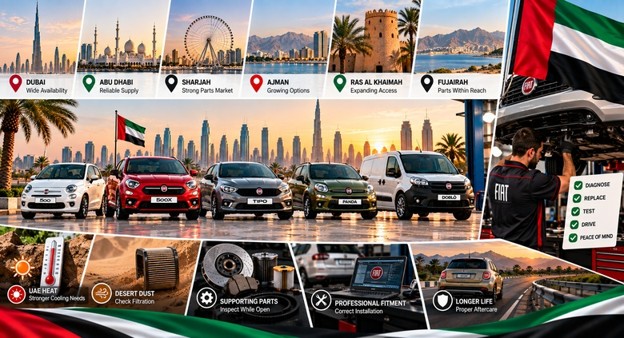
The UAE market is not one perfectly uniform warehouse. Availability, import channels, workshop concentration and delivery distance can affect what a buyer actually pays.
Dubai may offer convenience and rapid sourcing, while Sharjah's large automotive-parts ecosystem can provide broader choice. Neither automatically guarantees the lower final repair bill.
Abu Dhabi buyers should think about downtime
For someone using a Fiat for daily commuting in Abu Dhabi, waiting several days for a questionable cheap part may be more expensive than paying slightly more for a confirmed-fit replacement.
A vehicle that cannot be used still has a cost, particularly for family transport or business use.
Fleet-owned Doblòs need a different calculation
For a commercial Doblò, downtime has a measurable business effect. A cheaper gearbox that takes a week to source, fit and troubleshoot can be less economical than a more expensive unit that gets the vehicle back into service promptly.
This is not about buying the most expensive part. It is about calculating the cost of the vehicle sitting still.
UAE heat changes the supporting-parts conversation
Extreme summer temperatures make cooling and air-conditioning systems particularly important. A replacement engine fitted into a car with a neglected radiator, weak cooling fan or contaminated coolant system is not a finished repair.
The engine may be new to the vehicle. The heat around it is not.
Desert dust and workshop storage matter too
Dust affects air filtration, cooling surfaces and general under-bonnet cleanliness. Parts stored poorly can also arrive with corrosion, damaged connectors or missing seals.
For used electrical and mechanical parts, inspect the actual item rather than relying entirely on stock photographs.
Imported Fiat specifications require extra caution
Grey-import or non-GCC Fiat vehicles can differ in engine, emissions equipment, trim and electronic configuration.
The safest approach is to identify the actual vehicle through its VIN and original part number. Fiat's eLUM system specifically supports VIN-based vehicle-document identification, while the manufacturer's technical catalogue is built around vehicle-specific technical information.
How to verify a Fiat part before paying
VIN verification comes first
Give the seller the complete VIN before confirming an expensive purchase. Do not wait until the part arrives.
The VIN can distinguish variants that share the same model name but use different engines, transmissions, electrical modules or body specifications.
Match the original part number
Photograph the number on the old part where possible. If it has been superseded, ask the seller to show the replacement reference and explain the relationship.
Fiat's official technical system includes a genuine spare-parts catalogue and repair information, rather than relying solely on generic model searches.
Check superseded numbers properly
A changed part number does not automatically mean the new part is wrong. Manufacturers routinely revise references.
The important question is whether the newer number is an official replacement for the original application. A seller should be able to demonstrate the connection rather than saying, “same thing”.
Ask what is included
An engine can mean a bare long block, a complete assembly, or something in between.
Likewise, a gearbox may or may not include actuators, sensors, mounts, selector mechanisms or ancillary fittings. Ask for a written description before comparing prices.
Used-part mileage needs evidence
Mileage is useful only when it has some basis.
A dismantler's record, donor-vehicle documentation or credible vehicle history is stronger than a handwritten sticker. For an inexpensive trim piece, this may barely matter. For a diesel engine costing several thousand dirhams, it matters considerably.
Warranty wording matters more than warranty length
“30-day warranty” sounds reassuring until the small print says labour is excluded, overheating is excluded, electrical faults are excluded, or the part must be returned before any replacement is considered.
Ask what failure qualifies for replacement and who pays removal and refitting costs.
Repair versus replacement decisions
Repair the original part when its condition supports it
A repair can make sense where the original unit has a known history and the failed area is identifiable.
For example, repairing a known gearbox may be preferable to installing an anonymous used gearbox if the workshop can inspect and document the internals properly.
Replace when diagnosis shows structural failure
Some faults make replacement more practical. A severely damaged engine block, heavily contaminated transmission or irreparable electronic module may not justify a long repair attempt.
The decision should follow diagnosis rather than the emotional instinct to save the original part at all costs.
Compare total project cost
| Cost item | Used replacement | Reconditioned | New aftermarket | New genuine |
| Initial part price | Usually lowest | Medium | Medium | Highest |
| Condition certainty | Depends on history | Depends on rebuild | Depends on manufacturer | Generally highest |
| Fitment risk | VIN/code dependent | VIN/code dependent | VIN/code dependent | VIN/code dependent |
| Installation | Similar | Similar | Similar | Similar |
| Warranty | Varies widely | Varies | Varies | Usually structured |
| Best use case | Older/value-focused car | Repairable major assemblies | Wear/mechanical parts | Long-term ownership |
The table is a decision framework, not a claim that one category is universally better.
Do not compare an engine price with a vehicle price alone
Suppose an older Fiat needs a used engine, clutch, cooling-system work and substantial labour. The calculation should include the car's current condition, tyres, suspension, air-conditioning, electrical faults and registration situation.
A replacement engine can make perfect financial sense on a well-kept car. On a vehicle already needing five unrelated repairs, the arithmetic can change.
First-year ownership cost matters
The real question after a major repair is not “Will it start tomorrow?”
Ask what is likely to require attention over the next twelve months. A 12-year-old Fiat with a replacement engine may still have ageing hoses, mounts, suspension, air-conditioning parts and electronics.
A lower purchase price for the replacement part does not eliminate the age of the rest of the vehicle.
Resale value is not the same as repair value
A major replacement does not necessarily increase resale value by the amount spent.
Documentation can help. A professionally installed engine with invoices, part details and test records is easier to explain to a future buyer than an undocumented engine swap. That does not guarantee a higher sale price, but it improves the evidence surrounding the repair.
When comparing Fiat spare parts across Dubai, Abu Dhabi, Sharjah and the other emirates, buyers need more than a headline price. PartFinder UAE gives owners a practical starting point for comparing replacement options, but the useful comparison comes afterwards: check the VIN, exact part number, condition, donor mileage where applicable, warranty terms and the expected installation cost before deciding which option fits the vehicle and budget.
Workshop installation and aftercare
The installation plan should be written down
Before a major Fiat part is fitted, confirm what the workshop intends to replace, inspect, flush, programme or calibrate.
This is particularly important for engines, gearboxes and electronic modules. A vague “we will see once it is installed” approach is exactly what makes the final invoice unpredictable.
Supporting parts should be inspected while access is available
An engine replacement can expose hoses, mounts, belts, seals and cooling-system issues. A gearbox replacement can expose clutch and flywheel wear.
Not every supporting part should automatically be replaced. It should be inspected and replaced when condition or manufacturer requirements justify it.
Diagnostics should happen before and after installation
Before replacing an expensive part, record the original diagnostic faults and symptoms.
After installation, clear and rescan the system, check live data where appropriate and road-test the vehicle. For electronic parts, programming or configuration may be necessary depending on the application.
The first 1,000 km deserves attention
A replacement engine or gearbox should not simply disappear into the background once the vehicle leaves the workshop.
Check for leaks, abnormal noises, warning lights, overheating, fluid-level changes, shifting behaviour and unusual vibration during the early period. Keep every invoice and diagnostic report.
New noises are not “normal settling”
A newly fitted engine can sound different from the old one, but unexplained knocking, whistling, belt noise, coolant loss or transmission vibration should be investigated.
The same applies to body parts. A door that needs slamming to close is not evidence of successful installation.
Keep the old part where practical
For expensive replacement work, retain the old part until the repair has been accepted and the warranty period is understood.
It can provide useful evidence if a dispute arises, and sometimes the old part contains the exact reference needed for future sourcing.
Fiat buyer's final checklist
Before paying for a major Fiat spare part, the sensible minimum is straightforward: VIN confirmed, model year confirmed, engine and gearbox identified, original part number photographed, replacement reference checked, donor mileage investigated where relevant, included parts written down, warranty terms understood, installation cost separated from part cost, and supporting parts discussed.
That sounds tedious.
It is considerably less tedious than removing the wrong gearbox.
FAQs
Categories
- Audi
- BMW
- Car Accessories
- Car Tips
- Ford
- Land Rover
- Mazda
- Range Rover
- Top 10
- UAE Car Parts
- Used Car Parts
- Toyota
- Replacement Engines
- Nissan
- Hyundai
- Mitsubishi
- Volkswagen
- Honda
- Kia
- Chevrolet
- Dodge
- Jeep
- Subaru
- Renault
- Lexus
- Mercedes
- Suzuki
- Hummer
- Porsche
- Infiniti
- Peugeot
- GMC
- Mini
- Volvo
- Replacement Gearboxes
- MG
- Jaguar
- Skoda
- Cadillac
- Daihatsu
- Fiat
- German Car Parts
- Japanese Car Parts
- Aftermarket Car Parts
- Genuine Car Parts
- New Car Parts
- Reconditioned Car Parts
- European Car Parts
- American Car Parts
- Korean Car Parts
- British Car Parts
- Chinese Car Parts
- Sports/Exotic Car Parts
- Luxury Car Parts
- Performance Car Parts
- SUV/4x4 Spare Parts
- Truck Spare Parts
- EV Car Parts
- Hybrid Car Parts
- Auto Spare Parts in UAE
- Tesla
- Isuzu
- Ram
- Ferrari
- Bentley
- Lamborghini
- Genesis
- Maserati
- Lincoln
- Chrysler