Finding the Right Emgrand Spare Part in UAE: VIN, Model Year and Part Number Checks
October 1, 2026
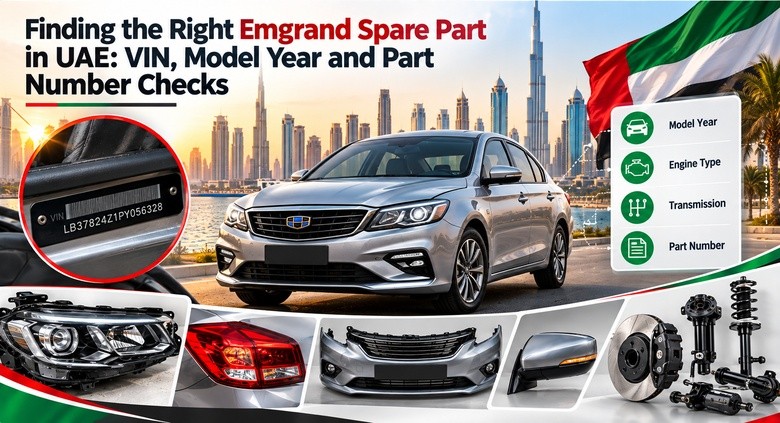
To buy Emgrand spare part in UAE sounds straightforward until the supplier asks for the VIN, the model year, the old part number and sometimes a photograph of the component you have just removed.
That is not needless paperwork.
It is the difference between identifying the car properly and gambling on a part that merely looks right.
The current UAE Emgrand is listed by Geely UAE with a 1.5D engine and 6AT transmission, while Geely’s own spare-parts system asks buyers to select the exact vehicle model before checking parts information. Older Emgrand-related applications can differ, and imported vehicles can add another layer of uncertainty.
For a UAE owner standing in a workshop with a failed sensor, damaged headlight, noisy suspension component or gearbox problem, the useful question is not simply, “Do you have an Emgrand part?”
It is: “Do you have the part for this exact Emgrand?”
That distinction matters.
Why the Emgrand badge is not enough
“Geely Emgrand” identifies the model family. It does not necessarily identify the exact component application.
A supplier may have several Emgrand-related parts in stock while only one is appropriate for your car. Differences can arise from model year, generation, facelift, trim, engine application, transmission, body configuration, regional specification or an electronic revision.
This becomes particularly important with expensive components. A wrong cabin filter is irritating. A wrong transmission control component is a different sort of headache.
The part may arrive. It may even look convincing.
Then the workshop discovers that the connector, mounting arrangement, software configuration or physical dimensions do not match.
What information should you send a UAE parts supplier?
For a serious parts enquiry, send more than the model name.
Ideally provide:
- Geely Emgrand
- model year
- VIN/chassis number
- engine information
- transmission type
- trim or grade where relevant
- left- or right-hand side for directional parts
- the old part number if visible
- a clear photograph of the old component
- a photograph of the connector or mounting points where relevant
- your UAE location if delivery matters
You do not necessarily need every item for a simple service component, but the more expensive or electronically complicated the part, the more valuable the information becomes.
A current Geely UAE spare-parts enquiry system is explicitly built around selecting the vehicle model, while its parts team handles availability and pricing enquiries.
The VIN is the strongest starting point
The VIN is useful because it identifies the vehicle rather than relying solely on the name written on the boot.
For a parts enquiry, that matters.
Two vehicles carrying the same model badge can have differences that are invisible from outside. The VIN gives the supplier or authorised parts operation a much stronger identification point for catalogue research.
But there is an important caveat: VIN does not make every parts enquiry automatic.
A supplier may still need the old component number, photograph, engine information or exact description of the failed item.
Think of the VIN as the foundation, not the entire building.
Where do you find the VIN on an Emgrand?
The exact visible location can depend on the vehicle and market specification, so do not assume that every Emgrand displays it in precisely the same place.
Common vehicle identification locations can include the dashboard area visible through the windscreen, the driver's-door area or vehicle documentation.
For a parts order, the safest approach is to copy the VIN exactly as it appears on the vehicle or official documentation.
Do not manually “correct” characters because a sequence looks unusual.
A single incorrect character can send a supplier looking at another vehicle application.
Check the VIN character by character
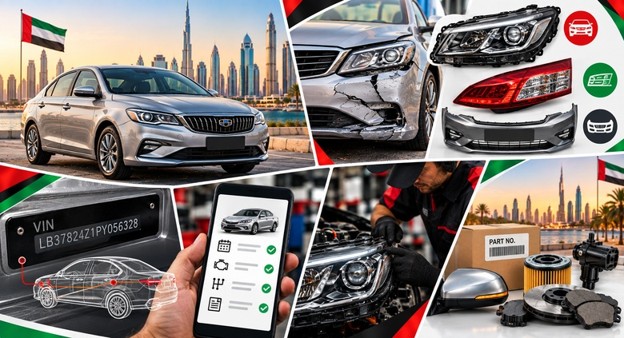
This sounds almost absurdly cautious until you have a costly part sitting on a workshop floor that cannot be fitted.
Read the VIN slowly.
Then read it again.
If you are sending it through WhatsApp, email or a parts enquiry form, check the typed version against the original before submitting.
A photograph of the VIN can also reduce transcription errors where the supplier accepts images.
For high-value parts, the few minutes spent checking the identification information are considerably cheaper than discovering a mismatch after delivery and installation has already been attempted.
Model year is not just a number on the registration document
The model year is useful, but it should not be treated as the sole fitment key.
A vehicle registered in one year may have been manufactured earlier. Imported vehicles can complicate the picture further. Facelifts and running production changes can also alter components without producing a completely different model name.
That is why a supplier asking for the VIN is not necessarily being difficult.
They are trying to move from a broad vehicle description to an exact catalogue application.
Current UAE Emgrand specification needs to be separated from older applications
Geely UAE currently lists the Emgrand as a 1.5D with a 6AT transmission and 120 hp on its vehicle catalogue.
That is useful when identifying a current UAE-market vehicle.
It should not automatically be used to describe every Emgrand ever sold in every market.
This distinction matters for parts research because older international applications can have different engines, transmissions, electrical systems and body components.
So if your Emgrand is older or imported, give the supplier the actual vehicle information rather than assuming the current UAE specification applies.
The registration year and production year can tell different stories
Suppose an Emgrand is registered in the UAE in 2024.
That does not, by itself, prove that every component belongs to a single 2024 catalogue application.
For ordinary maintenance parts this may not cause trouble. For headlights, ECUs, ABS components, body panels, transmission assemblies and other application-sensitive parts, it can.
The useful combination is:
VIN + production information where available + model year + exact component.
That gives the supplier something far more precise to work with.
The part number can be more useful than a photograph
A photograph tells you what a component looks like.
A part number can tell you what catalogue reference the manufacturer or supplier associates with it.
Those are not the same thing.
A headlight can look almost identical while having a different connector or internal configuration. A control module can have the same casing while carrying different hardware or software. A suspension component can look interchangeable until mounting dimensions are compared.
If the old part has a readable number, photograph it clearly and send a close-up.
Do not assume every number moulded into plastic is the actual ordering number, though. Some markings can relate to production, moulding, batch or component manufacture.
The supplier should confirm what the number represents.
Never assume a part number automatically proves fitment
This is where parts buying gets surprisingly messy.
A number may be superseded. It may have a replacement reference. It may belong to a related assembly rather than the complete part. A supplier may use its own catalogue reference alongside a manufacturer reference.
So the correct sequence is not:
“I found a number, therefore it fits.”
It is:
vehicle identification → application check → part reference → physical confirmation where appropriate → installation confirmation.
That sequence becomes increasingly important as the part gets more expensive.
Why photographs still matter
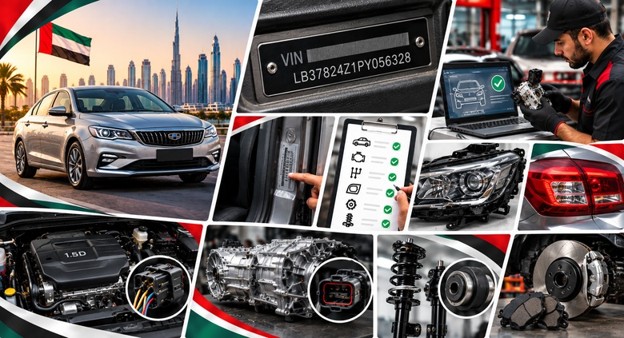
If the supplier asks for a photograph after receiving the VIN, send one.
That is not redundant.
The image can show connector position, mounting brackets, sensor openings, physical damage, revision markings and the exact configuration of the component.
For body parts, photographs can also help identify whether you need a bumper cover, grille, reinforcement, bracket, trim section or another supporting component.
A good photograph does not replace catalogue verification.
It strengthens it.
Headlights need more than left or right
“Left headlight for Emgrand” is a start, not a complete specification.
You may need to establish the model year, trim, lighting technology, regional specification and exact application.
The current UAE Emgrand brochure has listed different headlight equipment between grades, including halogen and LED configurations.
That is precisely why buying by photograph alone can go wrong.
The lamp may physically resemble yours while the electrical or equipment specification differs.
Tail lights and body lamps have the same problem
Rear lighting assemblies can vary by generation, facelift, body configuration and equipment level.
The same applies to indicators, mirror assemblies and certain exterior lighting modules.
For an accident-damaged Emgrand, send:
- the VIN
- model year
- side of vehicle
- photograph of the damaged lamp
- photograph of the undamaged opposite side if useful
- old component reference if visible
The opposite-side photograph can be particularly helpful for understanding shape and mounting, although it still does not prove catalogue compatibility.
Bumpers are not simply “front” and “rear”
A bumper enquiry should identify the exact body application.
There can be differences in grille openings, parking-sensor provisions, fog-light or trim openings, brackets, lower sections and other details.
If the bumper has been damaged in an accident, ask the workshop to inspect behind it before ordering everything from the visible damage alone.
The bumper cover may be broken while the reinforcement, absorber, mounting brackets, radiator support, condenser or other components have also moved.
Replacing the obvious plastic part first can leave you with a second order later.
Engine parts need engine identification
“1.5 Emgrand” is useful but may still be insufficient for a serious engine-parts enquiry.
For an engine assembly or internal component, the supplier may need the VIN, engine information and the old part reference.
For smaller components such as sensors, ignition components, pumps or brackets, application-specific details can still matter.
Do not invent an engine code from a search result or assume that a displacement number uniquely identifies every component.
If the engine plate, service documentation or diagnostic report provides useful identification, send that information to the supplier.
Gearbox identification deserves extra care
The transmission is one of the areas where guessing gets expensive quickly.
The current UAE Emgrand specification lists a six-speed automatic transmission.
But an older or imported Emgrand may belong to a different application.
If you are looking for a gearbox, valve body, transmission control component, selector assembly or internal transmission part, provide the VIN and transmission information before accepting a price.
A supplier saying “Emgrand gearbox available” is not enough.
Ask which Emgrand application it came from.
Electrical and electronic parts are particularly unforgiving
An ECU, BCM, ABS module, instrument cluster, electronic steering component or sensor can appear physically correct and still fail to work correctly.
Hardware is only part of the story.
Software version, vehicle configuration, coding, immobiliser relationships and calibration can matter depending on the component.
That means the workshop should establish whether the replacement needs programming, coding, adaptation or calibration before the part is purchased.
Otherwise the apparent bargain can become a second bill.
Air-conditioning components should be identified from the diagnosis
A weak A/C system does not automatically mean the compressor needs replacing.
The workshop should establish the actual fault before a major component is ordered.
Depending on the symptom, relevant checks can include refrigerant pressures, leaks, compressor operation, electrical control, condenser condition, pressure sensing and other system-specific tests.
This matters for parts sourcing because ordering an expensive compressor before confirming compressor failure can turn a diagnostic problem into an unnecessary parts purchase.
Cooling-system parts need the same discipline
An overheating Emgrand needs a diagnosis, not a shopping list.
The workshop may need to check coolant level, visible leaks, pressure integrity, thermostat operation, water-pump function, radiator condition, fan operation and fan control, depending on the symptoms and diagnostic findings.
A radiator is not automatically the answer because the temperature gauge rose.
Likewise, replacing a thermostat without checking for another underlying cooling-system fault may not solve the problem.
Identify the failed component first.
Then source it.
Suspension parts should be ordered by location and application
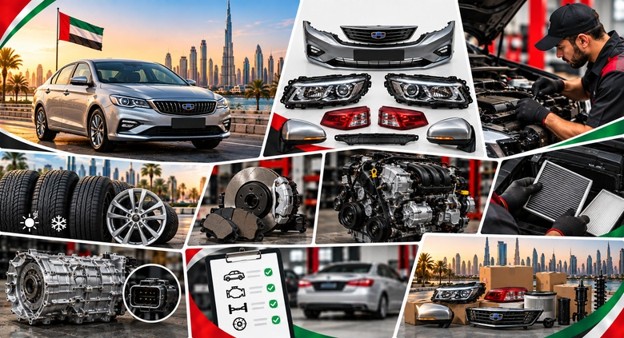
“Suspension arm” can mean several different components.
Specify front or rear, left or right where relevant, and the exact component.
For a damaged suspension assembly after a pothole or accident, the workshop should inspect associated components rather than replacing only the visibly bent item.
Wheel alignment, hubs, steering components, bushes and other related parts can be affected depending on the impact.
A replacement part that fits perfectly will not correct a second damaged component.
Brake parts are easier, but still worth checking
Brake pads and discs are generally more straightforward than electronic modules, but the exact application still matters.
Brake equipment can vary by model, grade or production application.
For brake parts, provide the VIN and ask the supplier to confirm the application. If possible, the workshop can also identify the existing component before ordering.
Do not choose solely by wheel size or visual appearance.
The correct friction material, dimensions and application matter.
UAE heat changes the sourcing conversation
The UAE environment is relevant to vehicle ownership, but it should not be used as a lazy explanation for every failure.
High ambient temperatures, heavy A/C use, dust, traffic and prolonged exposure to strong sunlight can influence vehicle operating conditions and component ageing.
That makes cooling components, A/C parts, batteries, lighting, rubber components and certain exterior/interior materials particularly worth inspecting carefully when sourcing replacement parts.
But diagnosis still comes first.
“UAE heat” is context.
It is not a diagnostic code.
Imported Emgrands require another layer of checking
An imported Emgrand can be perfectly usable in the UAE and still require more careful parts identification.
The regional specification can affect lighting, electronics, emissions-related equipment, wiring, cooling configuration and other components.
That is why the supplier should know if the vehicle is a UAE-market car or an imported example where that distinction is relevant.
Do not hide the import history simply because the badge says Emgrand.
It can be one of the most useful facts in the entire enquiry.
Genuine, OEM, aftermarket and used are not interchangeable terms
A supplier may offer several choices.
A genuine Geely part is not the same category as a generic aftermarket replacement. “OEM” is also frequently used loosely in the parts trade and should not be treated as a magic quality label.
Aftermarket does not automatically mean poor quality.
Used does not automatically mean bad.
Reconditioned does not automatically mean equivalent to new.
Ask what you are actually buying, who manufactured it, what application it came from, what testing has been performed and what warranty or return terms apply.
Used Emgrand parts need history, not just a low price
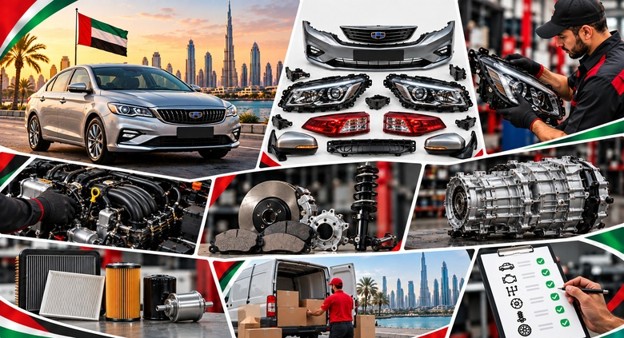
A used component can make sense, particularly for an older vehicle or discontinued application.
But ask where it came from.
For a used gearbox or engine, donor vehicle information, mileage where available, reason for dismantling, inspection/testing, warranty and return terms become important.
For a used electronic module, establish whether programming or configuration work will be required.
For a used headlight, inspect tabs, housing damage, moisture ingress and mounting points.
“Used” describes history.
It does not describe condition.
What should a UAE supplier quote actually contain?
A useful quotation should make the purchase understandable before money changes hands.
Ask for:
| Quote item | What to confirm |
| Part description | Exact component, not just “Emgrand part” |
| Application | Model year/VIN compatibility |
| Condition | New, genuine, aftermarket, used or reconditioned |
| Part reference | Manufacturer or supplier reference |
| Price | AED amount |
| VAT | Included or excluded |
| Delivery | Cost and expected timing |
| Warranty | Duration and conditions |
| Return policy | What happens if fitment is incorrect |
| Programming | Required or not |
| Labour | Included or separate |
| Supporting parts | Seals, brackets, fluids or related items |
| Availability | In stock, special order or enquiry |
The point is not to create paperwork for its own sake.
It is to expose the real cost before the vehicle is dismantled.
Part price is not the same as repair cost
This distinction gets lost constantly.
Suppose a replacement electronic component costs AED X.
That is not automatically the repair cost.
The final bill could also include diagnosis, removal, installation, coding, programming, calibration, delivery, supporting components and VAT depending on the job.
The same applies to a gearbox or engine.
A cheap component can become expensive if it requires repeated labour because the first part was wrong.
What should you do before ordering an expensive Emgrand part?
Use a simple five-point check:
1. Confirm the VIN.
2. Confirm the model year and vehicle specification.
3. Photograph the existing component and its connectors/mountings.
4. Record the old part number if one is present.
5. Ask the workshop what additional programming, calibration, fluids, seals or supporting parts are required.
If the supplier cannot confirm compatibility, do not treat uncertainty as confirmation.
For expensive components, pause the order and get the application checked.
The workshop should diagnose before the supplier sells
This is perhaps the most important rule in the entire article.
A supplier can identify a part.
A parts supplier should not be expected to diagnose a vehicle remotely from the description “car is shaking” or “engine overheating”.
The workshop needs to establish what has actually failed.
That might involve a diagnostic scan, live data, physical inspection, electrical testing, pressure testing, compression or leak-down testing for appropriate engine faults, charging-system checks, cooling-system checks, gearbox assessment or a road test.
The exact test depends on the symptom.
Parts ordering should follow diagnosis, not replace it.
A simple UAE Emgrand parts decision matrix
| Situation | Information to provide | Sensible next step |
| Routine service part | VIN/model/year | Confirm catalogue application |
| Body panel | VIN/year/side/photo | Check body and generation |
| Headlight | VIN/year/side/trim/photo | Confirm lighting specification |
| Engine component | VIN/engine information/old reference | Confirm engine application |
| Gearbox component | VIN/transmission information | Verify exact transmission application |
| ECU/module | VIN/old module reference/photo | Confirm hardware/software/coding |
| Used gearbox | VIN/transmission/donor information | Check donor history, testing and warranty |
| Used body part | VIN/year/side/photo | Confirm shape, mounting and condition |
| A/C component | Diagnosis + VIN | Confirm failed component before ordering |
| Suspension component | VIN/location/diagnosis | Confirm exact side and application |
This is deliberately less glamorous than simply comparing prices.
It is also much more useful.
Why the cheapest Emgrand part can become the expensive option
Imagine two suppliers.
Supplier A offers a component at a lower headline price but cannot clearly confirm the application and gives limited return information.
Supplier B charges more but confirms the VIN, part reference, condition, warranty and return process.
The difference is not simply the price printed on the quotation.
If Supplier A sends the wrong component, you can end up paying for delivery, workshop time, removal, reinstallation, another delivery and potentially lost vehicle use.
That is the cost of getting the fitment wrong.
For a small service component, the risk may be tolerable.
For a gearbox, ECU, headlight or major engine component, it is much harder to justify guessing.
What information should you send in one WhatsApp message?
Instead of sending ten separate messages, give the supplier a clean identification package.
For example:
Geely Emgrand
Model year: [year]
VIN: [17-character VIN]
Engine: [available information]
Transmission: [available information]
Part required: [exact component]
Side/location: [left/right/front/rear where relevant]
Old part number: [number if visible]
Condition required: New / used / either
Photo: Attached
UAE location: [emirate]
Then ask:
“Please confirm compatibility against the VIN and provide the part reference, price, VAT status, delivery time, warranty and return conditions.”
That is a much better parts enquiry than “Emgrand headlight price?”
How PartFinder UAE fits into the buying process
For owners comparing replacement options, the useful starting point is not simply finding a seller with an Emgrand component in stock.
The better process is identification first, sourcing second.
That means having the VIN, model year, exact component and any visible part reference ready before requesting alternatives. It makes it easier to compare genuine, aftermarket, used or reconditioned options at PartFinder UAE without losing track of what each quotation actually fits.
A practical “Before You Click Buy” checklist
Before paying for an Emgrand spare part in the UAE, ask yourself:
Do I know the VIN?
Has the workshop confirmed the failed component?
Does the supplier confirm the exact vehicle application?
Have I checked the model year rather than relying only on the badge?
Do I have the old part number?
Have I checked left/right/front/rear where relevant?
For electronics, have I asked about coding or programming?
For suspension or bodywork, have I checked for related damage?
For used parts, do I know the donor history and warranty?
Is VAT included?
Is delivery included?
What happens if the part does not fit?
Will the workshop charge additional labour if the wrong part has to be removed and replaced?
If several answers are “no”, the purchase is not ready yet.
The practical rule: identify first, buy second
The safest Emgrand parts purchase in the UAE rarely begins with a price.
It begins with identification.
VIN first. Model year next. Engine and transmission where relevant. Then the old part number, physical photographs and a proper diagnosis if the component has failed.
Only after that should you compare genuine, aftermarket, used or reconditioned options.
Geely UAE currently provides a dedicated spare-parts route for its models, including Emgrand, while its warranty information states that authorised dealers carry out diagnostics and repairs using original Geely parts under the applicable warranty terms.
For an owner outside the authorised network, the same principle still holds: make the identification precise before making the purchase.
That is how you avoid the most expensive kind of spare-part bargain — the one that was cheap until it reached the workshop.
FAQs
Categories
- Audi
- BMW
- Car Accessories
- Car Tips
- Ford
- Land Rover
- Mazda
- Range Rover
- Top 10
- UAE Car Parts
- Used Car Parts
- Toyota
- Replacement Engines
- Nissan
- Hyundai
- Mitsubishi
- Volkswagen
- Honda
- Kia
- Chevrolet
- Dodge
- Jeep
- Subaru
- Renault
- Lexus
- Mercedes
- Suzuki
- Hummer
- Porsche
- Infiniti
- Peugeot
- GMC
- Mini
- Volvo
- Replacement Gearboxes
- MG
- Jaguar
- Skoda
- Cadillac
- Daihatsu
- Fiat
- German Car Parts
- Japanese Car Parts
- Aftermarket Car Parts
- Genuine Car Parts
- New Car Parts
- Reconditioned Car Parts
- European Car Parts
- American Car Parts
- Korean Car Parts
- British Car Parts
- Chinese Car Parts
- Sports/Exotic Car Parts
- Luxury Car Parts
- Performance Car Parts
- SUV/4x4 Spare Parts
- Truck Spare Parts
- EV Car Parts
- Hybrid Car Parts
- Auto Spare Parts in UAE
- Tesla
- Isuzu
- Ram
- Ferrari
- Bentley
- Lamborghini
- Genesis
- Maserati
- Lincoln
- Chrysler
- Opel
- Citroen
- SsangYong
- Seat
- McLaren
- Aston Martin
- Rolls Royce
- Maybach
- Alfa Romeo
- Bugatti
- Scion
- Abu Dhabi Car Parts
- Ajman Car Parts
- Al Khan Car Parts
- Al Sajaa Car Parts
- Deira Car Parts
- Dubai Car Parts
- Fujairah Car Parts
- Industrial Area 6 Car Parts
- Mussafah Car Parts
- Ras Al Khaimah Car Parts
- Sharjah Car Parts
- Umm Al Quwain Car Parts
- Acura
- BYD
- Chery
- Dacia
- DS
- Geely Emgrand