Ford Mustang and F-150 Spare Parts in UAE: What Owners Replace Most
August 7, 2026
Introduction to Ford Mustang and F-150 Spare Parts in UAE
The Ford Mustang and Ford F-150 may belong to the same manufacturer, but they lead very different lives across the UAE.
One is admired for its performance, unmistakable styling and engaging driving experience.
The other has built its reputation through strength, durability and the ability to handle demanding work every day.
Despite those differences, both vehicles share one important characteristic.
They depend on high-quality replacement parts to continue performing at their best.
Whether you're driving through Dubai's busy city streets, covering long motorway distances between Abu Dhabi and Al Ain or using an F-150 on construction sites in Sharjah and the Northern Emirates, every replacement component contributes to reliability, safety and long-term ownership costs.
Buying the correct part isn't simply about restoring performance.
It's about protecting the investment you've already made.
This guide explains the components Mustang and F-150 owners replace most frequently, why those parts wear out in UAE conditions and how informed buying decisions can reduce future repair costs while improving ownership confidence.
Why This Guide Matters:
| Benefit | Why It Matters |
| Better Buying Decisions | Reduces expensive mistakes |
| Improved Compatibility | Prevents incorrect orders |
| Lower Long-Term Costs | Protects your ownership budget |
| Better Reliability | Supports dependable driving |
| Smarter Maintenance | Reduces unexpected breakdowns |
| Greater Buyer Confidence | Helps compare replacement options |
Good ownership always begins with good information.
Why Mustang and F-150 Owners Replace Parts More Frequently
Every vehicle experiences wear.
The way that wear develops depends entirely on how the vehicle is driven.
A Mustang regularly encounters spirited acceleration, motorway cruising and performance-focused driving.
An F-150 may spend its days towing trailers, carrying heavy loads or travelling over rough working environments.
Different driving styles create different maintenance priorities.
Brake components naturally wear faster on performance vehicles.
Suspension and steering components experience greater stress on commercial pickups.
Cooling systems work continuously throughout the UAE summer.
None of this indicates poor engineering.
It's simply the reality of vehicle ownership.
Replacing worn components at the correct time protects the systems surrounding them and helps avoid significantly more expensive repairs later.
Preventive maintenance remains considerably cheaper than emergency repairs.
Frequently Replaced Components:
- Brake pads.
- Suspension components.
- Cooling system parts.
- Steering assemblies.
- Air-conditioning components.
- Filters.
- Electrical components.
- Lighting systems.
Every replacement supports long-term reliability.
Replacement Priority Matrix:
| Component Category | Replacement Frequency |
| Braking System | High |
| Suspension | High |
| Cooling System | High |
| Steering Components | Medium |
| Electrical System | Medium |
| Interior Components | Low to Medium |
Regular maintenance protects every journey.
Common Wear and Tear in UAE Driving Conditions
Owning a Mustang or F-150 in the UAE introduces challenges that many vehicles elsewhere never experience.
Summer temperatures regularly place additional strain on engines, transmissions and air-conditioning systems.
Desert dust increases the workload placed upon air filters.
Heavy city traffic creates repeated braking and prolonged engine idling.
Long motorway journeys expose cooling systems to continuous operating temperatures.
Each of these conditions contributes to gradual component wear.
Fortunately, most of it can be managed through routine inspections and timely replacement of worn parts.
Professional workshops rarely wait until complete failure occurs.
They identify developing issues early.
That proactive approach reduces repair costs and keeps vehicles operating reliably throughout the year.
Common UAE Wear Factors:
- High ambient temperatures.
- Desert dust.
- Heavy urban traffic.
- Long motorway journeys.
- Commercial towing.
- Off-road driving.
- Continuous air-conditioning use.
- Stop-start commuting.
Local conditions shape maintenance priorities.
UAE Driving Conditions Comparison:
| Driving Condition | Components Most Affected |
| Extreme Heat | Cooling and AC systems |
| Desert Dust | Filters and turbochargers |
| Heavy Traffic | Brakes and transmission |
| Long Motorway Driving | Cooling and suspension |
| Towing | Gearbox and differential |
| Off-Road Driving | Suspension and steering |
The environment influences every replacement decision.
How Climate Affects Mustang and F-150 Components
Heat changes everything.
Engine oil works harder.
Coolant operates under greater pressure.
Rubber hoses age more quickly.
Plastic connectors become more brittle over time.
Air-conditioning systems operate for much longer periods than they would in cooler climates.
For the Mustang, high-performance driving combined with elevated temperatures increases stress on braking and cooling systems.
For the F-150, towing and heavy loads add even greater demands to the drivetrain and suspension.
Understanding these conditions allows owners to plan maintenance rather than react to failures.
Planning consistently delivers better reliability and lower ownership costs.
The climate should always influence replacement decisions.
Climate-Related Inspection Checklist:
- Inspect coolant levels.
- Check radiator condition.
- Examine coolant hoses.
- Test air-conditioning performance.
- Inspect suspension components.
- Monitor brake wear.
- Replace air filters regularly.
- Investigate warning lights immediately.
Small inspections prevent major repairs.
Climate Impact Matrix:
| Climate Factor | Primary Effect |
| High Temperatures | Increased cooling demand |
| Dust | Reduced filtration efficiency |
| Heavy Traffic | Greater brake wear |
| Long-Distance Driving | Increased cooling load |
| Towing | Transmission stress |
| UV Exposure | Rubber and plastic ageing |
Preparation is the best defence against harsh conditions.
Genuine vs OEM vs Used vs Aftermarket Parts
Every Ford owner eventually asks the same question.
Which replacement part should I choose?
The answer depends on the repair.
Genuine Ford components remain the benchmark for factory specifications and precise compatibility.
OEM parts frequently deliver comparable manufacturing quality while offering strong value.
Professionally inspected genuine used parts can provide significant savings for major assemblies such as engines, gearboxes and body panels.
Premium aftermarket components often suit routine servicing and selected maintenance items when purchased from reputable manufacturers.
No single category is universally superior.
The correct choice depends on the repair itself, the condition of the vehicle and your long-term ownership plans.
Successful buyers evaluate value rather than assumptions.
Ford Parts Comparison:
| Part Type | Best Application |
| Genuine | Safety-critical and factory-standard repairs |
| OEM | Routine mechanical maintenance |
| Genuine Used | Major mechanical assemblies and body panels |
| Reconditioned | Selected engines and gearboxes |
| Premium Aftermarket | Routine servicing components |
| Low-Quality Aftermarket | Generally Avoid |
Choose according to the repair.
Not simply the price.
Key Takeaways Before Buying Replacement Parts
Every replacement part influences more than today's repair.
It influences tomorrow's reliability.
Future maintenance costs.
Resale value.
Ownership confidence.
The most successful Mustang and F-150 owners rarely make hurried purchasing decisions.
They verify compatibility.
Compare several suppliers.
Review warranties.
Understand complete repair costs.
Maintain organised documentation.
Those habits consistently produce stronger long-term results.
Professional workshops rely on structured buying processes because they reduce unnecessary mistakes.
Private owners benefit from exactly the same approach.
Good preparation creates dependable ownership.
One repair at a time.
Professional Buyer's Checklist:
- Verify the VIN before ordering.
- Match the correct Ford part number.
- Compare several trusted suppliers.
- Request inspection reports.
- Review warranty conditions.
- Budget for complete repair costs.
- Keep service documentation.
- Follow preventive maintenance schedules.
Preparation protects both your vehicle and your budget.
Complete Buying Decision Matrix:
| Ownership Goal | Recommended Strategy |
| Maximum Reliability | Genuine or OEM Parts |
| Best Overall Value | Professionally Tested Genuine Used Parts |
| Lower Ownership Costs | Preventive Maintenance |
| Performance Driving | Quality Components |
| Commercial Operation | Planned Servicing |
| Stronger Resale Value | Complete Documentation |
Real UAE Workshop Case Study:
A Ford Mustang owner from Dubai and an F-150 owner from Sharjah visited the same workshop during the summer. The Mustang required replacement brake discs after repeated high-speed motorway driving, while the F-150 needed new suspension bushes following months of carrying heavy construction equipment. Rather than choosing the first available replacement parts, both owners compared supplier quotations, verified VIN compatibility and reviewed warranty coverage before ordering. The repairs were completed without compatibility issues, downtime was reduced and both vehicles returned to service with improved reliability. Careful planning delivered better results than rushed purchasing.
Key Takeaways:
Ford Mustang and F-150 ownership in the UAE demands careful maintenance because local driving conditions place additional pressure on cooling systems, brakes, suspension, steering and drivetrain components. Buyers who understand why these parts wear, compare quality replacement options, verify compatibility and plan repairs before failures occur consistently achieve lower ownership costs, better reliability and greater confidence throughout the life of their vehicles.
Most Replaced Ford Mustang Engine Parts
The Mustang's engine is designed to deliver performance.
Whether it's a naturally aspirated V8 or a turbocharged EcoBoost, every engine operates under significant mechanical and thermal loads, particularly in the UAE's demanding climate.
High temperatures, spirited acceleration and frequent motorway driving all contribute to gradual wear.
Fortunately, most replacement parts follow predictable maintenance patterns.
Cooling system components.
Ignition parts.
Belts.
Sensors.
Gaskets.
These items naturally receive attention as mileage increases.
Replacing them before complete failure helps protect the engine from far more expensive damage.
Performance is best preserved through consistent maintenance rather than emergency repairs.
A healthy engine rewards proactive ownership.
Common Mustang Engine Parts Replaced:
| Component | Why It Gets Replaced |
| Spark Plugs | Normal service wear |
| Ignition Coils | Heat and electrical ageing |
| Water Pump | Cooling system wear |
| Serpentine Belt | Age and mileage |
| Engine Mounts | Vibration over time |
| Oxygen Sensors | Reduced efficiency with age |
Small components often protect much larger systems.
Most Replaced Ford F-150 Engine Parts
The F-150 works differently.
Many spend years towing trailers, carrying heavy equipment or travelling long motorway distances across the UAE.
Those demands influence engine maintenance priorities.
Cooling systems operate continuously.
Filters work harder.
Engine mounts absorb additional vibration.
Accessory belts experience greater loading.
Commercial use naturally accelerates wear compared with private ownership.
That's why many fleet operators schedule preventive replacement rather than waiting for failures.
Planned maintenance reduces downtime.
It also creates more predictable ownership costs.
Reliability remains the foundation of every successful working vehicle.
Frequently Replaced F-150 Engine Components:
- Air filters.
- Fuel filters.
- Water pumps.
- Cooling fans.
- Engine mounts.
- Drive belts.
- Radiator hoses.
- Glow plugs (diesel models).
Working vehicles benefit from preventative care.
F-150 Engine Maintenance Matrix:
| Component | Inspection Priority |
| Cooling System | Very High |
| Air Filtration | High |
| Drive Belts | High |
| Engine Mounts | Medium |
| Fuel System | Medium |
| Sensors | Medium |
Consistent servicing supports dependable performance.
Common Cooling System Replacements
Few systems work harder in the UAE than engine cooling.
Summer temperatures place constant pressure on radiators, thermostats, water pumps, cooling fans and coolant hoses.
Even a relatively minor fault can quickly develop into overheating if ignored.
That's why cooling system maintenance deserves priority for both Mustang and F-150 owners.
Professional workshops rarely replace one cooling component without inspecting the surrounding system.
A worn radiator hose today could become tomorrow's roadside breakdown.
Complete inspections help avoid incomplete repairs.
That's both practical and economical.
Cooling Components That Commonly Need Replacement:
- Radiators.
- Water pumps.
- Thermostats.
- Cooling fans.
- Expansion tanks.
- Radiator hoses.
- Coolant temperature sensors.
- Radiator caps.
Cooling systems perform best when maintained together.
Cooling System Comparison Matrix:
| Component | Recommended Buying Option |
| Radiator | Genuine or OEM |
| Water Pump | Genuine or OEM |
| Cooling Fan | Professionally Tested Genuine Used |
| Thermostat | New |
| Coolant Hose | New |
| Expansion Tank | Genuine or OEM |
Heat rewards preparation.
Frequently Replaced Air Intake Components
Every Mustang and F-150 depends on clean airflow.
Dust, sand and long driving distances gradually reduce filter efficiency, particularly in UAE conditions.
Restricted airflow affects fuel economy, engine responsiveness and overall performance.
Fortunately, replacing intake components is usually straightforward and relatively inexpensive compared with repairing damage caused by neglected maintenance.
Air filters should receive regular inspection.
Mass airflow sensors should remain clean and functioning correctly.
Intake hoses deserve periodic examination for cracking or deterioration.
Small maintenance decisions consistently protect larger mechanical systems.
Clean airflow supports healthy engines.
Air Intake Components:
| Component | Function |
| Air Filter | Protects the engine |
| Intake Hose | Directs airflow |
| Mass Airflow Sensor | Measures intake air |
| Air Box | Houses filtration system |
| Intake Resonator | Reduces intake noise |
| Throttle Body | Controls airflow |
Clean air improves long-term reliability.
Oil Leak Components That Often Need Replacement
Oil leaks rarely appear without warning.
A small stain beneath the vehicle.
The smell of burning oil.
Gradually falling oil levels.
These early signs deserve attention.
Common causes include ageing valve cover gaskets, oil seals, sump gaskets and timing cover seals.
Heat accelerates rubber deterioration, making periodic inspection particularly important in the UAE.
Ignoring small leaks often creates larger repairs later.
Oil contamination can damage belts, hoses and electrical connectors while reducing lubrication efficiency.
Early intervention almost always costs less than delayed action.
Professional workshops understand this well.
Owners should too.
Common Oil Leak Sources:
- Valve cover gasket.
- Oil sump gasket.
- Front crankshaft seal.
- Rear main seal.
- Timing cover gasket.
- Oil filter housing seal.
- Camshaft seals.
- Turbo oil feed lines (where applicable).
Minor leaks deserve major attention.
Oil Leak Inspection Matrix:
| Leak Source | Inspection Priority |
| Valve Cover | High |
| Oil Sump | Medium |
| Front Seal | High |
| Rear Main Seal | High |
| Oil Filter Housing | Medium |
| Turbo Oil Lines | High |
Early repairs protect major components.
Ford Mustang spare parts for sale and F-150 Parts Buying Guide
Searching for Ford Mustang spare parts in UAE or replacement F-150 components online presents more options than ever before.
That wider choice is valuable.
Provided buyers know how to compare properly.
Always begin with compatibility.
Verify the VIN.
Match the Ford part number.
Compare several suppliers.
Review inspection reports.
Read warranty conditions carefully.
Calculate the complete repair cost instead of concentrating only on the advertised price.
Professional buyers compare complete solutions.
Not individual products.
Following the same structured approach consistently produces better reliability, smoother repairs and stronger long-term value.
Knowledge remains the best buying tool available.
Professional Buyer's Checklist:
- Verify the VIN before ordering.
- Match the correct Ford part number.
- Compare several trusted suppliers.
- Request inspection documentation.
- Review warranty conditions carefully.
- Include labour in your budget.
- Replace supporting components where appropriate.
- Keep complete purchase and service records.
Preparation protects every repair.
Complete Buying Decision Matrix:
| Buying Priority | Recommended Strategy |
| Maximum Reliability | Genuine or OEM Components |
| Best Overall Value | Professionally Tested Genuine Used Parts |
| Cooling System Repairs | Replace Related Components Together |
| Performance Driving | Preventive Maintenance |
| Commercial Operation | Planned Servicing |
| Long-Term Ownership | Complete Documentation |
Real UAE Workshop Case Study:
A Ford Mustang EcoBoost owner in Abu Dhabi noticed intermittent increases in engine temperature during motorway driving, while a Ford F-150 owner in Dubai experienced coolant loss after towing heavy equipment. Instead of replacing individual components immediately, the workshop inspected both cooling systems completely. The Mustang required a new thermostat and coolant temperature sensor, while the F-150 needed a replacement radiator hose and water pump. Both owners compared supplier quotations, verified VIN compatibility and selected warranty-backed components before installation. The repairs restored reliability while preventing much larger engine problems that could have resulted from overheating.
Key Takeaways:
Engine components, cooling systems, air intake assemblies and oil sealing parts are among the most frequently replaced items on Ford Mustang and F-150 models operating in the UAE. Buyers who prioritise preventive maintenance, verify compatibility, compare multiple suppliers and purchase quality replacement components consistently reduce long-term ownership costs while improving reliability, performance and confidence behind the wheel.
Most Common Gearbox Replacements
The gearbox is one of the hardest-working components in both the Ford Mustang and Ford F-150.
Every gear change.
Every acceleration.
Every towing journey.
Every motorway drive.
The transmission quietly manages enormous mechanical loads throughout the vehicle's life.
Eventually, wear becomes unavoidable.
Automatic transmissions may develop delayed gear engagement, rough shifting or slipping.
Manual gearboxes can suffer from worn synchronisers, noisy bearings or gear selection difficulties.
Replacing a gearbox isn't a routine maintenance task.
It's a major investment.
That makes careful supplier comparison and compatibility verification absolutely essential.
Buying the correct transmission once is always less expensive than correcting the wrong purchase later.
Signs a Gearbox May Need Replacement:
| Warning Sign | Possible Cause |
| Delayed Gear Engagement | Internal transmission wear |
| Gear Slipping | Clutch pack or internal damage |
| Grinding Noises | Bearing or synchroniser wear |
| Fluid Leaks | Damaged seals or housing |
| Transmission Warning Light | Electronic or mechanical fault |
| Burning Smell | Overheated transmission fluid |
Early diagnosis often prevents greater damage.
Automatic Transmission Components That Wear Out
Modern automatic transmissions contain hundreds of precision-engineered components working together continuously.
Valve bodies.
Solenoids.
Torque converters.
Clutch packs.
Filters.
Transmission fluid.
When one component begins to deteriorate, others may also experience additional stress.
That's why professional workshops inspect the complete transmission rather than replacing isolated parts without proper diagnosis.
Preventive servicing extends transmission life considerably.
Fresh fluid.
Clean filters.
Routine inspections.
These relatively simple maintenance tasks often prevent much larger repair bills later.
The gearbox rewards consistent attention.
Common Automatic Transmission Components:
- Torque converter.
- Valve body.
- Transmission solenoids.
- Transmission filter.
- Oil pan gasket.
- Speed sensors.
- Internal clutch packs.
- Transmission control module.
Routine servicing protects expensive assemblies.
Automatic Transmission Matrix:
| Component | Replacement Priority |
| Transmission Fluid | Very High |
| Filter | High |
| Solenoids | Medium |
| Valve Body | High |
| Torque Converter | High |
| Speed Sensors | Medium |
Maintenance remains the strongest investment.
Clutch Parts for Manual Mustang Models
Manual Mustang owners enjoy a uniquely engaging driving experience.
That enjoyment also places responsibility on the clutch system.
Clutch discs gradually wear with mileage.
Pressure plates weaken over time.
Release bearings eventually become noisy.
Hydraulic components may develop leaks.
Ignoring early warning signs often increases repair costs because damaged clutch assemblies can affect surrounding transmission components.
Professional workshops frequently recommend replacing the clutch kit, release bearing and pilot bearing together.
The gearbox is already removed.
Completing the repair properly reduces future labour costs and improves long-term reliability.
Comprehensive repairs nearly always provide better value.
Common Manual Clutch Components:
- Clutch disc.
- Pressure plate.
- Release bearing.
- Pilot bearing.
- Clutch slave cylinder.
- Clutch master cylinder.
- Flywheel.
- Hydraulic lines.
Complete clutch replacements reduce repeat labour.
Clutch Replacement Matrix:
| Component | Recommendation |
| Clutch Disc | Replace |
| Pressure Plate | Replace |
| Release Bearing | Replace |
| Pilot Bearing | Replace |
| Flywheel | Inspect or Replace if Necessary |
| Hydraulic Components | Inspect Carefully |
A complete repair is often the most economical repair.
Differential Components That Need Replacing
The differential quietly transfers power to the driven wheels.
Mustangs rely on it for smooth power delivery.
F-150 models depend on it during towing, heavy loading and demanding working conditions.
Over time, bearings, seals and internal gears naturally experience wear.
Fluid contamination or neglected servicing can accelerate that process.
Early warning signs include whining noises, vibration and oil leaks.
These symptoms deserve immediate attention.
Replacing a worn seal early is considerably less expensive than rebuilding an entire differential later.
Professional inspection provides the clearest answer.
Listening carefully often prevents major repairs.
Differential Components Commonly Replaced:
- Differential bearings.
- Oil seals.
- Crown wheel and pinion.
- Differential housing gasket.
- Axle seals.
- Differential oil.
- Limited-slip clutch packs.
- Mounting bushes.
Small repairs often protect larger assemblies.
Differential Inspection Matrix:
| Component | Inspection Priority |
| Oil Seals | High |
| Bearings | High |
| Differential Oil | Very High |
| Axle Seals | Medium |
| Gear Set | High |
| Mounting Bushes | Medium |
Preventive maintenance extends differential life.
Transfer Case Parts on F-150 Models
Four-wheel-drive F-150 models introduce another important component.
The transfer case.
It distributes power between the front and rear axles when additional traction is required.
Like any mechanical assembly, it benefits from regular servicing.
Fluid replacement.
Seal inspection.
Chain wear evaluation.
Electronic actuator testing.
These maintenance tasks help identify developing issues before complete failure occurs.
Owners who regularly tow trailers or drive off-road should pay particular attention to transfer case servicing.
Heavy-duty use naturally increases mechanical stress.
Planning maintenance early consistently reduces long-term ownership costs.
Transfer Case Maintenance Checklist:
- Check transfer case fluid.
- Inspect seals.
- Listen for unusual noises.
- Test electronic operation.
- Review service intervals.
- Inspect driveshaft connections.
- Verify warning lights.
- Replace worn components promptly.
Reliable four-wheel drive begins with proper maintenance.
Transfer Case Matrix:
| Component | Maintenance Priority |
| Transfer Case Fluid | Very High |
| Oil Seals | High |
| Electronic Actuator | Medium |
| Drive Chain | High |
| Bearings | High |
| Housing | Medium |
Regular servicing supports dependable performance.
Comparing Multiple Suppliers Before Buying
Major drivetrain components deserve careful evaluation before purchasing.
A gearbox.
Differential.
Transfer case.
These aren't components to buy impulsively.
Instead, compare several suppliers.
Review inspection reports.
Confirm VIN compatibility.
Verify the Ford part number.
Understand warranty conditions.
This is where PartFinder UAE becomes particularly valuable, allowing owners to compare multiple supplier quotations, check availability and evaluate suitable replacement options before committing to a purchase.
Professional buyers compare complete solutions.
Not simply prices.
Better information consistently produces better repairs.
Professional Buying Checklist:
- Verify the VIN before ordering.
- Match the Ford part number.
- Compare multiple supplier quotations.
- Request inspection and testing reports.
- Review warranty conditions carefully.
- Confirm delivery arrangements.
- Calculate complete repair costs.
- Keep every purchase document.
Preparation remains the strongest buying strategy.
Complete Drivetrain Buying Matrix:
| Buying Priority | Recommended Strategy |
| Maximum Reliability | Genuine or OEM Components |
| Best Overall Value | Professionally Tested Genuine Used Parts |
| Heavy-Duty Operation | Preventive Maintenance |
| Performance Driving | Scheduled Transmission Servicing |
| Commercial Fleet | Planned Component Replacement |
| Long-Term Ownership | Complete Service Documentation |
Real UAE Workshop Case Study:
A Ford Mustang GT owner in Dubai reported delayed gear engagement, while an F-150 owner in Abu Dhabi noticed transfer case vibration during four-wheel-drive operation. Instead of ordering replacement assemblies immediately, the workshop completed detailed diagnostics and requested multiple online quotations after verifying the VIN for both vehicles. Several suppliers were compared based on testing documentation, warranty coverage and compatibility. Both owners selected professionally inspected replacement components supported by written warranties. Installation proceeded without delays, restoring smooth drivetrain performance while avoiding the risks associated with purchasing unverified mechanical assemblies.
Key Takeaways:
Gearboxes, clutch systems, differentials and transfer cases are among the most important mechanical assemblies on Ford Mustang and F-150 models. Buyers who verify compatibility, compare multiple suppliers, review inspection reports and choose professionally tested replacement components consistently achieve smoother repairs, stronger reliability and lower long-term ownership costs throughout the UAE.
Suspension Parts Mustang Owners Replace Most
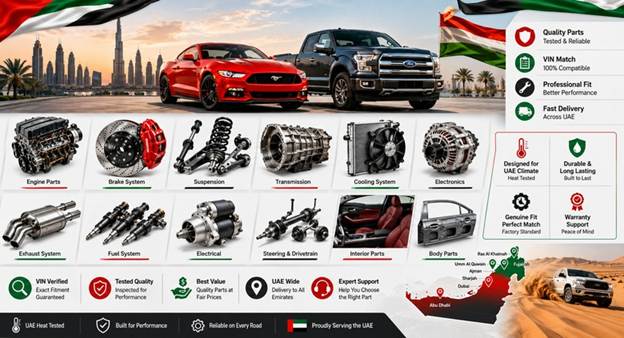
The Ford Mustang is engineered to deliver confident handling and precise road feedback.
To achieve that, its suspension works continuously.
Every corner.
Every speed bump.
Every motorway journey.
Every enthusiastic drive.
Over time, components naturally wear.
Bushes begin to soften.
Shock absorbers lose effectiveness.
Control arms develop play.
Ball joints gradually loosen.
These changes rarely happen overnight.
Instead, they appear gradually through reduced ride quality, uneven tyre wear or less predictable handling.
Addressing suspension wear early helps preserve the Mustang's performance while preventing additional stress on steering and tyre components.
Good suspension keeps every drive enjoyable.
Most Common Mustang Suspension Replacements:
| Component | Why It Gets Replaced |
| Shock Absorbers | Reduced damping performance |
| Control Arms | Bush wear and movement |
| Ball Joints | Suspension articulation wear |
| Suspension Bushes | Heat and ageing |
| Stabiliser Links | Road vibration |
| Wheel Bearings | High mileage and load |
Handling depends on healthy suspension.
Suspension Parts F-150 Owners Replace Most
The F-150 performs a very different role.
Many vehicles spend years carrying construction materials, towing trailers or travelling across uneven working environments.
That workload places additional pressure on suspension components.
Leaf springs.
Control arms.
Shock absorbers.
Steering links.
Mounting bushes.
These parts quietly absorb thousands of impacts throughout the vehicle's working life.
Professional fleet operators rarely wait until complete failure occurs.
Routine inspections help identify worn components before they begin affecting tyre wear, steering precision or vehicle stability.
Preventive maintenance remains considerably less expensive than emergency repairs.
Heavy-duty vehicles deserve heavy-duty maintenance planning.
Common F-150 Suspension Components:
- Leaf springs.
- Shock absorbers.
- Control arms.
- Suspension bushes.
- Stabiliser links.
- Ball joints.
- Wheel bearings.
- Steering knuckles.
Working vehicles rely on dependable suspension.
F-150 Suspension Matrix:
| Component | Inspection Priority |
| Leaf Springs | High |
| Shock Absorbers | High |
| Control Arms | High |
| Bushes | Medium |
| Ball Joints | High |
| Wheel Bearings | Medium |
Reliable suspension protects every journey.
Shock Absorbers and Struts
Shock absorbers perform one simple task exceptionally well.
They control movement.
Without them, every bump continues bouncing long after the road surface has disappeared.
Worn shock absorbers reduce braking stability, increase tyre wear and affect overall vehicle control.
Many owners overlook these gradual changes because they develop slowly.
Professional inspections often identify reduced damping before drivers notice significant handling problems.
Replacing worn shocks restores stability while reducing unnecessary stress on tyres and suspension components.
Ride quality improves immediately.
Safety improves too.
Signs Shock Absorbers Need Replacing:
- Excessive bouncing.
- Uneven tyre wear.
- Fluid leakage.
- Reduced braking stability.
- Suspension noise.
- Poor cornering control.
- Vehicle instability.
- Longer stopping distances.
Ride comfort reflects suspension health.
Shock Absorber Comparison Matrix:
| Component | Recommended Buying Option |
| Shock Absorber | Genuine or OEM |
| Strut Assembly | Genuine or OEM |
| Mounting Kit | Replace Together |
| Dust Boot | New |
| Bump Stop | New |
| Top Mount | Inspect or Replace |
Complete suspension repairs deliver better results.
Control Arms and Bushes
Control arms determine wheel positioning while allowing suspension movement.
Bushes isolate vibration and improve ride comfort.
Over time, rubber bushes naturally deteriorate because of age, heat and road conditions.
The UAE climate accelerates this process.
As bushes wear, steering precision gradually reduces.
Tyre wear increases.
Suspension noise becomes more noticeable.
Replacing worn bushes early helps preserve wheel alignment while reducing unnecessary strain on surrounding suspension components.
Professional workshops routinely inspect these areas during scheduled servicing.
Small repairs often prevent much larger ones.
Control Arm Inspection Checklist:
- Inspect rubber bushes.
- Check mounting points.
- Verify alignment.
- Examine ball joints.
- Review tyre wear.
- Listen for suspension noise.
- Inspect under load.
- Replace worn components promptly.
Healthy bushes improve driving comfort.
Control Arm Matrix:
| Component | Recommended Strategy |
| Control Arm | Genuine Used or OEM |
| Bushes | New |
| Mounting Bolts | Replace if Required |
| Ball Joint | Inspect Carefully |
| Alignment | Essential After Replacement |
| Suspension Inspection | Highly Recommended |
Precision begins with proper suspension geometry.
Ball Joints and Tie Rod Ends
Steering accuracy depends on surprisingly small components.
Ball joints and tie rod ends quietly guide the wheels through every turn while supporting constant suspension movement.
Eventually, wear develops.
Small amounts of movement become larger.
Steering precision decreases.
Tyre wear accelerates.
Ignoring these warning signs affects more than handling.
It influences safety.
Fortunately, replacement is usually straightforward when problems are identified early.
Professional inspections during routine servicing often detect wear before noticeable steering symptoms appear.
Regular checks remain one of the simplest ways to maintain predictable vehicle behaviour.
Steering Component Checklist:
- Inspect ball joints.
- Check tie rod ends.
- Verify steering movement.
- Inspect rubber boots.
- Check wheel alignment.
- Review tyre wear.
- Listen for knocking sounds.
- Replace worn components promptly.
Steering confidence begins with healthy joints.
Steering Component Matrix:
| Component | Replacement Recommendation |
| Ball Joint | New |
| Tie Rod End | New |
| Steering Rack Boot | Inspect |
| Steering Link | Genuine or OEM |
| Alignment | Essential |
| Suspension Inspection | Recommended |
Small steering components create big differences.
Wheel Bearings and Hub Assemblies
Wheel bearings rarely attract attention.
Until they begin making noise.
A low humming sound.
Vibration through the steering wheel.
Increased rolling resistance.
These symptoms should never be ignored.
Modern hub assemblies combine precision bearings with mounting components and, in many cases, ABS sensors.
Replacing worn bearings promptly protects surrounding suspension and braking components while restoring smooth, quiet operation.
Professional diagnosis remains important because similar noises can originate from tyres, differentials or transmission systems.
Correct diagnosis prevents unnecessary replacement.
Evidence always comes before purchasing.
Wheel Bearing Warning Signs:
- Humming noise.
- Steering vibration.
- Uneven tyre wear.
- ABS warning light.
- Wheel movement.
- Increased road noise.
- Rough wheel rotation.
- Heat around the hub.
Early replacement prevents additional wear.
Wheel Bearing Matrix:
| Component | Recommended Buying Option |
| Wheel Bearing | OEM or Genuine |
| Hub Assembly | Genuine or OEM |
| ABS Sensor | Genuine |
| Wheel Studs | Inspect |
| Hub Bolts | Replace if Required |
| Alignment Check | Recommended |
Healthy bearings support smoother driving.
Real UAE Workshop Case Study:
A Ford Mustang owner in Abu Dhabi reported increasing vibration at motorway speeds, while an F-150 owner in Dubai noticed uneven front tyre wear after several months of towing equipment. Comprehensive suspension inspections identified worn front control arm bushes on the Mustang and deteriorated ball joints with tired shock absorbers on the F-150. After comparing several online suppliers, verifying VIN compatibility and reviewing warranty options, both owners selected quality replacement components. Following installation and wheel alignment, handling improved immediately, tyre wear stabilised and both vehicles returned to predictable road behaviour.
The suspension didn't fail overnight.
Regular inspections identified the problems before they became considerably more expensive.
Professional Buyer's Checklist:
- Verify the VIN before ordering.
- Match the correct Ford part number.
- Compare several trusted suppliers.
- Inspect all related suspension components.
- Replace worn bushes and joints together where appropriate.
- Complete wheel alignment after repairs.
- Keep complete service documentation.
- Follow preventive inspection schedules.
Key Takeaways:
Suspension components are among the most frequently replaced parts on Ford Mustang and F-150 models operating in the UAE. Heat, heavy loads, long motorway journeys and demanding road conditions gradually affect shock absorbers, control arms, bushes, ball joints and wheel bearings. Buyers who identify wear early, compare quality replacement options and complete professional installation consistently achieve better handling, improved tyre life, lower maintenance costs and greater long-term reliability.
Brake Parts That Wear Out Quickly
Brakes are among the hardest-working systems on both the Ford Mustang and the Ford F-150.
Every traffic light.
Every roundabout.
Every emergency stop.
Every downhill descent.
Every towing journey.
The braking system absorbs enormous stress throughout the vehicle's life.
Unlike many other components, brake parts are designed to wear.
That's exactly how they protect the rest of the system.
The important question isn't whether brake components will need replacing.
It's when.
Recognising the early signs of wear allows owners to replace parts before braking performance begins to decline.
Safety should always remain the priority.
Not delaying maintenance.
Brake Components Replaced Most Often:
| Component | Reason for Replacement |
| Brake Pads | Normal friction wear |
| Brake Discs | Heat and surface wear |
| Brake Fluid | Moisture contamination |
| Brake Calipers | Seal and piston wear |
| ABS Sensors | Electrical faults |
| Brake Hoses | Rubber ageing |
Reliable braking begins with timely maintenance.
Brake Pads and Brake Discs
Brake pads gradually lose material with every stop.
Brake discs experience repeated heating and cooling cycles that slowly reduce their effectiveness.
Performance driving in a Mustang accelerates this process.
Heavy towing with an F-150 places similar demands on the braking system.
Ignoring worn pads often damages the discs, increasing the overall repair cost.
Professional workshops routinely inspect both components together because replacing them as a matched set usually delivers the best braking performance.
Balanced braking improves vehicle control.
It also extends the lifespan of surrounding brake components.
Complete repairs consistently provide better long-term value.
Signs Brake Pads and Discs Need Replacing:
- Squealing noises.
- Grinding sounds.
- Steering vibration.
- Longer stopping distances.
- Brake warning light.
- Visible disc scoring.
- Uneven braking.
- Reduced pedal response.
Early replacement improves safety.
Brake Pad and Disc Matrix:
| Component | Recommended Buying Option |
| Brake Pads | Genuine, OEM or Premium Aftermarket |
| Brake Discs | Genuine or OEM |
| Wear Sensors | Replace Together |
| Brake Hardware | Inspect |
| Brake Shims | Replace if Required |
| Brake Fluid | Renew During Major Brake Service |
Quality braking depends on quality components.
Brake Calipers
Brake calipers convert hydraulic pressure into braking force.
Although they are designed for durability, seals, pistons and sliding mechanisms naturally wear over time.
Exposure to heat, moisture and road contaminants gradually affects performance.
Warning signs include uneven braking, pulling to one side, excessive brake dust or fluid leaks.
Professional workshops inspect calipers carefully whenever brake pads and discs are replaced.
Sometimes a service is sufficient.
Other times replacement becomes the better long-term solution.
Correct diagnosis should always come before purchasing.
Every braking component works together.
No part should be evaluated in isolation.
Brake Caliper Inspection Checklist:
- Check piston movement.
- Inspect dust seals.
- Examine sliding pins.
- Look for fluid leaks.
- Inspect mounting bolts.
- Test brake balance.
- Review pad wear.
- Replace damaged components promptly.
Healthy calipers ensure even braking performance.
Brake Caliper Matrix:
| Component | Recommendation |
| Brake Caliper | Genuine or Professionally Tested |
| Caliper Seal Kit | Replace if Servicing |
| Sliding Pins | Inspect |
| Brake Hose | Inspect |
| Brake Fluid | Renew |
| Mounting Hardware | Replace if Required |
Smooth braking relies on smooth caliper operation.
ABS Sensors
Modern braking systems depend heavily on electronic monitoring.
ABS sensors continuously measure wheel speed and communicate with the braking control system.
When one sensor begins to fail, warning lights may appear and braking assistance systems can become limited.
Fortunately, diagnosis is usually straightforward using professional diagnostic equipment.
Replacement should always follow confirmed testing rather than assumptions.
Incorrect diagnosis can result in replacing perfectly functional components.
Professional evidence remains the foundation of every successful repair.
The warning light identifies a problem.
Diagnosis identifies the correct solution.
Common ABS Sensor Symptoms:
- ABS warning light.
- Traction control warning.
- Intermittent fault codes.
- Reduced braking assistance.
- Stability control issues.
- Speed sensor faults.
- Irregular ABS activation.
- Dashboard warnings.
Accurate diagnosis prevents unnecessary replacement.
ABS Sensor Matrix:
| Component | Buying Recommendation |
| ABS Sensor | Genuine or OEM |
| Sensor Wiring | Inspect |
| Wheel Hub | Inspect |
| Connector | Check Carefully |
| Diagnostic Test | Essential |
| Fault Code Scan | Essential |
Electronic braking systems demand accurate diagnosis.
Brake Master Cylinder Components
The brake master cylinder quietly performs one of the most important tasks in the vehicle.
It converts pedal pressure into hydraulic force.
Any deterioration affects braking performance immediately.
Symptoms may include a soft brake pedal, reduced braking response or visible fluid leakage.
Master cylinders generally provide long service life when brake fluid is replaced according to maintenance schedules.
Neglected fluid absorbs moisture over time, increasing internal wear.
Routine servicing therefore protects not only the master cylinder but the entire braking system.
Preventive maintenance remains the simplest form of protection.
Master Cylinder Inspection Checklist:
- Check brake fluid level.
- Inspect for leaks.
- Test pedal feel.
- Review service history.
- Examine hydraulic lines.
- Inspect reservoir.
- Replace contaminated fluid.
- Investigate warning lights immediately.
Hydraulic systems reward regular maintenance.
Master Cylinder Matrix:
| Component | Replacement Strategy |
| Master Cylinder | Genuine or OEM |
| Brake Fluid | Replace Regularly |
| Reservoir | Inspect |
| Brake Lines | Inspect |
| Seals | Replace if Required |
| Hydraulic Inspection | Recommended |
Healthy hydraulics support confident braking.
Brake Fluid Maintenance
Brake fluid rarely receives the attention it deserves.
Unlike engine oil, its condition isn't always obvious.
Over time, however, brake fluid absorbs moisture.
That gradually reduces boiling performance while increasing internal corrosion throughout the braking system.
Professional workshops routinely recommend replacing brake fluid according to scheduled maintenance intervals rather than waiting for braking problems to develop.
Fresh fluid protects calipers, master cylinders, ABS components and hydraulic lines.
It's one of the least expensive maintenance services available.
It also protects some of the most expensive braking components.
Small maintenance decisions continue producing long-term benefits.
Brake Fluid Maintenance Checklist:
- Check fluid condition.
- Follow replacement intervals.
- Inspect hydraulic lines.
- Test braking performance.
- Replace contaminated fluid.
- Check for leaks.
- Keep reservoir clean.
- Use approved specification fluid.
Fresh fluid protects the entire braking system.
Brake Fluid Decision Matrix:
| Maintenance Item | Long-Term Benefit |
| Fluid Replacement | Protects hydraulic components |
| Leak Inspection | Prevents pressure loss |
| Brake Testing | Improves safety |
| Scheduled Servicing | Lower ownership costs |
| Complete Documentation | Better maintenance history |
| Professional Inspection | Early fault detection |
Preventive servicing protects every stop.
Real UAE Workshop Case Study:
A Ford Mustang owner in Dubai reported steering vibration during braking, while an F-150 owner in Sharjah noticed the vehicle pulling slightly to one side when stopping after towing equipment. Comprehensive brake inspections revealed worn front brake discs on the Mustang and a sticking front brake caliper on the F-150. After verifying VIN compatibility and comparing multiple online suppliers, both owners selected quality replacement components supported by warranty documentation. The repairs restored balanced braking performance, reduced stopping distances and prevented further wear to surrounding brake components.
Early inspection protected far more than the individual replacement parts.
It protected the entire braking system.
Professional Buyer's Checklist:
- Verify the VIN before ordering.
- Match the correct Ford part number.
- Compare several trusted suppliers.
- Replace related braking components together where appropriate.
- Renew brake fluid during major repairs.
- Complete professional brake testing after installation.
- Keep maintenance documentation.
- Follow preventive inspection schedules.
Key Takeaways:
Brake pads, discs, calipers, ABS sensors, master cylinders and brake fluid are among the most frequently serviced components on Ford Mustang and F-150 models in the UAE. Buyers who replace worn parts promptly, maintain the hydraulic system, verify compatibility and choose quality replacement components consistently achieve stronger braking performance, greater safety, lower long-term repair costs and improved ownership confidence.
Air Conditioning Parts Commonly Replaced
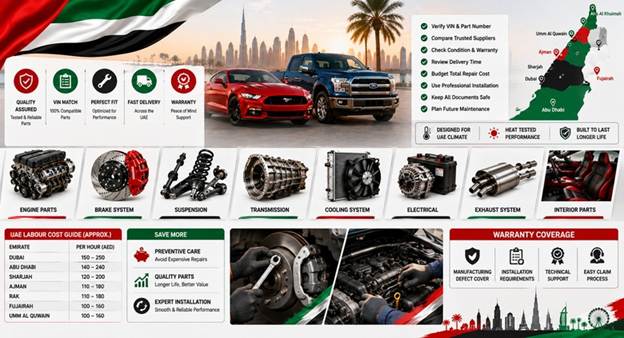
In the UAE, the air-conditioning system isn't a luxury.
It's essential.
Whether you're driving a Ford Mustang through Dubai traffic or using a Ford F-150 on long work journeys across Abu Dhabi, Sharjah or the Northern Emirates, the AC system operates for much of the year.
That continuous use naturally leads to wear.
Compressors work harder.
Condensers collect dust and debris.
Cooling fans operate almost constantly during summer.
Pressure sensors and expansion valves gradually age.
Ignoring early symptoms rarely makes repairs cheaper.
Weak cooling today can become complete system failure tomorrow.
Routine inspections and timely replacement of worn components help maintain cabin comfort while protecting the entire air-conditioning system.
Reliable cooling supports comfortable ownership.
Commonly Replaced AC Components:
| Component | Reason for Replacement |
| AC Compressor | Internal wear |
| Condenser | Stone damage and corrosion |
| Cooling Fan | Motor wear |
| Expansion Valve | Reduced cooling efficiency |
| Pressure Sensor | Electrical failure |
| Receiver Dryer | Moisture contamination |
Every component contributes to cooling performance.
AC Compressors
The compressor is the heart of the air-conditioning system.
Without it, refrigerant cannot circulate.
Continuous operation during UAE summers naturally places considerable pressure on compressor bearings, seals and internal mechanisms.
Common warning signs include unusual noises, weak cooling performance or intermittent operation.
Professional diagnosis is important because poor cooling isn't always caused by the compressor itself.
Low refrigerant, faulty sensors or cooling fan problems can produce similar symptoms.
Testing before replacement prevents unnecessary expense.
Diagnosis should always guide purchasing decisions.
Not assumptions.
Signs an AC Compressor May Need Replacing:
- Weak cooling.
- Grinding or rattling noises.
- Compressor clutch failure.
- Refrigerant leakage.
- Intermittent cooling.
- Increased engine load.
- AC warning faults.
- Poor cabin comfort.
Correct diagnosis protects your repair budget.
AC Compressor Comparison Matrix:
| Component | Recommended Buying Option |
| AC Compressor | Genuine, OEM or Professionally Tested |
| Compressor Clutch | Inspect |
| Compressor Pulley | Inspect |
| O-Rings | Replace |
| Refrigerant | Recharge After Installation |
| Drive Belt | Inspect |
Complete servicing improves long-term reliability.
Condensers and Cooling Fans
The condenser removes heat from the refrigerant before it returns to the passenger compartment.
The cooling fan assists that process, particularly during slow-moving traffic.
Dust, insects and road debris gradually reduce condenser efficiency.
Cooling fan motors eventually wear after years of continuous operation.
Professional workshops inspect both components together because they work as one system.
Replacing only one worn component may not restore full cooling performance if another part is already approaching the end of its service life.
A complete inspection provides the clearest answer.
Condenser and Fan Inspection Checklist:
- Inspect condenser fins.
- Check cooling fan operation.
- Remove debris.
- Inspect electrical connectors.
- Test fan motor.
- Check refrigerant pressures.
- Verify airflow.
- Replace damaged components promptly.
Efficient airflow supports efficient cooling.
Cooling System Matrix:
| Component | Inspection Priority |
| Condenser | High |
| Cooling Fan | High |
| Fan Motor | High |
| Electrical Wiring | Medium |
| Mounting Brackets | Medium |
| Refrigerant Pressure | High |
Healthy airflow improves cooling performance.
Radiators and Water Pumps
Although the radiator belongs to the engine cooling system rather than the air-conditioning system, both systems work closely together.
High engine temperatures directly affect air-conditioning performance.
The radiator dissipates engine heat while the water pump circulates coolant continuously.
Failure in either component places the entire vehicle under additional stress.
Professional workshops often inspect the cooling system whenever major AC repairs are carried out.
That practical approach identifies developing issues before they create overheating problems.
Comprehensive inspections reduce repeat workshop visits and improve long-term reliability.
Complete maintenance remains the most economical approach.
Cooling Components Commonly Replaced:
- Radiators.
- Water pumps.
- Coolant hoses.
- Thermostats.
- Expansion tanks.
- Radiator caps.
- Cooling fans.
- Temperature sensors.
Cooling systems work best together.
Cooling System Decision Matrix:
| Component | Recommended Buying Option |
| Radiator | Genuine or OEM |
| Water Pump | Genuine or OEM |
| Thermostat | New |
| Coolant Hose | New |
| Expansion Tank | Genuine |
| Temperature Sensor | OEM or Genuine |
Heat management protects the entire vehicle.
Thermostats and Coolant Hoses
A thermostat quietly regulates engine operating temperature.
Coolant hoses transport coolant throughout the engine.
Neither attracts much attention until a problem develops.
A sticking thermostat can cause overheating.
An ageing coolant hose may split without warning after years of exposure to extreme heat.
Routine inspections identify deterioration before complete failure occurs.
Professional workshops usually recommend replacing ageing hoses during major cooling system repairs because labour has already been invested.
Preventive replacement often costs significantly less than emergency roadside recovery.
Planning consistently creates better outcomes.
Cooling Hose Inspection Checklist:
- Check hose flexibility.
- Inspect for cracks.
- Examine hose clamps.
- Test thermostat operation.
- Check coolant condition.
- Inspect for leaks.
- Review service history.
- Replace ageing rubber components.
Rubber naturally ages in harsh climates.
Thermostat and Hose Matrix:
| Component | Replacement Recommendation |
| Thermostat | New |
| Upper Radiator Hose | New |
| Lower Radiator Hose | New |
| Hose Clamps | Replace if Required |
| Coolant | Renew |
| Pressure Test | Recommended |
Small cooling components protect major engines.
Complete Cooling System Maintenance
Maintaining the cooling system isn't about replacing parts unnecessarily.
It's about protecting expensive components before problems develop.
Professional workshops inspect coolant condition, radiator efficiency, water pump operation, thermostat function, hoses and cooling fans during routine servicing.
That comprehensive approach helps identify developing faults while repairs remain relatively inexpensive.
Waiting for overheating rarely produces good outcomes.
Regular inspections improve reliability, reduce long-term ownership costs and protect engine performance throughout the UAE's demanding climate.
Preventive maintenance always costs less than major engine repairs.
The cooling system deserves consistent attention.
Complete Cooling System Checklist:
- Inspect coolant condition.
- Pressure-test the system.
- Examine hoses.
- Test thermostat operation.
- Inspect radiator.
- Verify cooling fan performance.
- Check water pump.
- Replace worn components promptly.
Routine maintenance protects major investments.
Cooling System Maintenance Matrix:
| Maintenance Activity | Long-Term Benefit |
| Coolant Replacement | Prevents corrosion |
| Pressure Testing | Early leak detection |
| Radiator Inspection | Better cooling |
| Hose Replacement | Prevents breakdowns |
| Water Pump Inspection | Improved reliability |
| Professional Servicing | Lower ownership costs |
Preventive care protects both comfort and reliability.
Real UAE Workshop Case Study:
A Ford Mustang owner in Dubai noticed that the cabin took much longer to cool during afternoon traffic, while an F-150 owner in Abu Dhabi experienced occasional engine temperature increases when towing equipment in the summer. Comprehensive inspections identified a worn AC compressor clutch on the Mustang and an ageing radiator with deteriorated coolant hoses on the F-150. After verifying VIN compatibility and comparing supplier quotations, both owners selected quality replacement components backed by warranty documentation. The repairs restored efficient cooling performance, improved engine temperature control and reduced the likelihood of expensive future failures.
Small cooling problems became major repairs only because they were identified early.
Professional inspections made the difference.
Professional Buyer's Checklist:
- Verify the VIN before ordering.
- Match the correct Ford part number.
- Compare several trusted suppliers.
- Inspect the complete cooling system.
- Replace ageing hoses and seals during major repairs.
- Recharge refrigerant correctly after AC work.
- Keep maintenance documentation.
- Follow preventive service schedules.
Key Takeaways:
Air-conditioning compressors, condensers, cooling fans, radiators, water pumps, thermostats and coolant hoses are among the most commonly replaced components on Ford Mustang and F-150 models operating in the UAE. Buyers who maintain the complete cooling system, verify compatibility, choose quality replacement parts and address small faults before they become major failures consistently achieve better reliability, stronger cooling performance and lower long-term ownership costs.
Electrical Components That Frequently Fail
Modern Ford Mustang and Ford F-150 models depend on sophisticated electrical systems.
Every engine start.
Every dashboard warning.
Every power window.
Every lighting function.
Every driver assistance feature.
Behind each of these systems are electronic components working continuously.
Unlike mechanical parts, electrical failures often appear without obvious physical wear.
A warning light.
Intermittent starting.
Random electrical faults.
Battery drain.
These are usually the first signs.
Professional diagnosis becomes essential because several different components can produce similar symptoms.
Replacing parts without testing often increases repair costs unnecessarily.
Evidence should always guide electrical repairs.
Not assumptions.
Common Electrical Components Replaced:
| Component | Common Reason for Replacement |
| Alternator | Charging failure |
| Starter Motor | Internal wear |
| Battery | Reduced capacity |
| ECU Sensors | Electrical faults |
| Wiring Connectors | Heat and corrosion |
| Fuse Box Components | Electrical overload |
Accurate diagnosis saves both time and money.
Alternators
The alternator quietly powers the entire electrical system while keeping the battery charged.
When it begins to fail, the symptoms usually become noticeable quite quickly.
Battery warning lights.
Dim headlights.
Slow electrical accessories.
Starting difficulties.
Many owners immediately replace the battery.
Sometimes the battery isn't the problem.
Professional testing identifies whether the charging system is functioning correctly before replacement decisions are made.
That structured approach prevents unnecessary spending while ensuring the real fault is addressed.
Electrical testing always comes before ordering replacement components.
Signs of Alternator Failure:
- Battery warning light.
- Weak electrical performance.
- Flickering lights.
- Difficulty starting.
- Flat battery.
- Electrical warning messages.
- Charging voltage problems.
- Unusual alternator noises.
Diagnosis creates confident repairs.
Alternator Comparison Matrix:
| Component | Recommended Buying Option |
| Alternator | Genuine, OEM or Professionally Reconditioned |
| Drive Belt | Inspect |
| Belt Tensioner | Inspect |
| Battery | Test Before Replacement |
| Wiring | Inspect |
| Charging Test | Essential |
Healthy charging systems support reliable ownership.
Starter Motors
Few components work harder during short periods than the starter motor.
Every engine start depends on it.
Heat, repeated use and internal wear gradually reduce its effectiveness.
Typical warning signs include slow cranking, clicking sounds or complete failure to engage.
Before replacing the starter motor, experienced technicians test battery condition, charging voltage and electrical connections.
A weak battery can produce almost identical symptoms.
Professional diagnosis protects owners from replacing perfectly serviceable components.
Correct identification remains the foundation of every successful repair.
Starter Motor Inspection Checklist:
- Test battery voltage.
- Inspect electrical connections.
- Measure charging system output.
- Listen for starter engagement.
- Examine wiring.
- Inspect mounting bolts.
- Verify ignition switch operation.
- Replace confirmed faulty components.
Every successful repair begins with testing.
Starter System Matrix:
| Component | Inspection Priority |
| Starter Motor | High |
| Battery | High |
| Alternator | High |
| Wiring | Medium |
| Ignition Switch | Medium |
| Ground Connections | High |
Electrical systems work together.
Batteries
High temperatures shorten battery life.
That's particularly true in the UAE.
Continuous heat accelerates internal chemical ageing, making regular battery testing an important part of vehicle maintenance.
Most battery failures provide warning.
Slower engine cranking.
Reduced electrical performance.
Dashboard warning messages.
Professional battery testing identifies remaining capacity before complete failure occurs.
Replacing the battery proactively reduces the risk of inconvenient breakdowns while protecting other electrical components from unstable voltage.
Simple maintenance prevents significant disruption.
Battery Maintenance Checklist:
- Test battery capacity.
- Inspect terminal connections.
- Clean corrosion.
- Check charging voltage.
- Secure battery mounting.
- Inspect cables.
- Review service history.
- Replace ageing batteries promptly.
Reliable starts begin with healthy batteries.
Battery Decision Matrix:
| Battery Condition | Recommended Action |
| Strong Test Result | Continue Monitoring |
| Reduced Capacity | Plan Replacement |
| Weak Voltage | Replace |
| Terminal Corrosion | Clean and Inspect |
| Charging Fault | Diagnose Alternator |
| Battery Drain | Complete Electrical Diagnosis |
Heat accelerates battery ageing.
Sensors and Electronic Modules
Modern Ford vehicles contain dozens of sensors.
Each performs a specific task.
Monitoring temperature.
Fuel mixture.
Airflow.
Wheel speed.
Engine timing.
Transmission operation.
Electronic control modules process this information thousands of times every minute.
When one sensor begins to fail, warning lights or unusual vehicle behaviour often appear.
Replacing the correct component depends entirely on accurate diagnostic testing.
Fault codes provide valuable clues.
They do not automatically identify the failed component.
Professional interpretation remains essential.
Diagnosis should always precede replacement.
Commonly Replaced Sensors:
- Oxygen sensors.
- Mass airflow sensors.
- Crankshaft sensors.
- Camshaft sensors.
- Coolant temperature sensors.
- Wheel speed sensors.
- Throttle position sensors.
- Knock sensors.
Modern vehicles depend on accurate information.
Sensor Comparison Matrix:
| Sensor | Function |
| Oxygen Sensor | Fuel mixture monitoring |
| Mass Airflow Sensor | Air intake measurement |
| Coolant Sensor | Temperature monitoring |
| Crankshaft Sensor | Engine timing |
| Wheel Speed Sensor | ABS operation |
| Throttle Position Sensor | Throttle control |
Good data creates smooth performance.
Lighting Components
Lighting performs two equally important functions.
Helping the driver see.
Helping other road users see the vehicle.
Headlights.
Tail lights.
Brake lights.
Fog lamps.
Daytime running lights.
LED modules.
These components gradually age through vibration, heat and everyday use.
Modern lighting assemblies may also contain electronic control units that require precise compatibility.
When purchasing replacements online, always verify the VIN and Ford part number.
Appearance alone isn't enough.
Different production years often use different electrical configurations.
Compatibility should always be confirmed before ordering.
Lighting Inspection Checklist:
- Check headlight operation.
- Test brake lights.
- Inspect indicators.
- Examine mounting points.
- Verify LED functions.
- Inspect wiring.
- Confirm moisture-free lenses.
- Match the correct part number.
Visibility begins before the journey starts.
Lighting Buying Matrix:
| Component | Recommended Buying Option |
| LED Headlight | Genuine |
| Halogen Headlight | Genuine or OEM |
| Tail Light | Genuine Used or OEM |
| Fog Lamp | OEM |
| Daytime Running Light | Genuine |
| Wiring Harness | Genuine |
Reliable lighting supports safer driving.
Real UAE Workshop Case Study:
A Ford Mustang owner in Sharjah experienced intermittent battery warning lights, while an F-150 owner in Dubai complained of occasional starting problems after long working days. Initial assumptions suggested battery replacement in both vehicles. Instead, the workshop completed full electrical diagnostics. The Mustang required a replacement alternator after charging tests confirmed inconsistent output, while the F-150 only needed a new battery and cleaned ground connections. By diagnosing before ordering parts, both owners avoided unnecessary replacements, reduced repair costs and restored dependable electrical performance.
The correct diagnosis proved far more valuable than the first assumption.
Professional Buyer's Checklist:
- Verify the VIN before ordering.
- Match the correct Ford part number.
- Complete professional diagnostic testing.
- Compare several trusted suppliers.
- Request warranty documentation.
- Test related electrical components before replacement.
- Keep complete service records.
- Follow preventive battery and charging system inspections.
Key Takeaways:
Alternators, starter motors, batteries, sensors, electronic modules and lighting components are among the most frequently replaced electrical parts on Ford Mustang and F-150 models in the UAE. Buyers who prioritise professional diagnosis, verify compatibility, compare quality replacement options and maintain organised service records consistently achieve greater reliability, lower repair costs and improved long-term ownership confidence.
Interior Parts Owners Replace Most
The interior of a Ford Mustang or Ford F-150 experiences constant daily use.
Doors open and close thousands of times.
Buttons are pressed repeatedly.
Seats support countless journeys.
Touchscreens operate every day.
Although these components don't directly affect engine performance, they influence comfort, convenience and overall ownership satisfaction.
Heat, sunlight and regular use gradually wear interior materials throughout the UAE.
Plastic trim becomes brittle.
Switches lose responsiveness.
Seat mechanisms begin to wear.
Fortunately, many of these components can be replaced individually without requiring major repairs.
Choosing quality replacement parts helps maintain the original driving experience while protecting long-term resale value.
Comfort remains an important part of ownership.
Frequently Replaced Interior Components:
| Component | Common Reason for Replacement |
| Dashboard Trim | Heat and UV exposure |
| Window Switches | Daily use |
| Door Handles | Mechanical wear |
| Centre Console | Cosmetic wear |
| Steering Wheel Controls | Frequent operation |
| Interior Panels | Age and damage |
A well-maintained cabin improves everyday driving.
Dashboard Components
The dashboard is exposed to sunlight more than almost any other interior surface.
In the UAE, prolonged UV exposure and high cabin temperatures gradually affect plastics, clips, trim panels and electronic displays.
Small cracks.
Loose trim.
Faded surfaces.
These issues develop slowly.
When replacing dashboard components, matching colour, specification and production year becomes important.
Many interior parts appear identical while using different mounting systems or electrical connectors.
VIN verification remains valuable even for cosmetic components.
Accuracy always simplifies installation.
Factory fitment preserves original appearance.
Dashboard Replacement Checklist:
- Verify VIN compatibility.
- Match trim colour.
- Inspect mounting clips.
- Check electronic connectors.
- Compare production year.
- Inspect dashboard vents.
- Review photographs carefully.
- Confirm complete assembly.
Small details produce factory-quality repairs.
Dashboard Comparison Matrix:
| Component | Recommended Buying Option |
| Dashboard Panel | Genuine Used |
| Instrument Cluster | Genuine |
| Dashboard Vents | Genuine Used |
| Dashboard Trim | Genuine Used |
| Mounting Clips | New |
| Electronic Display | Genuine |
Correct fitment preserves cabin quality.
Infotainment Systems
Modern infotainment systems combine navigation, entertainment, connectivity and vehicle settings within one integrated unit.
As technology advances, these systems become increasingly sophisticated.
Replacement therefore requires careful compatibility checks.
Software versions.
Screen size.
Electrical connectors.
Programming requirements.
Each should be confirmed before purchasing.
Professional installation may also be necessary when replacing advanced multimedia systems.
Choosing the correct unit the first time avoids unnecessary programming delays and additional workshop costs.
Technology rewards careful planning.
Common Infotainment Components:
- Touchscreen displays.
- Navigation units.
- Audio amplifiers.
- USB modules.
- Bluetooth modules.
- Display control panels.
- Media interfaces.
- Steering wheel controls.
Modern electronics require accurate compatibility.
Infotainment Matrix:
| Component | Buying Recommendation |
|---|---|
| Display Screen | Genuine |
| Navigation Unit | VIN-Matched Genuine |
| Audio Module | Genuine or OEM |
| USB Module | OEM |
| Steering Controls | Genuine |
| Display Controller | Genuine |
Compatibility matters more than appearance.
Window Switches and Door Controls
Window switches rarely attract attention until they stop working.
The same applies to mirror controls, central locking switches and seat adjustment buttons.
Daily operation naturally creates wear.
Fortunately, these components are generally straightforward to replace once the correct part has been identified.
Electrical connectors should always match.
Switch layouts can differ between production years and trim levels.
Professional suppliers usually request VIN details before confirming compatibility.
That simple step helps prevent unnecessary returns.
Correct identification always saves time.
Frequently Replaced Door Components:
- Window switches.
- Mirror controls.
- Door lock switches.
- Door handles.
- Power window motors.
- Door control modules.
- Door wiring connectors.
- Interior door trims.
Small switches influence everyday convenience.
Door Control Matrix:
| Component | Recommended Option |
| Window Switch | Genuine or OEM |
| Mirror Switch | Genuine |
| Door Handle | Genuine Used |
| Window Motor | OEM or Genuine |
| Door Module | VIN-Matched Genuine |
| Door Trim | Genuine Used |
Everyday reliability depends on quality components.
Seat Components
Seats endure constant movement throughout the vehicle's life.
Adjustment mechanisms.
Seat rails.
Foam cushions.
Leather or fabric coverings.
Heating elements.
Electrical motors.
Each component gradually experiences wear.
Performance-oriented Mustang seats and heavy-duty F-150 seating systems naturally age differently depending on usage.
Replacing individual seat components often restores comfort without replacing the complete seat assembly.
Professional inspection helps identify whether repairs or complete replacement provide better long-term value.
Comfort deserves careful attention.
Especially during long journeys.
Seat Inspection Checklist:
- Inspect seat rails.
- Test adjustment motors.
- Check seat controls.
- Examine upholstery.
- Inspect heating elements.
- Review mounting points.
- Verify airbag connectors.
- Confirm compatibility.
Safe seating combines comfort with security.
Seat Comparison Matrix:
| Component | Recommended Buying Option |
| Seat Assembly | Professionally Inspected Genuine Used |
| Seat Rail | Genuine |
| Adjustment Motor | OEM |
| Seat Cushion | Genuine Used |
| Upholstery | Genuine Used |
| Seat Controls | Genuine |
Proper seating improves every drive.
Steering Wheel and Trim Components
The steering wheel remains in constant contact with the driver.
Buttons wear.
Leather surfaces age.
Control switches gradually lose responsiveness.
Trim pieces become scratched through everyday use.
Replacing these components restores both appearance and functionality.
Because many steering wheels contain airbags and integrated controls, compatibility must always be verified carefully.
Professional installation is recommended whenever airbag systems are involved.
Safety always takes priority over convenience.
Correct installation protects both the driver and the vehicle.
Steering Wheel Components:
- Steering wheel trim.
- Multifunction switches.
- Paddle shifters (Mustang models).
- Airbag modules.
- Steering wheel controls.
- Decorative trim panels.
- Horn switch.
- Wiring connectors.
Every control should operate exactly as intended.
Steering Wheel Matrix:
| Component | Recommendation |
| Steering Wheel | Genuine Used |
| Airbag Module | Genuine |
| Multifunction Controls | Genuine |
| Trim Panel | Genuine Used |
| Wiring | Genuine |
| Installation | Professional |
Safety and compatibility always come first.
Real UAE Workshop Case Study:
A Ford Mustang owner in Dubai wanted to restore a worn interior before selling the vehicle, while an F-150 owner in Abu Dhabi required replacement window switches and a damaged driver's seat adjustment motor after years of commercial use. After verifying the VIN for both vehicles, the workshop compared several online suppliers offering genuine used interior components and OEM electrical replacements. The Mustang received a matching steering wheel trim and centre console, while the F-150 had new window controls and a replacement seat motor installed. Both interiors regained their original functionality and appearance, increasing owner satisfaction and improving resale presentation.
Attention to interior details enhanced the overall ownership experience.
Not just the vehicle's appearance.
Professional Buyer's Checklist:
- Verify the VIN before ordering.
- Match interior colour and trim specification.
- Compare several trusted suppliers.
- Confirm electrical connector compatibility.
- Request photographs of used interior parts.
- Use professional installation for airbag-related components.
- Keep purchase and service documentation.
- Protect interior components from excessive UV exposure.
Key Takeaways:
Dashboard components, infotainment systems, window switches, seat assemblies, steering wheel controls and interior trim are among the most commonly replaced parts on Ford Mustang and F-150 models in the UAE. Buyers who verify compatibility, choose quality replacement components and protect their interiors from harsh environmental conditions consistently enjoy greater comfort, improved reliability, stronger resale value and a more satisfying ownership experience.
Exterior Body Parts Commonly Replaced
The exterior of a Ford Mustang or Ford F-150 faces constant exposure to the environment.
High temperatures.
Intense sunlight.
Motorway debris.
Parking incidents.
Construction sites.
Off-road driving.
Even careful owners eventually need to replace exterior body components.
Unlike mechanical repairs, body repairs combine appearance with functionality.
Correct fitment matters.
Paint preparation matters.
Panel alignment matters.
Choosing the right replacement part helps restore both the vehicle's appearance and its structural integrity.
Professionally inspected genuine used body panels often provide excellent value because they retain original factory dimensions.
Quality body repairs protect both appearance and resale value.
Most Frequently Replaced Exterior Components:
| Component | Common Reason for Replacement |
| Front Bumper | Minor collisions |
| Rear Bumper | Parking damage |
| Bonnet | Accident damage |
| Doors | Side impacts |
| Front Wings | Road damage |
| Tailgate | Commercial use and accidents |
Factory fitment simplifies professional repairs.
Front Bumpers
The front bumper is one of the first components to absorb minor impacts.
Parking manoeuvres.
Low-speed collisions.
Road debris.
These everyday events often result in scratches, cracks or broken mounting points.
For Mustang owners, maintaining the original appearance is particularly important.
F-150 owners frequently prioritise durability because of demanding working environments.
When purchasing a replacement bumper online, inspect mounting tabs, sensor compatibility and trim specifications carefully.
Not every bumper fits every production year.
VIN verification remains essential.
Correct fitment reduces installation time and paint preparation.
Front Bumper Buying Checklist:
- Verify VIN compatibility.
- Match trim specification.
- Inspect mounting tabs.
- Confirm sensor compatibility.
- Review photographs carefully.
- Check previous repairs.
- Compare several suppliers.
- Confirm paint preparation requirements.
Quality fitment creates quality repairs.
Front Bumper Matrix:
| Component | Recommended Buying Option |
| Front Bumper | Genuine Used |
| Reinforcement Bar | Genuine |
| Mounting Brackets | Genuine |
| Parking Sensors | Reuse or Genuine |
| Lower Grille | Genuine Used |
| Fasteners | New |
Factory alignment improves overall repair quality.
Rear Bumpers
Rear bumpers protect the vehicle during loading, reversing and everyday driving.
The F-150 often experiences greater rear bumper wear because of towing equipment and commercial use.
Mustang owners are more likely to encounter cosmetic damage caused by parking incidents.
Before purchasing a replacement bumper, inspect towing attachment points where applicable, mounting brackets and sensor openings.
Minor cosmetic imperfections are often manageable.
Structural damage should never be ignored.
Professional inspection provides valuable reassurance before purchase.
Strength remains just as important as appearance.
Rear Bumper Inspection Checklist:
- Inspect mounting points.
- Check parking sensor openings.
- Review towing attachment areas.
- Examine previous repairs.
- Confirm trim compatibility.
- Inspect reinforcement bar.
- Verify paint condition.
- Compare supplier documentation.
Every detail contributes to a better repair.
Rear Bumper Comparison Matrix:
| Component | Buying Recommendation |
| Rear Bumper | Genuine Used |
| Reinforcement | Genuine |
| Parking Sensor Housing | Genuine |
| Tow Hitch Cover | Genuine |
| Mounting Hardware | New |
| Rear Reflectors | Genuine Used |
Professional preparation supports professional results.
Bonnets and Tailgates
Bonnets and tailgates are large structural panels requiring accurate alignment during installation.
A poorly aligned bonnet may affect panel gaps, safety latches and overall appearance.
Tailgates on F-150 models often experience additional wear because of loading equipment and commercial use.
Professionally inspected genuine used panels frequently provide the best combination of factory fitment and value.
Before ordering, request photographs showing hinge areas, latch mounts and structural edges.
Surface scratches can usually be repaired.
Structural distortion cannot.
Fitment should always take priority.
Common Bonnet and Tailgate Issues:
- Panel dents.
- Hinge wear.
- Latch damage.
- Corrosion.
- Paint scratches.
- Misalignment.
- Structural impact damage.
- Previous repairs.
Correct alignment restores factory appearance.
Bonnet and Tailgate Matrix:
| Component | Recommended Option |
| Bonnet | Genuine Used |
| Tailgate | Genuine Used |
| Hinges | Inspect |
| Latch Assembly | Genuine |
| Gas Struts | Replace if Required |
| Mounting Bolts | Inspect |
Factory dimensions reduce installation complications.
Headlights and Tail Lights
Lighting assemblies perform both safety and cosmetic functions.
Modern Mustang and F-150 models often feature advanced LED technology, daytime running lights and integrated electronic modules.
Replacing these assemblies requires more than matching appearance.
Electrical compatibility must also be confirmed.
Different production years frequently use different control systems.
Moisture inside the lens, broken mounting points or damaged wiring should always be checked before purchase.
Professionally inspected lighting assemblies provide greater confidence than components with unknown history.
Visibility begins with reliable lighting.
Lighting Components Commonly Replaced:
- LED headlights.
- Halogen headlights.
- Tail lights.
- Daytime running lights.
- Fog lamps.
- Side indicators.
- Reflectors.
- Wiring connectors.
Good visibility improves road safety.
Lighting Decision Matrix:
| Component | Recommended Buying Option |
| LED Headlight | Genuine |
| Halogen Headlight | Genuine or OEM |
| Tail Light | Genuine Used |
| Fog Lamp | OEM |
| Reflector | Genuine Used |
| Wiring | Genuine |
Compatibility matters as much as clarity.
Mirrors and Grilles
Door mirrors perform more than one function.
Many now include heating elements, cameras, blind-spot monitoring and power adjustment motors.
Grilles also vary significantly between trim levels and production years.
Replacing either component requires careful specification matching.
Appearance alone rarely guarantees compatibility.
Professional suppliers normally request VIN details before recommending replacements.
That process protects buyers from ordering incorrect components.
Good preparation reduces unnecessary returns while preserving factory appearance.
Small exterior details make a noticeable difference.
Mirror and Grille Checklist:
- Verify VIN compatibility.
- Match trim specification.
- Confirm camera compatibility.
- Test mirror functions.
- Inspect mounting points.
- Compare grille design.
- Review photographs.
- Request warranty details.
Correct specification ensures smoother installation.
Mirror and Grille Matrix:
| Component | Recommendation |
| Door Mirror | Genuine Used or Genuine |
| Mirror Glass | OEM |
| Mirror Motor | Genuine |
| Front Grille | Genuine Used |
| Camera Module | Genuine |
| Mounting Hardware | New |
Attention to detail preserves original quality.
Real UAE Workshop Case Study:
A Ford Mustang owner in Sharjah required a replacement front bumper and left LED headlight after a low-speed collision, while an F-150 owner in Dubai needed a new tailgate following years of commercial loading. The workshop compared several online suppliers after verifying both VIN numbers and confirmed factory specifications before ordering. Genuine used body panels and lighting assemblies were selected because they offered original fitment with warranty support. Installation required minimal adjustment, paint preparation was simplified and both vehicles regained their factory appearance without compatibility issues.
Choosing correctly matched body panels saved both labour time and future adjustment work.
Professional Buyer's Checklist:
- Verify the VIN before ordering.
- Match the correct Ford part number.
- Compare several trusted suppliers.
- Inspect structural condition carefully.
- Request detailed photographs.
- Confirm electronic compatibility for lighting and mirrors.
- Use professional body repair specialists.
- Keep complete purchase and repair documentation.
Key Takeaways:
Front bumpers, rear bumpers, bonnets, tailgates, headlights, tail lights, mirrors and grilles are among the most commonly replaced exterior components on Ford Mustang and F-150 models throughout the UAE. Buyers who prioritise factory fitment, verify compatibility, inspect structural condition and choose quality replacement parts consistently achieve better repair quality, stronger resale value and a more original vehicle appearance.
Performance Parts Mustang Owners Upgrade
The Ford Mustang has always attracted enthusiasts who appreciate performance.
While routine maintenance remains the foundation of reliability, many owners also choose to upgrade selected components to enhance driving response.
These upgrades should never compromise reliability.
Instead, they should complement the vehicle's original engineering.
Performance air intake systems.
Cat-back exhaust systems.
Performance brake kits.
Upgraded suspension components.
Lightweight alloy wheels.
These are among the most common improvements.
Before purchasing any performance component, confirm compatibility with your specific Mustang model and engine specification.
A carefully selected upgrade delivers measurable benefits.
An unsuitable one can create unnecessary complications.
Balance always produces the best results.
Popular Mustang Performance Upgrades:
| Component | Primary Benefit |
| Performance Air Intake | Improved airflow |
| Cat-Back Exhaust | Better exhaust flow |
| Performance Brake Kit | Improved stopping power |
| Sport Suspension | Sharper handling |
| Lightweight Alloy Wheels | Reduced unsprung weight |
| Performance Tyres | Better grip |
Quality upgrades should improve both performance and confidence.
Heavy-Duty Parts F-150 Owners Upgrade
The priorities of F-150 owners are often different.
Rather than increasing outright performance, many upgrades focus on durability, towing capability and long-term reliability.
Heavy-duty suspension components.
Improved cooling systems.
Reinforced brake components.
Upgraded tow hitches.
Heavy-duty leaf springs.
Additional transmission cooling.
These modifications help the vehicle cope with demanding commercial or recreational use.
Every upgrade should be selected according to the vehicle's actual workload.
Overspecification isn't always beneficial.
Purpose-driven upgrades consistently deliver the greatest long-term value.
Popular F-150 Heavy-Duty Upgrades:
- Heavy-duty shock absorbers.
- Reinforced leaf springs.
- Larger transmission coolers.
- Heavy-duty brake components.
- Upgraded towing equipment.
- Off-road suspension kits.
- All-terrain tyres.
- Heavy-duty skid plates.
Working vehicles benefit from practical improvements.
Heavy-Duty Upgrade Matrix:
| Upgrade | Primary Advantage |
| Heavy-Duty Suspension | Better load handling |
| Transmission Cooler | Improved temperature control |
| Tow Hitch | Greater towing confidence |
| Brake Upgrade | Better stopping performance |
| Skid Plate | Underside protection |
| All-Terrain Tyres | Improved traction |
Choose upgrades that match real-world use.
Turbocharger Components
Turbocharged EcoBoost engines combine efficiency with impressive performance.
The turbocharger itself operates at extremely high temperatures and rotational speeds.
Regular oil changes and proper maintenance play a significant role in extending its service life.
Common replacement components include turbochargers, wastegate actuators, boost control solenoids, oil feed pipes and intercooler hoses.
Before purchasing online, request operational testing information where applicable.
Inspect supporting components as well.
Replacing a worn turbocharger without addressing contaminated oil lines or damaged hoses may reduce the lifespan of the new component.
Complete repairs consistently produce better results.
Turbocharger Components Commonly Replaced:
- Turbocharger assembly.
- Wastegate actuator.
- Boost control solenoid.
- Oil feed line.
- Oil return pipe.
- Intercooler hoses.
- Turbo gaskets.
- Boost pressure sensor.
Turbocharged engines reward careful maintenance.
Turbocharger Matrix:
| Component | Recommended Buying Option |
| Turbocharger | Professionally Tested Genuine Used or Genuine |
| Wastegate | Genuine |
| Oil Lines | New |
| Gaskets | New |
| Sensors | OEM or Genuine |
| Intercooler Hose | OEM |
Supporting components matter just as much.
Exhaust System Parts
The exhaust system performs several important functions.
It manages emissions.
Controls noise.
Supports engine performance.
Protects passenger comfort.
Heat, vibration and road conditions gradually affect exhaust components over time.
Common replacements include catalytic converters, silencers, resonators, exhaust pipes and mounting brackets.
Performance-oriented Mustang owners sometimes choose upgraded cat-back systems, while F-150 owners often prioritise durability and corrosion resistance.
Whatever the objective, compatibility should always come before appearance.
Professional installation helps prevent leaks and alignment problems.
Common Exhaust Components:
- Catalytic converter.
- Centre silencer.
- Rear silencer.
- Exhaust pipes.
- Mounting rubbers.
- Exhaust clamps.
- Oxygen sensor mounts.
- Heat shields.
A healthy exhaust supports efficient engine operation.
Exhaust Decision Matrix:
| Component | Buying Recommendation |
| Catalytic Converter | Genuine or OEM |
| Silencer | OEM |
| Exhaust Pipe | Genuine or OEM |
| Mounting Rubbers | New |
| Exhaust Clamps | New |
| Heat Shield | Genuine Used |
Correct fitment reduces future vibration.
Fuel System Components
The fuel system quietly delivers consistent engine performance.
Over time, filters become restricted.
Injectors accumulate deposits.
Fuel pumps gradually wear.
Pressure regulators age.
High-quality fuel and regular maintenance help extend component life, but eventual replacement remains normal.
Professional diagnosis is especially important because fuel system faults often resemble ignition or sensor problems.
Testing should always come before purchasing replacement components.
Evidence creates accurate repairs.
Guesswork increases unnecessary expense.
Fuel System Components Commonly Replaced:
- Fuel pump.
- Fuel injectors.
- Fuel filter.
- Pressure regulator.
- Fuel rail.
- Fuel pressure sensor.
- Fuel lines.
- Injector seals.
Clean fuel supports dependable performance.
Fuel System Matrix:
| Component | Inspection Priority |
| Fuel Pump | High |
| Fuel Filter | High |
| Fuel Injectors | Medium |
| Pressure Sensor | Medium |
| Fuel Lines | Medium |
| Injector Seals | High |
Preventive servicing protects engine performance.
Engine Mounts and Transmission Mounts
Engine and transmission mounts perform a surprisingly important role.
They absorb vibration while securing major mechanical assemblies.
Heat, age and continuous movement gradually weaken the rubber inside the mounts.
Typical symptoms include excessive vibration, clunking noises during acceleration or noticeable engine movement.
Replacing worn mounts restores refinement while reducing unnecessary stress on surrounding drivetrain components.
Professional workshops often inspect engine and transmission mounts whenever major mechanical repairs are carried out.
The components are already accessible.
Taking advantage of that opportunity often reduces future labour costs.
Mount Inspection Checklist:
- Check rubber condition.
- Inspect mounting brackets.
- Look for fluid-filled mount leakage.
- Test engine movement.
- Inspect transmission movement.
- Review vibration levels.
- Replace worn mounts promptly.
- Inspect surrounding fasteners.
Stable mounting protects the entire drivetrain.
Mount Comparison Matrix:
| Component | Recommended Buying Option |
| Engine Mount | Genuine or OEM |
| Transmission Mount | Genuine or OEM |
| Mounting Bolts | Replace if Required |
| Brackets | Inspect |
| Heat Shields | Inspect |
| Installation | Professional |
Small components deliver significant improvements in refinement.
Real UAE Workshop Case Study:
A Ford Mustang EcoBoost owner in Dubai wanted to improve throttle response while maintaining factory reliability, whereas an F-150 owner in Abu Dhabi required upgrades to support regular trailer towing. After reviewing the vehicles' intended use, the workshop recommended a performance air intake and premium brake upgrade for the Mustang, together with a larger transmission cooler and reinforced rear suspension components for the F-150. Every component was selected after verifying VIN compatibility and comparing several supplier options. Both vehicles achieved noticeable improvements without compromising long-term reliability or everyday usability.
The most successful upgrades were those chosen for genuine driving needs.
Not simply for appearance.
Professional Buyer's Checklist:
- Verify the VIN before ordering.
- Match the correct Ford part number.
- Choose upgrades that suit actual vehicle use.
- Compare several trusted suppliers.
- Replace supporting components where appropriate.
- Use professional installation.
- Keep upgrade documentation.
- Maintain scheduled servicing after modifications.
Key Takeaways:
Performance upgrades for the Ford Mustang and heavy-duty improvements for the Ford F-150 should always enhance reliability as well as capability. Turbocharger components, exhaust systems, fuel system parts, engine mounts and transmission mounts all require careful compatibility checks before purchase. Buyers who plan upgrades according to genuine driving requirements, select quality components and maintain professional installation consistently achieve stronger performance, improved durability and better long-term ownership value throughout the UAE.
How to Identify Worn Ford Parts
Vehicle components rarely fail without warning.
Most wear develops gradually.
A small vibration becomes more noticeable.
A faint noise becomes louder.
A dashboard warning appears more frequently.
Recognising these early changes is one of the most effective ways to reduce long-term ownership costs.
Both the Ford Mustang and Ford F-150 communicate developing problems long before complete failure occurs.
The challenge is knowing which warning signs deserve immediate attention.
Professional workshops rely on routine inspections because they identify worn components before they affect surrounding systems.
Owners who adopt the same habit consistently avoid more expensive repairs.
Early action protects the entire vehicle.
Early Signs of Component Wear:
| Symptom | Possible Cause |
| Unusual vibration | Suspension or drivetrain wear |
| Knocking noises | Steering or suspension components |
| Fluid leaks | Seals or gaskets |
| Warning lights | Electrical or sensor faults |
| Poor braking | Brake wear |
| Reduced performance | Engine or fuel system issues |
Every unusual symptom deserves investigation.
Warning Signs Before Parts Fail
A vehicle usually provides several warnings before a major component reaches the end of its service life.
The important step is responding promptly.
Ignoring unusual noises, vibrations or warning lights often allows minor faults to develop into larger repairs.
Listen carefully.
Observe changes.
Pay attention to how the vehicle feels during everyday driving.
Professional diagnosis remains the safest way to identify the exact cause.
Symptoms often overlap.
A vibration doesn't automatically indicate a suspension problem.
Electrical faults can resemble battery failure.
Evidence always comes before replacement.
Common Warning Signs:
- Engine warning light.
- ABS warning light.
- Battery warning light.
- Steering vibration.
- Unusual suspension noise.
- Poor cooling performance.
- Delayed gear changes.
- Increased fuel consumption.
Early diagnosis protects larger components.
Warning Sign Matrix:
| Warning | Inspection Priority |
| Engine Warning Light | Immediate |
| Brake Warning | Immediate |
| Cooling Issues | High |
| Steering Noise | High |
| Suspension Noise | High |
| Battery Warning | High |
Ignoring small warnings often creates larger problems.
Repair vs Replacement Decision Guide
Not every damaged component requires replacement.
Sometimes professional repair restores full functionality.
Other times replacement provides better long-term reliability and lower overall ownership costs.
The decision depends on several important factors.
Age.
Condition.
Labour costs.
Availability.
Expected service life.
Safety considerations.
Professional workshops evaluate every repair individually rather than following one universal rule.
Owners benefit from adopting the same approach.
Balanced decisions consistently produce better financial outcomes.
Every repair deserves objective evaluation.
Questions Before Choosing Repair or Replacement:
- Is the component structurally sound?
- Will the repair provide long-term reliability?
- How much labour is involved?
- Is a replacement readily available?
- Does warranty coverage differ?
- Will future maintenance costs increase?
- What do professional inspections recommend?
- Which option offers better value?
Long-term thinking creates smarter ownership.
Repair vs Replacement Matrix:
| Situation | Recommended Action |
| Minor Cosmetic Damage | Repair |
| Major Structural Damage | Replace |
| Worn Mechanical Components | Replace |
| Small Electrical Fault | Diagnose First |
| Safety-Critical Damage | Replace |
| Routine Wear Components | Replace |
Good decisions balance cost with reliability.
Hidden Repair Costs
The advertised price of a replacement part rarely reflects the complete repair cost.
Supporting components.
Fluids.
Programming.
Labour.
Wheel alignment.
These additional items frequently influence the final invoice.
Professional workshops calculate the complete project before ordering replacement parts.
That structured approach helps owners budget realistically while reducing unexpected expenses.
Major repairs should always be evaluated as complete projects rather than individual purchases.
Planning improves financial control.
Comprehensive budgeting protects ownership costs.
Common Hidden Costs:
- Labour.
- Programming.
- Replacement fluids.
- Supporting components.
- Wheel alignment.
- Delivery charges.
- Diagnostic testing.
- Workshop consumables.
The complete repair matters more than the individual part.
Hidden Cost Matrix:
| Cost Item | Importance |
| Labour | Essential |
| Programming | High |
| Fluids | High |
| Supporting Parts | High |
| Alignment | Medium |
| Diagnostics | High |
Accurate budgeting prevents surprises.
Labour Costs Across UAE
Labour requirements vary according to the complexity of the repair rather than the replacement part itself.
Replacing brake pads differs significantly from installing a replacement engine or automatic gearbox.
Professional workshops normally provide written quotations explaining labour activities in detail.
Diagnosis.
Component removal.
Installation.
Programming.
Road testing.
Final inspection.
Understanding exactly what is included allows buyers to compare quotations more effectively.
Transparent communication builds confidence.
The strongest quotation isn't always the cheapest.
It's the most complete.
Professional Labour Checklist:
- Written quotation.
- Clear labour breakdown.
- Diagnostic testing.
- Programming where required.
- Fluid replacement.
- Road testing.
- Final inspection.
- Warranty explanation.
Professional workmanship protects quality components.
Labour Comparison Matrix:
| Repair Type | Labour Complexity |
| Engine Replacement | Very High |
| Gearbox Replacement | High |
| Suspension Repair | Medium |
| Brake Service | Medium |
| Electrical Diagnosis | Medium |
| Routine Servicing | Low |
Experience often reduces long-term ownership costs.
First-Year Ownership Costs After Repairs
Collecting the vehicle from the workshop isn't the end of the repair.
It's the beginning of the next stage of ownership.
Replacement engines require careful monitoring.
Gearboxes benefit from follow-up inspections.
Cooling systems should be checked for leaks.
Suspension repairs deserve alignment reviews.
Following workshop recommendations during the first year helps protect newly installed components while identifying any developing issues early.
Preventive follow-up rarely costs much.
Ignoring minor concerns often does.
Successful ownership continues long after installation.
Maintenance protects every investment.
First-Year Maintenance Checklist:
- Monitor fluid levels.
- Check for leaks.
- Inspect warning lights.
- Follow service schedules.
- Review tyre wear.
- Schedule follow-up inspections.
- Keep maintenance records.
- Retain warranty documentation.
Ongoing care protects major repairs.
First-Year Ownership Matrix:
| Maintenance Activity | Long-Term Benefit |
| Fluid Monitoring | Component protection |
| Scheduled Inspection | Early fault detection |
| Wheel Alignment | Better tyre life |
| Service Documentation | Improved resale value |
| Prompt Diagnostics | Lower repair costs |
| Preventive Maintenance | Greater reliability |
Every inspection adds confidence.
Real UAE Workshop Case Study:
A Ford Mustang owner in Abu Dhabi reported a slight vibration during motorway driving, while an F-150 owner in Dubai noticed occasional steering noise after carrying heavy construction equipment for several months. Rather than replacing suspension components immediately, the workshop carried out a complete inspection. The Mustang only required wheel balancing and new front tyres, while the F-150 needed replacement ball joints and a wheel alignment before additional steering damage developed. Early diagnosis prevented unnecessary spending for one owner and avoided a much larger repair for the other.
Correct diagnosis protected both vehicles and both repair budgets.
Professional Buyer's Checklist:
- Investigate unusual symptoms immediately.
- Verify the VIN before ordering.
- Match the correct Ford part number.
- Compare several trusted suppliers.
- Budget for complete repair costs.
- Request written workshop quotations.
- Follow first-year maintenance recommendations.
- Keep complete service documentation.
Key Takeaways:
Identifying worn Ford parts early remains one of the most effective ways to reduce long-term ownership costs. Buyers who recognise warning signs, choose professional diagnosis, compare complete repair quotations and follow preventive maintenance schedules consistently achieve greater reliability, lower repair costs and stronger ownership confidence for both the Ford Mustang and Ford F-150 throughout the UAE.
How to Verify Compatibility Before Ordering
Ordering the correct Ford Mustang or Ford F-150 spare part begins with one simple principle.
Never assume.
Many replacement components look identical but differ internally.
A different production year.
An alternative engine.
A revised transmission.
An updated electrical connector.
Any one of these changes can make an otherwise identical-looking part completely unsuitable.
Professional workshops never rely on appearance alone.
They verify every important detail before placing an order.
Private owners should follow exactly the same process.
Taking a few extra minutes to confirm compatibility can prevent unnecessary returns, additional labour costs and frustrating installation delays.
Preparation always saves time later.
Essential Compatibility Checks:
| Verification Step | Why It Matters |
| VIN Number | Identifies the exact vehicle |
| Ford Part Number | Confirms correct replacement |
| Engine Specification | Prevents incorrect fitment |
| Transmission Type | Ensures compatibility |
| Production Year | Identifies design updates |
| Trim Level | Matches equipment specification |
Accuracy begins before the purchase.
VIN Number and Ford Part Number Matching
The Vehicle Identification Number provides the most reliable method of identifying the correct replacement component.
Every VIN contains detailed manufacturing information specific to one vehicle.
Combined with the Ford part number, it becomes the strongest safeguard against ordering mistakes.
Professional suppliers frequently request both pieces of information before preparing quotations.
That isn't an unnecessary delay.
It's an important quality-control step.
Matching the correct part first time reduces workshop downtime, simplifies installation and increases long-term reliability.
Good identification protects every stage of the repair.
Information to Provide Before Ordering:
- Complete VIN.
- Ford part number.
- Model year.
- Engine specification.
- Transmission type.
- Trim level.
- Photographs if requested.
- Description of the fault.
Better information creates better recommendations.
Identification Matrix:
| Identification Method | Reliability |
| VIN + Ford Part Number | Excellent |
| VIN Only | Very High |
| Ford Part Number Only | Very High |
| Model and Year | Moderate |
| Vehicle Photographs | Limited |
| Visual Comparison | Not Recommended |
Professional buying begins with accurate identification.
Warranty Comparison Guide
A warranty reflects confidence in the replacement part.
Before placing an order, compare more than the warranty period.
Understand exactly what is included.
Does the warranty cover replacement only?
Does it include manufacturing defects?
Are there installation requirements?
Will professional fitting be necessary to maintain coverage?
These details influence the true value of the purchase.
Two similar components may have identical prices but very different warranty protection.
Reading every condition carefully helps buyers make more informed decisions.
Protection should continue after delivery.
Not end when payment is made.
Warranty Checklist:
- Review warranty duration.
- Understand exclusions.
- Confirm installation requirements.
- Keep purchase invoices.
- Retain warranty certificates.
- Follow servicing recommendations.
- Report faults promptly.
- Store all documentation safely.
Strong warranties support confident ownership.
Warranty Matrix:
| Warranty Feature | Buyer Benefit |
| Written Warranty | Clear protection |
| Longer Coverage | Greater confidence |
| Technical Support | Easier problem resolution |
| Manufacturing Defect Cover | Better value |
| Professional Installation | Improved reliability |
| Complete Documentation | Stronger future support |
A warranty is part of the overall investment.
Delivery Across Dubai, Sharjah and UAE
Efficient delivery has become an important part of online spare parts buying.
Whether the replacement component is travelling to Dubai, Sharjah, Abu Dhabi, Ajman, Ras Al Khaimah, Fujairah or Umm Al Quwain, planning remains essential.
Confirm stock before arranging workshop appointments.
Request estimated delivery times.
Save tracking information.
Inspect the package immediately after arrival.
A well-organised delivery process reduces vehicle downtime and allows workshops to schedule repairs more efficiently.
Reliable logistics contribute directly to successful repairs.
Preparation extends beyond ordering.
It continues until installation is complete.
Delivery Planning Checklist:
- Confirm stock availability.
- Request delivery estimates.
- Save tracking information.
- Coordinate with your workshop.
- Inspect packaging immediately.
- Report transport damage quickly.
- Keep delivery records.
- Confirm receipt before installation.
Organisation keeps repairs moving.
Delivery Matrix:
| Delivery Consideration | Importance |
| Stock Availability | Essential |
| Delivery Tracking | High |
| Workshop Coordination | High |
| Packaging Inspection | High |
| Delivery Documentation | Medium |
| Communication | High |
Planning reduces unnecessary delays.
Online Buying Mistakes to Avoid
Most online purchasing mistakes are completely avoidable.
Buying purely on price.
Ignoring compatibility.
Skipping warranty checks.
Ordering without the VIN.
These decisions often create additional costs rather than savings.
Experienced buyers follow a structured process.
They compare suppliers.
Review inspection reports.
Confirm specifications.
Read every warranty carefully.
Calculate complete repair costs.
That organised approach consistently delivers better outcomes than rushed purchasing decisions.
Patience remains one of the most valuable buying skills.
Good preparation rarely disappoints.
Common Buying Mistakes:
- Ordering without VIN verification.
- Ignoring Ford part numbers.
- Comparing price only.
- Skipping inspection reports.
- Overlooking warranty terms.
- Ignoring labour costs.
- Forgetting supporting components.
- Rushing the purchase.
Avoiding simple mistakes protects major investments.
Buying Mistake Matrix:
| Common Mistake | Better Approach |
| Buy by Appearance | Verify VIN |
| Lowest Price Only | Compare Overall Value |
| Ignore Warranty | Read Every Condition |
| Skip Documentation | Request Inspection Reports |
| Rush Ordering | Compare Multiple Suppliers |
| Ignore Labour | Budget Completely |
Professional preparation consistently produces better results.
Best Time to Replace Ford Parts
Waiting for complete failure is rarely the most economical strategy.
The ideal time to replace a worn component is usually before it affects surrounding systems.
Cooling hoses should be replaced before they burst.
Brake pads before they damage the discs.
Suspension bushes before they affect tyre wear.
Professional workshops schedule preventive maintenance because it creates predictable repair costs and reduces unexpected downtime.
The same philosophy benefits private owners.
Small planned repairs usually cost far less than emergency breakdowns.
Maintenance should always be proactive.
Not reactive.
Preventive Maintenance Checklist:
- Investigate warning signs early.
- Replace worn components before failure.
- Follow scheduled servicing.
- Inspect cooling systems regularly.
- Monitor brake wear.
- Review suspension annually.
- Keep maintenance records.
- Plan major repairs in advance.
Preventive maintenance protects long-term ownership.
Preventive Maintenance Matrix:
| Maintenance Strategy | Long-Term Benefit |
| Early Replacement | Lower repair costs |
| Scheduled Servicing | Greater reliability |
| Regular Inspections | Early fault detection |
| Quality Components | Longer service life |
| Complete Documentation | Better resale value |
| Professional Installation | Improved reliability |
Planning always outperforms emergency repairs.
Real UAE Workshop Case Study:
A Ford Mustang owner in Dubai planned to replace a front suspension arm after noticing slight steering vibration, while an F-150 owner in Sharjah required a replacement alternator before a long commercial journey. Before ordering any parts, the workshop verified both VIN numbers, confirmed the Ford part numbers and compared several online suppliers. One supplier offered a lower price but supplied an incorrect specification for the Mustang. Another provided full compatibility verification, warranty documentation and inspection details. Both owners selected the correctly matched components, avoiding installation delays and unnecessary returns.
Compatibility proved far more valuable than a lower headline price.
Professional Buyer's Checklist:
- Verify the VIN before ordering.
- Match the correct Ford part number.
- Compare several trusted suppliers.
- Review warranty and return policies carefully.
- Confirm delivery arrangements.
- Budget for complete repair costs.
- Keep every purchase and service document.
- Follow preventive maintenance schedules.
Key Takeaways:
Successful online buying for Ford Mustang and Ford F-150 spare parts begins with compatibility verification, accurate VIN matching and careful supplier comparison. Buyers who avoid common purchasing mistakes, understand warranty protection, organise deliveries and replace components before complete failure consistently achieve lower ownership costs, smoother repairs and greater long-term reliability throughout the UAE.
Real UAE Workshop Case Studies
Every Ford Mustang and Ford F-150 tells a different ownership story.
Some vehicles spend most of their time on city roads.
Others cover thousands of motorway kilometres every month.
Many F-150 models operate on construction projects, farms and industrial sites.
Mustangs are often driven enthusiastically on open roads while still serving as everyday transport.
Despite these differences, successful repairs almost always follow the same pattern.
Professional diagnosis.
Accurate VIN verification.
Supplier comparison.
Quality replacement parts.
Experienced installation.
Real workshop experiences consistently demonstrate that preparation produces better results than rushed purchasing decisions.
Knowledge remains every owner's greatest advantage.
Lessons from Real Repairs:
| Workshop Practice | Long-Term Benefit |
| Professional Diagnosis | Accurate repairs |
| VIN Verification | Correct compatibility |
| Supplier Comparison | Better overall value |
| Warranty Review | Greater buyer protection |
| Complete Documentation | Stronger resale value |
| Preventive Maintenance | Lower lifetime costs |
Good planning consistently delivers better repairs.
Mustang Owner Maintenance Tips
Performance vehicles reward careful ownership.
The Mustang is no exception.
Routine servicing.
Quality lubricants.
Regular brake inspections.
Cooling system maintenance.
Tyre monitoring.
Each contributes to long-term reliability.
Owners who investigate unusual sounds or warning lights immediately usually avoid larger repairs later.
Performance driving naturally increases stress on brakes, tyres and suspension components.
That makes scheduled inspections even more valuable.
Maintaining factory performance isn't achieved through expensive modifications alone.
It begins with consistent maintenance.
Reliability supports enjoyment.
Every kilometre benefits.
Mustang Maintenance Checklist:
- Monitor engine oil quality.
- Inspect brake wear regularly.
- Check cooling system condition.
- Rotate tyres as recommended.
- Inspect suspension annually.
- Monitor battery performance.
- Investigate warning lights immediately.
- Maintain complete service records.
Performance depends on preparation.
Mustang Maintenance Matrix:
| Maintenance Area | Inspection Priority |
| Braking System | Very High |
| Cooling System | High |
| Suspension | High |
| Tyres | High |
| Electrical System | Medium |
| Interior Controls | Medium |
Consistent servicing preserves performance.
F-150 Fleet Maintenance Advice
Commercial vehicles rarely receive time off.
Many F-150 models operate every day.
Towing.
Transporting equipment.
Supporting businesses.
That constant workload requires structured maintenance planning.
Fleet operators understand this well.
Routine inspections reduce downtime.
Scheduled servicing improves budgeting.
Preventive replacement protects productivity.
Waiting until failure usually creates longer workshop visits and greater operating costs.
Commercial reliability depends on organisation.
Maintenance schedules should always reflect vehicle usage rather than mileage alone.
Planning remains the strongest business strategy.
Fleet Maintenance Priorities:
- Follow service schedules.
- Inspect suspension regularly.
- Check transmission performance.
- Service cooling systems.
- Monitor brake wear.
- Inspect towing equipment.
- Review electrical systems.
- Keep complete fleet records.
Reliable fleets depend on reliable planning.
Fleet Maintenance Matrix:
| Fleet Activity | Maintenance Focus |
| Daily Commercial Use | Preventive Servicing |
| Heavy Towing | Transmission and Brakes |
| Construction Work | Suspension |
| Long Motorway Driving | Cooling System |
| Mixed Usage | Complete Inspection |
| Seasonal Operation | Scheduled Maintenance |
Downtime is often more expensive than maintenance.
Workshop Red Flags
Choosing the right workshop is as important as choosing the correct replacement part.
Professional workshops communicate clearly.
Provide written quotations.
Explain diagnosis.
Outline warranty conditions.
Unprofessional workshops often do the opposite.
Vague pricing.
No documentation.
Pressure to approve repairs immediately.
Unclear explanations.
Every owner should feel comfortable asking questions before approving work.
Confidence grows through transparency.
Professional standards protect both the vehicle and the customer.
Quality workmanship begins with honest communication.
Warning Signs to Watch For:
- No written quotation.
- No VIN verification.
- Unclear labour costs.
- No warranty explanation.
- Limited diagnostic information.
- Pressure to approve immediately.
- Poor communication.
- Missing documentation.
Transparency reflects professionalism.
Workshop Evaluation Matrix:
| Workshop Feature | Importance |
| Written Estimate | Essential |
| Professional Diagnosis | Essential |
| VIN Verification | Essential |
| Warranty Support | High |
| Technical Communication | High |
| Complete Documentation | High |
Good workshops welcome informed customers.
Expert Buying Tips
Buying replacement parts successfully is rarely about finding the lowest advertised price.
Instead, successful buyers compare complete solutions.
Compatibility.
Inspection reports.
Warranty coverage.
Delivery.
Labour costs.
Supporting components.
These factors determine the real value of the repair.
Professional buyers understand this.
Private owners should follow the same approach.
Every purchasing decision should be based on evidence rather than assumptions.
The stronger the preparation, the smoother the repair.
Knowledge consistently produces better ownership outcomes.
Professional Buying Checklist:
- Verify the VIN.
- Match the Ford part number.
- Compare multiple suppliers.
- Request inspection reports.
- Review warranty conditions.
- Budget for labour.
- Keep complete documentation.
- Plan future maintenance.
Preparation creates confidence.
Buyer Decision Matrix:
| Buying Priority | Recommended Strategy |
| Reliability | Genuine or OEM Components |
| Overall Value | Professionally Tested Genuine Used Parts |
| Budget Planning | Complete Cost Comparison |
| Long-Term Ownership | Preventive Maintenance |
| Commercial Operation | Planned Servicing |
| Resale Value | Complete Documentation |
Better decisions begin before ordering.
Long-Term Cost Saving Strategies
Long-term ownership costs are rarely determined by one major repair.
They are shaped by hundreds of small decisions.
Replacing worn parts early.
Maintaining service schedules.
Choosing quality components.
Keeping organised records.
Investigating warning signs immediately.
These habits consistently reduce lifetime expenditure while improving vehicle reliability.
Professional fleet operators have followed these principles for years because they work.
Private owners benefit equally.
Every planned inspection protects future repairs.
Every documented service strengthens resale value.
Small decisions create substantial long-term savings.
Long-Term Ownership Checklist:
- Follow preventive maintenance.
- Replace supporting components together.
- Compare complete repair quotations.
- Keep organised documentation.
- Monitor vehicle performance regularly.
- Use qualified workshops.
- Investigate faults immediately.
- Protect resale value through servicing.
Consistency produces dependable ownership.
Long-Term Value Matrix:
| Ownership Goal | Recommended Strategy |
| Lowest Lifetime Cost | Preventive Maintenance |
| Maximum Reliability | Quality Replacement Parts |
| Commercial Productivity | Planned Fleet Servicing |
| Family Ownership | Scheduled Inspections |
| Performance Driving | Routine Mechanical Checks |
| Best Resale Value | Complete Service History |
Smart ownership is built over time.
Real UAE Workshop Case Study
A Ford Mustang GT owner in Abu Dhabi noticed a slight drivetrain vibration after several years of enthusiastic weekend driving, while a Ford F-150 used by a contracting company in Dubai required suspension attention after carrying heavy equipment daily. Instead of replacing major assemblies immediately, both vehicles underwent comprehensive inspections. The Mustang only required new engine mounts and wheel balancing, while the F-150 benefited from replacing worn control arm bushes and rear shock absorbers before additional steering damage developed. After comparing multiple supplier quotations and verifying VIN compatibility, both repairs were completed successfully with warranty-backed components. Early diagnosis reduced repair costs and prevented significantly larger mechanical failures.
Careful planning protected both vehicles.
It also protected the owners' budgets.
Key Takeaways:
Real workshop experience across the UAE demonstrates that successful Ford Mustang and F-150 ownership depends on preventive maintenance, professional diagnosis, careful supplier comparison and accurate compatibility verification. Owners who choose experienced workshops, recognise warning signs early, maintain complete documentation and focus on long-term value rather than the lowest purchase price consistently achieve greater reliability, lower ownership costs and stronger resale value.
Complete Ford Mustang and F-150 Spare Parts Buying Checklist
After exploring the most commonly replaced parts on the Ford Mustang and Ford F-150, one conclusion becomes obvious.
Successful ownership isn't based on luck.
It's based on preparation.
Owners who verify compatibility, compare suppliers and plan repairs carefully consistently achieve better long-term results than those who purchase replacement parts in haste.
Every repair deserves the same structured approach.
Whether you're replacing a brake disc, cooling fan, gearbox, suspension arm or complete engine assembly, careful planning protects both your vehicle and your budget.
Knowledge remains one of the most valuable tools any Ford owner possesses.
Every informed decision supports dependable ownership.
Complete Buying Checklist:
| Step | Why It Matters |
| Verify VIN | Confirms exact compatibility |
| Match Ford Part Number | Prevents incorrect orders |
| Compare Multiple Suppliers | Improves value |
| Review Inspection Reports | Reduces purchasing risk |
| Read Warranty Conditions | Protects your investment |
| Budget Complete Repair Costs | Prevents unexpected expenses |
Organisation creates reliable repairs.
Insurance and Service Documentation
Documentation often becomes valuable long after the repair has finished.
Insurance claims.
Warranty support.
Future vehicle sales.
Workshop history.
Every one of these situations benefits from organised records.
Professional workshops issue detailed invoices because they understand their long-term importance.
Owners should adopt the same habit.
Keep purchase invoices.
Store warranty certificates.
Retain inspection reports.
Save diagnostic records.
Document every major repair.
Complete records demonstrate responsible ownership while increasing confidence for future buyers.
Good paperwork protects more than repairs.
It protects vehicle value.
Essential Documents to Keep:
- Purchase invoices.
- Workshop invoices.
- Warranty certificates.
- VIN verification records.
- Diagnostic reports.
- Inspection reports.
- Delivery confirmations.
- Complete service history.
Documentation strengthens long-term ownership.
Documentation Matrix:
| Document | Importance |
| Purchase Invoice | Essential |
| Workshop Invoice | Essential |
| Warranty Certificate | High |
| Diagnostic Report | High |
| VIN Verification | High |
| Service History | Essential |
Well-organised records support stronger resale value.
Protecting Resale Value
Today's maintenance decisions influence tomorrow's selling price.
Prospective buyers often ask the same questions.
Has the vehicle been serviced properly?
Were quality replacement parts installed?
Can the repairs be verified?
Complete documentation provides reassuring answers.
Vehicles supported by organised maintenance records generally inspire greater confidence than those with uncertain repair histories.
Quality replacement parts also contribute.
Factory-correct fitment.
Professional installation.
Preventive maintenance.
These details may seem small during ownership.
They become significant during resale.
Trust consistently improves market value.
Resale Value Comparison:
| Ownership Standard | Buyer Confidence |
| Genuine Parts + Complete Records | Excellent |
| OEM Parts + Documentation | Very High |
| Professionally Tested Genuine Used Parts | High |
| Premium Aftermarket + Records | Good |
| Unknown Components | Low |
| No Documentation | Very Low |
Confidence supports stronger resale prices.
Expert Recommendations for Ford Owners
Professional workshops approach every repair systematically.
Owners should do the same.
Verify compatibility.
Confirm part numbers.
Compare quotations.
Understand warranties.
Budget for labour.
Replace supporting components where appropriate.
Keep detailed records.
Follow scheduled maintenance.
These habits consistently reduce long-term ownership costs while improving reliability and vehicle value.
The strongest repairs aren't necessarily the most expensive.
They're the best planned.
Preparation continues delivering benefits long after installation has been completed.
Professional Buyer's Checklist:
- Verify the VIN before ordering.
- Match the correct Ford part number.
- Compare several trusted suppliers.
- Request inspection and testing reports.
- Review warranty conditions carefully.
- Budget for the complete repair.
- Use qualified installation workshops.
- Maintain complete ownership records.
Preparation remains your greatest investment.
Complete Ownership Decision Matrix:
| Ownership Goal | Recommended Strategy |
| Maximum Reliability | Genuine or OEM Components |
| Best Overall Value | Professionally Tested Genuine Used Parts |
| Lowest Lifetime Cost | Preventive Maintenance |
| Daily Driving | Planned Servicing |
| Commercial Operation | Scheduled Fleet Maintenance |
| Highest Resale Value | Complete Documentation |
Thoughtful ownership produces dependable results.
Real UAE Workshop Case Study
A Ford Mustang owner in Dubai prepared the vehicle for resale after replacing worn suspension components and brake discs, while an F-150 owner in Abu Dhabi completed a major cooling system service before expanding commercial fleet operations. Both owners maintained detailed invoices, inspection reports, warranty certificates and VIN verification records throughout every repair. When the Mustang was advertised for sale, prospective buyers were able to review its complete maintenance history immediately, increasing confidence and reducing negotiation. The F-150 continued operating without unexpected downtime because preventive servicing had replaced ageing cooling components before failure occurred. In both situations, careful planning delivered lasting financial benefits.
The quality of the documentation proved almost as valuable as the quality of the repairs.
Key Takeaways:
Ford Mustang and Ford F-150 ownership in the UAE becomes significantly more rewarding when every repair follows a structured process. Accurate VIN verification, careful supplier comparison, quality replacement parts, preventive maintenance and complete documentation consistently improve reliability, reduce long-term ownership costs and protect resale value. Buyers who focus on total ownership value rather than simply the lowest purchase price make better decisions, experience fewer unexpected repairs and enjoy greater confidence throughout the life of their vehicle.
Frequently Asked Questions
Categories
- Audi
- BMW
- Car Accessories
- Car Tips
- Ford
- Land Rover
- Mazda
- Range Rover
- Top 10
- UAE Car Parts
- Used Car Parts
- Toyota
- Replacement Engines
- Nissan
- Hyundai
- Mitsubishi
- Volkswagen
- Honda
- Kia
- Chevrolet
- Dodge
- Jeep
- Subaru
- Renault
- Lexus
- Mercedes
- Suzuki
- Hummer
- Porsche
- Infiniti
- Peugeot
- GMC
- Mini
- Volvo
- Replacement Gearboxes
- MG
- Jaguar
- Skoda
- Cadillac
- Daihatsu
- Fiat
- German Car Parts
- Japanese Car Parts
- Aftermarket Car Parts
- Genuine Car Parts
- New Car Parts
- Reconditioned Car Parts
- European Car Parts
- American Car Parts
- Korean Car Parts
- British Car Parts
- Chinese Car Parts
- Sports/Exotic Car Parts
- Luxury Car Parts
- Performance Car Parts
- SUV/4x4 Spare Parts
- Truck Spare Parts
- EV Car Parts
- Hybrid Car Parts
- Auto Spare Parts in UAE
- Tesla
- Isuzu
- Ram
- Ferrari
- Bentley
- Lamborghini
- Genesis
- Maserati
- Lincoln
- Chrysler
- Opel
- Citroen
- SsangYong
- Seat
- McLaren
- Aston Martin
- Rolls Royce
- Maybach
- Alfa Romeo
- Bugatti
- Scion
- Abu Dhabi Car Parts
- Ajman Car Parts
- Al Khan Car Parts
- Al Sajaa Car Parts
- Deira Car Parts
- Dubai Car Parts
- Fujairah Car Parts
- Industrial Area 6 Car Parts
- Mussafah Car Parts
- Ras Al Khaimah Car Parts
- Sharjah Car Parts
- Umm Al Quwain Car Parts
- Acura
- BYD
- Chery
- Dacia
- DS
- Geely Emgrand
- EXEED
- GAC
- GAC Gonow
- Geely
- Gonow
- Great Wall
- Haima
- Haval
- Holden
- Iveco
- JAC
- Jaecoo
- Jetour
- Lotus
- Omoda
- Proton
- Renault Samsung
- Roewe
- Lucid
- Replacement Headlight