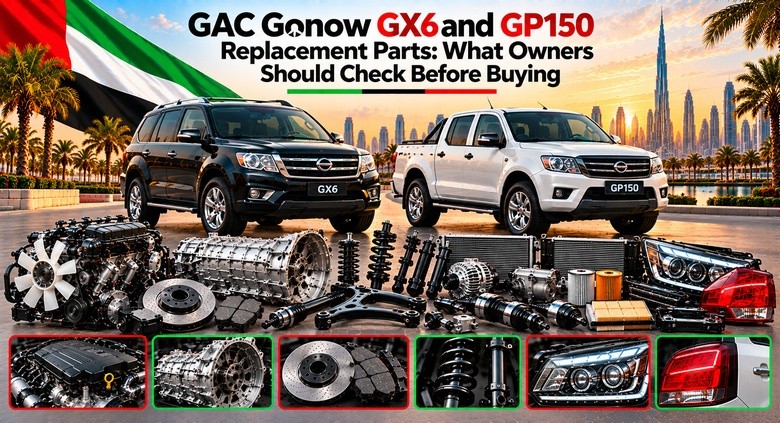
GAC Gonow GX6 and GP150 Replacement Parts: What Owners Should Check Before Buying
October 5, 2026
A GX6 or GP150 can turn a supposedly simple GAC Gonow replacement parts in UAE purchase into a detective job. The problem is not necessarily that the part cannot be found. It is that several listings can look convincing while belonging to another engine, another drivetrain, another production period, or even another Gonow model.
That matters more now because GAC Gonow is no longer a current vehicle-production brand in the way a modern GAC Motor model is. GAC acquired the remaining 49% of GAC Gonow in 2016, and contemporary reporting records the subsequent renaming and discontinuation of the Gonow model range. The GX6 was produced from 2014 to 2016, while the GP150 belongs to the later Gonow pickup period.
For a UAE owner, therefore, the sensible question is not simply, “Where can I find a Gonow part?”
It is: How do I prove that this particular part belongs on this particular vehicle?
Start with the exact vehicle, not the part
The first mistake is searching by a loose description such as “Gonow GX6 brake pad” or “GP150 engine part”.
That is too broad.
Write down the model, model year, engine, transmission, drivetrain and, where possible, the VIN or chassis number before contacting a supplier. Photograph the old component as well. For an electrical part, photograph the connector and label. For suspension, photograph the mounting points. For bodywork, photograph the reverse side as well as the visible face.
This turns a vague request into an application check.
A supplier who receives only “GX6 2015” has much more room to guess than one who receives the VIN, engine code, drivetrain, old-part photograph and part-number photograph.
The GX6 needs particular care over engine identification
The later GX6 is commonly catalogued with the 2.4-litre 4G69-S4N petrol engine. A current parts catalogue identifies the 2014–2016 GX6 2.4 application with that engine code and lists both 2WD and 4WD variants.
Other databases contain older GX6 applications using different engines, including the 4G64-S4M, which can create a nasty catalogue trap.
One database, for example, lists GX6 applications extending back much further than the 2014–2016 vehicle most UAE owners mean when they say “GX6”.
That is precisely why the model badge is not enough.
The GP150 is a different parts problem altogether
The GP150 should not be treated as a pickup-shaped version of the GX6.
A documented 2015 GP150 application uses the GA4D25TCI 2.5-litre turbocharged diesel, with a five-speed manual transmission. Published specifications show 2WD and 4WD variants, depending on configuration.
Another specification database records the GP150's 2.5-litre diesel at 2,499cc, 75kW and 265Nm, with the GA4D25TCI engine code.
That engine code is far more useful to a parts supplier than simply saying “GP150 diesel”.
Why the VIN still matters on an old vehicle
Some owners assume VIN checking is only necessary for newer cars with complicated electronics.
It is not.
On an older Gonow, VIN information can help separate production variants, regional specifications and equipment differences. It can also stop a supplier from using the wrong catalogue family.
For expensive parts — engine assemblies, gearboxes, transfer-case components, ECUs, ABS modules, steering components and body panels with integrated electronics — the VIN should be part of the enquiry.
The useful hierarchy is simple:
vehicle identification → application → part reference → physical comparison → installation confirmation.
Skipping the first step is where many parts searches go wrong.
Do not confuse GAC Gonow with today's GAC Motor parts network
This distinction is easy to miss.
The modern GAC parts market in the UAE includes current models such as GS3, EMPOW, EMKOO and GS8, with contemporary suppliers and catalogues built around those vehicles. Current UAE sources list substantial parts availability for modern GAC models.
That does not mean a current GAC Motor spare part is automatically suitable for a GAC Gonow.
The names are related historically, but the vehicle application is what matters.
If a seller says, “It is GAC, so it will fit,” ask for the actual application.
The Gonow production history explains the sourcing problem
GAC and Gonow established their joint venture in 2010, with GAC holding 51% and Gonow 49%. In 2016, GAC acquired the remaining 49% interest. GAC's own corporate reporting documents that transaction.
Contemporary industry reporting then recorded the renaming of GAC Gonow and the end of the Gonow model programme.
That history matters when buying parts today.
You are dealing with an older vehicle family whose original production and support environment has changed. Some parts may still be catalogued. Some may have aftermarket equivalents. Some may be sourced through specialist channels. Others may be easier to find as used genuine components.
Treating every part as if it were still being produced in a normal current-model supply chain is asking for disappointment.
A GX6 catalogue result can contain more than one application
This is one of the stranger problems with older Chinese vehicle catalogues.
A GX6 search can return different engine applications. Some catalogues identify the 2014–2016 2.4 GX6 with the 4G69-S4N, while broader databases show other historical GX6 configurations.
That does not automatically mean one catalogue is useless.
It means the buyer has to determine which vehicle the catalogue entry actually describes.
If the seller cannot tell you the engine code, production period or application behind the listing, do not treat the search result as proof of compatibility.
The 4G69-S4N can help widen the search — carefully
There is a useful advantage to the GX6's 4G69-S4N engine.
The engine family appears in parts catalogues across several vehicles, including other Gonow applications and vehicles from other manufacturers. Parts databases therefore contain more searchable information than the Gonow badge alone might suggest.
But cross-reference does not mean automatic interchangeability.
A brake component, filter, sensor, belt or engine service item may share an application. A complete intake assembly, mount, wiring harness, cooling component or electronic module may not.
Use the engine code to expand the search, not to bypass the vehicle application.
The GP150's GA4D25TCI gives you a second identification route
The GP150 is particularly suitable for engine-code-based searching because the GA4D25TCI identifier is clearly documented in multiple specification and filtration databases.
MANN-FILTER, for example, lists a GP150 2.5T diesel application with engine code GA4D25TCI and production coverage from October 2014 to May 2016 for a cabin-filter application.
That is useful evidence of catalogue support.
It also demonstrates something important: the engine code can connect an old vehicle to a current aftermarket catalogue even when the vehicle brand itself is no longer prominently supported.
Do not assume every GP150 is the same
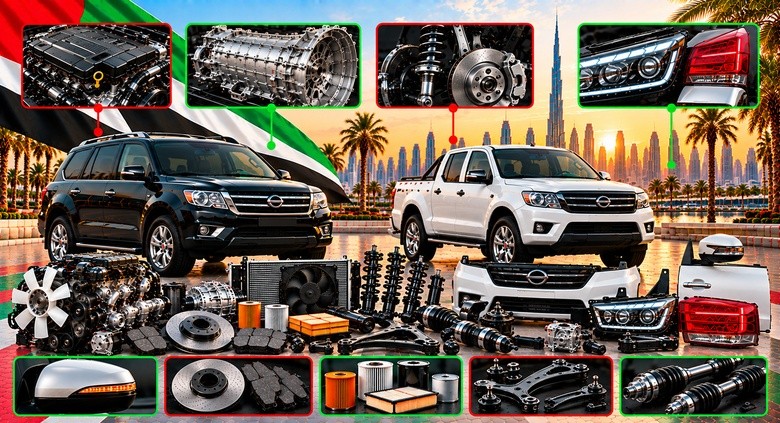
The GP150 appears in both two-wheel-drive and four-wheel-drive configurations.
Published 2015 specifications identify the 2.5T diesel with the GA4D25TCI engine across different drivetrain variants, while other GP150 versions are documented with a 2.7-litre petrol engine.
So “GP150 replacement part” is still incomplete information.
A front suspension component, propeller shaft, differential component, transfer-case part or axle-related component can be particularly sensitive to drivetrain configuration.
For those parts, 2WD versus 4WD should be one of the first questions asked.
Engine parts need more than a displacement match
Suppose you find a component described as “2.4 Mitsubishi engine part”.
That sounds promising for the GX6.
It is not enough.
The correct question is whether the part is intended for the 4G69-S4N application in this vehicle, with the correct mounting, connectors, sensor provision and surrounding components.
The same logic applies to the GP150. A component described as “2.5 diesel” is not automatically correct simply because the displacement matches.
Engine family, engine code, production period and physical application should all line up.
Brake parts are easier to cross-reference — but still verify them
Brake pads and discs are among the more promising categories for aftermarket sourcing.
The GX6 4G69-S4N application is present in aftermarket braking catalogues, including listings that identify the GX6 by engine and production period.
That is encouraging.
Still, compare the old pad or disc with the proposed replacement.
Check dimensions, pad shape, disc diameter and thickness, mounting arrangement and whether the catalogue specifies the exact axle. Never rely solely on a photograph in an online listing.
For brakes, a millimetre-level difference is not an academic problem.
Filters may be the easiest starting point
Routine service items are often easier to source than vehicle-specific body or electronic parts.
The GP150 is a good example. MANN-FILTER's catalogue explicitly identifies the GP150 2.5T diesel and GA4D25TCI engine for a cabin-filter application.
That gives owners an evidence-based aftermarket route rather than relying on a seller's description.
The same principle can apply to oil, air and fuel filters when a reputable catalogue provides a verified application.
But the rule remains: catalogue match first, physical dimensions second.
Suspension parts deserve closer inspection than most buyers give them
A suspension component can look almost identical to another part and still be wrong.
Check the number and position of mounting holes, bushing dimensions, arm geometry, ball-joint arrangement, left/right orientation and whether the component is front or rear.
For a used component, inspect the rubber bushes and ball joints rather than judging the part from a clean photograph.
A rusty outer surface is not automatically a failure. A cracked bush, bent arm, damaged ball joint or distorted mounting point is much more significant.
GX6 4WD components need a separate check
The GX6 was available in four-wheel-drive configurations, and published specifications identify the 4G69-S4N 2.4 engine with 4WD applications.
That makes drivetrain-specific parts particularly important.
Transfer-case components, propeller shafts, differentials, driveshafts and related mounting hardware should not be purchased from a generic “GX6” listing without confirmation.
Ask whether the donor or catalogue application is specifically 4WD.
If the answer is vague, keep looking.
GP150 suspension has a different architecture
The documented GP150 2.5T 4WD specification uses a double-wishbone independent front suspension and a leaf-spring rear suspension.
That immediately tells you something useful when inspecting parts.
A front suspension enquiry and a rear suspension enquiry are completely different jobs. A rear component should be identified around the leaf-spring arrangement, axle configuration and mounting hardware rather than simply described as “GP150 suspension”.
The vehicle's pickup construction matters.
Used engines need a much higher evidence threshold
A used GX6 engine should not be purchased because the seller says “tested”.
Tested how?
Ask for the exact engine identification, donor vehicle, mileage if documented, reason for dismantling, compression information where available, oil condition, coolant condition and whether accessories are included.
For the GP150 diesel, add turbocharger condition, injector information, fuel-system components and evidence of overheating or severe oil consumption to the discussion.
A complete engine can also mean different things to different sellers.
One may include the alternator and starter. Another may be a bare long block.
The price comparison is meaningless until the contents are written down.
A long block is not the same as a complete engine
This is a common source of unpleasant surprises.
A long block generally refers to the core engine assembly, while external components may be excluded. A complete engine may include considerably more equipment, but there is no universal seller definition that should be accepted without clarification.
Before buying, ask the supplier to photograph everything included.
Then compare that list against the engine being removed from your vehicle.
If your original engine has a good alternator, compressor, intake system, sensors and accessories, a cheaper bare replacement may not actually be cheaper once everything is transferred.
Gearbox identification should include the drivetrain
The GX6 is documented with a five-speed manual transmission.
The GP150 specifications likewise identify a five-speed manual transmission on documented 2.5T variants.
That sounds straightforward.
It isn't enough for a replacement gearbox.
The gearbox casing, ratios, bellhousing, output arrangement, mounting points and transfer-case relationship all need to match the actual vehicle.
For a 4WD vehicle, particularly, ask whether the quoted gearbox includes or interfaces correctly with the transfer-case assembly.
Body parts can be the most deceptive purchases
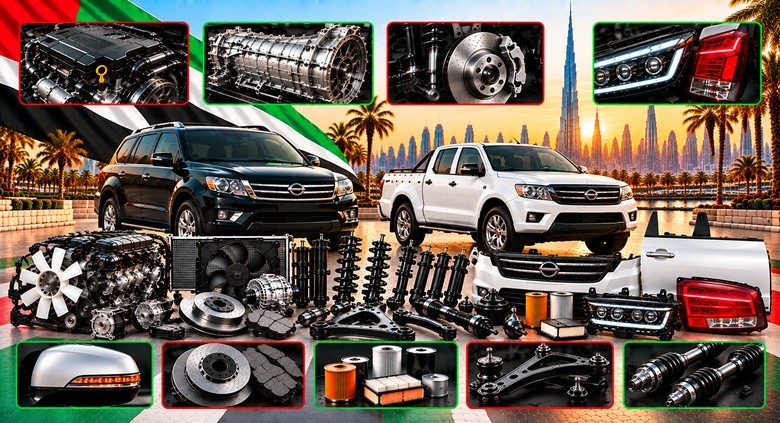
A bumper is not necessarily just a bumper.
It may contain brackets, grilles, fog-lamp surrounds, parking sensors, wiring, reinforcement components or trim pieces.
The same applies to headlights and tail lamps.
Two lamps can have the same outer shape while using different connectors, mounting arrangements or internal electronics.
When buying used body parts, ask for photographs of:
- the front face;
- the rear mounting side;
- connectors;
- brackets;
- sensor openings;
- damage around mounting points.
A perfect-looking bumper with broken mounting tabs is not a perfect bumper.
Headlights and electronic parts require special caution
The older the vehicle, the more tempting it becomes to buy an electrical component simply because the connector looks similar.
Don't.
For headlights, compare connector configuration, mounting points and specification. For ECUs, ABS units, instrument clusters and control modules, the identification label and hardware reference matter.
Some electronic components may require coding, configuration or adaptation after installation.
That is why a used ECU should never be treated like a used door handle.
Ask the workshop before purchase whether the replacement module can be programmed to the vehicle and what equipment is required.
Air-conditioning parts need vehicle-specific checking
The UAE climate makes air-conditioning components an obvious concern, but hot weather should not become an excuse for replacing parts without diagnosis.
If the GX6 or GP150 A/C is weak, the workshop should establish whether the problem is refrigerant charge, leakage, compressor performance, condenser airflow, expansion-device operation, evaporator restriction, electrical control or another fault.
Replacing the compressor first can be an expensive guess.
If a compressor is required, verify pulley arrangement, mounting, connector configuration and system specification before buying.
Cooling-system parts should be diagnosed, not guessed
Overheating does not automatically mean the radiator needs replacing.
The workshop should check coolant level and condition, pressure-test the system where appropriate, inspect hoses and connections, confirm thermostat operation, evaluate cooling-fan operation and investigate whether combustion gases are entering the cooling system when symptoms justify it.
For a used radiator, inspect the core for damage and the tanks for cracks or repairs.
For a water pump, check the actual symptoms rather than assuming every overheating complaint points to the pump.
The cheapest incorrect component is still wasted money.
UAE heat changes the inspection priorities
The UAE environment does not create a special “Gonow failure list”, but high ambient temperatures make cooling and A/C systems particularly relevant to vehicle owners.
It also makes the condition of rubber, plastics, wiring insulation, hoses and seals worth examining closely on an older vehicle.
This is especially important with used parts.
A donor part that has spent years exposed to heat can look excellent in a photograph while rubber components have aged considerably.
For used suspension and cooling parts, inspect the material that actually does the work, not just the painted metal.
What “tested” should mean before you buy a used part
“Tested” is one of the least useful words in a used-parts advert unless the test is explained.
Ask:
What was tested?
For an alternator, was charging output checked?
For a starter, was operation checked under load?
For an ECU, was communication established?
For an engine, was it run, compression-tested or merely removed from a running vehicle?
For an ABS module, was communication with diagnostic equipment confirmed?
For a gearbox, was it road-tested or simply inspected externally?
The answer tells you what evidence you actually have.
Compare used, aftermarket and reconditioned on the part's function
There is no universal rule saying used parts are bad and new aftermarket parts are good.
A used original differential with a documented donor history can be more useful than an unknown replacement with no identifiable application.
Equally, a reputable aftermarket brake component with a verified catalogue application can make more sense than an expensive used wear component.
Reconditioned parts need another layer of questioning: what was replaced, what was measured, what was machined, what was tested and what warranty applies?
The label alone does not tell you the quality of the process.
Ask for the part number before discussing the price
Price should come after identification.
This sounds backwards in an online market where buyers naturally search for the cheapest listing first. But with an older Gonow, the sequence can save money.
Ask the seller for the part number or reference printed on the component, if available.
Then ask:
“Is this the number for my exact VIN/application?”
If the supplier cannot provide the reference, ask for photographs of the label and mounting side.
For a costly component, a ten-minute identification exercise can be worth far more than saving a small amount on the purchase price.
The supplier should tell you what the price actually includes
A replacement-part quote can hide important differences.
For an engine, gearbox or suspension assembly, ask whether the price includes only the part or also delivery, installation, fluids, seals, gaskets, programming, calibration or other supporting components.
For a body panel, ask whether brackets, trims and lamps are included.
For an ECU, ask whether programming is included.
For a used engine, ask whether accessories are included.
A lower headline price is not necessarily the lower repair cost.
Use photographs as evidence, not decoration
For a rare vehicle such as a Gonow, photographs can be surprisingly valuable.
Ask the seller for photographs of the actual part rather than a generic catalogue image.
Useful photographs include the part label, casting number, connector, mounting face, damage points and complete assembly.
For engines and gearboxes, ask for photographs from several sides.
For suspension arms, photograph bushes and ball joints.
For body panels, photograph mounting tabs.
The objective is not to admire the part. It is to compare it.
The buyer's checklist should be written before the search begins
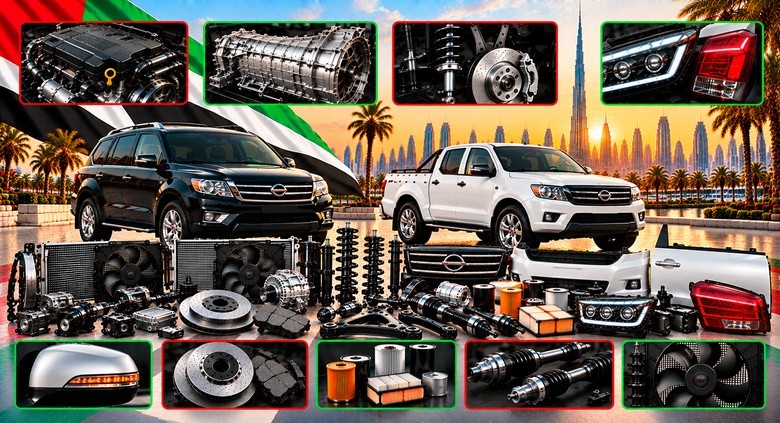
Before contacting a UAE supplier, prepare this information:
Vehicle
- GAC Gonow GX6 or GP150
- model year
- VIN/chassis number
- registration specification where relevant
Powertrain
- engine code
- fuel type
- transmission
- 2WD or 4WD
Part
- exact component
- left/right or front/rear
- old part number if available
- photographs
- visible connector or mounting details
For used parts
- donor vehicle
- donor year
- mileage if documented
- reason for dismantling
- test performed
- condition
- warranty
- return conditions
This is the information that turns a parts enquiry into something a supplier can actually work with.
A UAE parts search should separate current supply from legacy supply
The UAE's wider Chinese-vehicle spare-parts market has expanded considerably, with specialist suppliers and online sourcing platforms now covering many Chinese brands and common replacement categories. A September 2026 UAE availability guide notes stronger distribution for current Chinese brands and broader specialist sourcing across Dubai, Abu Dhabi and Sharjah.
But a current Chinese-parts distribution network should not be mistaken for a dedicated Gonow factory-parts network.
For GX6 and GP150 owners, the practical sourcing routes can therefore be different:
verified aftermarket catalogue → specialist legacy supplier → used genuine component → donor vehicle → reconditioning where technically sensible.
The route depends on the part.
Cross-reference the GX6 intelligently
The GX6's 4G69-S4N application appears in multiple aftermarket databases, including braking and engine-related catalogues.
That gives the owner a useful starting point.
Search by:
Gonow GX6 + 4G69-S4N + component
rather than simply:
Gonow GX6 + component
Then verify the vehicle year and drivetrain.
For a brake pad or service filter, this can produce useful aftermarket matches.
For a body panel or electronic module, it is much less likely to be enough on its own.
Cross-reference the GP150 by engine code and production period
For the GP150, use:
GP150 + GA4D25TCI + component + production/application
The MANN-FILTER catalogue demonstrates why this method works: it explicitly connects the GP150 2.5T diesel with GA4D25TCI and gives a defined production range for the listed filter application.
This is much stronger evidence than a seller simply saying “fits GP150”.
It also creates a record that can be shown to the workshop if there is disagreement over compatibility.
Know when a part is worth repairing instead
A rare replacement component does not automatically have to be replaced with another used part.
A damaged alloy bracket might be repairable. A suspension component with worn bushes may be rebuildable in some circumstances. An A/C compressor may be repairable depending on failure mode and available parts. A gearbox may be rebuildable if the casing and major components remain serviceable.
But repair should follow inspection.
Ask the workshop to identify what actually failed and what supporting components caused the failure.
Replacing a repaired component without correcting the underlying cause simply resets the clock.
The cost of getting the identification wrong can exceed the part price
This is where old-car parts buying becomes more expensive than it first appears.
Buy the wrong engine and you may pay for transport, removal, installation and further labour before discovering the mismatch.
Buy the wrong ECU and you may need programming or another replacement.
Buy the wrong suspension arm and you may lose time waiting for another component while the vehicle remains off the road.
Buy the wrong body panel and you may discover the mounting points do not line up only after the workshop has stripped the vehicle.
The cheap mistake is often not cheap at all.
For rare Gonow vehicles, accurate identification is itself a form of cost control.
Use a simple evidence hierarchy when comparing sellers
When two sellers quote apparently similar parts, rank the evidence, not the seller's confidence.
A strong listing might provide:
- exact vehicle application;
- model year;
- engine code;
- drivetrain;
- part number;
- photographs of the actual component;
- condition information;
- test information;
- warranty or return terms.
A weak listing might provide only:
“Gonow GX6 part — good condition.”
The second statement may still turn out to be correct.
You simply have much less evidence before handing over money.
What a UAE workshop should check before fitting the part
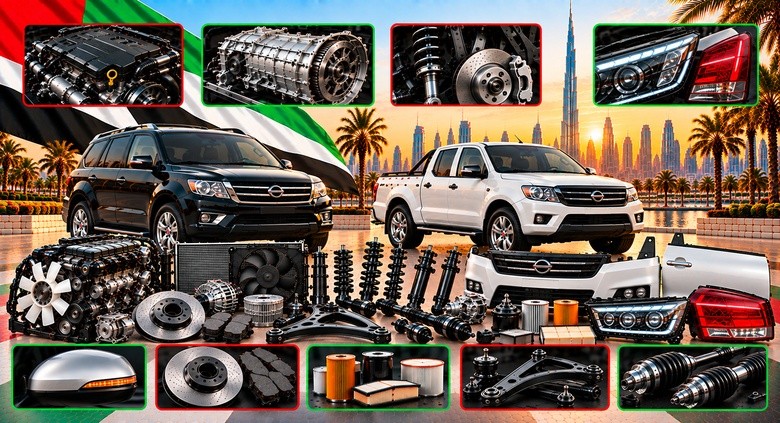
Before installation, ask the technician to compare the replacement against the removed component.
For mechanical parts, check mounting points, dimensions, connectors, shaft or pulley arrangement and surrounding clearances.
For electrical parts, check connector configuration, identification and diagnostic communication.
For drivetrain components, confirm transmission, differential and 2WD/4WD application.
For suspension, confirm left/right, front/rear and alignment implications.
For brakes, confirm disc and pad dimensions and caliper compatibility.
This final physical check is particularly valuable when a part has been sourced remotely.
When you should walk away from a listing
There are certain answers that should make a buyer pause.
“Same as Mitsubishi.”
“Same as another Chinese SUV.”
“Looks identical.”
“Don't worry, it will fit.”
“VIN isn't necessary.”
“Part number not available.”
“Tested, but we cannot explain how.”
None of these statements proves that the part is wrong.
They simply fail to provide enough evidence for a confident purchase.
For an old Gonow, where parts information can be fragmented across catalogues and suppliers, that distinction matters.
Keep the old part until the replacement is confirmed
Do not throw the original component away immediately.
The old part may contain the only useful identification label, casting number, connector, bracket or physical reference available for comparison.
For rare vehicles, the removed part is evidence.
Photograph it from every useful angle before dismantling if practical. Keep labels readable. Record the side of the vehicle and the component location.
This costs almost nothing and can prevent a second parts search later.
A good Gonow parts enquiry is unusually specific
A strong UAE enquiry might read:
Gonow GX6, 2015, 2.4 petrol, 4G69-S4N, 4WD, VIN available. Need front-left lower suspension component. Photos of old part attached. Please confirm part number, application, whether the quoted component is new or used, and what warranty or return terms apply.
That is dramatically more useful than:
Need GX6 suspension part. Price?
The same approach works for the GP150.
Specificity reduces guesswork.
What to do when no exact new part is available
If an exact new genuine component cannot be sourced, work through the alternatives rather than jumping straight to the first used listing.
First investigate a verified aftermarket application.
Then check specialist legacy suppliers.
Then look for a used genuine part from a known donor.
Then consider a professionally reconditioned component where the part is technically suitable for rebuilding.
For routine filters and some brake components, aftermarket sourcing may be straightforward where catalogues provide an exact application.
For body panels, ECUs and drivetrain components, used genuine sourcing may be more realistic.
The part category determines the strategy.
The right replacement is the one you can prove
That may sound less exciting than hunting for the cheapest part.
It is also the safer way to buy.
A 2015 GX6 2.4 4WD should be treated as that exact application, not merely as “a Gonow”. A GP150 with the GA4D25TCI diesel should be identified by that engine and its drivetrain rather than by the badge alone. Documented catalogue applications support this approach for both vehicles.
For UAE owners searching through specialist suppliers, a precise request also makes it easier to compare genuine, aftermarket and used options without mixing different applications together.
That is where PartFinder UAE can be used as part of the wider sourcing process: the important thing is still to send the supplier enough vehicle information to identify the exact component rather than relying on the model name alone.
A practical GX6 buying matrix
| Part category | Identification priority | Used-part risk | Best evidence before purchase |
| Engine | Engine code + VIN + year | High | Engine code, donor details, inspection |
| Gearbox | Transmission + drivetrain | High | Gearbox reference, casing photos |
| Transfer-case parts | 4WD configuration | High | Exact drivetrain/application |
| Brake pads | Axle + catalogue application | Medium | Catalogue match + dimensions |
| Filters | Engine + application | Lower | Reputable catalogue reference |
| Suspension | Position + dimensions | Medium | Photos + mounting comparison |
| ECU/module | Hardware reference + VIN | Very high | Label + programming confirmation |
| Headlight | Specification + connector | High | Rear/connector photographs |
| Bumper | Variant + mounting points | Medium | Actual-part photographs |
| Radiator | Engine + dimensions | Medium | Core/tank/connection comparison |
| A/C compressor | Engine + mounting + connector | High | Part reference + system match |
The matrix is deliberately conservative. The more expensive or electronically integrated the part, the stronger the identification evidence should be.
A practical GP150 buying matrix
| Part category | Identification priority | Main trap |
| Diesel engine | GA4D25TCI + VIN | Similar-looking 2.5 diesel listings |
| Turbocharger | Engine code + turbo reference | Generic “2.5 diesel” matching |
| Injectors | Engine/fuel-system application | Assuming all GA4D25TCI components interchange |
| Gearbox | Five-speed/manual + drivetrain | Confusing 2WD and 4WD applications |
| Transfer-case components | 4WD confirmation | Buying generic pickup drivetrain parts |
| Front suspension | Model + position + mounting | Mixing other Gonow applications |
| Rear suspension | Leaf-spring/axle application | Using unrelated pickup hardware |
| Filters | Engine + catalogue | Matching only dimensions |
| Headlights | Variant + connector | Exterior shape appearing identical |
| ECU | Hardware/software reference | Buying an unprogrammable module |
| Body panels | Variant + mounting points | Facelift/trim differences |
UAE Update Reference: September 2026
The central lesson is quite simple. A Gonow GX6 or GP150 does not become an easy parts search merely because the vehicle is mechanically straightforward. Its age, discontinued production history and fragmented catalogue coverage make identification more important, not less.
For a GX6, start with the exact engine and drivetrain. For a GP150, confirm the GA4D25TCI application where applicable and establish whether the vehicle is 2WD or 4WD. Then match the actual component.
The part should prove that it fits the vehicle before the buyer has to prove that the purchase was a mistake.
FAQs
Categories
- Audi
- BMW
- Car Accessories
- Car Tips
- Ford
- Land Rover
- Mazda
- Range Rover
- Top 10
- UAE Car Parts
- Used Car Parts
- Toyota
- Replacement Engines
- Nissan
- Hyundai
- Mitsubishi
- Volkswagen
- Honda
- Kia
- Chevrolet
- Dodge
- Jeep
- Subaru
- Renault
- Lexus
- Mercedes
- Suzuki
- Hummer
- Porsche
- Infiniti
- Peugeot
- GMC
- Mini
- Volvo
- Replacement Gearboxes
- MG
- Jaguar
- Skoda
- Cadillac
- Daihatsu
- Fiat
- German Car Parts
- Japanese Car Parts
- Aftermarket Car Parts
- Genuine Car Parts
- New Car Parts
- Reconditioned Car Parts
- European Car Parts
- American Car Parts
- Korean Car Parts
- British Car Parts
- Chinese Car Parts
- Sports/Exotic Car Parts
- Luxury Car Parts
- Performance Car Parts
- SUV/4x4 Spare Parts
- Truck Spare Parts
- EV Car Parts
- Hybrid Car Parts
- Auto Spare Parts in UAE
- Tesla
- Isuzu
- Ram
- Ferrari
- Bentley
- Lamborghini
- Genesis
- Maserati
- Lincoln
- Chrysler
- Opel
- Citroen
- SsangYong
- Seat
- McLaren
- Aston Martin
- Rolls Royce
- Maybach
- Alfa Romeo
- Bugatti
- Scion
- Abu Dhabi Car Parts
- Ajman Car Parts
- Al Khan Car Parts
- Al Sajaa Car Parts
- Deira Car Parts
- Dubai Car Parts
- Fujairah Car Parts
- Industrial Area 6 Car Parts
- Mussafah Car Parts
- Ras Al Khaimah Car Parts
- Sharjah Car Parts
- Umm Al Quwain Car Parts
- Acura
- BYD
- Chery
- Dacia
- DS
- Geely Emgrand
- EXEED
- GAC
- GAC Gonow
- Geely