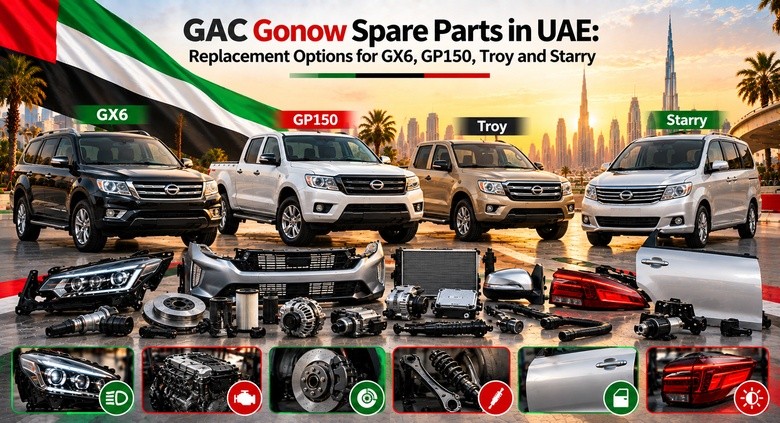
GAC Gonow Spare Parts in UAE: Replacement Options for GX6, GP150, Troy and Starry
October 5, 2026
The awkward truth about finding GAC Gonow spare parts in UAE is that the problem is rarely finding something that looks like the part you need.
The problem is proving that it is actually the part.
Gonow’s old UAE footprint now sits in an unusual corner of the aftermarket. The GX6, GP150, Troy and Starry are discontinued models, and the GAC Gonow joint venture itself is no longer operating in its old form. Current parts catalogues still show surprisingly extensive Gonow inventories overseas, including mechanical, suspension, electrical and body references, while UAE-facing searches produce a much thinner trail of clearly identified stock. A UAE directory still records GAC Gonow-related truck-parts providers, and historic UAE dealer information shows Belhasa Motors as having sold and serviced GAC Gonow vehicles, including Starry and Troy models.
That changes how an owner should buy.
You are not shopping for a modern GAC GS8 component where the model, trim and current catalogue can usually narrow the answer quickly. You are dealing with an older vehicle for which a used genuine component, an overseas new-old-stock part, an aftermarket equivalent, a donor vehicle or a specialist manufacturer may all be legitimate routes — provided the application is actually established.
And there is another wrinkle. GAC Gonow is not simply another spelling of today's GAC range.
The four models in this guide belong to a much older product era.
UAE Update Reference: September 2026
Why GAC Gonow parts are different from current GAC parts
A current GAC owner can usually approach a parts counter with a VIN, model year and specification and expect the search to begin from a contemporary catalogue.
A Gonow owner may have to do more detective work.
The GX6 was produced from 2014 to 2016. The GP150 belongs to the same late Gonow period, with 2015 examples documented in parts and specification databases. The Starry was sold as a 2014–2016-era compact MPV, while Troy variants span an older pickup history.
That means “Gonow spare parts” is too broad a search.
Even “GX6 spare parts” can be inadequate.
A seller needs to know which component, which side, which engine, which drivetrain and which production application you have.
For an older vehicle, identification becomes part of the purchase.
What happened to GAC Gonow?
This matters because parts availability follows the history of the manufacturer.
Gonow became part of a joint venture with GAC, producing vehicles under the GAC Gonow name. By March 2016, GAC Passenger Car had acquired the remaining 49% stake held by Gonow Holdings, and the company was subsequently renamed Guangzhou Automobile Group Passenger Car (Hangzhou) Co., Ltd. Contemporary reporting and later historical records describe the end of the joint venture and the gradual disappearance of Gonow production.
That is why the brand can feel oddly present and absent at the same time.
You can still find Gonow parts catalogues.
You can still find vehicles.
You can still find some specialist suppliers.
But that does not mean there is a normal current-production factory parts pipeline behind every listing.
For a UAE owner, that distinction is important.
GX6: the SUV with a narrow parts window
The Gonow GX6 is particularly important to identify correctly because its production period was short.
Available model data places it in the 2014–2016 period, with a 2.4-litre petrol engine and five-speed manual transmission. Some specifications list rear-wheel drive and four-wheel-drive variants, while another specification source identifies the Mitsubishi 4G69S4N 2.4-litre engine and 4WD configuration.
That immediately creates a buying problem.
A “GX6 2.4 part” may still require drivetrain confirmation.
A front suspension component, differential-related part, driveshaft component or transmission-related item cannot safely be selected from engine size alone.
The vehicle application comes first.
GX6 engine parts: don't assume Mitsubishi means everything interchanges
The GX6's Mitsubishi-sourced engine is useful information, but it should not be turned into a licence to buy any part advertised for a Mitsubishi 4G69 application.
The engine itself may share architecture or certain service components with other applications. The surrounding installation may not.
Different calibration, sensors, brackets, connectors, mounting arrangements and vehicle-specific accessories can change the correct component.
So if you are looking for a GX6 water pump, sensor, belt component, starter, alternator or engine-management item, establish the exact engine application before searching for a cross-reference.
“Same engine family” is evidence.
It is not proof.
GP150: a different parts problem altogether
The Gonow GP150 is a pickup, and available 2015 specification data identifies a 2.5-litre turbocharged diesel producing about 102 hp and 265 Nm, with a five-speed manual transmission and four-wheel drive on the documented variant. Another database identifies the engine as GA4D25TCI.
There are also online parts references that associate GP150 applications with several engine and service components.
That makes the GP150 potentially easier to source mechanically than its rarity might suggest.
But it also creates another trap.
Some UAE parts catalogues and aftermarket databases may attach a “GP150” label to a particular engine or component application without proving that the part is correct for every GP150 specification.
Confirm the vehicle first.
Then confirm the engine.
Then confirm the part.
Troy is not one single vehicle
This is where older Gonow searches become messy.
The name Troy appears across several generations and variants. Historical parts catalogues include Troy 100 and Troy 500 applications, while other vehicle databases identify an older Troy double-cab pickup with petrol and diesel options.
The Troy 500 has an extensive surviving overseas parts catalogue. Shindary, for example, publishes large lists of Troy 500 component references covering mechanical and chassis applications.
That is encouraging.
But it does not mean every Troy part is interchangeable.
If your registration says Troy, the search should continue until the exact variant is known.
Starry is the odd one in this group
The Gonow Starry, also known as Xinglang, was a compact MPV rather than a pickup or SUV.
Available specification records place it in the 2014–2016 period, with front-wheel drive, a five-speed manual gearbox and petrol engines including 1.3- and 1.5-litre versions. Another specification source lists a 1.6-litre 113 hp version, showing why catalogue descriptions need to be checked rather than assumed to be identical across markets.
This is precisely the kind of vehicle where regional specification can matter.
If someone offers you a Starry component based solely on a photograph, ask for the application details.
The photograph tells you what it looks like.
It does not tell you what it fits.
Which Gonow parts are easiest to source?
There is no reliable UAE-wide ranking of Gonow parts availability that can be treated as a current market statistic.
But surviving overseas catalogues show that mechanical and service components remain documented for several Gonow applications.
CINA Auto Parts, for example, lists Gonow references covering fuel pumps, radiators, suspension components, steering parts, brake components, body panels, lamps, door hardware, wiper motors and other systems. Its catalogue specifically includes GP150, Troy and other Gonow applications.
That suggests a useful sourcing hierarchy.
Routine mechanical components may have more cross-border aftermarket support than rare interior trim or model-specific body panels.
But “catalogued somewhere” and “available in the UAE today” are two very different statements.
Why mechanical parts can be easier than body panels
A brake component has a measurable job.
A bumper has a vehicle-specific shape.
That difference matters enormously with discontinued cars.
A manufacturer can continue producing a compatible bearing, filter, belt, seal or suspension component for an older application because the underlying engineering is relatively stable. A left-front bumper for a short-lived SUV is harder to justify economically once factory production has stopped.
This is why Gonow owners should not assume that all parts will have the same availability.
A specialist may find a suspension component quickly but spend much longer locating a correct headlamp.
The aftermarket does not disappear evenly.
Current UAE price evidence is unusually limited
This is one place where pretending would be more harmful than helpful.
As of September 2026, I could verify UAE-facing information about GAC Gonow-related parts channels and vehicles, but I could not establish a reliable, current UAE retail price list covering GX6, GP150, Troy and Starry replacement parts.
That means it would be misleading to publish a neat table claiming, for example, that a GX6 headlight costs a certain AED amount or a GP150 clutch costs another.
The evidence does not support that precision.
For these discontinued vehicles, a buyer should instead request a dated quotation that identifies:
- exact part
- condition
- source
- part reference
- delivery status
- VAT treatment
- warranty
- fitting cost
That quotation is more useful than an invented “average UAE price”.
A UAE supplier listing is not proof of stock
A web page can survive long after the last physical part has disappeared.
This is especially relevant to discontinued Gonow models.
A catalogue may display a component because the supplier has indexed the application, not because one unit is sitting on a shelf in Sharjah or Dubai.
Ask the seller a very plain question:
“Is this exact part physically in UAE stock today?”
Then ask for a photograph of the actual component.
Not a catalogue image.
The distinction becomes particularly important for headlights, body panels, dashboards, trim and other large or fragile parts.
Used Gonow parts may be the most practical route for rare components
For a discontinued vehicle, used genuine parts can make considerable sense.
A donor GX6 can potentially provide a correct bumper, headlamp, grille, door, mirror, interior trim or body-control component that would otherwise be difficult to locate.
But the word “used” tells you almost nothing about condition.
Ask:
- What vehicle did it come from?
- What year was the donor?
- Which engine and drivetrain?
- Was it accident-damaged?
- Was the donor flooded?
- Has the part been tested?
- Are mounting points intact?
- Is there corrosion?
- What is the return position?
For electronic parts, add one more question:
Can the component be programmed or paired to the replacement vehicle?
Used GX6 body panels need more inspection than you might expect
The temptation with an old SUV is to buy the first body panel that matches the photograph.
Don't.
Check the panel from several angles.
A used bumper should be inspected for repaired cracks, missing mounting tabs, distorted edges and previous paint. A used bonnet should be checked for hinge and latch alignment. A door should be examined for its shell geometry, hinges, lock and window mechanism.
Bodywork is expensive to correct once a supposedly cheap panel has been painted and installed.
The part was cheap.
The rework wasn't.
Troy body parts require variant identification
Pickup body panels are particularly vulnerable to year and variant confusion.
Troy catalogues show different generations and component references, including Troy 100 and Troy 500 material. A supplier's broad “Troy” label is therefore insufficient for an expensive body order.
Before buying a bonnet, grille, fender, headlight or bumper, photograph the vehicle from the front, side and rear.
Then provide the VIN or chassis identification if available.
If the seller cannot explain which Troy variant the part was catalogued against, treat the fitment as unconfirmed.
GP150 suspension parts deserve application checking
The GP150 is a body-on-frame pickup, and available specifications identify front ventilated discs and rear drums on the documented 2.5T version.
That gives a useful starting point for brake and chassis identification.
But it does not tell you that a brake shoe, wheel cylinder, control arm, shock absorber or hub from another Gonow pickup is interchangeable.
Suspension geometry is unforgiving.
A component that bolts on but alters ride height, wheel position or steering geometry can create a larger problem than the original shortage.
For chassis components, physical dimensions and catalogue application should agree.
The GP150 engine reference can help — if used carefully
The documented 2.5T GP150 application is associated with the GA4D25TCI engine.
That identifier is much more useful than simply telling a parts seller:
“I have a Gonow pickup.”
It narrows the search.
But an engine code should not become an automatic cross-reference to every part carrying the same engine designation. Ancillary components can differ by vehicle application.
Give the seller the engine identification and the vehicle identification.
If both point towards the same part, confidence rises sharply.
Starry owners should be especially careful with engine assumptions
The Starry is a good example of why internet specifications can conflict.
Some available records describe 1.3- and 1.5-litre engines, while another parts/specification source identifies a 1.6-litre 113 hp configuration.
That does not mean one random listing should be declared wrong.
It means the vehicle was sold in different specifications or databases have consolidated applications differently.
For a Starry engine component, use the actual vehicle's engine identification, not a generic “2014 Starry” description.
This is exactly the kind of uncertainty that VIN/chassis confirmation resolves.
What about filters and routine service parts?
Routine service parts are often where cross-reference research has the greatest potential.
One UAE-facing parts listing, for example, identifies a MANN oil filter application that includes GONOW (GAC) GP150 among a long list of compatible vehicles.
That is useful evidence of aftermarket cross-referencing.
But notice what the listing actually proves.
It establishes a specific filter application for a specific GP150 listing.
It does not establish that every Gonow model uses that filter.
It does not establish that every GP150 engine uses it.
And it does not establish that the filter is physically available in a UAE warehouse today.
This is how old-car parts research needs to be read.
Brakes can sometimes be sourced through component dimensions
Brake components can be more forgiving than body panels, but only when the application is properly established.
For example, a brake drum or shoe is defined by measurable dimensions and mounting/application details. A brake pad has its own friction material, backing-plate shape and fitment.
Do not buy simply because the seller says “Gonow”.
Ask for the application or technical dimensions.
For safety-critical components, a reputable manufacturer's catalogue cross-reference is much stronger evidence than a marketplace photograph.
Electrical parts are a different category
An old Gonow alternator may look like another alternator.
That does not prove compatibility.
Check:
- mounting points
- pulley arrangement
- electrical connector
- output rating
- belt arrangement
- regulator configuration
- physical dimensions
The same applies to starters, sensors, switches and body-control components.
For a rare vehicle, the temptation is to make an electrical component fit because finding the exact one is difficult.
That is precisely when caution matters most.
Headlights and lamps are usually harder to cross-reference
Lighting components are highly model-specific.
The shape of the lamp is only one variable. Mounting tabs, connector positions, bulb or LED configuration, beam pattern and housing design all matter.
For a GX6, Starry or Troy lamp, ask for the exact left/right application and a photograph of the rear connector side.
That photograph can reveal more than the front image.
A seller who supplies only a polished catalogue photograph has not yet established fitment.
Rare electronics should be bought with a return plan
A used ECU, instrument cluster, body-control module or other electronic unit can be perfectly functional and still fail to operate correctly in another vehicle.
Why?
Because programming, immobiliser pairing, software version or vehicle configuration may differ.
Before paying for an electronic Gonow component, establish whether it is:
- plug-and-play
- programmable
- coding-dependent
- immobiliser-linked
- supplied with matching components
- returnable if incompatible
If the seller cannot answer, the price is almost irrelevant.
A cheap incompatible module is still wasted money.
Can parts from another GAC model fit a Gonow?
Sometimes a component may share a manufacturer, supplier or underlying technology.
That does not make it interchangeable.
Gonow and GAC have a historical corporate relationship, but that relationship should not be used as a blanket parts cross-reference. The GAC Gonow joint venture ended in 2016, and the Gonow products in this article belong to that earlier period.
So don't assume a current GAC part fits an old Gonow vehicle because both names contain “GAC”.
The correct question is:
Is there documented application evidence for this exact part on this exact Gonow model?
If not, keep searching.
Overseas sourcing can rescue a rare Gonow
This is where the surviving parts catalogues become useful.
Shindary maintains substantial Troy 500 parts listings, while CINA Auto Parts publishes broad Gonow applications including GP150, Troy and other models.
That means the disappearance of local dealer stock does not necessarily mean the part has disappeared from the global aftermarket.
But overseas sourcing introduces its own costs:
- international freight
- customs or import charges
- delivery time
- damage risk
- return difficulty
- incorrect-fitment risk
For a cheap service component, importing one part may make little economic sense.
For a rare body panel, it might.
The UAE has a useful used-parts ecosystem for old vehicles
The UAE's used-parts market can be particularly relevant to discontinued vehicles.
A current UAE directory still identifies GAC Gonow-related truck-parts providers across Dubai, Sharjah, Ajman and Abu Dhabi, while historic dealer information records Belhasa Motors as a GAC Gonow sales and service operation.
That does not prove that any named supplier currently has a GX6 headlight or Starry door in stock.
It does show why a local physical search can still be worthwhile.
For rare Gonow parts, ask dismantlers specifically about donor vehicles rather than asking only for “new Gonow parts”.
The answer may change.
The donor-vehicle strategy works particularly well for body parts
Suppose you need a Starry rear lamp.
A factory-new part may be difficult.
A used lamp from a compatible donor can be much easier to source.
The same applies to:
- doors
- mirrors
- bumpers
- grilles
- tailgates
- interior trim
- instrument clusters
- switches
- glass
- body-control components
But the donor must match.
A donor vehicle's model name alone is not enough.
Check year, variant, body style and component shape.
How to compare three Gonow replacement options
For a discontinued Gonow, the practical comparison is usually:
Used genuine
versus
new aftermarket
versus
overseas new-old-stock or specialist supply.
Used genuine may offer the best chance of exact physical fitment, but condition varies.
New aftermarket eliminates donor history, but quality and application accuracy vary.
New-old-stock can be attractive because it may be an original component that was never installed, but availability and storage history matter.
There is no universal winner.
The right choice depends on the part.
A door and a thermostat should not be judged using the same buying criteria.
Repairing the original part may beat finding a replacement
This is particularly relevant to rare bodywork.
If a GX6 bumper is cracked but its mounting structure remains recoverable, plastic repair may be considered. If a Starry interior trim panel is broken, specialist plastic repair may be more sensible than searching internationally for an unobtainable replacement.
The same thinking can apply to certain lamps, brackets and trim pieces.
But structural and safety-critical parts should not be repaired simply because the replacement is difficult to find.
Scarcity is not a technical justification for unsafe repair.
Don't confuse a part number with a guarantee
Online Gonow catalogues contain long lists of part references. The Troy 500 catalogues, for example, publish numerous references for suspension, engine, body and chassis components.
A part number is valuable because it gives the search a precise identity.
But it still needs to be connected to your vehicle.
Before ordering, compare:
vehicle identification → model variant → component application → part reference → physical dimensions/connector → installation.
If two sources give different references, do not simply choose the cheaper one.
Find out why they differ.
What a UAE workshop should check before ordering
For an older Gonow, diagnosis and parts identification should happen together.
For a mechanical failure, the workshop should establish the actual failed component before ordering.
For an electrical fault, scan where appropriate, inspect wiring and connectors and test the circuit.
For suspension, inspect the complete assembly and check alignment after replacement.
For bodywork, dismantle enough of the damaged area to establish concealed damage.
For cooling-system faults, test the cooling system rather than replacing the radiator because the temperature gauge moved.
For an A/C problem, establish whether the compressor, condenser, evaporator, expansion device, pressure sensor or refrigerant circuit is actually responsible.
Old vehicles encourage parts swapping.
That gets expensive quickly.
The cost of getting the identification wrong
A wrong filter is irritating.
A wrong bumper can become expensive.
A wrong ECU can become a return headache.
A wrong suspension component can create a safety problem.
A wrong body panel may also leave the vehicle sitting in a workshop while the correct part is sourced.
This is why rare-car ownership changes the economics of parts buying.
The cheapest listing is not necessarily the cheapest outcome.
A correct part that arrives once can cost less than a bargain component that has to be returned, repainted, modified or replaced.
What information should you send a Gonow parts seller?
Make the seller's job easy.
Send:
- model name
- model year
- VIN/chassis number
- engine code if available
- drivetrain
- transmission
- left/right side
- photographs of the existing part
- photograph of the connector where relevant
- old part number if visible
- dimensions where useful
For body parts, include photographs of the complete vehicle.
For mechanical components, include the failed component and its identification markings.
A five-minute information pack can save several days of back-and-forth.
A practical sourcing order for GX6, GP150, Troy and Starry
For an expensive or difficult component, use this sequence:
First: identify the vehicle precisely.
Second: ask UAE specialists and dismantlers for the exact part.
Third: check whether a new aftermarket equivalent is documented.
Fourth: search specialist overseas Gonow catalogues.
Fifth: compare landed cost rather than advertised part price.
Sixth: verify the return policy before payment.
This is slower than typing “Gonow headlight UAE” into a search engine.
It is also much less likely to end with a part sitting on the workshop floor that nobody can install.
What not to do when buying rare Gonow parts
Do not order because the photograph looks identical.
Do not assume “GAC” means current GAC.
Do not assume all GX6 parts fit every GX6.
Do not assume GP150 parts fit every engine variant.
Do not assume Troy 100 and Troy 500 parts are interchangeable.
Do not assume Starry specifications are identical across markets.
Do not buy an electronic module without establishing programming requirements.
Do not accept an advertised price as the complete repair cost.
And do not let scarcity pressure you into buying an unverified component.
A UAE price checklist for discontinued Gonow parts
Because reliable current UAE retail prices are not consistently published for these four models, ask every supplier to separate the quotation into these lines:
| Cost item | What should be stated |
| Part | Exact description |
| Application | GX6, GP150, Troy variant or Starry |
| Condition | New, used, reconditioned |
| Part reference | Verified reference where available |
| Source | UAE stock, donor, importer or overseas |
| Price | AED part price |
| VAT | Included or excluded |
| Freight | Included or separate |
| Labour | Separate fitting price |
| Programming | Required or not |
| Warranty | Duration/conditions |
| Returns | Fitment/defect conditions |
| Delivery | Estimated availability |
That is the quotation worth comparing.
Not “Gonow bumper — AED X”.
GX6 owners: the sensible replacement strategy
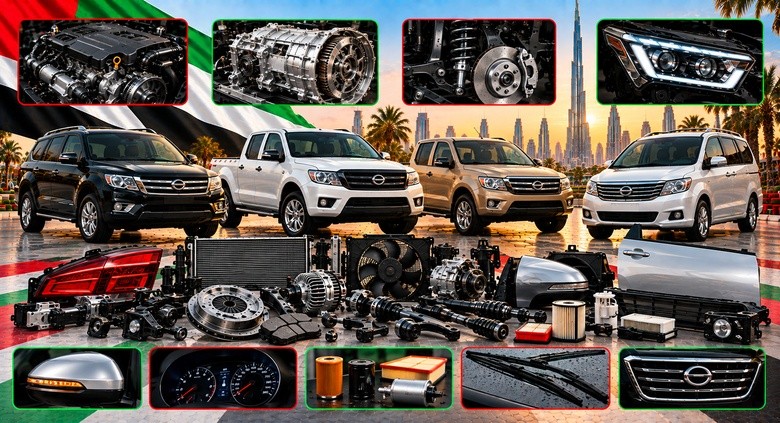
For a GX6, start with mechanical identification.
The 2.4-litre application and manual transmission give the search a useful foundation, but drivetrain must still be confirmed because documented specifications include different drive configurations.
For engine service parts, investigate documented cross-references.
For suspension and steering, prioritise exact application and dimensions.
For body panels and lamps, consider used genuine donor parts.
For rare electronic components, insist on compatibility and programming information before payment.
The GX6 is old enough that preservation of the original part can sometimes be more sensible than blindly replacing it.
GP150 owners: start with the engine and drivetrain
The documented GP150 2.5T diesel application provides unusually useful identification information: 2.5-litre turbo diesel, 75 kW, 265 Nm, five-speed manual and a four-wheel-drive configuration in the referenced specification.
Use that information to narrow mechanical searches.
But don't stop there.
Confirm the vehicle's actual engine and drivetrain.
This is particularly important for clutch, transmission, differential, driveshaft, transfer-case and suspension components.
The more expensive the component, the less acceptable a “probably fits” answer becomes.
Troy owners: identify the generation before asking for a price
If a seller asks simply, “Which Troy?”, that is not pedantry.
It is the correct question.
Historical catalogues distinguish Troy 100 and Troy 500 applications, while model databases also contain earlier Troy variants.
Send the VIN, photographs and model details.
For body panels, include the damaged part's dimensions if practical.
For mechanical components, include engine and transmission information.
For a Troy 500, the surviving overseas catalogue evidence is particularly useful because it contains numerous component references.
Starry owners: don't rely on the model name alone
The Starry's specification history is a good warning against catalogue shortcuts.
Available sources describe different engine capacities across markets and references, while the model itself sits in the 2014–2016 production period.
That makes VIN, chassis and engine identification particularly useful.
For body parts, photographs can help establish shape.
For mechanical parts, they are not enough.
For electronic components, they are definitely not enough.
The correct part starts with the vehicle, not the seller's search box.
Is keeping an old Gonow financially sensible?
That is a vehicle-specific question, but parts availability should be part of the calculation.
A cheap replacement component may keep an older vehicle running economically for years.
A rare body repair involving imported panels, specialist labour and long downtime can be a different proposition.
The calculation should include:
- current vehicle value
- mechanical condition
- remaining useful life
- availability of routine service parts
- availability of body parts
- cost of the specific repair
- workshop capability
- downtime
- future parts risk
A vehicle does not become uneconomic merely because one rare component is difficult to find.
But repeated sourcing problems are a warning that should be included in the ownership calculation.
Where PartFinder UAE fits into the search
For a discontinued Gonow, PartFinder UAE should be used as part of the identification and comparison process rather than as a substitute for it.
The useful workflow is simple: identify the vehicle, identify the component, compare available sources, confirm condition and fitment, then compare the total landed and fitted cost.
That approach is particularly valuable when a seller offers several versions of what appears to be the same component.
The catalogue should narrow the search.
The vehicle identification should decide it.
The most useful question to ask a UAE dismantler
Don't ask:
“Do you have Gonow parts?”
Ask:
“Do you have a donor GX6/GP150/Troy/Starry, and can you check this exact component against my VIN and photograph?”
That changes the conversation.
A dismantler who has the donor vehicle can compare the actual component, mounting points, connectors and body shape.
For rare vehicles, physical comparison can be far more valuable than a generic database search.
How to avoid buying the wrong old-stock part
New-old-stock sounds reassuring.
It isn't automatically so.
A component can sit for years in storage. Rubber seals can age. Electrical connectors can corrode. Plastics can become brittle. Paint or surface finishes can deteriorate.
For a stored part, ask when it was manufactured if that information exists and inspect the condition before installation.
For mechanical seals, hoses and rubber components, storage history deserves particular attention.
“Never fitted” means unused.
It does not necessarily mean fresh.
The best replacement depends on the component
There is no single Gonow parts strategy.
For an oil filter: a documented aftermarket cross-reference may be perfectly sensible.
For a suspension arm: application and dimensions become critical.
For a bumper: used genuine or specialist body sourcing may make more sense.
For a headlamp: exact application and condition matter.
For an ECU: compatibility, programming and return arrangements become central.
For an interior trim piece: a donor vehicle may be the most practical source.
The part itself should determine the sourcing method.
The buyer's final checklist
Before paying for any GX6, GP150, Troy or Starry replacement part in the UAE, check five things.
Vehicle: exact model, year, VIN/chassis and engine.
Part: exact description, side, application and reference.
Condition: new, used, reconditioned or new-old-stock.
Fitment: catalogue evidence, physical comparison and connector/mounting confirmation.
Money: part price, VAT, freight, labour, programming, warranty and return terms.
If any of those five remains unclear, the purchase is not ready.
The useful rule with Gonow is not complicated: the older and rarer the vehicle, the less you should shop by name and the more you should shop by verified application.
FAQ
Categories
- Audi
- BMW
- Car Accessories
- Car Tips
- Ford
- Land Rover
- Mazda
- Range Rover
- Top 10
- UAE Car Parts
- Used Car Parts
- Toyota
- Replacement Engines
- Nissan
- Hyundai
- Mitsubishi
- Volkswagen
- Honda
- Kia
- Chevrolet
- Dodge
- Jeep
- Subaru
- Renault
- Lexus
- Mercedes
- Suzuki
- Hummer
- Porsche
- Infiniti
- Peugeot
- GMC
- Mini
- Volvo
- Replacement Gearboxes
- MG
- Jaguar
- Skoda
- Cadillac
- Daihatsu
- Fiat
- German Car Parts
- Japanese Car Parts
- Aftermarket Car Parts
- Genuine Car Parts
- New Car Parts
- Reconditioned Car Parts
- European Car Parts
- American Car Parts
- Korean Car Parts
- British Car Parts
- Chinese Car Parts
- Sports/Exotic Car Parts
- Luxury Car Parts
- Performance Car Parts
- SUV/4x4 Spare Parts
- Truck Spare Parts
- EV Car Parts
- Hybrid Car Parts
- Auto Spare Parts in UAE
- Tesla
- Isuzu
- Ram
- Ferrari
- Bentley
- Lamborghini
- Genesis
- Maserati
- Lincoln
- Chrysler
- Opel
- Citroen
- SsangYong
- Seat
- McLaren
- Aston Martin
- Rolls Royce
- Maybach
- Alfa Romeo
- Bugatti
- Scion
- Abu Dhabi Car Parts
- Ajman Car Parts
- Al Khan Car Parts
- Al Sajaa Car Parts
- Deira Car Parts
- Dubai Car Parts
- Fujairah Car Parts
- Industrial Area 6 Car Parts
- Mussafah Car Parts
- Ras Al Khaimah Car Parts
- Sharjah Car Parts
- Umm Al Quwain Car Parts
- Acura
- BYD
- Chery
- Dacia
- DS
- Geely Emgrand
- EXEED
- GAC
- GAC Gonow
- Geely