Genesis GV70 and GV80 Spare Parts in UAE: Common Parts and Buying Tips
September 15, 2026
Start with the part, not the shopping page
The same-looking Genesis part can still be wrong
A GV70 and GV80 can sit next to each other in a Dubai workshop and look broadly related, yet that does not make their spare parts interchangeable.
Even within one model, engine, drivetrain, model year, trim, brake package, suspension specification and market specification can alter the correct part. Genesis itself warns that specifications can vary by model and country, which is precisely why a photograph or a vague “GV80 brake part” description is not enough.
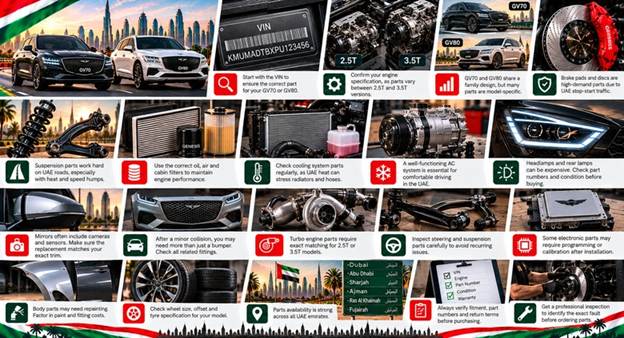
Start with the VIN. Then confirm the model year, engine, drivetrain and exact part number.
It sounds fussy. It is cheaper than discovering the mistake after the car is already on a workshop lift.
GV70 and GV80 are not simply smaller and larger versions
The GV70 is the more compact SUV, while the GV80 sits higher in the range and uses a larger SUV platform. Their parts demand therefore has a different shape.
The GV70 commonly brings buyers looking for brakes, suspension parts, filters, lighting, sensors, cooling-system parts and body fittings. The GV80 adds more expensive assemblies, larger brake and suspension hardware, advanced electronic equipment and, depending on specification, more complex drivetrain-related parts.
That difference matters in the UAE because labour and diagnostic time can become significant once a repair moves beyond a straightforward mechanical replacement.
Know which GV70 you actually own
The UAE-market GV70 can be fitted with different petrol engines, including 2.5-litre turbo and 3.5-litre turbo versions. Genesis lists the 2.5 Turbo at 304 PS and 43.0 kg·m of torque, while the 3.5 Turbo is listed at 380 PS and 54.0 kg·m.
That is not trivia.
A quotation for an air-intake part, cooling part, engine sensor, turbo-related part or exhaust item should be checked against the actual engine rather than the badge alone.
If a seller asks only, “GV70, which year?”, that is not enough for many engine-specific parts.
The GV80 needs even tighter specification checking
Genesis lists the GV80 with 2.5 Turbo and 3.5 Turbo petrol engines, producing 304 PS and 380 PS respectively in the cited Middle East specification. The GV80 also uses AWD configurations in the specification shown by Genesis, with an eight-speed automatic transmission.
So a GV80 parts request should normally include:
- VIN
- model year
- engine
- drivetrain
- trim
- part number, if available
- photograph of the existing part
- registration or specification information where relevant
The more expensive the part, the less sensible it becomes to guess.
Quick buying check before you spend anything
Keep this short checklist beside you when ordering:
- Match the VIN.
- Confirm engine and drivetrain.
- Compare the complete part number.
- Ask whether the number has been superseded.
- Check GCC specification versus imported specification.
- Ask whether programming or calibration is required.
- Confirm condition if buying used.
- Check the return terms before payment.
- Calculate delivery, VAT and workshop labour.
- Keep the old part until the replacement is fitted and tested.
That last point gets ignored surprisingly often. Then a fitment dispute appears, and the useful evidence has already been thrown into the bin.
The common parts buyers actually look for
Brake pads and discs
Brake parts are among the easier GV70 and GV80 purchases to understand, but they still deserve proper application checking.
The important details include front versus rear, engine and brake package, disc dimensions and whether the vehicle carries a particular performance or option package.
A GV80 is heavier than a GV70, so brake hardware should not be selected merely because the catalogue photograph looks identical.
For Dubai traffic, frequent stop-start driving and long periods of creeping through congestion can also make brake wear more relevant than the odometer suggests. A vehicle doing 60,000 km mostly on open roads is not necessarily equivalent to one that has spent those kilometres crawling through Sheikh Zayed Road traffic.
Suspension parts take UAE roads personally
Bushes, control arms, links, mounts, shock absorbers and related suspension parts work hard on UAE roads.
Heat is one thing. Road surfaces, speed humps, kerbs, potholes and repeated low-speed impacts add another layer.
For a GV70, a vague front-end knock might eventually lead to a relatively modest suspension repair. On a GV80, especially one carrying larger wheels, the bill can grow quickly because several associated parts may have developed wear together.
Do not automatically replace everything.
Ask the workshop to isolate the play first.
Engine filters are simple until the wrong one arrives
Oil, air and cabin filters are routine purchases, but “routine” should not become “careless”.
A filter may look close enough while having different dimensions, sealing surfaces or application details. That matters particularly when buying online and relying on a stock photograph.
For routine servicing, match the VIN or exact part number wherever possible. Keep a record of the installed filter reference as well; it makes the next purchase considerably less painful.
Cooling-system parts deserve more attention in UAE summers
Radiators, coolant hoses, thermostats, expansion tanks, cooling fans and related parts live in a harsh thermal environment.
The UAE summer does not need to be dramatized. Park the car outside, switch on the air conditioning, sit in traffic, and the cooling system has very little opportunity to relax.
For a GV70 or GV80 showing unexplained temperature changes, coolant loss or fan behaviour that seems unusual, diagnose the system before ordering a large pile of parts.
A leaking hose and a failing radiator are not the same repair.
Air-conditioning parts are not just comfort items here
A weak air-conditioning system in Britain is annoying.
In Abu Dhabi in August, it is a mechanical problem with a human being sitting inside the vehicle.
GV70 and GV80 owners may eventually need cabin blower parts, compressors, condensers, sensors, actuators, filters or related electrical parts. But refrigerant-related symptoms can have several causes.
Do not let a workshop replace an expensive compressor simply because the air is warm.
Pressure testing, electrical checks and system diagnosis should come first.
Headlamps and rear lamps can become expensive mistakes
Modern Genesis lighting assemblies are not the sort of item you want to buy casually.
A damaged lamp may involve more than the visible housing. Depending on the specific system, there can be control electronics, wiring, sensors or calibration considerations.
Before ordering a used lamp, ask for:
- Exact part number
- Connector condition
- Mounting-tab condition
- Lens condition
- Moisture history
- Donor vehicle details
- Whether the assembly has been tested
A cheap lamp with cracked mounts is not cheap once the workshop starts trying to make it fit.
Mirrors contain more technology than they appear to
A wing mirror can contain electric adjustment, heating, folding, cameras, blind-spot-related equipment and other trim-specific features.
This is where the old “it came from a GV70” argument falls apart.
The correct question is not whether it came from a GV70. It is whether it matches your GV70's exact equipment.
For camera-equipped mirrors, programming or calibration may also enter the repair bill.
GV70-specific buying logic
GV70 front-end parts
The GV70's front end combines bodywork, lighting, sensors and trim in a tightly packaged area.
After a minor front collision, a buyer may need more than a bumper cover. Brackets, grilles, lamps, radar-related parts, wiring, parking sensors and mounting hardware can all become part of the repair.
This is why buying one visible piece online can be misleading.
Get the damage assessed first, then build the parts list around what is actually broken.
GV70 turbo-engine parts
For the 2.5T and 3.5T versions, engine-related purchases need especially careful specification checking. Genesis confirms that both engine options are offered in the relevant Middle East performance information.
If buying a turbocharger-related part, intercooler, pipe, sensor or actuator, compare the complete number rather than relying on engine family names.
And if an engine has suffered serious failure, do not jump straight to a replacement assembly.
Compression and leak-down testing can tell you whether the bottom end, valves or cylinders are actually implicated. A scan tool can add another layer of evidence, but neither test should be treated as magic on its own.
GV70 suspension and steering parts
The GV70's steering and suspension deserve a physical inspection before parts are ordered.
Ask the technician to check wheel play, bush movement, ball joints, links, shock leakage and tyre wear pattern. Uneven tyre wear can point towards alignment or suspension issues rather than simply “bad tyres”.
That distinction saves money.
A parts seller can provide a control arm. They cannot, by themselves, tell you whether that control arm is actually the source of the noise.
GV70 electronic parts
Electronic parts create a different buying problem.
A sensor can be physically identical while carrying different software, connector or application requirements. Cameras, control modules, radar-related equipment and some vehicle electronics may require programming, calibration or system configuration after installation.
Genesis also operates vehicle software and OTA services across supported models, including the GV70 and GV80, which shows how much software now sits alongside the physical parts in these vehicles.
So ask one uncomfortable question before buying:
Will this part work immediately after installation, or does the workshop need to initialise it?
That answer can change the real price.
GV70 body parts
Doors, bonnet panels, wings, bumpers, grilles and trim pieces are easier to source when the exact model year and specification are known.
Colour creates another trap.
A used body panel may carry the correct shape but still require repainting. A supposedly inexpensive panel can therefore become:
part price + transport + preparation + paint + fitting + blending.
That is the number worth comparing.
GV70 wheel and tyre-related parts
Do not treat wheels as purely cosmetic.
Check wheel size, offset, tyre specification, brake clearance and the vehicle's exact configuration. Genesis catalogues and specifications can change by model and market, so a wheel advertised as “GV70 original” should still be verified against the VIN or exact specification.
For a used wheel, inspect the inner barrel as well as the face.
A polished wheel can hide a previous impact.
GV80-specific buying logic
GV80 brake and suspension assemblies
The GV80's larger SUV format means brake and suspension repairs can become materially more expensive when several parts are worn together.
If the steering wheel vibrates under braking, measure the discs and inspect the braking system rather than simply ordering pads.
If the vehicle knocks over bumps, identify whether the noise comes from a link, bush, mount, control arm or another source.
Luxury SUV ownership does not make diagnosis optional.
It makes bad diagnosis more expensive.
GV80 engine parts
The GV80 2.5T and 3.5T engines have different specifications, and Genesis lists the respective outputs at 304 PS and 380 PS in its Middle East performance information.
That difference should follow every serious engine-parts quotation.
If buying a used engine, ask for the donor VIN, engine code or identification information, mileage evidence, compression results where available, and a written warranty.
“Low mileage engine” is not enough.
Low mileage from where? Stored how? Was the donor vehicle crashed, flooded, overheated or dismantled after an electrical failure?
Those questions matter.
GV80 transmission-related parts
Transmission repairs can go from manageable to unpleasant very quickly.
Before buying a used gearbox or transmission assembly, establish the actual fault. Scan the vehicle, inspect fluid condition where applicable, check for leaks and identify whether the problem is mechanical, hydraulic, electronic or calibration-related.
A replacement transmission without diagnosis is gambling with workshop labour.
And labour is usually the part you cannot return.
GV80 AWD-related parts
Genesis describes GV80 AWD systems and electronic limited-slip differential technology as part of its traction and terrain capability.
That means drivetrain-related parts deserve careful identification.
Do not assume that an AWD-related assembly from another market or model year will automatically match.
Check the complete part number, drivetrain specification and software requirements before purchase.
GV80 lighting and electronic modules
The GV80 can carry sophisticated lighting, camera, safety and infotainment equipment.
When one electronic part fails, the visible symptom may not identify the failed unit.
For example, a parking-system warning does not automatically mean a parking sensor is defective. Wiring, control units, connectors and calibration can also enter the picture.
The workshop should establish the fault before the seller gets the order.
GV80 interior and infotainment parts
Screens, switches, controllers, seat modules, audio equipment and trim pieces are increasingly expensive to buy incorrectly.
A used screen may power up yet fail to match the vehicle configuration. A seat module may require configuration. A switch assembly can differ by trim.
Ask whether the replacement is plug-and-play.
If nobody can answer that confidently, the price comparison is incomplete.
Genuine, OEM, aftermarket, used or reconditioned?
Genuine Genesis parts
Genuine Genesis spare parts in UAE are the straightforward choice when fitment, safety and manufacturer specification are the priority.
Genesis states that its warranty covers new vehicles for 60 months from original retail delivery or first use, subject to the stated conditions and exclusions; commercial use has a separate 36-month/200,000 km limit.
For safety-critical parts, complex electronics and expensive assemblies, that manufacturer-backed route can be worth the additional cost.
Especially when the alternative is fitting something uncertain and then paying twice.
OEM is not automatically the same thing as genuine
This distinction gets blurred in online listings.
“Genuine” generally refers to the manufacturer-branded part supplied through the manufacturer's parts system. “OEM” is often used for a part made by an original-equipment supplier, but the exact meaning depends on the seller and market.
So ask:
Who made it? What is the exact number? What packaging does it come in? What warranty is offered?
A box labelled “OEM quality” does not answer those questions.
Aftermarket parts can make sense
Not every GV70 or GV80 part needs to carry a Genesis label.
For some non-safety-critical maintenance items, a reputable aftermarket manufacturer can offer sensible value, provided the part is genuinely suitable for the vehicle.
This is where the seller's technical confidence matters.
If the conversation is simply “yes, it fits” without asking for the VIN, engine or part number, be cautious.
Used genuine parts need a donor story
A used part is not merely “old”.
Its history matters.
For a used GV70 or GV80 engine, gearbox, lamp, module or suspension assembly, ask for donor information and inspect the physical condition before installation.
A donor vehicle that was dismantled after a rear-end collision may be useful for some front-end parts. A flood-damaged donor is a different proposition altogether, particularly for electronic parts.
No history? Price accordingly.
Reconditioned parts sit somewhere in the middle
A properly reconditioned gearbox, turbocharger or other major assembly can make financial sense, but “reconditioned” needs definition.
What was replaced?
What was measured?
Was the assembly tested?
What warranty applies?
A rebuilt part without documentation is simply a used part with a nicer adjective.
That may sound harsh. It is also why written details matter.
A simple choice matrix
| Part situation | Sensible first option | What to verify |
| Air filter / routine service | Genuine or reputable aftermarket | Exact application |
| Brake parts | Genuine or proven quality alternative | Brake package and dimensions |
| Suspension arm | Genuine, OEM or reputable aftermarket | VIN and physical fault |
| Headlamp | Genuine or verified used | Part number, electronics, mounts |
| Engine | Genuine/new, tested used or professionally rebuilt | Compression, leak-down, history |
| Gearbox | Genuine/reconditioned/tested used | Fault diagnosis and warranty |
| Electronic module | Genuine or tested exact-match used | Programming/calibration |
| Body panel | New, used or repairable original | Shape, colour, condition |
The UAE changes the buying equation
Dubai traffic can alter wear patterns
A Dubai car can accumulate kilometres without travelling very far in a straight line.
Traffic lights. Queues. Air conditioning. Short journeys. Parking manoeuvres. Repeated braking.
That usage can produce different wear from a vehicle that spends most of its life cruising between emirates.
When assessing a used GV70 or GV80 part, ask how the donor vehicle was used, not just how many kilometres it travelled.
Abu Dhabi use can be very different
A vehicle based around Abu Dhabi may spend more time on longer roads, but that does not automatically mean lower wear.
High-speed driving, heavy air-conditioning demand, long-distance commuting and occasional desert or rough-road use can all affect different parts in different ways.
The useful question is always:
What did the vehicle actually do?
Mileage is only one clue.
Sharjah adds another kind of stop-start life
Dense urban driving can put repeated stress on brakes, cooling systems, steering and suspension.
For a GV70 or GV80 used primarily for commuting, family transport and school runs, annual mileage can look perfectly ordinary while the number of braking and heat cycles is considerably higher.
That is why buying a low-mileage used part without asking about donor usage can be misleading.
Do not ignore Ajman, RAK, Fujairah and the northern emirates
Parts logistics are not limited to Dubai.
A buyer in Ajman or Ras Al Khaimah may be comparing local workshop installation with a part delivered from another emirate. Fujairah buyers may also face different delivery timing depending on stock location.
The important figure is the landed, fitted cost, not the cheapest online number.
A part that saves AED 300 but adds a long delay and extra workshop handling may not have saved anything meaningful.
UAE heat affects more than engines
Heat is often discussed as though only the engine cares.
Not true.
Rubber parts, batteries, wiring insulation, seals, plastics, cooling equipment, air-conditioning systems and electronics all operate in a demanding environment.
This does not mean every GV70 or GV80 will suffer premature failure.
It means a used part's storage and operating history deserves attention.
A module sitting in an air-conditioned warehouse is not the same proposition as one removed from a neglected outdoor vehicle.
GCC specification versus imported specification
This is one of the easiest ways to buy the wrong part.
A Korean-market, US-market or other imported GV70/GV80 can differ from a UAE/GCC vehicle in equipment, software, lighting, sensors, emissions hardware or trim.
The badge may be identical.
The part number may not be.
When the vehicle is imported, make that fact obvious at the beginning of the enquiry rather than mentioning it after payment.
VIN, part numbers and superseded references
VIN verification should happen before the quotation
Send the VIN before discussing final fitment.
Genesis provides model catalogues for the GV70 and GV80, but the manufacturer's own catalogue also makes clear that specifications can vary by model and country.
That is the useful lesson.
A catalogue is a starting point. The VIN narrows the answer.
The full part number matters
Do not send only the first few digits.
Part numbers can contain suffixes, revisions and application-specific references. A small character difference can separate one configuration from another.
If the seller cannot identify the complete number, ask for clarification before ordering.
Screenshots are useful. Clear photographs are better.
Superseded part numbers can confuse buyers
Manufacturers sometimes replace an older part number with a newer reference.
That does not automatically mean the old number was wrong. It may mean the newer number is the current service replacement.
Ask the seller to confirm:
- Original number
- Current number
- Whether the number is superseded
- Whether the new number replaces the old one
- Whether any additional fitting part is required
This little check can prevent a perfectly genuine part from being rejected simply because the buyer searched using an old reference.
Photograph the connector, not just the part
For electronics, take photographs of the connector, mounting points, labels and wiring.
A beautiful front-facing photograph of a module tells you very little if the rear connector is different.
The same principle applies to lamps, mirrors, sensors and some engine-related parts.
Turn it around.
Look underneath.
Read the label.
That is where the useful information usually hides.
Testing expensive parts before installation
Used engines need more than a mileage claim
If buying a used GV70 or GV80 engine, request evidence.
Compression testing should ideally be carried out across all cylinders, with results interpreted as a set rather than chasing one magical number. Large differences between cylinders can be more concerning than a modestly lower absolute reading, depending on the engine and test conditions.
A leak-down test can go further by helping identify where cylinder pressure is escaping.
Ask for the actual test sheet.
“Engine tested” is not a test result.
Scan the car before replacing electronic parts
If a warning light appears, the workshop should record fault codes before dismantling the vehicle.
Clear the codes only after recording them.
Then test the relevant circuit, connector, sensor or module.
Otherwise, parts replacement becomes guesswork.
A scan tool is not a crystal ball either. It identifies clues and system faults; the technician still has to interpret them.
Test used gearboxes properly
For a used gearbox, ask about:
- Donor mileage
- Donor VIN
- Transmission identification
- Fluid condition
- External leaks
- Previous repair history
- Bench testing, if available
- Warranty duration
- What the warranty covers
And get the original fault diagnosis in writing.
If the old gearbox has not been properly diagnosed, a replacement unit may simply move the problem somewhere else.
Electronics may require calibration
Some replacement parts are physical. Others are physical and software-dependent.
Cameras, sensors, control modules and certain driver-assistance-related equipment can require calibration or programming after installation.
Genesis's current OTA support also covers GV70 and GV80 vehicles, reinforcing that software is now part of normal vehicle operation rather than an afterthought.
Ask for the programming cost before buying.
Otherwise, the online price can look wonderfully cheap right up until the workshop invoice arrives.
Keep the failed part until the repair is proven
Do not let the old part disappear immediately.
Keep it until the replacement is fitted, programmed if necessary, tested and confirmed.
This is particularly useful when:
- A return is possible.
- Fitment is disputed.
- The new part develops a problem.
- The workshop needs to compare connectors.
- A warranty claim requires evidence.
It is a small habit. It can save a surprisingly large argument.
Price, labour and the real cost
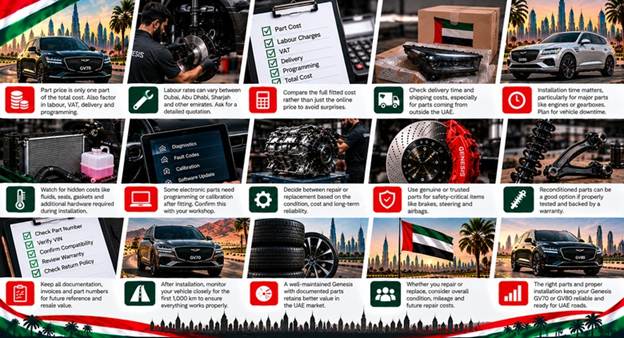
Part price is not repair price
Suppose a replacement electronic module costs AED 1,500.
That does not mean the repair costs AED 1,500.
You may also have:
AED 1,500 part + diagnosis + delivery + VAT + installation + programming + calibration.
The same applies to bodywork, suspension, engines and gearboxes.
Always ask for the fitted figure.
UAE labour can vary sharply
A realistic quotation should separate the part from workshop labour.
| Repair type | What usually adds labour |
| Brake pads | Wheel removal, cleaning, fitting and checks |
| Suspension arm | Removal, replacement and alignment |
| Headlamp | Removal, fitting and possible calibration |
| Cooling-system part | Coolant draining, bleeding and testing |
| Engine | Removal, installation, fluids and diagnostics |
| Gearbox | Removal, installation, fluid and adaptation |
| Electronic module | Fitting, coding/programming and testing |
Dubai and Abu Dhabi may have different labour rates from independent workshops in Sharjah, Ajman or Ras Al Khaimah. The cheapest hourly rate is not necessarily the cheapest repair.
VAT and delivery can distort online comparisons
An online listing can appear substantially cheaper than a workshop quotation.
Then shipping appears.
Then VAT.
Then the workshop charges for fitting.
Then programming.
Then alignment.
Compare like with like.
The correct comparison is not:
website price versus workshop price.
It is:
delivered part + all required installation work versus the alternative delivered-and-fitted option.
Installation time matters when the vehicle is a daily driver
A routine filter may take little time.
A body repair can stretch longer.
An engine or gearbox replacement can keep the vehicle off the road for considerably longer, particularly if the part needs to be sourced from outside the UAE or programming is required after installation.
For a family SUV, that downtime has a practical cost.
Taxi fares. Rental vehicle. Missed work. Fleet disruption.
Nobody puts those figures on the part label, but they still count.
Hidden costs appear after the purchase
Watch for:
- Shipping
- VAT
- Customs or import-related charges where applicable
- Diagnostic fees
- Programming
- Calibration
- Wheel alignment
- Fluids
- Seals and gaskets
- New fasteners where required
- Paint and blending
- Additional damaged mounting hardware
A quotation that leaves all of these as “to be confirmed” is not yet a final quotation.
Buying, fitting and living with the repair
When repair makes more sense than replacement
A damaged part does not automatically need replacing.
A workshop should decide whether the item is repairable, serviceable or genuinely failed.
For example, a suspension arm with worn bushes may have a different solution from an electrically failed steering-related module. A damaged bumper may be repairable while a cracked structural mounting area may not be.
The decision should follow inspection, not the seller's available stock.
When replacement is the cleaner option
Replacement becomes more attractive when:
- The part is safety-critical.
- Internal damage cannot be reliably assessed.
- Repair cost approaches replacement cost.
- A repair offers little or no warranty.
- The vehicle needs predictable reliability.
- Labour to rebuild the old part is excessive.
This is especially relevant for daily-driven GV70 and GV80 vehicles where another failure a month later is more than an inconvenience.
When should you choose used?
Used parts can be excellent value when the donor history is strong and the part is straightforward to inspect.
Body panels, wheels, some trim pieces and certain mechanical assemblies can make sense.
Electronics require more caution.
High-value engines and gearboxes require much more caution.
The more difficult the part is to inspect before installation, the more valuable a proper warranty becomes.
When does reconditioned become attractive?
Reconditioned parts can make sense for major assemblies where a professionally rebuilt unit is materially cheaper than new while still carrying meaningful warranty protection.
But ask what has actually been rebuilt.
A gearbox with documented internal replacement, measurement and testing is one thing.
A gearbox cleaned, painted and photographed beautifully is another.
Packaging is not engineering.
First 1,000 km after major installation
The first 1,000 km should not be treated as a ceremonial period.
For an engine replacement, monitor coolant level, oil level, temperature, warning lights, leaks, idle quality and unusual vibration.
For a gearbox, pay attention to shift quality, engagement delays, noises and warning messages.
For suspension or steering work, watch steering-centre position, tyre behaviour, pulling and abnormal noise.
For electronic parts, confirm that the original warning has disappeared and all affected functions operate correctly.
If something feels wrong, take it back early.
Warranty red flags
Be wary when a seller says:
- “No need for VIN.”
- “All GV80 parts are the same.”
- “Used, but no idea about donor.”
- “No testing available.”
- “No returns after installation.”
- “Programming is your problem.”
- “Warranty only if the part never fails.”
- “We cannot provide the part number.”
A warranty is useful only when its conditions are clear enough to enforce.
Ask what is covered, for how long, and who pays removal and refitting if the part fails.
Documentation is part of the repair
Keep the invoice.
Keep the part number.
Keep the donor information.
Keep test reports.
Keep the warranty.
Keep photographs before installation.
For a premium SUV, this paperwork becomes useful later when you sell the vehicle. It also helps the next workshop understand what has already been changed.
A vague verbal promise disappears remarkably quickly.
A dated invoice does not.
Resale value and the quality of the repair
A GV70 or GV80 repaired with properly documented parts and workmanship is easier to explain to a future buyer.
That does not mean every genuine part magically increases resale value.
It means documented maintenance reduces uncertainty.
For a luxury vehicle, uncertainty is expensive. Buyers start wondering what else was repaired cheaply, what was programmed incorrectly, or why the previous owner cannot produce an invoice.
Good records do not turn a worn car into a new one.
They do make the story cleaner.
Should you repair the SUV or replace it?
This decision needs numbers rather than emotion.
| Question | Repair GV70/GV80 | Consider replacing vehicle |
| Major repair | Still manageable | Several major systems failing |
| Service history | Strong | Poor or incomplete |
| Body condition | Good | Multiple structural/body issues |
| Electronics | Mostly healthy | Repeated expensive faults |
| Mileage | Reasonable for condition | High with widespread wear |
| Resale outlook | Still credible | Falling rapidly |
| Repair warranty | Clear | Uncertain |
| Total annual repair burden | Predictable | Increasing sharply |
A single expensive repair does not automatically justify selling the vehicle.
Several unrelated expensive repairs in a short period? Different story.
The practical buying rule
For online Genesis parts shopping in the UAE, the safest sequence is simple:
VIN → exact specification → part number → supersession check → condition → warranty → delivered price → installation requirements → final fitted cost.
That order matters.
For a GV70, pay particular attention to engine, trim, electronics and suspension specification. For a GV80, add drivetrain, larger mechanical assemblies and the cost of more involved installation to the calculation. Genesis's UAE catalogue confirms that both SUVs have dedicated model information and that specifications can vary by model and country.
For buyers comparing available options, PartFinder UAE can be treated as part of the wider fitment-checking process rather than as a substitute for VIN verification.
The seller should still prove the part fits.
FAQs
Categories
- Audi
- BMW
- Car Accessories
- Car Tips
- Ford
- Land Rover
- Mazda
- Range Rover
- Top 10
- UAE Car Parts
- Used Car Parts
- Toyota
- Replacement Engines
- Nissan
- Hyundai
- Mitsubishi
- Volkswagen
- Honda
- Kia
- Chevrolet
- Dodge
- Jeep
- Subaru
- Renault
- Lexus
- Mercedes
- Suzuki
- Hummer
- Porsche
- Infiniti
- Peugeot
- GMC
- Mini
- Volvo
- Replacement Gearboxes
- MG
- Jaguar
- Skoda
- Cadillac
- Daihatsu
- Fiat
- German Car Parts
- Japanese Car Parts
- Aftermarket Car Parts
- Genuine Car Parts
- New Car Parts
- Reconditioned Car Parts
- European Car Parts
- American Car Parts
- Korean Car Parts
- British Car Parts
- Chinese Car Parts
- Sports/Exotic Car Parts
- Luxury Car Parts
- Performance Car Parts
- SUV/4x4 Spare Parts
- Truck Spare Parts
- EV Car Parts
- Hybrid Car Parts
- Auto Spare Parts in UAE
- Tesla
- Isuzu
- Ram
- Ferrari
- Bentley
- Lamborghini
- Genesis
- Maserati