Genesis Spare Parts in UAE: Guide for G70, G80, G90, GV70 and GV80
September 15, 2026
Buying the Right Genesis Part Starts with Identification
A cheaper Genesis part can become the expensive option
The dangerous Genesis spare-part purchase is rarely the part that looks obviously wrong. It is the part that looks almost exactly right.
A G80 owner in Dubai might find a suspension arm, headlight, control module or cooling part at a noticeably lower price and assume the saving is straightforward. Then the workshop discovers a different connector, different specification, different revision or a calibration requirement that was never included in the quotation.
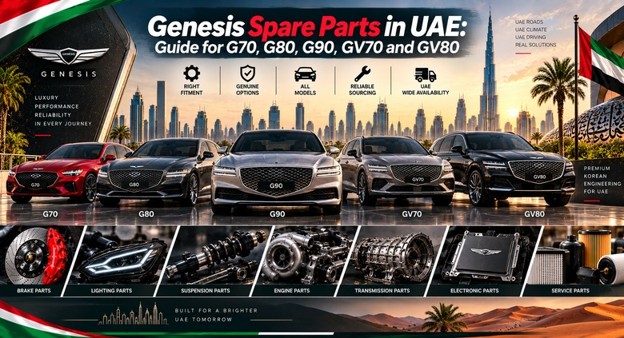
Genesis sells several closely related luxury models in the UAE, but the range is not one interchangeable parts catalogue. The current UAE range includes the G70, G80, G90, GV70 and GV80, alongside other derivatives, and Genesis itself warns that specifications can vary by model and country.
So the sensible order is:
identify the vehicle → identify the exact part → confirm compatibility → inspect condition → compare total cost.
Price comes later.
The five models need five different buying strategies
A G70 is a relatively compact performance-oriented sedan. The G80 is a larger executive saloon with different suspension and electronic requirements. The G90 moves further into chauffeur-oriented luxury, with features such as rear-wheel steering and advanced suspension technology on applicable versions.
The GV70 and GV80 bring SUV-specific concerns: larger wheels on some versions, different suspension loads, greater vehicle mass and, in the GV80's case, available 2.5-litre and 3.5-litre turbo engines.
That distinction matters when sourcing Genesis spare parts in UAE.
A brake part that is straightforward to identify on one version can become a specification problem on another. The same applies to suspension, cooling, electronics and drivetrain parts.
The quick buying checklist
Before paying for a Genesis spare part, establish:
- Full VIN
- Exact model
- Model year
- Engine
- Transmission
- Drivetrain
- GCC or imported specification
- Trim and major option package
- Exact part number
- Superseded number where applicable
- New, genuine, OEM, used, reconditioned or aftermarket condition
- Donor VIN for used parts
- Donor mileage
- Removal reason
- Actual photographs
- Test evidence for major assemblies
- Coding or calibration requirements
- Warranty
- Delivery time
- Complete installed cost
This sounds excessive for a simple filter.
It is not excessive for a control module, turbocharger, suspension assembly, gearbox, headlight or engine.
Genesis provides model-specific catalogues for a reason
The Middle East Genesis catalogue centre separates the G70, G80, G90, GV70 and GV80 into their own catalogues, rather than treating the range as one generic vehicle family.
That is useful when sourcing parts because the catalogue identity is the beginning of the fitment trail.
A buyer should be able to move from:
VIN → model → configuration → catalogue application → part number → replacement part.
If a seller cannot explain that chain, the buyer is relying too heavily on appearance.
What “fits Genesis” should actually mean
A proper fitment claim should mean more than:
“It is for a Genesis.”
It should establish that the part is suitable for the exact vehicle configuration.
That can involve:
- Physical mounting
- Dimensions
- Connector type
- Software
- Calibration
- Engine configuration
- Drivetrain
- Suspension package
- Brake package
- Market specification
- Production revision
This becomes particularly important with imported cars, because the same model can have different equipment depending on market.
Genesis G70 Needs Performance-Specific Reasoning
G70 parts are affected by engine and drivetrain choice
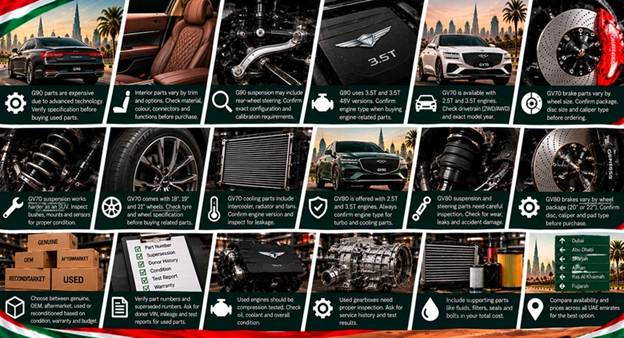
Genesis documentation identifies G70 configurations with 2.5-litre turbo and 3.3-litre turbo engines, and the model can be associated with rear-wheel-drive and all-wheel-drive configurations depending on specification and market. Genesis also lists an eight-speed automatic transmission.
That immediately creates several fitment questions.
A drivetrain part should not be ordered simply because the advertisement says “G70”.
Confirm:
- Engine
- RWD or AWD
- Model year
- Sport package where relevant
- Brake package
- Suspension specification
The difference can be small in a listing and expensive in a workshop.
G70 suspension parts deserve closer inspection
The G70 can be equipped with electronically controlled suspension, while certain performance specifications include additional chassis and braking equipment.
For a used suspension part, check:
- Exact front or rear position
- Left or right side
- Part number
- Sensor connections
- Mounting points
- Bushing condition
- Leakage where applicable
- Previous accident damage
- Whether calibration is required
A used suspension assembly removed from a crashed G70 should not be priced as though it came from a clean-running donor.
G70 brakes can change with specification
Sport-oriented G70 versions can use larger or upgraded braking hardware, including Brembo equipment on applicable configurations.
That means a buyer should establish the brake package before ordering:
- Disc
- Caliper
- Pad
- Sensor
- Mounting hardware
A photograph of a red caliper is useful.
It is not a part-number confirmation.
G70 turbo-engine parts need engine identification
The 2.5T and 3.3T engines have different architecture and output characteristics. Genesis lists the 2.5T at up to 304 PS in relevant documentation and the 3.3T at higher output depending on specification.
Therefore, “G70 turbo parts” is not specific enough for:
- Turbocharger
- Intercooler
- Intake parts
- Fuel-system parts
- Cooling parts
- Engine sensors
- Exhaust parts
The engine code and VIN should drive the order.
G70 is particularly sensitive to driving history
A G70 used enthusiastically on Dubai roads can have a very different wear profile from one used for commuting between home and office.
For a used performance part, investigate:
- Track or spirited-driving history where known
- Tyre condition
- Brake wear
- Suspension condition
- Accident history
- Modification history
- Service records
Low mileage does not automatically cancel those factors.
Genesis G80 Needs Executive-Sedan Logic
G80 parts need attention to comfort electronics
The G80 is not simply a larger G70.
Genesis describes the G80 with electronically managed suspension technology, including Preview-ECS on applicable versions, which uses camera and navigation information to adjust suspension damping.
That means a suspension-related fault can involve more than the physical damper.
A workshop may need to inspect:
- Damper
- Sensor
- Wiring
- Camera input where relevant
- Control system
- Stored fault codes
- Calibration
Replacing the most visible part first is not necessarily the correct diagnosis.
G80 engine choice changes the parts catalogue
Genesis documentation identifies 2.5-litre turbo and 3.5-litre turbo powertrains for the G80.
The two engines should therefore be treated separately when buying:
- Cooling parts
- Turbo-related parts
- Intake components
- Engine sensors
- Mounts
- Exhaust components
- Engine assemblies
A seller using “G80 2022–2025” as the entire compatibility description has not provided enough information for a major engine-related purchase.
G80 cooling deserves UAE-specific attention
Dubai traffic changes how the vehicle experiences heat.
A G80 spending hours in slow-moving traffic with the air conditioning operating continuously has a different thermal workload from one cruising at motorway speed.
For a cooling-system replacement, investigate:
- Radiator
- Fans
- Condenser
- Intercooler where applicable
- Hoses
- Thermostat
- Coolant condition
- Temperature data
- Pressure-test results
The workshop should establish whether the radiator is actually the failed part before replacement.
G80 lighting is not just a body part
Modern Genesis lighting assemblies can contain electronics, control functions and vehicle-specific wiring.
For a used headlight, inspect:
- Lens
- Housing
- Mounts
- Moisture
- Connector
- Control module
- Part number
- Internal damage
- Previous repair
If programming or calibration is required, include that in the original quotation.
A “headlight price” without installation and electronic setup can be misleading.
G80 imported cars require extra verification
An American-market G80, Korean-market G80 and GCC-specification G80 should not automatically be assumed identical.
Check:
- VIN
- Market
- Engine
- Lighting configuration
- Emissions equipment where applicable
- Software
- Safety equipment
- Wiring
- Factory options
Genesis explicitly notes that specifications can vary according to model and country.
That is a useful warning for UAE buyers dealing with imported vehicles.
Genesis G90 Needs Luxury-Electronics Discipline
G90 parts are expensive because the systems are sophisticated
The G90 sits at the top of the conventional Genesis sedan range in the UAE, with the current UAE Genesis site listing it above the G70 and G80 in starting price.
That does not mean every G90 part is expensive.
It does mean that a failed electronic, suspension or comfort-system part can carry more installation complexity.
A cheap used module is only attractive if the workshop can verify its compatibility.
G90 suspension should be diagnosed as a system
Genesis describes G90 technologies including rear-wheel steering and advanced suspension control.
If a G90 develops abnormal ride behaviour, the workshop should establish whether the fault originates in:
- Mechanical suspension hardware
- Electronic control
- Sensor
- Wiring
- Steering system
- Calibration
- Related chassis system
Replacing an expensive assembly without diagnosis is particularly unattractive on a G90.
G90 engine parts require version confirmation
Genesis currently describes G90 versions using a 3.5T engine and a 3.5 Turbo 48V electric-supercharger configuration on applicable long-wheelbase versions. The manufacturer lists different outputs for those systems.
That distinction matters.
A “G90 3.5 engine part” listing can still be insufficient.
Ask whether it belongs to:
- Standard 3.5T
- 3.5T 48V electric-supercharger system
- Exact model year
- Exact vehicle configuration
G90 rear-wheel steering adds another compatibility question
A G90 equipped with rear-wheel steering has an additional chassis system that a basic sedan may not.
For steering-related used parts, verify:
- Part number
- Rear-axle configuration
- Sensor arrangement
- Electronic control
- Donor vehicle specification
- Calibration requirement
This is a classic case where a part can physically look correct and still be wrong.
G90 interior parts deserve condition documentation
Luxury interior parts are often expensive to replace but can be relatively easy to overlook when buying used.
For:
- Seats
- Door panels
- Switch assemblies
- Screens
- Trim
- Rear-seat controls
- Climate-control interfaces
check:
- Colour
- Material
- Stitching
- Heating/ventilation functions
- Memory functions
- Wiring
- Connector
- Trim level
For a G90, cosmetic similarity is not enough.
Genesis GV70 Has Its Own SUV Buying Logic
GV70 engine choice changes the parts search
Genesis lists GV70 versions with 2.5-litre and 3.5-litre turbo engines. The manufacturer also lists eight-speed automatic transmission and both two-wheel-drive and AWD configurations in its specifications.
That makes engine and drivetrain confirmation essential.
For example, a cooling-system part for a 2.5T should not be assumed suitable for a 3.5T merely because both vehicles are GV70s.
GV70 suspension sees a different workload
The GV70 is a heavier SUV-style vehicle than the G70 sedan.
That affects how a buyer should assess:
- Control arms
- Bushes
- Dampers
- Wheel bearings
- Steering components
- Tyres
- Brake parts
UAE road conditions add another layer. Speed bumps, rough edges, parking ramps and high-temperature operation can expose worn suspension hardware sooner than a simple motorway mileage figure suggests.
GV70 wheel and tyre specification matters
Genesis lists different wheel and tyre sizes across GV70 configurations, including 18-, 19- and 21-inch applications.
That matters when buying:
- Wheels
- Tyres
- Brake components
- Suspension components
- Wheel-arch parts
A seller offering a “GV70 brake kit” should be asked which wheel and brake configuration it came from.
GV70 turbo cooling needs proper diagnosis
Genesis describes the 3.5T GV70 with a water-cooled intercooler and the 2.5T with its own cooling and injection arrangement.
For a cooling-related repair, the workshop should therefore establish:
- Coolant temperature
- Pressure
- Fan operation
- Hose condition
- Intercooler condition where applicable
- Turbo-related symptoms
- Fault codes
This is more useful than simply replacing the most obvious cooling part.
GV70 low mileage needs context
A low-mileage GV70 can still have:
- Old tyres
- Weak battery
- Deteriorated rubber
- Storage-related issues
- Previous accident damage
- Long periods without proper servicing
A used suspension part from a 20,000-km donor that spent years outside may be less attractive than a higher-mileage part from a properly maintained, clean donor.
Mileage is evidence.
It is not a verdict.
Genesis GV80 Needs Heavy-SUV Cost Analysis
GV80 engine variants are important
Genesis documentation identifies 2.5T and 3.5T petrol engines for the GV80, with published outputs of 304 PS and 380 PS respectively in relevant specifications.
That means engine-related sourcing should always identify the exact powertrain.
The same rule applies to:
- Radiators
- Intercoolers
- Turbochargers
- Engine mounts
- Cooling fans
- Sensors
- Exhaust parts
GV80 suspension and weight change the economics
A GV80's larger body and SUV configuration mean that suspension and brake parts deserve a more careful inspection.
For used parts, check:
- Bush wear
- Bent arms
- Shock leakage
- Mounting damage
- Wheel-bearing play
- Accident history
- Corrosion
- Donor mileage
A heavy SUV can hide suspension damage behind perfectly clean bodywork.
GV80 cooling parts need specification checks
The UAE environment makes cooling a practical priority, but the correct part still needs to be identified.
Check:
- Engine version
- Radiator design
- Intercooler
- Fan arrangement
- Hose connections
- Sensor arrangement
- Part number
- Production revision
The GV80 2.5T and 3.5T should not be treated as one generic cooling configuration.
GV80 braking needs wheel-package confirmation
The GV80 is offered with different wheel sizes and equipment packages. Genesis documentation for current versions shows 20- and 22-inch wheel applications on relevant configurations.
That can affect brake clearance and brake-package selection.
Before buying used brakes, establish:
- Disc size
- Caliper
- Pad
- Wheel size
- Axle
- Part number
A brake kit that cannot clear the wheel is not a bargain.
GV80 is where total repair cost becomes especially important
A relatively modest part can turn into a significant workshop invoice once you add:
- Diagnostic work
- Removal
- Supporting parts
- Fluids
- Labour
- Programming
- Calibration
- Alignment
- Testing
That is why the quoted part price should always be separated from the installed repair cost.
Genuine, OEM, Used and Reconditioned Genesis Parts
Genuine Genesis parts have a clear position
Genesis states that its UAE warranty coverage is subject to specified terms and that warranty service is provided through authorised Genesis distributors/retailers. The published warranty also identifies the use of non-genuine Genesis/Hyundai parts or accessories among circumstances that can affect warranty coverage.
For a vehicle still under warranty, that matters.
The buyer should therefore check warranty status before choosing a cheaper alternative.
OEM does not automatically mean genuine
The terms are frequently mixed together.
Genuine means the part is supplied as an original manufacturer part through the relevant route.
OEM describes original-equipment manufacturing relationships, but the label can be used loosely in the independent market.
Aftermarket means an independently produced replacement.
Reconditioned means an existing part has been repaired or rebuilt.
Used genuine means an original part removed from another vehicle.
Those categories should be compared separately.
Used genuine parts can make sense
Used Genesis parts are particularly interesting for:
- Older G70s
- Older G80s
- Body panels
- Interior trim
- Some headlights
- Certain electronic modules
- Rare assemblies
- Expensive parts that can be tested properly
The strongest used part is not necessarily the lowest-mileage one.
It is the one with the clearest history and acceptable remaining life.
Reconditioned parts need evidence
If a seller says a gearbox, steering rack, turbocharger or other major assembly has been “reconditioned”, ask what that means.
Request:
- Rebuild scope
- Replaced internal parts
- Measurements
- Test procedure
- Calibration
- Warranty
- Installation conditions
“Fully rebuilt” is a description.
A test report is evidence.
Aftermarket parts should be judged by category
An aftermarket cabin filter is not the same purchasing decision as an aftermarket brake part.
Risk increases when the part affects:
- Braking
- Steering
- Suspension
- Engine management
- Transmission
- Cooling
- ADAS
- Airbags
- Electronic control
For these parts, manufacturer identity, specification and testing matter much more than a percentage discount.
VIN, Part Numbers and Donor History
VIN verification should happen before the price comparison
Use the VIN to establish:
- Model
- Year
- Engine
- Drivetrain
- Transmission
- Market
- Equipment
- Applicable part number
Genesis's UAE catalogue structure reinforces this model-specific approach.
Do not send a seller only:
“G80 2022 brake parts.”
Send the complete vehicle identification information required to establish the exact application.
Superseded part numbers need explanation
A part number can change during a model's production life.
That does not automatically mean the replacement number is wrong.
A supplier should be able to explain:
Original number → superseded number → current applicable number.
If the seller cannot explain why the numbers differ, pause the order.
Donor VIN is valuable for used Genesis parts
For a used part, request:
- Donor VIN
- Donor model
- Donor year
- Donor mileage
- Accident history
- Removal reason
- Running condition
- Service history where available
This is especially important for:
- Engines
- Gearboxes
- Turbochargers
- Suspension
- Electronic modules
- Steering assemblies
A donor VIN turns an anonymous used part into a traceable part.
Low mileage should be investigated, not celebrated
A donor with 30,000 km may have suffered from:
- Flood exposure
- Long storage
- Accident damage
- Poor maintenance
- Battery failure
- Heat exposure
- Repeated short journeys
A 70,000-km donor with excellent records may actually be the more rational choice.
The mileage should influence the decision.
It should not make the decision by itself.
Photograph the actual part
For an expensive used Genesis part, request photographs showing:
- Part-number label
- Serial number where relevant
- Connectors
- Mounting points
- Seals
- Housing
- Damage
- Corrosion
- Previous repair
- Packaging
Do not accept a generic catalogue photograph as proof of the condition of the actual part.
What the Workshop Should Actually Test
Electronic modules need more than a scan
Before replacing an expensive Genesis control module, the workshop should establish:
- Fault codes
- Power supply
- Grounds
- Wiring
- Connector condition
- Communication
- Live data
- Software compatibility
- Calibration status
Genesis also supports OTA software updates for several current models, showing how software is increasingly part of the vehicle's operating environment rather than an afterthought.
A replacement module may therefore require more than physical installation.
Used engines should receive a proper test package
For a used Genesis engine, consider:
- Compression testing
- Leak-down testing
- Oil inspection
- Coolant inspection
- Borescope inspection where justified
- Cooling-system pressure test
- Diagnostic scan
- Donor history
Compression testing becomes useful when it is comparative.
A workshop should look at cylinder-to-cylinder consistency rather than saying:
“Compression is good.”
A single figure without test conditions or comparison is weak evidence.
Gearboxes need condition evidence
For a used automatic transmission, ask for:
- Donor mileage
- Removal reason
- Fault history
- Oil condition
- Housing condition
- Leakage
- Diagnostic information
- Adaptation information where available
- Road-test evidence where possible
The workshop should also establish whether programming or adaptation is required after installation.
Suspension faults should be reproduced before parts are ordered
If a G90 sits unevenly, a GV80 knocks over speed bumps or a G80 develops unusual ride behaviour, reproduce the fault.
Check:
- Visual condition
- Bushes
- Mounts
- Dampers
- Sensors
- Wiring
- Fault codes
- Ride-height information where applicable
- Alignment
- Calibration
The correct repair is the one that addresses the failure, not simply the part nearest to the symptom.
Cooling faults require pressure and temperature evidence
For a Genesis experiencing overheating or coolant loss, useful tests can include:
- Cooling-system pressure
- Temperature readings
- Fan operation
- Hose inspection
- Thermostat operation
- Coolant condition
- Radiator condition
- Intercooler condition where applicable
- Relevant diagnostic faults
A radiator replacement without establishing why the system overheated is incomplete diagnosis.
UAE Cost, Installation and Long-Term Ownership
Part price and repair cost are different numbers
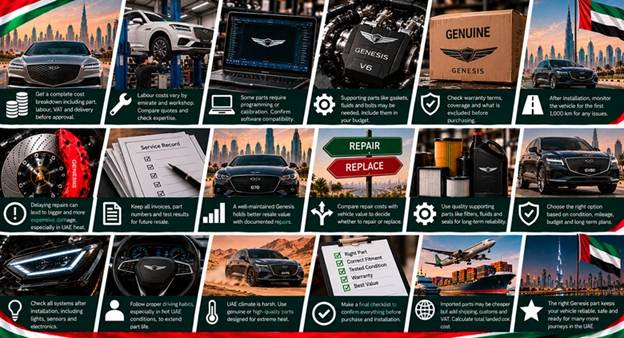
A proper UAE repair calculation should look like:
Part
- delivery
- VAT/customs where applicable
- diagnostics
- labour
- fluids
- seals/gaskets
- bolts/fasteners
- programming
- calibration
- alignment or testing where necessary
= installed repair cost
This is particularly important when comparing local stock against imported parts.
UAE labour varies by workshop capability
There is no useful single “Genesis labour rate” for the UAE.
Dubai, Abu Dhabi and Sharjah have different workshop markets, and the more important distinction is often whether the workshop has the correct diagnostic equipment and experience for the particular Genesis system.
| Job | Cost pressure | Main reason |
| Routine service | Lower | Standard maintenance |
| Brake replacement | Moderate | Parts and labour |
| Suspension repair | Moderate–high | Diagnosis plus alignment |
| Electronic module | High potential | Coding/calibration |
| Gearbox work | High | Labour and adaptation |
| Engine replacement | Very high | Removal, installation and supporting work |
| Complex diagnostic fault | Variable | Diagnosis may take longer than fitting |
These are planning categories, not fixed UAE tariffs.
Current Genesis vehicle prices show why repair economics matter
Genesis's UAE site currently lists starting prices of about AED 168,000 for the G70, AED 203,000 for the G80, AED 302,600 for the G90, AED 219,800 for the GV70 and AED 331,700 for the GV80.
Those are vehicle prices, not spare-part prices, but they provide useful context.
A major repair should be judged against:
- Current vehicle value
- Mileage
- Service history
- Existing faults
- Accident history
- Expected future repairs
- Resale value
The economics of replacing a major GV80 assembly are not the same as replacing a minor G70 part.
Imported parts need a landed-cost calculation
A lower overseas price can disappear once you add:
- Shipping
- Customs or clearance
- VAT
- Local delivery
- Return shipping
- Warranty risk
- Waiting time
For a rare G90 electronic module, importing may still be sensible.
For a common maintenance part, local availability may produce the better total cost.
The comparison should be made using landed price and installed price, not catalogue price alone.
Installation time can change the final bill
A part marked “available” does not mean the vehicle will be repaired immediately.
A realistic sequence can involve:
arrival → inspection → diagnosis confirmation → removal → supporting parts → installation → fluid replacement → programming → calibration → road test → final scan.
For an electronic part, programming may be the bottleneck.
For an engine or gearbox, supporting parts can become the bottleneck.
Supporting parts should be included before approval
A major repair can require:
- Seals
- Gaskets
- Fluids
- Filters
- Bolts
- Mounts
- Hoses
- Clips
- Coolant
- Transmission fluid
- Alignment
Genesis's published warranty also excludes many normal maintenance and wear items, including brake pads, filters, bulbs, belts and other consumables.
That distinction should be reflected in repair quotations.
Warranty red flags should be treated seriously
Ask whether the warranty covers:
- Part failure
- Labour
- Removal
- Refitting
- Diagnostics
- Programming
- Calibration
- Shipping
- Return
- Consequential damage
Genesis's official UAE warranty provides a useful benchmark for clarity: it specifies coverage periods and exclusions and identifies where warranty service must be obtained.
An independent used-part warranty should be equally clear.
First 1,000 km should depend on the part
For an engine:
- Monitor coolant
- Monitor oil
- Watch temperatures
- Check leaks
- Scan for warning codes
For a gearbox:
- Observe shifting
- Watch for hesitation
- Check leaks
- Monitor abnormal noises
For suspension:
- Observe ride height
- Watch for new noises
- Check steering behaviour
- Recheck alignment where appropriate
For electronics:
- Check recurring warnings
- Confirm all functions
- Verify calibration
- Return immediately if faults return
“Drive gently for 1,000 km” is not enough advice.
Cost of delay should be connected to the failure
A small issue does not always become catastrophic.
But some faults can spread.
Examples:
- Coolant leak → overheating
- Worn brake pads → disc damage
- Suspension fault → tyre/alignment wear
- Gearbox fault → progressive internal wear
- Electrical fault → secondary communication problems
- Oil leak → contamination of surrounding parts
The correct response is prompt diagnosis, not panic buying.
Repair or replace the Genesis?
| Situation | Repair | Used replacement | New/genuine replacement |
| Minor mechanical fault | Strong option | Usually unnecessary | May be excessive |
| Electronic module | Specialist-dependent | Possible | Strong option |
| Suspension assembly | Often possible | Attractive if tested | Best where risk is high |
| Used engine | Rebuild may work | Possible | Depends on economics |
| Gearbox failure | Specialist diagnosis | Possible | Higher-cost option |
| Safety-critical brake part | Limited | Carefully assessed | Usually preferred |
| Cosmetic trim | Often practical | Strong option | Depends on value |
The answer depends on the fault, not on a blanket preference for new or used parts.
When replacing the vehicle makes more sense
A major Genesis repair can still be perfectly rational when the rest of the vehicle is excellent.
But reconsider when:
- Multiple expensive systems are failing
- Accident history is serious
- Documentation is poor
- The vehicle has recurring unresolved faults
- Repair cost is approaching a substantial portion of market value
- More major repairs are clearly approaching
The question is not:
“Is the repair expensive?”
It is:
“What will this repair buy me in reliable ownership compared with replacing the vehicle?”
Documentation improves future resale
Keep:
- VIN confirmation
- Original part number
- Replacement part number
- Supersession evidence
- Donor VIN
- Donor mileage
- Diagnostic report
- Test results
- Invoice
- Installation record
- Coding/calibration record
- Warranty
- Photographs
For a luxury Genesis, a documented repair is much easier for the next buyer to understand.
UAE heat should be considered by model
For the G70, pay particular attention to turbo-related heat, brakes, suspension and rubber components when the car is driven hard.
For the G80, consider cooling, suspension electronics, seals and extensive air-conditioning use during urban commuting.
For the G90, electronic and comfort systems deserve additional attention because of the car's higher equipment level.
For the GV70, consider cooling, suspension, tyres and brake wear under SUV usage.
For the GV80, the combination of vehicle mass, turbocharged engines, larger brakes and SUV usage makes cooling, suspension and brake inspection particularly important.
This is more useful than simply saying “UAE heat is harsh”.
Genuine UAE workshop scenario
A GV80 owner receives two quotations for a suspension problem.
The first workshop recommends replacing a major assembly immediately.
The second begins with diagnostic scanning, physical inspection, ride-height checks and suspension inspection.
The second quotation is initially more expensive because it includes diagnosis.
But if the actual fault turns out to be a sensor, connector or smaller part, the additional diagnostic work may save the owner from buying an unnecessary major assembly.
That is the difference between parts replacement and fault diagnosis.
The final Genesis buying decision
For G70, G80, G90, GV70 and GV80 owners, the safest purchasing sequence is straightforward:
Identify the exact vehicle.
Check the VIN.
Confirm the engine and drivetrain.
Verify the exact part number.
Check superseded numbers.
Confirm GCC or imported specification.
Inspect the actual part.
For used parts, investigate the donor.
Test major assemblies.
Separate part price from installed cost.
Confirm programming and calibration.
Get the warranty in writing.
Keep the documentation.
That is where PartFinder UAE should fit into the wider sourcing process: as a way of finding the right part, not as a reason to skip VIN verification, technical checks or cost comparison.
Genesis Part Buying Decision Matrix
| Buying situation | Sensible starting point | Main risk | Essential check |
| G70 brake assembly | New/genuine or verified alternative | Wrong brake package | Caliper, disc, wheel and VIN |
| G70 suspension | Tested used/new | Sensor or specification mismatch | Part number and suspension configuration |
| G80 electronic module | Genuine or tested replacement | Coding | VIN, software and calibration |
| G90 steering part | Genuine/tested used | RWS compatibility | Exact configuration |
| G90 interior module | Used genuine can work | Trim/electronic mismatch | Connector, trim and coding |
| GV70 cooling part | New/verified replacement | Engine mismatch | 2.5T vs 3.5T |
| GV70 suspension | Tested used/new | SUV wear | Donor history and physical inspection |
| GV80 turbo-related part | Exact-engine replacement | Wrong engine application | Engine identification |
| GV80 brakes | New or verified used | Wheel/package mismatch | Disc, caliper and wheel size |
| Any used Genesis engine | Tested used/rebuilt | Hidden internal wear | Compression, leak-down and donor history |
| Any used gearbox | Tested/rebuilt | Internal wear | Fault history, oil and diagnostic data |
| Electronic control module | Genuine/tested replacement | Programming | Software and calibration |
UAE Price Evidence and Quotation Structure
Genesis's UAE website publishes current vehicle starting prices and model catalogues, but those figures should not be confused with spare-part prices.
For spare parts, a buyer should request a quotation structured like this:
| Cost item | What should be shown |
| Part | Exact part number |
| Condition | New, genuine, OEM, used or reconditioned |
| Part price | Separate line |
| Delivery | UAE or imported |
| VAT | Included or separate |
| Customs | Where applicable |
| Diagnostics | Before installation |
| Labour | Removal and fitting |
| Fluids | Exact quantity/type |
| Supporting parts | Seals, bolts, filters etc. |
| Programming | Included or separate |
| Calibration | Included or separate |
| Warranty | Duration and exclusions |
| Total | Complete installed cost |
This makes Dubai, Abu Dhabi, Sharjah, Ajman, Ras Al Khaimah and Fujairah quotations easier to compare.
The cheapest quotation is often the one that has left the most lines blank.
Compression Testing for Used Genesis Engines
Compression testing deserves more attention than it normally receives in spare-part articles.
For a used G70, G80, G90, GV70 or GV80 engine, the workshop should document:
- Test method
- Engine condition during testing
- Cylinder readings
- Cylinder-to-cylinder variation
- Any abnormal cylinder
- Follow-up leak-down testing where appropriate
A compression test does not certify the entire engine.
It says something about cylinder sealing under the test conditions.
That result should be considered alongside:
- Oil condition
- Coolant condition
- Leak-down
- Borescope findings
- Diagnostic data
- Donor mileage
- Donor history
If a seller provides only the sentence “engine compression is good”, ask for the actual readings.
First-Year Ownership Cost After a Major Genesis Repair
The first-year cost can include far more than the replacement part.
A sensible calculation is:
Replacement part
- installation
- diagnostics
- fluids
- supporting parts
- programming/calibration
- alignment
- follow-up inspection
- potential warranty-related transport or labour
The objective is not to predict an arbitrary number.
It is to prevent the buyer from comparing an incomplete quotation against a complete one.
Resale Value and Repair Documentation
A future buyer is unlikely to care that a seller once said:
“The part was genuine.”
They are more likely to care about evidence.
A useful repair file can show:
VIN → part number → donor information → test → installation → coding → warranty.
For an expensive engine, gearbox, suspension assembly or electronic module, that documentation can make the vehicle easier to evaluate during resale.
It also protects the current owner if the same fault returns.
What to Do With a Superseded Genesis Part Number
If the original part is marked with one number and the seller supplies another, do not immediately assume the seller is wrong.
Ask for:
- Original number
- New number
- Supersession relationship
- VIN applicability
- Manufacturer/catalogue confirmation
If the new number is genuinely the replacement, the change may be perfectly legitimate.
If nobody can explain the difference, do not take the risk.
Used Genesis Part Inspection Checklist
Before paying for a used part, check:
- Actual photographs
- Part number
- VIN compatibility
- Donor VIN
- Donor mileage
- Removal reason
- Accident history
- Flood exposure
- Service history where available
- Physical damage
- Corrosion
- Connector condition
- Test report
- Coding requirements
- Warranty
- Return conditions
- Delivery time
- Complete installed cost
Final Buyer Checklist
Before approving a Genesis spare-part purchase in the UAE:
- Exact model identified
- VIN checked
- Engine confirmed
- Transmission confirmed
- Drivetrain confirmed
- GCC/imported specification confirmed
- Part number verified
- Superseded number checked
- Actual part inspected
- Donor history checked for used parts
- Mileage assessed intelligently
- Relevant diagnostic tests completed
- Compression/leak-down considered for used engines
- Repair versus replacement evaluated
- Part price separated from repair cost
- Labour included
- Shipping/VAT/customs checked
- Supporting parts included
- Programming/calibration confirmed
- Installation timeline confirmed
- Warranty received in writing
- Documentation retained
First 1,000 km plan understood
FAQs
Categories
- Audi
- BMW
- Car Accessories
- Car Tips
- Ford
- Land Rover
- Mazda
- Range Rover
- Top 10
- UAE Car Parts
- Used Car Parts
- Toyota
- Replacement Engines
- Nissan
- Hyundai
- Mitsubishi
- Volkswagen
- Honda
- Kia
- Chevrolet
- Dodge
- Jeep
- Subaru
- Renault
- Lexus
- Mercedes
- Suzuki
- Hummer
- Porsche
- Infiniti
- Peugeot
- GMC
- Mini
- Volvo
- Replacement Gearboxes
- MG
- Jaguar
- Skoda
- Cadillac
- Daihatsu
- Fiat
- German Car Parts
- Japanese Car Parts
- Aftermarket Car Parts
- Genuine Car Parts
- New Car Parts
- Reconditioned Car Parts
- European Car Parts
- American Car Parts
- Korean Car Parts
- British Car Parts
- Chinese Car Parts
- Sports/Exotic Car Parts
- Luxury Car Parts
- Performance Car Parts
- SUV/4x4 Spare Parts
- Truck Spare Parts
- EV Car Parts
- Hybrid Car Parts
- Auto Spare Parts in UAE
- Tesla
- Isuzu
- Ram
- Ferrari
- Bentley
- Lamborghini
- Genesis
- Maserati