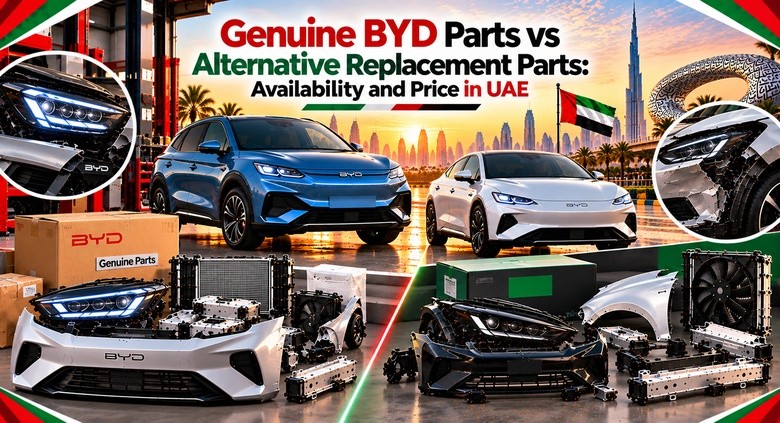
Genuine BYD Parts vs Alternative Replacement Parts: Availability and Price in UAE
September 30, 2026
The cheapest BYD spare parts in UAEis not necessarily the cheapest repair. That sounds obvious, yet accident repairs and routine maintenance regularly turn into a comparison of two numbers that were never actually comparable: a genuine part from an authorised route versus an alternative component from an independent supplier, with different fitment, warranty, stock position, installation requirements and sometimes completely different assumptions about what is included.
For UAE owners, the more useful question is not simply “genuine or aftermarket?” It is: which type of part makes financial and technical sense for this particular BYD, this particular component and this particular repair?
That distinction becomes increasingly important as the UAE BYD range expands across the ATTO 3, SEAL, HAN, SEALION 7 and newer models.
UAE Update Reference: September 2026. Public prices and availability change quickly, especially for newer models. The figures below are dated market observations rather than fixed UAE tariffs.
Genuine versus alternative is not a simple quality argument
“Genuine” generally means the part is supplied as a BYD-branded genuine replacement component.
“Alternative replacement” is broader. It can include branded aftermarket, OEM/OES-supplied components where provenance is actually established, independent replacement parts, remanufactured components or lower-cost aftermarket products.
Those categories should not be thrown into one bucket.
A well-specified alternative component can be perfectly appropriate for one job while a questionable substitute can be a false economy for another.
BYD itself recommends genuine spare parts
BYD's Middle East and Africa service information recommends BYD genuine spare parts and says that non-genuine replacement or modification can affect vehicle performance, particularly safety and durability. It also states that damage and performance issues caused by non-genuine parts will not be covered by the warranty.
That is the manufacturer's position.
It should not be twisted into “every aftermarket part automatically voids the whole vehicle warranty”. The actual wording is narrower: BYD addresses damage or performance issues caused by non-genuine parts.
The warranty makes the decision more serious
BYD's published Middle East and Africa warranty information states 6 years/150,000 km for the complete vehicle, 8 years/200,000 km for the power battery and 8 years/150,000 km for the powertrain, subject to the applicable warranty terms.
The UAE aftersales site separately identifies an 8-year/200,000 km battery and drive-unit limited warranty.
For a newer BYD still inside its applicable warranty period, the economics of saving a relatively small amount on a critical component can therefore be quite different from repairing an older vehicle outside warranty.
Start with the part, not the brand label
A cabin filter, wiper blade, cosmetic trim piece and HV charging component should not be judged using the same buying rule.
For example:
Low-risk consumable: alternative options may deserve serious comparison.
Brake component: specification, friction characteristics and certification become much more important.
Headlamp: fitment, electronics, beam pattern and connectors matter.
Camera or sensor: compatibility and calibration matter.
HV battery or drive-system component: identification, diagnostic evidence and manufacturer procedures matter enormously.
The component determines the risk.
ATTO 3 shows why model-specific sourcing matters
The UAE ATTO 3 uses BYD's e-Platform 3.0, Blade Battery and an integrated 8-in-1 electric powertrain architecture. The UAE model page lists 200 hp and 310 Nm and describes the vehicle's battery and driver-assistance systems.
So a supplier simply advertising a part as “BYD compatible” has not done enough.
The exact ATTO 3 application still needs to be established.
SEAL is a different proposition
The SEAL uses BYD's Cell-to-Body architecture, integrating the Blade Battery into the vehicle structure. The UAE model page also lists 150 kW DC charging and, for the all-wheel-drive version, two motors producing a combined 390 kW.
That matters when comparing alternatives.
A body trim and a high-voltage component should never be subjected to the same sourcing standard merely because both appear in an online “BYD parts” catalogue.
SEALION 7 adds another fitment trap
The SEALION 7 has RWD and AWD configurations, with different motor arrangements and outputs. Its published specifications show a 230 kW rear motor for both versions, with the AWD Performance adding a 160 kW front motor.
A replacement component associated with the front drivetrain, braking system, suspension or electronic controls therefore deserves closer verification than a generic trim piece.
A current UAE price example: ATTO 3 headlight
A UAE-facing public listing currently shows an ATTO 3 right headlight at AED 1,680. The same catalogue also shows the left headlight at the same listed price.
That gives us a useful dated market observation.
It does not tell us that AED 1,680 is the universal UAE price for every ATTO 3 headlamp, nor does it establish whether the listing represents the exact part specification required for every UAE vehicle.
Small ATTO 3 parts demonstrate the opposite end of the market
The same UAE-facing catalogue lists an ATTO 3 left front bumper bracket at AED 85, a left front fender lining at AED 255 and a rear bumper bracket at AED 90.
This is useful because it shows why replacing an entire assembly is not always necessary.
Sometimes the damaged component is a small bracket or liner.
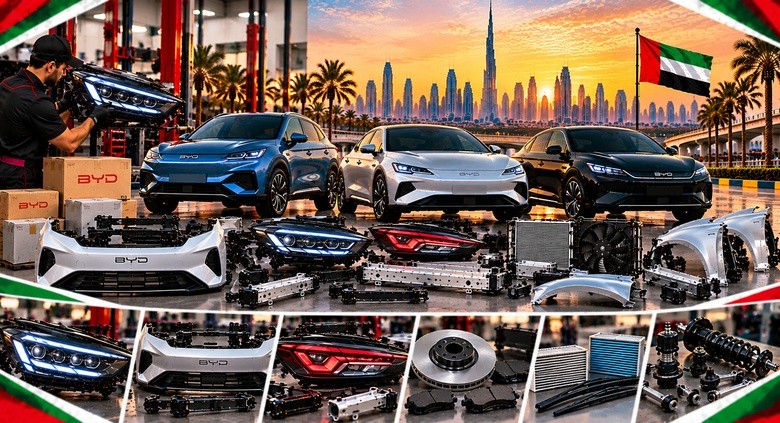
Genuine parts are not always the expensive option
This gets missed in aftermarket discussions.
A small genuine trim, bracket or fastener can be relatively inexpensive. Conversely, an aftermarket electronic assembly can be surprisingly costly once shipping, returns, programming or installation are added.
The comparison must be component-specific.
Alternative parts can be much cheaper—but the evidence needs checking
UAE suppliers are increasingly advertising genuine and aftermarket BYD components across bodywork, lighting, mechanical, electrical and suspension categories.
That indicates a growing independent supply market.
It does not mean every alternative part is equivalent to the genuine component.
The useful question is: what exactly is being substituted, and what evidence supports its fitment and specification?
Availability has improved in the UAE
A September 2026 UAE market report says common Chinese-car maintenance parts such as filters and brake pads are often available with short delivery times, while body panels and major components can be sourced from regional warehouses with longer lead times. It also reports growing aftermarket availability for popular models including the ATTO 3.
This is a market observation, not a guarantee for a particular BYD part.
A rare SEAL electronic component is still a very different sourcing problem from an ATTO 3 cabin filter.
Genuine availability can be the deciding factor
BYD's UAE service page specifically provides a genuine spare-parts route alongside maintenance and repair support.
If the required genuine component is readily available, the price difference may be small enough that the lower-risk route becomes attractive.
If the genuine component is special-order while a correctly specified alternative is locally stocked, the calculation changes.
Don't confuse “in stock” with “available for your car”
An online catalogue can show a component as available while the actual fitment depends on:
- model year;
- trim;
- drivetrain;
- market specification;
- facelift;
- left/right-hand application;
- sensor package;
- connector;
- part revision.
Availability is only useful after fitment is established.
VIN matching should come before price comparison
For an expensive BYD component, send the supplier:
VIN + model + model year + trim + damaged/replaced part + photograph + existing part number where visible.
This is particularly important for electronics, lamps, cameras, sensors, body assemblies and components that changed between production revisions.
A cheaper wrong part is not a saving.
Part numbers are the second line of defence
If the old component carries an identification label, photograph it.
Do not rely solely on a supplier's product title.
A part labelled “BYD Seal headlight” may still be unsuitable for your exact car if the assembly has different electronics, market specification or revision.
Genuine, OEM and aftermarket are three different claims
A seller using “OEM quality” has not necessarily demonstrated that the part is an OEM component.
Likewise:
Genuine BYD: sold as a BYD genuine replacement part.
OEM/OES: requires evidence of actual manufacturer/provenance if that distinction is being used commercially.
Aftermarket: independently produced replacement component.
If the seller cannot explain which category applies, treat “OEM quality” as marketing language rather than technical proof.
“Original quality” is not a technical specification
This phrase appears frequently in the parts trade.
It can mean almost anything unless supported by a manufacturer name, part identification, catalogue reference, test information or other evidence.
Ask what the component actually is.
That one question eliminates a lot of ambiguity.
Body panels are usually easier to compare
A bumper cover, fender, grille trim or mirror shell is relatively straightforward to inspect physically.
You can compare:
- mounting holes;
- tabs;
- shape;
- surface finish;
- panel gaps;
- material;
- trim compatibility.
That makes selected body components reasonable candidates for alternative sourcing when the specification is clear.
Headlights are a different story
A headlamp is not merely a piece of plastic and glass.
It can contain LED electronics, control components, connectors and interfaces with the vehicle's electrical architecture.
A replacement must therefore be assessed for both physical fit and electronic compatibility.
The higher the electronic complexity, the less attractive an unidentified alternative becomes.
Sensors deserve an even higher verification standard
Parking sensors, radar-related equipment and cameras can affect driver-assistance functions.
The supplier should be able to identify the exact component and application.
After installation, the workshop may also need diagnostic checks or calibration depending on the system and repair.
Saving AED 200 on a sensor is not particularly clever if it creates a calibration problem or intermittent fault.
Brakes need a specification comparison
Brake pads and discs are among the areas where alternative parts can make sense, but the comparison should include:
- friction material;
- dimensions;
- axle position;
- vehicle weight;
- performance variant;
- noise/dust characteristics;
- manufacturer;
- applicable specification;
- warranty.
Do not compare a genuine BYD pad with an unknown alternative solely by box price.
Filters are a different buying decision
Cabin filters and some routine maintenance items are generally lower-complexity components.
The buyer can reasonably compare an established alternative manufacturer if the dimensions, filtration specification and application are confirmed.
The risk profile is simply lower than an HV or ADAS component.
Wipers and trim can sit further down the risk ladder
Wiper blades, cosmetic trim, certain clips and non-critical accessories may be sensible areas for cost-conscious alternative sourcing.
The important thing is not to allow that experience to create a bad rule for every component.
A cheap wiper does not prove that a cheap camera is equally sensible.
Suspension components need more than a visual match
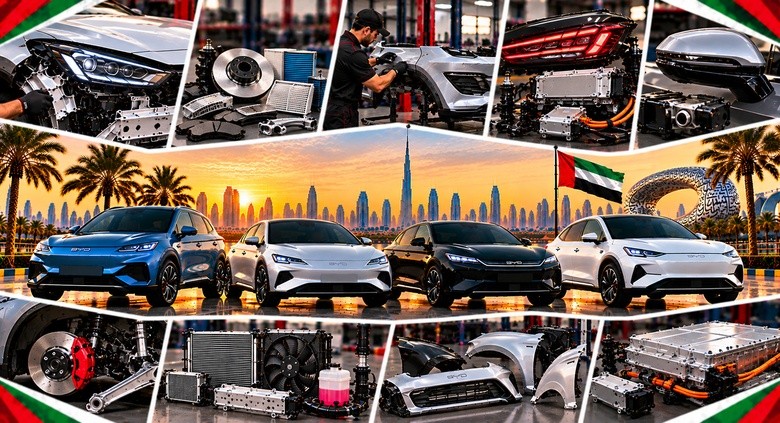
Control arms, bushes, links and dampers affect geometry and vehicle behaviour.
For a SEALION 7, for example, BYD specifies double-wishbone front suspension and multi-link rear suspension with FSD dampers.
A replacement suspension component therefore needs exact application and dimensional confirmation rather than simply “fits SEALION 7”.
Cooling components deserve UAE-specific attention
The UAE climate puts substantial thermal-management demand on vehicles.
With an EV, cooling is not simply about the passenger compartment.
Thermal management can involve the battery, power electronics, motor and cabin systems.
For these components, the price comparison should include specification, compatibility and installation procedure rather than simply “genuine versus aftermarket”.
A/C components are another area where cheap can become expensive
A replacement A/C component may appear inexpensive until the workshop discovers that the system needs evacuation, recharge, leak testing, electrical diagnosis or additional seals and fittings.
The correct comparison is therefore:
part price + refrigerant/service + labour + diagnosis + any required additional components.
High-voltage components should not be treated like ordinary aftermarket parts
Battery modules, HV connectors, onboard chargers, power electronics and drive units are not sensible candidates for casual trial-and-error purchasing.
Before ordering, establish:
- exact component;
- fault evidence;
- VIN/application;
- part number;
- voltage/specification;
- compatibility;
- installation procedure;
- programming/coding requirements;
- warranty;
- return conditions.
The diagnostic evidence comes before the price.
Prove the fault before pricing the replacement
A warning message does not automatically identify a failed component.
For an electronic or EV fault, the workshop should establish the relevant DTCs, inspect wiring/connectors, examine live data where appropriate and test associated systems before condemning an expensive component.
Otherwise the buyer is comparing prices for a part that may not even be faulty.
Genuine can be especially valuable for complex electronics
For a camera, control module, charger, BMS-related component or other vehicle-network device, compatibility matters more than the superficial appearance of the part.
The genuine route can offer a clearer application path.
That does not prove every genuine component is the best economic choice, but it raises the value of traceability.
Alternative parts are strongest where the specification is simple
A useful rule of thumb is:
The simpler the component and the clearer its specification, the easier it is to compare alternatives.
Brake consumables, filters, wipers and selected body components can therefore be evaluated differently from electronic modules and high-voltage components.
Not every alternative part deserves the same level of suspicion.
Not every genuine part deserves blind acceptance either.
UAE temperature changes the consequences of poor component selection
Heat, long A/C usage, dust, traffic congestion and high summer ambient temperatures create demanding operating conditions.
A cooling or electrical component that performs adequately in a mild climate should still be assessed for the vehicle's actual operating requirements.
This is one reason a component's specification matters more than its marketing description.
Genuine does not eliminate installation mistakes
Even the correct BYD component can fail to deliver the expected result if:
- the underlying fault remains;
- wiring is damaged;
- connectors are corroded;
- calibration is skipped;
- mounting is incorrect;
- software/configuration is incomplete;
- another failed component caused the original symptom.
“Genuine part fitted” is not the same as “repair completed correctly”.
Alternative does not automatically mean poor quality
The opposite myth is just as unhelpful.
Some independent manufacturers produce established replacement components for global vehicle applications.
The buyer should assess the manufacturer, specification, application evidence, warranty and failure consequences rather than making the decision from the word “aftermarket” alone.
But price alone proves nothing
A AED 300 alternative part is not necessarily better value than a AED 500 genuine part.
Nor is the AED 500 genuine part automatically the better economic choice.
You need the expected service life, installation cost, warranty, return policy, fitment confidence and consequence of failure.
Look at the cost of getting it wrong
For a cabin filter, the downside of an incorrect purchase may be modest.
For a headlamp, you could pay for removal, replacement, shipping and another installation.
For a sensor, you could add diagnostics and calibration.
For an HV component, the financial and technical consequences can be considerably greater.
This is why the cost of failure should influence the buying decision.
A useful UAE price snapshot
The following are public UAE-facing observations available around September 2026, not fixed market rates:
| Component | Public UAE price observation | What it tells us |
| ATTO 3 right headlight | AED 1,680 | Genuine-labelled BYD catalogue listing |
| ATTO 3 left front bumper bracket | AED 85 | Small body mounting component |
| ATTO 3 left front fender lining | AED 255 | Body/under-liner component |
| ATTO 3 left rear bumper bracket | AED 90 | Small replacement component |
| SEAL OEM-style front bumper emblem LED module | AED 188 | Public UAE-facing alternative/OEM-style listing |
| SEAL wiper blades, pair | AED 100 | Low-complexity replacement example |
| SEAL cabin air filter | AED 75 | Routine consumable example |
| SEAL OEM wing fender | AED 225 | Public UAE-facing OEM-labelled listing |
| SEAL front bumper trim | AED 121 | Public UAE-facing genuine-labelled listing |
| SEAL original headlamp listing | From AED 708 | Listing requiring exact specification verification |
The listings come from different suppliers and product categories, so these are not like-for-like genuine-versus-aftermarket comparisons. They are market observations showing the spread of available replacement options.
Why that table should not become a universal price list
The AED 1,680 ATTO 3 headlamp is useful evidence because it is a current public UAE listing.
But it does not prove that every ATTO 3 headlamp costs AED 1,680.
Similarly, a SEAL trim at AED 121 cannot be compared with a complete bumper assembly.
Parts pricing needs application, condition, supplier, stock status and scope attached to it.
Online alternative prices can be misleading
Some international catalogues display BYD parts at dramatically lower prices than UAE retail listings.
That may be genuine.
It may also exclude international freight, customs clearance, VAT, oversize shipping, brokerage or local handling.
A low overseas product price is therefore not automatically a low UAE landed cost.
UAE delivery can be part of the price decision
For common BYD parts, local stock can remove waiting time and import uncertainty.
For uncommon components, an international supplier may offer a wider catalogue.
A buyer should compare:
UAE price + delivery
against
overseas part price + freight + import costs + delivery time + return difficulty.
That is the real comparison.
Warranty should be written into the comparison
For each alternative, ask:
- Is there a parts warranty?
- How long?
- Is labour covered?
- What exclusions apply?
- Who handles a failed part?
- Is return shipping covered?
- Does the supplier require the failed part to be returned?
- Does the warranty depend on professional installation?
A slightly more expensive component with a meaningful warranty can sometimes carry less financial risk.
Ask whether programming or calibration is included
A quotation for a replacement electronic component may look competitive until the workshop adds programming.
For cameras and driver-assistance equipment, calibration can also be relevant.
The buyer should ask for these costs before authorising the repair, not after the part is installed.
Genuine parts may be easier to trace
A genuine component purchased through an authorised route generally gives the buyer a clearer chain of identification.
That can matter for:
- warranty;
- future repairs;
- technical support;
- part-number verification;
- resale documentation;
- troubleshooting.
Traceability is an economic benefit, not merely a branding benefit.
Independent suppliers can offer a useful advantage
The independent UAE market can be valuable because it allows owners to compare genuine, OEM-labelled and aftermarket options without automatically accepting one supply route.
Current UAE suppliers advertise BYD body parts, lights, mechanical components, electrical systems and suspension components, with both genuine and aftermarket categories available.
The buyer still needs to verify what each label actually means.
Ask the supplier five questions
Before paying for an expensive alternative part, ask:
What is the exact part number?
What BYD model/year does it fit?
Is it genuine, OEM/OES or aftermarket?
What manufacturer made it?
What warranty and return terms apply?
If the answer to several of those questions is vague, the apparent bargain needs another look.
Ask the workshop five different questions
The workshop needs to answer:
What failed?
How was it diagnosed?
What other components were checked?
Does the replacement require coding or calibration?
What is the total installed cost?
Supplier questions establish what you are buying.
Workshop questions establish why you need it.
A buyer decision matrix
| Situation | Part route to investigate | Main reason | What to verify |
| Cabin filter | Established alternative | Low complexity | Size/specification |
| Wipers | Genuine or quality alternative | Straightforward fitment | Dimensions/application |
| Body trim | Genuine or alternative | Often physical fitment issue | Clips, finish, model year |
| Brake pads | Genuine or reputable alternative | Cost can vary | Compound/specification |
| Bumper | Genuine, repair or alternative | Large price spread | Fit, brackets, finish |
| Headlamp | Genuine/verified OEM or proven alternative | Electronics | Part number/connectors |
| Camera/sensor | Genuine or verified specialist component | Calibration/ADAS | Compatibility/calibration |
| Control module | Genuine/verified specialist | Network/software | Programming and warranty |
| HV charger | Genuine/specialist route | Safety and compatibility | Diagnosis/specification |
| Battery component | Genuine/specialist route | High financial risk | Diagnostic proof/VIN |
Before You Click Buy
For any expensive BYD replacement component, have these details ready:
VIN
Exact model and year
Trim
Powertrain
Drivetrain where relevant
Old part number
Photographs
Supplier's part number
Part category
Condition
Warranty
Return policy
Delivery time
VAT treatment
Installation/programming/calibration cost
That may look excessive for a brake pad.
It is not excessive for an electronic module.
PartFinder UAE and the comparison process
For UAE owners comparing genuine and alternative BYD replacement options, PartFinder UAE can sit within the wider sourcing process as another point of comparison rather than treating the first available quotation as the market price.
The useful approach remains the same: establish the exact component first, then compare the available supply routes on total cost and risk.
When genuine BYD is usually the easier decision
Genuine becomes particularly compelling when:
- the component is safety-critical;
- the vehicle remains under applicable warranty;
- fitment is highly model-specific;
- electronics or software are involved;
- the part is difficult to diagnose;
- calibration is required;
- failure could cause significant secondary costs;
- the genuine price difference is relatively small.
This is not a universal rule. It is a risk-based buying framework.
When an alternative deserves serious consideration
An alternative can be worth investigating where:
- the vehicle is outside warranty;
- the component is relatively simple;
- manufacturer and specification are known;
- fitment is documented;
- the price difference is meaningful;
- warranty is provided;
- the part has a credible track record;
- installation does not introduce unusual programming or calibration requirements.
That is a very different proposition from buying an unidentified component because it is cheap.
When a used genuine part enters the equation
There is another route people often forget.
A used genuine BYD component from a suitable donor can sometimes sit between a new genuine part and an unknown aftermarket replacement.
For body panels, lamps, mirrors and selected mechanical components, it can be worth comparing.
But donor history, condition, part number, testing and warranty still matter.
Used genuine is not automatically better
A damaged used genuine headlight is still damaged.
A flood-affected electronic module is still a risk.
A bent bumper bracket from a crashed donor is not made safe by having a BYD label.
The word “genuine” describes provenance, not necessarily current condition.
Repair can beat both genuine and aftermarket replacement
A cracked trim, bumper or mounting component does not automatically require a new assembly.
If the original component can be repaired correctly, the total cost may be lower.
But the repair must preserve fit, mounting strength, finish and any sensor/camera interfaces.
Accident repairs need a different buying hierarchy
After a collision, the order should be:
Inspect → identify → diagnose → price → compare → authorise → install → calibrate/test.
Not:
Search Google → find cheap part → order → discover what else is broken.
The second method is how a simple accident becomes a parts pile.
Don't let the seller choose the diagnosis
A parts supplier can tell you what component they have.
They should not automatically be the person deciding what failed.
That belongs to the diagnostic process.
This matters especially with electronic BYD systems where one fault can produce symptoms in several connected components.
The UAE market is moving towards more independent BYD supply
Current market evidence shows a growing independent Chinese-vehicle parts ecosystem in the UAE, including BYD-specific catalogues and suppliers offering genuine and alternative components.
That is useful for owners because it creates more sourcing choices.
It also creates a new problem: more choices mean more labels to verify.
The best alternative is not necessarily the cheapest alternative
A better alternative is one where the supplier can answer:
- who manufactured it;
- what specification it follows;
- which vehicle it fits;
- what evidence supports the fitment;
- what warranty applies;
- what happens if it fails.
That is the standard worth applying.
What we could verify
For September 2026, we could verify BYD's official UAE genuine-parts/service route and published warranty information, current BYD UAE model information, public UAE-facing replacement-part listings and evidence that independent suppliers are offering both genuine and alternative BYD components.
We could also verify current public UAE price observations for several ATTO 3 and SEAL components.
What we could not responsibly verify
There is no single reliable UAE-wide percentage such as “aftermarket BYD parts are 40% cheaper” that can be applied across all models and components.
Nor can one supplier's advertised price be treated as the UAE market price.
Availability also changes by model, warehouse, supplier and import cycle.
That uncertainty should remain visible rather than being disguised with false precision.
The real price comparison
The most useful calculation is:
Part price + delivery + VAT + labour + programming/calibration + diagnostic cost + expected return/warranty risk = effective repair cost.
That number is far more meaningful than the sticker price on a product page.
The practical rule for UAE BYD owners
For simple, well-specified consumables and physical components, a reputable alternative can be worth comparing seriously.
For expensive electronics, ADAS equipment, high-voltage components, safety-critical systems and warranty-sensitive repairs, the evidence standard should be much higher.
And for every category, start with the same discipline: VIN, exact application, part number, diagnosis, total installed cost and warranty.
The sensible BYD parts buyer is not the person who always chooses genuine.
Nor is it the person who always chooses the cheapest alternative.
It is the person who knows why the component is being replaced, what exactly is being offered, what can go wrong, and what the complete repair will actually cost.
UAE update note: The BYD model range, supplier catalogues, prices and stock positions are changing quickly in the UAE. Recheck the VIN application, part number, supplier stock, warranty, VAT and delivery terms before ordering.
FAQs
Categories
- Audi
- BMW
- Car Accessories
- Car Tips
- Ford
- Land Rover
- Mazda
- Range Rover
- Top 10
- UAE Car Parts
- Used Car Parts
- Toyota
- Replacement Engines
- Nissan
- Hyundai
- Mitsubishi
- Volkswagen
- Honda
- Kia
- Chevrolet
- Dodge
- Jeep
- Subaru
- Renault
- Lexus
- Mercedes
- Suzuki
- Hummer
- Porsche
- Infiniti
- Peugeot
- GMC
- Mini
- Volvo
- Replacement Gearboxes
- MG
- Jaguar
- Skoda
- Cadillac
- Daihatsu
- Fiat
- German Car Parts
- Japanese Car Parts
- Aftermarket Car Parts
- Genuine Car Parts
- New Car Parts
- Reconditioned Car Parts
- European Car Parts
- American Car Parts
- Korean Car Parts
- British Car Parts
- Chinese Car Parts
- Sports/Exotic Car Parts
- Luxury Car Parts
- Performance Car Parts
- SUV/4x4 Spare Parts
- Truck Spare Parts
- EV Car Parts
- Hybrid Car Parts
- Auto Spare Parts in UAE
- Tesla
- Isuzu
- Ram
- Ferrari
- Bentley
- Lamborghini
- Genesis
- Maserati
- Lincoln
- Chrysler
- Opel
- Citroen
- SsangYong
- Seat
- McLaren
- Aston Martin
- Rolls Royce
- Maybach
- Alfa Romeo
- Bugatti
- Scion
- Abu Dhabi Car Parts
- Ajman Car Parts
- Al Khan Car Parts
- Al Sajaa Car Parts
- Deira Car Parts
- Dubai Car Parts
- Fujairah Car Parts
- Industrial Area 6 Car Parts
- Mussafah Car Parts
- Ras Al Khaimah Car Parts
- Sharjah Car Parts
- Umm Al Quwain Car Parts
- Acura
- BYD
- Chery