Genuine vs Aftermarket Alfa Romeo Parts in UAE: Which Should You Choose?
September 26, 2026
The cheapest Alfa Romeo part is not necessarily the cheaper repair. Neither is the genuine part automatically the right answer for every job.
That is the useful starting point.
A cabin filter, wiper component or certain routine service item can be approached very differently from a brake component, ECU, adaptive headlamp, turbocharger or suspension assembly. The mistake is treating “genuine” and “aftermarket” as two neat boxes, as though everything inside each box has the same quality, fitment and risk.
It does not.
Alfa Romeo's own technical information system separates its parts information into genuine spare parts, official accessories, reconditioned parts and repair packages, while its owner documentation describes genuine components as being engineered around the specifications used in vehicle assembly and subjected to approval and quality controls.
For an Alfa Romeo in Dubai, Abu Dhabi, Sharjah or elsewhere in the UAE, the sensible decision comes down to the component, the exact car, the failure being repaired, the quality of the alternative and the consequences if the part is wrong.
Genuine and aftermarket do not mean “good” and “bad”
This is where many parts discussions go off the rails.
Genuine Alfa Romeo parts are produced and supplied within the manufacturer's parts system. Aftermarket Alafa Romeo spare parts in UAE are made by independent manufacturers for the same vehicle application.
But “aftermarket” covers a huge range.
One component may come from a highly established equipment manufacturer with proper engineering and application data. Another may simply be a low-cost reproduction.
So the meaningful comparison is not:
Genuine vs aftermarket.
It is:
Known specification and provenance vs uncertain specification and provenance.
What Alfa Romeo means by genuine parts
Alfa Romeo states that its Genuine Spare Parts and Accessories follow the engineering and manufacturing specifications used during vehicle assembly. It also says the components undergo approval tests and quality controls intended to meet safety and environmental requirements.
That gives genuine parts a clear reference point.
It does not mean every genuine component is dramatically better than every aftermarket equivalent. It means the buyer has a much clearer relationship between the component and the original vehicle specification.
Aftermarket is a category, not a quality grade
This distinction is worth keeping.
An aftermarket brake pad, filter or suspension arm could be perfectly respectable. Another part carrying the same broad description might be poorly manufactured or incorrectly catalogued.
The brand, manufacturing standard, application data, warranty and actual part number matter.
If a seller simply says “aftermarket Alfa Romeo part” without identifying the manufacturer, there is not much useful information there.
OEM and genuine are not necessarily identical terms
“OEM” is frequently used rather loosely in the UAE parts market.
A supplier may mean that the part comes from the original equipment manufacturer. Another may use OEM to mean “same specification”. Someone else may simply be using it as a quality-sounding label.
Ask what the term means in that particular quotation.
A genuine Alfa Romeo component, an original-equipment manufacturer's unbranded component and an independent aftermarket replacement should not automatically be treated as interchangeable.
The correct part matters more than the attractive label
A genuine component with the wrong application is still the wrong component.
That sounds almost too obvious, yet it is one of the most common traps in online parts buying. Giulia, Stelvio, Quadrifoglio and Veloce components can share visual similarities while differing in braking, suspension, drivetrain or electronic specification.
The part number and vehicle identification settle the argument far more reliably than a photograph.
VIN first, price second
For expensive or electronically controlled parts, the VIN should normally be supplied before a final quotation is accepted.
Alfa Romeo's technical information platform provides access to spare-parts identification and vehicle-specific technical information, while certain ECU-related packages explicitly require the VIN during the process.
That tells you something useful about modern Alfa Romeo ownership: identification is not merely a nice extra.
It is part of the repair.
Giulia Veloce is not simply “a Giulia”
The Giulia range has different mechanical and equipment specifications.
The Middle East documentation, for example, identifies a 2.0-litre 280 HP Veloce TI with an eight-speed automatic transmission and specific 19-inch wheels, along with other equipment differences.
So a supplier quoting a “Giulia suspension part” without checking the exact variant is leaving too much unresolved.
Quadrifoglio changes the equation
The Giulia and Stelvio Quadrifoglio use performance-specific hardware.
Alfa Romeo's Quadrifoglio documentation lists features including active suspension on Giulia, active torque vectoring, performance braking equipment, specific wheels and other dedicated components.
A generic aftermarket replacement may therefore need much closer scrutiny than it would on an ordinary service component.
Brake pads are where the argument gets interesting
Brake pads are consumables, but they are not trivial components.
A reputable aftermarket pad can make sense if its specification, friction characteristics, dimensions and application are appropriate for the vehicle.
For a standard Giulia used mainly for commuting, the buying decision can be quite different from a Quadrifoglio being driven hard.
The badge on the box matters less than the engineering behind the pad.
Brake discs deserve the same scrutiny
A disc is not simply a circular piece of metal.
Diameter, thickness, ventilation, material, machining quality and application all matter. The wrong disc can create clearance, braking-balance or durability problems.
For performance Alfa Romeo variants, particularly Quadrifoglio applications, replacing original-style hardware with an unknown low-cost equivalent simply because it saves money deserves careful thought.
Why Quadrifoglio brake parts need more caution
The Quadrifoglio documentation identifies performance-specific braking equipment and even lists optional carbon-ceramic brake discs.
That makes the phrase “aftermarket brakes” almost meaningless without further detail.
A replacement for a conventional steel-brake system is one thing. A component intended to reproduce the behaviour of a high-performance braking package is another.
Filters are different
Oil, air and cabin filters are usually much easier territory.
A reputable aftermarket filter from a manufacturer with correct application data may be entirely reasonable where the dimensions, filtration specification, sealing arrangement and service interval are correct.
There is little value in paying a substantial premium merely because a cardboard box carries a vehicle manufacturer's badge if the alternative is a properly engineered equivalent.
Cabin filters are usually a straightforward comparison
For a cabin filter, look at:
- correct dimensions
- filtration medium
- activated-carbon or other specified construction where applicable
- sealing quality
- manufacturer
- application range
This is a very different buying decision from choosing an ECU.
The component's function determines how much risk the buyer is actually taking.
Engine oil filters deserve more attention
The oil filter has a direct relationship with engine lubrication.
That does not mean an aftermarket filter is automatically unsuitable. It means the filter should come from a known manufacturer and have the correct filtration, bypass-valve and sealing characteristics for the engine.
A random unbranded filter is a poor place to chase a tiny saving.
Spark plugs are specification-sensitive
Modern Alfa Romeo engines can use specific heat ranges, dimensions and electrode arrangements.
For the 2.9-litre twin-turbo V6 in Quadrifoglio applications, the cost of a wrong plug extends beyond the plug itself. Incorrect specification can affect combustion behaviour, ignition reliability and potentially catalyst or engine operation.
This is another area where “fits Alfa Romeo” is nowhere near precise enough.
Suspension components need a different buying philosophy
Control arms, bushes, links, dampers and related components affect geometry and handling.
The aftermarket can offer useful alternatives here, particularly where the manufacturer is established and the part is properly engineered for the exact application.
But suspension is not the place for catalogue guessing.
The vehicle's generation, axle position, suspension specification and sometimes performance package need to be established first.
Giulia's Alfa Link architecture matters
The Giulia uses Alfa Romeo's Alfa Link suspension architecture, with model specifications differing according to version.
That makes generic “front suspension kit” terminology particularly unhelpful.
The workshop should identify the failed component and then match its replacement to the actual vehicle configuration.
Stelvio suspension has its own considerations
The Stelvio is not simply a Giulia underneath with a taller body.
Its chassis, weight distribution, ride height, wheel and drivetrain configuration change the demands placed on suspension components.
An aftermarket component developed specifically for the Stelvio application may therefore be perfectly reasonable; a visually similar Giulia component is not automatically interchangeable.
Dampers are not an area for casual substitutions
A damper affects ride control, wheel movement and body response.
If the vehicle has electronically controlled or performance-specific suspension, the replacement needs to account for that system rather than merely matching the mounting points.
The phrase “same size” tells you almost nothing about damper compatibility.
Electronic modules are where genuine parts often become more attractive
ECUs, body modules, lighting modules and other electronic components can involve software, configuration and vehicle communication.
Alfa Romeo's technical information system includes genuine diagnostic information, guided procedures for diagnostic trouble codes, wiring diagrams, connector information and vehicle technical data.
That is a clue to the complexity of these repairs.
A used or aftermarket module may be physically correct and still require configuration, coding or additional work.
A used ECU is not equivalent to a used brake disc
The two are sometimes lumped together under “used parts”.
They should not be.
A used body trim component may be easy to inspect. A used ECU may have an unknown history, incompatible software or configuration issues. A used brake disc may have wear or heat-related damage that is difficult to assess visually.
Part category changes the risk.
Headlamps deserve particular care
Modern lighting assemblies can contain multiple electronic functions rather than being simple bulbs and housings.
Before buying a used or aftermarket headlamp, establish:
left or right, exact model, generation, lighting technology, market specification, part number and electronic configuration.
Otherwise an apparently excellent headlamp can become a very expensive piece of decorative plastic.
Genuine headlamps can justify their premium
If a headlamp contains integrated control electronics, adaptive functions or vehicle-specific components, the price difference between genuine and aftermarket becomes easier to understand.
The decision is not necessarily “pay more because genuine is better”.
It is “what does the alternative actually reproduce, and what happens if it does not?”
Body panels are usually more forgiving
A bonnet, wing, door skin or bumper cover is generally less technically complex than an ECU.
Here, a quality aftermarket panel or good used original component may make financial sense, particularly on an older Alfa Romeo.
But alignment, mounting points, sensor provisions and paint quality still matter.
A bumper is rarely just a bumper
Modern Alfa Romeo bumpers can accommodate parking sensors, radar-related equipment, grilles, cameras, brackets and trim.
A cheap bumper cover can therefore become an expensive installation if the supporting components do not transfer correctly.
Always establish whether the quoted part is:
bare panel, complete assembly, painted component or fully equipped unit.
Turbochargers demand engineering discipline
Turbochargers are not ideal candidates for bargain hunting.
The correct compressor and turbine configuration, actuator arrangement, balancing, oil supply and application all matter.
A reputable aftermarket turbo manufacturer may produce a legitimate replacement. An anonymous unit with no meaningful engineering information is a very different proposition.
Quadrifoglio turbo hardware deserves extra scrutiny
The 2.9-litre V6 twin-turbo Quadrifoglio engine makes the distinction particularly important.
A turbocharger is operating in a high-temperature, high-speed environment. A poor-quality replacement does not merely risk disappointing performance; it can create further engine or lubrication problems.
This is one component where saving money twice — once on the part and again after it fails — is not a clever strategy.
Cooling-system parts sit somewhere in the middle
Radiators, thermostats, expansion tanks, hoses and related components can often be sourced from established aftermarket manufacturers.
But the UAE climate makes cooling-system condition particularly relevant. High ambient temperatures and heavy traffic increase the workload placed on an already heat-loaded engine.
The sensible comparison is therefore between known-specification alternatives, not genuine versus anonymous.
Air-conditioning components need diagnosis first
If an Alfa Romeo's air-conditioning is weak, buying a compressor immediately may be the wrong move.
Pressure readings, refrigerant condition, condenser airflow, electrical commands, temperature behaviour and compressor operation should be investigated first.
The best aftermarket compressor in the world is still the wrong purchase if the compressor was never the fault.
Genuine parts do not eliminate diagnostic mistakes
This deserves saying plainly.
A genuine Alfa Romeo sensor can be perfectly manufactured and completely unnecessary.
If the wiring is damaged, the connector is corroded or the fault lies elsewhere, replacing the sensor merely produces an expensive new component attached to the same problem.
Diagnosis comes before brand selection.
UAE heat and aftermarket rubber components
Rubber and polymer components deserve closer inspection in the UAE.
Bushes, hoses, seals and mounts spend years exposed to high temperatures, engine heat and intense summer conditions. That does not mean an aftermarket component will fail prematurely. It means material quality matters.
For these parts, manufacturer reputation is far more useful than a vague “OEM quality” claim.
Battery-related components can be deceptively complicated
A battery itself is one thing.
Battery-management components, intelligent sensors and electronic charging systems are another.
Where the vehicle's electrical architecture requires battery registration, adaptation or configuration, the workshop should include that process in the repair quotation.
Otherwise a seemingly simple replacement can remain electronically incomplete.
Where VIN-Led Sourcing Makes the Difference
For a higher-value Alfa Romeo component, the sensible starting point is the VIN rather than a photograph or a generic model description. PartFinder UAE can be used as part of that sourcing process, allowing the enquiry to stay focused on the exact vehicle, engine, specification and required component before price comparisons begin. That matters particularly for Giulia, Stelvio and Quadrifoglio parts where braking hardware, electronics, suspension components and other assemblies can vary significantly between versions.
Reconditioned is not the same as used
A used gearbox removed from a donor vehicle has a history.
A reconditioned gearbox should have undergone a defined refurbishment process.
Those are materially different propositions.
Ask what was replaced, what was inspected, what testing was carried out and what warranty accompanies the component. “Reconditioned” without an explanation is merely another label.
Repair packages can change the calculation
Alfa Romeo's technical information system includes repair packages that combine spare parts with fixed-rate repair times.
That matters when comparing a component-only price with a complete repair route.
Sometimes the part is not the expensive part of the job. Sometimes labour, diagnostics or additional consumables dominate the final invoice.
The aftermarket can be the sensible route for routine maintenance
For filters, certain belts, wiper components, selected brake parts and other routine items, a reputable aftermarket manufacturer can offer a useful balance between price and specification.
The critical word is reputable.
The buyer should know who manufactured the component, what vehicle applications it covers and what warranty applies.
Genuine makes more sense when the part is highly integrated
The closer the component sits to the vehicle's safety, electronics or calibrated systems, the more valuable exact specification becomes.
That includes:
- ECUs
- airbag components
- advanced lighting
- certain sensors
- electronic suspension components
- performance brake hardware
- drivetrain control modules
There are exceptions, but these categories deserve more scrutiny than a cabin filter.
Do not confuse low price with value
Imagine two brake pads.
One costs AED 350 and requires replacement early. The other costs AED 500 and lasts considerably longer while delivering predictable braking behaviour.
The second component was more expensive.
It may still have been cheaper to own.
Parts should therefore be judged over the repair interval, not merely at the moment the card machine is used.
Warranty can change the comparison
Ask:
Who provides the warranty?
For how long?
Does it cover the part only?
Does it cover consequential damage?
Who pays labour if the component fails?
A six-month part warranty and a 24-month warranty may look similar on a quotation until something actually goes wrong.
Installation responsibility matters
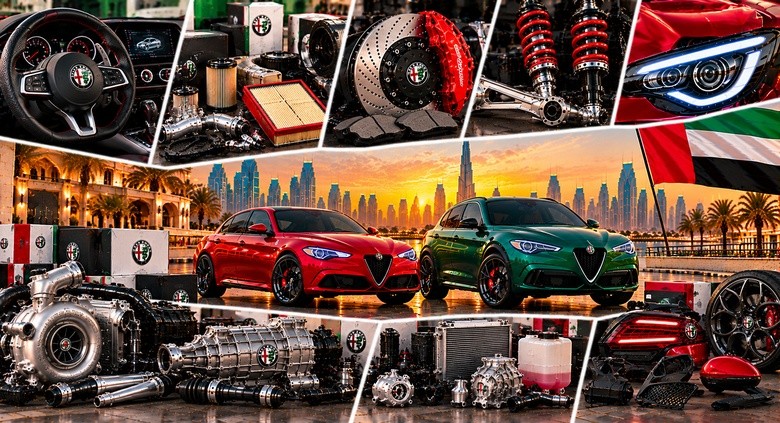
A component can fail because it was defective.
It can also fail because it was installed incorrectly, paired with the wrong component, contaminated during installation or fitted without the required calibration.
A useful supplier should make the installation requirements clear.
What should a UAE workshop test before choosing the part?
The answer depends on the fault.
For brakes: pad thickness, disc condition, calliper operation, fluid condition and braking behaviour.
For suspension: play, bush condition, damper performance, alignment and the actual source of noise.
For cooling: pressure, temperature behaviour, leaks, pump operation and airflow.
For electronics: fault codes, wiring, power supply, communication and module configuration.
For an engine: compression, leak-down where appropriate, oil condition, boost behaviour and relevant fault data.
That diagnostic work is what prevents the genuine-versus-aftermarket argument from becoming a distraction.
Before You Click Buy
Do not order an Alfa Romeo part simply because the listing contains your model name.
Check:
VIN
OEM/reference number
engine and transmission
model year/generation
left or right side
front or rear axle
genuine/OEM/aftermarket/reconditioned/used status
manufacturer
warranty
coding or calibration requirement
VAT and delivery
That is a much more useful checklist than “Is this genuine?”
Buyer decision matrix
| Part type | Genuine | Reputable aftermarket | Used genuine | Main concern |
| Cabin filter | Sensible | Often sensible | Usually unnecessary | Filtration and fit |
| Oil filter | Sensible | Often sensible | Avoid | Filtration/sealing |
| Brake pads | Sensible | Can be suitable | Usually avoid | Friction specification |
| Brake discs | Sensible | Can be suitable | Generally poor choice | Wear and heat history |
| Suspension arm | Sensible | Can be suitable | Condition-dependent | Geometry and bush quality |
| ECU/module | Often preferable | Highly application-dependent | Possible but risky | Coding/configuration |
| Headlamp | Strong option | Quality-dependent | Condition-dependent | Electronics and fitment |
| Body panel | Useful | Often practical | Often practical | Alignment/condition |
| Turbocharger | Strong option | Established manufacturer only | History critical | Balancing and specification |
| Cooling component | Sensible | Often viable | Condition-dependent | Material and sealing |
| Rare older-model trim | Availability-dependent | Model-dependent | Often useful | Condition and originality |
When aftermarket is the more practical choice
There are situations where the aftermarket route is entirely reasonable.
A reputable filter manufacturer, brake manufacturer or suspension supplier may produce a component designed specifically for the Alfa Romeo application.
The question is not whether the box says Alfa Romeo.
The question is whether the component is properly engineered for the job.
When genuine is the safer route
Genuine parts become particularly attractive when:
- the component is safety-critical;
- electronic integration is significant;
- the vehicle has a performance-specific configuration;
- fitment is unusually complex;
- the alternative's manufacturer cannot be established;
- programming or calibration is involved;
- the cost of a failed component is substantial.
That is not a blanket rule. It is a risk calculation.
When a used genuine part can make sense
For older Alfa Romeo models, discontinued trim, certain body components and selected non-safety-critical mechanical parts, a good used original component can solve a sourcing problem that a new aftermarket part cannot.
The donor vehicle matters.
Mileage matters where known.
Accident, flood and heat exposure matter.
So does the return policy.
Dubai sourcing needs the same discipline
A component being physically available in Dubai does not make it correct.
Ask for the VIN match, part number, condition, manufacturer, warranty and delivery status. If it is used, ask about the donor vehicle.
If it is aftermarket, identify the manufacturer rather than accepting “OEM quality” as the complete answer.
Genuine parts are not always the economical choice
A genuine component may carry a substantial premium.
If a well-established aftermarket manufacturer offers the same required specification, backed by a useful warranty, the additional genuine-parts cost may not produce a meaningful benefit for that particular repair.
That is a decision to make component by component.
The real question is what you are trying to protect
For a filter, you may primarily be protecting routine engine maintenance.
For brakes, you are protecting braking performance and safety.
For an ECU, you are protecting compatibility with a complex electrical system.
For a Quadrifoglio turbocharger, you are protecting a highly stressed engine system.
Different parts justify different levels of conservatism.
So, genuine or aftermarket?
Neither label settles the question on its own.
For routine components, a reputable, correctly specified aftermarket part can be a perfectly rational choice.
For safety-critical, electronically integrated or highly performance-specific components, genuine or demonstrably equivalent high-quality parts deserve much closer consideration.
And for used components, the decision should revolve around condition, donor history, exact fitment and warranty rather than the seductive word “original”.
Alfa Romeo's own technical ecosystem reflects this more nuanced reality: its official information resources distinguish genuine parts, reconditioned parts, accessories, repair packages, diagnostics and technical repair information rather than reducing every repair to a simple genuine-versus-non-genuine choice.
Frequently Asked Questions
Categories
- Audi
- BMW
- Car Accessories
- Car Tips
- Ford
- Land Rover
- Mazda
- Range Rover
- Top 10
- UAE Car Parts
- Used Car Parts
- Toyota
- Replacement Engines
- Nissan
- Hyundai
- Mitsubishi
- Volkswagen
- Honda
- Kia
- Chevrolet
- Dodge
- Jeep
- Subaru
- Renault
- Lexus
- Mercedes
- Suzuki
- Hummer
- Porsche
- Infiniti
- Peugeot
- GMC
- Mini
- Volvo
- Replacement Gearboxes
- MG
- Jaguar
- Skoda
- Cadillac
- Daihatsu
- Fiat
- German Car Parts
- Japanese Car Parts
- Aftermarket Car Parts
- Genuine Car Parts
- New Car Parts
- Reconditioned Car Parts
- European Car Parts
- American Car Parts
- Korean Car Parts
- British Car Parts
- Chinese Car Parts
- Sports/Exotic Car Parts
- Luxury Car Parts
- Performance Car Parts
- SUV/4x4 Spare Parts
- Truck Spare Parts
- EV Car Parts
- Hybrid Car Parts
- Auto Spare Parts in UAE
- Tesla
- Isuzu
- Ram
- Ferrari
- Bentley
- Lamborghini
- Genesis
- Maserati
- Lincoln
- Chrysler
- Opel
- Citroen
- SsangYong
- Seat
- McLaren
- Aston Martin
- Rolls Royce
- Maybach
- Alfa Romeo
- Bugatti