Genuine vs Aftermarket Chevrolet Parts in UAE: Buyer’s Guide
August 17, 2026
Understanding Genuine and Aftermarket Chevrolet Parts
What Genuine Chevrolet Parts Actually Mean
When a Chevrolet owner hears "genuine part", it usually means a component supplied through the vehicle manufacturer's approved parts system and intended to meet the manufacturer's specification.
That's an important distinction.
The genuine Chevrolet parts in UAE aren’t simply any component that fits a Tahoe, Silverado, Camaro, Corvette, Malibu or Captiva. It is identified for a particular vehicle application, normally through a specific part number and specification.
That matters when the component controls something critical.
Think about an engine sensor, electronic module or transmission component. Two parts can look almost identical, plug into similar connectors and still behave differently once installed.
For that reason, genuine parts are often chosen when fitment certainty, factory specification and predictable quality matter more than achieving the lowest purchase price.
But there's a catch.
Genuine does not automatically mean that it is the best financial decision for every Chevrolet.
An older Captiva with a relatively inexpensive body component may not justify the same spending approach as a newer Corvette or a warranty-covered Tahoe.
The vehicle, the component and the repair all have to be considered together.
What Aftermarket Chevrolet Parts Actually Mean
An aftermarket Chevrolet part is produced by a manufacturer other than the vehicle maker or its approved original parts channel.
That description covers a huge range of products.
And this is where buyers can get confused.
One aftermarket manufacturer may have strong engineering, consistent manufacturing and good quality control. Another may concentrate almost entirely on keeping the selling price down.
Both products can be called aftermarket.
So don't treat aftermarket as one quality category.
There are reputable aftermarket components that can work very well on Chevrolet vehicles, particularly for routine maintenance and selected mechanical or body components.
There are also very cheap parts where the apparent saving disappears after premature failure, poor fitment or repeated labour.
The useful question isn't:
"Is it aftermarket?"
It is:
"Who made it, what specification does it meet, and what evidence do I have that it suits this Chevrolet?"
That is a much better buying question.
Genuine vs Aftermarket Chevrolet Parts: The Basic Difference
The simplest difference is the route through which the component is manufactured and supplied.
| Factor | Genuine Chevrolet | Aftermarket |
| Intended vehicle application | Manufacturer-specific | Varies by manufacturer |
| Part identification | Chevrolet part number | Manufacturer-specific number |
| Quality consistency | Generally predictable | Varies considerably |
| Price | Usually higher | Wide range |
| Availability | Depends on dealer/stock | Often broader |
| Warranty | Manufacturer/supplier terms | Manufacturer/supplier terms |
| Choice | More limited | Much wider |
| Best advantage | Specification confidence | Price and choice |
This table shouldn't be read as genuine = good and aftermarket = bad.
That's far too simplistic.
A reputable aftermarket brake component may be a sensible purchase.
A poorly stored genuine part can still have problems.
Likewise, a cheap aftermarket sensor may create more trouble than the money saved.
The decision needs evidence.
OEM vs Genuine vs Aftermarket Chevrolet Parts
These terms are often mixed together in UAE parts conversations, and that's where buyers can accidentally pay for something different from what they thought they were buying.
Genuine generally refers to a manufacturer-branded part supplied through the vehicle manufacturer's parts system.
OEM commonly refers to a component made by the original equipment manufacturer, although sellers sometimes use the term loosely.
Aftermarket covers components made for the replacement market by companies other than the vehicle manufacturer.
The label alone isn't enough.
If a supplier tells you:
"This is OEM."
ask:
"Which manufacturer made it, and what is the part number?"
If the answer is unclear, don't assume the part is equivalent to a genuine Chevrolet component.
This is especially important for expensive electronic and mechanical parts.
A proper part number gives you something concrete to verify.
Are All Aftermarket Chevrolet Parts the Same?
No.
Not even close.
Aftermarket quality can range from excellent to poor, and sometimes the difference isn't obvious from the packaging.
A well-made aftermarket component may use appropriate materials, accurate dimensions and proper quality-control processes.
A cheap imitation may look fine when it arrives and still fail early.
That's why experienced parts buyers often look beyond the word aftermarket.
They check:
Manufacturer + part number + application + material/specification + warranty + supplier reputation.
For a simple trim clip, you may not need to investigate every detail.
For an AC compressor, brake component, engine sensor or suspension part, you should.
The more expensive or safety-critical the component, the more evidence you should demand.
Why Chevrolet Part Quality Varies So Much
Several things can influence the quality of a replacement part.
The manufacturer's engineering standards matter.
So do the materials, production tolerances, testing procedures and quality-control systems.
Storage can matter too.
A component that has spent years in poor conditions may not be in the same state as a properly stored part, even if both were originally manufactured well.
Then there is fitment.
A part can be marketed for a Chevrolet model but still require careful verification because the model may have different engines, transmissions, production years or regional specifications.
This is why model name alone is a weak basis for buying an expensive component.
Take a Chevrolet Silverado.
"Silverado" doesn't tell you the complete parts specification.
The engine, drivetrain, model year and VIN can all become important.
The same principle applies to Tahoe, Camaro, Corvette, Malibu and Captiva.
Genuine Does Not Always Mean Cheapest Overall
Here's where the buying decision gets interesting.
Suppose a genuine Chevrolet sensor costs significantly more than a reputable aftermarket equivalent.
If the aftermarket component has the correct specification, good warranty protection and a strong track record, the extra genuine-part cost may not provide enough additional value for an older daily driver.
Now change the situation.
Imagine the component is a major electronic module that is difficult to programme, expensive to replace and labour-intensive to install.
The calculation changes.
Paying more for the part with stronger compatibility confidence may make financial sense.
So the right question is not:
"Which one costs less?"
It is:
"Which option gives this particular Chevrolet the best balance of price, compatibility, reliability and risk?"
Genuine Chevrolet Parts in the UAE
What You Get When Buying Genuine Chevrolet Parts
A genuine Chevrolet part is bought for one main reason: confidence in specification.
You're not simply paying for a component that physically fits the vehicle. You're paying for a part intended for the relevant Chevrolet application, identified through the manufacturer's parts system and supplied through an authorised channel or approved parts route.
That becomes particularly valuable when the component is complicated.
An engine sensor, transmission component, electronic control module or vehicle-specific safety component can create headaches if the replacement is only "close enough".
With a genuine part, the starting point is clearer.
You have a recognised part number, an established vehicle application and, when purchased through the proper channel, defined manufacturer or dealer support.
But don't confuse that with a blank cheque.
A genuine part can still be poor value if the vehicle is old, the component is inexpensive to replace with a reputable alternative, or the price difference is simply too large.
The right question is:
What am I gaining by paying extra?
If the answer is better compatibility, stronger warranty support and lower risk, the premium may make sense.
If the answer is only a familiar box, think again.
Genuine Chevrolet Parts Prices in the UAE
Genuine parts don't have one fixed UAE price because the component, vehicle and model year all matter.
A brake pad set for a Captiva is obviously going to sit in a very different price bracket from a Tahoe electronic module or Corvette body component.
Chevrolet's UAE service programme publishes menu pricing for selected maintenance items, showing that genuine-parts servicing can sometimes be priced as a complete package rather than simply as a separate component. For example, its published Captiva menu includes parts, labour, oils and consumables for listed maintenance operations. These prices are model- and date-specific, so they should be checked before being used as a current quotation.
That distinction matters.
A published service price is not automatically the current standalone retail price of the part.
For a genuine replacement component, ask for a vehicle-specific quotation.
Then compare it against the appropriate aftermarket alternative.
When Genuine Chevrolet Parts Are Worth the Extra Money
There are situations where I'd lean towards genuine without spending too much time trying to shave the price down.
For example:
A newer Chevrolet still within its factory warranty.
A safety-related electronic component.
A complicated control module.
A part with difficult compatibility requirements.
A component that is expensive to install and painful to replace twice.
A performance Chevrolet where specification matters heavily.
Imagine replacing an inexpensive sensor on an older Malibu.
A reputable aftermarket equivalent might be perfectly reasonable.
Now imagine replacing an electronic module on a newer Tahoe where diagnosis, coding and installation are already expensive.
The additional genuine-part cost may look much more sensible.
The labour changes the calculation.
Genuine Parts for Tahoe, Silverado, Camaro, Corvette, Malibu and Captiva
The six Chevrolet models in this guide shouldn't be treated as one group.
Tahoe
Large SUV, complex electronics and expensive major assemblies mean compatibility and reliability deserve serious attention.
Silverado
Engine, transmission, drivetrain and work-related usage can make durability particularly important.
Camaro
Generation, engine and performance specification can affect the correct replacement part.
Corvette
Exact generation and performance specification become even more important. A cheap incorrect component isn't a bargain on a performance car.
Malibu
For older examples, the economics become more important. A reputable aftermarket part can sometimes make much more sense than a high-priced genuine replacement.
Captiva
There can be a strong case for comparing genuine parts against reputable aftermarket alternatives, especially on older vehicles where controlling maintenance costs matters.
So don't ask:
"Should Chevrolet owners always buy genuine?"
Ask:
"Should this Chevrolet receive a genuine part for this particular repair?"
That's a much more useful question.
How to Identify a Genuine Chevrolet Part
Don't judge authenticity purely by packaging.
Check the part number.
Then check the label, markings, manufacturing information and application.
For expensive components, compare the number against the original part removed from the vehicle.
If possible, ask the supplier to confirm:
Exact part number + vehicle application + new condition + warranty.
If you're buying through an authorised Chevrolet dealer, the verification process is naturally more straightforward.
For independent suppliers, slow down.
A box that says Chevrolet doesn't automatically prove that the component inside is the correct part for your vehicle.
The number matters more than the appearance.
Genuine Chevrolet Packaging, Labels and Part Numbers
Packaging can provide useful clues, but it shouldn't be your only authentication method.
Look for:
- Correct Chevrolet/GM branding where applicable
- Clear part number
- Barcode or identification label
- Consistent printing
- No obvious spelling or printing errors
- Undamaged packaging
- Component markings that correspond with the supplied information
Then compare the part number.
If a supplier gives you a box but refuses to identify the exact part number, that's a problem.
For an inexpensive service item, you might simply walk away.
For an expensive engine component or electronic module, definitely don't guess.
Genuine Chevrolet Parts and Warranty
Warranty is one of the biggest reasons some UAE owners choose genuine parts.
Chevrolet's UAE warranty information states that its standard bumper-to-bumper warranty is 3 years or 100,000 km, whichever comes first, with an available two-year extension for eligible vehicles that can take coverage to 5 years/150,000 km.
It also states that warranty repairs are carried out through authorised dealers and that genuine GM parts and accessories purchased through GM dealers have applicable parts-and-accessories warranty terms.
That creates an important distinction for buyers.
If your Chevrolet is still covered, don't simply compare:
Genuine = AED X
against
Aftermarket = AED Y.
Compare the warranty position as well.
A cheaper component may not offer the same manufacturer-backed support.
And where a warranty claim is involved, the terms should be checked before fitting a non-GM component.
Genuine Chevrolet Parts: The UAE Buyer's Quick Check
Before paying for an expensive genuine component, confirm:
Exact Chevrolet model
Model year
VIN
Part number
New condition
Supplier or dealer
Warranty
Installation requirements
Return policy
Final price
That's it.
No complicated process.
And if the quotation is significantly higher than an aftermarket alternative, don't reject it immediately.
Ask the supplier to explain what the genuine component offers that the alternative doesn't.
Sometimes the answer will be compelling.
Sometimes it won't.
Aftermarket Chevrolet Parts in the UAE
What Aftermarket Chevrolet Parts Actually Are
Aftermarket Chevrolet parts are replacement components made for the vehicle market by manufacturers other than Chevrolet's own genuine-parts channel.
That sounds simple.
In practice, the aftermarket is huge.
You've got established manufacturers producing carefully engineered replacement parts, mid-range suppliers offering competitive alternatives, and very cheap products where the priority may simply be keeping the selling price down.
All three can sit under the same aftermarket label.
That's why the word itself tells you very little about quality.
A good aftermarket component can be a sensible choice for a Chevrolet owner who wants to control repair costs. A poor one can create exactly the opposite result.
The important thing is to identify who made the part, what specification it follows, whether it matches the vehicle and what protection comes with it.
Aftermarket Chevrolet Parts Prices in the UAE
The biggest attraction is usually price.
Aftermarket parts can cost considerably less than genuine Chevrolet components, although the saving varies enormously by part.
A simple service component may have only a modest difference.
A larger mechanical or electrical component can show a much wider gap.
But don't judge the saving from the purchase price alone.
Suppose a genuine component costs AED 1,200 and a reputable aftermarket alternative costs AED 750.
That's a AED 450 saving.
Good.
Now suppose the cheaper component fails early and the workshop charges another AED 300 to diagnose and replace it.
The saving has almost disappeared.
That's why purchase price and ownership cost are not the same thing.
When Aftermarket Parts Can Save Serious Money
Aftermarket becomes particularly interesting when the genuine Chevrolet part carries a substantial premium and the replacement component isn't unusually sensitive to specification.
Body and trim components can be obvious examples.
Some suspension components, maintenance parts and selected mechanical items can also offer worthwhile savings when sourced from a reputable manufacturer.
But the more complicated the component becomes, the more careful you should be.
An aftermarket floor mat?
Easy decision.
An aftermarket transmission control component?
Slow down.
A brake component?
Check the manufacturer and specification.
An engine-management sensor?
Don't buy solely because it is AED 200 cheaper.
The part's job matters.
How to Judge Aftermarket Manufacturer Quality
Start with the manufacturer.
If the supplier says:
"This is a good aftermarket part."
ask:
"Which manufacturer?"
Then ask for the exact part number.
A known manufacturer with established automotive production is easier to evaluate than an anonymous component with nothing but a generic label.
Look for useful information such as:
- Manufacturer identity
- Part number
- Vehicle application
- Manufacturing information
- Technical specification where relevant
- Warranty
- Supplier details
You don't need a laboratory report for every replacement part.
You do need enough information to know what you're buying.
Cheap Aftermarket vs Reputable Aftermarket Chevrolet Parts
This is where the aftermarket market gets interesting.
Two replacement parts can both be advertised for the same Chevrolet and have completely different prices.
Why?
The manufacturer may use different materials.
Production tolerances may differ.
Testing may differ.
Quality control may differ.
Warranty may differ.
Even the supplier's confidence in the component may differ.
So don't ask:
"What's the cheapest aftermarket Chevrolet part?"
Ask:
"What's the lowest-priced reputable option?"
Those are very different searches.
The first one pushes you towards price.
The second keeps quality in the conversation.
Why Extremely Cheap Chevrolet Aftermarket Parts Need More Checking
A very low price doesn't prove poor quality.
Maybe the supplier has excess stock.
Maybe the manufacturer has a lower production cost.
Maybe the part is an older design.
There can be perfectly legitimate explanations.
But a dramatic price gap deserves investigation.
Ask what has changed.
Is the component a different manufacturer?
Is the warranty shorter?
Is it a different specification?
Is it missing a mounting bracket or sensor?
Is it a bare component rather than a complete assembly?
Is it actually compatible with your exact Chevrolet?
If the supplier can answer clearly, great.
If the explanation becomes vague, keep looking.
Aftermarket Chevrolet Parts for Older Vehicles
This is where aftermarket can become especially useful.
Take an older Chevrolet Malibu or Captiva.
The vehicle may still have plenty of useful life, but spending genuine-part money on every component may no longer make financial sense.
A reputable aftermarket alternative can keep the vehicle on the road without pushing maintenance costs unnecessarily high.
That's not cutting corners.
It's matching the parts strategy to the vehicle's age and value.
The same logic can apply to an older Tahoe or Silverado, although major mechanical components deserve much closer scrutiny because their replacement and installation costs are higher.
Aftermarket Chevrolet Parts for Newer Vehicles
Newer vehicles require a slightly more cautious approach.
Modern Chevrolets can contain more electronics, sensors, cameras, control modules and integrated systems.
A component may physically fit and still not perform correctly.
That makes compatibility more important.
If the vehicle is relatively new or still covered by a manufacturer's warranty, check the warranty implications before choosing an aftermarket component.
For a routine item on an older vehicle, the decision may be easy.
For a complex electronic system on a newer vehicle, it deserves more thought.
Aftermarket Brake Parts for Chevrolet
Brakes are not where I'd recommend chasing the absolute lowest price.
The braking system is safety-critical.
If you're comparing aftermarket brake pads, discs or related components, check the manufacturer's identity, application and specification.
Also consider the driving environment.
A Chevrolet used for heavy Dubai traffic, long motorway journeys or frequent high-temperature driving may put different demands on its braking system from a lightly used vehicle.
A reputable aftermarket brake component can be perfectly reasonable.
An unknown component with no meaningful specification information is another matter.
Pay for confidence where stopping the vehicle is concerned.
Aftermarket Suspension Parts for Chevrolet
Suspension components can offer good aftermarket savings, especially on older vehicles.
Control arms, links, bushes and selected steering components are common examples where reputable alternatives may be worth considering.
But inspect the complete system.
If the vehicle needs several suspension components at once, don't replace one cheap component and ignore the others simply because it was the easiest quotation to obtain.
Also ask whether the component includes the bush, ball joint or mounting hardware.
The headline price may cover less than you expect.
Aftermarket Chevrolet AC Parts
Air-conditioning deserves special attention in the UAE.
A Chevrolet AC system works hard during long hot periods, so component quality matters.
Aftermarket compressors, condensers, fans, pressure switches and other AC components are available in different quality levels.
Before buying one, confirm:
Exact compressor or component number
Vehicle application
Electrical configuration
Capacity/specification where applicable
Warranty
And diagnose the system first.
If the actual problem is a refrigerant leak or electrical fault, replacing the compressor with an aftermarket unit won't solve anything.
You'll simply have bought another part.
Aftermarket Chevrolet Engine Components
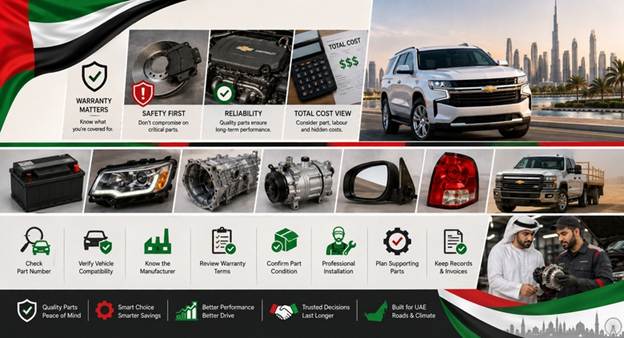
Engine components require a more selective approach.
There is a big difference between buying an aftermarket filter and buying an aftermarket internal engine component.
For items such as gaskets, sensors, belts, hoses and selected service components, reputable aftermarket manufacturers can offer sensible alternatives.
For internal engine components, however, material quality, dimensional accuracy and engineering specification become much more important.
Don't choose purely by brand familiarity.
Ask what the component is designed to meet.
And if the workshop recommends a particular manufacturer because they've installed the part repeatedly, that's useful practical information.
Aftermarket Chevrolet Gearbox Components
Transmission parts deserve similar caution.
A gearbox is a complicated assembly, and a small component can affect the operation of the entire system.
If you're considering an aftermarket solenoid, valve-body component, seal kit, sensor or other transmission part, confirm the exact transmission code.
Don't order based solely on:
"Chevrolet automatic gearbox."
That's nowhere near enough information.
Give the supplier the VIN and transmission details, then have the workshop verify the replacement before installation.
A few minutes of checking can prevent a very expensive mistake.
Aftermarket Sensors and Electrical Parts
Sensors are among the components where a small price difference can become a false economy.
A sensor doesn't simply need to fit the connector.
It needs to provide the correct signal within the required operating range.
A poor-quality sensor may trigger warning lights, produce incorrect readings or create symptoms that look like another mechanical fault.
If the genuine sensor costs AED 600 and a reputable alternative costs AED 450, the decision may be straightforward.
If an anonymous component costs AED 80, ask why.
The bigger the price gap, the more evidence you should want.
Aftermarket Headlights and Lighting Components
Lighting components can also vary in quality.
For a used or aftermarket Chevrolet headlight, check:
- Correct part number
- Generation
- Mounting points
- Connector configuration
- Lens quality
- Moisture resistance
- Adjustment mechanism
- Control electronics where applicable
A headlight that fits physically but produces poor illumination isn't a good replacement.
And if the vehicle has advanced lighting electronics, make sure the replacement is compatible with the system.
Aftermarket Body Panels and Exterior Parts
Body panels can be one of the easier categories for aftermarket buying.
But fit still matters.
A bonnet, fender or bumper that requires excessive adjustment can increase workshop time.
Then there's paint.
A cheaper aftermarket panel may need more preparation before it can be painted properly.
So compare:
Panel price + preparation + paint + fitting.
A genuine used panel in excellent condition may sometimes be a better buy than a very cheap new aftermarket panel.
That is exactly why this isn't a simple genuine-versus-aftermarket argument.
Aftermarket Parts and UAE Heat
The UAE environment adds another layer to the decision.
Extreme summer temperatures put considerable demand on cooling and AC systems.
That doesn't mean every aftermarket component will fail in the heat.
It means you should be more selective with components that operate under sustained thermal stress.
Pay particular attention to:
Cooling components + AC components + belts + hoses + electrical components.
For these parts, a reputable manufacturer and proper specification are worth more than an impressive discount.
Aftermarket Parts and Heavy UAE Traffic
Dubai and Abu Dhabi traffic can mean long periods of idling, repeated acceleration and braking, and frequent use of the AC.
A Chevrolet used mainly for short urban trips experiences a different workload from one travelling long distances across the UAE every week.
So when choosing aftermarket components, think about how the vehicle is actually used.
A part that works perfectly for a lightly driven vehicle may not be the best choice for a heavily used Silverado or Tahoe.
Ownership conditions matter.
Questions to Ask an Aftermarket Chevrolet Supplier
Before paying, ask:
Who manufactured the part?
What is the exact part number?
Which Chevrolet models and years does it cover?
Has the supplier verified the VIN?
Is it new?
What warranty is included?
What does the warranty exclude?
Does the price include all required components?
Does the workshop need programming or calibration?
These questions don't take long.
And they separate a proper parts purchase from a gamble.
The Best Aftermarket Chevrolet Part Is Not the Cheapest One
This is the central point of the entire aftermarket discussion.
A good aftermarket part should give you a meaningful combination of:
Correct fitment + acceptable quality + reasonable price + useful warranty + proven application.
If one option saves AED 500 but gives you almost no information about the manufacturer or warranty, while another saves AED 300 and comes from a reputable manufacturer with clear specifications, the second option may be the smarter purchase.
You're still saving money.
You're just not sacrificing all the evidence to get there.
Aftermarket Chevrolet Parts: Quick Buyer Test
Before ordering, ask yourself five questions.
Do I know who made it?
Do I know the exact part number?
Has compatibility been confirmed?
Is the price saving meaningful?
Would I be comfortable paying the labour again if it failed?
That final question is particularly powerful.
If installation costs AED 1,000 and the aftermarket part saves only AED 150, the risk may not be worth taking.
If the part saves AED 1,500 and comes with a solid warranty, the decision becomes much more interesting.
Compare the saving against the risk, not against the genuine-part price alone.
Genuine vs Aftermarket Chevrolet Parts by Component
Chevrolet Engine Parts: Genuine vs Aftermarket
Engine components need a more careful comparison than ordinary replacement items.
A Chevrolet engine contains dozens of parts that look relatively simple but have very specific jobs. Sensors, gaskets, belts, hoses, thermostats, water pumps and ignition components can all be sourced from aftermarket manufacturers, but quality varies.
For routine external components, a reputable aftermarket manufacturer can often provide a sensible alternative.
For internal engine components, I'd be more selective.
Think about pistons, bearings, timing components and other parts where dimensional accuracy and material quality directly affect engine life. Saving a few hundred dirhams isn't particularly impressive if the repair has to be opened up again.
For an older Malibu or Captiva, a good aftermarket component may make financial sense.
For a newer Tahoe or a heavily used Silverado, the reliability calculation can point towards genuine or a proven premium aftermarket manufacturer.
Chevrolet Engine Sensors: Genuine vs Aftermarket
Sensors are small.
Their consequences aren't.
A poor-quality sensor can produce incorrect readings, trigger warning lights or create symptoms that send the workshop looking in completely the wrong direction.
Before buying an aftermarket sensor, confirm:
Exact part number + engine application + connector + manufacturer + warranty.
Don't buy simply because the connector looks identical.
For a low-cost sensor, the genuine-versus-aftermarket decision may come down to how much the reputable alternative saves.
If the saving is tiny, genuine can be easier to justify.
If the reputable aftermarket alternative costs substantially less and has a solid application history, it may be perfectly sensible.
Chevrolet Water Pumps and Cooling Components
Cooling components deserve particular attention in the UAE.
The vehicle can spend long periods operating in high ambient temperatures, especially during summer traffic.
A water pump, thermostat, radiator or cooling fan isn't the place to chase an anonymous bargain.
A reputable aftermarket cooling component can work well.
But confirm the correct specification and check the rest of the cooling system while you're there.
If an old radiator is restricted and the thermostat is weak, installing one new component won't necessarily solve the overheating problem.
Look at the system.
Not just the part.
Chevrolet AC Parts: Genuine vs Aftermarket
This is one category where aftermarket can be attractive, particularly for older Chevrolet vehicles.
AC compressors, condensers, blower components and other parts can become expensive through genuine channels.
A reputable aftermarket component can reduce the bill.
But the UAE climate makes quality particularly important.
Before buying a compressor, confirm:
Compressor number + electrical configuration + pulley/clutch arrangement + vehicle application + warranty.
And diagnose the system first.
A compressor should not be replaced simply because the AC isn't cold.
A refrigerant leak, condenser problem, pressure issue, electrical fault or cooling-fan problem can create similar symptoms.
The cheapest compressor is worthless if the compressor wasn't the problem.
Chevrolet Gearbox Parts: Genuine vs Aftermarket
Transmission components require exact matching.
A gearbox may contain numerous valves, solenoids, sensors, seals and electronic components, and the correct specification can depend on the transmission code.
This is where the VIN becomes useful.
Before buying an aftermarket transmission component, confirm:
Transmission code + original part number + replacement part number + application.
For a relatively inexpensive seal or service component, reputable aftermarket can be attractive.
For an electronic transmission control component, I'd demand much stronger evidence.
The labour also matters.
If fitting the component requires removing a substantial portion of the transmission, don't risk a questionable part just to save a relatively small amount.
Chevrolet Transmission Filters and Service Parts
This is an area where a quality aftermarket option can often make good financial sense.
Transmission filters, seals and service kits are generally easier to compare than a complete transmission assembly.
Still, specification matters.
The filter must match the transmission.
The gasket must fit correctly.
The fluid must meet the required specification.
A cheap filter that doesn't seal properly can create a much bigger problem.
So yes, aftermarket can save money here.
Just don't confuse simple component with unimportant component.
Chevrolet Brake Parts: Genuine vs Aftermarket
Brake components require a different buying mindset.
Pads, discs and other braking components are safety-critical, so I'd rather see a reputable aftermarket manufacturer than an unknown ultra-cheap component.
A good aftermarket brake pad can be a sensible alternative to genuine.
But compare more than price.
Look at:
Manufacturer + application + specification + warranty + expected usage.
A Tahoe that spends its life in heavy traffic has different braking demands from a lightly driven Captiva.
A Camaro or Corvette driven enthusiastically deserves an even more careful component choice.
If the supplier can't clearly identify the brake component, move on.
There are plenty of areas where you can save money.
Braking isn't the one I'd gamble on.
Chevrolet Suspension Parts: Genuine vs Aftermarket
Suspension components often provide a reasonable opportunity to reduce repair costs.
Control arms, stabiliser links, bushes and selected steering components are available from aftermarket manufacturers, and a reputable alternative can make sense on an older Chevrolet.
But inspect the surrounding components.
If the vehicle has worn bushes, tired shocks and loose links, replacing only the cheapest failed component may simply postpone the next repair.
For a daily-driven Malibu or Captiva, a quality aftermarket suspension component can be excellent value.
For a heavy Tahoe or frequently loaded Silverado, durability deserves more weight in the decision.
Chevrolet Steering Components
Steering parts deserve the same caution as brakes.
Tie rods, steering links and related components affect vehicle control.
Don't buy an unknown component simply because it is half the price.
A reputable aftermarket manufacturer can provide a perfectly reasonable alternative, but verify the application and inspect the component before installation.
After fitting steering components, wheel alignment may also be required.
Remember that cost.
The replacement part is not necessarily the end of the bill.
Chevrolet Headlights: Genuine vs Aftermarket
Headlights can look like straightforward body components.
Modern ones aren't always.
Depending on the Chevrolet model and specification, the assembly may contain LED systems, adjustment mechanisms, control electronics or other integrated components.
A genuine headlight can therefore be expensive.
A reputable aftermarket replacement can offer substantial savings.
But check:
Part number + generation + connectors + mounting points + lighting technology + control electronics.
A headlight that physically bolts into place but doesn't communicate correctly with the vehicle isn't a successful replacement.
For older Malibu or Captiva models, aftermarket lighting can be easier to justify.
For a newer Tahoe or performance Chevrolet, verify everything before ordering.
Chevrolet Body Panels: Genuine vs Aftermarket
Body panels are usually one of the more straightforward categories for aftermarket comparison.
A bonnet, fender, door or bumper doesn't contain the same complexity as an ECU.
But fit matters.
A poor-fitting panel can create additional body-shop labour, adjustment and paint preparation.
This is why a genuine used panel can sometimes beat a brand-new cheap aftermarket panel.
Imagine:
Aftermarket panel = lower purchase price + extra preparation
versus:
Used genuine panel = higher purchase price + better existing fit
The second option may actually produce the lower final repair bill.
Ask for photographs of the actual panel.
Don't rely on a generic image.
Chevrolet Mirrors: Genuine vs Aftermarket
Mirrors sit somewhere between body and electrical components.
A basic manual mirror is relatively simple.
A modern powered, heated or electronically controlled mirror can be much more complicated.
Before buying, check:
Manual or electric + heated or non-heated + folding function + camera/sensor equipment + connector + paint condition.
If the genuine mirror is dramatically more expensive, a reputable aftermarket alternative may be attractive.
But make sure the quotation includes the features your Chevrolet actually has.
A cheaper mirror without the required electronics isn't equivalent.
Chevrolet Alternators: Genuine vs Aftermarket
Alternators can be good candidates for aftermarket replacement, provided the manufacturer and electrical specification are correct.
Check:
Output rating + mounting arrangement + pulley configuration + connector + engine application.
A low-cost alternator with the wrong output specification can cause charging problems.
For an older Captiva or Malibu, a reputable aftermarket alternator may offer excellent value.
For a newer Chevrolet with a more sophisticated charging system, verify compatibility more carefully.
Again, the question isn't simply:
"Does it fit?"
It's:
"Does it operate correctly with this vehicle?"
Chevrolet Starters: Genuine vs Aftermarket
Starter motors are another component where reputable aftermarket options can make sense.
The basic comparison is fairly straightforward:
Correct application + correct electrical specification + reputable manufacturer + warranty.
But don't replace the starter without diagnosing the starting problem.
A weak battery, poor ground connection or charging-system issue can look like a starter failure.
If the workshop hasn't established that the starter itself is faulty, don't order one yet.
Diagnosis first.
Purchase second.
Chevrolet ECUs and Electronic Modules
This is where I'd lean more heavily towards genuine or a specialist-approved replacement.
Electronic modules can require programming, coding or configuration.
A used module might be physically correct but still need additional work before the vehicle accepts it.
An aftermarket electronic component may be perfectly good, but the supplier should be able to explain exactly how compatibility is established.
Before paying, ask:
Does it require programming?
Can it be programmed for my VIN?
Is programming included?
Does the warranty cover programming-related problems?
These questions can prevent a cheap module from becoming an expensive installation.
Chevrolet ABS Components: Genuine vs Aftermarket
ABS components deserve the same caution as other safety-related electronics.
Sensors, modules and related components need to communicate correctly with the vehicle.
A reputable aftermarket sensor may be perfectly reasonable.
An unknown ABS module is a different proposition.
If the genuine part costs substantially more, ask whether a reputable specialist replacement exists.
Then have the workshop confirm the exact part number and programming requirements.
Don't experiment with safety systems simply because the online price looks attractive.
Chevrolet Exhaust Components
Exhaust components offer more room for aftermarket choices.
Mufflers, pipes, catalytic components and related hardware can all be available through different manufacturers.
But the application still matters.
A Chevrolet Silverado used for towing may have different requirements from a commuter Malibu.
A Camaro or Corvette may have an exhaust system where sound, flow and performance are part of the owner's priorities.
If emissions-related components are involved, be especially careful about specification and legality.
Cheap isn't necessarily simple.
Genuine vs Aftermarket: Which Components Are Safer to Buy Aftermarket?
A useful broad guide is:
| Component | Aftermarket potential | Main concern |
| Body panel | High | Fit and finish |
| Trim | High | Fit and appearance |
| Mirror | Medium/high | Features and electronics |
| Brake pads | Medium/high | Manufacturer and specification |
| Suspension links | Medium/high | Quality and durability |
| AC compressor | Medium | Correct specification and diagnosis |
| Alternator | Medium | Electrical output |
| Starter | Medium | Specification and quality |
| Engine sensor | Medium | Signal accuracy |
| ECU/module | Low/medium | Programming and compatibility |
| Gearbox electronics | Low/medium | Exact transmission match |
| Engine internals | Lower | Materials and dimensional accuracy |
These aren't absolute rules.
They're a starting point.
A reputable aftermarket manufacturer can change the answer.
So can the age and value of the Chevrolet.
Genuine vs Aftermarket: Which Parts Should You Avoid Buying Cheaply?
If I had to identify the categories where extreme price-cutting deserves the most caution, I'd start with:
Braking components
Steering components
Critical engine internals
Transmission control components
ECUs and safety-related modules
Poorly specified cooling components
Major performance components
The reason isn't that aftermarket is automatically inferior.
It's that failure can be expensive, dangerous or labour-intensive.
If a cheap trim clip breaks, replace it.
If a cheap transmission component fails after the gearbox has been removed and installed, you're dealing with a very different bill.
The UAE Climate Changes the Buying Calculation
The same Chevrolet part can face very different operating conditions depending on how and where the vehicle is used.
Dubai traffic.
Abu Dhabi motorway journeys.
Sharjah commuting.
Long-distance driving between Emirates.
Heavy summer AC use.
Extended idling.
High ambient temperatures.
These aren't reasons to reject aftermarket parts.
They are reasons to be more selective with components that operate under heat and load.
For AC, cooling and electrical components, I'd put manufacturer quality and correct specification ahead of the absolute lowest price.
Genuine vs Aftermarket: A Practical Component Rule
Here's the approach I'd use when standing at the parts counter.
If the component is cheap, simple and non-critical: reputable aftermarket can be an easy choice.
If it is expensive but straightforward: compare genuine, reputable aftermarket and used options.
If it is safety-critical: prioritise proven quality and correct specification.
If it is electronic: confirm programming and compatibility.
If it is labour-intensive: don't risk an unknown component merely to save a small amount.
If it is an engine or gearbox component: investigate the manufacturer, specification, warranty and installation requirements carefully.
That's much more useful than declaring one category universally superior.
The Real Difference Is Not Genuine vs Aftermarket
It's known quality vs unknown quality.
That's the distinction buyers should remember.
A reputable aftermarket brake component with clear specifications may be a better purchase than an unknown "genuine" part from an unreliable source.
Likewise, a genuine Chevrolet component from a proper supply channel may be the safest and simplest option for a complicated electronic system.
The badge on the box isn't enough.
Look at the evidence behind the component.
Then look at the cost of getting it wrong.
That's where the genuine-versus-aftermarket decision becomes much clearer.
Genuine vs Aftermarket Parts for Chevrolet Tahoe, Silverado, Camaro, Corvette, Malibu and Captiva
Genuine vs Aftermarket Parts for Chevrolet Tahoe
The Tahoe deserves a slightly more careful parts strategy because it combines a large powertrain, substantial weight and a relatively complex electrical system.
For routine maintenance items, a reputable aftermarket manufacturer can make sense.
For major components, I'd be more selective.
Think about:
Engine sensors + cooling components + AC parts + suspension + brakes + electronic modules.
A genuine part can be worth the extra money when compatibility is difficult or installation is expensive.
For an older Tahoe, however, a good aftermarket alternative may reduce ownership costs without compromising the vehicle's usefulness.
The key is not the Tahoe badge.
It's the component.
Tahoe Engine Parts: Which Route Makes Sense?
For belts, hoses, filters and selected external engine components, reputable aftermarket options can be perfectly reasonable.
For internal engine components, the quality threshold should be much higher.
A Tahoe used for long motorway journeys, family travel or heavy-duty work needs dependable cooling and lubrication systems.
Don't save AED 300 on a component that could contribute to a major engine repair.
If the aftermarket manufacturer is well established and the specification is clear, the calculation becomes more attractive.
If the part is anonymous, I'd walk away.
Tahoe AC Parts in UAE
The Tahoe's AC system works hard in UAE conditions.
That's especially noticeable during summer traffic, when the system can remain under load for long periods.
For compressors, condensers and electrical AC components, compare genuine against reputable aftermarket options rather than choosing the cheapest listing.
Check:
Correct compressor specification + electrical configuration + vehicle application + warranty.
And diagnose the system before ordering.
A compressor is expensive enough that guessing is unnecessary.
Tahoe Brakes and Suspension
A heavy SUV puts meaningful demands on brakes and suspension.
That doesn't mean you must buy genuine Chevrolet components.
It does mean that unknown-quality parts deserve caution.
A reputable aftermarket brake pad or control arm can be sensible.
A no-name component with unclear specifications isn't worth the risk.
If you're replacing several suspension components together, compare the complete package.
Sometimes buying a matching set from a reputable manufacturer can produce a better result than mixing several very cheap parts.
Genuine vs Aftermarket Parts for Chevrolet Silverado
The Silverado requires a more usage-focused approach.
A lightly used private vehicle and a pickup that spends its week carrying loads or towing aren't asking the same questions of their parts.
For a working Silverado, durability can be worth paying for.
Engine cooling components, drivetrain parts, suspension, brakes and transmission components deserve particular attention.
A reputable aftermarket component may still be the right answer.
Just make sure the manufacturer and specification are suitable for the actual workload.
Silverado Engine Components
For routine service components, aftermarket can be attractive.
For major engine components, be more cautious.
If the truck is used heavily, the cost of downtime should be part of the calculation.
Imagine an aftermarket component saves AED 600.
If it fails and the vehicle spends another two days in the workshop, the saving may disappear quickly for a business owner.
That's why fleet and commercial use changes the value equation.
A private owner may prioritise purchase price.
A working truck owner may prioritise uptime.
Neither approach is wrong.
Silverado Gearbox Components
Transmission specification is critical.
Give the supplier the VIN and transmission details before requesting an aftermarket component.
Ask for the exact replacement part number.
Then have the workshop verify it before installation.
For a gearbox solenoid, valve-body component or electronic module, I would be far more demanding about manufacturer quality than I would for a simple trim piece.
Why?
Because the installation labour can become significant.
If the part fails after installation, you're potentially paying twice.
Silverado Suspension and Steering
A Silverado used for towing or carrying heavy loads can put additional stress on suspension and steering components.
For this reason, a reputable aftermarket manufacturer can be a good middle ground.
You don't necessarily need genuine.
You do need something designed for the correct application.
Check load rating and specification where applicable.
And if the truck has been modified with different suspension, wheels or tyres, tell the supplier.
The original specification may no longer tell the whole story.
Genuine vs Aftermarket Parts for Chevrolet Camaro
The Camaro changes the conversation.
It's not just a transport appliance for many owners.
Performance, handling, braking and appearance can all matter.
For routine service items, reputable aftermarket is often perfectly sensible.
For performance-related components, the manufacturer and specification deserve more attention.
A Camaro fitted with upgraded suspension or brakes may also need different replacement components from a factory-standard car.
Tell the supplier about modifications.
Don't assume they can see them from the model name.
Camaro Brakes and Suspension
This is one area where aftermarket can be excellent — provided the manufacturer is reputable and the specification suits the vehicle.
Performance owners often have more choice than owners of ordinary commuter cars.
But choice creates another problem.
It's easy to buy something that looks impressive without actually being the right match.
Check:
Vehicle generation + engine + brake specification + wheel size + existing equipment.
Then compare.
A cheaper brake component that doesn't suit the vehicle's setup isn't a saving.
Camaro Body and Lighting Parts
For cosmetic parts, the aftermarket can offer significant savings.
Bumpers, grilles, trim and some lighting components can all have alternatives.
But fitment matters.
A badly fitting bumper creates extra body-shop work.
A cheap headlight with poor lens quality can affect visibility.
If you're buying used genuine bodywork, compare that against new aftermarket rather than assuming new is automatically better.
Sometimes the original panel wins.
Genuine vs Aftermarket Parts for Chevrolet Corvette
Corvette ownership deserves a more exact approach.
Generational differences are significant, and performance specifications can matter.
A supplier should know:
Generation + year + engine + transmission + VIN + original part number.
Don't accept a generic "Corvette compatible" answer for an expensive component.
For bodywork, trim and selected maintenance parts, reputable aftermarket options may be perfectly reasonable.
For performance-critical, electronic or specification-sensitive components, I'd want stronger evidence before moving away from genuine.
Corvette Performance Components
This is where "cheap aftermarket" becomes a particularly weak buying strategy.
A performance component affects how the vehicle behaves.
That can include:
- Brakes
- Suspension
- Cooling
- Engine components
- Transmission components
- Sensors
- Performance electronics
If a reputable specialist aftermarket manufacturer makes the exact component for your Corvette, excellent.
But don't buy an anonymous part simply because it has the right dimensions.
Performance vehicles punish poor assumptions.
Corvette Body Panels and Lighting
Bodywork can be a different story.
A good aftermarket bumper or used genuine panel may provide significant savings.
For exterior components, compare:
Purchase price + preparation + paint + fitting.
For headlights, check the electronic equipment and generation carefully.
A genuine used headlight in excellent condition can sometimes make more financial sense than an inexpensive new aftermarket assembly.
Genuine vs Aftermarket Parts for Chevrolet Malibu
Malibu ownership tends to be more cost-sensitive, particularly on older examples.
This makes reputable aftermarket parts attractive.
For routine maintenance, suspension, AC components, sensors and selected electrical parts, the aftermarket can reduce the cost of keeping the car on the road.
But don't go too far.
If the Malibu is already experiencing several major failures, ask whether the vehicle still justifies continued investment.
Saving AED 400 on one component doesn't matter much if another AED 8,000 repair is waiting around the corner.
Look at the whole vehicle.
Malibu AC and Cooling Parts
For an older Malibu in the UAE, AC performance is hardly optional.
A reputable aftermarket compressor, condenser or cooling component can make sense if the specification is correct.
But diagnose the system properly.
If the compressor is fine and the condenser is blocked, buying a compressor has achieved nothing.
Likewise, if an overheating problem is caused by a cooling fan or thermostat, replacing the radiator alone may not solve it.
Correct diagnosis saves more money than chasing the cheapest component.
Malibu Electrical Parts
Sensors, switches, alternators and other electrical components can often be sourced aftermarket.
The closer the component is to the vehicle's electronic control systems, the more carefully I'd check the manufacturer and part number.
If the genuine part costs only slightly more than the reputable aftermarket alternative, genuine may be easier to justify.
If the price gap is substantial, aftermarket becomes more attractive.
That's the same decision framework we've used throughout this article.
Genuine vs Aftermarket Parts for Chevrolet Captiva
The Captiva is another vehicle where the economics of ownership matter.
For an older Captiva, reputable aftermarket components can keep maintenance costs under control.
Body parts, suspension components, AC parts and selected electrical components may all provide worthwhile savings.
But the same warning applies:
Cheap isn't the objective.
The objective is reasonable quality at a sensible total cost.
If a genuine component costs AED 900 and a reputable aftermarket option costs AED 650 with a useful warranty, the aftermarket may be the obvious choice.
If an unknown part costs AED 250, investigate before celebrating the saving.
Captiva Suspension and Steering Parts
Suspension is often an area where aftermarket alternatives can work well.
But check the complete system.
If the vehicle has worn control arms, links and shocks, replacing only one component may leave the vehicle with uneven performance.
For a daily-driven Captiva, I'd choose a reputable manufacturer and compare the complete repair.
Don't buy five unrelated cheap parts simply because each one looks affordable.
A coherent repair is usually better.
Captiva AC Parts
The UAE climate makes AC an important ownership consideration.
A reputable aftermarket AC component can offer worthwhile savings, but compressor and condenser selection should be based on exact specification.
Before ordering, confirm:
Part number + engine + year + compressor configuration + warranty.
And have the system diagnosed.
No guessing.
Six Chevrolet Models: Quick Genuine vs Aftermarket Guide
| Chevrolet model | Areas where aftermarket can make sense | Areas needing more caution |
| Tahoe | Service, suspension, selected AC parts | Engine, transmission, electronics |
| Silverado | Service, suspension, selected cooling parts | Drivetrain, heavy-duty components |
| Camaro | Service, body, selected suspension | Performance brakes, engine, electronics |
| Corvette | Body, trim, selected service parts | Performance, electronics, drivetrain |
| Malibu | Service, suspension, AC, selected electrical | Major engine/gearbox repairs |
| Captiva | Service, suspension, AC, body | Engine, gearbox, electronics |
This is a starting framework rather than a fixed buying rule.
The exact vehicle and component can change the answer.
Which Chevrolet Model Has the Strongest Case for Aftermarket Parts?
Older Malibu and Captiva models can offer some of the strongest financial reasons to consider reputable aftermarket components.
The vehicle may have a lower market value, so paying a large genuine-part premium for every repair can become difficult to justify.
Tahoe and Silverado owners may also benefit from aftermarket choices, particularly for routine maintenance and selected suspension or cooling components.
Camaro and Corvette owners need to be more selective around performance-related parts.
Again, the component matters more than the badge.
Which Chevrolet Parts Should Stay Genuine Where Possible?
I'd lean towards genuine when:
The vehicle is still under warranty.
The component is safety-critical and alternatives are uncertain.
The part requires complex programming.
The labour to replace it is very high.
The genuine price premium is relatively small.
The exact specification is difficult to establish.
That doesn't mean aftermarket is forbidden.
It means the reason for choosing it needs to be stronger.
Which Chevrolet Parts Are Usually Easier to Buy Aftermarket?
The most straightforward categories tend to be:
Filters
Belts
Selected hoses
Some suspension components
Certain brake components from reputable manufacturers
Selected AC components
Body and trim items
But even here, verify the application.
"Easy to buy aftermarket" doesn't mean "buy anything that fits".
The UAE Ownership Factor
A Chevrolet in Dubai isn't necessarily living the same life as one in Abu Dhabi or Fujairah.
Traffic patterns differ.
Driving distances differ.
Heat exposure differs.
Vehicle usage differs.
A Silverado used commercially may accumulate miles quickly.
A Corvette may be driven mainly at weekends.
A Tahoe may carry a family every day.
A Malibu may be kept as a practical second vehicle.
A Captiva may be maintained primarily around budget.
The parts strategy should reflect that.
Final Model-by-Model Buying Rule
For Tahoe and Silverado, put reliability and workload near the top of the list.
For Camaro and Corvette, pay close attention to performance specification and generation.
For Malibu and Captiva, control costs intelligently without allowing cheap parts to undermine reliability.
And for every model:
Verify the VIN. Check the part number. Identify the manufacturer. Compare the warranty. Calculate the installed cost.
That's the point at which genuine versus aftermarket stops being a simple argument about brands.
It becomes a practical ownership decision — which is exactly what Chevrolet buyers in the UAE need.
Genuine vs Aftermarket Chevrolet Parts: Price, Labour and Total Repair Cost
Genuine vs Aftermarket Chevrolet Parts Price Comparison
The first number buyers see is usually the part price.
It shouldn't be the last.
A genuine Chevrolet component may cost considerably more than a reputable aftermarket equivalent, but that premium can sometimes buy stronger specification confidence, manufacturer support or a better-established warranty.
The aftermarket option may offer a substantial saving without sacrificing useful quality.
So compare the complete repair, not just the component.
| Cost factor | Genuine Chevrolet | Reputable aftermarket |
| Initial part price | Usually higher | Usually lower |
| Specification confidence | High | Depends on manufacturer |
| Warranty | Manufacturer/supplier terms | Manufacturer/supplier terms |
| Availability | Can depend on dealer stock | Often broader |
| Labour | Usually similar for the same job | Usually similar |
| Risk of poor fitment | Generally lower | Depends on quality |
| Potential saving | Lower | Higher |
The important word here is reputable.
A high-quality aftermarket part and an anonymous low-cost part should never be placed in the same category.
How Much Can Aftermarket Chevrolet Parts Save?
There is no fixed percentage.
The difference depends on the component.
For some routine parts, the saving may be modest.
For larger assemblies or certain specialist components, the gap can be much wider.
But don't automatically assume that a 40% cheaper component gives you a 40% saving.
Suppose a genuine component costs AED 2,000 and the aftermarket alternative costs AED 1,200.
The apparent saving is AED 800.
Now add a potential fitting problem, additional diagnostics or early replacement.
The real saving may be considerably smaller.
This is why the correct calculation is:
Genuine total repair cost − aftermarket total repair cost = actual potential saving.
Does a Cheaper Chevrolet Part Reduce the Total Repair Cost?
Sometimes.
Sometimes it doesn't.
Imagine two brake-pad options:
Genuine: AED 600
Reputable aftermarket: AED 420
If both install normally and provide suitable performance, the AED 180 saving is real.
Now imagine a gearbox component:
Genuine: AED 2,500
Unknown aftermarket: AED 1,200
The AED 1,300 difference looks excellent.
But if the aftermarket component fails and the gearbox needs to be opened again, the labour can wipe out the saving.
That's why part complexity changes the buying decision.
The more expensive the installation, the more cautious you should be about the component.
Genuine vs Aftermarket Labour Costs
One common misconception is that choosing aftermarket automatically reduces labour.
Usually, it doesn't.
If the workshop spends four hours replacing a component, those four hours remain four hours regardless of whether the part came from a Chevrolet dealer or an aftermarket manufacturer.
The difference usually appears in the component price, not the fundamental labour required.
There can be exceptions.
A different aftermarket design may require additional fitting or adjustment.
A complete genuine assembly may include hardware that an aftermarket version doesn't.
That's why the workshop should confirm what comes in the box before calculating the total.
When the Labour Cost Changes the Decision
Consider a component that costs AED 500.
If genuine costs AED 650 and aftermarket costs AED 500, saving AED 150 may not justify taking a risk.
Now consider a component that costs AED 5,000 genuine and AED 3,000 aftermarket.
The AED 2,000 saving is much more meaningful.
But if installation costs AED 2,500, you need a good reason to risk an uncertain component.
The more labour-intensive the repair, the more valuable reliability and warranty protection become.
That's a useful rule for engines, gearboxes and electronic modules.
Hidden Costs When Buying Cheap Aftermarket Parts
The purchase price can hide several additional expenses.
Potential extras include:
- Additional diagnostics
- Reinstallation
- Programming
- Calibration
- New seals
- Mounting hardware
- Fluids
- Delivery
- Paint preparation
- Wheel alignment
- Repeat workshop labour
Not every repair needs all of these.
But buyers should ask about them before approving the part.
A supplier who gives you a very low price isn't necessarily misleading you.
They may simply be quoting the component only.
Your job is to establish the complete repair cost.
Genuine vs Aftermarket: Installation Risk
Installation risk is one of the biggest differences between simple and complicated components.
Replacing a small trim component is relatively straightforward.
Replacing a gearbox isn't.
If the gearbox component costs AED 1,000 less but fails after installation, you're not simply losing AED 1,000.
You may also pay for:
Removal + diagnosis + replacement + fluid + testing.
The same applies to some engine components.
This is why a slightly more expensive proven part can sometimes be the cheaper choice overall.
It sounds backwards.
It isn't.
Replacement Frequency and Long-Term Ownership Cost
Purchase price matters once.
Reliability matters every time the component is used.
Suppose an aftermarket component lasts four years while the genuine equivalent lasts six years.
The aftermarket option may still be cheaper overall.
But if the aftermarket component lasts one year and needs repeated replacement, the economics change completely.
That's why long-term ownership cost should consider:
Purchase price + expected service life + installation + repeat labour + downtime.
This is particularly useful for older Chevrolet vehicles where owners intend to keep the car for several more years.
Genuine vs Aftermarket Brake Cost
Brake components offer an interesting comparison because replacement is relatively routine.
A reputable aftermarket brake pad can often reduce the parts bill.
But don't compare only the pad price.
Check:
Pad specification + disc condition + fitting + wear sensor where applicable + warranty.
If the discs are already worn, installing new pads alone may not produce the result you expect.
A workshop should inspect the complete braking system.
The cheapest brake-pad quotation is not necessarily the cheapest brake repair.
Genuine vs Aftermarket AC Cost
AC is particularly important for UAE Chevrolet owners.
A compressor, condenser or fan component may have a significant genuine-part price.
A reputable aftermarket option can reduce the bill.
But installation should be considered.
If the system needs flushing, refrigerant recovery, seals or additional repairs, those costs remain regardless of the component brand.
So compare:
Part + labour + refrigerant + seals + system service + testing.
Then look at the final amount.
That's a much more realistic comparison.
When comparing reputable aftermarket Chevrolet suppliers, PartFinder UAE can be considered alongside other available purchasing options, particularly when buyers want to compare parts, suppliers and vehicle-specific requirements before making a decision.
Genuine vs Aftermarket Suspension Cost
Suspension can provide meaningful aftermarket savings.
For example, a reputable aftermarket control arm or stabiliser link may cost less than a genuine equivalent.
But the workshop should inspect related components.
If several suspension parts are worn, replacing one component today and another next month can increase labour costs.
Sometimes buying a complete, properly matched repair package is more economical.
Ask the workshop:
"What else is worn while you're in there?"
That's a useful question.
Genuine vs Aftermarket Engine Cost
Engine components require more detailed calculations.
A cheaper gasket, thermostat or sensor may be sensible.
A cheaper internal engine component deserves much greater scrutiny.
If the engine has already been opened, don't save AED 300 on a questionable part and risk another teardown.
The labour involved in accessing internal engine components can be far greater than the part saving.
This is one of the clearest examples of why component price and repair economics are different things.
Genuine vs Aftermarket Gearbox Cost
The same principle applies to transmissions.
A reputable aftermarket service kit can make sense.
A low-quality internal or electronic transmission component can create much bigger problems.
Before deciding, calculate:
Part + transmission labour + fluid + programming/adaptation + diagnostics + warranty.
Then compare the genuine and aftermarket totals.
If the difference is small, genuine may be easier to justify.
If the difference is substantial and the aftermarket manufacturer is proven, the alternative becomes more attractive.
Genuine vs Aftermarket Electronics Cost
Electronics are often deceptively expensive to get wrong.
An ECU, ABS module or control module may require programming.
That programming itself may cost money.
If the component doesn't communicate correctly, you may also pay for additional diagnostics.
So ask the supplier and workshop:
Is this module plug-and-play?
Does it need coding?
Can it be programmed to my VIN?
Is programming included?
What happens if the module cannot be programmed?
A cheap electronic part with no clear answers isn't really a cheap option.
Total Repair Cost Example
Imagine a Chevrolet requires a component with these two choices:
| Cost | Genuine | Reputable aftermarket |
| Part | AED 2,400 | AED 1,550 |
| Delivery | AED 100 | AED 100 |
| Labour | AED 700 | AED 700 |
| Diagnostics | AED 150 | AED 150 |
| Supporting parts | AED 150 | AED 150 |
| Estimated total | AED 3,500 | AED 2,650 |
The potential saving is AED 850.
Now the decision becomes meaningful.
If the aftermarket component has clear manufacturer information, correct fitment and a solid warranty, AED 850 may be worth keeping in your pocket.
If it has no identifiable manufacturer and no warranty, the risk may not justify the saving.
The numbers don't make the decision.
They help you ask the right question.
When Paying More for Genuine Is Financially Sensible
I'd be more willing to pay the genuine premium when:
The component is difficult to replace.
The vehicle is under warranty.
The part is safety-critical.
The aftermarket specification is uncertain.
The genuine price difference is relatively small.
The vehicle is valuable or relatively new.
In those situations, the additional money can buy more than a logo.
It can buy confidence.
When Aftermarket Is the More Sensible Choice
I'd lean towards reputable aftermarket when:
The vehicle is older.
The component is relatively simple.
The manufacturer is established.
The specification is clearly matched.
The warranty is acceptable.
The price difference is meaningful.
The installation risk is low.
That can be an excellent way to keep an older Chevrolet affordable without automatically choosing the cheapest available component.
A Simple Genuine vs Aftermarket Cost Formula
For expensive repairs, use:
Part price + delivery + labour + supporting parts + diagnostics/programming + expected repeat cost = realistic ownership cost.
Then compare the genuine and aftermarket options.
If the aftermarket option wins comfortably and the quality evidence is strong, go ahead.
If the saving is tiny, genuine may be the easier decision.
If the saving is huge but the quality evidence is poor, stop and investigate.
Don't let a large discount rush you into a bad purchase.
Final Price Rule
The best Chevrolet parts deal isn't the one with the lowest component price.
It's the one that gives you the strongest combination of:
Purchase price + quality + compatibility + warranty + service life + installation cost.
That's the number that should guide the decision.
And once you start calculating that way, genuine versus aftermarket becomes much less emotional.
It becomes a straightforward ownership calculation.
Compatibility, Quality and UAE Conditions
How to Check Chevrolet Aftermarket Part Compatibility
A part can look right, carry the Chevrolet model name and still be wrong for your vehicle.
That's why compatibility should be checked before price.
Start with the VIN, model year, engine, transmission and original part number where available. Then compare those details with the replacement component.
For simple items, model and year may be enough to narrow things down.
For an ECU, transmission component, AC compressor, sensor or engine part, they often aren't.
If the supplier says:
"It fits all Chevrolet Tahoe models."
ask for more detail.
Which years?
Which engine?
Which transmission?
Which specification?
Which part number?
A proper answer should be specific.
Why the VIN and Part Number Still Matter
The VIN gives the supplier a much stronger starting point than the model name alone.
The original part number adds another layer of confirmation.
Ideally, you want both.
For example:
Vehicle: Chevrolet Tahoe
Year: 2021
VIN: Supplied to seller
Original part number: Confirmed
Replacement number: Matched
That is much safer than:
"Tahoe 2021 — please send gearbox."
The second request leaves too much room for assumption.
And assumptions become expensive when the part is already on the workshop floor.
Can Two Chevrolet Parts Look Identical but Be Different?
Absolutely.
This happens particularly with electronic and mechanical components that are shared across related vehicles.
A connector may look the same.
The mounting points may line up.
The housing may be almost identical.
Yet the internal specification can differ.
A sensor can have a different operating range.
A module can require different software.
A gearbox component can belong to another transmission version.
A compressor can have a different capacity or electrical configuration.
So visual similarity is useful for identification.
It isn't proof of compatibility.
How to Match a Chevrolet Part Number
If the old component has a readable number, photograph it before removing or discarding it.
Then provide that photograph to the supplier.
Ask the supplier to confirm:
Original number → replacement number → exact vehicle application.
For an expensive component, get that confirmation in writing.
If the numbers differ, don't immediately assume the replacement is wrong.
Manufacturers can supersede older part numbers.
The important thing is whether the new number is a confirmed replacement for your original application.
That's something the supplier or workshop should establish.
What Happens If You Buy the Wrong Chevrolet Part?
The obvious problem is that the part may not fit.
But the financial consequences can go further.
You could also face:
- Return shipping
- Restocking or return restrictions
- Additional workshop time
- Delayed repairs
- Vehicle downtime
- Diagnostic charges
- Reinstallation costs
- Programming charges for electronic components
And if the wrong part has already been installed and operated, the situation can become even more complicated.
That's why spending a few minutes checking compatibility is usually far cheaper than correcting the mistake afterwards.
Why UAE Climate Matters When Choosing Chevrolet Parts
The UAE environment changes how some components are used.
Summer temperatures can become extremely high, while traffic can keep vehicles idling for extended periods with the AC running.
That puts particular attention on:
Cooling systems + AC systems + batteries + electrical components + belts + hoses.
This doesn't mean you must choose genuine parts for everything.
It means quality becomes more important for components exposed to sustained heat.
A reputable aftermarket cooling component may be an excellent purchase.
An unknown low-cost component with no useful specification information is much harder to justify.
Genuine vs Aftermarket AC Components in UAE Heat
AC components are among the most relevant parts for UAE vehicle owners.
A compressor, condenser, blower motor or cooling fan can work hard during summer.
When comparing genuine and aftermarket options, check the exact specification rather than simply comparing the price.
For a compressor, confirm:
Part number
Engine/application
Electrical configuration
Pulley or clutch arrangement where applicable
Refrigerant compatibility
Warranty
And don't overlook the diagnosis.
If the AC system has a leak, electrical fault or blocked condenser, installing a new compressor won't necessarily fix the problem.
Cooling-System Components Need More Attention
A Chevrolet operating in summer traffic relies heavily on its cooling system.
Radiators, thermostats, water pumps, cooling fans, hoses and related components need to work together.
This is one reason I wouldn't recommend choosing a cooling component purely because it is the cheapest aftermarket option.
Ask about:
Manufacturer
Material/specification
Vehicle application
Warranty
And inspect the rest of the cooling system while the vehicle is being repaired.
A new radiator cannot compensate for a failing water pump.
A new thermostat cannot repair a weak cooling fan.
The system needs to be treated as a system.
Chevrolet Parts for Dubai Driving
Dubai driving can involve a mixture of stop-start traffic, motorway speeds and long periods of AC use.
That creates a very different workload from occasional weekend driving.
For everyday Dubai vehicles, I'd pay particular attention to:
Brake quality
AC components
Cooling components
Battery and electrical components
Suspension
The right choice doesn't always mean genuine.
A reputable aftermarket manufacturer can be entirely appropriate.
But the component should match the way the vehicle is actually used.
Chevrolet Parts for Abu Dhabi Driving
Abu Dhabi owners may have a different mix of city driving and longer motorway journeys.
For vehicles regularly travelling between Abu Dhabi, Dubai and other Emirates, reliability and service life become increasingly important.
A component that saves AED 200 but creates a breakdown during a long trip isn't particularly good value.
This is where total ownership cost matters.
If the Chevrolet is a daily long-distance vehicle, prioritise proven components over extreme discounts.
Chevrolet Parts for Sharjah Driving
Sharjah commuting can involve heavy traffic and long periods of slow-moving driving.
For older Chevrolet vehicles, cooling and AC maintenance can become especially important.
A reputable aftermarket component may help control repair costs.
But make sure the component is suitable for the exact vehicle.
And if several systems are ageing at once, consider the bigger repair picture.
Replacing one component after another can become more expensive than planning the maintenance properly.
Chevrolet Parts for Ajman and the Northern Emirates
The same buying principles apply in Ajman, Ras Al Khaimah, Fujairah and Umm Al Quwain.
Availability can influence the decision.
If a genuine component has to be ordered and an appropriate aftermarket equivalent is immediately available, the time saving may matter.
On the other hand, if the vehicle is already dismantled, don't rush into the first available aftermarket component simply to get the vehicle moving.
Confirm the part first.
Then buy.
Long-Distance UAE Driving and Part Reliability
A Chevrolet travelling regularly between Emirates needs dependable components.
Think about a Silverado used for work, a Tahoe used for family travel or a Malibu making frequent motorway journeys.
A component failure away from your usual workshop creates more than a repair bill.
There may be towing, lost working time, missed appointments and additional transport costs.
That's why a small price premium can sometimes be sensible for a component with better evidence behind it.
The cheapest option is not always the lowest-risk option.
Heavy AC Use and Electrical Components
The UAE climate makes AC use almost unavoidable for much of the year.
That places a substantial demand on the vehicle's electrical and charging system.
When choosing aftermarket alternators, batteries, cooling fans or AC electrical components, check the correct electrical specification.
Don't assume:
"Same Chevrolet model = same electrical part."
Confirm the output, connector, mounting and application.
For electronic components, also check whether programming or calibration is required.
Chevrolet Battery and Charging Components
Battery replacement is relatively straightforward, but the correct specification still matters.
For an aftermarket battery or alternator, check:
Capacity
Physical dimensions
Terminal configuration
Electrical rating
Vehicle requirements
A battery that physically fits but doesn't suit the vehicle's electrical demands isn't a good purchase.
For newer Chevrolets with more sophisticated electrical systems, the workshop may also need to perform battery-related configuration or registration procedures depending on the specific vehicle.
Don't assume every model behaves the same way.
How UAE Heat Affects Rubber and Plastic Components
Heat doesn't only affect engines and AC systems.
Rubber hoses, seals, bushes and plastic components can also age over time.
For an older Chevrolet, inspect these parts when carrying out major maintenance.
If you're already replacing a water pump and discover an ageing hose nearby, replacing the hose at the same time may be more economical than waiting for another failure and paying labour again.
This is one area where preventive maintenance can genuinely save money.
Not because every old part needs replacing.
Because accessible parts should be assessed while the repair is already underway.
Genuine vs Aftermarket Parts for Desert and Off-Road Use
A Chevrolet used on desert roads or rough terrain can experience additional dust, vibration and suspension load.
That changes the component priorities.
Suspension, filtration, cooling and drivetrain components deserve particular attention.
If the vehicle is regularly driven away from paved roads, don't choose parts solely on urban commuting assumptions.
Tell the supplier and workshop how the vehicle is actually used.
A part recommendation should follow the vehicle's workload.
Does UAE Heat Mean You Should Always Buy Genuine?
No.
That's an easy statement to make, but it isn't accurate.
A reputable aftermarket manufacturer can produce a perfectly suitable component for UAE conditions.
The important factors are:
Correct specification + suitable materials + reputable manufacturer + proper installation + warranty.
Genuine can provide an easier path to specification confidence.
Aftermarket can provide a useful price advantage.
The climate simply raises the importance of making an informed choice.
How to Check an Aftermarket Manufacturer Before Buying
Before ordering an expensive aftermarket component, find out:
Who manufactured it?
What is the exact part number?
What vehicles does it cover?
Is there a warranty?
How long has the supplier been selling the component?
Can the supplier provide actual photographs?
Has the workshop used this manufacturer before?
The final question can be surprisingly useful.
A workshop that has repeatedly fitted a particular aftermarket manufacturer may have practical experience that isn't obvious from an online product description.
Don't treat that as absolute proof.
Treat it as another piece of evidence.
What Workshop Experience Can Tell You
Suppose a workshop says:
"We've fitted this aftermarket compressor on several Tahoes and haven't had problems."
That's useful.
Now suppose another workshop says:
"We've had three failures from that same supplier in the last year."
That's also useful.
These observations aren't laboratory testing.
They're real-world feedback.
When combined with manufacturer information, warranty terms and correct fitment, they can help you make a better decision.
Compatibility Checklist Before Ordering
Use this quick check:
Chevrolet model
Model year
VIN
Engine
Transmission
Original part number
Replacement part number
Manufacturer
Required features
Warranty
If any important item remains unknown, stop and clarify it.
The five minutes spent checking can save days of unnecessary repair work.
UAE Conditions: The Final Buying Rule
The UAE environment doesn't automatically make genuine parts better.
It makes correct specification and reliable quality more important.
For a cheap trim component, the risk may be minimal.
For an AC compressor, cooling component, brake assembly, ECU or transmission part, the consequences of getting the choice wrong are much greater.
So use the same process every time:
Match the part.
Check the manufacturer.
Consider the UAE workload.
Compare the warranty.
Calculate the installed cost.
Then decide.
That way, you're not buying genuine simply because it sounds safer, and you're not buying aftermarket simply because it is cheaper.
You're choosing the part that makes sense for the Chevrolet sitting in your driveway.
Warranty, Safety and Reliability
Genuine Chevrolet Parts and Warranty Considerations
Warranty can change the genuine-versus-aftermarket decision considerably.
If your Chevrolet is still within its applicable manufacturer warranty, check the warranty conditions before fitting an aftermarket component. Don't assume a cheaper replacement will have no effect, but don't assume the opposite either. The actual warranty terms matter.
For an older Chevrolet outside warranty, the calculation is different. You have more freedom to compare genuine, OEM, reputable aftermarket and used options.
A simple rule works well:
Warranty vehicle = check manufacturer requirements first.
Older vehicle = compare total value more freely.
Either way, keep the invoice and parts information. Good records make future warranty or repair discussions much easier.
Aftermarket Chevrolet Parts and Warranty Considerations
Aftermarket warranties vary enormously.
One supplier may offer a defined replacement period. Another may provide limited cover. A third may sell the component without meaningful warranty protection.
Before paying, ask:
How long is the warranty?
What exactly is covered?
Does it cover parts only or labour too?
Are installation conditions specified?
Who pays for removal if the component fails?
That last question is easy to overlook.
Imagine an aftermarket gearbox component fails after installation. A replacement component may be provided, but if the supplier doesn't cover labour, you could still face another substantial workshop bill.
So don't judge a warranty by the word "warranty" alone.
Read the conditions.
Which Chevrolet Parts Should You Avoid Buying Too Cheaply?
Not every component deserves the same level of spending.
I'd be particularly cautious about extremely cheap:
- Brake components
- Steering components
- Engine internals
- Transmission electronics
- ECU and safety modules
- Cooling-system components
- Critical suspension parts
The issue isn't simply quality.
It's the consequence of failure.
A cheap interior trim piece breaks? Annoying.
A steering component fails? Serious.
A transmission component fails after the gearbox has been removed and refitted? Expensive.
A poor-quality cooling component contributes to overheating? Potentially much worse.
Spend according to the risk.
Safety-Critical Chevrolet Parts: When Genuine Makes More Sense
For brakes, steering and certain electronic safety systems, I'd put proven quality ahead of maximum savings.
That doesn't mean every aftermarket component is unsuitable.
A reputable aftermarket manufacturer can produce an excellent replacement.
But the supplier should be able to establish the exact application, manufacturer and specification.
If the genuine part costs only slightly more, I'd be more inclined to choose genuine.
If a reputable aftermarket component costs substantially less, investigate it properly.
The important distinction is:
Known quality vs unknown quality.
That's the line you don't want to cross merely to save money.
How Aftermarket Parts Can Affect Reliability
A single aftermarket component doesn't automatically make a Chevrolet unreliable.
The bigger concern is using poorly matched or low-quality components repeatedly.
For example, fitting an unsuitable sensor can create diagnostic problems. A poor-quality thermostat can contribute to cooling issues. An incorrect transmission component can create shifting faults.
Sometimes the part itself isn't even the original problem.
That's why diagnosis comes first.
Before buying, ask the workshop to establish:
What failed?
Why did it fail?
What exactly needs replacing?
Are related components also worn?
This prevents the common mistake of replacing parts based on symptoms alone.
What Warranty Terms Should Chevrolet Buyers Demand?
For an expensive component, get the warranty in writing.
At minimum, you should understand:
Warranty period
Covered failure
Exclusions
Installation requirements
Return procedure
Labour responsibility
Testing requirements
Transport responsibility
For an engine or gearbox, also ask whether supporting parts must be replaced during installation for the warranty to remain valid.
If the supplier says the warranty is conditional on professional installation, get that condition before purchasing.
Don't discover it after a failure.
Reliability: Genuine vs Aftermarket Isn't a Simple Winner
There is no universal rule saying genuine Chevrolet parts will always last longer than aftermarket parts.
There is also no rule saying aftermarket parts are just as good.
The manufacturer, specification, application, installation quality and operating conditions all matter.
A reputable aftermarket brake component may be an excellent purchase.
An unknown aftermarket transmission component may be a terrible one.
A genuine part may provide strong specification confidence, but its price may be difficult to justify on an older vehicle.
So make the decision component by component.
Pay more where failure is expensive. Save where the risk is low and the alternative is properly proven.
That is the sensible middle ground for Chevrolet owners in the UAE.
How to Buy Genuine and Aftermarket Chevrolet Parts Without Getting Caught
How to Compare Genuine and Aftermarket Chevrolet Quotations
Don't compare quotations by looking at the first number.
Ask every supplier for the same information:
Part number + manufacturer + condition + warranty + delivery + final price.
If one supplier quotes AED 1,000 and another AED 1,400, you still don't know which is cheaper until you establish whether they're offering equivalent components.
One might be genuine.
One might be premium aftermarket.
One might include delivery.
One might not include a warranty.
Make the quotations comparable first.
Then negotiate.
How to Verify Chevrolet Part Numbers
The part number should be one of your first checks.
Photograph the original component or its label, then provide that information to the supplier.
For important parts, ask the supplier to confirm:
Original part number → replacement part number → exact Chevrolet application.
If the numbers are different, don't automatically reject the replacement. A manufacturer may have superseded an older number.
But get confirmation that the replacement number is genuinely applicable.
Never let a supplier's "same model, same part" statement replace proper verification.
How to Check Supplier Claims
Be particularly careful with words such as:
Genuine
OEM
Original
Premium
German
Japanese
Factory quality
These descriptions don't tell you enough by themselves.
Ask:
Who manufactured it?
What is the exact part number?
Is it new or used?
What warranty is provided?
How was compatibility confirmed?
The more expensive the component, the more specific the answers should become.
What Photographs Should You Request?
For expensive Chevrolet parts, ask for photographs of the actual component, not just a catalogue image.
Useful photographs include:
- Part-number label
- Manufacturer marking
- Connectors
- Mounting points
- Overall condition
- Visible damage
- Included components
For used body panels, ask for close-ups of scratches, dents, mounting tabs and paint condition.
For used engines and gearboxes, ask for clear photographs of identification numbers and the complete assembly.
A photograph doesn't prove mechanical condition.
It does help establish what you're actually being offered.
Questions to Ask Before Paying for Aftermarket Parts
Keep the conversation simple.
Ask:
Who made the part?
What is the exact part number?
Does it match my VIN?
What warranty do I receive?
Does the price include all required components?
Does it require programming or calibration?
What happens if it doesn't fit?
Who pays return delivery?
If the supplier answers clearly, you have useful information.
If every answer becomes vague once you ask about warranty or compatibility, slow down.
Genuine vs Aftermarket: Don't Pay Before Verification
For inexpensive parts, the risk may be manageable.
For an engine, gearbox, ECU, compressor or expensive body assembly, verify everything before transferring money.
Get the quotation.
Confirm the part number.
Confirm availability.
Confirm the warranty.
Then pay.
If a supplier says:
"Pay now and we'll check the number afterwards."
that's the wrong order.
Verification should happen first.
What to Do When a Supplier Offers a Very Cheap Chevrolet Part
A very cheap price isn't automatically suspicious.
Maybe the supplier has excess stock.
Maybe it is an older genuine component.
Maybe the manufacturer has competitive production costs.
Maybe the supplier simply bought well.
But a large price difference deserves an explanation.
Ask:
Why is this cheaper than the other quotations?
If the answer is clear, investigate further.
If the supplier cannot explain the difference, don't allow the discount to make the decision for you.
A cheap part is only valuable when you know what you're buying.
Genuine vs Aftermarket Chevrolet Buying Checklist
Before approving the purchase, run through this list:
Correct Chevrolet model?
Correct year?
VIN checked?
Part number matched?
Manufacturer identified?
Actual component confirmed?
Condition confirmed?
Warranty understood?
Return terms understood?
Delivery included?
Labour calculated?
Programming or calibration included where required?
If you've checked all of these, you're in a much stronger position.
Genuine vs Aftermarket: The Smart Buyer Strategy
Don't become a genuine-only buyer.
Don't become an aftermarket-at-any-price buyer either.
Use the component to decide.
For a simple, low-risk component, a reputable aftermarket option can save money.
For a complicated electronic module, genuine may provide valuable compatibility confidence.
For a used body panel, condition may matter more than whether it is technically genuine.
For a major engine or gearbox repair, warranty and installation risk can outweigh a large initial discount.
The smartest Chevrolet buyer isn't loyal to one category.
They're loyal to evidence, correct fitment and sensible total cost.
Final Genuine vs Aftermarket Decision Guide and FAQs
When to Choose Genuine Chevrolet Parts
Genuine Chevrolet parts make the strongest case when specification, compatibility and warranty protection are more important than achieving the lowest purchase price.
Choose genuine more readily when:
- The Chevrolet is relatively new
- The vehicle is still under warranty
- The component is safety-critical
- The part requires complex programming
- Installation is expensive
- The genuine price premium is relatively small
- The correct aftermarket specification is difficult to establish
For a newer Tahoe, Silverado, Camaro or Corvette, this can be particularly relevant for electronic, drivetrain and performance-related components.
When to Choose Aftermarket Chevrolet Parts
A reputable aftermarket part can be the smarter option when the Chevrolet is older, the manufacturer is established and the component is relatively straightforward.
Aftermarket can work particularly well for:
Maintenance parts + selected suspension components + body parts + certain AC components + selected electrical and mechanical parts.
But don't let the lower price do all the thinking.
Confirm the manufacturer, part number, compatibility and warranty first.
If those checks are satisfactory and the saving is meaningful, aftermarket can reduce ownership costs without automatically compromising the vehicle.
Genuine vs Aftermarket: Final Decision Matrix
| Situation | Better starting choice |
| New Chevrolet under warranty | Genuine |
| Safety-critical component | Genuine or proven premium aftermarket |
| Complex electronic module | Genuine or specialist-approved alternative |
| Older daily-driver Chevrolet | Reputable aftermarket |
| Low-cost maintenance part | Reputable aftermarket |
| Major engine repair | Compare carefully |
| Gearbox component | Proven manufacturer with strong warranty |
| Body panel | Compare genuine used vs aftermarket |
| AC component | Genuine vs reputable aftermarket |
| Unknown manufacturer | Avoid |
This isn't a rigid rulebook.
The exact part, Chevrolet model, age, condition and repair cost can change the answer.
Genuine vs Aftermarket: The UAE Ownership Calculation
A Chevrolet owner in Dubai, Abu Dhabi, Sharjah or another Emirate shouldn't make the decision from the component price alone.
Calculate:
Part + delivery + labour + supporting parts + programming + expected service life + warranty risk.
Then compare the alternatives.
A genuine component costing AED 1,500 isn't necessarily expensive if the aftermarket option costs AED 1,200 but has questionable quality.
Likewise, paying AED 1,500 for genuine isn't automatically sensible if a reputable aftermarket equivalent costs AED 800 and carries suitable warranty protection.
The correct answer sits between those two extremes.
What Is the Biggest Mistake Chevrolet Parts Buyers Make?
Buying before confirming what they actually need.
The sequence should be:
Diagnose → identify → verify → compare → calculate → buy.
Not:
See cheap part → order → hope it fits.
That small difference can save a surprising amount of money.
Final Chevrolet Parts Buying Checklist
Before paying, confirm:
VIN
Part number
Manufacturer
Vehicle application
Condition
Warranty
Return terms
Delivery
Labour
Programming or calibration
Final installed cost
If a supplier can't answer important questions about an expensive component, don't rush.
There will always be another quotation.
Final Verdict: Genuine or Aftermarket?
There is no single winner.
Genuine Chevrolet parts are strongest when specification confidence, warranty support and low compatibility risk matter most.
Reputable aftermarket parts are strongest when you want to control costs without sacrificing reasonable quality.
And the worst option?
Buying an unknown component simply because its price looks attractive.
For Chevrolet owners across the UAE, the smartest approach is straightforward:
Check the part. Check the manufacturer. Check the VIN. Check the warranty. Then compare the complete repair cost.
Save money where the risk is low.
Spend more where getting it wrong is expensive.
That's a much better parts strategy than automatically choosing genuine or automatically choosing aftermarket.
FAQs
Categories
- Audi
- BMW
- Car Accessories
- Car Tips
- Ford
- Land Rover
- Mazda
- Range Rover
- Top 10
- UAE Car Parts
- Used Car Parts
- Toyota
- Replacement Engines
- Nissan
- Hyundai
- Mitsubishi
- Volkswagen
- Honda
- Kia
- Chevrolet
- Dodge
- Jeep
- Subaru
- Renault
- Lexus
- Mercedes
- Suzuki
- Hummer
- Porsche
- Infiniti
- Peugeot
- GMC
- Mini
- Volvo
- Replacement Gearboxes
- MG
- Jaguar
- Skoda
- Cadillac
- Daihatsu
- Fiat
- German Car Parts
- Japanese Car Parts
- Aftermarket Car Parts
- Genuine Car Parts
- New Car Parts
- Reconditioned Car Parts
- European Car Parts
- American Car Parts
- Korean Car Parts
- British Car Parts
- Chinese Car Parts
- Sports/Exotic Car Parts
- Luxury Car Parts
- Performance Car Parts
- SUV/4x4 Spare Parts
- Truck Spare Parts
- EV Car Parts
- Hybrid Car Parts
- Auto Spare Parts in UAE
- Tesla
- Isuzu
- Ram
- Ferrari
- Bentley
- Lamborghini
- Genesis
- Maserati
- Lincoln
- Chrysler
- Opel
- Citroen
- SsangYong
- Seat
- McLaren
- Aston Martin
- Rolls Royce
- Maybach
- Alfa Romeo
- Bugatti
- Scion
- Abu Dhabi Car Parts
- Ajman Car Parts
- Al Khan Car Parts
- Al Sajaa Car Parts
- Deira Car Parts
- Dubai Car Parts
- Fujairah Car Parts
- Industrial Area 6 Car Parts
- Mussafah Car Parts
- Ras Al Khaimah Car Parts
- Sharjah Car Parts
- Umm Al Quwain Car Parts
- Acura
- BYD
- Chery
- Dacia
- DS
- Geely Emgrand
- EXEED
- GAC
- GAC Gonow
- Geely
- Gonow
- Great Wall
- Haima
- Haval
- Holden
- Iveco
- JAC
- Jaecoo
- Jetour
- Lotus
- Omoda
- Proton
- Renault Samsung
- Roewe
- Lucid
- Replacement Headlight
- Replacement Bumper