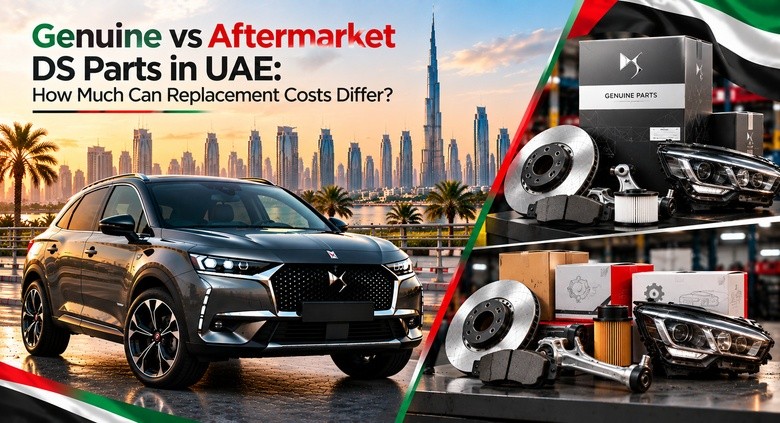
Genuine vs Aftermarket DS Parts in UAE: How Much Can Replacement Costs Differ?
October 1, 2026
UAE Update Reference: September 2026
A DS owner in the UAE can receive two quotes for what sounds like the same repair and find a surprisingly large gap between them. One workshop names a genuine DS component. Another offers an aftermarket equivalent. The parts may even look almost identical in photographs.
That is where the trouble starts.
The real question is not simply, “Why is this one cheaper?” It is whether both parts actually serve the same application, whether the aftermarket manufacturer is reputable, whether the component needs coding or calibration, what warranty comes with it, and how much of the quoted difference survives once labour, delivery, diagnostics and installation are added.
There is another complication in the UAE: DS cars are a relatively niche sight compared with mainstream European and Japanese brands, and current third-party automotive sources indicate that the brand does not have the same broad official UAE retail presence as some larger marques. That makes sourcing, especially for imported or less common DS models, a different exercise from buying a common service part for a Toyota or Nissan.
So yes, genuine and aftermarket DS spare parts in UAE can differ substantially in price. But the percentage alone tells you very little.
The price gap is real, but the percentage is not the whole story
There is no single UAE-wide percentage that can honestly be applied to every DS replacement part.
A brake pad, wiper blade or filter is one thing. A DS headlamp, electronic module, transmission component or electronically controlled suspension component is another entirely.
As a useful manufacturer-published benchmark, DS Automobiles UK currently lists fixed-price repairs using Genuine DS Parts alongside DS Approved Parts. Its published prices show front brake pads at £185 for genuine parts versus £125 for approved parts, a difference of about 32%; front brake pads and discs are £345 versus £249, roughly 28% apart; and a timing-belt repair is £595 versus £494, about 17% apart. These are UK DS-network prices, not UAE prices, so they should not be copied into a UAE quotation. They are useful because they demonstrate that even within the manufacturer's own repair ecosystem, a lower-priced approved alternative can exist.
The UAE figure can move in either direction once freight, availability, exchange rates, importer margins, VAT and labour are included.
That is why the useful question is not “How many per cent cheaper is aftermarket?”
It is: How much cheaper is the complete repair, and what are you giving up to achieve that saving?
What does “genuine DS” actually mean?
DS Automobiles describes its Genuine Parts, branded Mopar, as original-equipment parts — effectively the type of part used when the vehicle was built. DS also says its Approved Parts meet the same quality standards but are offered at a lower price, with availability depending on the model.
That distinction matters because the word “genuine” is sometimes used rather loosely in the wider spare-parts market.
A seller calling something “OEM quality” has not automatically proved that it is a Genuine DS part.
Ask for:
- the exact part reference;
- the manufacturer or brand;
- the vehicle application;
- packaging and provenance where relevant;
- warranty terms;
- whether it is genuine, aftermarket, remanufactured or used;
- and whether the quoted price includes VAT.
For an expensive component, a photograph of a box is not enough.
Aftermarket does not automatically mean inferior
This is probably the most important correction to make before comparing prices.
“Aftermarket” describes a supply category, not a universal quality level.
There are inexpensive aftermarket parts, premium aftermarket parts, specialist manufacturers and suppliers whose products are used across multiple vehicle manufacturers. Some aftermarket manufacturers also supply original-equipment components to vehicle makers or operate in closely related supply chains.
A current UAE listing provides a useful example. AUTOTEK lists a Blue Print brake-pad set at AED 73.63 and identifies DS 7 Crossback among its applications, alongside several Peugeot and Citroën applications. The listing also gives OE references. That does not establish that this particular part is equivalent to every genuine DS brake-pad specification, but it shows why a branded aftermarket part can sit at a very different price point from a manufacturer-network component.
The sensible comparison is therefore:
Genuine DS vs which aftermarket brand?
Not:
Genuine DS vs aftermarket.
Those are very different questions.
The biggest mistake is comparing two parts that have not been properly identified
A DS 7 Crossback is not simply “a DS 7”.
Production period, engine, transmission, trim, braking system, body version and regional specification can change the correct component.
Parts catalogues themselves demonstrate this complexity. Parts databases list DS 3, DS 4 and DS 7 applications by model and powertrain, while some aftermarket catalogues break vehicles down further by production period and engine.
So if a supplier asks for your VIN, that is not bureaucracy for the sake of it.
For expensive or generation-sensitive parts, it is one of the quickest ways of avoiding an expensive mistake.
VIN first, part number second, photograph third
For a complicated DS replacement, I would treat identification as a hierarchy.
Start with the VIN.
Then confirm the engine and transmission application where relevant.
Then compare the existing component's part reference.
Then use photographs, connector shapes, mounting points and physical dimensions as supporting evidence.
Not the other way around.
A photograph can tell you that two headlights look similar. It cannot prove that their software, control unit, wiring, beam pattern, sensors or coding requirements are identical.
The same applies to ABS components, body-control modules, steering electronics and some lighting assemblies.
Why DS parts can be particularly sensitive to specification
DS vehicles use a considerable amount of electronic integration.
That changes the economics of replacement.
A mechanical component such as a simple bracket may be largely a physical fitment exercise. An electronically controlled headlamp or control module may require configuration, coding, programming, calibration or diagnostic verification depending on the application.
A part can therefore be physically perfect and electronically wrong.
That is the nasty version of “it doesn't fit”.
The vehicle may accept the component physically but still produce faults, lose functions or require additional work before the repair is complete.
Where aftermarket savings tend to make the most sense
Routine wear components are usually the easiest place to investigate aftermarket alternatives.
Think:
- brake pads;
- brake discs;
- filters;
- wiper blades;
- certain belts and tensioner components;
- some suspension wear parts;
- selected cooling components;
- batteries;
- and other service items where reputable aftermarket manufacturers offer a documented application.
DS itself provides evidence that lower-priced approved alternatives are available for several ordinary repairs in at least some markets, including brake pads, brake discs, wipers, timing belts, water pumps and batteries.
That does not mean every cheaper component is sensible.
It means the decision deserves more nuance than “genuine good, aftermarket bad”.
Headlights are a different financial animal
A DS headlamp is a good example of where the price difference can become misleading.
A basic aftermarket bulb or lighting component may be inexpensive. A complete modern headlamp assembly can contain multiple LED elements, electronic control hardware, sensors or communication functions depending on the vehicle specification.
If a supplier offers a complete replacement for dramatically less money, ask exactly what you are receiving.
Is it:
- the complete assembly;
- a lamp housing;
- a used genuine unit;
- a new aftermarket assembly;
- a refurbished original;
- or a component stripped from another lamp?
And does the quoted price include programming or calibration?
The cheapest-looking headlamp quote can become rather less impressive after installation.
Brake parts are easier to compare — if the application is correct
Brakes are one area where aftermarket comparison can be relatively straightforward because reputable manufacturers publish application data and product references.
But “brake pad for DS 7” is still not enough information.
You need to know the exact brake configuration.
Disc diameter, axle position, caliper application and production period can matter. Some cars may have different brake packages depending on engine or specification.
A current UAE aftermarket listing for a Blue Print pad explicitly provides multiple vehicle applications and OE references, which is the kind of traceability worth looking for.
The lesson is simple: a branded box is useful; documented application is better.
Suspension parts need more than a visual match
Control arms, bushes, links, dampers and associated suspension components can look deceptively simple.
They are not necessarily simple to compare.
The workshop should confirm the exact application and inspect adjacent components before fitting a replacement. If one suspension component has failed because of an impact, for example, replacing only the visibly damaged item may leave another bent or worn component behind.
For an aftermarket part, ask whether the manufacturer provides the correct vehicle application and whether installation requires alignment.
A saving that disappears into a second alignment appointment is not much of a saving.
Engines and timing-system parts deserve a stricter standard
This is where I would become considerably less interested in saving a few hundred dirhams merely because the box is cheaper.
Engine internals, timing-system components, oil-pump components, cooling-system parts and other critical items can have consequences beyond the price of the part itself.
A current UAE aftermarket listing for a Blue Print timing-belt kit shows why application data matters: the same listing covers numerous Peugeot, Citroën and DS applications across different production periods.
That shared application does not mean every kit fits every DS vehicle.
It means the catalogue must be checked properly.
For a timing-system repair, ask what the kit contains, which manufacturer produced it, what supporting components are being replaced and what warranty applies.
The same logic applies to cooling-system parts
Radiators, thermostats, water pumps, hoses and related components can have several aftermarket options.
But a cooling complaint should not automatically become a radiator purchase.
Overheating may involve coolant loss, pressure problems, thermostat operation, fan control, water-pump performance, airflow, sensors or other faults.
A workshop should establish the failure before the parts catalogue becomes involved.
Otherwise you can save AED 300 on a radiator you never needed.
That is not economy. It is just a cheaper wrong answer.
Electronic modules are where “cheap aftermarket” becomes a dangerous phrase
An ECU, ABS module, body-control module, steering module or similar electronic unit needs much more than a physical match.
The workshop may need to check:
- exact hardware reference;
- software version;
- vehicle configuration;
- connector arrangement;
- communication network compatibility;
- coding;
- programming;
- immobiliser relationships where applicable;
- calibration;
- and stored diagnostic faults after installation.
For these parts, genuine versus aftermarket is only one question.
Can this specific unit actually be commissioned on this specific car?
If the supplier cannot answer that, the low price is not yet useful information.
Imported DS cars make the UAE comparison more complicated
This deserves its own section because the UAE market is not a neat single-specification environment.
Cars arrive through different channels and may have European, GCC, Japanese, North American or other specifications.
That can affect:
- lighting;
- emissions equipment;
- wiring;
- cooling configuration;
- sensors;
- software;
- body fittings;
- and component availability.
Current third-party UAE automotive sources describe DS vehicles in the local market as relatively niche and note that some have been privately imported.
For an imported DS, never assume that a supplier's “DS 7 2020” description is enough.
Give them the VIN.
The UAE climate can change the cost of getting the choice wrong
Heat and humidity are not reasons to automatically reject aftermarket parts.
They are reasons to be disciplined about component quality and diagnosis.
Stellantis Middle East has, for example, issued a recall reminder covering certain DS vehicles equipped with Takata airbag inflators and specifically directed owners to use the VIN to determine whether their vehicle is affected. The notice also highlights the relevance of hot and humid Middle Eastern conditions to the issue.
That is a useful reminder of the broader point: climate, vehicle age and specification can matter when assessing a component.
Do not turn that into a blanket claim that every aftermarket part performs poorly in UAE conditions. There is no evidence for such a universal rule.
What does the current price evidence actually tell us?
This is where a responsible UAE article has to resist making up a neat table of “genuine DS prices”.
There is not enough reliable public UAE pricing evidence to establish a universal September 2026 price list for genuine and aftermarket DS components across DS 3, DS 4, DS 5 and DS 7.
There are UAE aftermarket listings, such as the Blue Print DS 7-compatible brake pad listing, and there are manufacturer-network prices from other markets. But those sources describe different markets and should not be blended into a fictional UAE price average.
That distinction matters.
A UAE buyer should obtain a current quotation for the exact VIN/application rather than treating an internet price as the final local cost.
A manufacturer benchmark shows how wide the gap can be
The DS UK published fixed-price repair schedule gives us a useful controlled comparison.
| Repair | Genuine DS | DS Approved | Difference |
| Front brake pads | £185 | £125 | ~32% |
| Front pads + discs | £345 | £249 | ~28% |
| Rear brake pads | £185 | £125 | ~32% |
| Rear pads + discs | £345 | £249 | ~28% |
| Front wiper blades | £49 | £39 | ~20% |
| Timing belt | £595 | £494 | ~17% |
| Battery | £169 | £129 | ~24% |
These figures are DS UK's published prices, not UAE quotations, and the comparison is between Genuine DS and DS Approved Parts rather than an anonymous aftermarket product. DS says Approved Parts meet its quality standards and carry a two-year warranty in that market.
That is exactly why simply writing “aftermarket parts are 30% cheaper” would be misleading.
The actual gap depends on the component and the alternative.
Part price is not repair cost
This is the figure that should be sitting at the top of every DS owner's comparison sheet.
Total installed cost = part + delivery + labour + diagnostics + supporting parts + fluids + programming/calibration + VAT where applicable.
Not every repair contains every item.
But expensive DS repairs can contain several of them.
A genuine component costing AED 1,500 may produce a lower final bill than a cheaper AED 1,000 alternative if the latter requires additional work, has poor fitment, needs another order or creates installation problems.
Conversely, paying AED 1,500 for a genuine component that offers no meaningful advantage for a simple wear item may not make financial sense for every owner.
The quote needs to be unpacked.
Warranty can narrow the apparent price difference
Suppose an aftermarket part costs AED 700 and the genuine alternative costs AED 1,050.
The headline saving is AED 350.
Now ask:
- How long is the aftermarket warranty?
- Who handles the warranty claim?
- Does the supplier require the workshop to inspect the failed part?
- Is labour covered?
- Is return delivery covered?
- What happens if the replacement fails again?
- Does the genuine part carry a manufacturer-backed warranty?
DS's own published repair information demonstrates why warranty should be treated as part of the purchase rather than a footnote: its UK Approved Parts programme states a two-year warranty, while its Genuine Parts and repair programmes carry their own terms.
UAE sellers may operate under completely different terms.
Get them in writing.
The supplier's return policy matters more with expensive DS parts
A return policy is especially important where fitment depends on VIN or configuration.
Imagine ordering a headlamp because the photograph looks correct.
It arrives.
The connector differs.
Now you have shipping, waiting time, a workshop appointment and potentially a return dispute.
For a low-cost filter, annoying.
For an expensive electronic component, costly.
Before ordering, ask whether the supplier accepts returns for incorrect application, whether electrical parts are returnable after installation, and who pays the freight.
Genuine, OEM, aftermarket and approved are not interchangeable terms
These labels are often thrown into the same sentence, which helps nobody.
Genuine DS: manufacturer-branded original replacement component sold through the relevant DS/Stellantis parts channel.
DS Approved Parts: a manufacturer-supported alternative category where offered; DS UK describes these as meeting its quality standards at a lower price.
Aftermarket: produced for the replacement market by a third-party manufacturer.
OEM: commonly used to describe an original-equipment manufacturer, but sellers sometimes use the term loosely. Ask which manufacturer actually produced the part.
Reconditioned/remanufactured: an existing component restored through a defined process. The quality depends heavily on what was replaced, tested and warranted.
Used: a component removed from another vehicle. Its condition and history become part of the purchase.
Those distinctions matter enormously when comparing quotations.
There is a useful middle ground between genuine and cheap
The sensible choice is not always one of two extremes.
A buyer may have several legitimate options:
| Option | Potential advantage | What to verify |
| Genuine DS | Original manufacturer-supplied specification | Price, availability, warranty |
| DS Approved | Manufacturer-supported lower-cost route where offered | Availability for your model |
| Premium aftermarket | Potential saving with established manufacturer | Exact application, manufacturer, warranty |
| Reconditioned | Can reduce cost for suitable assemblies | Rebuild process, testing, warranty |
| Used genuine | Useful for rare or expensive parts | Donor history, condition, return terms |
| Budget aftermarket | Lowest initial price in some cases | Provenance, quality, fitment, warranty |
None is automatically correct for every DS.
The part determines the risk.
When genuine DS is often easier to justify
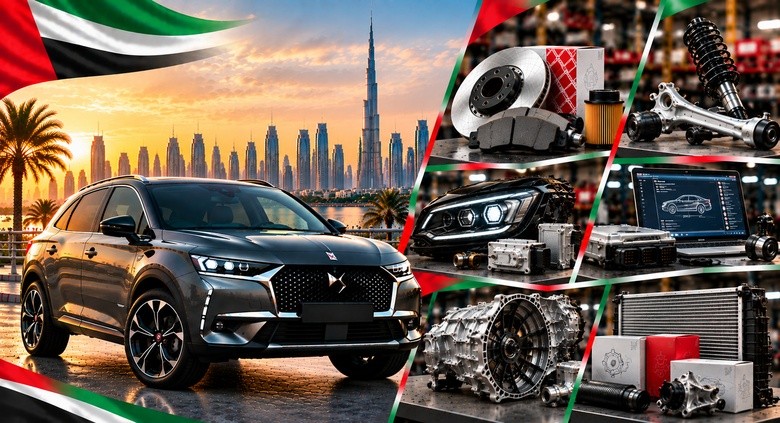
There are situations where the extra expenditure can be easier to defend.
For example:
- safety-critical components where specification is uncertain;
- electronically integrated modules;
- complex lighting assemblies;
- parts requiring programming;
- components with difficult installation access;
- expensive assemblies where labour would have to be repeated;
- vehicles where maintaining documented repair provenance matters to the owner;
- or situations where the genuine part has a clear warranty advantage.
The point is not that genuine parts are universally better.
It is that the consequences of a wrong decision can be larger on some components than others.
When a premium aftermarket part may be perfectly rational
The opposite case matters too.
If a reputable manufacturer supplies a correctly specified brake component, filter, wiper system or mechanical wear part with clear application data and a reasonable warranty, paying considerably more simply because the box carries the DS name may not deliver a proportionate benefit.
That is particularly relevant for older DS vehicles where the owner is balancing maintenance cost against remaining vehicle life.
A DS 5 with substantial mileage and a documented service history presents a different economic decision from a nearly new DS 7 being maintained under a strict manufacturer-oriented programme.
Same brand.
Different economics.
What the workshop should check before recommending the cheaper part
A good workshop should not simply say, “This aftermarket one is cheaper.”
It should establish:
Vehicle: VIN, model, production period and specification.
Part: exact application, manufacturer and reference.
Diagnosis: proof that the component actually needs replacement.
Installation: whether seals, fluids, fasteners or supporting components are required.
Electronics: whether coding, programming or calibration is required.
Testing: what will be checked after installation.
That is particularly important for DS vehicles because manufacturer and aftermarket catalogues demonstrate how broad the shared PSA/Stellantis application environment can be. Parts can appear across DS, Peugeot and Citroën applications while still requiring exact vehicle identification.
Before You Click Buy: ask these questions
Send the supplier a message that is difficult to misunderstand:
“Please confirm this part against my VIN. Is it Genuine DS, DS Approved, OEM, aftermarket, reconditioned or used? Please provide the exact manufacturer and part reference, vehicle application, warranty period, return conditions, delivery cost and whether coding, programming or calibration is required after installation. Is the quoted price including VAT?”
That one message will eliminate a surprising amount of vague advertising.
For a used component, add donor year, mileage, accident/flood history and reason for removal where available.
For an electronic part, ask specifically about coding and configuration.
For a body part, confirm left/right, front/rear, facelift/non-facelift and whether sensors, brackets or trim pieces are included.
How much can replacement costs actually differ in the UAE?
The honest answer is: there is no single defensible UAE percentage.
The manufacturer-published DS UK data shows differences of roughly 17–32% between Genuine DS and DS Approved pricing across several listed repair categories.
A UAE aftermarket listing demonstrates that individual DS-compatible components can also be advertised at substantially lower absolute prices, but that listing is for one specific aftermarket product and cannot be used to calculate a UAE-wide genuine-versus-aftermarket percentage.
For UAE buyers, the final gap can be widened or narrowed by:
- local stock;
- import freight;
- supplier margin;
- currency movement;
- VAT;
- special-order status;
- availability of the genuine part;
- aftermarket manufacturer;
- warranty;
- workshop labour;
- programming;
- calibration;
- and return costs.
So if one quote is AED 900 and another is AED 1,400, do not celebrate the AED 500 saving until you know what the two AED figures actually include.
The practical rule for choosing genuine or aftermarket DS parts
Start with the part, not the badge.
For a straightforward wear component, a reputable aftermarket manufacturer with verified fitment, traceable references and sensible warranty terms may offer a perfectly rational way to reduce the repair bill.
For a complex electronic module, high-value assembly, safety-critical component or part where programming and calibration are involved, the financial calculation changes because the cost of being wrong rises sharply.
And in the UAE, where DS vehicles can be imported through different channels and public local price information is less complete than it is for higher-volume brands, identification matters even more. Current UAE sources show the brand's relatively niche position locally, while Stellantis' Middle East material confirms that DS vehicles are supported within regional campaigns and VIN-based service processes.
This is where PartFinder UAE becomes useful as a sourcing route: not because the lowest quotation automatically deserves the order, but because comparing suppliers is more valuable when every supplier is being asked for the same information — exact application, part reference, condition, warranty, delivery and installed requirements.
The useful comparison is therefore not:
Genuine = expensive. Aftermarket = cheap.
It is:
Correct part + credible manufacturer + suitable application + acceptable warranty + sensible installation cost = sensible repair.
That is the calculation worth making before the order is placed.
FAQs
Categories
- Audi
- BMW
- Car Accessories
- Car Tips
- Ford
- Land Rover
- Mazda
- Range Rover
- Top 10
- UAE Car Parts
- Used Car Parts
- Toyota
- Replacement Engines
- Nissan
- Hyundai
- Mitsubishi
- Volkswagen
- Honda
- Kia
- Chevrolet
- Dodge
- Jeep
- Subaru
- Renault
- Lexus
- Mercedes
- Suzuki
- Hummer
- Porsche
- Infiniti
- Peugeot
- GMC
- Mini
- Volvo
- Replacement Gearboxes
- MG
- Jaguar
- Skoda
- Cadillac
- Daihatsu
- Fiat
- German Car Parts
- Japanese Car Parts
- Aftermarket Car Parts
- Genuine Car Parts
- New Car Parts
- Reconditioned Car Parts
- European Car Parts
- American Car Parts
- Korean Car Parts
- British Car Parts
- Chinese Car Parts
- Sports/Exotic Car Parts
- Luxury Car Parts
- Performance Car Parts
- SUV/4x4 Spare Parts
- Truck Spare Parts
- EV Car Parts
- Hybrid Car Parts
- Auto Spare Parts in UAE
- Tesla
- Isuzu
- Ram
- Ferrari
- Bentley
- Lamborghini
- Genesis
- Maserati
- Lincoln
- Chrysler
- Opel
- Citroen
- SsangYong
- Seat
- McLaren
- Aston Martin
- Rolls Royce
- Maybach
- Alfa Romeo
- Bugatti
- Scion
- Abu Dhabi Car Parts
- Ajman Car Parts
- Al Khan Car Parts
- Al Sajaa Car Parts
- Deira Car Parts
- Dubai Car Parts
- Fujairah Car Parts
- Industrial Area 6 Car Parts
- Mussafah Car Parts
- Ras Al Khaimah Car Parts
- Sharjah Car Parts
- Umm Al Quwain Car Parts
- Acura
- BYD
- Chery
- Dacia
- DS
- Geely Emgrand