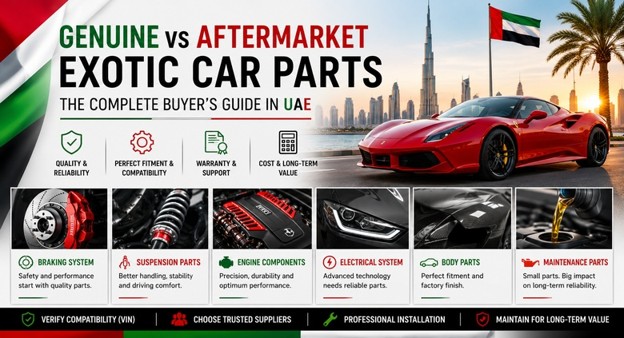
Genuine vs Aftermarket Exotic Car Parts in UAE: What Owners Should Know
July 30, 2026
Understanding Genuine vs Aftermarket Exotic Car Parts
Quick Summary
| Topic | Key Insight |
| Genuine Parts | Manufactured or approved by the vehicle manufacturer for exact fit and performance. |
| Aftermarket Parts | Produced by third-party manufacturers with varying levels of quality. |
| Biggest Difference | Quality, fitment, warranty and long-term reliability. |
| UAE Considerations | Climate, driving conditions and specialist workshops make part selection even more important. |
| Common Misconception | Aftermarket does not automatically mean poor quality, and genuine does not always mean the only option. |
| Smart Buying Rule | Match the part to the repair, the vehicle and your ownership goals—not simply the price. |
Owning an exotic car isn't just about enjoying breathtaking performance or admiring its sculpted bodywork every weekend.
It's about responsibility.
Whether you drive a Ferrari through Downtown Dubai, take a Porsche along Jumeirah Beach Road or enjoy weekend trips in a Lamborghini across Abu Dhabi, every component fitted to your vehicle plays a role in preserving its performance, safety and value.
Sooner or later, every owner faces the same question.
"Should I buy a genuine part or choose an aftermarket alternative?"
It sounds like a simple decision.
In reality, it isn't.
The answer depends on the component, the vehicle, the intended use and, perhaps most importantly, the quality of the replacement itself.
Many owners assume genuine parts are always the only sensible option.
Others believe every aftermarket part is simply a cheaper version of the same product.
Neither assumption tells the full story.
Understanding the difference could save you thousands of dirhams over the lifetime of your vehicle while helping you avoid unnecessary repairs, poor fitment and disappointing performance.
What Are Genuine Exotic Car Parts?
A genuine part is supplied by, or officially approved for, the vehicle manufacturer.
These components are designed to match the exact specifications of the original equipment fitted when the car left the factory.
That means:
- Precise dimensions.
- Correct materials.
- Manufacturer-approved tolerances.
- Exact mounting points.
- Tested compatibility.
- Consistent quality control.
For an exotic vehicle, precision matters.
A fraction of a millimetre can influence panel alignment.
An incorrectly calibrated sensor can trigger dashboard warnings.
A poorly manufactured suspension component may change the way the car handles through corners.
That's why genuine parts remain the benchmark for many critical repairs.
What Are Aftermarket Exotic Car Parts?
Aftermarket parts are manufactured by companies other than the original vehicle manufacturer.
That description often creates unnecessary concern.
In reality, aftermarket products vary enormously.
Some are produced by internationally recognised engineering companies with outstanding reputations.
Others are manufactured purely to achieve the lowest possible selling price.
Those two products may look similar.
They rarely perform the same.
Premium aftermarket manufacturers often invest heavily in engineering, testing and material quality.
Budget manufacturers may focus almost entirely on reducing production costs.
The label "aftermarket" tells you who made the part.
It doesn't automatically tell you how good it is.
Genuine vs Aftermarket: Understanding the Key Differences
Choosing between genuine and aftermarket parts involves much more than comparing prices.
Several factors deserve attention.
| Feature | Genuine Parts | Premium Aftermarket Parts |
| Fitment Accuracy | Excellent | Usually excellent if correctly manufactured |
| Manufacturing Standards | Manufacturer approved | Depends on the manufacturer |
| Warranty | Typically supported by manufacturer or supplier | Varies between suppliers |
| Availability | May require ordering | Often wider availability |
| Cost | Usually higher | Often more competitive |
| Performance | Factory specification | Can match or occasionally exceed factory performance in specific applications |
Notice that the comparison isn't simply "good versus bad".
It's about selecting the most appropriate solution for each repair.
Replacing a decorative trim clip isn't the same as replacing an electronic control module.
Every repair deserves its own assessment.
Why Exotic Car Owners in the UAE Need to Choose Carefully
Owning a high-performance vehicle in the UAE introduces challenges that drivers in cooler climates rarely experience.
Extreme summer temperatures.
Heavy stop-start traffic.
Fine desert dust.
Long-distance motorway driving.
High-performance braking.
All of these conditions place additional stress on mechanical and electronic components.
Cooling systems work harder.
Suspension experiences constant heat cycles.
Brake components operate under intense temperatures.
Electronic sensors endure demanding environmental conditions.
Choosing the correct replacement part becomes even more important because these vehicles often perform at the limits of engineering.
Saving a small amount during one repair can sometimes create significantly higher costs later.
Common Myths About Genuine and Aftermarket Parts
The automotive industry is full of opinions.
Some are accurate.
Others have survived simply because they've been repeated for years.
Let's clear up a few common misconceptions.
Myth 1: Every Aftermarket Part Is Poor Quality
Not true.
Many respected engineering companies manufacture components that meet or exceed original specifications.
Professional workshops frequently install premium aftermarket parts with excellent long-term results.
Myth 2: Genuine Parts Never Fail
Unfortunately, no manufactured component lasts forever.
Even genuine parts wear with mileage, age and environmental conditions.
The difference usually lies in predictable performance and consistent quality standards.
Myth 3: Genuine Parts Always Offer Better Value
Sometimes they do.
Sometimes they don't.
A premium aftermarket air filter, for example, may offer outstanding durability at a lower purchase price.
However, a complex electronic module may justify the additional investment in a genuine replacement.
Context matters.
Myth 4: All Aftermarket Manufacturers Produce the Same Quality
This is one of the biggest misconceptions.
The aftermarket industry includes both world-class engineering companies and low-cost manufacturers with inconsistent quality control.
Treating them as identical can lead to expensive mistakes.
How the Right Parts Protect Performance, Safety and Value
An exotic car is a carefully balanced machine.
Each component works alongside dozens of others.
Replace one part with an unsuitable alternative and unexpected problems may appear.
Examples include:
- Uneven tyre wear from poor suspension geometry.
- Brake vibration caused by inferior rotors.
- Warning lights triggered by incompatible sensors.
- Excessive wind noise from poorly aligned body panels.
- Reduced resale value because of visible repair quality.
The right replacement doesn't simply solve today's problem.
It protects tomorrow's ownership experience as well.
That's especially important for vehicles whose values remain strong in the used market.
Well-documented repairs using quality components often inspire greater confidence among future buyers.
Workshop Story
A customer arrived at a specialist workshop in Dubai with a beautifully maintained Aston Martin.
A previous repair had involved replacing the front bumper after minor accident damage.
From a distance, everything looked perfect.
Up close, the technician noticed uneven panel gaps around the headlights.
The bumper itself wasn't defective.
It simply wasn't manufactured to the same tolerances as the original.
After discussing the options, the owner approved a genuine replacement.
Once installed, the difference was immediate.
The panel alignment returned to factory standards, wind noise disappeared and the owner admitted something many enthusiasts eventually discover.
"I thought I was saving money the first time."
Sometimes the most expensive repair is doing the same job twice.
Genuine vs Aftermarket Comparison Table
| Component | Genuine Recommended | Premium Aftermarket Suitable? |
| Brake Pads | Yes | Yes, from reputable manufacturers |
| Suspension Bushes | Yes | Often suitable if premium quality |
| Engine Sensors | Strongly recommended | Limited cases depending on manufacturer |
| Body Panels | Highly recommended | Depends on fitment quality |
| Air Filters | Optional | Often an excellent alternative |
| Oil Filters | Yes | Premium aftermarket widely available |
Buyer Decision Matrix
| If Your Priority Is... | Best Choice |
| Factory-original appearance | Genuine |
| Maximum resale value | Genuine |
| Cost-effective routine servicing | Premium aftermarket |
| Safety-critical repairs | Genuine or premium OEM-quality aftermarket |
| Long-term ownership | Quality over lowest price |
| Specialist performance upgrades | Carefully selected premium aftermarket |
Suggested Visual Callout
"One Car, Two Repairs"
Create a side-by-side illustration of an exotic sports car.
The left side should show perfectly aligned genuine body panels, smooth panel gaps and factory-quality finish with a green checkmark.
The right side should display uneven panel alignment, warning icons near a sensor and slightly inconsistent bumper fitment with a caution symbol.
Use minimal labels to highlight Fitment, Quality, Warranty and Long-Term Value.
Smart Buyer's Checklist
Before purchasing any exotic car part:
- Confirm your VIN.
- Verify the OEM part number.
- Understand whether the repair is safety-critical.
- Compare warranty terms.
- Ask who manufactured the replacement.
- Discuss options with a specialist workshop.
- Don't judge a part solely by its price.
- Consider long-term ownership costs rather than immediate savings.
Five extra minutes spent asking questions today can prevent days of inconvenience and significant repair costs later.
Key Takeaways
Choosing between genuine and aftermarket exotic car parts is rarely a black-and-white decision. The right answer depends on the component being replaced, the quality of the available alternatives and your long-term ownership goals.
For cosmetic items or routine maintenance, premium aftermarket products can often provide excellent value when sourced from reputable manufacturers. For safety-critical systems, complex electronics and precision body components, genuine parts frequently offer the greatest confidence in terms of fitment, reliability and long-term performance.
Fitment and Compatibility – The Foundation of Every Successful Repair
Quick Summary
| Topic | Why It Matters |
| Perfect Fitment | Ensures factory-level performance, safety and appearance. |
| OEM Part Numbers | Help identify the exact replacement component. |
| VIN Verification | Eliminates costly ordering mistakes. |
| Model-Year Compatibility | Even small production changes can affect fitment. |
| GCC vs Imported Cars | Specifications often differ despite identical appearances. |
| Professional Verification | Saves time, money and repeat labour costs. |
Many owners spend hours comparing prices.
Few spend enough time confirming compatibility.
Ironically, compatibility is usually the difference between a successful repair and an expensive mistake.
Imagine ordering a front bumper for your Ferrari.
The colour matches.
The shape looks identical.
The mounting points?
They're slightly different.
Now the workshop has to stop.
The bumper won't fit.
The vehicle occupies a service bay longer than expected.
Labour costs increase.
The correct part must be ordered.
All because one important detail wasn't verified.
That's why experienced technicians often ask for the VIN before they discuss prices.
Why Perfect Fitment Matters for Exotic Cars
Exotic vehicles aren't built with generous manufacturing tolerances.
They're engineered with extraordinary precision.
Every panel gap.
Every mounting bracket.
Every electronic connector.
Every sensor location.
Everything is designed to work together.
A poorly fitting replacement component can affect far more than appearance.
It may influence:
- Aerodynamics.
- Cooling airflow.
- Suspension geometry.
- Brake performance.
- Electronic calibration.
- Safety systems.
That's especially true for modern supercars packed with sophisticated electronics.
A small fitment error can create surprisingly large consequences.
Understanding OEM Part Numbers
Every genuine component carries a unique identification number.
This is commonly known as the OEM part number.
Think of it as the component's fingerprint.
Even two parts that appear visually identical may have completely different OEM numbers because of:
- Different production years.
- Updated engineering designs.
- Engine variations.
- Regional specifications.
- Optional equipment packages.
Many owners assume matching the vehicle model is enough.
Unfortunately, it rarely is.
For example:
A 2021 Porsche may use a different cooling fan from a visually identical 2023 model.
Nothing obvious changes externally.
Internally, however, the engineering has evolved.
The OEM part number removes guesswork.
How to Verify Parts Using Your Vehicle VIN
If the OEM number identifies the component...
The VIN identifies the vehicle.
The Vehicle Identification Number contains valuable manufacturing information, including:
- Production year.
- Factory.
- Engine specification.
- Transmission type.
- Trim level.
- Market specification.
- Equipment options.
Professional suppliers almost always request the VIN before confirming compatibility.
That's not because they're being cautious.
It's because they've seen what happens when people don't.
VIN verification dramatically reduces:
- Incorrect orders.
- Shipping delays.
- Repeat labour.
- Return requests.
- Installation problems.
One number can prevent dozens of potential complications.
Model-Year Compatibility: Why Small Changes Matter
Many buyers believe that if two cars belong to the same generation, every part will interchange.
Sometimes that's true.
Quite often, it isn't.
Manufacturers regularly introduce improvements during production.
These updates may include:
- Revised sensors.
- Updated wiring harnesses.
- Different mounting brackets.
- New software versions.
- Improved suspension geometry.
- Alternative brake suppliers.
Externally...
The vehicle appears unchanged.
Mechanically...
It's a different story.
Ignoring production-year updates is one of the most common reasons parts need to be returned.
GCC Specification vs Imported Exotic Cars
This is especially important in the UAE.
Many exotic vehicles arrive through official GCC dealerships.
Others are imported privately from Europe, North America or Asia.
At first glance, two identical Lamborghinis may look exactly the same.
Underneath?
Not always.
Differences may include:
- Cooling systems.
- Lighting regulations.
- Emissions equipment.
- Electronic programming.
- Radiator specifications.
- Sensor calibration.
- Climate-control components.
These differences exist because vehicles are designed to comply with different markets.
Ordering purely by appearance can therefore become an expensive mistake.
Always confirm whether the vehicle is:
- GCC Specification.
- European Specification.
- North American Specification.
- Japanese Specification.
That information matters.
Common Fitment Mistakes That Cost Owners Thousands
After years in specialist workshops, certain mistakes appear repeatedly.
The most common include:
- Ordering by photographs.
- Ignoring the VIN.
- Assuming identical model years share every component.
- Buying based only on price.
- Forgetting optional equipment packages.
- Confusing left-hand-drive and right-hand-drive components.
- Assuming imported and GCC vehicles use identical parts.
Each mistake seems small.
Combined, they can delay repairs by weeks.
Why Body Panels Demand Extra Attention
Body panels often receive less attention than mechanical components.
They shouldn't.
Exotic vehicles rely on exceptionally accurate alignment.
Even a slight variation can result in:
- Uneven panel gaps.
- Increased wind noise.
- Water leaks.
- Difficult door operation.
- Reduced resale appeal.
Professional body shops routinely compare mounting points, panel curvature and reinforcement structures before ordering replacements.
It's a careful process.
For good reason.
Electronic Components Leave No Room for Guesswork
Modern exotic cars depend on dozens of interconnected control systems.
A replacement sensor doesn't simply fit physically.
It also needs to communicate correctly with the vehicle.
Incorrect compatibility can trigger:
- Dashboard warning lights.
- Reduced engine performance.
- Incorrect suspension behaviour.
- ABS faults.
- Stability-control warnings.
- Adaptive lighting errors.
Sometimes the sensor itself isn't defective.
It's simply incompatible.
That's why technicians increasingly rely on manufacturer databases before ordering electronic components.
Workshop Story
A McLaren owner visited a specialist workshop in Dubai after ordering a suspension height sensor online.
According to the listing, it matched the model perfectly.
Installation took less than thirty minutes.
Immediately afterwards, the dashboard displayed multiple suspension warnings.
The technician checked the sensor.
It wasn't faulty.
It belonged to the same model...
But a different production year.
The connector looked identical.
The calibration values weren't.
After sourcing the correct component using the VIN, every warning disappeared.
The owner laughed.
"It looked exactly the same."
The technician nodded.
"That's why we never trust appearances."
Compatibility Comparison Table
| Verification Method | Accuracy | Risk Level |
| VIN Verification | Excellent | Very Low |
| OEM Part Number | Excellent | Very Low |
| Registration Details Only | Moderate | Medium |
| Visual Comparison | Limited | High |
| Internet Photographs | Poor | Very High |
| Guessing by Model Name | Unreliable | Extremely High |
Buyer Decision Matrix
| Situation | Recommended Action |
| Ordering brake components | Verify VIN and OEM number first |
| Buying body panels | Confirm production year and market specification |
| Replacing electronic sensors | Use VIN and manufacturer database |
| Imported exotic vehicle | Confirm regional specification before ordering |
| Unsure about compatibility | Ask a specialist supplier to verify fitment |
| Multiple part options appear identical | Compare OEM numbers instead of photographs |
Suggested Visual Callout
"Looks the Same... Doesn't Fit the Same"
Create a split illustration showing two identical-looking exotic cars.
Above both vehicles, place a magnifying glass highlighting different OEM part numbers and VIN details.
Use small callouts pointing to:
- Body panel mounting points.
- Brake components.
- Suspension sensor.
- Wiring connector.
- Production year.
Finish with a green checkmark beside the correctly verified vehicle and a caution icon beside the incorrectly matched component.
Smart Buyer's Checklist
Before ordering any exotic car part:
- Locate your VIN.
- Record the OEM part number.
- Confirm the exact production year.
- Check whether the vehicle is GCC or imported.
- Verify engine and transmission specifications.
- Compare supplier recommendations.
- Confirm warranty coverage.
- Ask your workshop to verify compatibility before ordering.
These simple checks require only a few minutes.
Correcting an incorrect order can cost days—or even weeks.
Key Takeaways
Fitment is the foundation of every successful exotic car repair. Even the highest-quality replacement part becomes a poor choice if it isn't designed for the exact vehicle specification.
Using the VIN, OEM part numbers and professional compatibility checks dramatically reduces the risk of incorrect orders, unnecessary labour and frustrating delays. This is particularly important for exotic vehicles in the UAE, where GCC and imported models often differ in ways that aren't immediately visible.
Body Panels and Exterior Components – Why Fitment Matters More Than You Think
Quick Summary
| Topic | Key Insight |
| Genuine Body Panels | Manufactured to factory specifications for perfect fit and finish. |
| Aftermarket Body Panels | Quality varies significantly between manufacturers. |
| Carbon Fibre Components | Premium options require precise engineering and installation. |
| Paint Matching | Correct fitment and finish are equally important. |
| Lighting Components | Sensors and electronics make compatibility essential. |
| Long-Term Value | Poor body repairs can reduce resale value and increase future costs. |
Ask any experienced body shop technician one simple question.
"What's the biggest mistake owners make after an accident?"
Most won't answer...
"Buying the cheapest bumper."
Instead, they'll probably say something else.
"Believing every bumper is the same."
That's where problems begin.
An exotic car is designed with remarkable precision.
Every curve.
Every mounting bracket.
Every panel gap.
Every air intake.
Nothing is accidental.
Replacing an exterior component isn't simply about making the vehicle look attractive again.
It's about restoring the engineering that sits beneath the paint.
Genuine vs Aftermarket Body Panels
Body panels may appear uncomplicated.
After all, they're just pieces of metal, aluminium or carbon fibre.
Right?
Not quite.
A genuine body panel is manufactured using the exact dimensions, materials and production methods specified by the vehicle manufacturer.
That means:
- Factory mounting locations.
- Accurate panel curvature.
- Correct reinforcement points.
- Consistent material thickness.
- Reliable corrosion protection.
- Precise aerodynamic design.
Aftermarket panels, however, vary considerably.
Some premium manufacturers produce excellent replacements.
Others focus primarily on reducing production costs.
The difference often becomes obvious during installation.
Why Fitment Is Everything
Imagine trying to close the bonnet.
It refuses to sit flush.
The technician adjusts it.
Still not right.
Eventually, several hours are spent modifying brackets that should have aligned perfectly from the beginning.
That additional labour wasn't caused by poor workmanship.
It was caused by poor fitment.
Correct fitment affects far more than appearance.
It influences:
- Wind resistance.
- Water sealing.
- Noise insulation.
- Crash protection.
- Sensor alignment.
- Long-term durability.
One poorly fitting component can create several unrelated problems.
Bonnets, Bumpers and Fenders: Which Parts Should Always Be Genuine?
Not every repair carries the same level of risk.
Some exterior components contribute directly to structural performance and safety systems.
These include:
- Front bumpers.
- Rear bumpers.
- Bonnets.
- Front fenders.
- Crash reinforcement bars.
- Radiator supports.
Modern bumpers don't simply absorb minor impacts.
They also house:
- Parking sensors.
- Radar systems.
- Cameras.
- Adaptive cruise control modules.
- Collision warning equipment.
Even slight dimensional differences can affect how these systems operate.
That's why many specialist workshops strongly recommend genuine replacements for safety-critical body components.
Carbon Fibre Components: Genuine vs Replica
Carbon fibre has become almost synonymous with exotic cars.
It's lightweight.
Strong.
Beautifully engineered.
Unfortunately, it's also widely copied.
Replica carbon fibre components may appear convincing in photographs.
Closer inspection often reveals:
- Uneven weave patterns.
- Lower-quality resin.
- Poor edge finishing.
- Incorrect mounting points.
- Reduced structural integrity.
More importantly...
Some decorative carbon fibre panels are cosmetic.
Others contribute to aerodynamic performance.
Mixing the two can create unexpected consequences at higher speeds.
Quality matters even more when weight reduction and airflow are involved.
Paint Matching and Panel Alignment Challenges
A perfect paint colour doesn't guarantee a perfect repair.
Professional body shops understand this well.
Panel alignment often requires just as much attention as paintwork itself.
Technicians inspect:
- Panel gaps.
- Door clearances.
- Bonnet height.
- Bumper alignment.
- Lighting alignment.
- Trim positioning.
When these measurements aren't consistent, even people with little automotive knowledge often sense that something looks "slightly off."
They may not know why.
They simply notice it.
That's enough to affect resale value.
Headlights, Tail Lights and Exterior Trim Compatibility
Lighting systems have changed dramatically over the past decade.
Modern exotic vehicles often feature:
- Adaptive LED headlights.
- Laser lighting.
- Matrix beam technology.
- Dynamic indicators.
- Intelligent cornering lights.
Replacing a headlight now involves far more than swapping a bulb.
Compatibility extends to:
- Electronic modules.
- Wiring harnesses.
- Software coding.
- Sensor calibration.
An incorrectly specified unit may physically fit while still triggering dashboard faults.
Appearance alone doesn't guarantee compatibility.
Hidden Costs of Poorly Fitted Body Panels
Owners often focus on the purchase price.
Experienced workshops look further ahead.
Poorly fitting panels can lead to:
- Additional labour charges.
- Repainting costs.
- Water leaks.
- Wind noise.
- Premature corrosion.
- Sensor recalibration.
- Repeated workshop visits.
The original saving gradually disappears.
Sometimes it disappears surprisingly quickly.
Quality repairs usually cost less than repeated repairs.
Why Exterior Repairs Influence Resale Value
Buyers notice bodywork before they notice mechanical components.
Straight panel gaps.
Consistent paint finish.
Accurate lighting alignment.
These details quietly communicate how well the vehicle has been maintained.
Conversely...
Uneven body lines.
Mismatched paint.
Poorly fitting trim.
Those details create doubt.
Even if the engine performs perfectly.
For high-value exotic cars, presentation matters almost as much as mechanical condition.
Workshop Story
A Bentley owner visited a specialist body shop in Sharjah after a low-speed parking accident.
The previous repair had used an inexpensive aftermarket front bumper.
From a distance, everything looked acceptable.
Under workshop lighting, the technician noticed something unusual.
The bumper sat several millimetres lower on one side.
Parking sensors occasionally produced false warnings.
The owner admitted he hadn't noticed until recently.
A genuine replacement bumper was installed using factory mounting hardware.
The improvement was immediate.
The panel gaps became perfectly symmetrical.
Sensor errors disappeared.
The owner smiled as he collected the vehicle.
"I finally understand what people mean when they talk about factory fit."
Sometimes the difference isn't dramatic.
It's simply... correct.
Genuine vs Aftermarket Exterior Components Comparison
| Component | Genuine | Premium Aftermarket |
| Front Bumper | Excellent fit and sensor compatibility | Quality varies by manufacturer |
| Bonnet | Factory alignment | Requires careful quality assessment |
| Carbon Fibre Trim | Factory finish | Suitable if produced by a reputable manufacturer |
| Headlights | Full compatibility | Programming may still be required |
| Exterior Trim | Perfect colour and texture match | May differ slightly |
| Side Mirrors | Guaranteed electronic compatibility | Depends on specifications |
Buyer Decision Matrix
| Repair Situation | Recommended Choice |
| Accident damage involving sensors | Genuine components |
| Cosmetic trim replacement | Genuine or premium aftermarket |
| Carbon fibre styling upgrades | Premium manufacturers with proven quality |
| Adaptive headlights | Genuine preferred |
| Structural front-end repair | Genuine strongly recommended |
| Budget-conscious cosmetic repair | High-quality aftermarket after compatibility checks |
Suggested Visual Callout
"Perfect Fit vs Poor Fit"
Create a side-by-side comparison of the front end of an exotic sports car.
The left image should display perfectly aligned bonnet, bumper and headlights with green checkmarks.
The right image should show uneven panel gaps, a slightly misaligned headlight, incorrect bumper alignment and warning icons near the parking sensors.
Use minimal labels highlighting:
- Panel Gap
- Paint Match
- Sensor Alignment
- Factory Fit
- Resale Value
Smart Buyer's Checklist
Before buying any exterior replacement component:
- Verify the VIN.
- Match the OEM part number.
- Confirm the production year.
- Check whether parking sensors or cameras are integrated.
- Inspect the manufacturer's reputation.
- Ask about paint preparation.
- Confirm warranty coverage.
- Have the component inspected before installation.
Body repairs shouldn't simply restore appearance.
They should restore factory precision.
Key Takeaways
Body panels and exterior parts play a much bigger role than many owners realise. Beyond appearance, they influence aerodynamics, safety systems, sensor performance, weather sealing and long-term resale value.
Genuine components continue to offer the highest level of confidence for structural body repairs and vehicles equipped with advanced driver-assistance systems. Premium aftermarket options can provide excellent results for selected cosmetic components, provided they come from reputable manufacturers and are carefully checked for fitment and quality.
Brake System Components – Why This Is One Area Where You Should Never Cut Corners
Quick Summary
| Topic | Key Insight |
| Genuine Brake Parts | Designed to meet the manufacturer's exact safety and performance standards. |
| Premium Aftermarket Brakes | Can deliver excellent performance when sourced from trusted brands. |
| Carbon Ceramic Brakes | Require specialist knowledge and correct replacement components. |
| ABS Sensors | Compatibility is essential for modern braking systems. |
| Cheap Brake Components | Often increase stopping distance, noise and premature wear. |
| Smart Buying Rule | Safety should always take priority over short-term savings. |
When owners think about upgrading or repairing an exotic car, conversations often revolve around horsepower.
Or acceleration.
Or styling.
Rarely do they begin with brakes.
Yet ask any experienced racing driver a simple question.
"What's more important—going faster or stopping safely?"
The answer arrives almost instantly.
Stopping safely.
Every single time.
An exotic car capable of accelerating from 0 to 100 km/h in just a few seconds places extraordinary demands on its braking system.
That system deserves the same attention as the engine beneath the bonnet.
Perhaps even more.
Genuine vs Aftermarket Brake Pads
Brake pads may look remarkably simple.
A steel backing plate.
Friction material.
A few clips.
That's all.
Or so it seems.
In reality, manufacturers spend years developing friction compounds that balance:
- Stopping power.
- Heat resistance.
- Noise reduction.
- Dust production.
- Rotor wear.
- Everyday drivability.
A genuine brake pad is engineered specifically for the vehicle's weight, performance characteristics and electronic safety systems.
Premium aftermarket manufacturers often produce excellent alternatives.
Some even supply braking components directly to vehicle manufacturers.
Others, however, reduce costs by using lower-grade friction materials.
That difference usually isn't visible.
It becomes noticeable when you need to stop quickly.
Brake Discs, Rotors and Carbon Ceramic Options
Few components experience more punishment than brake rotors.
Every braking event generates enormous heat.
During spirited driving, temperatures can exceed several hundred degrees.
Repeated heat cycles gradually affect the rotor's surface.
Exotic vehicles may use:
- Standard ventilated discs.
- Cross-drilled rotors.
- Slotted rotors.
- Carbon ceramic braking systems.
Carbon ceramic brakes deserve special attention.
They're exceptionally durable.
Remarkably lightweight.
Highly resistant to heat.
But they're also extremely expensive.
Replacing them without proper inspection can become one of the costliest maintenance decisions an owner makes.
Many workshops carefully measure wear before recommending replacement.
That's sensible advice.
Not every worn-looking rotor actually needs replacing.
Brake Calipers and Performance Differences
The brake caliper does far more than squeeze the pads together.
It distributes braking pressure evenly across the rotor.
Precision matters.
Poor-quality replacement calipers may cause:
- Uneven braking.
- Excessive pad wear.
- Brake pull.
- Fluid leaks.
- Reduced pedal feel.
Modern exotic vehicles often feature multi-piston calipers designed specifically for high-performance driving.
Replacing these components requires careful attention to specification, compatibility and installation procedures.
This isn't an area where guessing is acceptable.
ABS Sensors and Electronic Brake Components
Braking systems today rely heavily on electronics.
ABS sensors.
Wheel speed sensors.
Brake pressure sensors.
Electronic stability control.
Traction management.
Adaptive cruise control.
They're all connected.
Replacing a faulty sensor with an incompatible alternative may lead to:
- ABS warning lights.
- Stability-control faults.
- Traction-control errors.
- Reduced emergency braking assistance.
- Incorrect diagnostic codes.
Sometimes the brakes themselves are working perfectly.
The electronics simply don't recognise the replacement component.
That's why professional workshops always verify compatibility before installation.
Warning Signs of Low-Quality Brake Parts
Brake components rarely fail without warning.
Your vehicle usually provides clues.
Pay attention if you notice:
- Squealing during braking.
- Excessive brake dust.
- Vibration through the steering wheel.
- Pulsating brake pedal.
- Longer stopping distances.
- Uneven pad wear.
- Dashboard warning lights.
- Burning smells after heavy braking.
These symptoms shouldn't be ignored.
Brakes rarely repair themselves.
The longer the problem continues, the more expensive the repair often becomes.
Which Brake Components Should Never Be Compromised?
Some repairs allow flexibility.
Brakes rarely do.
If your budget only allows one area to receive the very best components...
Make it here.
Parts that deserve particular attention include:
- Brake pads.
- Brake rotors.
- Brake calipers.
- Brake hoses.
- Brake fluid.
- ABS sensors.
- Brake master cylinder.
- Wheel bearings associated with brake assemblies.
Saving a small amount today simply isn't worth risking braking performance tomorrow.
Why Driving Conditions in the UAE Matter
The UAE creates demanding conditions for every braking system.
Heavy traffic in Dubai.
Long motorway journeys between emirates.
High summer temperatures.
Mountain roads in Ras Al Khaimah.
All of these increase brake temperatures.
Heat affects:
- Brake fluid.
- Friction materials.
- Rotor expansion.
- Caliper seals.
- Electronic sensors.
Routine brake inspections become particularly valuable because excessive heat accelerates component wear.
Owners who regularly inspect their braking systems usually avoid more serious problems later.
Workshop Story
A McLaren owner visited a specialist workshop in Dubai after noticing a slight vibration during motorway braking.
The vehicle had recently received budget aftermarket brake pads installed overseas.
The rotors appeared serviceable.
The pads looked almost new.
Road testing quickly revealed inconsistent braking under higher temperatures.
The technician removed the pads and immediately noticed uneven friction material.
Premium genuine replacements were installed together with fresh brake fluid.
The vibration disappeared.
The owner looked surprised.
"The old pads barely had any mileage."
The technician smiled.
"Mileage isn't everything. Quality matters from the very first stop."
Genuine vs Premium Aftermarket Brake Components
| Component | Genuine | Premium Aftermarket |
| Brake Pads | Excellent factory balance | Excellent when sourced from established manufacturers |
| Brake Rotors | Exact factory specification | High-quality options available |
| Carbon Ceramic Rotors | Strongly recommended | Specialist manufacturers only |
| Brake Calipers | Factory performance | Limited premium alternatives |
| ABS Sensors | Genuine preferred | Compatibility must be verified |
| Brake Fluid | Manufacturer specification recommended | Premium performance fluids widely available |
Buyer Decision Matrix
| Your Priority | Recommended Choice |
| Maximum safety | Genuine components |
| Track-day performance | Specialist premium aftermarket from recognised brands |
| Daily driving reliability | Genuine or premium OEM-quality aftermarket |
| Carbon ceramic systems | Genuine or manufacturer-approved specialist suppliers |
| Electronic brake repairs | Genuine sensors strongly recommended |
| Long-term ownership | Quality over initial purchase price |
Suggested Visual Callout
"What Happens During One Emergency Stop?"
Design a cross-sectional illustration of an exotic car braking at high speed.
Highlight:
- Brake pad contacting the rotor.
- Multi-piston brake caliper.
- ABS sensor.
- Brake fluid pathway.
- Heat generated at the disc.
Use small labels showing:
- Heat
- Friction
- Precision
- Safety
- Electronic Control
Finish with a green checkmark beside a genuine braking system and a caution icon beside a poor-quality replacement.
Smart Buyer's Checklist
Before purchasing any brake component:
- Verify the VIN.
- Confirm the OEM part number.
- Choose trusted manufacturers.
- Check compatibility with electronic braking systems.
- Replace brake fluid when appropriate.
- Inspect rotors before replacing pads.
- Ask about warranty coverage.
- Have installation completed by an experienced specialist workshop.
Braking performance depends on the entire system.
Not just one component.
Key Takeaways
The braking system is one of the most safety-critical areas of any exotic vehicle, making quality and compatibility far more important than short-term savings. Genuine brake components continue to offer the highest level of confidence, while premium aftermarket alternatives can perform exceptionally well when sourced from established manufacturers with proven engineering standards.
Modern braking systems combine mechanical precision with sophisticated electronics, meaning brake pads, rotors, calipers and ABS sensors must all work together seamlessly. Choosing the correct components, verifying compatibility and relying on experienced installation helps maintain braking performance, protects expensive surrounding components and preserves the confidence every exotic car owner expects behind the wheel.
Suspension and Steering Components – Protecting Ride Quality, Precision and Safety
Quick Summary
| Topic | Key Insight |
| Genuine Suspension Parts | Designed to maintain factory ride quality and handling. |
| Premium Aftermarket Suspension | Excellent for selected applications when purchased from trusted manufacturers. |
| Air Suspension Systems | Require precise compatibility and professional installation. |
| Steering Components | Directly affect control, stability and driver confidence. |
| Suspension Bushings & Ball Joints | Small components with a major impact on handling. |
| UAE Driving Conditions | Heat, speed humps and uneven roads accelerate suspension wear. |
When people think about suspension...
They usually think about comfort.
A smoother journey.
A softer ride.
That's only part of the story.
Your suspension also determines how confidently your exotic car corners, brakes, accelerates and keeps all four tyres firmly connected to the road.
Without a properly functioning suspension system, even the most powerful Ferrari or Lamborghini can't perform as its engineers intended.
The same applies to steering.
It only takes one worn component to transform a sharp, confidence-inspiring drive into something that feels vague and unpredictable.
That's why suspension and steering deserve just as much attention as the engine or braking system.
Genuine vs Aftermarket Suspension Parts
Modern suspension systems are carefully tuned.
Engineers don't simply install springs and dampers.
They spend thousands of hours balancing:
- Ride comfort.
- Steering response.
- Cornering stability.
- Braking behaviour.
- Tyre contact.
- Weight distribution.
Genuine suspension components preserve that balance.
Every bushing.
Every control arm.
Every damper.
Every mounting point.
Everything is designed to work together.
Premium aftermarket manufacturers also produce excellent suspension components.
Many specialise in performance engineering and offer products that equal—or in certain specialist applications exceed—factory performance.
The challenge is knowing the difference between premium engineering and inexpensive imitations.
Air Suspension Components and Ride Quality
Many luxury and exotic vehicles rely on sophisticated air suspension systems.
These systems automatically adjust ride height according to:
- Driving speed.
- Road conditions.
- Vehicle load.
- Selected driving mode.
When functioning correctly, they're remarkably impressive.
The vehicle remains comfortable during city driving.
Stable at motorway speeds.
Confident through corners.
However...
Air suspension systems contain numerous specialised components.
Including:
- Air struts.
- Air springs.
- Compressors.
- Valve blocks.
- Ride-height sensors.
- Electronic control modules.
Replacing only one faulty component without inspecting the rest of the system often leads to repeat repairs.
Experienced workshops always inspect the complete system first.
Shock Absorbers, Springs and Control Arms
These components rarely attract attention.
Until they wear out.
Shock absorbers control wheel movement.
Springs support vehicle weight.
Control arms maintain suspension geometry.
Together, they influence:
- Ride quality.
- Braking stability.
- Steering precision.
- Tyre wear.
- Cornering confidence.
Ignoring wear can create surprisingly expensive consequences.
One worn control arm bushing, for example, may eventually lead to uneven tyre wear.
Replacing tyres prematurely often costs far more than replacing the original suspension component.
Steering Components and Precision Handling
Steering is about trust.
When you turn the wheel, you expect an immediate response.
No hesitation.
No vibration.
No uncertainty.
That confidence depends on components such as:
- Steering rack.
- Tie rods.
- Steering joints.
- Rack bushes.
- Steering sensors.
- Electric power steering modules.
Modern exotic cars often integrate steering with advanced stability systems.
Replacing steering components requires far more than mechanical installation.
Calibration may also be necessary.
That's another reason why compatibility matters so much.
Suspension Bushings and Ball Joints Explained
Bushings rarely receive much attention.
They're small.
Relatively inexpensive.
Hidden beneath the vehicle.
Yet they absorb enormous forces every day.
Ball joints perform a similarly important role.
Together, they help maintain:
- Wheel alignment.
- Steering accuracy.
- Ride comfort.
- Suspension movement.
- Tyre stability.
As rubber ages, heat gradually causes it to harden and crack.
Eventually...
Handling becomes less predictable.
Road noise increases.
Tyre wear accelerates.
Replacing worn bushings early often prevents much larger repair bills later.
Choosing Suspension Parts for UAE Road Conditions
The UAE presents unique challenges.
Even luxury vehicles experience constant exposure to:
- High temperatures.
- Fine desert dust.
- Speed humps.
- Long motorway journeys.
- Urban stop-start traffic.
Rubber components age faster in extreme heat.
Air suspension systems work harder.
Shock absorbers experience repeated heat cycles.
Suspension inspections therefore become more valuable than many owners realise.
Vehicles driven daily in Dubai or Abu Dhabi often accumulate significant suspension wear long before owners notice obvious symptoms.
Regular inspections help identify problems before they affect steering or tyre wear.
Signs Your Suspension Needs Attention
Most suspension problems don't appear overnight.
They develop gradually.
Watch for:
- Knocking noises over bumps.
- Uneven tyre wear.
- Vehicle pulling to one side.
- Steering vibration.
- Excessive body roll.
- Nose-diving during braking.
- Uneven ride height.
- Suspension warning lights.
- Reduced cornering confidence.
Ignoring these symptoms rarely makes them disappear.
It usually allows additional components to wear unnecessarily.
Workshop Story
A Rolls-Royce owner visited a specialist workshop in Dubai complaining that the vehicle no longer felt as refined as it once had.
There were no warning lights.
No obvious mechanical failures.
Only one comment.
"It doesn't glide anymore."
The technician carried out a full suspension inspection.
The air suspension compressor remained healthy.
The air springs were functioning correctly.
The real culprit?
Several worn suspension bushes and one ageing ride-height sensor.
After replacing those relatively modest components and recalibrating the suspension, the transformation surprised even the owner.
"It feels like a completely different car."
The technician smiled.
"Sometimes the smallest parts restore the biggest differences."
Genuine vs Premium Aftermarket Suspension Components
| Component | Genuine | Premium Aftermarket |
| Shock Absorbers | Factory ride quality | Excellent from recognised manufacturers |
| Springs | Exact factory specifications | Suitable when correctly engineered |
| Air Suspension Struts | Strongly recommended | High-quality specialist brands available |
| Control Arms | Excellent fitment | Premium options widely available |
| Bushings | Genuine or OEM-quality recommended | Suitable from trusted manufacturers |
| Steering Components | Genuine preferred for electronic systems | Mechanical components may have quality alternatives |
Buyer Decision Matrix
| Your Priority | Recommended Choice |
| Maximum ride comfort | Genuine suspension components |
| Factory steering feel | Genuine steering parts |
| Performance-focused handling | Specialist premium aftermarket suspension |
| Air suspension repairs | Genuine or established specialist manufacturers |
| Long-term ownership | Replace worn supporting components together |
| Daily driving reliability | Quality over the lowest purchase price |
Suggested Visual Callout
"How Suspension Keeps an Exotic Car Stable"
Create a detailed illustration showing an exotic sports car travelling over an uneven road surface.
Highlight:
- Shock absorber.
- Coil spring or air spring.
- Control arm.
- Suspension bushing.
- Ball joint.
- Steering rack.
- Tyre contact patch.
Use simple labels with green arrows showing how each component contributes to:
- Comfort
- Stability
- Precision
- Safety
- Tyre Protection
Smart Buyer's Checklist
Before purchasing suspension or steering components:
- Verify the VIN.
- Confirm the OEM part number.
- Inspect surrounding suspension components.
- Replace worn bushes where necessary.
- Check wheel alignment after installation.
- Choose reputable manufacturers.
- Ask whether calibration is required.
- Ensure warranty coverage is clearly explained.
A suspension repair should restore more than comfort.
It should restore confidence every time you turn the steering wheel.
Key Takeaways
Suspension and steering systems define how an exotic car feels on the road. They influence comfort, handling precision, tyre wear, braking stability and overall driving confidence, making component quality and correct fitment essential for every repair.
Genuine suspension parts continue to provide factory-engineered ride characteristics, while premium aftermarket alternatives can deliver outstanding performance when selected from trusted manufacturers. Regular inspections, especially in demanding UAE driving conditions, help identify worn bushes, control arms, air suspension components and steering parts before they lead to more expensive repairs.
Engine Sensors and Electronic Components – Why Precision Matters More Than Ever
Quick Summary
| Topic | Key Insight |
| Engine Sensors | They continuously monitor engine performance and communicate with the ECU. |
| Genuine Sensors | Designed for precise compatibility and manufacturer specifications. |
| Aftermarket Sensors | Quality varies significantly between manufacturers. |
| Electronic Control Modules | Often require programming and coding after installation. |
| Sensor Compatibility | Incorrect parts can trigger multiple warning lights and performance issues. |
| Smart Buying Rule | Always verify the VIN, OEM part number and software compatibility before purchasing. |
Modern exotic cars are incredibly intelligent.
They don't simply rely on mechanical engineering anymore.
They're constantly making decisions.
Hundreds of times every second.
The engine management system monitors fuel delivery.
The transmission communicates with the engine.
The braking system exchanges information with stability control.
Suspension adjusts automatically.
Turbochargers respond instantly.
Even the air-conditioning system contributes data.
At the centre of all this sits a network of sensors and electronic control units.
If one sensor provides incorrect information...
Everything else starts making incorrect decisions.
That's why replacing electronic components has become one of the most specialised areas of exotic car ownership.
Why Sensors Are Critical in Modern Exotic Cars
Think of sensors as the vehicle's senses.
Just as your eyes, ears and touch help you understand your surroundings, sensors help the car understand what's happening inside the engine and throughout the vehicle.
Without accurate information, the engine control unit (ECU) can only guess.
Modern exotic vehicles rely on dozens of sensors, including:
- Mass Air Flow (MAF) sensors.
- Manifold Absolute Pressure (MAP) sensors.
- Oxygen sensors.
- Crankshaft position sensors.
- Camshaft position sensors.
- Knock sensors.
- Coolant temperature sensors.
- Intake air temperature sensors.
- Throttle position sensors.
- Wheel speed sensors.
Every one of them performs a specific job.
Every one of them affects performance.
Genuine vs Aftermarket Engine Sensors
Replacing an engine sensor appears simple.
Remove one.
Install another.
Job finished.
Unfortunately...
It rarely works that way.
Genuine sensors are manufactured to communicate perfectly with the vehicle's software.
Signal voltage.
Response speed.
Calibration.
Resistance values.
Everything follows strict engineering standards.
Premium aftermarket manufacturers often produce sensors that perform extremely well.
Some even manufacture components for the original vehicle supplier.
However, lower-quality sensors can create problems immediately after installation.
The vehicle may start.
It may even drive normally.
But hidden faults often remain stored inside the ECU.
Over time, those faults can affect fuel economy, emissions, engine response and reliability.
Oxygen Sensors, MAF Sensors and MAP Sensors Explained
Not every sensor performs the same function.
Understanding their roles helps owners appreciate why compatibility matters.
Oxygen Sensors
These monitor the oxygen content in the exhaust gases.
They allow the ECU to adjust the air-fuel mixture for maximum efficiency and performance.
Symptoms of failure may include:
- Increased fuel consumption.
- Engine warning light.
- Rough idle.
- Reduced power.
Mass Air Flow (MAF) Sensors
The MAF sensor measures the amount of air entering the engine.
Incorrect readings may result in:
- Poor acceleration.
- Hesitation.
- Engine stalling.
- Increased fuel usage.
Manifold Absolute Pressure (MAP) Sensors
MAP sensors monitor intake manifold pressure.
They're particularly important in turbocharged exotic cars.
Faulty readings can affect:
- Turbo boost.
- Engine response.
- Fuel delivery.
- Ignition timing.
Three sensors.
Three completely different responsibilities.
Electronic Control Modules and Programming Requirements
Many owners are surprised to learn that replacing an electronic module isn't always enough.
The new component often needs to be introduced to the vehicle.
That process may involve:
- Programming.
- Coding.
- Adaptation.
- Calibration.
- Security authentication.
- Software updates.
Without these procedures, the module may not communicate correctly with the rest of the vehicle.
Imagine replacing the brain without teaching it who the patient is.
The hardware works.
The communication doesn't.
Professional workshops use manufacturer-approved diagnostic equipment to complete this process accurately.
Common Sensor Compatibility Problems
One of the most common workshop conversations begins like this:
"I already replaced the sensor, but the warning light is still there."
That happens more often than people realise.
Common causes include:
- Incorrect OEM part number.
- Wrong production year.
- Software incompatibility.
- Poor-quality aftermarket component.
- Damaged wiring.
- Connector differences.
- Missing calibration.
Replacing the sensor again won't always solve the problem.
Accurate diagnosis comes first.
Parts replacement comes second.
How Faulty Electronics Affect Performance
Electronic problems don't always produce dramatic symptoms.
Sometimes the changes are subtle.
Slightly slower acceleration.
Rougher gear changes.
Reduced fuel economy.
Occasional hesitation.
Minor warning lights.
Other times...
The vehicle enters limp mode.
Power drops significantly.
Performance becomes restricted.
These safety measures protect expensive mechanical components from further damage.
Ignoring electronic faults simply increases the likelihood of more expensive repairs later.
Why Heat in the UAE Challenges Electronic Components
Electronic systems dislike excessive heat.
The UAE offers plenty of it.
Long summers.
Engine bay temperatures.
Heavy traffic.
Continuous air-conditioning use.
Over time, heat affects:
- Sensor electronics.
- Wiring insulation.
- Plastic connectors.
- Battery performance.
- Control modules.
Regular inspections become particularly valuable because many electrical problems develop gradually.
Identifying them early usually keeps repair costs lower.
Workshop Story
A Ferrari owner arrived at a specialist workshop in Dubai after replacing a Mass Air Flow sensor purchased from an unfamiliar online seller.
The installation seemed straightforward.
The engine started immediately.
Yet something wasn't right.
Acceleration felt inconsistent.
Fuel consumption increased.
No obvious mechanical faults could be found.
The technician connected the diagnostic equipment.
The replacement sensor was transmitting airflow data...
But not within the factory calibration range.
A genuine sensor was installed and programmed correctly.
The difference was immediate.
Throttle response sharpened.
Idle stabilised.
Fuel trims returned to normal.
The owner laughed.
"It looked exactly like the original."
The technician replied quietly.
"Looking right isn't the same as communicating correctly."
Genuine vs Premium Aftermarket Electronic Components
| Component | Genuine | Premium Aftermarket |
| Oxygen Sensor | Excellent compatibility | Suitable from recognised manufacturers |
| MAF Sensor | Factory calibration | Quality varies significantly |
| MAP Sensor | Genuine preferred | Premium alternatives available |
| Crankshaft Sensor | Genuine strongly recommended | Only trusted manufacturers |
| ECU Module | Genuine only in most cases | Limited specialist options |
| Temperature Sensors | Genuine or premium OEM-quality | Suitable when correctly specified |
Buyer Decision Matrix
| Your Situation | Recommended Choice |
| Engine warning light | Diagnose before replacing parts |
| ECU replacement | Genuine component with professional programming |
| MAF or MAP sensor replacement | Genuine or recognised OEM-quality aftermarket |
| Multiple warning lights | Full diagnostic scan before purchasing |
| Imported exotic vehicle | Verify regional software compatibility |
| Long-term ownership | Prioritise quality over lower purchase prices |
Suggested Visual Callout
"How Your Exotic Car Thinks"
Create a clean technical illustration showing the engine at the centre of the vehicle.
Use arrows connecting:
- MAF Sensor
- MAP Sensor
- Oxygen Sensor
- ECU
- Turbocharger
- Fuel Injectors
- Dashboard
Display data flowing between each component using simple digital lines.
Highlight the ECU as the control centre with a green checkmark, and show a warning icon beside an incompatible sensor to demonstrate how one incorrect signal can affect the entire system.
Smart Buyer's Checklist
Before buying any electronic component:
- Verify the VIN.
- Match the OEM part number.
- Confirm the production year.
- Check software compatibility.
- Ask whether programming is required.
- Choose recognised manufacturers.
- Inspect electrical connectors carefully.
- Use an experienced workshop with advanced diagnostic equipment.
Replacing electronics is no longer simply about changing a component.
It's about restoring communication across an entire network.
Key Takeaways
Modern exotic cars depend on sophisticated electronic systems that rely on precise communication between sensors, control modules and onboard software. Even a minor compatibility issue can affect engine performance, fuel efficiency, transmission behaviour and diagnostic systems.
Genuine sensors continue to provide the highest level of confidence for critical electronic repairs, while premium aftermarket components can perform exceptionally well when sourced from trusted manufacturers and matched correctly to the vehicle. Accurate diagnosis, VIN verification, OEM part numbers and professional programming remain the foundation of every successful electronic repair.
Reliability, Quality and Warranty – How to Protect Your Exotic Car and Your Investment
Quick Summary
| Topic | Key Insight |
| Genuine Parts | Built to manufacturer specifications with consistent quality control. |
| Aftermarket Parts | Quality depends entirely on the manufacturer and supplier. |
| Manufacturer Warranty | Certain repairs may require genuine components to maintain coverage. |
| Parts Warranty | Always understand what is covered before purchasing. |
| Counterfeit Parts | Increasingly sophisticated and difficult to identify. |
| Smart Buying Rule | Buy from trusted suppliers who provide clear warranty terms and verified parts. |
Buying an exotic car is exciting.
Maintaining one...
That's where careful decision-making really begins.
Most owners don't mind paying for quality.
What they dislike is paying twice.
Once for the wrong part.
Then again to replace it.
That situation happens far more often than many people realise.
Usually not because the owner made a careless decision.
But because the differences between genuine, aftermarket and counterfeit parts weren't fully understood.
Quality isn't simply about how a component looks.
It's about how consistently it performs.
And how confidently you can rely on it every time you start the engine.
How Genuine Parts Protect Manufacturer Standards
Manufacturers invest years developing every component fitted to an exotic vehicle.
Each part is tested for:
- Durability.
- Heat resistance.
- Precision.
- Material strength.
- Electronic compatibility.
- Long-term reliability.
These components must perform under demanding conditions.
Fast motorway driving.
Heavy braking.
Extreme temperatures.
Daily use.
Repeated heat cycles.
When you purchase a genuine replacement, you're buying a component designed to meet those same engineering standards.
That consistency is one reason why many owners continue choosing genuine parts for critical systems.
Do Aftermarket Parts Void Your Warranty?
This is probably one of the most frequently asked questions.
The answer isn't always straightforward.
Simply installing an aftermarket component does not automatically cancel every aspect of a vehicle's warranty.
However...
If an aftermarket part directly causes damage to another component, warranty coverage for that related failure may be affected.
For example:
Installing an incorrectly specified electronic module that damages the factory wiring could create warranty complications.
By contrast...
Replacing a cabin air filter from a reputable manufacturer is unlikely to create the same concern.
Every repair should be considered individually.
When in doubt, speak with both your workshop and warranty provider before purchasing.
A short conversation today may prevent a costly disagreement later.
Manufacturer Warranty vs Supplier Warranty
Many owners assume every warranty provides identical protection.
It doesn't.
A manufacturer warranty generally relates to the vehicle itself or manufacturer-approved components.
A supplier warranty applies specifically to the replacement part being sold.
Understanding the difference matters.
Always ask:
- How long does the warranty last?
- Which faults are covered?
- Are labour costs included?
- Does professional installation matter?
- Are software updates covered?
- What documentation is required to make a claim?
The clearer the answers...
The more confident you can feel about the purchase.
Understanding Parts Warranty Terms
Not every warranty protects against the same risks.
Read the details carefully.
Some warranties cover manufacturing defects only.
Others may include:
- Material failures.
- Premature wear.
- Internal defects.
- Replacement of the defective component.
They may exclude:
- Incorrect installation.
- Accident damage.
- Misuse.
- Racing.
- Lack of maintenance.
- Normal wear and tear.
A warranty isn't simply about the length of coverage.
It's about understanding exactly what that coverage includes.
How to Avoid Counterfeit Exotic Car Parts
Counterfeit components continue to become more convincing.
Packaging looks professional.
Logos appear authentic.
Labels resemble genuine products.
Sometimes even experienced buyers need to inspect carefully.
Warning signs include:
- Unusually low prices.
- Poor print quality.
- Missing serial numbers.
- Incorrect packaging colours.
- Weak or damaged seals.
- Missing documentation.
- No traceable supplier information.
The safest approach?
Buy from established suppliers who can verify the origin of every component.
Saving a little money isn't worthwhile if authenticity remains uncertain.
Questions Every Buyer Should Ask Before Purchasing
Experienced buyers rarely rush.
They ask questions first.
Questions such as:
- Is this genuine or aftermarket?
- Who manufactured this component?
- Has compatibility been verified?
- What warranty is included?
- Is the part new or reconditioned?
- Has the supplier checked the VIN?
- Is professional programming required?
- Are there any known compatibility issues?
Reliable suppliers answer confidently.
Unreliable suppliers often become vague.
That difference tells you a great deal.
Why Cheap Parts Often Become Expensive
Price attracts attention.
Reliability earns trust.
Imagine purchasing a low-cost suspension sensor.
Installation goes smoothly.
The warning light disappears.
Three weeks later...
It returns.
The workshop repeats the diagnosis.
Another sensor is fitted.
Additional labour is charged.
The original saving disappears completely.
This pattern isn't unusual.
It happens because the initial decision focused entirely on purchase price instead of overall value.
The cheapest option rarely remains the cheapest over time.
Why Documentation Matters
Keep everything.
Invoices.
Warranty documents.
Service records.
Installation reports.
Diagnostic scans.
These records help when:
- Making warranty claims.
- Selling the vehicle.
- Tracking maintenance.
- Confirming replacement history.
- Supporting insurance claims.
Future buyers appreciate organised documentation.
So do professional workshops.
Workshop Story
A Bentley Continental GT owner visited a specialist workshop in Abu Dhabi after an engine warning light appeared shortly after another garage had replaced an oxygen sensor.
The replacement sensor wasn't counterfeit.
It simply came from an unknown manufacturer with inconsistent calibration.
The workshop verified the VIN, confirmed the OEM specification and installed a genuine replacement.
Within minutes, the warning light disappeared.
Engine performance returned to normal.
The owner looked relieved.
"I thought something serious had happened."
The technician smiled.
"Sometimes the problem isn't the repair. It's the quality of the replacement."
Warranty and Quality Comparison
| Feature | Genuine Parts | Premium Aftermarket | Unknown Low-Cost Parts |
| Quality Control | Excellent | Usually high | Inconsistent |
| Fitment Accuracy | Excellent | Generally very good | Unpredictable |
| Electronic Compatibility | Excellent | Depends on manufacturer | High risk |
| Warranty Support | Strong | Varies | Often limited |
| Long-Term Reliability | Excellent | Very good | Uncertain |
| Resale Confidence | High | Good | Lower |
Buyer Decision Matrix
| Your Situation | Recommended Choice |
| Vehicle under manufacturer warranty | Genuine components where required |
| Routine maintenance | Genuine or premium aftermarket from recognised manufacturers |
| Electronic modules | Genuine strongly recommended |
| Cosmetic accessories | Quality aftermarket may be suitable |
| Unknown online seller | Avoid unless authenticity is verified |
| Long-term ownership | Prioritise reliability over initial purchase price |
Suggested Visual Callout
"Can You Spot the Genuine Part?"
Create a split illustration showing two identical-looking exotic car components.
One should display:
- Manufacturer label.
- QR code.
- Correct serial number.
- Warranty card.
- Professional packaging.
The second should show:
- Blurred printing.
- Missing identification.
- Damaged packaging.
- No warranty documentation.
Use green checkmarks beside authentic features and warning icons beside suspicious details.
Keep the labels minimal and easy to understand.
Smart Buyer's Checklist
Before purchasing any exotic car component:
- Confirm the VIN.
- Verify the OEM part number.
- Buy from a trusted supplier.
- Read the warranty conditions.
- Inspect the packaging carefully.
- Ask who manufactured the component.
- Keep every invoice.
- Have the part installed by an experienced workshop.
The quality of the repair depends not only on the component you buy...
But also on the confidence you have in its origin.
Key Takeaways
Reliability and warranty protection begin long before a replacement part is installed. They start with choosing the correct supplier, verifying compatibility and understanding exactly what you're buying.
Genuine parts continue to provide the highest level of confidence for warranty-sensitive repairs and critical vehicle systems, while premium aftermarket components can offer excellent value when sourced from reputable manufacturers with proven engineering standards. Counterfeit or poorly manufactured parts, however, often lead to repeat repairs, unnecessary labour costs and reduced confidence in the vehicle.
Cost Comparison and Long-Term Value – Is Genuine Really More Expensive?
Quick Summary
| Topic | Key Insight |
| Purchase Price | Genuine parts usually cost more upfront. |
| Lifetime Cost | The cheapest part doesn't always offer the lowest ownership cost. |
| Labour Costs | Incorrect or poor-quality parts often increase labour expenses. |
| Repair Costs | Poor fitment can damage surrounding components. |
| Long-Term Savings | Quality parts reduce repeat repairs and unexpected downtime. |
| Resale Value | Well-maintained exotic cars command stronger resale prices. |
Every exotic car owner has asked the same question at some point.
"Why does this genuine part cost so much?"
It's a fair question.
When two components look almost identical, paying considerably more for one of them can seem difficult to justify.
But appearance tells only a tiny part of the story.
The smarter question isn't:
"Which part costs less today?"
It's this.
"Which choice will cost me less over the next five years?"
Those are very different questions.
And they often produce very different answers.
Genuine vs Aftermarket Parts Price Comparison
There's no denying it.
Genuine parts generally carry a higher purchase price.
That's because the cost often reflects:
- Manufacturer testing.
- Engineering development.
- Strict quality control.
- Exact fitment.
- Warranty support.
- Consistent material standards.
Premium aftermarket manufacturers usually compete by offering similar quality at a lower purchase price.
Meanwhile, low-cost alternatives often reduce manufacturing expenses by simplifying materials, production methods or quality control.
The challenge isn't finding a cheaper part.
It's understanding why it's cheaper.
Initial Cost vs Lifetime Ownership Cost
Let's imagine two owners.
Owner A chooses a premium genuine suspension control arm.
Owner B buys the least expensive alternative available online.
Initially...
Owner B spends less.
Six months later, the aftermarket bushing begins to deteriorate.
Tyre wear increases.
Wheel alignment changes.
Additional labour becomes necessary.
Eventually, the original component is replaced again.
Now compare the total spending.
The genuine part may actually have been the less expensive decision over the full ownership period.
This happens more frequently than many buyers expect.
When comparing genuine and aftermarket body panels, working with experienced suppliers who verify VIN compatibility and part specifications helps avoid expensive fitment issues. PartFinder UAE allows owners to compare multiple trusted suppliers before making a purchasing decision.
Labour Costs Associated with Incorrect Parts
Labour is often overlooked during purchasing decisions.
That's understandable.
The replacement part usually receives most of the attention.
However, incorrect fitment can dramatically increase workshop time.
Imagine ordering the wrong bumper.
The technician discovers the mounting points don't align.
Now the vehicle remains on the lift.
Replacement parts must be reordered.
The workshop repeats much of the installation process.
Those additional hours increase the invoice.
Not because the workshop made a mistake.
Because the component wasn't correct in the first place.
Typical Labour Cost Drivers
Labour costs often increase because of:
- Incorrect fitment.
- Software programming.
- Sensor recalibration.
- Repeat installation.
- Wheel alignment.
- Diagnostic time.
- Additional dismantling.
- Supporting component replacement.
One small compatibility mistake can create several additional repair stages.
Planning carefully almost always costs less.
Repair Costs Caused by Poor Fitment
Poor-quality components rarely fail in isolation.
One faulty part often affects several others.
Consider these examples:
A poorly manufactured brake pad may accelerate rotor wear.
An incorrectly fitted suspension arm may increase tyre wear.
An incompatible sensor may trigger unnecessary diagnostic work.
A poorly fitting body panel may create wind noise and water leaks.
Each repair starts with one problem.
Then quietly creates another.
Preventing those secondary repairs often represents the biggest financial saving.
When Genuine Parts Save Money in the Long Run
Some components deserve particularly careful consideration.
These include:
- Electronic control modules.
- Engine sensors.
- Air suspension components.
- Carbon ceramic brake systems.
- Adaptive headlights.
- Steering assemblies.
Failures in these systems often involve:
- Specialist diagnostics.
- Programming.
- Calibration.
- Expensive labour.
Choosing a proven, correctly specified component usually reduces the likelihood of repeat repairs.
Sometimes paying more once costs considerably less overall.
How Quality Parts Protect Resale Value
Exotic car buyers notice maintenance history.
Very quickly.
Complete documentation.
Professional repairs.
Quality replacement components.
These details build confidence.
Now imagine two identical vehicles.
One has:
- Full service history.
- Genuine replacement components.
- Detailed invoices.
- Specialist workshop records.
The other has:
- Limited documentation.
- Unknown replacement parts.
- Incomplete repair history.
Which one would inspire greater confidence?
The answer is obvious.
Resale value often reflects that confidence.
The Hidden Costs Nobody Mentions
The replacement part itself is only one expense.
Other costs frequently include:
- Vehicle recovery.
- Diagnostic charges.
- Programming fees.
- Wheel alignment.
- Paint preparation.
- Consumables.
- Additional workshop visits.
- Lost time.
These hidden expenses often exceed the difference between genuine and premium-quality components.
That's why experienced owners calculate the entire repair...
Not just the price of the replacement part.
UAE Climate and Long-Term Costs
The UAE places constant pressure on every vehicle.
High temperatures.
Long motorway journeys.
Traffic congestion.
Dust.
Humidity near coastal areas.
These conditions accelerate wear on:
- Cooling systems.
- Rubber bushes.
- Electronic connectors.
- Suspension components.
- Brake systems.
Quality replacement parts generally tolerate these demanding conditions more consistently.
That doesn't mean every aftermarket component is unsuitable.
It simply means quality becomes even more important.
Workshop Story
A Porsche 911 owner in Dubai required replacement front control arms.
Two quotations were available.
One genuine.
One significantly cheaper.
The owner initially chose the lower-priced option.
Eight months later, uneven tyre wear appeared.
The workshop discovered premature bushing deterioration.
The suspension required dismantling again.
Fresh wheel alignment became necessary.
New tyres were also fitted.
When the owner calculated the combined cost, he paused.
"I actually spent more trying to save money."
The technician replied politely.
"That's one of the most common lessons in exotic car ownership."
Genuine vs Aftermarket Cost Comparison
| Cost Factor | Genuine Parts | Premium Aftermarket | Low-Cost Alternatives |
| Initial Purchase Price | Higher | Moderate | Lowest |
| Fitment Accuracy | Excellent | Usually very good | Unpredictable |
| Repeat Labour Risk | Very low | Low | High |
| Long-Term Reliability | Excellent | Very good | Variable |
| Warranty Confidence | High | Moderate to High | Often limited |
| Total Ownership Cost | Frequently lower over time | Often competitive | Can become the highest |
Buyer Decision Matrix
| Your Priority | Recommended Choice |
| Lowest lifetime ownership cost | Genuine or premium aftermarket from trusted manufacturers |
| Lowest purchase price | Compare carefully and verify quality before buying |
| Warranty protection | Genuine components where appropriate |
| Performance upgrades | Specialist premium aftermarket manufacturers |
| High-value collector vehicle | Genuine components preferred |
| Daily-driven exotic vehicle | Balance quality, warranty and long-term reliability |
Suggested Visual Callout
"The Real Cost of a Cheap Part"
Design a simple flow diagram beginning with:
Cheap Part → Poor Fitment → Extra Labour → Repeat Repair → Higher Total Cost
Alongside it, create a second path:
Quality Part → Correct Fitment → Reliable Performance → Lower Lifetime Cost
Use green icons for savings and reliability, and amber warning icons for hidden costs and repeat workshop visits.
Keep the design clean with minimal text.
Smart Buyer's Checklist
Before comparing prices, ask yourself:
- Am I comparing identical specifications?
- Has the VIN been verified?
- Does the part include warranty protection?
- Will programming or calibration be required?
- Have labour costs been included?
- Could poor quality damage surrounding components?
- Will this repair affect resale value?
- Am I buying for today's budget or tomorrow's ownership costs?
A wise purchase isn't always the cheapest.
It's the one that delivers dependable value long after the invoice has been paid.
Key Takeaways
Purchase price tells only part of the financial story. The real cost of owning an exotic car depends on fitment, reliability, labour, warranty support and how long a replacement component performs without causing additional problems.
Genuine parts often involve a higher upfront investment, while premium aftermarket alternatives can provide outstanding value when sourced from reputable manufacturers. Low-quality replacements, however, frequently increase labour costs, create repeat repairs and reduce long-term confidence in the vehicle.
The most experienced exotic car owners rarely ask, "What's the cheapest option?" Instead, they ask, "Which option delivers the greatest value over the life of the car?" That simple change in perspective often leads to smarter purchasing decisions and lower ownership costs over time.
Buying Exotic Car Parts in the UAE – How to Find Trusted Suppliers and Avoid Costly Mistakes
Quick Summary
| Topic | Key Insight |
| Trusted Suppliers | A reputable supplier reduces the risk of counterfeit and incompatible parts. |
| Online vs Local Buying | Both offer advantages depending on urgency, availability and technical support. |
| Delivery Times | Stock availability varies by brand and component type. |
| Imported Parts | Some specialist components require international sourcing. |
| Supplier Verification | Reputation, warranty and technical knowledge matter as much as price. |
| Smart Buying Rule | Never purchase an exotic car part without verifying compatibility first. |
Buying an exotic car part has become much easier than it was ten years ago.
Finding the right one?
That's still where many owners struggle.
The UAE has developed into one of the Middle East's largest automotive markets, and that includes luxury and exotic vehicles.
Ferrari.
Lamborghini.
McLaren.
Bentley.
Rolls-Royce.
Porsche.
Aston Martin.
These vehicles are no longer rare sights on Dubai's roads or Abu Dhabi's highways.
Naturally, the demand for quality replacement parts has grown alongside them.
That growth has created more suppliers.
More online stores.
More importers.
More choice.
And, unfortunately...
More opportunities to make expensive mistakes.
Choosing where to buy is every bit as important as choosing what to buy.
Where to Buy Genuine Exotic Car Parts in the UAE
Owners generally have several purchasing options.
Each has its strengths.
These include:
- Authorised dealerships.
- Independent luxury vehicle specialists.
- OEM parts distributors.
- Premium aftermarket suppliers.
- International import specialists.
- Professional workshop sourcing services.
Each option suits different situations.
For example, if you're replacing an adaptive headlight or electronic control module, a genuine manufacturer-approved component may provide the greatest confidence.
On the other hand, premium aftermarket brake pads or filters from recognised engineering companies may offer outstanding value.
The key is understanding which option suits the repair.
Not assuming one solution fits every situation.
How to Identify Trusted Suppliers
A professional supplier does far more than sell parts.
They help prevent costly mistakes before they happen.
Reliable suppliers usually:
- Ask for your VIN.
- Verify the OEM part number.
- Confirm the production year.
- Explain available options.
- Provide warranty information.
- Issue proper invoices.
- Answer technical questions confidently.
Notice what they don't do.
They don't rush you.
They don't simply ask,
"Which model is it?"
Instead, they collect the information needed to confirm compatibility.
That careful approach often separates experienced specialists from ordinary sellers.
Buying Parts Online vs Local Suppliers
Online shopping has transformed the automotive industry.
Today, owners can compare products from multiple suppliers without leaving home.
That convenience is valuable.
But so is expert advice.
Let's compare both approaches.
Buying Online
Advantages:
- Wider product selection.
- Easy price comparisons.
- Access to international suppliers.
- Convenient ordering.
- Customer reviews.
Potential drawbacks:
- No physical inspection before purchase.
- Delivery waiting times.
- Compatibility depends on accurate information.
- Returns may take longer.
Buying from Local Suppliers
Advantages:
- Immediate technical advice.
- Faster collection or delivery.
- Easier warranty claims.
- Physical product inspection.
- Better communication with workshops.
Potential drawbacks:
- Smaller stock for rare components.
- Prices may vary between suppliers.
Neither method is universally better.
The smartest buyers often use both.
Understanding Delivery Times and Stock Availability
One question appears in almost every enquiry.
"How quickly can I get the part?"
The answer depends on several factors.
Routine maintenance items such as:
- Filters.
- Brake pads.
- Spark plugs.
- Belts.
- Sensors.
Are often available much sooner than specialist components.
By contrast:
- Carbon ceramic brake discs.
- Carbon fibre body panels.
- Electronic control modules.
- Limited-production trim.
- Special-order interior components.
May require importing.
Planning ahead helps avoid unnecessary vehicle downtime.
Waiting for an unusual component becomes far less frustrating when the repair isn't an emergency.
Importing Exotic Car Parts into the UAE
Certain rare or discontinued parts simply aren't available locally.
Importing becomes the only realistic solution.
Professional import specialists usually assist with:
- International sourcing.
- Compatibility checks.
- Shipping arrangements.
- Customs documentation.
- Warranty coordination.
Importing doesn't have to be complicated.
Provided it's managed by experienced professionals.
Attempting to source complex components independently without confirming specifications often creates avoidable delays.
Common Buying Mistakes to Avoid
After years of workshop experience, certain purchasing mistakes appear repeatedly.
They include:
- Ordering by photographs.
- Ignoring the VIN.
- Choosing the cheapest quotation immediately.
- Assuming identical model years use identical components.
- Forgetting software compatibility.
- Ignoring warranty conditions.
- Buying from unknown sellers.
- Overlooking labour and programming costs.
Most of these mistakes happen before the repair begins.
Fortunately...
That means they're almost entirely preventable.
Why Supplier Knowledge Matters
An experienced supplier often notices problems before they become expensive.
Suppose you request a steering rack.
A knowledgeable supplier might ask:
"Does your vehicle have rear-wheel steering?"
Or...
"Is it a GCC specification vehicle?"
Those questions may seem minor.
In reality, they prevent incorrect orders.
Technical knowledge is one of the most valuable services a supplier provides.
Not every benefit appears on the invoice.
Why Relationships Matter
Owners who build long-term relationships with trusted suppliers often enjoy several advantages.
Including:
- Faster technical assistance.
- Better availability updates.
- Easier warranty support.
- Consistent compatibility checks.
- More reliable after-sales service.
The relationship becomes more valuable with every repair.
Trust takes time to build.
But it often pays for itself many times over.
Workshop Story
A Lamborghini Huracán owner in Dubai needed a replacement front parking sensor after minor accident damage.
An online marketplace listed what appeared to be the correct sensor at a remarkably attractive price.
Before ordering, the owner contacted a specialist supplier.
The supplier requested the VIN.
Within minutes, they identified an important difference.
The advertised sensor belonged to an earlier production year.
Externally, it looked identical.
Internally, it communicated using different software.
The correct component was sourced instead.
Installation was completed successfully.
No warning lights.
No programming complications.
The owner later admitted,
"That one phone call probably saved me another workshop visit."
Sometimes expert advice is worth far more than the discount.
Buying Options Comparison
| Buying Source | Best For | Things to Consider |
| Authorised Dealer | Critical genuine components | Higher purchase price but factory support |
| Independent Exotic Car Specialist | Technical advice and compatibility | Excellent balance of expertise and value |
| Premium Aftermarket Supplier | Routine maintenance and performance upgrades | Choose recognised manufacturers |
| Online Specialist Store | Wider product choice | Verify compatibility carefully |
| International Importer | Rare and discontinued parts | Longer delivery times |
| Workshop-Supplied Parts | Convenience and installation support | Ask about warranty and manufacturer |
Buyer Decision Matrix
| Your Situation | Recommended Buying Method |
| Vehicle under manufacturer warranty | Genuine parts through authorised channels where appropriate |
| Emergency repair | Local specialist supplier with confirmed stock |
| Rare exotic model | Professional import specialist |
| Routine servicing | Trusted OEM or premium aftermarket supplier |
| Electronic component replacement | Supplier offering VIN verification and technical support |
| Long-term ownership | Build relationships with experienced suppliers rather than chasing the lowest price |
Suggested Visual Callout
"The Smart Buying Journey"
Create a simple roadmap beginning with:
Identify the Fault → VIN Verification → Confirm OEM Part Number → Compare Trusted Suppliers → Check Warranty → Order the Correct Part → Professional Installation
Use clean icons for:
- VIN
- Magnifying glass
- Supplier
- Shield (Warranty)
- Delivery box
- Workshop
- Green checkmark
Keep labels short and visual.
Smart Buyer's Checklist
Before placing your order:
- Confirm the VIN.
- Verify the OEM part number.
- Check the vehicle specification.
- Compare trusted suppliers.
- Read warranty conditions carefully.
- Include labour and programming costs in your budget.
- Confirm estimated delivery times.
- Keep all invoices and documentation.
Buying an exotic car part shouldn't feel like taking a gamble.
With the right preparation, it becomes a straightforward and confident decision.
Key Takeaways
The UAE offers an excellent selection of genuine, OEM and premium aftermarket parts for many exotic vehicles, but the quality of your purchasing decision depends just as much on the supplier as it does on the component itself.
Experienced suppliers provide far more than inventory. They verify compatibility, explain available options, help avoid ordering mistakes and support customers long after the sale has been completed. Whether you buy locally or import specialist components, careful planning, VIN verification and choosing reputable suppliers remain the most effective ways to reduce costs, avoid delays and protect your investment.
Professional Installation and Preventative Maintenance – Getting the Best from Every Replacement Part
Quick Summary
| Topic | Key Insight |
| Professional Installation | Correct installation is just as important as choosing the right part. |
| Specialist Workshops | Experience with exotic vehicles reduces the risk of costly mistakes. |
| Supporting Components | Replacing related wear items often prevents repeat repairs. |
| Post-Installation Inspection | Testing and calibration ensure everything performs correctly. |
| Preventative Maintenance | Regular servicing extends the lifespan of expensive components. |
| Smart Ownership | A well-maintained exotic car delivers better reliability, performance and resale value. |
Buying the correct replacement part is only half the job.
Installing it correctly...
That's what determines whether the repair lasts for years or creates another workshop visit in a few weeks.
Many owners spend considerable time comparing genuine and aftermarket parts.
Far fewer ask an equally important question.
"Who's fitting the part?"
Even the highest-quality component cannot perform properly if it's installed incorrectly.
That's why experienced workshops treat installation as a complete engineering process rather than simply replacing one component with another.
Why Professional Installation Matters
Modern exotic cars are incredibly sophisticated.
Replacing a single component often involves much more than removing bolts and fitting a new part.
Depending on the repair, technicians may also need to perform:
- Vehicle diagnostics.
- ECU programming.
- Sensor calibration.
- Wheel alignment.
- Torque verification.
- Software adaptation.
- Road testing.
- System reset procedures.
Skipping any of these steps can reduce the effectiveness of the repair.
In some cases, it may even trigger new warning lights or create unnecessary wear on surrounding components.
Professional installation protects both the replacement part and the vehicle itself.
Choosing the Right Workshop
Not every garage works on exotic cars every day.
That matters.
Luxury and high-performance vehicles often require:
- Brand-specific diagnostic equipment.
- Manufacturer repair procedures.
- Specialist tools.
- Technical service bulletins.
- Software updates.
- Experienced technicians.
A workshop that regularly services Ferrari, Bentley, Porsche or McLaren models is more likely to recognise common issues before they become expensive failures.
Experience cannot be replaced by guesswork.
Supporting Components You Should Replace Together
One of the biggest mistakes owners make is replacing only the failed component.
Sometimes that's perfectly acceptable.
Often...
It isn't.
Many repairs involve surrounding components that wear at a similar rate.
For example:
Replacing brake discs may also require:
- Brake pads.
- Wear sensors.
- Brake hardware.
Replacing suspension components may also involve:
- Bushings.
- Ball joints.
- Mounting bolts.
- Alignment adjustments.
Replacing an air suspension strut may require inspection of:
- Air lines.
- Compressor.
- Height sensors.
- Valve block.
Replacing related components together often reduces future labour costs.
More importantly, it restores the vehicle as a complete system.
The Importance of Torque Specifications
Every bolt on an exotic car has a purpose.
Every tightening specification exists for a reason.
Too loose...
Components may move.
Too tight...
Threads may become damaged or parts may deform under excessive pressure.
Professional workshops use calibrated torque wrenches and manufacturer repair data to ensure every fastener is tightened correctly.
It's one of those details owners rarely see.
Yet it's one of the details that protects long-term reliability.
Why Calibration and Programming Cannot Be Ignored
Today's exotic vehicles rely heavily on electronics.
Replacing a steering angle sensor, adaptive headlight, suspension module or engine control component often requires calibration.
Without it:
- Warning lights may remain illuminated.
- Safety systems may operate incorrectly.
- Suspension performance may change.
- Driver assistance features may become unreliable.
- Engine management may not perform as intended.
Calibration isn't an optional extra.
It's often an essential part of the repair.
Post-Installation Inspection Checklist
Experienced workshops never assume a repair is complete simply because the part has been installed.
A thorough inspection should include:
- Diagnostic scan.
- Fluid level check.
- Torque verification.
- Road test.
- Leak inspection.
- Suspension geometry check.
- Electronic fault confirmation.
- Customer handover inspection.
These final checks help identify small issues before they become major concerns.
Quality control doesn't finish with installation.
It finishes when the vehicle performs exactly as it should.
Preventative Maintenance Saves Money
Preventative maintenance isn't about spending more.
It's about avoiding larger expenses later.
Routine inspections help identify:
- Fluid leaks.
- Worn bushes.
- Damaged wiring.
- Cooling system deterioration.
- Suspension wear.
- Brake component fatigue.
- Sensor faults.
Repairing a minor issue today often prevents a major repair tomorrow.
That's particularly true for exotic vehicles where secondary damage can become extremely expensive.
Maintaining Exotic Cars in UAE Conditions
The UAE presents unique maintenance challenges.
Extreme temperatures.
Heavy traffic.
Long-distance motorway driving.
Dust.
Humidity along coastal areas.
These conditions increase the importance of regular servicing.
Owners should pay particular attention to:
- Cooling systems.
- Air-conditioning performance.
- Rubber seals.
- Suspension bushes.
- Brake fluid condition.
- Battery health.
- Electronic connectors.
- Engine filtration.
Consistent maintenance helps ensure the vehicle remains reliable despite demanding environmental conditions.
Building a Long-Term Maintenance Plan
Owning an exotic car isn't about reacting to problems.
It's about staying ahead of them.
A sensible maintenance plan includes:
- Scheduled servicing.
- Annual inspections.
- Diagnostic health checks.
- Suspension evaluations.
- Brake inspections.
- Cooling system servicing.
- Software updates where applicable.
- Detailed maintenance records.
This approach not only improves reliability but also protects resale value.
Future buyers appreciate evidence that the vehicle has been cared for properly.
Workshop Story
A McLaren owner from Sharjah booked a routine service before a planned road trip to Abu Dhabi.
The car felt perfectly normal.
No warning lights.
No unusual noises.
During the inspection, the technician noticed a small hydraulic fluid seepage near the suspension system.
It hadn't yet affected the vehicle's handling.
But it would have.
The workshop replaced the affected seal, inspected the surrounding components and recalibrated the suspension.
The repair was completed before the leak became serious.
When collecting the vehicle, the owner smiled.
"I nearly postponed the service because everything seemed fine."
The technician replied,
"That's exactly why preventative maintenance works. We fix problems before you ever feel them."
Installation and Maintenance Comparison
| Approach | Professional Installation | Poor Installation |
| Part Fitment | Precise and manufacturer-compliant | Increased risk of incorrect alignment |
| Diagnostics | Completed before and after repair | Often overlooked |
| Calibration | Performed where required | Frequently omitted |
| Reliability | High long-term confidence | Greater chance of repeat repairs |
| Warranty Support | Better documentation | Potential warranty complications |
| Overall Ownership Cost | Lower over time | Can increase due to repeat labour |
Buyer Decision Matrix
| Your Situation | Recommended Approach |
| Engine or transmission repairs | Specialist exotic vehicle workshop |
| Electronic module replacement | Workshop with manufacturer-level diagnostics |
| Suspension repairs | Replace related wear components together |
| Brake system repairs | Renew supporting hardware where required |
| Long-term ownership | Follow preventative maintenance schedules |
| High-value collector vehicle | Keep detailed service records and use experienced specialists |
Suggested Visual Callout
"The Complete Repair Process"
Create a clean step-by-step infographic showing:
Vehicle Inspection → Diagnostics → Correct Part Selection → Professional Installation → Calibration → Road Test → Final Quality Inspection → Customer Delivery
Use simple icons for:
- Inspection
- Computer diagnostics
- Spare part
- Workshop tools
- Laptop calibration
- Steering wheel
- Green quality check
- Vehicle handover
Use green arrows to demonstrate the flow from one stage to the next.
Smart Buyer's Checklist
Before approving any repair:
- Choose a workshop experienced with exotic vehicles.
- Confirm the correct replacement part has been verified.
- Ask whether programming or calibration is required.
- Replace supporting components where appropriate.
- Request a post-repair diagnostic report.
- Keep all invoices and service records.
- Follow the recommended maintenance schedule.
- Arrange regular inspections, even if no obvious problems are present.
The best repairs don't simply replace a faulty component.
They restore the vehicle to the standard its engineers originally intended.
Key Takeaways
Professional installation is just as important as purchasing the correct replacement part. Modern exotic vehicles depend on precise mechanical assembly, advanced diagnostics, electronic calibration and thorough quality checks to deliver the performance, safety and reliability owners expect.
Replacing supporting components during major repairs, following preventative maintenance schedules and choosing experienced specialist workshops all contribute to lower lifetime ownership costs and stronger resale value. In demanding UAE driving conditions, proactive maintenance is often the difference between a straightforward service visit and a costly mechanical failure.
Final Buyer's Guide – Checklist, Real Workshop Case Study, FAQs and Key Takeaways
Quick Summary
| Topic | Key Insight |
| Buying Checklist | A structured buying process reduces expensive mistakes. |
| Workshop Case Study | Correct diagnosis and quality parts save money over time. |
| Frequently Asked Questions | Answers to the concerns most exotic car owners have. |
| Real Buyer Questions | Practical guidance based on everyday ownership decisions. |
| Final Advice | Choose quality, compatibility and trusted expertise over the lowest price. |
| Long-Term Ownership | Smart purchasing decisions protect performance, reliability and resale value. |
Owning an exotic car isn't simply about driving something extraordinary.
It's about preserving something extraordinary.
Every service.
Every inspection.
Every replacement part.
Every workshop visit.
Each decision influences how the vehicle performs next month...
Next year...
And perhaps even a decade from now.
Throughout this guide we've explored the differences between genuine and Sports/Exotic car parts in UAE, examined compatibility, warranties, costs, installation and long-term ownership.
Now it's time to bring everything together into one practical buying guide you can use whenever your vehicle needs attention.
- The Ultimate Exotic Car Parts Buying Checklist
Before purchasing any replacement component, work through this checklist.
It takes only a few minutes.
Yet it can prevent thousands of dirhams in unnecessary repairs.
✔ Verify the vehicle's VIN.
✔ Confirm the OEM part number.
✔ Check the exact production year.
✔ Identify whether the vehicle is GCC specification or imported.
✔ Compare genuine and premium aftermarket options.
✔ Confirm warranty coverage.
✔ Ask whether software programming is required.
✔ Include labour costs in your budget.
✔ Inspect supporting components.
✔ Buy from a reputable supplier.
✔ Choose an experienced exotic car workshop.
✔ Keep every invoice and service record.
Simple steps.
Significant savings.
A Real Workshop Case Study
A long-term Maserati owner from Dubai noticed a slight vibration through the steering wheel during motorway driving.
The symptoms were subtle.
No warning lights.
No unusual noises.
Just a vibration that gradually became more noticeable.
An initial inspection elsewhere suggested replacing the front suspension arms immediately.
Before approving the repair, the owner requested a second opinion from an independent exotic vehicle specialist.
The technician carried out a complete inspection.
Instead of replacing multiple expensive suspension components, they discovered:
- One worn suspension bushing.
- A partially worn steering tie rod.
- Minor wheel alignment issues.
Only the affected components were replaced.
The steering geometry was corrected.
A complete calibration followed.
The vibration disappeared.
The owner avoided replacing perfectly serviceable suspension parts.
The technician later explained,
"Good diagnosis always comes before good repairs."
That simple principle saved both time and money.
The Biggest Lessons from This Guide
If there's one message repeated throughout this article, it's this:
Not every expensive part is the best choice.
And not every affordable part is the wrong choice.
The correct decision depends on:
- Compatibility.
- Engineering quality.
- Vehicle application.
- Installation quality.
- Long-term ownership goals.
Some repairs genuinely require manufacturer components.
Others can be completed successfully using premium aftermarket alternatives from respected manufacturers.
Knowledge—not assumptions—creates the best outcomes.
Real Buyer Questions
These are the kinds of questions specialist workshops hear every week.
"I'm planning to keep the car for ten years. Which parts should I prioritise?"
Invest in quality for major mechanical, electronic, braking and suspension systems.
Those components influence reliability, safety and resale value more than cosmetic accessories.
"I only drive my exotic car on weekends. Does that reduce maintenance?"
Not entirely.
Low-mileage vehicles still experience:
- Rubber ageing.
- Fluid deterioration.
- Battery discharge.
- Seal hardening.
- Electronic issues.
Regular inspections remain important regardless of mileage.
"Can I mix genuine and premium aftermarket parts?"
Yes, in many situations.
Many experienced workshops recommend a balanced approach depending on the repair, warranty considerations and the manufacturer's specifications.
"Should I replace only the failed component?"
Sometimes.
However, replacing related wear items during major repairs often reduces future labour costs and prevents repeat workshop visits.
Discuss the complete repair with your technician before making a decision.
"How do I know whether a supplier is trustworthy?"
Look for suppliers who:
- Verify your VIN.
- Explain compatibility clearly.
- Provide warranty documentation.
- Answer technical questions confidently.
- Offer transparent after-sales support.
Professional advice is often just as valuable as the component itself.
Common Mistakes Every Exotic Car Owner Should Avoid
Even experienced owners occasionally make avoidable mistakes.
The most common include:
- Buying purely on price.
- Ignoring OEM part numbers.
- Assuming all model years use identical components.
- Choosing unknown suppliers.
- Skipping preventative maintenance.
- Delaying minor repairs.
- Forgetting software programming requirements.
- Failing to keep maintenance records.
Avoiding these mistakes is often easier than correcting them later.
Final Decision Matrix
| Your Situation | Recommended Choice |
| Vehicle still under manufacturer warranty | Genuine parts where required |
| Daily-driven exotic vehicle | Genuine or premium aftermarket from trusted manufacturers |
| Performance upgrades | Specialist aftermarket engineering companies |
| Critical electronic systems | Genuine components strongly recommended |
| Collector or investment vehicle | Prioritise factory-specification components |
| Long-term ownership | Focus on quality, compatibility and preventative maintenance |
Suggested Visual Callout
"The Smart Exotic Car Ownership Cycle"
Design a circular infographic showing the complete ownership journey:
Inspection → Accurate Diagnosis → VIN Verification → Correct Part Selection → Professional Installation → Calibration → Preventative Maintenance → Higher Reliability → Stronger Resale Value
Use simple icons for:
- Vehicle inspection
- Diagnostic computer
- VIN document
- Genuine part
- Workshop tools
- Calibration laptop
- Maintenance calendar
- Shield representing vehicle value
Use green arrows to show that good maintenance creates an ongoing cycle of reliable ownership.
Smart Buyer's Checklist
Before approving your next repair, remember to:
- Verify compatibility before ordering.
- Compare quality, not just price.
- Request warranty information.
- Confirm professional installation requirements.
- Replace supporting components where appropriate.
- Keep detailed maintenance records.
- Schedule preventative inspections.
- Work with suppliers and workshops that understand exotic vehicles.
Every one of these steps helps reduce risk and improve long-term ownership confidence.
Key Takeaways
Choosing between genuine and aftermarket exotic car parts is rarely about finding a single "right" answer. It's about making informed decisions based on engineering quality, compatibility, vehicle usage, warranty considerations and long-term ownership goals.
Throughout the UAE, exotic car owners face unique challenges created by extreme temperatures, demanding driving conditions and increasingly sophisticated vehicle technology. Whether maintaining a Ferrari, Bentley, Porsche, Lamborghini, McLaren, Rolls-Royce or Aston Martin, success depends on selecting correctly specified components, working with knowledgeable suppliers and trusting experienced specialist workshops.
Premium aftermarket parts have an important place in modern exotic car ownership, particularly when manufactured by respected engineering companies and matched carefully to the vehicle. Genuine parts, however, continue to offer unmatched confidence for many critical mechanical, electronic and safety-related systems.
The smartest owners don't simply ask which part costs less.
They ask which decision delivers the greatest reliability.
Which repair protects the vehicle's performance.
Which choice preserves long-term value.
And which investment keeps their car performing exactly as its engineers intended.
Those questions lead to better decisions.
Better repairs.
Lower lifetime ownership costs.
And many more years of enjoyable, confident driving across the roads of Dubai, Abu Dhabi, Sharjah, Ajman, Ras Al Khaimah, Fujairah and Umm Al Quwain.
With the right parts, the right supplier and the right workshop, your exotic car remains more than just a remarkable machine.
It remains an experience worth protecting.
Frequently Asked Questions
Categories
- Audi
- BMW
- Car Accessories
- Car Tips
- Ford
- Land Rover
- Mazda
- Range Rover
- Top 10
- UAE Car Parts
- Used Car Parts
- Toyota
- Replacement Engines
- Nissan
- Hyundai
- Mitsubishi
- Volkswagen
- Honda
- Kia
- Chevrolet
- Dodge
- Jeep
- Subaru
- Renault
- Lexus
- Mercedes
- Suzuki
- Hummer
- Porsche
- Infiniti
- Peugeot
- GMC
- Mini
- Volvo
- Replacement Gearboxes
- MG
- Jaguar
- Skoda
- Cadillac
- Daihatsu
- Fiat
- German Car Parts
- Japanese Car Parts
- Aftermarket Car Parts
- Genuine Car Parts
- New Car Parts
- Reconditioned Car Parts
- European Car Parts
- American Car Parts
- Korean Car Parts
- British Car Parts
- Chinese Car Parts
- Sports/Exotic Car Parts
- Luxury Car Parts
- Performance Car Parts
- SUV/4x4 Spare Parts
- Truck Spare Parts
- EV Car Parts
- Hybrid Car Parts
- Auto Spare Parts in UAE
- Tesla
- Isuzu
- Ram
- Ferrari
- Bentley
- Lamborghini
- Genesis
- Maserati
- Lincoln
- Chrysler
- Opel
- Citroen
- SsangYong
- Seat
- McLaren
- Aston Martin
- Rolls Royce
- Maybach
- Alfa Romeo
- Bugatti
- Scion
- Abu Dhabi Car Parts
- Ajman Car Parts
- Al Khan Car Parts
- Al Sajaa Car Parts
- Deira Car Parts
- Dubai Car Parts
- Fujairah Car Parts
- Industrial Area 6 Car Parts
- Mussafah Car Parts
- Ras Al Khaimah Car Parts
- Sharjah Car Parts
- Umm Al Quwain Car Parts
- Acura
- BYD
- Chery
- Dacia
- DS
- Geely Emgrand
- EXEED
- GAC
- GAC Gonow
- Geely
- Gonow
- Great Wall
- Haima
- Haval
- Holden
- Iveco
- JAC
- Jaecoo
- Jetour
- Lotus
- Omoda
- Proton
- Renault Samsung
- Roewe
- Lucid