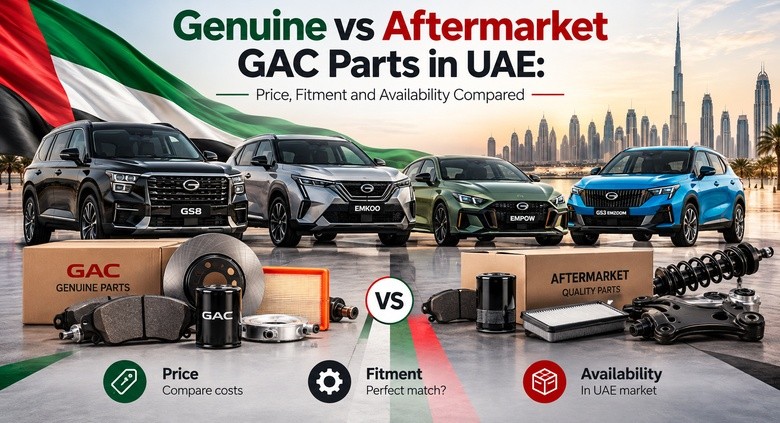
Genuine vs Aftermarket GAC Parts in UAE: Price, Fitment and Availability Compared
October 5, 2026
The cheapest GAC part in a UAE search is rarely the whole story.
A brake pad listed at AED 279 can sit beside another EMPOW brake-pad listing priced at AED 625–959. An EMKOO bumper may be advertised around AED 425–492, while another component for the same accident repair is available only by enquiry. Even something as ordinary as an oil filter can carry several descriptions depending on the supplier and application.
That is why the genuine-versus-aftermarket argument gets muddled so easily.
“Genuine” tells you something about sourcing and manufacturer branding. “Aftermarket” tells you that the part comes from outside the vehicle manufacturer's branded supply chain. Neither word, by itself, tells you the actual quality of a particular component, the accuracy of its fitment, whether it needs coding, or whether it is the sensible choice for a particular repair.
For GAC EMKOO and EMPOW owners in the UAE, the useful comparison is much more specific: price, exact application, evidence of fitment, availability, warranty, installation requirements and the consequence of getting it wrong.
UAE Update Reference: September 2026
Genuine and aftermarket are not simply “expensive” and “cheap”
The familiar version of the argument goes like this:
Genuine costs more.
Aftermarket costs less.
Therefore aftermarket saves money.
That is too neat.
A genuine GAC component may carry a higher price because it is supplied through the manufacturer's parts network, packaged and catalogued for a particular vehicle application. An aftermarket component may be cheaper because it is produced by another manufacturer and distributed through a different supply chain.
But aftermarket is not one category of quality.
There are established aftermarket manufacturers, budget suppliers, remanufactured components, pattern parts and products where the available information is simply too thin to make a confident comparison.
The word “aftermarket” does not tell you which one you are buying.
GAC's own UAE network remains the reference point for genuine parts
GAC's authorised UAE distributor, Gargash GAC Motor, provides dedicated parts and service support through its UAE network. Its current online material identifies EMPOW and other GAC models in the UAE range, while the GAC aftersales system provides model-specific service and parts structures.
That matters when the part is difficult to identify.
For a straightforward consumable, an independent supplier may be perfectly capable of identifying the correct component.
For a control module, transmission component, hybrid-related component or body assembly containing sensors, the manufacturer's parts system can become considerably more valuable.
The important distinction is not “dealer good, independent bad”.
It is information quality.
What does “genuine GAC” actually mean?
A genuine GAC part is a component sold as the vehicle manufacturer's genuine replacement part.
That gives the buyer a useful starting point: the part is being supplied within the GAC parts ecosystem rather than merely described as “compatible with GAC”.
But do not confuse genuine with the broader term OEM.
In the aftermarket, “OEM” is frequently used in product descriptions in ways that are not identical to the manufacturer's own terminology. A supplier may use “OEM” to mean original-equipment specification, original manufacturer, or a component believed to be equivalent.
Ask what the seller actually means.
If the answer is vague, the label has little value.
What is an aftermarket GAC part?
The aftermarket GAC parts in UAE are manufactured or supplied outside the vehicle manufacturer's branded replacement parts channel.
That does not automatically make it inferior.
An aftermarket manufacturer may produce a well-engineered component with proper dimensional control, suitable materials and documented application coverage.
The opposite can also happen. A part may look convincing in a photograph while having little useful information about the manufacturer, material, testing, warranty or application.
So the proper question is not:
“Is it aftermarket?”
It is:
“Who made it, what exactly is it, what vehicle application does it cover, and what evidence supports that claim?”
The current UAE market already shows why price comparisons need context
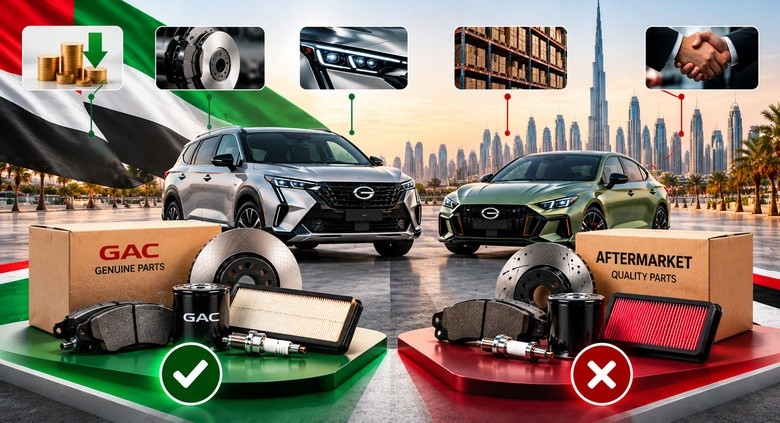
A UAE parts catalogue currently lists a GAC EMPOW front brake pad at AED 279 before VAT, or AED 292.95 including VAT. The same catalogue lists a rear EMPOW application at AED 218.16 before VAT, or AED 229.07 including VAT.
A separate UAE supplier lists an EMPOW brake-pad product at AED 625–959.
The difference is enormous.
But it would be poor analysis to declare one seller “expensive” simply from those two numbers.
The available listings do not establish that the products are identical in manufacturer, packaging, compound, axle application, warranty or supply route.
A real comparison requires the actual part reference and specification.
Why the AED 279 brake-pad figure is useful — and limited
The AED 279 EMPOW front-pad listing is useful because it is a current UAE public price for a GAC-branded product with an OEM part number shown in the catalogue. The listing identifies the front EMPOW pad as part number 8830008BSV0000 and gives AED 292.95 including VAT.
That makes it a useful market observation.
It does not establish a universal EMPOW brake-pad price.
It also does not tell us that every aftermarket pad should cost less.
A lower-priced aftermarket pad could still be more expensive after delivery, installation or an unsuitable fit creates a second trip to the workshop.
EMKOO is even more revealing
The current UAE supplier evidence for an EMKOO brake pad is different.
ShipMyPart lists the EMKOO brake pad as available but asks the customer to enquire rather than publishing a fixed price. The product is described as available in genuine and aftermarket options.
That tells us something important about parts availability.
Not every GAC component has a transparent public price.
A supplier may hold stock but quote individually. Another may need to source the component. A genuine part may be available through one channel while an aftermarket equivalent is easier to obtain through another.
Availability and price are linked, but they are not the same thing.
The oil filter is a better apples-to-apples example
The current UAE catalogue lists a GAC oil filter covering GAC GS3, EMPOW, EMKOO and EMZOOM at AED 40.20 before VAT, or AED 42.21 including VAT. It identifies the GAC part number as 10110441560000.
This is the kind of component where an aftermarket alternative can be worth investigating.
Why?
Because the component is relatively simple compared with an ECU, gearbox controller or hybrid system component. The buyer can compare the exact application, manufacturer, filter construction, warranty and price without trying to decode a complicated electronic compatibility problem.
Still, the same rule applies.
Same model name does not automatically mean same filter application.
Confirm the part number or VIN.
Air filters show where aftermarket comparison can become sensible
The same UAE catalogue lists an air filter covering GAC 3, EMZOOM and EMKOO at AED 72.70 before VAT, or AED 76.34 including VAT.
This is another relatively straightforward maintenance component.
If an aftermarket manufacturer provides the correct dimensions, filtration specification, application data and credible product information, the buyer has something meaningful to compare.
The mistake is choosing purely by the lowest price.
An air filter is part of the engine's intake system. Poor sealing, incorrect dimensions or weak construction can turn a small saving into a maintenance problem.
Spark plugs are a small part with a big fitment warning
A current UAE listing gives a GAC spark plug application for EMKOO and EMPOW at AED 45.40 before VAT, or AED 47.67 including VAT. The listing identifies GAC part number 10130352060100.
This is exactly the sort of component where buyers may search by model name and stop there.
Don't.
Spark-plug specification can involve thread dimensions, reach, heat range, electrode design and other characteristics. The vehicle's exact engine application matters.
The aftermarket alternative needs to cross-reference the correct original application, not merely say “fits EMKOO/EMPOW”.
Brake pads are where quality becomes more consequential
A brake pad is not just a shaped block of friction material.
Its friction characteristics, operating temperature, noise behaviour, wear rate, bedding behaviour and interaction with the brake disc all matter.
That does not mean an aftermarket brake pad is automatically unsuitable.
It means the buyer should demand more information.
For a reputable aftermarket pad, look for a named manufacturer, exact application, part reference, appropriate certification or specification information where applicable, and a sensible warranty.
A product page saying “high quality” is not evidence.
UAE heat is a condition, not a quality certificate
UAE suppliers frequently market parts around high temperatures, sand and demanding driving conditions. For example, current GAC parts listings describe brake components and other replacement parts in the context of UAE operating conditions.
The climate genuinely matters.
But “designed for the UAE” should not be treated as proof that a particular aftermarket part is superior.
Ask what that claim actually means.
Was the component tested at a specified temperature? Is there a documented application? Is there a recognised specification? Or is the phrase simply marketing copy?
Heat matters.
Evidence matters more.
Body parts create a different genuine-versus-aftermarket decision
Consider an EMKOO front bumper.
A UAE supplier currently lists an EMKOO front bumper at approximately AED 425–492.
At first glance, this looks like an easy aftermarket-versus-genuine comparison.
It isn't.
The bumper may be only one part of the repair. The vehicle may also need grilles, brackets, absorbers, clips, parking sensors, wiring, paint and calibration.
And if the aftermarket bumper's mounting points or sensor apertures are inaccurate, the cheap part can become the expensive choice.
Body panels are a classic case where physical fitment matters as much as catalogue compatibility.
“Fits EMKOO” does not mean “fits this EMKOO perfectly”
A listing that says EMKOO compatibility has answered only the first question.
The buyer still needs to establish:
- model year
- trim
- market specification
- facelift or generation where applicable
- bumper design
- sensor configuration
- camera configuration
- mounting arrangement
- exact part reference
The Middle East EMKOO catalogue itself warns that specifications, options, services and parts can vary by region and that information is subject to change.
That is a useful warning against assuming every EMKOO worldwide is identical.
A genuine part can still be the wrong part
This sounds obvious until an expensive component is sitting on a workshop floor.
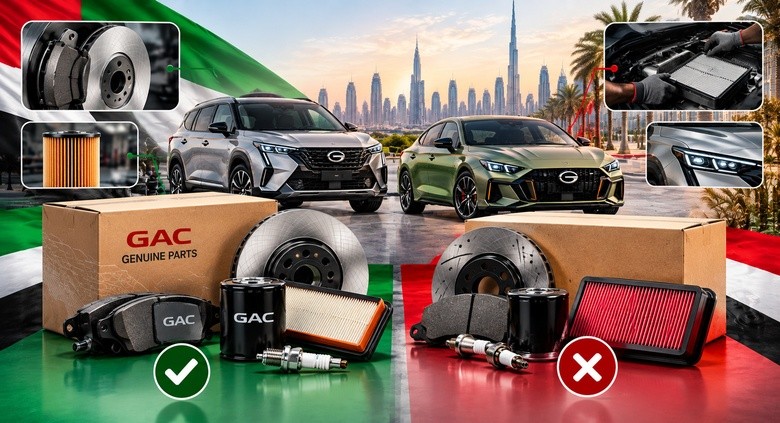
A genuine GAC part with a legitimate part number can still be wrong for a particular vehicle if the application differs.
The same manufacturer can use different components across model years, engine versions, trim levels and regional specifications.
So “genuine” answers the question:
What type of part is this?
It does not necessarily answer:
Is this the correct part for my VIN?
That second question still needs to be checked.
VIN beats model-name searching
One UAE parts catalogue explicitly provides both part-number and 17-character VIN searching.
That is the right hierarchy for expensive parts.
Start with the vehicle identification.
Then establish the application.
Then confirm the part reference.
Then compare the physical component.
Then confirm installation requirements.
For an oil filter, this may take seconds.
For a transmission component or electronic module, skipping those steps can become very costly.
Electronic parts change the genuine-versus-aftermarket equation
A brake pad is largely a physical component.
An ECU is not.
A TCU is not.
An ABS control module is not.
A modern electronic component can depend on hardware version, software, communication protocols, calibration and vehicle-specific configuration.
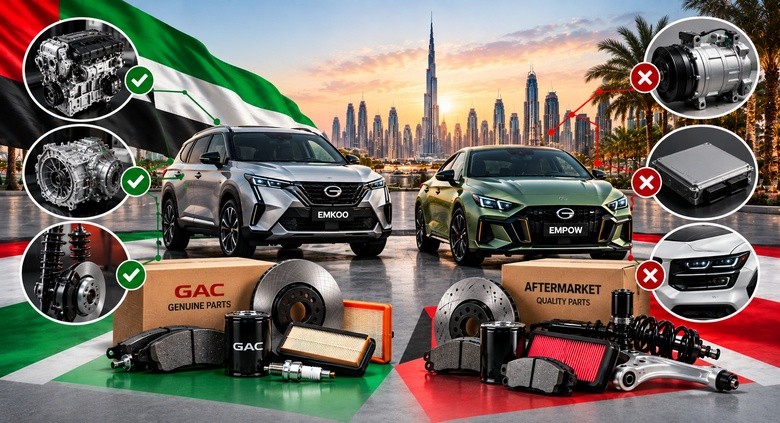
A current UAE supplier lists EMPOW ECU, TCU and ABS control modules as a category available in genuine and aftermarket forms, but the products are enquiry-based rather than carrying a simple public price.
That absence of a public price is not surprising.
A module is not a simple “click, fit and drive” component.
Ask about programming before buying electronic parts
Before purchasing an EMPOW control module, ask:
Does the module need coding?
Then:
Does it need programming?
Then:
Does it require calibration or vehicle-specific configuration?
Finally:
Who will perform that work?
A cheaper module is not cheaper if the workshop cannot configure it.
This is one of the clearest situations where part price and installed repair cost can diverge dramatically.
The aftermarket advantage is strongest when the part is simple
There is no universal rule, but the economic case for aftermarket alternatives is usually easier to assess when the component is:
- a routine filter
- a straightforward suspension component
- a conventional rubber or mounting component
- certain brake components
- selected body trim
- some non-programmable mechanical parts
The more the component depends on vehicle-specific software, calibration, safety integration or precise electronic communication, the more important sourcing and compatibility become.
That is not an argument against aftermarket.
It is an argument for matching the sourcing strategy to the component.
Genuine can make more sense for complex electronic components
For a control module, sensor network component or electronically integrated assembly, the value of a genuine part can include more than the physical component.
There may be clearer application information, established part-number references and better integration with the vehicle's intended architecture.
But even here, genuine does not eliminate the need for programming or diagnosis.
A new module cannot repair a wiring fault.
A new sensor cannot repair a damaged connector.
A new ECU cannot magically fix an engine problem that was misdiagnosed as an ECU failure.
The same principle applies to brake boosters
A current UAE supplier lists GAC EMKOO brake boosters and describes genuine and aftermarket options.
This is a more serious choice than an air filter.
The workshop should establish whether the booster itself has failed.
Brake-pedal complaints can arise from several causes, including hydraulic problems, vacuum-related issues, control-system faults and other braking-system components.
Replacing the booster because the pedal “feels wrong” is not enough.
Diagnosis comes first.
Driveline parts sit in the middle
For EMPOW, a UAE supplier lists axles and CV-joint replacement parts at AED 704–746 and identifies both genuine and aftermarket options.
This is an interesting category.
A reputable aftermarket driveline component may be economically attractive because it is mechanical rather than software-dependent.
But the consequences of poor fitment can be unpleasant: vibration, clicking, premature wear, seal problems or driveline noise.
Before ordering, confirm the side, application, transmission, dimensions and exact reference.
A generic “EMPOW CV joint” search is not enough.
Suspension parts need physical diagnosis
The same logic applies to suspension.
If an EMPOW makes a knock over a speed hump, don't order a control arm because the symptom “sounds like a control arm”.
The workshop should inspect:
- bushes
- ball joints
- stabiliser links
- dampers
- top mounts
- fasteners
- wheel bearings
- steering components
The correct aftermarket component may be perfectly acceptable.
The wrong aftermarket component is still the wrong repair.
Availability can outweigh a modest price difference
Imagine two genuine parts.
One costs AED 500 and is available immediately.
Another costs AED 450 but has to be sourced internationally.
The second is not automatically cheaper once delivery, waiting time and possible installation delays are considered.
This becomes more important for vehicles that are used daily.
A car sitting on a workshop ramp for several days has an economic cost even when that cost never appears as a line on the parts invoice.
Current UAE suppliers advertise different availability arrangements: some products are explicitly marked available, while others are enquiry-only.
That is why availability should be treated as part of the price calculation.
Stock status needs to be read carefully
“In stock” is useful.
It is not a guarantee that the part will arrive at your workshop tomorrow.
Check:
- physical stock or supplier stock
- UAE location
- dispatch time
- delivery time
- whether the listed product is the exact part
- whether the price is current
- return conditions
- whether the item is special-order
A product page can tell you that a component is available without telling you how quickly it will reach your mechanic.
Ask.
Warranty changes the real price
Suppose an aftermarket part costs AED 350 and a genuine part costs AED 550.
The aftermarket option looks cheaper by AED 200.
Now imagine the aftermarket supplier offers limited support, while the genuine part has clearer warranty handling through the established parts network.
That does not automatically make the genuine part the better financial choice.
It means the AED 200 difference is not the complete comparison.
For high-labour repairs, warranty becomes particularly important.
If the part fails after installation, who pays for removal and refitting?
That question is often forgotten.
Installation labour can destroy a small parts saving
Imagine saving AED 150 on a component that takes several hours to install.
If the part fails or proves incompatible, the customer may pay the labour twice.
This is why the cheapest component is not necessarily the cheapest repair.
The calculation should be:
Part price + delivery + diagnostic work + labour + programming/calibration + consumables + risk of repeat labour.
That is the number worth comparing.
A genuine part is not always economically sensible
There are repairs where the genuine part is clearly desirable.
There are others where a properly specified aftermarket alternative can be a rational choice.
Consider an older GAC with a straightforward mechanical component.
If a reputable aftermarket manufacturer offers the correct application, useful technical information and a meaningful warranty at a substantial saving, paying the full genuine premium may not necessarily produce a proportional benefit.
The important word is reputable.
“Aftermarket” alone is not enough.
The opposite is also true: cheap aftermarket can become expensive
A low-cost part can create secondary costs through:
- poor fitment
- premature wear
- noise
- vibration
- leaks
- warning lights
- incorrect sensor readings
- repeated labour
- alignment problems
- programming failures
The buyer should be particularly cautious when the component is difficult to remove or has safety implications.
A saving of AED 200 is less attractive when the installation labour is AED 600.
Price comparison should happen by exact part, not category
Don't compare:
Genuine brake pad vs aftermarket brake pad.
Compare:
Genuine GAC part reference X vs aftermarket manufacturer part reference Y for the same EMPOW axle/application.
Don't compare:
Genuine bumper vs aftermarket bumper.
Compare:
Genuine bumper assembly for this VIN/specification vs aftermarket bumper assembly with confirmed mounting and sensor compatibility.
That is a proper comparison.
Anything less is mostly marketing.
What the current UAE market tells us about EMPOW
The current evidence gives several useful reference points.
A GAC-branded EMPOW front brake pad is publicly listed at AED 279 before VAT. The same UAE catalogue lists a rear EMPOW pad at AED 218.16 before VAT, an EMPOW/EMKOO oil filter at AED 40.20 before VAT, and an EMKOO/EMPOW spark plug at AED 45.40 before VAT.
Separately, an EMPOW brake-pad listing sits at AED 625–959, while EMPOW axle/CV-joint parts are listed at AED 704–746.
These figures are not a universal price list.
They are evidence that the UAE market contains substantial price variation, even before labour enters the equation.
What the current UAE market tells us about EMKOO
For EMKOO, the market is less transparent for some components.
The current EMKOO brake-pad listing is enquiry-based rather than showing a fixed price. The front bumper is publicly listed around AED 425–492.
That makes availability itself part of the buying decision.
A buyer who needs an accident repair immediately may reasonably value confirmed local availability differently from someone planning preventative maintenance.
There is no single correct purchasing strategy for both situations.
A simple genuine-versus-aftermarket decision matrix
| Part type | Genuine advantage | Aftermarket opportunity | What to verify |
| Oil filter | Known GAC application | Potential cost saving | Part number, filtration specification |
| Air filter | Direct application | Often worth comparing | Dimensions, sealing, manufacturer |
| Spark plugs | Exact application reference | Established alternatives may exist | Heat range, dimensions, specification |
| Brake pads | Known vehicle application | Stronger price-comparison case | Manufacturer, compound, certification/specification |
| Brake discs | Known fitment | Potential saving | Dimensions, metallurgy, runout/specification |
| Suspension arm | Direct application | Potential saving | Bush/ball-joint design, dimensions |
| Bumper | Original mounting design | Possible major saving | Mounting points, sensors, cameras, finish |
| CV joint/axle | Known driveline application | Established alternatives may exist | Side, transmission, dimensions |
| ECU/TCU/ABS module | Integration and application | Higher compatibility burden | Software, coding, calibration, VIN |
| Hybrid electronics | System compatibility | Requires strong evidence | High-voltage system/application and programming |
The table is not a ranking.
It is a way to match the level of sourcing risk to the component.
Before You Click Buy: ask these questions
For a GAC EMKOO or EMPOW part, ask the supplier:
Is this genuine GAC, aftermarket or used?
What manufacturer made it?
What is the exact part number?
Does the reference match my VIN?
Is it for the correct model year and powertrain?
Is VAT included?
Is the part physically in UAE stock?
What is the delivery time?
What warranty is provided?
What happens if the part does not fit?
Does installation require coding, programming, calibration or adaptation?
If the seller cannot answer basic questions about a high-value component, the low price deserves more scrutiny, not less.
Don't let “OEM quality” end the conversation
“OEM quality” sounds reassuring.
But it is not a complete technical description.
Ask:
Who manufactured it?
What is the part number?
What application is it approved for?
Is the component new?
What warranty applies?
What evidence supports compatibility?
For some products, the answer may be straightforward.
For others, the phrase “OEM quality” is doing far too much work.
Used is a different category again
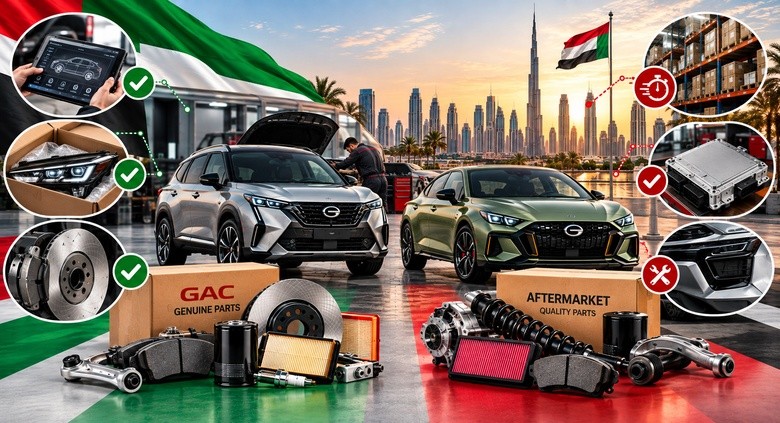
Used parts should not be casually grouped with aftermarket.
A used genuine GAC component may be an original factory part removed from another vehicle.
That can make it attractive for expensive or discontinued components.
But its history matters.
For a used ECU, transmission, turbocharger, engine, steering component or electronic module, investigate donor vehicle, mileage where known, accident/flood history, testing, storage, warranty and return conditions.
A used genuine part is not automatically safer than a new aftermarket part.
The condition and evidence matter.
Genuine versus aftermarket for accident repairs
Accident damage creates a slightly different calculation.
For a bumper, grille, bracket or trim component, an aftermarket body part may offer a meaningful saving.
But the workshop should inspect the entire assembly before ordering.
Check:
- mounting points
- crash supports
- sensor locations
- camera openings
- parking sensors
- radar-related components where fitted
- wiring
- clips
- paint requirements
- panel alignment
The cheapest bumper becomes a poor bargain if it does not line up correctly or forces additional work around integrated electronics.
Genuine versus aftermarket for routine servicing
Routine service parts are often the easiest area for comparison.
Filters, plugs and other scheduled maintenance items have identifiable specifications and predictable replacement intervals.
The current UAE catalogue demonstrates that GAC-branded EMKOO/EMPOW consumables are available publicly, including oil filters, air filters and spark plugs.
For aftermarket alternatives, compare the actual specification and manufacturer rather than assuming the lowest-priced filter is equivalent.
A few dirhams saved on a filter are rarely worth gambling with fitment.
Genuine versus aftermarket for electronics
Here the threshold should be higher.
An electronic component should be treated as a system component, not simply a replacement box.
The workshop should establish:
- fault code
- live-data evidence where relevant
- wiring integrity
- connector condition
- power and ground
- communication
- software/application
- calibration
- coding requirements
Only then should the replacement part be selected.
This is where a cheap incompatible module can become one of the most expensive “bargains” in the workshop.
What a proper UAE quotation should show
A useful parts quotation should identify:
Vehicle: GAC EMKOO or EMPOW
Model year: exact year
Powertrain: exact engine/hybrid application where relevant
VIN: confirmed
Part: exact component
Part number: supplier/manufacturer reference
Type: genuine / aftermarket / used / reconditioned
Brand: named manufacturer where applicable
Price: AED
VAT: included or excluded
Availability: UAE stock / special order
Delivery: estimated timeframe
Warranty: stated period and conditions
Labour: separate
Programming/calibration: separate if applicable
This format makes two quotations much easier to compare.
The cheapest part can be the most expensive route
Imagine an aftermarket component saves AED 250.
It arrives two days later than expected.
It turns out to be the wrong application.
The mechanic has already dismantled the car.
The replacement must be returned.
A second component is ordered.
The workshop charges additional labour.
The vehicle remains off the road.
That AED 250 saving has disappeared.
This is why experienced parts buyers often care as much about fitment certainty and return conditions as the headline price.
When the genuine premium is easier to justify
The genuine option deserves closer consideration when:
- the part is electronically integrated
- programming is required
- safety systems are involved
- fitment is highly specific
- labour to replace the part is substantial
- failure could damage other components
- the aftermarket manufacturer cannot be established
- warranty support is unclear
- the component is difficult to source again
The point is not that genuine always wins.
It is that the consequences of uncertainty are higher.
When aftermarket deserves serious consideration
A reputable aftermarket part deserves proper comparison when:
- the manufacturer is identifiable
- the exact application is documented
- dimensions/specifications are available
- the part has appropriate quality evidence
- warranty is clear
- the price difference is meaningful
- installation is straightforward
- the part does not require complicated programming
- the supplier has a sensible return policy
That is a much stronger basis for buying aftermarket than simply seeing a lower number.
The real comparison is five prices, not two
For a serious repair, compare:
Genuine part price
Aftermarket part price
Delivery
Installation
Risk-adjusted total
The fifth category is not a fake mathematical number.
It simply means asking what happens if the cheaper part is incompatible, fails early or needs additional work.
You do not need to put a precise dirham figure on that risk to recognise that it exists.
Where PartFinder UAE belongs in the buying process
For UAE buyers searching across genuine and aftermarket GAC components, the useful role of PartFinder UAE is comparison — but comparison should happen after the vehicle has been correctly identified.
Search by model and component.
Confirm the VIN or application.
Check the exact reference.
Compare genuine and aftermarket manufacturers.
Then compare the complete delivered cost, warranty and return conditions.
The objective is not to find the lowest number on a search page.
It is to find the lowest defensible cost for the correct part.
The practical rule for choosing GAC parts in the UAE
Don't choose genuine because the word sounds safer.
Don't choose aftermarket because the number looks cheaper.
Choose according to the part's complexity, fitment risk, manufacturer evidence, availability, warranty and total installed cost.
For a filter, the comparison may be relatively straightforward.
For a brake component, look harder at manufacturer and specification.
For a bumper, investigate physical fit and integrated electronics.
For an ECU, TCU, ABS module or other electronic assembly, compatibility and programming can matter more than the headline discount.
And for any expensive GAC repair, get the exact part reference against the VIN before the money leaves your account.
That is the comparison that actually matters.
FAQs
Categories
- Audi
- BMW
- Car Accessories
- Car Tips
- Ford
- Land Rover
- Mazda
- Range Rover
- Top 10
- UAE Car Parts
- Used Car Parts
- Toyota
- Replacement Engines
- Nissan
- Hyundai
- Mitsubishi
- Volkswagen
- Honda
- Kia
- Chevrolet
- Dodge
- Jeep
- Subaru
- Renault
- Lexus
- Mercedes
- Suzuki
- Hummer
- Porsche
- Infiniti
- Peugeot
- GMC
- Mini
- Volvo
- Replacement Gearboxes
- MG
- Jaguar
- Skoda
- Cadillac
- Daihatsu
- Fiat
- German Car Parts
- Japanese Car Parts
- Aftermarket Car Parts
- Genuine Car Parts
- New Car Parts
- Reconditioned Car Parts
- European Car Parts
- American Car Parts
- Korean Car Parts
- British Car Parts
- Chinese Car Parts
- Sports/Exotic Car Parts
- Luxury Car Parts
- Performance Car Parts
- SUV/4x4 Spare Parts
- Truck Spare Parts
- EV Car Parts
- Hybrid Car Parts
- Auto Spare Parts in UAE
- Tesla
- Isuzu
- Ram
- Ferrari
- Bentley
- Lamborghini
- Genesis
- Maserati
- Lincoln
- Chrysler
- Opel
- Citroen
- SsangYong
- Seat
- McLaren
- Aston Martin
- Rolls Royce
- Maybach
- Alfa Romeo
- Bugatti
- Scion
- Abu Dhabi Car Parts
- Ajman Car Parts
- Al Khan Car Parts
- Al Sajaa Car Parts
- Deira Car Parts
- Dubai Car Parts
- Fujairah Car Parts
- Industrial Area 6 Car Parts
- Mussafah Car Parts
- Ras Al Khaimah Car Parts
- Sharjah Car Parts
- Umm Al Quwain Car Parts
- Acura
- BYD
- Chery
- Dacia
- DS
- Geely Emgrand
- EXEED
- GAC
- GAC Gonow
- Geely