Genuine vs Aftermarket German Car Parts in UAE: What Car Owners Should Know
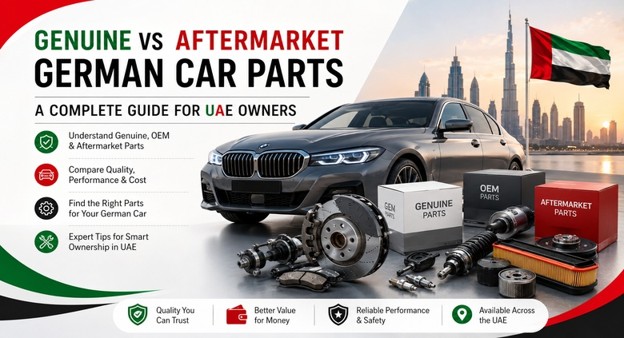
July 27, 2026
Understanding Genuine and Aftermarket German Car Parts
German vehicles have built a reputation that few automotive manufacturers can rival.
From the refined engineering of a Mercedes-Benz S-Class to the precise handling of a BMW 5 Series, the innovation of an Audi Q7, the practicality of a Volkswagen Touareg and the performance of a Porsche Cayenne, German vehicles continue to attract drivers who expect exceptional quality, advanced technology and an engaging driving experience.
Across the UAE, these vehicles are a familiar sight.
They transport families through Dubai's busy streets, cruise comfortably along Abu Dhabi's motorways, tackle long journeys between the Emirates and serve business owners who value both prestige and reliability.
Like every vehicle, however, even the finest German engineering eventually requires replacement parts.
Brake components wear.
Suspension bushes deteriorate.
Electronic sensors fail.
Air suspension systems develop leaks.
Gearboxes require attention.
Body panels become damaged.
When repairs become necessary, most owners face an important decision.
Should they invest in genuine German car parts?
Or do high-quality aftermarket alternatives provide better value?
The answer is rarely straightforward.
The best decision depends on the component being replaced, the age of the vehicle, the owner's budget and their long-term plans for the car.
Throughout this guide, we'll compare genuine and aftermarket German car parts in UAE to help you make informed buying decisions while avoiding expensive mistakes.
Why German Car Parts Are in High Demand Across the UAE
German vehicles occupy an important place within the UAE automotive market.
Their reputation for engineering excellence attracts private owners, company executives, fleet managers and driving enthusiasts alike.
Popular German manufacturers found across Dubai, Abu Dhabi, Sharjah, Ajman, Ras Al Khaimah, Fujairah and Umm Al Quwain include:
- Mercedes-Benz.
- BMW.
- Audi.
- Volkswagen.
- Porsche.
- MINI.
- Opel.
Because these vehicles often incorporate advanced mechanical and electronic systems, demand for quality replacement parts remains consistently high.
Owners regularly search for components such as:
- Brake systems.
- Suspension parts.
- Air suspension components.
- Engine sensors.
- ECU modules.
- Gearboxes.
- Body panels.
- Lighting systems.
Choosing the correct replacement part has a direct influence on reliability, safety and long-term ownership costs.
Genuine vs Aftermarket German Car Parts: What's the Difference?
Understanding the terminology is the first step towards making the right purchasing decision.
Genuine German Car Parts
Genuine parts are supplied through the vehicle manufacturer's authorised parts network.
They are manufactured to meet the exact specifications required for the vehicle and are designed to integrate seamlessly with existing systems.
Many owners choose genuine parts because they provide confidence in compatibility and consistent quality.
Aftermarket German Car Parts
Aftermarket parts are manufactured by independent companies rather than the vehicle manufacturer.
Some are produced by highly respected engineering firms that meet exceptionally high quality standards.
Others focus primarily on affordability.
As a result, quality can vary significantly between brands.
Understanding the reputation of the manufacturer is therefore just as important as comparing prices.
Why UAE Owners Compare Genuine and Aftermarket Parts Before Buying
Repair costs for premium German vehicles can be substantial.
Naturally, owners want to achieve the best balance between quality and value.
Rather than automatically choosing the most expensive option, experienced buyers compare:
- Purchase price.
- Reliability.
- Compatibility.
- Warranty.
- Expected lifespan.
- Supplier reputation.
- Installation costs.
- Long-term ownership value.
A carefully selected aftermarket suspension arm may represent excellent value for one repair.
A genuine air suspension compressor or electronic control module may be the wiser investment for another.
Every repair deserves its own assessment.
Common German Car Parts That Need Replacement
German vehicles contain thousands of components working together with remarkable precision.
Some naturally require replacement more frequently than others.
These commonly include:
- Brake discs.
- Brake pads.
- Suspension control arms.
- Air suspension struts.
- Shock absorbers.
- Wheel bearings.
- ECU modules.
- Engine sensors.
- Alternators.
- Starter motors.
- Gearboxes.
- Turbochargers.
- Body panels.
- Headlights.
- Tail lights.
Replacing these components with the right quality level helps maintain the driving characteristics German vehicles are known for.
Genuine, OEM and Aftermarket German Parts Explained
Many buyers encounter three terms repeatedly while researching replacement parts.
Understanding the differences prevents unnecessary confusion.
Genuine Parts
Supplied through the manufacturer's authorised network and built to factory specifications.
OEM Parts
Original Equipment Manufacturer parts are produced by companies that supply components to vehicle manufacturers during production.
Many OEM components offer factory-level quality while often costing less than genuine alternatives.
Aftermarket Parts
Produced independently by third-party manufacturers.
Premium aftermarket brands can offer impressive quality and performance, while lower-grade alternatives may compromise durability, fitment or reliability.
The goal is not simply to choose the cheapest option.
It is to choose the most appropriate option for the specific repair.
How to Choose a Trusted German Car Parts Supplier
Even the highest-quality component can become a poor purchase if supplied incorrectly.
A reputable supplier does far more than dispatch replacement parts.
Experienced specialists help verify compatibility before an order is placed.
Look for suppliers that can:
- Confirm compatibility using the VIN.
- Explain the differences between genuine, OEM and aftermarket parts.
- Provide warranty support.
- Offer technical guidance.
- Supply detailed product information.
- Arrange reliable delivery across the UAE.
Suppliers with extensive experience in German vehicles are often better equipped to recommend the most suitable replacement for each repair.
Workshop Story: The Most Expensive Option Wasn't the Best Option
A BMW X5 owner visited a specialist workshop after developing excessive front suspension noise.
The initial recommendation from another repair centre was to replace every suspension component with genuine parts.
Although technically correct, the quotation exceeded the owner's repair budget.
Following a detailed inspection, technicians discovered that only the front control arms and bushes required replacement.
High-quality aftermarket components from a respected manufacturer were selected because they matched the required specifications and had a proven record of durability.
The remaining suspension components remained in excellent condition and required no attention.
After installation and wheel alignment, the vehicle handled precisely as intended.
The owner achieved a significant saving without compromising safety or driving quality.
The experience demonstrated that the best repair is based on accurate diagnosis rather than automatically choosing the most expensive components.
Why Correct Diagnosis Comes Before Ordering Parts
One of the most common and costly mistakes made by vehicle owners is ordering replacement parts before confirming the actual cause of the fault.
For example, a suspension warning light may originate from:
- A damaged height sensor.
- A leaking air suspension strut.
- A faulty compressor.
- A worn electrical connector.
- A control module issue.
- Wiring damage.
Replacing expensive assemblies without proper diagnosis can quickly multiply repair costs.
Professional diagnostic equipment helps identify the true source of the problem before money is spent on unnecessary parts.
Key Takeaways
Before moving to the next section, remember these important points:
- German vehicles require replacement parts that match their engineering standards.
- Genuine and aftermarket components both have important roles depending on the repair.
- Premium aftermarket parts can provide excellent value when sourced from reputable manufacturers.
- Supplier expertise is just as important as component quality.
- VIN verification and professional diagnostics help prevent costly compatibility mistakes.
- Every repair should be assessed individually rather than relying on price alone.
Engine Components
Few automotive industries have influenced engine engineering as profoundly as Germany.
Whether it is the smooth refinement of a BMW straight-six, the advanced turbocharged technology found in modern Mercedes-Benz models, Audi's efficient TFSI and TDI engines, Volkswagen's renowned EA-series powertrains or Porsche's high-performance flat-six engines, German manufacturers have consistently pushed engineering boundaries.
That same engineering excellence also means replacement parts demand careful selection.
Unlike simpler powertrains, modern German engines integrate advanced electronics, high-pressure fuel systems, turbocharging, variable valve timing and sophisticated cooling technologies.
Every component works together with remarkable precision.
When one part fails, owners naturally ask an important question.
Should they purchase a genuine replacement?
Or will a high-quality aftermarket component perform just as well?
The answer depends on the component, the manufacturer of the replacement part and the vehicle's intended future.
Genuine vs Aftermarket German Engines
Replacing a complete engine is among the largest investments any vehicle owner will make.
Fortunately, complete engine replacement is relatively uncommon.
When it does become necessary, owners generally compare genuine engines with professionally rebuilt or premium aftermarket solutions.
A genuine engine offers complete manufacturer specifications together with maximum compatibility.
High-quality aftermarket engines or professionally rebuilt units, when prepared by experienced specialists, may provide excellent value for older vehicles where budget plays a greater role.
A practical comparison illustrates the differences.
| Feature | Genuine Engine | Premium Aftermarket / Professionally Rebuilt Engine |
| Factory specification | Yes | Depends on manufacturer and rebuild quality |
| Purchase price | Highest | Usually lower |
| Compatibility | Exact manufacturer specification | Requires verification |
| Warranty | Typically comprehensive | Varies by supplier |
| Best suited for | Long-term ownership | Cost-conscious ownership |
The correct choice depends on vehicle age, intended ownership period and the reputation of both the supplier and installer.
Engine Internal Components Compared
Not every engine problem requires replacing the complete assembly.
Many internal components can be replaced individually following proper inspection.
Frequently serviced engine components include:
- Pistons.
- Connecting rods.
- Crankshafts.
- Camshafts.
- Cylinder heads.
- Timing chains.
- Timing guides.
- Valves.
- Bearings.
- Oil pumps.
Some premium aftermarket manufacturers produce components that meet or exceed original specifications.
For highly stressed internal parts, however, workshops often recommend genuine or recognised OEM-quality replacements to maintain reliability.
Turbochargers, Fuel Injection and Air Intake Systems
Modern German vehicles rely heavily on forced induction and precise fuel delivery.
These systems play a major role in both performance and fuel efficiency.
Key components include:
- Turbochargers.
- Wastegates.
- Intercoolers.
- Fuel injectors.
- High-pressure fuel pumps.
- Intake manifolds.
- Throttle bodies.
- Air intake sensors.
Premium aftermarket manufacturers supply many of these components successfully.
However, selecting unknown brands simply because they cost less can result in reduced efficiency, poor fitment or shorter service life.
The manufacturer's reputation should always be considered alongside price.
Cooling System Components: Which Option Is Better?
Cooling systems operate under considerable pressure in the UAE.
Summer temperatures place continuous demands on every cooling component.
Common replacement items include:
- Radiators.
- Water pumps.
- Thermostats.
- Expansion tanks.
- Cooling fans.
- Coolant pipes.
- Temperature sensors.
- Auxiliary cooling pumps.
Routine service items such as thermostats and water pumps are frequently replaced with genuine or premium OEM-quality components because of their importance in protecting the engine.
Failure of a relatively inexpensive cooling component can quickly lead to major engine damage if ignored.
Warning Signs Your Engine Parts Need Replacement
German engines generally provide early indications before serious mechanical failure develops.
Owners should investigate symptoms including:
- Excessive oil consumption.
- Blue exhaust smoke.
- Persistent coolant loss.
- Engine overheating.
- Reduced power.
- Rough idle.
- Metallic knocking sounds.
- Turbocharger whistling.
- Increased fuel consumption.
- Dashboard warning lights.
Ignoring these symptoms often transforms manageable repairs into significantly more expensive engine work.
Professional diagnosis should always be the first step.
Which Engine Components Should Always Be Genuine?
One of the most common questions owners ask concerns which components genuinely justify the additional investment.
While many premium aftermarket products perform exceptionally well, workshops frequently recommend genuine replacements for:
- Timing chain kits where manufacturer updates exist.
- Head gaskets.
- Oil seals.
- Critical engine sensors.
- Variable valve timing actuators.
- Engine control components.
- Certain cooling system components specified by the manufacturer.
- One-time-use engine fasteners.
Selecting proven components in these areas helps protect the entire engine.
The cost difference is often modest when compared with the expense of major engine repairs.
Understanding OEM Quality in German Vehicles
Many owners assume every aftermarket component is inferior.
That simply isn't accurate.
Several internationally recognised manufacturers produce components that meet the same engineering standards required during original vehicle production.
In many cases, these suppliers manufacture parts for multiple premium automotive brands.
Understanding the difference between premium aftermarket manufacturers and low-cost alternatives allows buyers to make far better purchasing decisions.
Quality should always take precedence over branding alone.
Workshop Story: A Turbocharger That Didn't Need Replacing
An Audi A6 owner visited a specialist workshop after another garage diagnosed a failed turbocharger.
Replacement costs appeared substantial.
Before approving the repair, technicians completed a detailed inspection.
The turbocharger itself remained in good mechanical condition.
Instead, a split intercooler hose combined with a faulty boost pressure sensor had caused a significant loss of performance.
Replacing both components restored full engine power immediately.
The original turbocharger continued operating perfectly.
Accurate diagnosis prevented an unnecessary replacement costing several times more than the actual repair.
Practical Advice Before Buying Engine Components
Before requesting quotations, prepare the following information:
- VIN.
- Vehicle model.
- Production year.
- Engine code.
- Existing part number where available.
- Diagnostic fault codes.
- Service history if relevant.
- Photographs where appropriate.
Providing complete information helps suppliers identify compatible components quickly while reducing ordering errors.
Buyer Checklist Before Ordering Engine Parts
Before making a purchase, ask:
- Has VIN compatibility been confirmed?
- Is the replacement part genuine, OEM or premium aftermarket?
- Does the manufacturer have a strong reputation?
- Is warranty included?
- Does installation require specialist programming?
- Are additional seals or fasteners required?
- Has the original fault been professionally diagnosed?
- Can technical support be provided after purchase?
Well-informed buyers generally experience fewer installation problems and better long-term reliability.
Key Takeaways
Before moving to the next section, remember these important points:
- Modern German engines require accurately matched replacement components.
- Premium aftermarket manufacturers can provide outstanding quality for many repairs.
- Genuine parts remain the preferred option for numerous critical engine components.
- Cooling system maintenance is particularly important in the UAE climate.
- Professional diagnosis prevents unnecessary replacement of expensive assemblies.
- Compatibility and manufacturer reputation matter far more than simply choosing the lowest-priced option.
Gearboxes and Drivetrain Components
Modern German vehicles are renowned for delivering effortless performance.
Whether you accelerate onto Sheikh Zayed Road in Dubai, climb the mountain roads of Ras Al Khaimah or cruise comfortably between Abu Dhabi and Al Ain, every movement feels smooth because dozens of drivetrain components work together in perfect harmony.
The engine generates power.
The gearbox controls how that power is delivered.
The clutch, differential, drive shafts and electronic control systems ensure that every horsepower reaches the road efficiently.
When one component begins to fail, the entire driving experience changes.
Gear shifts become hesitant.
Acceleration loses its smoothness.
Warning lights appear.
Unexpected noises become more frequent.
Ignoring these early symptoms rarely saves money. In many cases, a relatively small repair develops into a complete gearbox rebuild or replacement if left unresolved.
For owners of BMW, Mercedes-Benz, Audi, Volkswagen, Porsche, MINI and Opel vehicles, understanding the difference between genuine and aftermarket drivetrain components can make a significant difference to both repair costs and long-term reliability.
Genuine vs Aftermarket German Gearboxes
A gearbox is one of the most sophisticated mechanical systems fitted to any modern German vehicle.
Inside a single transmission are hundreds of precision-machined components operating under extreme pressure and temperature.
Choosing the correct replacement therefore deserves careful consideration.
Genuine gearboxes are built to the manufacturer's original specifications and are engineered to work seamlessly with the vehicle's electronic systems.
Premium aftermarket or professionally remanufactured gearboxes, however, have become increasingly popular across the UAE because they often provide substantial savings while maintaining dependable performance when rebuilt by experienced transmission specialists.
The choice should never be based on price alone.
Instead, consider:
- Vehicle age.
- Current mileage.
- Future ownership plans.
- Availability of genuine parts.
- Supplier reputation.
- Warranty coverage.
- Installation expertise.
Genuine vs Premium Aftermarket Gearboxes
| Comparison | Genuine Gearbox | Premium Aftermarket or Remanufactured Gearbox |
| Factory specifications | Exact | Depends on rebuild quality |
| Electronic compatibility | Excellent | Must be verified |
| Purchase cost | Highest | Generally lower |
| Warranty | Manufacturer or supplier | Supplier dependent |
| Best suited for | Long-term ownership and newer vehicles | Older vehicles seeking excellent value |
A professionally rebuilt gearbox from a respected transmission specialist may outperform a poor-quality replacement assembled using inferior components.
The quality of workmanship is every bit as important as the origin of the gearbox itself.
Automatic, DSG, S tronic, PDK and Manual Transmissions
German manufacturers employ several advanced transmission technologies, each requiring specialist knowledge during diagnosis and repair.
Some of the most common include:
- Traditional torque-converter automatic transmissions.
- Dual-clutch DSG gearboxes.
- Audi S tronic transmissions.
- Porsche PDK transmissions.
- Manual gearboxes.
- Continuously improving electronically controlled transmission systems.
Each design has unique service requirements.
For example, dual-clutch systems rely heavily on clean transmission fluid and accurate clutch calibration.
Ignoring recommended maintenance intervals often leads to premature wear.
Professional programming may also be required after installing certain transmission components.
Clutch Systems and Flywheel Components
Manual and dual-clutch transmissions rely on precise clutch operation.
Even small amounts of wear can affect drivability.
Frequently replaced components include:
- Clutch plates.
- Pressure plates.
- Release bearings.
- Concentric slave cylinders.
- Dual-mass flywheels.
- Pilot bearings.
Premium aftermarket clutch kits from established manufacturers often provide excellent performance.
However, workshops generally recommend avoiding low-cost clutch assemblies of uncertain origin, particularly for high-torque German vehicles.
Replacing a clutch involves significant labour.
Installing inferior components simply to reduce initial costs rarely proves economical.
Drive Shafts, CV Joints and Differentials
Power leaving the gearbox must pass through numerous drivetrain components before reaching the wheels.
Common replacement items include:
- Drive shafts.
- Constant velocity joints.
- CV boots.
- Front differentials.
- Rear differentials.
- Differential bearings.
- Universal joints.
- Propeller shafts.
Damaged CV boots may appear insignificant.
In reality, a split boot allows contaminants to enter the joint, eventually leading to complete CV joint failure.
Early replacement is considerably less expensive than replacing the entire assembly.
Transfer Cases and AWD Drivetrain Components
Many premium German SUVs rely on sophisticated all-wheel-drive systems.
Vehicles such as the BMW X5, Mercedes-Benz GLE, Audi Q7, Volkswagen Touareg and Porsche Cayenne distribute power intelligently between all four wheels.
Key drivetrain components include:
- Transfer cases.
- Electronic coupling units.
- Centre differentials.
- AWD control modules.
- Actuator motors.
- Drive couplings.
These systems improve traction and stability, particularly during wet weather or when travelling on loose desert terrain.
Because many AWD components communicate directly with multiple electronic control modules, accurate diagnosis is essential before replacing expensive assemblies.
Which Drivetrain Parts Can Be Aftermarket?
Not every drivetrain repair requires genuine components.
Several premium aftermarket manufacturers produce exceptionally reliable replacement parts.
Many workshops confidently install aftermarket versions of:
- Clutch kits.
- Release bearings.
- CV boots.
- Drive shafts.
- Wheel bearings.
- Mountings.
- Transmission filters.
- Transmission service kits.
Conversely, certain electronically controlled transmission modules, mechatronic units and manufacturer-specific control components are often best replaced using genuine parts to minimise compatibility issues.
Each repair should be evaluated individually rather than applying one rule to every component.
Common Signs of Gearbox and Drivetrain Problems
German transmissions usually provide warning signs long before complete failure occurs.
Drivers should arrange an inspection if they notice:
- Delayed gear engagement.
- Jerky gear changes.
- Gear slipping.
- Transmission warning lights.
- Fluid leaks beneath the vehicle.
- Grinding noises.
- Vibrations during acceleration.
- Clunking sounds from underneath.
- Difficulty selecting gears.
- Burning smells after extended driving.
Prompt diagnosis often prevents secondary damage to expensive drivetrain components.
Workshop Story: A Simple Seal Prevented a Major Gearbox Repair
A Mercedes-Benz E-Class arrived at a specialist workshop after its owner reported occasional hesitation when selecting reverse gear.
Another repair centre suggested replacing the entire transmission.
Before authorising such an expensive repair, technicians completed a comprehensive inspection.
They discovered that the gearbox itself remained mechanically sound.
The real problem originated from a leaking transmission connector sleeve that had allowed fluid loss over time.
After replacing the seal, renewing the transmission fluid, fitting a new filter and completing the manufacturer's adaptation procedure, the gearbox operated smoothly once again.
The owner avoided an unnecessary transmission replacement and reduced repair costs dramatically.
The case highlighted the importance of accurate diagnosis rather than relying solely on initial assumptions.
Compatibility Checks Before Ordering Gearbox Parts
Ordering drivetrain components without confirming compatibility creates unnecessary risks.
Before purchasing any gearbox-related component, verify:
- Vehicle Identification Number (VIN).
- Gearbox code.
- Engine code.
- Production date.
- Software version where applicable.
- Existing part number.
- Transmission type.
- Four-wheel-drive or rear-wheel-drive configuration.
Many German manufacturers introduce running production changes during a model's lifespan.
Two visually identical gearboxes may contain completely different internal specifications.
Professional verification helps avoid costly ordering mistakes.
Long-Term Cost Considerations
The cheapest transmission component is not always the most economical.
Owners should consider the total cost of ownership, including:
- Purchase price.
- Labour charges.
- Programming costs.
- Transmission fluid.
- Filters.
- Seals.
- Warranty support.
- Expected service life.
A higher-quality component frequently reduces future repair bills and improves overall reliability.
Evaluating the complete repair rather than focusing solely on the initial purchase price leads to better long-term value.
Key Takeaways
Before progressing to the next section, remember these essential points:
- German gearboxes combine sophisticated mechanics with advanced electronics.
- Premium aftermarket drivetrain components can offer outstanding value when sourced from reputable manufacturers.
- Genuine components remain the preferred choice for many electronic transmission systems.
- Accurate diagnosis often prevents unnecessary gearbox replacement.
- Compatibility checks using the VIN and gearbox code are essential before ordering parts.
- Regular transmission servicing significantly extends gearbox lifespan, particularly in demanding UAE driving conditions.
Suspension, Steering and Braking Systems
Comfort, confidence and safety depend on far more than engine performance.
A powerful engine and responsive gearbox mean very little if the vehicle struggles to absorb uneven roads, loses stability during cornering or takes longer than expected to stop in an emergency.
German manufacturers have earned worldwide recognition for producing some of the most refined suspension and braking systems available. Whether driving a Mercedes-Benz E-Class through Abu Dhabi, a BMW X7 across Dubai, an Audi Q8 in Sharjah or a Porsche Macan along the mountain roads of Ras Al Khaimah, owners expect exceptional ride quality and precise handling.
Achieving that standard relies on hundreds of carefully engineered suspension, steering and braking components working together.
Eventually, every one of them wears.
Bushes deteriorate.
Brake discs become thinner.
Shock absorbers lose their damping ability.
Air suspension systems develop leaks.
Steering components loosen.
When replacement becomes necessary, choosing between genuine and aftermarket parts can have a significant impact on both safety and long-term ownership costs.
Genuine vs Aftermarket Suspension Components
The suspension system absorbs road imperfections while keeping the tyres firmly connected to the road surface.
Every component contributes to ride comfort, steering accuracy and tyre wear.
Frequently replaced suspension components include:
- Control arms.
- Suspension bushes.
- Ball joints.
- Shock absorbers.
- Coil springs.
- Stabiliser links.
- Stabiliser bushes.
- Strut mounts.
- Wheel bearings.
- Suspension arms.
Many premium aftermarket manufacturers produce suspension components that equal or closely match original equipment quality.
For routine maintenance, these products often provide outstanding value.
However, extremely cheap alternatives frequently compromise on material quality, corrosion protection and manufacturing precision.
A suspension arm that costs less initially may wear prematurely, resulting in additional labour costs only months later.
Comparison:
| Feature | Genuine Suspension Parts | Premium Aftermarket Suspension Parts |
| Factory fitment | Exact | Usually excellent |
| Material quality | Manufacturer specification | Brand dependent |
| Purchase cost | Higher | Moderate |
| Warranty | Manufacturer or supplier | Supplier dependent |
| Long-term value | Excellent | Excellent when selecting reputable brands |
Quality matters considerably more than price alone.
Air Suspension Systems: Genuine or Aftermarket?
Air suspension has become increasingly common on premium German vehicles.
Models such as the Audi A8, Mercedes-Benz S-Class, BMW X5, Porsche Cayenne and Volkswagen Touareg rely on electronically controlled air suspension to deliver remarkable ride comfort.
Typical replacement components include:
- Air struts.
- Air springs.
- Compressors.
- Valve blocks.
- Height sensors.
- Air reservoirs.
- Air lines.
- Suspension control modules.
Because these systems combine mechanical, pneumatic and electronic components, accurate diagnosis becomes essential.
A vehicle sitting unevenly may not require complete suspension replacement.
The fault could simply involve:
- A leaking air line.
- A worn height sensor.
- A damaged valve block.
- A failing compressor relay.
- An electrical connection.
Replacing the wrong component wastes both time and money.
Premium aftermarket air suspension components have improved significantly over recent years, but workshops generally recommend using recognised manufacturers with proven reliability records.
Brake Components Compared
Braking systems remain one of the most important safety features fitted to any vehicle.
Unlike cosmetic repairs, brake component quality should never be compromised.
Common replacement items include:
- Brake discs.
- Brake pads.
- Brake callipers.
- Brake hoses.
- Brake master cylinders.
- Brake boosters.
- ABS sensors.
- Wheel speed sensors.
- Electronic parking brake motors.
Premium aftermarket brake manufacturers often supply products that perform exceptionally well during everyday driving.
For high-performance German vehicles, however, many workshops recommend genuine or recognised OEM-quality braking components to maintain factory braking characteristics.
Stopping performance should always take priority over saving a small amount on replacement parts.
Steering System Parts and Rack Assemblies
Modern steering systems rely on both mechanical precision and electronic assistance.
Wear gradually develops through everyday driving, particularly on heavier luxury SUVs.
Frequently replaced steering components include:
- Steering racks.
- Tie rods.
- Track rod ends.
- Steering columns.
- Electric power steering motors.
- Steering angle sensors.
- Hydraulic pumps.
- Steering couplings.
Symptoms that often indicate steering problems include:
- Excessive steering play.
- Knocking noises.
- Uneven steering effort.
- Steering vibration.
- Vehicle pulling to one side.
- Steering warning lights.
Professional diagnosis helps determine whether a simple component replacement is sufficient or whether a complete steering rack requires attention.
Wheel Bearings, Bushes and Control Arms
These relatively small components have a surprisingly large influence on ride quality.
As mileage increases, rubber bushes gradually harden and crack.
Wheel bearings develop internal wear.
Control arm ball joints loosen.
Ignoring these issues often results in:
- Uneven tyre wear.
- Reduced handling precision.
- Suspension noise.
- Steering instability.
- Increased braking distance.
- Additional strain on surrounding components.
Replacing worn suspension components promptly often prevents considerably larger repair bills later.
Which Safety Components Should Always Be Genuine?
Owners frequently ask whether every safety-related component should be purchased from the manufacturer.
There is no universal answer.
Many premium aftermarket manufacturers produce braking and suspension components that perform to exceptionally high standards.
However, workshops often recommend genuine components for certain systems where manufacturer-specific calibration or electronic integration plays a major role.
These commonly include:
- Electronic steering modules.
- Brake control modules.
- Adaptive suspension controllers.
- Air suspension control units.
- Certain ABS components.
- Electronic stability system modules.
Using manufacturer-approved components helps reduce compatibility issues while preserving the vehicle's original safety systems.
Workshop Story: The Suspension Noise That Wasn't a Shock Absorber
A BMW 7 Series owner complained of persistent knocking noises whenever driving across speed bumps.
The initial recommendation from another workshop was to replace both front shock absorbers.
Before ordering expensive parts, technicians completed a comprehensive suspension inspection.
The dampers remained in excellent condition.
Instead, worn stabiliser bar links and deteriorated bushes were allowing excessive movement.
Replacing these inexpensive components immediately restored the vehicle's quiet, composed ride.
The owner avoided replacing perfectly serviceable shock absorbers and reduced repair costs substantially.
The lesson was straightforward.
Accurate diagnosis almost always costs less than replacing parts based on assumptions.
How UAE Driving Conditions Affect Suspension and Braking Systems
German vehicles operating in the UAE experience conditions very different from those found across much of Europe.
Daily exposure to:
- Extreme summer temperatures.
- High-speed motorway driving.
- Frequent speed humps.
- Fine desert dust.
- Heavy urban traffic.
- Long commuting distances.
...places continuous demands on suspension bushes, brake systems and steering components.
Regular inspections become increasingly valuable as vehicles accumulate mileage.
Detecting wear early often prevents larger failures while preserving ride comfort and handling.
Buyer Checklist Before Ordering Suspension or Brake Parts
Before purchasing replacement components, confirm the following:
- VIN compatibility.
- Model year.
- Suspension specification.
- Air suspension or conventional suspension.
- Brake size.
- Electronic parking brake compatibility.
- Performance package specification.
- Manufacturer reputation.
- Warranty coverage.
Taking a few extra minutes to verify compatibility significantly reduces the likelihood of ordering incorrect components.
Key Takeaways
- Suspension quality influences comfort, handling and tyre life.
- Premium aftermarket suspension components can provide excellent value when sourced from trusted manufacturers.
- Air suspension systems should always be diagnosed thoroughly before replacing expensive assemblies.
- Brake quality should never be compromised.
- Steering and suspension wear often develops gradually before becoming obvious.
- Correct diagnosis remains the most effective way to reduce unnecessary repair costs.
Electrical and Electronic Components
German vehicles have undergone a remarkable transformation over the past two decades.
Mechanical engineering still lies at the heart of every BMW, Mercedes-Benz, Audi, Volkswagen, Porsche, MINI and Opel, but today's vehicles also depend on sophisticated electronics to manage almost every function. From engine performance and fuel efficiency to adaptive lighting, air suspension, driver assistance systems and climate control, electronic components continuously communicate with one another.
A modern premium German vehicle may contain more than 70 electronic control units, hundreds of sensors and several kilometres of wiring.
That level of technology delivers outstanding refinement, but it also means electrical faults can become difficult to diagnose.
When warning lights appear or electronic systems stop functioning correctly, many owners immediately assume the most expensive module has failed.
In reality, the cause is often far simpler.
Understanding the difference between genuine and aftermarket electrical components helps owners avoid unnecessary expenditure while maintaining reliability.
ECU Modules: Genuine vs Aftermarket
Electronic Control Units, commonly known as ECUs, are effectively the vehicle's computers.
Rather than operating independently, modern German vehicles use multiple interconnected modules, each responsible for a specific system.
Examples include:
- Engine Control Module (ECM).
- Transmission Control Module (TCM).
- Body Control Module (BCM).
- Air Suspension Control Module.
- ABS Control Module.
- Airbag Control Module.
- Comfort Control Module.
- Lighting Control Module.
- Infotainment Control Unit.
These modules exchange information continuously.
Replacing one module often requires software coding, calibration or programming before it communicates correctly with the rest of the vehicle.
For this reason, genuine ECUs are frequently recommended, particularly where software compatibility is critical.
Professionally refurbished original modules can also provide an excellent alternative, provided they are tested thoroughly and correctly programmed.
Engine Sensors and Electronic Control Units
Modern German engines rely on precise sensor data.
Even a minor fault can affect fuel economy, emissions, acceleration and engine performance.
Frequently replaced sensors include:
- Oxygen sensors.
- Mass Air Flow sensors.
- Manifold Absolute Pressure sensors.
- Crankshaft position sensors.
- Camshaft position sensors.
- Knock sensors.
- Coolant temperature sensors.
- Oil pressure sensors.
- Fuel pressure sensors.
- Wheel speed sensors.
Many premium aftermarket manufacturers produce sensors that perform extremely well.
However, low-quality sensors may generate inaccurate readings, resulting in recurring warning lights or poor engine performance despite replacing the original fault.
Accurate calibration remains just as important as the component itself.
Alternators, Starter Motors and Wiring Systems
Electrical charging and starting systems experience considerable wear throughout a vehicle's life.
The UAE climate places additional stress on batteries and charging components, particularly during extended periods of high ambient temperatures.
Common replacement parts include:
- Alternators.
- Starter motors.
- Voltage regulators.
- Battery monitoring sensors.
- Main battery cables.
- Earth cables.
- Fuse boxes.
- Wiring harnesses.
Premium aftermarket alternators and starter motors from established manufacturers generally provide dependable service.
Nevertheless, workshops recommend checking charging voltage, battery condition and wiring integrity before replacing expensive components unnecessarily.
Lighting Modules and Adaptive Headlight Components
Lighting technology has evolved dramatically.
Many German vehicles now feature:
- Adaptive LED headlights.
- Matrix LED systems.
- Laser lighting technology.
- Automatic high-beam assist.
- Cornering lights.
- Dynamic daytime running lights.
- Intelligent lighting control modules.
These systems improve visibility while enhancing safety.
Replacing a headlight assembly without confirming the actual fault can become extremely expensive.
Sometimes the issue originates from:
- A damaged wiring connector.
- A failed control module.
- Moisture ingress.
- A blown fuse.
- Software calibration.
Professional diagnostics should always precede replacement.
Infotainment, Navigation and Comfort Electronics
Owners increasingly expect their vehicles to deliver both comfort and connectivity.
Modern German vehicles therefore include sophisticated electronic systems such as:
- Digital instrument clusters.
- Navigation units.
- Multimedia displays.
- Wireless charging systems.
- Climate control modules.
- Seat control modules.
- Parking assistance systems.
- Camera systems.
- Keyless entry systems.
- Electronic tailgate controls.
Many of these systems communicate through fibre optic or high-speed data networks.
Installing incompatible components may cause multiple unrelated systems to malfunction.
Compatibility checks become especially important when purchasing replacement electronic modules.
Which Electronic Parts Are Safe to Buy Aftermarket?
Not every electrical component requires a genuine replacement.
Several premium aftermarket manufacturers have developed outstanding reputations for producing reliable electronic components.
Depending on the application, reputable aftermarket alternatives often perform exceptionally well for:
- Alternators.
- Starter motors.
- Battery sensors.
- Parking sensors.
- Window regulators.
- Switch assemblies.
- Ignition coils.
- Certain engine sensors.
Conversely, many workshops recommend genuine replacements for:
- Engine control modules.
- Transmission control modules.
- Airbag modules.
- Adaptive lighting controllers.
- Advanced driver assistance modules.
- Manufacturer-specific communication gateways.
The greater the software integration, the greater the importance of manufacturer compatibility.
Workshop Story: An ECU That Was Never Faulty
A Volkswagen Arteon owner arrived after receiving repeated engine management warnings and intermittent power loss.
Another repair centre had recommended replacing the engine control module.
Before ordering a costly ECU, technicians completed a systematic diagnostic process.
The investigation revealed corrosion within a wiring connector supplying the boost pressure sensor.
The ECU itself was operating exactly as designed.
Cleaning the connector, replacing the damaged wiring section and fitting a new sensor resolved every fault.
No expensive control module was required.
The owner avoided a repair costing several thousand dirhams because the workshop focused on diagnosis rather than assumptions.
How Heat Affects German Vehicle Electronics in the UAE
Electronic components operate reliably within carefully controlled temperature ranges.
During the UAE summer, prolonged exposure to extreme heat accelerates the ageing of:
- Wiring insulation.
- Plastic connectors.
- Electronic relays.
- Control modules.
- Battery systems.
- Cooling fans.
Fine desert dust can also affect electrical connectors, cooling ducts and sensor housings.
Regular inspections help identify deterioration before intermittent faults become permanent failures.
Protecting electrical systems through preventive maintenance is considerably less expensive than replacing multiple electronic modules.
Buyer Checklist Before Purchasing Electronic Components
Before ordering any electrical part, confirm the following:
- VIN compatibility.
- Original part number.
- Software version where applicable.
- Coding requirements.
- Programming requirements.
- Manufacturer reputation.
- Warranty coverage.
- Return policy for electronic components.
- Professional installation requirements.
Electronic components often cannot be returned once programmed or installed, making compatibility verification particularly important.
Key Takeaways
- Modern German vehicles rely on extensive electronic integration.
- Genuine ECUs remain the preferred option for many highly integrated systems.
- Premium aftermarket sensors, alternators and starter motors can provide excellent value when sourced from recognised manufacturers.
- Accurate diagnosis frequently prevents unnecessary replacement of expensive control modules.
- Heat and environmental conditions in the UAE increase the importance of regular electrical inspections.
- Compatibility, software coding and professional installation should always be considered before purchasing electronic components.
Body, Interior and Exterior Components
First impressions matter.
For many German vehicle owners, the appearance of their car is every bit as important as its mechanical condition. A perfectly maintained engine means little if damaged body panels, faded headlights or worn interior trim diminish the vehicle's overall appeal.
German manufacturers are recognised worldwide for their build quality, tight panel alignment and premium cabin materials. Whether it is the elegant lines of a Mercedes-Benz C-Class, the muscular styling of a BMW X6, the minimalist interior of an Audi A6, the practicality of a Volkswagen Tiguan or the unmistakable silhouette of a Porsche Panamera, every detail has been carefully engineered.
Over time, however, daily driving inevitably leaves its mark.
Minor collisions.
Parking damage.
Stone chips.
Sun exposure.
Road debris.
General wear and tear.
Eventually, replacement becomes necessary.
At that point, owners are once again faced with the familiar question.
Should they purchase genuine replacement components or consider premium aftermarket alternatives?
The answer depends not only on appearance but also on safety, fitment, corrosion resistance and long-term value.
Genuine vs Aftermarket Body Panels
Body panels define the structural appearance of every vehicle.
Poorly manufactured replacements often become obvious long before the paintwork is completed.
Common replacement body components include:
- Front bumpers.
- Rear bumpers.
- Bonnets.
- Front wings.
- Rear quarter panels.
- Doors.
- Tailgates.
- Boot lids.
- Grilles.
- Reinforcement bars.
Genuine body panels are manufactured to factory dimensions, allowing precise alignment and consistent panel gaps.
Premium aftermarket manufacturers have also improved considerably in recent years, producing panels that often provide excellent fitment for everyday repairs.
However, lower-quality alternatives may require additional body shop adjustments before installation.
Those extra labour costs can reduce or eliminate any initial savings.
Comparison:
| Feature | Genuine Body Panels | Premium Aftermarket Body Panels |
| Panel fitment | Exact factory specification | Generally very good with reputable manufacturers |
| Corrosion protection | Manufacturer standard | Varies by manufacturer |
| Installation time | Usually straightforward | May require additional adjustment |
| Purchase price | Higher | More affordable |
| Resale appearance | Excellent | Excellent when correctly installed |
Selecting a reputable manufacturer remains more important than simply choosing the least expensive panel.
Bumpers, Bonnets, Doors and Tailgates
These larger structural components influence both appearance and occupant safety.
Modern bumpers often house:
- Parking sensors.
- Radar units.
- Adaptive cruise control sensors.
- Cameras.
- Headlight washer systems.
- Air ducts.
A replacement bumper therefore involves considerably more than painted plastic.
Correct sensor positioning becomes essential for advanced driver assistance systems to operate accurately.
Likewise, replacement doors and tailgates frequently contain:
- Wiring harnesses.
- Window regulators.
- Side airbags.
- Electronic locks.
- Speakers.
- Cameras.
- Lighting modules.
Compatibility should always be confirmed before ordering replacement assemblies.
Headlights, Tail Lights and Mirrors
Lighting technology has advanced rapidly across German vehicles.
Current models commonly feature:
- LED headlights.
- Matrix LED systems.
- Laser headlights.
- Dynamic indicators.
- Adaptive lighting.
- Intelligent lighting control.
- Heated mirrors.
- Auto-dimming mirrors.
- Camera-equipped mirrors.
Premium aftermarket lighting assemblies can represent excellent value for certain applications.
However, where adaptive lighting technology or manufacturer-specific calibration is involved, workshops often recommend genuine assemblies to preserve full functionality.
A visually similar headlight may still differ internally in terms of electronics or programming requirements.
Interior Trim and Dashboard Components
Luxury interiors are one of the defining characteristics of German vehicles.
Owners naturally expect replacement components to maintain that premium feel.
Frequently replaced interior components include:
- Dashboard trim.
- Centre console panels.
- Air vents.
- Door trims.
- Switch panels.
- Instrument cluster surrounds.
- Storage compartments.
- Cup holders.
- Climate control panels.
Premium aftermarket interior parts often perform well where cosmetic appearance is the primary concern.
For components containing integrated electronics or safety systems, genuine replacements generally remain the preferred option.
Seats, Steering Wheels and Cabin Accessories
Comfort plays an important role in daily driving.
German manufacturers invest heavily in ergonomics, seating support and interior refinement.
Replacement items commonly include:
- Seat cushions.
- Seat frames.
- Electric seat motors.
- Steering wheels.
- Gear selectors.
- Armrests.
- Interior handles.
- Floor carpets.
- Roof lining.
- Sun visors.
Where airbags, heating systems or steering wheel controls are integrated, compatibility becomes especially important.
Professional installation helps ensure every safety feature continues operating correctly.
Cosmetic Components That Offer Excellent Aftermarket Value
Not every replacement part needs to originate from the vehicle manufacturer.
Many cosmetic items can be sourced confidently from respected aftermarket manufacturers.
Examples include:
- Exterior grilles.
- Mud flaps.
- Mirror covers.
- Interior trim pieces.
- Door sill protectors.
- Boot liners.
- Load compartment mats.
- Floor mats.
- Weather strips.
- Decorative trim.
Selecting high-quality aftermarket accessories allows owners to personalise their vehicles while maintaining excellent value.
Workshop Story: A Bumper That Needed More Than Paint
An Audi Q5 arrived at a body repair centre following a low-speed parking collision.
At first glance, replacing the front bumper appeared straightforward.
During dismantling, technicians discovered that the impact had also damaged a parking sensor bracket and slightly misaligned the radar mounting frame behind the bumper.
Rather than replacing every component unnecessarily, the workshop installed a high-quality aftermarket bumper together with genuine mounting brackets and recalibrated the radar system using manufacturer-approved diagnostic equipment.
The finished repair restored the vehicle's appearance while ensuring every driver assistance feature operated exactly as intended.
The owner benefited from a lower repair bill without compromising safety or functionality.
How UAE Conditions Affect Exterior Components
Vehicles operating throughout the UAE experience conditions that gradually affect exterior finishes.
Continuous exposure to:
- Strong ultraviolet sunlight.
- High ambient temperatures.
- Desert sand.
- Road debris.
- Coastal humidity in some Emirates.
...can accelerate fading, surface wear and corrosion if damaged panels remain untreated.
Regular cleaning, paint protection and prompt repair of minor body damage help preserve both appearance and resale value.
Well-maintained bodywork also protects underlying structural components from long-term deterioration.
Buyer Checklist Before Ordering Body or Interior Parts
Before purchasing replacement body or cabin components, confirm the following:
- VIN compatibility.
- Exact model year.
- Exterior colour specification where applicable.
- Left-hand or right-hand component.
- Parking sensor compatibility.
- Camera compatibility.
- Lighting specification.
- Airbag compatibility.
- Manufacturer reputation.
- Warranty coverage.
Verifying these details before ordering reduces installation delays and avoids unnecessary returns.
Key Takeaways
- Genuine body panels offer precise factory fitment and excellent long-term durability.
- Premium aftermarket body components can provide outstanding value when sourced from reputable manufacturers.
- Advanced lighting and safety systems require careful compatibility checks.
- Cosmetic accessories often represent excellent opportunities to choose premium aftermarket products.
- Professional installation preserves panel alignment, safety features and vehicle appearance.
- Protecting bodywork from harsh UAE environmental conditions helps maintain resale value and reduces future repair costs.
Cost Comparison and Long-Term Ownership
Price is often the first figure owners notice when replacing German car parts.
It is also the figure most likely to be misunderstood.
A genuine brake disc may appear expensive compared with an aftermarket alternative.
A genuine air suspension compressor may cost considerably more than a third-party replacement.
A genuine ECU module may seem difficult to justify when another supplier advertises a similar-looking unit for half the price.
Yet the purchase price represents only one part of the overall financial picture.
Installation costs, service life, warranty support, reliability, downtime and future maintenance all influence the true cost of ownership.
Experienced workshops rarely focus solely on what a component costs today.
Instead, they evaluate what that component is likely to cost over the next three, five or even ten years.
That broader perspective often leads to far better buying decisions.
Genuine vs Aftermarket German Parts Price Comparison
German vehicle owners generally compare genuine and aftermarket parts because they are trying to balance quality with affordability.
Neither option is automatically the correct choice.
Instead, each repair should be assessed individually.
Comparison:
| Component Category | Genuine Parts | Premium Aftermarket Parts |
| Brake components | Higher purchase price | Often lower while maintaining excellent performance |
| Suspension components | Premium pricing | Excellent value from reputable manufacturers |
| Air suspension parts | Higher investment | Good value when selecting recognised brands |
| Engine sensors | Higher cost | Competitive pricing with quality brands |
| Alternators and starter motors | More expensive | Frequently cost-effective |
| Body panels | Factory pricing | Usually more affordable |
| Interior trim | Premium pricing | Wide range of quality levels |
| Cosmetic accessories | Highest cost | Excellent value in many cases |
A lower purchase price should never be considered in isolation.
Installation quality and expected lifespan are equally important.
Labour Costs Across the UAE
Many owners concentrate entirely on component prices while overlooking labour charges.
For major repairs, labour frequently represents a substantial proportion of the total invoice.
Labour costs typically vary depending on:
- Vehicle model.
- Repair complexity.
- Workshop expertise.
- Diagnostic requirements.
- Programming requirements.
- Location within the UAE.
Luxury German vehicles equipped with advanced electronics generally require specialist equipment and experienced technicians.
Although specialist workshops may appear more expensive initially, accurate diagnosis often reduces unnecessary parts replacement, lowering the total repair cost.
Long-Term Ownership Cost Analysis
The least expensive repair today may become the most expensive repair next year.
When comparing replacement parts, experienced owners consider:
- Expected service life.
- Manufacturer reputation.
- Warranty support.
- Repeat labour costs.
- Reliability history.
- Vehicle resale value.
- Future maintenance requirements.
For example, replacing suspension components with premium products that last significantly longer often proves more economical than fitting low-cost alternatives requiring repeated replacement.
The same principle applies throughout the vehicle.
Repair vs Replacement Decisions
Not every faulty component requires complete replacement.
Many German vehicle systems allow individual components to be repaired, rebuilt or refurbished successfully.
Examples include:
- Alternators.
- Starter motors.
- Steering racks.
- Turbochargers.
- Certain ECU modules.
- Air suspension compressors.
- Brake callipers.
- Gearbox valve bodies.
Professional diagnosis helps determine whether repair remains practical or whether complete replacement represents the better long-term investment.
Replacing an entire assembly without confirming the actual fault can significantly increase ownership costs.
Hidden Costs Buyers Often Overlook
The advertised price of a replacement component rarely reflects the final repair bill.
Owners should also consider:
- Diagnostic charges.
- Programming and coding.
- Calibration procedures.
- Wheel alignment.
- Transmission adaptation.
- Replacement seals.
- Mounting hardware.
- Fluids and lubricants.
- VAT where applicable.
- Delivery charges.
Understanding these additional expenses before authorising repairs prevents unexpected surprises once work has begun.
Which German Car Parts Offer the Best Value?
Certain replacement components consistently provide excellent long-term value when sourced from reputable aftermarket manufacturers.
These often include:
- Brake pads.
- Brake discs.
- Suspension bushes.
- Stabiliser links.
- Shock absorbers.
- Alternators.
- Starter motors.
- Window regulators.
- Cosmetic trim.
- Body panels.
Conversely, components involving advanced software integration or complex safety systems frequently justify the additional investment associated with genuine replacements.
Examples include:
- ECU modules.
- Airbag control units.
- Adaptive suspension controllers.
- Certain air suspension electronics.
- Advanced lighting modules.
- Driver assistance control units.
The most economical decision depends on the role each component performs rather than its purchase price alone.
Workshop Story: The Cheapest Repair Became the Most Expensive
A BMW 530i owner wanted to reduce repair costs after both front suspension control arms required replacement.
The owner supplied inexpensive aftermarket components purchased independently.
Although installation proceeded successfully, excessive play developed within less than a year.
Both control arms required replacing again.
The second repair involved:
- New components.
- Additional labour.
- Wheel alignment.
- Further diagnostic checks.
The combined cost significantly exceeded the price of fitting premium-quality components during the original repair.
The experience demonstrated an important lesson.
Buying the lowest-priced part rarely guarantees the lowest ownership cost.
Calculating Total Ownership Value
Before approving any repair, owners should ask themselves several practical questions.
Questions:
- How long do I intend to keep the vehicle?
- Is reliability more important than reducing today's invoice?
- Will this repair affect resale value?
- Does the replacement include a meaningful warranty?
- Could poor-quality components create additional repairs?
- Does this component require extensive labour to replace?
- Would repeating the repair cost more than buying a better-quality part today?
Thinking beyond the immediate repair often leads to significantly better financial decisions.
Practical Budgeting for German Vehicle Maintenance
Premium German vehicles reward owners who budget proactively rather than reactively.
Routine inspections allow workshops to identify developing wear before major failures occur.
Creating an annual maintenance budget for:
- Braking systems.
- Suspension.
- Cooling systems.
- Electrical components.
- Fluids.
- Filters.
- Tyres.
...helps spread ownership costs while reducing the likelihood of unexpected repairs.
Preventive maintenance almost always costs less than emergency repairs following component failure.
Key Takeaways
- The purchase price represents only one part of the total ownership cost.
- Labour, diagnostics and future reliability should always influence buying decisions.
- Premium aftermarket components frequently deliver outstanding long-term value.
- Genuine parts remain the preferred choice for many advanced electronic and safety systems.
- Professional diagnosis prevents unnecessary replacement of expensive assemblies.
- Preventive maintenance remains one of the most effective ways to reduce long-term ownership costs.
Buying German Car Parts Across the UAE
Finding the right replacement part is no longer as simple as visiting the nearest spare parts shop.
German vehicles have become increasingly sophisticated, and so has the replacement parts market. Today, owners have access to genuine parts, OEM components and premium aftermarket products through dealerships, independent specialists and online suppliers.
That greater choice benefits buyers.
It also introduces greater responsibility.
Ordering the wrong component can result in installation delays, unnecessary labour costs, compatibility problems and repeated repairs.
Whether you own a BMW 3 Series in Dubai, a Mercedes-Benz GLE in Abu Dhabi, an Audi A5 in Sharjah, a Volkswagen Tiguan in Ajman or a Porsche Cayenne in Fujairah, purchasing the correct replacement part begins with accurate information rather than attractive pricing.
Understanding how the UAE market operates allows buyers to make informed decisions while avoiding common purchasing mistakes.
Buying German Car Parts in Dubai
Dubai remains one of the largest automotive parts markets in the Middle East.
The city's extensive network of specialist suppliers provides access to:
- Genuine manufacturer parts.
- OEM replacement components.
- Premium aftermarket brands.
- Body panels.
- Suspension systems.
- Brake components.
- Engine parts.
- Gearboxes.
- Electronic modules.
Many suppliers maintain stock specifically for popular German vehicles, helping reduce waiting times for common repairs.
Nevertheless, availability alone should never determine a purchase.
Compatibility verification remains essential before placing an order.
Buying Parts Across Abu Dhabi, Sharjah and Other Emirates
German vehicle ownership extends well beyond Dubai.
Owners throughout:
- Abu Dhabi.
- Sharjah.
- Ajman.
- Ras Al Khaimah.
- Fujairah.
- Umm Al Quwain.
...also benefit from an expanding network of automotive specialists and nationwide delivery services.
Many reputable suppliers now provide rapid shipping across the Emirates, allowing owners to compare availability, pricing and warranty support without limiting themselves to a single location.
This wider marketplace encourages healthy competition while improving access to quality replacement parts.
Finding Parts for BMW, Mercedes-Benz, Audi, Volkswagen and Porsche
Although many German manufacturers share engineering philosophies, replacement components are rarely interchangeable.
Each manufacturer introduces unique design specifications, software calibrations and production updates.
Popular replacement categories include:
BMW
- Suspension arms.
- Cooling system components.
- Electronic sensors.
- Turbochargers.
- Steering assemblies.
Mercedes-Benz
- Air suspension components.
- Brake systems.
- Engine sensors.
- Transmission electronics.
- Lighting modules.
Audi
- TFSI engine components.
- DSG and S tronic transmission parts.
- Suspension systems.
- Electrical modules.
- Interior electronics.
Volkswagen
- Timing components.
- Cooling systems.
- Braking systems.
- Steering components.
- Body panels.
Porsche
- Performance braking systems.
- Suspension assemblies.
- PDK transmission components.
- Cooling systems.
- Electronic control modules.
Identifying the correct specification remains more important than simply identifying the vehicle manufacturer.
Comparing Local and Online German Parts Suppliers
The growth of online automotive suppliers has transformed how owners purchase replacement parts.
Rather than relying exclusively on local availability, buyers can now compare:
- Stock availability.
- Warranty terms.
- Product specifications.
- Delivery times.
- Customer support.
- Technical assistance.
- Pricing.
- Brand reputation.
Online purchasing offers convenience, but buyers should still verify the supplier's experience with German vehicles before proceeding.
Technical support becomes particularly valuable when purchasing complex electronic or drivetrain components.
VIN Matching and Compatibility Checks
One of the most effective ways to avoid ordering incorrect parts is through Vehicle Identification Number verification.
The VIN provides detailed manufacturing information, including:
- Production year.
- Engine specification.
- Transmission type.
- Factory options.
- Suspension configuration.
- Brake package.
- Electronic equipment.
- Market specification.
Two visually identical vehicles may contain entirely different components because of production updates or optional equipment.
Relying solely on model names can therefore lead to expensive mistakes.
Professional VIN verification significantly reduces compatibility issues.
Delivery Options Across the UAE
Efficient logistics have made purchasing replacement parts more convenient than ever.
Many suppliers now provide delivery services throughout:
- Dubai.
- Abu Dhabi.
- Sharjah.
- Ajman.
- Ras Al Khaimah.
- Fujairah.
- Umm Al Quwain.
Fast delivery helps minimise vehicle downtime, particularly for owners relying on their vehicles for business or daily commuting.
When ordering larger components such as body panels, engines or gearboxes, buyers should also confirm:
- Packaging standards.
- Transit protection.
- Insurance during shipping.
- Delivery times.
- Inspection procedures upon arrival.
These precautions reduce the risk of transport-related damage.
Workshop Story: A Different Brake Disc for the Same Model
A Mercedes-Benz C-Class owner ordered replacement brake discs after searching by vehicle model online.
The parts appeared identical.
However, during installation the workshop discovered that the vehicle had been factory-equipped with a larger braking package as part of an optional performance specification.
Although the model name matched, the brake discs did not.
Using the VIN, technicians quickly identified the correct components and completed the repair without compromising braking performance.
The experience highlighted an important lesson.
Model names alone are rarely sufficient when ordering German vehicle parts.
Accurate vehicle identification always produces better results.
How to Identify a Reliable German Parts Supplier
Choosing a reputable supplier often matters just as much as selecting the correct component.
Experienced suppliers should be able to:
- Verify compatibility using the VIN.
- Explain the differences between genuine, OEM and aftermarket parts.
- Provide warranty information.
- Offer technical guidance.
- Recommend suitable alternatives where appropriate.
- Supply recognised brands.
- Explain programming requirements where necessary.
- Assist after purchase if technical questions arise.
Knowledge and customer support frequently distinguish excellent suppliers from those focused purely on price.
Buyer Checklist Before Placing an Order
Before confirming any purchase, verify the following:
- VIN compatibility.
- Correct part number.
- Vehicle production year.
- Engine specification.
- Transmission type.
- Suspension specification.
- Warranty coverage.
- Return policy.
- Supplier reputation.
- Delivery timeframe.
Spending a few extra minutes confirming these details often prevents days of unnecessary delay.
Why Supplier Relationships Matter
Many experienced German vehicle owners continue purchasing from the same trusted supplier over many years.
A supplier familiar with your vehicle history can often:
- Recommend appropriate replacement options.
- Identify manufacturer updates.
- Highlight known reliability improvements.
- Reduce ordering errors.
- Assist with technical documentation.
- Coordinate with specialist workshops.
Developing a relationship with an experienced supplier frequently leads to faster repairs and more confident purchasing decisions.
Key Takeaways
- The UAE offers a wide range of purchasing options for German vehicle owners.
- VIN verification remains the most reliable method of confirming compatibility.
- Comparing suppliers should involve more than simply evaluating price.
- Technical support and after-sales assistance provide significant long-term value.
- Nationwide delivery has made quality replacement parts more accessible across every Emirate.
- Experienced suppliers help minimise compatibility problems and unnecessary repair costs.
Choosing the Right Parts
After exploring the differences between genuine and aftermarket components, one important question remains.
Which option should you actually buy?
There is no universal answer.
The right decision depends on the vehicle, the component being replaced, the vehicle's age, expected ownership period, repair budget and the importance of long-term reliability.
Experienced German vehicle specialists rarely recommend the same solution for every repair.
Instead, they assess each component individually.
A premium aftermarket brake disc from a recognised manufacturer may provide excellent performance for everyday driving.
An engine control module, on the other hand, may justify the additional investment associated with a genuine replacement because of its integration with the vehicle's software and safety systems.
Making informed decisions rather than emotional ones is the key to reducing ownership costs while maintaining reliability.
When Aftermarket German Parts Make Sense
Premium aftermarket manufacturers have invested heavily in engineering and quality control.
Today, many independent brands produce components that meet demanding international standards.
Choosing a reputable aftermarket component often makes excellent financial sense for parts such as:
- Brake pads.
- Brake discs.
- Suspension arms.
- Stabiliser links.
- Shock absorbers.
- Wheel bearings.
- Window regulators.
- Exterior trim.
- Body panels.
- Cooling components.
These products frequently deliver dependable performance while offering significant savings compared with genuine alternatives.
The emphasis should always remain on manufacturer reputation rather than selecting the lowest-priced option available.
When Genuine German Parts Are Worth the Investment
Certain components play such an important role in vehicle operation that workshops frequently recommend genuine replacements.
These commonly include:
- Engine control modules.
- Transmission control units.
- Airbag systems.
- Adaptive suspension controllers.
- Advanced lighting modules.
- Safety-related electronic components.
- Manufacturer-specific communication modules.
- Certain engine timing components.
These parts often require precise software compatibility, factory calibration or integration with multiple vehicle systems.
Using genuine components helps minimise compatibility risks while maintaining manufacturer performance standards.
Genuine vs OEM vs Aftermarket Comparison
Many buyers confuse genuine, OEM and aftermarket parts.
Although they may appear similar, important differences exist.
Comparison:
| Feature | Genuine Parts | OEM Parts | Premium Aftermarket Parts |
| Manufactured to factory specifications | Yes | Yes | Varies by manufacturer |
| Vehicle manufacturer branding | Yes | Usually no | No |
| Software compatibility | Excellent | Excellent | Component dependent |
| Purchase price | Highest | Moderate | Usually lowest |
| Warranty | Manufacturer or supplier | Supplier dependent | Supplier dependent |
| Best suited for | Maximum compatibility | Excellent balance of quality and value | Cost-conscious repairs using reputable brands |
Understanding these differences allows owners to choose the most appropriate solution rather than assuming one category is always superior.
Warranty Considerations Before Buying
Warranty should never be treated as an afterthought.
Before purchasing any replacement component, ask:
- What does the warranty cover?
- How long is the warranty valid?
- Are labour costs included?
- Does professional installation affect coverage?
- Are programming costs covered?
- What documentation is required?
- How are warranty claims handled?
A longer warranty is valuable only if supported by a reputable supplier capable of honouring it efficiently.
How to Avoid Low-Quality Aftermarket Parts
The aftermarket industry includes both exceptional manufacturers and products of questionable quality.
Avoid making purchasing decisions based solely on attractive pricing.
Instead, evaluate:
- Manufacturer reputation.
- Product certification.
- Material quality.
- Engineering standards.
- Warranty support.
- Supplier expertise.
- Technical documentation.
- Customer service.
Reliable suppliers are generally willing to explain why they recommend a particular component rather than simply promoting the least expensive option.
Complete Buyer Checklist Before Ordering German Car Parts
Before confirming any purchase, review the following checklist.
Checklist:
- Confirm the VIN.
- Verify the original part number.
- Identify the exact vehicle specification.
- Confirm engine type.
- Confirm transmission type.
- Check production year.
- Verify electronic compatibility where applicable.
- Compare warranty coverage.
- Confirm delivery arrangements.
- Ensure professional installation is available if required.
Completing these steps significantly reduces the likelihood of ordering unsuitable components.
Workshop Story: Saving Money by Choosing the Right Component
A Volkswagen Passat owner required replacement front brake discs and pads after several years of daily commuting.
Initially, the owner intended to purchase genuine braking components throughout.
Following a discussion with a German vehicle specialist, premium aftermarket brake discs and pads from a respected manufacturer were recommended instead.
The replacement components met the required performance standards, fitted perfectly and included comprehensive warranty support.
The owner achieved a meaningful saving without sacrificing braking performance or safety.
Several months later, the braking system continued to perform exactly as expected.
The experience demonstrated that premium aftermarket parts can represent excellent value when selected carefully.
Common Buying Mistakes German Vehicle Owners Make
Even experienced owners occasionally make avoidable purchasing errors.
The most common include:
- Ordering parts using only the vehicle model.
- Ignoring VIN verification.
- Choosing unknown manufacturers solely because they are inexpensive.
- Assuming every aftermarket part has identical quality.
- Replacing expensive assemblies without proper diagnosis.
- Overlooking programming requirements.
- Ignoring warranty conditions.
- Purchasing from suppliers unfamiliar with German vehicles.
Avoiding these mistakes often saves considerably more money than negotiating a small discount.
Making the Right Decision for Long-Term Ownership
When evaluating replacement parts, consider the vehicle as a complete investment rather than focusing on one repair.
Ask yourself:
Questions:
- How long do I intend to keep the vehicle?
- Does this repair affect safety?
- Will genuine components improve long-term reliability?
- Does premium aftermarket quality offer equivalent performance?
- Will this repair influence future resale value?
- Is professional installation available?
- Has the fault been accurately diagnosed?
Thinking strategically rather than emotionally generally produces the most cost-effective outcome.
Key Takeaways
- Premium aftermarket components can provide outstanding value for many routine repairs.
- Genuine parts remain the preferred option for numerous advanced electronic and safety-related systems.
- OEM components frequently offer an excellent balance between quality and affordability.
- Manufacturer reputation matters considerably more than simply comparing prices.
- Careful compatibility checks prevent expensive ordering mistakes.
- A structured buying process reduces ownership costs while protecting long-term vehicle reliability.
Smart German Car Ownership
Owning a German vehicle is about far more than replacing worn parts when problems arise.
The most satisfied owners are rarely those who spend the most money.
Instead, they are the owners who understand their vehicles, maintain them consistently and make informed decisions before minor issues become major repairs.
Whether you drive a BMW, Mercedes-Benz, Audi, Volkswagen, Porsche, MINI or Opel, every vehicle responds positively to preventive maintenance and professional servicing.
German engineering is designed to deliver exceptional refinement and long-term reliability.
However, like every precision-built machine, it performs best when maintained proactively rather than reactively.
In the demanding climate of the UAE, adopting a long-term ownership strategy can significantly reduce repair costs while preserving both performance and resale value.
Preventive Maintenance for German Vehicles
Preventive maintenance is the most effective way to avoid unexpected mechanical failures.
Rather than waiting for warning lights to appear, experienced owners schedule regular inspections that identify wear before components fail completely.
Routine maintenance should include:
- Engine oil and filter replacement.
- Transmission servicing where recommended.
- Brake inspections.
- Suspension inspections.
- Cooling system checks.
- Battery testing.
- Electronic diagnostic scans.
- Tyre inspections.
- Fluid level inspections.
- Air filter replacement.
Small maintenance tasks completed at the correct intervals frequently prevent expensive repairs later.
Protecting Engine, Gearbox and Suspension Reliability
The engine, transmission and suspension represent some of the largest financial investments in any German vehicle.
Fortunately, their lifespan can often be extended through sensible maintenance practices.
Owners should:
- Use manufacturer-approved fluids.
- Replace filters at recommended intervals.
- Address fluid leaks immediately.
- Avoid ignoring warning lights.
- Investigate unusual noises promptly.
- Perform regular diagnostic inspections.
- Repair minor suspension wear before it affects surrounding components.
- Follow recommended service schedules.
Preventive care almost always costs less than major component replacement.
Choosing a Specialist German Car Workshop
German vehicles require specialist knowledge, diagnostic equipment and technical experience.
Although many general workshops provide excellent service, complex German vehicles often benefit from technicians who work with these brands every day.
A reputable specialist workshop should be able to:
- Perform manufacturer-level diagnostics.
- Verify VIN compatibility.
- Explain repair options clearly.
- Distinguish between genuine, OEM and premium aftermarket components.
- Carry out software coding where required.
- Provide transparent quotations.
- Offer warranty support.
Selecting the right workshop frequently proves just as important as selecting the correct replacement part.
Reducing Long-Term Repair Costs
Lower ownership costs rarely result from purchasing the cheapest available parts.
Instead, experienced owners reduce expenses by:
- Completing scheduled servicing.
- Replacing worn components before they fail.
- Using reputable replacement parts.
- Maintaining complete service records.
- Investigating warning lights immediately.
- Comparing repair options.
- Avoiding repeated temporary repairs.
Consistent maintenance generally produces lower lifetime ownership costs than reactive repairs.
Common German Car Owner Mistakes to Avoid
Even well-maintained vehicles can become expensive if avoidable mistakes are repeated.
Common errors include:
- Ignoring early warning signs.
- Delaying routine maintenance.
- Purchasing incompatible parts.
- Choosing unknown manufacturers based solely on price.
- Skipping diagnostic inspections.
- Ignoring minor fluid leaks.
- Failing to maintain transmission fluid where applicable.
- Delaying suspension repairs.
- Neglecting cooling system maintenance.
- Overlooking battery health.
Most major mechanical failures begin as relatively minor issues.
Early intervention usually prevents significantly larger repair bills.
Maintaining German Vehicles in the UAE Climate
The UAE presents operating conditions that differ considerably from many European markets.
Daily exposure to:
- High ambient temperatures.
- Long motorway journeys.
- Heavy urban traffic.
- Fine desert dust.
- Coastal humidity in some regions.
- Frequent stop-start driving.
...places additional demands on engines, transmissions, cooling systems and electronic components.
Owners should therefore consider more frequent inspections than the minimum manufacturer recommendations, particularly for vehicles covering high annual mileage.
Routine maintenance becomes even more valuable under these conditions.
Workshop Story: Preventive Maintenance Prevented a Major Breakdown
An Audi Q7 owner arranged a routine service before departing on a family journey across the UAE.
During the inspection, technicians identified a small coolant leak from a plastic coolant pipe beginning to deteriorate with age.
The owner had noticed no warning lights and experienced no obvious symptoms.
Replacing the pipe during routine maintenance required only a relatively modest repair.
Had the leak developed during the journey, overheating could have resulted in severe engine damage together with recovery costs and considerable inconvenience.
The inspection demonstrated how preventive maintenance protects both the vehicle and the owner's budget.
Building a Long-Term Maintenance Strategy
Every German vehicle benefits from a structured maintenance plan.
Owners should maintain records covering:
- Service dates.
- Mileage.
- Parts replaced.
- Diagnostic reports.
- Software updates.
- Fluid changes.
- Brake servicing.
- Suspension inspections.
- Battery replacements.
- Warranty documentation.
Comprehensive records not only simplify future maintenance but also enhance resale value by demonstrating responsible ownership.
Why Professional Diagnostics Save Money
Modern German vehicles generate extensive diagnostic information long before noticeable symptoms develop.
Routine electronic health checks can identify:
- Sensor irregularities.
- Battery deterioration.
- Charging system weaknesses.
- Transmission adaptation issues.
- Air suspension faults.
- Cooling system concerns.
- Communication errors between electronic modules.
Correct diagnosis allows workshops to repair faults while they remain relatively minor.
Replacing components based purely on symptoms frequently results in unnecessary expenditure.
Smart Ownership Checklist
Before concluding this guide, every German vehicle owner should remember the following principles.
Checklist:
- Follow scheduled maintenance consistently.
- Choose experienced German vehicle specialists.
- Confirm compatibility before purchasing replacement parts.
- Prioritise quality over the lowest purchase price.
- Investigate warning lights immediately.
- Keep complete service records.
- Protect the vehicle from harsh environmental conditions.
- Use professional diagnostics whenever faults develop.
- Consider long-term ownership costs rather than immediate savings.
- Maintain the vehicle proactively rather than reactively.
Owners who follow these practices generally experience lower repair costs, greater reliability and stronger resale values throughout the life of the vehicle.
Key Takeaways
- Preventive maintenance remains the most effective method of reducing long-term ownership costs.
- Experienced workshops provide more accurate diagnosis and repair recommendations.
- Regular inspections identify developing problems before major failures occur.
- Service history contributes significantly to future resale value.
- The demanding UAE climate makes proactive maintenance particularly important.
- Smart ownership decisions protect both vehicle reliability and long-term financial value.
Complete German Car Parts Buying Guide
By this stage, one conclusion should be clear.
There is no single answer to the genuine versus aftermarket debate.
Some repairs demand genuine components because of their complexity, software integration or safety implications.
Others can be completed confidently using premium aftermarket parts manufactured by respected engineering companies that have established an excellent reputation for quality and reliability.
The key is understanding which approach suits each repair rather than following a single rule for every replacement.
German vehicles reward informed ownership.
Owners who invest time in researching replacement parts, selecting experienced workshops and verifying compatibility generally spend less over the lifetime of their vehicles while enjoying greater reliability and stronger resale values.
Future Trends in the UAE German Car Parts Market
The German car parts industry continues to evolve rapidly.
Several developments are already influencing purchasing decisions across the UAE.
These include:
- Greater availability of premium aftermarket brands.
- Faster nationwide delivery services.
- Improved digital parts catalogues.
- More accurate VIN-based compatibility systems.
- Growth in professionally remanufactured components.
- Increased demand for sustainable repairs.
- Wider adoption of online ordering.
- Greater workshop access to manufacturer-level diagnostics.
As the market develops, buyers will have more choice than ever before.
The challenge will not be finding replacement parts.
It will be identifying the right replacement parts.
Why Comparing Multiple Suppliers Saves Money
Many vehicle owners request only one quotation before approving repairs.
That approach often limits both choice and value.
Comparing several experienced suppliers allows buyers to evaluate:
- Component availability.
- Genuine, OEM and aftermarket options.
- Warranty coverage.
- Technical support.
- Delivery times.
- Manufacturer reputation.
- Pricing.
- After-sales assistance.
The lowest quotation does not always represent the lowest ownership cost.
Likewise, the highest quotation does not automatically guarantee the highest quality.
A balanced comparison generally produces the best outcome.
Complete German Car Parts Buying Checklist
Before ordering any replacement component, work through the following checklist.
Checklist:
- Confirm the Vehicle Identification Number (VIN).
- Verify the original manufacturer part number.
- Confirm the vehicle's production year.
- Identify the engine specification.
- Confirm the transmission type.
- Check suspension configuration.
- Verify electronic compatibility where applicable.
- Compare genuine, OEM and premium aftermarket options.
- Confirm warranty terms.
- Understand return conditions.
- Check delivery arrangements.
- Ensure professional installation is available where required.
Completing these simple checks dramatically reduces the likelihood of compatibility issues.
Key Takeaways
Before making your next purchase, remember these essential principles.
- Genuine parts remain the preferred choice for many advanced electronic and safety-related systems.
- Premium aftermarket components often deliver outstanding value for numerous mechanical and cosmetic repairs.
- Correct diagnosis prevents unnecessary replacement of expensive assemblies.
- VIN verification is one of the simplest ways to avoid compatibility issues.
- Professional installation protects both reliability and warranty coverage.
- Preventive maintenance reduces long-term ownership costs.
- Experienced suppliers and specialist workshops add value well beyond simply supplying replacement parts.
Making informed decisions consistently delivers better ownership experiences than making hurried decisions based purely on price.
Final Thoughts on Choosing Genuine vs Aftermarket German Car Parts in the UAE
German vehicles have earned their reputation through exceptional engineering, advanced technology and refined driving characteristics.
Maintaining those qualities requires thoughtful purchasing decisions rather than automatic assumptions.
There will always be situations where genuine components remain the best investment.
There will also be many repairs where premium aftermarket alternatives provide outstanding performance, dependable reliability and meaningful savings.
The most successful owners understand the difference.
They verify compatibility.
They prioritise quality over short-term savings.
They choose experienced workshops.
Most importantly, they treat every repair as an investment in the long-term health of their vehicle.
Whether you are replacing brake components, suspension parts, air suspension systems, ECU modules, sensors, gearboxes or body panels, careful research and professional advice will almost always produce better results than rushing into the first available option.
When comparing trusted suppliers across the Emirates, PartFinder UAE helps owners request multiple quotations from verified suppliers, making it easier to compare availability, pricing and suitable replacement options before making an informed purchasing decision.
Frequently Asked Questions
Categories
- Audi
- BMW
- Car Accessories
- Car Tips
- Ford
- Land Rover
- Mazda
- Range Rover
- Top 10
- UAE Car Parts
- Used Car Parts
- Toyota
- Replacement Engines
- Nissan
- Hyundai
- Mitsubishi
- Volkswagen
- Honda
- Kia
- Chevrolet
- Dodge
- Jeep
- Subaru
- Renault
- Lexus
- Mercedes
- Suzuki
- Hummer
- Porsche
- Infiniti
- Peugeot
- GMC
- Mini
- Volvo
- Replacement Gearboxes
- MG
- Jaguar
- Skoda
- Cadillac
- Daihatsu
- Fiat
- German Car Parts
- Japanese Car Parts
- Aftermarket Car Parts
- Genuine Car Parts
- New Car Parts
- Reconditioned Car Parts
- European Car Parts
- American Car Parts
- Korean Car Parts
- British Car Parts
- Chinese Car Parts
- Sports/Exotic Car Parts
- Luxury Car Parts
- Performance Car Parts
- SUV/4x4 Spare Parts
- Truck Spare Parts
- EV Car Parts
- Hybrid Car Parts
- Auto Spare Parts in UAE
- Tesla
- Isuzu
- Ram
- Ferrari
- Bentley
- Lamborghini
- Genesis
- Maserati
- Lincoln
- Chrysler
- Opel
- Citroen
- SsangYong
- Seat
- McLaren
- Aston Martin
- Rolls Royce
- Maybach
- Alfa Romeo
- Bugatti
- Scion
- Abu Dhabi Car Parts
- Ajman Car Parts
- Al Khan Car Parts
- Al Sajaa Car Parts
- Deira Car Parts
- Dubai Car Parts
- Fujairah Car Parts
- Industrial Area 6 Car Parts
- Mussafah Car Parts
- Ras Al Khaimah Car Parts
- Sharjah Car Parts
- Umm Al Quwain Car Parts
- Acura
- BYD
- Chery
- Dacia
- DS
- Geely Emgrand
- EXEED
- GAC
- GAC Gonow
- Geely
- Gonow
- Great Wall
- Haima
- Haval
- Holden
- Iveco