Genuine vs Aftermarket Omoda Parts in UAE: Replacement Price and Fitment Differences
October 13, 2026
The cheapest Omoda aftermarket spare parts in UAE can become the most expensive one by the time the car leaves the workshop.
Not because aftermarket parts are inherently bad, and certainly not because every genuine component is automatically worth its premium, but because the number printed beside a replacement part rarely tells the whole story. A bumper can be cheaper and need hours of adjustment. A headlamp can look identical and still carry different electronics. A parking sensor can click neatly into its aperture yet report a fault because the application is wrong. Even a supposedly straightforward body panel can turn into a fitting, painting and recalibration exercise once the surrounding hardware is disturbed.
That is where the genuine-versus-aftermarket argument gets interesting.
For an Omoda C5 owner in the UAE, the useful question is not simply “Which one is cheaper?” It is “Which replacement gives me the lowest credible total cost without creating a second repair?”
The genuine-versus-aftermarket argument is too simplistic
“Genuine” sounds reassuring.
“Aftermarket” sounds cheaper.
Neither word, on its own, tells you enough.
A genuine Omoda component is generally purchased through the manufacturer's parts ecosystem and is intended for the specified vehicle application. An aftermarket component is produced outside that branded supply chain, but that category covers an enormous range of manufacturing quality, from well-engineered replacements to parts where fitment is little more than an approximation.
So the comparison should not be treated as:
genuine = good
aftermarket = bad
It should be:
What does this particular component need to do, how precisely does it need to fit, and what happens if it doesn't?
That last question changes the buying decision rather quickly.
Why Omoda parts require more than a model-name match
An Omoda C5 is not one uniform specification.
The UAE range has different trims, powertrains and equipment levels, with the 1.5-litre turbo versions and the higher-output 1.6-litre Sport using different transmissions, while camera, parking-sensor and driver-assistance equipment also varies.
That matters because a replacement part can be physically shaped for a C5 while still being wrong for a particular C5.
A bumper with the wrong sensor provisions is a poor replacement.
A headlamp with the wrong electronic configuration is a poor replacement.
A control module with a matching connector but the wrong application is a particularly expensive mistake.
The model badge gets you into the right family.
The VIN gets you to the right part.
What are you actually paying for with a genuine part?
The strongest argument for genuine parts is not the logo.
It is application confidence.
When the correct genuine component is ordered against the vehicle identification, the buyer has a much clearer basis for expecting the mounting points, dimensions, interfaces and intended equipment configuration to correspond with the vehicle.
That matters enormously on complicated components.
It matters less on others.
A painted bumper cover and an electronic camera should not be subjected to the same purchasing logic simply because both happen to be called “spare parts”.
One is primarily a fitment problem.
The other is a fitment, electrical, software and functional problem.
What does aftermarket actually mean?
This is where many parts discussions go off the rails.
Aftermarket does not mean counterfeit. It does not automatically mean poor quality. It simply means the replacement is supplied outside the vehicle manufacturer's branded parts channel.
Quality then becomes a separate question.
Who manufactured it?
Was it designed specifically for the C5?
Were the mounting points accurately reproduced?
Is the material appropriate?
Are the sensor apertures correctly positioned?
Does the connector match?
Is there a warranty?
Can it be returned?
Has the supplier actually confirmed application against the VIN?
A reputable aftermarket component can be a perfectly sensible purchase.
An unidentified cheap component with no meaningful return policy is another matter entirely.
The first price you see is rarely the real price
Imagine two quotations.
The genuine bumper is AED 2,000.
The aftermarket bumper is AED 1,250.
At first glance, the saving is AED 750.
But then the aftermarket bumper needs additional preparation, the mounting holes require adjustment, one bracket is missing, the painter spends extra time getting the edges right, and the workshop discovers that the sensor holders are not correctly positioned.
The AED 750 saving has started leaking away.
This is why a proper comparison should look at:
part price + delivery + VAT + preparation + paint + fitting + supporting hardware + diagnostic work + programming/calibration where required + warranty and return risk.
That is the number worth comparing.
Body panels are where aftermarket parts can make the strongest case
A bumper, grille, fender or trim component does not necessarily need to come from the manufacturer's branded parts channel to be a sensible purchase.
If the part is well manufactured and correctly specified, the economic argument for aftermarket can be strong.
The trouble begins when the component is poorly moulded or inaccurately formed.
Then the technician starts compensating for the part.
A gap is adjusted.
A mounting point is modified.
A trim edge is persuaded into place.
A bracket is replaced.
The painter works around an imperfect contour.
None of those costs appear in the original aftermarket listing.
The part was cheaper.
The repair was not.
Why the rear of a bumper matters more than the photograph
When people compare bumpers online, they usually look at the front.
Fair enough. That is the attractive side.
But the back is where the useful evidence lives.
Look at the mounting tabs.
Look at the brackets.
Look at the sensor apertures.
Look at the attachment points.
Look at the areas around the grille and lighting.
If the bumper is intended to accommodate parking sensors or other equipment, check whether the relevant provisions actually correspond with the original component.
A painted bumper can hide a multitude of sins.
The rear cannot hide quite so well.
Omoda C5 bumper pricing needs a part-number conversation
A seller saying “C5 front bumper available” has not yet told you enough.
Ask which bumper section.
Ask for the part reference.
Ask whether it is upper or lower.
Ask whether the component is complete.
Ask whether brackets, grilles, sensor holders and trims are included.
Ask whether it is new genuine, new aftermarket, used or repaired.
Public parts catalogues identify separate C5 bumper body references, including 602002155AA for an upper front bumper body and 602002156AA for a lower bumper body. Those references are useful when checking a quotation, but the VIN and exact vehicle application should still control the final purchase decision.
This is one of those occasions when five minutes spent identifying a component properly can save several hours of workshop frustration.
A cheaper bumper may need more expensive preparation
The aftermarket saving often disappears in the paint shop rather than the parts department.
A panel that is slightly out of shape may need preparation before painting. A bumper with inconsistent edges may need additional adjustment. Poor surface quality can increase preparation time. Missing brackets or clips create another line on the invoice.
None of this means aftermarket is the wrong choice.
It means the supplier should be asked a very practical question:
“Is this supplied ready for normal fitting, or should the workshop expect preparation and adjustment?”
That question is far more useful than asking whether the part is “good quality”.
Headlights change the calculation completely
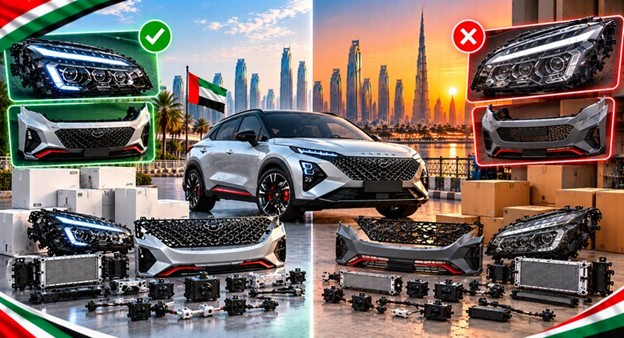
A bumper is mainly a geometry and bodywork problem.
A headlamp can be a geometry problem, an electrical problem and a vehicle-integration problem at the same time.
That is why buying an aftermarket headlight simply because it has the same shape can be risky.
Check the housing.
Check the mounting points.
Check the connector.
Check the internal electronics.
Check the exact specification.
Check whether configuration is required.
Check whether the supplier will accept a return if the component is incompatible.
A headlamp can fit physically and still fail the more important test.
It has to work.
Why two headlights that look identical may not be identical
This is one of the less visible traps in modern parts buying.
Two lamps may share the same external housing and lens design while carrying different internal hardware or vehicle-specific configurations.
The difference might not be obvious until the component is installed.
Then comes the unpleasant sequence: fault appears, technician diagnoses, replacement is questioned, seller is contacted, return is arranged, another unit is sourced.
The part may have been “compatible” according to a photograph.
That is not the same thing as being compatible with the vehicle.
Used genuine headlights deserve serious consideration — carefully
A used genuine headlamp can be an excellent middle-ground option.
You may retain original application and physical fitment while avoiding the cost of a brand-new component.
But used does not mean verified.
Ask about the donor vehicle.
Ask whether the lamp was removed from an accident-damaged car.
Ask whether the mounting lugs are intact.
Ask about condensation or water exposure.
Ask whether the electronics have been tested.
Ask about the return period.
Ask for photographs of the rear housing and connectors, not just the attractive front lens.
The front tells you what you are buying visually.
The rear tells you much more about what you are buying mechanically.
Sensors are small, but the risk is not
Parking sensors create a curious parts-buying problem because they look simple.
Small plastic body.
Small connector.
Small price.
Yet their function depends on the correct electrical and physical characteristics.
An aftermarket sensor that fits the aperture may still produce an error if its signal characteristics or application are wrong.
A sensor fault can also originate somewhere else entirely.
The wiring may be damaged.
The connector may be corroded.
The sensor holder may have shifted.
The control system may have stored another fault.
So the question should never be:
“Which sensor should I replace?”
It should first be:
“What evidence proves the sensor itself has failed?”
That is a much cheaper question.
Camera systems demand even more caution
The same principle becomes stronger with cameras.
A camera is not merely a little lens mounted on the vehicle.
Its position matters.
Its field of view matters.
Its relationship to the vehicle's geometry matters.
Its electronic communication matters.
Depending on the system, calibration or configuration may also matter.
This is why a camera should be purchased against the exact application rather than by visual similarity.
If the camera has been involved in an accident, the workshop should establish whether the camera itself is defective or whether its bracket, wiring, mounting position or surrounding structure has been disturbed.
Replacing the camera first and asking questions afterwards is the expensive way round.
ADAS makes bumper fitment a technical issue
The C5's driver-assistance equipment makes the front and rear bodywork more consequential than it might appear.
A bumper may contain or surround sensor equipment. Its mounting points can affect where those components sit. An accident can move a bracket without obviously destroying the sensor.
This creates an important distinction:
physical condition is not the same as functional condition.
A sensor can look perfect.
A camera can still display an image.
The system can still require investigation.
That is why post-repair diagnostics and, where applicable, calibration belong in the repair calculation before the cheaper bumper is chosen.
Genuine parts reduce uncertainty, but they do not replace diagnosis
There is another myth worth removing.
Buying a genuine component does not mean the repair automatically becomes correct.
If the vehicle has damaged wiring, distorted mounting points or an unrelated fault, the new genuine component will not magically fix those problems.
A genuine camera installed onto a damaged bracket is still badly installed.
A genuine sensor connected to damaged wiring is still going to report a problem.
A genuine bumper cannot straighten a bent structure behind it.
Genuine reduces a particular type of uncertainty: component application and specification.
It does not remove the need for proper diagnosis.
The best aftermarket parts are application-specific
A serious aftermarket supplier should be able to tell you what the component fits.
Not merely:
“C5.”
Ideally:
model generation, model year, trim or equipment level where relevant, side, engine/transmission where application changes, and the corresponding original reference.
That is what distinguishes a replacement part from a generic object that happens to resemble the original.
If the seller cannot establish the application, the low price should not be your main attraction.
It should be your warning to ask more questions.
Why trim level matters more than buyers expect
The C5's different UAE variants are not simply different interior packages.
The powertrain changes between the 1.5T/CVT versions and the 1.6T Sport with its 7-speed DCT, while equipment levels also affect the electronic systems fitted to the vehicle.
That matters when buying components that interact with those systems.
A parts supplier who asks for the trim is not creating unnecessary paperwork.
They are trying to prevent a mismatch.
And if the supplier asks for the VIN as well, even better.
The VIN is the most useful piece of information in the transaction
A VIN turns a broad parts search into a vehicle-specific enquiry.
Give the supplier:
- full VIN;
- model year;
- trim;
- engine;
- transmission where relevant;
- side of vehicle;
- exact component;
- photograph of the existing part;
- visible part number.
If the seller still cannot establish application, you have learned something useful before spending money.
The VIN is particularly valuable for electronic components and trim-specific bodywork because visual similarity is not enough.
Genuine Omoda parts and warranty considerations
For a relatively new C5, the warranty question deserves to be considered before an owner independently substitutes components.
The local after-sales programme promotes genuine parts and factory-trained technicians, so owners should establish what the applicable warranty and repair terms require before fitting non-genuine components.
That does not mean every aftermarket component automatically invalidates every warranty provision.
It means the owner should not guess.
Warranty, parts choice and responsibility for subsequent faults should be understood before the repair begins.
Grey-import Omoda vehicles complicate the comparison
A grey-import C5 can look exactly like a UAE-market vehicle.
That does not guarantee identical equipment.
Regional specifications can affect lighting, electronics, software, safety equipment and part applications.
For such a vehicle, the phrase “UAE C5 part” is not enough.
The supplier needs the VIN and, ideally, the existing component reference.
If the vehicle came from another market, say so.
Hiding that detail because the car looks identical is precisely how incompatible parts get ordered.
UAE pricing: don't compare a local fitted price with an overseas component
This is a particularly common mistake.
An overseas aftermarket bumper might appear dramatically cheaper when viewed online.
Then the UAE buyer has to account for delivery, VAT, handling, possible import costs, waiting time, and the possibility that the part arrives incorrectly specified.
A local genuine part might have a higher initial price but lower uncertainty and shorter downtime.
The correct comparison is therefore not:
UAE genuine price vs overseas aftermarket price.
It is:
UAE installed outcome vs imported installed outcome.
Those are very different calculations.
Why availability has a monetary value
A vehicle sitting in a workshop is not free simply because the invoice has stopped increasing.
There is lost mobility.
There may be additional transport costs.
The workshop may need to keep the vehicle occupying space.
An insurance process may be delayed.
A replacement part may need to be reordered.
For a business user, downtime can become even more meaningful.
So if one part is AED 300 cheaper but takes two weeks longer to arrive, the AED 300 saving should not automatically win.
Time belongs in the calculation.
The aftermarket-versus-genuine decision changes with the component
There is no single rule because the consequences of failure are different.
| Component | Genuine advantage | Aftermarket potential | Main risk |
|---|---|---|---|
| Bumper cover | Application confidence | Often strong | Fit and mounting |
| Grille/trim | Exact fit | Often good value | Clips and finish |
| Headlamp | Lower compatibility uncertainty | Possible saving | Electronics and fit |
| Parking sensor | Known application | Possible | Signal compatibility |
| Camera | Strong application confidence | Higher caution | Calibration/function |
| Control module | Lowest application uncertainty | High caution | Coding/configuration |
| Bracket/mount | Correct geometry | Often viable | Alignment |
| Cosmetic panel | Consistent fit | Often attractive | Material and finish |
The more electronically integrated the component, the less attractive an unknown low-cost alternative becomes.
The simpler the component, the stronger the aftermarket case can be.
That is the pattern worth remembering.
What about reconditioned Omoda parts?
Reconditioned is another word that can sound more reassuring than it actually is.
A reconditioned component might have been properly dismantled, inspected, repaired, tested and returned to service.
Or it might simply have been cleaned and resold.
Ask what “reconditioned” actually involved.
Which components were replaced?
What was tested?
What was the failure originally?
Was the component electronically tested?
Is there a written warranty?
For a mechanical or cosmetic component, reconditioning can be perfectly rational.
For an electronic component, the process matters enormously.
Sometimes repairing the original part is the best option
The genuine-versus-aftermarket debate assumes replacement is necessary.
It isn't always.
A bumper with localised damage may be repairable.
A bracket may be replaceable without buying an entire assembly.
A mounting point may be repairable if its structural integrity can be restored properly.
A trim component may need nothing more than a correctly sourced fixing.
Before ordering an expensive assembly, ask:
“What exactly has failed?”
Not:
“How much is a replacement?”
Those questions lead to very different repair bills.
The workshop should diagnose before ordering expensive electronics
If a C5 develops a warning after an accident, the first move should not automatically be an electronic parts order.
The workshop should establish the fault through appropriate diagnostics and physical inspection.
That can include:
DTC scanning.
Connector inspection.
Wiring checks.
Physical sensor inspection.
Mounting-point inspection.
Live-data analysis where applicable.
Camera or sensor alignment assessment.
Calibration requirements.
Post-repair verification.
A component should be replaced because evidence points towards its failure, not because it happens to be the most obvious component in the area.
A proper quotation should expose the hidden costs
Ask the supplier or workshop to separate:
part price
VAT
delivery
paint
preparation
fitting
clips/brackets
diagnostics
programming
calibration
alignment
warranty
returns
This makes genuine and aftermarket quotations much easier to compare.
If one supplier gives you AED 1,500 for a bumper and another gives you AED 2,200, you still do not know which is cheaper until you know what those numbers include.
One might be a bare component.
The other might be an installed, painted and warranted repair.
Comparing those two numbers is meaningless.
The cost of getting the fitment wrong
There is a particular kind of parts mistake that looks tiny at the beginning.
The wrong bumper is ordered.
The workshop discovers it after removing the original.
A replacement has to be found.
The car stays where it is.
The wrong part has to be returned.
The correct part arrives.
The workshop refits everything.
The paint schedule moves.
The electronic system then requires another check.
What began as a parts mismatch has become additional labour, additional transport, additional downtime and a frustrated owner.
This is why correct fitment has an economic value even when it does not appear as a line on the invoice.
How to compare genuine and aftermarket prices properly
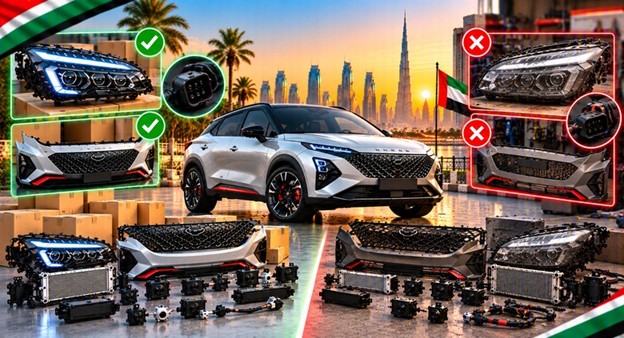
Use a wider equation:
True replacement cost = part + delivery + VAT + preparation + fitting + supporting hardware + diagnostics + programming/calibration + return risk.
Then ask one more question:
What happens if this part is wrong?
If the answer is “send it back and fit another bumper”, the risk is manageable.
If the answer is “the car cannot be properly tested until another electronic module arrives”, the cheap option deserves much more scrutiny.
Risk is part of price, even when nobody writes it down.
When paying more for genuine makes sense
The genuine premium is easier to justify when the component is:
- electronically integrated;
- safety-related;
- difficult to diagnose;
- difficult to return;
- dependent on precise geometry;
- expensive to calibrate;
- critical to another system;
- difficult to source locally.
A camera is therefore not the place to chase the cheapest unknown component.
Neither is a complex control module.
A simple trim piece is another story.
When aftermarket makes more sense
Aftermarket can be the smarter financial decision when:
- the component is straightforward;
- application is confirmed;
- fitment is demonstrably good;
- no complex electronics are involved;
- the supplier offers a meaningful warranty;
- returns are practical;
- the price saving remains significant after fitting.
That can make aftermarket bodywork particularly attractive.
But the supplier still needs to stand behind the part.
Cheap without accountability is not value.
What a UAE buyer should ask before ordering
Before paying, ask:
Is this genuine, aftermarket, used or reconditioned?
What is the exact part number?
Has the VIN been checked?
Which C5 trim does it fit?
Is it complete?
Are brackets, clips and sensor holders included?
Has it been tested?
What is the warranty?
What is the return policy?
Is VAT included?
Is delivery included?
Will programming or calibration be required?
Is the part physically available in the UAE?
Those questions are not bureaucracy.
They are cheap insurance against an expensive misunderstanding.
What to check when the part arrives
Do not send a replacement directly into paint or permanent installation without checking it first.
For bodywork, compare it against the original.
Check every mounting point.
Check the shape and edges.
Check sensor apertures.
Check grille and lamp openings.
For electronic components, compare the part number, connectors and physical configuration.
If something does not match, stop.
Do not let the workshop “make it work” before establishing whether the component is actually correct.
Modification is not a substitute for fitment verification.
Genuine versus aftermarket Omoda parts: the decision matrix
| Situation | More sensible starting point |
|---|---|
| Simple cosmetic trim | Quality aftermarket or used genuine |
| Bumper with no electronic equipment nearby | Quality aftermarket can be attractive |
| Bumper with multiple sensor provisions | Genuine or proven aftermarket |
| Complex headlamp | Genuine or verified high-quality equivalent |
| Used genuine headlamp with warranty | Often worth considering |
| Parking sensor | Exact-match genuine or proven equivalent |
| Camera | Genuine or fully verified compatible component |
| Control module | Genuine/exact verified replacement |
| Older C5 outside warranty | Broader price comparison makes sense |
| Grey-import C5 | VIN and original-market verification first |
The matrix is deliberately cautious around electronics.
That is where mistakes become disproportionately expensive.
The Omoda C5's age should influence the economics
A nearly new C5 and an older C5 should not necessarily receive the same parts strategy.
For a new vehicle with substantial remaining value and applicable warranty support, reducing compatibility risk can be worth paying more for.
For an older vehicle, particularly one already carrying a lower market value, a good used genuine component or reputable aftermarket alternative can make much more economic sense.
The right question is not “Which part is best?”
It is:
“Which part is best for this vehicle, at this point in its ownership life?”
That is a much more grown-up way of looking at repair economics.
The cheapest part can be the one you don't replace
This sounds like a joke until you have seen a quotation built around replacing an entire assembly when only a bracket, clip, trim section or repairable component was damaged.
Ask the workshop to identify the failed component before agreeing to the assembly replacement.
Sometimes the correct answer is a genuine part.
Sometimes it is aftermarket.
Sometimes it is used.
Sometimes it is repair.
And occasionally the original component is perfectly serviceable once the surrounding damage has been corrected.
Diagnosis should decide the parts list.
How to use PartFinder UAE without reducing the decision to price
When comparing Omoda replacement options through PartFinder UAE, the useful comparison is not simply the number beside the genuine or aftermarket component. Look at the whole repair equation: application, part reference, condition, delivery, VAT, fitting, paint where applicable, diagnostics, calibration, warranty, return terms and the cost of being wrong.
That is the difference between finding a cheap part and finding a sensible part.
The final rule: buy certainty where certainty matters
There is no prize for buying the most expensive Omoda part.
There is also no prize for finding the cheapest one.
The sensible buyer spends the premium where a mismatch would be expensive and looks for savings where the consequences of substitution are modest.
For a bumper, a properly manufactured aftermarket component may be an excellent purchase.
For a trim piece, paying extra for a genuine component may make little financial sense.
For a headlamp, the calculation becomes more serious.
For a camera or electronic control unit, application and functional compatibility should outweigh a tempting discount.
And for every one of them, the VIN should come before the shopping cart.
That is the rule worth carrying into the UAE parts market: don't compare genuine and aftermarket labels; compare the complete repair outcome.
FAQ
Categories
- Audi
- BMW
- Car Accessories
- Car Tips
- Ford
- Land Rover
- Mazda
- Range Rover
- Top 10
- UAE Car Parts
- Used Car Parts
- Toyota
- Replacement Engines
- Nissan
- Hyundai
- Mitsubishi
- Volkswagen
- Honda
- Kia
- Chevrolet
- Dodge
- Jeep
- Subaru
- Renault
- Lexus
- Mercedes
- Suzuki
- Hummer
- Porsche
- Infiniti
- Peugeot
- GMC
- Mini
- Volvo
- Replacement Gearboxes
- MG
- Jaguar
- Skoda
- Cadillac
- Daihatsu
- Fiat
- German Car Parts
- Japanese Car Parts
- Aftermarket Car Parts
- Genuine Car Parts
- New Car Parts
- Reconditioned Car Parts
- European Car Parts
- American Car Parts
- Korean Car Parts
- British Car Parts
- Chinese Car Parts
- Sports/Exotic Car Parts
- Luxury Car Parts
- Performance Car Parts
- SUV/4x4 Spare Parts
- Truck Spare Parts
- EV Car Parts
- Hybrid Car Parts
- Auto Spare Parts in UAE
- Tesla
- Isuzu
- Ram
- Ferrari
- Bentley
- Lamborghini
- Genesis
- Maserati
- Lincoln
- Chrysler
- Opel
- Citroen
- SsangYong
- Seat
- McLaren
- Aston Martin
- Rolls Royce
- Maybach
- Alfa Romeo
- Bugatti
- Scion
- Abu Dhabi Car Parts
- Ajman Car Parts
- Al Khan Car Parts
- Al Sajaa Car Parts
- Deira Car Parts
- Dubai Car Parts
- Fujairah Car Parts
- Industrial Area 6 Car Parts
- Mussafah Car Parts
- Ras Al Khaimah Car Parts
- Sharjah Car Parts
- Umm Al Quwain Car Parts
- Acura
- BYD
- Chery
- Dacia
- DS
- Geely Emgrand
- EXEED
- GAC
- GAC Gonow
- Geely
- Gonow
- Great Wall
- Haima
- Haval
- Holden
- Iveco
- JAC
- Jaecoo
- Jetour
- Lotus
- Omoda
- Proton
- Renault Samsung
- Roewe