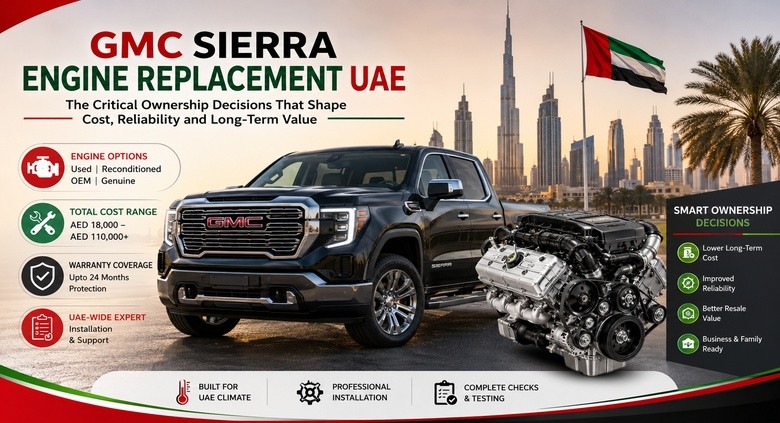
GMC Sierra Engine Replacement UAE: The Critical Ownership Decisions That Shape Cost, Reliability and Long-Term Value
June 12, 2026
Most GMC Sierra owners do not wake up one morning and decide to replace an engine.
The decision usually develops gradually.
A warning light appears.
Oil consumption increases.
Performance begins changing.
Repair bills start arriving more frequently.
Then an uncomfortable question emerges.
Should more money be invested into repairs?
Or is it finally time to replace the engine?
What makes this decision difficult is that the replacement engine itself is rarely the most important factor.
The ownership decisions surrounding that engine often determine whether the outcome becomes financially successful or unnecessarily expensive.
This is particularly true in the UAE.
A GMC Sierra may serve multiple roles:
- Family vehicle
- Business truck
- Construction support vehicle
- Fleet asset
- Long-distance transport solution
- Weekend towing vehicle
The replacement-engine decision therefore affects more than mechanical reliability.
It affects operational continuity.
It affects future costs.
It affects resale value.
It affects long-term ownership confidence.
The purpose of this guide is not simply to discuss engine prices.
It is to build a decision architecture that helps GMC Sierra owners evaluate every major choice before committing to a replacement-engine project.
The First Decision: Recognising When an Engine Problem Has Become an Ownership Problem
Many owners initially treat engine concerns as repair issues.
The reality is often more complicated.
At a certain point, a mechanical problem becomes an ownership problem.
The distinction matters.
Common Warning Signs
- Increasing repair frequency
- Rising maintenance costs
- Reduced reliability
- Repeated workshop visits
- Growing downtime
Ownership Risk Indicators
| Indicator | Ownership Impact |
| Occasional Repair | Low |
| Repeated Repairs | Moderate |
| Major Mechanical Failure | High |
| Recurring Downtime | Very High |
Once reliability begins affecting daily operations, the discussion shifts from repair costs to ownership strategy.
The Timing Decision: Determining When Action Creates More Value Than Delay
One of the most expensive ownership mistakes involves delaying decisions.
Many owners hope problems will stabilise.
Unfortunately, mechanical systems rarely operate this way.
Consequences of Delayed Action
- Additional engine wear
- Secondary component damage
- Increased labour costs
- Reduced resale value
- Greater downtime exposure
Cost-of-Delay Comparison
| Decision Timing | Typical Financial Exposure |
| Early Investigation | Low |
| Planned Repair Strategy | Moderate |
| Delayed Response | High |
| Failure-Based Response | Very High |
Real UAE Business Scenario
A contractor operating a GMC Sierra in Dubai experiences minor overheating symptoms.
The vehicle continues working.
Repairs are postponed.
Several months later:
- Cooling-system damage expands
- Additional components require replacement
- Vehicle downtime increases
The original issue was manageable.
The delayed decision was expensive.
The Investigation Decision: What Information Should Be Collected Before Considering Engine Replacement?
Good decisions require good information.
Surprisingly, many owners consider engine replacement before gathering sufficient evidence.
This creates unnecessary risk.
Information Every Owner Should Collect
✓ Diagnostic reports
✓ Compression-test results
✓ Service history
✓ Oil-consumption records
✓ Cooling-system assessment
✓ Previous repair history
Decision Quality Framework
| Information Available | Decision Confidence |
| Limited Information | Low |
| Basic Diagnostics | Moderate |
| Comprehensive Assessment | High |
| Full Mechanical Evaluation | Very High |
The stronger the information, the stronger the decision.
The Cost-of-Delay Decision: Measuring the Financial Consequences of Waiting Too Long
A replacement engine often appears expensive.
However, many owners fail to compare that cost against the cost of continued deterioration.
Delayed Decision Consequences
- Increased repair bills
- Reduced reliability
- Greater operational interruptions
- Potential towing expenses
- Reduced truck value
Cost Escalation Analysis
| Stage | Typical Cost Range (AED) |
| Initial Diagnosis | 300 – 1,500 |
| Minor Repairs | 1,000 – 8,000 |
| Major Repairs | 8,000 – 25,000 |
| Replacement Engine Project | 18,000 – 90,000+ |
The cheapest decision today can become the most expensive decision tomorrow.
The Budget Architecture Decision: Calculating the True Cost of a GMC Sierra Engine Replacement Project
Many owners budget only for the engine.
This creates one of the most common planning mistakes.
The true project budget usually includes multiple categories.
Primary Cost Categories
- Engine purchase
- Labour
- Diagnostics
- Fluids and filters
- Supporting parts
- Programming and calibration
Typical Budget Structure
| Cost Category | Typical Range (AED) |
| Engine Cost | 12,000 – 75,000+ |
| Labour | 4,000 – 18,000 |
| Diagnostics | 300 – 2,500 |
| Fluids & Filters | 500 – 2,500 |
| Supporting Parts | 2,000 – 15,000+ |
Hidden Cost Exposure
Many projects also uncover:
- Engine mounts
- Cooling-system components
- Water pumps
- Sensors
- Wiring repairs
Successful owners budget for the entire project.
Not just the engine.
UAE Labour Strategy Analysis: Comparing Installation Costs Across Emirates
Labour costs can vary significantly across the UAE.
This variation affects ownership decisions.
Labour Cost Comparison by Emirate
| Emirate | Typical Labour Cost (AED) |
| Dubai | 6,000 – 18,000 |
| Abu Dhabi | 6,000 – 17,000 |
| Sharjah | 4,500 – 14,000 |
| Ajman | 4,000 – 12,000 |
| Ras Al Khaimah | 4,000 – 11,000 |
| Fujairah | 4,000 – 11,000 |
| Umm Al Quwain | 4,000 – 10,000 |
Factors Influencing Labour Pricing
- Workshop reputation
- Truck expertise
- Project complexity
- Documentation standards
- Diagnostic procedures
The lowest quotation is not always the lowest-risk decision.
The Engine Selection Decision: Comparing Used, Reconditioned, OEM and Genuine Engine Pathways
Perhaps the most important decision involves engine selection.
Every option creates different ownership outcomes.
Used Engine Decision
Advantages:
- Lower upfront cost
- Faster sourcing
Risks:
- Unknown history
- Higher uncertainty
Reconditioned Engine Decision
Advantages:
- Refreshed components
- Balanced investment profile
Risks:
- Quality depends on rebuild standards
OEM Engine Decision
Advantages:
- Strong compatibility
- Reliable sourcing
Risks:
- Higher purchase cost
Genuine GMC Engine Decision
Advantages:
- Maximum confidence
- Strong resale support
Risks:
- Largest investment requirement
GMC Sierra Engine Cost Comparison
| Engine Type | Engine Cost (AED) | Installation (AED) | Estimated Total (AED) |
| Used Engine | 12,000 – 25,000 | 4,000 – 18,000 | 16,000 – 43,000 |
| Reconditioned Engine | 18,000 – 40,000 | 4,500 – 18,000 | 22,500 – 58,000 |
| OEM Engine | 30,000 – 60,000 | 5,000 – 18,000 | 35,000 – 78,000 |
| Genuine GMC Engine | 45,000 – 90,000+ | 6,000 – 20,000 | 51,000 – 110,000+ |
The correct decision depends not only on budget.
It depends on ownership goals.
The Business Continuity Perspective Often Missing From Engine Decisions
Many GMC Sierra owners operate their vehicles as income-producing assets.
This changes the decision framework entirely.
A truck that is unavailable:
- Cannot transport equipment
- Cannot serve customers
- Cannot generate revenue
- Cannot support business operations
Downtime Risk Comparison
| Scenario | Business Impact |
| Planned Replacement | Lower |
| Unexpected Failure | Higher |
| Extended Downtime | Significant |
For business users, reliability often carries greater financial value than initial savings.
The First Major Conclusion
At this stage, the ownership architecture becomes clearer.
The replacement-engine decision is not a single decision.
It is a collection of interconnected decisions.
The quality of each choice influences:
- Future costs
- Reliability
- Downtime
- Resale value
- Ownership satisfaction
The Mileage Evaluation Decision: How Engine History Should Influence Your Investment Strategy
One of the most misunderstood decisions in the replacement-engine process involves mileage.
Many buyers focus entirely on price.
Experienced owners evaluate history.
Mileage is not a verdict.
It is evidence.
Evidence that helps shape expectations.
A properly maintained GMC Sierra engine with higher mileage can sometimes represent lower ownership risk than a neglected engine with significantly fewer kilometres.
The key is understanding how mileage influences future reliability.
GMC Sierra Mileage Evaluation Guide
| Mileage Range | Ownership Outlook | Risk Level |
| Under 80,000 km | Strong Reliability Potential | Low |
| 80,000 – 150,000 km | Detailed Inspection Recommended | Moderate |
| 150,000 – 220,000 km | Comprehensive Evaluation Required | Elevated |
| Above 220,000 km | Higher Future Exposure | High |
Questions Buyers Should Ask
✓ Was servicing completed consistently?
✓ Are maintenance records available?
✓ Have cooling-system components been replaced?
✓ Has towing been frequent?
✓ Are diagnostic reports available?
Mileage should influence the decision.
It should never be the entire decision.
The UAE Climate Decision: Accounting for Environmental Factors Before Choosing an Engine
The UAE creates operating conditions that differ significantly from many international markets.
This reality should influence every replacement-engine decision.
Common UAE Operating Conditions
- Extreme summer temperatures
- Heavy traffic congestion
- Extended idling
- Long-distance highway driving
- Frequent towing requirements
These factors accelerate wear patterns.
UAE Summer Failure Pattern Analysis
The following systems often experience increased stress:
- Cooling systems
- Water pumps
- Radiators
- Hoses
- Oil-management systems
- Sensors
Climate Stress Comparison
| Operating Environment | Mechanical Stress |
| Mild Climate | Moderate |
| UAE Winter Operation | Moderate |
| UAE Summer Highway Driving | High |
| Heavy-Traffic Summer Use | Very High |
| Towing in Summer Conditions | Critical |
A replacement engine selected without considering climate exposure may create future ownership challenges.
The Labour Strategy Decision: Choosing the Right Installation Approach Across the UAE
Many owners focus on engine quality.
The installation strategy often deserves equal attention.
A premium engine installed poorly can create disappointing results.
A well-installed engine frequently delivers better long-term value.
Labour Decision Factors
- Workshop experience
- GMC expertise
- Documentation standards
- Testing procedures
- Diagnostic capabilities
Labour Cost Analysis
| Workshop Type | Typical Labour Range (AED) |
| General Workshop | 4,000 – 10,000 |
| Independent Truck Specialist | 6,000 – 15,000 |
| Premium American Vehicle Specialist | 8,000 – 18,000 |
| Highly Documented Installation Project | 10,000 – 20,000 |
The objective is not finding the lowest labour cost.
The objective is finding the strongest value proposition.
The Supporting Parts Decision: Determining Which Components Should Be Replaced Alongside the Engine
One of the most expensive ownership mistakes involves treating the engine as an isolated component.
Successful replacement projects evaluate supporting systems.
Supporting Parts Replacement Checklist
✓ Radiator
✓ Water pump
✓ Thermostat
✓ Engine mounts
✓ Cooling hoses
✓ Belts
✓ Sensors
✓ Fluids
✓ Filters
✓ Electrical connectors
Supporting-Part Cost Analysis
| Component | Typical Cost (AED) |
| Radiator | 1,500 – 7,000 |
| Water Pump | 1,000 – 5,000 |
| Thermostat | 500 – 2,500 |
| Engine Mounts | 1,500 – 6,000 |
| Sensors | 500 – 6,000 |
| Belts & Hoses | 500 – 3,500 |
Ignoring these items often creates repeat workshop visits later.
The Documentation Decision: Building an Ownership Record That Protects Future Value
Documentation is frequently undervalued.
Yet documentation often influences future ownership outcomes.
Particularly during resale.
Documentation Verification Checklist
✓ Engine purchase invoice
✓ Engine serial number
✓ Import documentation
✓ Compression-test results
✓ Installation invoice
✓ Warranty certificate
✓ Diagnostic reports
✓ Service records
Documentation Risk Assessment
| Documentation Status | Future Risk |
| Complete Documentation | Low |
| Strong Documentation | Low to Moderate |
| Partial Records | Moderate |
| Missing Records | High |
Future buyers often trust documentation more than verbal explanations.
Insurance, Registration and Administrative Considerations
Many owners focus entirely on the mechanical side of the project.
Administrative preparation deserves attention too.
Documentation Owners Should Retain
- Engine identification details
- Purchase invoices
- Installation invoices
- Warranty documentation
- Service records
These records can become valuable during:
- Ownership verification
- Future resale discussions
- Warranty claims
- Vehicle history reviews
Good ownership architecture includes strong record keeping.
The Warranty Decision: Evaluating Protection Levels Before Making a Financial Commitment
A replacement engine should not be evaluated solely on purchase price.
Warranty quality often becomes equally important.
Strong Warranty Characteristics
✓ Written coverage
✓ Clear terms
✓ Defined claim process
✓ Documented duration
Warranty Red Flags
✗ Verbal-only promises
✗ Extremely short coverage
✗ Unclear conditions
✗ No supporting paperwork
✗ Excessive exclusions
Warranty Comparison
| Warranty Type | Ownership Protection |
| Comprehensive Written Warranty | Strong |
| Limited Written Warranty | Moderate |
| Minimal Coverage | Weak |
| Verbal Warranty | Very Weak |
The cheapest engine frequently comes with the weakest protection.
Poor Installation Warning Signs Every Owner Should Monitor
A replacement-engine project does not end at installation.
Monitoring remains essential.
Warning Signs That Require Immediate Attention
- Warning lights
- Fluid leaks
- Unusual vibration
- Rough idle
- Temperature fluctuations
- Power inconsistencies
Installation Quality Matrix
| Observation | Priority Level |
| Smooth Operation | Low |
| Minor Irregularity | Moderate |
| Repeated Warning Lights | High |
| Fluid Leaks | High |
| Overheating | Critical |
The first few weeks often reveal whether installation standards were sufficient.
Family and Business Ownership Perspectives
The GMC Sierra occupies a unique position.
Some owners rely on it for family responsibilities.
Others depend on it for commercial operations.
Many use it for both.
Family Ownership Priorities
- Reliability
- Safety
- Predictable costs
- Reduced downtime
Business Ownership Priorities
- Operational continuity
- Revenue protection
- Fleet reliability
- Lower interruption risk
Decision Comparison
| Priority Type | Key Focus |
| Family Ownership | Dependability |
| Business Ownership | Uptime |
| Mixed Usage | Balance |
The strongest replacement-engine decision usually aligns with how the truck is actually used.
The Second Major Conclusion
At this stage of the ownership architecture, a clear pattern emerges.
The quality of the replacement-engine outcome depends less on a single purchase decision and more on the system of decisions surrounding that purchase.
Mileage.
Climate.
Labour strategy.
Supporting parts.
Documentation.
Warranty protection.
Installation quality.
Each contributes to the final result.
For owners researching replacement online GMC Sierra engine for sale, the most successful projects are rarely the cheapest.
They are usually the projects built upon the strongest decision framework.
The First 1,000 Kilometres Decision: Creating a Post-Installation Monitoring Framework
Many owners assume the decision-making process ends when the replacement engine is installed.
In reality, one of the most important decisions comes afterwards.
The verification decision.
The first 1,000 kilometres establish whether the project is delivering the outcome that justified the investment.
This stage should be approached systematically.
First 1,000 km Monitoring Checklist
✓ Check oil levels regularly
✓ Monitor coolant levels
✓ Observe operating temperatures
✓ Scan for fault codes
✓ Watch for warning lights
✓ Inspect for fluid leaks
✓ Monitor fuel consumption
Post-Installation Risk Matrix
| Area | Priority |
| Cooling System | Critical |
| Oil Management | Critical |
| Diagnostics | Very High |
| Fluid Leaks | Very High |
| Electrical Systems | High |
The objective is not simply driving.
The objective is validating the ownership decision.
The Resale Value Decision: Protecting Future Marketability While Solving Today's Problem
One of the biggest misconceptions surrounding replacement engines involves resale value.
Many owners assume a replacement engine automatically damages future marketability.
The evidence is more nuanced.
Resale value is influenced by confidence.
Confidence is influenced by documentation.
Factors That Strengthen Resale Value
- Professional installation
- Complete records
- Warranty support
- Transparent history
- Proper maintenance
Factors That Reduce Buyer Confidence
- Missing documentation
- Unknown engine source
- Limited maintenance evidence
- Poor installation records
Resale Value Comparison Table
| Ownership Scenario | Resale Outlook |
| Genuine Engine + Full Documentation | Excellent |
| OEM Engine + Records | Very Good |
| Reconditioned Engine + Documentation | Good |
| Used Engine + Partial Records | Moderate |
| Unknown History | Weak |
The engine itself matters.
The supporting evidence often matters more.
The Ownership Forecast Decision: Projecting Costs Across the Next Three to Five Years
A replacement engine solves a current challenge.
Good ownership architecture also evaluates future obligations.
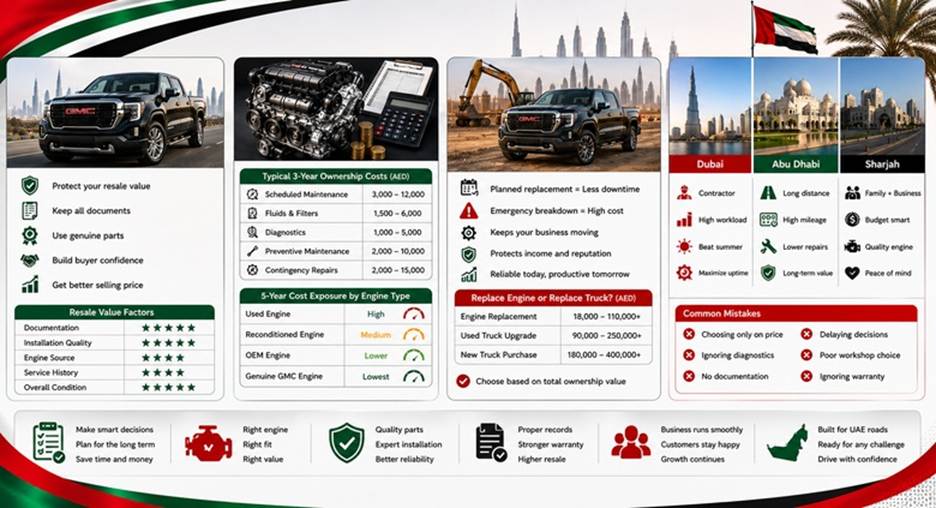
Typical Three-Year Ownership Costs
| Category | Estimated Cost (AED) |
| Scheduled Maintenance | 3,000 – 12,000 |
| Fluids & Filters | 1,500 – 6,000 |
| Diagnostics | 1,000 – 5,000 |
| Preventive Maintenance | 2,000 – 10,000 |
| Contingency Repairs | 2,000 – 15,000 |
Five-Year Ownership Forecast
| Engine Type | Five-Year Cost Exposure |
| Used Engine | Highest |
| Reconditioned Engine | Moderate |
| OEM Engine | Lower |
| Genuine Engine | Lowest Risk |
A lower purchase price can sometimes create higher long-term ownership costs.
Business Continuity and Revenue Protection Analysis
For many GMC Sierra owners, downtime has a measurable financial impact.
The truck is not simply transportation.
It is part of a business system.
Potential Downtime Consequences
- Delayed projects
- Lost productivity
- Rental vehicle costs
- Customer dissatisfaction
- Revenue interruptions
Operational Impact Comparison
| Scenario | Business Exposure |
| Planned Engine Replacement | Lower |
| Emergency Breakdown | Higher |
| Extended Downtime | Significant |
| Repeated Failures | Severe |
Business owners frequently evaluate reliability as an investment rather than an expense.
The Replace-Engine-or-Replace-Truck Decision
Eventually every owner reaches the same decision point.
Should the engine be replaced?
Or should the truck be replaced?
The answer depends on multiple variables.
Factors Supporting Engine Replacement
- Strong chassis condition
- Good maintenance history
- Lower replacement cost
- Long-term ownership plans
Factors Supporting Truck Replacement
- Multiple major failures
- Severe wear across systems
- High projected future costs
- Changing operational requirements
Financial Comparison
| Option | Typical Investment (AED) |
| Replacement Engine Project | 18,000 – 110,000+ |
| Used Truck Upgrade | 90,000 – 250,000+ |
| New Truck Purchase | 180,000 – 400,000+ |
The strongest decision often emerges from total ownership economics rather than emotions.
Real UAE Ownership Scenarios
Dubai Construction Contractor
Vehicle:
GMC Sierra
Challenge:
Repeated cooling-system warnings.
Decision:
Replace engine before peak summer workload.
Outcome:
Improved reliability and reduced operational disruption.
Abu Dhabi Long-Distance Operator
Vehicle:
GMC Sierra
Challenge:
Increasing mileage and growing maintenance costs.
Decision:
Invest in higher-quality replacement engine.
Outcome:
Lower long-term repair frequency.
Sharjah Family and Business Owner
Vehicle:
GMC Sierra
Challenge:
Balancing budget constraints with reliability needs.
Decision:
Choose documented reconditioned engine with warranty support.
Outcome:
Balanced cost and ownership confidence.
These scenarios demonstrate how different decision frameworks create different outcomes.
Common Buyer Mistakes That Influence Ownership Outcomes
Many replacement-engine projects encounter similar errors.
Frequent Mistakes
- Choosing solely on price
- Ignoring diagnostics
- Overlooking documentation
- Delaying decisions
- Selecting inexperienced workshops
- Ignoring warranty conditions
Mistake Impact Assessment
| Mistake | Potential Consequence |
| Cheapest Engine Selection | Higher Future Risk |
| Weak Documentation | Lower Resale Value |
| Poor Workshop Selection | Reliability Issues |
| Delayed Action | Cost Escalation |
| Weak Warranty Review | Increased Exposure |
Good ownership outcomes rarely happen accidentally.
Competitor Truck Ownership Comparison
Many buyers compare replacement-engine economics against alternative truck ownership options.
Truck Ownership Comparison
| Vehicle | Replacement Cost Outlook | Ownership Complexity |
| GMC Sierra | Moderate to High | Moderate |
| Ford F-150 | Moderate | Moderate |
| RAM 1500 | Moderate to High | Moderate |
| Toyota Tundra | Moderate | Lower |
Long-term ownership success often depends more on maintenance quality than vehicle badge.
The Final Review Decision: Evaluating Every Critical Variable Before Approval
Before approving a replacement-engine project, owners should review every major decision area.
Mechanical Review
- Compression results
- Diagnostic reports
- Cooling-system condition
Financial Review
- Total project budget
- Labour requirements
- Future maintenance forecasts
Documentation Review
- Engine records
- Warranty paperwork
- Installation documentation
Reliability Review
- Workshop reputation
- Engine source
- Supporting-part condition
Buyer Decision Matrix
| Ownership Priority | Recommended Focus |
| Lowest Cost | Documented Used Engine |
| Balanced Value | Reconditioned Engine |
| Long-Term Reliability | OEM Engine |
| Maximum Confidence | Genuine GMC Engine |
| Business Continuity | Reliability-Focused Strategy |
| Family Ownership | Dependability-Focused Strategy |
The best decision depends on ownership goals.
The Ownership Architecture Decision: Designing a GMC Sierra Strategy Around Reliability, Cost Control and Long-Term Value
The most important lesson from this guide is simple.
A replacement-engine project is not a single purchase.
It is a system of decisions.
Every choice influences:
- Reliability
- Future costs
- Downtime exposure
- Resale value
- Ownership confidence
For owners researching solutions through PartFinder UAE, the strongest outcomes typically come from structured decision-making rather than reactive spending.
Final GMC Sierra Ownership Architecture Framework
| Decision Area | Desired Outcome |
| Engine Selection | Reliability |
| Labour Strategy | Installation Quality |
| Documentation | Future Protection |
| Warranty Review | Risk Reduction |
| Supporting Parts | Long-Term Stability |
| Ownership Forecasting | Financial Clarity |
| Resale Planning | Value Preservation |
The strongest ownership decisions rarely begin with asking:
"Which engine is cheapest?"
They usually begin with asking:
"Which decision creates the strongest ownership outcome over the next five years?"
In the UAE's demanding operating environment, that question often determines whether a replacement-engine investment becomes a financial burden or a long-term success.
Frequently Asked Questions
Categories
- Audi
- BMW
- Car Accessories
- Car Tips
- Ford
- Land Rover
- Mazda
- Range Rover
- Top 10
- UAE Car Parts
- Used Car Parts
- Toyota
- Replacement Engines
- Nissan
- Hyundai
- Mitsubishi
- Volkswagen
- Honda
- Kia
- Chevrolet
- Dodge
- Jeep
- Subaru
- Renault
- Lexus
- Mercedes
- Suzuki
- Hummer
- Porsche
- Infiniti
- Peugeot
- GMC
- Mini
- Volvo
- Replacement Gearboxes
- MG
- Jaguar
- Skoda
- Cadillac
- Daihatsu
- Fiat
- German Car Parts
- Japanese Car Parts
- Aftermarket Car Parts
- Genuine Car Parts
- New Car Parts
- Reconditioned Car Parts
- European Car Parts
- American Car Parts
- Korean Car Parts
- British Car Parts
- Chinese Car Parts
- Sports/Exotic Car Parts
- Luxury Car Parts
- Performance Car Parts
- SUV/4x4 Spare Parts
- Truck Spare Parts
- EV Car Parts
- Hybrid Car Parts
- Auto Spare Parts in UAE
- Tesla
- Isuzu
- Ram
- Ferrari
- Bentley
- Lamborghini
- Genesis
- Maserati
- Lincoln
- Chrysler
- Opel
- Citroen
- SsangYong
- Seat
- McLaren
- Aston Martin
- Rolls Royce
- Maybach
- Alfa Romeo
- Bugatti
- Scion
- Abu Dhabi Car Parts
- Ajman Car Parts
- Al Khan Car Parts
- Al Sajaa Car Parts
- Deira Car Parts
- Dubai Car Parts
- Fujairah Car Parts
- Industrial Area 6 Car Parts
- Mussafah Car Parts
- Ras Al Khaimah Car Parts
- Sharjah Car Parts
- Umm Al Quwain Car Parts
- Acura
- BYD
- Chery
- Dacia
- DS
- Geely Emgrand
- EXEED
- GAC
- GAC Gonow
- Geely
- Gonow
- Great Wall
- Haima
- Haval
- Holden
- Iveco
- JAC
- Jaecoo
- Jetour
- Lotus
- Omoda
- Proton
- Renault Samsung
- Roewe
- Lucid