Great Wall Spare Parts in UAE: Replacement Prices for Wingle 5, Wingle 7 and Poer
October 6, 2026
A Great Wall pickup can look like a straightforward repair proposition: find the failed part, get a price, fit it, move on. In the UAE, that logic starts falling apart as soon as the parts counter asks the question that actually matters: which Wingle or Poer, exactly?
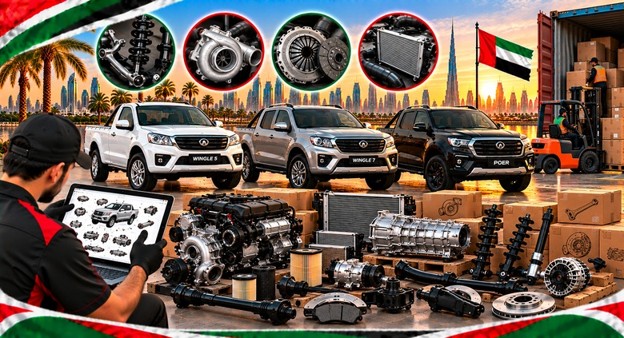
The current UAE GWM range includes the Wingle 5, Wingle 7 and Poer, but they are not simply three names for the same mechanical package. The official UAE distributor currently lists the Wingle 5 as a single-cab 2.4-litre petrol 4x2, while the Wingle 7 is offered as a double-cab pickup with 4x2 and 4x4 configurations and petrol and diesel specifications. The Poer sits further up the range, with petrol and diesel versions and 4x4 capability.
That matters because a brake component, clutch, engine sensor, turbocharger, bumper or electronic module can carry a perfectly convincing description and still be the wrong part.
And that is where replacement price becomes slightly deceptive.
A part may cost AED 300. The repair may not.
UAE Update Reference: September 2026
What Great Wall spare parts actually cost in the UAE
There is no single “Great Wall spare parts in UAE price”. There is a spread.
Current online UAE listings demonstrate the problem rather neatly. One UAE parts seller lists GWM components such as Poer engine assemblies, short blocks, manual gearboxes, control arms, brake pads, bumpers, alternators and A/C compressors, with individual displayed ranges rather than one fixed market price. For example, its current Poer listings show an engine assembly at AED 320–994, a manual gearbox at AED 303–995 and an A/C compressor at AED 309–962.
Those figures should not be treated as universal UAE installed prices.
They are advertised parts ranges. They do not establish labour, VAT treatment, diagnostic charges, programming, fluids, seals, delivery or installation.
That distinction is the first rule of Great Wall repair pricing.
The three pickups need to be priced separately
The temptation is to search for “Great Wall Wingle parts” and assume the results will sort themselves out.
They will not always do that.
The Wingle 5 currently listed by the UAE distributor is a 2.4-litre petrol, 4x2 single-cab pickup producing 125 hp and 200 Nm.
The Wingle 7 is a different proposition: double cab, with 4x2 and 4x4 versions and diesel and petrol specifications listed by the UAE distributor.
The Poer moves again into a more heavily equipped platform, with the current UAE model offering 4x4 and a 188 hp headline output, alongside systems such as Bosch ESP, traction control, hill-start assistance, TPMS and a 360-degree camera system.
So if three quotations arrive for “Great Wall pickup brake parts”, comparison should begin with the vehicle specification, not the number at the bottom.
Wingle 5 spare parts: where the lower price can make sense
The current UAE Wingle 5 is relatively straightforward in specification compared with the newer Poer.
The official UAE page identifies a 2.4-litre petrol engine, 125 hp, 200 Nm and 4x2 drive.
That has consequences for parts sourcing.
Routine mechanical components such as filters, belts, brake components, suspension bushes, bearings, starter motors and cooling-system parts can sometimes be easier to source than model-specific electronic or body components.
But “easier to source” is not the same as “fits every Wingle 5”.
Older Wingle 5 catalogues contain large numbers of specific references, and supplier catalogues show that the model has had multiple engine and component applications. Shindary, for example, publishes extensive Wingle 5 part-number listings rather than treating the model as one universal specification.
For a buyer, the lesson is simple: Wingle 5 is the starting point for identification, not the final answer.
Wingle 7 prices change sharply with engine and drivetrain
The Wingle 7 is where casual parts searching becomes risky.
The UAE distributor currently lists the model as a double-cab pickup and identifies 4x2, 4x4 petrol and 4x4 diesel specifications.
That means “Wingle 7 brake pad”, “Wingle 7 clutch”, or “Wingle 7 engine mount” is not necessarily enough information for a reliable quotation.
A diesel 4x4 configuration can involve different engine, transmission, drivetrain, cooling and ancillary components from another Wingle 7 specification.
This is particularly relevant to expensive items.
A clutch disc is not something to buy because the photograph looks right. A turbocharger is not something to buy because the seller says “Wingle 7”. An engine mount is not confirmed by the vehicle badge.
For major parts, the vehicle identification should travel with the enquiry.
Poer parts are a different pricing conversation
The Poer is not simply a newer Wingle 7 with a different grille.
The UAE model is positioned as a lifestyle pickup and currently offered in petrol and diesel versions. The official UAE listing gives starting prices of AED 83,900 plus VAT for diesel and AED 89,900 plus VAT for petrol, while identifying 188 hp, 360 Nm and 4x4 drive for the listed vehicle.
More importantly for parts buyers, the Poer carries more electronic and driver-assistance equipment.
Its UAE specification includes Bosch Generation 9.3 ESP, emergency brake assistance, traction control, hill-start assistance, reversing camera, reversing radar and TPMS.
A repair involving one of these systems can therefore have a very different total cost from replacing a conventional mechanical component.
The expensive part may not even be the physical component. Diagnosis, calibration or configuration can become part of the bill.
A realistic Great Wall spare-parts price table
The table below is best read as a market-reference guide, not a promise of what a UAE workshop will charge.
| Part | Model/application | Current advertised evidence | What the figure does not establish |
| Engine assembly | Poer | AED 320–994 | Installation, fluids, diagnostics, exact specification |
| Short block | Poer | AED 310–991 | Internal components, labour, machining |
| Manual gearbox | Poer | AED 303–995 | Fitting, oil, clutch-related work |
| Control arm | Poer | AED 340–991 | Alignment and labour |
| Brake pad | Poer | AED 335–998 | Axle specification, labour |
| Front bumper | Poer | AED 306–981 | Paint, sensors, brackets, fitting |
| Alternator | Poer | AED 320–985 | Charging diagnosis, belt, labour |
| A/C compressor | Poer | AED 309–962 | Refrigerant, flushing, labour |
| Wingle 7 clutch disc | Wingle 7 | AED 765 | Full clutch kit, labour, flywheel condition |
| Wingle 5/7/Poer catalogue parts | Multiple | Varies | UAE availability and exact application |
The Poer figures come from a current UAE parts listing; the Wingle 7 clutch figure is from a UAE-based parts retailer. These are advertised component prices, not installed repair quotations.
That distinction matters enormously.
Why an AED 765 clutch is not an AED 765 repair
A current UAE listing gives a Wingle 7 clutch disc at AED 765.
Fine. But what happens next?
The workshop still needs to remove the gearbox, inspect the clutch assembly and flywheel, confirm whether the pressure plate and release bearing should be replaced, install the component, refill any lost fluids where applicable and road-test the vehicle.
If the flywheel is damaged and the quotation quietly expands, the original “clutch price” becomes almost irrelevant.
This is why a sensible quotation separates:
part price + supporting parts + labour + fluids + machining if required + diagnostics + VAT where applicable.
A cheap component can sit inside an expensive repair.
And the reverse can also happen: a more expensive component may be the better economic choice if it reduces repeat labour or comes with stronger fitment support.
Wingle 5 engine-part pricing needs more identification than “2.4 petrol”
The current UAE Wingle 5 is listed with a 2.4-litre petrol engine, but that does not mean every 2.4-litre Great Wall engine component should be assumed interchangeable.
Older Wingle catalogues contain numerous distinct part references, and historical Wingle parts documentation shows separate assemblies for fuel, cooling, exhaust, axles, suspension, steering, braking and electrical systems.
For an engine sensor, throttle component, ECU, starter, alternator or cylinder-head component, the correct procedure is therefore to establish:
- model year
- engine specification
- VIN/chassis number
- existing part reference
- connector and physical configuration
- supplier catalogue application
Only then should price comparison begin.
Wingle 7 diesel parts can be particularly specification-sensitive
The Wingle 7 diesel deserves extra caution because diesel fuel and engine-management components are not generic commodities.
Supplier catalogues identify Wingle 7 and Poer applications around the GW4D20M diesel engine family, including engine mounts and related components. A current parts catalogue also identifies GW4D20M applications for Wingle 7 and Poer.
That does not mean every component carrying “GW4D20M” is automatically interchangeable.
The surrounding vehicle specification still matters.
For injectors, turbochargers, EGR components, sensors, engine mounts and control modules, confirm the exact application rather than relying on the engine-family name alone.
A part-number match is useful evidence.
It is not a substitute for application confirmation.
Poer engine parts: petrol and diesel should never be mixed in a search
The current UAE Poer is available in petrol and diesel versions.
The official specification identifies the petrol engine as GW4C20B and pairs it with a ZF-8AT transmission on the published model information.
That is precisely the sort of detail that should be carried into a parts enquiry.
Searching “Poer engine parts” without saying petrol or diesel can produce a pile of apparently relevant results that are useless to the vehicle sitting outside the workshop.
For expensive engine components, quote the VIN first.
Then state the engine.
Then identify the part.
Not the other way around.
Brake parts are cheaper than engines, but fitment still matters
Brake pads look like the easy win.
They are small, familiar and frequently replaced. Yet Great Wall pickup braking systems can vary by model, axle and specification, and current catalogues themselves show different brake applications across Wingle and Poer vehicles. A current Great Wall parts list, for example, distinguishes Wingle/Poer brake applications and even separates mechanical and electronic rear-handbrake configurations on some Poer applications.
So a buyer should confirm:
- front or rear
- model
- year
- 4x2 or 4x4 where relevant
- brake-system configuration
- old pad dimensions where needed
- VIN or catalogue reference
The wrong brake pad is not an interesting bargain.
It is simply the wrong part.
Suspension parts should be bought by position and specification
Control arms, shock absorbers, stabiliser links, bushes and wheel bearings are often quoted too casually.
“Poer front suspension” is not a useful purchase description.
A better request identifies the exact component and position: left or right, front or rear, upper or lower where relevant.
Current Great Wall parts catalogues show specific Poer suspension components, including upper and lower control-arm references, rear shock absorbers and stabiliser-related components.
This matters because a suspension quotation can otherwise hide an application mismatch.
It also affects labour.
A control arm replacement may require wheel alignment afterwards. A shock absorber replacement may expose worn bushes or mounts. A wheel bearing may require additional hub-related work depending on design.
The part price is only one line.
Body parts create a different kind of price problem
Mechanical parts fail.
Body parts get damaged.
The buying logic changes.
For a bumper, bonnet, grille, headlamp or tail lamp, condition and completeness matter almost as much as the part identity.
A current UAE Poer parts listing includes front bumpers among advertised components.
But a bumper quote should answer another question: what comes with it?
Does it include the reinforcement? Grille inserts? Mounting brackets? Sensor apertures? Parking-sensor holders? Trim? Lower grille? Are clips intact?
And then comes paint.
An unpainted bumper at a seemingly attractive price can become a much larger repair once preparation, paint matching and fitting are included.
Headlights are particularly dangerous to compare by photograph
Two lamps can look almost identical in an online photograph.
That proves very little.
For a Poer or Wingle, establish the exact year and specification, then check the lamp reference, connector arrangement, mounting points and available functions.
If the lamp contains integrated electronics, the replacement may also need configuration or calibration depending on the system.
The same principle applies to tail lamps.
Current Great Wall parts catalogues list distinct Poer lighting components rather than one generic “Poer light” category.
So if a seller asks for a photograph of your old lamp, that is not necessarily bureaucratic fussiness.
It can be useful evidence.
Air-conditioning parts need diagnosis before price comparison
An A/C compressor is a good example of why a parts-price article cannot simply become a shopping list.
A current UAE listing advertises Poer A/C compressors in a broad AED 309–962 range.
But a weak A/C system does not prove the compressor has failed.
The workshop should establish refrigerant pressure, compressor engagement, electrical supply, clutch or compressor control, condenser performance, cooling-fan operation and relevant fault codes where applicable.
A compressor replacement without finding the original cause can become an expensive repeat job.
And in UAE summer conditions, a marginal cooling system can expose several faults at once.
Do not let “the A/C is weak” become “replace the compressor”.
Cooling-system repairs can be deceptively expensive
Radiators, water pumps, thermostats, hoses and fans sit in the same general conversation but do very different jobs.
A high coolant temperature does not automatically identify the failed component.
The workshop should establish whether the engine is actually overheating, whether coolant circulation is correct, whether the cooling fan operates at the required speeds, whether the system holds pressure and whether there is evidence of combustion-gas leakage.
For a Wingle or Poer used heavily in hot UAE conditions, this matters even more because cooling capacity is being tested under demanding ambient conditions.
A radiator quote without diagnosis is not a diagnosis.
It is merely a radiator quote.
Alternators and starter motors should be tested, not guessed
Current online listings show Poer alternators among advertised replacement components.
But a battery warning does not automatically mean the alternator needs replacement.
The workshop should check battery condition, charging voltage, charging current under load, belt condition, wiring and relevant connections.
Likewise, a no-start condition does not automatically mean “starter motor”.
The starter may be receiving insufficient voltage, the battery may be weak, a connection may have excessive resistance, or the starting-control circuit may have another fault.
For these components, ten minutes of testing can prevent several hundred dirhams of unnecessary parts spending.
Gearbox replacement prices need a much wider lens
A gearbox is one of the worst parts to compare using headline price alone.
A current UAE parts marketplace lists Poer manual gearboxes in a broad AED 303–995 advertised range.
That figure tells the buyer very little about a complete repair.
Is it a complete transmission?
Is it tested?
Is it used, new or rebuilt?
What oil does it require?
Is the clutch included?
What is the warranty?
What happens if the gearbox arrives and the actual fault is elsewhere?
For an automatic Poer, the situation can become more involved because the current UAE petrol specification is listed with a ZF-8AT transmission.
Diagnosis first. Replacement second.
Used Great Wall parts can make financial sense — with evidence
Used parts are not automatically inferior.
They are simply parts with history.
That history needs investigating.
For a used Wingle or Poer engine, gearbox, differential, transfer case, ECU or body panel, ask for the donor vehicle details, component identification, mileage where known, reason for dismantling, condition, testing information, warranty and return terms.
An engine from a lightly used donor is a different proposition from an engine removed from an unknown vehicle after an accident.
And a used electronic module may physically fit while still requiring programming or being incompatible with the vehicle's software configuration.
Price is not the evidence.
The evidence is the history behind the price.
Genuine, aftermarket and used are not interchangeable labels
A quotation may contain three apparently similar alternatives:
Genuine: supplied as a manufacturer-branded vehicle part.
Aftermarket: produced by another manufacturer for the replacement market.
Used: previously installed on another vehicle.
These categories answer different questions.
“Aftermarket” does not automatically mean poor quality. “Genuine” does not automatically mean the most economical choice. “Used” does not automatically mean damaged.
The useful questions are about manufacturer, application, quality evidence, warranty, condition, testing and total repair cost.
For a common filter, an established aftermarket manufacturer may be perfectly reasonable.
For a programmed electronic module, a poorly documented alternative can create far more trouble.
The part category should match the risk of getting the decision wrong.
Part numbers are more valuable than model names
A Great Wall model name gets the search started.
A verified part number can narrow it dramatically.
Shindary publishes extensive Wingle 5 references, including engine, body and chassis-related numbers, illustrating how quickly the identification problem moves beyond the simple model name.
Other catalogues similarly identify specific Wingle 7 and Poer references and shared applications.
But never copy a number from a search result and assume it is correct.
Check whether it is:
- original equipment number
- supplier number
- superseded number
- cross-reference
- aftermarket number
- catalogue-only identifier
A part number without provenance can be just another piece of noise.
VIN is the safest starting point for expensive parts
For engines, gearboxes, ECUs, ABS modules, turbochargers, fuel-system components and complex body electronics, VIN identification is worth the few minutes it takes.
The ideal sequence is:
VIN → vehicle specification → engine/transmission → original part reference → catalogue confirmation → physical comparison → installation confirmation.
That sequence is deliberately boring.
Boring is good when the alternative is ordering a gearbox that cannot be used.
For routine consumables, a VIN may not always be necessary. For expensive or specification-sensitive components, it should be treated as standard evidence.
The “same part” problem is bigger than it looks
A seller may tell you that two components are “the same”.
Ask what that means.
Same mounting points?
Same dimensions?
Same electrical connector?
Same software?
Same pressure rating?
Same brake configuration?
Same transmission?
Same engine?
Same calibration?
This matters particularly with sensors and electronics.
A component can physically bolt into position while producing the wrong signal, carrying different software or lacking the expected communication protocol.
That is not a fitment success.
It is a delayed fault code.
What a UAE workshop should check before replacing a major part
A proper repair quotation should be preceded by a diagnosis appropriate to the component.
For engine faults, that may include fault-code scanning, live data, compression or leak-down testing, oil-pressure testing and cooling-system checks.
For charging faults, voltage and current measurements matter.
For A/C, pressure and system-performance checks matter.
For drivetrain complaints, road testing, fluid inspection, scan data and mechanical examination may be necessary.
For electronic systems, fault codes, wiring, power supply, communication and programming status can matter more than the physical component.
The point is not to demand every possible test.
It is to demand the right test before the expensive part is authorised.
What actually pushes a Great Wall repair bill higher
The part itself is only the obvious cost.
The less obvious costs can include:
- diagnostic time
- removal and refitting
- programming
- coding
- calibration
- wheel alignment
- fluids
- seals and gaskets
- refrigerant
- paint
- machining
- delivery
- VAT
- supporting components
- post-repair testing
A bumper replacement is the clearest example.
The bumper might be one line.
Paint, clips, brackets, lamps, parking sensors, radar-related components and labour can turn it into something else entirely.
Always ask for the installed repair total.
Wingle 5, Wingle 7 or Poer: which parts are usually easier to source?
There is no reliable one-line answer because availability changes by part and specification.
Routine service items are generally easier to identify than rare body panels, electronic modules or unusual drivetrain components.
Wingle 5 has an extensive established parts catalogue, while Wingle 7 and Poer share certain applications in supplier catalogues but also have specification-specific components.
The UAE also has an established GWM distribution and after-sales network. The official UAE site says the distributor has showrooms and after-sales service across Dubai, Sharjah, Abu Dhabi, Ras Al Khaimah and Fujairah.
So the question is less “Can I find Great Wall parts?”
It is “Can I identify the exact part quickly enough to compare the right sources?”
That is a much more useful question.
How to compare three quotations without being fooled by the cheapest number
Imagine three quotations for the same Poer component.
Quotation A: AED 500.
Quotation B: AED 650.
Quotation C: AED 900.
That does not automatically make A cheaper.
Quotation A may exclude VAT, labour and programming.
Quotation B may include installation.
Quotation C may include a genuine component, warranty and calibration.
The comparison should therefore look like this:
| Cost item | Quote A | Quote B | Quote C |
| Part | Check | Check | Check |
| Part category | Genuine/aftermarket/used | Confirm | Confirm |
| Labour | Check | Check | Check |
| Diagnostics | Check | Check | Check |
| Programming/calibration | Check | Check | Check |
| Fluids/supporting parts | Check | Check | Check |
| VAT | Check | Check | Check |
| Warranty | Check | Check | Check |
| Final installed price | Calculate | Calculate | Calculate |
Only then is the comparison meaningful.
A buyer's decision matrix for Great Wall replacement parts
| Repair situation | What to prioritise | What to verify before buying |
| Oil/air/cabin filter | Correct application | Model, engine, dimensions/reference |
| Brake pads | Correct brake system | Axle, configuration, reference |
| Suspension bush | Fitment and material | Position, chassis/application |
| Control arm | Complete assembly | Left/right, upper/lower, VIN |
| Clutch | Complete system compatibility | Engine, gearbox, flywheel condition |
| Turbocharger | Exact application | Engine, turbo reference, actuator |
| Injector | Engine-system match | Engine code/application, injector number |
| Alternator | Electrical compatibility | Output, connector, mounting |
| A/C compressor | Correct diagnosis | Compressor type, refrigerant/system |
| ECU/module | Exact specification | VIN, hardware/software, programming |
| Headlamp | Physical + electrical fitment | Year, trim, connector, functions |
| Bumper | Complete collision repair | Sensors, brackets, paint, trim |
| Gearbox | Exact transmission | VIN, gearbox code, configuration |
| Used engine | Donor evidence | Mileage, testing, history, warranty |
The more expensive the part, the more demanding the verification should become.
What should be included in a Great Wall parts enquiry?
A good enquiry saves time because it removes the guesswork before the seller starts searching.
Send:
Vehicle: Wingle 5 / Wingle 7 / Poer
Model year: exact year
Engine: petrol or diesel, plus confirmed engine identification where available
Transmission: manual or automatic
Drive: 4x2 or 4x4
VIN/chassis: full VIN where appropriate
Part required: exact component
Old part number: photograph it if available
Vehicle photograph: useful for body parts
Fault symptoms: for mechanical/electrical components
Diagnostic evidence: where available
This is far better than sending “Need Poer turbo”.
A parts supplier cannot identify what you have not identified yourself.
The cheapest Great Wall part is not always the cheapest repair
That sounds obvious.
It is surprisingly easy to forget.
A cheap used gearbox with no history can become expensive if removal and refitting have to be repeated. A low-priced bumper can become costly once paint and missing brackets are discovered. A bargain electronic module can become a headache if coding is impossible. A cheap A/C compressor can be the wrong answer if the original fault was elsewhere.
The current UAE market already shows why advertised component prices should be treated carefully: individual Poer components can appear at wide price ranges, while some specific Wingle parts are sold at substantially different prices depending on the component and supplier.
So when comparing Great Wall spare parts in the UAE, PartFinder UAE should be approached as part of a wider identification-and-price-checking process rather than as a substitute for diagnosis.
The strongest quotation is the one that tells you what the part is, why it is required, what specification it matches, what else is included and what the final installed repair will cost.
That is the number worth comparing.
Why older Wingle parts can still be worth sourcing
Older pickups create an interesting economics problem.
The vehicle may be worth considerably less than a new Poer, yet its owner may have every reason to keep it working. A Wingle used as a commercial vehicle can have established equipment, known maintenance history and a job to do every day.
Replacing the vehicle simply because one major part is expensive may make little financial sense.
That is where used genuine parts, aftermarket components, remanufactured units and carefully sourced donor components can enter the calculation.
The important word is carefully.
For a starter motor or body trim, the sourcing risk may be manageable.
For an engine, gearbox, differential or electronic control module, evidence becomes far more important.
Commercial use changes the repair calculation
A private owner can sometimes tolerate a vehicle sitting in a workshop for several days.
A working pickup may not have that luxury.
Downtime has an economic cost.
If a Wingle 5 or Wingle 7 is being used for deliveries, construction, maintenance work or other commercial activity, a slightly more expensive part that is available quickly and carries usable warranty support may be preferable to a cheaper part with uncertain delivery or fitment.
That does not mean paying more is automatically justified.
It means downtime belongs in the calculation.
A repair quote that ignores the vehicle's actual job is incomplete.
When genuine parts make more sense
Genuine parts become particularly relevant when the cost of incompatibility is high.
Think:
- electronic control modules
- safety-system components
- complex sensors
- transmission-specific components
- body electronics
- certain engine-management parts
- unusual trim or structural components
The case for genuine supply becomes weaker for some routine items where reputable aftermarket alternatives have established application and quality.
The sensible question is not “Is genuine always better?”
It is:
What happens if this alternative part is wrong?
That answer should influence how much verification you demand.
When an aftermarket part can be perfectly reasonable
A reputable aftermarket manufacturer can make sense for routine mechanical components where the application is well established.
Brake pads, filters, belts, bushes and other wear items are obvious areas where aftermarket supply can be considered.
But “aftermarket” is not a quality specification.
The manufacturer matters.
So does the exact application.
So does warranty.
So does the seller's ability to stand behind the part.
An aftermarket component that has a clear application, credible manufacturer and sensible return policy is a different proposition from an anonymous component whose only selling point is that it is cheap.
When a used part deserves serious consideration
Used can be particularly useful when:
- the vehicle is older
- a new genuine part is difficult to source
- the component is expensive
- the original specification is discontinued
- a donor vehicle has a strong documented match
- the component can be properly tested
Wingle parts catalogues demonstrate that the model has a broad range of specific component references, while current supplier catalogues also show shared Wingle 7/Poer applications for some components.
That creates opportunities for used sourcing.
But it also creates a trap: shared application does not mean universal interchangeability.
Verify before paying.
The cost of getting Great Wall fitment wrong
The obvious cost is the wrong part.
The less obvious cost is everything attached to it.
For a major mechanical component, that can mean:
wrong part → delivery delay → workshop downtime → removal/refitting → return dispute → replacement order → second installation.
Suddenly a part that was AED 500 cheaper has cost far more than the correct component.
This is why VIN verification is not administrative overhead.
It is risk control.
For complex components, spending extra time before ordering is usually cheaper than discovering the mistake after installation.
A practical Great Wall parts checklist for UAE buyers
Before approving any significant replacement, ask the supplier or workshop:
- What exact Great Wall model is this part for?
- What model year?
- Petrol or diesel?
- What engine specification?
- 4x2 or 4x4?
- Manual or automatic?
- Has the VIN been checked?
- What is the original part number?
- Is this number current or superseded?
- Is the part genuine, aftermarket, used or reconditioned?
- If used, what is known about the donor vehicle?
- Has the component been tested?
- What exactly is included?
- Does labour form part of the quoted price?
- Is VAT included?
- Are programming or calibration costs included?
- Is wheel alignment required?
- Are fluids, seals or supporting components included?
- What warranty is provided?
- What happens if the part does not fit?
If the answer to several of these questions is “we'll see when it arrives”, do not confuse that with certainty.
What a proper UAE Great Wall repair quotation should look like
A good quotation should be almost boringly clear.
Vehicle: GWM Wingle 7
Year: XXXX
Engine: confirmed specification
Drive: 4x4
Part: exact component
Part number: verified reference
Condition: new / used / reconditioned
Brand/source: identified
Part price: AED XXX
Labour: AED XXX
Diagnostics: AED XXX
Programming/calibration: AED XXX
Supporting parts: AED XXX
VAT: stated
Warranty: stated
Total installed repair: AED XXX
That is much more useful than a WhatsApp message saying:
“Wingle 7 clutch AED 1,200 fitted.”
Maybe.
But which clutch? Which Wingle 7? What is included? Is the flywheel checked? What warranty applies?
A quotation should answer those questions before the vehicle comes apart.
Current UAE market context: the vehicle itself sets the scale
The official UAE distributor currently lists the Wingle 5 from AED 52,395 plus VAT, Wingle 7 from AED 57,645 plus VAT and Poer from AED 83,900 plus VAT for diesel and AED 89,900 plus VAT for petrol.
These are vehicle starting prices, not spare-parts benchmarks.
But they illustrate why repair economics can differ between the three models.
A major repair on an older Wingle 5 has to be considered against the vehicle's age, condition and remaining service life.
A major electronic or transmission repair on a newer Poer has a different ownership context.
There is no sensible universal rule that says “repair” or “replace”.
The vehicle's condition and the repair's total cost decide whether the numbers make sense.
Great Wall parts availability is not the same as Great Wall parts certainty
The UAE has an established GWM distribution and after-sales structure, and the official distributor continues to list Wingle 5, Wingle 7 and Poer within its pickup range.
There are also independent UAE parts listings covering Wingle and Poer components.
So availability should not be described as a simple yes-or-no question.
A part may be available locally.
Another may need ordering.
A third may exist only as a used component.
A fourth may have several aftermarket alternatives but require careful identification.
That is why a buyer asking “Do you have Great Wall parts?” is asking too broad a question.
Ask about the exact component.
The real difference between Wingle 5, Wingle 7 and Poer
The easiest way to think about these pickups is not as a hierarchy of “cheap, medium and expensive”.
Think of them as different identification problems.
Wingle 5: relatively simple current UAE specification, but older vehicle applications and catalogue variations still matter.
Wingle 7: more specification-sensitive because of multiple drivetrain and engine configurations.
Poer: newer, more powerful and more electronically equipped, so mechanical fitment and electronic compatibility both matter.
The official UAE specifications support those distinctions: Wingle 5 is currently listed as a 2.4-litre petrol 4x2; Wingle 7 has multiple drivetrain and fuel configurations; Poer is offered in petrol and diesel with 4x4 and more extensive electronic systems.
That is the foundation for sensible price comparison.
Before you click buy
Stop if the listing only says:
“Great Wall pickup part.”
Stop again if it says:
“Wingle/Poer compatible.”
Then ask for the actual application.
For a cheap service item, this may take seconds.
For a turbocharger, gearbox, ECU, engine assembly or major body-electronic component, insist on proper identification.
The seller should be able to tell you what vehicle specification the component fits.
You should be able to tell the seller what vehicle you own.
If neither side can establish that, the price is premature.
Final buyer rule
For Great Wall spare parts in the UAE, identify first, price second.
The Wingle 5, Wingle 7 and Poer are not interchangeable shopping categories. Their engines, drivetrains, braking systems, electronics and body components can differ, and even apparently shared applications need verification.
A good parts search starts with the vehicle.
A good quotation names the part.
A good repair explains why it is needed.
And a genuinely useful price is the one you can understand from the first line to the final installed dirham.
FAQ
Categories
- Audi
- BMW
- Car Accessories
- Car Tips
- Ford
- Land Rover
- Mazda
- Range Rover
- Top 10
- UAE Car Parts
- Used Car Parts
- Toyota
- Replacement Engines
- Nissan
- Hyundai
- Mitsubishi
- Volkswagen
- Honda
- Kia
- Chevrolet
- Dodge
- Jeep
- Subaru
- Renault
- Lexus
- Mercedes
- Suzuki
- Hummer
- Porsche
- Infiniti
- Peugeot
- GMC
- Mini
- Volvo
- Replacement Gearboxes
- MG
- Jaguar
- Skoda
- Cadillac
- Daihatsu
- Fiat
- German Car Parts
- Japanese Car Parts
- Aftermarket Car Parts
- Genuine Car Parts
- New Car Parts
- Reconditioned Car Parts
- European Car Parts
- American Car Parts
- Korean Car Parts
- British Car Parts
- Chinese Car Parts
- Sports/Exotic Car Parts
- Luxury Car Parts
- Performance Car Parts
- SUV/4x4 Spare Parts
- Truck Spare Parts
- EV Car Parts
- Hybrid Car Parts
- Auto Spare Parts in UAE
- Tesla
- Isuzu
- Ram
- Ferrari
- Bentley
- Lamborghini
- Genesis
- Maserati
- Lincoln
- Chrysler
- Opel
- Citroen
- SsangYong
- Seat
- McLaren
- Aston Martin
- Rolls Royce
- Maybach
- Alfa Romeo
- Bugatti
- Scion
- Abu Dhabi Car Parts
- Ajman Car Parts
- Al Khan Car Parts
- Al Sajaa Car Parts
- Deira Car Parts
- Dubai Car Parts
- Fujairah Car Parts
- Industrial Area 6 Car Parts
- Mussafah Car Parts
- Ras Al Khaimah Car Parts
- Sharjah Car Parts
- Umm Al Quwain Car Parts
- Acura
- BYD
- Chery
- Dacia
- DS
- Geely Emgrand
- EXEED
- GAC
- GAC Gonow
- Geely
- Gonow
- Great Wall