Hard-to-Find GAC Gonow Parts in UAE: How VIN and Original Part Numbers Can Help
October 5, 2026
Finding GAC Gonow parts in UAE is rarely just a matter of locating something that looks right.
The difficult part is proving that it is right.
That distinction becomes more important with an older Gonow because the original production system is no longer operating like a current-model parts network. GAC acquired the remaining 49% of GAC Gonow in March 2016, and the company was subsequently reorganised; contemporary reporting also records parts-supply problems around the transition.
So an owner searching for a headlight, suspension arm, engine component, gearbox, ECU or even a seemingly ordinary filter can encounter several catalogue entries, several sellers and several different descriptions.
Some will be useful.
Some will merely look convincing.
The difference often comes down to two pieces of information that owners overlook: the VIN and the number printed on the original part.
Why Gonow parts are unusually difficult to identify
The Gonow brand was discontinued as a production vehicle marque in 2016, with the GX6 documented around the 2014–2016 period and the GP150 around 2015–2016.
That leaves today's owner dealing with an unusual combination of circumstances.
The vehicles are old enough for original components to have become scarce, but not necessarily old enough for every part to have disappeared from aftermarket catalogues. Some components remain searchable through vehicle-specific databases. Others survive mainly through specialist suppliers, dismantlers, old stock or cross-reference catalogues.
This creates a fragmented market.
And fragmented markets reward precise identification.
VIN information is more useful than the badge
“Gonow GX6” identifies the vehicle family.
It does not necessarily identify every component fitted to it.
A current parts catalogue for the GX6, for example, distinguishes a 2.4-litre 4G69-S4N application from another historical 2.4-litre 4G64-S4M application. It also separates front-wheel-drive and all-wheel-drive configurations.
That is already enough to demonstrate the problem.
Two vehicles can both be called GX6 and still require different parts.
The VIN helps narrow the vehicle before the part search begins.
The GX6 has documented VIN/application differences
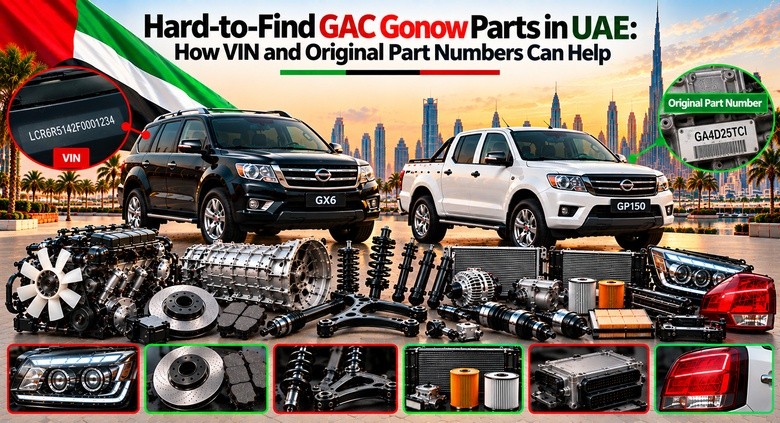
A 2015 GX6 2.4-litre two-wheel-drive configuration is documented with VIN pattern LCR6R514, while a 2015 2.4-litre four-wheel-drive version is documented with LCR6R524. Both use the 4G69S4N engine, but their vehicle configurations differ.
Those identifiers are useful evidence of why “GX6 2.4” is still incomplete information.
The owner should not copy a VIN pattern from another vehicle and assume it applies to theirs. The point is simply that catalogue systems can distinguish configurations at this level.
For a difficult part, give the supplier the actual VIN from the vehicle.
Do not confuse a VIN pattern with the complete VIN
This matters.
A short identifier such as LCR6R514 is a model/application code appearing in a database. It is not a substitute for the complete vehicle VIN.
The complete VIN identifies the individual vehicle.
For parts sourcing, provide the complete VIN where the supplier or catalogue supports VIN-based identification.
A partial code can help with research, but it should not be presented as if it were the vehicle's full identification number.
The GP150 has its own identification trail
The GP150 provides an even clearer example.
A documented 2015 GP150 2.5T diesel application uses engine code GA4D25TCI, a five-speed manual transmission and a pickup body. A database also shows VIN examples beginning with LCR1B41D for that application.
That gives an owner several independent identifiers:
GP150 → 2015 application → 2.5T diesel → GA4D25TCI → vehicle VIN.
If a seller's listing says only “GP150 diesel”, the enquiry is still missing useful information.
Engine code can narrow the search dramatically
Engine displacement is a broad description.
Engine code is much narrower.
For the GX6, the documented 2014–2016 2.4 application includes the 4G69-S4N engine. For the GP150, documented 2.5T diesel applications use GA4D25TCI.
That means an owner searching for an engine-related component can use the engine code alongside the vehicle name.
But there is an important qualification.
Engine code is an identification aid, not automatic proof of interchangeability.
A part can be used on the same engine family while differing because of vehicle packaging, transmission, emissions specification, wiring, mounting or production revision.
The original part number can be even more valuable
The number printed, stamped or moulded into the original component may provide a second route to identification.
This is particularly useful when:
- the vehicle catalogue is incomplete;
- the model name produces too many results;
- the part has been superseded;
- an aftermarket catalogue uses a different description;
- the component is shared with another application;
- the seller cannot identify the vehicle from the badge alone.
Photograph the number before removing or discarding the old part.
If it is difficult to read, clean the label gently and photograph it from several angles.
Do not “correct” an unclear digit from memory.
One character can change the search result.
Where should you look for the original number?
It depends on the component.
On an electronic module, look for a label or printed identification plate.
On a starter or alternator, there may be a manufacturer's reference or assembly number.
On suspension components, the number may be stamped, cast or printed on a label.
On a light assembly, look around the rear housing.
On a gearbox, look for casing markings or an identification plate.
On engine components, look for casting numbers and labels, but distinguish a casting number from a true service part number.
That distinction matters.
A casting reference may identify the basic component family without identifying the exact replacement assembly.
A casting number is not automatically a part number
This is an easy mistake when buying used mechanical components.
A number cast into an aluminium housing may relate to the casting itself. It may not be the number a supplier uses to order the finished service component.
Likewise, an engine block casting number does not necessarily identify the complete engine assembly.
If the number is unclear, send the photograph to the supplier and ask:
“Is this an OE/service part number, a casting number or another reference?”
That single question can prevent a surprisingly large amount of confusion.
VIN plus original number is stronger than either alone
The two forms of evidence answer different questions.
The VIN identifies the vehicle.
The original part number identifies the component.
When both point towards the same replacement, the confidence level is much higher.
For example:
VIN → 2015 GX6 2.4 4G69S4N 4WD
then:
original suspension component number → catalogue replacement
then:
physical mounting points → confirmed
That is far stronger than:
GX6 → photograph looks similar → buy.
The GX6 engine variation is exactly why catalogue discipline matters
A parts database currently lists the GX6 with three documented modifications: a 2.4-litre 4G69-S4N application in 2014–2016, including 2WD and 4WD versions, plus another 2.4-litre 4G64-S4M application.
This is the sort of catalogue detail that gets lost in casual online searching.
Someone searching only “Gonow GX6 engine part” could easily see a component associated with the wrong engine application.
The listing may not be fraudulent.
It may simply belong to another GX6 configuration.
That is why the vehicle identification has to come first.
The GP150 also needs drivetrain confirmation
The documented GP150 2.5T diesel uses the GA4D25TCI engine, but GP150 configurations include different drivetrain arrangements. A documented four-wheel-drive version is separately identified in vehicle databases.
For engine service parts, this may sometimes make little difference.
For transfer-case, driveshaft, differential, axle, suspension and drivetrain components, it can make a huge difference.
A supplier who receives only “GP150 2.5 diesel” still needs to know which configuration is sitting in front of them.
The 4G69-S4N can widen the GX6 parts search
There is a useful upside to engine-code research.
The 4G69-S4N appears in multiple catalogue applications, including the GX6 and earlier Gonow Aoxuan/G5 applications.
This can make routine mechanical parts easier to investigate.
But there is a trap here too.
The presence of the same engine code does not prove that every attached component is interchangeable.
Engine-mounted accessories, brackets, wiring, sensors, intake components and cooling connections can differ according to the vehicle.
Use the engine code to expand the search.
Then return to the vehicle application to confirm it.
Cross-reference catalogues are useful — if you know what they are doing
A cross-reference catalogue is essentially a bridge.
It can connect:
vehicle → original reference → aftermarket reference
or sometimes:
original reference → replacement reference → dimensions/application.
MANN-FILTER's current catalogue, for example, supports searching by vehicle, product, cross-reference and dimensions, and its updated system also includes VIN search functionality in selected markets.
That is exactly the sort of structure that helps with older vehicles.
But a cross-reference is evidence of a catalogue relationship.
It is not permission to ignore the vehicle application.
Filters are where catalogue cross-referencing often works best
Filters are relatively standardised components compared with ECUs, body electronics or complete drivetrain assemblies.
The GP150 is a good example because its GA4D25TCI engine is explicitly identifiable in vehicle and filtration databases.
That means an aftermarket filter catalogue can sometimes provide a much clearer route to a replacement than searching for a “Gonow filter” in a general marketplace.
Still check:
- engine;
- production period;
- filter type;
- dimensions where relevant;
- catalogue application;
- old filter reference.
A filter that physically fits the housing is not automatically the correct filtration specification.
Brakes can also benefit from original-number checking
Brake pads and discs are another category where aftermarket catalogues can provide useful coverage.
The GX6 4G69-S4N application is represented in aftermarket braking catalogues.
But brake components need axle-specific confirmation.
A front pad is not a rear pad.
A 4WD application can have different braking hardware from another configuration.
And a catalogue photograph is not enough.
Compare the old component's shape, dimensions and mounting arrangement against the proposed replacement.
For brakes, “close enough” is not a sensible category.
Suspension parts need physical confirmation
Suspension is less forgiving of catalogue shortcuts.
A control arm, shock absorber, hub or steering component should be checked against:
- mounting-hole arrangement;
- bushing position;
- ball-joint arrangement;
- left/right orientation;
- front/rear position;
- dimensions;
- axle configuration;
- donor vehicle details if used.
The VIN can narrow the application.
The old component can confirm the physical arrangement.
You want both where the part is difficult or expensive to source.
Body parts create a different identification problem
A bumper, bonnet, door, mirror or lamp may have no obvious part number visible to the owner.
This is where photographs become important.
Take photographs of the:
- front surface;
- rear mounting side;
- brackets;
- clips;
- connector;
- sensor openings;
- reinforcement points.
For headlights and tail lamps, the rear housing is often more informative than the front lens.
Two lamps can look nearly identical from the road and still have different connectors or mounting arrangements.
Electronic parts have the highest identification burden
ECUs, ABS modules, body-control modules, instrument clusters and other electronic units deserve more caution than ordinary mechanical parts.
The part number matters.
The hardware version matters.
The vehicle application matters.
Software or coding requirements may matter.
A used module can therefore require two separate questions:
Will it physically fit?
and:
Can it operate correctly on this vehicle?
A supplier confirming only the first question has not completed the identification job.
Do not buy an ECU from a photograph alone
This is one of the few areas where a clean photograph can be dangerously persuasive.
The casing may be identical.
The connector may be identical.
The label may even look almost identical.
But software configuration, hardware revision or vehicle application can differ.
Before buying a used electronic module, record the complete identification label from the original unit.
Then ask the supplier whether the replacement requires coding, programming, cloning or another adaptation procedure.
If they cannot answer, ask the workshop before buying.
Gearbox numbers deserve the same treatment
The GX6 is documented with a five-speed manual transmission in the 2015 2.4 configurations cited above.
The documented GP150 2.5T diesel is also shown with a five-speed manual transmission.
That does not mean the two gearboxes are interchangeable.
The bellhousing, gear ratios, output arrangement, mounting points and drivetrain integration still have to be checked.
For a 4WD vehicle, the relationship with the transfer case becomes another critical identification point.
A gearbox is not identified by “five-speed manual” alone.
Used engines require donor evidence
A used engine should come with more information than “tested” or “good condition”.
Ask for:
- donor vehicle;
- donor year;
- engine code;
- mileage if documented;
- reason for dismantling;
- compression evidence where available;
- oil and coolant condition;
- accessories included;
- visible damage;
- warranty or return conditions.
For a GP150 diesel, ask specifically about turbocharger, injection-system components and evidence of overheating or severe oil consumption.
For a GX6 petrol engine, establish whether the quoted unit is a bare engine, long block or more complete assembly.
The description must be as precise as the part.
“Original” does not automatically mean correct
A used genuine Gonow component can still be the wrong component.
This is particularly obvious with parts removed from another vehicle.
The seller may genuinely be offering an original part.
It may genuinely have come from a GX6.
It can still be wrong for your GX6 because of drivetrain, model year, engine application, equipment level or production variation.
“Original” answers the question of provenance.
It does not automatically answer the question of compatibility.
The same applies to aftermarket parts
Aftermarket does not mean “unverified”.
Some aftermarket catalogues provide detailed vehicle applications and cross-references. MANN-FILTER's catalogue, for example, is explicitly structured around vehicle, product, cross-reference and dimension searches.
But an aftermarket listing without an application reference is a different proposition.
The buyer should distinguish:
catalogued aftermarket application
from:
seller says it fits.
They are not equivalent forms of evidence.
UAE sourcing makes physical evidence even more useful
The UAE market has suppliers handling used and specialist vehicle parts, and current UAE-facing sourcing services explicitly describe VIN-based enquiries and original-part-number checks as part of their process.
There are also UAE directories listing suppliers dealing with GAC Gonow-related truck and used-parts categories.
That does not mean every listed supplier will have a GX6 or GP150 component in stock.
It does mean the owner should approach the search as an evidence exchange.
Send the VIN.
Send the old-part photograph.
Send the number.
Ask the supplier to identify the replacement.
Do not make the supplier guess from the badge.
Why the UAE climate matters during used-part inspection
Heat and sun are relevant when evaluating older used components, particularly rubber, plastics, wiring insulation, seals and exterior trim.
A used part can have a clean metallic appearance while age-related deterioration is hidden in flexible materials.
For a used suspension arm, inspect bushes.
For a radiator, inspect tanks and connections.
For a headlight, inspect housing and mounting points.
For wiring, inspect insulation and connectors.
For an A/C component, inspect fittings and signs of leakage or previous repair.
Climate is a condition factor, not a diagnosis.
A part number should be checked for supersession
Older vehicles create another problem: the number on the original component may no longer be the current ordering reference.
A manufacturer or aftermarket catalogue may have replaced an earlier number with a newer reference.
That is why the correct question is not simply:
“Does this number match?”
Ask:
“Is this the current replacement or supersession for this original reference?”
A different number is not automatically wrong.
Conversely, a similar number is not automatically right.
The catalogue relationship needs to be established.
The safest buying sequence for a rare Gonow part
For difficult GX6 and GP150 parts, use this sequence:
1. Identify the vehicle.
VIN, model year, engine and drivetrain.
2. Identify the original component.
Photograph the part and every visible number.
3. Identify the reference.
Separate service part numbers from casting numbers or supplier numbers.
4. Search the application.
Use the exact vehicle configuration, not just the model name.
5. Cross-reference.
Check whether an aftermarket or superseded reference is documented.
6. Compare physically.
Mounting points, dimensions, connectors, orientation and surrounding components.
7. Confirm installation requirements.
Programming, coding, calibration, alignment, fluids or supporting parts.
8. Only then compare prices.
This order feels slower.
In practice, it can be much faster than buying the wrong part and starting again.
What a good parts enquiry should contain
A UAE supplier should ideally receive something like this:
Vehicle: GAC Gonow GX6
Year: 2015
Engine: 2.4 petrol
Engine code: 4G69S4N
Drive: 4WD
VIN: complete VIN supplied privately to supplier
Part: front-left suspension component
Original number: photographed from removed component
Photos: complete part + mounting side + label
Request: confirm application, replacement reference, condition and return terms
For a GP150:
Vehicle: GAC Gonow GP150
Year: 2015
Engine: 2.5T diesel
Engine code: GA4D25TCI
Drive: confirm 2WD/4WD
VIN: complete VIN
Part: exact component
Original number: photographed
Request: confirm application and included components
That is a parts enquiry.
“Need Gonow part” is barely a starting point.
When the original number cannot be found
Do not panic.
Not every component carries a useful visible number.
In that situation, build the identification from the remaining evidence:
VIN + model year + engine + drivetrain + component position + photographs + dimensions.
For a mechanical component, physical dimensions can help.
For a filter, catalogue application and dimensions can be useful.
For an electrical component, connector shape and label information can narrow the field.
For a body panel, mounting points and vehicle variant can become more important.
The missing number makes the job harder.
It does not make identification impossible.
When the VIN is unavailable
This is also recoverable, although the evidence threshold becomes higher.
Use the registration documentation where appropriate, chassis markings, engine identification, photographs and the original component number.
If the vehicle has already been partially dismantled, photograph everything before removing further parts.
For a rare vehicle, every surviving identifier can matter.
But if a supplier tells you that VIN confirmation is required for a high-value component, take that seriously rather than trying to force a catalogue match from incomplete information.
Do not use another owner's VIN as a shortcut
This deserves its own warning.
A VIN found in an online listing can help demonstrate that a catalogue contains a particular application.
It should not be used as a substitute for the buyer's actual VIN.
The documented GX6 examples show why: different configurations have different VIN patterns and drivetrain specifications.
Use other vehicles as research references.
Use your own vehicle's identification for the purchase.
A catalogue match still needs physical verification
Digital databases are powerful, but they are not infallible.
Older vehicle data can contain incomplete applications, regional differences, duplicated descriptions or historical catalogue errors.
That is why physical comparison remains valuable.
If the supplier says the part is correct, compare:
- mounting holes;
- connectors;
- dimensions;
- orientation;
- brackets;
- hose connections;
- sensor provision;
- left/right position.
For expensive parts, photograph the replacement before installation.
That creates one last opportunity to catch a mismatch.
Watch for “universal” parts descriptions
Words such as “universal”, “fits many models” and “same as” deserve extra scrutiny.
A universal oil filter tool is one thing.
A universal ECU is another.
A “same as GX6” suspension component is not convincing without dimensions and application evidence.
The older the vehicle, the more tempting it becomes for sellers to use broad descriptions because the exact catalogue information is harder to find.
The buyer should respond by becoming more specific, not less.
Original numbers can help find used genuine parts
Used-part sellers may not organise stock by the exact model description you expect.
A dismantler might list a component by its part number, donor vehicle or assembly name.
Searching the original reference can therefore uncover a useful used component that a simple “Gonow GX6 spare parts” search misses.
This is especially relevant for:
- lamps;
- mirrors;
- ECUs;
- ABS modules;
- switches;
- body trim;
- suspension assemblies;
- drivetrain components.
The number becomes the bridge between different sellers' descriptions.
Original numbers can also reveal that you are looking at the wrong component
This is the less glamorous benefit.
Suppose the seller insists that a part fits because the photograph looks identical.
You check the original component number.
It belongs to another application.
The photograph has now lost its persuasive power.
That is exactly what good identification should do: replace visual confidence with evidence.
The workshop should verify the part before fitting
For a difficult Gonow component, ask the technician to inspect the replacement beside the removed component before installation.
This is particularly important for:
- suspension;
- steering;
- brakes;
- cooling components;
- drivetrain parts;
- electrical modules;
- body components with integrated wiring.
For an ECU or other module, confirm programming requirements before installation.
For suspension, confirm alignment implications.
For drivetrain parts, confirm the 2WD/4WD application.
For brakes, confirm axle and dimensions.
The final check belongs at the vehicle, not just on the supplier's screen.
What to do when two numbers seem to conflict
Do not choose the cheaper one.
First determine what each number represents.
One may be:
- an original equipment reference;
- a supplier reference;
- an aftermarket number;
- a casting number;
- a superseded number;
- a distributor stock number.
Ask the seller or catalogue provider to explain the relationship.
If there is a documented supersession, record both numbers.
If there is no documented relationship, treat them as separate until compatibility is established.
Why the cheapest listing can become the expensive option
Rare parts have an unusual cost structure.
The part itself may not be the largest expense.
A wrong component can trigger:
- delivery charges;
- workshop removal time;
- installation labour;
- diagnostic time;
- programming;
- fluid replacement;
- alignment;
- return shipping;
- vehicle downtime.
That is why price comparison should happen after identification.
For a difficult Gonow part, saving AED 100 on the purchase price is not a saving if the component has to be removed and replaced again.
A buyer should ask what “tested” actually means
This word appears frequently in used-parts listings.
Ask what test was performed.
For an ECU:
Was communication checked?
For an alternator:
Was charging output measured?
For a starter:
Was operation checked?
For an engine:
Was it run, compression-tested or simply removed from a donor?
For a gearbox:
Was it road-tested?
For a headlight:
Were all functions checked?
“Tested” without a description is not useless.
It is simply incomplete evidence.
Rare Gonow parts need a stronger evidence hierarchy
For ordinary service items, a reputable catalogue application may be enough.
For expensive or difficult parts, use a higher standard:
VIN
↓
engine/drivetrain/application
↓
original component number
↓
catalogue or cross-reference
↓
actual-part photographs
↓
physical comparison
↓
workshop confirmation
↓
purchase
That hierarchy is particularly useful for GX6 and GP150 owners because the remaining parts ecosystem is fragmented.
The difference between “available” and “identifiable”
A supplier may tell you:
“Yes, we have a Gonow GX6 part.”
That does not answer the most important question.
Which GX6?
The same problem exists with:
“Yes, we have a GP150 gearbox.”
Which engine?
Which drivetrain?
Which transmission application?
Which donor?
Which reference?
Availability is only useful after identification.
A part sitting on a shelf is not a solution until you know what vehicle it belongs to.
What makes a good used-part listing
For a rare Gonow component, a useful listing should ideally show:
- actual photographs;
- donor vehicle;
- donor year;
- component number;
- engine/application;
- drivetrain where relevant;
- condition;
- testing information;
- included accessories;
- warranty or return conditions.
A generic photograph and the words “good condition” provide much less evidence.
This is particularly important for electronic components and body parts, where photographs can conceal missing brackets, connectors or damage.
What makes a good aftermarket listing
For a new aftermarket component, look for:
- exact vehicle application;
- production period;
- engine;
- drivetrain where relevant;
- original-equipment reference or documented cross-reference;
- dimensions where relevant;
- manufacturer;
- warranty information.
A reputable catalogue system should make it possible to understand why the component has been matched to the vehicle.
If the only evidence is a seller's sentence saying “fits Gonow”, ask for more.
A UAE owner should keep an identification record
For an older Gonow, it is worth keeping a small digital folder containing:
- complete VIN;
- engine code;
- transmission information;
- drivetrain;
- photographs of original parts;
- original part numbers;
- previous replacement numbers;
- successful aftermarket references;
- workshop notes;
- invoices.
That information becomes increasingly valuable as the vehicle ages.
The next time the alternator fails, you do not start from zero.
You already have the evidence.
The practical GX6 identification example
Consider a 2015 GX6 2.4 4WD.
A weak search would be:
“Gonow GX6 2015 parts.”
A better search is:
“Gonow GX6 2015 2.4 4G69S4N 4WD + exact component.”
A stronger supplier enquiry adds:
complete VIN + original component number + photographs.
The catalogue evidence supports the 4G69-S4N 2.4 application and distinguishes the 4WD version from other GX6 configurations.
That is the difference between searching for a model and identifying a vehicle.
For UAE owners searching through specialist suppliers, a precise request also makes it easier to compare genuine, aftermarket and used options without mixing different applications together.
That is where PartFinder UAE can be used as part of the wider sourcing process: the important thing is still to send the supplier enough vehicle information to identify the exact component rather than relying on the model name alone.
The practical GP150 identification example
Now take a documented 2015 GP150 2.5T diesel.
The identification chain becomes:
GP150 → 2015 → GA4D25TCI → 5-speed manual → 2WD/4WD confirmation → VIN → original part number.
The vehicle database identifies the engine, transmission, suspension architecture and drivetrain information for the documented application.
If the part is a filter, the engine/application route may be sufficient to reach a catalogue match.
If it is a transfer-case component, axle part or electronic module, the identification burden becomes considerably higher.
Same vehicle.
Different part-risk level.
When you should stop searching and ask a specialist
There is a point where more marketplace searching becomes counterproductive.
Stop and escalate when:
- the part is safety-critical;
- the part is electronically coded;
- multiple catalogue applications conflict;
- the original number is unclear;
- the donor history is unknown;
- the part is expensive;
- the seller cannot confirm application;
- the replacement differs physically from the original.
The objective is not to prove that you can identify everything yourself.
It is to avoid paying for an unidentified component.
UAE Update Reference: September 2026
The best way to search for a hard-to-find GAC Gonow part is not to search harder. It is to search with better evidence.
For a GX6, that means confirming the exact engine and drivetrain rather than stopping at the badge. For a GP150, the documented engine code, transmission and drivetrain can narrow the application considerably. Then bring in the original part number, catalogue cross-reference and physical comparison.
The older and rarer the vehicle becomes, the less useful a vague description such as “Gonow part” becomes.
VIN identifies the vehicle. The original number identifies the component. The physical comparison checks the claim. Use all three before paying for the part.
FAQs
Categories
- Audi
- BMW
- Car Accessories
- Car Tips
- Ford
- Land Rover
- Mazda
- Range Rover
- Top 10
- UAE Car Parts
- Used Car Parts
- Toyota
- Replacement Engines
- Nissan
- Hyundai
- Mitsubishi
- Volkswagen
- Honda
- Kia
- Chevrolet
- Dodge
- Jeep
- Subaru
- Renault
- Lexus
- Mercedes
- Suzuki
- Hummer
- Porsche
- Infiniti
- Peugeot
- GMC
- Mini
- Volvo
- Replacement Gearboxes
- MG
- Jaguar
- Skoda
- Cadillac
- Daihatsu
- Fiat
- German Car Parts
- Japanese Car Parts
- Aftermarket Car Parts
- Genuine Car Parts
- New Car Parts
- Reconditioned Car Parts
- European Car Parts
- American Car Parts
- Korean Car Parts
- British Car Parts
- Chinese Car Parts
- Sports/Exotic Car Parts
- Luxury Car Parts
- Performance Car Parts
- SUV/4x4 Spare Parts
- Truck Spare Parts
- EV Car Parts
- Hybrid Car Parts
- Auto Spare Parts in UAE
- Tesla
- Isuzu
- Ram
- Ferrari
- Bentley
- Lamborghini
- Genesis
- Maserati
- Lincoln
- Chrysler
- Opel
- Citroen
- SsangYong
- Seat
- McLaren
- Aston Martin
- Rolls Royce
- Maybach
- Alfa Romeo
- Bugatti
- Scion
- Abu Dhabi Car Parts
- Ajman Car Parts
- Al Khan Car Parts
- Al Sajaa Car Parts
- Deira Car Parts
- Dubai Car Parts
- Fujairah Car Parts
- Industrial Area 6 Car Parts
- Mussafah Car Parts
- Ras Al Khaimah Car Parts
- Sharjah Car Parts
- Umm Al Quwain Car Parts
- Acura
- BYD
- Chery
- Dacia
- DS
- Geely Emgrand
- EXEED
- GAC
- GAC Gonow
- Geely