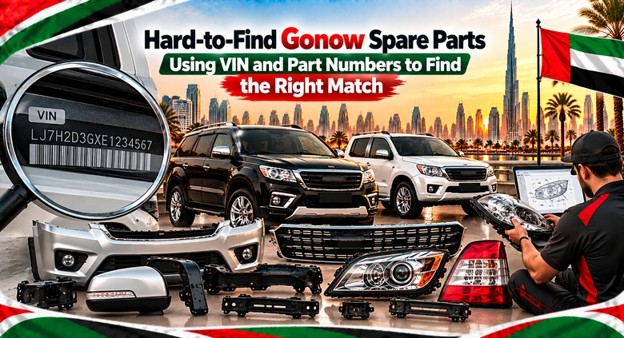
Hard-to-Find Gonow Spare Parts: Using VIN and Part Numbers to Find the Right Match
October 6, 2026
Finding a hard-to-source Gonow spare parts in UAE is rarely a simple stock-check exercise.
The seller says, “Yes, we have it.”
You send a photograph.
They send another photograph.
Someone asks for the model year. Someone else asks whether it is 4WD. Another supplier says the part fits “Gonow” without identifying the actual variant. Then, just when the price looks reasonable, the photograph arrives and the connector, mounting holes or body shape is different.
That is where the real problem begins.
With an older or less common vehicle, identification is part of the repair. A VIN can narrow the vehicle down. A part number can narrow the component down. Neither, by itself, should be treated as magical proof that the replacement will fit.
The safest search is a chain:
vehicle identity → exact application → original part → part number → physical comparison → supplier evidence → fitment confirmation.
Break that chain at any point and the bargain can become another parcel, another labour charge and another afternoon wasted.
Why Gonow parts can become difficult to identify
Gonow is not one vehicle.
That sounds obvious, but it is exactly the mistake behind many failed parts searches.
The marque has been used across pickups, SUVs and other utility vehicles, with different models and configurations appearing in different markets. Catalogue evidence for the 2014 Gonow Aoosed GX6, for example, identifies multiple 2.4-litre configurations with different engine codes and drivetrains.
So a request such as:
“I need a Gonow 2.4 headlight.”
is nowhere near specific enough.
Which model?
Which year?
Which body?
Which side?
Which market specification?
Which headlight design?
Which connector?
That is the difference between searching for a part and identifying one.
The model badge is only the beginning
For common cars, a make and model sometimes get you surprisingly close.
For a hard-to-find Gonow component, they may get you into the wrong catalogue altogether.
Take the GX6 as an example. Current catalogue data identifies a 2014 vehicle with 2.4-litre petrol variants producing 125 hp or 136 hp, including front-wheel-drive, all-wheel-drive and rear-wheel-drive configurations depending on version.
The badge alone therefore leaves several branches open.
A supplier who searches only “Gonow GX6 2014” may still need to establish which vehicle configuration is sitting in front of them.
This is why the VIN matters.
What the VIN actually contributes
A VIN is useful because it identifies the individual vehicle rather than merely describing the badge on its boot.
For difficult parts, that distinction matters.
Current UAE parts-sourcing services explicitly ask for the chassis/VIN so suppliers can search against the customer's actual vehicle rather than relying solely on make, model and year.
That does not mean every supplier has a perfect Gonow factory database.
It means the search begins with better evidence.
And with a rare part, better evidence is half the battle.
VIN is not a part number
These two identifiers do different jobs.
The VIN identifies the vehicle.
The part number identifies a component or component reference.
Confusing them creates a peculiar kind of false confidence.
You can have the correct VIN and still receive the wrong bumper.
You can have a genuine-looking part number and still discover that the number belongs to another application.
The strongest purchase combines both.
Start with the vehicle, not the broken component
When contacting a supplier, give the vehicle information first.
Ideally:
- full VIN/chassis number;
- model;
- model year;
- body type;
- engine information where known;
- drivetrain where relevant;
- market/import specification;
- left or right side;
- front or rear;
- photograph of the existing component.
This gives the supplier several independent clues.
If one clue is wrong, another may expose the mistake.
That is much safer than handing over a model name and hoping the catalogue does the rest.
Why the engine size is not enough
“2.4-litre Gonow” sounds precise.
It isn't.
The GX6 catalogue evidence demonstrates the problem neatly: its 2014 listings include a 2.4-litre 136 hp configuration using the 4G69-S4N and a 2.4-litre 125 hp configuration using the 4G64-S4M, with different drive configurations also recorded.
That is a useful warning for parts buying.
Engine displacement is one identifier.
It is not the whole vehicle identity.
For engine-related parts, cooling components, intake pieces, sensors, brackets and other application-sensitive components, engine family/code and production/application information can matter considerably.
The VIN should be supplied before the supplier searches
This is one of the simplest changes an owner can make.
Do not start with:
“Do you have a Gonow GX6 headlight?”
Start with:
“This is my VIN. I need the left front headlight for this vehicle. Here is a photograph of the existing unit.”
The second request gives the supplier something to investigate.
The first merely asks them to guess.
Current UAE sourcing services describe essentially this approach: the chassis number is passed to suppliers with the request so they are looking at the specific vehicle rather than only the make, model and year.
Take a photograph of the original part before removing it
This is particularly useful with rare Gonow components.
Photograph:
- the complete part;
- front face;
- rear face;
- mounting points;
- connectors;
- labels;
- stamped numbers;
- moulded numbers;
- barcode stickers;
- broken areas;
- surrounding vehicle location.
The photograph becomes a second identification record.
It also gives the supplier something physical to compare against.
For bodywork and lighting, that can be surprisingly valuable.
Find the number on the part itself
If the old part is still available, look for an identifier.
It may be:
- printed;
- stamped;
- moulded into plastic;
- attached to a label;
- laser-marked;
- printed on a barcode label.
Do not assume every number is the manufacturer's service part number.
Some markings identify moulds, suppliers, production batches or component revisions.
Still, they are useful clues.
Photograph the entire label rather than typing only the final six digits into a search engine.
The surrounding information may be what distinguishes one version from another.
Part numbers are powerful — and easy to misuse
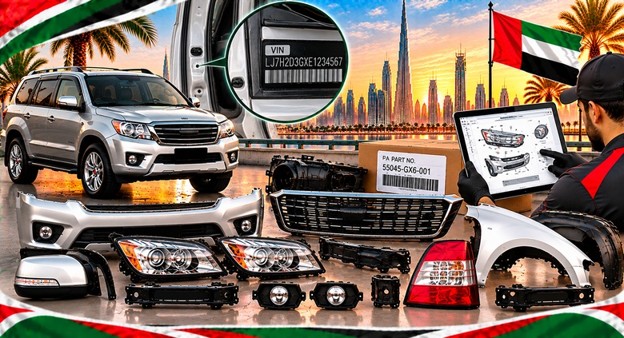
A part number feels definitive.
Sometimes it is.
But a number copied from an old forum post or an overseas listing is not automatically evidence that the component belongs on your UAE vehicle.
There can be:
- superseded numbers;
- revised components;
- regional versions;
- supplier references;
- aftermarket equivalents;
- catalogue transcription errors;
- model-specific applications.
The correct question is not:
“Does this number exist?”
It is:
“Does this number correspond to this vehicle and this exact component?”
That is a much higher standard.
Gonow part-number catalogues do exist
The lack of easy retail availability does not mean Gonow parts were never assigned proper references.
A current online catalogue for the Gonow Troy 500, for example, publishes numerous component references, including numbers such as 1706011-D11000, 1103010-401000 and many others.
Another Troy 500 parts listing contains a separate set of references covering additional vehicle systems.
These pages demonstrate something important:
Gonow part numbering can be much more detailed than the model name shown in a UAE classified advert.
That makes the number useful evidence — provided its application is verified.
Do not copy a part number from a different Gonow model
This is where rare-part searches become messy.
A supplier has a Gonow number.
You have a Gonow.
The number therefore “looks relevant”.
Stop there.
A Troy 500 number does not become a GX6 number because both vehicles carry the Gonow badge.
The same warning applies to GA200, Victory, pickup and other Gonow applications.
Older catalogue material also shows Gonow models appearing alongside other vehicle applications in cross-reference databases, which reinforces the need to verify the actual application rather than treating the brand name as sufficient.
The same-looking part may still be wrong
Visual similarity is one of the biggest traps in used-part buying.
Two headlights can have almost identical:
- lens shape;
- mounting tabs;
- reflector layout;
- connector position.
Then one has a different wiring arrangement.
Or a different bulb configuration.
Or a different internal adjustment mechanism.
Or slightly different mounting geometry.
The eye sees “same”.
The vehicle sees “wrong”.
For that reason, physical comparison should be part of the identification process, not an afterthought.
Compare mounting points before comparing the price
When a replacement arrives in photographs, ignore the price for a moment.
Look at:
mounting holes
tabs
brackets
connector
housing shape
bolt positions
clips
sensor openings
lamp openings
sealing surfaces
A component that fails these basic checks should not become more attractive because it is AED 100 cheaper.
Fitment is not a discount category.
Headlights need unusually careful identification
Lighting assemblies are particularly sensitive to specification changes.
Check:
- left/right side;
- lens shape;
- housing;
- mounting points;
- connector;
- bulb arrangement;
- adjustment mechanism;
- fog/indicator integration where applicable;
- any electronic control component;
- condition of the rear housing.
A seller's description saying “GX6 headlight” is not enough.
Ask for photographs of the back.
The rear of the lamp often tells you more than the front.
Bumpers can change with facelifts and body versions
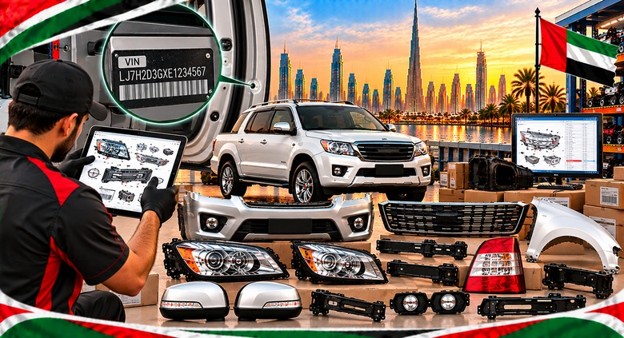
The front bumper is another part where a model name is too broad.
Differences may involve:
- grille opening;
- fog-lamp aperture;
- lower intake;
- parking-sensor holes;
- mounting brackets;
- upper edge;
- wheel-arch shape;
- reinforcement interface.
A bumper can therefore be approximately correct and still be wrong for the vehicle.
For an older Gonow, a photograph of the original bumper — especially its mounting and grille areas — can be more useful than another generic catalogue description.
Body panels need dimensional evidence
A bonnet, door, fender or tailgate should be checked beyond its outer silhouette.
Look at:
- hinge points;
- bolt holes;
- latch openings;
- inner reinforcement;
- edge profile;
- wheel-arch relationship;
- door shut line;
- adjacent panel interface.
A body panel that looks right lying on the floor can reveal its incompatibility only after the workshop tries to install it.
That is an expensive moment to discover an identification error.
Electrical parts need more than a part number
Sensors, control modules, switches and electronic assemblies deserve another layer of caution.
The part number should be checked against:
- VIN/application;
- connector;
- hardware revision;
- software/programming requirements where applicable;
- physical mounting;
- system compatibility.
A used electronic module can be physically identical to another unit and still require programming or belong to a different vehicle configuration.
That is why “same plug” is not proof.
Nor is “same number” necessarily enough if the number has been superseded.
Engine parts require application discipline
Engine-related Gonow searches can become especially confusing because some parts may have broader mechanical relationships while others are highly application-specific.
A current GX6 catalogue records different 2.4-litre engine configurations, including 4G69-S4N and 4G64-S4M applications.
So a request such as “Gonow 2.4 thermostat” should not be treated as complete identification.
The supplier should establish which engine application the vehicle actually carries.
Then confirm the component.
The part comes second.
Shared mechanical origins can help — but do not assume interchangeability
Older vehicles sometimes use components derived from larger supplier ecosystems.
That can widen the search.
It can also create a spectacular amount of misinformation.
A component associated with a Mitsubishi-derived engine, for example, may resemble or cross-reference with another application without being automatically correct for every Gonow installation.
The useful question is:
Has interchangeability been verified for this exact application?
Not:
“Does someone online say it is similar?”
Similarity is a lead.
Verified application is evidence.
What UAE parts suppliers should receive from you
A serious parts request can be surprisingly compact.
Send:
VIN/chassis number
Model and year
Part required
Left/right or front/rear position
Photograph of the old part
Photograph of the part number
Photograph of connector/mounting points where relevant
Engine/drivetrain information if relevant
That gives a dismantler or supplier enough material to start a useful search.
Current UAE sourcing services describe requests built around the vehicle identity, part requirement and actual photographs, with supplier options then documented using details such as condition, mileage, part number, fitment, warranty and return policy.
That is a much stronger process than sending a badge name into a WhatsApp group.
What a supplier should send back
The buyer should not have to reconstruct the evidence themselves.
Ask for:
- photograph of the actual part;
- visible part number;
- donor vehicle information if used;
- condition;
- mounting-point photographs;
- connector photographs where applicable;
- confirmation of fitment;
- price;
- warranty;
- return terms.
Current UAE sourcing services use essentially this evidence structure when documenting used components, including actual-part photographs rather than stock images.
For a hard-to-find Gonow part, that level of documentation is worth far more than a vague promise that “it should fit”.
The phrase “fits Gonow” should make you ask another question
Fits which Gonow?
This is not pedantry.
A catalogue that covers 50 makes and 60 part types can still produce the wrong answer if the vehicle application is entered incorrectly. Current UAE sourcing platforms themselves distinguish generation, facelift, trim and drivetrain because those details can change the component.
For Gonow, where public parts information is thinner, that discipline becomes even more important.
Ask for the exact application.
How to verify a part number before paying
Use a four-step check.
First: compare the number with the original component.
Second: confirm the number against the vehicle's VIN/application.
Third: compare the physical part — mounting, connector, dimensions and shape.
Fourth: obtain written confirmation of fitment and return conditions from the supplier.
If all four agree, the purchase has a much stronger evidence trail.
If one conflicts, stop.
Do not let a low price settle the argument.
What if the original part number is unreadable?
Then the VIN becomes more important.
So do photographs.
Take several.
If the component is broken, photograph the break and the undamaged side of the same component if possible. Compare left and right where the vehicle uses symmetrical parts.
For bodywork, measure obvious mounting distances if the workshop can do so accurately.
For electrical components, photograph the connector from multiple angles.
You are building an identification record because the label cannot do the job.
What if no catalogue shows the part?
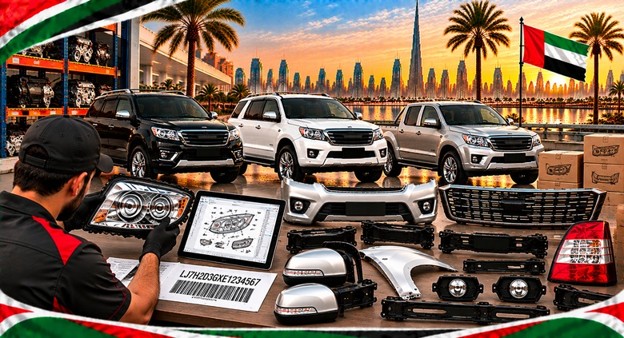
This happens with older vehicles.
Do not immediately conclude that the part does not exist.
Search in layers:
exact model
then model + component
then VIN/application
then part number
then supplier/dismantler inventory
then donor vehicle
then verified equivalent or superseded reference
This is where a parts marketplace can be useful. Current UAE sourcing services describe searching across hundreds of suppliers rather than relying on a single catalogue, particularly for rare vehicles.
The search method changes when the catalogue runs out.
Donor vehicles can solve what catalogues cannot
For a discontinued or uncommon Gonow, the most useful source may be another vehicle.
A dismantler can identify a donor, photograph the required component and provide the relevant vehicle information.
This is particularly useful for:
- body panels;
- headlights;
- grilles;
- mirrors;
- interior trim;
- switches;
- brackets;
- suspension components;
- engine accessories.
But donor matching still needs evidence.
“Same model” is a starting point, not a final answer.
Do not confuse a donor's identity with the replacement's condition
A perfect VIN match does not tell you whether the used part is good.
A donor vehicle may have:
- accident damage;
- flood exposure;
- high mileage;
- missing components;
- broken mounting points;
- corrosion;
- previous repairs.
That is why the evidence chain has two separate questions:
Will it fit?
Is it worth fitting?
VIN and part number primarily answer the first question.
Condition inspection answers the second.
The part-number trap: old references and newer references
Older Gonow documentation can contain long, manufacturer-style reference numbers, while aftermarket suppliers may use their own references.
A seller may therefore present:
- original reference;
- replacement/superseding reference;
- aftermarket number;
- internal stock number.
Those are not necessarily interchangeable identifiers.
Ask the seller exactly what the number represents.
If they cannot explain it, treat the number as a clue rather than proof.
When a cross-reference is genuinely useful
Cross-referencing can be valuable when the original Gonow part is unavailable.
But the cross-reference should be supported by evidence.
Useful evidence might include:
- verified catalogue application;
- manufacturer or supplier cross-reference;
- identical dimensions and mounting;
- matching connector;
- confirmed vehicle application;
- documented interchangeability.
A forum comment saying “I think this fits” belongs much lower on the evidence ladder.
For a cheap clip, perhaps that is tolerable.
For an engine, gearbox, ECU or complete lighting assembly, it is not.
The UAE market changes the search strategy
The UAE has a large used-parts ecosystem, but it is not one giant warehouse.
Current sourcing services describe searching suppliers across Sharjah, Ajman and Dubai, while other UAE market references identify established automotive clusters such as Sharjah's industrial areas, Al Sajaa, Dubai's Ras Al Khor and Al Quoz, and Abu Dhabi's Mussafah.
For a Gonow owner, that matters because the part may exist locally without appearing in a neat online catalogue.
The search may need to move from catalogue lookup to supplier discovery.
Why photographs can outperform a long description
Suppose you tell a dismantler:
“2014 Gonow, front bumper, 2.4.”
That is a start.
Now send photographs showing:
- the bumper;
- grille openings;
- mounting tabs;
- fog-lamp apertures;
- underside;
- nearby headlight.
Suddenly the supplier can compare the physical design.
For scarce body parts, this can eliminate ambiguity much faster than a long text description.
The same applies to connectors
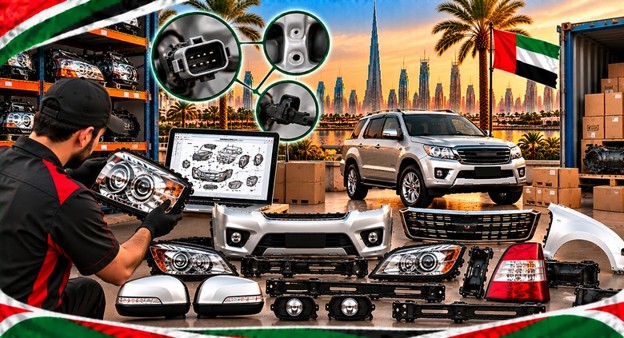
Electrical connectors are often excellent identifiers.
Photograph:
- connector face;
- number of pins;
- locking mechanism;
- wire arrangement;
- connector position on the housing.
Do not cut or alter the wiring simply to make the photograph easier.
The original connector is evidence.
Keep it intact.
A physical measurement can settle an argument
When catalogue data is poor, measurement can become useful.
For a body component, the workshop might compare:
- mounting-hole spacing;
- overall width;
- tab position;
- bolt diameter;
- connector dimensions.
This does not replace VIN or part-number verification.
It supplements it.
The goal is not to prove that two parts look similar.
The goal is to establish that the critical interfaces correspond.
Why “same year” is still not enough
Model years are messy.
Production changes can occur within a nominal year. Facelifts can alter bodywork. Imported vehicles can carry market-specific equipment.
Current UAE parts-sourcing guidance explicitly warns that manufacturers can change parts within a generation and that facelifts commonly alter lights and bumpers.
That lesson applies directly to Gonow sourcing.
A 2014 registration date is not the same thing as a complete engineering identity.
Imported Gonow vehicles need another layer of caution
If the vehicle entered the UAE as an import, establish its market origin where possible.
Ask:
- Was it GCC specification?
- Was it imported from another market?
- Does the lighting match the UAE vehicle?
- Does the bumper have the same equipment openings?
- Is the wiring arrangement identical?
- Does the VIN correspond to the same market specification?
Current UAE parts-sourcing guidance specifically recommends providing VIN information for imported cars because market differences can affect lighting, bumpers and cooling components.
That is exactly the sort of detail that can derail a rare-part purchase.
What your workshop should verify before ordering
For a difficult Gonow part, ask the workshop to record:
vehicle identification
damaged component
part number
physical interfaces
required supporting parts
fitment confirmation
installation requirements
If it is electronic, add:
coding/programming/calibration requirement
If it is bodywork, add:
paint and alignment requirement
If it is mechanical, add:
seals, fluids and associated components
The point is to prevent the workshop from discovering additional requirements after the part has already been ordered.
A hard-to-find part should have an evidence trail
This is the habit worth keeping.
Before paying, retain:
- VIN/chassis information;
- original-part photographs;
- original part number;
- supplier's photographs;
- replacement part number;
- fitment confirmation;
- price quotation;
- warranty;
- return policy;
- invoice.
For a common air filter, this may feel excessive.
For a discontinued Gonow headlight, it is sensible.
If the part turns out to be wrong, the evidence tells you exactly where the identification failed.
Where PartFinder UAE fits into a rare-part search
The useful role of PartFinder UAE in this situation is not simply to display another product listing.
The value is in making the search more evidence-led: vehicle identification first, supplier options second, actual-part photographs rather than generic images, and enough information for the buyer to compare condition and fitment before committing.
For older Gonow vehicles, that distinction matters because a conventional catalogue may simply return nothing.
No result does not necessarily mean no part exists.
It may mean the search method is too narrow.
What to do when two suppliers give different answers
This is where buyers often choose the cheaper answer.
Instead, compare the evidence.
Supplier A says:
“Fits GX6.”
Supplier B says:
“Fits GX6, part number shown, rear connector photographed, mounting tabs intact, VIN/application confirmed.”
Those are not equivalent statements.
The second supplier has supplied more evidence.
You do not need a rating system.
You need a paper trail.
Buyer decision matrix for difficult Gonow parts
| Situation | What to verify first | Evidence needed before buying |
| Common service component | Vehicle/application | Part number and application |
| Rare body panel | Model, year, body version | Photos + mounting points |
| Headlight | Exact application + side | Part number + connector + mounts |
| Bumper | Generation/facelift + body version | Physical comparison + openings |
| Engine component | Engine family/code | VIN + engine code + part reference |
| ECU/module | Exact vehicle/system | Part number + programming requirements |
| Used electronic part | Application + condition | Label + connector + donor details |
| Discontinued component | Vehicle identity | VIN + catalogue evidence + physical match |
| Imported vehicle | Market specification | VIN + market-specific comparison |
| Unnumbered part | VIN + photographs | Physical comparison + supplier confirmation |
The table is less about finding a universal answer than stopping the wrong question from being asked.
The five-minute pre-purchase check
Before transferring money, ask five things:
1. What is the exact part number?
2. Where was that number obtained — original part, catalogue or supplier database?
3. What exact Gonow application does it belong to?
4. Can I see the actual component and its mounting/connector areas?
5. What happens if it does not fit?
If the supplier answers all five clearly, the purchase has a sensible evidence base.
If the answer to three is “I think so”, the search is not finished.
When should you walk away?
Not because a part is used.
Not because it is old.
Not because the supplier is in another emirate.
Walk away when the critical identification evidence cannot be established.
For example:
- VIN/application is ignored;
- part number is unreadable or unexplained;
- actual-part photographs are refused;
- mounting points cannot be shown;
- connector differs;
- supplier cannot state what vehicle the part came from;
- return terms are unclear;
- the seller insists that “it should fit” is enough.
Scarcity is not a reason to lower every standard.
It is a reason to become more careful.
UAE Update Reference: September 2026
Current UAE sourcing information checked for this article shows a strong emphasis on chassis/VIN-based identification, actual-part photographs, part-number documentation and supplier-level fitment information.
Current catalogue evidence also confirms that Gonow applications can split into different configurations even within the same model and engine displacement.
The practical rule is therefore straightforward:
For a hard-to-find Gonow part, do not search harder until you have identified better.
Start with the VIN. Photograph the original component. Read every available marking. Verify the part number against the exact application. Compare the physical interfaces. Get the supplier's evidence in writing.
Then buy.
A rare part is not difficult merely because nobody has it listed.
Sometimes it is difficult because nobody has identified exactly which part you need.
FAQ
Categories
- Audi
- BMW
- Car Accessories
- Car Tips
- Ford
- Land Rover
- Mazda
- Range Rover
- Top 10
- UAE Car Parts
- Used Car Parts
- Toyota
- Replacement Engines
- Nissan
- Hyundai
- Mitsubishi
- Volkswagen
- Honda
- Kia
- Chevrolet
- Dodge
- Jeep
- Subaru
- Renault
- Lexus
- Mercedes
- Suzuki
- Hummer
- Porsche
- Infiniti
- Peugeot
- GMC
- Mini
- Volvo
- Replacement Gearboxes
- MG
- Jaguar
- Skoda
- Cadillac
- Daihatsu
- Fiat
- German Car Parts
- Japanese Car Parts
- Aftermarket Car Parts
- Genuine Car Parts
- New Car Parts
- Reconditioned Car Parts
- European Car Parts
- American Car Parts
- Korean Car Parts
- British Car Parts
- Chinese Car Parts
- Sports/Exotic Car Parts
- Luxury Car Parts
- Performance Car Parts
- SUV/4x4 Spare Parts
- Truck Spare Parts
- EV Car Parts
- Hybrid Car Parts
- Auto Spare Parts in UAE
- Tesla
- Isuzu
- Ram
- Ferrari
- Bentley
- Lamborghini
- Genesis
- Maserati
- Lincoln
- Chrysler
- Opel
- Citroen
- SsangYong
- Seat
- McLaren
- Aston Martin
- Rolls Royce
- Maybach
- Alfa Romeo
- Bugatti
- Scion
- Abu Dhabi Car Parts
- Ajman Car Parts
- Al Khan Car Parts
- Al Sajaa Car Parts
- Deira Car Parts
- Dubai Car Parts
- Fujairah Car Parts
- Industrial Area 6 Car Parts
- Mussafah Car Parts
- Ras Al Khaimah Car Parts
- Sharjah Car Parts
- Umm Al Quwain Car Parts
- Acura
- BYD
- Chery
- Dacia
- DS
- Geely Emgrand
- EXEED
- GAC
- GAC Gonow
- Geely
- Gonow
- Great Wall