Honda Civic and Accord Spare Parts in UAE: Common Parts Owners Need
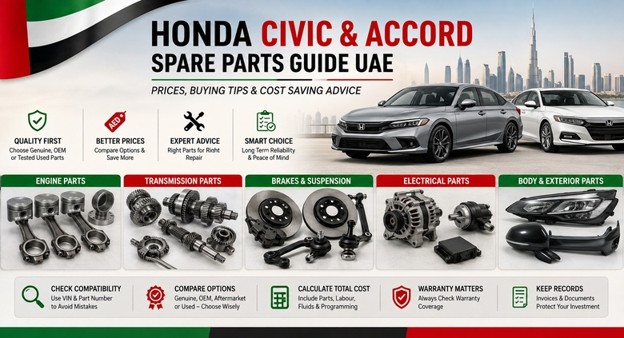
August 11, 2026
Honda Civic and Accord Spare Parts in UAE: What Owners Commonly Need
Honda Civic and Accord owners in the UAE have access to a large replacement-parts market, but finding the correct component is not always as simple as searching by model name.
A Civic used for daily Dubai commuting can require very different components from another Civic of the same generation. The same applies to the Accord. Engine specification, production year, transmission type, trim level and factory equipment can all affect compatibility.
Professional workshops therefore begin with diagnosis and vehicle identification before recommending any replacement part.
Commonly requested Honda Civic and Accord components include:
- Brake pads and discs.
- Suspension bushes and control arms.
- Shock absorbers.
- Engine mounts.
- Radiators.
- Water pumps.
- Thermostats.
- Alternators.
- Starter motors.
- Sensors.
- Spark plugs.
- Air-conditioning components.
- Gearbox components.
- Body panels.
- Headlights and tail lights.
- Electrical modules.
The correct replacement depends on the vehicle's exact specification rather than the model name alone.
Common Honda Civic and Accord Parts
| Part Category | Honda Civic | Honda Accord |
| Brake Components | Common | Common |
| Suspension Parts | Common | Common |
| Engine Mounts | Common | Common |
| Cooling Components | Common | Common |
| Electrical Components | Common | Common |
| Air-Conditioning Parts | Common | Common |
| Gearbox Components | Common | Common |
| Body Panels | Common | Common |
| Lighting | Common | Common |
| Electronic Modules | Common | Common |
Professional diagnosis should determine which component actually requires replacement.
Why Honda Civic and Accord Spare Parts Are Widely Available in the UAE
The Civic and Accord have maintained a strong presence in the UAE market for many years.
That creates a substantial ecosystem of genuine, OEM, professionally inspected used, reconditioned and aftermarket replacement components.
Dubai has a particularly broad network of automotive suppliers, while Sharjah is well known for its extensive used-parts market. Abu Dhabi also offers access to specialist workshops and genuine replacement components.
Owners in Ajman, Ras Al Khaimah, Fujairah and Umm Al Quwain can increasingly source parts through online suppliers that deliver across the Emirates.
This wider availability gives buyers an important advantage: comparison.
Instead of accepting the first quotation, owners can compare:
- Component condition.
- Supplier reputation.
- Warranty.
- Inspection reports.
- Compatibility.
- Delivery time.
- Labour requirements.
- Total repair cost.
A wider market is useful only when buyers know how to evaluate it.
Most Commonly Replaced Honda Civic Parts
The Honda Civic is widely used for commuting, family travel and everyday driving across the UAE.
Long periods in traffic, high summer temperatures and frequent stop-start driving can increase wear on several components.
Common Civic replacement parts include brake pads, control-arm bushes, shock absorbers, engine mounts, filters, batteries, cooling-system components and air-conditioning parts.
Higher-mileage Civics may also require attention to engine seals, suspension assemblies, alternators, starter motors and transmission-related components.
Honda Civic Common Parts Guide
| Component | Typical Reason for Replacement |
| Brake Pads | Friction Wear |
| Brake Discs | Wear and Heat |
| Control-Arm Bushes | Age and Road Stress |
| Shock Absorbers | Loss of Damping |
| Engine Mounts | Vibration and Deterioration |
| Battery | Age and Heat Exposure |
| Radiator | Leakage or Restricted Cooling |
| Water Pump | Wear or Coolant Leakage |
| Alternator | Charging Failure |
| Air-Conditioning Components | Reduced Cooling |
Not every symptom means the corresponding component has failed.
Professional inspection remains essential.
Most Commonly Replaced Honda Accord Parts
The Accord is generally larger and heavier than the Civic, and its replacement-part requirements can therefore differ.
Brake and suspension components experience substantial loads, particularly during frequent urban driving and motorway use.
Air-conditioning systems also receive heavy use in UAE conditions.
Common Accord replacement components include:
Brake pads.
Brake discs.
Control arms.
Suspension bushes.
Shock absorbers.
Engine mounts.
Radiators.
Water pumps.
Alternators.
Starter motors.
Air-conditioning components.
Transmission components.
Sensors.
Body panels.
Professional technicians inspect the complete system before recommending replacement.
Honda Accord Common Parts Guide
| Component | Typical Reason for Replacement |
| Brake Pads | Wear |
| Brake Discs | Wear and Heat |
| Control Arms | Bush or Joint Wear |
| Shock Absorbers | Reduced Damping |
| Engine Mounts | Excessive Vibration |
| Radiator | Leakage or Cooling Restriction |
| Water Pump | Mechanical Wear |
| Alternator | Charging Problems |
| AC Compressor | Cooling-System Failure |
| Transmission Components | Mechanical or Electronic Faults |
Correct diagnosis prevents unnecessary purchases.
Honda Civic vs Accord Spare Parts: What Is Different
The Civic and Accord share Honda engineering principles, but their components should never be assumed to be interchangeable.
Even where two parts look similar, differences may exist in:
- Dimensions.
- Mounting points.
- Electrical connectors.
- Engine specifications.
- Transmission systems.
- Suspension geometry.
- Brake dimensions.
- Electronic calibration.
A Civic component should not be installed on an Accord simply because both vehicles are Hondas.
The same caution applies across different generations of the same model.
Civic vs Accord Compatibility
| Area | Civic | Accord |
| Engine Components | Model-Specific | Model-Specific |
| Gearbox Components | Specification Dependent | Specification Dependent |
| Suspension | Different Geometry | Different Geometry |
| Brake System | Model/Trim Dependent | Model/Trim Dependent |
| Lighting | VIN/Specification Dependent | VIN/Specification Dependent |
| Electronic Modules | VIN/Software Dependent | VIN/Software Dependent |
| Body Panels | Not Interchangeable by Assumption | Not Interchangeable by Assumption |
VIN and part-number verification should settle compatibility questions.
How to Choose the Correct Honda Spare Part for Your Car
The safest approach is to identify the vehicle precisely before contacting a supplier.
Start with the VIN.
Then confirm the Honda part number where available.
For mechanical components, also verify the engine and transmission codes.
For electronic components, software and programming compatibility may be equally important.
For body parts, trim level, sensors, cameras and lighting equipment can affect fitment.
Professional Compatibility Checklist
| Verification | Importance |
| VIN | Mandatory |
| Honda Part Number | Mandatory |
| Production Year | Important |
| Engine Code | Important for Engine Parts |
| Transmission Code | Important for Gearbox Parts |
| Trim Level | Important for Body/Electronic Parts |
| Connector Configuration | Important for Electrical Parts |
| Software Compatibility | Essential for Electronic Modules |
A professional supplier should be willing to confirm these details before accepting an order.
Genuine, OEM, Used and Aftermarket Honda Parts
Honda owners have several purchasing options in the UAE.
Genuine Honda parts provide factory-branded components and are often preferred for safety-critical and highly integrated systems.
OEM components can offer excellent quality from established equipment manufacturers.
Professionally inspected used parts can provide strong value, particularly for body panels, engines, gearboxes and selected electronic components.
Reconditioned parts can be attractive when a major assembly has been professionally rebuilt and tested.
Premium aftermarket components may be suitable for selected wear and maintenance items.
The appropriate category depends on the component, vehicle age, budget and intended ownership period.
Honda Parts Choice
| Part Type | Typical Strength |
| Genuine | Factory Compatibility |
| OEM | Quality and Value |
| Professionally Inspected Used | Cost Saving with Original Engineering |
| Reconditioned | Rebuilt Major Components |
| Premium Aftermarket | Competitive Maintenance Cost |
Low-quality unknown components should not be confused with reputable aftermarket products.
Buying Honda Civic and Accord Spare Parts Online in the UAE
Online purchasing has made it easier for owners to compare suppliers before committing to a repair.
A professional online buying process should look something like this:
Diagnose → Identify → Verify → Compare → Inspect → Purchase → Install → Test
This sequence matters.
Ordering first and diagnosing later can result in the wrong component arriving at the workshop.
For expensive assemblies such as engines, gearboxes and ECUs, buyers should request supporting documentation before making payment.
For used mechanical components, inspection reports can provide valuable evidence of condition.
For electronic components, VIN matching and programming requirements should be confirmed in advance.
UAE Climate and Honda Parts Wear
The UAE's operating environment deserves special consideration when evaluating Honda replacement parts.
Summer temperatures can be extreme.
Vehicles may spend long periods exposed to heat while parked, followed by heavy air-conditioning use during daily journeys.
Dubai traffic can create prolonged periods of low-speed operation and repeated braking.
Long motorway journeys between Dubai and Abu Dhabi place different demands on tyres, suspension, cooling and drivetrain systems.
These conditions make preventive inspection particularly valuable.
UAE Conditions Affecting Honda Components
| UAE Condition | Components That May Receive Greater Stress |
| Extreme Heat | Batteries, Cooling System, AC Components |
| Stop-Start Traffic | Brakes, Transmission, Cooling System |
| Poor Road Surfaces | Suspension, Steering, Wheels |
| Long Motorway Journeys | Tyres, Brakes, Cooling System |
| Heavy AC Use | Compressor, Condenser, Cooling Fans |
| Dusty Conditions | Air Filters, AC Filters, Cooling Surfaces |
The UAE environment does not automatically cause component failure, but it makes preventive maintenance more important.
Real UAE Workshop Example — Honda Civic
Mileage: 219,000 km
Customer Complaint: Excessive vibration when the vehicle was stationary with the air-conditioning running.
The owner initially suspected a failing air-conditioning compressor.
Professional technicians checked:
- Engine mounts.
- Idle speed.
- Compressor operation.
- Engine fault codes.
- Cooling-fan operation.
The compressor was operating normally.
The main problem was a deteriorated engine mount combined with an unstable idle caused by a separate intake-system issue.
Replacing the mount and correcting the intake fault restored smooth operation.
The owner avoided an unnecessary compressor purchase.
Real UAE Workshop Example — Honda Accord
Mileage: 251,000 km
Customer Complaint: Front-end knocking over uneven roads.
The owner planned to purchase a complete suspension kit online.
Professional inspection found:
- Worn lower control-arm bushes.
- One deteriorated stabiliser-link component.
- Serviceable shock absorbers.
- Healthy wheel bearings.
Only the defective components required replacement.
The repair restored the vehicle's handling without unnecessarily replacing the entire suspension system.
UAE Labour Planning for Common Honda Repairs
| Repair | Dubai Specialist (AED) | Sharjah Independent (AED) | Abu Dhabi Specialist (AED) |
| Brake Pad Installation | 180–450 | 130–350 | 200–500 |
| Control-Arm Replacement | 350–850 | 250–650 | 400–900 |
| Shock Absorber Replacement | 450–1,000 | 350–750 | 500–1,100 |
| Radiator Replacement | 500–1,200 | 350–900 | 550–1,300 |
| Alternator Replacement | 350–800 | 250–600 | 400–850 |
| Diagnostic Inspection | 300–650 | 220–500 | 350–700 |
Actual labour depends on vehicle generation, workshop equipment, component accessibility and repair complexity.
Professional Honda Civic and Accord Parts Buying Checklist
Before purchasing any replacement part online or from a local supplier:
- Confirm the actual fault through professional diagnosis.
- Record the VIN.
- Confirm the Honda part number.
- Verify engine and transmission specifications where applicable.
- Compare genuine, OEM, professionally inspected used and premium aftermarket options.
- Request inspection reports for major used components.
- Review warranty coverage.
- Compare delivery times.
- Calculate labour and supporting-part costs.
- Retain invoices and repair documentation.
Key Takeaways
Honda Civic and Accord owners in the UAE have access to a broad spare-parts market, but the large choice makes accurate identification more important, not less. Common replacement components include brakes, suspension parts, engine mounts, cooling components, electrical parts, air-conditioning components, transmission parts, body panels and lighting. The correct choice should always be based on VIN verification, Honda part-number matching, professional diagnosis and the vehicle's exact specification. This approach helps owners across Dubai, Abu Dhabi, Sharjah, Ajman, Ras Al Khaimah, Fujairah and Umm Al Quwain control repair costs while protecting reliability and long-term resale value.
Honda Civic Engine Parts Owners Commonly Replace
A Honda Civic engine can run for a very long time when it is serviced properly. But UAE driving is not exactly gentle on an ageing engine. Long traffic queues, repeated heat cycles, heavy air-conditioning use and the occasional hard motorway run all add up.
That does not mean every high-mileage Civic needs a major engine rebuild. Far from it.
Quite often, the problem comes down to one supporting component.
Engine mounts soften. Seals start sweating. Belts crack. Sensors become unreliable. Cooling components lose efficiency. And when one small issue gets ignored for too long, it can drag another component into the mess.
Common Honda Civic engine-related replacement parts include:
- Engine mounts.
- Oil seals and gaskets.
- Drive belts.
- Tensioners and pulleys.
- Water pumps.
- Thermostats.
- Spark plugs.
- Ignition coils.
- PCV valves.
- Engine sensors.
- Air-intake components.
The right repair depends on the actual fault, not simply the mileage shown on the dashboard.
Honda Civic Engine Parts Commonly Replaced
| Component | Common Reason for Replacement | Priority |
| Engine Mount | Vibration, cracking or collapse | High |
| Drive Belt | Cracking or deterioration | High |
| Tensioner | Noise or belt instability | High |
| Water Pump | Coolant leakage or bearing wear | High |
| Thermostat | Incorrect engine temperature | High |
| Spark Plugs | Wear and poor combustion | Routine |
| Ignition Coil | Misfire or poor acceleration | Diagnostic |
| PCV Valve | Oil vapour and crankcase issues | Moderate |
| Oil Seals | Oil leakage | Moderate |
| Engine Sensors | Incorrect readings or fault codes | Diagnostic |
A warning light does not automatically tell you which part has failed. Get the fault traced first.
Honda Accord Engine Parts Owners Commonly Replace
The Accord's larger engine options and heavier overall vehicle can put different demands on its mechanical components.
Older Accords in particular may arrive at workshops with a familiar combination of age-related wear and heat exposure. An engine can still have plenty of life left, yet its surrounding components may have started to give up.
Engine mounts are a good example.
A worn mount can make the whole car feel rough at idle, especially when the air-conditioning compressor cycles on. Owners sometimes assume the engine itself is failing. It may not be.
Other commonly replaced Accord engine components include:
- Water pumps.
- Thermostats.
- Engine mounts.
- Drive belts.
- Belt tensioners.
- Oil seals.
- Valve-cover gaskets.
- Ignition coils.
- Spark plugs.
- Crankshaft and camshaft sensors.
- PCV components.
Honda Accord Engine Parts Guide
| Component | Typical Warning Sign |
| Engine Mounts | Excessive vibration |
| Water Pump | Coolant loss or bearing noise |
| Thermostat | Temperature fluctuation |
| Drive Belt | Squealing or visible cracking |
| Tensioner | Belt noise or movement |
| Valve-Cover Gasket | Oil seepage |
| Spark Plugs | Misfire or rough running |
| Ignition Coil | Cylinder-specific misfire |
| Crankshaft Sensor | Starting or running problems |
| Camshaft Sensor | Starting or performance problems |
Some faults overlap. That is why proper testing matters.
Honda Civic Engine Mounts and Supporting Components
Engine mounts rarely receive much attention until the vehicle starts shaking.
Then suddenly, they become very noticeable.
A Civic with worn mounts can develop vibration through the steering wheel, seats and dashboard. The sensation may become stronger when selecting Drive, switching on the air conditioning or pulling away from a standstill.
But replacing every mount immediately is not always necessary.
A technician should inspect the complete mounting system and check for:
- Torn rubber.
- Collapsed hydraulic mounts.
- Excessive engine movement.
- Oil contamination.
- Damaged brackets.
- Loose mounting bolts.
Oil contamination deserves particular attention because leaking engine oil can gradually deteriorate rubber mounting material.
Supporting Engine Components Worth Checking
| Component | Why Inspect It? |
| Engine Mounts | Control engine movement |
| Mounting Brackets | Prevent structural movement |
| Drive Belt | Transfers accessory power |
| Belt Tensioner | Maintains correct belt tension |
| Pulleys | Prevent belt tracking problems |
| Oil Seals | Control lubricant leakage |
| PCV System | Controls crankcase pressure |
| Intake Hoses | Prevent unmetered air entering engine |
Fixing the root cause early can stop a small repair from turning into a bigger one.
Honda Accord Engine Mounts and Supporting Components
Accord engine mounts can deteriorate gradually, particularly on higher-mileage cars.
The first clue may be a mild vibration. Then it becomes more obvious.
At idle, the cabin might feel slightly rough. When shifting from Park to Drive, there may be a noticeable thump. Under acceleration, the engine may move more than it should.
A professional inspection can separate mount failure from problems involving ignition, fuel delivery, air intake or transmission operation.
That distinction matters because the repair bills can be very different.
Honda Accord Mount Inspection
| Inspection Point | What Technicians Look For |
| Rubber Mount | Splitting or collapse |
| Hydraulic Mount | Fluid leakage |
| Brackets | Cracks or movement |
| Engine Movement | Excessive rocking |
| Mount Bolts | Looseness |
| Nearby Components | Contact or secondary damage |
Do not let an engine-mount problem get mistaken for an engine failure.
Honda Civic Timing Belt, Chain and Tensioner Parts
Timing components deserve serious attention because they control the relationship between the engine's internal moving parts.
Depending on the Civic generation and engine specification, the timing system can use a belt or chain arrangement. That distinction matters when sourcing replacement parts.
A professional workshop should verify the exact engine code before ordering a timing component.
The complete timing system may include:
- Timing belt or chain.
- Tensioner.
- Idler components.
- Guides where applicable.
- Water pump on certain belt-driven configurations.
- Associated seals.
Replacing one worn component while leaving a badly deteriorated supporting component behind can be false economy.
Timing System Inspection Guide
| Part | What to Check |
| Timing Belt | Cracks, wear and age |
| Timing Chain | Stretch and abnormal noise |
| Tensioner | Bearing condition and tension |
| Guides | Wear or damage |
| Water Pump | Leakage and bearing condition |
| Seals | Oil or coolant leakage |
If the timing system is due for major service, ask the workshop whether related components should be renewed at the same time.
Honda Accord Timing Components and Common Replacement Parts
Accord timing-system requirements vary considerably between generations and engines, so a generic parts list can easily send an owner in the wrong direction.
Start with the engine code.
Then match the exact component.
A professional technician may inspect the timing system for abnormal noise, visible wear, oil contamination, tensioner movement or evidence of previous repair work.
If the engine uses a timing chain, a rattling noise during cold starting can sometimes point towards chain, tensioner or guide problems. But don't jump to that conclusion from noise alone. Oil pressure, actuator operation and other mechanical factors can create similar symptoms.
For belt-equipped engines, age and service history become especially important.
Accord Timing Component Checklist
| Component | Inspection Focus |
| Timing Belt | Age, cracking and service history |
| Timing Chain | Stretch and noise |
| Tensioner | Correct operation |
| Chain Guides | Wear |
| Water Pump | Leakage and bearing condition |
| Camshaft Seals | Oil leakage |
| Crankshaft Seal | Oil leakage |
| Timing Cover | Sealing condition |
A complete timing-system inspection is usually more useful than replacing a single part on guesswork.
Real UAE Workshop Example — Honda Civic
A Honda Civic with around 226,000 km arrived at a Dubai workshop with a strong vibration at idle.
The owner had already searched online for an engine replacement.
That sounded excessive.
The technician checked engine compression, ignition performance, idle data and mount movement. The engine itself was healthy. One engine mount had collapsed, while another showed significant deterioration.
The mounts were replaced and the idle returned to normal.
No replacement engine was required.
This is precisely why diagnosis should come before parts shopping.
Real UAE Workshop Example — Honda Accord
A high-mileage Honda Accord came in with a faint rattling sound during cold starts.
The owner suspected a serious internal engine problem and began looking at replacement engines online.
The workshop inspected the timing system, engine oil condition, tensioner operation and related components.
The internal engine remained healthy.
The issue was traced to a worn timing-system component, which was replaced before the problem developed into something more serious.
A relatively focused repair saved the owner a much larger engine-replacement bill.
UAE Labour Cost Comparison for Engine-Related Repairs
| Service | Dubai Specialist (AED) | Sharjah Independent (AED) | Abu Dhabi Specialist (AED) |
| Engine Mount Replacement | 350–900 | 250–700 | 400–1,000 |
| Drive Belt Replacement | 180–450 | 130–350 | 200–500 |
| Tensioner Replacement | 250–650 | 180–500 | 300–700 |
| Water Pump Replacement | 600–1,500 | 450–1,150 | 700–1,650 |
| Timing System Service | 900–2,200 | 700–1,700 | 1,000–2,400 |
| Engine Diagnostic Inspection | 300–650 | 220–500 | 350–700 |
Actual labour varies by generation, engine configuration, accessibility and workshop equipment.
Professional Buying Checklist
Before ordering Honda Civic or Accord engine parts online:
- Confirm the exact engine code.
- Verify the VIN.
- Match the Honda part number.
- Check whether the vehicle uses a timing belt or chain.
- Inspect supporting components rather than replacing one part blindly.
- Request a diagnostic report when an electronic component is involved.
- Ask for warranty coverage on major components.
- Compare genuine, OEM and professionally inspected used options.
- Include labour, fluids and related components in the repair budget.
- Keep the invoice and technical records after installation.
Key Takeaways
Honda Civic and Accord engine repairs do not always mean major engine work. Quite often, the culprit sits around the engine: a mount, belt, tensioner, water pump, thermostat, sensor or sealing component. UAE heat and heavy daily use can expose weaknesses sooner, but good diagnosis keeps the repair focused. Verify the engine code and VIN, match the Honda part number, inspect supporting components and compare the complete repair cost before buying. That approach helps owners avoid throwing money at the wrong part while keeping their Civic or Accord dependable on Dubai's roads and across the wider UAE.
Honda Civic Radiator and Cooling System Parts
The cooling system does a huge job quietly.
You notice it only when something goes wrong.
A Honda Civic can sit in Dubai traffic with the air conditioning running while temperatures outside climb sharply. The radiator, cooling fans, thermostat, water pump and coolant system then have to keep the engine within its normal operating range, despite the conditions.
That is why cooling-system parts deserve more attention in the UAE than a quick visual inspection often gives them.
Common Civic cooling components include:
- Radiators.
- Radiator fans.
- Cooling fan motors.
- Thermostats.
- Water pumps.
- Radiator caps.
- Coolant hoses.
- Expansion tanks.
- Coolant temperature sensors.
- Seals and associated fittings.
A coolant leak is obvious when it leaves a puddle. But not every cooling-system problem announces itself so clearly.
A weak fan, restricted radiator or faulty thermostat can gradually push operating temperatures in the wrong direction.
Honda Civic Cooling Parts
| Component | Common Problem |
| Radiator | Leakage or restricted coolant flow |
| Cooling Fan | Poor airflow at low speed |
| Fan Motor | Intermittent or complete failure |
| Thermostat | Incorrect coolant circulation |
| Water Pump | Leakage or bearing wear |
| Radiator Cap | Loss of system pressure |
| Coolant Hose | Cracking or leakage |
| Expansion Tank | Cracks or coolant loss |
| Temperature Sensor | Incorrect temperature signal |
Do not replace the radiator simply because the engine is running hot. Find out why first.
Honda Accord Radiator and Cooling System Parts
The Accord faces much the same UAE climate, but its larger engine options and vehicle size can make cooling-system performance particularly important.
A cooling problem that seems minor in January can become much more obvious when summer arrives.
Technicians commonly inspect the radiator, cooling fans, thermostat, water pump, hoses and coolant condition when an Accord shows signs of overheating.
Warning signs can include:
- Temperature gauge rising.
- Coolant smell.
- Coolant level repeatedly dropping.
- Cooling fan running unusually often.
- Poor air-conditioning performance while stationary.
- Steam or visible coolant leakage.
- Engine temperature increasing in traffic.
One symptom can have several causes, so a pressure test and proper diagnosis are usually worth doing.
Honda Accord Cooling System Checklist
| Component | What to Inspect |
| Radiator | Leaks, blockage and condition |
| Cooling Fans | Operation and speed |
| Water Pump | Leakage and bearing condition |
| Thermostat | Opening temperature |
| Hoses | Swelling, cracking and softness |
| Expansion Tank | Cracks and coolant loss |
| Radiator Cap | Pressure retention |
| Coolant | Level, condition and contamination |
A healthy cooling system protects much more than the radiator itself. It protects the engine.
Honda Civic Water Pump and Thermostat Replacement
The water pump and thermostat perform different jobs, yet problems with either component can produce confusingly similar symptoms.
The water pump circulates coolant.
The thermostat regulates when coolant flows through the wider cooling circuit.
A failing water pump may develop a coolant leak, bearing noise or inadequate circulation. A faulty thermostat can remain stuck open or closed, creating temperature-control problems.
And then there is the awkward middle ground: a component may still work, but not properly.
Water Pump vs Thermostat
| Component | Primary Function | Possible Failure Sign |
| Water Pump | Circulates Coolant | Leakage, Noise, Poor Circulation |
| Thermostat | Controls Coolant Flow | Temperature Fluctuation |
| Radiator | Removes Heat | High Temperature, Leakage |
| Fan | Provides Airflow | Overheating in Traffic |
| Hose | Carries Coolant | Leakage or Swelling |
Replacing the wrong component will not solve the underlying fault.
Honda Accord Water Pump and Thermostat Replacement
Accord owners sometimes notice temperature fluctuations before an obvious overheating event occurs.
That should not be brushed aside.
A thermostat that does not regulate correctly can affect warm-up time and operating temperature. A water pump with internal wear may not circulate coolant efficiently enough under demanding conditions.
Professional technicians normally check the entire system rather than treating the thermostat or water pump in isolation.
They may carry out:
- Cooling-system pressure testing.
- Temperature monitoring.
- Water-pump inspection.
- Thermostat testing.
- Fan-operation checks.
- Coolant-flow assessment.
- Diagnostic scanning.
The exact repair depends on what the tests reveal.
Cooling-System Diagnostic Sequence
| Test | Purpose |
| Pressure Test | Finds leaks |
| Temperature Test | Confirms operating range |
| Fan Test | Checks airflow |
| Thermostat Test | Confirms regulation |
| Water Pump Inspection | Checks circulation and mechanical condition |
| Coolant Inspection | Detects contamination or degradation |
| Diagnostic Scan | Checks electronic faults |
A proper diagnosis can save the cost of replacing several good components.
Honda Civic Air-Conditioning Compressor and Condenser Parts
In the UAE, air conditioning is not a luxury.
It is part of everyday vehicle use.
A Civic's AC system may run heavily during summer commutes, especially when the vehicle spends twenty or thirty minutes crawling through traffic. That makes compressor, condenser, cooling-fan and refrigerant-system condition particularly important.
Common AC-related replacement components include:
- AC compressors.
- Condensers.
- Receiver-driers.
- Expansion valves.
- Pressure sensors.
- AC fans.
- O-rings and seals.
- Refrigerant lines.
But weak cooling does not automatically mean the compressor has failed.
Low refrigerant, a blocked condenser, poor airflow, electrical problems or a faulty pressure sensor can create similar complaints.
Honda Civic AC Parts
| Component | Common Warning Sign |
| Compressor | Weak or inconsistent cooling |
| Condenser | Poor heat rejection or leakage |
| Cooling Fan | AC weak while stationary |
| Pressure Sensor | Incorrect compressor operation |
| Expansion Valve | Incorrect refrigerant flow |
| O-Rings/Seals | Refrigerant leakage |
| Refrigerant Lines | Leakage or damage |
Diagnose the AC system before buying an expensive compressor.
Honda Accord Air-Conditioning Parts for UAE Summer Conditions
An Accord with weak air conditioning can become uncomfortable very quickly during a UAE summer.
If the AC cools reasonably well while driving but struggles badly at traffic lights, airflow and condenser cooling deserve attention.
The problem could involve:
- Cooling fan performance.
- Condenser condition.
- Refrigerant charge.
- Compressor efficiency.
- Pressure sensors.
- Electrical controls.
A technician should check operating pressures and system performance rather than simply topping up refrigerant.
A refrigerant top-up may temporarily improve cooling, but if the system is losing refrigerant, the leak still needs to be found.
AC Symptom Guide
| Symptom | Possible Area to Investigate |
| Cold While Driving, Warm at Idle | Fan/Condenser/Airflow |
| No Cooling | Compressor, Refrigerant or Electrical System |
| Intermittent Cooling | Pressure or Electrical Control |
| Unusual Compressor Noise | Compressor or Belt System |
| Refrigerant Repeatedly Low | Possible Leak |
| Weak Airflow | Cabin Filter or Blower System |
Never assume the most expensive component is the faulty one.
UAE Summer and Honda Cooling-System Stress
The UAE climate changes the way owners should think about preventative maintenance.
A cooling system that barely copes during mild weather may struggle badly once temperatures rise.
Traffic makes the situation more demanding because the vehicle cannot rely on natural airflow through the radiator and condenser.
The cooling fans therefore become especially important.
Before the hottest months, professional workshops often recommend checking:
- Coolant level.
- Coolant concentration.
- Radiator condition.
- Cooling-fan operation.
- Water-pump condition.
- Thermostat operation.
- Hose condition.
- AC condenser cleanliness.
A ten-minute inspection can uncover something that would otherwise become a roadside breakdown.
Common Cooling-System Warning Signs
Owners should take unusual temperature behaviour seriously.
Look out for:
- Temperature gauge moving higher than usual.
- Coolant disappearing without an obvious explanation.
- Sweet coolant smell around the engine bay.
- Fan running continuously.
- Fan failing to operate.
- Steam after driving.
- AC performance dropping at idle.
- Visible coolant residue around hoses or the radiator.
Do not keep driving an overheating vehicle simply because it still starts and moves.
Repeated overheating can cause far more expensive engine damage.
Warning Signs and Response
| Warning Sign | Recommended Action |
| Slight Coolant Loss | Inspect Promptly |
| Temperature Fluctuation | Diagnose Soon |
| Persistent Overheating | Stop and Investigate |
| Steam | Stop Driving |
| Coolant Leak | Repair Before Continued Use |
| AC Weak at Idle | Inspect Cooling/AC Airflow |
| Cooling Fan Failure | Repair Promptly |
Prevention is considerably cheaper than repairing heat-related engine damage.
Real UAE Workshop Example — Honda Civic
A Civic owner in Dubai noticed that the air conditioning became noticeably warmer while sitting in traffic.
On the motorway, it cooled again.
The owner assumed the AC compressor was failing and started looking for a replacement.
The workshop tested the compressor and refrigerant system first.
The compressor was healthy.
The condenser fan motor, however, was operating intermittently.
Once the fan motor was replaced, the AC returned to normal performance even during prolonged traffic.
The lesson is simple: symptom and cause are not always the same thing.
Real UAE Workshop Example — Honda Accord
A high-mileage Accord arrived with repeated coolant loss.
There was no large puddle underneath the car, so the owner initially assumed the coolant was simply being consumed.
A pressure test revealed a small leak around a deteriorated hose connection.
The hose and seal were replaced, the cooling system was refilled correctly and the vehicle was road-tested.
The engine never required replacement.
Catching the leak early kept the repair relatively straightforward.
UAE Labour Cost Comparison for Cooling and AC Repairs
| Service | Dubai Specialist (AED) | Sharjah Independent (AED) | Abu Dhabi Specialist (AED) |
| Radiator Replacement | 500–1,200 | 350–900 | 550–1,300 |
| Water Pump Replacement | 600–1,500 | 450–1,150 | 700–1,650 |
| Thermostat Replacement | 300–750 | 220–550 | 350–800 |
| Cooling Fan Motor | 300–800 | 220–600 | 350–900 |
| AC Compressor Replacement | 700–1,600 | 500–1,200 | 800–1,800 |
| AC System Diagnosis | 250–600 | 180–450 | 300–650 |
| Cooling-System Pressure Test | 250–500 | 180–400 | 300–550 |
Actual charges vary by Civic or Accord generation, engine specification and component accessibility.
Professional Buying Checklist
Before buying Honda Civic or Accord cooling or AC parts:
- Confirm the exact vehicle specification.
- Verify the VIN and Honda part number.
- Diagnose the cooling or AC fault first.
- Check whether supporting components have also deteriorated.
- Request compatibility confirmation from the supplier.
- Compare genuine, OEM and professionally inspected used options where appropriate.
- Ask about warranty coverage.
- Include coolant, refrigerant, seals and labour in the total repair budget.
- Test the complete system after installation.
Key Takeaways
Honda Civic and Accord cooling and air-conditioning systems deserve particular attention in the UAE. Extreme summer temperatures, heavy AC use and slow-moving traffic can expose weak cooling components quickly. A radiator, thermostat, water pump, cooling fan or AC component should never be replaced simply because one symptom appears. Test the system, trace the fault and then buy the correct part. That approach keeps repair costs under control and, more importantly, helps prevent a small cooling problem from turning into serious engine damage.
Honda Civic Gearbox Parts Owners Commonly Need
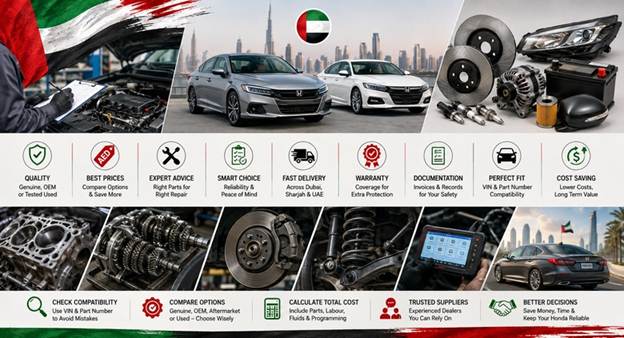
The gearbox rarely gives up without warning.
Sometimes it does, of course. But more often, there are clues first: delayed engagement, harsh shifting, unusual whining, transmission warning lights or a change in the way the car responds when pulling away.
Honda Civic owners in the UAE need to pay particular attention to transmission behaviour because daily stop-start traffic can put repeated demands on the drivetrain. A car crawling through Dubai traffic for an hour is working differently from one cruising steadily on an open road.
Common Civic gearbox-related replacement components include:
- Transmission mounts.
- Transmission fluid.
- Fluid filters where applicable.
- Solenoids.
- Sensors.
- Valve-body components.
- Seals and gaskets.
- CVT-related components.
- Bearings.
- Complete replacement gearboxes where internal damage is confirmed.
But here is the important bit: a transmission fault code does not automatically mean the gearbox itself needs replacing.
A proper diagnostic assessment comes first.
Honda Civic Gearbox Parts Guide
| Component | Common Reason for Replacement |
| Transmission Mount | Vibration or excessive movement |
| Transmission Fluid | Age or contamination |
| Solenoid | Shifting or pressure fault |
| Transmission Sensor | Incorrect signal |
| Seals | Fluid leakage |
| Valve-Body Components | Hydraulic control problems |
| CVT Components | Internal wear or pressure problems |
| Complete Gearbox | Severe internal damage |
A complete gearbox replacement should be the last conclusion of a proper diagnosis, not the first guess.
Honda Accord Gearbox Parts Owners Commonly Need
The Accord has been sold with different transmission configurations across generations and engine specifications.
That matters.
An Accord transmission part that fits one generation may be completely unsuitable for another.
Owners should therefore provide the VIN, production year, engine code and transmission specification when asking a supplier for a replacement component.
Common Accord transmission-related parts include:
- Transmission mounts.
- Solenoids.
- Transmission sensors.
- Seals.
- Gaskets.
- Fluid.
- Valve-body components.
- CVT components on applicable models.
- Automatic transmission assemblies.
- Transmission control modules.
Honda Accord Gearbox Replacement Guide
| Part | What Can Go Wrong? |
| Transmission Mount | Excessive vibration |
| Fluid | Contamination or deterioration |
| Solenoid | Incorrect hydraulic control |
| Sensor | Incorrect transmission data |
| Seal | Fluid leakage |
| Valve Body | Shifting or pressure problems |
| Transmission Control Module | Electronic faults |
| Complete Gearbox | Severe mechanical damage |
Transmission problems should be diagnosed using both mechanical and electronic evidence.
Honda Civic CVT Transmission Components
Civic models equipped with CVT transmissions require a slightly different approach to diagnosis and maintenance.
The CVT does not operate like a conventional stepped automatic gearbox. Its pulley-and-belt system relies on precise hydraulic control, correct fluid condition and electronic management.
That means the wrong fluid can create serious problems.
So can ignoring early symptoms.
Potential warning signs include:
- Delayed engagement.
- Juddering during acceleration.
- Unusual whining.
- Surging.
- Poor response under load.
- Transmission warning messages.
- Abnormal engine speed behaviour.
Before ordering a CVT replacement, technicians may inspect fluid condition, operating pressure, electronic data and transmission behaviour.
Civic CVT Components
| Component | Inspection Focus |
| CVT Fluid | Correct specification and condition |
| Pulley System | Wear and operation |
| Drive Belt | Wear or damage |
| Valve Body | Hydraulic control |
| Solenoids | Pressure regulation |
| Sensors | Accurate transmission data |
| Seals | Fluid retention |
| Control Module | Electronic communication |
Correct fluid specification is particularly important.
Honda Accord Automatic and CVT Transmission Components
Accord transmission requirements vary considerably by model year and engine.
Some generations use conventional automatic transmissions, while others use CVT technology.
That difference changes the maintenance and replacement strategy.
A conventional automatic transmission may involve torque-converter, clutch-pack, valve-body and solenoid diagnosis. A CVT requires attention to its own pulley, belt and hydraulic-control systems.
Do not order a transmission simply because an online listing says "Honda Accord gearbox".
That description is nowhere near specific enough.
Transmission Compatibility Checklist
| Verification | Importance |
| VIN | Mandatory |
| Production Year | Mandatory |
| Engine Code | Essential |
| Transmission Code | Essential |
| Fluid Specification | Essential |
| Control Module Compatibility | Important |
| Mounting Configuration | Important |
| Software/Programming | Important Where Applicable |
A supplier should confirm compatibility before the order is finalised.
Honda Civic Transmission Mounts and Supporting Parts
A worn transmission mount can produce symptoms that look like a gearbox problem.
The vehicle may jerk when shifting between Reverse and Drive. There may be a dull knock during acceleration. Vibration can travel through the cabin.
That does not necessarily mean the transmission has internal damage.
A technician should inspect the transmission mount, engine mounts and surrounding brackets before condemning the gearbox.
Oil or transmission-fluid contamination can also shorten mount life.
Supporting Transmission Components
| Component | Why It Matters |
| Transmission Mount | Controls drivetrain movement |
| Engine Mounts | Stabilise powertrain |
| Mounting Brackets | Maintain structural position |
| Seals | Prevent fluid loss |
| Fluid Lines | Maintain transmission-fluid circulation |
| Wiring | Supports electronic communication |
| Sensors | Provide operating data |
Sometimes the cheapest gearbox repair is simply not replacing the gearbox.
Honda Accord Transmission Mounts and Supporting Parts
Accord owners may notice a harsh "clunk" when shifting into Drive or Reverse.
Again, don't jump straight to a transmission replacement.
A workshop should inspect drivetrain movement first.
If a mount has collapsed, the engine and transmission can move more than intended. That movement can create noise and harshness, particularly when torque loads change.
A worn mount can also place additional stress on nearby components.
Professional inspection should therefore include the complete mounting arrangement.
Transmission Fluid and UAE Driving Conditions
Transmission fluid works hard.
Stop-start traffic, high ambient temperatures and frequent acceleration can increase operating demands, particularly when a vehicle is used heavily in urban conditions.
The exact fluid specification and service interval depend on the Honda model, transmission type and market specification.
Using the wrong fluid is not a shortcut.
It can create shifting problems and accelerate wear.
Professional workshops check:
- Fluid specification.
- Fluid level.
- Fluid condition.
- Leakage.
- Transmission temperature where required.
- Diagnostic data.
For CVT-equipped vehicles, using the manufacturer-specified CVT fluid is especially important.
Transmission Fluid Inspection
| Check | Why It Matters |
| Fluid Specification | Prevents compatibility problems |
| Fluid Level | Supports correct operation |
| Fluid Condition | Indicates possible wear |
| Leakage | Prevents fluid loss |
| Temperature | Helps assess operating condition |
| Service History | Shows previous maintenance |
Never top up a transmission with an unknown fluid simply because the container says "automatic transmission fluid".
Common Honda Civic Gearbox Warning Signs
Civic owners should pay attention to changes in transmission behaviour.
Early signs may include:
- Shuddering.
- Delayed engagement.
- Harsh shifts.
- Whining.
- Slipping.
- Unusual engine-speed changes.
- Transmission warning lights.
- Fluid leakage.
- Difficulty selecting gears.
A vehicle that suddenly behaves differently deserves an inspection.
Continuing to drive for months while symptoms worsen can turn a manageable repair into a major transmission project.
Civic Transmission Warning Signs
| Symptom | Possible Area to Investigate |
| Delayed Engagement | Fluid, Solenoid, Hydraulic System |
| Shuddering | CVT/Transmission System |
| Whining | Internal Mechanical Components |
| Fluid Leak | Seal, Line or Housing |
| Harsh Shifting | Hydraulic or Electronic Control |
| Warning Light | Diagnostic System |
| Slipping | Internal Wear or Control Issue |
These are diagnostic clues, not automatic diagnoses.
Common Honda Accord Gearbox Warning Signs
The same principle applies to the Accord.
A transmission that starts shifting differently should be inspected before the issue grows.
Particularly concerning signs include repeated slipping, strong engagement shocks, persistent whining and transmission-fluid leakage.
If the vehicle enters a limp mode or displays a transmission warning message, avoid treating the warning as a nuisance.
Get it scanned.
Then find out what is actually happening.
Real UAE Workshop Example — Honda Civic
A Civic owner in Sharjah complained about a judder during low-speed acceleration.
The owner believed the CVT was failing and began searching for a replacement transmission.
The workshop inspected the CVT fluid, scanned the transmission system and checked operating data.
The transmission itself was functioning correctly.
The problem was traced to an issue with the transmission fluid condition and a related control-system fault.
After the appropriate service and repair, the judder disappeared.
A complete gearbox replacement would have been unnecessary.
Real UAE Workshop Example — Honda Accord
A high-mileage Accord arrived with a pronounced clunk when moving from Reverse to Drive.
The owner had already been quoted for a replacement gearbox.
A second workshop inspected the drivetrain.
The transmission mounts showed significant deterioration, while transmission operation remained normal.
The mounts were replaced and the vehicle was road-tested.
The harsh movement disappeared.
One inspection saved the owner several thousand dirhams.
UAE Labour Cost Comparison for Transmission Repairs
| Service | Dubai Specialist (AED) | Sharjah Independent (AED) | Abu Dhabi Specialist (AED) |
| Transmission Diagnostic Scan | 300–650 | 220–500 | 350–700 |
| Transmission Fluid Service | 300–800 | 220–600 | 350–900 |
| Transmission Mount Replacement | 350–900 | 250–700 | 400–1,000 |
| Solenoid Replacement | 500–1,300 | 350–950 | 600–1,450 |
| Valve-Body Repair | 1,200–3,000 | 900–2,300 | 1,400–3,300 |
| Complete Gearbox Installation | 4,500–7,500 | 3,500–6,200 | 4,800–7,800 |
Actual labour depends on transmission design, accessibility, programming requirements and workshop equipment.
Professional Gearbox Buying Checklist
Before buying a Honda Civic or Accord gearbox online:
- Confirm the exact transmission type.
- Provide the VIN.
- Match the transmission code.
- Confirm the engine specification.
- Check the required fluid specification.
- Ask for diagnostic or hydraulic testing documentation.
- Review donor-vehicle information for used units.
- Confirm warranty coverage.
- Check whether programming or adaptation is required.
- Include installation, fluid and supporting-component costs in the final budget.
Key Takeaways
Honda Civic and Accord transmission problems can be expensive, but a gearbox replacement is not always the answer. A worn mount, incorrect fluid, faulty sensor, solenoid or control-system problem can create symptoms that look far more serious than they really are. In the UAE, where stop-start traffic and high temperatures add to everyday drivetrain demands, early diagnosis matters. Verify the VIN and transmission code, use the correct fluid, investigate warning signs quickly and compare professionally tested replacement options before committing to a complete gearbox.
Honda Civic Suspension Parts Commonly Replaced
A Civic can feel perfectly normal one week and noticeably unsettled the next.
Perhaps there is a knock over a speed bump. Maybe the steering feels less precise. Or the car keeps bouncing after passing over a rough section of road. These changes often point towards suspension wear, particularly on higher-mileage cars.
UAE road conditions also matter. Frequent speed humps, rough patches, kerb impacts and long daily commutes can gradually take their toll on bushes, ball joints, control arms and shock absorbers.
Common Honda Civic suspension replacement parts include:
- Shock absorbers.
- Lower control arms.
- Control-arm bushes.
- Ball joints.
- Stabiliser links.
- Stabiliser bushes.
- Wheel bearings.
- Suspension top mounts.
- Coil springs.
- Steering-related joints.
But don't replace the whole suspension just because one component has worn out.
A proper inspection can narrow the problem down.
Honda Civic Suspension Parts Guide
| Component | Common Warning Sign |
| Shock Absorber | Excessive bouncing |
| Control-Arm Bush | Knocking or unstable handling |
| Ball Joint | Play or clunking |
| Stabiliser Link | Noise over uneven roads |
| Stabiliser Bush | Squeaking or knocking |
| Wheel Bearing | Humming or growling |
| Top Mount | Noise while steering |
| Coil Spring | Uneven ride height |
The best suspension repair is usually the one that fixes the actual source of the problem.
Honda Accord Suspension Parts Commonly Replaced
The Accord's larger size means its suspension system deals with substantial loads, especially during repeated braking, cornering and uneven-road impacts.
Over time, rubber bushes harden or split. Shock absorbers lose damping performance. Ball joints develop play. Wheel bearings start humming.
And sometimes several components wear at roughly the same time.
That is why a proper suspension inspection should look at the entire axle rather than focusing on whichever component makes the loudest noise.
Honda Accord Suspension Components
| Component | Typical Failure Pattern |
| Lower Control Arm | Bush deterioration |
| Shock Absorber | Reduced damping |
| Ball Joint | Excessive play |
| Stabiliser Link | Knocking |
| Stabiliser Bush | Noise and movement |
| Wheel Bearing | Humming or vibration |
| Top Mount | Steering-related noise |
| Coil Spring | Sagging or breakage |
A suspension noise is a clue. It is not a parts order.
Honda Civic Shock Absorbers, Bushes and Control Arms
Shock absorbers and control arms work together, but they do completely different jobs.
The shock absorber controls suspension movement.
The control arm guides the wheel through its suspension travel, while bushes absorb movement and vibration between components.
When bushes deteriorate, the steering can start feeling vague. When shocks become weak, the car may bounce more than it should. If a control arm or ball joint develops excessive play, handling and tyre wear can suffer.
A technician should inspect these parts together.
Civic Suspension Inspection
| Part | What Technicians Check |
| Shock Absorber | Leakage and damping |
| Control Arm | Bush condition and movement |
| Ball Joint | Excessive play |
| Bushes | Cracking and separation |
| Stabiliser Link | Joint movement |
| Top Mount | Bearing and rubber condition |
| Wheel Bearing | Noise and play |
Replacing a control arm without checking wheel alignment afterwards can leave another problem behind.
Honda Accord Shock Absorbers, Bushes and Control Arms
Accord owners often notice suspension deterioration through changes rather than one dramatic failure.
The car may feel less planted on a motorway.
It may nose-dive slightly under hard braking.
The steering might require more correction than before.
Or the vehicle may continue bouncing after a speed hump.
Those are useful clues.
Worn bushes can also create uneven tyre wear because the wheel is no longer being held in exactly the position intended by the suspension geometry.
Accord Suspension Warning Signs
| Symptom | Possible Area |
| Repeated Bouncing | Shock Absorbers |
| Front-End Knock | Control Arms or Stabiliser Links |
| Uneven Tyre Wear | Bushes, Alignment or Suspension |
| Steering Pull | Alignment or Suspension |
| Nose Dive | Weak Front Shocks |
| Rear-End Instability | Rear Suspension Components |
| Steering Noise | Top Mounts or Steering Components |
A road test combined with a physical inspection usually gives a much clearer picture.
Honda Civic Steering Rack, Tie Rod and Ball Joint Parts
Suspension and steering overlap more than many owners realise.
A Civic with worn tie rods, ball joints or steering components can feel loose even when its shock absorbers are perfectly serviceable.
Possible warning signs include:
- Steering play.
- Knocking when turning.
- Uneven tyre wear.
- Vehicle wandering.
- Steering-wheel vibration.
- Difficulty maintaining a straight line.
However, tyre pressure and wheel alignment can create similar symptoms.
That's why technicians should inspect the steering and suspension system together.
Civic Steering Components
| Component | Common Problem |
| Inner Tie Rod | Excessive play |
| Outer Tie Rod | Joint wear |
| Ball Joint | Movement or looseness |
| Steering Rack | Leakage or internal wear |
| Rack Boot | Cracking or damage |
| Steering Knuckle | Damage after impact |
| Wheel Bearing | Noise and play |
A worn steering component is not something to postpone indefinitely.
Honda Accord Steering and Wheel Alignment Components
The Accord can develop steering and alignment issues after pothole impacts, kerb strikes or prolonged suspension wear.
One badly worn component can alter wheel geometry and leave the driver constantly correcting the steering.
Uneven tyre wear is often the first visible clue.
Look for:
- Inner-edge tyre wear.
- Outer-edge wear.
- Feathering.
- Uneven tread patterns.
- Steering-wheel offset.
- Vehicle pulling to one side.
Wheel alignment should generally be checked after significant suspension or steering repairs.
Alignment and Steering Checks
| Check | Purpose |
| Front Toe | Controls directional stability |
| Camber | Influences tyre contact |
| Caster | Affects steering behaviour |
| Steering-Wheel Position | Confirms alignment |
| Tyre Wear Pattern | Indicates possible geometry issues |
| Suspension Play | Identifies worn components |
Alignment cannot compensate for a seriously worn suspension joint.
Genuine, OEM and Used Suspension Parts
Suspension components are available through several purchasing routes in the UAE.
Genuine Honda parts provide factory-specification components.
OEM parts can offer a useful balance between quality and cost when sourced from reputable manufacturers.
Professionally inspected used components can make sense for selected applications, particularly on older vehicles where keeping repair costs under control matters.
But safety-critical suspension and steering components deserve careful scrutiny.
For an older Civic or Accord, a premium OEM control arm may be more sensible than an unknown aftermarket component simply because the latter is cheaper.
Suspension Parts Buying Comparison
| Option | Cost | Typical Advantage |
| Genuine Honda | Higher | Factory Compatibility |
| OEM | Moderate | Quality/Value Balance |
| Professionally Inspected Used | Lower | Cost Saving |
| Premium Aftermarket | Moderate | Competitive Pricing |
| Unknown Low-Cost Aftermarket | Lowest | Higher Quality Uncertainty |
Cheap is not automatically economical.
UAE Road Conditions and Suspension Wear
UAE driving can be deceptively hard on suspension systems.
A smooth motorway hides what the car experiences elsewhere.
Repeated speed humps, parking ramps, pothole edges, sudden kerb impacts and rough industrial-area roads can all transfer substantial loads into suspension components.
Dubai's urban traffic adds another layer because vehicles repeatedly accelerate, brake and change direction.
Sharjah and Ajman commuters may also spend long periods travelling through heavily trafficked roads, while inter-emirate motorway driving introduces different loads at higher speeds.
Suspension components should therefore be inspected according to condition rather than mileage alone.
Real UAE Workshop Example — Honda Civic
A Civic owner in Dubai complained about a knocking sound from the front suspension.
The owner had already searched online for complete front shock absorbers.
The workshop lifted the vehicle and inspected the suspension.
The shocks were still performing well.
The actual problem was a worn stabiliser link together with a deteriorated control-arm bush.
Replacing those two components and carrying out wheel alignment restored the car's handling.
The owner avoided paying for a complete shock-absorber replacement that was not needed.
Real UAE Workshop Example — Honda Accord
A high-mileage Accord arrived with uneven front tyre wear.
The owner assumed the tyres were defective.
The workshop checked tyre pressures, alignment readings and suspension movement.
The inspection found worn control-arm bushes allowing excessive movement under braking and acceleration.
After replacing the affected components and completing a proper alignment, tyre wear returned to a normal pattern.
The important lesson? Don't keep buying tyres to solve a suspension problem.
UAE Labour Cost Comparison for Suspension and Steering Repairs
| Service | Dubai Specialist (AED) | Sharjah Independent (AED) | Abu Dhabi Specialist (AED) |
| Shock Absorber Replacement | 450–1,000 | 350–750 | 500–1,100 |
| Control-Arm Replacement | 350–850 | 250–650 | 400–900 |
| Ball Joint Replacement | 300–750 | 220–550 | 350–800 |
| Stabiliser Link Replacement | 180–450 | 130–350 | 200–500 |
| Wheel Bearing Replacement | 350–850 | 250–650 | 400–950 |
| Wheel Alignment | 180–350 | 130–280 | 200–400 |
| Steering Rack Replacement | 1,000–2,500 | 750–1,900 | 1,200–2,800 |
Actual costs depend on vehicle generation, component accessibility and whether additional parts require replacement.
Professional Honda Suspension Buying Checklist
Before buying Civic or Accord suspension parts:
- Confirm which component has actually failed.
- Check the VIN and Honda part number.
- Inspect related suspension components at the same time.
- Check tyre condition and wheel alignment.
- Compare genuine, OEM and reputable aftermarket options.
- Use professionally inspected used parts cautiously for safety-critical components.
- Ask about warranty coverage.
- Include wheel alignment in the repair budget where required.
- Road-test the vehicle after installation.
- Recheck suspension fasteners and geometry after major repairs.
Key Takeaways
Honda Civic and Accord suspension problems often start quietly: a slight knock, uneven tyre wear, vague steering or a little extra bouncing. UAE roads, speed humps, kerb impacts and heavy commuting can speed up wear, but replacing every visible component is rarely the smartest move. Have the suspension and steering system checked as a whole, identify the worn part, verify the correct Honda part number and then compare genuine, OEM and reputable alternatives. Done properly, a focused suspension repair can restore handling, protect tyres and save a surprisingly large amount of money.
Honda Civic Brake Pads and Brake Disc Replacement
Brakes are among the most frequently replaced Honda Civic spare parts, particularly on cars that spend most of their lives in busy UAE traffic.
Repeated braking in Dubai, Abu Dhabi and Sharjah traffic creates a very different wear pattern from long-distance motorway driving. Add high temperatures and frequent stop-start journeys, and brake components can gradually lose their best performance.
Brake pads normally wear first, but the discs, calipers, hoses and fluid should not be ignored.
A Civic owner may notice:
- Squealing during braking.
- Grinding sounds.
- Longer stopping distances.
- Steering-wheel vibration.
- Brake-pedal pulsation.
- Uneven pad wear.
- Visible scoring on brake discs.
One symptom can point to several possible causes.
For example, a vibrating steering wheel under braking might come from disc condition, uneven pad deposits, suspension play or wheel-related problems. Diagnosis matters.
Honda Civic Brake Components
| Component | Common Reason for Inspection or Replacement |
| Brake Pads | Friction-material wear |
| Brake Discs | Wear, scoring or excessive thickness loss |
| Brake Calipers | Seized or uneven operation |
| Brake Hoses | Age, damage or leakage |
| Brake Fluid | Age or contamination |
| ABS Sensors | Electronic fault or damage |
| Caliper Pins | Corrosion or restricted movement |
Replacing pads while ignoring a badly worn disc can produce disappointing results.
Honda Accord Brake Pads and Brake Disc Replacement
The Accord's larger size and weight mean its braking system has substantial work to do.
Owners who drive regularly through congested areas may notice brake wear sooner than expected, especially when the vehicle is heavily loaded or used for frequent short journeys.
Brake inspection should include pad thickness, disc condition and caliper operation.
A technician should also check whether the pads are wearing evenly.
If one pad is dramatically thinner than the other, something else may be wrong.
Honda Accord Brake Inspection Guide
| Inspection | What It Can Reveal |
| Pad Thickness | Remaining Service Life |
| Disc Thickness | Wear Limit |
| Disc Surface | Scoring or Uneven Wear |
| Caliper Movement | Binding |
| Brake Hose | Leakage or Deterioration |
| Brake Fluid | Contamination or Age |
| ABS System | Electronic Faults |
| Wheel Area | Heat or Bearing Issues |
Brake components should be assessed as a system.
Honda Civic Brake Calipers and Brake Hoses
Brake calipers do more than simply hold the brake pads.
They apply the pads to the disc with controlled hydraulic force.
A sticking caliper can cause uneven pad wear, excessive heat, poor fuel economy and the sensation that the car is pulling to one side.
The symptoms can be subtle at first.
A Civic may feel completely normal during a short drive, then develop a burning smell or unusually hot wheel after heavier braking.
Brake hoses also deserve attention, particularly on older vehicles.
Caliper and Hose Warning Signs
| Symptom | Possible Cause |
| One Pad Wears Faster | Caliper or slide-pin problem |
| Vehicle Pulls While Braking | Uneven Brake Operation |
| Hot Wheel | Binding Caliper |
| Brake Fluid Leak | Hose or Hydraulic Component |
| Soft Pedal | Hydraulic or Fluid Issue |
| Burning Smell | Excessive Brake Heat |
Do not continue driving with a visibly overheating brake assembly.
Honda Accord Brake Calipers and Brake Hoses
Accord brake calipers can develop problems through age, contamination or restricted movement.
The caliper slide pins are particularly important on systems that rely on floating-caliper designs.
If movement becomes restricted, the pads may not release correctly after braking.
That can lead to:
- Premature pad wear.
- Disc overheating.
- Reduced fuel economy.
- Pulling.
- Brake noise.
- Increased stopping-distance risk.
Brake hoses should also be checked for cracking, swelling or leakage.
Accord Brake System Inspection
| Component | Inspection Point |
| Caliper | Correct piston operation |
| Slide Pins | Free movement |
| Brake Pads | Even wear |
| Brake Disc | Thickness and surface |
| Brake Hose | Cracking or leakage |
| Fluid | Condition and level |
| ABS Sensor | Correct signal |
A complete brake inspection often uncovers problems that a simple pad check misses.
Honda Civic Wheel Bearings and Hub Assemblies
Wheel bearings can last for a long time, but they are not immune to wear.
The first clue is often a humming or droning noise that changes with road speed.
It may sound like tyre noise.
That's what makes wheel-bearing diagnosis tricky.
A technician can inspect wheel play, listen for bearing noise and compare the sound while cornering or changing road speed.
The hub assembly itself may also require replacement depending on the Civic generation and bearing design.
Honda Civic Wheel Bearing Symptoms
| Symptom | Possible Cause |
| Humming at Speed | Wheel Bearing |
| Growling Noise | Bearing Wear |
| Wheel Play | Bearing or Suspension Joint |
| Vibration | Bearing, Wheel or Tyre |
| Uneven Tyre Wear | Alignment, Suspension or Bearing |
| ABS Warning | Possible Sensor/Hub Issue |
Do not automatically blame the tyres for a speed-related humming noise.
Honda Accord Wheel Bearings and Hub Assemblies
The same issue can occur with the Accord, especially on higher-mileage vehicles or cars that have experienced pothole or kerb impacts.
A damaged bearing may become progressively louder.
Sometimes the noise is only noticeable above a particular speed. Sometimes it changes when the vehicle's weight transfers through a corner.
Professional diagnosis helps separate bearing noise from tyre noise, which can sound remarkably similar.
Accord Hub and Bearing Inspection
| Inspection Area | What Technicians Check |
| Bearing Noise | Humming or growling |
| Wheel Play | Excessive movement |
| Hub Surface | Damage or corrosion |
| ABS Sensor | Correct operation |
| Wheel Fasteners | Correct torque |
| Tyre Condition | Irregular wear |
If a bearing is confirmed as worn, delaying the repair is rarely worthwhile.
Genuine vs OEM vs Aftermarket Brake Parts
Brake components are safety-critical, so price should not be the only deciding factor.
Genuine Honda brake components provide factory-specification compatibility.
Quality OEM brake parts can also provide excellent performance when supplied by reputable manufacturers.
Premium aftermarket pads and discs can be perfectly suitable when their specifications, friction characteristics and application are properly matched to the vehicle.
Unknown low-cost brake components are another matter.
A large price difference should make you ask why.
Brake Parts Buying Comparison
| Option | Cost | Professional View |
| Genuine Honda | Higher | Strong Compatibility |
| Quality OEM | Moderate–High | Excellent Value |
| Premium Aftermarket | Moderate | Suitable From Reputable Brands |
| Professionally Inspected Used | Lower | Limited Use for Certain Components |
| Unknown Low-Cost Aftermarket | Lowest | Higher Risk |
Used brake pads should not be treated as an attractive bargain. They are a wear item with a limited remaining service life.
Honda Brake Fluid and UAE Conditions
Brake fluid is easy to forget because it does not usually create a dramatic warning.
Yet it matters.
Brake fluid absorbs moisture over time, and its boiling performance can deteriorate as contamination increases.
Heavy braking, high ambient temperatures and long-term service can all make fluid condition important.
Professional workshops inspect the fluid according to the vehicle's service requirements rather than assuming it is fine because the brake pedal still feels normal.
A fluid service may be relatively inexpensive compared with the consequences of neglected hydraulic maintenance.
Brake Fluid Checks
| Check | Purpose |
| Fluid Level | Detects possible loss |
| Fluid Condition | Identifies deterioration |
| Moisture Content | Assesses fluid quality |
| Leak Inspection | Protects Hydraulic System |
| Pedal Feel | Identifies Potential Problems |
Always use the correct fluid specification for the vehicle.
Honda Civic ABS and Wheel-Speed Sensors
Modern Civic braking systems rely on electronic information as well as hydraulic pressure.
Wheel-speed sensors feed data into the ABS and stability-control systems.
A damaged sensor, wiring issue or contaminated sensor area can trigger warning lights and affect electronic safety systems.
However, an ABS warning does not automatically mean the sensor itself has failed.
Technicians should scan the vehicle and check the wiring, connectors and wheel-bearing condition.
ABS Diagnostic Guide
| Fault Area | Recommended Check |
| Wheel-Speed Sensor | Signal Test |
| Wiring | Continuity and Damage |
| Connector | Corrosion or Loose Connection |
| Wheel Bearing | Excessive Play |
| ABS Module | Diagnostic Scan |
| Warning Light | Fault-Code Analysis |
Replace the sensor only after confirming the diagnosis.
Honda Accord ABS and Electronic Brake Components
Accord models with advanced stability and braking systems can also develop faults involving wheel-speed sensors and related electronic components.
A warning light should not simply be cleared.
Find out why it appeared.
A professional diagnostic scan can identify stored fault codes, while physical inspection confirms whether the problem lies with a sensor, wiring, wheel bearing or another part of the braking system.
Electronic brake faults can become especially important when a vehicle is being prepared for long-distance driving.
Real UAE Workshop Example — Honda Civic
A Civic owner in Dubai complained about a vibration through the steering wheel whenever braking from motorway speeds.
The owner immediately suspected warped brake discs.
The workshop inspected the discs, measured their thickness and checked the suspension.
The discs showed wear, but the bigger issue was uneven pad deposits combined with a slightly worn front suspension component.
The affected brake components and suspension part were replaced, followed by wheel alignment and a road test.
The vibration disappeared.
A proper inspection prevented the workshop from treating only one part of the problem.
Real UAE Workshop Example — Honda Accord
A high-mileage Accord arrived with a humming sound that became louder above approximately 70 km/h.
The owner believed the tyres were becoming noisy.
Technicians rotated the wheels, inspected tyre wear and checked the wheel bearings.
One rear bearing showed clear signs of wear.
Replacing the bearing eliminated the humming sound.
The tyres were not the problem.
UAE Labour Cost Comparison for Brakes and Wheel Components
| Service | Dubai Specialist (AED) | Sharjah Independent (AED) | Abu Dhabi Specialist (AED) |
| Front Brake Pad Replacement | 180–450 | 130–350 | 200–500 |
| Brake Disc Replacement | 300–750 | 220–550 | 350–850 |
| Brake Caliper Replacement | 350–850 | 250–650 | 400–950 |
| Brake Fluid Service | 180–400 | 130–300 | 200–450 |
| Wheel Bearing Replacement | 350–850 | 250–650 | 400–950 |
| ABS Diagnostic Scan | 250–550 | 180–400 | 300–600 |
| ABS Sensor Replacement | 200–500 | 150–350 | 250–550 |
| Wheel Alignment | 180–350 | 130–280 | 200–400 |
Labour varies by Civic or Accord generation, component accessibility and whether additional repairs are required.
Professional Honda Brake and Wheel Buying Checklist
Before ordering Civic or Accord brake and wheel components:
- Confirm the exact model year and specification.
- Verify the VIN and Honda part number.
- Check brake-disc dimensions and applicable specifications.
- Inspect pads, discs and calipers together.
- Investigate uneven pad wear before buying replacements.
- Check wheel bearings when diagnosing speed-related humming.
- Scan ABS faults before replacing electronic components.
- Choose genuine, quality OEM or reputable aftermarket brake parts.
- Avoid used brake pads and other heavily worn safety components.
- Complete wheel alignment after relevant suspension repairs.
- Road-test the vehicle after installation.
Key Takeaways
Honda Civic and Accord brake and wheel components need more than a quick visual check, particularly on vehicles that spend their days in UAE traffic. Brake pads, discs, calipers, hoses, ABS sensors, wheel bearings and hubs all interact, so one worn component can sometimes imitate another fault. Check the whole system, verify the correct part number and choose quality components rather than chasing the cheapest listing. With proper inspection and timely replacement, owners can maintain braking performance, reduce tyre wear and keep their Civic or Accord confident on busy UAE roads.
Honda Civic Battery, Alternator and Starter Motor Parts
Electrical problems can be frustrating because the car may give you very little warning.
One morning, the Civic starts normally. The next morning, the starter turns slowly, the dashboard lights flicker and the engine refuses to fire.
In the UAE, battery and charging-system components deserve particular attention because extreme heat can accelerate battery ageing. A weak battery can also place additional demand on the starter and charging system.
Common Honda Civic electrical replacement parts include:
- Batteries.
- Alternators.
- Starter motors.
- Battery terminals.
- Starter relays.
- Fuses.
- Charging cables.
- Ground straps.
- Voltage regulators where applicable.
But replacing the battery immediately is not always the answer.
A proper test should establish whether the battery, alternator, starter or wiring is actually responsible.
Honda Civic Electrical Parts Guide
| Component | Common Warning Sign |
| Battery | Slow cranking |
| Alternator | Battery warning light |
| Starter Motor | Clicking or no crank |
| Battery Terminal | Intermittent starting |
| Ground Strap | Electrical instability |
| Charging Cable | Low charging voltage |
| Starter Relay | Intermittent starting |
| Fuse | Individual electrical function failure |
A five-minute electrical test can sometimes prevent a completely unnecessary parts purchase.
Honda Accord Battery, Alternator and Starter Motor Parts
The Accord uses the same basic electrical principles, but its larger range of equipment means there can be more electrical systems to investigate.
Air-conditioning demand, lighting, infotainment, safety systems and electronic control modules all depend on a stable electrical supply.
A weak charging system can therefore create several apparently unrelated symptoms.
The owner may notice:
- Battery warning messages.
- Dim headlights.
- Slow engine cranking.
- Electrical accessories cutting out.
- Intermittent warning lights.
- Repeated battery failure.
- Unusual starter behaviour.
Do not keep fitting new batteries if the alternator is not charging correctly.
Honda Accord Charging-System Checks
| Inspection | What It Determines |
| Battery Load Test | Battery condition |
| Charging Voltage | Alternator performance |
| Starter Current Test | Starter condition |
| Voltage-Drop Test | Cable resistance |
| Ground Inspection | Poor electrical connection |
| Diagnostic Scan | Electronic faults |
The charging system needs to be assessed as one complete circuit.
Honda Civic ECU and Electronic Control Modules
Modern Civic models depend heavily on electronic control modules.
The ECU manages critical engine functions, while other modules control systems such as body electronics, safety features and transmission operation depending on the model and specification.
This creates an important buying rule.
Never purchase an electronic module simply because the casing looks identical.
The replacement may require:
- VIN matching.
- Part-number matching.
- Software compatibility.
- Immobiliser programming.
- Coding.
- Calibration.
A visually identical module can still be completely unsuitable.
Civic ECU Buying Checklist
| Verification | Importance |
| VIN | Mandatory |
| Honda Part Number | Mandatory |
| Software Version | Important |
| Engine Specification | Important |
| Immobiliser Compatibility | Essential Where Applicable |
| Programming Requirement | Confirm |
| Warranty | Recommended |
Electronic components should be tested before replacement wherever possible.
Honda Accord ECU and Electronic Modules
The same caution applies to Accord electronic modules.
A replacement ECU, body-control module or transmission-control component may require programming after installation.
In some cases, a used module can be physically installed but still fail to operate correctly because it has not been configured for the vehicle.
That is why professional suppliers ask for the VIN rather than simply asking, "Which Accord do you have?"
The production year alone may not be enough.
Accord Electronic Module Checks
| Component | Important Verification |
| ECU | Engine and software compatibility |
| Body Control Module | VIN and configuration |
| Transmission Module | Transmission specification |
| Immobiliser Module | Security compatibility |
| ABS Module | Brake-system specification |
| Airbag Module | Safety-system compatibility |
Electronic compatibility is not something to guess.
Honda Civic Sensors and Ignition Components
Sensors are small, but their influence on engine behaviour can be substantial.
A faulty sensor can affect fuel delivery, ignition timing, emissions, starting and drivability.
Common Civic replacement components include:
- Oxygen sensors.
- Crankshaft-position sensors.
- Camshaft-position sensors.
- Coolant-temperature sensors.
- Throttle-position sensors.
- Mass-airflow sensors where applicable.
- MAP sensors.
- Ignition coils.
- Spark plugs.
The problem is that several sensor faults can create similar symptoms.
Poor acceleration, rough idling and a check-engine light do not identify the failed sensor by themselves.
Honda Civic Sensor Symptoms
| Symptom | Possible Area |
| Hard Starting | Crank/Cam Sensor |
| Rough Idle | Ignition or Air/Fuel System |
| Poor Acceleration | Sensor, Ignition or Fuel System |
| Check-Engine Light | Diagnostic Scan Required |
| Poor Fuel Economy | Sensor or Fuel-Control Issue |
| Misfire | Coil, Plug or Engine-Related Fault |
Scan first. Replace second.
Honda Accord Sensors, Ignition Coils and Spark Plugs
Accord engines also depend on accurate sensor readings and reliable ignition components.
Spark plugs gradually wear. Ignition coils can weaken. Sensors can develop electrical or signal faults.
A misfire is particularly important because continued driving with a persistent misfire can potentially damage other components, including the catalytic-converter system.
Professional diagnosis usually combines fault-code analysis with live data, ignition testing and physical inspection.
Accord Ignition Components
| Component | Typical Problem |
| Spark Plug | Wear or incorrect gap |
| Ignition Coil | Misfire |
| Crankshaft Sensor | Starting or running fault |
| Camshaft Sensor | Timing signal problem |
| Oxygen Sensor | Fuel-control issue |
| Coolant Sensor | Incorrect temperature data |
| MAP Sensor | Incorrect intake-pressure reading |
A fault code points technicians towards an area. It does not always identify the exact failed part.
Honda Civic Spark Plug Replacement
Spark plugs are relatively inexpensive compared with major engine components, yet they can make a noticeable difference to how a Civic runs.
Worn plugs can contribute to:
- Rough idle.
- Misfires.
- Poor acceleration.
- Difficult starting.
- Increased fuel consumption.
The correct spark plug specification matters.
Heat range, electrode design and application must match the engine.
Using an unsuitable plug simply because it fits the thread can create problems later.
Spark Plug Inspection Guide
| Check | What to Look For |
| Electrode Wear | Excessive erosion |
| Insulator | Cracks or contamination |
| Plug Colour | Abnormal combustion clues |
| Gap | Correct specification |
| Thread | Damage |
| Installation | Correct torque |
Spark plugs can also provide useful clues about the engine's condition.
Honda Accord Ignition Coil Replacement
A failing ignition coil can produce a very specific misfire, or it may behave intermittently.
The engine might run smoothly when cold and then start misfiring after reaching operating temperature.
Sometimes the check-engine light flashes.
That deserves immediate attention.
A professional technician may swap-test coils where appropriate, inspect spark plugs, review fault codes and check cylinder-specific data before ordering a replacement.
Ignition Coil Warning Signs
| Symptom | Possible Cause |
| Engine Misfire | Coil or Spark Plug |
| Rough Idle | Ignition or Fuel System |
| Flashing Engine Light | Active Misfire |
| Poor Acceleration | Ignition Breakdown |
| Increased Fuel Use | Incomplete Combustion |
| Intermittent Fault | Heat-Related Coil Issue |
Replacing all ignition coils without confirming the fault can be unnecessary.
Honda Civic and Accord Battery Selection in the UAE
Battery selection should be based on the vehicle specification rather than physical size alone.
The battery needs to provide suitable:
- Capacity.
- Cold-cranking performance.
- Terminal configuration.
- Physical dimensions.
- Electrical characteristics.
Some modern vehicles may also require battery registration or system adaptation after replacement, depending on the specific model and electrical architecture.
UAE heat makes battery condition especially important.
A battery that is already weakening may fail suddenly after prolonged exposure to high temperatures.
Battery Buying Checklist
| Specification | What to Confirm |
| Battery Size | Correct physical fit |
| Capacity | Vehicle requirement |
| Starting Rating | Suitable specification |
| Terminal Position | Correct layout |
| Technology | Match vehicle requirement |
| Manufacturing Date | Avoid excessively old stock |
| Warranty | Confirm before purchase |
Fresh stock and correct specification matter.
Real UAE Workshop Example — Honda Civic
A Civic owner in Abu Dhabi complained that the vehicle sometimes required two attempts to start.
The battery had been replaced only several months earlier.
Instead of replacing it again, technicians tested:
- Battery condition.
- Alternator output.
- Starter current.
- Battery terminals.
- Ground connections.
The battery was healthy.
A poor ground connection was creating excessive electrical resistance during starting.
Cleaning and repairing the connection restored reliable starting.
The second battery would have solved nothing.
Real UAE Workshop Example — Honda Accord
An Accord owner in Dubai noticed the battery warning light appearing intermittently during traffic.
The battery itself appeared relatively new.
A charging-system inspection found that alternator output was dropping intermittently as the vehicle warmed up.
The alternator was professionally tested and replaced with a correctly matched unit.
Charging voltage then remained stable during both idle and road testing.
The issue was the charging system, not the battery.
UAE Labour Cost Comparison for Electrical Repairs
| Service | Dubai Specialist (AED) | Sharjah Independent (AED) | Abu Dhabi Specialist (AED) |
| Battery Replacement | 100–250 | 80–180 | 120–280 |
| Alternator Replacement | 350–800 | 250–600 | 400–900 |
| Starter Motor Replacement | 350–850 | 250–650 | 400–950 |
| ECU Diagnostic Scan | 300–650 | 220–500 | 350–700 |
| ECU Programming | 500–1,200 | 350–900 | 600–1,300 |
| Sensor Replacement | 180–550 | 130–400 | 220–650 |
| Ignition Coil Replacement | 150–400 | 100–300 | 180–450 |
Labour varies according to vehicle generation, accessibility, programming requirements and workshop equipment.
Genuine, OEM and Used Electrical Parts
Electrical components require a little more caution than ordinary cosmetic parts.
A used headlight housing may be relatively straightforward to assess. A used ECU is another matter entirely.
For complex electronic components, professional buyers should look for:
- Correct Honda part number.
- VIN compatibility.
- Tested functionality.
- Programming requirements.
- Donor information.
- Warranty coverage.
Quality OEM alternatives can make sense for certain sensors and charging components, while genuine Honda modules may be preferable for highly integrated electronic systems.
Electrical Parts Buying Guide
| Component | Preferred Approach |
| Battery | Quality New Unit |
| Alternator | Genuine or Quality OEM |
| Starter Motor | Genuine, OEM or Professionally Tested |
| Spark Plugs | Correct Specification |
| Ignition Coil | Genuine or Quality OEM |
| ECU | VIN-Matched and Tested |
| ABS Module | VIN-Matched and Professionally Tested |
| Sensors | Genuine or Reputable OEM |
The more integrated the component, the more important compatibility becomes.
Professional Honda Electrical Parts Buying Checklist
Before ordering Civic or Accord electrical components:
- Diagnose the electrical fault first.
- Test the battery before replacing it.
- Check alternator output.
- Inspect battery terminals and ground connections.
- Scan electronic fault codes.
- Verify the VIN.
- Match the Honda part number.
- Confirm software or programming requirements.
- Use tested electronic modules with documented warranty.
- Keep the original diagnostic report and purchase invoice.
Key Takeaways
Honda Civic and Accord electrical faults can look deceptively simple. A dead battery may actually be a charging problem. A misfire may be a spark plug, ignition coil, sensor or something deeper. And an ECU that looks identical to the original may still refuse to work correctly without the right specification and programming. In UAE conditions, heat adds another layer of stress to batteries and electrical systems. Diagnose first, verify the exact part, and then buy. That small change in approach can save an owner from replacing the same symptom again and again.
Honda Civic Bumpers, Bonnets, Fenders and Body Panels
Body panels are among the easiest Honda Civic spare parts to find in the UAE, yet they are also among the easiest parts to order incorrectly.
Why?
Because a Civic can have different bumper designs, sensor openings, mounting arrangements, grille configurations and trim details depending on its generation and specification.
A bumper that looks almost identical in an online photograph may still require different brackets or have different openings for parking sensors, cameras or other equipment.
Common Civic body replacement parts include:
- Front bumpers.
- Rear bumpers.
- Bonnet panels.
- Front fenders.
- Doors.
- Boot lids.
- Grilles.
- Reinforcement bars.
- Wheel-arch liners.
- Underbody covers.
- Exterior trim.
For accident repairs, professional workshops normally compare the VIN and original part number before ordering.
Honda Civic Body Parts Guide
| Component | What to Verify |
|---|---|
| Front Bumper | Sensors, grille and mounting points |
| Rear Bumper | Sensors and trim configuration |
| Bonnet | Generation and mounting |
| Fender | Left/right side and body specification |
| Door | Side, trim and electrical equipment |
| Boot Lid | Camera, trim and mounting |
| Grille | Exact generation |
| Reinforcement | Structural compatibility |
| Wheel-Arch Liner | Correct body configuration |
A body panel can fit physically and still be wrong for the vehicle.
Honda Accord Bumpers, Bonnets, Doors and Body Panels
The Accord's larger body and wider range of model generations make exact identification particularly important.
A used Accord door, for example, may appear perfect in photographs but have a different wiring arrangement, trim level or mirror configuration.
That is why professional body shops inspect more than paint and visible damage.
They check:
- Mounting points.
- Door wiring.
- Window mechanisms.
- Locking system.
- Mirror connections.
- Sensor openings.
- Trim pieces.
- Structural condition.
For used panels, donor-vehicle information can be extremely useful.
Honda Accord Body Panel Inspection
| Part | Important Check |
| Bumper | Mountings and sensor openings |
| Bonnet | Alignment and hinges |
| Door | Wiring and locking system |
| Fender | Mounting points |
| Boot Lid | Camera and trim |
| Grille | Exact model specification |
| Reinforcement | Structural condition |
| Undertray | Correct shape and fittings |
A professionally inspected used panel can sometimes provide excellent value.
Used Honda Civic Body Panels: What to Check
Used body panels are particularly popular among owners trying to control accident-repair costs.
They can make sense.
A genuine used bonnet or door may offer factory dimensions and mounting points at a considerably lower price than a new dealer-supplied component.
But inspect it carefully.
Look for:
- Previous accident repairs.
- Hidden filler.
- Rust.
- Bent mounting points.
- Cracks.
- Uneven gaps.
- Paint overspray.
- Missing brackets.
- Damaged trim.
A photograph is useful, but it does not tell the whole story.
Used Civic Body Panel Checklist
| Inspection | Why It Matters |
| Panel Alignment | Reveals previous damage |
| Mounting Points | Confirms installation |
| Paint Condition | Indicates previous repair |
| Filler | May hide accident damage |
| Rust | Affects long-term condition |
| Brackets | Prevents installation problems |
| Trim | Avoids additional purchases |
| VIN/Donor Details | Supports compatibility |
Ask for clear photographs before agreeing to purchase a used panel.
Used Honda Accord Body Panels: What to Check
Accord body panels can offer substantial savings when sourced from a suitable donor vehicle.
However, a cheap panel can become expensive if it arrives incomplete.
For example, a used door may be advertised at an attractive price but exclude:
- Door glass.
- Window regulator.
- Wiring harness.
- Door lock.
- Interior trim.
- Mirror.
- Exterior handle.
Suddenly, the "cheap" door requires several additional purchases.
Professional buyers therefore ask exactly what is included.
Used Accord Panel Buying Guide
| Question | Why Ask It? |
| Is the Panel Complete? | Prevents hidden costs |
| Is Paint Original? | Identifies previous repair |
| Any Structural Damage? | Protects fit and safety |
| Are Brackets Included? | Avoids additional purchases |
| Is Trim Included? | Reduces extra cost |
| Is Wiring Included? | Important for doors/lights |
| Is the Donor VIN Available? | Supports identification |
Complete information makes online buying much easier.
Honda Civic Headlights, Tail Lights and Fog Lamps
Lighting components have become more complicated.
Older Civic models may use relatively straightforward halogen assemblies, while newer versions can feature LED technology, integrated control modules and advanced lighting functions.
That means the headlight housing alone may not tell you whether a replacement will work correctly.
Before buying a Civic headlight, check:
- Part number.
- Left or right side.
- Halogen or LED specification.
- Mounting points.
- Wiring connector.
- Control module.
- Daytime-running-light configuration.
- Vehicle trim.
A visually similar headlight can still have completely different electronics.
Honda Civic Lighting Compatibility
| Lighting Item | Verify Before Purchase |
| Headlight | Part number and technology |
| Tail Light | Generation and connector |
| Fog Lamp | Housing and wiring |
| LED Module | Software/electrical compatibility |
| DRL | Vehicle specification |
| Bulb | Correct application |
| Ballast/Driver | Matching lighting system |
Electronic lighting components should be tested before installation whenever possible.
Honda Accord Headlights, Tail Lights and Lighting Modules
Accord lighting systems have also evolved considerably across generations.
A used headlight can be a cost-effective option, particularly when the original housing is damaged in an accident.
But inspect the unit carefully.
Look for:
- Cracked mounting tabs.
- Water ingress.
- Clouded lenses.
- Damaged connectors.
- Missing control modules.
- Moisture inside the housing.
- Previous repair work.
Water inside a headlight is not merely a cosmetic problem. It can eventually affect electronic components.
Accord Lighting Inspection
| Inspection Area | What to Check |
| Lens | Cracks and clouding |
| Housing | Structural damage |
| Mounting Tabs | Breakage |
| Connector | Corrosion |
| Control Module | Included and functional |
| Seals | Water protection |
| Lighting Output | Functional test |
For advanced lighting systems, compatibility should be confirmed before payment.
Honda Civic Door Mirrors, Handles and Exterior Trim
Door mirrors are another area where model specification matters.
A Civic mirror may include:
- Power adjustment.
- Electric folding.
- Heating.
- Indicator lamps.
- Blind-spot equipment.
- Camera systems.
Two mirrors can look almost identical while having different wiring.
The same principle applies to exterior handles and trim.
Before buying, confirm the exact equipment fitted to the vehicle.
Civic Exterior Trim Parts
| Component | Important Compatibility Check |
| Door Mirror | Electrical equipment |
| Mirror Glass | Shape and heating |
| Door Handle | Keyless-entry configuration |
| Side Skirt | Generation and body style |
| Grille | Trim and generation |
| Exterior Moulding | Exact body specification |
| Emblem | Correct model application |
Never assume that "Civic" is enough information for an online order.
Honda Accord Interior, Dashboard and Door Trim Parts
Interior components are often overlooked when discussing spare parts.
Yet older Accords can need replacement trim because of broken clips, sun exposure, damaged switches or general wear.
Common interior parts include:
- Dashboard trim.
- Door cards.
- Centre consoles.
- Window switches.
- Door handles.
- Air vents.
- Seat components.
- Steering-wheel trim.
- Gear selectors.
- Interior switches.
For used interior parts, colour and trim code matter.
A black dashboard may be easy to find. Matching a particular interior shade or finish can be considerably harder.
Interior Part Buying Guide
| Part | What to Confirm |
| Dashboard Trim | Colour and trim code |
| Door Card | Side and interior specification |
| Window Switch | Connector and functions |
| Centre Console | Exact generation |
| Air Vent | Shape and mounting |
| Steering Trim | Controls and specification |
| Gear Selector | Transmission type |
| Seat Component | Trim and electrical functions |
A complete interior component can save more money than buying several missing pieces separately.
Genuine vs OEM vs Used Body Parts
Body panels provide one of the clearest cases where professionally inspected used components can make financial sense.
A genuine used bonnet from a straight donor vehicle may fit better than a low-quality aftermarket panel that needs extensive adjustment before painting.
Likewise, a genuine used headlight can be attractive when the replacement is inspected and electrically tested.
Body Parts Buying Comparison
| Option | Main Advantage | Main Concern |
| Genuine New | Factory Specification | Higher Cost |
| Genuine Used | Factory Fit and Lower Cost | Condition |
| OEM | Good Quality/Value | Manufacturer Variation |
| Aftermarket | Competitive Price | Fit and Finish Variation |
| Reconditioned | Cost Saving for Selected Parts | Quality of Rebuilding |
For visible body parts, fit and finish matter almost as much as price.
UAE Heat and Exterior Honda Parts
The UAE climate does not only affect mechanical components.
Exterior plastics, rubber seals, trim pieces and lighting assemblies also spend years exposed to intense sunlight and heat.
Over time, owners may notice:
- Faded trim.
- Brittle clips.
- Cracked seals.
- Clouded headlight lenses.
- Deteriorated weather stripping.
- Faded paint.
- Warped or damaged plastic components.
Parking in direct sunlight for long periods can accelerate deterioration.
This is one reason why a professionally inspected used part from a newer donor vehicle can sometimes be a sensible replacement.
Real UAE Workshop Example — Honda Civic
A Civic owner in Dubai needed a front bumper after a minor accident.
An online supplier offered a low-cost aftermarket bumper.
Another supplier had a genuine used bumper from the same generation.
The used bumper cost more initially, but it included the correct sensor openings and factory mounting points.
The aftermarket bumper required additional adjustment and bracket work before painting.
The genuine used panel was installed with far less modification.
The cheaper purchase was not actually the cheaper repair.
Real UAE Workshop Example — Honda Accord
An Accord owner needed a replacement headlight after water entered the original unit.
A visually identical used headlight was available at a low price.
Before purchase, the workshop checked the part number, connector arrangement and lighting module.
The first unit belonged to a different specification.
A second unit matched correctly and passed an electrical test before installation.
That small check prevented an expensive return and another round of labour.
UAE Labour Cost Comparison for Body and Lighting Repairs
| Service | Dubai Specialist (AED) | Sharjah Independent (AED) | Abu Dhabi Specialist (AED) |
| Bumper Replacement | 350–900 | 250–700 | 400–1,000 |
| Fender Replacement | 300–750 | 220–550 | 350–850 |
| Bonnet Replacement | 350–850 | 250–650 | 400–950 |
| Door Replacement | 500–1,300 | 350–1,000 | 600–1,450 |
| Headlight Replacement | 200–600 | 150–450 | 250–700 |
| Headlight Programming/Calibration | 450–1,000 | 320–750 | 500–1,100 |
| Wheel-Arch/Underbody Panel | 180–450 | 130–350 | 200–500 |
Paintwork, sensor calibration and additional structural repairs can increase the final project cost.
Professional Honda Body and Lighting Buying Checklist
Before ordering Civic or Accord body, lighting or interior parts:
- Confirm the exact model year and body style.
- Verify the VIN and Honda part number.
- Check left/right orientation.
- Confirm trim and equipment level.
- Ask whether brackets, wiring and control modules are included.
- Inspect used panels for previous accident damage.
- Check headlights for water ingress.
- Confirm sensor and camera openings.
- Compare genuine, OEM and reputable aftermarket options.
- Inspect the part immediately after delivery.
- Complete calibration where electronic systems require it.
Key Takeaways
Honda Civic and Accord body, lighting and interior parts can be sourced at very different prices across the UAE, and the cheapest listing is not automatically the smartest buy. Genuine used panels can offer factory fit at a lower cost, while quality OEM parts may work well for selected applications. Lighting and electronic components need extra care because matching the housing is not enough; the wiring, control module and software may also have to line up. Check the VIN, part number and equipment specification before ordering, especially when buying online. A little checking up front can save a surprisingly awkward return, another delivery and a second labour bill.
Genuine Honda Civic Spare Parts vs OEM Parts
The word "genuine" can make a spare-parts quotation look reassuring. It can also make the price jump.
For Honda Civic owners, the more useful question is whether the component is appropriate, correctly matched and backed by a reliable supplier.
A genuine Honda part is supplied under the Honda brand and is designed for the relevant vehicle application. An OEM component, meanwhile, may come from a manufacturer that produces equipment for vehicle manufacturers or supplies equivalent components through its own brand.
Both can be sensible choices.
The difference often comes down to the specific component, its quality, warranty, availability and price.
For a Civic used every day in Dubai, paying extra for a genuine component can make sense for certain electronic, safety or highly integrated systems. For routine wear items, a reputable OEM alternative may offer a better balance.
Genuine vs OEM Honda Civic Parts
| Factor | Genuine Honda | Quality OEM |
| Branding | Honda | Component Manufacturer |
| Compatibility | Factory-Specified | Application Dependent |
| Price | Usually Higher | Often Lower |
| Availability | Varies | Often Broad |
| Warranty | Supplier/Manufacturer Dependent | Supplier/Manufacturer Dependent |
| Best Use | Critical or Integrated Parts | Many Maintenance and Mechanical Parts |
Do not confuse a reputable OEM manufacturer with an anonymous aftermarket seller. They are not the same thing.
Genuine Honda Accord Spare Parts vs OEM Parts
The same comparison applies to the Accord.
Because the Accord has been produced across multiple generations and engine configurations, compatibility should remain the first concern.
A quality OEM control arm, bearing, sensor or braking component can sometimes make more financial sense than paying a premium simply for the Honda box.
But that decision should be made component by component.
For example, an owner keeping an older Accord for another two or three years might reasonably prioritise a reputable OEM suspension component. On the other hand, an electronic control module requiring precise programming and vehicle integration may justify choosing a genuine, VIN-matched component.
Accord Parts Buying Decision
| Situation | More Suitable Approach |
| Safety-Critical Integrated System | Genuine or Proven OEM |
| Routine Service Item | Quality OEM Often Suitable |
| Older Vehicle | Compare Genuine, OEM and Used |
| Electronic Module | VIN-Matched Genuine/OEM |
| Body Panel | Genuine Used Can Offer Strong Value |
| Major Mechanical Assembly | Test Documentation Matters |
The badge on the packaging matters less than the evidence behind the part.
Used Honda Civic Spare Parts: What to Check Before Buying
Used Honda Civic spare parts can save a considerable amount of money, particularly when the original component is expensive or no longer readily available as a new item.
But used does not mean automatically good.
A part removed from a low-mileage, accident-free donor vehicle may be an excellent purchase. Another component removed from an abused or poorly maintained car may be a headache waiting to happen.
Ask where the part came from.
Ask how it was tested.
Ask what is included.
For major components, request documentation rather than relying on a seller's verbal assurance.
Used Civic Parts Inspection Checklist
| Check | Why It Matters |
| Donor Vehicle Details | Shows origin |
| Mileage | Helps assess wear |
| Visual Condition | Identifies obvious damage |
| Functional Test | Confirms operation |
| Part Number | Confirms application |
| VIN Compatibility | Reduces fitment risk |
| Warranty | Protects the purchase |
| Included Components | Prevents hidden costs |
For an engine or gearbox, a simple photograph is nowhere near enough evidence.
Used Honda Accord Spare Parts: What to Check Before Buying
Used Accord parts can be particularly attractive for older vehicles where new genuine components are expensive.
Body panels, mirrors, headlights, interior trim, engines, gearboxes and selected electronic components may all be available through the used market.
However, each category needs a different inspection approach.
A bonnet needs a structural and cosmetic inspection.
A gearbox needs mechanical testing.
An ECU needs compatibility and electronic testing.
One buying rule does not fit everything.
Accord Used-Part Inspection
| Part Category | Important Test |
| Engine | Compression and leak checks where appropriate |
| Gearbox | Functional/hydraulic testing |
| ECU | Compatibility and electronic testing |
| Headlight | Electrical and moisture inspection |
| Body Panel | Alignment and structural inspection |
| Suspension | Joint, bush and wear inspection |
| Alternator | Charging/output test |
| Starter Motor | Bench/current test |
If a supplier cannot explain how a major used component was tested, slow the purchase down.
Reconditioned vs Used Honda Civic and Accord Parts
"Used" and "reconditioned" are often treated as though they mean the same thing.
They don't.
A used component may simply have been removed from another vehicle and checked for obvious damage.
A reconditioned component has normally undergone some level of disassembly, inspection, repair or replacement before being sold again.
The quality of that process matters enormously.
A properly rebuilt gearbox can be a strong option.
A poorly rebuilt gearbox can be worse than a carefully tested used unit.
Used vs Reconditioned
| Factor | Used | Reconditioned |
| Previous Use | Yes | Yes |
| Internal Inspection | Varies | Usually Expected |
| Worn Parts Replaced | Not Normally | Often |
| Testing | Supplier Dependent | Should Be Documented |
| Price | Lower | Moderate |
| Warranty | Varies | Often Available |
| Risk | Condition Dependent | Rebuilder Quality Dependent |
Always ask what "reconditioned" actually means.
That single question can reveal a lot.
What Makes a Reconditioned Honda Engine Worth Buying?
A reconditioned engine should have more behind it than a fresh coat of paint and a sales description.
Professional buyers may ask about:
- Compression testing.
- Cylinder inspection.
- Oil-pressure testing.
- Seal replacement.
- Gasket replacement.
- Timing components.
- Cooling-system inspection.
- Leak testing.
- Running test.
- Warranty terms.
A reconditioned engine from a specialist with documented testing can be a sensible alternative for an older Civic or Accord.
But a seller who cannot provide any meaningful information about the rebuild should raise a warning flag.
Reconditioned Engine Questions
Before buying, ask:
- What was replaced?
- What was inspected?
- Was the engine compression-tested?
- What was the donor mileage?
- Are seals and gaskets new?
- Has the engine been run and tested?
- What warranty is included?
- What parts are excluded from the warranty?
Do not pay reconditioned-engine prices for an ordinary used engine.
Aftermarket Honda Civic and Accord Parts: When Are They Worth Buying?
Aftermarket does not automatically mean poor quality.
There are reputable manufacturers producing high-quality components for Honda vehicles, and many workshops use them successfully.
The key is knowing which aftermarket part you are buying.
A premium brake pad from an established manufacturer is one thing.
An anonymous electronic module with no manufacturer information is another.
The more safety-critical or electronically integrated the component, the more careful the buyer should be.
Aftermarket Suitability Guide
| Component | Aftermarket Suitability |
| Filters | Often Excellent |
| Brake Pads | Good From Reputable Brands |
| Brake Discs | Good From Reputable Brands |
| Suspension Bushes | Brand Dependent |
| Belts | Established Brands Preferred |
| Sensors | Quality Matters Greatly |
| Electronic Modules | Higher Compatibility Risk |
| Body Panels | Fit/Finish Must Be Checked |
A lower purchase price only helps if the part actually performs.
Price Comparison: Genuine vs OEM vs Used vs Reconditioned
Honda owners often compare four prices and assume the lowest one is automatically the best deal.
That can be misleading.
Suppose a Civic gearbox is offered at AED 3,500 used, AED 5,000 reconditioned and AED 8,000 as a new genuine assembly.
At first glance, the used unit wins.
But what if the used gearbox has no warranty and requires another removal after two months? The saving disappears quickly.
The reconditioned unit may then become the better financial decision.
Example Decision Matrix
| Option | Purchase Cost | Warranty | Condition Evidence | Long-Term Risk |
| Genuine New | Highest | Usually Strong | Strong | Lower |
| Quality OEM | High | Varies | Strong | Low–Moderate |
| Reconditioned | Moderate | Often Available | Depends on Rebuilder | Moderate |
| Tested Used | Lower | Varies | Depends on Supplier | Moderate |
| Unknown Used | Lowest | Weak/None | Limited | Higher |
The right answer depends on the vehicle, component and ownership plans.
Choosing Parts for an Older Honda Civic
Older Civic owners often have a different calculation to make.
If the vehicle has high mileage but the engine and body remain healthy, spending heavily on one major genuine component may still make sense.
But if the car is approaching the end of its practical ownership life, a carefully inspected used or quality OEM part can protect the budget without compromising essential reliability.
Consider:
- Current vehicle value.
- Annual mileage.
- Remaining ownership period.
- Repair history.
- Parts availability.
- Warranty.
- Future maintenance needs.
Don't spend blindly just because the car has served you well.
And don't throw away a perfectly good Civic simply because one major component has failed.
Choosing Parts for an Older Honda Accord
The same calculation applies to older Accords.
A well-maintained Accord with a healthy body, good interior and sound engine can remain a useful daily vehicle for years.
In that situation, professionally inspected used components can make financial sense.
However, if several major systems are failing at once — gearbox, suspension, cooling system and electrical modules, for example — the total repair picture changes.
That is where a first-year ownership-cost calculation becomes useful.
Older Accord Decision Factors
| Factor | Favour Repair |
| Healthy Engine | ✔ |
| Healthy Body | ✔ |
| Good Service History | ✔ |
| One Major Component Failed | ✔ |
| Multiple Major Failures | ⚠ |
| Severe Structural Damage | ✖ |
| Poor Overall Condition | ✖ |
One expensive repair does not necessarily make an older Honda uneconomical.
Several expensive repairs at once might.
Warranty: What Honda Spare-Part Buyers Should Check
Warranty wording matters.
A seller may advertise "warranty included", but that does not tell you what the warranty actually covers.
Ask whether it covers:
- Parts only.
- Parts and labour.
- Installation errors.
- Overheating.
- Electrical faults.
- Wear and tear.
- Incorrect fluid.
- Consequential damage.
For used engines and gearboxes, also ask whether the warranty requires installation by an approved workshop.
Warranty Questions
| Question | Why It Matters |
| How Long Is the Warranty? | Defines coverage period |
| Parts Only or Labour Too? | Shows real financial protection |
| What Voids the Warranty? | Avoids surprises |
| Is Installation Restricted? | Important for workshop planning |
| Is Testing Required? | Confirms claim procedure |
| Is Consequential Damage Covered? | Important for Major Components |
A warranty is useful only if you understand its conditions.
Many UAE owners use PartFinder UAE to compare gearbox options, supplier availability, documentation quality and replacement costs before committing to a major transmission investment, helping them evaluate multiple pathways within a structured decision-making process.
Real UAE Workshop Example — Genuine vs OEM
A Civic owner needed replacement suspension components.
The genuine Honda quotation was significantly higher.
The workshop compared the specifications and sourced a reputable OEM alternative with appropriate warranty support.
The OEM parts were installed, the suspension was aligned and the vehicle was road-tested.
The owner reduced the parts bill without moving into unknown-quality territory.
This is where comparison shopping works well.
Real UAE Workshop Example — Used vs Reconditioned
An Accord required a replacement transmission.
A tested used unit was available at a relatively low price.
A reconditioned unit cost more but came with documented testing and a longer warranty.
The owner intended to keep the Accord for several years.
The reconditioned unit was selected because the additional upfront cost bought more documented protection.
The cheapest quotation did not win. The better-supported option did.
UAE Labour and Installation Cost Considerations
A spare part does not exist in isolation.
Installation can form a substantial part of the final bill, especially when a component requires extensive dismantling, programming, calibration or fluid replacement.
Typical Installation Considerations
| Part | Additional Work That May Apply |
| Engine | Fluids, mounts, programming, testing |
| Gearbox | Fluid, adaptation, programming |
| ECU | Coding and immobiliser procedures |
| Suspension | Alignment |
| Brakes | Bedding/inspection |
| Headlights | Calibration where applicable |
| Cooling Parts | Coolant refill and bleeding |
Always ask for the complete installed price.
That is much more useful than comparing parts-only quotations.
Professional Buying Checklist
Before choosing between genuine, OEM, used, reconditioned and aftermarket Honda parts:
- Identify the exact failed component.
- Verify the VIN.
- Match the Honda part number.
- Compare the complete installed cost.
- Ask for testing documentation.
- Check donor information for used components.
- Understand what "reconditioned" actually includes.
- Review warranty exclusions.
- Consider how long you intend to keep the Civic or Accord.
- Factor in installation, fluids, programming and alignment.
- Avoid making the decision on purchase price alone.
Key Takeaways
There is no single "best" Honda spare-part category for every Civic or Accord. Genuine parts can be worth the premium for selected applications, while quality OEM components may offer a strong middle ground. Professionally inspected used parts can make sense for older vehicles, and properly reconditioned major assemblies can provide useful warranty-backed value. Aftermarket components are also worth considering when they come from established manufacturers and match the vehicle correctly.
The trick is to compare the whole repair, not just the part sitting on the quotation. Once labour, warranty, testing, installation and future ownership are included, the cheapest option often stops looking quite so cheap.
Honda Civic Spare Parts Prices in UAE
There is no single price for Honda spare parts in UAE. The same component can be quoted at very different prices depending on whether it is genuine, OEM, professionally inspected used, reconditioned or aftermarket.
That difference is especially noticeable with major components.
A brake pad is one thing. An engine, gearbox or electronic control module is another story altogether.
The Civic's model year, engine, trim and transmission also affect pricing. A part listed for a newer turbocharged Civic, for example, should not be compared directly with a component for an older naturally aspirated model.
Indicative Honda Civic Spare Parts Price Guide
| Honda Civic Part | Used / Inspected (AED) | OEM / Aftermarket (AED) | Genuine New (AED) |
| Brake Pads | 100–250 | 180–450 | 300–600 |
| Brake Discs | 250–550 | 350–800 | 550–1,000 |
| Shock Absorber | 250–600 | 400–900 | 650–1,300 |
| Control Arm | 200–500 | 350–800 | 550–1,000 |
| Radiator | 300–700 | 450–1,000 | 700–1,400 |
| Alternator | 450–1,000 | 700–1,500 | 1,100–2,000 |
| Starter Motor | 350–800 | 550–1,200 | 900–1,600 |
| AC Compressor | 700–1,600 | 1,100–2,200 | 1,800–3,500 |
| Engine Mount | 180–450 | 300–700 | 500–900 |
| Headlight | 500–1,500 | 800–2,000 | 1,500–3,500 |
| Used Engine | 4,000–9,000 | — | 10,000+ |
| Used Gearbox | 3,000–7,000 | — | 8,000+ |
These are indicative UAE market ranges, not fixed quotations. Actual prices can move considerably according to Civic generation, engine specification, supplier, condition, warranty and availability.
And there is another point worth remembering: parts-only prices rarely tell the complete story.
A AED 4,500 engine may sound attractive until you add removal, installation, fluids, seals, programming and testing.
Honda Accord Spare Parts Prices in UAE
Accord parts can sit at a slightly different price point because the model spans numerous generations and engine configurations.
Older Accord components can sometimes be sourced cheaply through the used market, while newer electronic, lighting and drivetrain components can command substantially higher prices.
This is where comparing the part category rather than just the model name becomes useful.
A used body panel might be excellent value. A cheap used electronic module may not be.
Indicative Honda Accord Spare Parts Price Guide
| Honda Accord Part | Used / Inspected (AED) | OEM / Aftermarket (AED) | Genuine New (AED) |
| Brake Pads | 120–300 | 200–500 | 350–650 |
| Brake Discs | 300–650 | 400–900 | 600–1,100 |
| Shock Absorber | 300–700 | 450–1,000 | 700–1,400 |
| Control Arm | 250–600 | 400–900 | 600–1,100 |
| Radiator | 350–800 | 500–1,100 | 750–1,500 |
| Alternator | 500–1,100 | 750–1,600 | 1,200–2,200 |
| Starter Motor | 400–900 | 600–1,300 | 950–1,700 |
| AC Compressor | 800–1,800 | 1,200–2,400 | 2,000–3,800 |
| Engine Mount | 200–500 | 350–750 | 550–1,000 |
| Headlight | 600–1,700 | 900–2,200 | 1,600–3,800 |
| Used Engine | 4,500–10,000 | — | 11,000+ |
| Used Gearbox | 3,500–8,000 | — | 9,000+ |
For a high-mileage Accord, the most sensible option may not be the newest or cheapest component.
Think about the whole car.
If the engine is healthy, the body is straight and the service history is good, spending more on a quality replacement gearbox may make sense. If several major systems are already deteriorating, the calculation changes.
Honda Civic vs Accord Spare Parts Cost Comparison
The Civic and Accord overlap in many component categories, but their parts are not automatically interchangeable and their prices can differ.
The Accord is generally a larger vehicle, and certain brake, suspension, cooling and drivetrain components may therefore cost more.
However, availability can sometimes reverse that difference.
A common Civic part may be stocked by several suppliers, creating stronger price competition. A less common Accord component might have fewer available sources and therefore a higher asking price.
Civic vs Accord Cost Tendencies
| Part Category | Civic | Accord | Typical Cost Tendency |
| Brake Pads | Moderate | Moderate | Accord Often Slightly Higher |
| Brake Discs | Moderate | Moderate–High | Accord Often Higher |
| Suspension | Moderate | Moderate–High | Specification Dependent |
| Radiator | Moderate | Moderate–High | Accord Often Higher |
| AC Compressor | Moderate–High | High | Model Dependent |
| Alternator | Moderate | Moderate–High | Specification Dependent |
| Engine | Wide Range | Wide Range | Strongly Engine Dependent |
| Gearbox | Wide Range | Wide Range | Transmission Dependent |
| Body Panels | Broad Availability | Broad Availability | Generation Dependent |
| Electronic Modules | High Variation | High Variation | VIN Dependent |
Don't assume the Accord will always cost more.
Supplier availability can make a surprising difference.
Genuine vs OEM vs Used: What Changes the Price?
The condition and source of a component have a direct effect on its price.
A genuine new Honda component generally commands a premium because it is supplied as a factory-branded part.
A quality OEM component can bring the cost down while still offering strong manufacturing quality.
A professionally inspected used component can reduce the purchase price further, particularly for major assemblies and body parts.
Reconditioned components sit somewhere in between, but the quality of the rebuilding process matters enormously.
Price vs Value
| Option | Initial Cost | Documentation | Warranty Potential | Typical Buyer |
| Genuine New | High | Strong | Strong | Long-Term Owner |
| Quality OEM | Medium–High | Good | Good | Value-Conscious Owner |
| Reconditioned | Medium | Depends on Rebuilder | Often Available | Major-Repair Buyer |
| Tested Used | Lower | Supplier Dependent | Varies | Older Vehicle Owner |
| Unknown Used | Lowest | Weak | Limited | High-Risk Purchase |
The lowest price should trigger more questions, not fewer.
Honda Civic Spare Parts Labour Costs in Dubai
A replacement component is only one part of the repair bill.
Dubai workshops can have different labour rates depending on location, equipment, technician specialisation and the complexity of the work.
Replacing brake pads is relatively straightforward.
Replacing an engine is not.
And when a repair requires programming, calibration, wheel alignment or additional dismantling, labour can climb quickly.
Indicative Honda Civic Labour Costs in Dubai
| Repair | Independent Workshop (AED) | Specialist Workshop (AED) |
| Brake Pads | 150–350 | 200–450 |
| Brake Discs | 250–600 | 350–750 |
| Shock Absorbers | 350–800 | 500–1,000 |
| Control Arms | 300–700 | 400–850 |
| Radiator | 400–900 | 550–1,200 |
| Alternator | 300–700 | 400–850 |
| Starter Motor | 300–700 | 400–900 |
| AC Compressor | 600–1,300 | 800–1,600 |
| Engine Replacement | 4,000–7,000 | 5,000–8,500 |
| Gearbox Replacement | 3,500–6,500 | 4,500–7,500 |
These figures are indicative and can vary substantially according to the Civic generation and repair complexity.
For major repairs, always ask whether the quotation includes fluids, seals, diagnostics, programming and road testing.
Honda Civic and Accord Spare Parts Labour Costs Across UAE Emirates
Dubai is not the only place where Honda owners can source and install replacement components.
Sharjah has a substantial independent automotive market, while Abu Dhabi has specialist workshops and authorised-service options. Ajman can also be competitive for independent repair work, particularly for older vehicles.
Labour pricing can vary even between workshops in the same emirate.
Indicative Labour Comparison
| Repair | Dubai (AED) | Abu Dhabi (AED) | Sharjah (AED) | Ajman (AED) |
| Brake Pads | 150–450 | 180–500 | 120–350 | 120–350 |
| Control Arms | 300–850 | 350–900 | 250–650 | 250–650 |
| Shock Absorbers | 350–1,000 | 400–1,100 | 300–750 | 300–750 |
| Radiator | 400–1,200 | 500–1,300 | 350–900 | 350–900 |
| Alternator | 300–850 | 350–900 | 250–650 | 250–650 |
| AC Compressor | 600–1,600 | 700–1,800 | 500–1,250 | 500–1,250 |
| Engine Replacement | 4,000–8,500 | 5,000–9,000 | 3,500–7,000 | 3,500–7,000 |
| Gearbox Replacement | 3,500–7,500 | 4,500–8,000 | 3,000–6,500 | 3,000–6,500 |
Ras Al Khaimah, Fujairah and Umm Al Quwain can also offer independent workshop options, although the availability of specialist Honda technicians and specific components may vary.
For a major repair, travelling to another emirate can occasionally make financial sense if the workshop has the right diagnostic equipment or the required component is readily available there.
But calculate the whole trip and downtime cost before making that decision.
Why Parts-Only Prices Can Be Misleading
Imagine two Civic owners receive quotations for the same radiator.
The first supplier quotes AED 550 for the component.
The second quotes AED 700, but includes coolant, installation, pressure testing and a six-month parts warranty.
The first quotation appears cheaper.
It may not be.
This is why experienced buyers ask for a complete installed price.
Complete Repair Cost Example
| Cost Item | Option A | Option B |
| Radiator | AED 550 | AED 700 |
| Labour | AED 500 | Included |
| Coolant | AED 150 | Included |
| Pressure Test | AED 150 | Included |
| Warranty | Limited | 6 Months |
| Effective Cost | AED 1,350 | AED 700 |
The numbers above are illustrative, but the principle is important.
Compare like with like.
Hidden Costs to Ask About Before Buying
Before approving a Honda Civic or Accord spare-part quotation, ask whether the price includes:
- Installation.
- Diagnostic testing.
- Programming.
- Calibration.
- Coolant.
- Transmission fluid.
- Engine oil.
- Filters.
- Seals.
- Gaskets.
- Wheel alignment.
- Disposal of old components.
- Delivery.
For an engine or gearbox, this conversation should happen before the vehicle is dismantled.
Otherwise, additional costs can start appearing halfway through the job.
Professional Price-Comparison Checklist
Before choosing the cheapest Honda spare-part quotation:
- Compare the same component specification.
- Check whether the part is genuine, OEM, reconditioned or used.
- Verify the Honda part number.
- Confirm the warranty.
- Ask whether testing is included.
- Compare installation labour.
- Add fluids and supporting parts.
- Check programming or calibration costs.
- Confirm delivery charges.
- Calculate the complete repair price.
A low parts price can be useful.
A low total repair cost is what actually matters.
UAE Buyer Example — Civic Brake Repair
A Civic owner in Dubai received three brake quotations.
The first was for cheap aftermarket pads.
The second used quality OEM pads and included installation.
The third offered genuine Honda pads but at a considerably higher price.
The owner compared pad specifications, warranty and total installation cost rather than choosing the first quotation.
The OEM option provided the preferred balance between price and quality.
That's a better way to shop.
UAE Buyer Example — Accord Gearbox
An Accord owner needed a replacement transmission.
One supplier offered a used unit for AED 3,200.
Another quoted AED 4,300 for a tested unit with a warranty.
After adding installation and fluid costs, the difference in the complete repair became much smaller than it initially appeared.
The owner chose the tested unit.
Why? Less uncertainty.
And with a major drivetrain repair, reducing uncertainty has real financial value.
Key Takeaways
Honda Civic and Accord spare-part prices in the UAE can vary dramatically depending on component condition, source, generation, specification and supplier. Genuine parts usually cost more, while OEM, reconditioned and professionally inspected used components can provide attractive alternatives when selected carefully.
But don't stop at the parts price.
Add labour, fluids, diagnostics, programming, calibration, warranty and delivery. Then compare the complete repair.
That is the number that matters when you're deciding whether a Honda repair is genuinely affordable.
Honda Civic Spare Parts Affected by UAE Heat
The UAE climate changes the way a Honda Civic ages.
It is not just the outside temperature. The car can sit under direct sunlight, then spend an hour crawling through traffic with the air conditioning working hard. Later, it may head onto the motorway and run at higher speed. Those repeated changes put different demands on the vehicle.
Some components are particularly sensitive to heat and long-term exposure.
These include:
- Batteries.
- Cooling-system components.
- Air-conditioning components.
- Rubber hoses.
- Belts.
- Engine mounts.
- Suspension bushes.
- Plastic connectors.
- Wiring insulation.
- Exterior trim.
- Cabin filters.
Battery deterioration is an obvious example. A battery that appears fine during a cooler period can suddenly struggle after months of high heat exposure.
Cooling components deserve similar attention. A radiator, thermostat or cooling fan that is already marginal may show its weakness when ambient temperatures climb.
Honda Civic Parts and Heat Exposure
| Component | Possible Heat-Related Effect |
| Battery | Faster ageing and reduced capacity |
| Radiator | Greater cooling demand |
| Cooling Fan | Heavy operating workload |
| AC Compressor | Increased operating demand |
| Hoses | Hardening or cracking |
| Engine Mounts | Rubber deterioration |
| Suspension Bushes | Hardening and cracking |
| Belts | Drying and cracking |
| Wiring | Insulation deterioration |
| Exterior Plastics | Fading and brittleness |
Heat does not guarantee failure. It simply makes preventive inspection more worthwhile.
Honda Accord Spare Parts Affected by UAE Heat
The Accord faces the same environment, and its larger cabin and strong air-conditioning requirements can make thermal management particularly important.
A well-maintained Accord should cope with UAE conditions. Problems arise when ageing components are already near the end of their service life.
A coolant hose with a tiny crack, for example, might survive mild weather but begin leaking once the engine bay becomes extremely hot.
The same goes for old rubber mounts and seals.
Honda Accord Heat-Stress Areas
| System | Parts Worth Checking |
| Cooling | Radiator, Fan, Thermostat, Water Pump |
| AC | Compressor, Condenser, Fan, Seals |
| Electrical | Battery, Alternator, Wiring |
| Engine | Mounts, Belts, Seals |
| Suspension | Bushes and Rubber Components |
| Body | Trim, Weather Seals, Plastics |
A summer inspection does not need to become a huge service bill. Often, it is simply about catching deterioration before it becomes a breakdown.
Common Honda Civic Failure Patterns in Dubai Traffic
Dubai traffic can be tough on a Civic, particularly when the vehicle spends long periods moving slowly and repeatedly stopping.
Brake components work frequently.
The cooling fans may run for extended periods.
The transmission experiences repeated low-speed engagement.
The air-conditioning system works almost continuously during hot weather.
None of this means the Civic is unsuitable for Dubai. It simply means the maintenance pattern should reflect how the car is actually being used.
Common complaints include:
- Brake-pad wear.
- Engine-mount vibration.
- AC performance dropping at idle.
- Cooling-system leaks.
- Battery weakness.
- Suspension knocks.
- CVT or automatic-transmission behaviour changes.
- Uneven tyre wear.
Dubai Civic Driving Pattern
| Driving Condition | Components Under Greater Demand |
| Stop-Start Traffic | Brakes, Transmission |
| Long Idle Periods | Cooling, AC |
| Heavy AC Use | Compressor, Condenser, Fans |
| Speed Humps | Suspension, Steering |
| Short Trips | Battery, Engine |
| Long Motorway Runs | Tyres, Brakes, Cooling |
The important point is not to replace parts based on assumptions about Dubai driving.
Inspect them based on actual condition.
Common Honda Accord Failure Patterns in UAE Driving Conditions
The Accord can develop similar wear patterns, although the specific components and service requirements depend heavily on the generation and engine.
A high-mileage Accord used for daily commuting may eventually show wear in its suspension, braking, cooling, electrical or transmission systems.
One pattern worth watching is the combination of several small symptoms.
For example:
A slight vibration.
Then a faint transmission shudder.
Then a small coolant loss.
None looks catastrophic individually. Together, however, they tell you the car needs a proper inspection.
Common Accord Warning Patterns
| Pattern | Areas to Investigate |
| Vibration at Idle | Engine Mounts, Ignition, AC Load |
| Front-End Knock | Bushes, Links, Control Arms |
| Brake Vibration | Discs, Pads, Suspension |
| Slow Starting | Battery, Starter, Charging System |
| Weak AC at Idle | Fan, Condenser, Compressor |
| Temperature Increase | Cooling System |
| Transmission Shudder | Fluid, Control System, Transmission |
Do not wait for several minor symptoms to become one major repair.
Honda Civic and Accord Maintenance for Extreme Summer Temperatures
Summer preparation should be practical.
You do not need to replace every component simply because temperatures are rising.
Instead, concentrate on systems that keep the vehicle cool, electrically stable and mechanically safe.
Before the hottest months, a professional inspection can include:
- Battery testing.
- Coolant-level and condition checks.
- Cooling-system pressure testing.
- Radiator inspection.
- Cooling-fan operation.
- AC performance testing.
- Belt inspection.
- Hose inspection.
- Tyre-pressure checks.
- Brake inspection.
Tyre pressure deserves attention too.
Heat increases tyre pressure, while under-inflation creates additional heat build-up. Correct pressure should always follow the vehicle manufacturer's specification rather than a random number from the internet.
Summer Honda Inspection
| Check | Why It Matters in UAE |
| Battery Test | Helps prevent starting problems |
| Coolant Check | Protects engine temperature control |
| Radiator Inspection | Supports heat rejection |
| Fan Test | Important in traffic |
| AC Test | Confirms cooling performance |
| Hose Inspection | Finds ageing rubber |
| Brake Check | Controls heat and stopping performance |
| Tyre Pressure | Supports safe operation |
A short pre-summer inspection can be much cheaper than a roadside recovery.
Workshop Red Flags When Buying or Installing Honda Spare Parts
A cheap Honda spare part is not necessarily a bad purchase.
But a supplier or workshop that avoids basic questions should make you pause.
Be cautious when someone:
- Refuses to verify the VIN.
- Cannot provide a part number.
- Gives a major-component price without explaining its condition.
- Calls an engine or gearbox "tested" but provides no testing details.
- Offers an electronic module without discussing programming.
- Cannot explain the warranty.
- Wants payment before confirming compatibility.
- Says every Honda Civic or Accord uses the same component.
- Insists that the cheapest option is automatically the best.
- Refuses to provide an invoice.
The same caution applies to workshops.
If a technician immediately recommends an engine, gearbox or ECU without carrying out basic diagnosis, get a second opinion.
Honda Workshop Red Flags
| Red Flag | Why It Matters |
| No VIN Check | Compatibility Risk |
| No Diagnostic Report | Weak Diagnosis |
| No Part Number | Identification Risk |
| Vague Warranty | Poor Buyer Protection |
| No Testing Evidence | Unknown Component Condition |
| Parts-Only Quote | Hidden Labour Costs |
| Immediate Major Replacement | Possible Over-Diagnosis |
| No Invoice | Weak Documentation |
Good workshops are not afraid of questions.
In fact, the right technician usually welcomes them because clear information makes the repair easier to manage.
Genuine, OEM and Used Parts Under UAE Conditions
The UAE climate can influence which replacement category makes the most sense.
For example, a used body panel from a relatively recent donor vehicle may be perfectly reasonable.
A used rubber hose that has already spent years in a hot engine bay? That is a very different proposition.
Likewise, an inspected used electronic module may work well, while an unknown used battery is unlikely to be an attractive long-term purchase.
UAE Heat and Parts Selection
| Component | Preferred Approach |
| Battery | Quality New |
| Cooling Hose | New Quality Component |
| Thermostat | Genuine/OEM |
| Radiator | Genuine, OEM or Proven Replacement |
| Engine Mount | Genuine/OEM Preferred |
| Body Panel | Professionally Inspected Used Can Work |
| Headlight | Tested Genuine Used/OEM |
| ECU | VIN-Matched Tested Unit |
| Brake Components | New Quality Parts |
The age and heat history of the part matter.
Real UAE Workshop Example — Honda Civic Cooling Problem
A Civic owner in Dubai noticed that the temperature gauge occasionally moved higher during prolonged traffic.
The car behaved normally on the motorway.
The owner assumed the engine was beginning to fail.
The workshop checked coolant pressure, radiator condition, thermostat operation and cooling-fan performance.
The engine was healthy.
The cooling fan was operating inconsistently.
After the fan problem was repaired, the temperature remained stable during extended traffic testing.
No engine replacement was necessary.
Real UAE Workshop Example — Honda Accord Battery Problem
An Accord owner had replaced the battery twice in a relatively short period.
Each time, the vehicle started normally for a while, then began showing slow cranking.
Instead of installing another battery, the workshop tested the charging system.
The alternator was producing inconsistent output.
Once the charging problem was repaired, the new battery operated normally.
The repeated battery failures had been a symptom, not the root cause.
UAE Labour Cost Considerations for Summer-Related Repairs
| Service | Dubai (AED) | Sharjah (AED) | Abu Dhabi (AED) |
| Cooling-System Diagnosis | 250–600 | 180–450 | 300–650 |
| Radiator Replacement | 500–1,200 | 350–900 | 550–1,300 |
| Cooling Fan Repair | 300–800 | 220–600 | 350–900 |
| Thermostat Replacement | 300–750 | 220–550 | 350–800 |
| AC Diagnosis | 250–600 | 180–450 | 300–650 |
| AC Compressor Installation | 600–1,600 | 500–1,250 | 700–1,800 |
| Battery Replacement | 100–250 | 80–180 | 120–280 |
| Alternator Replacement | 350–850 | 250–650 | 400–950 |
Actual charges depend on the Honda generation, component accessibility and repair requirements.
How to Reduce Honda Spare-Part Costs in UAE Summer
There is a simple way to avoid some expensive summer repairs: don't wait for complete failure.
That does not mean replacing perfectly good components early.
It means watching for small changes.
If the AC becomes weaker at idle, investigate it.
If coolant level keeps dropping, find the leak.
If the battery starts cranking more slowly, test it.
If the Civic develops a new vibration, don't keep driving for months hoping it disappears.
Small symptoms are often cheaper to diagnose than major failures are to repair.
Professional UAE Summer Inspection Checklist
Before the hottest period of the year:
- Test the battery.
- Check coolant level and condition.
- Inspect radiator and cooling fans.
- Pressure-test the cooling system where necessary.
- Check hoses and belts.
- Test AC performance.
- Inspect brake condition.
- Check tyre pressure and condition.
- Scan warning lights rather than simply clearing them.
- Review service history for overdue maintenance.
This is particularly useful for older Civic and Accord vehicles with high mileage.
Key Takeaways
Honda Civic and Accord owners in the UAE have to think about heat as part of normal vehicle maintenance. Extreme temperatures, long traffic queues and heavy air-conditioning use can expose weaknesses in batteries, cooling systems, rubber components, brakes and suspension. The answer is not to replace everything pre-emptively. Instead, inspect the systems that face the greatest workload, pay attention to small changes and investigate warning signs early. And when buying parts, consider how the component has been stored and used — a fresh quality part and an old heat-exposed used part are not equal simply because both fit the car.
Repair vs Replacement: Which Honda Spare Parts Option Saves Money?
A Honda Civic or Accord does not automatically need a new component just because the existing one has developed a fault.
Sometimes a repair is the sensible move.
Sometimes replacement is the better long-term decision.
And occasionally, the cheapest-looking repair simply delays the inevitable.
The answer depends on the component, its condition, vehicle mileage, previous repair history and how long the owner intends to keep the car.
A damaged bumper may be repairable.
A severely cracked bumper with broken mounting points may be better replaced.
A gearbox with a minor external leak may need a focused repair.
A gearbox with severe internal wear is a different story.
Repair vs Replacement Decision Matrix
| Situation | Repair | Replacement |
| Minor External Damage | ✔ | — |
| Worn Service Component | — | ✔ |
| Small Oil/Fluid Leak | ✔ | — |
| Severe Internal Engine Damage | — | ✔ |
| Repeated Component Failure | — | ✔ |
| Cosmetic Body Damage | ✔ Often | Depends |
| Major Electronic Failure | Depends | Often |
| High-Value Major Assembly | Depends on Testing | Depends on Condition |
The key question is not simply, "Which option costs less today?"
Ask instead:
Which option is likely to cost less over the next few years?
That changes the decision.
When Repairing a Honda Civic Part Makes More Sense
Repair can work particularly well when the underlying component is fundamentally healthy.
For example, a leaking seal, worn bush, damaged connector or serviceable cooling component may not justify replacing the complete assembly.
Repairing a good component can also preserve the original factory assembly.
But the repair needs to be technically sound.
A temporary fix that fails again after a few weeks is not a saving.
It is just another invoice waiting to happen.
Repair Makes Sense When
- The main assembly remains structurally sound.
- The damaged component is replaceable.
- Repair quality can be verified.
- The cost is substantially below replacement.
- A warranty is available.
- The repair does not create another reliability concern.
For older Civics, this approach can keep ownership costs under control.
When Replacing a Honda Accord Part Makes More Sense
Replacement becomes more attractive when a component has suffered major internal or structural damage.
A badly worn gearbox, severely damaged engine or repeatedly failing electronic module may consume more money through repeated repairs than a properly selected replacement.
The same applies when a particular component has already been repaired several times.
At some point, you have to stop chasing the same fault.
Replacement Becomes More Attractive When
| Condition | Why Replacement May Win |
| Severe Internal Damage | Repair May Be Uneconomical |
| Repeated Failure | Indicates Continuing Reliability Risk |
| Major Structural Damage | Repair Quality May Be Uncertain |
| Parts No Longer Available | Replacement Assembly May Be Easier |
| High Repair Labour | Total Cost Can Approach Replacement |
| Strong Warranty Available | Reduces Future Risk |
For a major component, always compare the complete installed cost rather than the component price alone.
Hidden Costs When Buying Honda Civic and Accord Spare Parts
The advertised part price can look wonderfully simple.
Then the vehicle enters the workshop.
Suddenly there is labour.
Then fluids.
Then seals.
Then programming.
Then alignment.
Then, perhaps, another supporting component that was already showing signs of wear.
This is how a seemingly cheap repair grows.
Common Hidden Costs
| Hidden Cost | Where It Can Appear |
| Labour | Almost Any Mechanical Repair |
| Fluids | Engines, Gearboxes, Cooling Systems |
| Filters | Major Engine/Gearbox Work |
| Seals | Engines, Gearboxes, AC Systems |
| Gaskets | Mechanical Assemblies |
| Programming | ECUs and Electronic Modules |
| Calibration | ADAS and Selected Lighting Systems |
| Wheel Alignment | Suspension and Steering Work |
| Diagnostics | Electrical and Transmission Repairs |
| Delivery | Online/Inter-Emirate Purchases |
Before approving a repair, ask:
"What will I actually pay when the car leaves the workshop?"
That is a much better question than "How much is the part?"
Hidden Costs of Used Honda Spare Parts
Used components can be excellent value, but the purchase price should never be considered the entire cost.
Imagine buying a used gearbox for AED 3,500.
If installation costs AED 1,500, fluids another AED 400 and programming or adaptation another AED 500, the real repair is already considerably higher.
Then consider warranty.
If the gearbox fails and removal is not covered, you may pay another labour bill.
Used-Part Cost Calculation
| Expense | Illustrative Cost |
| Used Gearbox | AED 3,500 |
| Installation | AED 1,500 |
| Transmission Fluid | AED 400 |
| Diagnostics/Adaptation | AED 500 |
| Initial Repair Cost | AED 5,900 |
The same calculation applies to engines, ECUs and other expensive components.
Look beyond the sticker price.
Cost of Delaying Honda Civic and Accord Repairs
Ignoring a small problem can sometimes be harmless for a short period.
But not always.
A worn brake component can damage another braking component.
A coolant leak can become overheating.
A small transmission-fluid leak can eventually leave the gearbox operating with insufficient fluid.
A weak engine mount can allow excessive drivetrain movement.
A failing charging system can repeatedly damage batteries.
The cost of delay depends heavily on the component and severity of the fault.
Cost-of-Delay Examples
| Early Problem | Possible Later Consequence |
| Small Coolant Leak | Overheating and Engine Damage |
| Worn Brake Pad | Disc Damage |
| Fluid Leak | Major Component Wear |
| Weak Battery | Starting and Electrical Problems |
| Failing Alternator | Battery Failure |
| Worn Suspension Bush | Tyre Wear and Handling Issues |
| Transmission Shudder | Potentially Greater Internal Wear |
The sensible approach is not panic.
It is timely diagnosis.
How Much Can Delaying a Honda Repair Cost?
There is no universal figure because the consequences depend on the fault.
A worn stabiliser link might remain a relatively modest repair.
An ignored overheating problem can become an engine project worth several thousand dirhams.
That difference explains why professional diagnosis is valuable.
If a warning light appears, a fluid level repeatedly drops or a new mechanical noise develops, get the problem checked before it becomes dramatically worse.
Early vs Delayed Repair
| Repair Stage | Typical Financial Risk |
| Early Diagnosis | Lower |
| Minor Component Replacement | Moderate |
| Secondary Component Damage | Higher |
| Major Assembly Damage | High |
| Complete Vehicle Downtime | Highest |
The cost of an inspection is usually easier to absorb than the cost of a preventable major repair.
First-Year Ownership Cost After Major Honda Repairs
A major repair does not end when the replacement component is installed.
For the first year afterwards, owners should consider the wider maintenance picture.
Suppose a high-mileage Accord receives a replacement gearbox.
The owner should then budget for:
- Correct transmission fluid.
- Follow-up diagnostics if required.
- Related seals.
- Mount inspection.
- Cooling-system checks.
- Regular servicing.
- Other age-related components.
A major repair can restore one system while another ageing component remains untouched.
Illustrative First-Year Repair Budget
| Expense | Example Allowance |
| Major Replacement Part | AED 5,000 |
| Installation | AED 1,500 |
| Fluids and Supporting Parts | AED 700 |
| Diagnostic/Programming | AED 500 |
| Preventive Maintenance | AED 1,000 |
| Contingency | AED 1,000 |
| Illustrative First-Year Budget | AED 9,700 |
This is an example planning model, not a fixed Honda repair price.
The actual figure depends on vehicle condition and repair type.
Honda Civic and Accord Spare Parts: Impact on Resale Value
Good repairs can protect resale value.
Poor repairs can do the opposite.
A buyer looking at a ten-year-old Civic may not expect every component to be original. That is normal.
But they will care about how the vehicle has been maintained.
Invoices, service records and evidence of properly completed repairs can help establish confidence.
A car with documented gearbox replacement, regular servicing and professional inspection may be easier to sell than one with no maintenance history.
Resale-Value Factors
| Factor | Effect on Buyer Confidence |
| Complete Service Records | Positive |
| Genuine/OEM Parts Documentation | Positive |
| Major Repair Invoices | Positive |
| Proper Accident Repairs | Positive |
| Missing Maintenance History | Negative |
| Repeated Unexplained Faults | Negative |
| Poor-Quality Body Repairs | Negative |
| Warning Lights | Strongly Negative |
Keep the paperwork.
It matters more than many owners realise.
Does Using Used Honda Parts Reduce Resale Value?
Not necessarily.
A professionally installed genuine used headlight, body panel or gearbox does not automatically make a Honda less valuable.
What matters is the quality of the repair and the evidence supporting it.
A used engine installed by a reputable workshop with testing documentation and a warranty can be more reassuring than an unknown aftermarket replacement with no paperwork.
The buyer needs confidence.
Documentation provides it.
Real UAE Workshop Case Study — Honda Civic
A Civic owner with approximately 230,000 km developed a transmission problem.
The first quotation recommended a complete new transmission.
The cost was high enough to make the owner consider selling the car.
A second workshop performed a deeper diagnosis.
The transmission itself had a manageable control-system issue rather than catastrophic internal damage.
The repair cost considerably less than a complete replacement.
The owner kept the Civic.
A second opinion changed the economics of the entire decision.
Real UAE Workshop Case Study — Honda Accord
An Accord with approximately 260,000 km required major engine-related work.
The owner had two options:
Option one: rebuild the existing engine.
Option two: install a professionally inspected used engine with documented testing and warranty.
The workshop compared internal engine condition, rebuild labour, parts availability, replacement-engine cost and expected warranty coverage.
The professionally inspected replacement engine offered the more predictable overall cost.
The owner chose the replacement.
The important point was not that used was always better.
It was that the decision was based on evidence.
Honda Civic Repair vs Replace Decision
Before spending heavily on a Civic, consider:
- Current mileage.
- Body condition.
- Engine condition.
- Transmission condition.
- Service history.
- Previous accident history.
- Current market value.
- Expected annual mileage.
- Planned ownership period.
- Upcoming maintenance.
If everything else is healthy, one expensive repair can still be worthwhile.
If several major systems are failing together, calculate the total cost before approving anything.
Civic Ownership Decision Matrix
| Vehicle Condition | Repair Strategy |
| Good Body + Healthy Engine | Repair Often Sensible |
| High Mileage + Good History | Compare Repair Carefully |
| One Major Failure | Obtain Multiple Quotations |
| Multiple Major Failures | Calculate First-Year Cost |
| Severe Structural Damage | Replacement Vehicle May Make Sense |
| Poor Maintenance History | Inspect Before Investing |
Honda Accord Repair vs Replace Decision
The Accord deserves the same careful assessment.
A well-maintained Accord can remain a useful UAE family car for many years.
If the interior, body and engine remain in good condition, spending money on a gearbox, suspension system or cooling-system repair may be entirely reasonable.
But if the vehicle already needs several major components, step back and look at the total.
Don't make the decision one invoice at a time.
Add everything together.
Professional Cost-of-Repair Checklist
Before approving a major Civic or Accord spare-parts purchase:
- Confirm the actual fault.
- Obtain a second opinion for major repairs where practical.
- Compare repair versus replacement.
- Compare genuine, OEM, reconditioned and tested used options.
- Calculate labour.
- Add fluids, seals and supporting parts.
- Include programming and calibration.
- Check warranty coverage.
- Estimate the next 12 months of maintenance.
- Consider resale value.
- Compare the total repair cost with the vehicle's overall condition.
Key Takeaways
A Honda Civic or Accord repair should be judged by its total ownership cost, not the first number printed on a parts quotation. A cheap used component can become expensive after installation, fluids, repeat labour and downtime are added. Likewise, an expensive genuine component may be worthwhile when it restores a healthy vehicle that the owner plans to keep for years.
Look at the complete picture. Diagnose early, compare repair and replacement properly, keep every invoice and think about the next 12 months rather than just today's bill. In the UAE, that approach can make the difference between a sensible repair and pouring money into a car without a clear end point.
Buying Honda Civic and Accord Spare Parts Online in the UAE
Buying Honda parts online can save time, widen the choice and make price comparison much easier.
It can also go wrong surprisingly quickly.
A photograph may look right. The description may say "Honda Civic". The price may seem excellent. Yet the component could still belong to another engine, transmission, trim level or model year.
So, before ordering, slow down.
Give the supplier the information needed to identify the exact vehicle and component.
Information to Provide a Honda Parts Supplier
| Information | Why It Helps |
| VIN | Identifies Vehicle Specification |
| Model Year | Confirms Generation |
| Engine Code | Confirms Engine Application |
| Transmission Type | Confirms Drivetrain |
| Part Number | Identifies Exact Component |
| Left/Right Side | Prevents Orientation Error |
| Trim Level | Confirms Equipment |
| Existing Fault | Helps Supplier Understand Requirement |
| Photos | Helps With Physical Verification |
For major components, send the VIN before discussing final price.
That one step can prevent a surprisingly expensive mistake.
What Should You Ask a Honda Spare Parts Supplier?
A good supplier should be able to answer straightforward questions.
Don't feel awkward asking them.
Ask:
- Is this part compatible with my VIN?
- What is the Honda part number?
- Is it genuine, OEM, aftermarket, used or reconditioned?
- If used, what vehicle did it come from?
- What mileage did the donor vehicle have?
- Has the component been tested?
- What exactly is included?
- Is installation available?
- Does the warranty cover labour?
- What happens if the part does not fit?
- Is programming required?
- Is calibration required?
- How long is delivery likely to take?
If the answers keep changing, step back.
For a major Civic or Accord component, clarity is worth paying for.
How to Buy Used Honda Civic Parts Safely
Used parts can be a smart way to reduce repair costs, especially on older Civic models.
But the buyer needs to distinguish between tested used and simply removed from another vehicle.
Those are not equivalent.
For a used engine, gearbox, ECU, alternator or starter motor, ask for evidence of testing.
For body panels, ask about previous accident damage.
For headlights, check the connectors, mounting points and moisture inside the housing.
For suspension components, inspect wear rather than assuming the part is good because it came from a running car.
Used Civic Buying Checklist
- Confirm the donor vehicle.
- Check donor mileage where available.
- Match the part number.
- Verify VIN compatibility.
- Ask what testing was performed.
- Check warranty terms.
- Confirm exactly what is included.
- Inspect photographs carefully.
- Ask about return conditions.
- Calculate installation costs.
The word "used" tells you the history is not new.
It does not tell you whether the part is good.
How to Buy Used Honda Accord Parts Safely
The same rules apply to Accord components.
A used Accord door, bumper or interior trim may be relatively straightforward to inspect.
A used engine or gearbox requires considerably more evidence.
For major mechanical components, ask whether the supplier can provide:
- Compression-test results where applicable.
- Running-test information.
- Leakage inspection.
- Transmission testing.
- Donor mileage.
- Warranty documentation.
If the supplier cannot explain what was tested, treat the component as higher risk.
Honda Civic and Accord Spare Parts Delivery Across UAE
Location can influence both delivery time and total repair cost.
A part available in Dubai may be delivered to Sharjah quickly, while a specialist component might need to come from another emirate or an external supplier.
For urgent repairs, ask about availability before paying.
"Available" can mean several different things.
It might mean:
- Physically in stock.
- Available from another branch.
- Available from a supplier.
- Available after dismantling a donor vehicle.
- Available by special order.
Those are very different timelines.
Availability Questions
| Question | Why Ask? |
| Is It Physically in Stock? | Confirms Immediate Availability |
| Where Is It Located? | Estimates Delivery |
| Is It Tested? | Establishes Condition |
| When Can It Be Dispatched? | Helps Plan Workshop Time |
| Is Delivery Included? | Clarifies Total Price |
| Can It Be Inspected Before Dispatch? | Reduces Buying Risk |
If the vehicle is already sitting in a workshop, delivery time can become part of the repair cost.
Honda Spare Parts Installation Timeline
Installation time varies enormously.
A brake pad replacement can be completed relatively quickly.
An engine or gearbox replacement may take considerably longer because the workshop may need to remove surrounding components, replace fluids, inspect mounts, perform programming and road-test the vehicle.
Indicative Installation Times
| Repair | Approximate Workshop Time |
| Brake Pads | 1–2 Hours |
| Brake Discs and Pads | 1–3 Hours |
| Battery | 15–45 Minutes |
| Alternator | 2–5 Hours |
| Shock Absorbers | 3–6 Hours |
| Radiator | 3–6 Hours |
| AC Compressor | 4–8 Hours |
| ECU Replacement | 1–4 Hours |
| Gearbox Replacement | 1–2 Working Days |
| Engine Replacement | 2–4 Working Days |
These are planning ranges rather than guaranteed completion times.
Parts availability, vehicle condition, workshop workload and programming requirements can all change the schedule.
Supporting Parts to Replace During Major Honda Repairs
This is where experienced workshops can save owners from repeat labour.
Suppose a Civic gearbox is removed.
That is the ideal time to inspect related seals, mounts, fluid lines and other accessible components.
If an engine is being replaced, inspect hoses, mounts, belts, cooling components and other accessible items before the replacement unit goes in.
You do not have to replace everything.
The point is to inspect what is already accessible.
Major Repair Supporting-Part Check
| Major Repair | Supporting Components to Inspect |
| Engine | Mounts, Hoses, Belts, Cooling Parts |
| Gearbox | Mounts, Seals, Fluid Lines |
| Suspension | Alignment, Tyres, Related Bushes |
| AC Compressor | Condenser, Lines, Dryer Where Applicable |
| Radiator | Hoses, Thermostat, Fans |
| Alternator | Battery, Belt, Connections |
| Brakes | Discs, Calipers, Hoses |
Replacing a cheap supporting part during major dismantling can sometimes prevent paying the same labour twice.
Post-Installation Checks for Honda Civic and Accord
The repair is not finished when the new component is bolted into place.
A proper workshop should carry out relevant post-installation checks.
Depending on the repair, this may include:
- Diagnostic scanning.
- Fluid-level checks.
- Leak inspection.
- Electrical testing.
- Programming.
- Calibration.
- Wheel alignment.
- Road testing.
- Noise inspection.
- Temperature monitoring.
For engines and gearboxes, road testing should be treated as part of the repair process rather than an optional extra.
Post-Repair Inspection
| Repair | Important Final Check |
| Engine | Fluid, Temperature, Diagnostics |
| Gearbox | Shifting, Fluid, Diagnostics |
| Suspension | Alignment and Road Test |
| Brakes | Pedal Feel and Braking Performance |
| Alternator | Charging Voltage |
| AC | Cooling Performance |
| ECU | Communication and Fault Codes |
| Headlight | Operation and Calibration Where Required |
Don't collect the vehicle simply because the workshop says, "It's done."
Ask what was tested.
First 1,000 km After Major Honda Repair
A major replacement deserves a little attention during the first few hundred kilometres.
For an engine or gearbox replacement, pay attention to:
- New fluid leaks.
- Unusual vibration.
- Strange noises.
- Warning lights.
- Temperature changes.
- Transmission behaviour.
- Starting performance.
- Fluid levels.
If something feels different, report it quickly.
Do not wait until the warranty period is nearly over.
First 1,000 km Monitoring
| Observation | What To Do |
| New Leak | Stop and Inspect |
| Warning Light | Scan Promptly |
| New Vibration | Return to Workshop |
| Harsh Shifting | Report Immediately |
| Overheating | Stop Driving and Investigate |
| Unusual Noise | Document and Recheck |
| Fluid Level Drop | Check for Leakage |
Keep the repair invoice and warranty document in the vehicle records.
Honda Civic and Accord Spare Parts for Fleet and Business Vehicles
For businesses running multiple Civic or Accord vehicles, spare-parts decisions become less about one repair and more about downtime.
A vehicle sitting in a workshop is not earning money or serving customers.
Fleet operators should therefore consider:
- Parts availability.
- Repair turnaround.
- Warranty.
- Supplier consistency.
- Bulk pricing.
- Workshop capability.
- Replacement-vehicle costs.
- Downtime.
A slightly more expensive component that arrives tomorrow can sometimes be financially preferable to a cheaper component that takes a week.
Fleet Parts Decision
| Factor | Importance |
| Part Price | High |
| Availability | Very High |
| Warranty | Very High |
| Installation Time | High |
| Vehicle Downtime | Very High |
| Supplier Reliability | Very High |
| Bulk Pricing | High |
For commercial users, uptime is part of the spare-part cost.
Honda Spare Parts Buying Across Dubai, Abu Dhabi and Sharjah
Different UAE locations can offer different advantages.
Dubai often provides a wide selection of specialist workshops and suppliers.
Sharjah has a strong independent automotive market and can be competitive for repair and replacement work.
Abu Dhabi offers a broad mix of independent and specialist workshops, while other emirates can also provide suitable options depending on the vehicle and part required.
The right choice is not always the closest workshop.
For a routine brake job, convenience may win.
For an ECU, gearbox or engine, specialist knowledge can be more important.
Emirate-Level Buying Considerations
| Emirate | What Buyers May Prioritise |
| Dubai | Wide Supplier and Specialist Choice |
| Abu Dhabi | Specialist and Premium Workshop Options |
| Sharjah | Independent Repair Market |
| Ajman | Cost-Conscious Independent Repairs |
| Ras Al Khaimah | Local Availability and Specialist Access |
| Fujairah | Local Service and Delivery Planning |
| Umm Al Quwain | Availability and Inter-Emirate Sourcing |
Prices and availability vary between individual workshops, so compare the actual quotation rather than assuming one emirate is always cheaper.
Honda Civic and Accord Spare Parts: When to Get a Second Opinion
A second opinion becomes particularly valuable when the proposed repair is expensive.
You should seriously consider one when a workshop recommends:
- Complete engine replacement.
- Complete gearbox replacement.
- ECU replacement.
- Multiple suspension assemblies.
- Major electrical-module replacement.
- Expensive AC-system work.
- Several major components at once.
A second opinion does not mean the first workshop is wrong.
It simply gives you another technical assessment before you commit substantial money.
Real UAE Buyer Example — Major Civic Repair
A Civic owner was told that the vehicle required several major components.
The estimated repair bill was high enough to make selling the vehicle seem attractive.
A second workshop inspected the car from scratch rather than relying on the first diagnosis.
Several recommended parts were found to be serviceable.
The final repair was substantially smaller.
The owner kept the car.
This is exactly why a diagnosis should be separated from a parts quotation.
Real UAE Buyer Example — Accord Parts Sourcing
An Accord owner needed several body and mechanical components after an accident.
Instead of ordering everything new, the workshop separated the requirement into categories.
Genuine used body panels were sourced where condition allowed.
Quality new components were selected for safety-critical parts.
The result was a lower total repair cost without compromising the areas where new components were considered more appropriate.
That is a smarter hybrid approach.
Honda Spare Parts Documentation and Warranty
Keep everything.
That means:
- Original quotation.
- Final invoice.
- Part number.
- VIN reference.
- Warranty document.
- Testing report.
- Installation record.
- Diagnostic report.
- Programming record where applicable.
This documentation helps if something goes wrong later.
It can also strengthen the vehicle's resale story.
A future buyer is far more likely to trust "gearbox replaced professionally with documented warranty" than "gearbox changed, I think, a while ago".
Final Honda Civic and Accord Spare Parts Buying Checklist
Before completing the purchase:
- Identify the exact vehicle.
- Record the VIN.
- Confirm engine and transmission details.
- Identify the correct part number.
- Diagnose the fault.
- Compare genuine, OEM, reconditioned and used options.
- Check the supplier's reputation and documentation.
- Ask how a used or reconditioned part was tested.
- Confirm the warranty.
- Calculate labour and supporting-part costs.
- Include fluids and programming where required.
- Confirm delivery time.
- Inspect the component on arrival.
- Keep all invoices and testing documents.
- Complete post-installation checks.
- Monitor the vehicle after repair.
Key Takeaways
Buying Honda Civic and Accord spare parts in the UAE does not have to become a complicated exercise. The safest route is actually quite straightforward: identify the vehicle accurately, diagnose the fault properly, verify the part number, compare the available replacement categories and calculate the complete installed cost.
Genuine, OEM, reconditioned and used parts can all have a place. What matters is choosing the right one for the specific component, vehicle condition and ownership plan.
And don't overlook the final stage. After installation, test the vehicle, check for leaks and warning lights, keep your paperwork and monitor the repair during the first few hundred kilometres.
That is how a spare-parts purchase becomes a proper repair rather than just another box arriving at the workshop.
FAQs
Categories
- Audi
- BMW
- Car Accessories
- Car Tips
- Ford
- Land Rover
- Mazda
- Range Rover
- Top 10
- UAE Car Parts
- Used Car Parts
- Toyota
- Replacement Engines
- Nissan
- Hyundai
- Mitsubishi
- Volkswagen
- Honda
- Kia
- Chevrolet
- Dodge
- Jeep
- Subaru
- Renault
- Lexus
- Mercedes
- Suzuki
- Hummer
- Porsche
- Infiniti
- Peugeot
- GMC
- Mini
- Volvo
- Replacement Gearboxes
- MG
- Jaguar
- Skoda
- Cadillac
- Daihatsu
- Fiat
- German Car Parts
- Japanese Car Parts
- Aftermarket Car Parts
- Genuine Car Parts
- New Car Parts
- Reconditioned Car Parts
- European Car Parts
- American Car Parts
- Korean Car Parts
- British Car Parts
- Chinese Car Parts
- Sports/Exotic Car Parts
- Luxury Car Parts
- Performance Car Parts
- SUV/4x4 Spare Parts
- Truck Spare Parts
- EV Car Parts
- Hybrid Car Parts
- Auto Spare Parts in UAE
- Tesla
- Isuzu
- Ram
- Ferrari
- Bentley
- Lamborghini
- Genesis
- Maserati
- Lincoln
- Chrysler
- Opel
- Citroen
- SsangYong
- Seat
- McLaren
- Aston Martin
- Rolls Royce
- Maybach
- Alfa Romeo
- Bugatti
- Scion
- Abu Dhabi Car Parts
- Ajman Car Parts
- Al Khan Car Parts
- Al Sajaa Car Parts
- Deira Car Parts
- Dubai Car Parts
- Fujairah Car Parts
- Industrial Area 6 Car Parts
- Mussafah Car Parts
- Ras Al Khaimah Car Parts
- Sharjah Car Parts
- Umm Al Quwain Car Parts
- Acura
- BYD
- Chery
- Dacia
- DS
- Geely Emgrand
- EXEED
- GAC
- GAC Gonow
- Geely
- Gonow
- Great Wall
- Haima
- Haval
- Holden
- Iveco
- JAC
- Jaecoo
- Jetour
- Lotus
- Omoda
- Proton
- Renault Samsung
- Roewe
- Lucid