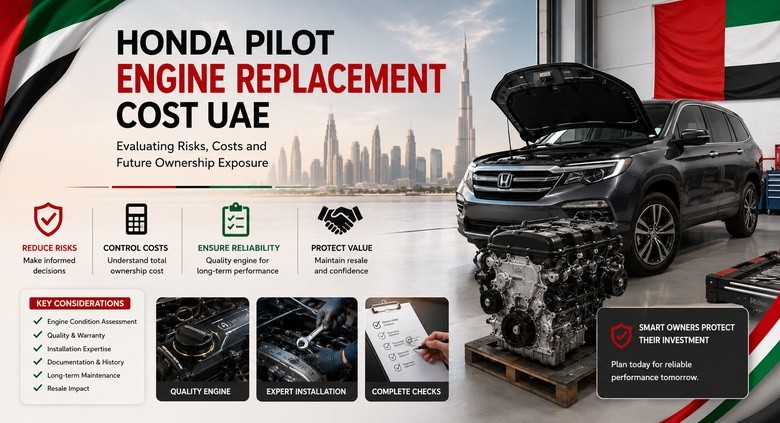
Honda Pilot Engine Replacement Cost UAE: Evaluating Risks, Costs and Future Ownership Exposure
June 12, 2026
Most Honda Pilot owners begin their engine replacement journey by asking a straightforward question.
How much will it cost?
The problem is that this is often the wrong starting point.
Cost matters.
Of course it does.
But when major mechanical decisions are involved, cost rarely represents the largest ownership threat.
Risk does.
A replacement engine may cost thousands of dirhams.
An unmanaged risk can cost considerably more.
This distinction becomes particularly important across the UAE, where vehicles operate under demanding conditions.
Extreme summer temperatures.
Heavy urban traffic.
Long-distance motorway driving.
Frequent stop-start journeys.
Extended air-conditioning usage.
All of these factors influence engine stress levels and long-term reliability.
The result is that a Honda Pilot engine replacement should not simply be viewed as a repair project.
It should be viewed as a risk-management exercise.
Owners who focus solely on price often discover additional expenses later.
Owners who evaluate risk exposure from the beginning usually make stronger long-term decisions.
The objective of this guide is therefore simple:
Help Honda Pilot owners identify, measure and reduce ownership risks before those risks become financial liabilities.
Ownership Risk Assessment: Why Total Risk Exposure Matters More Than Engine Replacement Cost
One of the biggest misconceptions in vehicle ownership is the belief that the replacement-engine invoice represents the largest financial threat.
In reality, the engine cost is usually visible.
Risk exposure is often hidden.
And hidden costs are usually the ones that create regret.
Common Areas of Ownership Risk
- Mechanical risk
- Financial risk
- Reliability risk
- Downtime risk
- Resale-value risk
- Documentation risk
- Warranty risk
Most owners focus on only one of these categories.
Successful ownership decisions require evaluating all of them.
Total Risk Exposure Framework
| Risk Category | Potential Ownership Impact |
| Mechanical Failure | High |
| Cost Escalation | High |
| Downtime | Moderate to High |
| Warranty Gaps | Moderate |
| Poor Documentation | Moderate |
| Resale Loss | Moderate to High |
The replacement engine may solve one problem.
A risk-management strategy prevents several.
Mechanical Risk Identification: Early Warning Indicators Before Major Engine Failure
Major engine failures rarely occur without warning.
The challenge is recognising those warnings before costs escalate.
The Honda Pilot is generally regarded as a dependable family SUV.
However, like any vehicle, it produces signals when underlying issues begin developing.
Common Early Warning Signs
- Increased oil consumption
- Coolant loss
- Temperature fluctuations
- Reduced fuel economy
- Rough idle
- Unusual engine noises
- Warning lights
These symptoms should never be evaluated in isolation.
Patterns matter more than individual events.
Mechanical Risk Matrix
| Symptom | Risk Level |
| Minor Oil Consumption | Moderate |
| Repeated Coolant Loss | Elevated |
| Persistent Overheating | High |
| Compression Issues | Very High |
| Mechanical Knocking | Critical |
The earlier these signs are addressed, the wider the range of available solutions tends to be.
Cost-of-Delay Risk Analysis: The Impact of Postponing a Honda Pilot Engine Decision
Delay is one of the most expensive ownership behaviours.
Not because delay always causes failure.
But because delay frequently reduces options.
When a minor issue develops, owners often have choices.
As deterioration continues, those choices narrow.
Eventually the decision becomes reactive rather than strategic.
The Delay Progression
Minor Symptom
↓
Temporary Workaround
↓
Repeated Occurrence
↓
Growing Mechanical Exposure
↓
Major Repair Requirement
↓
Replacement Decision
The issue is not necessarily the delay itself.
The issue is whether the delay is planned or accidental.
Cost-of-Delay Comparison
| Stage | Typical Cost Range (AED) |
| Early Diagnosis | 300 – 2,000 |
| Minor Repair | 1,000 – 8,000 |
| Major Engine Repair | 8,000 – 25,000 |
| Replacement Engine Project | 15,000 – 70,000+ |
A delayed decision does not always eliminate costs.
Sometimes it simply transfers them into a larger category.
Financial Exposure Assessment: Hidden Risks Before Complete Engine Failure
One of the most dangerous assumptions owners make is believing the engine itself represents the entire project.
In reality, the engine often sits at the centre of a much larger financial ecosystem.
Hidden Cost Categories
- Cooling-system repairs
- Water pump replacement
- Engine mounts
- Sensors
- ECU programming
- Labour escalation
- Fluids and filters
Many of these items become visible only after work begins.
Hidden Cost Exposure Table
| Item | Typical Cost (AED) |
| Engine Mounts | 1,000 – 5,000 |
| Cooling Components | 2,000 – 10,000 |
| Water Pump | 1,000 – 4,000 |
| ECU Programming | 500 – 3,000 |
| Sensors | 500 – 5,000 |
| Fluids & Filters | 500 – 2,500 |
Owners who budget only for the engine frequently underestimate the total project cost.
Risk-aware owners budget for the entire system.
Risk Versus Prevention Strategy: Evaluating Engine Failure Probability Against Preventive Investment
Every ownership decision ultimately involves a comparison between two costs:
The cost of prevention.
And the cost of failure.
Many owners instinctively choose the lower immediate figure.
The challenge is that the lower immediate figure is not always the lower long-term figure.
Preventive Actions
- Early diagnostics
- Cooling-system inspections
- Compression testing
- Fluid analysis
- Regular maintenance
Potential Benefits
- Reduced repair exposure
- Improved reliability
- Lower downtime
- Greater ownership confidence
Risk Versus Prevention Comparison
| Decision Type | Immediate Cost | Long-Term Risk |
| Preventive Maintenance | Lower | Lower |
| Delayed Action | Lower Initially | Higher |
| Reactive Repair | Moderate | Moderate |
| Failure Response | Highest | Highest |
This is where risk management becomes practical.
It transforms ownership from reacting to problems into anticipating them.
Engine Replacement Risk Classification: Used, Reconditioned, OEM and Genuine Engine Options
Not all replacement engines carry the same risk profile.
Price differences usually reflect differences in certainty.
The cheapest option may be perfectly suitable.
Or it may introduce new risks.
The challenge is understanding the distinction.
Used Engine
Potential Advantages:
- Lowest purchase cost
- Fast availability
Potential Risks:
- Unknown operating history
- Variable wear levels
- Limited warranty coverage
Reconditioned Engine
Potential Advantages:
- Refreshed internal parts
- Improved reliability outlook
Potential Risks:
- Rebuild quality varies significantly
OEM Engine
Potential Advantages:
- Strong compatibility
- Predictable quality
Potential Risks:
- Higher initial investment
Genuine Engine
Potential Advantages:
- Highest confidence level
- Excellent compatibility
- Strong resale support
Potential Risks:
- Largest acquisition cost
Risk Classification Table
| Engine Type | Typical Cost (AED) | Risk Profile |
| Used Engine | 8,000 – 20,000 | Variable |
| Reconditioned Engine | 15,000 – 35,000 | Moderate |
| OEM Engine | 25,000 – 50,000 | Lower |
| Genuine Engine | 35,000 – 70,000+ | Lowest |
The objective is not necessarily selecting the lowest-risk option.
The objective is selecting the risk level that aligns with ownership goals, budget constraints and future plans.
The Risk Management Principle Most Owners Discover Too Late
Across the UAE automotive market, one lesson appears repeatedly.
Engine replacement decisions rarely fail because of a lack of spending.
They fail because of incomplete risk evaluation.
Owners often assess:
- Price
But overlook:
- Reliability exposure
- Warranty strength
- Documentation quality
- Future maintenance risk
- Resale-value implications
The result is predictable.
Short-term savings.
Long-term uncertainty.
The most successful Honda Pilot owners approach replacement-engine decisions differently.
They ask:
"What risks am I eliminating?"
rather than:
"What is the cheapest option available?"
Budget Expansion Risks: Hidden Cost Factors in Honda Pilot Engine Replacement Projects
One of the most common ownership mistakes is believing the replacement engine represents the entire project budget.
In reality, the engine is often only the starting point.
This is where financial exposure begins expanding.
The Honda Pilot is a sophisticated family SUV with multiple interconnected systems. When an engine replacement project starts, supporting parts frequently require inspection, servicing or replacement.
Some are preventive.
Others are essential.
Either way, they affect the final invoice.
Common Budget Expansion Areas
- Cooling-system components
- Water pumps
- Thermostats
- Engine mounts
- Sensors
- Wiring repairs
- ECU programming
- Air-conditioning-related components
- Fluids and filters
Typical Hidden Cost Exposure
| Item | Typical Cost (AED) |
| Engine Mounts | 1,000 – 5,000 |
| Water Pump | 1,000 – 4,000 |
| Cooling System Repairs | 2,000 – 10,000 |
| ECU Programming | 500 – 3,000 |
| Sensors | 500 – 5,000 |
| Fluids & Filters | 500 – 2,500 |
| Diagnostics | 500 – 2,000 |
Many owners initially budget for the engine.
The more experienced owners budget for the entire system.
That distinction often determines whether the project remains financially comfortable.
Workshop Selection Risk Management: Protecting Reliability, Safety and Future Ownership Value
A replacement engine can only perform as well as the installation behind it.
This reality is frequently underestimated.
Many ownership problems originate not from engine quality but from installation quality.
The UAE market contains a wide range of workshops.
Some specialise in family SUVs.
Others handle a broad mix of vehicles.
The difference matters.
Workshop Selection Risks
- Incomplete diagnostics
- Improper installation procedures
- Weak quality control
- Limited documentation
- Inadequate testing
Characteristics of Lower-Risk Workshops
- Detailed inspections
- Transparent quotations
- Experienced technicians
- Clear communication
- Comprehensive testing
Workshop Risk Comparison
| Workshop Type | Risk Profile |
| Low-Cost General Workshop | Higher |
| Independent Honda Specialist | Moderate |
| Premium SUV Specialist | Lower |
| Highly Documented Professional Installation | Lowest |
The cheapest workshop is not always the least expensive ownership decision.
Documentation and Warranty Risk Control: Protecting Future Ownership Interests
Many owners focus heavily on the mechanical aspects of engine replacement.
Far fewer focus on paperwork.
This frequently creates future complications.
Documentation is more than administration.
Documentation is protection.
It protects future resale discussions.
It supports warranty claims.
It provides evidence of professional maintenance.
Essential Documentation
- Engine purchase invoice
- Installation invoice
- Warranty documentation
- Diagnostic reports
- Service records
- Engine serial information
Documentation Risk Assessment
| Documentation Status | Ownership Risk |
| Comprehensive Records | Low |
| Strong Documentation | Low to Moderate |
| Partial Records | Moderate |
| Missing Documentation | High |
Future buyers often trust paperwork more than promises.
The same principle applies to warranty providers.
Post-Replacement Reliability Risk Assessment During the First Year of Ownership
The first year after engine replacement is one of the most important periods in the entire ownership cycle.
This is where reliability assumptions become reliability evidence.
The objective during this period is not simply driving.
The objective is verification.
Areas Requiring Monitoring
- Oil consumption
- Coolant levels
- Operating temperatures
- Diagnostic fault codes
- Fluid condition
- Engine performance consistency
First-Year Reliability Risks
- Minor installation issues
- Sensor-related problems
- Cooling-system weaknesses
- Fluid leaks
- Electrical faults
Reliability Monitoring Framework
| Area | Monitoring Priority |
| Cooling System | Very High |
| Oil Management | Very High |
| Diagnostics | High |
| Electrical Systems | High |
| Fluid Condition | High |
Owners who actively monitor these areas generally experience fewer surprises.
Resale Value Risk Management After Engine Replacement
Many owners believe resale value becomes relevant only when the vehicle is sold.
In reality, resale value is influenced by decisions made years earlier.
Engine replacement is one of those decisions.
Future buyers evaluate risk.
And risk influences value.
Factors Supporting Resale Value
- Professional installation
- Full documentation
- Warranty coverage
- Service history
- Transparent ownership records
Factors Increasing Buyer Concern
- Missing paperwork
- Unknown engine origin
- Limited maintenance history
- Unclear installation standards
Resale Confidence Comparison
| Ownership Profile | Buyer Confidence |
| Fully Documented Replacement | Very High |
| Professional Installation | High |
| Partial Records | Moderate |
| Limited History | Low |
The replacement engine itself rarely damages resale value.
Poor risk management often does.
UAE Environmental Risk Factors: How Climate Conditions Affect Engine Longevity
The UAE presents one of the most demanding operating environments for vehicles.
Heat alone changes the ownership equation.
Then additional factors appear.
Heavy traffic.
Long-distance driving.
Extended idling.
Constant air-conditioning usage.
All contribute to engine stress.
UAE Operating Risks
- Extreme summer temperatures
- Cooling-system pressure
- Increased oil degradation
- Higher thermal loads
- Stop-start traffic exposure
Environmental Risk Comparison
| Operating Condition | Engine Stress Level |
| Moderate Climate | Moderate |
| UAE Winter Operation | Moderate |
| UAE Summer Urban Driving | High |
| UAE Summer Highway Use | High |
| Heavy-Traffic Summer Conditions | Very High |
This is one reason preventive maintenance often delivers greater value in the UAE than in milder operating environments.
The Risk That Many Buyers Overlook Entirely
When owners compare replacement-engine options, they often compare:
- Purchase price
- Warranty duration
- Installation cost
What frequently gets overlooked is future exposure.
Future exposure includes:
- Reliability uncertainty
- Additional repairs
- Downtime
- Reduced resale confidence
- Unexpected maintenance costs
For buyers researching buy Honda Pilot engine online, this distinction becomes critically important.
The objective is not simply buying an engine.
The objective is reducing future ownership risk.
Sometimes the lowest-priced solution achieves that goal.
Sometimes it does not.
The answer depends on the entire ownership picture rather than the invoice alone.
The Risk Management Conversation Changes Here
By this stage, the replacement-engine discussion begins shifting.
It stops being a repair conversation.
It becomes an ownership-protection conversation.
The questions become different.
Instead of asking:
"How much does it cost?"
Owners begin asking:
- How reliable will it be?
- What risks remain?
- What future expenses should I expect?
- How will this affect resale value?
- How confident am I in the installation?
These questions usually lead to stronger ownership outcomes.
The final section of this guide will examine first-1,000-kilometre risk management, first-year ownership cost exposure, repair-risk thresholds, replace-engine-versus-replace-vehicle analysis, critical ownership risk indicators, comprehensive FAQ guidance and a complete Honda Pilot ownership risk-management framework for UAE conditions.
Immediate Post-Installation Risk Control: Managing the First 1,000 Kilometres
Many Honda Pilot owners believe the risk-management process ends when the replacement engine is installed.
In reality, one of the most important stages is only beginning.
The first 1,000 kilometres represent a verification period.
This stage helps confirm whether the installation, supporting systems and engine integration are performing as expected.
Owners who ignore this phase often discover problems later.
Owners who monitor it carefully usually identify issues before they become expensive.
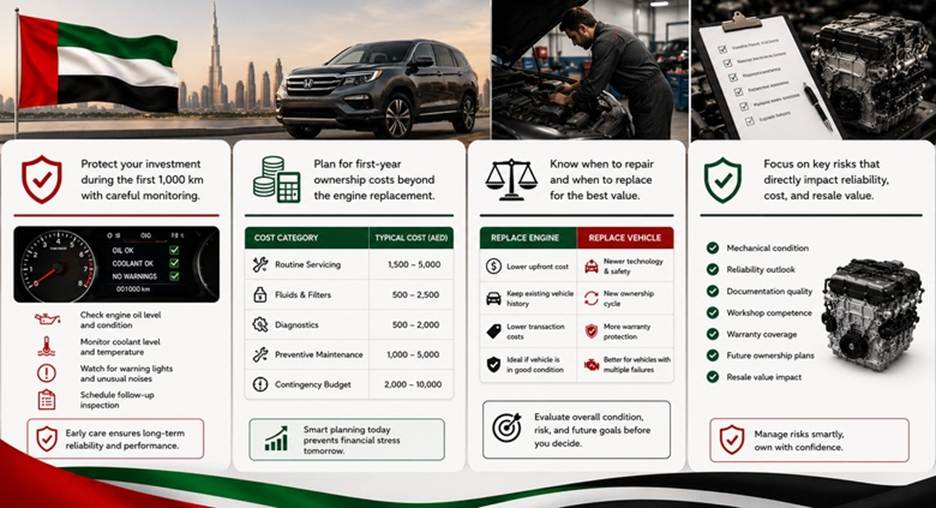
Recommended Monitoring Actions
- Check engine oil levels regularly
- Monitor coolant levels
- Observe operating temperatures
- Watch for warning lights
- Schedule follow-up inspections
- Monitor fluid leaks
Actions Best Avoided
- Aggressive acceleration
- Heavy towing
- Prolonged high-load driving
- Ignoring minor warning signs
First 1,000 km Risk-Control Matrix
| Inspection Area | Priority Level |
| Cooling System | Critical |
| Oil Condition | Critical |
| Diagnostics | Very High |
| Fluid Leaks | Very High |
| Mount Stability | High |
The objective is not simply completing 1,000 kilometres.
The objective is validating the quality of the entire project.
First-Year Cost Exposure Management Following Engine Replacement
Many ownership budgets focus on installation costs.
Far fewer account for first-year ownership exposure.
This oversight frequently creates unnecessary financial pressure.
First-Year Ownership Costs
- Scheduled servicing
- Fluids and filters
- Diagnostic inspections
- Preventive maintenance
- Minor adjustments
- Contingency repairs
First-Year Cost Comparison
| Category | Typical Cost (AED) |
| Routine Servicing | 1,500 – 5,000 |
| Fluids & Filters | 500 – 2,500 |
| Diagnostics | 500 – 2,000 |
| Preventive Maintenance | 1,000 – 5,000 |
| Contingency Budget | 2,000 – 10,000 |
First-Year Exposure by Engine Type
| Engine Type | Typical First-Year Exposure (AED) |
| Used Engine | 5,000 – 20,000+ |
| Reconditioned Engine | 3,000 – 12,000+ |
| OEM Engine | 2,000 – 8,000+ |
| Genuine Engine | 2,000 – 6,000+ |
The cheapest engine often produces the highest uncertainty.
That uncertainty has a financial value.
Investment Risk Threshold Analysis: When Continued Repairs No Longer Deliver Value
One of the most difficult ownership decisions is recognising when further investment stops producing meaningful returns.
Many owners continue spending because of previous expenditure.
This is understandable.
But past spending should not determine future decisions.
Future value should.
Signs the Risk Threshold May Be Approaching
- Repeated major repairs
- Multiple ageing systems
- Escalating annual costs
- Increasing downtime
- Reduced ownership confidence
Ownership Investment Evaluation
| Vehicle Condition | Future Investment Outlook |
| Strong Overall Condition | Positive |
| Strong Vehicle With Engine Issue | Very Positive |
| Multiple Major Failures | Moderate |
| Significant System Deterioration | Weak |
| Recurring High-Cost Repairs | Poor |
The key question is not:
"How much have I spent?"
The key question is:
"Will future spending continue creating value?"
Strategic Risk Evaluation: Engine Replacement Versus Vehicle Replacement
This is the decision that generates the most anxiety.
Should the engine be replaced?
Or should the vehicle itself be replaced?
There is no universal answer.
The correct decision depends on risk exposure, financial priorities and ownership objectives.
Engine Replacement
Potential Advantages:
- Lower capital requirement
- Retain known vehicle history
- Lower transaction costs
Vehicle Replacement
Potential Advantages:
- Newer technology
- New ownership cycle
- Potential warranty protection
Financial Comparison
| Option | Typical Investment (AED) |
| Replacement Engine | 15,000 – 70,000+ |
| Used SUV Upgrade | 80,000 – 180,000+ |
| New Family SUV | 180,000 – 300,000+ |
For many Honda Pilot owners, replacing the engine may present significantly lower financial risk than entering a completely new ownership cycle.
Critical Risk Indicators Every Honda Pilot Owner Should Evaluate Before Making a Decision
Risk management becomes far more effective when decisions are based on measurable indicators rather than assumptions.
Critical Evaluation Areas
Mechanical Condition Risk
- Compression results
- Cooling-system health
- Oil-consumption trends
Reliability Outlook Risk
- Maintenance history
- Failure frequency
- Diagnostic reports
Documentation Compliance Risk
- Service records
- Warranty information
- Installation documentation
Workshop Competency Risk
- Experience levels
- Testing procedures
- Installation standards
Future Ownership Planning Risk
- Expected ownership duration
- Family requirements
- Resale objectives
Decision Assessment Matrix
| Risk Area | Importance |
| Mechanical Condition | Very High |
| Reliability Outlook | Very High |
| Documentation Quality | High |
| Workshop Selection | High |
| Future Ownership Plans | High |
The more uncertainty present in these areas, the greater the overall ownership exposure.
Comprehensive Honda Pilot Ownership Risk Management Framework for UAE Conditions
By this stage, one fact becomes clear.
Engine replacement is not merely a repair decision.
It is a risk-management decision.
Successful owners evaluate:
- Cost risk
- Reliability risk
- Warranty risk
- Documentation risk
- Resale-value risk
- Future maintenance risk
Risk-Mitigation Priorities
Cost Risk Control
- Budget for hidden costs
- Include contingency funds
- Evaluate total project cost
Reliability Risk Mitigation
- Prioritise diagnostics
- Select appropriate engine quality
- Monitor performance carefully
Resale Value Protection
- Maintain documentation
- Preserve service records
- Use reputable installers
Warranty Risk Management
- Understand coverage limitations
- Retain supporting documentation
Future Ownership Planning
- Evaluate expected ownership duration
- Consider family needs
- Assess long-term operating costs
The Ownership Lesson Many Drivers Learn Too Late
Across Dubai, Abu Dhabi, Sharjah, Ajman, Ras Al Khaimah, Fujairah and Umm Al Quwain, one pattern appears repeatedly.
The most expensive ownership decisions are rarely caused by the engine itself.
They are caused by unmanaged risks surrounding the engine.
Owners frequently focus on:
- Purchase price
While overlooking:
- Reliability exposure
- Future maintenance costs
- Documentation quality
- Warranty protection
- Installation standards
The result is often predictable.
Short-term savings.
Long-term uncertainty.
For owners researching solutions through PartFinder UAE, the objective should not simply be finding a replacement engine.
The objective should be reducing future ownership exposure while protecting reliability, resale value and long-term financial stability.
Final Honda Pilot Risk Management Decision Matrix
| Priority | Recommended Focus |
| Reliability Protection | Engine Quality |
| Financial Stability | Total Project Budget |
| Resale Value | Documentation |
| Risk Reduction | Professional Installation |
| Warranty Security | Coverage Verification |
| Long-Term Ownership | Future Planning |
The strongest ownership decisions are rarely the cheapest.
They are usually the ones that reduce the greatest amount of future risk.
And in the UAE's demanding operating environment, reducing risk is often the most valuable investment a Honda Pilot owner can make.
Frequently Asked Questions
Categories
- Audi
- BMW
- Car Accessories
- Car Tips
- Ford
- Land Rover
- Mazda
- Range Rover
- Top 10
- UAE Car Parts
- Used Car Parts
- Toyota
- Replacement Engines
- Nissan
- Hyundai
- Mitsubishi
- Volkswagen
- Honda
- Kia
- Chevrolet
- Dodge
- Jeep
- Subaru
- Renault
- Lexus
- Mercedes
- Suzuki
- Hummer
- Porsche
- Infiniti
- Peugeot
- GMC
- Mini
- Volvo
- Replacement Gearboxes
- MG
- Jaguar
- Skoda
- Cadillac
- Daihatsu
- Fiat
- German Car Parts
- Japanese Car Parts
- Aftermarket Car Parts
- Genuine Car Parts
- New Car Parts
- Reconditioned Car Parts
- European Car Parts
- American Car Parts
- Korean Car Parts
- British Car Parts
- Chinese Car Parts
- Sports/Exotic Car Parts
- Luxury Car Parts
- Performance Car Parts
- SUV/4x4 Spare Parts
- Truck Spare Parts
- EV Car Parts
- Hybrid Car Parts
- Auto Spare Parts in UAE
- Tesla
- Isuzu
- Ram
- Ferrari
- Bentley
- Lamborghini
- Genesis
- Maserati
- Lincoln
- Chrysler
- Opel
- Citroen
- SsangYong
- Seat
- McLaren
- Aston Martin
- Rolls Royce
- Maybach
- Alfa Romeo
- Bugatti
- Scion
- Abu Dhabi Car Parts
- Ajman Car Parts
- Al Khan Car Parts
- Al Sajaa Car Parts
- Deira Car Parts
- Dubai Car Parts
- Fujairah Car Parts
- Industrial Area 6 Car Parts
- Mussafah Car Parts
- Ras Al Khaimah Car Parts
- Sharjah Car Parts
- Umm Al Quwain Car Parts
- Acura
- BYD
- Chery
- Dacia
- DS
- Geely Emgrand
- EXEED
- GAC
- GAC Gonow
- Geely
- Gonow
- Great Wall
- Haima
- Haval
- Holden
- Iveco
- JAC
- Jaecoo
- Jetour
- Lotus
- Omoda
- Proton
- Renault Samsung
- Roewe
- Lucid