How Toyota Hilux Owners in UAE Gradually Turn Minor Engine Problems into Major Replacement Costs Without Noticing the Damage Growing Underneath

May 25, 2026
Across the UAE, the Toyota Hilux is rarely treated gently. It becomes part construction partner, part desert machine, part business vehicle and sometimes all three within the same week. One day it is towing equipment through Abu Dhabi industrial zones under brutal afternoon heat. The next it is crossing soft desert tracks outside Al Ain with sand pushing deep into every mechanical corner underneath. Then back again into Dubai traffic where the engine idles endlessly while the AC fights temperatures that feel almost hostile to machinery itself.
And because the Hilux keeps surviving those conditions year after year, owners begin believing the engine can tolerate almost anything indefinitely.
That confidence becomes expensive later.
Not immediately. Slowly.
A slight overheating issue gets ignored because the pickup still pulls properly under load. Oil consumption increases a little, but the engine still starts every morning. Coolant disappears gradually from the reservoir, yet the Hilux continues working hard enough to convince owners everything remains manageable.
So, maintenance gets delayed.
Then delayed again.
And somewhere during those years of towing, off-road driving, overloaded cargo work and postponed servicing, internal engine damage quietly spreads underneath until the conversation changes completely.
Not about repairs anymore.
About replacement.
Why Toyota Hilux Pickups in UAE Often Spend Years Under Extreme Mechanical Pressure Without Proper Maintenance Gaps
There is something relentless about commercial and off-road driving in the UAE that slowly grinds engines down without owners fully recognising the long-term cost initially.
A Toyota Hilux working daily across Dubai or Sharjah rarely gets genuine recovery time mechanically. The pickup finishes one heavy-duty task and immediately starts another. Long motorway journeys between emirates. Construction-site crawling in brutal heat. Desert driving where sand, heat and heavy throttle input place enormous pressure on cooling systems and internal lubrication simultaneously.
Then there is the air-conditioning.
Always running.
Always demanding more load from an engine already operating under Gulf temperatures capable of exhausting weaker cooling systems surprisingly quickly.
Add:
- Heavy Cargo Loads
- Long Towing Runs
- Desert Off-Road Driving
- Delayed Oil Changes
- Cheap Coolant Usage
- Continuous Stop-Start Traffic
And internal wear begins spreading far earlier than many Hilux owners realise.
The difficult thing about Hilux engines is that they often continue functioning convincingly while deterioration quietly develops underneath. The pickup still starts instantly. Still pulls hard enough under load. Still completes difficult jobs without obvious hesitation.
So, inspections get delayed.
Because the vehicle still feels strong enough to keep going.
Until suddenly the repair bill says otherwise.
The Everyday Driving Habits That Quietly Shorten Toyota Hilux Engine Life Across Dubai, Sharjah, and Abu Dhabi
Most catastrophic Hilux engine failures across UAE workshops begin with habits owners considered completely normal for years.
Not reckless behaviour necessarily. Ordinary behaviour repeated endlessly until the engine eventually stops tolerating it.
The most common long-term stress factors usually include:
- Constant Heavy Acceleration Under Load
- Long Idling Periods
- Overloaded Cargo Weight
- Short Maintenance Intervals Ignored
- Frequent Desert Driving
- Delayed Cooling-System Repairs
- Cheap Oil and Coolant Usage
And because many Hilux owners prioritise keeping the pickup operational daily rather than stopping for preventative maintenance, small mechanical weaknesses quietly become major internal problems later.
A weak radiator becomes chronic overheating.
A minor oil leak becomes lubrication failure.
Repeated heat exposure becomes:
- Cylinder Head Warping
- Internal Bearing Damage
- Oil Sludge Build-Up
- Cooling-System Corrosion
Then suddenly workshops stop discussing routine repairs and start talking about replacement-engine options instead.
Which changes the financial situation very quickly.
How Heavy Cargo Loads, Desert Trips, and Long Highway Mileage Slowly Damage Hilux Engines Internally
The UAE is unusually demanding on working pickups because the environment rarely allows engines genuine rest.
A Hilux towing equipment between Dubai and Abu Dhabi during summer already operates under enormous thermal stress before desert driving or off-road work even begins. Then add soft sand conditions where engines maintain high RPM for extended periods while airflow and cooling efficiency drop simultaneously.
The pressure compounds gradually:
- High Engine Temperatures
- Increased Oil Breakdown
- Turbocharger Heat Stress
- Radiator Fatigue
- Weak Lubrication Performance
- Air Intake Contamination From Sand
And because many pickups accumulate extremely high mileage across UAE commercial usage surprisingly quickly, internal engine wear often reaches dangerous levels long before owners realise how serious the deterioration has already become.
The most common causes of Hilux engine failure across UAE workshops include:
- Repeated Overheating
- Delayed Oil Servicing
- Poor Cooling-System Maintenance
- Low Oil Pressure Damage
- Turbocharger Problems
- Sand And Dust Contamination
- Heavy Commercial Usage
Eventually pistons, crankshaft bearings and cylinder walls suffer enough heat and friction damage that rebuilding stops making reliable long-term financial sense.
That is usually where replacement becomes safer than repair.
Not cheaper initially.
Safer later.
Why Small Cooling-System Problems in a Toyota Hilux Rarely Stay Small for Long in UAE Heat
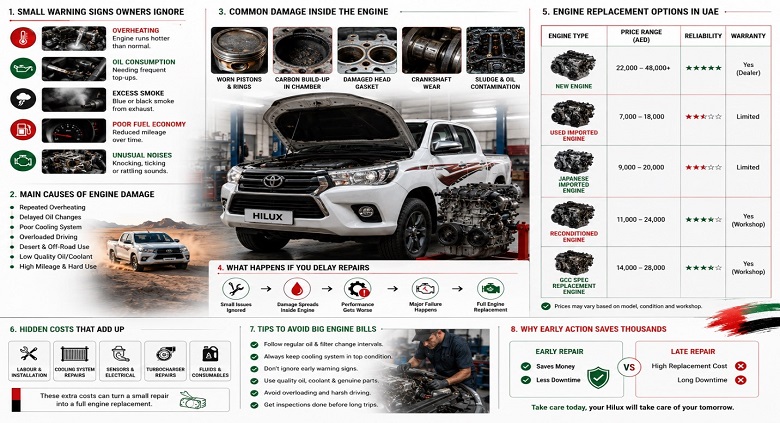
This is where many UAE Hilux owners underestimate the situation badly.
Cooling-system problems almost never remain isolated for long under Gulf temperatures. Once efficiency starts dropping, heat spreads aggressively throughout the engine:
- Head Gasket Failure
- Cylinder Head Cracking
- Internal Bearing Wear
- Coolant Contamination
- Oil Breakdown Problems
- Radiator Corrosion
And because many drivers continue operating the pickup after early overheating symptoms appear, the internal damage usually spreads much further underneath than they realise initially.
Typical UAE overheating-related repair costs often include:
| Repair Type | Estimated UAE Cost (AED) |
| Radiator Replacement | 1,000 – 4,500 |
| Water Pump Repairs | 700 – 3,000 |
| Head Gasket Repairs | 4,000 – 12,000 |
| Engine Rebuild Costs | 10,000 – 25,000 |
| Full Engine Replacement | 15,000 – 45,000+ |
Experienced UAE mechanics tend to react immediately whenever somebody casually says they have “just been topping up coolant for a while”.
Because engines remember repeated overheating much longer than owners expect them to.
New vs Used vs Reconditioned Toyota Hilux Engines in UAE With Realistic Cost, Labour, Reliability, and Warranty Comparisons
This is usually where optimism encounters financial reality properly.
A brand-new Hilux engine sounds reassuring in theory. Fresh internals. Zero mileage. No hidden abuse history from commercial towing or harsh off-road work. Yet dealership pricing across Dubai and Abu Dhabi becomes difficult for many owners to justify once labour, diagnostics and downtime costs begin stacking together.
Which explains why many UAE Hilux owners drift towards imported used or reconditioned engines instead.
The differences matter enormously.
Used Hilux engines generally arrive through:
- Japanese Salvage Auctions
- GCC Donor Vehicles
- Commercial Fleet Imports
- Accident-Damaged Pickups
Some remain mechanically excellent. Others arrive carrying hidden internal wear that UAE heat exposes surprisingly quickly afterwards.
Typical UAE pricing generally looks like this:
| Engine Type | Engine Price (AED) | Labour Cost (AED) | Total Estimated Cost (AED) | Best For | Main Risk |
| New Toyota Hilux Engine | 22,000 – 48,000+ | 5,000 – 12,000 | 30,000 – 60,000+ | Long-Term Reliability | Very High Cost |
| Used Imported Hilux Engine | 7,000 – 18,000 | 3,000 – 8,000 | 12,000 – 26,000 | Budget-Friendly Repairs | Unknown Usage History |
| Japanese Imported Engine | 9,000 – 20,000 | 3,500 – 8,500 | 14,000 – 30,000 | Better Mileage Availability | Limited Verification |
| Reconditioned Hilux Engine | 11,000 – 24,000 | 4,000 – 10,000 | 18,000 – 35,000 | Balanced Cost and Reliability | Workshop Quality Variations |
| GCC Spec Replacement Engine | 14,000 – 28,000 | 4,500 – 11,000 | 20,000 – 40,000 | Better UAE Heat Compatibility | Higher Purchase Cost |
And experienced UAE mechanics repeat the same warning constantly because they have watched the cycle happen repeatedly across Dubai and Sharjah workshops. The cheapest Hilux engine rarely remains the cheapest solution long-term.
Because weak imported engines paired with rushed installation work often create another round of overheating or oil-pressure problems only months later.
Then the labour bill begins all over again.
Why Many UAE Hilux Owners Choose Reconditioned or Imported Engines Instead of Full Engine Rebuilds
This usually becomes a financial decision mixed with practicality.
Full engine rebuilds sound appealing initially because owners keep the original engine block. But once internal damage becomes severe enough, rebuilding often creates uncertainty regarding long-term reliability, especially for pickups continuing heavy commercial or off-road usage afterwards.
Which explains why many UAE Hilux owners eventually prefer:
- Imported Low-Mileage Engines
- Japanese Reconditioned Units
- GCC-Spec Replacement Engines
- Warranty-Covered Rebuilt Engines
The decision usually depends on:
- Budget Limits
- Downtime Pressure
- Commercial Usage Needs
- Workshop Reputation
- Future Resale Plans
And because downtime costs matter enormously for working pickups, many business owners prioritise replacement speed and reliability over theoretical long-term rebuilding savings.
Particularly when the Hilux itself remains essential to daily income generation.
What UAE Workshops Usually Find After Dismantling a High-Mileage Toyota Hilux Engine
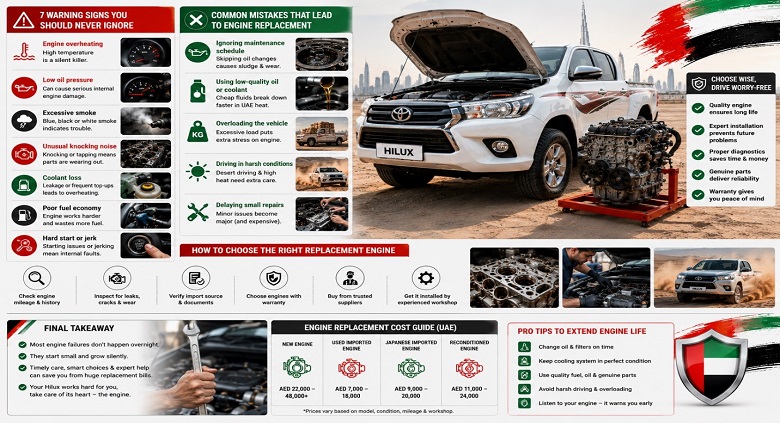
This is normally where original repair quotations begin drifting upwards quietly.
Because once technicians dismantle the damaged engine, surrounding weaknesses reveal themselves almost automatically:
- Weak Radiators
- Cooling Hose Damage
- Turbocharger Wear
- Oil Cooler Problems
- Gearbox Stress Damage
- Sensor Failures
Typical UAE repair costs often include:
- Radiator Replacement: AED 1,000 – 4,500
- Turbocharger Repairs: AED 3,000 – 12,000
- Gearbox Servicing: AED 2,000 – 8,000
- Electrical Diagnostics: AED 800 – 3,500
- Cooling-System Restoration: AED 1,000 – 5,000
Individually these repairs seem manageable enough.
Together, especially inside premium UAE workshops, they quietly transform the invoice into something much larger than owners originally prepared themselves for emotionally.
And yet ignoring them often creates another engine problem afterwards.
Particularly during UAE summers where working pickups already operate under relentless thermal pressure every single day.
Why Toyota Hilux Engine Replacement Costs Rise Fast Once Downtime, Labour, and Hidden Repairs Start Expanding
Many Hilux owners focus almost entirely on the engine price itself while underestimating everything surrounding the installation process.
Modern Hilux engine replacement now involves:
- ECU Calibration
- Turbocharger Integration
- Cooling-System Bleeding
- Gearbox Communication Checks
- Electrical Diagnostics
- Sensor Reconfiguration
Which means labour pricing rises quickly once dismantling begins.
Typical UAE labour and diagnostic costs often include:
- Basic Engine Installation Labour: AED 3,500 – 9,000
- ECU Diagnostics And Coding: AED 1,000 – 4,500
- Cooling-System Restoration: AED 1,000 – 5,000
- Gearbox Inspection: AED 1,500 – 5,000
- Sensor Replacement Costs: AED 500 – 3,000
And once surrounding systems come apart, additional weaknesses almost always appear:
- Weak Engine Mounts
- Gearbox Fluid Contamination
- Sensor Failures
- Oil Cooler Leaks
- Cooling Hose Fatigue
Most experienced UAE workshops recommend handling those immediately because reopening everything later becomes financially ridiculous.
Though many owners still try postponing the extra expense initially.
Usually until they return again months later.
The Most Common Mistakes UAE Hilux Owners Make When Buying Imported Engines and Choosing Workshops
Most replacement-engine disasters become easier to prevent before purchase than after installation.
Experienced UAE Hilux specialists usually recommend checking:
- Compression Test Results
- Engine Mileage Documentation
- Turbocharger Condition
- Cooling-System Health
- ECU Compatibility Information
- Import Source Verification
- Warranty Coverage Terms
And if a supplier pressures immediate payment without inspection opportunities or proper diagnostics, that alone should probably end the conversation immediately.
Reliable suppliers understand why buyers ask difficult questions.
The unreliable ones prefer customers who do not.
Many UAE owners now use platforms like PartFinder UAE to compare:
- Used Toyota Hilux Engines
- Reconditioned Engine Options
- Imported Japanese Engines
- UAE Supplier Availability
- Warranty-Covered Replacement Engines
Particularly across Dubai, Abu Dhabi, Sharjah and Ajman where engine availability changes constantly while workshop storage charges quietly continue building in the background.
Final Thoughts: Most Toyota Hilux Engine Replacements in UAE Begin Long Before the Engine Actually Fails Completely
A Toyota Hilux engine replacement in UAE rarely begins with one dramatic mechanical collapse. More often it develops quietly through years of towing, overheating, desert driving, delayed servicing and small warning signs owners convinced themselves could wait slightly longer.
Then UAE heat, heavy workloads and daily pressure gradually transform manageable repairs into major internal engine damage underneath.
Handled properly, with realistic budgeting, experienced labour and carefully sourced replacement engines, a Hilux can still return to being exactly what UAE owners expect from it: durable, dependable and capable across some of the harshest driving conditions in the Gulf.
Handled badly, through rushed installation, weak imported engines or ignored cooling-system problems, the same failures usually come back much faster than owners expect.
And hard-working engines, especially in UAE heat, eventually expose every shortcut.
Categories
- Audi
- BMW
- Car Accessories
- Car Tips
- Ford
- Land Rover
- Mazda
- Range Rover
- Top 10
- UAE Car Parts
- Used Car Parts
- Toyota
- Replacement Engines
- Nissan
- Hyundai
- Mitsubishi
- Volkswagen
- Honda
- Kia
- Chevrolet
- Dodge
- Jeep
- Subaru
- Renault
- Lexus
- Mercedes
- Suzuki
- Hummer
- Porsche
- Infiniti
- Peugeot
- GMC
- Mini
- Volvo
- Replacement Gearboxes
- MG
- Jaguar
- Skoda
- Cadillac
- Daihatsu
- Fiat
- German Car Parts
- Japanese Car Parts
- Aftermarket Car Parts
- Genuine Car Parts
- New Car Parts
- Reconditioned Car Parts
- European Car Parts
- American Car Parts
- Korean Car Parts
- British Car Parts
- Chinese Car Parts
- Sports/Exotic Car Parts
- Luxury Car Parts
- Performance Car Parts
- SUV/4x4 Spare Parts
- Truck Spare Parts
- EV Car Parts
- Hybrid Car Parts
- Auto Spare Parts in UAE
- Tesla
- Isuzu
- Ram
- Ferrari
- Bentley
- Lamborghini
- Genesis
- Maserati
- Lincoln
- Chrysler
- Opel
- Citroen
- SsangYong
- Seat
- McLaren
- Aston Martin
- Rolls Royce
- Maybach
- Alfa Romeo
- Bugatti
- Scion
- Abu Dhabi Car Parts
- Ajman Car Parts
- Al Khan Car Parts
- Al Sajaa Car Parts
- Deira Car Parts
- Dubai Car Parts
- Fujairah Car Parts
- Industrial Area 6 Car Parts
- Mussafah Car Parts
- Ras Al Khaimah Car Parts
- Sharjah Car Parts
- Umm Al Quwain Car Parts
- Acura
- BYD
- Chery
- Dacia
- DS
- Geely Emgrand
- EXEED
- GAC
- GAC Gonow
- Geely
- Gonow
- Great Wall
- Haima
- Haval
- Holden
- Iveco
- JAC
- Jaecoo
- Jetour
- Lotus
- Omoda
- Proton
- Renault Samsung
- Roewe
- Lucid