Hybrid Battery and Hybrid System Parts in UAE: What Buyers Need to Know
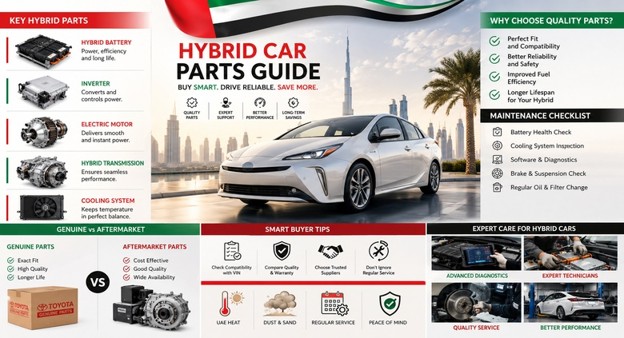
August 1, 2026
Understanding Hybrid Technology
Quick Summary
| Topic | Key Insight |
| Hybrid Popularity | Growing rapidly across the UAE as drivers seek lower fuel consumption without depending entirely on charging infrastructure. |
| Hybrid Technology | Combines a petrol engine with one or more electric motors working together. |
| Hybrid Components | Includes a high-voltage battery, electric motor, inverter, regenerative braking system and conventional petrol engine. |
| Maintenance | Different from both petrol and fully electric vehicles. |
| Spare Parts | Require specialist knowledge, accurate compatibility checks and professional diagnostics. |
| Ownership | Hybrid vehicles reward owners who understand how both power systems interact. |
Some cars burn fuel.
Some rely entirely on electricity.
Hybrid vehicles do neither.
Or perhaps more accurately, they do both—constantly deciding, often several times within the same journey, which source of power makes the most sense.
That's the part many buyers never see.
Behind the steering wheel, everything feels remarkably ordinary. Press the accelerator. The car moves. Stop at traffic lights. It falls silent. Pull away again. Sometimes the engine wakes. Sometimes it doesn't. The transition is so seamless that many owners couldn't tell you which system was actually moving the car at any particular moment.
Yet beneath that calm experience sits one of the most sophisticated pieces of engineering found in modern road cars.
And that's exactly why understanding hybrid spare parts matters.
Because repairing a hybrid isn't simply repairing a petrol car with an extra battery.
Nor is it maintaining an electric vehicle with a small engine attached.
It's something entirely different.
Why Hybrid Vehicles Are Becoming More Popular in the UAE
Walk through the car parks of Dubai Marina, Business Bay or Yas Island today and you'll notice something changing.
Not dramatically.
Quietly.
A Lexus RX Hybrid parked beside a conventional SUV.
A Toyota Corolla Hybrid collecting passengers outside an office tower.
A Honda Accord Hybrid gliding through early morning traffic without making much noise at all.
Five years ago these cars felt unusual.
Today they're becoming increasingly familiar.
There are several reasons for that.
Fuel economy remains one of the obvious attractions.
Anyone regularly driving between Dubai and Abu Dhabi understands how quickly weekly fuel costs accumulate. Hybrids reduce consumption without asking drivers to completely change their routines.
Unlike fully electric vehicles, they don't depend entirely on charging stations.
That removes one of the biggest psychological barriers for many buyers.
The UAE climate has also played a role.
Extreme summer temperatures often lead motorists to keep air conditioning running continuously.
Hybrid systems manage energy differently, helping improve efficiency even when cooling demands remain high.
Then there's traffic.
Anyone who has spent forty minutes creeping along Sheikh Zayed Road knows engines spend plenty of time idling.
Hybrid systems turn that wasted energy into an opportunity.
Instead of continuously burning fuel while stationary, they intelligently alternate between electric and petrol power whenever conditions allow.
The result isn't magic.
It's engineering.
What Is a Hybrid Vehicle?
Ask ten people to explain a hybrid vehicle.
You'll probably receive ten different answers.
Some believe hybrids run entirely on electricity until the battery becomes empty.
Others assume the electric motor simply assists the petrol engine occasionally.
Neither explanation tells the whole story.
A hybrid vehicle is designed around cooperation.
Rather than asking one power source to perform every task, engineers divide responsibilities.
Low-speed driving?
The electric motor often handles it.
Hard acceleration?
The petrol engine joins in.
Cruising?
Both systems may work together.
Slowing down?
The vehicle captures energy that would normally disappear as heat and stores it for later use.
Think of it less like two separate systems.
Think of it as a carefully choreographed partnership where every component constantly communicates with every other component.
Nothing works independently.
Everything depends on everything else.
How a Hybrid Powertrain Works
Imagine driving through central Sharjah during afternoon traffic.
The journey begins quietly.
The electric motor moves the vehicle away from traffic lights using energy already stored inside the high-voltage battery.
A few minutes later traffic begins flowing.
The petrol engine starts almost imperceptibly.
Acceleration increases.
Both power sources now contribute.
Approaching the next junction, you remove your foot from the accelerator.
Something unusual happens.
Instead of wasting movement as heat, the electric motor reverses its role.
It becomes a generator.
Energy travels back into the battery.
No charging cable.
No external power source.
Just intelligent energy recovery taking place hundreds of times during everyday driving.
This constant exchange continues throughout the journey.
Engine.
Motor.
Battery.
Generator.
Inverter.
Control unit.
Each making thousands of decisions every minute without the driver noticing.
That invisible teamwork explains why hybrid systems appear simple while remaining remarkably complex underneath.
Main Components Inside a Hybrid Vehicle
Hybrid vehicles combine conventional mechanical engineering with advanced electrical technology.
The major systems include:
- Petrol engine.
- High-voltage hybrid battery.
- Electric motor.
- Generator.
- Inverter and converter.
- Hybrid transmission.
- Hybrid Control Unit (HCU).
- Battery cooling system.
- Regenerative braking system.
- Conventional braking components.
- High-voltage wiring.
- Standard 12-volt electrical system.
Unlike conventional vehicles, these components rarely operate in isolation.
If one system performs poorly, another often compensates.
That makes professional diagnostics far more important than replacing parts based purely on symptoms.
Hybrid vs Petrol vs Electric Vehicles
Drivers often assume hybrids simply occupy the middle ground between petrol cars and electric vehicles.
In practice, the comparison is more interesting.
A petrol vehicle relies almost entirely on mechanical systems.
An electric vehicle depends heavily on electrical systems.
A hybrid asks both technologies to cooperate flawlessly.
That creates obvious advantages.
But it also creates additional complexity.
| Feature | Hybrid Vehicle | Petrol Vehicle | Electric Vehicle |
| Power Source | Petrol + Electric | Petrol Only | Battery Only |
| Engine | Yes | Yes | No |
| Electric Motor | Yes | No | Yes |
| High-Voltage Battery | Yes | No | Yes |
| Fuel Tank | Yes | Yes | No |
| Charging Plug | Usually No (Self-Charging Hybrids) | No | Yes |
| Regenerative Braking | Yes | No | Yes |
| Mechanical Complexity | High | Moderate | Lower |
| Electronic Complexity | High | Moderate | Very High |
No system is inherently better.
Each simply solves the same problem differently.
The best choice depends less on technology and more on how the vehicle will actually be used.
Why Hybrid Spare Parts Are Different
Here's where many buyers make an expensive mistake.
They assume hybrid car parts in UAE are simply petrol components with additional electronics attached.
Workshops know otherwise.
Replacing a cooling pump isn't always just replacing a cooling pump.
It may also involve battery temperature management.
Replacing a transmission isn't always purely mechanical.
Software calibration may become part of the repair.
Even replacing the 12-volt battery on certain hybrids can trigger system resets requiring specialist diagnostic equipment.
The vehicle isn't merely checking whether the new component fits.
It's checking whether it communicates correctly.
Compatibility has become just as important as physical installation.
That's a significant change from traditional vehicle maintenance.
Workshop Story
A Toyota hybrid arrived at an independent workshop in Dubai after another garage had replaced the auxiliary battery.
The customer expected a straightforward repair.
Instead, dashboard warning lights remained illuminated.
The engine behaved normally.
The battery appeared healthy.
Yet something still wasn't right.
Rather than replacing additional components, the workshop connected manufacturer-level diagnostic equipment.
Within minutes the technician identified the problem.
The new battery had been installed correctly.
The vehicle simply required the hybrid management system to recognise the replacement through a calibration procedure.
Fifteen minutes later every warning light disappeared.
As the owner collected the vehicle, he laughed.
"So nothing was actually broken?"
The technician smiled.
"No."
"The car just needed introducing to its new battery."
That conversation perfectly captures modern hybrid ownership.
Sometimes the solution isn't another replacement part.
It's understanding how intelligent systems communicate.
Hybrid Technology Comparison Table
| Component | Hybrid Vehicle | Petrol Vehicle | Electric Vehicle |
| High-Voltage Battery | ✔ | ✖ | ✔ |
| Petrol Engine | ✔ | ✔ | ✖ |
| Electric Motor | ✔ | ✖ | ✔ |
| Fuel System | ✔ | ✔ | ✖ |
| Regenerative Braking | ✔ | ✖ | ✔ |
| Inverter | ✔ | ✖ | ✔ |
| Conventional Starter Motor | Often Not Required | ✔ | ✖ |
Buyer Decision Matrix
| Your Situation | Recommended Choice |
| Mostly urban commuting with frequent traffic | Hybrid offers excellent efficiency |
| Long motorway journeys every week | Compare hybrid and petrol ownership costs carefully |
| Unsure about charging availability | Hybrid provides flexibility without relying on charging infrastructure |
| Planning long-term ownership | Prioritise maintenance history over mileage alone |
| Buying a used hybrid | Always request a professional battery health inspection |
| Replacing hybrid components | Verify VIN compatibility before purchasing parts |
Suggested Visual Callout
"How a Hybrid Vehicle Works"
Create a clean infographic showing:
- Petrol engine.
- High-voltage battery.
- Electric motor.
- Hybrid transmission.
- Regenerative braking.
- Energy flowing back into the battery during braking.
- Cooling system.
- Hybrid Control Unit connecting every component.
Use realistic vehicle illustrations with subtle UAE-inspired red, green, white and black accents.
Keep wording minimal and allow the visuals to explain the technology.
Smart Buyer's Checklist
Before purchasing or repairing a hybrid vehicle:
- Understand whether the vehicle is self-charging or plug-in.
- Verify the service history carefully.
- Request a hybrid battery health report.
- Confirm that replacement parts match the VIN.
- Choose workshops experienced with hybrid systems.
- Never ignore hybrid warning lights.
- Ask whether software calibration is included after repairs.
- Prioritise long-term reliability over the cheapest quotation.
The smartest hybrid owners aren't necessarily those who spend the least.
They're usually the ones who understand their vehicle well enough to prevent expensive surprises before they happen.
Key Takeaways
Hybrid vehicles combine the strengths of petrol engines and electric motors, but they also introduce a level of engineering complexity that neither technology possesses on its own. Every journey involves constant communication between mechanical and electrical systems, making accurate diagnostics, compatible spare parts and specialist knowledge essential for reliable ownership.
Understanding how these systems interact is the first step towards making better maintenance decisions. Whether buying a hybrid for the first time or replacing major components years later, informed owners consistently avoid the most expensive mistakes because they appreciate that modern hybrid technology depends just as much on intelligent software and system integration as it does on physical parts.
Inside the Heart of a Hybrid Vehicle
Quick Summary
| Component | Primary Function |
| Hybrid Battery Pack | Stores electrical energy for propulsion and regenerative braking. |
| Electric Motor | Drives the vehicle and assists the petrol engine. |
| Inverter & Converter | Controls electricity flowing between the battery and motor. |
| Hybrid Control Unit | Coordinates every major hybrid system. |
| Hybrid Transmission | Blends petrol and electric power efficiently. |
| Battery Cooling System | Maintains safe operating temperatures for long battery life. |
The most expensive part inside a hybrid vehicle isn't always the one that attracts the most attention.
That's an uncomfortable truth.
People worry about batteries because they hear stories. Expensive stories. Stories repeated so often that they begin to sound inevitable.
"You'll need a new battery one day."
Perhaps.
Perhaps not.
In many workshops across the UAE, technicians discover something else entirely.
The battery wasn't the problem.
A cooling fan had stopped working.
A sensor was reading incorrectly.
A damaged connector interrupted communication.
Or an inverter had quietly failed while the battery remained perfectly healthy.
Hybrid systems rarely reward assumptions.
They reward diagnosis.
Understanding the individual components—and how they depend upon one another—can save thousands of dirhams over the lifetime of the vehicle.
Hybrid Battery Pack Explained
If the hybrid system has a heartbeat, this is probably it.
The high-voltage battery stores electrical energy captured through regenerative braking and, when required, supplies power to the electric motor.
Unlike fully electric vehicles, however, hybrid batteries usually spend very little time either completely full or completely empty.
Manufacturers deliberately avoid both extremes.
Why?
Because lithium-ion and nickel-metal hydride batteries generally last longer when they operate within a carefully controlled window.
It's rather like asking an athlete to run a marathon.
Not sprint every kilometre.
Not stand still.
Maintain a steady rhythm.
Hybrid batteries are managed in exactly the same way.
Modern hybrid battery packs typically include:
- Individual battery modules.
- Battery Management System (BMS).
- High-voltage safety relays.
- Temperature sensors.
- Cooling ducts or cooling fans.
- High-voltage wiring.
- Protective casing.
Every component has one purpose.
Protect battery health.
The battery isn't simply storing electricity.
It's constantly being monitored.
Every second.
Why Hybrid Batteries Last Longer Than Many People Expect
There remains an outdated belief that hybrid batteries routinely fail after a few years.
That idea refuses to disappear.
Reality looks rather different.
Many hybrid taxis operating across Dubai and Abu Dhabi accumulate remarkably high mileages while continuing to use their original battery packs.
Why?
Because the battery is rarely subjected to the stress experienced by fully electric vehicles.
Hybrid systems carefully manage:
- Charging levels.
- Operating temperatures.
- Power delivery.
- Regenerative charging.
The battery works continuously.
It simply isn't pushed to its absolute limits.
That distinction matters.
Heat remains the greatest long-term enemy.
Not electricity.
Which explains why cooling systems deserve just as much attention as the battery itself.
Electric Motor and Generator
Unlike conventional starter motors, hybrid electric motors rarely perform just one job.
They constantly change roles.
One moment they're moving the vehicle.
The next they're generating electricity.
Then they're assisting the petrol engine during acceleration.
Moments later they're harvesting braking energy.
Imagine cycling downhill.
Instead of wasting momentum, you somehow managed to refill your water bottle using the movement itself.
That's essentially what regenerative braking achieves.
The motor transforms movement back into electricity.
It's wonderfully efficient.
And surprisingly elegant.
Hybrid electric motors are generally known for exceptional reliability.
Most failures actually occur around supporting systems rather than the motor itself.
Technicians often inspect:
- Bearings.
- Position sensors.
- Electrical connectors.
- Cooling systems.
- Power cables.
Replacing the complete motor should never become the first assumption.
Inverter and Converter Systems
If the battery stores electricity...
And the motor uses electricity...
Who decides how much electricity flows?
That's the inverter.
Often overlooked.
Frequently misunderstood.
Absolutely essential.
The inverter converts direct current from the battery into alternating current required by the electric motor.
Meanwhile, the converter manages voltage for lower-powered vehicle systems.
Without these electronic control systems, nothing communicates correctly.
Symptoms of inverter problems may include:
- Warning lights.
- Reduced power.
- Failure to start the hybrid system.
- Unexpected shutdowns.
- Charging irregularities.
Interestingly, many inverter faults initially resemble battery problems.
Which is exactly why proper diagnostics matter.
Replacing the battery before inspecting the inverter has become one of the industry's more expensive mistakes.
Hybrid Control Unit (HCU)
This is the decision-maker.
The conductor standing in front of the orchestra.
Every hybrid component reports information here.
Battery temperature.
Throttle position.
Vehicle speed.
Brake pressure.
Engine load.
Electric motor demand.
Hundreds of calculations happen almost instantly.
The Hybrid Control Unit then decides:
Should the petrol engine run?
Should the electric motor assist?
Should regenerative braking begin?
Should battery charging increase?
Should cooling fans operate?
The driver notices almost none of it.
That invisibility is deliberate.
The smoother everything feels, the better the software is performing.
When faults develop inside the Hybrid Control Unit, symptoms often appear completely unrelated.
Performance changes.
Fuel economy declines.
Warning lights appear.
Intermittent faults emerge.
The underlying cause may still be one intelligent electronic module.
Hybrid Transmission (eCVT and Hybrid Gearboxes)
Many owners hear the phrase hybrid transmission and immediately picture a conventional automatic gearbox.
That isn't always accurate.
Several manufacturers use electronically controlled continuously variable transmissions, commonly called eCVTs.
They contain fewer traditional wear components than many conventional automatic gearboxes.
Yet they're far from simple.
Instead of relying heavily on fixed gear changes, hybrid transmissions blend power from:
- Petrol engine.
- Electric motor.
- Planetary gear system.
- Electronic control systems.
Everything happens almost seamlessly.
That's why many first-time hybrid drivers ask the same question.
"When did it change gear?"
Often...
It didn't.
The system simply altered how power flowed.
Different engineering.
Different driving experience.
Different maintenance requirements.
Battery Cooling System
Here's a component almost nobody thinks about.
Until it fails.
Hybrid batteries generate heat.
Heat reduces efficiency.
Excessive heat shortens battery life.
Manufacturers therefore spend enormous effort controlling battery temperature.
Cooling systems vary by model.
Some use air.
Others rely on liquid cooling.
Common cooling components include:
- Cooling fans.
- Air ducts.
- Coolant pumps.
- Radiators.
- Temperature sensors.
- Electronic controls.
Dust presents an additional challenge in the UAE.
Air-cooled systems can gradually become obstructed.
Restricted airflow raises battery temperatures.
Higher temperatures accelerate battery ageing.
Ironically, many battery problems begin with cooling systems rather than the battery itself.
Why UAE Driving Conditions Matter
Hybrid systems behave differently in the Gulf.
They have to.
A hybrid climbing Jebel Jais in midsummer experiences entirely different thermal conditions from one driving through northern Europe.
Continuous air-conditioning.
Heavy traffic.
High ambient temperatures.
Long motorway journeys.
Fine desert dust.
Every one of these factors influences:
- Battery cooling.
- Inverter temperature.
- Engine cooling.
- Electrical efficiency.
That doesn't mean hybrids struggle in the UAE.
Quite the opposite.
It simply means preventative maintenance becomes even more valuable.
Especially before summer arrives.
Workshop Story
A hybrid SUV arrived at a specialist workshop in Abu Dhabi after its owner received a quotation recommending complete battery replacement.
The battery warning light had appeared intermittently.
Fuel economy had dropped.
Performance occasionally felt sluggish.
Rather than ordering a replacement battery immediately, technicians performed thermal imaging alongside a full diagnostic scan.
The battery modules remained healthy.
The problem lay elsewhere.
A partially blocked battery cooling intake had restricted airflow for months.
After cleaning the cooling system, replacing the cooling fan assembly and recalibrating the battery management software, temperatures returned to normal.
Weeks later the customer returned—not with another warning light, but with homemade sweets for the workshop staff.
"I thought I'd bought a battery."
The technician smiled.
"You bought a cooling fan."
Sometimes the most expensive diagnosis leads to the least expensive repair.
Provided someone takes the time to investigate properly.
Hybrid Component Comparison Table
| Component | Function | Typical Importance |
| Hybrid Battery | Stores electrical energy | Critical |
| Electric Motor | Drives and regenerates energy | Critical |
| Inverter | Controls electrical power flow | Critical |
| Hybrid Control Unit | Coordinates all hybrid operations | Critical |
| Hybrid Transmission | Combines engine and motor output | Critical |
| Cooling System | Protects battery and electronics | Critical |
Buyer Decision Matrix
| Your Situation | Recommended Decision |
| Hybrid battery warning light appears | Request battery health testing before replacing components |
| Poor fuel economy develops suddenly | Inspect cooling and hybrid control systems first |
| Buying a used hybrid | Ask for a documented battery health report |
| Replacing inverter or control modules | Confirm software programming requirements |
| High-mileage hybrid | Focus on maintenance history rather than mileage alone |
| Living in very hot UAE conditions | Inspect battery cooling systems during routine servicing |
Suggested Visual Callout
"Inside a Hybrid System"
Create a premium exploded-view illustration showing:
- Hybrid battery pack.
- Electric motor.
- Inverter.
- Hybrid Control Unit.
- eCVT transmission.
- Battery cooling fan.
- Energy flow between every component.
Use realistic engineering illustrations with subtle UAE-inspired red, green, white and black accents.
Keep labels short and let arrows explain the movement of energy throughout the system.
Smart Buyer's Checklist
Before replacing any major hybrid component:
- Request a complete diagnostic scan.
- Obtain a battery health report.
- Inspect the battery cooling system.
- Verify VIN compatibility for replacement parts.
- Ask whether software calibration is included.
- Use genuine or high-quality OEM components for high-voltage systems.
- Choose workshops experienced with hybrid technology.
- Never authorise battery replacement based solely on warning lights.
The difference between a costly repair and an intelligent repair is often measured not by the price of the parts—but by the quality of the diagnosis.
Key Takeaways
Hybrid systems rely on a carefully balanced relationship between the battery pack, electric motor, inverter, Hybrid Control Unit, transmission and cooling system. While the battery naturally attracts the most attention, supporting components frequently determine overall reliability and can often be responsible for symptoms that owners mistakenly attribute to battery failure. Accurate diagnostics remain the foundation of every successful repair.
Understanding these core components also changes the way buyers approach ownership. Instead of fearing expensive replacements, informed owners learn to evaluate battery health, cooling performance, software communication and maintenance history together. That broader perspective leads to better purchasing decisions, lower repair costs and more dependable hybrid ownership in demanding UAE conditions.
The Supporting Systems That Keep Every Hybrid Running Smoothly
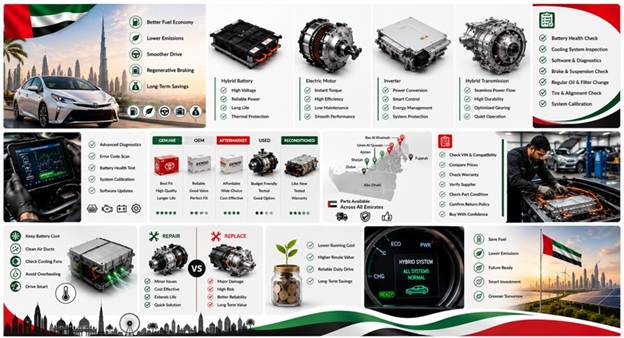
Quick Summary
| Component | Primary Role |
| Regenerative Braking | Recovers energy during deceleration and recharges the hybrid battery. |
| Conventional Brakes | Provide stopping power alongside regenerative braking. |
| Suspension & Steering | Maintain stability, comfort and handling. |
| Cooling System | Regulates temperatures for both engine and hybrid components. |
| High-Voltage Wiring | Transfers electrical power safely throughout the hybrid system. |
| 12-Volt Battery | Powers standard electrical accessories and starts hybrid electronics. |
A hybrid vehicle isn't held together by one remarkable component.
It's held together by dozens of ordinary ones quietly doing extraordinary jobs.
That's the irony.
Everyone asks about battery replacement.
Very few ask about the cooling fan feeding that battery fresh air.
Drivers worry about electric motors.
Almost nobody wonders whether a high-voltage connector hidden beneath the rear seats has begun to corrode.
Yet workshops know the pattern.
Large failures often begin with surprisingly small problems.
A blocked cooling duct.
A worn brake slider.
A weak auxiliary battery.
None sound particularly dramatic.
Until they become expensive.
Regenerative Braking System
The first time someone explains regenerative braking, it almost sounds fictional.
Brake...
And recharge the battery.
Surely energy can't simply appear.
It doesn't.
It has always been there.
Conventional brakes convert motion into heat.
Hybrid vehicles ask a different question.
Why waste that energy?
Instead of allowing momentum to disappear, the electric motor briefly changes its purpose.
During deceleration, it becomes a generator.
Movement becomes electricity.
Electricity returns to the hybrid battery.
Every roundabout.
Every traffic light.
Every queue approaching a toll gate.
The process repeats itself.
Thousands of times.
The driver barely notices.
The battery certainly does.
This constant energy recovery is one of the biggest reasons hybrids achieve impressive fuel economy in busy UAE traffic.
Conventional Braking Components
Regenerative braking performs a remarkable amount of work.
But it doesn't replace traditional brakes.
Not completely.
Brake discs.
Pads.
Callipers.
Hydraulic lines.
Brake fluid.
ABS sensors.
Every one remains essential.
Interestingly, hybrid vehicles sometimes experience a different type of brake wear.
Because regenerative braking handles much of the slowing, friction brakes may actually be used less frequently.
That sounds beneficial.
Mostly, it is.
But reduced use can allow corrosion to develop more quickly, particularly on brake discs.
Workshops occasionally inspect hybrid vehicles where brake pads remain almost new, yet discs require replacement because rust has become excessive.
Less wear doesn't always mean less maintenance.
Sometimes it simply changes the maintenance required.
Suspension and Steering Components
Hybrids often weigh more than equivalent petrol vehicles.
The battery pack accounts for much of that difference.
Manufacturers carefully distribute this weight to preserve balance.
Even so, suspension systems inevitably work harder.
Components commonly inspected include:
- Shock absorbers.
- Springs.
- Suspension bushes.
- Ball joints.
- Anti-roll bar links.
- Steering rack components.
Poor road surfaces, speed humps and continuous urban driving accelerate wear regardless of vehicle type.
The additional battery weight simply makes regular inspections even more worthwhile.
A hybrid should feel composed.
Not unsettled.
If steering begins feeling vague or uneven tyre wear develops unexpectedly, suspension inspection should become a priority rather than an afterthought.
Cooling System Components
Many motorists still imagine cooling systems exist solely for engines.
Hybrid engineers would disagree.
Modern hybrid vehicles often manage temperatures across multiple independent systems.
These may include:
- Petrol engine cooling.
- Hybrid battery cooling.
- Inverter cooling.
- Power electronics cooling.
- Cabin climate control integration.
Each system performs a specific task.
Each depends on accurate temperature monitoring.
A coolant leak affecting the engine might never influence battery temperature.
Likewise, restricted airflow through the battery cooling circuit may leave the petrol engine performing perfectly.
Diagnosing hybrids therefore requires understanding which cooling system is reporting a fault.
Not simply seeing coolant and assuming every component shares the same circuit.
High-Voltage Wiring and Connectors
Few hybrid components receive less attention.
Few deserve more.
Bright orange cables running beneath the vehicle don't exist for decoration.
They indicate high-voltage electrical systems requiring specialist handling.
These cables transfer electricity between:
- Battery pack.
- Inverter.
- Electric motor.
- Hybrid control modules.
They're heavily protected.
Thoroughly insulated.
Extensively tested.
Even so, time, vibration, moisture and accidental damage can eventually affect connectors.
Workshops routinely inspect:
- Connector security.
- Corrosion.
- Physical damage.
- Water ingress.
- Insulation integrity.
Replacing an expensive electronic module before checking wiring has become an avoidable mistake.
Electricity only travels as reliably as the path provided.
The Low-Voltage (12V) Battery
Here's the part that catches many new hybrid owners by surprise.
The hybrid battery doesn't power everything.
A conventional 12-volt battery still exists.
Without it, many hybrid vehicles won't even initialise their electronic systems.
It powers:
- Interior lighting.
- Dashboard systems.
- Central locking.
- Infotainment.
- Electronic control units during start-up.
A weak auxiliary battery can produce an astonishing variety of warning messages.
Owners sometimes fear catastrophic hybrid failure.
Technicians frequently discover something far simpler.
One tired battery.
One straightforward replacement.
Sometimes the smallest battery creates the biggest confusion.
Why Dust Matters More Than Many Drivers Realise
Ask technicians working across Al Ain or the outskirts of Dubai what they clean surprisingly often.
Battery cooling ducts.
Fine desert dust gradually settles where airflow should remain unrestricted.
Months pass.
Temperatures rise almost imperceptibly.
Cooling efficiency declines.
The battery works harder to remain within its ideal operating range.
Nothing dramatic happens overnight.
That's precisely why the problem develops unnoticed.
Routine cleaning during scheduled servicing may appear insignificant.
Yet it contributes directly to battery longevity.
Hybrid ownership in the UAE isn't only about managing heat.
It's also about managing dust.
Workshop Story
A hybrid hatchback arrived at a workshop in Sharjah with repeated braking warnings.
The owner expected worn brake pads.
Another garage had already recommended replacing the braking system.
Before ordering parts, technicians conducted a complete inspection.
Brake pads still retained substantial material.
Discs remained within specification.
The real issue?
One wheel-speed sensor had accumulated metallic debris, disrupting communication between the regenerative braking system and the ABS module.
The sensor was cleaned.
The system recalibrated.
The warning disappeared.
As the invoice was prepared, the customer looked at the technician and smiled.
"So my brakes weren't actually worn?"
"No," the technician replied.
"Your car simply stopped understanding what one wheel was doing."
Sometimes modern vehicles don't suffer mechanical failure.
They suffer communication failure.
The repair strategy changes completely.
Supporting System Comparison Table
| Component | Hybrid Vehicle | Why It Matters |
| Regenerative Braking | ✔ | Improves efficiency and reduces brake wear |
| Conventional Brakes | ✔ | Provides primary stopping safety |
| Suspension | ✔ | Supports additional hybrid system weight |
| Steering System | ✔ | Maintains vehicle stability and control |
| High-Voltage Wiring | ✔ | Transfers electrical energy safely |
| 12-Volt Battery | ✔ | Powers electronic systems and hybrid start-up |
Buyer Decision Matrix
| Your Situation | Recommended Decision |
| Brake warning light appears | Inspect both regenerative and hydraulic braking systems |
| Buying a used hybrid | Check suspension wear and brake condition carefully |
| Hybrid warning lights appear after battery replacement | Test the 12-volt battery before assuming high-voltage failure |
| Driving frequently in dusty environments | Include battery cooling duct inspection during servicing |
| Steering feels inconsistent | Inspect suspension and steering components promptly |
| Electrical fault develops unexpectedly | Verify connectors and wiring before replacing control modules |
Suggested Visual Callout
"How Hybrid Supporting Systems Work Together"
Create a premium infographic showing:
- Regenerative braking transferring energy back to the battery.
- Conventional brake system.
- Suspension components.
- Steering rack.
- High-voltage orange cables.
- Battery cooling airflow.
- 12-volt battery powering vehicle electronics.
Use realistic technical illustrations with subtle UAE-inspired red, green, white and black accents.
Keep labels concise and allow arrows to demonstrate energy flow and system interaction.
Smart Buyer's Checklist
Before approving repairs involving supporting hybrid systems:
- Inspect regenerative and conventional braking together.
- Check battery cooling ducts for dust accumulation.
- Test the 12-volt battery.
- Examine suspension wear during routine servicing.
- Verify high-voltage connector condition.
- Request a complete diagnostic scan before replacing electronic modules.
- Choose workshops experienced with hybrid electrical systems.
- Prioritise preventative maintenance before symptoms become expensive repairs.
Supporting systems rarely receive the attention they deserve.
Yet they quietly determine whether every major hybrid component can perform exactly as engineers intended.
Key Takeaways
Hybrid vehicles depend on an intricate network of supporting systems that are every bit as important as the battery and electric motor. Regenerative braking, conventional braking, suspension, cooling circuits, high-voltage wiring and the 12-volt electrical system work together continuously, and a fault in any one of them can affect the performance of the entire hybrid powertrain. Many issues that appear to involve expensive high-voltage components ultimately originate from far simpler supporting parts.
For UAE owners, routine inspections become even more valuable because heat, heavy traffic and fine desert dust place additional demands on cooling systems, braking components and electrical connections. Understanding these supporting systems helps buyers make better maintenance decisions, avoid unnecessary part replacements and enjoy more dependable hybrid ownership over the long term.
Hybrid Maintenance – The Repairs You Can Prevent Before They Ever Happen
Quick Summary
| Maintenance Area | Why It Matters |
| Hybrid Battery Care | Preserves battery efficiency and extends lifespan. |
| Cooling System Maintenance | Protects batteries, electronics and the petrol engine from excessive heat. |
| Fluids & Filters | Keeps both mechanical and electrical systems operating efficiently. |
| Spark Plugs & Engine Components | Ensures smooth engine performance when petrol power is required. |
| UAE Service Intervals | Adjustments may be needed due to heat, dust and heavy traffic. |
| Preventative Maintenance | Reduces unexpected repairs and long-term ownership costs. |
Hybrid vehicles have an interesting habit.
They quietly convince owners that very little needs maintaining.
After all, the engine switches off regularly.
Brake pads wear more slowly.
Fuel consumption falls.
Everything feels... effortless.
That feeling is wonderful.
Until someone mistakes "lower maintenance" for "no maintenance."
Workshops across the UAE see this misunderstanding more often than people imagine.
A customer proudly explains that the hybrid has "never needed anything."
The technician opens the battery cooling duct.
Dust.
Checks the engine coolant.
Low.
Inspects the spark plugs.
Well beyond their recommended service interval.
Nothing has actually broken.
Yet several components have quietly spent months asking for attention.
Hybrid vehicles don't eliminate maintenance.
They simply change where maintenance matters most.
Hybrid Battery Maintenance
The battery doesn't ask for much.
It certainly doesn't require weekly attention.
But ignoring it completely is equally unwise.
Unlike a conventional battery, the hybrid battery depends on several supporting systems remaining healthy throughout its life.
Routine inspections should include:
- Battery health analysis.
- Cooling system inspection.
- Air intake cleaning.
- Temperature monitoring.
- Software diagnostics.
- Electrical connection checks.
Interestingly, technicians often spend more time examining the environment around the battery than the battery itself.
Because that's where many long-term problems begin.
Heat.
Restricted airflow.
Dust.
Poor cooling.
Protect those areas and the battery usually rewards owners with impressive longevity.
Cooling System Maintenance
Ask an experienced hybrid technician which component deserves more attention.
Many won't answer "battery."
They'll answer "cooling."
Without effective temperature control, every major hybrid component works harder.
Battery efficiency declines.
Power electronics generate additional stress.
The petrol engine may also experience increased operating temperatures.
Depending on the vehicle, routine cooling maintenance may involve:
- Coolant replacement.
- Cooling fan inspection.
- Battery air duct cleaning.
- Coolant pump testing.
- Radiator inspection.
- Hose condition checks.
The cooling system doesn't simply preserve reliability.
It protects expensive components from premature ageing.
Fluids and Filters
There's another common misconception.
Because hybrids use electricity...
Some owners assume fluids become almost irrelevant.
Quite the opposite.
Hybrid vehicles still rely on numerous fluids depending on their design.
These may include:
- Engine oil.
- Engine coolant.
- Hybrid cooling coolant.
- Brake fluid.
- Transmission fluid.
- Windscreen washer fluid.
Filters remain equally important.
Regular inspections may include:
- Engine air filter.
- Cabin air filter.
- Hybrid battery cooling filter (where fitted).
Each performs a relatively inexpensive task.
Ignoring them often leads to disproportionately expensive consequences.
That's rarely a sensible trade.
Spark Plugs and Engine Components
One curious characteristic of hybrid ownership is that the petrol engine often works less frequently than in conventional vehicles.
Some drivers assume this means engine servicing becomes unnecessary.
Unfortunately, engines don't measure maintenance in hours alone.
Time matters too.
Spark plugs gradually age.
Rubber seals continue ageing.
Engine oil slowly deteriorates.
Cooling systems still require servicing.
Even if the engine spends part of every journey switched off.
Hybrid engines generally experience less continuous stress.
That helps.
But it doesn't exempt them from scheduled maintenance.
Manufacturers establish service intervals for good reason.
Ignoring them simply postpones problems until they become more expensive.
Service Intervals in UAE Conditions
Service schedules printed inside owner manuals represent ideal conditions.
The UAE isn't always ideal.
Summer temperatures regularly exceed forty degrees.
Fine sand circulates continuously.
Urban congestion keeps cooling systems working harder.
Long motorway journeys expose drivetrains to sustained heat.
These conditions accelerate wear in subtle ways.
Many experienced workshops therefore recommend paying closer attention to:
- Cooling system inspections.
- Air filter replacement.
- Battery cooling maintenance.
- Brake inspections.
- Suspension checks.
Not necessarily because components fail sooner.
Because environmental conditions become more demanding.
Maintenance should always reflect reality.
Not simply mileage.
The Cost of Delaying Routine Maintenance
Every workshop has stories.
This one begins with something as ordinary as an air filter.
A hybrid crossover arrived with declining fuel economy.
Nothing dramatic.
No warning lights.
No unusual noises.
The owner assumed battery deterioration.
Diagnostic testing suggested otherwise.
The hybrid system operated exactly as expected.
The petrol engine, however, struggled to breathe efficiently because the engine air filter had become heavily restricted after repeated exposure to dusty conditions.
Replacing the filter restored normal performance almost immediately.
The battery had spent months compensating for an engine that wasn't performing efficiently.
One inexpensive service item had gradually influenced the behaviour of the entire hybrid system.
Maintenance rarely affects only one component.
Everything remains connected.
Preventative Maintenance Always Costs Less Than Reactive Repairs
Preventative maintenance sounds wonderfully sensible.
Until someone receives the invoice.
Then it suddenly feels optional.
Yet compare those figures with major component replacement.
Battery.
Inverter.
Cooling pump.
Transmission.
The mathematics changes quickly.
Routine servicing offers something repairs never can.
Choice.
Owners decide when servicing happens.
Breakdowns usually make that decision themselves.
There's another benefit often overlooked.
Technicians inspecting vehicles regularly notice patterns.
Small coolant seepage.
Slight suspension wear.
Dust beginning to collect inside cooling ducts.
Nothing urgent.
Everything worth addressing.
That quiet intervention often prevents much larger repairs months later.
Why Hybrid Software Checks Matter
Modern servicing extends well beyond spanners and sockets.
Hybrid vehicles increasingly rely on software to optimise efficiency.
Manufacturers occasionally release updates affecting:
- Battery management.
- Charging behaviour.
- Engine calibration.
- Hybrid control strategies.
- Fault detection.
Ignoring available software updates doesn't usually cause immediate failure.
However, updated programming may improve reliability, efficiency and fault diagnosis.
Servicing today increasingly includes digital maintenance alongside mechanical maintenance.
The toolbox now contains laptops as often as torque wrenches.
Workshop Story
A ride-hailing driver from Dubai brought his hybrid saloon into a specialist workshop after noticing fuel consumption had slowly increased over several months.
Nothing felt obviously wrong.
No warning lights.
No unusual noises.
Because the vehicle remained pleasant to drive, he postponed booking an inspection.
Eventually curiosity outweighed convenience.
Technicians carried out a routine hybrid health assessment.
The battery remained exceptionally healthy.
The electric motor performed perfectly.
The culprit turned out to be remarkably ordinary.
The battery cooling intake behind the rear seat had accumulated a thick layer of dust, while the engine air filter had become heavily restricted after thousands of kilometres in heavy urban traffic.
Neither problem alone appeared significant.
Together they gradually reduced overall efficiency.
After servicing both systems, fuel economy returned almost to its previous level.
Collecting the vehicle later that afternoon, the owner smiled.
"I thought hybrids looked after themselves."
The technician laughed.
"They help look after themselves."
"They still need someone to look after them occasionally."
That's probably the simplest explanation of hybrid ownership you'll ever hear.
Hybrid Maintenance Comparison Table
| Maintenance Item | Frequency Depends On | Why It Matters |
| Battery Health Check | Periodic Inspection | Detects early deterioration |
| Battery Cooling System | Regular Inspection | Prevents overheating |
| Engine Oil | Manufacturer Schedule | Protects petrol engine |
| Engine Air Filter | More Frequent in Dusty Conditions | Maintains engine efficiency |
| Brake Fluid | Scheduled Replacement | Ensures safe braking performance |
| Software Updates | As Recommended | Optimises hybrid system operation |
Buyer Decision Matrix
| Your Situation | Recommended Decision |
| Daily city driving | Schedule regular battery cooling inspections |
| Frequent motorway journeys | Monitor engine cooling and fluids carefully |
| Living in dusty areas | Replace air filters more frequently |
| Buying a used hybrid | Review documented service history in detail |
| Hybrid fuel economy suddenly worsens | Request a complete hybrid diagnostic inspection |
| Planning long-term ownership | Follow preventative maintenance rather than reactive repairs |
Suggested Visual Callout
"Hybrid Maintenance That Protects Expensive Components"
Create a premium infographic illustrating:
- Hybrid battery inspection.
- Cooling fan cleaning.
- Engine oil servicing.
- Air filter replacement.
- Battery health scan.
- Software diagnostics.
- Coolant inspection.
- Final road test.
Use realistic workshop illustrations with subtle UAE-inspired red, green, white and black accents.
Keep text minimal and allow icons and arrows to explain the maintenance process.
Smart Buyer's Checklist
Before every scheduled hybrid service:
- Request a battery health report.
- Inspect battery cooling ducts.
- Replace filters when required.
- Check coolant condition and levels.
- Follow engine oil service intervals.
- Ask about available software updates.
- Inspect brake fluid and braking components.
- Choose workshops familiar with hybrid systems rather than treating the vehicle as a conventional petrol car.
Good hybrid maintenance rarely feels dramatic.
That's precisely the point.
When servicing is done properly, owners spend less time discussing major repairs because those repairs often never become necessary.
Key Takeaways
Hybrid maintenance is built around prevention rather than reaction. While these vehicles often require fewer routine mechanical repairs than conventional petrol cars, they still depend on carefully maintained cooling systems, healthy batteries, clean filters, quality fluids and regular software diagnostics. Many of the most expensive hybrid failures can be traced back to neglected maintenance that initially appeared too minor to matter.
For owners in the UAE, environmental conditions make preventative servicing even more valuable. High temperatures, heavy traffic and airborne dust increase the importance of cooling efficiency and routine inspections. Looking after these seemingly ordinary service items protects the extraordinary technology working beneath the surface and helps ensure reliable, economical hybrid ownership for years to come.
Why Hybrid Diagnostics Matter More Than Replacing Parts
Quick Summary
| Topic | Why It Matters |
| Hybrid Diagnostic Equipment | Identifies faults accurately before expensive components are replaced. |
| High-Voltage Safety | Protects technicians and prevents damage to sensitive systems. |
| Battery Health Testing | Determines the true condition of the hybrid battery. |
| Software Updates & Calibration | Ensures replacement components communicate correctly. |
| Choosing the Right Workshop | Reduces the risk of misdiagnosis and unnecessary repairs. |
| Diagnostic Mistakes | Often cost more than the actual repair. |
Walk into a modern hybrid workshop and something becomes obvious almost immediately.
The mechanic isn't reaching for a spanner first.
He's reaching for a laptop.
That single image tells the story of how dramatically vehicle repair has changed.
Twenty years ago, unusual engine noises often pointed technicians towards worn mechanical parts.
Today's hybrid vehicles behave differently.
A warning light might indicate a cooling issue.
Or an inverter communication fault.
Or a software calibration problem.
Or a battery sensor sending inaccurate information.
The symptom rarely tells the whole story.
That's why replacing parts before completing diagnostics has become one of the most expensive habits in modern vehicle repair.
Hybrid technology doesn't reward educated guesses.
It rewards evidence.
Hybrid Diagnostic Equipment
Every hybrid vehicle constantly records information.
Battery temperatures.
Voltage levels.
Motor performance.
Charging behaviour.
Engine load.
Brake regeneration.
Cooling efficiency.
Thousands of measurements pass through electronic control units every minute.
Diagnostic equipment allows technicians to read that information.
Without it, repairing a hybrid becomes little more than speculation.
Professional workshops typically rely on:
- Manufacturer-level diagnostic scanners.
- Battery health analysis equipment.
- High-voltage testing tools.
- Oscilloscopes.
- Electrical insulation testers.
- Software programming systems.
Each tool serves a different purpose.
Together, they reveal what the human eye cannot.
Modern diagnostics have become less about finding broken parts.
More about understanding why they stopped behaving normally.
High-Voltage Safety Procedures
There's a reason technicians wear insulated gloves before working on hybrid batteries.
It isn't theatre.
High-voltage systems deserve respect.
Not fear.
Respect.
Before repairs begin, trained technicians usually follow a carefully controlled sequence.
The vehicle is isolated.
The high-voltage circuit is disabled.
Protective equipment is checked.
Voltage is confirmed before touching any electrical components.
Every step exists because assumptions have consequences.
Hybrid systems are engineered with multiple safety mechanisms, but those safeguards depend upon technicians following the correct procedures.
Professional workshops never rush this stage.
Neither should vehicle owners.
Battery Health Testing
A battery warning light doesn't automatically mean the battery has reached the end of its life.
That's probably the single most important lesson hybrid owners can learn.
Battery health testing examines much more than simple voltage.
Technicians assess:
- State of charge.
- State of health.
- Individual module balance.
- Internal resistance.
- Temperature behaviour.
- Charging efficiency.
- Historical fault records.
Think of it as a medical examination.
A doctor doesn't diagnose a patient by checking heart rate alone.
Likewise, hybrid batteries require a complete assessment before any meaningful conclusions can be drawn.
Healthy batteries are replaced surprisingly often.
Simply because nobody tested them properly.
Software Updates and Calibration
Replacing a hybrid component isn't always the final step.
Sometimes it's merely the beginning.
Many replacement parts require software configuration before they become fully operational.
That includes components such as:
- Hybrid control modules.
- Battery management systems.
- Inverters.
- Electronic braking systems.
- Steering modules.
Without calibration, the vehicle may continue displaying warning lights despite having perfectly functioning hardware.
Owners understandably become frustrated.
The new component is fitted.
Why doesn't everything work?
Because modern hybrids don't simply recognise physical installation.
They expect digital confirmation.
The vehicle needs to know exactly what has changed.
Software has become as important as the component itself.
Choosing a Qualified Hybrid Workshop
Not every garage advertises hybrid expertise.
Some simply accept hybrid vehicles because they appear similar to conventional cars.
The similarities end quickly.
Experienced hybrid workshops usually invest heavily in:
- Technician certification.
- High-voltage safety training.
- Manufacturer diagnostic equipment.
- Software subscriptions.
- Specialist testing tools.
Those investments matter.
Because hybrid repairs increasingly involve interpretation rather than replacement.
A technician isn't simply changing a part.
They're analysing relationships between dozens of interconnected systems.
Experience shortens diagnosis.
Inexperience often lengthens invoices.
Common Diagnostic Mistakes
Some mistakes repeat themselves with surprising regularity.
One warning light appears.
One expensive part gets replaced.
The warning light returns.
The real fault remains.
Among the most common errors are:
- Replacing the hybrid battery before testing cooling performance.
- Replacing the inverter without checking wiring integrity.
- Ignoring software updates.
- Diagnosing faults using generic scan tools alone.
- Assuming every warning light indicates hardware failure.
- Skipping battery health analysis before ordering replacement components.
Every mistake shares something in common.
A conclusion arrived before the investigation finished.
Good technicians become suspicious of obvious answers.
Hybrid systems often reward that scepticism.
Why One Fault Can Create Multiple Symptoms
This is where hybrid diagnosis becomes genuinely fascinating.
Imagine a battery cooling fan gradually losing efficiency.
Battery temperatures increase slightly.
The control unit responds by limiting battery output.
Fuel economy falls because the petrol engine now works harder.
Acceleration feels different.
Warning lights eventually appear.
From the driver's perspective, four separate problems seem to exist.
From the technician's perspective...
It's one cooling fan.
Hybrid vehicles don't simply develop faults.
They develop chains of consequences.
Breaking that chain requires identifying the first link.
Not the loudest symptom.
Why Second Opinions Can Save Thousands
There's no shame in asking another workshop to inspect a major diagnosis.
Quite the opposite.
Large repair quotations deserve careful scrutiny.
Particularly when expensive components such as batteries or inverters are involved.
A reputable workshop won't object.
Confident technicians understand that accurate diagnosis withstands independent inspection.
Sometimes both workshops reach identical conclusions.
Sometimes they don't.
Either way, the owner benefits from greater certainty before authorising significant expenditure.
Confidence should come from evidence.
Not optimism.
Workshop Story
A hybrid executive saloon arrived at a specialist workshop in Abu Dhabi after another repair centre recommended replacing both the inverter and the hybrid battery.
The quotation exceeded the value many owners would consider reasonable.
Before ordering any components, technicians began with the basics.
Battery health remained excellent.
The inverter operated normally.
Voltage readings appeared stable.
Eventually attention turned towards a section of high-voltage wiring beneath the vehicle.
During an earlier underbody repair, a connector retaining clip had not been secured correctly.
Months of vibration created intermittent electrical contact.
Every warning light.
Every reduced-power incident.
Every fault code.
All traced back to one connector costing a fraction of the original quotation.
As the customer collected the vehicle, he looked at the technician and asked,
"So I nearly replaced two perfectly healthy components?"
The reply came almost immediately.
"You nearly replaced the evidence instead of the cause."
That sentence deserves remembering.
Because it applies to almost every modern hybrid repair.
Hybrid Diagnostics Comparison Table
| Diagnostic Procedure | Purpose | Importance |
| Manufacturer Diagnostic Scan | Reads hybrid system faults | Essential |
| Battery Health Test | Measures battery condition | Essential |
| High-Voltage Safety Inspection | Confirms safe working conditions | Essential |
| Software Calibration | Ensures component communication | Essential |
| Electrical Connector Inspection | Identifies hidden connection faults | High |
| Road Test & Data Logging | Confirms repair effectiveness | High |
Buyer Decision Matrix
| Your Situation | Recommended Decision |
| Hybrid warning light appears | Request a full manufacturer-level diagnostic scan |
| Battery replacement recommended | Ask for a documented battery health report first |
| Major inverter quotation received | Obtain a second professional opinion |
| Electronic component replaced | Confirm software programming has been completed |
| Buying a used hybrid | Request diagnostic reports alongside the service history |
| Choosing a workshop | Prioritise hybrid experience over convenience alone |
Suggested Visual Callout
"The Hybrid Diagnostic Process"
Create a realistic workshop infographic showing:
- Vehicle connected to diagnostic equipment.
- High-voltage safety isolation.
- Battery health testing.
- Inverter analysis.
- Wiring inspection.
- Software calibration.
- Road test.
- Final diagnostic confirmation.
Use realistic workshop imagery with subtle UAE-inspired red, green, white and black accents.
Keep labels concise and allow arrows to demonstrate the diagnostic journey from fault detection to successful repair.
Smart Buyer's Checklist
Before approving any major hybrid repair:
- Request a complete diagnostic report.
- Ask for battery health results rather than assumptions.
- Confirm whether software updates are included.
- Verify that high-voltage safety procedures were followed.
- Ask if wiring and connectors have been inspected.
- Consider obtaining a second opinion for expensive repairs.
- Choose workshops equipped specifically for hybrid diagnostics.
- Never authorise major component replacement based solely on warning lights.
The best hybrid repairs don't begin with ordering parts.
They begin with asking better questions.
Key Takeaways
Successful hybrid repairs depend far more on accurate diagnosis than on replacing expensive components. Modern hybrid vehicles constantly monitor battery performance, electrical systems, cooling efficiency and software communication, meaning a single fault can produce multiple symptoms that easily mislead inexperienced technicians. Professional diagnostic equipment, battery health testing and careful analysis remain the most valuable tools in any hybrid workshop.
For owners, understanding the importance of diagnostics changes the entire repair process. Rather than focusing immediately on replacement costs, informed buyers ask for evidence, request detailed diagnostic reports and choose workshops with genuine hybrid expertise. Those decisions frequently prevent unnecessary repairs, protect healthy components and reduce long-term ownership costs.
Hybrid Spare Parts Costs and Availability – What UAE Buyers Should Really Expect
Quick Summary
| Component | Cost Impact | Buyer Advice |
| Hybrid Battery | Highest | Always request a battery health report before replacement. |
| Electric Motor & Inverter | High | Confirm diagnosis before ordering expensive components. |
| Cooling System Parts | Moderate | Small repairs often prevent major battery costs. |
| Routine Service Parts | Low | Replace on schedule to protect hybrid efficiency. |
| Parts Availability | Improving | Availability varies by make, model and component. |
| Genuine vs Used Parts | Depends on Component | High-voltage systems deserve extra care when choosing replacements. |
Ask somebody what the most expensive part inside a hybrid vehicle is.
The answer comes almost instantly.
"The battery."
Usually accompanied by a worried expression.
It's an understandable response.
Large battery replacement figures generate headlines.
Routine servicing rarely does.
Yet ownership costs are rarely defined by one dramatic invoice.
They're shaped by dozens of smaller decisions made over several years.
Choosing the correct workshop.
Replacing filters before they become blocked.
Cleaning battery cooling systems.
Buying compatible replacement parts instead of chasing the cheapest listing online.
Hybrid ownership isn't simply about avoiding expensive repairs.
It's about preventing them from becoming necessary.
That distinction changes everything.
Hybrid Battery Replacement Costs
Let's begin with the component everyone talks about.
Replacing an entire hybrid battery can certainly represent one of the largest repair expenses associated with hybrid ownership.
But here's something workshops know exceptionally well.
Complete battery replacement happens far less frequently than many buyers imagine.
Modern battery packs are remarkably durable.
When issues develop, technicians first investigate:
- Battery cooling efficiency.
- Individual module performance.
- Battery Management System operation.
- Electrical connections.
- High-voltage contactors.
- Software calibration.
Only after these areas have been properly assessed should replacement even enter the conversation.
Replacing a healthy battery because another component has failed is rather like replacing an entire house because one light switch stopped working.
Accurate diagnosis protects owners from unnecessarily large bills.
Electric Motor and Inverter Costs
The electric motor enjoys an excellent reputation for reliability.
It's deserved.
Unlike many conventional mechanical systems, hybrid motors contain relatively few wear-prone components.
That doesn't mean failures never occur.
It means technicians usually investigate supporting systems before assuming the motor itself requires replacement.
The inverter follows a similar pattern.
Because it controls electrical power flowing throughout the hybrid system, inverter faults can imitate numerous other problems.
Reduced performance.
Warning lights.
Charging irregularities.
Intermittent operation.
Replacing the inverter without confirming the underlying cause may simply relocate the problem rather than solve it.
Owners should always request evidence supporting any recommendation involving major electronic components.
Cooling System Replacement Costs
Cooling systems rarely receive the attention they deserve.
Perhaps because they don't sound particularly exciting.
Fans.
Coolant pumps.
Radiators.
Temperature sensors.
Nothing especially glamorous.
Until one of them quietly allows battery temperatures to climb.
Suddenly, an inexpensive cooling issue begins influencing the health of components worth many thousands of dirhams.
That relationship makes cooling system maintenance one of the most cost-effective investments available to hybrid owners.
Replacing a cooling fan before it fails completely may prevent unnecessary stress on the battery pack.
It's a small decision with disproportionately large benefits.
Routine Maintenance Parts
Most hybrid servicing revolves around remarkably ordinary components.
Engine oil.
Filters.
Spark plugs.
Brake fluid.
Coolant.
Cabin filters.
Tyres.
There's nothing revolutionary about any of them.
Yet together they determine how efficiently the hybrid system performs.
One neglected engine air filter forces the petrol engine to work harder.
The hybrid battery compensates.
Fuel economy gradually declines.
Owners sometimes blame the hybrid system when routine servicing is actually the missing piece.
Major technology still depends upon ordinary maintenance.
Perhaps that's the most overlooked lesson in hybrid ownership.
Spare Parts Availability Across the UAE
There was a time when finding hybrid components required considerable patience.
Those days are gradually disappearing.
As hybrid vehicle ownership increases across Dubai, Abu Dhabi, Sharjah, Ajman, Ras Al Khaimah, Fujairah and Umm Al Quwain, suppliers have expanded their inventories accordingly.
Routine service components are now widely available for many popular hybrid models.
Major high-voltage components remain more specialised.
Availability often depends upon:
- Vehicle manufacturer.
- Model year.
- Production specification.
- Regional configuration.
- Demand.
Premium European hybrids occasionally require longer sourcing times than high-volume Japanese models.
That's hardly surprising.
Market size influences supply.
The encouraging trend is that hybrid parts availability continues improving every year.
Genuine vs Used Hybrid Components
Few subjects generate stronger opinions inside workshops.
Should owners buy genuine parts?
OEM alternatives?
Used components?
Reconditioned assemblies?
The answer depends entirely upon the component involved.
High-voltage safety systems deserve exceptional caution.
Battery management modules.
Inverters.
High-voltage relays.
Critical electrical components.
These generally benefit from genuine or high-quality OEM replacements.
Routine maintenance items offer greater flexibility.
Filters.
Brake components.
Suspension parts.
Quality aftermarket alternatives often perform extremely well when sourced from reputable manufacturers.
Used hybrid batteries deserve careful evaluation.
A battery isn't simply old or new.
Its condition depends upon:
- Remaining capacity.
- Thermal history.
- Previous maintenance.
- Internal balance.
- Overall health.
Age alone tells only part of the story.
Why Cheap Parts Sometimes Become the Most Expensive Choice
Every workshop has encountered the same situation.
A customer arrives carrying a remarkably inexpensive replacement component purchased online.
The part appears identical.
Installation begins.
Then something doesn't fit.
Or communicates incorrectly.
Or fails within weeks.
The initial saving disappears quickly.
Additional labour.
Replacement parts.
Vehicle downtime.
Frustration.
The cheapest invoice often becomes the most expensive ownership decision.
Quality isn't always visible immediately.
Reliability usually reveals it eventually.
The Hidden Cost Most Buyers Forget
When people compare repair quotations, attention naturally settles on component prices.
Labour appears further down the page.
Almost unnoticed.
Yet removing a hybrid battery twice because the wrong supporting part was installed can easily double labour costs.
Likewise, replacing electronic modules without completing software calibration often creates repeat workshop visits.
A low component price means very little if the vehicle spends another week inside the workshop.
Owners should compare complete repair costs.
Not simply parts prices.
Why Availability Should Influence Buying Decisions
Suppose you're choosing between two used hybrid vehicles.
Both appear similar.
Both have comparable mileage.
Both fall comfortably within budget.
One belongs to a manufacturer with extensive UAE parts support.
The other relies heavily on imported specialist components.
That difference may never matter.
Or it may determine whether future repairs take three days or three weeks.
Ownership extends beyond today's purchase.
Availability should form part of every buying decision.
Not merely every repair.
Workshop Story
A family from Abu Dhabi owned two hybrid SUVs purchased within months of one another.
One required an inverter replacement after an electrical fault developed.
Eager to reduce costs, they sourced an unusually inexpensive imported unit themselves.
The workshop agreed to install it after explaining the risks.
The component fitted physically.
Software refused to recognise it.
Multiple calibration attempts failed.
Eventually the vehicle received the correct specification inverter recommended from the beginning.
The original "saving" disappeared beneath additional labour, shipping costs and repeated diagnostic sessions.
Collecting the vehicle, the owner laughed quietly.
"That cheap part turned out to be surprisingly expensive."
The technician replied,
"The invoice only measures today's spending."
"Compatibility determines tomorrow's."
That observation probably deserves framing on every workshop wall.
Hybrid Spare Parts Cost Comparison Table
| Component | Typical Replacement Complexity | Buying Priority |
| Hybrid Battery | Very High | Battery health before replacement |
| Inverter | High | Confirm diagnosis and software compatibility |
| Electric Motor | High | Inspect supporting systems first |
| Cooling Fan & Pumps | Moderate | Replace early if faulty |
| Engine Service Parts | Low | Follow scheduled maintenance |
| Filters & Fluids | Low | Never delay routine servicing |
Buyer Decision Matrix
| Your Situation | Recommended Decision |
| Battery replacement recommended | Request documented battery health testing first |
| Inverter fault diagnosed | Verify software compatibility before ordering |
| Buying used hybrid parts | Prioritise condition over price alone |
| Choosing between genuine and aftermarket | Use genuine or OEM for high-voltage systems |
| Purchasing a used hybrid vehicle | Consider long-term parts availability |
| Comparing repair quotations | Evaluate total repair cost, not component price alone |
Suggested Visual Callout
"Where Your Hybrid Maintenance Budget Goes"
Create a premium infographic illustrating:
- Hybrid battery.
- Electric motor.
- Inverter.
- Cooling system.
- Routine service items.
- Parts availability across the UAE.
- Genuine vs OEM vs Used component comparison.
- Cost balance showing preventative maintenance versus major repairs.
Use realistic workshop illustrations with subtle UAE-inspired red, green, white and black accents.
Keep labels short and allow icons to communicate the relationships between maintenance, repair costs and long-term ownership.
Smart Buyer's Checklist
Before purchasing any hybrid spare part:
- Confirm the exact fault through diagnostics.
- Request a battery health report where applicable.
- Verify VIN compatibility.
- Compare genuine, OEM and quality aftermarket options.
- Ask whether software programming is required.
- Check warranty coverage.
- Consider long-term parts availability.
- Focus on total ownership value rather than the lowest purchase price.
The best buying decisions rarely begin with asking,
"What's cheapest?"
They begin with a far better question.
"What's most likely to keep this vehicle reliable for the next five years?"
Key Takeaways
Hybrid ownership costs are influenced far more by maintenance quality and accurate diagnosis than by the price of individual components. Although hybrid batteries, inverters and electric motors attract the greatest attention, supporting systems and routine service items often determine whether these major components enjoy long, reliable service lives. Understanding where money is best invested allows owners to prevent expensive repairs rather than simply reacting to them.
For buyers across the UAE, replacement car spare parts availability continues to improve as hybrid adoption grows, but choosing the correct component remains just as important as finding it quickly. Genuine and high-quality OEM parts remain the safest option for critical high-voltage systems, while preventative maintenance consistently delivers the greatest long-term value. Thoughtful purchasing decisions today almost always reduce repair costs tomorrow.
Hybrid Reliability – What Actually Fails and What Usually Doesn't
Quick Summary
| Component | Reliability | What Buyers Should Know |
| Hybrid Battery | Excellent | Most batteries last much longer than many buyers expect when maintained properly. |
| Inverter | Very Good | Failures are uncommon but require specialist diagnostics. |
| Cooling System | Moderate | One of the most overlooked causes of hybrid problems. |
| Petrol Engine | Excellent | Usually experiences less stress than in conventional vehicles. |
| Hybrid Transmission | Excellent | Built for durability but still requires proper maintenance. |
| Overall Reliability | High | Preventative servicing has a greater impact than vehicle age alone. |
There is an interesting difference between what people expect hybrid ownership to be...
...and what workshops actually experience.
Ask somebody who's never owned a hybrid what normally goes wrong.
The answer almost always begins with the battery.
Ask a technician who repairs hybrids every day.
The conversation becomes very different.
Cooling fans.
Auxiliary batteries.
Electrical connectors.
Software calibration.
Blocked air ducts.
Intermittent sensors.
The battery still enters the discussion.
Just much later than most people imagine.
That's because hybrid vehicles rarely fail in spectacular fashion.
They usually whisper first.
Owners simply need to recognise the whispers before they become expensive conversations.
Most Common Hybrid Battery Problems
Let's clear away the biggest misconception first.
Hybrid batteries do not suddenly wake up one morning and decide to stop working.
Ageing happens gradually.
Almost politely.
Drivers may notice:
- Slightly lower fuel efficiency.
- More frequent petrol engine operation.
- Reduced electric-only driving.
- Longer charging cycles through regenerative braking.
- Occasional hybrid warning messages.
Those aren't necessarily signs of battery failure.
They're signs that the vehicle deserves inspection.
Battery-related issues commonly involve:
- Individual modules.
- Cooling performance.
- Temperature sensors.
- Battery Management System.
- Electrical connections.
Complete battery replacement is often considered only after these areas have been investigated thoroughly.
The battery is usually the final conclusion.
Not the opening assumption.
Inverter and Electronic Module Failures
The inverter has one remarkably difficult job.
It continuously manages enormous amounts of electrical energy while responding instantly to changing driving conditions.
Acceleration.
Braking.
Traffic.
Motorway speeds.
Everything changes within seconds.
Fortunately, inverter failures remain relatively uncommon.
When they do occur, symptoms often include:
- Hybrid warning lights.
- Reduced power.
- Failure to enter electric drive.
- Unexpected engine operation.
- Communication faults.
Interestingly, workshops frequently discover that surrounding components caused the original problem.
Cooling issues.
Voltage irregularities.
Damaged connectors.
Electrical modules rarely exist in isolation.
They react to the systems around them.
Cooling System Problems
If experienced technicians were allowed to nominate the most underestimated hybrid component...
Many would choose the cooling system.
Without hesitation.
Hybrid batteries dislike excessive heat.
Inverters dislike excessive heat.
Power electronics dislike excessive heat.
The UAE has no shortage of excessive heat.
That doesn't make hybrids unreliable.
It simply means cooling systems become exceptionally important.
Common issues include:
- Blocked battery cooling ducts.
- Cooling fan wear.
- Low coolant levels.
- Restricted radiators.
- Faulty temperature sensors.
- Coolant pump failures.
None sound particularly dramatic.
Collectively, they protect components worth many thousands of dirhams.
It's remarkable how often modest cooling repairs prevent major battery concerns.
Engine-Related Hybrid Issues
Here's a surprising advantage.
Hybrid petrol engines often enjoy easier working lives than conventional engines.
Why?
Because they don't shoulder every kilometre alone.
Electric motors assist during:
- Moving away from junctions.
- Heavy acceleration.
- Urban traffic.
- Low-speed driving.
The result?
Reduced engine workload.
Lower average operating stress.
Potentially longer engine life.
Of course, engines remain mechanical devices.
They still require:
- Oil changes.
- Filter replacement.
- Spark plugs.
- Coolant servicing.
- Regular inspections.
Less stress doesn't mean zero maintenance.
It simply improves the odds.
Hybrid Transmission Reliability
Conventional automatic gearboxes often experience repeated gear changes throughout every journey.
Hybrid transmissions operate differently.
Electronic control systems constantly blend engine and motor power rather than relying solely on traditional gear changes.
This smoother operation reduces stress across many internal components.
That explains why hybrid transmissions have earned an excellent reputation for long-term reliability.
Problems still occur.
Usually involving:
- Bearings.
- Seals.
- Electronic controls.
- Cooling systems.
Again...
Diagnosis matters more than assumptions.
Transmission replacement should always follow detailed investigation.
Never precede it.
How the UAE Climate Changes Everything
A hybrid operating in Norway lives a very different life from one commuting between Abu Dhabi and Dubai.
Ambient temperature matters.
So does traffic.
So does dust.
Summer temperatures regularly push cooling systems towards their limits.
Air conditioning operates almost continuously.
Stop-start traffic encourages repeated charging and discharging cycles.
Fine airborne dust slowly settles inside cooling ducts and filters.
Individually...
None create immediate concern.
Combined...
They explain why preventative maintenance becomes so valuable across the Emirates.
Climate rarely destroys hybrid components.
Neglected climate-related maintenance sometimes does.
How Long Do Hybrid Components Usually Last?
This question appears in almost every workshop.
"How much life has it got left?"
Unfortunately, vehicles don't read calendars.
They respond to maintenance.
Driving style.
Heat.
Traffic.
Load.
Service history.
Two identical hybrid cars purchased on the same day can experience completely different ownership journeys.
One receives regular servicing.
Cooling systems remain clean.
Software stays updated.
Minor faults are corrected promptly.
The other postpones maintenance whenever possible.
Several years later, those vehicles may share similar mileage while possessing dramatically different mechanical condition.
Longevity is rarely determined by age alone.
It's determined by accumulated decisions.
Reliability Is Often Misunderstood
People sometimes use the word reliable rather casually.
A vehicle isn't reliable simply because nothing has broken this month.
It's reliable because every supporting system continues performing exactly as designed over many years.
That distinction matters.
Hybrid reliability isn't measured only by batteries.
It's measured by:
- Battery cooling.
- Engine servicing.
- Electrical communication.
- Routine inspections.
- Software maintenance.
- Diagnostic accuracy.
Good maintenance quietly creates reliable vehicles.
Owners often notice only the absence of problems.
Which, in many ways, is exactly how reliability should feel.
Workshop Story
A hybrid taxi operating between Dubai International Airport and Downtown Dubai arrived at a specialist workshop after covering an extraordinary distance over several years.
The owner expected bad news.
Friends had repeatedly warned him that such mileage must surely have destroyed the hybrid battery.
Technicians carried out a complete inspection.
Battery health remained impressive.
The inverter operated correctly.
The transmission showed no abnormal behaviour.
Instead, technicians recommended replacing several routine service items, cleaning the battery cooling system and renewing ageing suspension components.
As the inspection finished, the driver looked genuinely surprised.
"So after all these kilometres..."
The technician nodded.
"The battery is still doing its job."
"Because you've been doing yours."
Maintenance had quietly protected one of the vehicle's most valuable components without the owner ever fully appreciating it.
Sometimes reliability isn't luck.
It's routine.
Hybrid Reliability Comparison Table
| Component | Typical Reliability | Most Common Concern |
| Hybrid Battery | Excellent | Cooling efficiency and ageing |
| Inverter | Very Good | Electrical communication and temperature |
| Hybrid Transmission | Excellent | Electronic controls and lubrication |
| Petrol Engine | Excellent | Routine servicing |
| Cooling System | Good | Dust, coolant condition and airflow |
| High-Voltage Wiring | Very Good | Connector condition and physical damage |
Buyer Decision Matrix
| Your Situation | Recommended Decision |
| Buying a high-mileage hybrid | Prioritise service history over mileage figures |
| Battery warning appears | Request a battery health assessment before replacement |
| Fuel economy gradually worsens | Inspect cooling systems and routine service items first |
| Planning long-term ownership | Maintain cooling systems as carefully as the engine |
| Choosing between two used hybrids | Buy the better-maintained vehicle rather than the newer one |
| Unsure about reliability | Review diagnostic reports instead of relying on assumptions |
Suggested Visual Callout
"What Keeps a Hybrid Reliable?"
Create a clean infographic illustrating:
- Hybrid battery.
- Battery cooling airflow.
- Inverter.
- Electric motor.
- Petrol engine.
- Hybrid transmission.
- Cooling system.
- Preventative servicing.
- Diagnostic scanning.
Connect each component using subtle energy-flow arrows with UAE-inspired red, green, white and black accents.
Use realistic workshop imagery while keeping labels minimal.
The visuals should demonstrate that reliability depends upon every system working together.
Smart Buyer's Checklist
Before buying or maintaining a hybrid vehicle:
- Request a documented battery health report.
- Inspect battery cooling ducts and fans.
- Confirm routine servicing has been completed.
- Check coolant condition and maintenance history.
- Verify software updates where applicable.
- Review diagnostic reports rather than relying on dashboard warning lights alone.
- Choose workshops experienced in hybrid systems.
- Remember that maintenance history is usually more valuable than mileage alone.
The most dependable hybrid vehicles rarely belong to owners who spend the most money.
They belong to owners who solve small problems before those problems discover expensive friends.
Key Takeaways
Hybrid vehicles have earned a strong reputation for reliability because major components such as the battery, electric motor and transmission are engineered for long-term durability. In everyday workshop practice, supporting systems—including battery cooling, electrical connectors, sensors and routine service items—are far more likely to require attention than complete high-voltage component replacement. Understanding this distinction helps owners approach maintenance with greater confidence and avoid unnecessary expense.
For UAE drivers, reliability depends less on the vehicle's age than on how consistently it has been maintained in challenging environmental conditions. High temperatures, heavy traffic and airborne dust increase the importance of preventative servicing, cooling system care and regular diagnostics. Owners who invest in those fundamentals usually discover that hybrid vehicles reward them with dependable performance, lower operating costs and impressively long component lifespans.
Buying Hybrid Spare Parts in the UAE – How to Avoid Expensive Mistakes
Quick Summary
| Buying Factor | Why It Matters |
| Genuine Parts | Maximum compatibility and manufacturer quality. |
| OEM Parts | Excellent balance between quality and value. |
| Aftermarket Parts | Suitable for selected non-critical components when sourced carefully. |
| Used & Reconditioned Parts | Can offer excellent value if professionally inspected and tested. |
| VIN Compatibility | Prevents ordering incorrect hybrid components. |
| Buyer Verification | Proper checks reduce the risk of costly installation mistakes. |
Buying hybrid spare parts has become much easier over the last decade.
Buying the right hybrid spare parts?
That's still where many owners get into trouble.
A battery from one model may physically resemble another.
An inverter may carry nearly identical part numbers.
A wiring connector might fit perfectly.
None of that guarantees compatibility.
Hybrid vehicles are remarkably intelligent.
They're also remarkably unforgiving when incorrect components are introduced into the system.
A conventional car might tolerate a slightly different replacement part.
A hybrid usually prefers precision.
Not approximation.
That difference explains why informed buyers spend more time confirming compatibility than comparing photographs on online marketplaces.
Genuine vs OEM vs Aftermarket Hybrid Parts
Three phrases appear repeatedly whenever owners begin searching for replacement parts.
Genuine.
OEM.
Aftermarket.
People often use them interchangeably.
They shouldn't.
Genuine Hybrid Parts
Genuine parts are supplied through the vehicle manufacturer or its authorised distribution network.
These components are built to the exact specifications intended for the vehicle.
Advantages include:
- Exact compatibility.
- Manufacturer quality standards.
- Reliable software integration.
- Consistent performance.
- Warranty confidence.
For critical high-voltage systems, genuine components remain the benchmark against which others are measured.
OEM Hybrid Parts
OEM stands for Original Equipment Manufacturer.
In many cases, the company producing the component for the vehicle manufacturer also sells an equivalent version under its own brand.
The component may come from the same production facility.
Sometimes even the same production line.
The difference?
Packaging.
Branding.
Distribution.
For many hybrid owners, OEM parts provide an excellent balance between quality and overall ownership costs.
Aftermarket Hybrid Parts
Aftermarket parts deserve a more balanced reputation than they sometimes receive.
Some are manufactured to exceptionally high standards.
Others...
Less so.
Quality varies considerably.
For routine service components such as:
- Brake pads.
- Suspension parts.
- Filters.
- Wiper blades.
Reputable aftermarket manufacturers often provide reliable alternatives.
For critical high-voltage electronics, greater caution remains advisable.
The more complex the component...
The more valuable proven compatibility becomes.
Used vs Reconditioned Hybrid Batteries
This is where many buyers become understandably uncertain.
Used.
Reconditioned.
Refurbished.
Remanufactured.
The terminology can become confusing surprisingly quickly.
A used battery is generally removed from another vehicle and sold in its existing condition.
Its remaining lifespan depends entirely upon:
- Previous usage.
- Charging history.
- Temperature exposure.
- Maintenance.
- Overall battery health.
A professionally reconditioned battery follows a different journey.
Technicians inspect individual modules.
Replace weak sections where appropriate.
Balance performance.
Conduct electrical testing.
Verify overall operation.
The result isn't a brand-new battery.
Nor should anyone describe it as one.
But a properly reconditioned unit can provide excellent value when supported by professional testing and an appropriate warranty.
VIN and Compatibility Checks
The Vehicle Identification Number is one of the most valuable pieces of information any hybrid owner possesses.
Oddly enough...
Many buyers ignore it.
The VIN allows suppliers to confirm:
- Model specification.
- Production year.
- Engine configuration.
- Hybrid system type.
- Factory-installed equipment.
- Original component numbers.
Two vehicles built only months apart may use different electrical systems.
Hybrid technology evolves quickly.
Small production changes sometimes introduce entirely different modules or software requirements.
Ordering parts based solely on model name is rarely enough.
Ordering them using the VIN dramatically reduces costly mistakes.
How to Avoid Buying Incorrect Hybrid Parts
Most purchasing errors don't happen because owners lack intelligence.
They happen because the wrong question gets asked.
Instead of asking,
"Will this part fit?"
A better question might be,
"How has compatibility been verified?"
Professional suppliers usually confirm:
- VIN compatibility.
- Part number supersessions.
- Software requirements.
- Production date compatibility.
- Hybrid generation.
- Electrical specifications.
That's the conversation buyers should actively encourage.
Confidence built upon evidence always outperforms confidence built upon assumptions.
The Buying Mistakes Workshops See Repeatedly
Patterns begin to emerge after enough years inside the trade.
Certain mistakes appear again...
And again...
And again.
Among the most common are:
- Buying solely on price.
- Assuming identical appearance means identical compatibility.
- Ignoring software programming requirements.
- Purchasing electrical modules without diagnostic confirmation.
- Mixing incompatible hybrid system components.
- Forgetting to verify warranty coverage.
Interestingly, very few of these mistakes involve poor-quality parts.
Most involve insufficient information before the purchase.
Knowledge usually saves more money than discounts.
Questions Every Buyer Should Ask
Sometimes the smartest purchase begins with a conversation rather than a payment.
Before ordering hybrid components, consider asking:
- Has compatibility been confirmed using my VIN?
- Does this component require software programming?
- Has the part been electrically tested?
- Is there documented battery health information where applicable?
- What warranty accompanies this component?
- Has the supplier installed similar parts successfully before?
- Are additional seals, connectors or cooling components recommended during installation?
These questions rarely lengthen the buying process.
They often shorten the repair process considerably.
Why Warranty Matters More Than Many Buyers Realise
A warranty isn't simply a promise that a component will work.
It's often a reflection of the supplier's confidence in what they're selling.
That distinction deserves attention.
A professionally tested reconditioned battery supported by a meaningful warranty may represent a safer purchase than an untested used battery sold without any protection.
Likewise, warranty conditions reveal useful information.
Does coverage include testing?
Labour?
Replacement?
Only the component itself?
Understanding those details before purchase prevents disappointment later.
The cheapest option occasionally becomes expensive when warranty support proves almost non-existent.
Availability Versus Compatibility
Owners sometimes feel pressure to buy the first available part.
Especially when the vehicle is off the road.
Understandably so.
Downtime is inconvenient.
For business owners, it's expensive.
Yet availability should never replace compatibility.
Receiving the wrong component tomorrow is rarely better than receiving the correct component two days later.
Professional workshops often spend more time verifying replacement parts than installing them.
That patience usually saves both labour and frustration.
Workshop Story
A hybrid SUV arrived at a specialist workshop in Dubai after its owner had already purchased a replacement Battery Management System from an overseas seller.
The photographs looked convincing.
The part number appeared almost identical.
Even the electrical connectors matched.
Installation began without difficulty.
Programming did not.
The software refused to communicate with the vehicle.
Further investigation revealed that the replacement module belonged to the same model family but a different production revision introduced midway through the manufacturing year.
The difference involved only a few characters within the original part number.
Visually...
Impossible for most buyers to notice.
Technically...
Entirely different.
Eventually, the correct module was sourced using the vehicle's VIN.
Programming completed successfully within minutes.
Collecting the vehicle, the owner smiled and admitted,
"I thought I was saving time."
The technician nodded.
"Compatibility usually saves more time than availability."
A remarkably expensive lesson had become an extremely valuable one.
Hybrid Spare Parts Comparison Table
| Part Type | Advantages | Considerations |
| Genuine | Maximum compatibility and manufacturer standards | Usually the highest purchase price |
| OEM | Excellent quality with strong value | Verify supplier authenticity |
| Aftermarket | Wide availability for routine components | Quality varies between manufacturers |
| Used | Lower initial cost | Confirm testing and remaining condition |
| Reconditioned | Professionally restored and tested | Review warranty and refurbishment process |
| High-Voltage Components | Critical for safety and reliability | Compatibility should always take priority over price |
Buyer Decision Matrix
| Your Situation | Recommended Decision |
| Buying a replacement battery | Compare battery health reports rather than age alone |
| Ordering electronic modules | Always verify compatibility using the VIN |
| Replacing routine service parts | Consider reputable OEM or quality aftermarket options |
| Choosing between used and reconditioned | Prioritise testing, documentation and warranty |
| Unsure about compatibility | Ask the supplier to confirm the exact part number before purchasing |
| Comparing suppliers | Evaluate technical support and warranty as carefully as pricing |
Suggested Visual Callout
"Choosing the Right Hybrid Spare Part"
Create a premium infographic showing a decision pathway:
- Identify the fault.
- Confirm diagnosis.
- Verify VIN.
- Compare Genuine vs OEM vs Aftermarket vs Used vs Reconditioned.
- Check software compatibility.
- Review warranty.
- Complete professional installation.
Use realistic workshop illustrations with subtle UAE-inspired red, green, white and black accents.
Keep text concise and allow arrows and icons to explain the purchasing process.
Smart Buyer's Checklist
Before buying any hybrid spare part:
- Confirm the diagnosis before ordering components.
- Provide the supplier with the VIN.
- Verify the exact part number.
- Ask whether software programming is required.
- Request testing documentation for used or reconditioned components.
- Review warranty terms carefully.
- Compare quality rather than price alone.
- Buy from suppliers experienced in hybrid systems.
A successful hybrid repair usually begins long before the technician reaches for a toolbox.
It begins when the correct part arrives at the workshop.
Key Takeaways
Buying hybrid spare parts successfully is about far more than finding the lowest price. Modern hybrid vehicles depend on precise compatibility between mechanical components, high-voltage electronics and software systems, making VIN verification, accurate diagnosis and professional guidance essential before any purchase is made. A well-informed buying decision protects both the repair and the vehicle's long-term reliability.
For UAE owners, the growing availability of hybrid parts provides greater choice than ever before, but choice also brings responsibility. Understanding the differences between genuine, OEM, aftermarket, used and reconditioned components helps buyers balance quality, value and reliability while avoiding costly compatibility mistakes that can delay repairs and increase ownership costs.
When comparing hybrid spare parts from multiple suppliers, platforms such as PartFinder UAE can help buyers compare availability and compatibility before making a purchase.
Repair or Replace? Making the Smart Financial Decision for Hybrid Components
Quick Summary
| Decision Area | Key Consideration |
| Hybrid Battery | Test first. Replace only when repair is no longer economical. |
| Inverter | Confirm the root cause before authorising replacement. |
| Hybrid Transmission | Compare repair costs against expected remaining service life. |
| Hidden Repair Costs | Labour, software, diagnostics and downtime all affect the final bill. |
| Long-Term Ownership | Think beyond today's invoice. |
| Replacement Decision | Sometimes spending more today saves considerably more tomorrow. |
Few moments in vehicle ownership feel as uncomfortable as receiving a major repair quotation.
Especially when it involves words like:
"Hybrid battery."
"Inverter."
"Transmission."
The numbers immediately capture your attention.
Everything else becomes background noise.
It's human nature.
But experienced owners ask a different question.
Not...
"How much does this repair cost?"
Instead...
"What am I actually buying?"
Those two questions sound almost identical.
They are not.
One focuses on today's invoice.
The other focuses on tomorrow's ownership.
That's where smarter decisions usually begin.
Repair vs Replace a Hybrid Battery
Let's imagine a battery develops an issue.
Many people immediately assume replacement is inevitable.
Reality is rarely that straightforward.
Professional workshops normally investigate several possibilities before recommending a complete battery replacement.
They assess:
- Individual battery module condition.
- Battery cooling efficiency.
- Electrical connections.
- Battery Management System operation.
- Temperature behaviour.
- Diagnostic history.
Sometimes only one section of the battery has deteriorated.
Sometimes cooling problems have accelerated uneven ageing.
Sometimes software calibration has contributed to misleading fault messages.
A comprehensive diagnosis often reveals options that initially appeared impossible.
Repair may extend useful service life.
Replacement may still become necessary.
The correct decision depends upon evidence rather than assumptions.
Repair vs Replace the Inverter
Inverters are remarkably sophisticated.
They're also remarkably misunderstood.
Because they control electrical power throughout the hybrid system, inverter-related symptoms can resemble numerous unrelated faults.
Before replacement is considered, technicians generally verify:
- Power supply integrity.
- High-voltage wiring.
- Cooling system performance.
- Software communication.
- Internal fault codes.
- Connector condition.
If the inverter itself has genuinely failed, replacement usually becomes the sensible solution.
If another component triggered the warning...
Replacing the inverter alone may solve nothing.
That's why diagnosis deserves as much attention as the repair itself.
Repair vs Replace the Hybrid Transmission
Hybrid transmissions have earned a reputation for impressive durability.
Nevertheless, no mechanical system lasts indefinitely.
When transmission issues appear, owners usually face three possibilities:
Continue driving.
Repair.
Replace.
Continuing to drive despite obvious symptoms often proves the most expensive option.
Minor bearing wear may eventually affect larger internal assemblies.
Electronic control problems may place additional stress on mechanical components.
Fluid contamination may spread throughout the system.
Early intervention frequently preserves repair options.
Delaying repairs often narrows them.
Sometimes replacement becomes necessary simply because repair opportunities were missed months earlier.
Hidden Repair Costs That Rarely Appear in Advertisements
Most quotations begin with the component price.
That's understandable.
It's also incomplete.
Hybrid repairs may involve additional costs including:
- Specialist diagnostics.
- Software programming.
- High-voltage safety procedures.
- Replacement seals.
- Coolant renewal.
- Calibration.
- Road testing.
- Labour.
None represent unnecessary extras.
They're often essential parts of completing the repair correctly.
Comparing quotations without understanding what each includes can produce misleading conclusions.
The lowest figure on paper isn't automatically the least expensive repair.
Not once every necessary step has been added.
The Cost of Delaying a Decision
Some repairs become cheaper when postponed.
Hybrid repairs rarely belong in that category.
Imagine a battery cooling fan beginning to fail.
Initially...
Temperatures rise only slightly.
Battery efficiency decreases almost imperceptibly.
Weeks pass.
Then months.
Gradually the battery experiences additional thermal stress.
Eventually owners receive a quotation far larger than the original cooling repair would have been.
Small faults possess an unfortunate habit.
They attract larger ones.
Timing often influences repair costs almost as much as the repair itself.
Long-Term Ownership Costs
There's another question buyers rarely ask.
"What happens after this repair?"
That matters enormously.
Suppose two owners each spend AED 8,000.
The first owner repairs a well-maintained vehicle expected to deliver another six years of reliable service.
The second spends the same amount on a neglected vehicle with several unrelated problems already developing.
Identical invoices.
Completely different investments.
Repair decisions should always consider:
- Vehicle age.
- Service history.
- Overall mechanical condition.
- Future maintenance expectations.
- Annual mileage.
- Intended ownership period.
A repair isn't purchased in isolation.
It's purchased alongside the future of the entire vehicle.
When Replacement Becomes the Better Investment
Repair isn't automatically the smarter choice.
Neither is replacement.
Sometimes replacement genuinely represents better value.
Typical situations include:
- Extensive battery degradation affecting multiple modules.
- Severe internal transmission damage.
- Major inverter failure confirmed through comprehensive diagnostics.
- Repeated repairs with recurring faults.
- Repair costs approaching replacement costs without similar reliability.
The objective isn't to spend less.
It's to spend wisely.
There is a difference.
Reliable ownership occasionally requires the larger invoice.
Provided it also delivers the larger long-term benefit.
Don't Let Emotion Decide
Major repair decisions often arrive unexpectedly.
A warning light yesterday.
A substantial quotation today.
Emotion naturally enters the conversation.
Frustration.
Concern.
Even panic.
Unfortunately, emotion rarely improves financial judgement.
Evidence does.
That's why experienced owners request:
- Detailed diagnostic reports.
- Photographs where appropriate.
- Battery health documentation.
- Repair explanations.
- Alternative repair options.
- Expected lifespan after repair.
Knowledge reduces uncertainty.
Uncertainty frequently creates expensive decisions.
Workshop Story
A businessman from Sharjah owned a hybrid SUV that had served him faithfully for almost a decade.
One morning, a warning message appeared relating to the hybrid battery.
Another workshop quickly recommended complete battery replacement.
The quotation was significant.
Rather than approving the work immediately, he requested a second opinion from a specialist hybrid workshop.
Comprehensive testing revealed something unexpected.
Most battery modules remained healthy.
The primary issue involved reduced cooling efficiency caused by years of accumulated dust and an ageing cooling fan that no longer operated consistently.
Following repairs, battery testing showed substantial improvement.
Replacement could be postponed safely.
The owner later admitted,
"I had already convinced myself the battery was finished."
The technician smiled.
"Never let the warning light write the invoice."
Diagnosis had bought the owner several more years of dependable service.
Not because the battery was new.
Because someone took time to understand it properly.
Repair vs Replacement Comparison Table
| Situation | Repair May Be Best | Replacement May Be Best |
| Battery Issue | Localised faults with strong overall battery health | Widespread degradation affecting multiple modules |
| Inverter Problem | Wiring, cooling or software-related faults | Confirmed internal inverter failure |
| Hybrid Transmission | Early wear detected before major damage | Extensive internal mechanical failure |
| Cooling System | Individual components failing | Multiple system failures combined |
| Vehicle Condition | Strong service history and good overall reliability | Multiple expensive systems approaching end of life |
| Ownership Plans | Keeping the vehicle for several more years | Repeated repairs with declining reliability |
Buyer Decision Matrix
| Your Situation | Recommended Decision |
| First major hybrid repair | Request a complete diagnostic report before approving work |
| Battery replacement recommended | Compare repair and replacement options using battery health data |
| Vehicle has excellent service history | Repairs often provide strong long-term value |
| Multiple expensive faults developing simultaneously | Assess total ownership costs before investing |
| Unsure about a large quotation | Seek an independent second opinion |
| Planning to sell the vehicle soon | Consider how repair decisions influence resale value |
Suggested Visual Callout
"How to Decide Between Repair and Replacement"
Create a premium infographic illustrating a decision pathway:
- Warning light appears.
- Complete diagnostics.
- Battery health assessment.
- Cooling and wiring inspection.
- Compare repair cost.
- Compare replacement cost.
- Estimate future ownership.
- Make the informed decision.
Use realistic workshop imagery with subtle UAE-inspired red, green, white and black accents.
Keep text minimal while using arrows and icons to guide readers through the decision-making process.
Smart Buyer's Checklist
Before approving any major hybrid repair:
- Request documented diagnostic results.
- Review battery health reports where relevant.
- Compare repair and replacement costs objectively.
- Ask about expected lifespan after repair.
- Confirm whether software calibration is included.
- Obtain a second opinion for high-value quotations.
- Consider future ownership plans before spending.
- Make decisions using evidence rather than urgency.
The smartest hybrid owners don't automatically choose the cheapest repair.
Nor do they automatically authorise the most expensive replacement.
They choose the option most likely to deliver reliable, economical motoring long after today's invoice has been forgotten.
Key Takeaways
Choosing between repairing and replacing a major hybrid component is rarely a simple financial calculation. The right decision depends on accurate diagnostics, the overall condition of the vehicle, expected future reliability and the owner's long-term plans. Batteries, inverters and hybrid transmissions should never be replaced simply because they are expensive or because a warning light appears. They should be replaced only when evidence clearly shows that repair is no longer the most sensible option.
For UAE owners, thoughtful decision-making often saves considerably more money than chasing the lowest quotation. Understanding hidden repair costs, considering long-term ownership rather than immediate expenditure and seeking independent specialist advice when necessary all contribute to better outcomes. The most successful hybrid ownership stories are rarely built on avoiding repairs altogether—they are built on making the right repair at the right time.
The Complete Hybrid Inspection Guide – Spot Problems Early and Maximise Battery Life
Quick Summary
| Inspection Area | Why It Matters |
| Hybrid Inspection Checklist | Identifies developing problems before they become expensive repairs. |
| Hybrid Warning Signs | Early symptoms often appear long before complete component failure. |
| Battery Failure Indicators | Understanding gradual battery deterioration prevents unnecessary replacements. |
| UAE Workshop Case Study | Demonstrates how proper diagnostics avoid costly mistakes. |
| Hybrid Buyer's Checklist | Helps buyers evaluate used hybrid vehicles with confidence. |
| Battery Life Maximisation | Good habits can extend the lifespan of expensive hybrid components. |
Hybrid ownership isn't won or lost the day you buy the car.
It's won in the months...
And years...
That follow.
The difference between a hybrid that delivers ten years of dependable service and one that becomes an expensive disappointment often isn't the manufacturer.
It isn't even the battery.
More often than not...
It's attention.
Small inspections.
Routine servicing.
Recognising subtle changes before they evolve into significant repairs.
Hybrid vehicles rarely fail without warning.
The challenge is that their warnings are usually quieter than those of conventional cars.
They ask politely.
Not loudly.
Owners who listen early usually spend considerably less later.
Hybrid Inspection Checklist
Every hybrid inspection should look beyond obvious mechanical components.
Modern hybrid systems combine mechanical engineering with sophisticated electronics, meaning a thorough inspection involves far more than checking fluids and tyre pressures.
A comprehensive inspection should include:
High-Voltage System
- Battery condition assessment.
- High-voltage cable inspection.
- Connector security.
- Electrical insulation checks.
- Warning light verification.
Battery Cooling System
- Cooling intake cleanliness.
- Cooling fan operation.
- Air duct inspection.
- Temperature sensor performance.
- Dust accumulation.
Engine System
- Engine oil condition.
- Coolant level.
- Air filter.
- Spark plugs.
- Belt condition where applicable.
Hybrid Electronics
- Diagnostic scan.
- Software updates.
- Battery Management System status.
- Inverter operation.
- Charging performance.
Chassis and Running Gear
- Brake discs and pads.
- Suspension components.
- Steering system.
- Tyres.
- Wheel alignment.
Each inspection provides another piece of the overall picture.
No single item tells the entire story.
Together...
They reveal how the vehicle has been treated throughout its life.
Warning Signs of Hybrid System Problems
One of the greatest advantages of modern hybrids is their ability to monitor themselves continuously.
The vehicle constantly watches:
- Battery temperature.
- Electrical voltage.
- Charging performance.
- Motor efficiency.
- Cooling operation.
- Electronic communication.
Drivers should pay attention when they notice:
- Reduced fuel economy.
- Increased petrol engine operation.
- Hybrid warning messages.
- Reduced electric-only driving.
- Sluggish acceleration.
- Cooling fan operating unusually frequently.
- Unexpected dashboard alerts.
None automatically indicate catastrophic failure.
They simply suggest the vehicle would benefit from professional evaluation.
Ignoring symptoms never makes them disappear.
It merely delays understanding them.
Warning Signs of Battery Failure
Battery ageing rarely arrives dramatically.
It arrives quietly.
Gradually.
Almost unnoticed.
Early indicators may include:
- The petrol engine starting more frequently.
- Battery charge fluctuating unusually quickly.
- Reduced regenerative braking effectiveness.
- Lower electric driving assistance.
- Declining fuel efficiency.
- Battery-related warning lights.
- Reduced overall responsiveness.
Many of these symptoms overlap with other hybrid system faults.
That's exactly why battery replacement should never be based solely upon dashboard warnings.
Battery health testing remains essential before reaching conclusions.
The Inspection Most Buyers Forget
Ask experienced technicians what buyers inspect first.
Almost everyone answers the same way.
Bodywork.
Interior.
Paint.
Tyres.
Those checks matter.
But they're rarely the most expensive.
Few buyers ask to inspect the battery cooling intake.
Even fewer request a battery health report.
Almost nobody asks whether software updates have been completed.
Ironically...
Those forgotten questions often reveal more about future ownership costs than a perfectly polished exterior.
A clean cabin feels reassuring.
A healthy hybrid system proves reassuring.
The distinction matters.
The Value of a Professional Pre-Purchase Inspection
Buying a used hybrid without inspection is rather like buying a house after standing only in the front garden.
Everything visible may appear impressive.
The important information often sits out of sight.
Professional inspections commonly identify:
- Previous accident repairs.
- Cooling system deterioration.
- Suspension wear.
- Battery health concerns.
- Electrical communication faults.
- Pending maintenance.
- Software irregularities.
None necessarily prevent purchase.
They simply transform uncertainty into knowledge.
Knowledge allows buyers to negotiate confidently.
Or walk away confidently.
Both outcomes have value.
Hybrid Buyer's Checklist
Before purchasing any used hybrid vehicle, ask for:
- Complete service history.
- Battery health assessment.
- Diagnostic scan report.
- Cooling system inspection.
- Evidence of routine maintenance.
- VIN verification.
- Spare key availability.
- Confirmation of completed recalls where applicable.
Then perform your own observations.
Listen during cold start.
Observe charging behaviour.
Watch dashboard warnings.
Test regenerative braking.
Drive in urban traffic if possible.
Hybrid vehicles reveal far more about themselves during varied driving conditions than during a brief motorway test drive.
How to Maximise Hybrid Battery Life
Battery longevity isn't mysterious.
It follows remarkably predictable principles.
Owners should aim to:
- Follow scheduled maintenance.
- Keep battery cooling systems clean.
- Replace air filters when required.
- Address warning lights promptly.
- Avoid prolonged neglect of cooling issues.
- Use experienced hybrid workshops.
- Install compatible replacement parts.
- Complete software updates when recommended.
One habit deserves particular attention in the UAE.
Keep battery cooling air passages free from dust.
Fine desert particles slowly restrict airflow over time.
That single maintenance task often influences battery temperatures throughout thousands of kilometres.
Hybrid batteries appreciate cool, consistent operating conditions.
Helping them achieve those conditions costs remarkably little.
Small Changes Usually Come Before Big Repairs
Large failures often receive the headlines.
Small changes deserve more attention.
Fuel economy decreases slightly.
Acceleration feels just a little different.
The engine runs more frequently than usual.
Nothing seems urgent.
Owners continue driving.
Weeks become months.
Minor changes gradually become major repairs.
Technicians learn something fascinating over the years.
Vehicles rarely surprise them.
Owners surprise themselves by remembering symptoms that began long before warning lights appeared.
Listening earlier almost always proves cheaper.
Workshop Story
A teacher from Al Ain purchased a seven-year-old hybrid hatchback after seeing an attractive online advertisement.
The vehicle looked immaculate.
Fresh paint.
Clean interior.
Low recorded mileage.
Before completing the purchase, she booked a hybrid inspection at a specialist workshop.
The battery passed its health assessment comfortably.
The drivetrain performed exactly as expected.
One issue stood out.
The battery cooling intake behind the rear seat had become heavily blocked with dust and pet hair accumulated over several years.
The previous owner had never realised it existed.
Technicians cleaned the entire cooling system, completed a preventative inspection and recommended routine servicing.
The purchase went ahead.
Nearly three years later, the owner continued driving the vehicle without experiencing any significant hybrid repairs.
When she returned for another inspection, the technician smiled.
"Remember that cooling duct?"
She laughed.
"The cheapest repair I've never regretted."
Sometimes the best workshop invoice isn't the largest one.
It's the one that prevents every future invoice from becoming much larger.
Complete Hybrid Inspection Comparison Table
| Inspection Area | What Is Checked | Why It Matters |
| Hybrid Battery | Health, balance and charging performance | Predicts long-term reliability |
| Cooling System | Fans, ducts, coolant and airflow | Protects expensive components |
| Inverter & Electronics | Diagnostic communication | Detects hidden faults |
| Engine | Oil, filters, spark plugs and coolant | Maintains hybrid efficiency |
| Suspension & Brakes | Safety and handling | Prevents uneven wear and poor driving dynamics |
| Software Systems | Updates and calibration | Ensures correct hybrid operation |
Buyer Decision Matrix
| Your Situation | Recommended Decision |
| Buying a used hybrid | Always request a professional hybrid inspection |
| Fuel economy declines gradually | Inspect cooling systems before assuming battery failure |
| Dashboard warning appears | Complete diagnostics before replacing components |
| Planning long-term ownership | Prioritise preventative maintenance over reactive repairs |
| Battery replacement suggested | Review documented battery health results first |
| Comparing multiple vehicles | Choose the one with stronger maintenance history rather than simply lower mileage |
Suggested Visual Callout
"The Complete Hybrid Health Check"
Create a premium infographic illustrating a full hybrid inspection process:
- Battery health testing.
- Cooling system inspection.
- Diagnostic scan.
- Inverter testing.
- Brake inspection.
- Suspension inspection.
- Engine servicing.
- Final road test.
Include a second section titled "Battery Life Habits" with icons representing:
- Clean cooling ducts.
- Routine servicing.
- Software updates.
- Quality replacement parts.
- Early diagnostics.
- Professional inspections.
Use realistic workshop illustrations with subtle UAE-inspired red, green, white and black accents. Keep text minimal and allow arrows and icons to guide the reader naturally.
Smart Buyer's Checklist
Before purchasing or servicing any hybrid vehicle:
- Request a complete hybrid diagnostic report.
- Review battery health documentation.
- Inspect battery cooling ducts and fans.
- Verify routine maintenance history.
- Confirm software updates where available.
- Check braking and suspension systems.
- Use workshops experienced in hybrid technology.
- Never ignore gradual changes in performance, efficiency or warning messages.
A hybrid rarely asks for perfection.
It simply rewards consistency.
Owners who inspect regularly, maintain carefully and respond early to developing issues often discover that hybrid ownership becomes surprisingly predictable—and surprisingly affordable.
Key Takeaways
Hybrid vehicles are designed to communicate problems long before those problems become major failures. Regular inspections, battery health testing, cooling system maintenance and professional diagnostics allow owners to identify developing issues while repairs remain relatively straightforward and affordable. Rather than relying solely on dashboard warning lights, successful hybrid ownership comes from recognising gradual changes in efficiency, performance and driving behaviour.
For buyers in the UAE, a comprehensive pre-purchase inspection is one of the most valuable investments that can be made. High temperatures, heavy traffic and airborne dust make preventative maintenance particularly important, especially for battery cooling systems and high-voltage components. Owners who combine routine servicing with informed buying decisions consistently enjoy lower running costs, longer battery life and greater confidence throughout their hybrid ownership journey.
The Complete Hybrid Ownership Verdict – Comparing Parts, Answering Real Questions and Looking Ahead
Quick Summary
| Final Topic | Purpose |
| Complete Hybrid Parts Comparison | Understand which components require the greatest attention. |
| Real Buyer Questions | Answers based on genuine workshop experiences. |
| Frequently Asked Questions | Practical guidance for current and future hybrid owners. |
| Future of Hybrid Vehicles in the UAE | What buyers can realistically expect over the coming years. |
| Should You Buy a Hybrid? | Matching the vehicle to your driving habits. |
| Expert Verdict | Bringing together every lesson from this guide. |
After thousands of words discussing batteries...
Motors...
Cooling systems...
Diagnostics...
Repairs...
And ownership costs...
One conclusion becomes surprisingly clear.
Hybrid vehicles aren't complicated because they contain more technology.
They're complicated because every piece of that technology depends on another.
The battery relies on cooling.
The cooling relies on airflow.
The electronics rely on software.
The software relies on accurate sensors.
The driver relies on workshops making the correct diagnosis.
Everything connects.
Which explains why informed owners consistently spend less money than uninformed ones.
Not because they experience fewer problems.
Because they recognise the right solutions sooner.
Complete Hybrid Parts Comparison Table
| Component | Typical Reliability | Maintenance Priority | Replacement Complexity | Buying Recommendation |
| Hybrid Battery | Excellent | Very High | Very High | Test before replacing |
| Electric Motor | Excellent | Medium | High | Confirm diagnosis first |
| Inverter | Very Good | High | High | Verify software compatibility |
| Hybrid Transmission | Excellent | Medium | High | Inspect before assuming replacement |
| Battery Cooling Fan | Good | Very High | Moderate | Clean and inspect regularly |
| Battery Cooling Ducts | Excellent | Very High | Low | Keep free from dust |
| High-Voltage Wiring | Very Good | Medium | High | Inspect connectors carefully |
| Battery Management System | Very Good | High | Moderate | Confirm programming requirements |
| Engine Cooling System | Excellent | High | Moderate | Follow service schedule |
| Engine Oil & Filters | Excellent | Very High | Low | Never delay servicing |
| Brake System | Excellent | High | Moderate | Inspect regenerative and hydraulic braking together |
| Suspension Components | Good | Medium | Moderate | Inspect regularly on UAE roads |
| 12-Volt Battery | Good | Medium | Low | Test before assuming hybrid faults |
One interesting pattern immediately appears.
The components attracting the most public attention...
Usually aren't the components requiring the most frequent attention.
Routine maintenance quietly protects expensive technology.
That relationship appears repeatedly throughout modern hybrid ownership.
Real Buyer Questions
These are the kinds of conversations technicians hear almost every day.
Not from journalists.
Not from engineers.
From ordinary owners trying to make sensible decisions.
"Should I avoid buying a hybrid with high mileage?"
Not automatically.
Mileage tells only one chapter of the story.
Maintenance history usually tells the rest.
A carefully maintained hybrid covering substantial motorway distances may present considerably less risk than a poorly maintained vehicle with significantly lower mileage.
Always request a battery health assessment and service records before making assumptions based purely on the odometer.
"Will I definitely need to replace the battery one day?"
Almost certainly.
Eventually.
Just as conventional vehicles eventually require major mechanical work.
The important question isn't whether replacement may become necessary.
It's when.
Many hybrid batteries continue operating reliably for years longer than owners initially expect, particularly when cooling systems remain clean and scheduled maintenance is followed consistently.
"Can independent workshops repair hybrid vehicles properly?"
Many certainly can.
Provided they possess:
- Appropriate training.
- Manufacturer-level diagnostic equipment.
- High-voltage safety certification.
- Hybrid repair experience.
Experience matters far more than the size of the workshop.
A specialist independent garage may understand hybrid systems considerably better than a general repair facility.
"Are hybrid vehicles suitable for UAE summers?"
Yes.
Manufacturers design hybrid vehicles to operate across a broad range of climates.
However...
High temperatures make routine maintenance more important.
Battery cooling systems.
Coolant condition.
Airflow.
Dust removal.
These become particularly valuable in the Emirates.
Climate doesn't prevent successful hybrid ownership.
Neglected maintenance sometimes does.
"Should I buy a used hybrid battery?"
Sometimes.
Provided it has undergone professional testing, compatibility has been confirmed and meaningful warranty support accompanies the purchase.
Condition remains far more important than age.
The Future of Hybrid Vehicles in the UAE
The conversation surrounding hybrid vehicles has changed dramatically.
Only a decade ago, hybrids felt unfamiliar.
Today they have become an established part of everyday traffic across Dubai, Abu Dhabi, Sharjah and the wider Emirates.
Several trends are already shaping the future.
Greater parts availability.
More specialist workshops.
Improved diagnostic equipment.
Better technician training.
More competitive repair costs.
Longer-lasting battery technology.
Manufacturers continue refining battery chemistry, cooling efficiency and energy management software with each new generation.
At the same time, the UAE's growing focus on cleaner transport and improved charging infrastructure is encouraging greater public confidence in electrified vehicles.
Hybrids occupy an interesting position.
They provide many efficiency benefits associated with electrification while retaining the convenience of conventional refuelling.
For many households and businesses, that balance remains extremely attractive.
Should You Buy a Hybrid Vehicle in the UAE?
There isn't one universal answer.
There never has been.
The right vehicle always depends upon the person using it.
A hybrid may be an excellent choice if you:
- Drive frequently in urban traffic.
- Value fuel efficiency.
- Plan to keep the vehicle for several years.
- Follow scheduled maintenance.
- Prefer smoother, quieter driving.
You may wish to evaluate alternatives if:
- Maintenance history is unavailable.
- The vehicle has received poor previous care.
- Diagnostic information cannot be provided.
- Critical hybrid components show unresolved faults.
The hybrid itself isn't the deciding factor.
Its condition is.
Well-maintained hybrids often become remarkably dependable long-term companions.
Neglected hybrids can become expensive projects regardless of their badge.
The Biggest Lesson This Guide Has Tried to Teach
Throughout this guide we've discussed batteries.
Motors.
Cooling systems.
Electronics.
Repairs.
Costs.
Yet none represents the single most important lesson.
That lesson is much simpler.
Don't guess.
Inspect.
Don't assume.
Diagnose.
Don't panic.
Understand.
Those three habits quietly separate enjoyable hybrid ownership from expensive hybrid ownership.
Technology rewards informed decisions.
Perhaps now more than ever.
Workshop Story
A retired engineer from Fujairah visited a hybrid specialist after purchasing his first hybrid vehicle.
Before leaving, he asked one final question.
"If you could give me just one piece of advice..."
The technician paused for a moment.
Then pointed towards the diagnostic scanner sitting beside the workshop lift.
"Don't become frightened by warning lights."
"Become curious about them."
Months later, the owner returned for routine servicing.
No major repairs.
No unexpected breakdowns.
Just preventative maintenance completed exactly on schedule.
Smiling, he admitted,
"Curiosity turned out to be much cheaper than panic."
The technician laughed.
"That's probably true for most modern vehicles."
It's difficult to imagine a better summary of hybrid ownership.
Final Buyer Decision Matrix
| Your Situation | Best Recommendation |
| Buying your first hybrid | Request a complete inspection and battery health assessment |
| Comparing several used hybrids | Choose maintenance history over mileage alone |
| Warning lights appear | Complete diagnostics before replacing components |
| Major repair quotation received | Obtain a second specialist opinion |
| Planning long-term ownership | Prioritise preventative maintenance consistently |
| Buying hybrid spare parts | Verify VIN compatibility and component quality before purchasing |
Suggested Visual Callout
"The Complete Hybrid Ownership Journey"
Create a premium infographic illustrating the full ownership lifecycle:
- Purchase inspection.
- Routine servicing.
- Battery health testing.
- Cooling maintenance.
- Diagnostics.
- Smart parts selection.
- Repair vs replacement decisions.
- Long-term reliable ownership.
Alongside the journey, include a small comparison panel showing:
- Genuine.
- OEM.
- Aftermarket.
- Used.
- Reconditioned.
Use realistic workshop illustrations with subtle UAE-inspired red, green,white and black accents.
Keep labels minimal while allowing arrows to demonstrate how informed maintenance leads to dependable long-term ownership.
The Ultimate Hybrid Owner's Checklist
Before buying, servicing or repairing any hybrid vehicle:
- Request a professional diagnostic report.
- Review battery health documentation.
- Confirm VIN compatibility for replacement parts.
- Inspect battery cooling systems regularly.
- Follow manufacturer servicing schedules.
- Complete recommended software updates.
- Choose experienced hybrid workshops.
- Never approve expensive repairs without clear supporting evidence.
- Think about long-term ownership rather than today's invoice.
- Remember that preventative maintenance is almost always cheaper than reactive repairs.
Final Expert Verdict
Hybrid vehicles have matured into some of the most dependable and efficient passenger vehicles available for everyday driving. The technology that once seemed unfamiliar has proven itself across millions of kilometres worldwide, and in the UAE it continues to demonstrate that it can cope successfully with demanding temperatures, congested traffic and long-distance commuting—provided owners understand that hybrid maintenance is different rather than unnecessary.
The greatest misconception surrounding hybrids is that the battery determines everything. In reality, the battery is only one part of a carefully balanced system that also depends on cooling performance, accurate diagnostics, software management, electrical integrity and consistent servicing. When those supporting systems receive proper attention, major hybrid components frequently exceed expectations for reliability and longevity.
For buyers, the smartest investment is not necessarily the newest hybrid or the least expensive one. It is the vehicle with the strongest maintenance history, documented battery health, correct diagnostic records and evidence that previous owners cared for the systems hidden beneath the bodywork as carefully as the paintwork visible from the outside.
Ultimately, successful hybrid ownership is built on informed decisions rather than optimistic assumptions. Ask better questions before buying. Demand evidence before replacing expensive components. Treat preventative maintenance as an investment instead of a cost. Do those things consistently, and a hybrid vehicle is likely to reward you with lower running costs, dependable performance and many years of confident motoring across the roads of the UAE.
Frequently Asked Questions
Categories
- Audi
- BMW
- Car Accessories
- Car Tips
- Ford
- Land Rover
- Mazda
- Range Rover
- Top 10
- UAE Car Parts
- Used Car Parts
- Toyota
- Replacement Engines
- Nissan
- Hyundai
- Mitsubishi
- Volkswagen
- Honda
- Kia
- Chevrolet
- Dodge
- Jeep
- Subaru
- Renault
- Lexus
- Mercedes
- Suzuki
- Hummer
- Porsche
- Infiniti
- Peugeot
- GMC
- Mini
- Volvo
- Replacement Gearboxes
- MG
- Jaguar
- Skoda
- Cadillac
- Daihatsu
- Fiat
- German Car Parts
- Japanese Car Parts
- Aftermarket Car Parts
- Genuine Car Parts
- New Car Parts
- Reconditioned Car Parts
- European Car Parts
- American Car Parts
- Korean Car Parts
- British Car Parts
- Chinese Car Parts
- Sports/Exotic Car Parts
- Luxury Car Parts
- Performance Car Parts
- SUV/4x4 Spare Parts
- Truck Spare Parts
- EV Car Parts
- Hybrid Car Parts
- Auto Spare Parts in UAE
- Tesla
- Isuzu
- Ram
- Ferrari
- Bentley
- Lamborghini
- Genesis
- Maserati
- Lincoln
- Chrysler
- Opel
- Citroen
- SsangYong
- Seat
- McLaren
- Aston Martin
- Rolls Royce
- Maybach
- Alfa Romeo
- Bugatti
- Scion
- Abu Dhabi Car Parts
- Ajman Car Parts
- Al Khan Car Parts
- Al Sajaa Car Parts
- Deira Car Parts
- Dubai Car Parts
- Fujairah Car Parts
- Industrial Area 6 Car Parts
- Mussafah Car Parts
- Ras Al Khaimah Car Parts
- Sharjah Car Parts
- Umm Al Quwain Car Parts
- Acura
- BYD
- Chery
- Dacia
- DS
- Geely Emgrand
- EXEED
- GAC
- GAC Gonow
- Geely
- Gonow
- Great Wall
- Haima
- Haval
- Holden
- Iveco
- JAC
- Jaecoo
- Jetour
- Lotus
- Omoda
- Proton
- Renault Samsung
- Roewe
- Lucid