Hyundai Genesis Replacement Engine UAE: Why Downtime Often Costs More Than the Engine Itself
June 12, 2026
Many owners believe engine replacement is primarily a repair decision. Executive ownership often proves it is actually a risk-management decision.
A Hyundai Genesis is rarely purchased simply to travel from one location to another. It is often chosen because it delivers comfort, predictability and professional confidence.
That matters.
When an engine begins developing serious problems, the financial risk extends beyond workshop invoices. The vehicle's absence starts affecting schedules, commitments and daily operational reliability.
A replacement engine may cost thousands of dirhams. Extended downtime can quietly cost much more.
The interesting thing about executive ownership is that the most expensive problem is not always the largest invoice. Sometimes it is the interruption that follows.
Missed meetings create consequences. Delayed travel creates consequences.
Unexpected transport arrangements create consequences. Lost time creates consequences.
These risks rarely appear on repair estimates. Yet they are often the costs owners remember most.
This article examines Hyundai Genesis replacement engines through a different lens.
Not simply:
"What does the engine cost?"
But rather:
"What is the total exposure created when reliability begins to disappear?"
Understanding Executive Risk Exposure: Why Engine Failure Is Usually the Final Stage of a Much Larger Story
Major engine failures rarely appear without warning.
The warning signs often arrive months earlier.
Sometimes they arrive years earlier.
A small cooling-system concern appears. The vehicle continues operating.
A minor oil-consumption issue develops. The vehicle still feels normal.
A warning light appears occasionally. The issue is postponed.
Nothing catastrophic happens immediately.
That delay creates confidence.
Unfortunately, it can also create exposure.
The problem continues developing while daily usage continues uninterrupted. Eventually the repair conversation becomes much larger.
Common Early Risk Indicators
✓ Cooling-system irregularities
✓ Oil consumption increases
✓ Unusual operating temperatures
✓ Warning-light activity
✓ Repeated workshop visits
✓ Performance inconsistency
Each symptom may appear manageable individually. Together they often signal growing risk exposure.
Risk Escalation Matrix
| Early Indicator | Future Exposure |
| Minor Irregularity | Low |
| Repeated Concern | Moderate |
| Multiple Warning Signs | High |
| Ongoing Neglect | Very High |
| Chronic Overheating | Critical |
Executive risk management begins long before engine replacement becomes necessary. The strongest ownership outcomes often start with early intervention.
Hyundai Genesis Replacement Engine UAE: When Downtime Starts Costing More Than Repairs
Imagine two ownership scenarios.
The first owner approves corrective action early. The second owner delays the decision repeatedly.
The first owner receives a repair invoice.
The second owner receives a repair invoice plus disruption.
That difference is significant.
Executive ownership often places a premium on availability. Reliability itself becomes an asset.
When vehicle availability disappears, replacement transport becomes necessary. Schedules become harder to manage.
Commitments become less predictable.
The repair invoice remains fixed. The downtime costs continue accumulating.
Common Downtime Costs
✓ Rental vehicles
✓ Alternative transport
✓ Schedule disruption
✓ Additional travel planning
✓ Lost productivity
✓ Unexpected logistics expenses
These costs are often overlooked during the early stages of engine failure. They become highly visible later.
Downtime Exposure Analysis
| Downtime Duration | Exposure Level |
| Short-Term | Low |
| Several Days | Moderate |
| One Week | High |
| Multiple Weeks | Very High |
| Extended Uncertainty | Critical |
For many Genesis owners, predictability matters almost as much as cost. Downtime directly challenges both.
The Cost-of-Delay Investigation: How Waiting Often Increases Financial Exposure
Delaying a decision can sometimes be sensible.
Delaying an engine-related problem rarely becomes cheaper over time.
The reason is simple.
Mechanical issues continue evolving while ownership continues. Exposure grows quietly in the background.
A cooling-system concern may initially require a modest repair. Continued operation can eventually affect far more expensive components.
This pattern appears regularly across UAE workshops.
Typical Escalation Pattern
Minor Fault
↓
Repair Deferred
↓
Additional Stress
↓
Secondary Damage
↓
Increased Repair Costs
↓
Major Mechanical Decision
This progression is surprisingly common. So is the resulting financial shock.
Cost-of-Delay Comparison
| Repair Stage | Estimated Cost (AED) |
| Minor Cooling Repair | 500 – 1,500 |
| Water Pump Replacement | 1,000 – 4,500 |
| Radiator Repairs | 1,500 – 6,000 |
| Cylinder Head Repairs | 6,000 – 18,000 |
| Replacement Engine Project | 18,000 – 80,000+ |
The numbers tell a clear story. Delaying action often increases both repair costs and operational risk.
Reliability as an Executive Asset: Why Predictability Matters More Than Repair Costs
Many automotive discussions focus exclusively on spending.
Executive ownership frequently focuses on predictability.
A reliable vehicle reduces uncertainty. Reduced uncertainty creates confidence.
Confidence influences decision-making.
Business travel becomes easier. Personal commitments become easier.
Long-distance journeys become easier.
This is why many executive owners evaluate replacement-engine decisions differently. They often view reliability as an investment rather than a cost.
Reliability Value Factors
✓ Schedule consistency
✓ Reduced downtime
✓ Predictable ownership costs
✓ Reduced stress
✓ Improved travel confidence
These benefits rarely appear in pricing tables. Yet they often influence ownership satisfaction more than purchase cost.
UAE Climate Risk Assessment: How Extreme Temperatures Accelerate Mechanical Exposure
Climate creates risk.
The UAE creates significant climate-related mechanical demands.
Summer temperatures place extraordinary pressure on cooling systems. Traffic conditions often amplify that pressure.
A Hyundai Genesis operating through Dubai congestion in August experiences a different workload from a similar vehicle operating in milder conditions.
The engine works harder.
The cooling system works harder.
Supporting components work harder.
Components Most Affected by UAE Heat
✓ Radiator
✓ Water pump
✓ Thermostat
✓ Cooling fans
✓ Hoses
✓ Sensors
Every component contributes to reliability. Every component influences risk exposure.
Climate Stress Analysis
| Operating Condition | Mechanical Exposure |
| Mild Weather | Low |
| Typical Summer Driving | High |
| Highway Summer Use | Very High |
| Summer Congestion | Critical |
Many replacement-engine stories begin with cooling-system weaknesses that initially appeared insignificant.
Early Warning Indicators: The Signals That Often Appear Before Major Engine Decisions Become Necessary
The strongest risk-management strategy is simple.
Identify problems before they become expensive.
This sounds obvious.
Yet many ownership cases reveal the opposite.
Small warning signs are often dismissed because the vehicle remains operational. Operational does not always mean healthy.
Warning Indicators Worth Investigating
✓ Temperature fluctuations
✓ Coolant loss
✓ Oil-consumption increases
✓ Unusual engine sounds
✓ Reduced fuel efficiency
✓ Intermittent warning lights
These symptoms do not automatically indicate engine replacement. They do justify investigation.
Risk Assessment Checklist
| Observation | Recommended Response |
| Minor Concern | Monitor Closely |
| Repeated Concern | Diagnostic Inspection |
| Multiple Symptoms | Immediate Investigation |
| Overheating Events | Urgent Attention |
The objective is not avoiding repair costs entirely. The objective is controlling exposure before it expands.
Hyundai Genesis Engine Cost Comparison UAE
Eventually every replacement-engine discussion reaches the same question.
What will the solution cost?
The answer depends heavily on engine type, sourcing strategy and installation requirements.
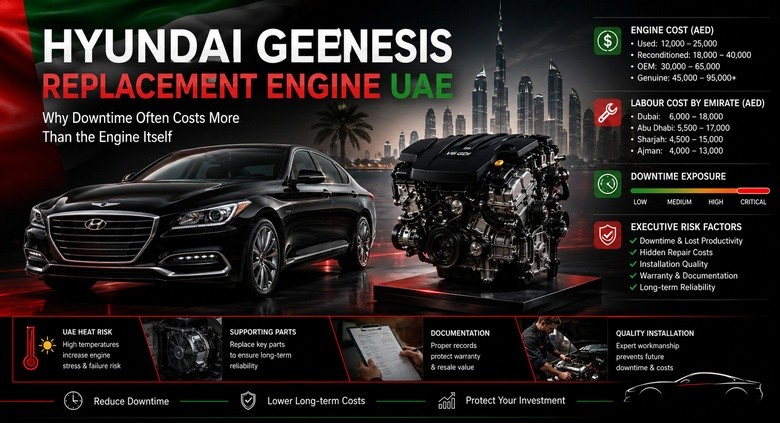
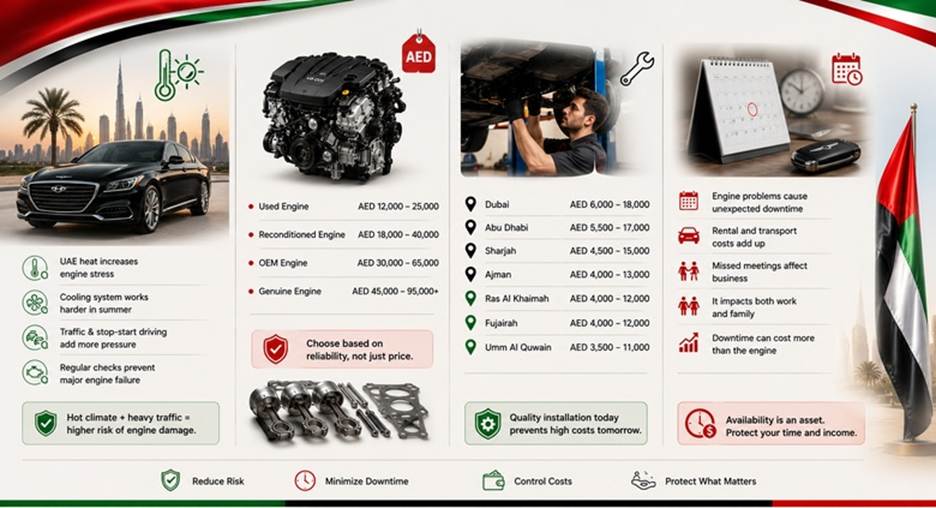
Hyundai Genesis Engine Cost Comparison
| Engine Type | Estimated Cost (AED) |
| Used Engine | 12,000 – 25,000 |
| Reconditioned Engine | 18,000 – 40,000 |
| OEM Engine | 30,000 – 65,000 |
| Genuine Engine | 45,000 – 95,000+ |
Price matters.
Risk profile often matters more.
Labour Costs Across the Emirates: How Installation Decisions Influence Future Exposure
Engine replacement success depends heavily on installation quality.
The engine receives attention. The installation process deserves equal attention.
A cheaper labour quotation may appear attractive initially. Long-term reliability depends on execution quality.
Labour Cost Analysis by Emirate
| Emirate | Typical Labour Cost (AED) |
| Dubai | 6,000 – 18,000 |
| Abu Dhabi | 5,500 – 17,000 |
| Sharjah | 4,500 – 15,000 |
| Ajman | 4,000 – 13,000 |
| Ras Al Khaimah | 4,000 – 12,000 |
| Fujairah | 4,000 – 12,000 |
| Umm Al Quwain | 3,500 – 11,000 |
The cheapest installation is not automatically the lowest-risk installation. Executive ownership requires evaluating outcomes rather than quotations.
Reliability Is a Risk-Reduction Strategy
The most important lesson is surprisingly simple.
Engine replacement is rarely about the engine alone.
It is about controlling risk.
It is about protecting reliability.
It is about reducing uncertainty before uncertainty becomes expensive.
For Hyundai Genesis owners in the UAE, downtime often creates consequences that extend far beyond repair invoices. Understanding those consequences early is often the first step towards making better ownership decisions.
Used, Reconditioned, OEM and Genuine Engines: Comparing Risk Profiles Instead of Purchase Prices
Many owners begin their search by comparing prices.
Executive owners often begin by comparing risk.
The distinction matters.
A replacement engine does not simply solve a current problem. It influences future reliability, future downtime exposure and future ownership costs.
A used engine may offer the lowest entry cost. It may also carry the greatest uncertainty.
The previous maintenance history is often incomplete. The operational history may be largely unknown.
That uncertainty represents risk.
A reconditioned engine often reduces some of that uncertainty. Key wear items are inspected or replaced before installation.
OEM engines typically increase confidence further. Documentation, traceability and quality assurance are usually stronger.
Genuine engines generally represent the lowest mechanical risk. They also represent the highest financial commitment.
Engine Risk Comparison Matrix
| Engine Type | Initial Cost | Risk Exposure | Long-Term Confidence |
| Used | Lowest | Highest | Moderate |
| Reconditioned | Moderate | Moderate | Good |
| OEM | High | Low | Very Good |
| Genuine | Highest | Lowest | Excellent |
The cheapest option does not always create the lowest ownership cost. Risk-adjusted ownership often produces a different answer.
Executive Engine Selection: Choosing Reliability Instead of Simply Choosing Price
A Hyundai Genesis often serves owners who value consistency.
Reliability therefore becomes part of the ownership equation.
An executive travelling regularly between Dubai and Abu Dhabi faces different requirements from an owner who drives occasionally on weekends.
Vehicle usage matters.
Operational demands matter.
Downtime tolerance matters.
The correct engine choice depends on the owner's exposure profile.
Ownership Profile Analysis
| Ownership Type | Common Priority |
| Budget-Focused | Lower Entry Cost |
| Family Ownership | Reliability |
| Executive Ownership | Availability |
| Business Usage | Downtime Reduction |
The most effective decisions align engine choice with ownership objectives. Price alone rarely provides enough information.
Supporting Components and Secondary Failure Exposure: The Parts That Determine Future Stability
An engine replacement project rarely succeeds because of the engine alone.
It succeeds because the surrounding components support it properly.
Many future failures originate from neglected supporting parts. This pattern appears repeatedly across UAE workshops.
A new engine operating with ageing cooling-system components inherits unnecessary risk. The replacement project begins with a disadvantage.
High-Risk Supporting Components
✓ Radiator
✓ Water pump
✓ Thermostat
✓ Cooling fans
✓ Engine mounts
✓ Belts
✓ Tensioners
✓ Sensors
✓ Hoses
Every one of these parts contributes to operational stability. Every one of them influences future downtime risk.
Supporting-Part Cost Comparison
| Component | Estimated Cost (AED) |
| Water Pump | 1,000 – 5,000 |
| Radiator | 1,500 – 7,000 |
| Thermostat | 500 – 2,500 |
| Engine Mounts | 1,500 – 6,000 |
| Sensors | 700 – 4,500 |
| Belts & Tensioners | 800 – 4,000 |
| Cooling Hoses | 500 – 3,000 |
Replacing the engine without evaluating supporting parts often creates a false sense of security.
Hidden Ownership Costs: The Expenses That Rarely Appear in the Original Estimate
Replacement-engine quotations are important.
Complete ownership calculations are more important.
Many owners focus heavily on engine pricing. Additional expenses often receive less attention.
Then the project begins.
Additional diagnostics become necessary. Supporting components require replacement.
Labour requirements expand. Calibration procedures become necessary.
The budget changes.
Common Hidden Costs
- Diagnostics
- Cooling-system servicing
- Sensor replacement
- Electrical repairs
- Software calibration
- Additional labour
- Fluid replacement
Individually these costs appear manageable. Together they can significantly affect project economics.
Hidden-Cost Scenario
| Expense Item | Estimated Cost (AED) |
| Replacement Engine | 25,000 |
| Labour | 10,000 |
| Cooling Components | 4,000 |
| Sensors | 2,000 |
| Diagnostics | 1,500 |
| Additional Labour | 2,500 |
| Total Project Cost | 45,000 |
Risk exposure often increases when hidden costs are ignored during planning.
Documentation Verification: Building Confidence Before Problems Appear
Strong documentation reduces uncertainty.
Uncertainty is often expensive.
Executive buyers, future purchasers and workshops all value transparency. Proper records help create that transparency.
Documentation Checklist
✓ Engine purchase invoice
✓ Installation invoice
✓ Warranty certificate
✓ Diagnostic reports
✓ Service history
✓ Maintenance records
✓ Mileage verification
A documented vehicle is easier to evaluate. It is often easier to sell as well.
Documentation Confidence Matrix
| Documentation Quality | Confidence Level |
| Complete Records | Excellent |
| Strong Records | Very Good |
| Partial Records | Moderate |
| Limited Records | Weak |
| Missing Records | Poor |
Documentation reduces exposure. Missing documentation creates questions.
Warranty Risk Analysis: What Owners Often Discover Too Late
Most owners appreciate warranties.
Few examine them carefully enough.
A warranty is valuable only when expectations and coverage align. Problems emerge when assumptions replace verification.
Positive Warranty Indicators
✓ Written coverage
✓ Defined duration
✓ Clear exclusions
✓ Transparent claims process
✓ Workshop accountability
Warranty Red Flags
✗ Verbal promises
✗ Missing paperwork
✗ Unclear exclusions
✗ Undefined claim procedures
✗ Limited support obligations
Warranty misunderstandings frequently appear after a claim becomes necessary. That is usually the worst possible time to discover them.
Mileage Versus Risk Exposure: Why Usage Patterns Matter More Than Numbers
Mileage remains one of the most misunderstood ownership indicators.
Risk exposure often tells a more useful story.
Two Hyundai Genesis vehicles may display identical mileage. Their future reliability may differ significantly.
One vehicle may have travelled mostly on highways. The other may have spent years in severe congestion.
The odometer does not explain the difference. Usage patterns do.
Mileage Evaluation Guide
| Usage Type | Long-Term Exposure |
| Highway Dominant | Lower |
| Mixed Driving | Moderate |
| Urban Congestion | High |
| Severe Daily Traffic | Very High |
Executive ownership decisions should evaluate both mileage and operating conditions.
Executive Commuter Perspective: When Availability Becomes a Priority
Executives often measure reliability differently.
A vehicle is not merely transportation.
It supports meetings. It supports schedules.
It supports productivity.
Unexpected downtime creates operational consequences. Those consequences often exceed repair costs.
Executive Ownership Priorities
✓ Reliability
✓ Availability
✓ Predictability
✓ Comfort
✓ Reduced disruption
The replacement-engine decision therefore becomes part of a broader continuity strategy.
Family Ownership Perspective: Protecting Stability Beyond Transportation
Many Hyundai Genesis vehicles also serve family responsibilities.
School runs, family travel and daily commitments create their own reliability requirements.
A vehicle unavailable for several weeks affects more than convenience. It affects routines.
Family Ownership Priorities
✓ Dependability
✓ Safety
✓ Predictable expenses
✓ Reduced breakdown risk
✓ Long-term value
Risk exposure exists in family ownership too. The consequences simply appear in different ways.
Poor Installation Warning Signs That Increase Future Exposure
The first weeks after installation reveal important information.
Problems often introduce themselves early.
Warning Signs
- Fluid leaks
- Warning lights
- Rough idle
- Temperature fluctuations
- Excessive vibration
- Unusual noises
None of these symptoms should be ignored.
Early action frequently prevents larger complications.
Installation Risk Matrix
| Observation | Risk Level |
| Stable Operation | Low |
| Minor Irregularity | Moderate |
| Persistent Concern | High |
| Repeated Faults | Very High |
| Overheating Events | Critical |
Risk management continues after installation. The project does not end when the vehicle leaves the workshop.
Supporting-Parts Replacement Checklist
Before approving any replacement-engine project, many experienced owners review:
✓ Radiator
✓ Water pump
✓ Thermostat
✓ Cooling fans
✓ Engine mounts
✓ Belts
✓ Tensioners
✓ Sensors
✓ Cooling hoses
✓ Fluids
This checklist often reduces future downtime. It frequently reduces long-term costs as well.
Reducing Exposure Before It Becomes Expensive
The strongest ownership outcomes rarely happen by accident.
They are usually the result of deliberate decisions.
Engine selection matters.
Documentation matters.
Warranty analysis matters.
Supporting-part evaluation matters.
For Hyundai Genesis owners in the UAE, risk exposure can often be reduced significantly before the engine is even installed.
The First 1,000 Kilometres After Installation: Monitoring Risk Before It Becomes Expensive
Many owners assume the replacement project ends when the vehicle leaves the workshop.
Executive risk management views that moment differently.
The first 1,000 kilometres create a validation period. This is when installation quality begins revealing itself.
Small concerns are easier to resolve than major failures. Early observation therefore creates significant value.
Owners should monitor performance closely. The objective is to identify emerging risks before they expand.
First 1,000 km Monitoring Checklist
✓ Engine temperature
✓ Coolant levels
✓ Oil levels
✓ Fuel consumption
✓ Warning lights
✓ Fluid leaks
✓ Engine performance
Every observation contributes to risk reduction. Every ignored symptom increases uncertainty.
Early Detection Benefits
| Issue Identified Early | Potential Risk Reduction |
| Coolant Leak | High |
| Oil Leak | High |
| Sensor Failure | Moderate |
| Calibration Problem | Moderate |
| Cooling Failure | Very High |
Executive ownership rewards vigilance. Small interventions often prevent larger disruptions.
Resale Value Protection: Managing Future Financial Exposure Before It Appears
Many owners focus entirely on present ownership.
Future buyers focus heavily on ownership history.
That difference matters.
A replacement engine is not necessarily a negative factor. Poor documentation often is.
Buyers want evidence.
They want invoices. They want installation records.
They want maintenance history.
They want transparency.
Resale Protection Checklist
✓ Engine invoice
✓ Labour invoice
✓ Warranty documentation
✓ Diagnostic reports
✓ Service history
✓ Supporting-parts records
Strong documentation protects value. Weak documentation creates negotiation pressure.
Resale Confidence Matrix
| Documentation Quality | Buyer Confidence |
| Complete Records | Excellent |
| Strong Records | Very Good |
| Partial Records | Moderate |
| Limited Records | Weak |
| Missing Records | Poor |
Executive ownership involves protecting future value, not only present usability.
Three-Year Ownership Forecast: Quantifying Short-to-Medium-Term Exposure
Three years passes quickly.
A Hyundai Genesis used regularly for business travel can accumulate significant mileage during that period.
Maintenance quality largely determines the experience. So does the quality of the replacement project itself.
Owners who prioritise preventive maintenance typically experience fewer disruptions. Their ownership costs also tend to remain more predictable.
Three-Year Cost Forecast
| Category | Estimated Cost (AED) |
| Scheduled Maintenance | 4,000 – 12,000 |
| Fluids & Filters | 2,000 – 6,000 |
| Diagnostics | 1,000 – 4,000 |
| Preventive Repairs | 3,000 – 12,000 |
| Contingency Repairs | 3,000 – 15,000 |
Predictability creates value. Executive owners often recognise this quickly.
Three-Year Reliability Outlook
| Engine Type | Reliability Outlook |
| Used Engine | Variable |
| Reconditioned Engine | Good |
| OEM Engine | Very Good |
| Genuine Engine | Excellent |
Reliability reduces exposure. Exposure reduction often becomes the real objective.
Five-Year Ownership Forecast: Understanding Long-Term Risk
Five years tells a much larger story.
At that point, engine selection becomes only one part of the equation.
Maintenance discipline becomes increasingly important. Supporting components become increasingly important as well.
The replacement project creates the foundation. Ownership behaviour determines what happens next.
Long-Term Cost Drivers
- Annual mileage
- Climate exposure
- Traffic exposure
- Maintenance quality
- Workshop quality
- Supporting-part condition
Each factor compounds over time. Long-term ownership is rarely shaped by a single decision.
Five-Year Stability Analysis
| Engine Type | Long-Term Stability |
| Used Engine | Moderate |
| Reconditioned Engine | Good |
| OEM Engine | Very Good |
| Genuine Engine | Excellent |
Executive ownership often rewards long-term thinking. Short-term savings sometimes create long-term exposure.
Engine Replacement Versus Vehicle Replacement: Which Strategy Produces Lower Overall Risk?
This question eventually emerges in most major repair discussions.
Should the engine be replaced?
Or should the vehicle be replaced?
The correct answer depends on risk profile, not emotion.
A well-maintained Hyundai Genesis with strong documentation may justify a replacement engine. A neglected vehicle with multiple major issues may not.
Indicators Supporting Engine Replacement
✓ Strong service history
✓ Good structural condition
✓ Predictable maintenance history
✓ Good ownership records
✓ Stable reliability profile
Indicators Supporting Vehicle Replacement
✓ Multiple major failures
✓ Escalating repair frequency
✓ Poor documentation
✓ Significant neglected maintenance
✓ High future uncertainty
Financial Comparison
| Option | Estimated Cost (AED) |
| Used Engine Project | 18,000 – 35,000 |
| Reconditioned Project | 25,000 – 50,000 |
| OEM Project | 40,000 – 75,000 |
| Genuine Project | 55,000 – 110,000+ |
| Replacement Luxury Sedan | 180,000 – 450,000+ |
Risk-adjusted ownership often favours engine replacement when the vehicle remains fundamentally strong.
Real UAE Executive Ownership Scenarios
Dubai Executive Ownership Scenario
The owner regularly travels between meetings across the city.
Availability matters more than minimum repair cost.
A high-quality OEM solution often provides a strong balance between risk reduction and financial practicality.
Abu Dhabi Business Owner Scenario
Long-distance travel forms part of weekly operations.
Reliability becomes a business requirement rather than a convenience.
Downtime creates measurable consequences.
Sharjah Professional Ownership Scenario
The owner balances business use with family responsibilities.
Predictability becomes the primary objective.
A properly documented reconditioned engine often delivers strong value within this ownership profile.
Different ownership situations create different risk profiles. Executive ownership rarely follows a single formula.
Competitor Comparison: Evaluating Alternative Ownership Risk
Many Genesis owners compare alternatives before making major decisions.
That comparison should focus on ownership realities rather than marketing claims.
Ownership Comparison
| Vehicle | Ownership Complexity | Risk Exposure |
| Hyundai Genesis | Moderate | Moderate |
| Lexus ES | Low | Low |
| Toyota Avalon | Low | Low |
| Kia K900 | Moderate | Moderate |
| Nissan Maxima | Moderate | Moderate |
Maintenance behaviour continues to influence outcomes more than badges alone.
Executive Ownership Mistakes That Consistently Increase Exposure
Certain mistakes appear repeatedly across workshop case studies.
Most begin as attempts to save money.
Many end up increasing costs.
Common Ownership Mistakes
- Delaying diagnostics
- Ignoring warning lights
- Choosing solely on price
- Neglecting cooling-system maintenance
- Ignoring supporting components
- Accepting unclear warranties
Each decision may appear reasonable initially. The cumulative effect often creates greater exposure.
Risk Escalation Matrix
| Ownership Behaviour | Future Exposure |
| Proactive Maintenance | Low |
| Occasional Delays | Moderate |
| Frequent Delays | High |
| Chronic Neglect | Very High |
| Repeated Overheating | Critical |
Risk management is usually cheaper than risk recovery.
Insurance and Documentation Guidance
Administrative preparation often protects ownership value.
Documentation remains one of the simplest forms of risk management.
Essential Documentation Checklist
✓ Engine invoice
✓ Installation invoice
✓ Warranty certificate
✓ Diagnostic reports
✓ Service records
✓ Mileage verification
✓ Maintenance history
These records support future resale discussions. They also support warranty and ownership transparency.
Buyer Decision Matrix
Not every owner seeks the same outcome.
Decision-making should therefore reflect ownership priorities.
Ownership Goal: Lowest Initial Cost
Recommended Route:
Used Engine
Ownership Goal: Best Balance of Cost and Risk
Recommended Route:
Reconditioned Engine
Ownership Goal: Long-Term Reliability
Recommended Route:
OEM Engine
Ownership Goal: Maximum Confidence
Recommended Route:
Genuine Engine
Strategic Decision Matrix
| Priority | Recommended Option |
| Budget | Used |
| Value | Reconditioned |
| Reliability | OEM |
| Maximum Confidence | Genuine |
The strongest decision is the one aligned with actual ownership needs.
The UAE Executive Risk Exposure Blueprint: Building a Reliability-First Ownership Strategy
Most major ownership losses do not arrive without warning.
The warning signs usually appear first.
The challenge is recognising them early enough.
Executive ownership is ultimately about reducing uncertainty. Reliability, documentation and proactive maintenance all contribute to that goal.
For readers researching online Hyundai Genesis engine for sale, the strongest ownership outcomes generally belong to those who evaluate risk before evaluating price.
UAE Executive Risk Exposure Blueprint
| Focus Area | Objective |
| Reliability Assessment | Exposure Reduction |
| Downtime Planning | Continuity Protection |
| Engine Selection | Risk Management |
| Labour Evaluation | Installation Quality |
| Warranty Verification | Financial Protection |
| Documentation Control | Resale Protection |
| Supporting Parts | Reliability Stability |
| Ownership Forecasting | Financial Clarity |
| Maintenance Discipline | Long-Term Value |
For readers exploring options through PartFinder UAE, one conclusion appears consistently throughout executive ownership case studies.
The engine itself is rarely the entire story.
Downtime, uncertainty and operational disruption often create the largest risks.
That is why the smartest Hyundai Genesis replacement-engine decisions are rarely driven by cost alone.
They are driven by exposure, reliability and long-term ownership confidence.
Frequently Asked Questions
Categories
- Audi
- BMW
- Car Accessories
- Car Tips
- Ford
- Land Rover
- Mazda
- Range Rover
- Top 10
- UAE Car Parts
- Used Car Parts
- Toyota
- Replacement Engines
- Nissan
- Hyundai
- Mitsubishi
- Volkswagen
- Honda
- Kia
- Chevrolet
- Dodge
- Jeep
- Subaru
- Renault
- Lexus
- Mercedes
- Suzuki
- Hummer
- Porsche
- Infiniti
- Peugeot
- GMC
- Mini
- Volvo
- Replacement Gearboxes
- MG
- Jaguar
- Skoda
- Cadillac
- Daihatsu
- Fiat
- German Car Parts
- Japanese Car Parts
- Aftermarket Car Parts
- Genuine Car Parts
- New Car Parts
- Reconditioned Car Parts
- European Car Parts
- American Car Parts
- Korean Car Parts
- British Car Parts
- Chinese Car Parts
- Sports/Exotic Car Parts
- Luxury Car Parts
- Performance Car Parts
- SUV/4x4 Spare Parts
- Truck Spare Parts
- EV Car Parts
- Hybrid Car Parts
- Auto Spare Parts in UAE
- Tesla
- Isuzu
- Ram
- Ferrari
- Bentley
- Lamborghini
- Genesis
- Maserati
- Lincoln
- Chrysler
- Opel
- Citroen
- SsangYong
- Seat
- McLaren
- Aston Martin
- Rolls Royce
- Maybach
- Alfa Romeo
- Bugatti
- Scion
- Abu Dhabi Car Parts
- Ajman Car Parts
- Al Khan Car Parts
- Al Sajaa Car Parts
- Deira Car Parts
- Dubai Car Parts
- Fujairah Car Parts
- Industrial Area 6 Car Parts
- Mussafah Car Parts
- Ras Al Khaimah Car Parts
- Sharjah Car Parts
- Umm Al Quwain Car Parts
- Acura
- BYD
- Chery
- Dacia
- DS
- Geely Emgrand
- EXEED
- GAC
- GAC Gonow
- Geely
- Gonow
- Great Wall
- Haima
- Haval
- Holden
- Iveco
- JAC
- Jaecoo
- Jetour
- Lotus
- Omoda
- Proton
- Renault Samsung
- Roewe
- Lucid
- Replacement Headlight