Hyundai Spare Parts in UAE: Guide for Tucson, Elantra, Sonata, Santa Fe, Accent and Palisade
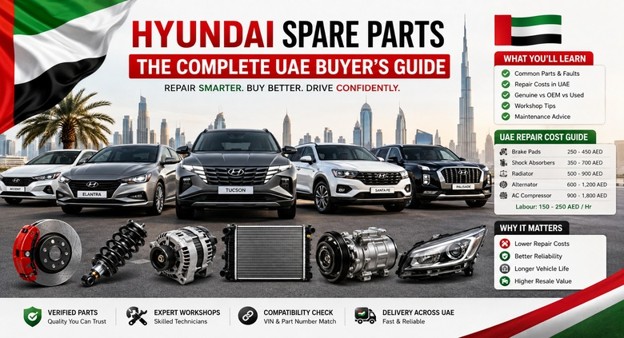
August 7, 2026
Introduction to Hyundai Spare Parts in UAE
Hyundai has become one of the UAE's most trusted automotive brands because it delivers dependable vehicles with sensible ownership costs. Whether you drive a Tucson in Dubai, an Elantra in Sharjah, a Sonata in Abu Dhabi, a Santa Fe in Ras Al Khaimah, an Accent in Ajman or a Palisade in Fujairah and Umm Al Quwain, every vehicle eventually reaches the point where replacing worn components becomes part of responsible ownership.
That doesn't mean the vehicle is unreliable.
It means the vehicle is being maintained properly.
Extreme summer temperatures, daily commuting, motorway journeys, family travel, commercial use and desert dust all accelerate normal wear. Cooling systems work harder, suspension absorbs constant punishment, brakes experience repeated heat cycles and electrical components gradually age.
Buying the right replacement part is therefore just as important as replacing it.
One incorrect purchase can increase labour costs, delay repairs and create compatibility problems that could easily have been avoided through proper research.
Today's Hyundai owners can choose between genuine, OEM, professionally inspected used, reconditioned and premium aftermarket parts. Understanding where each option provides the greatest value helps reduce ownership costs without compromising reliability or safety.
This guide explains exactly what Hyundai owners should know before buying replacement parts anywhere in the UAE.
Why Hyundai Owners Replace Spare Parts
Every mechanical component has a service life.
Some parts wear through normal operation.
Others deteriorate because of heat, age or mileage.
Brake pads, discs, suspension bushes, control arms, batteries, radiators, cooling fans, water pumps and air-conditioning compressors are among the components most frequently replaced on Hyundai vehicles operating across the Emirates.
Professional workshops rarely wait until complete failure occurs.
They identify wear early because replacing one component is often significantly cheaper than repairing several damaged systems later.
Most Frequently Replaced Hyundai Components
| Component | Common Reason |
| Brake Pads | Normal wear |
| Brake Discs | Heat and mileage |
| Shock Absorbers | Road conditions |
| Control Arms | Suspension wear |
| Radiator | Cooling efficiency |
| Water Pump | Mechanical wear |
| Battery | High temperatures |
| Alternator | Charging faults |
| AC Compressor | Continuous summer use |
| Cooling Fan | Heavy operation |
Preventive maintenance almost always costs less than emergency repairs.
Most Popular Hyundai Models in the UAE
Hyundai offers a vehicle for almost every owner.
The Tucson remains one of the country's best-selling SUVs.
The Elantra continues attracting commuters seeking economy.
The Sonata appeals to business users and motorway drivers.
The Santa Fe suits growing families.
The Accent provides affordable daily transport.
The Palisade delivers premium comfort and advanced technology.
Although these models differ in size and engineering, every one depends on selecting the correct replacement parts throughout its ownership.
Popular Hyundai Models
| Model | Primary Ownership |
| Tucson | Family SUV |
| Elantra | Daily commuting |
| Sonata | Executive driving |
| Santa Fe | Family touring |
| Accent | City driving |
| Palisade | Premium family SUV |
Every Hyundai has different maintenance priorities.
How UAE Driving Conditions Affect Hyundai Parts
The UAE creates unique operating conditions.
Extreme heat affects batteries, cooling systems and air-conditioning performance.
Heavy traffic increases brake and transmission wear.
Long motorway journeys place continuous demand on engines and cooling systems.
Dust shortens filter life while commercial use increases suspension and steering wear.
Understanding these conditions helps owners plan maintenance rather than react to breakdowns.
Routine inspections become particularly valuable before and after the hottest months of the year.
UAE Driving Conditions vs Component Wear
| Driving Condition | Parts Affected |
| Summer Heat | Cooling system, battery, AC |
| Traffic | Brakes, gearbox |
| Motorways | Engine, suspension |
| Desert Dust | Air filters |
| Heavy Loads | Steering, suspension |
| High Mileage | Drivetrain |
Local conditions directly influence maintenance schedules.
Genuine vs OEM vs Used vs Reconditioned vs Aftermarket Parts
No single replacement option suits every repair.
Genuine Hyundai parts provide factory specifications.
OEM components deliver excellent quality for many routine repairs.
Professionally inspected used parts often offer outstanding value for expensive assemblies including engines, gearboxes and body panels.
Reconditioned components suit selected mechanical applications where specialist rebuilding restores service life.
Premium aftermarket parts remain suitable for many servicing items when sourced from reputable manufacturers.
Buying solely on price usually proves more expensive in the long run.
Compatibility should always come first.
Replacement Part Comparison
| Type | Best Application |
| Genuine | Factory-standard repairs |
| OEM | Routine servicing |
| Used | Major assemblies |
| Reconditioned | Selected mechanical repairs |
| Premium Aftermarket | Service components |
Choose value, not simply the lowest price.
Professional Buyer's Checklist
Before ordering any Hyundai spare part:
- Verify the VIN.
- Match the Hyundai part number.
- Compare trusted suppliers.
- Review inspection reports.
- Understand warranty terms.
- Budget for labour and supporting parts.
- Keep service documentation.
- Follow preventive maintenance schedules.
Good preparation protects your wallet as much as your vehicle.
Every successful repair starts before the replacement part is purchased.
Most Replaced Hyundai Engine Parts
Hyundai engines have earned a solid reputation for reliability, but even the strongest powertrain needs attention once mileage starts adding up. Drive through Dubai's rush hour every day, spend weekends travelling between Abu Dhabi and Fujairah or use your SUV for family holidays, and you'll eventually replace a few engine components. That's normal. Ignore early warning signs, though, and a simple repair can quickly snowball into an expensive rebuild.
Heat is the biggest enemy.
Dust doesn't help either.
Cooling components, ignition parts, seals, sensors and belts work flat out in UAE conditions. Catch problems early and you'll save yourself plenty of money later.
Engine Parts Replaced Most Often
| Component | Why It Fails |
| Spark Plugs | Normal wear |
| Ignition Coils | Heat damage |
| Water Pump | Bearing wear |
| Timing Components | High mileage |
| Engine Mounts | Rubber deterioration |
| Sensors | Age and heat |
Don't chase the cheapest option.
Chase the correct one.
Hyundai Tucson Engine Parts Guide
The Tucson has become one of the UAE's favourite SUVs because it handles city driving and long motorway journeys with ease. Still, heavy traffic, continuous air-conditioning use and high summer temperatures gradually affect engine performance.
Cooling systems deserve particular attention.
Radiators clog.
Cooling fans wear.
Thermostats stick.
Water pumps eventually leak.
Turbocharged versions also benefit from regular oil servicing because clean lubrication keeps the turbocharger healthy.
Waiting for overheating isn't a maintenance plan.
It's an expensive gamble.
Tucson Engine Buying Checklist
- Verify VIN.
- Match engine code.
- Inspect cooling system.
- Replace worn hoses.
- Compare supplier warranties.
- Keep service history.
Hyundai Elantra Engine Parts Guide
The Elantra spends much of its life commuting through busy roads, so ignition and cooling components often receive the greatest workload. Spark plugs, ignition coils and engine mounts gradually wear, especially on vehicles covering high annual mileage.
Small faults usually appear first.
Slight hesitation.
Poor fuel economy.
Occasional warning lights.
Don't brush them aside.
Professional diagnosis normally identifies the real cause before larger engine damage develops.
Hyundai Sonata Engine Parts Guide
The Sonata is designed for comfortable long-distance driving, but motorway mileage increases stress on cooling systems, drive belts and engine sensors. Owners who service the engine regularly rarely experience major mechanical failures because preventive maintenance keeps the powertrain operating efficiently.
Oil quality matters.
Cooling matters.
Correct parts matter even more.
Replacing one worn component at the right time often protects several others.
Hyundai Santa Fe Engine Parts Guide
Family SUVs rarely enjoy an easy life. Santa Fe models frequently carry passengers, luggage and sometimes tow light trailers, increasing demand on the engine and cooling system.
Watch for coolant leaks.
Listen for unusual noises.
Monitor engine temperature carefully.
A simple thermostat or water pump replacement costs far less than repairing an overheated engine. Experienced workshops inspect the complete cooling system rather than replacing individual parts in isolation.
Hyundai spare parts for sale Buying Guide
Searching online for Hyundai spare parts in UAE isn't difficult.
Choosing the right supplier is.
Start with the VIN.
Confirm the Hyundai part number.
Compare genuine, OEM and professionally inspected used parts before making any decision. Ask for warranty details, inspection reports and photographs where appropriate, particularly when purchasing expensive engines or major assemblies.
Price tells only part of the story.
Compatibility tells the rest.
Engine Replacement Options
| Part Type | Best Choice For |
| Genuine | Maximum reliability |
| OEM | Routine engine repairs |
| Professionally Inspected Used | Engine assemblies |
| Reconditioned | Selected engine replacements |
| Premium Aftermarket | Service components |
Professional Buyer's Checklist
Before buying any Hyundai engine component:
- Verify the VIN.
- Match the Hyundai engine code.
- Compare several trusted suppliers.
- Request inspection reports.
- Review warranty conditions.
- Budget for labour and fluids.
- Replace supporting components where necessary.
- Keep complete maintenance records.
A reliable engine isn't built by luck.
It's built by informed decisions made long before the replacement part arrives.
Hyundai Accent Spare Parts Most Commonly Replaced
The Hyundai Accent has built its reputation on low running costs and dependable daily performance. Across Dubai, Sharjah and Ajman, thousands cover long commuting distances every week, so routine wear arrives naturally rather than unexpectedly.
Brake pads wear first.
Suspension bushes follow.
Engine mounts soften.
Batteries struggle through long summers.
Window switches and cooling fans also become common replacement items once mileage climbs. Fortunately, most repairs remain affordable when faults are identified early instead of being ignored.
Common Accent Replacement Parts
| Component | Reason |
| Brake Pads | Friction wear |
| Engine Mounts | Heat and vibration |
| Battery | Summer temperatures |
| Shock Absorbers | High mileage |
| Cooling Fan | Continuous operation |
| Window Switch | Daily use |
Small repairs keep ownership affordable.
Hyundai Palisade Spare Parts Most Commonly Replaced
The Palisade operates in very different conditions.
Large families.
Long holidays.
Motorway journeys.
Heavy passenger loads.
That extra weight naturally increases wear on suspension, braking and cooling components. Owners usually notice reduced ride comfort before complete failure develops.
Listen carefully.
The vehicle often tells you what's happening.
Replacing worn suspension parts early protects tyres, steering components and overall driving comfort.
Common Hyundai Gearbox Components
Automatic transmissions work hard in UAE traffic.
Stop.
Move.
Stop again.
That constant cycling generates heat, and heat gradually affects transmission components.
Valve bodies.
Transmission mounts.
Oil seals.
Sensors.
Cooling lines.
Regular fluid servicing helps, but eventually some parts require replacement through normal use.
Professional diagnosis always comes first.
Never replace gearbox components based purely on assumptions.
Common Gearbox Components
| Component | Function |
| Transmission Mount | Controls vibration |
| Oil Seal | Prevents leaks |
| Speed Sensor | Gear monitoring |
| Valve Body | Hydraulic control |
| Oil Cooler Line | Temperature management |
| Filter | Oil cleanliness |
Correct diagnosis saves unnecessary expense.
Suspension and Steering Components
Hyundai suspension absorbs thousands of road imperfections every week.
Eventually something gives.
Control arms develop play.
Bushes deteriorate.
Ball joints loosen.
Tie rod ends wear.
Steering gradually loses precision while tyres begin wearing unevenly. Professional workshops inspect every related component because replacing one worn part while ignoring another rarely solves the problem completely.
Good suspension improves comfort.
Great suspension improves safety.
Suspension Inspection Checklist
- Inspect control arms.
- Check bushes.
- Examine ball joints.
- Test steering movement.
- Review tyre wear.
- Complete wheel alignment.
Everything underneath works together.
Brake System Parts That Wear Most
Brakes never stop working.
Every junction.
Every roundabout.
Every emergency stop.
Brake pads naturally wear first, followed by discs and occasionally calipers. Heavy city traffic throughout Dubai and Abu Dhabi accelerates this process because repeated braking generates additional heat.
Don't wait for grinding noises.
By then the repair usually costs considerably more.
Brake Components
| Component | Replacement Priority |
| Brake Pads | Very High |
| Brake Discs | High |
| Brake Fluid | Regular Service |
| Calipers | Inspect |
| ABS Sensor | Diagnose |
| Brake Hose | Inspect |
Strong brakes begin with timely maintenance.
Comparing Multiple Suppliers Before Buying
Buying Hyundai parts online has become much easier.
Choosing wisely remains the challenge.
Always compare more than price.
Check warranty.
Inspect photographs.
Confirm VIN compatibility.
Review inspection reports.
Ask about delivery times across the UAE.
Professional buyers follow this process because it reduces mistakes and protects long-term ownership costs.
Many experienced workshops also recommend comparing quotations before approving expensive repairs. Owners searching through PartFinder UAE and other trusted supplier networks should always prioritise compatibility, inspection quality and warranty support above headline discounts.
Professional Buyer's Checklist
- Verify the VIN.
- Match the Hyundai part number.
- Compare trusted suppliers.
- Review warranty conditions.
- Request inspection reports.
- Budget for labour.
- Keep complete documentation.
- Replace supporting components where necessary.
A better buying decision today usually prevents a bigger repair tomorrow.
Hyundai Cooling System Components
The cooling system quietly protects one of the most expensive parts of your Hyundai.
The engine.
Ignore it, and things can go wrong quickly.
Really quickly.
UAE summers don't forgive neglected cooling systems. Sitting in slow-moving Dubai traffic with the air conditioning running flat out is very different from driving through a cool European city. Radiators work harder. Cooling fans stay on longer. Rubber hoses live in constant heat. Every component is under pressure, and eventually one of them gives up.
The good news?
Cooling problems usually leave clues before complete failure.
Watch the temperature gauge.
Check underneath the vehicle.
Listen for cooling fan noise.
Small warnings today often prevent major engine repairs tomorrow.
Most Common Hyundai Cooling Components
| Component | Why It Gets Replaced |
| Radiator | Internal blockage and ageing |
| Cooling Fan | Continuous operation |
| Thermostat | Heat-related wear |
| Water Pump | Bearing and seal failure |
| Radiator Hoses | Rubber deterioration |
| Expansion Tank | Heat and pressure |
A healthy cooling system protects the entire engine.
Radiators and Cooling Fans
Radiators rarely fail overnight.
They lose efficiency slowly.
Dust builds up.
Internal corrosion develops.
Cooling fins become damaged by road debris.
Meanwhile, cooling fans work almost every day during the UAE summer. After years of constant cycling, electric motors weaken, bearings wear and fan blades become less efficient.
Don't wait until steam appears from under the bonnet.
By then you've already lost the advantage.
Experienced workshops inspect the radiator and cooling fan together because replacing one worn component while ignoring another often creates repeat visits.
Radiator Inspection Checklist
- Inspect coolant leaks.
- Check radiator fins.
- Test cooling fan operation.
- Examine electrical connectors.
- Inspect mounting points.
- Verify coolant level.
Cooling starts before the engine overheats.
Water Pumps and Thermostats
The water pump keeps coolant moving.
The thermostat controls when it flows.
Simple jobs.
Massive responsibility.
A worn water pump may begin with a tiny coolant leak or a faint bearing noise. A sticking thermostat may cause slow overheating during traffic but appear normal on the motorway.
That's why professional diagnosis matters.
Guesswork costs money.
Replacing both components together during major cooling repairs often reduces future labour costs because much of the work has already been completed.
Cooling Component Comparison
| Component | Recommended Option |
| Water Pump | Genuine or OEM |
| Thermostat | Genuine or OEM |
| Gasket | New |
| Radiator Cap | Replace if required |
| Coolant | Manufacturer-approved |
| Hoses | Inspect or replace |
One cooling repair should solve the problem completely.
Air Conditioning Parts
Life without air conditioning in the UAE?
Most drivers wouldn't even consider it.
Hyundai air-conditioning systems operate for much of the year, placing continuous demand on compressors, condensers, pressure sensors and expansion valves.
Weak cooling.
Strange noises.
Intermittent operation.
Don't ignore them.
Low refrigerant isn't always the culprit. Sometimes the compressor clutch begins wearing. Sometimes the condenser has been damaged by road debris. Sometimes an electrical sensor is sending incorrect information.
Professional testing always comes before replacement.
Most Common AC Components
- AC compressor.
- Condenser.
- Expansion valve.
- Pressure sensor.
- Cooling fan.
- Receiver dryer.
Comfort depends on proper diagnosis.
Fuel System Components
Modern Hyundai engines rely on precise fuel delivery.
Every second.
Every journey.
Fuel pumps, injectors, filters and pressure sensors all work together. When one begins to fail, performance usually changes before complete failure occurs.
Rough idling.
Poor acceleration.
Reduced fuel economy.
Hard starting.
These aren't problems to put off until next month.
Quality fuel and regular servicing extend component life, but even well-maintained vehicles eventually require replacement parts as mileage increases.
Fuel System Matrix
| Component | Inspection Priority |
| Fuel Pump | High |
| Fuel Injectors | Medium |
| Fuel Filter | High |
| Fuel Pressure Sensor | Medium |
| Fuel Rail | Inspect |
| Injector Seals | Replace if required |
Smooth performance begins with clean fuel delivery.
Exhaust System Components
The exhaust system does far more than reduce noise.
It controls emissions.
Supports engine efficiency.
Protects performance.
Heat cycles, vibration and daily driving gradually affect catalytic converters, silencers, exhaust pipes, oxygen sensors and mounting brackets. A small rattle today could become a broken mounting tomorrow.
Listen carefully.
Your Hyundai often tells you what it needs.
Ignoring unusual exhaust noises rarely makes repairs cheaper.
It usually does the opposite.
Common Exhaust Components
| Component | Typical Replacement Reason |
| Catalytic Converter | Age and contamination |
| Centre Silencer | Corrosion |
| Rear Silencer | Internal wear |
| Oxygen Sensor | Mileage |
| Exhaust Mounts | Rubber ageing |
| Heat Shield | Vibration damage |
Real UAE Workshop Case Study
A Hyundai Tucson owner in Abu Dhabi complained that the temperature gauge occasionally climbed during afternoon traffic, while an Elantra owner in Sharjah noticed weak air conditioning after several weeks of extreme summer heat. Comprehensive testing identified a partially blocked radiator on the Tucson and a worn compressor clutch on the Elantra. Both owners compared supplier options, verified VIN compatibility and replaced the correct components before complete failure occurred. The repairs restored cooling performance, prevented secondary engine damage and reduced overall ownership costs.
Early diagnosis solved the problem.
Delayed repairs would have multiplied the bill.
Professional Buyer's Checklist
- Verify the VIN before ordering.
- Match the Hyundai part number.
- Compare trusted suppliers.
- Replace supporting cooling components where appropriate.
- Use manufacturer-approved coolant.
- Pressure-test the system after repairs.
- Keep service documentation.
- Follow preventive maintenance schedules.
Cooling systems rarely fail without warning.
The smartest owners pay attention before those warnings become expensive.
Hyundai Electrical Parts That Frequently Fail
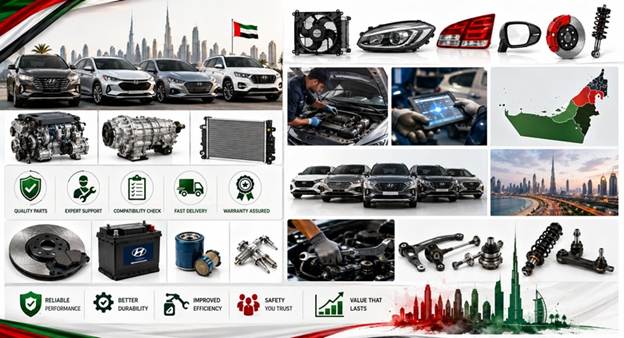
Modern Hyundai vehicles rely on dozens of electrical parts that communicate with one another every second. Start the engine, switch on the headlights, use the infotainment system or adjust the climate control, and hundreds of electrical signals move around the vehicle almost instantly.
Most electrical faults don't arrive without warning.
They build up.
A battery struggles on cold mornings.
The alternator charges inconsistently.
Dashboard lights flicker.
Power windows become slower.
Many owners replace expensive parts too quickly when the real fault is a worn sensor, weak battery or damaged wiring. That's why experienced workshops always begin with electrical testing rather than guessing.
Most Common Hyundai Electrical Parts:
| Part | Why It Gets Replaced |
| Alternator | Charging failure |
| Starter Motor | Internal wear |
| Battery | Heat damage |
| Ignition Switch | Daily use |
| ECU Sensors | Age and electrical faults |
| Fuse Box | Circuit damage |
Electrical faults rarely fix themselves.
Alternators and Starter Motors
Without a healthy alternator, the battery gradually loses power.
Without a reliable starter motor, the engine won't crank properly.
Simple.
Yet many owners replace the battery first because it's easier and cheaper. Sometimes that works.
Sometimes it doesn't.
Professional workshops test the charging system before replacing anything. A worn alternator often shows itself through dim headlights, warning lights or repeated battery failures, while starter motors usually become noisy before refusing to operate.
Listen carefully.
Your Hyundai often gives advance warning.
Alternator and Starter Buying Checklist:
- Verify VIN compatibility.
- Check charging output.
- Inspect electrical connections.
- Test battery condition.
- Compare warranty.
- Use professional installation.
Replacing the correct part once is cheaper than replacing the wrong part twice.
Batteries and Charging Systems
The UAE climate is unforgiving.
Summer temperatures reduce battery life far quicker than many owners expect. A battery that performs perfectly during winter can suddenly struggle after months of continuous heat.
Short journeys don't help.
Neither does leaving electrical accessories running unnecessarily.
Whenever the battery is replaced, the charging system should also be tested. Installing a new battery without checking the alternator can simply move the problem somewhere else.
Battery Comparison Matrix:
| Part | Inspection Priority |
| Battery | Very High |
| Alternator | High |
| Battery Terminals | High |
| Earth Cable | Medium |
| Charging Voltage | Essential |
| Drive Belt | Inspect |
A healthy charging system protects every electrical part.
ECU Sensors and Electronics
Modern Hyundai engines depend on accurate information.
Sensors measure airflow.
Engine temperature.
Fuel pressure.
Throttle position.
Oxygen levels.
One faulty sensor can affect fuel economy, performance and emissions without causing obvious mechanical problems.
Don't replace sensors blindly.
Scan the fault codes.
Confirm the diagnosis.
Then replace only what's necessary.
Good workshops solve problems with evidence.
Not assumptions.
Frequently Replaced Electronic Parts:
- Oxygen sensor.
- Crankshaft sensor.
- Camshaft sensor.
- Knock sensor.
- Mass airflow sensor.
- Coolant temperature sensor.
Diagnosis always comes before replacement.
Lighting Parts
Lighting does more than help you see.
It helps others see you.
Hyundai owners commonly replace LED units, halogen bulbs, tail lights, daytime running lights and fog lamps after years of normal use or minor accidents.
Before ordering, check more than appearance.
Different production years often use different connectors, control modules and lighting specifications.
VIN verification remains the safest option.
Lighting Parts Guide:
| Part | Recommended Option |
| LED Headlight | Genuine |
| Halogen Bulb | OEM |
| Tail Light | Genuine Used |
| Fog Lamp | OEM |
| Daytime Running Light | Genuine |
| Light Control Module | Genuine |
Visibility should never be compromised.
Wiring and Fuse Box Parts
Electrical wiring rarely receives attention until something stops working.
Unfortunately, damaged wiring can imitate dozens of other faults.
Loose connectors.
Corroded terminals.
Heat-damaged insulation.
Blown fuses.
Each can interrupt communication between electrical systems and create confusing warning lights.
Replacing the fuse without investigating the cause is rarely a permanent solution.
Professional testing identifies where the problem started rather than where it appeared.
That's a big difference.
Common Wiring Parts:
- Wiring harness.
- Fuse box.
- Relay.
- Battery cable.
- Earth strap.
- Electrical connectors.
Every circuit deserves proper testing.
Real UAE Workshop Case Study:
A Hyundai Sonata owner in Dubai experienced repeated battery failures despite installing a new battery only two months earlier. At the same time, an Accent owner in Ajman complained that dashboard warning lights appeared randomly during evening driving. Complete electrical testing revealed a weak alternator on the Sonata and a damaged earth connection on the Accent. After replacing the faulty parts and verifying charging performance, both vehicles returned to normal operation without replacing unnecessary electrical parts.
The first diagnosis saved money.
The second prevented it from being wasted.
Professional Buyer's Checklist:
- Verify the VIN before ordering.
- Match the Hyundai part number.
- Test the complete electrical system.
- Compare trusted suppliers.
- Review warranty conditions.
- Replace supporting parts where necessary.
- Keep repair documentation.
- Complete post-repair testing.
Key Takeaways:
Hyundai electrical parts usually fail gradually rather than suddenly. Batteries, alternators, starter motors, ECU sensors, lighting parts and wiring should always be professionally tested before replacement. Owners who diagnose faults correctly, verify compatibility and choose quality replacement parts enjoy greater reliability, lower repair costs and fewer unexpected electrical problems throughout the UAE.
Hyundai Interior Parts Owners Replace Most
The cabin is where Hyundai owners spend every journey.
Open the door.
Start the engine.
Adjust the seat.
Switch on the air conditioning.
Use the touchscreen.
Every movement depends on interior parts working exactly as they should.
Unlike engine or suspension repairs, interior faults rarely stop the vehicle from moving. Even so, they affect comfort, convenience and resale value. A clean, fully functioning interior usually tells buyers the vehicle has been cared for properly.
The opposite is true as well.
Worn interiors raise questions.
Most Replaced Hyundai Interior Parts:
| Part | Common Reason for Replacement |
| Dashboard Trim | Sun exposure |
| Infotainment Screen | Electrical faults |
| Window Switch | Frequent use |
| Door Handle | Wear and tear |
| Seat Adjustment Switch | Daily operation |
| Steering Wheel Controls | Heavy use |
A well-maintained interior improves every journey.
Dashboard Parts
The UAE sun is relentless.
Park outside every day, and dashboard materials face continuous heat. Over time, trim panels can fade, clips may weaken and electronic displays occasionally develop faults.
Modern Hyundai dashboards also house important safety systems.
Airbags.
Sensors.
Driver displays.
Replacing damaged dashboard parts requires more than matching colour and design. Fitment and compatibility matter just as much.
Professional installation protects surrounding electrical systems.
Dashboard Buying Checklist:
- Verify VIN compatibility.
- Match interior colour.
- Inspect mounting clips.
- Check airbag compatibility.
- Confirm electronic connections.
- Compare supplier warranty.
Small details make a big difference.
Infotainment System Parts
Drivers expect more from modern vehicles than ever before.
Navigation.
Bluetooth.
Apple CarPlay.
Android Auto.
Rear cameras.
Voice controls.
When the infotainment system begins freezing, restarting or losing connectivity, many assume the entire unit has failed. Quite often, the fault lies elsewhere.
Software.
Wiring.
Display cables.
Power supply.
Professional diagnosis should always come first.
Replacing expensive electronics unnecessarily benefits nobody.
Frequently Replaced Infotainment Parts:
- Touchscreen display.
- Display module.
- Audio control unit.
- USB ports.
- Rear camera.
- Control buttons.
Technology deserves proper diagnosis.
Window Switches and Door Control Parts
Few Hyundai parts receive more daily use than window switches.
Up.
Down.
Lock.
Unlock.
Repeat.
After years of constant operation, switches naturally wear while electric window motors gradually slow down. Door lock actuators and mirror adjustment switches also become common replacement items on higher-mileage vehicles.
Don't ignore slow-moving windows.
They rarely improve on their own.
Door Parts Comparison
| Part | Recommended Option |
| Window Switch | Genuine or OEM |
| Window Motor | Genuine |
| Door Lock Actuator | Genuine |
| Mirror Switch | OEM |
| Door Handle | Genuine Used |
| Wiring Connector | Genuine |
Daily-use parts deserve quality replacements.
Seat Parts
Seats support the driver on every journey.
Thousands of entries.
Thousands of exits.
Constant adjustment.
Eventually, seat mechanisms begin showing signs of wear.
Electric seat motors.
Seat adjustment switches.
Seat rails.
Headrest mechanisms.
On family SUVs like the Santa Fe and Palisade, rear-seat release mechanisms also receive frequent use.
Replacing worn seat parts restores comfort while preserving the interior's overall appearance.
Comfort matters more than many people realise.
Especially on long UAE journeys.
Seat Inspection Checklist:
- Test adjustment movement.
- Inspect seat rails.
- Check electrical connections.
- Examine seatbelt anchors.
- Verify memory functions.
- Review upholstery condition.
Comfort begins with proper support.
Steering Wheel and Trim Parts
The steering wheel never gets a day off.
Every journey starts here.
Leather surfaces gradually wear.
Control buttons fade.
Trim panels loosen.
Multifunction switches eventually reach the end of their service life after years of daily operation.
Fortunately, many steering wheel parts can be replaced individually without changing the complete assembly.
Always disconnect the battery before working near the airbag system.
Better still, leave the job to experienced technicians.
Safety comes first.
Common Steering Wheel Parts:
- Steering wheel controls.
- Cruise control buttons.
- Audio buttons.
- Airbag cover.
- Steering trim.
- Clock spring.
Professional fitting protects critical safety systems.
Real UAE Workshop Case Study:
A Hyundai Palisade owner in Abu Dhabi complained that the infotainment screen occasionally froze, while an Elantra owner in Sharjah struggled with an intermittent driver's window switch. Initial assumptions pointed towards expensive replacements. Comprehensive testing revealed a software update solved the Palisade issue, while only the window switch required replacement on the Elantra. Accurate diagnosis reduced repair costs for both owners and avoided replacing perfectly serviceable interior parts.
The correct diagnosis changed everything.
So did choosing the correct replacement part.
Professional Buyer's Checklist:
- Verify the VIN before ordering.
- Match the Hyundai part number.
- Compare trusted suppliers.
- Check colour and trim compatibility.
- Review warranty conditions.
- Test electrical functions after installation.
- Keep repair documentation.
- Use experienced installation technicians.
Key Takeaways:
Hyundai interior parts gradually wear through everyday use, especially under demanding UAE conditions. Dashboard parts, infotainment systems, window switches, seat parts and steering wheel controls should always be matched carefully to the vehicle specification. Owners who verify compatibility, diagnose faults correctly and choose quality replacement parts protect comfort, reliability and long-term resale value while avoiding unnecessary repair costs.
Hyundai Exterior Body Parts
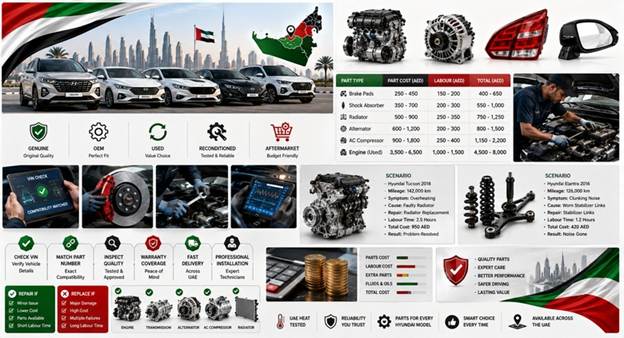
The exterior tells the story of a vehicle before the engine is even started.
A straight body.
Clear headlights.
Even panel gaps.
Fresh paint.
These details influence resale value just as much as service history.
Hyundai vehicles spend years facing blazing sunshine, motorway debris, shopping-centre car parks and occasional sandstorms across the UAE. Even careful owners eventually replace exterior parts after everyday wear or minor accidents.
Good repairs restore confidence.
Poor repairs stand out immediately.
Most Replaced Hyundai Exterior Parts:
| Part | Common Reason |
| Front Bumper | Parking damage |
| Rear Bumper | Low-speed impacts |
| Bonnet | Accident damage |
| Doors | Side collisions |
| Headlights | Age and accidents |
| Door Mirrors | Parking damage |
Appearance matters.
Fitment matters even more.
Front Bumpers
The front bumper is designed to absorb minor impacts.
It does its job well.
Parking mishaps, speed bumps, road debris and low-speed collisions make it one of the most commonly replaced Hyundai parts throughout the UAE.
Don't focus on paint alone.
Check mounting tabs.
Sensor openings.
Grille fitment.
Fog light positions.
Even a small crack behind the bumper can affect installation later.
Always compare the part with your VIN before ordering.
Front Bumper Buying Checklist:
- Verify VIN compatibility.
- Inspect mounting tabs.
- Check sensor holes.
- Match trim level.
- Review previous repairs.
- Compare supplier warranty.
The right fit saves hours in the workshop.
Rear Bumpers
Rear bumpers often suffer from reversing incidents rather than major collisions.
Shopping centres.
Apartment parking.
Busy streets.
It happens.
Fortunately, many Hyundai rear bumpers can be replaced without extensive structural repairs if damage is identified early.
Look beyond scratches.
Inspect reinforcement bars.
Parking sensor brackets.
Mounting points.
A clean-looking bumper can still hide damage underneath.
Rear Bumper Comparison
| Part | Recommended Option |
| Rear Bumper | Genuine Used |
| Reinforcement Bar | Genuine |
| Parking Sensor Holder | Genuine |
| Reflector | OEM |
| Mounting Brackets | Genuine |
| Clips and Fasteners | New |
Small hidden damage can create bigger fitting problems.
Bonnets and Tailgates
Bonnets and tailgates are large structural parts.
Alignment is everything.
A bonnet that doesn't close correctly creates safety concerns, while a poorly aligned tailgate affects sealing, water protection and overall appearance.
Family vehicles like the Santa Fe and Palisade often experience additional tailgate wear because they are opened and closed constantly.
Inspect hinges carefully.
Check latch points.
Examine structural edges before buying any replacement panel.
Bonnet and Tailgate Checklist:
- Inspect hinge condition.
- Check latch alignment.
- Look for corrosion.
- Review previous repairs.
- Confirm VIN compatibility.
- Compare photographs.
Straight panels usually indicate careful ownership.
Headlights and Tail Lights
Modern Hyundai lighting systems are far more advanced than they were a decade ago.
LED technology.
Daytime running lights.
Adaptive lighting.
Integrated control units.
That means compatibility has become more important than ever.
Never buy lighting parts based only on appearance.
Different production years often use different wiring and electronic modules.
One incorrect connector can turn a straightforward replacement into an expensive headache.
Lighting Parts Guide
| Part | Recommended Choice |
| LED Headlight | Genuine |
| Halogen Headlight | OEM |
| Tail Light | Genuine Used |
| Fog Lamp | OEM |
| DRL Unit | Genuine |
| Wiring Connector | Genuine |
Visibility begins with quality lighting.
Mirrors, Grilles and Body Panels
Door mirrors do far more than reflect traffic behind you.
Many include cameras.
Heating.
Power folding.
Blind-spot monitoring.
Likewise, front grilles vary between trim levels and production years.
Always confirm the specification before ordering.
A mirror from one model year may look identical but use completely different electronics.
That's why experienced suppliers ask for the VIN first.
It protects everyone.
Frequently Replaced Exterior Parts:
- Door mirrors.
- Front grille.
- Front wings.
- Wheel arch trim.
- Side mouldings.
- Door panels.
Attention to detail separates average repairs from excellent ones.
Real UAE Workshop Case Study:
A Hyundai Tucson owner in Dubai required a replacement front bumper after a minor collision, while a Santa Fe owner in Ras Al Khaimah needed a new powered door mirror damaged in a parking incident. Before ordering, the workshop verified both VIN numbers, checked trim specifications and compared several supplier options. Genuine used body parts provided factory fitment, reduced painting adjustments and restored the original appearance without compatibility issues. Careful preparation also shortened installation time and lowered overall repair costs.
Planning saved money.
Factory fitment saved time.
Professional Buyer's Checklist:
- Verify the VIN before ordering.
- Match the Hyundai part number.
- Check trim specification.
- Inspect mounting points.
- Compare trusted suppliers.
- Review warranty conditions.
- Use professional body repair technicians.
- Keep complete repair documentation.
Key Takeaways:
Hyundai exterior body parts should always be selected for fitment, compatibility and structural condition rather than price alone. Front bumpers, rear bumpers, bonnets, tailgates, headlights, mirrors and body panels all require careful inspection before purchase. Owners who verify specifications, compare trusted suppliers and choose quality replacement parts achieve better repairs, stronger resale value and a factory-finished appearance throughout the UAE.
Repair vs Replacement Guide
One question comes up in almost every workshop.
Repair it?
Or replace it?
There isn't one answer that fits every Hyundai.
The decision depends on mileage, labour costs, part availability, safety and the overall condition of the vehicle. Sometimes a simple repair keeps the car running for years. In other cases, replacing the worn part immediately saves money because it prevents further damage.
Think beyond today's invoice.
Think about next year as well.
Professional workshops don't chase the cheapest repair.
They recommend the smartest one.
Repair vs Replacement Matrix
| Situation | Best Choice |
| Minor cosmetic damage | Repair |
| Worn safety part | Replace |
| Cracked radiator | Replace |
| Small wiring issue | Repair after diagnosis |
| Worn suspension part | Replace |
| Major structural damage | Replace |
A cheap repair isn't always the economical repair.
How to Identify Worn Hyundai Parts
Hyundai parts rarely fail without warning.
They whisper first.
Then they complain.
Finally, they stop working.
A slight vibration.
A strange smell.
An unusual noise.
A warning light.
None of these should be ignored because small faults often spread into neighbouring systems.
Owners who notice changes early usually spend less over the lifetime of the vehicle.
That's no coincidence.
It's good maintenance.
Common Signs of Wear
- Unusual vibration.
- Fluid leaks.
- Engine hesitation.
- Uneven tyre wear.
- Poor braking.
- Warning lights.
Your Hyundai usually tells you when it needs attention.
Early Warning Signs Before Failure
Every journey gives you information.
The trick is paying attention.
Listen when the engine starts.
Feel how the steering responds.
Watch the temperature gauge.
Notice how the gearbox changes gear.
Ask yourself a simple question.
Does the vehicle feel different from last month?
If the answer is yes, book an inspection before the problem becomes bigger.
Early diagnosis nearly always costs less than emergency repairs.
Warning Sign Matrix
| Symptom | Possible Cause |
| Overheating | Cooling parts |
| Steering vibration | Suspension parts |
| Hard starting | Battery or starter |
| Knocking noise | Suspension |
| Poor acceleration | Fuel or ignition parts |
| Grinding brakes | Brake parts |
Small symptoms deserve immediate attention.
Common Workshop Diagnoses
Experienced technicians don't replace parts because they "might" be faulty.
They test.
They measure.
They verify.
Modern Hyundai vehicles store valuable fault information through onboard diagnostics, making it easier to identify the real problem before ordering replacement parts.
That saves money.
It also prevents unnecessary repairs.
Good workshops diagnose first.
Repair second.
Workshop Inspection Checklist
- Scan fault codes.
- Test battery voltage.
- Check charging system.
- Inspect suspension.
- Pressure-test cooling system.
- Road-test the vehicle.
Evidence beats guesswork every time.
Hidden Repair Costs
Many owners budget for the replacement part.
Then the workshop calls.
Additional labour.
Fresh coolant.
New seals.
Wheel alignment.
Programming.
Supporting parts.
Suddenly the final invoice looks very different.
That's why experienced buyers calculate the complete repair cost before ordering anything.
Unexpected expenses become far less stressful when they're expected.
Hidden Cost Comparison
| Cost | Should You Budget? |
| Labour | Yes |
| Fluids | Yes |
| Programming | Yes |
| Supporting Parts | Yes |
| Delivery | Yes |
| Wheel Alignment | When Required |
The cheapest quote isn't always the lowest final bill.
Supporting Parts You Should Replace Together
Replacing one worn part while leaving another equally worn part behind rarely makes sense.
If the water pump comes off, inspect the thermostat.
Replacing suspension arms?
Check bushes and ball joints.
Installing new brake discs?
Fit new brake pads.
It saves labour.
It improves reliability.
It reduces repeat workshop visits.
Experienced technicians think about the complete repair rather than individual parts.
Owners should do exactly the same.
Supporting Parts Guide
| Main Part | Replace Alongside |
| Water Pump | Thermostat and coolant |
| Brake Discs | Brake pads |
| Shock Absorbers | Mounts and bushes |
| Radiator | Hoses and coolant |
| Alternator | Drive belt inspection |
| Suspension Arm | Ball joints and alignment |
One complete repair usually costs less than two separate repairs.
Real UAE Workshop Case Study:
A Hyundai Elantra owner in Dubai visited a workshop after noticing a slight steering vibration, while a Santa Fe owner in Abu Dhabi reported rising engine temperatures during afternoon traffic. Initial inspections suggested simple repairs, but a detailed diagnosis revealed worn lower control arms on the Elantra and a leaking water pump with an ageing thermostat on the Santa Fe. Replacing the supporting parts at the same time reduced future labour costs, prevented repeat breakdowns and restored both vehicles to reliable operating condition.
The repair was bigger.
The long-term bill became smaller.
Professional Buyer's Checklist:
- Verify the VIN before ordering.
- Match the Hyundai part number.
- Diagnose before replacing.
- Compare trusted suppliers.
- Budget for complete repair costs.
- Replace supporting parts where appropriate.
- Keep repair documentation.
- Follow preventive maintenance.
Key Takeaways:
Successful Hyundai ownership isn't about replacing the most parts. It's about replacing the right parts at the right time. Owners who recognise early warning signs, choose professional diagnosis, budget for the complete repair and replace supporting parts together enjoy lower ownership costs, better reliability and fewer unexpected breakdowns across the UAE.
Labour Costs Across UAE
Buying the right Hyundai part is only half the job.
Installation matters just as much.
A perfectly good replacement part fitted incorrectly can create vibration, leaks, warning lights or even complete failure. That's why experienced owners compare workshops as carefully as they compare suppliers.
Labour costs vary across the UAE.
Not because one emirate is better than another.
But because workshop facilities, technician experience, repair complexity and equipment all differ.
The cheapest labour isn't always the smartest choice.
Poor workmanship usually becomes expensive later.
Typical Labour Complexity
| Repair | Labour Level |
| Brake Parts | Low |
| Suspension Parts | Medium |
| Cooling Parts | Medium |
| Engine Parts | High |
| Gearbox Parts | Very High |
| Electrical Parts | Medium |
Quality workmanship protects quality parts.
Dubai vs Abu Dhabi vs Sharjah Repair Costs
Every workshop calculates labour differently.
Large dealer facilities generally charge more because they provide manufacturer-trained technicians, specialised diagnostic equipment and genuine Hyundai procedures. Independent workshops often deliver excellent value, especially when experienced Hyundai specialists carry out the work.
Compare quotations carefully.
Ask what's included.
Diagnosis.
Programming.
Road testing.
Fresh fluids.
Warranty.
Those details matter far more than a single headline figure.
Workshop Comparison Matrix
| Workshop Type | Best For |
| Hyundai Dealer | Complex repairs |
| Hyundai Specialist | Best overall value |
| Independent Garage | Routine maintenance |
| Body Repair Centre | Accident repairs |
| Fleet Workshop | Commercial vehicles |
| Mobile Technician | Minor repairs |
Choose experience before convenience.
Used vs Genuine vs OEM Cost Comparison
Price influences every buying decision.
It shouldn't control it.
Genuine Hyundai parts usually offer maximum compatibility and factory quality. OEM parts often provide similar performance at a lower cost, while professionally inspected used parts can dramatically reduce the cost of replacing expensive items such as engines, gearboxes, doors, bumpers and tailgates.
Every repair deserves its own decision.
Safety-critical parts usually justify genuine or OEM replacements.
Large body and mechanical assemblies often make professionally inspected used parts the smarter financial option.
Replacement Parts Comparison
| Part Type | Value |
| Genuine | Maximum reliability |
| OEM | Excellent balance |
| Professionally Inspected Used | Major savings |
| Reconditioned | Selected repairs |
| Premium Aftermarket | Routine servicing |
Value isn't measured by price alone.
Total Repair Cost Calculator
Many owners calculate only the replacement part.
That's the first mistake.
A complete repair normally includes labour, fluids, supporting parts, programming, wheel alignment, diagnostics and sometimes delivery charges.
Add everything together before making a decision.
Suddenly the cheapest quotation may no longer be the cheapest.
Professional workshops estimate the whole project.
Not just one line on the invoice.
Complete Repair Cost Checklist
- Replacement part.
- Labour.
- Fluids.
- Supporting parts.
- Programming.
- Diagnostics.
- Wheel alignment.
- VAT where applicable.
Know the full cost before saying yes.
First-Year Ownership Costs After Repairs
Collecting the vehicle isn't the finish line.
It's the beginning of the next stage.
Monitor coolant.
Check warning lights.
Listen for unusual sounds.
Inspect fluid levels.
Follow every service recommendation given by the workshop.
Many major repairs require simple follow-up inspections during the first year to confirm everything continues operating correctly.
Ignore aftercare and you risk shortening the life of the new part.
First-Year Maintenance Guide
| Maintenance | Benefit |
| Fluid Checks | Prevent leaks |
| Follow-up Inspection | Early diagnosis |
| Wheel Alignment | Longer tyre life |
| Scheduled Servicing | Greater reliability |
| Documentation | Better resale |
| Prompt Repairs | Lower costs |
A repaired Hyundai still needs looking after.
Cost of Delaying Spare Part Replacement
Waiting often feels cheaper.
It rarely is.
A worn suspension bush damages tyres.
A leaking water pump overheats the engine.
Failing brake pads destroy brake discs.
One neglected fault quickly turns into three or four separate repairs.
That's why preventive maintenance remains the cheapest maintenance strategy over the lifetime of any Hyundai.
Fix problems while they're still small.
You'll thank yourself later.
Real UAE Workshop Case Study:
A Hyundai Tucson owner in Sharjah delayed replacing noisy front suspension parts because the vehicle still felt safe to drive. Three months later, uneven tyre wear and steering vibration developed, increasing both labour and replacement costs. Meanwhile, an Accent owner in Dubai replaced worn brake pads as soon as the first warning signs appeared. The discs remained undamaged, labour stayed low and the total repair cost was considerably smaller. The difference wasn't luck.
It was timing.
Professional Buyer's Checklist:
- Compare complete repair quotations.
- Verify the VIN before ordering.
- Match the Hyundai part number.
- Choose experienced Hyundai workshops.
- Budget for labour and supporting parts.
- Don't delay safety-related repairs.
- Keep complete maintenance records.
- Schedule follow-up inspections.
Key Takeaways:
Labour quality, workshop experience and complete repair planning have just as much influence on Hyundai ownership costs as the replacement part itself. Owners who compare total repair costs, choose the correct parts, avoid delaying essential repairs and maintain proper documentation enjoy greater reliability, lower lifetime expenses and stronger resale value throughout the UAE.
How to Verify Hyundai Part Compatibility
One wrong Hyundai part can waste days.
Sometimes weeks.
It also wastes money.
Many replacement parts look identical at first glance, yet they differ internally because of production year, engine size, trim level or transmission specification. Ordering by appearance alone is one of the biggest mistakes buyers make.
Professional workshops don't take that risk.
Neither should you.
The safest approach is simple.
Verify the VIN.
Match the Hyundai part number.
Confirm the engine and gearbox specification.
Only then should you compare prices.
Accuracy always comes before affordability.
Compatibility Checklist:
| Verification | Importance |
| VIN Number | Essential |
| Hyundai Part Number | Essential |
| Engine Code | High |
| Gearbox Type | High |
| Model Year | High |
| Trim Level | Medium |
Buying the correct part the first time saves both time and money.
VIN Number and Hyundai Part Number Matching
The VIN is your Hyundai's fingerprint.
No two vehicles share exactly the same one.
It tells suppliers how the vehicle left the factory, making it far easier to recommend the correct replacement part.
The Hyundai part number adds another layer of confidence. Together, these two details remove most of the uncertainty from the buying process.
Good suppliers ask for both.
If they don't, ask yourself why.
It's always better to spend one extra minute checking compatibility than one extra week returning the wrong part.
Information to Prepare Before Ordering:
- Complete VIN.
- Hyundai part number.
- Model year.
- Engine size.
- Gearbox type.
- Clear photographs if needed.
Good information leads to good advice.
Warranty Comparison Guide
A warranty says a lot about a supplier's confidence.
Read it carefully.
Don't stop at the number of months.
Check what's actually covered.
Manufacturing defects.
Replacement.
Labour.
Return conditions.
Installation requirements.
Sometimes two identical-looking offers carry completely different warranty protection.
That's why experienced buyers compare the small print instead of only comparing prices.
Protection matters long after the payment has been made.
Warranty Comparison
| Warranty Feature | Benefit |
| Written Warranty | Clear protection |
| Longer Coverage | Greater confidence |
| Inspection Report | Better transparency |
| Technical Support | Easier claims |
| Return Policy | Lower buying risk |
| Supplier Reputation | Greater trust |
Strong warranty support reflects strong supplier confidence.
Common Online Buying Mistakes
Online shopping saves time.
It also creates opportunities to make expensive mistakes.
Ordering without the VIN.
Ignoring the Hyundai part number.
Buying the cheapest listing.
Skipping inspection reports.
Overlooking warranty conditions.
These are some of the most common reasons why buyers receive unsuitable parts.
Slow down.
Compare carefully.
Ask questions.
A few extra minutes today can prevent weeks of frustration later.
Mistakes to Avoid:
- Ordering by appearance.
- Ignoring VIN verification.
- Comparing price only.
- Skipping warranty checks.
- Forgetting labour costs.
- Buying from unknown suppliers.
Patience nearly always pays for itself.
Delivery Across Dubai, Sharjah and UAE
A replacement part isn't useful until it arrives safely.
Delivery therefore deserves proper planning.
Confirm stock availability before booking workshop appointments.
Track the shipment.
Inspect the packaging.
Check the part before installation.
Whether you're ordering to Dubai, Abu Dhabi, Sharjah, Ajman, Ras Al Khaimah, Fujairah or Umm Al Quwain, organisation reduces delays and keeps repairs moving smoothly.
Professional workshops appreciate prepared customers.
It saves everyone time.
Delivery Planning Checklist:
| Delivery Step | Why It Matters |
| Confirm Stock | Prevent delays |
| Track Shipment | Better planning |
| Inspect Package | Detect damage |
| Verify Part | Confirm compatibility |
| Keep Invoice | Warranty support |
| Coordinate Workshop | Reduce downtime |
Planning starts long before installation.
Safe Online Buying Checklist
The safest Hyundai purchase isn't always the fastest one.
Experienced buyers work through a simple routine every single time.
Verify compatibility.
Compare suppliers.
Review inspection reports.
Understand warranty terms.
Budget for labour.
Then place the order.
It sounds straightforward.
That's because it is.
Most expensive buying mistakes happen when one of these steps is skipped.
Real UAE Workshop Case Study:
A Hyundai Sonata owner in Dubai ordered a replacement alternator after matching the vehicle by model year only. Unfortunately, the electrical connector differed from the original unit, delaying the repair by several days. During the same week, a Tucson owner in Abu Dhabi supplied the workshop with the VIN, Hyundai part number and engine details before ordering a cooling fan assembly. The correct part arrived first time, installation took less than expected and the vehicle returned to the road without delays.
Preparation solved one repair.
Lack of preparation delayed the other.
Professional Buyer's Checklist:
- Verify the VIN.
- Match the Hyundai part number.
- Compare trusted suppliers.
- Review inspection reports.
- Read warranty conditions carefully.
- Budget for complete repair costs.
- Confirm delivery before booking the workshop.
- Keep all purchase documentation.
Key Takeaways:
Buying Hyundai parts online becomes much safer when compatibility comes before price. VIN verification, Hyundai part number matching, supplier comparison, warranty checks and organised delivery planning help owners avoid costly mistakes while reducing downtime and improving long-term reliability across the UAE.
Hyundai Tucson Maintenance Tips
The Tucson has earned its place as one of the UAE's favourite family SUVs.
Reliable?
Yes.
Maintenance-free?
Not even close.
Like every vehicle, it rewards owners who stay ahead of problems instead of reacting to them. Frequent motorway journeys, school runs, shopping trips and summer traffic all place steady pressure on the engine, suspension and cooling system.
Keep an eye on coolant levels.
Listen for suspension noises.
Inspect brake wear regularly.
Simple habits often prevent major workshop bills later.
Tucson Maintenance Checklist:
- Monitor coolant level.
- Inspect brake parts.
- Check suspension parts.
- Replace filters on time.
- Rotate tyres regularly.
- Follow service schedule.
Look after the Tucson, and it'll usually look after you.
Hyundai Elantra Maintenance Tips
The Elantra spends much of its life commuting.
Stop.
Start.
Repeat.
That's exactly why brake parts, batteries and suspension parts deserve regular attention. High-mileage owners should also monitor ignition parts because worn spark plugs and coils often reduce fuel economy before triggering warning lights.
Don't wait for poor performance.
Prevent it.
Common Elantra Inspection Areas:
| Part | Inspection Priority |
| Brake Parts | High |
| Battery | High |
| Ignition Parts | High |
| Suspension Parts | Medium |
| Cooling Parts | Medium |
| Air Filter | Regular Service |
Every inspection adds confidence.
Hyundai Sonata Maintenance Tips
Long-distance driving suits the Sonata perfectly.
Even so, motorway mileage creates its own challenges.
Cooling parts operate continuously.
Tyres wear steadily.
Engine oil works harder over extended journeys.
Owners who stick to service intervals usually avoid the expensive repairs that appear after neglected maintenance.
Good servicing isn't an expense.
It's protection.
Sonata Owner's Checklist:
- Monitor engine oil.
- Inspect cooling parts.
- Check tyre condition.
- Test battery performance.
- Replace worn belts.
- Review warning lights.
Small checks support long journeys.
Hyundai Santa Fe Maintenance Tips
Family SUVs rarely get an easy life.
The Santa Fe carries passengers, luggage and plenty of everyday responsibility. Extra weight naturally increases wear on brake parts, suspension parts and tyres.
Inspect the vehicle before long family trips.
Not afterwards.
Pay special attention to cooling performance during the hottest months because overloaded vehicles create additional engine heat.
Santa Fe Maintenance Matrix
| Maintenance Area | Importance |
| Cooling Parts | Very High |
| Brake Parts | High |
| Suspension Parts | High |
| Tyres | High |
| Battery | Medium |
| Steering Parts | Medium |
Preparation keeps family journeys stress-free.
Hyundai Accent Maintenance Tips
Affordable ownership doesn't happen by accident.
The Accent earns that reputation because routine maintenance remains straightforward when owners don't ignore small faults.
Watch for unusual noises.
Replace worn brake parts early.
Inspect engine mounts.
Service the cooling system before summer arrives.
The earlier problems are identified, the cheaper they usually are to fix.
Simple.
Effective.
Worth doing.
Accent Owner's Checklist:
- Inspect engine mounts.
- Check brake parts.
- Test battery.
- Replace filters regularly.
- Monitor coolant.
- Review tyre wear.
Good habits reduce ownership costs.
Hyundai Palisade Maintenance Tips
The Palisade is built for comfort.
That comfort depends on regular care.
Larger SUVs place greater demand on suspension parts, braking systems and cooling parts because they carry more passengers and equipment. Interior electrical parts also deserve attention as technology becomes increasingly sophisticated.
Follow the manufacturer's maintenance schedule.
Don't cut corners.
Premium vehicles reward careful ownership.
Real UAE Workshop Case Study:
A Hyundai Tucson owner in Fujairah booked a routine inspection before a summer road trip to Dubai. The workshop identified worn front brake parts and a coolant hose beginning to crack. Both were replaced immediately. A Palisade owner, meanwhile, postponed servicing despite receiving a cooling system warning. Two weeks later, overheating resulted in a far more expensive repair. The difference between the two vehicles wasn't reliability.
It was timing.
Professional Buyer's Checklist:
- Follow Hyundai service intervals.
- Inspect cooling parts regularly.
- Replace worn brake parts early.
- Monitor battery condition.
- Check suspension parts annually.
- Keep complete maintenance records.
- Investigate warning lights immediately.
- Use quality replacement parts.
Key Takeaways:
Every Hyundai model has different maintenance priorities, but the ownership principles remain the same. Regular inspections, timely replacement of worn parts, professional diagnosis and preventive servicing help Tucson, Elantra, Sonata, Santa Fe, Accent and Palisade owners reduce repair costs, improve reliability and enjoy worry-free driving throughout the UAE.
UAE Workshop Red Flags
Finding the right replacement part is only half the job.
Finding the right workshop is just as important.
A skilled technician can make an average repair last for years. An inexperienced one can turn a straightforward job into a costly headache. That's why experienced Hyundai owners judge workshops by their standards, not by their advertisements.
Be cautious if a workshop avoids explaining the diagnosis.
Or refuses to provide a written quotation.
Or insists every problem needs an expensive replacement.
Good workshops welcome questions.
Poor ones usually avoid them.
Trust is earned.
Not advertised.
Workshop Warning Signs:
- No written quotation.
- No diagnostic report.
- No VIN verification.
- Unclear labour charges.
- No warranty explanation.
- Pressure to approve repairs quickly.
Professional workshops explain.
They don't pressure.
Real UAE Workshop Case Studies
Every Hyundai repair tells a story.
Some end well.
Others become expensive lessons.
A Hyundai Accent used for daily deliveries in Sharjah arrived with poor fuel economy and rough idling. The owner expected major engine work, yet detailed testing identified only a faulty ignition coil and worn spark plugs. The repair took a few hours instead of several days.
Meanwhile, a Santa Fe owner in Dubai ignored a small coolant leak for weeks. The leaking hose eventually caused severe overheating, increasing both labour and repair costs dramatically.
One owner acted early.
The other waited.
The invoices reflected those decisions.
Expert Buying Tips
Buying Hyundai parts isn't difficult.
Buying wisely takes discipline.
Always compare more than price.
Look at warranty.
Compatibility.
Inspection reports.
Supplier reputation.
Delivery times.
One extra phone call can prevent ordering the wrong part. One additional comparison can save hundreds of dirhams without sacrificing quality.
Experienced buyers rarely rush.
Neither should you.
Smart Buying Checklist:
- Verify the VIN.
- Match the Hyundai part number.
- Compare trusted suppliers.
- Request inspection reports.
- Read warranty conditions.
- Budget for labour.
Knowledge usually costs nothing.
Mistakes rarely do.
Fleet and Family Ownership Advice
Private owners and fleet operators have different priorities.
The goal, however, stays exactly the same.
Keep the vehicle reliable.
Families want safe, dependable transport every day. Businesses want maximum uptime and minimum downtime. Both benefit from preventive maintenance because unexpected breakdowns cost far more than planned servicing.
A missed school run is frustrating.
A missed delivery can lose customers.
Planning protects both.
Ownership Comparison
| Owner | Priority |
| Family | Safety and reliability |
| Fleet | Maximum uptime |
| Business | Running costs |
| Private Driver | Long-term value |
| Taxi | High-mileage reliability |
| Delivery Vehicle | Preventive servicing |
Every owner benefits from planning ahead.
Long-Term Maintenance Planning
Hyundai ownership should never be reactive.
Think ahead.
Schedule inspections.
Replace worn parts before they fail.
Keep accurate records.
Budget for future servicing.
Vehicles that receive consistent maintenance nearly always cost less to own over five or ten years than vehicles repaired only after breakdowns.
That's not theory.
It's what experienced workshops see every day.
Maintenance isn't simply about today's repair.
It's about protecting tomorrow's.
Protecting Reliability in UAE Conditions
The UAE asks more from every vehicle.
Heat never really disappears.
Traffic rarely stays light.
Dust finds its way everywhere.
That means Hyundai owners should pay particular attention to cooling parts, brake parts, suspension parts, batteries and air-conditioning systems throughout the year.
Don't assume everything is fine because the vehicle still drives.
Inspect it.
Test it.
Maintain it.
Reliability is built one service at a time.
Real UAE Workshop Case Study:
A Hyundai Elantra owner in Abu Dhabi booked an inspection before travelling across several Emirates during the summer holidays. The workshop discovered a weak battery and worn front brake parts, both replaced before the journey. In contrast, a Tucson owner postponed servicing despite hearing suspension noise. Weeks later, worn bushes damaged neighbouring suspension parts, increasing the overall repair bill. The vehicles weren't treated differently by chance.
They were maintained differently by choice.
Professional Buyer's Checklist:
- Verify the VIN before ordering.
- Match the Hyundai part number.
- Compare trusted suppliers.
- Choose experienced workshops.
- Replace worn parts before failure.
- Keep detailed maintenance records.
- Follow scheduled servicing.
- Never ignore warning signs.
Key Takeaways:
Reliable Hyundai ownership across the UAE depends on more than quality replacement parts. Choosing trustworthy workshops, acting on early warning signs, planning maintenance properly and buying compatible parts from reputable suppliers all work together to reduce long-term ownership costs, prevent unexpected breakdowns and protect resale value.
Insurance and Documentation for Replacement Parts
Many Hyundai owners think the repair ends once the vehicle leaves the workshop.
It doesn't.
Good documentation continues protecting the vehicle long afterwards.
Insurance claims.
Warranty requests.
Future servicing.
Vehicle resale.
Every one of these situations becomes easier when paperwork has been organised from the beginning. A missing invoice today could become a problem months or even years later.
Keep everything.
You may need it when you least expect it.
Documents Worth Keeping:
- Purchase invoice.
- Workshop invoice.
- Warranty certificate.
- VIN verification.
- Diagnostic report.
- Service history.
- Delivery confirmation.
- Payment receipt.
Paperwork protects your investment.
Maintaining Hyundai Resale Value
Resale value begins long before the vehicle is advertised.
Every service.
Every repair.
Every replacement part.
Buyers quickly recognise a well-maintained Hyundai because the evidence is easy to see. A complete service history, genuine or quality replacement parts and professional repairs inspire confidence before negotiations even begin.
Cutting corners rarely stays hidden.
Future buyers usually notice.
And they negotiate accordingly.
Resale Value Comparison
| Ownership Habit | Effect on Resale |
| Complete Service History | Excellent |
| Quality Replacement Parts | High |
| Professional Repairs | High |
| Missing Records | Low |
| Poor Body Repairs | Very Low |
| Unknown Parts | Reduced Buyer Confidence |
Trust increases value.
Common Buyer Questions Answered
Hyundai owners ask many of the same questions before ordering replacement parts.
Should I buy genuine parts?
Are OEM parts reliable?
Can professionally inspected used parts be trusted?
Should I replace supporting parts at the same time?
The answer depends on the repair.
Not every situation requires the same solution.
Safety-related parts often justify genuine or OEM replacements, while professionally inspected used parts can provide excellent value for expensive body panels, engines and gearboxes.
The smartest buyers compare options.
Not assumptions.
Seasonal Maintenance Checklist
Every season places different demands on a vehicle.
Summer increases pressure on cooling and air-conditioning parts.
Winter may be shorter in the UAE, but batteries and tyres still deserve attention. Before long journeys, inspect fluid levels, brake parts, suspension parts and tyres regardless of the time of year.
Routine inspections beat emergency breakdowns.
Every single time.
Seasonal Inspection Checklist:
- Check coolant.
- Test battery.
- Inspect brake parts.
- Review tyre condition.
- Examine suspension parts.
- Test air conditioning.
Small inspections prevent major surprises.
Professional Inspection Checklist
Professional workshops follow structured inspections because experience has shown they work.
Nothing is left to chance.
Technicians inspect visible wear, test electrical systems, scan diagnostic codes and road-test the vehicle before recommending replacement parts.
That process protects both the owner and the workshop.
Evidence matters.
Opinions don't repair vehicles.
Professional Inspection Matrix
| Inspection | Priority |
| Diagnostic Scan | Essential |
| Cooling System | High |
| Brake Parts | High |
| Suspension Parts | High |
| Battery Test | Medium |
| Road Test | Essential |
Every inspection tells part of the story.
Long-Term Cost Saving Strategies
Many people focus on today's repair bill.
Successful Hyundai owners think differently.
They think five years ahead.
Replace worn parts early.
Service the vehicle on time.
Choose quality replacement parts.
Keep maintenance records.
Compare trusted suppliers.
Follow workshop recommendations.
These habits don't eliminate repairs.
They simply make them smaller, cheaper and less stressful.
That's the real secret behind affordable Hyundai ownership in the UAE.
Real UAE Workshop Case Study:
A Hyundai Sonata owner in Dubai kept every service invoice, replaced brake parts before they reached their wear limit and followed every maintenance recommendation. When it came time to sell the vehicle, the complete history reassured buyers and the car sold quickly. Meanwhile, an Accent owner had very few maintenance records despite keeping the vehicle mechanically sound. Buyers questioned the history, negotiated harder and the final selling price reflected that uncertainty.
Good records added value.
Missing records reduced confidence.
Professional Buyer's Checklist:
- Keep every repair invoice.
- Store warranty documents safely.
- Verify the VIN before ordering.
- Match the Hyundai part number.
- Compare trusted suppliers.
- Replace worn parts early.
- Follow scheduled maintenance.
- Maintain a complete service history.
Key Takeaways:
Long-term Hyundai ownership is built on good habits rather than expensive repairs. Complete documentation, quality replacement parts, professional inspections and preventive maintenance protect reliability, strengthen resale value and reduce lifetime ownership costs. The owners who plan ahead almost always spend less and enjoy greater confidence behind the wheel throughout the UAE.
Complete Hyundai Spare Parts Buying Checklist
You've reached the final stage of this guide.
Now comes the important part.
Putting everything into practice.
Buying Hyundai spare parts shouldn't feel complicated. Yet many expensive mistakes happen because owners rush the process, ignore compatibility or focus only on price. The most successful buyers take a different approach. They plan ahead, compare carefully and never assume two similar-looking parts are identical.
A few extra minutes spent checking details can save days of inconvenience later.
That's time well spent.
Complete Buying Checklist:
- Verify the VIN.
- Match the Hyundai part number.
- Confirm engine and gearbox specification.
- Compare trusted suppliers.
- Review inspection reports.
- Check warranty coverage.
- Budget for labour and supporting parts.
- Confirm delivery availability.
- Keep every invoice.
- Use experienced Hyundai technicians.
Preparation usually costs nothing.
Mistakes usually do.
Final Expert Recommendations
After years of workshop experience, one lesson stands out above everything else.
Preventive maintenance always beats emergency repairs.
Replace worn brake parts before they damage the discs.
Repair cooling leaks before the engine overheats.
Inspect suspension parts before tyre wear becomes uneven.
Service the vehicle according to schedule instead of waiting for warning lights.
Simple decisions like these protect your Hyundai for years.
They also protect your wallet.
Choose quality over shortcuts.
Choose evidence over guesswork.
Choose compatibility over convenience.
Those habits separate confident owners from frustrated ones.
Best Practices for Long-Term Hyundai Ownership
Owning a Hyundai in the UAE isn't simply about driving from one destination to another.
It's about looking after the vehicle between those journeys.
Inspect it regularly.
Listen to it carefully.
Respond to warning signs quickly.
Keep accurate maintenance records.
Choose experienced workshops.
Use quality replacement parts.
These aren't complicated ideas.
They're proven ones.
Thousands of Hyundai owners follow them every day because they work.
Consistency beats shortcuts.
Every single time.
Conclusion
Whether you own a Hyundai Tucson, Elantra, Sonata, Santa Fe, Accent or Palisade, one fact remains unchanged.
Every vehicle rewards good maintenance.
The UAE presents demanding driving conditions, but careful servicing, professional diagnosis and informed buying decisions allow Hyundai owners to enjoy dependable performance for many years.
Buying replacement parts should never be about finding the lowest price.
It should be about finding the right part.
At the right time.
From the right supplier.
That's how long-term ownership costs stay under control.
That's how reliability is protected.
Final Buyer's Action Plan
Before ordering your next Hyundai spare part, stop for a moment and work through a simple routine.
Verify compatibility.
Compare trusted suppliers.
Review warranty conditions.
Calculate the complete repair cost.
Choose an experienced workshop.
Keep every service record.
Follow the manufacturer's maintenance schedule.
It sounds straightforward because it is.
The owners who consistently follow these steps usually spend less, experience fewer unexpected breakdowns and enjoy greater confidence every time they drive.
Real UAE Workshop Case Study:
Two Hyundai Tucson owners arrived at different workshops in Dubai during the same month with similar cooling system faults. The first owner approved repairs after verifying the VIN, comparing suppliers and replacing all supporting parts together. The second owner selected the cheapest available part without checking compatibility and delayed replacing ageing coolant hoses. Within weeks, the first vehicle continued operating perfectly, while the second returned with another coolant leak and additional labour costs. Both vehicles started with the same problem.
Only one repair was planned properly.
Professional Buyer's Checklist:
- Verify the VIN before every purchase.
- Match the Hyundai part number.
- Compare trusted suppliers.
- Review inspection reports.
- Understand warranty conditions.
- Budget for the complete repair.
- Use qualified Hyundai technicians.
- Replace supporting parts where appropriate.
- Keep complete maintenance records.
- Never ignore early warning signs.
Key Takeaways:
Owning a Hyundai in the UAE becomes far more rewarding when maintenance is proactive rather than reactive. The right replacement parts, professional installation, complete documentation and timely servicing work together to improve reliability, reduce long-term ownership costs and strengthen resale value. Whether you're maintaining a Tucson, Elantra, Sonata, Santa Fe, Accent or Palisade, informed decisions today will keep your Hyundai performing confidently for many years to come.
Frequently Asked Questions
Categories
- Audi
- BMW
- Car Accessories
- Car Tips
- Ford
- Land Rover
- Mazda
- Range Rover
- Top 10
- UAE Car Parts
- Used Car Parts
- Toyota
- Replacement Engines
- Nissan
- Hyundai
- Mitsubishi
- Volkswagen
- Honda
- Kia
- Chevrolet
- Dodge
- Jeep
- Subaru
- Renault
- Lexus
- Mercedes
- Suzuki
- Hummer
- Porsche
- Infiniti
- Peugeot
- GMC
- Mini
- Volvo
- Replacement Gearboxes
- MG
- Jaguar
- Skoda
- Cadillac
- Daihatsu
- Fiat
- German Car Parts
- Japanese Car Parts
- Aftermarket Car Parts
- Genuine Car Parts
- New Car Parts
- Reconditioned Car Parts
- European Car Parts
- American Car Parts
- Korean Car Parts
- British Car Parts
- Chinese Car Parts
- Sports/Exotic Car Parts
- Luxury Car Parts
- Performance Car Parts
- SUV/4x4 Spare Parts
- Truck Spare Parts
- EV Car Parts
- Hybrid Car Parts
- Auto Spare Parts in UAE
- Tesla
- Isuzu
- Ram
- Ferrari
- Bentley
- Lamborghini
- Genesis
- Maserati
- Lincoln
- Chrysler
- Opel
- Citroen
- SsangYong
- Seat
- McLaren
- Aston Martin
- Rolls Royce
- Maybach
- Alfa Romeo
- Bugatti
- Scion
- Abu Dhabi Car Parts
- Ajman Car Parts
- Al Khan Car Parts
- Al Sajaa Car Parts
- Deira Car Parts
- Dubai Car Parts
- Fujairah Car Parts
- Industrial Area 6 Car Parts
- Mussafah Car Parts
- Ras Al Khaimah Car Parts
- Sharjah Car Parts
- Umm Al Quwain Car Parts
- Acura
- BYD
- Chery
- Dacia
- DS
- Geely Emgrand
- EXEED
- GAC
- GAC Gonow
- Geely
- Gonow
- Great Wall
- Haima
- Haval
- Holden
- Iveco
- JAC
- Jaecoo
- Jetour
- Lotus
- Omoda
- Proton
- Renault Samsung
- Roewe
- Lucid