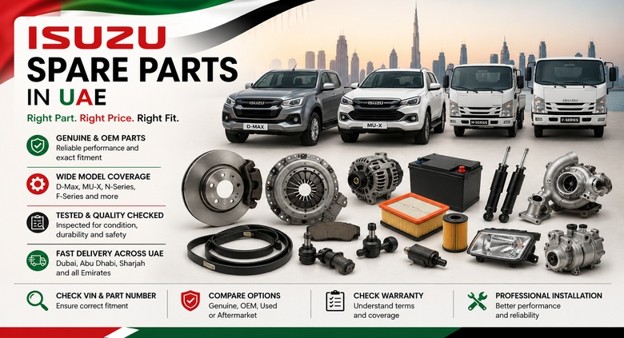
Isuzu Spare Parts in UAE: Complete Guide for D-Max, MU-X, N-Series and F-Series
September 3, 2026
Isuzu Spare Parts in UAE: Models, Parts and Common Replacement Needs
Isuzu Spare Parts in UAE: What Parts Do D-Max, MU-X, N-Series and F-Series Owners Replace Most?
An Isuzu does not usually come into a workshop because the owner suddenly woke up one morning and decided it was time for new spare parts.
There is normally a story behind it.
A D-Max has been carrying equipment for months. An MU-X has spent another summer crawling through Dubai traffic with the AC running constantly. An N-Series delivery truck has been starting, stopping, loading and unloading all day. An F-Series has been working under weight, sometimes on roads that are far less forgiving than the smooth motorway suggests.
The part fails later.
The workload started the process much earlier.
That distinction matters when buying Isuzu spare parts in UAE because the same part can have very different remaining life depending on how the vehicle has been used. Brake pads on a city-driven D-Max are one thing. Brake parts on a loaded commercial truck making repeated stops around Sharjah industrial areas are another altogether.
The common replacement areas are fairly broad:
- Brake pads and discs
- Suspension bushes and control arms
- Stabiliser links and ball joints
- Shock absorbers
- Wheel bearings
- Clutch and transmission-related parts
- Radiators, hoses and cooling parts
- Belts, tensioners and pulleys
- Batteries, alternators and starter motors
- Filters and routine service parts
- Sensors and electrical parts
- AC-related parts
- Lights, mirrors, bumpers and exterior body parts
But don't turn that list into a shopping list just yet.
Diagnosis comes first.
If a D-Max is pulling to one side, for example, the tyre may be worn — but so might an alignment-related part, suspension bush or steering part. If an N-Series truck is running hot, replacing one cooling-system part without checking the radiator, fan operation, hoses and coolant condition can simply push the same problem further down the road.
UAE conditions make these checks even more important. Heat, dust, long-distance driving, heavy traffic and extended AC use all add their own pressure. Vehicles operating around Dubai and Abu Dhabi may spend hours idling or crawling. Trucks working around construction areas face another kind of punishment. Coastal humidity brings yet another variable.
So, which Isuzu parts should owners worry about first?
Usually the ones that deal with stopping, carrying, cooling and moving the vehicle.
Those four areas tell you a lot.
| Part area | D-Max | MU-X | N-Series | F-Series |
| Brakes | Frequent inspection | Regular inspection | High priority | High priority |
| Suspension | High priority | Regular–high | Heavy-use area | Heavy-use area |
| Cooling system | Important | Important | Critical | Critical |
| Clutch/transmission | Usage dependent | Usage dependent | High on working vehicles | High on working vehicles |
| Filters | Regular replacement | Regular replacement | Very important | Very important |
| Electrical system | Regular checks | Regular checks | Fleet priority | Fleet priority |
| AC | High UAE workload | High UAE workload | Important | Important |
| Body/lighting | Usage dependent | Common urban damage | Fleet damage possible | Fleet damage possible |
And one more thing: don't compare parts by price alone.
A cheap brake pad is not cheap if it wears quickly. A low-priced used part is not a bargain if it needs another removal and installation job two weeks later. For commercial vehicles, even the hours spent sitting in a workshop can cost more than the part itself.
That's where sensible Isuzu ownership begins — not with the cheapest quotation, but with the right part, the right specification and the right diagnosis.
Isuzu D-Max Spare Parts in UAE: Common Parts That Need Replacement
The D-Max can be a daily driver, workhorse and weekend 4x4 all in the same week.
That's why its spare-part needs can vary so much.
A privately owned D-Max travelling between home and office has a different mechanical routine from a pickup carrying tools around construction sites in Dubai, then heading out towards Al Ain or Ras Al Khaimah loaded with equipment. Same badge. Very different life.
Start with the brakes.
Brake pads gradually disappear — not dramatically, just little by little. Stop-start traffic speeds that process up, particularly when the pickup is carrying weight. Discs can also develop scoring, uneven wear or heat-related problems. If braking produces vibration, squealing, pulling or an unfamiliar pedal feel, don't simply order pads because they are the obvious item.
Look around.
Suspension parts are another recurring area. Control-arm bushes, stabiliser links, ball joints and shock absorbers take the hits from potholes, rough surfaces and loaded driving. A D-Max that knocks over broken road surfaces or feels less settled through corners may be giving you an early warning.
Then there are wheel bearings.
They often don't announce themselves with a dramatic failure. Instead, you get a humming or droning sound that rises with road speed. Sometimes owners initially blame the tyres. Sometimes they are right. Sometimes they're not.
Cooling deserves attention too, particularly before the UAE summer really gets going. Radiator condition, hoses, thermostat operation, cooling fans, belts and related parts all have to work together. Replacing one weak part while ignoring another can leave you right back where you started.
And don't forget the clutch on manual D-Max models.
Heavy traffic is not kind to a clutch. Neither is repeated loading, hill work or careless driving technique. Slipping, difficulty selecting gears, a changing bite point or unusual smells should be investigated rather than ignored.
A practical D-Max inspection therefore looks beyond the part that has already failed.
| D-Max area | Typical concern | What the driver may notice |
| Brake system | Pad/disc wear | Noise, vibration, longer stopping distance |
| Suspension | Bushes, links, ball joints | Knocks, loose handling |
| Shock absorbers | Loss of damping | Bouncing, poor body control |
| Wheel bearings | Bearing wear | Humming or rumbling |
| Cooling | Hose, radiator, fan or thermostat issue | Rising temperature, coolant loss |
| Clutch | Wear from heavy use | Slip, difficult gear selection |
| Electrical | Battery, alternator, starter | Slow starting, warning lights |
| AC | Cooling or electrical faults | Weak cabin cooling |
Mileage helps, but it does not tell the whole story.
A D-Max with 150,000 km of mostly steady highway driving may be in better mechanical shape than another with 90,000 km of heavy loads, short journeys, dusty sites and constant urban crawling.
That's why the question should not only be “How many kilometres?”
Ask: “What kind of kilometres?”
Isuzu MU-X Spare Parts in UAE: Common Replacement Parts for Family and 4x4 Use
The MU-X has an interesting workload.
It can behave like a family SUV Monday to Friday, then become a loaded 4x4 at the weekend. Seven seats, luggage, passengers, highway driving, city traffic — and occasionally a rough track thrown into the mix.
That variety shows up in the parts that wear.
Brake pads and discs deserve regular checks because the MU-X is a substantial vehicle and urban driving means repeated braking. Dubai traffic can turn a normal commute into a long sequence of acceleration, braking, waiting, accelerating again. Do that for years and the brakes eventually complain.
Suspension parts tell another story.
Control-arm bushes, stabiliser links, ball joints and shock absorbers gradually lose their ability to keep everything tight and controlled. You may hear a knock first. Or perhaps the steering starts feeling slightly vague. Maybe the vehicle dips more than it used to after a speed hump.
Those small changes matter.
Don't wait until the MU-X feels obviously broken.
The UAE cooling and AC systems also deserve their own inspection. Radiators, cooling fans, hoses, thermostats, AC compressors, condensers and related electrical parts work hard in summer. A cabin that takes too long to cool is not always an AC compressor problem, either. Refrigerant issues, condenser condition, airflow restrictions, electrical faults and other parts can produce similar symptoms.
This is where a proper diagnosis saves money.
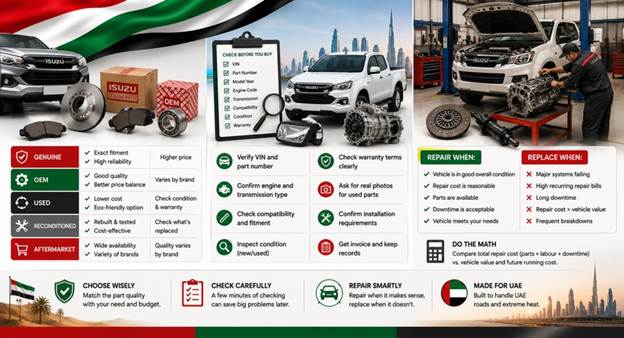
And when you're comparing replacement options, think about the part's role rather than simply its price. PartFinder UAE can be useful when comparing available Isuzu parts, but the sensible decision still depends on the exact vehicle specification, VIN, part number, condition, warranty and total installed cost.
Used parts can work well in some situations.
A mirror, certain trim pieces or selected body parts? Often worth considering.
A safety-critical brake or steering part with uncertain history? That's a different conversation.
The same applies to electronically controlled parts. If a unit requires coding, programming or a specific vehicle configuration, physical similarity does not guarantee compatibility.
The MU-X may look straightforward from outside.
Underneath, it isn't.
Isuzu N-Series Spare Parts in UAE: Parts That Matter for Commercial Fleets
For an N-Series truck, spare parts are not just a maintenance expense.
They are part of keeping the business moving.
That sounds obvious, but fleet operators know how quickly a minor fault can become expensive. A truck scheduled for several deliveries across Dubai and Sharjah doesn't care that the replacement part itself costs relatively little. If the truck cannot leave the workshop, the entire day's route may need to be rearranged.
So the priority shifts.
Brake pads, discs, suspension bushes, wheel bearings, clutch parts, filters, belts, hoses and cooling-system parts deserve close attention. Batteries, alternators, starter motors and electrical connections matter too because commercial vehicles accumulate operating hours much faster than many private cars.
The cooling system is especially important.
An N-Series working in summer may spend long periods crawling through traffic, idling at loading points and carrying a meaningful payload, all while the AC is running. That's a lot of heat management.
If the radiator is restricted, the cooling fan isn't behaving properly or a hose has started deteriorating, the engine may cope for a while.
Until it doesn't.
And when an overheating problem finally becomes obvious, the repair can be much larger than the original cooling fault.
Commercial clutch wear deserves similar attention. Repeated starts, stops, loading and urban manoeuvring can shorten clutch life. If the clutch is being replaced, the workshop should inspect the related parts rather than treating the job as a single-part swap.
The same thinking applies to wheel bearings and suspension.
If one part has failed, ask why.
Was the vehicle overloaded? Was another worn part putting additional stress on it? Has alignment been ignored? Has the truck spent years travelling over poor surfaces?
These questions are more useful than simply asking for the lowest replacement price.
| N-Series part area | Why it gets attention | Useful check |
| Brakes | Frequent stops and payload | Pad/disc condition |
| Clutch | Repeated commercial operation | Slip and engagement |
| Suspension | Load and road impacts | Bushes, links, joints |
| Cooling | Heat and extended operation | Radiator, hoses, fan |
| Filters | Dust and high mileage | Service history |
| Wheel bearings | Load and mileage | Noise/play |
| Battery | Frequent starting cycles | Voltage/charging test |
| Belts and hoses | Heat and age | Cracks, wear, tension |
There is another fleet habit worth keeping: record everything.
Mileage. Date. Part number. Repair reason. Warranty. Supplier. Installation.
It sounds dull.
It is also incredibly useful six months later when someone asks why the same part is being replaced again.
Isuzu F-Series Spare Parts in UAE: Heavy-Duty Parts and Maintenance Needs
The F-Series needs a slightly different way of thinking.
This is where payload, operating hours and working conditions become impossible to ignore. A heavy-duty truck can accumulate mechanical stress even when the odometer does not look particularly frightening, because the vehicle may spend long periods under load, climbing gradients, manoeuvring in tight industrial areas or running repeated delivery routes.
Brakes therefore deserve serious attention.
So do tyres, wheel bearings, suspension and steering parts. These areas deal directly with the truck's weight and the road beneath it. If something begins to loosen or wear unevenly, the driver may notice vibration, pulling, abnormal tyre wear, knocking or a change in steering feel.
Don't brush those signs aside.
Cooling is another big one for UAE operation. A working truck has little sympathy for a weak cooling system, especially during very hot months. Radiator efficiency, hoses, coolant condition, fan operation, thermostat behaviour and related belts all need to be considered together.
Then there is the engine itself.
Filters and routine service parts are not glamorous, but they are cheap insurance compared with repairing an engine that has been running with restricted airflow, poor lubrication or contaminated fluids. For fleet operators, service intervals should be treated as operating controls rather than suggestions.
Transmission and clutch parts also need a workload-based inspection. A truck repeatedly starting under load puts more strain on these systems than one travelling lightly loaded on open highways.
And here's where buying used parts gets tricky.
For certain body parts, mirrors, lights or non-critical accessories, second-hand can make financial sense. For major mechanical or safety-related parts, the inspection standard needs to be much higher. Engine and gearbox purchases should come with proper identification, condition evidence and, where applicable, testing rather than a vague “good condition” promise.
A useful F-Series parts decision should answer four questions:
- Does the part match the exact truck specification?
- Does its condition suit the vehicle's workload?
- What warranty or return protection comes with it?
- What will the complete repair cost once labour and supporting parts are included?
That last question catches people out.
The replacement part may be affordable. Installation, fluids, seals, diagnostics, adjustment and downtime can quietly push the final bill much higher.
For a working F-Series, the cheapest part is therefore not automatically the cheapest repair.
Sometimes the smarter purchase is simply the one that gets the truck back on the road once — and keeps it there.
Mechanical, Engine and Electrical Parts
Isuzu Engine Spare Parts in UAE: What Usually Needs Attention?
An Isuzu engine can cover serious mileage. That reputation is deserved, but it can also create a dangerous habit: assuming the engine will simply keep going regardless of maintenance.
It won't.
The engine itself may remain healthy while the smaller parts around it gradually wear, harden, leak or lose efficiency. And in the UAE, those supporting parts can become important surprisingly quickly.
Start with the cooling system. Radiators, hoses, thermostats, water-pump-related parts, cooling fans and belts all work together to keep engine temperature under control. A weak hose may look harmless during a quick inspection, yet a sudden leak on a hot motorway can turn a small replacement into a recovery job.
Filters matter too. Air filters collect dust; fuel filters deal with contamination; oil filters protect lubrication quality. Commercial Isuzus operating around industrial areas or dusty routes may need particularly careful service attention.
Then there are belts, tensioners and pulleys.
A squeal, chirp or rough bearing noise should not be dismissed simply because the engine still starts. One worn belt-related part can affect other systems, and a broken belt can leave the vehicle stranded.
Sensors deserve a little caution as well. A warning light does not automatically mean the sensor itself is faulty. Diagnostic testing should establish whether the sensor is reporting a genuine underlying problem.
| Engine-related area | Common concern | Sensible inspection |
| Cooling system | Radiator, hose, thermostat, fan | Temperature and leak checks |
| Belts | Cracking, wear, tension | Visual and tension inspection |
| Pulleys/tensioners | Bearing noise or play | Noise and movement check |
| Filters | Dust or contamination | Service history and condition |
| Sensors | Fault codes or incorrect readings | Diagnostic testing |
| Battery/charging | Weak starting or low voltage | Battery and alternator test |
| Fuel system | Restricted flow or contamination | Filter and system inspection |
| Engine internals | Wear at high mileage | Compression and mechanical testing |
For a used Isuzu engine, the inspection needs to go much deeper.
Check the engine code and identification first. Confirm the vehicle's model year and specification. Then look at compression, oil condition, coolant contamination, visible leaks, unusual smoke and abnormal noises. If the engine has been removed from another vehicle, ask what mileage it covered and whether that mileage can actually be supported by documentation.
Don't accept “low mileage” as a mechanical test.
Compression testing can tell you considerably more.
And if the engine is being replaced, inspect the supporting parts while access is already available. Hoses, belts, mounts, seals, fluids, filters and related cooling parts can be inexpensive compared with the labour required to remove the engine again.
That is the bit people sometimes overlook.
You don't just buy an engine.
You buy the job around the engine.
Isuzu Brake and Suspension Parts: What Wears Out on UAE Roads?
Brakes and suspension have one thing in common: they rarely fail at the exact moment they begin wearing.
They fade.
A little less braking bite. A little more movement over a speed hump. One strange knock. Slightly uneven tyres. The driver adapts, keeps going and eventually forgets that the vehicle used to feel tighter.
Then the workshop lifts it.
Suddenly there are three or four worn parts instead of one.
On the D-Max and MU-X, brake pads and discs are obvious inspection points. Heavy traffic around Dubai, Sharjah and Abu Dhabi means repeated braking, while additional passengers or loads increase the work the braking system has to handle.
Commercial N-Series and F-Series vehicles face an even harder job. Payload, repeated stops and long operating hours put greater demands on brakes, hubs, suspension and tyres.
Suspension wear needs to be assessed as a group rather than as isolated pieces. Control-arm bushes, stabiliser links, ball joints, shocks and related steering parts can influence one another. Replace one badly worn part while leaving another loose, and the vehicle may still feel wrong afterwards.
Tyres are part of the evidence too.
Uneven inner-edge wear? Don't simply fit another tyre.
Check alignment and suspension.
A worn shock absorber can also make a tyre behave badly. A loose suspension joint can affect steering feel. A damaged bush can create noise without making the vehicle obviously unsafe during a short test drive.
| Symptom | Possible area to inspect | Don't assume |
| Steering feels loose | Bushes, joints, steering parts | Wheel alignment alone |
| Knocking over bumps | Links, bushes, ball joints | Shock absorber only |
| Vehicle pulls | Tyres, alignment, suspension | Tyre pressure only |
| Brake vibration | Discs, hubs, braking surfaces | Pads alone |
| Uneven tyre wear | Alignment, bushes, shocks | Tyre quality only |
| Excessive bouncing | Shock absorbers | Wheel alignment |
| Humming at speed | Wheel bearing or tyre | Engine noise |
UAE roads aren't uniformly harsh, of course. But potholes, expansion joints, speed humps, construction routes and occasional desert or gravel driving can all add up over years.
And the heavy vehicles feel it.
For fleet owners, inspection intervals should therefore be based on operating conditions as well as mileage. A truck making hundreds of stops every week has a different brake life from one doing long highway runs.
The practical rule is simple: when one wear part is being replaced, inspect the neighbouring parts while everything is accessible.
That small step can prevent another workshop visit later.
Isuzu Cooling System and AC Parts: How UAE Heat Changes Wear
In the UAE, a cooling system doesn't get much time off.
Neither does the AC.
During summer, an Isuzu can sit in traffic under intense heat while the engine continues producing its own heat and the cabin AC works continuously. That's normal operation here. The system has to cope with it.
A cooling fault therefore deserves more attention than a small dashboard warning might suggest.
Radiators can become restricted. Hoses age and harden. Thermostats can stop regulating temperature correctly. Cooling fans may develop electrical or mechanical faults. Belts and pulleys can wear. Coolant can deteriorate or leak.
And the important point is that these parts interact.
If the radiator isn't transferring heat effectively, the fan may have to work harder. If a hose starts leaking, coolant level falls. If the thermostat isn't behaving correctly, temperature control becomes unstable.
Don't replace whichever part is easiest to reach.
Find the cause.
The AC system has its own list of possibilities. A weakly cooling cabin could involve refrigerant loss, condenser condition, compressor performance, airflow restriction, electrical controls or other related parts. Simply replacing the compressor because the AC isn't cold enough can become a very expensive guess.
For Isuzu trucks, the issue can be even more noticeable because many vehicles operate for long hours and may spend considerable time idling.
| System | Parts worth checking | Warning signs |
| Radiator | Core, fins, restrictions | Rising temperature |
| Hoses | Cracks, swelling, leaks | Coolant loss |
| Thermostat | Opening/closing operation | Unstable temperature |
| Cooling fan | Motor and controls | Overheating in traffic |
| Belts | Wear and tension | Squeal or visible damage |
| AC compressor | Performance and leaks | Weak cooling |
| Condenser | Condition and airflow | Poor AC efficiency |
| AC electrical system | Relays, controls, wiring | Intermittent cooling |
A useful UAE workshop inspection should also consider when the problem occurs.
Only in traffic?
Only at idle?
Only during long highway runs?
Only when the AC is switched on?
Those details can narrow the diagnosis considerably.
If a D-Max stays cool at motorway speed but begins running hot while stationary, for example, the workshop should pay close attention to airflow and fan operation rather than immediately blaming the engine.
Likewise, if an MU-X's AC works reasonably well in the morning but struggles after sitting in the afternoon heat, the system needs proper pressure, airflow and performance checks.
Heat exposes weak points.
It doesn't necessarily create them.
Isuzu Transmission and Clutch Parts in UAE: What Should Owners Check Before Buying a Replacement?
Transmission problems have a nasty habit of becoming expensive before the owner fully understands what is wrong.
A D-Max may start hesitating between gears. An N-Series truck may develop clutch slip. An F-Series vehicle may become difficult to shift under load. The temptation is obvious: find a gearbox or clutch assembly and replace it.
Slow down.
First establish what has actually failed.
For manual Isuzus, clutch wear can involve the clutch disc, pressure plate, release bearing and related parts. A worn flywheel surface can also affect the finished repair. Replacing only the visibly damaged item may leave the system performing poorly afterwards.
Automatic transmissions need an even more careful diagnosis. Fluid condition, electronic faults, sensors, solenoids and internal transmission problems can produce symptoms that overlap. A fault code is evidence, not a complete diagnosis.
Used gearboxes therefore require proper identification and testing.
Check the transmission code. Match it against the vehicle specification. Confirm whether the replacement gearbox has the same configuration and mounting arrangement. For electronically controlled systems, check whether programming, adaptation or coding will be required after installation.
And ask about warranty.
Not “Does it have warranty?”
Ask what exactly is covered.
| Check | Why it matters |
| Transmission code | Prevents specification mismatch |
| Vehicle VIN | Confirms application |
| Model year | Helps identify revisions |
| Engine pairing | Gearbox compatibility can depend on engine |
| Physical mounting | Similar-looking units may differ |
| Electrical connections | Connectors and controls must match |
| Condition/testing | Used units need evidence |
| Warranty | Protects against early failure |
| Installation requirements | Fluids, seals and programming may add cost |
Commercial Isuzus need another layer of scrutiny because usage can accelerate clutch and transmission wear. Repeated loading, stop-start routes, reversing, hill work and long operating hours all matter.
So when someone says, “This gearbox fits your Isuzu,” that isn't enough.
Which Isuzu? Which engine? Which year? Which transmission code?
Get those answers before money changes hands.
A gearbox that is mechanically similar but electronically or physically incompatible is not a bargain.
It's a second repair waiting to happen.
Isuzu Electrical and Sensor Parts: Batteries, Alternators, Starters and Sensors
Electrical faults are often blamed on the wrong part.
The battery is weak, so replace the battery.
The warning light is on, so replace the sensor.
The starter is slow, so replace the starter motor.
Sometimes that works. Sometimes the real fault is sitting one step behind it.
A battery, alternator and starter form part of the same starting and charging system. A weak alternator can leave a healthy battery undercharged. A poor connection can imitate a failing battery. A tired starter can draw excessive current and make diagnosis more confusing.
Test first.
That is particularly important with commercial Isuzus because fleet vehicles accumulate starting cycles and operating hours quickly. N-Series and F-Series trucks may be switched on repeatedly throughout a working day, while accessories and electrical systems can remain active during loading or waiting periods.
Sensors require similar caution.
A fault code identifies a circuit or system that needs investigation. It does not automatically prove that the sensor itself needs replacement. Wiring, connectors, voltage supply, mechanical faults and related systems can all create misleading symptoms.
| Electrical part | Common symptom | Useful check |
| Battery | Slow starting | Battery condition/load test |
| Alternator | Charging warning | Charging output |
| Starter motor | Slow or difficult cranking | Current draw and starter test |
| Sensor | Warning light | Diagnostic scan + circuit testing |
| Wiring/connectors | Intermittent faults | Continuity and connection inspection |
| Relays/fuses | Electrical system failure | Circuit testing |
| Lighting parts | Flickering or failure | Power and connector check |
UAE heat can also be hard on batteries and electrical connections. Under-bonnet temperatures become high, and repeated summer operation puts additional stress on electrical systems.
For replacement parts, match the exact specification.
That means vehicle model, model year, engine, transmission where relevant, VIN and original part number. For sensors and electronically controlled parts, connector shape alone is nowhere near enough.
And don't overlook programming.
Some modern replacement electrical parts may require coding, calibration or system adaptation after installation. A part can physically fit and still fail to function correctly.
This is why a proper Isuzu spare-parts purchase should finish with more than a box and a receipt.
You want the correct part, confirmed compatibility, proper installation and a clear warranty position.
Otherwise, you're only halfway through the repair.
Prices, Compatibility and Buying Options
Isuzu Spare Parts Prices in UAE: Genuine, OEM, Used and Aftermarket Options
There is no single “Isuzu spare parts price” in the UAE.
That's the first thing to get out of the way.
A D-Max brake disc, an MU-X AC part, an N-Series clutch part and an F-Series cooling-system part can all sit in completely different price brackets. Even within the same model, the final figure changes according to the engine, model year, specification, availability and whether you choose genuine, OEM, used, reconditioned or aftermarket parts.
Then labour gets added.
And sometimes diagnostics, programming, fluids, seals, delivery or supporting parts quietly join the bill as well.
So comparing two quotations by looking only at the part price can be misleading.
| Buying option | Typical advantage | Main thing to check |
| Genuine | Exact manufacturer application | Price and availability |
| OEM | Strong quality-to-price balance | Actual manufacturer and specification |
| Used | Lower purchase cost | Mileage, condition and testing |
| Reconditioned | Rebuilt rather than simply used | What was replaced during rebuilding |
| Aftermarket | Broad price range and availability | Brand quality and exact fitment |
For a D-Max that needs a non-critical body part, a good used option can sometimes make far more sense than paying premium money for a new item. For an engine, gearbox, braking or electronically controlled part, however, condition and compatibility become much more important.
Think about the whole repair.
A replacement gearbox may look inexpensive until installation labour, fluids, seals, diagnostics and adaptation are added. A used engine may appear attractive until compression testing reveals a problem — or until worn supporting parts need replacing after installation.
Availability also affects pricing. A part sitting in UAE stock may cost more or less than an apparently cheaper option that has to be sourced from elsewhere and delivered later, especially when the vehicle is already sitting in a workshop.
For UAE buyers comparing these options, PartFinder UAE can be useful when assessing available Isuzu parts, but the sensible comparison still comes down to the actual part number, VIN compatibility, condition, warranty, delivery and complete installed cost.
That final figure is the one worth comparing.
Not the shiny number at the top of the quotation.
Isuzu Spare Parts Prices by Model: Why D-Max, MU-X, N-Series and F-Series Costs Differ
The model itself changes the economics.
A D-Max generally gives owners a wide range of replacement choices because it is used in both private and commercial settings. Common wear parts such as brakes, filters, suspension parts and belts can be relatively straightforward to source, while larger drivetrain or engine-related jobs can move into a very different price category.
The MU-X brings SUV-specific costs into the picture. Its larger body, passenger-carrying role, AC workload and 4x4 hardware mean that some repairs involve more expensive parts or more workshop time.
Then there are the trucks.
N-Series and F-Series vehicles should not be priced like passenger cars simply because they carry the Isuzu badge. Their brakes, suspension, clutch, transmission, cooling systems and heavy-duty running gear can face considerably more stress.
And downtime matters.
For a private MU-X owner, waiting another day for a part may be frustrating. For an N-Series delivery truck, that same delay can affect several routes, customers and drivers.
A useful comparison therefore looks like this:
| Model | Common cost-sensitive areas | Where expenses can rise |
| D-Max | Brakes, suspension, filters, electrical | Engine, gearbox, 4x4 drivetrain |
| MU-X | Brakes, suspension, AC | 4x4 system, transmission, major cooling repairs |
| N-Series | Filters, brakes, clutch, suspension | Engine, gearbox, heavy-duty running gear |
| F-Series | Brakes, suspension, cooling | Engine, transmission, steering and heavy-duty parts |
There is another trap: cheap parts can increase labour costs indirectly.
Suppose an inexpensive suspension part wears prematurely. The saving looked good when it was purchased. But if the vehicle needs another inspection, another installation and another alignment, the real saving may disappear.
For fleet operators, this becomes even more obvious.
A slightly more expensive part that lasts longer can sometimes produce a lower cost per kilometre than the cheapest available replacement. That calculation is worth making when the vehicle is working every day.
Don't ask only, “How much is the part?”
Ask, “How much will this repair cost me over its useful life?”
That's a much better question.
Isuzu Spare Parts VIN and Part Number Check: How to Avoid the Wrong Part
The part number is not decoration.
Neither is the VIN.
They are two of the quickest ways to stop a spare-parts purchase from going sideways.
Isuzu models can have specification differences across model years, engines, transmissions, body configurations and markets. Two parts can look almost identical and still have different mounting points, electrical connections, dimensions or operating characteristics.
That's why “it looks the same” is a poor compatibility test.
Start with the VIN.
Use it to identify the exact vehicle specification, then compare the original part number against the proposed replacement. If the number has been superseded, confirm that the newer number is the correct replacement rather than assuming any similar number will work.
For used parts, ask for photographs of the actual item where possible.
Not a catalogue image.
The actual part.
| Compatibility check | Why it matters |
| VIN | Identifies the exact vehicle |
| Model year | Helps separate revisions |
| Engine code | Can change part application |
| Transmission type/code | Important for drivetrain parts |
| Original part number | Strong identification reference |
| Superseded number | Confirms updated replacements |
| Connector arrangement | Critical for electrical parts |
| Mounting points | Prevents physical mismatch |
| Dimensions | Useful for mechanical and body parts |
| Programming requirement | Important for electronic units |
This becomes especially important with electrical and electronic parts.
A sensor can have the same general shape but a different connector. A control unit can physically mount in the correct place yet require different programming. A cooling part may look suitable while having a different configuration for another engine.
For engines and gearboxes, go further.
Confirm the engine or transmission code, not simply “D-Max engine” or “N-Series gearbox”. For a used engine, compression testing and inspection for leaks, smoke-related evidence, contamination and abnormal noise can tell you much more than a seller's mileage claim.
And if the part is being installed by a workshop, let the technician verify it before fitting.
That sounds obvious.
Yet it is much cheaper to discover a mismatch while the box is still on the workshop floor than after the old part has already been removed and the vehicle is sitting halfway through a repair.
Used Isuzu Spare Parts in UAE: Which Parts Are Worth Buying Second-Hand?
Used parts are not automatically bad.
They are also not automatically a bargain.
The answer depends heavily on what the part does, how it was used before and how difficult it is to replace again.
A used mirror, door, trim piece, certain lights or selected body parts can make plenty of sense when the part is clean, undamaged and correctly matched. The financial difference from buying new can be substantial, particularly for older Isuzu vehicles.
Mechanical parts need more caution.
A used suspension arm might look fine in a photograph, but bushes, ball joints and mounting points need inspection. A wheel-bearing-related part requires even greater care because wear may not be obvious externally.
Engines and gearboxes are in another category altogether.
For a used Isuzu engine, ask for identification and mileage evidence, then check compression where appropriate. Inspect oil and coolant condition, look for leaks, assess smoke evidence and examine the engine before installation. A gearbox should be matched by its correct code and, where possible, tested for operation and abnormal noise.
Warranty terms matter enormously here.
“What warranty?” is not specific enough.
Ask:
- How long is the warranty?
- What exactly does it cover?
- Does it cover the part only or labour as well?
- Who pays removal and reinstallation if it fails?
- Is a return possible?
- Are there exclusions for overheating, installation errors or incorrect fluids?
- Does the warranty require professional installation?
| Used-part category | Buying second-hand | Inspection level |
| Body panels | Often sensible | Check damage, corrosion and fit |
| Mirrors/trim | Often sensible | Check condition and mounting |
| Lights | Can make sense | Check lenses, housing and electronics |
| Suspension parts | Case by case | Inspect wear and mounting areas |
| Alternator/starter | Case by case | Test output and operation |
| AC parts | Case by case | Check condition and system compatibility |
| Engine | Potentially valuable | Identification + mechanical testing |
| Gearbox | Potentially valuable | Code matching + operational testing |
| Safety-critical parts | Greater caution | Proven condition and compatibility |
The biggest mistake is buying a used part simply because the price is low.
Imagine saving a few hundred dirhams on a used gearbox, only to discover after installation that it has an internal fault. Now you're paying workshop labour twice, plus fluids and possibly transport.
That isn't saving money.
That's paying for uncertainty.
Used parts work best when the buyer knows where to accept uncertainty and where not to.
For a cosmetic repair, some uncertainty may be tolerable.
For an engine, gearbox, steering or safety-related part, it usually isn't.
Isuzu Spare Parts Buying Guide: How to Get the Best Value in the UAE
The best-value Isuzu part is rarely the cheapest one on the first quotation.
Sometimes it is genuine. Sometimes OEM makes more sense. Sometimes a properly inspected used part is the sensible answer, particularly on an older D-Max or MU-X where the value of the vehicle does not justify fitting expensive new parts everywhere.
The decision should follow the vehicle.
A relatively new Isuzu that you intend to keep for years deserves a different parts strategy from an older commercial truck approaching the end of its working life.
Then consider the part itself.
A cosmetic item? Price and appearance may dominate.
A brake, steering, cooling or engine part? Quality and proven compatibility move much higher up the list.
And if the vehicle is a commercial N-Series or F-Series, factor downtime into the calculation. A part that arrives tomorrow and works correctly may be financially preferable to a cheaper part that takes several days to source.
Before paying, run through the basics:
- Confirm the VIN.
- Match the original part number.
- Check the model year and engine specification.
- Verify the transmission where relevant.
- Ask whether the part is genuine, OEM, used, reconditioned or aftermarket.
- For used mechanical parts, ask about mileage and testing.
- For engines, request compression or other appropriate mechanical checks.
- For gearboxes, confirm the transmission code and testing procedure.
- Check warranty terms in writing.
- Confirm whether labour is covered if the part fails.
- Add delivery, fluids, seals, diagnostics and programming to the calculation.
- Check supporting parts before installation.
- Keep the invoice and part-number information.
And don't forget the first few hundred kilometres after a major repair.
A replacement engine, gearbox, cooling part or suspension assembly should not simply disappear from your attention once the workshop hands the keys back. Watch temperatures, warning lights, fluid levels, noises, vibration and unusual smells. A proper post-installation check can catch a developing issue before it becomes another major repair.
For UAE owners, the buying decision should ultimately come down to four things:
Fit. Condition. Warranty. Total cost.
Get those right, and the choice between genuine, OEM, used, reconditioned and aftermarket becomes much easier.
Get them wrong, and even an apparently cheap Isuzu spare part can become an expensive lesson.
UAE Workshop Costs and Buying Decisions
Isuzu Spare Parts Labour Cost in UAE: Dubai, Abu Dhabi, Sharjah and Other Emirates
The part price is only half the repair bill.
Sometimes not even half.
An Isuzu brake pad may be reasonably priced, yet the final invoice can rise once inspection, removal, installation, cleaning, adjustment and testing are added. A gearbox or engine is even more obvious. The replacement part might look manageable on paper, but fluids, seals, diagnostics, programming and several hours of workshop work can change the number quite quickly.
UAE labour rates also vary by location and workshop type.
A specialist workshop in Dubai may charge differently from an independent garage in Ajman. Abu Dhabi fleet work can follow another pricing structure again, while workshops in Ras Al Khaimah, Fujairah or Umm Al Quwain may have different overheads and labour arrangements.
These are practical indicative workshop ranges, not fixed market tariffs.
| UAE location | Typical independent workshop labour/hour | Specialist workshop labour/hour | Jobs where cost can rise |
| Dubai | AED 120–250 | AED 180–350+ | Diagnostics, electrical, engine/gearbox |
| Abu Dhabi | AED 130–260 | AED 190–360+ | Major mechanical and electronic work |
| Sharjah | AED 100–220 | AED 160–320+ | Commercial repairs, drivetrain |
| Ajman | AED 90–200 | AED 140–280+ | Engine, gearbox and electrical |
| Ras Al Khaimah | AED 90–200 | AED 140–280+ | Heavy-duty and commercial work |
| Fujairah | AED 90–200 | AED 140–280+ | 4x4, cooling and drivetrain |
| Umm Al Quwain | AED 80–180 | AED 130–250+ | Commercial and mechanical repairs |
The actual invoice can move outside these ranges depending on the vehicle and job.
A D-Max brake job is obviously not an F-Series transmission repair. Don't compare them as though they were.
Diagnostics can also add a separate charge. Electrical faults may require considerably more investigation than a straightforward mechanical replacement. Some electronic parts need programming or calibration after installation. Wheel alignment may be necessary after suspension work. Fluids and seals may be required when a transmission or cooling-system part is replaced.
And then there is supporting work.
If the workshop removes an engine, this is the moment to inspect accessible hoses, mounts, belts, filters, seals and related cooling parts. Paying a little more while everything is already exposed can be far cheaper than paying another removal-and-installation bill later.
For commercial N-Series and F-Series owners, downtime should be calculated as part of labour cost too.
A truck sitting in a workshop isn't earning.
That matters.
Genuine vs OEM vs Used vs Aftermarket Isuzu Parts: Which Option Makes Sense?
There is no universal winner here.
Anyone who tells you that every Isuzu repair should use only one category of spare part is making the decision far too simple.
A genuine part can make excellent sense when exact fitment, manufacturer specification and long-term reliability are the priority. OEM parts can offer a useful middle ground where quality remains important but the genuine packaging carries a higher price.
Used parts have their place too.
An older D-Max needing a body panel does not necessarily need an expensive new replacement. A clean, undamaged used panel that matches properly may be perfectly sensible. The same logic can apply to certain mirrors, trim pieces and selected non-critical parts.
But change the subject to brakes, steering, engine internals or a transmission, and the calculation changes.
| Part category | Genuine | OEM | Used | Aftermarket |
| Brake parts | Strong choice | Strong choice | Greater caution | Depends heavily on brand |
| Suspension | Strong choice | Strong choice | Inspect carefully | Quality varies |
| Body/trim | Good | Good | Often sensible | Depends on fit/finish |
| Engine | Strong choice | Strong choice | Testing essential | Specification matters |
| Gearbox | Strong choice | Strong choice | Testing essential | Careful compatibility check |
| Sensors | Strong choice | Strong choice | Greater uncertainty | Brand quality matters |
| AC parts | Strong choice | Good | Case by case | Quality varies |
| Filters | Strong choice | Good | Usually not preferred | Good-quality brands can work |
The vehicle's age matters.
So does the ownership plan.
If you have a relatively new MU-X and intend to keep it for another five years, fitting a questionable used electronic part just to save money today may not be the smartest move. If you have an older D-Max used for occasional work, the economics can look very different.
Commercial trucks require another calculation.
For an N-Series or F-Series that earns money every day, reliability and downtime can outweigh a modest difference in purchase price. A cheaper clutch that needs replacing again shortly afterwards isn't cheaper in any meaningful sense once labour and lost operating time are included.
Ask yourself:
How critical is the part?
How difficult is it to replace again?
How long will I keep the vehicle?
What does the warranty actually cover?
Those questions usually make the answer much clearer.
Isuzu Spare Parts Buying Checklist: What Should You Check Before Installation?
Before the part reaches the workshop, stop for five minutes.
It can save hours later.
Start with the VIN. Confirm the exact Isuzu model, model year, engine and transmission specification. Then match the original part number against the replacement. If the supplier says the number has been superseded, ask for confirmation that the new number is the correct replacement.
For used parts, inspect the actual item rather than relying on a generic photograph.
For an engine, go much further.
Ask about mileage and source vehicle. Check the engine identification. Inspect for leaks and contamination. Where appropriate, carry out compression testing before installation. Look at the supporting parts too — belts, hoses, mounts, seals, filters and cooling-system items can all affect the finished repair.
A used gearbox deserves similar scrutiny. Match the transmission code, confirm its application and ask how it was tested. If electronic adaptation or programming is required, establish that before the vehicle is dismantled.
And get the warranty details in writing.
| Before installation | What to confirm |
| VIN | Exact vehicle application |
| Part number | Original and superseded number |
| Model year | Correct production specification |
| Engine | Exact engine/code where relevant |
| Transmission | Correct gearbox specification |
| Condition | New, OEM, used, reconditioned or aftermarket |
| Testing | Appropriate mechanical/electrical testing |
| Warranty | Duration, exclusions and labour coverage |
| Installation | Required fluids, seals and supporting parts |
| Programming | Coding, calibration or adaptation if required |
| Documentation | Invoice and part identification |
Then check the workshop's installation plan.
What exactly is being replaced?
What is being reused?
What will be inspected while the vehicle is apart?
Those questions become particularly important with engines and gearboxes because access labour can be substantial.
Once the repair is finished, don't simply drive away and forget about it.
The first 1,000 km deserves attention.
Watch coolant temperature. Check fluid levels. Listen for new noises. Pay attention to vibration, steering feel, braking behaviour, gear changes and warning lights. With a replacement engine or gearbox, early leaks or unusual operating behaviour should be reported promptly.
And keep the paperwork.
Invoice. Part number. Warranty. Mileage. Installation date.
It becomes valuable later, especially for fleet vehicles and older Isuzus.
Isuzu Repair or Replace: When Does a Major Spare-Part Bill Stop Making Sense?
There is a point where repairing the vehicle needs to be compared with replacing the vehicle.
Not because the Isuzu has suddenly become worthless.
Because several expensive repairs can arrive close together.
Imagine an older D-Max that needs a transmission, suspension work, cooling repairs and several electrical parts within a relatively short period. Individually, each repair might be manageable. Together, they can push the annual ownership cost into uncomfortable territory.
An N-Series truck presents another version of the same problem. If the truck remains structurally sound, has a healthy engine and transmission, and continues generating income, a major repair can still be financially sensible. But if downtime is becoming frequent and multiple systems are reaching the end of their useful life, replacement deserves a proper calculation.
Look at the vehicle's current value, expected remaining life and likely repair needs over the next 12–24 months.
| Situation | Repair usually makes sense | Replacement deserves consideration |
| Vehicle condition | Generally sound | Multiple systems deteriorating |
| Engine | Healthy or repairable | Major internal failure + other major faults |
| Transmission | Good | Major failure alongside other expensive repairs |
| Body/chassis | Sound | Serious corrosion or structural problems |
| Annual repairs | Manageable | Repeated large bills |
| Downtime | Low | Frequent workshop visits |
| Business use | Repair restores earning ability | Downtime increasingly expensive |
| Ownership plan | Long-term | Vehicle nearing end of practical life |
Resale value matters too.
A well-maintained D-Max with documented repairs can be easier to sell than one with vague maintenance history. The same applies to an MU-X. For commercial Isuzus, service records can help demonstrate that the vehicle has been maintained rather than simply driven until something failed.
But don't spend AED 20,000 repairing a vehicle simply because you've already spent AED 15,000 on it.
Past expenditure is gone.
The question is what the next dirham will achieve.
If the repair restores several years of useful service, excellent. If it merely delays the next major failure by a few months, step back and run the numbers.
That's the uncomfortable bit.
Sometimes the best spare-part decision is deciding not to keep repairing the vehicle.
Isuzu Spare Parts After Installation: What Should Owners Check During the First 1,000 km?
The repair isn't really finished when the workshop closes the bonnet.
The first few hundred kilometres tell you whether everything has settled into place properly.
For a brake job, pay attention to pedal feel, vibration, pulling and unusual noise. For suspension work, watch for steering changes, knocking, uneven tyre wear and whether the vehicle sits and handles correctly.
A replacement cooling part needs different attention.
Watch the temperature gauge. Check coolant levels when the engine is cold. Look underneath for fresh leaks. If the problem originally appeared during traffic or AC use, recreate those conditions carefully rather than assuming the repair has solved everything.
Engine and gearbox replacements need even closer monitoring.
Check fluid levels, temperatures, warning lights, starting behaviour, gear engagement, vibration and unusual sounds. If a used engine has been installed, early evidence of oil or coolant problems should not be brushed off. If a transmission has been replaced, pay attention to shift quality and any new hesitation or abnormal noise.
The first 1,000 km can be treated as a practical observation period.
| After the repair | What to monitor |
| Brakes | Pedal feel, vibration, noise |
| Suspension | Steering, knocks, tyre wear |
| Engine | Temperature, leaks, smoke, noises |
| Cooling | Coolant level and temperature |
| Gearbox | Shifts, vibration, leaks |
| AC | Cooling performance |
| Electrical | Warning lights and starting |
| Wheels | Alignment and unusual vibration |
Keep an eye on fluid levels during this period, particularly after major mechanical work.
And if the workshop asks you to return for a follow-up inspection, do it.
A small adjustment is much easier to handle at 300 km than after another 10,000 km of use.
Isuzu Spare Parts Documentation and Warranty: What Should UAE Buyers Keep?
Paperwork feels unimportant until something goes wrong.
Then it becomes extremely important.
Keep the invoice showing the part description, part number, purchase date and price. If it is a used engine or gearbox, retain whatever identification and mileage information was supplied with it. If testing was carried out, keep those records too.
Warranty terms deserve the same attention.
A seller saying “three-month warranty” doesn't tell you enough. Does it cover the part only? Does it include labour? What happens if the part fails after installation? Who pays for removal? Are fluids excluded? Are overheating or installation-related problems excluded?
Read the actual terms.
For major parts, keep installation documentation as well. Some warranties may require professional installation or evidence that the correct fluids and procedures were followed.
A sensible file for an Isuzu repair should contain:
- Vehicle VIN and registration details
- Model year and engine information
- Original part number
- Replacement part number
- Supplier invoice
- Installation invoice
- Warranty terms
- Test results where applicable
- Mileage at installation
- Date of installation
- Follow-up repair records
This matters for resale as well.
A future buyer may not care that you spent money on a replacement radiator three years ago. But documented evidence that a major engine or gearbox was properly sourced and installed can make the vehicle's history much easier to understand.
For fleet operators, documentation is even more valuable because it creates a repair history across vehicles.
And when a recurring fault appears, the records can expose it.
If three trucks have required the same part unusually early, that's useful information. Maybe the operating conditions are harder than expected. Maybe the replacement quality needs reviewing. Maybe another supporting part is causing premature wear.
Good records don't just prove that maintenance happened.
They help explain why the maintenance keeps happening.
FAQs
Categories
- Audi
- BMW
- Car Accessories
- Car Tips
- Ford
- Land Rover
- Mazda
- Range Rover
- Top 10
- UAE Car Parts
- Used Car Parts
- Toyota
- Replacement Engines
- Nissan
- Hyundai
- Mitsubishi
- Volkswagen
- Honda
- Kia
- Chevrolet
- Dodge
- Jeep
- Subaru
- Renault
- Lexus
- Mercedes
- Suzuki
- Hummer
- Porsche
- Infiniti
- Peugeot
- GMC
- Mini
- Volvo
- Replacement Gearboxes
- MG
- Jaguar
- Skoda
- Cadillac
- Daihatsu
- Fiat
- German Car Parts
- Japanese Car Parts
- Aftermarket Car Parts
- Genuine Car Parts
- New Car Parts
- Reconditioned Car Parts
- European Car Parts
- American Car Parts
- Korean Car Parts
- British Car Parts
- Chinese Car Parts
- Sports/Exotic Car Parts
- Luxury Car Parts
- Performance Car Parts
- SUV/4x4 Spare Parts
- Truck Spare Parts
- EV Car Parts
- Hybrid Car Parts
- Auto Spare Parts in UAE
- Tesla
- Isuzu
- Ram
- Ferrari
- Bentley
- Lamborghini
- Genesis
- Maserati
- Lincoln
- Chrysler
- Opel
- Citroen
- SsangYong
- Seat
- McLaren
- Aston Martin
- Rolls Royce
- Maybach
- Alfa Romeo
- Bugatti
- Scion
- Abu Dhabi Car Parts
- Ajman Car Parts
- Al Khan Car Parts
- Al Sajaa Car Parts
- Deira Car Parts
- Dubai Car Parts
- Fujairah Car Parts
- Industrial Area 6 Car Parts
- Mussafah Car Parts
- Ras Al Khaimah Car Parts
- Sharjah Car Parts
- Umm Al Quwain Car Parts
- Acura
- BYD
- Chery
- Dacia
- DS
- Geely Emgrand
- EXEED
- GAC
- GAC Gonow
- Geely
- Gonow
- Great Wall
- Haima
- Haval
- Holden
- Iveco
- JAC
- Jaecoo
- Jetour
- Lotus
- Omoda
- Proton
- Renault Samsung
- Roewe
- Lucid