Jaguar Spare Parts in UAE: Buyer’s Guide for XE, XF, XJ, F-Pace, F-Type and XK

September 7, 2026
Jaguar Spare Parts and Common Replacement Problems
Jaguar Spare Parts in UAE: Which Parts Need Replacement Most Often?
A Jaguar does not usually become expensive because one part suddenly decides to give up. More often, it is the slow stuff — a tired bush, a cooling fan that is no longer pulling enough air, a brake disc that has gone uneven, a hose that has hardened after years of heat. Then one day the car feels different, and the owner starts looking for parts.
That pattern is especially noticeable in the UAE.
A Jaguar XE used every morning through Dubai traffic is working differently from an F-Type that comes out on weekends. An XF travelling between Abu Dhabi and Dubai racks up motorway kilometres. An F-Pace may carry a family every day, while an older XJ can spend much of its life parked outside in brutal summer temperatures. Same badge. Different wear.
The parts that deserve attention most often include:
| Jaguar area | What owners may notice | What should be checked before buying |
| Brakes | Vibration, squeal, judder, longer stopping distance | Pads, discs, callipers, hubs |
| Suspension | Knocks, bouncing, uneven tyre wear | Bushes, arms, ball joints, shocks |
| Cooling | Coolant loss, temperature rise, fan running excessively | Radiator, thermostat, water pump, hoses, fans |
| AC | Weak cooling, noisy compressor, inconsistent cabin temperature | Refrigerant pressure, compressor, condenser, fan |
| Engine | Misfire, smoke, oil loss, rough running | Fault codes, leaks, compression, cooling system |
| Gearbox | Harsh shifts, hesitation, slipping | Fluid, fault codes, transmission identification |
| Steering | Pulling, vibration, looseness | Tie rods, joints, hubs, alignment |
| Electrical | Warning lights, intermittent functions | Battery, charging system, wiring, modules |
And don't overlook the UAE climate. Heat changes the failure pattern.
Rubber ages. Plastic becomes brittle. Cooling systems get worked hard. Air-conditioning systems rarely get a holiday. A vehicle sitting outside in August is not experiencing a gentle storage environment either.
This is why a workshop should diagnose the fault before anyone starts comparing genuine, OEM, used, second-hand, reconditioned or aftermarket prices.
Suppose the Jaguar is overheating. Replacing the radiator may fix it. Or it may not. If the water pump is weak, the thermostat is sticking or the cooling fan is not operating correctly, the new radiator has simply become an expensive bystander.
The same thing happens with suspension.
If a Jaguar keeps pulling to one side after alignment, don't keep paying for alignments without checking the actual suspension and steering parts. Something may be worn, bent or moving when it should not.
Buy the diagnosis before you buy the part.
That one habit prevents a surprising amount of wasted money in UAE workshops.
Jaguar XE and XF Spare Parts: Common Faults and Replacement Options
The XE and XF are popular enough that buyers can find plenty of replacement parts in the UAE. That sounds convenient. It can also create a trap.
There may be several parts that look right.
Only one may actually be right.
Engine specification, model year, gearbox, drivetrain, electrical configuration and part-number revisions can all affect fitment. A used part removed from another Jaguar may be genuine and still be completely unsuitable for your particular car.
Start with the symptom.
An XE or XF with rough running might have an ignition, fuelling, air-intake, sensor or electrical problem. It might also have a more serious internal engine issue. You cannot determine that from the noise alone.
If oil consumption is increasing, check for external leaks, inspect the intake and exhaust behaviour, scan for relevant faults and assess the engine's overall condition. If internal wear is suspected, compression testing gives the workshop something measurable to work with rather than relying on guesswork.
Coolant loss needs the same discipline. Find the leak. Pressure-test the system where appropriate. Check the radiator, thermostat, water pump, hoses and fan operation. If the vehicle has already overheated, investigate the consequences before deciding that a replacement engine is necessary.
That distinction matters because the replacement options can be very different.
A used engine may make financial sense when the donor history and condition are convincing. A reconditioned engine needs a clear explanation of what has actually been rebuilt, not just the word “reconditioned” on an invoice. A new or genuine replacement can carry a much higher upfront cost but may make sense where long-term ownership and warranty risk matter more.
Then there are supporting parts.
This is where some apparently cheap engine deals start to unravel. Mounts, seals, fluids, hoses, belts, filters, sensors and other service items may need attention while the engine is already out. Labour is another large piece of the calculation.
A sensible quote therefore separates:
part price + delivery + removal + installation + fluids + supporting parts + diagnostics/programming + warranty conditions.
Not just the number attached to the engine.
XE and XF suspension problems can be deceptive
A worn control-arm bush might start as a faint knock. A tired ball joint can change steering feel. A weak shock absorber may show itself through uneven tyre wear rather than dramatic bouncing.
The UAE road environment adds another layer. Repeated speed humps, broken road edges and potholes can gradually loosen up suspension parts, particularly on higher-mileage cars.
So when a Jaguar begins knocking, pulling or vibrating, don't automatically replace the most obvious-looking part.
Get the front end checked properly.
And if a workshop recommends replacing several suspension parts together, ask why. Sometimes a complete repair is sensible because several related parts have reached the same stage of wear. Sometimes it is simply a broad quotation that has not been narrowed down enough.
The difference is diagnosis.
Jaguar XJ Spare Parts: What Usually Wears Out on Older Models?

With the XJ, the odometer tells only part of the story.
Age matters. Storage matters. Maintenance history matters. A ten-year-old XJ that has been driven regularly, serviced properly and kept mechanically healthy can be a better buy than a lower-mileage example that has spent years sitting outside and has a patchy repair history.
That is particularly relevant in the UAE.
Heat does not care whether the car is moving. Seals, hoses, wiring insulation, plastic fittings, batteries and other ageing parts still spend months being cooked through summer temperatures.
Suspension is one area where an older XJ deserves a proper inspection. Depending on the generation and specification, the suspension system can be sophisticated and costly to repair. Uneven ride height, warning messages, knocking, excessive movement or strange tyre wear should trigger an inspection rather than another round of guesswork.
Then look at cooling.
Check the radiator. Check hoses. Check thermostat operation. Check the water pump. Check cooling fans. Look for evidence of previous overheating.
Why so much attention to cooling?
Because an ageing cooling system in a UAE summer can turn a manageable repair into an engine problem very quickly.
Electrical faults need a different approach
Older luxury Jaguars can develop electrical faults that come and go. One day a warning appears. The next day it disappears. A module stops responding, then mysteriously starts working again.
Don't throw expensive electronic parts at the problem.
Scan the car. Check the battery and alternator. Inspect relevant wiring and connectors. Establish whether the module is actually defective or whether another fault is causing the communication problem.
And ask about programming before buying an electronic Jaguar part.
Some modules may require configuration or coding after installation. If the seller gives you a low part price but the workshop later adds diagnostics and programming, the saving may disappear.
When is an XJ repair still sensible?
Look beyond the single failed part.
If the body is good, the engine and gearbox are healthy, the interior is worth preserving and the car has reasonable service history, spending money on one major repair can be perfectly rational.
But if the XJ is already facing a gearbox problem, suspension overhaul, cooling-system failure and several electrical faults, stop and calculate the bigger figure.
| Situation | Better question to ask |
| One isolated failure | Can this be repaired properly? |
| Several worn parts | What is the complete repair cost? |
| Engine failure | Repair, used, reconditioned or replacement engine? |
| Gearbox failure | Replacement gearbox or rebuild? |
| Repeated electrical faults | Is there one underlying cause? |
| Several major systems failing | Does keeping the XJ still make financial sense? |
That is the repair-versus-replace-vehicle question.
Not glamorous. Very useful.
An owner may spend less by repairing a well-maintained XJ than by selling it, buying another used luxury car and immediately discovering somebody else's neglected problems.
Jaguar F-Pace, F-Type and XK Spare Parts: What Should Owners Check?
The F-Pace, F-Type and XK should not be thrown into one generic “Jaguar parts” basket.
They live different lives.
An F-Pace might spend five days a week crawling through Dubai traffic, collecting children from school, then covering the motorway at the weekend. Its suspension, brakes, steering and cooling systems deserve attention according to that workload.
The F-Type is more likely to be judged by how it behaves when driven hard. Brakes matter. Cooling matters. Tyres matter. Suspension matters. Drivetrain condition matters.
And an XK?
Now age enters the room again.
An older XK may need more attention to seals, hoses, cooling parts, suspension, electrical equipment, trim and body-related parts. Availability can also become more important as the model gets older, so buying the first apparently suitable used part can backfire.
Look at the differences:
| Jaguar | Parts worth checking closely | Main UAE buying concern |
| F-Pace | Suspension, brakes, steering, cooling, drivetrain | Daily use, mileage and road conditions |
| F-Type | Brakes, suspension, cooling, drivetrain | Performance driving and previous treatment |
| XK | Cooling, seals, suspension, electrical, body/trim | Age, condition and parts availability |
There is another point worth making plainly: physical fit is not proof of compatibility.
A part can bolt into place and still be wrong.
The engine may differ. The gearbox may differ. A connector may be different. Brake specifications may change. Suspension calibration may not match. An electronic part may require different programming.
So before buying, get the VIN, exact part number, model year, engine specification, gearbox and drivetrain checked together.
For mechanical used parts, ask about mileage and testing. For a used engine, ask for compression evidence where appropriate and find out whether the donor vehicle had overheating or accident damage. For a gearbox, ask whether it has been tested, whether there are leaks, what transmission it came from and what warranty comes with it.
For body parts, the equation is different. A used original bonnet, door, mirror or lamp can sometimes be a sensible way to keep costs under control, particularly when colour and condition are acceptable.
Safety-critical parts deserve more caution.
And don't forget labour.
A used part costing considerably less than a genuine replacement can still become poor value if installation takes hours, additional parts are needed and the workshop has to remove it again when the part turns out to be wrong.
Price the job, not just the part.
For a Jaguar owner in Dubai, Sharjah, Abu Dhabi or elsewhere in the UAE, that is often the difference between a repair that feels expensive and one that genuinely saves money.
Jaguar Engine, Gearbox and Mechanical Parts
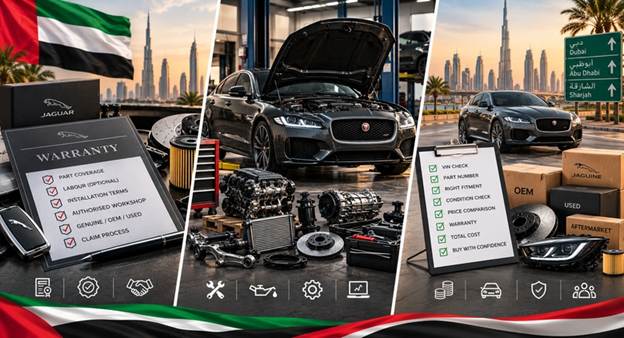
Jaguar Engine Spare Parts in UAE: Repair, Used or Replacement Engine?
An engine problem is where Jaguar parts shopping can go badly wrong.
The car starts using more oil. It hesitates. A warning appears. Coolant disappears. Maybe there is a tapping noise when the engine is cold, or the temperature begins creeping up in traffic. Suddenly someone says, “You need an engine.”
Maybe.
But don't approve that job yet.
A proper Jaguar engine diagnosis should establish whether the problem sits inside the engine or somewhere around it. Scan for fault codes, check oil pressure where relevant, inspect for external leaks, examine the coolant system and look for signs of previous overheating. If internal wear is suspected, compression testing gives you hard evidence.
That matters enormously when comparing repair with a used, second-hand, reconditioned or new replacement engine.
| Engine option | Where it can make sense | Main risk to investigate |
| Repair existing engine | Localised failure, otherwise healthy engine | Hidden internal damage |
| Used engine | Lower upfront cost, suitable donor available | Unknown history and mileage |
| Reconditioned engine | Major internal work already carried out | What was actually rebuilt? |
| New/genuine engine | Long-term ownership, lower history risk | High purchase price |
A used Jaguar engine should come with more information than a photograph.
Ask for the engine code, donor vehicle, mileage, compression-test results where appropriate, running condition, oil condition and coolant condition. If the donor car was involved in a serious accident, that does not automatically make the engine bad, but it should prompt more questions. If it overheated before removal, ask why.
And what about the parts around the engine?
This gets missed constantly.
If the old engine failed because of overheating, simply dropping in another engine without checking the radiator, thermostat, water pump, cooling fans, hoses and related parts is asking for trouble. If an oil-related failure occurred, investigate the lubrication system and the reason for the original damage.
Otherwise, the replacement engine inherits the same problem.
The installation bill is bigger than the engine
The quoted engine price is only one line.
Removal and refitting, fluids, filters, seals, mounts, belts, hoses, diagnostics and programming can all change the final figure. A workshop may also find tired supporting parts once everything is accessible.
So ask for the complete installed price before committing.
For a Jaguar used daily in Dubai or Abu Dhabi, downtime matters too. A car sitting in a workshop for days has a real cost when it is the vehicle you depend on for work, family travel or commuting.
Don't rush an engine decision because the car is already off the road.
Take the opposite approach. Slow down, test properly, then spend.
Jaguar Gearbox Spare Parts in UAE: Used, OEM and Genuine Options Compared
Gearbox faults have a nasty habit of sounding worse than they are.
A Jaguar may hesitate when pulling away, shift harshly, flare between gears or go into a protection mode. The first instinct is often to blame the transmission itself. Yet fluid condition, electrical faults, sensors, control issues or software-related problems can sometimes create symptoms that look much more serious.
So start with diagnosis.
Read the fault codes. Identify the exact transmission. Check fluid condition and leaks. Look for evidence of overheating. Confirm whether the issue appears when cold, when hot, under load or during a particular shift.
Then identify the gearbox by part number and transmission specification, not merely by Jaguar model.
A used gearbox can be a sensible option where the donor is known and the unit has been tested. It becomes far less attractive when the seller cannot tell you its mileage, source or operating condition.
The phrase Jaguar gearbox for sale can produce plenty of choices, but more choices do not make compatibility easier. They make verification more important.
| Gearbox option | Advantage | What to verify |
| Used original | Usually lower upfront cost | Donor, mileage, testing and warranty |
| Reconditioned | Internal work may already be completed | What was replaced and tested |
| OEM replacement | Strong balance of specification and quality | Exact transmission compatibility |
| Genuine replacement | Lowest uncertainty when correctly supplied | Price and full installation cost |
There is also the matter of what happens after fitting.
Some Jaguar transmissions may require diagnostics, adaptation procedures, software configuration or related calibration. Ask the workshop whether those steps are included.
And don't forget the cooling side of the transmission. If the gearbox has suffered from excessive heat, investigate why. UAE summer traffic, long idling and heavy use can expose a marginal transmission-cooling system.
A replacement gearbox should not simply be fitted and forgotten.
Check for leaks. Confirm shift quality. Scan again. Verify operating temperature. Test the vehicle through different speeds and loads.
If the old gearbox failed because of an underlying cooling, electrical or lubrication issue, fix that first.
Otherwise you're buying the same failure twice.
Jaguar Brake and Suspension Parts: What Wears Out on UAE Roads?
You can often feel suspension wear before you can see it.
The Jaguar starts making a muted knock over a speed hump. The steering feels slightly vague. One front tyre is wearing faster than the other. Under braking, the car seems to move or pull differently.
Then somebody says, “Just do the alignment.”
Not so fast.
Alignment cannot repair a worn control-arm bush. It cannot tighten a loose ball joint. It cannot turn a tired shock absorber into a healthy one.
For XE, XF, XJ and F-Pace owners especially, the workshop should inspect the complete front and rear suspension rather than changing whichever part is easiest to point at.
Look at:
- Control arms and bushes
- Ball joints
- Shock absorbers
- Stabiliser links
- Tie rods
- Wheel hubs and bearings
- Springs or air-suspension parts where fitted
- Brake discs and pads
- Callipers and sliders
The UAE environment plays a part here. Repeated speed humps and rough road edges add impact. Heavy vehicles and large wheels can increase suspension load. A vehicle that spends its life on smooth motorway runs may age differently from one constantly crossing urban road imperfections.
Brake vibration needs diagnosis too
A steering-wheel shake under braking might come from disc condition, but hub runout, calliper problems or uneven pad contact can also be involved.
Don't buy a complete brake set simply because the discs look old.
Measure. Inspect. Test.
For used suspension parts, condition becomes the sticking point. A second-hand control arm with a tired bush is not much of a saving. A used electronic suspension part with unknown history can be even harder to judge.
New genuine parts are not always the only sensible answer, though. A properly identified OEM or quality aftermarket part may provide a better balance, particularly on wear items. The important bit is specification and proven quality, not the label alone.
A small workshop calculation can prevent a large repeat bill
Suppose one suspension bush is worn but the related arm is also heavily corroded or damaged. Replacing only the bush may look cheaper. Yet if the arm has to come out again shortly afterwards, the labour gets paid twice.
Ask the mechanic to show you the worn part.
Not because every mechanic is trying to oversell you. Quite the opposite — a good workshop should have no problem explaining what has play, what is cracked, what is leaking and what can safely remain in service.
That is useful evidence when you're deciding between genuine, OEM, used or aftermarket Jaguar parts.
Jaguar Cooling and AC Parts: How UAE Heat Affects Your Jaguar
This is where the UAE climate stops being background information and becomes part of the repair diagnosis.
A Jaguar cooling system that behaves perfectly on a cool morning can struggle when the car is stationary in Dubai traffic with the AC running and outside temperatures climbing. The engine needs to shed heat. The AC system is also working hard. Cooling fans matter. Airflow matters.
Everything is under pressure.
If the temperature rises, don't immediately order a radiator.
Check the whole system.
The workshop should look at the radiator, thermostat, water pump, hoses, expansion tank and cooling fans, while also checking for leaks and signs of previous overheating. A pressure test can help identify certain coolant leaks. Diagnostic data can also reveal whether the engine is actually reaching the temperatures being reported.
And if the fan is not operating correctly?
Replacing the radiator may do very little.
AC faults need the same discipline
Weak Jaguar AC is particularly unpleasant in the UAE. There is no polite way around it.
The cabin should cool properly.
But low cooling performance does not automatically mean the compressor has failed. Refrigerant level, pressure, condenser condition, airflow, cooling-fan operation, leaks and control faults all need to be considered.
A compressor replacement can become a substantial job, so confirm the diagnosis before buying one.
| Symptom | Possible area to investigate |
| Engine temperature rises in traffic | Cooling fan, radiator, thermostat, pump, airflow |
| Coolant repeatedly drops | Hose, radiator, tank, pump or another leak |
| AC weak while stationary | Fan operation, condenser airflow, refrigerant pressure |
| AC noisy | Compressor or associated drive system |
| Engine overheated previously | Cooling system plus possible internal engine damage |
| AC works intermittently | Electrical control, pressure, compressor or sensor |
There is another UAE workshop reality worth considering: heat-related failures often appear together.
A car with an ageing radiator may also have brittle hoses. An old cooling system may have a tired thermostat. A weak battery can expose electrical problems when the AC and cooling fans are demanding power.
That does not mean replace everything.
It means inspect the supporting parts while the main repair is being carried out.
After a cooling repair, don't just collect the keys
Run the vehicle properly.
Check coolant level after the system has stabilised. Look for leaks. Confirm fan operation. Watch temperatures in traffic, not only on an empty road. Make sure the AC produces consistent cooling.
For a Jaguar that has had an overheating event, the first 1,000 km after major cooling or engine work deserves a little extra attention. Keep an eye on coolant level, temperature behaviour, warning messages, oil condition and any unusual smell or noise.
A replacement part is only successful when the car stays healthy after the workshop has finished with it.
That's the part of the bill nobody sees on the invoice — whether the repair actually holds up.
Used Parts, Compatibility and Jaguar Spare Parts Prices
Used Jaguar Spare Parts in UAE: Which Parts Are Safe to Buy Second-Hand?
Used Jaguar parts can save a serious amount of money in the UAE. But “used” is not a quality grade. It simply tells you that somebody else had the part first.
That distinction matters.
A used bonnet with straight edges and matching paint is one thing. A used gearbox with unknown mileage is something else entirely. You cannot judge both with the same buying rule.
For body and trim parts, second-hand original Jaguar parts can often be sensible. Mirrors, doors, bonnets, bumpers, interior trim and certain lights may offer good value when the actual part is inspected properly. Colour, mounting points, cracks and previous repair work still need checking, but the risk is usually easier to see.
Mechanical parts need more digging.
| Used Jaguar part | Buying suitability | What to verify |
| Bonnet, door or body panel | Often sensible | Damage, repairs, alignment, paint |
| Mirror | Usually reasonable | Glass, motor, folding function, connectors |
| Headlight/tail light | Depends on specification | Damage, moisture, connector and electronics |
| Control arm | Moderate | Bushes, ball joints, corrosion |
| Wheel hub | Moderate | Bearing noise, play and condition |
| Brake calliper | Moderate | Pistons, sliders, corrosion |
| Gearbox | Higher risk | Donor, mileage, testing, leaks, warranty |
| Differential | Higher risk | Noise, backlash, donor specification |
| Engine | High scrutiny required | Compression, mileage, oil, coolant, overheating |
| Electronic module | High scrutiny required | Exact part number, condition, coding requirements |
The UAE market can make used parts particularly attractive because there are plenty of older luxury cars reaching the point where a genuine new part starts looking disproportionate to the vehicle's current value.
But don't let that turn into a false economy.
A used Jaguar engine that costs less than a reconditioned unit may require additional seals, fluids, mounts, hoses or sensors. A second-hand gearbox may need adaptation or programming. A used suspension arm may have a bush that is already half-dead.
Then you've paid for the installation.
Again.
That's why the right question is not “Is this used part cheap?”
Ask, “What is my total cost if this part turns out to be wrong or fails shortly after fitting?”
For safety-critical parts, be stricter. Brakes, steering and suspension deserve proper inspection and a clear condition assessment. Don't buy purely because the part came from another Jaguar.
And for engines and gearboxes, insist on evidence.
A photograph is not a test report.
Jaguar Spare Parts VIN and Part Number Check: How to Avoid Buying the Wrong Part
Jaguar parts buying gets much easier once you stop searching by model name alone.
“Jaguar XF brake part” is too broad.
Which XF? What year? Which engine? Which brake package? Which drivetrain? Which revision?
That's where the VIN earns its keep.
Before ordering a major Jaguar part, give the supplier or workshop the vehicle identification number and have it matched against the exact part number. Then confirm the engine specification, transmission and drivetrain. If the part is electronic, check the connector and programming requirements as well.
A simple fitment check should cover:
- VIN
- Model year
- Exact model
- Engine specification
- Engine code where applicable
- Transmission
- 2WD or AWD configuration where applicable
- Original part number
- Replacement/superseded number
- Connector arrangement
- Physical dimensions and mounting points
- Programming or calibration requirements
Why bother with all of that?
Because Jaguar model names cover several generations and specifications, while parts can change during a model's production run.
A used part advertised as “for Jaguar XJ” tells you almost nothing by itself.
The same goes for engines and gearboxes. Never buy those from the model badge alone.
Ask for the identification stamped or attached to the actual unit. Compare it against the vehicle's requirement. If possible, have the workshop verify the match before payment rather than after the part has arrived.
Watch the connector
Electronic parts are particularly sneaky.
Two modules may look almost identical. The mounting points may even match. But the connector, software version or vehicle configuration can differ.
Then the part is fitted, the warning light stays on, and everyone starts pointing fingers.
Get the programming question answered beforehand.
Will the part need coding? Does it need calibration? Is specialist diagnostic equipment required? Is that included in the installation quote?
These questions are boring until they save you from paying twice.
VIN checking also matters for used parts
Suppose you're buying a used F-Pace differential.
The seller says it came from an F-Pace.
Fine. Which one?
Different engine and drivetrain combinations can change the correct unit. Ask for the donor VIN or sufficient identification information, then compare the differential specification and part number.
Do the same for a used gearbox.
Do the same for an engine.
Match first. Pay second.
That order is especially useful in the UAE because shipping a large incorrect part back and arranging another one can add days of downtime, delivery charges and workshop disruption to an already expensive repair.
Jaguar XE vs XF vs XJ vs F-Pace Parts: Which Parts Are Not Interchangeable?
This is where visual similarity causes trouble.
Jaguar has used related engineering across different models and generations, but that does not mean you can treat XE, XF, XJ, F-Pace, F-Type and XK parts as one interchangeable catalogue.
Some parts may share applications. Others absolutely do not.
And even when a part appears to fit physically, the specification can still be wrong.
| Part area | Why interchangeability can fail | What to verify |
| Engine parts | Different engine families and revisions | Engine code and part number |
| Gearbox | Transmission and software differences | Transmission code |
| Suspension | Weight, geometry and specification | VIN and suspension setup |
| Brakes | Disc, calliper and package differences | Brake specification |
| Driveshafts | Length and drivetrain differences | Drivetrain and dimensions |
| Differential | Ratio and drivetrain configuration | Differential identification |
| Cooling parts | Different engine layouts and capacities | Engine specification |
| Electronics | Connector/software differences | Module number and coding |
| Body parts | Shape, mounting and generation | Model year and exact part |
| Lights | Wiring, sensors and specification | Part number and connector |
The classic mistake is assuming that “same model family” means “same part.”
An XF and F-Pace can share engineering ideas without sharing every suspension arm. An XE and XF can use related systems while still having different dimensions or specifications. A performance F-Type can require brake or cooling parts that would be completely inappropriate for another Jaguar.
Then there are mid-generation revisions.
A manufacturer may alter a part during production. The old number might be superseded by a newer one. That doesn't necessarily mean the old part was wrong; it means the replacement needs to be checked against the vehicle.
What about used parts?
This is where cross-model swapping becomes even riskier.
A dismantler may list a part against several Jaguar models because it appears visually similar or because some applications share a base design. That is a starting point, not proof.
Get the actual part number.
Get the VIN.
Have the workshop verify it.
And for expensive mechanical parts, confirm before shipping if possible.
Nobody wants to discover that a gearbox costing thousands of dirhams fits the mounting points but communicates incorrectly with the vehicle.
That's not a bargain.
That's a very large paperweight.
Jaguar Spare Parts Prices in UAE: Genuine, OEM, Used and Aftermarket
Jaguar parts prices in the UAE can swing wildly, and the reason is not always obvious from the part itself.
A genuine part carries one price. An OEM alternative may be lower. A used original can be substantially cheaper. An aftermarket replacement may be cheaper still.
But the four labels don't tell you the whole story.
| Option | Typical price position | Best suited to | Main concern |
| Genuine | Highest | Critical fitment, long-term ownership | Upfront cost |
| OEM | Medium to high | Quality-conscious replacement | Confirm manufacturer/specification |
| Used original | Lower | Selected body and mechanical parts | Condition and history |
| Reconditioned | Variable | Engines, gearboxes and selected major parts | Quality of rebuilding |
| Aftermarket | Low to medium | Suitable non-critical applications | Quality varies widely |
A genuine part can be worth paying more for where incorrect fitment creates substantial risk. An OEM part may offer a sensible middle ground. Used original parts can make excellent financial sense for certain body or trim items.
Aftermarket?
Be selective.
A reputable aftermarket brake or suspension part from the correct specification may work perfectly well. An unknown cooling-system part fitted to a Jaguar already struggling with UAE temperatures is a different proposition.
Compare the installed price
Let's say one suspension part is cheaper by several hundred dirhams.
Sounds good.
Then the workshop discovers that another worn part needs replacing, alignment is required, and the first part has to be returned because its specification does not match the car.
The saving disappears.
This is why a proper Jaguar parts quotation should separate:
Part + delivery + labour + fluids + supporting parts + diagnostics + programming + alignment + warranty.
The final number is what matters.
This is also where PartFinder UAE can fit into the search process when looking for suitable Jaguar replacement options, but the buyer still needs to confirm the VIN, exact part number, condition and warranty before paying.
UAE labour changes the final calculation
Labour can vary between independent workshops, specialist Jaguar garages and larger facilities, while the emirate and location can also affect what an owner is quoted.
| Location | Typical workshop consideration |
| Dubai | Specialist and premium workshop labour can be higher |
| Abu Dhabi | Costs vary considerably by workshop and vehicle complexity |
| Sharjah | Independent repair options can offer different labour rates |
| Ajman | Often worth comparing independent workshop quotations |
| Ras Al Khaimah | Availability of specialist Jaguar support may influence cost |
| Fujairah | Part sourcing and specialist availability can affect downtime |
| Umm Al Quwain | Smaller workshop market can affect sourcing and labour |
These are general market patterns, not fixed emirate-wide rates. Always ask the workshop what the quoted labour actually includes.
For a gearbox, does the price include removal and refitting?
For an engine, are fluids and filters included?
For an electronic module, is programming included?
For suspension work, is alignment included?
For a used part, does the warranty cover only the part, or does it also cover the labour needed to remove and refit it?
Those details can turn a cheap Jaguar spare part into an expensive repair.
And there is one more number worth calculating: cost of delay.
If your daily XE is sitting in a workshop waiting for the wrong part to be returned, you're not only paying for the part. You're losing transport time, potentially arranging taxis or another vehicle, and extending the repair window.
So compare properly.
Genuine versus OEM. Used versus reconditioned. Cheap versus durable. Part price versus installed price.
The best Jaguar spare parts in UAE are not necessarily the most expensive one — and it certainly isn't automatically the cheapest. It is the one that matches the car, suits the repair, survives the intended use and leaves you with the lowest sensible ownership risk.
Buying, Installation and Warranty
Jaguar Spare Parts Warranty in UAE: What Should Buyers Check Before Paying?
A warranty sounds reassuring until you actually need to use it.
Then the small print starts talking.
For Jaguar spare parts in the UAE, don't stop at “warranty available”. Ask exactly what is covered, for how long, and under what installation conditions. A used gearbox might carry a warranty against internal failure but exclude labour. A replacement engine may be covered only if the workshop follows particular installation procedures. An electronic module could have coverage for the part itself while programming remains entirely your responsibility.
Those differences matter.
Before paying, get these points in writing:
| Warranty point | What the buyer should confirm |
| Duration | Exact number of days or months |
| Covered failure | What actually qualifies as a warranty claim |
| Exclusions | Overheating, misuse, installation damage and other exclusions |
| Labour | Whether removal and refitting are covered |
| Fluids | Whether replacement fluids are included |
| Installation | Whether an approved or specified workshop is required |
| Diagnostics | Whether testing or fault-code diagnosis is covered |
| Programming | Who pays if coding or calibration is required |
| Return process | How quickly a defective part must be reported |
| Documentation | Invoice, part number and warranty terms |
This becomes particularly important with used engines and gearboxes.
Suppose a used Jaguar gearbox fails after installation. The seller agrees to replace the gearbox. Good.
But who pays for removing the faulty unit?
Who pays for fitting the replacement?
What about transmission fluid? Adaptation? Diagnostics? Towing?
Suddenly the “warranty” covers a part worth thousands of dirhams while leaving another substantial bill on your side.
Ask before installation, not after the failure.
Installation conditions can quietly invalidate a warranty
Some warranties require particular fluids, filters, flushing procedures or diagnostic checks. An engine may need the cooling system inspected before installation. A gearbox may need the transmission system serviced correctly. An electronic part may need coding.
If those conditions exist, get them written down.
For a major Jaguar repair, keep the invoice, part number, donor information, mileage evidence, diagnostic report and installation paperwork. If compression testing was carried out on a used engine, keep the results.
Paperwork feels unnecessary when everything works.
Six months later, it can become your strongest evidence.
Watch for vague warranty language
“Tested.”
“Guaranteed.”
“Good condition.”
Those phrases are not the same thing as a written warranty.
Ask what happens if the part fails. Ask who decides whether the failure qualifies. Ask how quickly you must report it. Ask whether the replacement has its own warranty.
If the answers become vague when you ask specific questions, take that seriously.
Jaguar Spare Parts Installation in UAE: What Should the Workshop Check?
The fitting stage is where a good parts purchase can either become a proper repair or go sideways.
The part itself is only half the job.
Before installation, the workshop should compare the replacement against the old unit. Check the part number. Check mounting points. Compare connectors. Confirm the specification. For an engine or gearbox, verify the identification again before the crane or transmission jack comes anywhere near the vehicle.
Sounds obvious.
Yet this is exactly when a mismatch becomes expensive.
Engine installation needs a wider inspection
If you're fitting a replacement Jaguar engine, don't simply remove the old one and drop the new one in.
Check the cooling system. Inspect hoses and connections. Examine mounts. Replace appropriate fluids and filters. Check belts and other service items while access is available. Investigate the reason the original engine failed.
If overheating caused the original failure, make sure the radiator, thermostat, water pump, cooling fans and related parts are healthy.
Otherwise the replacement engine may be heading into the same problem.
For a used engine, confirm the condition before installation where possible. Compression evidence is valuable. Donor details matter. Mileage matters, although mileage alone is not a complete health report.
Gearbox installation has its own traps
Confirm the transmission specification first.
Then check seals, mounts, fluid condition and associated cooling arrangements. After installation, scan the vehicle and carry out any required adaptation, coding or calibration.
Don't accept “it shifts” as the entire test.
The gearbox should be checked when cold and once it reaches operating temperature. Test pull-away, normal upshifts, downshifts, reversing and, where appropriate, heavier acceleration.
Suspension and brakes need the final geometry checked
After replacing suspension parts, inspect all related fasteners and joints, then carry out wheel alignment where required.
For brakes, check disc and pad contact, calliper operation and pedal feel. Don't simply drive around the block and declare victory.
And for electronic parts, make sure the warning light actually stays away after scanning the vehicle again.
The first 1,000 km matters
The first few kilometres after a major repair are not a victory lap.
They are a monitoring period.
For the first 1,000 km, keep an eye on coolant level, oil level, temperature behaviour, warning lights, unusual noises, vibration, leaks and changes in gearbox or suspension behaviour. Recheck anything the workshop specifically asks you to monitor.
If a smell appears, investigate it.
If a fluid level drops, don't shrug it off.
If the gearbox starts shifting differently after several days, go back before the problem develops further.
This is particularly sensible in UAE conditions because a car can behave perfectly during a short workshop road test and then show a cooling or AC issue once it sits in traffic under summer heat.
A proper installation is not simply “part fitted.”
It is part fitted, system checked, vehicle scanned, road-tested and monitored afterwards.
Jaguar Spare Parts Buying Checklist: How to Buy the Right Part at the Right Price
Buying Jaguar parts becomes much less stressful once you stop treating the price as the first question.
Start with identification.
VIN first. Part number second. Price third.
That order can prevent an astonishing amount of unnecessary back-and-forth.
Before paying for a Jaguar XE, XF, XJ, F-Pace, F-Type or XK part, run through the actual vehicle details:
- VIN verified against the part
- Exact model and model year confirmed
- Engine specification checked
- Engine code confirmed where applicable
- Gearbox/transmission identified
- Drivetrain confirmed
- Original part number checked
- Superseded/replacement number verified
- Connector and mounting arrangement compared
- Used-part mileage and donor information requested
- Mechanical parts tested where appropriate
- Used engine compression tested where appropriate
- Gearbox condition and leak history checked
- Programming or coding requirements confirmed
- Delivery charges included
- Labour quoted separately
- Fluids, filters and seals accounted for
- Supporting parts identified
- Wheel alignment included where required
- Warranty supplied in writing
- Return conditions understood
- Installation requirements documented
That's the practical checklist.
But there is another calculation that matters more when the Jaguar is older: what will this repair cost me over the next year?
A £— or AED-sized saving today can be meaningless if the same car needs another major repair three months later. Conversely, spending more on a genuine or properly specified OEM part can be perfectly rational if it reduces repeat labour and protects a well-maintained vehicle.
A simple Jaguar buying decision
| Situation | Usually worth considering |
| Cosmetic/body part | Good-condition used original |
| Routine wear part | Quality OEM or aftermarket |
| Safety-critical part | Genuine or proven-quality replacement |
| Electronic module | Exact part-number match + programming confirmation |
| Used gearbox | Tested unit with donor information and warranty |
| Used engine | Compression evidence, donor details and warranty |
| Major repair on a good Jaguar | Compare repair cost with vehicle value |
| Several major failures together | Calculate first-year ownership cost |
Don't forget resale value either.
A documented repair history can make a Jaguar easier to explain to the next buyer. Keep invoices. Keep part numbers. Keep warranty documents. Keep diagnostic reports for major repairs. If an engine or gearbox has been replaced, record the replacement details rather than leaving the future owner to guess what happened.
That paperwork has practical value.
And then comes the uncomfortable question
Should you repair the Jaguar at all?
If an XE has a healthy body, good interior, sound transmission and one failed engine part, repairing it may be obvious.
If an older XJ needs an engine, suspension overhaul, cooling repairs and several electronic modules at the same time, the calculation changes.
If an F-Pace has one worn suspension assembly but otherwise strong service history, replacing it can make complete sense.
If an XK has become a rolling collection of unrelated faults, however, add everything up before throwing another cheque at it.
The right decision is not always “buy genuine”.
It is not always “buy used”.
It is not always “buy aftermarket”.
And it certainly is not always “buy the cheapest”.
Verify the Jaguar. Diagnose the failure. Match the exact part. Compare genuine, OEM, used, reconditioned and aftermarket options. Add labour and hidden costs. Check the warranty. Then decide whether the repair still makes sense for the vehicle you actually own.
That is how you buy Jaguar spare parts in the UAE without turning a supposedly simple repair into a much larger bill.
FAQs
Categories
- Audi
- BMW
- Car Accessories
- Car Tips
- Ford
- Land Rover
- Mazda
- Range Rover
- Top 10
- UAE Car Parts
- Used Car Parts
- Toyota
- Replacement Engines
- Nissan
- Hyundai
- Mitsubishi
- Volkswagen
- Honda
- Kia
- Chevrolet
- Dodge
- Jeep
- Subaru
- Renault
- Lexus
- Mercedes
- Suzuki
- Hummer
- Porsche
- Infiniti
- Peugeot
- GMC
- Mini
- Volvo
- Replacement Gearboxes
- MG
- Jaguar
- Skoda
- Cadillac
- Daihatsu
- Fiat
- German Car Parts
- Japanese Car Parts
- Aftermarket Car Parts
- Genuine Car Parts
- New Car Parts
- Reconditioned Car Parts
- European Car Parts
- American Car Parts
- Korean Car Parts
- British Car Parts
- Chinese Car Parts
- Sports/Exotic Car Parts
- Luxury Car Parts
- Performance Car Parts
- SUV/4x4 Spare Parts
- Truck Spare Parts
- EV Car Parts
- Hybrid Car Parts
- Auto Spare Parts in UAE
- Tesla
- Isuzu
- Ram
- Ferrari
- Bentley
- Lamborghini
- Genesis
- Maserati
- Lincoln
- Chrysler
- Opel
- Citroen
- SsangYong
- Seat
- McLaren
- Aston Martin
- Rolls Royce
- Maybach
- Alfa Romeo
- Bugatti
- Scion
- Abu Dhabi Car Parts
- Ajman Car Parts
- Al Khan Car Parts
- Al Sajaa Car Parts
- Deira Car Parts
- Dubai Car Parts
- Fujairah Car Parts
- Industrial Area 6 Car Parts
- Mussafah Car Parts
- Ras Al Khaimah Car Parts
- Sharjah Car Parts
- Umm Al Quwain Car Parts
- Acura
- BYD
- Chery
- Dacia
- DS
- Geely Emgrand
- EXEED
- GAC
- GAC Gonow
- Geely
- Gonow
- Great Wall
- Haima
- Haval
- Holden
- Iveco
- JAC
- Jaecoo
- Jetour
- Lotus
- Omoda
- Proton
- Renault Samsung
- Roewe
- Lucid
- Replacement Headlight
- Replacement Bumper