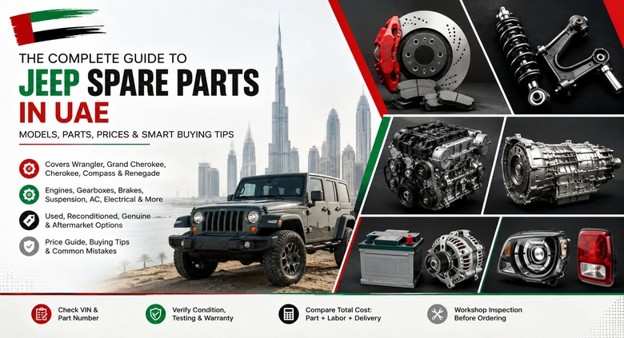
Jeep Spare Parts in UAE: Complete Guide for Wrangler, Grand Cherokee, Cherokee, Compass and Renegade
August 15, 2026
Jeep Spare Parts Buying Basics
Most Commonly Replaced Jeep Spare Parts in the UAE
Jeep owners commonly search for replacement brakes, suspension components, AC parts, cooling-system components, engines, gearboxes, electrical modules, lights and body panels. The exact pattern depends heavily on the model: a Wrangler has very different replacement priorities from a Compass or Renegade.
UAE traffic, summer heat, dusty conditions and frequent AC use can also expose weaknesses in cooling, electrical and air-conditioning systems.
What to Check Before Ordering a Jeep Replacement Part
Don't start with the price. Start with identification.
Check the VIN, model year, engine, transmission and exact part number before comparing suppliers. For used parts, add mileage, condition, testing and warranty to that list.
This matters particularly for engines, gearboxes, ECUs, sensors and lighting assemblies, where a component can look correct yet still be incompatible.
VIN, Part Number and Model-Year Compatibility
The VIN identifies the vehicle; the part number identifies the component. Ideally, use both.
Wrangler, Grand Cherokee, Cherokee, Compass and Renegade have different generations and specifications, so a broad search such as "Jeep brake parts" isn't enough.
If a supplier provides a different part number, ask whether it is a superseded number or an approved replacement. Don't assume the difference is harmless.
Jeep Engine and Transmission Specification Checks
Engine and gearbox purchases deserve extra scrutiny because a mismatch can become an expensive installation problem.
Before ordering, confirm:
| Check | Why it matters |
| VIN | Vehicle identification |
| Engine code | Correct engine application |
| Transmission code | Correct gearbox |
| Part number | Component identification |
| Donor mileage | Used-part assessment |
| Testing | Condition verification |
| Warranty | Failure protection |
For major components, have the workshop confirm compatibility before payment.
Used vs Genuine vs OEM vs Aftermarket Jeep Parts
There isn't one best category for every Jeep.
A new genuine part may make sense for a newer Grand Cherokee or a specification-sensitive electronic component. A tested used genuine bumper can be excellent value for an older Wrangler. Reputable aftermarket parts may reduce the cost of routine maintenance.
The sensible choice depends on part type, vehicle age, quality, price difference and expected ownership period.
Quick Jeep Spare-Parts Buying Checklist
Before placing an order, check:
VIN confirmed?
Part number matched?
Engine and transmission verified?
Condition clearly stated?
Used-part mileage checked?
Testing explained?
Warranty understood?
Return conditions checked?
Delivery included or calculated?
Labour and installation costs known?
Programming or calibration required?
Total installed cost acceptable?
For an expensive Jeep component, don't rush. A few minutes spent checking the specification can save a much longer repair headache.
Jeep Wrangler Spare Parts
Jeep Wrangler Brake Pads and Discs
Jeep spare parts in UAE and Wrangler brake wear depends heavily on how the vehicle is driven. City traffic, larger tyres, off-road use and extra vehicle weight can all change the workload.
Squealing, vibration, grinding or reduced braking response should be investigated rather than treated as a reason to order pads immediately.
For replacement, compare genuine and reputable aftermarket options, but make sure the brake specification matches the exact Wrangler generation.
Wrangler Suspension and Shock Absorbers
Suspension takes a particularly hard life on Wranglers used away from smooth roads.
Common replacement items include shocks, springs, control arms, bushes, stabiliser links and related joints.
A knocking sound doesn't automatically mean the shock absorber has failed. Get the suspension inspected first.
If the Wrangler has been modified with different wheels, tyres or suspension components, mention those changes before ordering replacement parts. They can affect compatibility.
Wrangler Steering and Control-Arm Parts
Loose steering, wandering, uneven tyre wear and knocks over rough surfaces can point towards worn steering or suspension components.
Possible replacement areas include:
- Tie-rod ends
- Ball joints
- Control arms
- Steering links
- Steering-related joints
Because these components affect vehicle control, exact fitment matters more than chasing a bargain.
Wrangler Engine Replacement Parts
A complete engine replacement isn't always necessary when a Wrangler develops an engine problem.
First establish whether the fault involves a specific component, cooling issue, accessory or internal engine damage.
If a replacement engine is required, confirm the engine code, donor information, mileage, testing and warranty. A used engine can reduce the initial cost, but installation, fluids, seals and supporting parts still need to be included in the budget.
Wrangler Gearbox and Transmission Parts
Wrangler transmission problems can come from several sources, so diagnosis should come before ordering a replacement gearbox.
Check the transmission code and part number, particularly when buying used.
For a used gearbox, ask about:
| Check | Why |
| Donor vehicle | Establishes history |
| Mileage | Indicates previous use |
| Testing | Helps assess condition |
| Transmission code | Confirms compatibility |
| Warranty | Limits replacement risk |
Also budget for fluid, labour and any required adaptation or programming.
Wrangler Body, Lights and Exterior Parts
Wrangler body and exterior components are popular used-part purchases because genuine panels, mirrors, lights and trim can be expensive when bought new.
For a used component, inspect the actual part for cracks, repaired areas, damaged mounting points and missing hardware.
Lights deserve extra attention if electronic modules are integrated into the assembly.
For modified Wranglers, confirm that the replacement part suits the vehicle's current configuration rather than assuming standard factory fitment.
Jeep Grand Cherokee Spare Parts
Grand Cherokee Brake Replacement Parts
The Grand Cherokee is a larger SUV, so brake components deserve proper inspection rather than replacement by assumption. Pad thickness, disc condition and uneven wear should be checked before ordering.
For frequent Dubai or Abu Dhabi traffic, brake wear can accumulate faster than expected.
When comparing replacement pads or discs, check the exact Grand Cherokee generation and brake specification. A reputable aftermarket option may reduce the cost, while genuine parts can make sense when exact fitment is the priority.
Grand Cherokee Suspension Components
Suspension wear can show up as knocking, excessive bouncing, uneven tyre wear or a less settled ride.
Potential replacement parts include:
- Shock absorbers
- Control arms
- Bushes
- Ball joints
- Stabiliser links
- Air-suspension components where equipped
Don't replace an entire suspension system because one component has failed. Have the other related parts inspected first.
For air-suspension-equipped vehicles, diagnosis is particularly important because leaks, compressors, sensors and air springs can produce different symptoms.
Grand Cherokee Steering and Drivetrain Parts
Steering problems should be dealt with promptly. Excessive play, wandering or unusual noises can involve tie-rod ends, joints, steering components or alignment.
Drivetrain repairs require a different level of identification.
If the Grand Cherokee has a four-wheel-drive system, confirm the exact component before ordering transfer-case or related drivetrain parts.
VIN + part number + drivetrain specification is a useful starting point.
Grand Cherokee Engine Replacement Options
A replacement engine becomes worth considering when internal damage is extensive or repair costs are approaching the value of a suitable replacement.
For a used engine, check:
- Engine code
- Donor vehicle
- Mileage
- Testing
- Included components
- Warranty
A low-mileage unit isn't automatically the safest purchase. Testing and history matter.
Also calculate installation, fluids, seals, filters and diagnostics before comparing the engine prices.
Grand Cherokee Gearbox and Transmission Parts
Transmission problems can be expensive, so diagnosis comes first.
Harsh shifting, slipping, delayed engagement or warning lights don't automatically prove that the complete gearbox needs replacing.
If replacement is confirmed, match the transmission code and part number. Used units should come with clear information about mileage, testing and warranty.
For a high-value gearbox, a slightly more expensive tested or reconditioned unit may make better financial sense than an unknown cheap replacement.
Grand Cherokee AC and Cooling-System Parts
UAE heat makes AC and cooling components particularly important on a daily-driven Grand Cherokee.
Common replacement areas include:
- AC compressors
- Condensers
- Radiators
- Cooling fans
- Thermostats
- Hoses
- Related sensors
Weak AC doesn't automatically mean the compressor has failed. Refrigerant leaks, electrical faults and other system problems can create similar symptoms.
Get the fault confirmed first, then compare the replacement part, labour, refrigerant and supporting work as one repair cost.
Jeep Cherokee Spare Parts
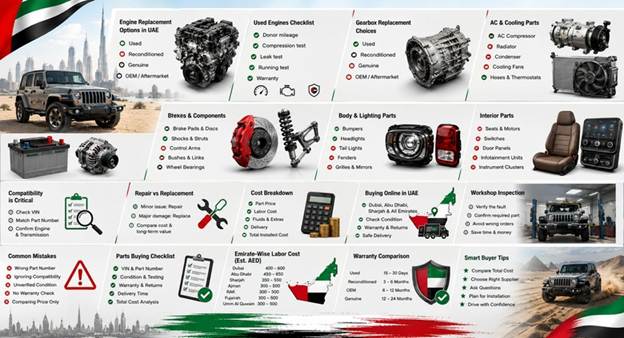
Jeep Cherokee Brake Parts
Cherokee brake wear is influenced by traffic, driving style, vehicle load and road conditions. Squealing, vibration, grinding or a soft pedal should be inspected before ordering replacement components.
Common parts include brake pads, discs, callipers and related hardware.
For an older Cherokee, reputable aftermarket pads may offer sensible value. For a newer vehicle, genuine or established OEM-equivalent components can be worth considering. Always match the exact brake specification rather than buying solely by model name.
Cherokee Suspension and Wheel-Bearing Parts
Worn suspension can make a Cherokee feel unsettled, particularly over speed bumps or rougher UAE roads.
Common replacements include:
- Shock absorbers
- Control arms
- Bushes
- Stabiliser links
- Ball joints
- Wheel bearings
A humming noise that rises with speed may indicate a wheel bearing, although uneven tyres can sound remarkably similar. Confirm the source before ordering.
For relatively inexpensive bearings, buying new is often preferable to an unknown used component.
Cherokee Steering Components
Steering parts deserve more care than ordinary trim or cosmetic components.
Loose steering, wandering, uneven front-tyre wear or knocking can involve tie-rod ends, ball joints, steering links or other suspension components.
Don't automatically blame the steering rack.
Have the complete front end inspected first. A worn suspension joint or incorrect wheel alignment can create symptoms that feel like a steering fault.
When replacing safety-related components, correct specification and quality should outweigh a small price saving.
Cherokee Engine-Related Replacement Parts
An engine problem doesn't automatically mean the complete engine needs replacing.
The fault could involve an accessory, cooling component, sensor or another replaceable part. If internal damage is confirmed, then compare repairing the existing engine with sourcing a suitable replacement.
For a used Cherokee engine, check the engine code, donor vehicle, mileage, testing and warranty. Include labour, fluids, seals and supporting components in the final calculation.
The cheapest engine on the listing isn't necessarily the cheapest completed repair.
Cherokee Gearbox Replacement Options
Transmission symptoms can be deceptive. Harsh shifts, slipping or delayed engagement may come from fluid condition, sensors, wiring or control components rather than complete gearbox failure.
If replacement is confirmed, match the transmission code and part number carefully.
A used gearbox should ideally have documented mileage, appropriate testing and clear warranty terms. A reconditioned unit can also be worth comparing, particularly when installation labour makes repeat failure expensive.
Cherokee AC, Cooling and Electrical Parts
Cherokee AC and cooling systems work hard during UAE summers, so compressors, condensers, radiators, fans, thermostats and related components deserve attention.
Weak cooling does not automatically mean the compressor has failed. Diagnose the system first.
Electrical faults also need careful identification. A faulty battery, alternator, sensor, wiring connection or control module can create overlapping symptoms.
For electronic replacement parts, confirm the part number and whether coding or programming is required before ordering.
Jeep Compass Spare Parts
Jeep Compass Brake Components
Compass brake wear tends to become noticeable through squealing, vibration, uneven braking or a pedal that feels different from usual. Don't wait for grinding.
Check the exact model year and brake specification before ordering pads or discs. For an older Compass, a reputable aftermarket set can be perfectly sensible; for a newer vehicle, genuine or established OEM-equivalent parts may be worth the extra spend.
And if the discs are still within specification, there may be no reason to replace them simply because the pads are worn.
Compass Suspension and Shock Absorbers
A Compass that feels bouncy, unsettled or slightly loose over speed humps may have tired shocks or other suspension wear.
Common replacement areas include:
- Shock absorbers
- Control arms
- Bushes
- Stabiliser links
- Ball joints
- Strut-related components
Don't buy a complete suspension package after hearing one knock. Get the front and rear systems checked first. Sometimes the culprit is a small joint or bush, not an expensive assembly.
Compass Steering and Wheel-Bearing Parts
Steering wander, uneven tyre wear and knocking can point towards worn steering or suspension components. A humming noise that rises with road speed can suggest a wheel bearing, although tyre noise can be surprisingly convincing too.
That's why diagnosis matters.
For steering components, prioritise exact fitment and quality. For wheel bearings, a new reputable component is often easier to justify than a used one because the labour involved in replacing a failed bearing can quickly wipe out the original saving.
Compass Engine Replacement Parts
A Compass engine should not be replaced simply because the vehicle has developed an engine-related fault.
First establish whether the issue is internal engine damage or something more contained, such as an accessory, cooling component, sensor or related system.
If replacement is genuinely required, verify the engine code, VIN compatibility, donor mileage, testing and warranty. Then add labour, fluids, filters, seals and supporting parts to the calculation.
A low-priced used engine can look brilliant on paper. Until the installation bill arrives.
Compass Gearbox and Transmission Components
Transmission symptoms can be messy. A harsh shift or delayed engagement doesn't automatically mean the complete gearbox has failed.
Fluid condition, sensors, wiring and control components can create similar behaviour.
If a replacement gearbox is required, match the transmission code and part number exactly. For a used unit, ask about donor mileage and testing. A reconditioned gearbox is also worth comparing if the price difference is reasonable and the rebuild work is properly documented.
Warranty matters here because gearbox labour isn't cheap.
Compass AC, Cooling and Electrical Parts
A Compass used through UAE summers puts its AC and cooling systems under plenty of pressure.
Common replacement areas include AC compressors, condensers, radiators, cooling fans, thermostats, batteries and alternators.
Weak AC isn't proof of compressor failure. A refrigerant leak or electrical problem may be responsible.
The same caution applies to electrical components. Before replacing a sensor, alternator or control module, confirm the actual fault and check the part number.
For modules that require programming, include that cost before deciding whether the online price is genuinely attractive.
Jeep Renegade Spare Parts
Jeep Renegade Brake Pads and Discs
Renegade brake wear is usually straightforward to diagnose, but don't order pads or discs from the model name alone. Brake specifications can change with year and equipment.
Squealing, grinding, vibration or uneven braking deserves inspection. If the discs remain within specification, replacing them unnecessarily only inflates the bill.
For an older Renegade, a reputable aftermarket brake set can be sensible. For a newer vehicle, genuine or established OEM-equivalent parts may justify the extra cost.
Renegade Suspension Components
A Renegade that starts knocking over speed humps or feeling loose through corners may have worn shocks, bushes, stabiliser links or control-arm components.
The tricky bit? Several suspension faults can produce almost identical noises.
Have the complete axle inspected before ordering parts. If one shock absorber has failed and the other has similar age and wear, replacing them as a pair may be sensible.
For used suspension parts, be cautious. Wear isn't always visible, and the labour involved can make a cheap component a false economy.
Renegade Steering and Wheel-Bearing Parts
Steering wander, uneven front-tyre wear or excessive play can point towards worn steering or suspension components.
A humming noise that becomes louder with road speed may indicate a wheel bearing, although tyre noise can mimic it surprisingly well.
| Symptom | Areas worth checking |
| Steering play | Tie rods, joints, steering components |
| Knocking | Links, bushes, control arms |
| Uneven tyre wear | Alignment, suspension |
| Speed-related humming | Wheel bearing or tyre |
| Vibration | Wheel, tyre, brake or suspension |
Confirm the actual fault before ordering. It sounds obvious, but this is where unnecessary parts purchases often begin.
Renegade Engine Replacement Parts
An engine-related warning doesn't automatically mean the Renegade needs another engine.
A sensor, cooling component, accessory or other supporting system can create symptoms that look far more serious from the driver's seat.
If internal engine damage is confirmed, compare repair and replacement properly. For a used engine, check the engine code, donor vehicle, mileage, testing and warranty.
Then add labour, fluids, filters, seals and any components that need transferring from the original engine.
The engine price is only the first line of the quotation.
Renegade Gearbox and Transmission Parts
Renegade transmission symptoms can be deceptive. Harsh shifting, delayed engagement or slipping may involve the gearbox, but they can also originate from fluid, sensors, wiring or electronic control systems.
Diagnosis comes first.
If replacement is required, match the transmission code and part number. For a used gearbox, ask about donor mileage and testing; for a reconditioned unit, ask what work was actually carried out.
Warranty is particularly important because gearbox removal and installation can make a second repair painfully expensive.
Renegade AC and Electrical Components
A Renegade used through UAE summers can put considerable demand on its AC and electrical systems.
Common replacement areas include:
- AC compressors
- Condensers
- Radiators
- Cooling fans
- Batteries
- Alternators
- Sensors
- Electronic modules
Weak AC doesn't automatically condemn the compressor. A refrigerant leak, electrical fault or another component may be responsible.
Likewise, don't replace an alternator simply because the battery keeps going flat. Test the charging system first.
For electronic modules, confirm whether coding or programming is required and include that work in the total repair cost before comparing suppliers.
Jeep Engines and Engine Parts
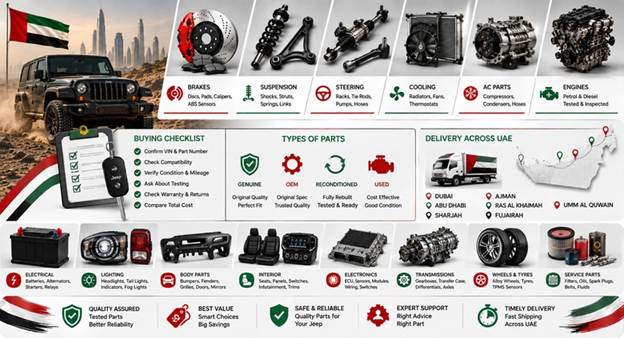
Jeep Replacement Engines in UAE
Engine replacement is one of the bigger Jeep repair decisions, so start with diagnosis rather than an online price.
Wrangler, Grand Cherokee, Cherokee, Compass and Renegade use different engines and specifications across generations. A replacement therefore needs more than a simple "Jeep engine" description.
Confirm the VIN, engine code, model year and part number. For a used engine, also check donor mileage, testing and warranty.
Then price the complete job. Labour, fluids, filters, seals and supporting components can add considerably to the engine itself.
Used Jeep Engines: Mileage and Testing
Mileage is useful, but don't treat it as a magic number.
A 70,000-km engine with unclear history isn't automatically a better buy than a 90,000-km unit with documented testing and stronger warranty protection.
Ask what was actually checked.
For a used Jeep engine, useful information can include:
| Check | What it tells you |
| Donor mileage | Previous use |
| Engine code | Compatibility |
| Compression testing | Internal condition clue |
| Leak inspection | Possible sealing issues |
| Running test | Operational condition |
| Warranty | Protection after installation |
A clean photograph is nice. It isn't a mechanical test.
Jeep Engine Codes and Compatibility
This is where careful buyers save themselves trouble.
Two Jeeps can share a model name yet require different engine components because of production year, market specification, engine family or transmission pairing.
Before paying, match the engine code and part number. If the replacement carries a different number, ask whether it is a superseded or compatible number.
For a complete replacement engine, also clarify which accessories and sensors are included.
Don't assume everything from the original engine transfers automatically.
Engine Mounts, Belts and Pulleys
An engine that vibrates, knocks or makes an unusual noise doesn't necessarily need replacing.
Worn engine mounts can transmit heavy vibration into the cabin. Belts, tensioners and pulleys can create rattling or squealing that sounds far more serious than the actual repair.
That's why diagnosis matters.
If compression, oil pressure and other appropriate checks indicate that the core engine remains healthy, replacing a smaller failed component may be the smarter move.
For belts and pulleys especially, the saving from buying used is often too small to justify the uncertainty.
When to Repair a Jeep Engine Instead of Replacing It
A repair can make sense when the damage is localised and the remaining engine is fundamentally sound.
Replacement becomes more attractive when there is extensive internal damage, severe wear, repeated major failures or a repair estimate approaching the cost of a suitable replacement engine.
Compare:
Repair + expected remaining life
with
Replacement engine + labour + supporting parts + warranty.
Also consider the Jeep's age and condition. Putting a very expensive engine into a vehicle with several other major problems may not be the wisest use of the budget.
Used vs Reconditioned Jeep Engines
A used engine generally gives you the lowest initial purchase price, while a reconditioned unit may cost more because internal components have been inspected or replaced.
| Option | Main advantage | What to question |
| Used | Lower upfront cost | Mileage, testing, history |
| Reconditioned | Refurbished components | What was rebuilt? |
| Genuine new | Strong specification confidence | Price |
| Replacement/OEM | Balance of options | Manufacturer and warranty |
For an older Jeep, a properly tested used engine can be excellent value. For long-term ownership, however, paying more for a documented rebuild and stronger warranty may be easier to justify.
The right answer depends on the engine, not simply the label.
Jeep Gearboxes and Drivetrain
Jeep Replacement Gearbox Options
A Jeep gearbox should never be ordered simply because the listing says "automatic" or names the model.
Wrangler, Grand Cherokee, Cherokee, Compass and Renegade can use different transmission specifications across generations. Match the VIN, transmission code and part number before paying.
For a replacement, compare:
- Used
- Reconditioned
- Genuine
- OEM/replacement
A tested used unit may be the economical choice for an older Jeep, while a reconditioned gearbox can make more sense when warranty protection and expected service life carry greater weight.
Used Jeep Gearboxes: What to Check
Used transmission purchases deserve more scrutiny than most ordinary spare parts.
Ask about donor mileage, testing and condition. Find out whether the gearbox is supplied complete and whether any components need transferring from your original unit.
Check these before ordering:
| Item | Why it matters |
| Transmission code | Confirms specification |
| Part number | Confirms identification |
| Donor mileage | Indicates previous use |
| Testing | Helps establish condition |
| Included components | Prevents surprises |
| Warranty | Reduces repeat-repair risk |
A cheap gearbox with vague history can become an expensive lesson once installation labour is added.
Jeep Automatic Transmission Parts
Not every shifting problem means the complete transmission has failed.
Hard shifts, slipping, delayed engagement, shuddering and warning lights can also involve fluid condition, sensors, solenoids, wiring or control modules.
That is why diagnosis should come first.
If a smaller transmission component is responsible, replacing the entire gearbox is unnecessary expenditure. If the internal damage is extensive, however, a replacement may be the cleaner option.
Don't let the online listing diagnose the Jeep for you.
Jeep Transfer Cases and Drivetrain Components
For four-wheel-drive Jeeps, the transfer case and other drivetrain components introduce another layer of compatibility.
A fault may involve the transfer case itself, an actuator, sensor, wiring or another drivetrain component.
Before ordering a used transfer case, match the exact part number and drivetrain specification. Ask about donor mileage and testing as well.
For Wranglers in particular, modified vehicles need extra attention. Aftermarket suspension, tyres or drivetrain modifications can change what replacement parts are appropriate.
Transmission Fluid and Supporting Parts
A gearbox replacement rarely ends with bolting in the transmission.
Depending on the repair, the workshop may recommend:
- Correct transmission fluid
- Filters
- Seals
- Gaskets
- Related hardware
- Diagnostics
- Adaptation or programming
These costs are easy to overlook when comparing online gearbox prices.
For UAE driving, correct fluid specification and service condition matter, particularly where the vehicle spends long periods in traffic or operates in high ambient temperatures.
Repair vs Replacement Gearbox Cost
The sensible choice depends on the actual fault and the numbers.
| Situation | Option worth considering |
| Minor diagnosed fault | Repair |
| Sensor/solenoid issue | Component repair/replacement |
| Localised internal damage | Rebuild |
| Severe internal failure | Replacement |
| Repeated transmission problems | Compare replacement carefully |
| Repair approaching replacement cost | Compare repair and replacement |
For an older Jeep, a tested used gearbox can reduce the initial bill significantly.
For a newer vehicle or one you intend to keep for years, a reconditioned or higher-confidence replacement may justify the additional expense.
The important figure isn't the gearbox sitting on the quotation. It's the complete installed repair cost.
Jeep AC, Cooling and Electrical Parts
Jeep AC Compressor Replacement
In UAE summer, a Jeep with weak AC gets uncomfortable quickly. Still, don't condemn the compressor just because the cabin isn't cooling properly.
A refrigerant leak, electrical fault, condenser problem or pressure issue can create similar symptoms.
Once the compressor is confirmed as faulty, compare genuine, reputable aftermarket, used and reconditioned options. For a used unit, ask whether it was tested and whether the warranty covers the component.
Remember the full calculation:
Compressor + refrigerant + labour + diagnostics + supporting parts.
The compressor price alone tells you very little.
Jeep Radiator and Condenser Parts
The radiator and AC condenser perform different jobs, although both sit within the front cooling area.
A damaged condenser can reduce AC performance, while a radiator problem can contribute to overheating.
Look for leaks, physical damage, restricted airflow and corrosion before ordering.
For an older Jeep, a good-quality replacement radiator can often be more practical than an expensive genuine unit. With a condenser, however, make sure the replacement matches the exact engine and AC specification.
Cooling Fans, Thermostats and Hoses
If a Jeep runs hot, don't immediately order a radiator.
A cooling fan, thermostat, hose, sensor or electrical connection can create the same basic complaint.
A sensible inspection should establish where the fault actually sits before parts are purchased.
| Symptom | Areas to investigate |
| Overheating in traffic | Fan, airflow, cooling system |
| Slow warm-up | Thermostat |
| Coolant loss | Hoses, radiator, seals |
| AC weak at idle | Fan, condenser, refrigerant |
| Temperature warning | Cooling system and sensors |
In UAE heat, cooling problems deserve prompt attention. A small fault can become an expensive engine problem if ignored.
Jeep Batteries, Alternators and Starters
A Jeep that struggles to start may have a weak battery, but don't assume that's the whole story.
A failing alternator can leave the battery repeatedly discharged. A starter problem can create clicking or no-crank symptoms even when the battery is healthy.
Test the system before buying.
For these common components, reputable new aftermarket parts can often provide good value, particularly when the saving from a used component is relatively small.
Jeep Sensors and Electronic Modules
Modern Jeeps rely heavily on sensors and electronic control systems, and faults can overlap.
A warning light might involve the sensor, wiring, connector, power supply or control module rather than the sensor itself.
Before ordering an electronic part, confirm the fault and match the part number.
For used modules, ask whether the component has been tested. Appearance proves almost nothing with electronics.
ECU, Programming and Calibration Requirements
An ECU or control module isn't necessarily plug-and-play.
Depending on the Jeep and component, replacement may require coding, programming, relearning or calibration. Some sensor and camera-related systems can also need post-installation calibration.
Ask the workshop before ordering:
Does it need programming? Can you perform it? Is calibration required? Is that cost included?
That conversation can save a surprisingly awkward second trip to the workshop — and an unexpected addition to the invoice.
Jeep Brakes, Suspension and Steering
Jeep Brake Replacement Parts
Brake pads and discs are routine replacements, but Jeep model, engine, wheel size and brake specification can change the correct part.
Grinding, vibration, pulling or a noticeably different pedal feel should be checked promptly. If the discs remain within specification, replacing them unnecessarily adds cost.
For older Jeeps, reputable aftermarket brake components can offer good value. On newer or higher-performance models, genuine or established OEM-equivalent parts may be worth considering.
Jeep Shock Absorbers and Struts
A Jeep that bounces excessively, knocks over speed humps or feels unsettled through corners may have worn shocks or related suspension components.
Don't assume every knock means a failed shock. Bushes, links, mounts and control arms can produce remarkably similar noises.
For vehicles with modified suspension, especially Wranglers, tell the supplier about the modifications before ordering. Standard replacement parts may not suit a modified setup.
Jeep Control Arms and Bushes
Control arms and bushes gradually lose their ability to control suspension movement. The symptoms can be vague at first — steering wander, uneven tyre wear, clunks or a slightly loose feeling over rough roads.
Have both sides inspected before ordering a single component.
| Component | Typical concern |
| Control arm | Wear or excessive movement |
| Bush | Cracking or deterioration |
| Ball joint | Play or knocking |
| Stabiliser link | Clunking over bumps |
| Shock absorber | Poor body control |
If only one part has failed, don't automatically buy an entire suspension package.
Jeep Wheel Bearings and Hubs
A humming or rumbling sound that increases with road speed can indicate a worn wheel bearing, although tyre noise can sound almost identical.
Confirm the source first.
For a relatively inexpensive bearing, buying new is often preferable to gambling on an unknown used unit. The labour involved in removing and fitting the component can make a premature failure particularly frustrating.
Where a complete hub assembly is required, check whether the supplied unit includes the relevant sensor or other integrated components.
Jeep Steering Racks and Tie-Rod Components
Steering faults deserve more attention than ordinary wear items because they affect vehicle control.
Possible symptoms include:
- Excessive steering play
- Wandering
- Uneven front-tyre wear
- Knocking
- Loose steering response
- Unusual movement over bumps
Don't jump straight to a steering-rack replacement. Tie rods, ball joints, suspension components and wheel alignment can create similar symptoms.
For a replacement rack or steering component, match the exact part number and specification, then check whether any calibration or alignment work is required after installation.
When Jeep Suspension Parts Should Be Replaced in Pairs
Some suspension components are best considered as an axle pair, particularly where the replacement affects handling balance.
If one front shock has failed and the opposite side has similar mileage and wear, replacing both can produce more consistent behaviour.
The same principle doesn't mean every component must automatically be replaced twice.
Have the workshop inspect the opposite side first.
That's the sensible middle ground: don't replace healthy parts unnecessarily, but don't leave a severely worn matching component behind simply because it hasn't failed yet.
Jeep Body, Lighting and Interior Parts
Jeep Headlights and Tail Lights
Jeep lighting assemblies can vary between generations and trim levels, so "fits Wrangler" or "fits Grand Cherokee" isn't enough information.
Check the part number and inspect the actual unit if buying used. Look for cracked housings, moisture, broken mounting tabs and damaged connectors.
Some modern lighting assemblies also contain electronic modules, which can introduce programming or calibration requirements.
For a simple lamp, a clean used genuine unit can be excellent value. For an electronic assembly, testing becomes much more important.
Jeep Bumpers, Grilles and Fenders
Used genuine body panels can save a surprising amount of money, especially on older Jeeps.
But inspect the things that photographs often hide: mounting points, cracks, previous repairs, clips and sensor openings.
If the panel needs repainting, add that cost before deciding whether it is actually cheaper.
| Body part | Check before buying |
| Bumper | Mounts, cracks, sensor openings |
| Fender | Damage, alignment, mounting points |
| Grille | Clips and condition |
| Door | Hinges, wiring, dents |
| Mirror | Electronics and housing |
For Wranglers with aftermarket accessories, also confirm that the replacement body component works with the existing setup.
Jeep Mirrors, Doors and Exterior Trim
A Jeep mirror may contain far more than the glass and housing. Depending on specification, it can include electric adjustment, folding, heating, indicators or other electronic equipment.
Match the exact configuration.
For used doors and trim, inspect hinges, clips, connectors and mounting points. A cheap component that needs substantial correction before fitting isn't much of a bargain.
For smaller plastic trim pieces, however, a clean used genuine part can be a very sensible purchase.
Jeep Interior Replacement Parts
Interior parts are often overlooked until something breaks or becomes badly worn.
Common replacements include:
- Seat components
- Door handles
- Switches
- Centre-console trim
- Dashboard pieces
- Interior panels
- Seat motors
For simple cosmetic trim, used genuine parts can work beautifully. Electronic components need more scrutiny.
A used seat may look immaculate but have a failed motor or damaged connector. Ask what has actually been tested.
Jeep Infotainment and Instrument Clusters
Infotainment screens and instrument clusters can be expensive because they combine hardware with vehicle-specific electronics.
Before buying a used unit, check:
Part number → screen/cluster version → connectors → testing → programming requirements.
For instrument clusters, also establish how vehicle-specific information will be handled after installation.
Don't assume that a replacement module will simply plug in and behave exactly like the original.
Used Genuine vs Aftermarket Jeep Body Parts
For cosmetic components, the choice isn't always complicated.
A used genuine bumper may offer better original fitment, while a new aftermarket panel could cost less and arrive unused. The better option depends on the actual component and finishing work required.
| Option | Best advantage | Main concern |
| Used genuine | Original fitment | Previous damage |
| New genuine | Strong specification confidence | Higher cost |
| New aftermarket | Lower purchase price | Fit/finish variation |
| Repaired used | Potentially cheapest | Repair quality |
For bodywork, calculate part + paint + fitting before deciding. That is the number worth comparing.
Jeep Parts Prices and UAE Buying Costs
Jeep Spare Parts Prices in UAE
Jeep parts prices can swing considerably depending on the model, generation, component and condition. A Wrangler bumper, Grand Cherokee gearbox and Renegade brake pad set are completely different purchases, so one generic "Jeep parts price" isn't very useful.
For a realistic comparison, look at:
Part price + delivery + labour + supporting parts + diagnostics.
That gives you the actual repair cost.
Wrangler Parts Price Considerations
Wrangler parts can vary sharply depending on whether the vehicle is standard or modified.
Suspension, steering and exterior components deserve particular attention because aftermarket modifications can change compatibility.
For routine brakes and service parts, reputable aftermarket options may reduce costs. For specialist drivetrain or electronic components, a tested genuine or OEM-quality replacement can be easier to justify.
Don't compare a modified Wrangler with a standard vehicle and assume the same part will fit.
Grand Cherokee Parts Price Considerations
Grand Cherokee repairs can become expensive when the component involves air suspension, drivetrain, electronics, engines or transmissions.
A used genuine component can reduce the initial bill considerably, but condition and testing matter.
For expensive parts, compare options like this:
| Option | Typical cost position | What matters most |
| Used genuine | Lower | Mileage and testing |
| Reconditioned | Mid-range | Rebuild quality |
| OEM | Mid–high | Manufacturer |
| Genuine new | Higher | Specification and warranty |
| Aftermarket | Varies | Brand and quality |
The cheapest category isn't automatically the best value.
Cherokee, Compass and Renegade Price Differences
Smaller Jeeps don't necessarily mean every replacement part will be cheap.
A Renegade sensor might be inexpensive compared with a Grand Cherokee engine, but an electronic module can still carry a sizeable price. Cherokee and Compass parts likewise vary according to generation and specification.
For each model, compare the exact component rather than using the vehicle's size as a price guide.
That's particularly important when searching online, where similar-looking listings can represent different specifications.
Jeep Labour Costs and Total Installed Cost
Labour can change the economics of a replacement dramatically.
Replacing a sensor is one thing. Removing an engine or gearbox is another altogether.
Before approving a major repair, ask for separate figures for:
- Replacement part
- Labour
- Fluids
- Supporting components
- Diagnostics
- Programming or calibration
- Delivery
A lower-priced engine can therefore end up costing more overall if it requires additional work or has weaker warranty protection.
Delivery, Warranty and Downtime Costs
A part that costs less but takes several days longer to arrive may not be the better choice if the Jeep is essential for work or family use.
Likewise, a component with a stronger warranty can justify a slightly higher purchase price, particularly when installation labour is substantial.
Think beyond the invoice.
Part price matters. Repair downtime matters too.
For an expensive Jeep component, compare the total package: price, availability, warranty, delivery and installation.
Buying Jeep Parts Online in UAE
Where to Buy Jeep Spare Parts Online in Dubai
Online sourcing makes it easier to compare Wrangler, Grand Cherokee, Cherokee, Compass and Renegade parts without driving from supplier to supplier.
But don't search only by model name. Use the VIN, part number, engine and transmission specification wherever possible.
For routine items, ordering is relatively simple. Engines, gearboxes, ECUs and expensive electronic components need more care.
A useful supplier should be able to explain what the part is, what condition it is in and what warranty comes with it.
Buying Jeep Parts in Abu Dhabi and Sharjah
You don't necessarily need to buy from a supplier in your own emirate.
A supplier elsewhere in the UAE may have the exact part in stock, offer better pricing or provide a stronger warranty. Compare the delivered price, though, not the collection price.
For used parts, ask for photographs of the actual component and identification markings. For major mechanical parts, confirm testing and donor mileage before paying.
That extra checking is worth the effort.
Jeep Parts Delivery to Ajman, RAK, Fujairah and Umm Al Quwain
Online sourcing can be especially useful when a particular Jeep component isn't readily available nearby.
Small sensors and switches are simple to transport. Engines, gearboxes, bumpers and body panels need more attention because they're heavier or easier to damage.
| Part type | Delivery concern |
| Sensor | Dispatch time |
| Headlight | Packaging |
| Bumper | Transport damage |
| Engine | Heavy-item handling |
| Gearbox | Weight and packaging |
| Body panel | Scratches or dents |
Before ordering, confirm delivery timing and what happens if the part arrives damaged or incorrect.
How to Check an Online Jeep Parts Supplier
Don't be overly impressed by a polished listing. Ask practical questions instead.
Can the supplier confirm the part number? Do they know the exact Jeep specification? For used components, can they provide mileage and testing details? Is the warranty written clearly?
For major components, the conversation should cover:
Compatibility → condition → testing → warranty → delivery.
If straightforward questions receive vague answers, I'd pause before sending payment.
What to Check Before Buying Used Jeep Parts Online
Used parts can provide excellent savings, but the risk varies enormously by component.
For a body panel, physical inspection may tell you most of what you need. An engine or gearbox is another story.
Check:
- Part number
- Donor vehicle
- Mileage where relevant
- Testing
- Actual condition
- Warranty
- Return terms
- Included components
For electronic parts, also confirm whether coding or programming is required.
Workshop Inspection Before Ordering Major Jeep Components
For a mirror or trim piece, you may be able to identify the requirement yourself.
For an engine, gearbox, transfer case, ECU or complex electronic module, involve the workshop before purchasing.
A technician can confirm whether the component has actually failed and whether another, cheaper repair could solve the problem.
This is also where PartFinder UAE can be useful for comparing suitable supplier options, but the final purchase decision should still be based on compatibility, condition, warranty and total repair cost.
Buying Jeep Parts From Another Emirate
Buying across emirates can open up more choices, particularly for older or less common Jeep components.
Don't let a slightly lower advertised price make the decision for you.
Compare:
Part + delivery + warranty + expected arrival time + installation.
If one supplier costs AED 150 more but has the correct part ready today and provides stronger warranty protection, that may be the better deal — especially when the Jeep is already sitting in the workshop.
Simple Online Jeep Parts Buying Process
Identify the vehicle.
Confirm the exact part.
Compare genuine, OEM, used, reconditioned and aftermarket options.
Check condition and testing.
Confirm warranty and returns.
Calculate delivery and installation.
Then place the order.
It sounds almost painfully simple. That's the point. Most costly mistakes happen when one of those steps gets skipped.
Jeep Buying Decisions, Mistakes and FAQs
Common Mistakes When Buying Jeep Spare Parts
The easiest mistake is ordering too early.
A listing may say "Wrangler" or "Grand Cherokee", look identical to your old component and still be wrong for the vehicle. Model year, engine, transmission, trim and part number can change everything.
Other common mistakes include ignoring delivery costs, buying an untested used engine, overlooking programming requirements and comparing only the component price.
For major parts, slow down. Check first, pay second.
How to Avoid Ordering the Wrong Jeep Part
Use a simple identification chain:
VIN → model year → engine → transmission → part number → specification.
If the supplier gives you a different part number, ask why. It could be a superseded number, but don't assume that without confirmation.
This matters particularly with Jeep engines, gearboxes, ECUs, lighting assemblies and drivetrain components.
Repair vs Replacement: Which Makes More Sense?
A complete replacement isn't always necessary.
If a smaller component has failed and the main assembly remains healthy, repairing it may be far cheaper. Replacement becomes more attractive when the damage is extensive, the unit has high wear or the repair estimate approaches the cost of a suitable replacement.
| Situation | Worth considering |
| Minor isolated fault | Repair |
| Localised mechanical damage | Repair/rebuild |
| Severe internal damage | Replacement |
| Repeated major failure | Compare replacement |
| Repair close to replacement price | Calculate both |
| Older Jeep | Consider used/reconditioned |
The Jeep's age, condition and expected future ownership should be part of the decision.
Jeep Spare-Parts Buying Checklist
Before ordering an important component, check:
- VIN confirmed
- Exact part number matched
- Model year verified
- Engine specification checked
- Transmission checked
- Used-part mileage confirmed where relevant
- Testing explained
- Warranty understood
- Return terms checked
- Delivery cost confirmed
- Labour estimated
- Programming/calibration checked
- Supporting parts identified
- Total installed cost calculated
If several of those answers are still unclear, the part isn't ready to order.
FAQs
Categories
- Audi
- BMW
- Car Accessories
- Car Tips
- Ford
- Land Rover
- Mazda
- Range Rover
- Top 10
- UAE Car Parts
- Used Car Parts
- Toyota
- Replacement Engines
- Nissan
- Hyundai
- Mitsubishi
- Volkswagen
- Honda
- Kia
- Chevrolet
- Dodge
- Jeep
- Subaru
- Renault
- Lexus
- Mercedes
- Suzuki
- Hummer
- Porsche
- Infiniti
- Peugeot
- GMC
- Mini
- Volvo
- Replacement Gearboxes
- MG
- Jaguar
- Skoda
- Cadillac
- Daihatsu
- Fiat
- German Car Parts
- Japanese Car Parts
- Aftermarket Car Parts
- Genuine Car Parts
- New Car Parts
- Reconditioned Car Parts
- European Car Parts
- American Car Parts
- Korean Car Parts
- British Car Parts
- Chinese Car Parts
- Sports/Exotic Car Parts
- Luxury Car Parts
- Performance Car Parts
- SUV/4x4 Spare Parts
- Truck Spare Parts
- EV Car Parts
- Hybrid Car Parts
- Auto Spare Parts in UAE
- Tesla
- Isuzu
- Ram
- Ferrari
- Bentley
- Lamborghini
- Genesis
- Maserati
- Lincoln
- Chrysler
- Opel
- Citroen
- SsangYong
- Seat
- McLaren
- Aston Martin
- Rolls Royce
- Maybach
- Alfa Romeo
- Bugatti
- Scion
- Abu Dhabi Car Parts
- Ajman Car Parts
- Al Khan Car Parts
- Al Sajaa Car Parts
- Deira Car Parts
- Dubai Car Parts
- Fujairah Car Parts
- Industrial Area 6 Car Parts
- Mussafah Car Parts
- Ras Al Khaimah Car Parts
- Sharjah Car Parts
- Umm Al Quwain Car Parts
- Acura
- BYD
- Chery
- Dacia
- DS
- Geely Emgrand
- EXEED
- GAC
- GAC Gonow
- Geely
- Gonow
- Great Wall
- Haima
- Haval
- Holden
- Iveco
- JAC
- Jaecoo
- Jetour
- Lotus
- Omoda
- Proton
- Renault Samsung
- Roewe
- Lucid
- Replacement Headlight
- Replacement Bumper