Jetour Hybrid Parts in UAE: T2 i-DM and T1 i-DM Replacement Costs Explained
October 12, 2026
A Jetour T2 i-DM or T1 i-DM does not suddenly become an ordinary petrol SUV just because a warning light appears on the dashboard.
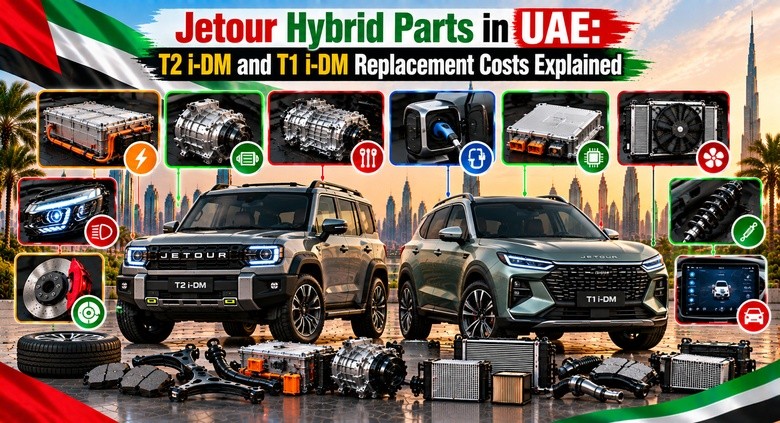
There is still a 1.5-litre turbocharged petrol engine, cooling system, brakes, suspension, steering, A/C and all the usual bodywork. But sitting alongside them are a traction battery, electric motor hardware, power electronics, charging equipment and a dedicated hybrid transmission. On the T2 i-DM, the 2026 UAE specification identifies a 26.7 kWh LiFePO₄ battery, two electric motors and a three-speed DHT; the T1 i-DM uses a 26.7 kWh battery with a single electric motor and DHT.
That changes the repair equation.
And it makes one thing particularly important for UAE owners: there is no honest single “hybrid battery replacement price” or “T2 i-DM gearbox price” that can be applied to every car. Current UAE sources do not publish sufficiently reliable retail prices for complete traction batteries, inverters, electric motors or DHT assemblies. Giving a neat AED figure without a verified quotation would create false precision.
So this guide separates what can actually be established from what needs a vehicle-specific quotation.
UAE Update Reference: October 2026
The first mistake is calling every hybrid fault a battery problem
The battery gets blamed for almost everything.
Reduced electric range? Battery.
Hybrid warning? Battery.
Poor acceleration? Battery.
Charging problem? Battery.
Sometimes, yes. Quite often, no.
A plug-in hybrid has several interconnected systems. The T1 i-DM, for example, combines a 1.5-litre turbocharged engine with an electric motor and a 26.7 kWh battery. The T2 i-DM adds a more complex dual-motor arrangement and three-speed DHT.
A diagnostic scan, charging test and examination of live hybrid-system data should establish which part of that chain is actually misbehaving.
Replacing a battery because the vehicle displayed a hybrid warning is not diagnosis.
T1 i-DM and T2 i-DM are mechanically different
They share the i-DM family name, but that does not make their hybrid components interchangeable.
The UAE T1 i-DM specification lists one permanent-magnet synchronous electric motor, producing 150 kW and 310 Nm in the published technical data, with a 26.7 kWh LFP battery and a one-speed DHT.
The 2026 UAE T2 i-DM specification lists two drive motors, a combined motor output of 165 kW and combined motor torque of 390 Nm, with the same stated 26.7 kWh battery capacity but a three-speed DHT.
That distinction matters enormously when sourcing expensive components.
A battery pack may have the same nominal capacity and still have different casing, connectors, cooling arrangements, control hardware, software configuration or mounting.
Never order a high-voltage component simply because “T1 i-DM” and “T2 i-DM” appear on the same supplier page.
What does a Jetour hybrid repair actually include?
A useful way to think about the T1 i-DM or T2 i-DM is as several repair groups:
| System | Typical components |
|---|---|
| Petrol engine | Engine, turbo, injectors, cooling, sensors |
| Hybrid battery | Battery pack, cells/modules, BMS-related hardware |
| Electric drive | Motor/generator assemblies and related hardware |
| Power electronics | Inverter/converter and high-voltage electronics |
| DHT | Hybrid transmission and associated controls |
| Charging | Charge inlet, charging hardware, cables and controls |
| Thermal management | Radiators, pumps, coolant circuits, heat exchangers |
| 12V electrical | Auxiliary battery, fuses, relays, wiring |
| Chassis | Brakes, suspension, steering, hubs |
| Electronics | ECUs, sensors, cameras, displays and body modules |
The expensive hybrid components are only part of the vehicle.
That matters because a T2 i-DM with a faulty coolant pump may need a completely different repair from one with a genuine battery fault.
The T1 i-DM hybrid system in UAE specification
Jetour UAE currently describes the T1 i-DM as a plug-in hybrid using a 1.5-litre turbocharged engine and electric motor, producing 335 hp and 530 Nm combined. It claims up to 117 km of WLTC pure-electric range and up to 1,000 km combined range. The published battery capacity is 26.7 kWh.
The UAE page also states fast charging from 30–80% in 0.5 hours and slow charging from 30–100% in under four hours.
Those figures matter when diagnosing charging complaints.
If a vehicle is charging slowly, for example, the question is not simply whether the battery is “bad”. The charging equipment, temperature, state of charge, charging mode and vehicle-side hardware all need to be considered.
The T2 i-DM hybrid system is more complicated
The 2026 UAE T2 i-DM specification lists a 1.5TD petrol engine, two permanent-magnet synchronous drive motors and a three-speed hybrid DHT. It gives the system 375 bhp and 610 Nm in that particular 2026 specification, while Jetour's current marketing page also contains different output figures for the T2 i-DM.
That discrepancy is precisely why buyers should identify the model year and actual UAE specification rather than copying a powertrain number from an overseas review.
For Jetour Hybrid parts in UAE, the same rule is even more important.
A 2025 T2 i-DM and a 2026 T2 i-DM should not be treated as identical simply because the badge says T2 i-DM.
How much does a T1 i-DM battery cost in the UAE?
There is no sufficiently reliable current UAE retail listing that establishes a complete T1 i-DM traction-battery replacement price.
That is the honest answer.
The battery itself is a 26.7 kWh LFP pack according to Jetour UAE, and the manufacturer currently states an 8-year/160,000 km battery warranty for the T1 i-DM.
So if a T1 i-DM develops a battery-related fault while still within the applicable warranty terms, the first question should be whether the condition is covered, not “how much is a new battery?”
If it is outside warranty, the quotation needs to identify whether the repair involves the complete pack, an internal component, battery-management hardware, wiring, cooling or another fault.
T2 i-DM battery replacement is not a simple AED figure either
The same caution applies to the T2 i-DM.
The 2026 UAE specification identifies a 26.7 kWh LiFePO₄ battery and states an 8-year/160,000 km battery warranty.
The official T2 i-DM page for the earlier model year describes an 8-year/150,000 km battery warranty, showing why model year matters when discussing coverage.
So a generic online article saying “T2 i-DM battery replacement costs AED X” would be misleading unless it identifies the exact model year, battery assembly and quotation basis.
For this component, no verified current UAE retail benchmark was found.
Battery capacity does not tell you battery replacement cost
Two batteries with identical nominal capacity do not necessarily cost the same to replace.
The quotation can depend on:
- complete pack versus internal repair;
- battery-management hardware;
- casing and protection;
- cooling hardware;
- connectors;
- software configuration;
- labour;
- diagnostic procedures;
- transportation and storage requirements;
- warranty;
- whether the component is new or previously used.
The 26.7 kWh figure tells you the battery's nominal energy capacity.
It does not tell you the price of a replacement assembly.
Battery degradation is different from battery failure
This distinction saves owners from unnecessary panic.
A battery can gradually lose usable capacity without suffering a catastrophic failure.
That is different from a pack that has a serious electrical fault, damaged module, insulation problem or thermal-management issue.
If an owner notices that EV range has fallen, the workshop should establish whether the change is consistent with operating conditions and battery state-of-health or whether there is a fault code or abnormal cell behaviour.
Range alone is not a battery diagnosis.
UAE heat makes battery thermal management particularly relevant
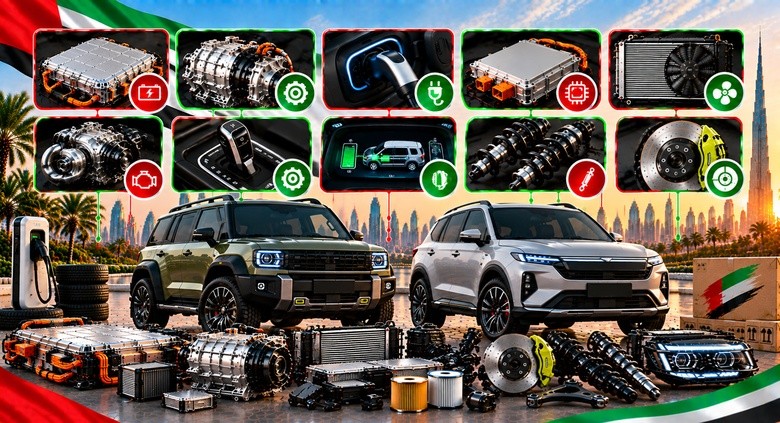
The UAE's summer temperatures make thermal management an important part of hybrid diagnosis.
But again, “UAE is hot” does not mean “the battery is damaged”.
The T1 i-DM manufacturer describes its LFP battery as high-temperature tolerant and includes battery protection hardware in the vehicle specification. The T2 i-DM specification also lists battery preheating and battery side protection.
A workshop should therefore look at the actual thermal-management system, coolant circuits, temperature readings and relevant diagnostic data before blaming the battery itself.
T1 i-DM electric motor replacement cost
A reliable current UAE retail price for a complete T1 i-DM drive motor was not found in the sources checked.
That absence matters.
The official UAE specification identifies a permanent-magnet synchronous motor, but the manufacturer page does not publish a retail spare-part price for the complete motor assembly.
A genuine quotation should identify the motor assembly by VIN and part reference and state whether the quoted figure includes related control hardware, seals, coolant work, installation and post-repair diagnostics.
Don't confuse the cost of a small motor-related component with the price of the complete drive unit.
T2 i-DM has two drive motors to consider
The T2 i-DM is more complex again.
The 2026 UAE specification identifies two drive motors with a P2+P2.5 layout.
That means “the electric motor” is an inadequate description when ordering a major T2 hybrid component.
A supplier needs to know which motor, which side/location or assembly, which model year and which vehicle specification.
A fault in one motor-related subsystem does not automatically justify replacing both.
The DHT is one of the most misunderstood parts
DHT means Dedicated Hybrid Transmission.
It is not simply a conventional petrol automatic gearbox with an electric motor bolted on somewhere nearby.
The T1 i-DM uses a DHT arrangement described in current UAE specifications as one-speed, while the T2 i-DM uses a three-speed DHT.
That is a fundamental parts-compatibility distinction.
So if a workshop says “the hybrid gearbox needs replacement”, ask for the exact diagnosis and part identification.
How much does a T2 i-DM DHT cost?
There is no dependable current UAE retail benchmark for a complete T2 i-DM DHT assembly in the sources checked.
That means a fabricated figure such as “AED 20,000” or “AED 30,000” would be more misleading than useful.
The cost needs to be quoted against:
VIN + model year + exact DHT assembly + new/used/reconditioned status + labour + fluids + programming/adaptation + warranty.
For a major hybrid transmission, the quotation should also explain why the complete assembly is required rather than a smaller serviceable component.
A hybrid warning does not prove the DHT has failed
A DHT-related warning can have several causes.
Possible areas to investigate include:
- transmission control;
- electric motor operation;
- sensors;
- wiring;
- lubrication;
- temperature;
- software;
- mechanical damage;
- communication between control modules.
The workshop should scan the vehicle, record relevant DTCs and examine live data before condemning the transmission.
This is particularly important because a complete DHT is one of the expensive components for which an incorrect diagnosis can produce a very large bill.
Inverters and power electronics are another expensive unknown
The inverter is fundamentally different from the petrol engine ECU.
It manages high-voltage electrical power between the battery and electric drive system.
If an inverter-related fault is suspected, the workshop needs the appropriate high-voltage diagnostic equipment and manufacturer procedures.
Current UAE sources do not provide a sufficiently reliable public retail price for a complete T1 or T2 i-DM inverter assembly.
So again: quote required, generic internet estimate avoided.
The 12V battery can imitate a much larger hybrid problem
This one catches people out.
A modern PHEV still has a conventional low-voltage electrical system.
A weak 12V auxiliary battery can produce strange warnings, communication faults and starting or system-activation problems.
That does not mean the traction battery has failed.
Before approving an expensive hybrid component, a workshop should check the 12V battery condition, charging system, relevant grounds and electrical connections.
It is a very cheap diagnostic step compared with replacing a high-voltage assembly unnecessarily.
Charging faults need to be separated into vehicle and charger problems
A T1 or T2 i-DM that refuses to charge has at least two obvious suspects: the vehicle and the charging equipment.
Then there is the charging cable, connector, communication system, temperature condition and vehicle-side charge hardware.
The T1 i-DM supports fast charging from 30–80% in about 30 minutes and slow charging from 30–100% in under four hours according to Jetour UAE.
The 2026 T2 i-DM specification gives the same 30–80% fast-charge interval and under-four-hour slow-charge figure.
A failure to achieve those figures under every circumstance is not, by itself, proof of battery failure.
Charging hardware can be cheaper than the battery — but the part still needs identification
A charge inlet, cable, connector or associated control component is a completely different purchase from a traction battery.
That sounds obvious.
Yet online parts searches often blur these categories together, especially when model names and hybrid terminology are used as catalogue keywords.
Before buying, confirm:
- vehicle model;
- model year;
- PHEV specification;
- charging-port type;
- connector configuration;
- part number;
- whether the component is vehicle-side or cable-side;
- whether coding or configuration is required.
Hybrid cooling components deserve more attention than they get
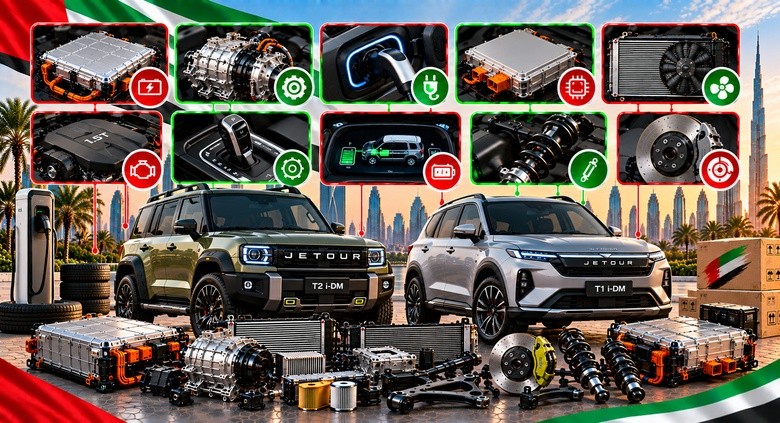
The T1 and T2 i-DM powertrains have thermal-management demands beyond those of a conventional petrol SUV.
There can be separate or interconnected cooling requirements for the engine, battery, electric drive components and other power electronics.
A coolant leak is therefore not automatically “just a radiator problem”.
The workshop should establish which circuit is affected, where the leak is, whether the pump operates correctly and whether the relevant component temperatures are normal.
Replacing the wrong cooling component is particularly frustrating because the original fault remains.
Hybrid braking does not mean conventional brake parts disappear
Regenerative braking changes how the vehicle uses the friction brakes, but it does not eliminate discs, pads or calipers.
The T2 i-DM 2026 specification lists ventilated front discs and rear discs, with an electronic parking brake.
Brake servicing can therefore remain comparatively straightforward compared with high-voltage repairs.
But hybrid vehicles can have different brake-control behaviour, so warning lights, pedal feel and regenerative-braking faults need proper diagnosis rather than a simple pad replacement.
Suspension and steering costs remain ordinary mechanical costs
Not every expensive Jetour hybrid repair involves high voltage.
A worn control arm, damaged shock absorber, wheel bearing, steering component or suspension bush is still a conventional chassis repair.
This is actually useful for owners because the UAE aftermarket can provide more accessible price comparisons for these components than it currently does for complete high-voltage assemblies.
The important distinction is to avoid assuming that every repair on a T2 i-DM must be expensive because it is a hybrid.
It isn't.
Body parts are usually a different economic problem
A front bumper, door, wing, headlamp or tailgate can be damaged on a T1 i-DM or T2 i-DM exactly as it can on a petrol SUV.
The hybrid complication appears when accident damage reaches the areas around high-voltage components, wiring, battery protection structures or electronic sensors.
After a significant collision, the workshop should not treat the car as a cosmetic body repair until the relevant systems have been inspected.
Accident damage around the battery needs a different level of caution
The T1 i-DM specification includes battery side guards and an aluminium battery bottom guard. The T2 i-DM specification also identifies battery protection equipment.
If the vehicle has suffered an impact underneath or around the battery area, the correct question is not simply:
“Is the battery still working?”
The workshop needs to determine whether the battery casing, mounting structure, high-voltage wiring, insulation and associated protection have been affected.
This is not a part-ordering exercise. It is a safety inspection first.
Used hybrid parts need much more due diligence
Used components can make economic sense, especially for body parts and some mechanical assemblies.
High-voltage components are different.
A used traction battery should come with meaningful information about:
- donor vehicle;
- model year;
- mileage;
- battery condition;
- reason for removal;
- damage or accident history;
- storage conditions;
- test results where available;
- part number;
- warranty;
- return conditions.
“Tested” is useful only when the seller can explain what was tested.
Reconditioned does not automatically mean cheap or safe
A reconditioned inverter, DHT or battery-related assembly can sound attractive because the price may be below a new genuine unit.
But what was actually reconditioned?
Were internal components replaced? Was the unit electrically tested? Was insulation checked? Were software/configuration requirements addressed? Is there a written warranty?
The word “reconditioned” describes a process only when the seller can explain that process.
Otherwise, it is just a label.
What should a UAE workshop test before quoting a hybrid battery?
For a battery-related complaint, the workshop should establish the actual fault before discussing replacement.
Depending on the system and manufacturer procedure, that can involve:
- full diagnostic scan;
- battery-system fault codes;
- state-of-charge data;
- state-of-health information where available;
- cell/module voltage behaviour;
- battery temperature data;
- insulation-related diagnostics;
- charging behaviour;
- high-voltage system status;
- 12V system condition;
- cooling-system operation.
The exact test procedure should follow the manufacturer's service information and the technician's high-voltage safety requirements.
The important thing is that battery replacement should be the result of diagnosis, not the starting assumption.
Why current UAE prices for hybrid parts are harder to benchmark
There is a healthy online market for conventional Jetour parts, but complete i-DM high-voltage assemblies are less transparent.
A UAE supplier currently lists an extensive catalogue of T2 i-DM categories, including drive shafts, differentials, axles, transmission filters, shifter assemblies, steering components, A/C parts and electrical items. However, the page does not establish reliable retail prices for complete traction batteries, inverters or DHT assemblies.
Jetour UAE itself says its authorised network provides genuine Jetour parts and that special parts can be ordered from Jetour Global.
That explains why a buyer may get a genuine quotation from the authorised channel without finding a comparable public online price.
The absence of a public price is not evidence that the part does not exist.
Warranty can change the economics completely
This is the first question an owner should ask before paying for a hybrid battery.
The current Jetour UAE T1 i-DM page states:
- engine warranty: 10 years / 1,000,000 km
- battery warranty: 8 years / 160,000 km
- service contract: 3 years / 30,000 km.
The 2026 T2 i-DM specification also states a 10-year/1-million-km warranty and 8-year/160,000 km battery warranty.
Earlier T2 i-DM UAE material states an 8-year/150,000 km battery warranty, so owners should check the exact warranty terms applicable to their model year and vehicle.
That is far more useful than assuming a battery replacement is automatically an owner-paid expense.
Where should a UAE owner get a hybrid repair assessed?
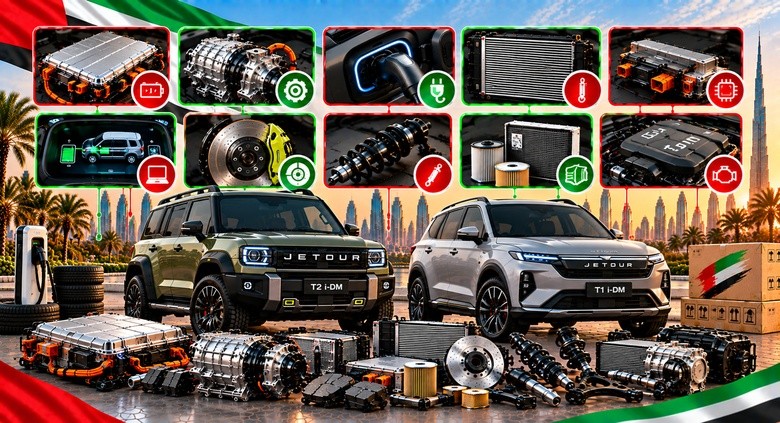
For high-voltage faults, use a workshop with appropriate hybrid diagnostic equipment, trained technicians and procedures for the specific vehicle.
Jetour UAE says its authorised network uses manufacturer-trained technicians, approved service procedures and advanced diagnostic technologies. Its flagship service centre on Sheikh Zayed Road is a 100,000 sq ft facility, according to the manufacturer.
That does not mean every non-dealer workshop is incapable of servicing a PHEV.
It means the owner should ask a simple question before handing over a high-voltage vehicle:
Does this workshop have the equipment, training and service information to diagnose this particular Jetour hybrid safely?
What a proper hybrid-parts quotation should contain
A serious quotation for an expensive T1 or T2 i-DM component should not simply say:
Hybrid battery — AED XX,XXX
It should identify:
| Quotation detail | Why it matters |
|---|---|
| VIN | Confirms vehicle application |
| Model year | Hybrid hardware can change |
| Exact part name | Prevents vague ordering |
| Part number | Stronger compatibility check |
| New/used/reconditioned | Defines risk |
| Battery/motor/DHT identification | Prevents system confusion |
| Labour | Separates component from installation |
| Diagnostics | Shows how failure was established |
| Programming/configuration | May affect electronic components |
| Cooling/fluids | Some repairs require additional work |
| Warranty | Crucial for expensive components |
| Return policy | Important if sourcing externally |
| Availability | Prevents unexpected downtime |
If a supplier cannot answer the basic identification questions, a low price is not necessarily a bargain.
T1 i-DM versus T2 i-DM: where the cost risk sits
The two vehicles have different hybrid architectures.
| Component | T1 i-DM | T2 i-DM |
|---|---|---|
| Petrol engine | 1.5L turbo | 1.5TD |
| Battery | 26.7 kWh LFP | 26.7 kWh LFP |
| Electric motors | Single | Two |
| DHT | One-speed specification | Three-speed DHT |
| Drive | FWD | 2026 UAE spec: FWD |
| Battery warranty | 8 years/160,000 km | 8 years/160,000 km in 2026 spec |
| Combined output | 335 hp | 375 bhp in 2026 specification |
The published specifications support those distinctions.
The table is not a price ranking. It simply shows why a T1 component should not automatically be quoted as a T2 component, or vice versa.
How to compare a hybrid repair quotation properly
Suppose three UAE suppliers offer three prices.
Don't immediately choose the lowest.
First make the quotations equivalent.
Is each one quoting the same component?
Is each one new?
Does each include VAT?
Does one include labour?
Does one include programming?
Does one include the required coolant or seals?
Does one offer a warranty?
Is one part actually a used donor component?
Once those questions are answered, the price comparison becomes meaningful.
Before that, it is mostly theatre.
What parts are easiest to source compared with high-voltage assemblies?
The UAE market is generally easier to compare for ordinary service and chassis components than for complete hybrid powertrain assemblies.
A supplier catalogue for the T2 i-DM currently identifies categories such as filters, steering, suspension, A/C, driveshafts, differential and other conventional components.
For these parts, online listings can give the buyer a useful starting point.
For the traction battery, inverter, complete motor or DHT, a direct VIN-based quotation is much more valuable.
That is the dividing line.
The cost of getting the diagnosis wrong
This is where hybrid repair economics become uncomfortable.
If a workshop incorrectly condemns a battery, the owner may spend thousands of dirhams chasing a component that was never the cause.
Then comes the secondary cost:
diagnosis again, towing, workshop downtime, removal and refitting, replacement of unrelated parts, programming, charging-system checks and potentially another repair.
A correct diagnostic process may cost more at the beginning.
It can cost dramatically less by the end.
Should you buy a used T2 or T1 i-DM hybrid component?
Possibly, but the decision depends heavily on the part.
A used body panel is one thing.
A used high-voltage battery is another.
A used DHT is another.
For a high-voltage component, insist on traceability and evidence. Ask where it came from, what vehicle it came from, its mileage, whether it was involved in an accident, why it was removed and what testing was performed.
A donor vehicle's history becomes part of the component's history.
Why VIN matching matters even more on hybrid models
A VIN is not just an administrative detail.
It can help identify model year, powertrain specification, equipment level and the correct component family.
That matters when a supplier's catalogue includes several Jetour models or several generations of the same hybrid system.
For an expensive hybrid component, the sensible sequence is:
VIN → application → part number → physical/component identification → quotation → installation.
That sequence is worth the extra few minutes.
A practical UAE hybrid repair-cost framework
For ordinary wear items, budget using the normal parts-plus-labour approach.
For cooling and A/C, include diagnosis and system testing.
For electronic components, allow for configuration or calibration where applicable.
For charging faults, diagnose the charger, cable and vehicle-side hardware separately.
For battery, inverter, motor and DHT problems, obtain a VIN-specific written quotation.
For accident damage near the high-voltage system, prioritise inspection and safety assessment before sourcing parts.
And for any expensive used hybrid component, treat provenance as part of the price.
Where PartFinder UAE fits into the buying process
The useful role of a parts marketplace is not to turn every hybrid component into a bargain.
It is to make the identification process easier as PartFinder UAE does.
For a T1 i-DM or T2 i-DM owner, the valuable information is the combination of vehicle identity, exact component, specification, condition, availability and supplier terms.
That is particularly important when the online market contains conventional Jetour parts alongside hybrid-specific components.
A lower number beside the wrong part is not a saving.
The safest rule for buying Jetour hybrid parts in the UAE
For a brake pad, filter, trim piece or conventional suspension component, normal parts comparison can work well.
For a traction battery, electric motor, inverter, DHT or other high-voltage component, slow down.
Get the VIN.
Get the diagnostic evidence.
Get the exact part number.
Confirm whether the vehicle is T1 i-DM or T2 i-DM and which model year it is.
Check warranty eligibility before paying.
Then compare the complete repair cost, not merely the number beside the component.
That is the difference between buying a hybrid part and actually solving a hybrid fault.
The useful hybrid-parts price is not the biggest AED number you can find online. It is the verified cost of the correct component, fitted and configured properly, after the actual fault has been proven.
FAQ
Categories
- Audi
- BMW
- Car Accessories
- Car Tips
- Ford
- Land Rover
- Mazda
- Range Rover
- Top 10
- UAE Car Parts
- Used Car Parts
- Toyota
- Replacement Engines
- Nissan
- Hyundai
- Mitsubishi
- Volkswagen
- Honda
- Kia
- Chevrolet
- Dodge
- Jeep
- Subaru
- Renault
- Lexus
- Mercedes
- Suzuki
- Hummer
- Porsche
- Infiniti
- Peugeot
- GMC
- Mini
- Volvo
- Replacement Gearboxes
- MG
- Jaguar
- Skoda
- Cadillac
- Daihatsu
- Fiat
- German Car Parts
- Japanese Car Parts
- Aftermarket Car Parts
- Genuine Car Parts
- New Car Parts
- Reconditioned Car Parts
- European Car Parts
- American Car Parts
- Korean Car Parts
- British Car Parts
- Chinese Car Parts
- Sports/Exotic Car Parts
- Luxury Car Parts
- Performance Car Parts
- SUV/4x4 Spare Parts
- Truck Spare Parts
- EV Car Parts
- Hybrid Car Parts
- Auto Spare Parts in UAE
- Tesla
- Isuzu
- Ram
- Ferrari
- Bentley
- Lamborghini
- Genesis
- Maserati
- Lincoln
- Chrysler
- Opel
- Citroen
- SsangYong
- Seat
- McLaren
- Aston Martin
- Rolls Royce
- Maybach
- Alfa Romeo
- Bugatti
- Scion
- Abu Dhabi Car Parts
- Ajman Car Parts
- Al Khan Car Parts
- Al Sajaa Car Parts
- Deira Car Parts
- Dubai Car Parts
- Fujairah Car Parts
- Industrial Area 6 Car Parts
- Mussafah Car Parts
- Ras Al Khaimah Car Parts
- Sharjah Car Parts
- Umm Al Quwain Car Parts
- Acura
- BYD
- Chery
- Dacia
- DS
- Geely Emgrand
- EXEED
- GAC
- GAC Gonow
- Geely
- Gonow
- Great Wall
- Haima
- Haval
- Holden
- Iveco
- JAC
- Jaecoo
- Jetour